
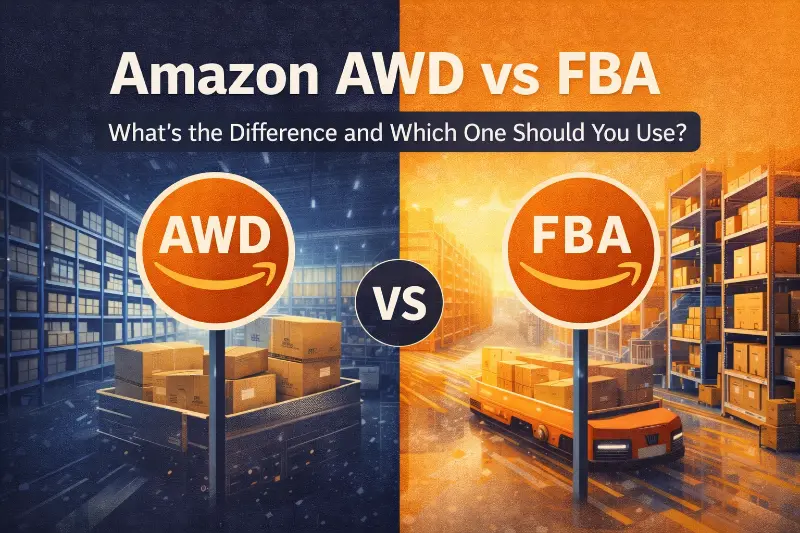
Amazon AWD vs FBA: What’s the Difference and Which One Should You Use?

Last updated on January 30, 2026
In this article
 23 minutes
- Introduction to Amazon Services
- AWD provides low-cost bulk storage with automatic FBA replenishment
- FBA delivers end-to-end fulfillment with Prime badge access
- The fundamental distinction determines when each service applies
- The combined AWD-FBA workflow creates a scalable inventory system
- Decision criteria depend on inventory velocity, volume, and risk tolerance
- Operational realities require contingency planning for AWD delays
- Practical implementation requires testing and backup plans
- Strategic recommendations from experienced sellers emphasize redundancy
- Frequently Asked Questions
Amazon Warehousing and Distribution (AWD) and Fulfillment by Amazon (FBA) serve fundamentally different purposes, and using them correctly can slash storage costs by up to 80% during peak season while eliminating capacity constraints. AWD launched in September 2022 as an upstream bulk storage solution that feeds inventory into FBA, not as a replacement for it. The critical insight most sellers miss: AWD cannot ship directly to customers, making it purely a warehouse solution while FBA handles the actual fulfillment to Prime customers. Both services operate within the Amazon fulfillment network, which manages the placement and movement of inventory across Amazon’s fulfillment centers to optimize delivery speed and reduce fees. This guide provides operations leaders with the complete framework for deciding when to use each service or both together.
The strategic question isn’t AWD versus FBA, but rather how to orchestrate them as complementary systems. High-volume sellers storing $250,000 in inventory report paying just $80/month in AWD storage fees, compared to thousands in FBA storage. However, seller feedback reveals a critical caveat: AWD auto-replenishment can take 20-30+ days during peak seasons instead of the stated 10-14 days, leading some sellers to experience stockouts despite having abundant inventory sitting in AWD warehouses.
Introduction to Amazon Services
Amazon provides a robust suite of services designed to help sellers manage inventory and fulfill customer orders efficiently. Two of the most important solutions in Amazon’s ecosystem are Amazon Warehousing and Distribution (AWD) and Fulfillment by Amazon (FBA). Each service addresses different needs within the supply chain, and understanding their unique roles is essential for optimizing inventory management, controlling storage costs, and maximizing customer satisfaction.
Amazon AWD is tailored for bulk storage and distribution, allowing sellers to store large quantities of inventory in Amazon’s dedicated warehousing and distribution network. This service is ideal for managing bulk inventory, especially for products with longer storage duration or seasonal demand. AWD stores inventory in a dedicated storage space at lower storage fees compared to FBA, making it a cost-effective solution for long-term storage and managing overflow inventory. One of AWD’s standout features is its ability to automatically replenish FBA fulfillment centers, ensuring inventory levels remain healthy and reducing the risk of stockouts. Additionally, AWD supports multi-channel distribution, enabling sellers to use the same inventory pool for Amazon orders and other sales channels, streamlining the supply chain and improving overall inventory management.
In contrast, FBA is a more comprehensive fulfillment service that goes beyond storage. FBA handles the entire fulfillment process, including picking, packing, shipping, customer service, and returns. By leveraging Amazon’s extensive fulfillment center network, sellers can offer fast, reliable shipping and access the Prime badge, which is a major driver of sales on Amazon’s marketplace. FBA is a comprehensive fulfillment solution that is particularly well-suited for sellers who prioritize customer experience and want to benefit from Amazon’s trusted brand and logistics expertise. However, FBA storage fees are typically higher than AWD, especially during peak seasons, and sellers may incur additional costs such as inbound placement fees, fulfillment fees, and aged inventory surcharges.
When evaluating AWD vs FBA, sellers should consider their inventory management needs, sales volume, and fulfillment goals. AWD is best for storing large quantities of inventory at lower storage costs, managing long-term or seasonal stock, and supporting multiple distribution channels. FBA, on the other hand, is ideal for sellers seeking a more comprehensive fulfillment solution that includes fast shipping, customer service, and seamless integration with Amazon’s marketplace. The choice between AWD and FBA often comes down to balancing storage fees, fulfillment fees, and the need for a scalable, reliable distribution solution.
Both AWD and FBA have distinct pricing models. AWD charges storage fees based on the cubic footage of inventory stored, with additional transportation fees for moving inventory from AWD warehouses to FBA fulfillment centers. This model is particularly advantageous for managing bulk inventory and reducing overall storage costs. FBA, meanwhile, calculates storage fees based on product size and weight, and adds fulfillment fees for each order processed, as well as potential surcharges for aged inventory or low inventory levels.
Ultimately, Amazon’s warehousing and distribution services offer sellers flexible options for storing and shipping inventory. By understanding the differences between AWD and FBA, and considering factors like storage space, inventory pool management, and total storage costs, sellers can develop a fulfillment strategy that supports business growth and customer satisfaction. Whether you need to store large quantities of inventory for long-term distribution or require a more comprehensive fulfillment solution for fast-moving products, Amazon AWD and FBA provide the tools to succeed in today’s competitive e-commerce landscape.
AWD provides low-cost bulk storage with automatic FBA replenishment
Amazon Warehousing and Distribution operates as a third-party logistics solution offering bulk inventory storage at significantly lower costs than FBA. Launched at Amazon Accelerate in September 2022, AWD emerged from Amazon’s excess warehouse capacity built during the pandemic ecommerce boom. VP Gopal Pillai identified three pain points AWD addresses: high storage prices, complicated fee structures, and insufficient storage capacity.
The service works through a straightforward flow: sellers ship bulk inventory to AWD distribution centers (using LTL or truckload shipments only, no small parcel), Amazon stores and manages the inventory, then automatically or manually transfers stock to FBA fulfillment centers when inventory runs low. AWD facilities, also referred to as AWD warehouses, are optimized for bulk storage while FBA centers are optimized for picking, packing, and fast delivery. AWD provides dedicated storage space in Amazon’s fulfillment centers for sellers’ inventory. Crucially, inventory cannot move backward from FBA to AWD.
AWD’s pricing structure offers substantial savings over FBA storage. AWD offers significantly lower storage fees compared to FBA, especially for long-term storage, and AWD offers cheaper storage options for sellers managing bulk or seasonal inventory. The base storage rate is $0.48 per cubic foot monthly, with a Smart Storage Rate of $0.43 for sellers maintaining 70%+ auto-replenishment ratios, and an Amazon Managed Rate of $0.38 for those using Amazon Global Logistics or Partnered Carrier Program. However, significant changes effective October 2025 introduce peak season fees of $2.40 per cubic foot for Q4 and non-peak rates of $0.78, a departure from AWD’s original “no seasonal surcharges” value proposition.
When considering AWD cost, it is influenced by storage fees, fulfillment fees, and additional surcharges. AWD’s pricing model is designed to provide cheaper storage for long-term inventory.
Processing fees run $1.35 per box as an inbound processing fee for both inbound and outbound handling, while transportation from AWD to FBA costs $1.15 per cubic foot at base rates or $1.04 with managed service discounts. AWD charges transportation fees to cover the cost of moving inventory from an AWD warehouse to Amazon’s fulfillment network. A key benefit: AWD pricing includes FBA inbound placement fees, eliminating the $0.16-$3.32 per unit charges sellers face when shipping directly to FBA with minimal location splits. AWD can help sellers avoid high peak season surcharges and inbound placement fees while reducing bulk storage costs.
Eligibility requires an active Amazon seller account in good standing, with most retail categories supported including apparel, electronics, beauty, and home goods. Recent additions in 2024-2025 expanded coverage to shoes, expiration-dated products, and non-sort conveyable items. Ineligible products include Amazon devices, hazmat items, meltable products, refrigerated goods, and lithium-ion batteries. Size limits cap individual SKUs at 18” × 14” × 8” and under 20 pounds per carton.
AWD imposes no capacity limits, a stark contrast to FBA’s storage restrictions. AWD does not have seasonal surcharges, which can lead to lower overall storage costs compared to FBA during high-demand periods. Combined with the auto-replenishment system that bypasses FBA capacity limits, this creates a powerful solution for sellers constantly battling restock limits.
Using AWD for storing inventory offers several advantages, such as eliminating peak season storage fees and additional surcharges associated with traditional FBA storage, thereby reducing overall storage costs and avoiding surprise expenses.
Slash Your Fulfillment Costs by Up to 30%
Cut shipping expenses by 30% and boost profit with Cahoot's AI-optimized fulfillment services and modern tech —no overheads and no humans required!
I'm Interested in Saving Time and MoneyFBA delivers end-to-end fulfillment with Prime badge access
Fulfillment by Amazon remains the cornerstone of Amazon seller logistics, providing complete end-to-end fulfillment: storage, picking, packing, shipping, customer service, and returns handling. FBA warehouses handle the customer-facing logistics such as picking, packing, and shipping, ensuring a seamless experience for both sellers and buyers. The service automatically qualifies products for Prime, accessing over 200 million Prime members who actively filter for Prime-eligible products. FBA also offers options for branded packaging as part of its comprehensive fulfillment service, allowing sellers to enhance brand visibility and customer experience with custom packaging, labeling, and inserts.
Current FBA fulfillment fees for non-apparel standard-size items range from $3.06 for small items under 2 ounces to $6.27 plus $0.16 per half-pound for items over 3 pounds. Apparel commands higher fees, typically $0.30-$1.00 more per tier. Large bulky items start around $9.73 plus $0.42 per pound, while extra-large items exceeding 150 pounds hit $158.49 base plus $0.83 per pound.
Monthly storage fees for standard-size products are $0.78 per cubic foot during January-September and surge to $2.40 per cubic foot during the October-December peak season, reflecting the impact of high demand periods. Oversized products pay $0.56 off-peak and $1.40 peak. The aged inventory surcharge compounds costs for slow-moving stock: $1.50 per cubic foot at 181-270 days, $3.80 at 271-365 days, and $6.90 per unit or $0.15 per unit monthly (whichever is greater) beyond 365 days.
FBA fees are part of a different fee structure compared to AWD, with FBA typically having cheaper base fulfillment fees but including hidden costs like low-inventory-level fees and peak season surcharges. The low-inventory-level fee, introduced April 2024, penalizes sellers when historical days of supply drops below 28 days, with charges ranging from $0.32 to $2.09 per unit based on size tier and shortage severity. This fee targets standard-size items and reflects Amazon’s push for consistent inventory availability.
FBA capacity limits are now measured in cubic feet and calculated as approximately 5 months of forecasted sales (reduced from 6 months in mid-2025). The Inventory Performance Index (IPI) threshold stands at 400 minimum, with sellers below this level facing immediate storage restrictions and potential surcharges up to $10 per cubic foot. IPI updates weekly based on rolling 3-month performance data, evaluating excess inventory, sell-through rate, stranded inventory, and in-stock rate.
Multi-Channel Fulfillment (MCF) extends FBA capabilities to non-Amazon sales channels including Shopify, eBay, TikTok Shop, and proprietary websites. MCF fees run 30-50% higher than standard FBA rates since Prime shipping subsidies don’t apply. A 3.5% fee increase took effect January 15, 2025, and multi-unit discounts can reduce per-unit fees by up to 50%.
FBA provides a more comprehensive fulfillment service, including picking, packing, and shipping, which can be beneficial for sellers with fast sell-through rates. FBA is suitable for items with high sales velocity requiring fast, Prime-eligible shipping, and FBA products are eligible for Prime’s fast shipping, which is critical for winning the Buy Box and customer trust.
The fundamental distinction determines when each service applies
The central difference between AWD and FBA lies in their supply chain positions: AWD is upstream bulk storage while FBA is downstream customer fulfillment. AWD cannot pick, pack, or ship to end customers—these services, including customer service, are provided by FBA. It exclusively moves inventory to FBA fulfillment centers or bulk distribution channels like Walmart Fulfillment Services, third-party warehouses, or retail partners. AWD also supports multi-channel distribution, allowing sellers to use their inventory for both Amazon and non-Amazon orders.
When customers order a product, that order can only be fulfilled from FBA inventory, never directly from AWD. Products stored in AWD are considered “in stock and buyable” when automatic replenishment is enabled, leveraging Amazon’s demand forecasting to restock FBA when stock levels are low and help prevent stockouts. However, the actual Prime-eligible fast shipping only occurs once inventory physically reaches FBA. Some sellers report AWD-only inventory showing 40+ day delivery windows to customers.
Storage cost differentials are substantial. AWD’s pricing model is based on cubic feet of storage, while FBA’s pricing is based on item count and size. During off-peak months, AWD saves approximately 38% compared to FBA standard storage ($0.48 versus $0.78 per cubic foot). During Q4 peak season, savings historically reached 80% ($0.48 versus $2.40), though the October 2025 fee changes narrow this advantage. One seller documented paying $61.56 in AWD storage versus $217.84 in FBA storage for comparable volume. AWD generally has higher per-unit fulfillment fees than FBA, which can be disadvantageous for sellers with high-volume, low-value products.
Control and visibility differ significantly between platforms. FBA provides full real-time visibility of inventory levels per SKU, detailed order tracking, and comprehensive reporting on sales velocity. AWD’s dashboard shows inventory in bulk with less granular tracking, but Amazon’s advanced warehouse management system tracks inventory levels in real-time for AWD users. Inventory effectively “goes invisible” during AWD-to-FBA transit, complicating demand planning for fast-moving products.
Transfer speed represents AWD’s most significant operational risk. Amazon states 2-4 days for AWD receiving and 10-14 days for AWD-to-FBA replenishment. Real seller experiences paint a different picture: optimal conditions see 3-8 days, but peak season reports document 20-30+ days or even longer. Third-party inventory software recommends using 20-day inbound lead time as worst-case planning. The auto-replenishment algorithm runs only three times weekly, creating potential timing gaps.
AWD is particularly beneficial for sellers with large inventory volumes or slow-moving products.
Looking for a New 3PL? Start with this Free RFP Template
Cut weeks off your selection process. Avoid pitfalls. Get the only 3PL RFP checklist built for ecommerce brands, absolutely free.
Get My Free 3PL RFPThe combined AWD-FBA workflow creates a scalable inventory system
The optimal approach for many high-volume sellers combines Amazon Warehousing Distribution (AWD) and FBA in an upstream-downstream relationship. The flow moves from supplier or manufacturer to AWD bulk storage, then to FBA fulfillment centers, and finally to customers. Think of AWD as a staging warehouse and FBA as the shipping hub. Combining AWD and FBA is a common strategy to maintain low storage fees while ensuring consistent, fast fulfillment.
Auto-replenishment mechanics work through Amazon’s proprietary data-science model that monitors FBA inventory levels continuously. When available FBA inventory plus in-transit inventory falls below the calculated optimal supply level, the system triggers replenishment. Sellers can choose full automation (Amazon decides quantities), automation with limits (seller-set min/max FBA thresholds), or manual replenishment only. Sellers can also use the Amazon Managed Service for auto-replenishment, which helps avoid certain storage surcharges and fees, such as the aged inventory surcharge and low-level inventory fee.
Achieving a 70% auto-replenishment ratio (ARR) over 90 days unlocks significant benefits: aged inventory surcharges for 181-365 day inventory are waived, low-inventory-level fees can be avoided, overage fees may be waived, and most importantly, AWD auto-replenishment bypasses FBA capacity limits entirely. Sellers also qualify for the Smart Storage Rate (10% discount) and, effective April 2025, the first 90 days automatically qualify for this rate.
Real-world applications demonstrate the strategy’s power. Q4 preparation becomes dramatically cheaper by storing bulk holiday inventory in AWD during off-peak months, avoiding FBA’s October-December storage surcharges, and letting auto-replenishment feed FBA as demand increases. For sellers facing FBA restock limits, keeping overflow in AWD (which doesn’t count against FBA storage limits) provides an overflow valve. International sellers routing containers through AWD via Amazon Global Logistics report 25% savings on cross-border transportation combined with lower storage rates.
Coordinating inventory between systems requires careful planning. Best practices include tracking in-transit inventory separately (it’s not in AWD or FBA during transfer), setting restock points with buffers (if selling 20 units daily and transfer takes 14 days, set FBA minimum at 280+ units), using inventory management software integrating both systems, and planning 3-4 weeks ahead for seasonal demand spikes. Sellers can send inventory from AWD to FBA as needed to optimize costs and logistics.
Decision criteria depend on inventory velocity, volume, and risk tolerance
AWD makes the most sense for specific seller profiles and inventory characteristics. High-volume sellers shipping thousands of units benefit from bulk storage economics. Products with 60+ days expected sell-through maximize AWD’s flat-rate advantage. AWD is more suitable for sellers with long-term storage needs and those who manage large quantities of inventory. Seasonal businesses storing holiday inventory year-round avoid FBA’s Q4 surcharges, and AWD is a cost-effective option for managing seasonal inventory due to its cheaper storage and predictable costs. International importers leveraging Amazon Global Logistics plus AWD capture compounding savings. One seller reported storing enough inventory to cover $250,000 in gross revenue for just $80 monthly in storage fees. Many sellers are considering or adopting AWD, with mixed feedback from the seller community about its pros and cons.
FBA alone suffices when products sell within 30-60 days, when sellers need custom packaging, labeling, or Amazon Custom product personalization (unavailable through AWD), when same-day or expedited Prime fulfillment is essential, or when products require FBA prep work like poly-bagging or bundling. Fast-turnover SKUs that don’t justify AWD-to-FBA transfer time perform better with direct FBA placement.
The hybrid AWD-FBA strategy suits high-volume products where bulk storage in AWD drip-feeds into FBA, Q4 preparation scenarios avoiding storage surcharges, international imports routing through AWD first, and mixed-velocity catalogs where fast movers go direct to FBA while slow movers flow through AWD.
Neither service is optimal when sellers need custom packaging, branded unboxing, or kitting services; when products have expiration dates (AWD doesn’t support them); when predictable, guaranteed SLAs are essential (AWD delays are common); or when heavy multi-channel selling requires fulfillment flexibility beyond Amazon’s ecosystem. Third-party 3PLs like ShipBob, MyFBAPrep, or Red Stag serve brands needing capabilities AWD and FBA don’t provide.
Operational realities require contingency planning for AWD delays
Stockout risks differ substantially between approaches. AWD-FBA combinations carry significant risk during peak seasons when replenishment can stretch to weeks or months. The auto-replenishment system doesn’t always trigger reliably, and AWD warehouses regularly run out of capacity and refuse shipments. Sellers report receiving messages stating capacity isn’t available and to try again in 7 days. FBA-only approaches face capacity limits and higher storage costs for safety stock but offer greater inventory control and visibility.
One experienced seller’s stark warning captures the risk: “Go to another 3PL service if you are running into FBA limits. Do not use AWD, don’t risk it. You could lose your entire business just to save a couple bucks.” Another documented having “half of our inventory stuck in ‘receiving’ for several weeks without any indication of when it may be located,” with Amazon indicating it could take 180 days before inventory might be found.
Cash flow impacts favor AWD for lower storage costs keeping more capital available for inventory purchases, predictable monthly costs without seasonal surcharges, and reduced overall warehousing expenses. However, capital tied up in slow-moving inventory stuck in AWD delays creates risk, and additional processing fees ($1.35 per box inbound plus $1.35 outbound) plus transportation fees ($1.04-$1.15 per cubic foot) add to costs.
Forecasting requirements intensify with AWD. Plan for 4-8 weeks minimum from AWD receipt to FBA availability. Demand forecasting must extend 60-90 days ahead. Critically, as one seller noted, “Amazon’s algorithms do not understand seasonal products,” manual intervention becomes necessary, eliminating the promised convenience and discounts.
Account health benefits from AWD include avoiding low-inventory-level fees with auto-replenishment, maintaining consistent Prime-ready status, and exemption from aged inventory surcharges when auto-replenishing 70%+ of units. Potential negatives include stockouts during peak season tanking Best Seller Rank, lost Buy Box time when inventory is stuck in transfer, and IPI score impacts from fluctuating FBA inventory.
Scale Faster with the World’s First Peer-to-Peer Fulfillment Network
Tap into a nationwide network of high-performance partner warehouses — expand capacity, cut shipping costs, and reach customers 1–2 days faster.
Explore Fulfillment NetworkPractical implementation requires testing and backup plans
Enrolling in AWD involves logging into Seller Central, navigating to Growth, Explore Programs, Warehousing and Distribution, and clicking Enroll. After reviewing product eligibility and preparing inventory with proper barcodes and secure packaging, create shipments in the AWD portal and ship using Amazon labels via LTL or truckload carriers. Post-enrollment, set auto-replenishment thresholds per SKU, configure replenishment ratios targeting 70%+ for Smart Storage rates, and monitor the AWD inventory dashboard. Sellers using AWD can distribute their inventory across multiple sales channels, not just Amazon, which allows them to reach different customer bases and supports a multi-channel sales strategy.
Managing inventory across both services requires daily monitoring of FBA stock levels during Q4, conservative replenishment thresholds higher than the default 44 units, tracking of AWD-to-FBA transfer times to calibrate forecasting, and maintaining a 3PL backup for emergency replenishment. The default 44-unit threshold triggers replenishment when FBA stock hits that level. Sellers with higher velocity products should increase this substantially.
Common mistakes include using AWD solely to avoid FBA placement fees when AWD is designed for bulk storage of thousands of units, trusting auto-replenishment during peak season when delays are common, not planning for capacity constraints when AWD regularly refuses shipments, sending seasonal products without manual intervention since Amazon’s algorithms don’t understand seasonality, and underestimating transfer times by planning for days rather than weeks. AWD reviews are largely negative, with many users complaining about replenishment delays and missing items affecting their business.
Cost calculations should compare total landed costs. For a standard-size item in Q4, direct FBA might cost $0.78 per cubic foot for three months plus $2.40 for one month ($4.74 total) plus inbound placement fees of approximately $0.50 per unit. The AWD-FBA hybrid for the same period costs $0.48 per cubic foot for four months ($1.92) plus $2.70 per box processing plus $1.15 per cubic foot transportation, with inbound placement fees waived. AWD wins for slow-moving inventory over 60 days; FBA wins for fast-moving inventory under 30 days.
Strategic recommendations from experienced sellers emphasize redundancy
Expert consensus favors a hybrid strategy with contingencies. One consultant advises: “Use AWD for lower-cost backend storage and smoother replenishment, and let FBA handle fast delivery and customer-facing fulfillment. Together, they create a smart, scalable solution.” Another recommends thinking of “AWD as overflow storage, not the backbone of your supply chain” and keeping “at least two inbound pathways open: AWD and either a 3PL or direct-to-FBA shipments.”
Testing before committing is essential. Run test shipments in off-peak weeks to understand how Amazon treats your account before Q4 hits. International sellers should leverage Amazon Global Logistics plus AWD for compounding savings on cross-border transportation and storage. Some successful sellers accept higher FBA storage costs for reliability: “I’m fine with spending $10,000 a month in storage. It is what it is. At least it’s checked in and it’s there.”
Success stories demonstrate AWD’s potential: one international seller shipped a pallet from China for $250 through AGL handling tariffs, with two-month total time from pickup to inventory logged and just $50 monthly storage thereafter. Failure cases reveal the risks: seasonal products received to one location “too late to get them to FBA” forced expensive returns, and capacity redirections sent pallets from Maryland to Texas at thousands of dollars in additional cost.
Frequently Asked Questions
What is Amazon AWD and how does it work?
Amazon Warehousing and Distribution (AWD) is a bulk storage service launched in September 2022 that stores large quantities of inventory at low costs and automatically replenishes FBA fulfillment centers. AWD charges $0.48-$0.78 per cubic foot monthly (depending on season and replenishment ratio) compared to FBA’s $0.78-$2.40 rates. Sellers ship inventory via LTL or truckload to AWD facilities, and Amazon’s system automatically transfers products to FBA when stock runs low. AWD cannot ship directly to customers and requires FBA for actual order fulfillment.
What is the main difference between AWD and FBA?
AWD is upstream bulk storage while FBA is downstream customer fulfillment. AWD stores inventory in large quantities at lower costs but cannot pick, pack, or ship to customers. FBA handles actual order fulfillment, customer service, returns, and provides Prime eligibility. When a customer orders a product, it must be fulfilled from FBA inventory, never directly from AWD. Think of AWD as a staging warehouse feeding inventory into FBA fulfillment centers.
How long does AWD to FBA replenishment take?
Amazon states 10-14 days for AWD-to-FBA transfers, but real seller experiences vary significantly. Optimal conditions see 3-8 days, while peak season (Q4) transfers commonly take 20-30+ days or longer. The auto-replenishment algorithm only runs three times weekly, creating potential timing gaps. Third-party inventory management software recommends planning for 20-day inbound lead times as worst-case scenarios. Sellers must plan 4-8 weeks minimum from AWD receipt to FBA availability to avoid stockouts.
When should I use AWD versus FBA alone?
Use AWD for high-volume inventory with 60+ days expected sell-through, seasonal products stored during off-peak months to avoid Q4 FBA surcharges, international imports via Amazon Global Logistics, and overflow inventory when hitting FBA capacity limits. Use FBA alone for products selling within 30-60 days, items requiring custom packaging or prep work unavailable through AWD, fast-turnover SKUs where transfer delays create stockout risk, and when predictable SLAs are essential. Most high-volume sellers benefit from a hybrid approach combining both services.
What are the costs of using AWD versus FBA?
AWD storage costs $0.48-$0.78 per cubic foot monthly (base to peak season) versus FBA’s $0.78-$2.40. AWD charges $1.35 per box for inbound and outbound processing plus $1.04-$1.15 per cubic foot for AWD-to-FBA transportation, but waives FBA inbound placement fees ($0.16-$3.32 per unit). FBA charges fulfillment fees ranging from $3.06 to $6.27+ per unit plus aged inventory surcharges ($1.50-$6.90 per cubic foot) and low-inventory-level fees ($0.32-$2.09 per unit). AWD offers 38-80% storage cost savings for slow-moving inventory but adds processing and transportation fees.
What are the risks of using AWD?
Major risks include unpredictable transfer delays (20-30+ days during peak season versus stated 10-14 days), capacity constraints where AWD refuses shipments and tells sellers to try again in 7 days, inventory going invisible during AWD-to-FBA transit complicating demand planning, auto-replenishment algorithms that don’t trigger reliably or understand seasonal products, and potential stockouts despite having abundant inventory stuck in AWD warehouses. Experienced sellers recommend maintaining 3PL backup options and never relying solely on AWD as the backbone of supply chain operations.
Written By:

Indy Pereira
Indy Pereira helps ecommerce brands optimize their shipping and fulfillment with Cahoot’s technology. With a background in both sales and people operations, she bridges customer needs with strategic solutions that drive growth. Indy works closely with merchants every day and brings real-world insight into what makes logistics efficient and scalable.

Turn Returns Into New Revenue

Related Articles

SLA Meaning in Logistics: What Service Level Agreements Actually Guarantee (and What They Don’t)
The gap between what 3PL providers promise in SLA marketing (“99.
Inventory Turnover Ratio: What It Is, How to Calculate It, and How Ecommerce Brands Improve It
Inventory turnover ratio (also called stock turnover) measures how many times a company sells and replaces its inventory during an accounting period.
FIFO Inventory Explained: What It Means for Ecommerce, Warehousing, and Profitability
FIFO (First In, First Out) is the dominant inventory method for ecommerce brands for good reason: it prevents obsolescence, aligns with international accounting standards, and deli...