
Amazon AWD Size Limits Changed: What Bulky Sellers Must Do Before Q4 2026

Last updated on September 02, 2026
In this article
 15 minutes
- The Sellable Unit Is Tested, Not the Master Carton
- Existing AWD Stock Is a Finite Transition Buffer
- Q4 Deadlines Make the Change Immediate
- Sellers Lose More Than Low-Cost Storage
- The Cost Exposure Depends on SKU Volume and Weight
- Route Each Affected SKU Instead of Moving the Whole Catalog
- Audit the Catalog Before the Next Purchase Order
- How Cahoot Helps Rebuild the Buffer Without More Operational Sprawl
- Frequently Asked Questions
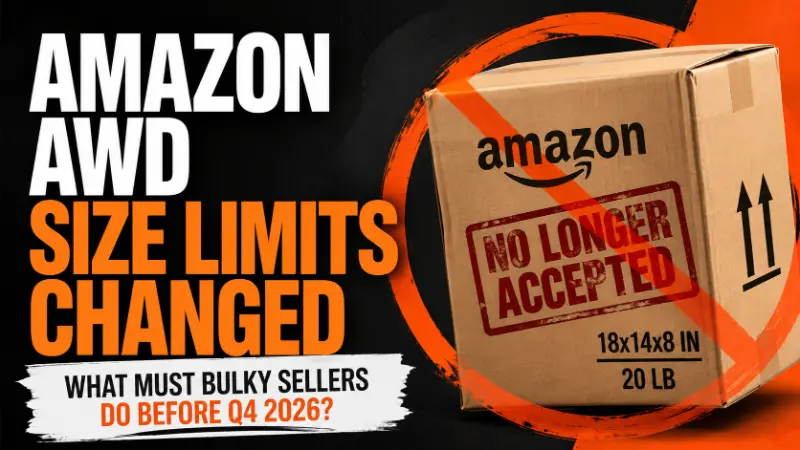
Beginning July 31, 2026, Amazon AWD stopped accepting new sortable sellable units at or above 18x14x8 inches or 20 lb, so any unit that meets or exceeds those thresholds is no longer eligible for AWD inbound shipments. For Amazon sellers who used Amazon Warehousing and Distribution as low-cost, upstream storage for bulky, seasonal, or slow-moving inventory, that cuts off AWD as an inbound route for every Small Bulky, Large Bulky, and Extra-Large FBA unit and forces a fulfillment-plan change before peak season.
This is not a pricing adjustment, it is a category change: AWD becomes a small-item program, and bulky SKUs must be re-routed through direct FBA, an external buffer, a third-party logistics provider, or another strategy before Q4 2026 volume arrives. Below, we break down the new Amazon AWD size and weight limits, what they do to bulky-inventory fulfillment, the cost and routing tradeoffs, the deadlines that matter, and how Cahoot can help sellers avoid shipment disruptions, higher costs, and lost sales. The first step is mechanical: pull packaged dimensions and weight for every affected ASIN and check them against the new gate before the next AWD shipment.
The Sellable Unit Is Tested, Not the Master Carton
Amazon validates ASIN eligibility during shipment creation, and the test applies to the individual sellable unit, including retail packaging, not the master carton it ships in. A shipping carton holding several compliant units can pass its own carton limits while units inside pass or fail independently. Confusing the two is the most common way sellers misjudge AWD eligibility.
The threshold is strict. A unit measuring exactly 18, 14, or 8 inches on any side, or weighing exactly 20 lb, does not qualify, since Amazon’s published limits read “smaller than” and “less than,” not “at or below.” The envelope: 18 x 14 x 8 inches equals 2,016 cubic inches, about 1.17 cubic feet, and true eligible volume runs slightly under that once the strict inequality applies.
Exhibit 1: Eligibility examples
| Unit dimensions and weight | Result | Reason |
| 17 x 13 x 7 in, 19 lb | Passes | Under all four thresholds |
| 10 x 10 x 10 in, 5 lb | Fails | Third dimension exceeds 8 inches |
| 19 x 8 x 6 in, 8 lb | Fails | Longest side exceeds 18 inches |
| 17 x 13 x 7 in, exactly 20 lb | Fails | Amazon requires less than 20 lb |
| 17 x 13 x 7 in unit in a compliant 25-inch master carton | Unit may pass; carton may separately pass | Unit and carton are tested independently |
AWD master cartons carry a separate shipment rule: no side over 25 inches and no more than 50 lb, even though Amazon has expanded the maximum FBA box length to 36 inches for certain FBA shipments. A carton can satisfy that rule while holding units that individually fail the sellable-unit gate, and the reverse is also true. Seller Central measurement and eligibility results control, so a spec sheets dimension is a starting point, not a final answer.
AWD has also always carried category restrictions independent of size: hazmat items are not eligible for AWD storage, and dangerous goods, battery products, non-spillable batteries, wax-based products, and expiration-dated items face added documentation. Those rules did not change on July 31, but they are strictly enforced and compound the size gate for sellers with regulated SKUs.
Existing AWD Stock Is a Finite Transition Buffer
Non-sortable units already stored in AWD before the July 31 cutoff are not automatically pulled from the facility. Amazon has indicated existing affected inventory can remain as a finite transition buffer and continue replenishing FBA under its announced treatment, with affected units referring to units no longer eligible to be newly supplied through AWD after the cutoff. That is a bridge, not a new allowance: it does not permit new receipts of over-threshold units, and it does not guarantee indefinite storage.
Sellers should verify current status for every affected ASIN in Seller Central rather than assume last quarter’s shipment record still applies. Confirm current awd inventory levels in Seller Central, how they reconcile against what remains in the facility, how it is being drawn down, and whether Amazon has flagged a wind-down timeline. Also separate awd inventory from inbound shipments so you know what stock is still available versus only on the way. Treat this buffer as inventory moving through a transition period, not permanent fulfillment capacity.
Q4 Deadlines Make the Change Immediate
The size-limit change lands inside peak planning. Amazon’s 2026 arrival cutoffs for Prime Big Deal Days are September 2 for AWD, September 9 for FBA minimal-split shipments, and September 16 for FBA optimized-split shipments. For Black Friday and Cyber Monday, the cutoffs are October 14, 21, and 28 respectively. Amazon states shipments arriving later are not guaranteed to be processed in time. These cutoffs sit inside Amazon’s broader 2026 holiday fulfillment fee changes, which reach well beyond AWD-excluded SKUs, and they raise the stakes on having ecommerce fulfillment software that can dynamically reroute inventory as deadlines shift.
Because affected bulky units have already lost the AWD route, sellers now work backward from the FBA cutoffs. Amazon recommends delivery appointments at least seven days before the cutoff and Partnered Carrier pickups at least 14 days before.
Exhibit 4: Cahoot back-plan using Amazon’s minimum seven-/14-day guidance
| Direct-FBA route | Cutoff | Appointment | Partnered pickup |
| PBBD, minimal split | Sep. 9 | Sep. 2 | Aug. 26 |
| PBBD, optimized split | Sep. 16 | Sep. 9 | Sep. 2 |
| BFCM, minimal split | Oct. 21 | Oct. 14 | Oct. 7 |
| BFCM, optimized split | Oct. 28 | Oct. 21 | Oct. 14 |
As of publication, the August 26 pickup window for the PBBD minimal-split route has already passed, and the September 2 appointment date for that route is imminent. Sellers still planning PBBD inventory should move to the optimized-split lane or confirm an alternate route can land before September 9. Longer transit lanes may need earlier booking, so treat the 7-/14-day figures as a floor, not a target.
Sellers Lose More Than Low-Cost Storage
The practical mistake is treating this as a storage price story. AWD combined functions that bulky sellers now have to replace individually: bulk pallet storage away from fulfillment centers, auto replenishment into FBA based on demand as stock sells or manual replenishment on the seller’s schedule, included FBA inbound placement rather than a separately billed fee, and peak-capacity relief during the weeks FBA capacity is tightest.
Amazon has reported that sellers enrolled in AWD in Q4 2025 shipped more than 13% more units and saw a greater than 30% reduction in out-of-stock days. Amazon reported both figures; they describe outcomes for AWD participants broadly, not a guarantee tied to any seller or replacement route, and should not be read as independent research or a promise that an alternative reproduces the same result. They do illustrate AWD’s operational role: fewer stockouts and higher sell-through during the year’s busiest stretch.
Losing that buffer means a seller now owns the sequencing Amazon used to manage: how much bulk stock to hold, where it should sit relative to customer demand, and how often to replenish FBA as part of a broader fulfillment strategy that avoids disruption across channels. That routing logic once leaned in part on Amazon’s network, so sellers now have to replicate more of it themselves while capacity limits at fulfillment centers tighten heading into peak. Sellers who want the fuller mechanics of how AWD storage, replenishment, and placement fit together can start with Cahoot’s Amazon AWD guide.
The Cost Exposure Depends on SKU Volume and Weight
Two cost categories change for bulky SKUs pushed out of AWD: storage, including the awd storage fees sellers give up when those units can no longer sit there, and, for units routed through Send to Amazon’s minimal-split option, placement fees.
Exhibit 2: Cahoot calculation using Amazon-published storage rates
AWD storage runs $0.48 per cubic foot monthly in the East Coast, Southeast, and South Central regions, and $0.57 in the West. FBA oversize storage runs $0.78 monthly from January through September, and $2.43 from October through December, about 3.1 times the off-peak rate.
| Q4 volume | AWD storage (3 months) | FBA oversize storage (3 months) | Difference |
| 100 cu. ft. | $144-$171 | $729 | $558-$585 |
| 500 cu. ft. | $720-$855 | $3,645 | $2,790-$2,925 |
| 1,000 cu. ft. | $1,440-$1,710 | $7,290 | $5,580-$5,850 |
This table isolates storage only. It excludes inbound freight, AWD processing and transportation, FBA fulfillment fees, placement fees, aged-inventory charges, capacity fees, and 3PL receiving and handling. It is not a total-cost or total-savings figure, only one input into a routing decision.
Exhibit 3: Cahoot calculation using Amazon-published per-unit placement ranges
For Small Bulky inventory sent through Amazon’s minimal-split option, Amazon publishes a per-unit placement fee range by weight tier. These are placement fees only, before freight, storage, and fulfillment.
| Weight | Per unit | 1,000 units | 5,000 units |
| 5 lb or less | $1.10-$1.60 | $1,100-$1,600 | $5,500-$8,000 |
| Over 5-12 lb | $1.75-$2.40 | $1,750-$2,400 | $8,750-$12,000 |
| Over 12-28 lb | $2.74-$3.50 | $2,740-$3,500 | $13,700-$17,500 |
| Over 28-42 lb | $3.95-$4.95 | $3,950-$4,950 | $19,750-$24,750 |
| Over 42-50 lb | $4.80-$5.95 | $4,800-$5,950 | $24,000-$29,750 |
Optimized splits can carry no placement fee at all, but typically require more destinations and different freight economics. Direct FBA is not always the cheapest path, and FBM can be cheaper for slow-moving oversized SKUs. The quote generated at shipment creation controls the actual fee; these ranges are for planning, not invoicing. That matters even more in Q4, when tight warehouse space can change storage economics. Those tradeoffs often determine how oversize inventory gets routed.
Route Each Affected SKU Instead of Moving the Whole Catalog
The instinct to move every affected SKU to a third-party warehouse is understandable and usually wrong. The right response is a SKU-by-SKU decision built on velocity, variability, dimensions, margin, and channel demand.
Fast, predictable bulky SKUs
Stable sell-through and margin to absorb oversize storage and placement fees can keep these SKUs on direct FBA, particularly if Q4 volume keeps the exposure in Exhibit 2 and Exhibit 3 manageable and your fba shipments plan also accounts for box weight compliance. Cahoot’s Amazon AWD vs. FBA comparison walks through that trade-off in more detail.
Seasonal, volatile, or long-lead-time SKUs
These are the ones AWD was built for. They generally fit better in an external buffer, such as a third-party warehouse, with measured FBA replenishment timed to demand rather than a fixed schedule; that setup can also support other sales channels as part of a multi channel distribution approach, with multiple units flowing into standard replenishment batches to avoid stranded inventory and Q4 storage-fee spikes, especially when paired with specialized order fulfillment services for ecommerce companies. Cahoot’s Amazon FBA vs. 3PL cost breakdown covers that comparison in more depth.
FBM or Seller Fulfilled Prime
This route fits only when parcel economics, coverage, margins, and operating standards support it. SFP is not generic two-day shipping; it requires meeting Amazon’s updated Seller Fulfilled Prime requirements and is not the answer for every bulky SKU just because AWD no longer is. Cahoot’s Amazon FBA vs. FBM comparison covers the operational trade-offs, and sellers evaluating SFP further can review Cahoot’s Amazon Seller Fulfilled Prime guide for program requirements and the current Seller Fulfilled Prime 3PL shortlist for vetted partners.
Packaging redesign for borderline SKUs
A unit at 19 x 8 x 6 inches fails on one dimension; have the packaging team verify the sellable-unit dimensions and weight before any redesign decisions are made, since trimming that side under 18 inches, or cutting weight under 20 lb, restores eligibility without changing the product.
A qualifying GWD route for off-Amazon distribution
Separate from AWD, this may fit specific SKUs once current eligibility is verified in Seller Central. Global Warehousing and Distribution launched on April 9, 2026, and compared with us awd as the domestic baseline, warehousing and distribution awd is a separate route sellers should use only after confirming the SKU and origin profile fit.
Audit the Catalog Before the Next Purchase Order
Before the next inbound shipment, run every affected ASIN through a short checklist, and use a structured 3PL RFP template for evaluating Amazon prep and logistics partners if you plan to shift inventory into external warehouses:
- Packaged dimensions and weight, confirmed in Seller Central, and checked against packaging details before shipment creation
- Confirm whether the ASIN accepts sortable items under current AWD rules
- Size tier and catalog attribute accuracy
- Sell-through velocity, seasonality, and weeks of cover
- Expected Q4 unit volume by SKU
- Placement option and fee exposure
- Inbound freight mode and lead time, including open pickup windows and any limits that apply to pallet shipments for direct-FBA routing
- Storage profile under off-peak versus October-December rates
- Parcel costs and coverage if FBM or SFP is considered
- Margin per unit after added storage, placement, and freight
- Demand on other channels, not just Amazon
- Packaging redesign feasibility for narrow misses
- Track expiration date risk for any date-sensitive inventory
Missing catalog attributes are a common cause of incorrect eligibility results. Confirm dimensions and weight before escalating a rejected shipment to Selling Partner Support, and use Amazon’s Seller Assistant if ASIN classification or eligibility appears wrong.
How Cahoot Helps Rebuild the Buffer Without More Operational Sprawl
Cahoot is a connected ecommerce fulfillment operations layer, not a single warehouse, a shipping tool, or a WMS bolted onto existing systems. For sellers rebuilding the buffer AWD used to provide, that distinction matters. Cahoot can coordinate inventory placement across a distributed fulfillment network, including Bring-Your-Own-3PL workflows and external warehouse nodes for sellers with existing warehouse relationships when AWD is no longer an option for bulky and oversize inventory, standardize shipment creation and labeling workflows across locations through deep order fulfillment integrations with major ecommerce partners as Amazon no longer provides item labeling services for US FBA shipments, and keep replenishment, tracking, and SLA governance visible instead of scattered across vendors.
Cahoot helps ecommerce brands save every penny, scale operations without adding complexity, and outperform on every sales channel through its networked order fulfillment services for ecommerce companies. Saving every penny means SKU-level modeling of where inventory should sit, cartonization and zone reduction that lower shipping costs, and fulfillment placed closer to the customer and customer demand, surfacing cost leaks a single storage rate can hide. Scaling without complexity means centralized routing and standardized workflows across a distributed footprint, not a pile of new vendors. Outperforming on every channel matters because Amazon decisions do not happen in isolation: the same inventory typically also serves Shopify, Walmart, TikTok Shop, B2B, wholesale, and retail demand.
None of this replaces direct FBA where it still works, and SFP fits only sellers who meet its bar. The point is modeling each SKU against real options, not defaulting every bulky unit to whichever route is loudest. In one operating layer, sellers can also keep visibility into inbound flows and shipments created across channels and nodes.
Frequently Asked Questions
What are Amazon AWD’s size and weight limits after July 31, 2026?
Only sortable sellable units qualify, and AWD now accepts sortable items only; they must be smaller than 18 x 14 x 8 inches and weigh less than 20 lb. A unit at exactly any of those thresholds does not.
Do the new Amazon AWD limits apply to the sellable unit or the master carton?
The individual sellable unit, including retail packaging. Amazon measures the sellable unit for AWD size eligibility, not the shipping carton. Master cartons follow a separate rule, no side over 25 inches and no more than 50 lb, tested independently.
What happens to oversized inventory already stored in AWD?
It can remain as a finite transition buffer as existing AWD inventory and continue replenishing FBA under Amazon’s announced treatment. Keep that stock separate from inbound shipments still in transit when checking quantities or planning moves. Verify current status and any wind-down timeline in Seller Central rather than assume indefinite eligibility.
Can bulky products still be sent directly to Amazon FBA?
Yes, where the ASIN qualifies for its size tier. Amazon validates eligibility at shipment creation, and units excluded from AWD can generally still move through direct FBA, subject to that tier’s limits and fees.
How much more could direct FBA storage and placement cost?
FBA oversize storage from October through December runs about 3.1 times the off-peak rate, and Small Bulky minimal-split placement fees range roughly $1.10 to $5.95 per unit by weight. Exposure depends on volume and shipment option.
What are the best AWD alternatives for bulky Amazon inventory?
There is no single best alternative. Fast, predictable SKUs may fit direct FBA; seasonal or long-lead SKUs fit better in an external buffer with measured replenishment; FBM or SFP fits only where parcel economics support it; and packaging redesign can restore eligibility for units that miss the threshold narrowly.
Affected sellers do not need to solve this catalog-wide at once. Model the SKUs Q4 volume depends on first, route each against its own velocity, dimensions, and margin, and treat AWD’s transition buffer as time to plan with, not a deadline to react to. Cahoot can help model and route affected SKUs systematically before the next purchase order.
Written By:

Manish Chowdhary
Manish Chowdhary is the founder and CEO of Cahoot, the most comprehensive post-purchase suite for ecommerce brands. A serial entrepreneur and industry thought leader, Manish has decades of experience building technologies that simplify ecommerce logistics—from order fulfillment to returns. His insights help brands stay ahead of market shifts and operational challenges.

Turn Returns Into New Revenue

Related Articles

Why Cross-Border DTC Brands Are Moving Fulfillment Inside the US
Cross-border ecommerce fulfillment is the process of shipping ecommerce orders across national borders—often from warehouses outside the United States to U.
Crafting a Return Policy that Drives Customer Loyalty and Reduces Returns
Let’s talk about ecommerce returns policies.

Cheapest Shipping from USA to UK: What It Really Costs
Shipping from the USA to the UK is one of the most common international routes for ecommerce brands, and it is also one of the most misunderstood from a cost perspective.