
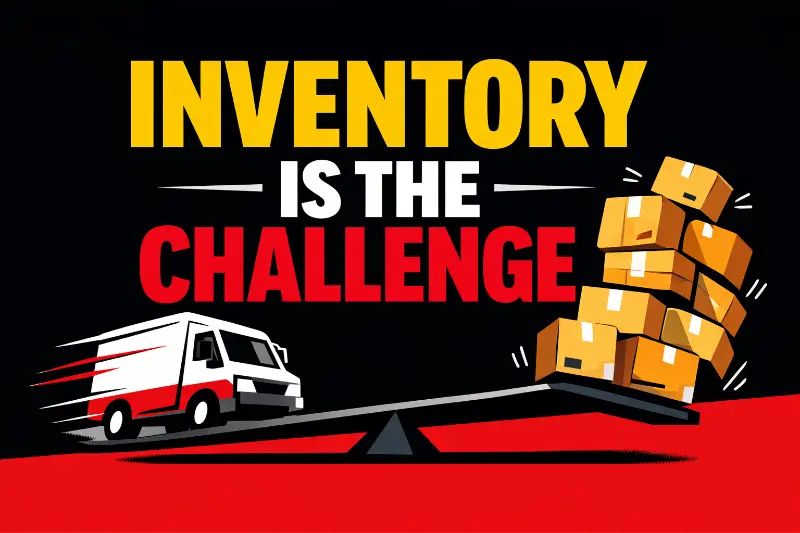
Fast Delivery Isn’t the Hard Part – Inventory Decisions Are

Last updated on February 05, 2026
In this article
 19 minutes
- Why Fast Fulfillment Strategy is Essential: Carrier Optimization Cannot Overcome Inventory Constraints
- The hidden economics of multi-warehouse fulfillment
- When expedited shipping becomes a symptom of structural failure
- Calculating true delivery cost beyond carrier rates
- Predictive logistics transforms inventory positioning
- Operational cascades from inventory misplacement
- Decision frameworks for inventory management and network design
- The importance of customer satisfaction in fulfillment strategy
- Creating a competitive advantage through inventory placement
- Practical implementation for operations leaders
- Peak season exposes inventory placement decisions
- Frequently Asked Questions
Fast delivery is no longer a differentiator in ecommerce, it is an expectation. Same-day and next-day promises are now table stakes, driven by regional carrier expansion, AI-assisted routing, and increasingly dense fulfillment networks. Industry discussions, including recent coverage in Inbound Logistics, have rightly reframed expedited shipping as a systems problem rather than a pricing one.
What those conversations often stop short of explaining is why so many brands still fail to execute fast fulfillment consistently. The issue is rarely the carrier. It is almost always the inventory decision that came before the order was ever placed.
Where you store inventory, not which carrier you choose, determines whether fast delivery is economically viable. Strategic inventory positioning achieves 71% faster delivery compared to single-location fulfillment, while brands trying to “buy speed” through expedited shipping often pay 3-5x ground rates to compensate for poor placement decisions. The math is unforgiving: a package traveling from Los Angeles to Boston cannot reach customers in two days via ground shipping regardless of carrier, but the same order fulfilled from a Pennsylvania warehouse arrives in Zone 2 transit times at a fraction of the cost.
Why Fast Fulfillment Strategy is Essential: Carrier Optimization Cannot Overcome Inventory Constraints
Shipping costs are fundamentally determined by distance-based pricing zones, not carrier selection. A 35-pound FedEx Ground package costs approximately $20.93 in Zone 2 (local) versus $25.74 in Zone 3, a 23% increase for just one zone jump. At Zones 6-8, costs can exceed the baseline by 80-120%. Carrier optimization provides 10-15% savings within a given zone; proper inventory placement can eliminate 2-3 zones entirely.
The coverage math illustrates this principle clearly. A single centrally-located warehouse (Kansas or Kentucky) reaches 60-70% of the US population within two-day ground shipping. Adding a second strategic location (Knoxville, Tennessee plus Salt Lake City, Utah, for example) extends that coverage to 96% of US addresses. A three-warehouse configuration (coasts plus central hub) reaches 98% or more. Commonwealth Inc. research suggests that same-day delivery requires 15-25 facilities across major markets, next-day needs 5-7, and two-day coverage requires just 3-5 strategically positioned locations.
Real time inventory tracking and accurate monitoring of inventory levels are essential for optimizing inventory placement and preventing stockouts or overstocking. Warehouse management systems (WMS) provide real-time visibility into stock levels across all warehouses and fulfillment centers, while an Order Management System (OMS) ensures a single source of truth by updating inventory levels instantly after every sale. This real-time visibility supports strategic decisions for a fast fulfillment strategy.
J&J Global Fulfilment’s CCO Claudine Mosseri observes that most businesses fundamentally misunderstand their actual customer distribution: “Most businesses have no idea how their customers are distributed across shipping zones. They think they serve customers ‘nationwide’ but when we analyze their actual ZIP codes, we often find the majority of orders going to just three or four zones. That changes everything about their optimal fulfillment strategy.”
Slash Your Fulfillment Costs by Up to 30%
Cut shipping expenses by 30% and boost profit with Cahoot's AI-optimized fulfillment services and modern tech —no overheads and no humans required!
I'm Interested in Saving Time and MoneyThe hidden economics of multi-warehouse fulfillment
The case for distributed inventory appears straightforward: ShipBob merchants report 13% overall shipping cost savings from distributed inventory, and cookware brand Our Place achieved $1.5 million in annual freight savings by expanding from two to four warehouses while cutting delivery times from 5-6 days to 2.5 days. These headline numbers, however, obscure substantial hidden costs that can reverse the economics for smaller operations.
Storage costs alone can increase dramatically when splitting inventory. A single warehouse storing 1,000 cubic feet at $0.75 per cubic foot costs $750 monthly. The same inventory split across two warehouses at 750 cubic feet each (with higher per-unit rates of $0.85) costs $1,275, representing 70% higher storage expense. Safety stock multiplication compounds this: a slow-moving item requiring one pallet in a single warehouse may need three pallets across three locations, tripling carrying charges for that SKU.
Additional hidden costs include inbound freight duplication (multiple container shipments instead of consolidated receiving), inventory transfer expenses when demand shifts require rebalancing, technology upgrades for multi-location warehouse management systems, and sales tax nexus obligations in each state where inventory resides. Implementing real time inventory tracking and real-time visibility in inventory management helps prevent overstocking or stockouts, optimizing capital invested in inventory and reducing hidden costs. Many 3PLs also charge minimum monthly fees per warehouse location, averaging $195-$337 as of 2024.
The break-even threshold is higher than commonly advertised. Red Stag Fulfillment estimates a minimum of $5 million GMV or 50-100+ daily orders before multi-warehouse economics become favorable. Below this volume, distributed fulfillment often creates “higher inventory costs, increased inbound shipping expenses, and reduced efficiency.”
When expedited shipping becomes a symptom of structural failure
Paying premium shipping rates to compensate for inventory placement failures represents a false economy that compounds over time. OnTrac research reveals that 88% of retailers still display vague delivery ranges like “4-6 business days” at checkout, while 84% of consumers used expedited shipping in the past six months. The disconnect suggests widespread reliance on speed premiums rather than network optimization.
The diagnostic signs of poor inventory placement are measurable: high percentage of Zone 6-8 shipments, frequent air shipping to maintain delivery promises, and stockouts requiring emergency expedited transfers between warehouses. One illustrative calculation: if 20% of orders require expedited shipping at an $8 per-order premium, annual costs reach $16,000 for a 10,000-order business. That may sound manageable until compared against the $30,000-$100,000+ annual overhead of operating a second warehouse that could eliminate much of that expedited volume.
The breaking point indicators include warehouse capacity at 80%+ for three or more consecutive months, delivery performance slipping despite team effort, expedited shipping consuming more than 15% of the shipping budget, and Zone 7-8 shipments representing over 30% of orders. At these thresholds, paying for speed rather than building infrastructure becomes unsustainable. Focusing solely on speed can result in sacrificing accuracy, leading to incorrect shipments that cause costly errors, returns, and customer dissatisfaction. Slow fulfillment also leads to customer dissatisfaction and lost sales, highlighting the need for quality control to ensure order accuracy while optimizing for speed.
Calculating true delivery cost beyond carrier rates
The complete cost formula extends far beyond published shipping rates: True Delivery Cost = Direct Shipping + Hidden Costs + Opportunity Costs + Infrastructure Costs. Direct costs include base carrier rates, fuel surcharges (20-30% of total), residential delivery surcharges, dimensional weight adjustments, and peak season surcharges that add 15-30% during holidays.
Hidden costs prove particularly consequential. Online returns average 20-30% versus 9% for in-store purchases, with returns processing adding 30% to initial delivery emissions. Fast shipping increases CO₂ emissions by up to 15%, while transportation costs jump 68% for expedited service. Shipping and returns account for 37% of total greenhouse gas emissions in online shopping, an increasingly material concern for brands and investors.
Operational complexity creates additional hidden costs when managing multiple locations. Multi-warehouse WMS and order management system upgrades typically cost $5,000-$8,000+ annually. Inventory allocation errors lead to cross-warehouse transfers. Split shipments (multiple packages to the same customer) occur in 40% of ecommerce orders and cost 25-30% more than consolidated fulfillment due to duplicate handling and freight charges.
To streamline operations and improve order processing, integrating warehouse management systems, barcode scanners, or AI-driven automation can minimize human errors and significantly boost speed and accuracy. Streamlining order processing through automation—such as automating order entry, invoicing, and tracking—and leveraging barcode scanners for picking and packing not only speeds up the fulfillment process but also reduces costly mistakes.
Healthy benchmarks provide useful reference points: fulfillment should represent 8-12% of revenue, with percentages above 15% indicating inefficiency. Shipping typically comprises 40-70% of total fulfillment costs. Average US cost per package reached $9.08 in 2024, while 3PL fulfillment ranges from $4-10 per order versus $7-15 for in-house small business operations.
Looking for a New 3PL? Start with this Free RFP Template
Cut weeks off your selection process. Avoid pitfalls. Get the only 3PL RFP checklist built for ecommerce brands, absolutely free.
Get My Free 3PL RFPPredictive logistics transforms inventory positioning
Geographic-level demand forecasting has evolved from competitive advantage to operational necessity. Modern forecasting employs hierarchical architectures analyzing demand at SKU, location, regional, category, and channel levels simultaneously. The critical variables extend beyond historical sales to include geodemographics (communities surrounding each location have distinct shopping patterns), regional seasonality, local competitive dynamics, and weather patterns.
Amazon’s 2013 anticipatory shipping patent (US8615473B2) established the conceptual framework now becoming industry standard: inventory proactively pushed toward geographical areas based on predicted demand, with final destination assignment occurring en route. The patent model incorporates historical buying patterns, wish lists, shopping cart activity, and even cursor hover time to forecast regional demand.
Leading platforms operationalize these concepts at scale. Blue Yonder’s cognitive demand planning incorporates hundreds of variables including economic data like CPI, inflation, GDP, interest rates, and fuel prices. Manhattan Associates’ fulfillment optimization simulation engine models alternative strategies balancing cost, speed, service level, and margin, achieving up to 50% reduction in split shipments. Walmart’s route optimization technology avoided 94 million pounds of CO₂ by eliminating 30 million unnecessary miles.
The ROI data supports investment: AI implementations demonstrate 20-30% average inventory reduction and 65% reduction in lost sales due to out-of-stock situations. One multinational food company achieved $70 million in value within six weeks of AI deployment. A multi-location retailer operating 12 regional warehouses reduced total network inventory by 18% while improving fill rates from 89% to 96%.
With the rapid growth of e-commerce, scalable and efficient order fulfillment strategies are essential to support increasing sales volumes and business expansion. Developing a fast fulfillment strategy in 2026 requires predictive operations, distributed networks, and unified technology ecosystems, enabling growth by supporting scalability and operational efficiency.
Operational cascades from inventory misplacement
When inventory sits in the wrong location, costs compound through multiple channels simultaneously. The average fulfillment or shipping error costs $35-58.50 per incident excluding customer service time. Split shipments (an almost inevitable consequence of distributed inventory without intelligent routing) increase costs by 25-30% through duplicate handling and freight charges while confusing customers and eroding brand trust.
Fulfillment errors and delays can significantly damage brand reputation and erode customer trust, leading to a negative customer experience. Effective order fulfillment helps businesses manage demand, streamline logistics, and minimize inefficiencies, all of which are crucial for maintaining a positive customer experience and protecting brand reputation.
The compounding pattern follows a predictable trajectory: immediate higher per-order shipping costs and customer confusion; short-term increased “where is my order” inquiries and customer service costs; medium-term lost repeat purchases and negative reviews; long-term eroded market share and reduced customer lifetime value. Baymard research shows 49% of customers cite unexpected shipping costs as their primary reason for cart abandonment, while PwC found 41% of luxury shoppers would switch brands after a single poor delivery experience.
Stockout dynamics differ significantly between concentrated and distributed inventory. Concentrated inventory creates catastrophic single-point-of-failure risk, where any disruption leaves no backup options. Distributed inventory ensures that stockouts in one region don’t impact operations elsewhere, though it requires sophisticated demand forecasting to avoid the opposite problem: popular SKUs running out in one location while sitting overstocked in another. One brand using three fulfillment centers “encountered issues: popular SKUs would run out in one location and sit overstocked in another, causing lost sales until stock was rebalanced.” They ultimately reverted to two warehouses.
Decision frameworks for inventory management and network design
The signals indicating readiness for distributed fulfillment are measurable: shipping costs rising as a percentage of revenue, high concentration of orders shipping to Zones 5-8, frequent express shipping to maintain delivery promises, single warehouse bottlenecking during volume spikes, customer complaints about delivery times increasing, and competitors offering faster delivery in key markets.
The decision matrix balances multiple factors. Single-warehouse strategies favor businesses with fewer than 100 daily orders, under $5 million annual GMV, customer geography concentrated in 2-3 regions, unique or differentiated products where customers will wait, high SKU counts that would multiply carrying costs, and low margins that cannot absorb overhead. Multi-warehouse strategies favor the inverse: 100+ daily orders, $5 million+ GMV, truly nationwide dispersed customers, commodity products where speed provides competitive advantage, low SKU counts, and high margins.
ABC-XYZ inventory segmentation provides a practical allocation framework. “A” items (the top 20% of SKUs generating 80% of revenue) should be placed in multiple fulfillment centers nearest customers. “B” items warrant centralized or limited distribution. “C” items (slow-movers) belong in single locations and may be candidates for discontinuation. The XYZ overlay addresses demand predictability: predictable demand (X) allows confident distribution, variable demand (Y) requires safety stock buffers, and unpredictable demand (Z) should remain centralized to reduce risk of stockouts or overstock situations. To meet demand across multiple sales channels, businesses must align their inventory and fulfillment processes by integrating sales channels and developing a comprehensive order fulfillment strategy. A successful order fulfillment strategy optimizes every aspect of the product fulfillment process, ensuring efficient operations and customer satisfaction.
The importance of customer satisfaction in fulfillment strategy
Customer satisfaction is at the heart of every successful e-commerce business, and a robust fulfillment strategy is essential to consistently meet customer expectations. In today’s competitive landscape, customers expect fast, reliable, and transparent order fulfillment. When the fulfillment process is streamlined—delivering orders accurately and on time—customers are more likely to be delighted with their experience, leading to higher rates of repeat purchases and positive word-of-mouth.
A well-designed order fulfillment process goes beyond simply shipping products; it encompasses every touchpoint, from the moment a customer places an order to the final delivery. Offering multiple shipping options allows customers to choose the speed and cost that best fits their needs, while real-time tracking and proactive updates provide peace of mind and build trust. Ensuring accuracy in picking, packing, and shipping not only reduces costly errors but also enhances the overall delivery experience.
Prioritizing customer satisfaction within your fulfillment strategy is a critical role for any e-commerce business aiming for long-term success. Satisfied customers are more likely to return, recommend your brand, and become loyal advocates. By focusing on fulfillment processes that consistently meet or exceed customer expectations, businesses can drive growth, strengthen their reputation, and secure a competitive position in the market.
Creating a competitive advantage through inventory placement
Strategic inventory placement is a powerful lever for gaining a competitive advantage in e-commerce fulfillment. By analyzing sales data and leveraging demand forecasts, businesses can identify their top-performing products and position them optimally within their warehouse or across multiple distribution centers. This targeted approach reduces picking and packing times, lowers labor costs, and accelerates delivery speed—key factors in improving customer satisfaction and reducing shipping costs.
Modern inventory management systems and warehouse management systems enable real-time tracking of stock levels, allowing businesses to dynamically adjust inventory placement as demand shifts. This agility ensures that high-demand items are always close to the customers who want them, minimizing delays and enhancing fulfillment speed. For many businesses, partnering with third-party logistics providers or utilizing specialized fulfillment centers can further streamline fulfillment operations, reduce operational costs, and elevate service quality.
Optimizing inventory placement not only improves the efficiency of the fulfillment process but also supports a more responsive and scalable fulfillment strategy. By reducing operational and labor costs, increasing delivery speed, and ensuring products are always available where they’re needed most, businesses can achieve a true competitive edge. In a market where customers expect fast, reliable service, smart inventory placement is essential for meeting demand, improving customer satisfaction, and driving sustained business growth.
Scale Faster with the World’s First Peer-to-Peer Fulfillment Network
Tap into a nationwide network of high-performance partner warehouses — expand capacity, cut shipping costs, and reach customers 1–2 days faster.
Explore Fulfillment NetworkPractical implementation for operations leaders
An effective inventory placement audit begins with mapping customer concentration by ZIP code, identifying where the majority of orders actually originate. Many brands discover that 60-70% of orders concentrate in major coastal metros despite assumptions of nationwide distribution. Current zone distribution analysis reveals what percentage of orders ship in lower-cost Zones 1-4 versus expensive Zones 5-8. Cost-per-zone and transit time calculations establish the baseline for improvement.
SKU-level analysis applies the Pareto principle: 80% of sales come from 20% of SKUs. These “A” SKUs merit multi-location distribution investment, while slow-movers should remain centralized. Reorder quantity calculation (Average Daily Units Sold × Average Lead Time) combined with demand variability analysis determines appropriate safety stock levels for each location.
To further improve efficiency and reduce costs, it is essential to optimize warehouse layout and warehouse operations. Optimizing warehouse layout reduces picking and packing times, while streamlining fulfillment processes can lower costs and increase efficiency across the operation.
Common implementation mistakes include selecting fulfillment partners based solely on cost without evaluating SLAs and technology capabilities, expanding warehouses without unified WMS integration, starting peak season planning too late (November instead of Q1), underinvesting in demand forecasting, and assuming in-house fulfillment saves money without calculating true total costs including overhead.
The successful transformation pattern from case studies follows a consistent sequence: Our Place expanded from 2 to 4 fulfillment centers and cut delivery times from 5-6 days to 2.5 days while saving $1.5 million annually. Semaine Health scaled from single location to 4 centers, reducing transit time from 5.2 to 3.6 days while saving $2+ per order. Ample Foods added a second center and increased 2-day ground coverage from 32% to 65% of customers while achieving 13% bottom-line savings.
Peak season exposes inventory placement decisions
The peak season stress test reveals whether inventory placement decisions were strategic or reactive. Order volumes spike 300-500% during peak periods, and fulfillment systems either scale gracefully or collapse entirely. The preparation timeline demands attention: optimal planning begins in January for Q4 execution, with late summer representing the latest viable start date. Waiting until November to plan for holiday fulfillment means you’re already too late.
Peak season performance benchmarks set by leading 3PLs in 2025 include 99.975% order accuracy, 87% same-day fulfillment, and 99.9% next-day shipping. Return rates peaked at 17.7% during Christmas and Boxing Week 2024, with over $122 billion in returns processed by the first week of January 2025, creating substantial reverse logistics pressure that compounds placement mistakes. During these periods, last mile delivery becomes critical, as shipping speed and reliability directly impact customer satisfaction. Clear communication with customers about delivery times and shipping costs is essential to reduce uncertainty and build trust. Maintaining relationships with multiple carriers ensures redundancy and flexibility in shipping, helping brands adapt quickly to disruptions and meet delivery promises during peak demand.
The micro-seasonality within Q4 requires granular inventory positioning: October demands Halloween items peaking in final two weeks while early gift-buying begins; November explodes with Black Friday deal-seekers and thoughtful gift selection; December brings urgent purchases with specific delivery deadlines; post-holiday creates returns surge. Each phase stresses inventory placement differently, rewarding brands that pre-positioned inventory based on predictive demand signals rather than reacting to orders as they arrive.
Frequently Asked Questions
Why does inventory placement matter more than carrier selection for fast delivery?
Inventory placement determines the fundamental distance packages must travel, which directly controls both transit time and shipping costs. A package traveling from Los Angeles to Boston cannot reach customers in two days via ground shipping regardless of which carrier you use. However, the same order fulfilled from a Pennsylvania warehouse arrives in Zone 2 transit times at a fraction of the cost. Carrier optimization provides 10-15% savings within a given zone, but proper inventory placement can eliminate 2-3 zones entirely, resulting in 71% faster delivery and dramatically lower costs.
What is the minimum order volume needed to justify multiple fulfillment locations?
Red Stag Fulfillment estimates a minimum of $5 million annual GMV or 50-100+ daily orders before multi-warehouse economics become favorable. Below this threshold, the hidden costs of distributed fulfillment (higher storage rates, safety stock multiplication, inbound freight duplication, technology upgrades, and inventory transfer expenses) typically outweigh the shipping savings. A single warehouse storing 1,000 cubic feet costs $750 monthly, while splitting that inventory across two warehouses can cost $1,275 (70% higher) due to higher per-unit rates and duplicated overhead.
How do I know if my business needs distributed fulfillment or if I’m overpaying for expedited shipping?
Warning signs include expedited shipping consuming more than 15% of your shipping budget, Zone 7-8 shipments representing over 30% of orders, warehouse capacity at 80%+ for three or more consecutive months, and delivery performance slipping despite operational improvements. Calculate the cost: if 20% of your orders require expedited shipping at an $8 premium, that’s $16,000 annually for a 10,000-order business. Compare this against the $30,000-$100,000+ cost of operating a second warehouse. If you’re consistently paying expedited rates to compensate for poor placement, distributed fulfillment likely makes economic sense.
What is ABC-XYZ inventory segmentation and how does it guide warehouse placement decisions?
ABC-XYZ segmentation combines sales velocity with demand predictability to determine optimal inventory placement. “A” items are your top 20% of SKUs generating 80% of revenue and should be placed in multiple fulfillment centers nearest customers. “B” items warrant centralized or limited distribution. “C” items (slow-movers) belong in single locations. The XYZ overlay adds demand predictability: predictable demand (X) allows confident distribution across locations, variable demand (Y) requires safety stock buffers, and unpredictable demand (Z) should remain centralized to reduce risk of stockouts or overstock situations.
How does predictive logistics and AI-powered demand forecasting improve inventory placement?
Geographic-level demand forecasting analyzes patterns at SKU, location, regional, category, and channel levels simultaneously, incorporating geodemographics, regional seasonality, local competition, and weather patterns. Amazon’s anticipatory shipping patent established the framework: inventory is proactively pushed toward geographical areas based on predicted demand. Modern AI implementations demonstrate 20-30% average inventory reduction and 65% reduction in lost sales due to stockouts. One multi-location retailer reduced total network inventory by 18% while improving fill rates from 89% to 96% using predictive placement.
When should I start planning inventory placement for peak season?
Optimal peak season planning begins in January for Q4 execution, with late summer representing the latest viable start date. Order volumes spike 300-500% during peak periods, and waiting until November means you’re already too late. The micro-seasonality within Q4 requires granular positioning: October for Halloween and early gift-buying, November for Black Friday, December for urgent deliveries, and post-holiday for returns processing. Return rates peaked at 17.7% during Christmas 2024 with over $122 billion processed in early January, creating reverse logistics pressure that compounds poor placement decisions made months earlier.
Written By:

Rinaldi Juwono
Rinaldi Juwono leads content and SEO strategy at Cahoot, crafting data-driven insights that help ecommerce brands navigate logistics challenges. He works closely with the product, sales, and operations teams to translate Cahoot’s innovations into actionable strategies merchants can use to grow smarter and leaner.

Turn Returns Into New Revenue

Related Articles
The End of Traditional Ecommerce Returns
PART I — THE PROBLEM Why Returns Didn’t Just Break — They Were Never Built for This Returns are ecommerce’s dirty secret: a billion-dollar bonfire that most brands prefer not to lo...

Moving from Amazon 1P to 3P: What It Actually Takes to Succeed
The decision to move from Amazon Vendor Central (1P) to Seller Central (3P) usually follows months of frustration with pricing control loss, erratic purchase orders, and margin com...
Why Amazon 1P Feels Out of Control — and Why That’s Not Your Fault
When your Amazon Vendor Central account starts generating problems faster than your team can fix them, the instinct is to treat each issue as a separate operational failure.