
Where Peer-to-Peer Returns Don’t Work And Why That’s Fine

Last updated on April 15, 2026
 18 minutes
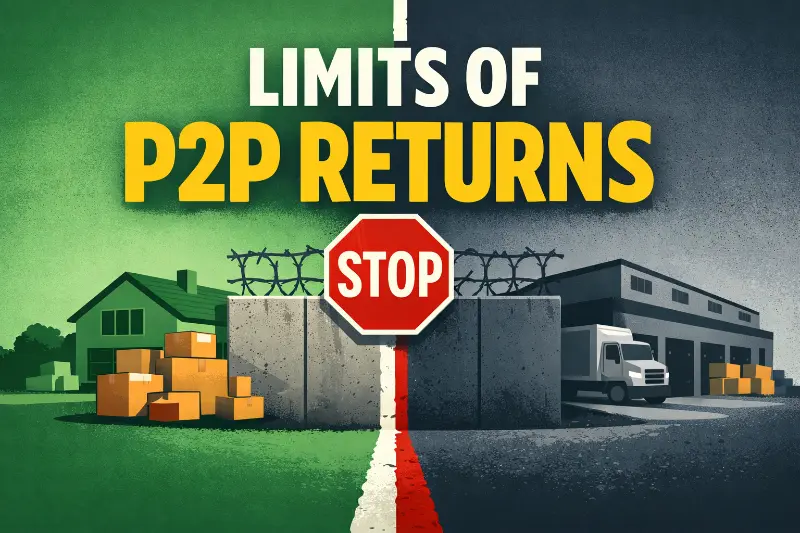
Peer-to-peer returns are not a silver bullet, and any system claiming universal applicability in retail logistics is not serious. The credibility of P2P as a model rests precisely on knowing where it stops, which SKUs belong in it, and which ones still belong in a warehouse. That boundary is not a weakness. It is what makes the model implementable. Peer-to-peer returns operate by bypassing traditional financial institutions or intermediaries, enabling direct transactions between buyers and sellers.
For ecommerce operators who have spent years watching reverse logistics costs compound in the face of rising e-commerce return rates, the appeal of P2P is obvious. Eliminate the warehouse intake. Remove the redundant shipping leg. Stop the markdown spiral. The economics are compelling, and the structural logic holds. Peer-to-peer (P2P) returns in e-commerce allow items to be shipped directly from the original buyer to a new buyer instead of returning to a warehouse. But none of that changes the reality that a meaningful share of every return catalog will always require centralized handling. The retailers who understand that distinction early are the ones who will deploy P2P confidently and scale it without operational fragility. Sustainability benefits of P2P returns include reduced packaging waste and lower carbon emissions from shipping, aligning closely with broader initiatives to support eco-friendly returns.
This article is about scope. Where P2P works, where it does not, and what the realistic operating model actually looks like in a landscape where free returns are increasingly under pressure.
Why Boundaries Make a Model Stronger
Most operations problems get pitched as universal solutions. Returns software will fix your cost structure. Carrier consolidation will bend the curve. Scale will eventually solve the economics. These promises share a common flaw: they avoid acknowledging the conditions under which they fail.
P2P returns are built differently. The model is not designed to handle everything. It is designed to handle the right things, which in practice means the majority of recoverable, resalable inventory that currently gets routed backward through the supply chain for no structural reason. Specialized online platforms facilitate these returns by managing the process securely and efficiently.
When a system defines its own limits, it becomes more trustworthy, not less. The constraints below are not edge cases to be footnoted. They are load-bearing parts of how P2P gets deployed correctly.
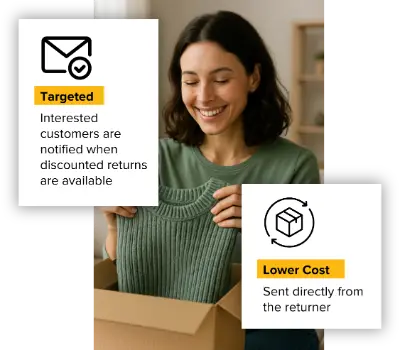
P2P returns can reduce reverse logistics costs by roughly 70% by eliminating the need to return items to a warehouse, changing the underlying math of the cost of so-called “free” returns.
Where Peer-to-Peer Returns Do Not Work
Fragile Goods
Some products simply cannot reliably survive a second customer-initiated shipment. Glassware, ceramics, fragile electronics, and items requiring specialized cushioning fall into this category. When a customer packs a returned item for forwarding, they are not a trained warehouse associate. They do not have standardized materials, controlled processes, or inspection checklists.
For these SKUs, controlled inspection and professional repackaging still matter. A warehouse provides:
- Standardized outbound protection
- Condition verification before items move again
- Accountability if something arrives damaged
Routing fragile goods through P2P is not a cost-saving move. It is a customer experience liability. These items belong in traditional handling, and a well-configured P2P system routes them there automatically based on SKU flags and category rules.
Regulatory Constraints
Certain product categories face legal and compliance barriers that limit or prohibit resale or re-routing without centralized oversight. Cosmetics, personal care products, medical devices, consumables, and items with tamper-evident packaging requirements all fall into this zone.
The issue is not policy preference. It is chain-of-custody.
In these verticals:
- Resale may be prohibited outright by regulation
- Inspection requirements are non-negotiable and must be documented
- The condition of the item cannot be verified without a controlled process
P2P adoption in regulated categories is limited until regulatory frameworks evolve to accommodate forward-routing models. Until then, routing these returns through traditional inspection is not a workaround. It is the only legally defensible path.
Damaged or Defective Items
Not all returns are created equal. A customer returning a defective item out of the box is not the same as a customer returning an item that does not fit. P2P is designed for the latter, not the former.
Items that are defective out of the box, damaged in transit, or missing components require:
- Verification and root-cause analysis
- Vendor or carrier claims processing
- Controlled disposition, whether that means repair, replacement, or write-off
Forwarding a defective item directly to the next buyer is not P2P. It is a customer service failure waiting to happen. The distinction matters operationally: P2P eligibility checks should include return reason as a primary filter, routing defect and damage returns into traditional flows before they ever enter the P2P pipeline.
P2P is for recoverable inventory. Failure cases are not recoverable inventory.
Seasonality and Edge Cases
Timing creates a category of its own. End-of-season apparel, event-driven merchandise, and SKUs with expiring demand are not good P2P candidates, even if the items themselves are in perfect condition.
The logic is simple: if there is no downstream buyer, forwarding has no value. A P2P system routes items toward demand. When demand no longer exists for a given SKU, there is no one to route toward.
For these items, liquidation or recycling may still be the optimal path, ideally within a broader strategy for supporting eco-friendly returns. That is not a failure of P2P. It is the system working correctly by identifying that centralized disposition is the better outcome in that specific case.
Understanding Credit Risk
Credit risk sits at the heart of peer to peer lending. Simply put, it’s the risk that a borrower will fail to repay their loan, directly impacting the returns investors hope to earn. Unlike traditional financial institutions, where layers of regulation and established underwriting processes help manage this risk, peer to peer lending platforms must build their own systems for evaluating and pricing credit risk—often with more transparency and flexibility, but also with greater responsibility placed on both the platform and the investor.
Peer to peer lending platforms tackle credit risk through a combination of rigorous borrower assessments, income and employment verification, and detailed credit history checks. These steps help platforms assign risk grades and set appropriate interest rates, giving investors the information they need to make informed decisions. However, the responsibility doesn’t end there. Investors themselves play a crucial role in managing risk by spreading their investments across multiple loans—a strategy known as portfolio diversification. By lending money directly to a diverse group of borrowers, investors can reduce the impact of any single borrower default, smoothing out returns over time.
By bypassing traditional intermediaries, peer to peer lending offers the potential for higher returns than most traditional loans or savings products. But these higher returns come with inherent risks, including the possibility of borrower default and platform insolvency. That’s why careful consideration is essential. Investors should thoroughly research each platform, understand the loan term and credit risk associated with every investment, and take advantage of tools that support proper diversification. Many platforms now offer auto-invest features and risk management products, providing a safety net in the event of default and helping investors reduce risk.
Regulatory oversight is another key factor. As the peer to peer lending industry matures, platforms that prioritize compliance and transparency are better positioned to protect both investors and borrowers. Staying informed about regulatory changes and choosing platforms with strong governance can further reduce potential risks.
Ultimately, peer to peer lending empowers investors to participate directly in the lending market, offering a fast growing market with the potential for higher returns. By understanding credit risk, diversifying across multiple loans, and selecting reliable platforms, investors can navigate the inherent risks and position themselves to earn returns that outpace those available from traditional financial institutions. As the industry evolves, peer to peer lending is set to play an increasingly important role in the future of finance—rewarding those who approach it with research, discipline, and a clear understanding of risk.
Platform Stability and Security
When it comes to peer to peer lending, platform stability and security are not just technical details—they are the foundation of trust and the safety net for your investments. Unlike traditional financial institutions, where regulatory oversight and established processes provide a built-in layer of protection, peer to peer platforms must prove their reliability every day to both lenders and borrowers. Platform-related risks, such as potential bankruptcy, technical failures, and cybersecurity threats, can directly impact your investments.
Platform stability in peer to peer lending means more than just uptime or a slick interface. It’s about the platform’s ability to manage loans efficiently, handle repayments even during economic downturns, and maintain operations without exposing investors to unnecessary risk. Security, meanwhile, covers everything from safeguarding your personal data to preventing fraud and ensuring that every transaction is conducted with transparency and integrity. Cybercrime poses a significant threat to P2P lending platforms, with risks including data breaches and financial fraud.
For investors, choosing a reliable platform is the first and most important step. This means doing your research: look for platforms with a proven track record, read reviews from other investors, and dig into how the platform manages default risk and borrower vetting. A trustworthy peer to peer lending platform will be upfront about its risk management strategies, provide clear information on loan performance, and communicate openly about any issues that arise. Fraud or negligence by the platform or borrowers can cause significant financial losses. Additionally, P2P platforms often operate with limited credit evaluation tools and typically offer unsecured loans, which increases the potential for losses.
One of the main attractions of peer to peer lending is the potential for higher returns compared to traditional financial institutions. By bypassing traditional intermediaries, investors can often earn returns that outpace those of savings accounts or even some traditional loans. Interest rates and return rates are typically fixed and set upfront, providing predictable income for investors. However, these higher returns come with inherent risks—most notably, the risk of borrower default. Investors can lose both their principal investment and anticipated returns if borrowers fail to repay. To reduce risk, it’s essential to spread your investments across multiple loans and take advantage of portfolio diversification tools offered by the platform. Many platforms now provide auto-invest features and detailed loan listings, making it easier to lend money directly to a range of borrowers and minimize exposure to any single default.
Liquidity risk in P2P lending stems from the difficulty in accessing invested funds before the loan term ends. Investors may not be able to sell loans easily before the loan term ends, as secondary markets for selling loans can be limited or illiquid, affecting access to funds.
Regulatory oversight is another critical factor. The peer to peer lending industry is evolving rapidly, and platforms that prioritize compliance with relevant laws and regulations offer a safer environment for investors. Look for platforms that are transparent about their regulatory status and proactive in adapting to new rules—this is a sign of a company committed to sustainable growth and investor protection.
Market dynamics, valuation uncertainty, and the potential for economic downturns all play a role in the performance of peer to peer loans. A robust platform will help investors navigate these challenges by offering a wide range of loan options, providing detailed performance data, and implementing strong risk assessment techniques. Understanding the fee structure of a P2P lending platform is crucial for evaluating its overall cost-effectiveness. Regular updates on loan statuses and overall platform performance are indispensable for investors. Proper diversification and ongoing research are key to staying ahead in this fast growing market.
In summary, platform stability and security are essential for anyone considering peer to peer lending. By selecting a reliable platform that emphasizes stability, security, and regulatory compliance, investors can reduce risk and position themselves to earn higher returns. Peer to peer lending offers a compelling alternative to traditional financial institutions, with the advantages of lower interest rates for borrowers and attractive returns for investors—but only when approached with careful consideration of the inherent risks and a commitment to proper diversification.
The Hybrid Reality
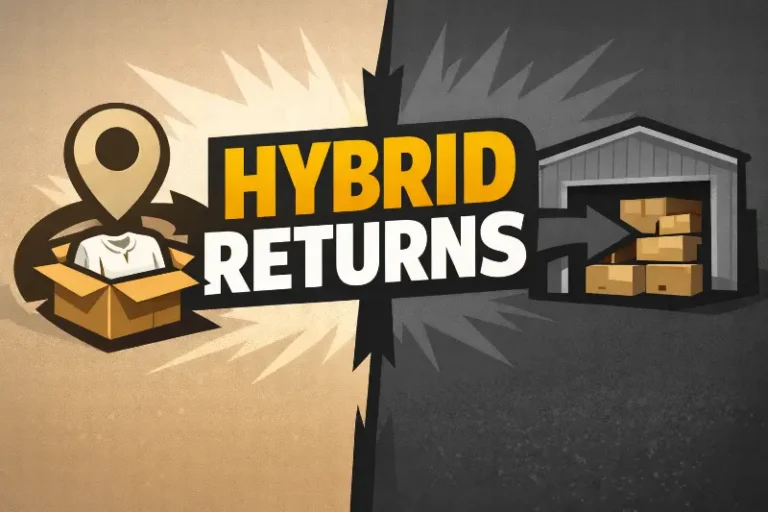
Understanding where P2P does not work leads directly to the model that actually wins in practice: the hybrid.
No retailer will ever route 100% of returns peer-to-peer, and they should not try. Across most ecommerce operations, a realistic view of the return catalog looks like this:
- Roughly 60% of returns are viable P2P candidates: recoverable items in good condition with active downstream demand, primarily apparel, footwear, accessories, and durable home goods
- Roughly 40% of returns will continue to require traditional handling: defective items, regulated categories, fragile goods, and end-of-season inventory
That 40% is expected. It is not a gap in the model. It is the model working correctly.
The shift that matters is how warehouses are repositioned in this framework. In a P2P-enabled operation, a warehouse is no longer the default endpoint for every return that comes in. It becomes a specialized exception handler for the items that genuinely need centralized processing. That reframing changes the labor equation, the space equation, and the cost-per-return equation in ways that compound meaningfully at scale.
The visual that captures this well is a staged funnel: Quick Setup at the top, Hybrid Model in the middle, Effortless Scale at the base. Adoption is not a disruptive overhaul. It is a staged progression where eligibility rules are established, a pilot cohort is selected, and the system expands as evidence accumulates. That structure is what makes P2P scalable without requiring a full operational transformation upfront.
Why Hybrid Models Outperform Extremes
There is a tendency in operational strategy to prefer clean solutions. Either stay with the warehouse model or move everything to P2P. Neither extreme is operationally sound.
A pure warehouse model maximizes cost. Every return, regardless of whether it needs centralized handling, absorbs the full stack: inbound freight, inspection labor, repackaging, restocking delays, and markdown exposure, even when using convenience-focused solutions such as Happy Returns’ drop-off network. The economics are brutal on recoverable inventory that never needed to travel backward in the first place.
A pure P2P model is impractical. Fragile goods break. Defective items get forwarded to the wrong place. Regulated categories create liability. And the operational overhead of enforcing 100% routing compliance would eliminate much of the efficiency the model was meant to create.
The hybrid captures the upside of both without the fragility of either. Recoverable inventory moves forward efficiently. Items that need careful handling get it. The cost curve bends on the portion of returns where it can actually bend, which is where most of the margin damage was occurring anyway.
This is not a compromise position. It is the correct architecture for how returns actually behave across a real catalog.
Addressing the Objections
Skepticism toward P2P tends to cluster around four objections. Each one misunderstands what the model is actually trying to do.
Customers won’t accept this
Customer behavior has already shifted. Return fees are now common across major apparel retailers. Open box and like-new goods are normalized on every major marketplace. Sustainability awareness is rising among the consumer segments that drive ecommerce growth.
Acceptance hinges on outcomes, not routing diagrams. Customers do not care how an item gets to the next buyer. They care whether their refund arrives quickly, whether the process was clear, and whether the experience felt fair—the same pillars that underpin an exceptional returns program that builds loyalty. When P2P delivers faster refunds and transparent condition standards, the experience improves. The routing is invisible.
This adds friction
Compared to what? Traditional returns involve repackaging, printing labels, waiting weeks for warehouse processing, and receiving refunds only after inspection clears. P2P can reduce the number of steps, accelerate the refund timeline, and eliminate warehouse delays entirely for eligible items. The friction argument assumes that warehouse handling is somehow frictionless to customers. It is not.
We already have returns software
Returns management systems optimize requests, not routes. They improve the customer experience at the front end of a return, automate policy enforcement, generate labels, and provide analytics, and the right returns management software can make those front-end processes significantly more efficient. What they do not change is where inventory flows after the return is initiated. P2P complements RMS. It addresses the routing decision that RMS was never designed to make. These are not competing capabilities.
Scale will fix it
This has already been tested. Carrier consolidation, mega-warehouses, drop-off network expansion, none of these interventions have reduced per-return cost in any structural way. Scale optimizes throughput. It does not remove the underlying waste: the redundant shipping leg, the inspection labor, the markdown risk while inventory sits. Volume amplifies those costs rather than dissolving them. P2P changes direction. Scale does not.
What These Limits Prove
The limitations of peer-to-peer returns do not undermine the model. They define its realistic operating envelope, and that definition is precisely what makes it credible to finance leaders, operations teams, and executive buyers who have watched too many logistics innovations overpromise and underdeliver.
A system that claims to solve everything for every SKU in every category should be treated with skepticism. A system that says here is where it works, here is where it does not, and here is how the two paths coexist is a system that can actually be deployed.
The 60/40 split is not a concession. It is an honest representation of where the return losses are concentrated and where they can be structurally reduced. In most cases, most of the margin damage in returns flows from recoverable inventory that never needed to enter a warehouse in the first place. That is the portion P2P addresses. The rest continues exactly as it always has.
Credibility comes from boundaries.
The question for retailers is not whether peer-to-peer returns replace everything. The question is whether they can afford to keep routing the portion of returns that clearly should not go back at all through a system that was never designed to handle them efficiently in the first place.
For more on the full structural case for rethinking returns, see the canonical piece: The End of Traditional Returns.
Frequently Asked Questions
What are the main limitations of peer-to-peer returns?
Peer-to-peer returns are not suited for fragile goods that cannot survive customer-packed shipments, regulated product categories such as cosmetics and medical devices, items that are defective or damaged, and end-of-season SKUs with no remaining downstream demand—or for abuse patterns like wardrobing and similar return fraud. For these cases, traditional warehouse handling or a rules-driven platform like ZigZag’s returns management solution remains the appropriate path.
Does a P2P returns model mean eliminating warehouses entirely?
No. In a hybrid model, roughly 40% of returns still require centralized handling for defective, damaged, fragile, or regulated items. Warehouses shift from being the default endpoint for every return to being specialized exception handlers for the items that genuinely need them.
What percentage of returns are typically viable P2P candidates?
Across most ecommerce operations, approximately 60% of returns represent viable peer-to-peer candidates. These are recoverable items in good condition with active downstream demand, primarily apparel, footwear, accessories, and durable home goods. The remaining 40% continues through traditional reverse logistics.
Is peer-to-peer returns compatible with existing returns management software?
Yes. Returns management systems handle the customer-facing policy experience, approvals, and analytics. Peer-to-peer returns address routing, specifically where eligible inventory flows after a return is initiated. The two capabilities are complementary, not competing, and can be layered on top of solutions like Return Prime’s returns platform.
How does a hybrid returns model perform compared to a fully warehouse-centric model?
A hybrid model captures the cost reduction available on recoverable inventory, which is where most margin damage occurs, without requiring a disruptive overhaul of existing infrastructure. Purely warehouse-centric models absorb full reverse logistics cost on every return. Pure P2P models are impractical. Hybrid models capture the upside without the operational fragility of either extreme.
How should retailers start transitioning toward a hybrid P2P model?
The practical path is staged. Establish a baseline cost per return by category, define SKU eligibility based on condition, demand, and regulatory constraints, run a controlled pilot on a narrow product set, and expand based on evidence. Adoption does not require a full operational transformation upfront. It scales in proportion to the data it generates.
Written By:

Manish Chowdhary
Manish Chowdhary is the founder and CEO of Cahoot, the most comprehensive post-purchase suite for ecommerce brands. A serial entrepreneur and industry thought leader, Manish has decades of experience building technologies that simplify ecommerce logistics—from order fulfillment to returns. His insights help brands stay ahead of market shifts and operational challenges.

Turn Returns Into New Revenue
Related Articles
What Is Demand Planning? How It Impacts Inventory, Forecasting, and Profitability
Demand planning is the process of estimating future customer demand so that a business can align its inventory, procurement, and operations to meet that demand without carrying mor...
Why 100% P2P Adoption Is the Wrong Goal
Peer-to-peer returns let customers send eligible returned items directly to other customers instead of routing every package back through the warehouse, cutting shipping and proces...
Walmart Officially Allows Amazon Multi-Channel Fulfillment (MCF)
Big news for multichannel sellers: Walmart now officially allows Amazon Multi-Channel Fulfillment (MCF), Amazon’s service for using its fulfillment network to ship orders from mult...