
Returns as a Margin Lever, Not a Cost Center

Last updated on June 09, 2026
In this article
 18 minutes
- The Old Frame Is Costing You More Than You Think
- Cost Center Is the Wrong Mental Model
- Margin Lever Means Recovery Value of Returns Can Be Actively Improved
- The Real Opportunity Is Not Just Cost Reduction, But Enhancing Customer Experience
- Returns and Reverse Logistics Sit at the Intersection of Margin, Recovery, and Loyalty
- The Companies That Reframe Returns Will Outperform the Ones That Just Absorb Them
- A Lever Has to Be Measured, But It Has to Be Reframed First
- Conclusion
- Frequently Asked Questions
The Old Frame Is Costing You More Than You Think
Returns should no longer be treated as a passive cost center to absorb and minimize. They are a strategic margin lever that leadership can redesign, measure, and improve to unlock better recovery, lower waste, stronger profitability, and smarter customer outcomes.
That framing shift sounds simple. Its consequences are not. Most ecommerce businesses are still organized around the old assumption: returns are overhead, the job is containment, and success means keeping the line item flat. Many retailers now face high return rates, especially with ecommerce returns, which present unique challenges in management, cost, and customer satisfaction. Ecommerce return volumes are now roughly three times higher than physical retail returns, with many retailers using around 30% as a benchmark for online return rates in internal planning. Notably, ecommerce return volumes are projected to reach 12.1% of total ecommerce revenue by 2029, underscoring the growing economic impact of returns on margins. That posture is now one of the most expensive strategic mistakes a leadership team can make.
With U.S. retail returns hitting $890 billion in 2024, the highest level on record, the financial consequences of passive management are no longer rounding errors. They are structural drains on margin that compound quietly across every return processed. The true cost of a return goes far beyond just the refund, encompassing reverse shipping, quality control labor, lost selling days, and inventory distortion, all of which can significantly affect overall profitability. And the organizations still asking “how do we reduce the pain?” are falling further behind the ones asking “how do we improve the outcome?”
That shift in framing is everything.
Cost Center Is the Wrong Mental Model
A cost center is a business function where the primary goal is to limit spending. The frame is inherently passive. The organization is not trying to generate value. It is trying to minimize loss.
When returns are categorized as a cost center, the organizational response follows that logic exactly:
- Invest just enough to keep operations moving
- Set policies to reduce return volume
- Measure success by whether costs stayed flat or declined
- Treat any improvement as a logistics win, not a strategic one
The problem with this frame is not that it is inaccurate. It is that it narrows ambition.
Consider what cost-center behavior looks like in practice. A brand sees return volume spike after a peak season. The response is to audit label costs, tighten eligibility windows, and push for faster warehouse processing times. The operations team reports back that cost per return held steady. Leadership accepts this as a win. Nothing about the underlying system changed. The same items traveled the same routes, absorbed the same labor costs, and experienced the same markdown pressure. The brand contained the visible cost without touching the actual problem. These decisions always involve trade-offs, such as balancing cost containment with customer experience or operational efficiency.
That is the cost-center trap. The operations get cleaner. The financial impact does not. The true financial impact of returns is not just about visible costs, but about the broader return economics, which include all costs and profitability factors associated with returns.
A company that treats returns as a cost center will almost never ask whether the system can be redesigned to capture more value. It will ask how to trim visible cost at the margins without changing the underlying approach. The result is a series of incremental fixes that reduce the sting without improving the outcome.
Cost-center thinking leads to containment. Containment, by definition, is not improvement.
This is how so many ecommerce businesses end up spending years processing returns more efficiently while losing the same margin year after year. To grasp how ecommerce return rates erode profit margins and what levers actually fix it, it helps to examine how ecommerce return rate affects profit margins. But the diagnosis alone is not sufficient. The starting point has to be the frame.
Margin Lever Means Recovery Value of Returns Can Be Actively Improved
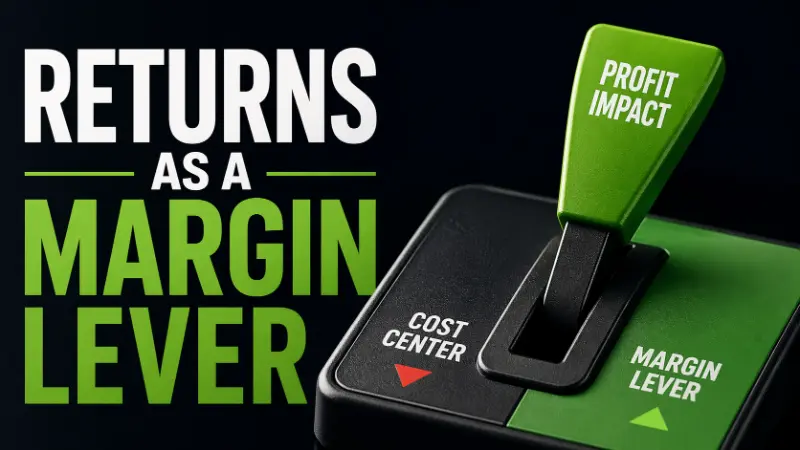
A lever is something you can pull. It changes outcomes based on how you design and operate it.
That is the right mental model for returns management. Returns management is a strategic lever that can be pulled to optimize business outcomes and protect margins, especially when you deliberately craft a returns program that balances customer experience with the real economics of reverse logistics.
When leadership treats returns as a margin lever rather than a cost center, the operational and strategic posture changes entirely. Instead of asking how to absorb the loss, teams start asking how to redesign the system to generate a better result. That is not a semantic difference. It is a fundamentally different organizational response.
In practical terms, a margin lever has three properties that a cost center does not.
It is measurable. Leadership cannot improve what it cannot track. When returns are a lever, measurement becomes purposeful. The question shifts from “what did returns cost us?” to “which parts of the returns system can we redesign, and what would a better outcome look like?” Treating returns as a margin lever requires making intentional strategic decisions about system design and measurement.
It is redesignable. A cost center is absorbed. A lever is engineered. Businesses that treat returns as a lever invest in changing routing logic, recovery systems, disposition decisions, routing rules, and disposition rules, as well as policy design. To achieve efficiency, speed, and trust, they must transform the operating model for returns, not just improve the portal experience.
It is influenceable by leadership decisions. This is the most important property. A cost center sits in the operations budget. A margin lever sits in the strategy conversation. That is a very different seat at the table. Treating returns as a margin lever builds strategic capability for the organization, enabling it to adapt and thrive as returns management becomes more complex.
A cost center gets tolerated. A margin lever gets redesigned.
The Real Opportunity Is Not Just Cost Reduction, But Enhancing Customer Experience
Here is where the reframe becomes commercially significant.
Most leadership teams, when they finally do focus on returns, focus on cost reduction. Reduce the number of returns. Reduce the cost per return. Reduce the friction in the process. These are not bad goals, especially when trying to address the recent rise of e-commerce return rates. But they represent only a fraction of the actual opportunity.
Treating returns as a margin lever means recognizing that the lever affects multiple dimensions of business performance simultaneously:
Inventory recovery. A well-designed returns system captures more value from returned goods. Maximizing recovery value depends on faster processing and optimized routing, which directly improve revenue recovery and revenue retention by salvaging more value from each return. Items that would otherwise sit in a warehouse queue, lose resale value, and get liquidated at a steep discount can instead be recirculated faster, at a better price point, with better margin outcomes. However, inefficient returns management can result in lower recovery or lower recovery value, reducing the amount recovered from returns and negatively impacting profitability. Recovery is a revenue conversation, not just a cost conversation.
Waste reduction. Roughly 44% of apparel returns never reenter inventory. They are liquidated, incinerated, or discarded. Every item that follows that path represents not just a financial loss but an avoidable operational failure. Many of these are avoidable returns, which can be prevented by providing accurate product content, sizing guidance, and clear delivery promises to reduce purchase ambiguity and improve the customer experience, rather than reflexively relying on broad free returns policies that quietly inflate costs and environmental impact. A better-designed system produces less waste as a direct result of better routing and faster recirculation, not as a sustainability campaign added on afterward, even though eco-friendly returns practices are increasingly central to how brands signal their values to customers.
Stronger profitability. The fully loaded cost of a return, including shipping, labor, inspection, repackaging, restocking, and markdown exposure, averages around $40 per return, which is a major reason many retailers are reassessing the long-term sustainability of free returns. That number is not fixed. It is a function of how the system is designed. Leadership that treats returns as a lever can materially reduce that figure through smarter disposition decisions and better routing logic to reduce cost as well as improve margin outcomes. Processing a single return can consume anywhere from 20% to 65% of the item’s original value, significantly impacting margins.
Faster recirculation of good inventory. Time destroys the value of returned goods. Every day an item sits in a reverse logistics queue is a day closer to a markdown, a missed selling window, or a disposal decision. A returns system designed around recirculation rather than containment gets good inventory back in front of buyers faster.
Better customer outcomes when the system is designed intelligently. Faster refunds, clearer condition disclosures, and smarter exchange paths all improve the post-purchase experience, especially when they are built into an exceptional returns program that is explicitly designed to earn loyalty. That has measurable effects on loyalty, repeat purchase rate, and lifetime value. Returns that are handled well retain customers. Returns that are handled passively often lose them. Differentiating good customers—those who are trusted and typically behave honestly—and providing them with a convenient, flexible returns experience is essential to preserving customer trust while managing risk.
None of these outcomes are achievable through cost containment alone. They require redesign.
Reducing the volume of returns is the most effective way to protect profit margins.
Returns and Reverse Logistics Sit at the Intersection of Margin, Recovery, and Loyalty
One reason returns have historically been misclassified as a cost center is that they are difficult to assign to a single business function.
Finance sees returns as a cost. Operations sees returns as a logistics workflow. Marketing sees returns as a customer experience issue. Because returns touch all three simultaneously, no single team tends to own them strategically. They become a shared inconvenience rather than a shared opportunity.
That cross-functional nature is actually the strongest argument for treating returns as a strategic margin lever.
Consider what a return actually represents at the business level. It is a financial event that affects gross margin. It is an inventory event that affects working capital. It is a customer event that affects loyalty and repeat purchase behavior. Effective returns management directly impacts customer loyalty by meeting or exceeding customer expectations during the returns process, shaping the overall customer journey and influencing customer lifetime value. And it is an operational event that affects throughput, labor costs, and warehouse capacity.
A business that treats returns as a cost center addresses each of these effects separately, usually in reactive mode. A business that treats returns as a margin lever addresses them together, through proactive design.
For operations, managing returned inventory is critical to maintaining inventory accuracy and avoiding inventory distortion, which can otherwise lead to stock discrepancies, increased write-offs, and reduced profitability. Effective returns management also requires careful oversight of inventory moves and the physical movement of goods within the supply chain, ensuring that reverse logistics processes—such as transporting, inspecting, and restocking returned items—are optimized for value recovery and operational efficiency, whether you manage them in-house or leverage solutions like Happy Returns’ reverse logistics network.
That is why returns are increasingly becoming a board-level conversation rather than an operations-floor one. As more leadership teams recognize that returns touch margin durability, working capital efficiency, customer retention, and ESG disclosures simultaneously, the conversation naturally moves up the hierarchy. Understanding why returns are becoming a board-level topic helps explain how that shift in executive attention is unfolding across the industry.
The finance evaluation lens reinforces the same conclusion. When leaders begin examining how CFOs should evaluate returns strategy, the conversation almost always expands beyond cost per return into recovery rates, inventory velocity, and the real P&L impact of poor returns design. That expansion only happens when returns are already being treated as something worth improving, not just tolerating.
The Companies That Reframe Returns Will Outperform the Ones That Just Absorb Them
This is the point most returns conversations avoid making directly.
The framing is not just philosophical. It is competitive.
A company that treats returns as a cost center sets its ambition ceiling at “reduce the pain.” It will invest in better portals, cleaner processes, and tighter policies. It will track return rates and average cost per return. And it will produce marginal improvements while the underlying economics remain unchanged. Many brands still handle returns internally, but as brands scale, they face increasing challenges with complexity and operational limits, making this approach less sustainable.
A company that treats returns as a margin lever sets a different ambition entirely. It asks what a better-designed returns system would produce in terms of recovered margin, reduced waste, faster inventory turns, and stronger customer outcomes. Then it invests accordingly. Treating returns as a margin lever provides a competitive edge and competitive advantage in modern retail, allowing companies to differentiate themselves and drive profitability.
Over time, the gap between these two postures compounds.
Think about how each company responds to the same returns volume spike. The cost-center company activates damage control. It processes more returns faster, contains the cost increase, and reports back to leadership that the situation is under control. The margin-lever company activates redesign. It asks which portion of those returns could be routed more efficiently, standardizes how it processes returns to optimize operational efficiency, and automates routing returns to improve speed, minimize handling time and cost, and boost returns velocity as a key performance indicator. It also examines which SKUs are generating disproportionate loss, and how the system can be adjusted to improve recovery.
Same volume. Different response. Very different outcomes over time.
This is the strategic asymmetry that makes the reframe matter commercially, not just conceptually. Companies competing in markets where returns are endemic, apparel, footwear, consumer electronics, home goods, cannot afford to treat returns passively. The businesses that design their returns systems as active margin levers will compound operational advantages that their cost-center competitors will not be able to close through logistics efficiency alone. The right returns strategy should be tailored to the company’s business model, especially as brands scale and face increased complexity in their operations.
A Lever Has to Be Measured, But It Has to Be Reframed First
There is an important sequencing point that often gets missed in returns discussions.
Measurement matters. The baselines you establish, the KPIs you track, and the metrics you hold teams accountable to are all critical to improving returns performance. But measurement only works when the organization has first adopted the right frame. Analyzing returns data is especially valuable: it can reveal patterns that inform improvements to product descriptions and help prevent future returns, with studies showing a 10:1 ROI on such improvements.
A business that measures returns as a cost center will measure cost. It will track cost per return, total returns spend, and return rate. Those are not useless metrics. But they are the metrics of containment, not redesign.
A business that measures returns as a margin lever will measure outcomes. It will track inventory recovery rates, time-to-resale, markdown percentage on returned goods, refund cycle times, and the marginal contribution of returns improvements to gross margin. These are the metrics of a system that leadership is actively trying to improve, not merely report on. Adopting a dedicated returns platform and optimizing the returns process can drive operational improvement, enabling better data visibility, faster processing, and more actionable measurement outcomes; for some brands, tools like the Return Prime returns solution can be a pragmatic starting point as volume scales.
The practical implication is straightforward: the business cannot build an intelligent measurement system until it first decides what it is trying to optimize. And it cannot make that decision until the frame shifts from cost center to margin lever.
That sequencing matters. The frame comes first. The KPI system follows. Understanding the KPIs that actually matter for modern returns is a natural next step once the strategic reframe is in place, but designing a measurement system inside the old cost-center frame will produce the wrong set of metrics regardless of how rigorously they are tracked.
The same logic applies at the governance level. If leadership is presenting returns performance to a board or investor group, that conversation will be far more productive once it is grounded in the margin-lever frame. The language of redesign, recovery rates, and active improvement is a more credible strategic story than the language of cost minimization. How to talk to your board about returns becomes a more tractable question once the underlying frame has shifted.
Conclusion
Returns stop behaving like a passive cost center the moment leadership starts redesigning them as a strategic margin lever.
The framing shift is not complicated, but it is consequential. A cost center invites tolerance. A margin lever invites engineering. Those two postures produce different investments, different metrics, different organizational priorities, and ultimately different financial outcomes.
The businesses that recognize this early have a meaningful advantage. They are building returns systems that recover more value, generate less waste, protect margin, and create better customer outcomes — not because they tolerated returns more gracefully, but because they stopped tolerating them at all.
The question for every ecommerce leader is a simple one: are your returns being absorbed, or are they being redesigned?
Frequently Asked Questions
What is the difference between treating returns as a cost center versus a margin lever?
A cost center frame positions returns as overhead to be minimized. It encourages passive management and focuses organizational energy on containing pain. A margin lever frame positions returns as a system that leadership can redesign to improve recovery, reduce waste, protect profitability, and generate better customer outcomes. The practical difference is that a cost center gets tolerated while a margin lever gets actively engineered.
Why does the framing of returns management affect business outcomes?
Framing determines the question leadership asks. A cost-center frame produces the question “how do we reduce the pain?” A margin-lever frame produces the question “how do we improve the outcome?” Those two questions lead to different investments, different metrics, and different organizational responses. Over time, the gap between those outcomes compounds.
What opportunities does treating returns as a margin lever unlock beyond cost reduction?
The opportunity set includes improved inventory recovery, reduced waste, faster recirculation of good inventory, stronger gross margin protection, and better customer outcomes through faster refunds and smarter disposition decisions. Cost reduction is one component of this, but it is far from the full picture.
Which teams should be involved in redesigning returns as a margin lever?
Returns touch finance, operations, and marketing simultaneously, which is why passive management persists: no single team tends to own them strategically. An effective margin-lever approach requires finance to model the full P&L impact, operations to redesign routing and disposition logic, and marketing to understand how returns design affects loyalty and repeat purchase behavior.
Does treating returns as a margin lever require new technology?
Not necessarily as the first step. The reframe begins with leadership posture and organizational intent. Once the frame shifts, measurement systems and operational processes follow. Technology investments should be informed by a clear understanding of what outcomes the business is trying to improve, not deployed before that strategic clarity exists.
How do you know if your returns management system is still operating as a cost center?
If the primary metrics your team tracks are return rate and cost per return, if the budget conversation is about containment rather than improvement, and if returns are managed reactively rather than designed proactively, the cost-center frame is still in place. The shift to a margin-lever posture is visible in the questions leadership asks, the metrics the business prioritizes, and the ambition of the improvements it pursues.
Written By:

Manish Chowdhary
Manish Chowdhary is the founder and CEO of Cahoot, the most comprehensive post-purchase suite for ecommerce brands. A serial entrepreneur and industry thought leader, Manish has decades of experience building technologies that simplify ecommerce logistics—from order fulfillment to returns. His insights help brands stay ahead of market shifts and operational challenges.

Turn Returns Into New Revenue

Related Articles

Why Returns Look Manageable Until They Suddenly Aren’t
Returns management is the retail process of handling customer returns across reverse logistics, cost control, and customer experience—and it rarely fails the way leadership expects...

The Economics of Peer-to-Peer Returns
Traditional returns management has one fundamental flaw: it optimizes a process that should not exist in its current form.

The Myth of “Efficient” Reverse Logistics
Efficient reverse logistics is treated as a goal worth chasing.