
Why Drop-Off Networks Improve UX But Don’t Fix Economics\n

Last updated on June 08, 2026
In this article
 17 minutes
- Drop-Off Networks Make Returns Easier to Start
- The Expensive Part of Reverse Logistics Starts After the Drop-Off
- Convenience at the Front End Does Not Remove Cost at the Back End
- Happy Returns and FedEx Easy Returns Prove the Pattern
- Why Better UX Can Still Preserve a Broken Loop for Customer Satisfaction
- The Industry Keeps Improving Return Entry Instead of Rethinking Return Direction
- Conclusion
- Frequently Asked Questions
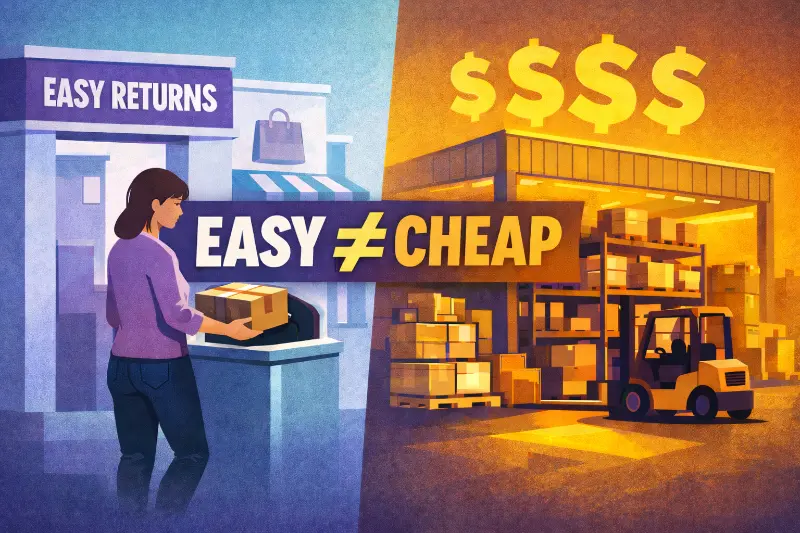
Drop-off networks have genuinely improved how customers experience the first step of a return — and that improvement is real. According to the National Retail Federation, ecommerce returns are projected to hit $890 billion in 2024, representing about 17% of total sales, which poses significant challenges in managing reverse logistics costs and operational efficiency. But improving the beginning of a return is not the same thing as improving the economics of returns management for the merchant on the other side of that transaction.
That distinction matters more than most operators realize. The growth of online shopping and ecommerce operations has made efficient returns management solutions and platforms essential for handling ecommerce returns at scale. When a customer walks into a Happy Returns location with no box and no printed label, the friction they feel goes down. What does not go down, at least not structurally, is the labor, transport, handling, delay, and markdown risk that kicks in the moment that item enters the centralized network on the other side. Better return entry is not the same thing as better return economics. That is the central argument of this piece, and it has real operational consequences for any ecommerce business treating drop-off convenience as a proxy for cost improvement.
Many ecommerce businesses now rely on returns management software and platforms to improve operational efficiency and manage reverse logistics costs, but drop-off networks alone do not address the underlying economic challenges.
Drop-Off Networks Make Returns Easier to Start
Let’s give the model fair credit, because it deserves it.
Traditional mail-back returns were friction-heavy. Customers had to find a box, print a return label, tape everything up, and then locate a drop-off point. For many shoppers, that sequence was enough to turn a neutral return into a negative brand experience. In fact, 75% of users find returns to be the most difficult aspect of ecommerce, and 87% report that a negative returns process will deter them from shopping at that retailer again.
Drop-off networks solved that problem meaningfully. Modern return portals and self-service options now allow customers to initiate return requests online, meeting customer expectations for convenience and keeping customers informed throughout the returns process. Box-free and label-free returns eliminate the two most common physical obstacles in the return process. A customer can walk into a UPS Store, hand over an item in a shopping bag, and walk out. The consolidation happens downstream, invisible to them. From a customer effort standpoint, that is a genuine improvement.
The result is lower first-mile friction, higher return completion rates, and a smoother post-purchase experience. Automation rules and self-service portals streamline the returns process, reducing customer support requests by automating return approvals and keeping customers updated. Merchants benefit from that too. Returns that are easier to initiate tend to produce faster inventory feedback, cleaner data on return reasons, and fewer customer service contacts from shoppers stuck mid-return. The UX case for drop-off networks is solid, especially when paired with an exceptional returns program that builds loyalty.
Many drop-off points now facilitate label-free and box-free returns via a simple QR code scan. The process typically involves customers initiating a return online, selecting a nearby drop-off location, and then dropping off the item, making it quick and low-hassle for busy shoppers.
That is not the problem.
The Expensive Part of Reverse Logistics Starts After the Drop-Off
The problem is what happens next.
Once a customer hands off that item at a drop-off location, the item enters a centralized network. It still needs to be consolidated with other returned items. It still needs to be transported, often across significant distances, to a return center or warehouse. Once there, it still requires intake labor, inspection, repackaging decisions, and disposition routing. If it can be resold, it needs to be restocked or relisted. If it cannot, it moves toward liquidation or disposal. Many retailers report that managing returns manually becomes expensive and operationally complex, leading to significant resource allocation for customer support and warehouse handling, which can hurt profitability, underscoring why businesses look for ways to optimize reverse logistics.
None of those steps disappear because the drop-off experience was smoother.
This is the core mechanics of warehouse-centric returns management: two shipping legs are unavoidable, labor is unavoidable, and delay is unavoidable. The item still flows back into the same warehouse-first economic loop that makes returns expensive for merchants. The drop-off location is, operationally speaking, a longer foyer attached to the same building. However, returns management software and platforms can automate the entire returns process—including return approvals, label generation, and refund processing—which helps manage returns more efficiently and reduce operational costs.
This matters because merchants often evaluate returns innovation through the lens of customer experience metrics. When customers rate a return as easy, operators can reasonably interpret that as a signal that the process is working. But customer effort and merchant-side cost are measuring different things. Automating the process of handling product returns, exchanges, and refunds reduces the operational burden on ecommerce businesses and improves the management of returned inventory. A return can score high on customer satisfaction and still carry the same per-unit economics as a return that was painful to initiate, especially in a world where ecommerce return rates continue to rise.
Convenience at the Front End Does Not Remove Cost at the Back End
Here is where the distinction needs to be made concrete.
Consider what happens on both sides of the same return. A shopper walks into a drop-off location with a pair of shoes and no packaging. There is no box to find, no label to print, no tape to locate. She hands the shoes to the associate and walks out in under two minutes. From her perspective, the return is done. The experience was easy. She is satisfied.
From the merchant’s perspective, that return just began. Those shoes now need to be consolidated at the drop-off location with dozens of other items, picked up by a carrier, transported to a processing facility, received into an intake queue, inspected for condition, repackaged if resellable, and either restocked or routed to a liquidation channel. Every one of those steps carries a cost. The shoes may sit in the pipeline for days or weeks before they are available for resale, and during that time their resale value is quietly eroding.
The customer’s effort went down. The merchant’s cost structure did not.
When a merchant adopts a drop-off network, the specific costs that remain largely unchanged include—regardless of whether the merchant is also offering promotions like free returns that carry their own cost burden:
- Labor at the return center for intake, inspection, and disposition decisions
- Inbound transport from the consolidation point to the processing facility
- Delay between when the item is dropped off and when it is available for resale
- Markdown drag as inventory sits in reverse logistics pipelines, losing value over time
- Inventory distortion as items are unavailable during the return cycle
Return costs and reverse logistics costs remain high due to shipping costs and the need for consolidated returns to optimize the process. These costs are a function of where the item goes after the handoff, not how the handoff was executed. Improving the handoff experience is a real improvement. It is just not the same category of improvement as reducing what it costs to process and recover a returned item.
The consolidation process at drop-off locations enables consolidated returns and bulk shipping, which reduces shipping expenses by lowering the need for individual packaging and leveraging cheaper bulk carrier rates. This approach also improves cash flow and supports stock management for retailers. Bulk shipping and reusable packaging in return processes reduce cardboard waste and carbon emissions from transit. These networks act as a critical solution in reverse logistics by consolidating shipments and accelerating the returns process.
The contrarian insight here is straightforward: convenience at the front end and unchanged economics at the back end are not contradictory. They coexist regularly. A polished front end does not signal a reformed back end. It signals a better on-ramp to the same destination.
Happy Returns and FedEx Easy Returns Prove the Pattern
The two most visible examples in the drop-off space illustrate this dynamic clearly, and the trade-offs are especially clear when you look closely at Happy Returns’ advantages and disadvantages.
Happy Returns built its reputation on the box-free, label-free return experience. Acquired by PayPal in 2021 and then sold to UPS in 2023, it is now fully integrated into the UPS Store network as a UPS company. Its drop off locations and drop off points include stores, lockers, and shipping centers, forming a returns drop-off network—a group of physical locations where customers can return online purchases, saving time and avoiding hassle. The product improved drop-off convenience at scale. What it did not do is structurally change what happens to items after they enter the consolidation and handling pipeline. Items collected at Return Bars still need to flow through centralized processing. The economics of that processing remain intact.
These drop-off networks increase foot traffic to retail locations and can positively impact retail sales by bringing more customers into stores. The fact that Happy Returns has increasingly focused on partnering with other returns management platforms rather than competing as a standalone system reflects its actual value proposition: ownership of the return entry point, not redesign of the reverse logistics destination. Its value is physical convenience. The warehouse-bound economics that follow are not what it was built to solve. In-store returns and online return in-store options further improve convenience for shoppers and help businesses cut costs and restock faster, supporting a more efficient system that builds customer trust and forms part of a broader strategy for crafting the perfect ecommerce returns program.
FedEx launched FedEx Easy Returns in 2025, signaling that carriers see significant strategic value in owning where returns begin. Carriers are racing to control return entry points because doing so gives them first-mile volume, customer relationship data, and network density advantages. That race is about owning the start of the return, not about bending the cost curve of centralized processing downstream.
That is not a criticism of either network. They deliver what they promise: a better experience for customers initiating a return. But when evaluating whether a drop-off network improves returns management economics, the carrier’s motivation for building it is a useful signal. Owning the entry point and restructuring the economics of what happens downstream are different strategic objectives. The industry’s two leading drop-off investments confirm that the innovation is concentrated at the front of the loop, not in the loop itself.
Why Better UX Can Still Preserve a Broken Loop for Customer Satisfaction
What merchants experience and what customers experience in a return are genuinely different things, and conflating them produces bad operational decisions.
From the customer’s perspective, a return is essentially over at the moment of drop-off. The effort is done. The experience is complete. Customers expect a seamless and convenient return process, and meeting customer expectations is a key factor in customer decision-making. Whether that item takes two days or two weeks to process, whether it gets restocked or liquidated, whether the merchant absorbs a 25% markdown or a 40% markdown — none of that is visible or relevant to the customer who just handed over a bag at a UPS Store.
From the merchant’s perspective, the return is just beginning at the moment of drop-off. Every step that follows carries a cost. And those costs compound in ways that average per-return metrics tend to obscure. Transport, labor, delay, and markdown risk are not edge cases. They are structural features of the warehouse-centric model that drop-off networks attach to rather than replace.
A smooth return experience encourages customers returning and enhances customer loyalty, driving repeat purchases. This is why better return entry can coexist with an otherwise expensive and inefficient return system. Improving how returns start does not automatically improve what happens to them. A well-designed on-ramp still leads to the same road.
This is also why it is worth being deliberate about what question you are actually asking when evaluating returns innovation. If the question is “are customers finding it easier to return items?”, drop-off networks can meaningfully move that number. If the question is “are our per-return economics improving structurally?”, the honest answer with drop-off networks alone is: probably not much. That is not a failure of execution. It is a function of what these networks were designed to do.
For a deeper look at why returns software more broadly preserves this same loop, returns software doesn’t actually fix returns covers that argument in full.
The Industry Keeps Improving Return Entry Instead of Rethinking Return Direction
There is a pattern worth naming. Across the last several years of returns innovation, the dominant investment has been in making returns easier to initiate, not in changing where returned items ultimately go. Drop-off networks, box-free experiences, label-free QR codes, in-store return options — these are all improvements to return entry. Many returns platforms and management software solutions now integrate with ecommerce platforms to streamline this process, centralizing and automating workflows for greater efficiency. They reduce friction at the moment of handoff.
What the industry has not broadly cracked is how to change the destination. As long as the default endpoint for a returned item remains a centralized warehouse or return center, the structural cost drivers remain intact regardless of how smoothly the item arrived there. This pattern is directly connected to why scale and consolidation failed to reduce returns — a topic covered separately, but worth naming here because the drop-off investment follows the same logic: more and better infrastructure around the existing loop, rather than a challenge to the loop itself.
The distinction between improving the beginning of the loop and rethinking the loop itself is not academic. It has direct implications for where merchants allocate returns-related investment and what they should expect to get back from it. For example, AfterShip Returns is a returns platform that offers key features such as automated return approvals, branded portals, and carrier integrations, supporting seamless automation and integration with major ecommerce platforms. Other tools, such as the Return Prime returns solution, focus heavily on software workflows while leaving physical logistics to external providers. When selecting a returns management solution, it is important to evaluate key features and core capabilities to ensure the software meets specific brand needs. Convenience improvements are worth pursuing for their customer experience benefits. But they should not be evaluated as though they are solving the same problem as structural cost reduction.
If the destination remains a warehouse, the economics remain a warehouse problem. Improving how items arrive at that destination is a different category of solution than changing where items go. Merchants who understand that distinction are better positioned to evaluate which investments will actually bend their returns management cost curve and which will improve customer satisfaction scores without touching their P&L.
For merchants curious about what structural rerouting looks like in terms of cost, the economics of peer-to-peer returns covers the comparison in detail, just as solutions like the ZigZag returns management platform illustrate how software can reshape routing options without fully owning the logistics network.
Conclusion
Drop-off networks are a genuine improvement in customer experience. No serious evaluation of returns management should dismiss that. Box-free, label-free return initiation reduces friction, improves completion rates, and produces better data. Those are real benefits, and they belong in any honest accounting of what these networks deliver. However, optimized reverse logistics and efficient processes to process returns are essential for reducing costs and maximizing the value of these networks.
But the expensive parts of returns management are not located at the drop-off point. They are located in everything that happens after: consolidation, transport, intake, inspection, handling, delay, and markdown risk. Those costs remain structurally intact in a warehouse-centric model regardless of how smooth the entry experience is. Drop-off networks improve the first mile of a return. They do not improve the full model.
Merchants who treat convenience at the front end as a proxy for economic improvement at the back end will find themselves with satisfied customers and an unchanged cost structure. Offering store credit and instant refunds can further enhance the returns experience, support customer retention, and incentivize loyalty as part of a comprehensive returns management strategy. Understanding that difference is not a reason to abandon drop-off networks. It is a reason to evaluate them accurately — and to keep asking the harder question about what it would actually take to make returns cheaper to finish, not just easier to start.
Frequently Asked Questions
Do drop-off networks reduce the cost of returns for merchants?
Not structurally. Drop-off networks reduce first-mile friction for customers by eliminating the need for a box or printed label, but the item still enters a centralized network requiring consolidation, transport, inspection, and handling. However, many drop-off networks provide preprinted or digital return labels or return shipping labels, making the process easier for customers. Real-time return status updates are also available through many platforms, giving both you (retailers and customers) better visibility into the return process. Those costs remain largely intact regardless of how smoothly the item was handed off at the drop-off point.
Why do carriers like UPS and FedEx invest in drop-off return networks if they don’t fix economics?
Carriers are competing to own return entry points because doing so gives them first-mile volume, customer relationship data, and network density advantages. Owning where a return starts is a different strategic objective than restructuring what happens to the item once it enters the reverse logistics pipeline. The investment is about controlling the beginning of the loop, not redesigning it. Both you (retailers and customers) benefit from improved security and accessibility, especially through secure lockers and staffed counters that protect returns and make drop-offs easier.
What is the difference between front-end returns convenience and back-end returns economics?
Front-end convenience refers to the customer experience of initiating a return — how easy it is to hand off an item. Back-end economics refers to the merchant-side costs that accumulate after that handoff: transport, labor, delay, inspection, repackaging, and markdown risk. Improving the former does not automatically improve the latter, and conflating the two produces inaccurate evaluations of returns management investments. In-person scanning at drop-off locations also helps minimize return fraud by verifying each return as it enters the network.
Is Happy Returns an example of structural returns improvement?
Happy Returns improved drop-off convenience at meaningful scale. It did not structurally change the economics of what happens to items after they enter the centralized processing network. Items collected at Return Bars still require consolidation, transport, and warehouse-based disposition. The UX innovation is real; the structural economic improvement is limited. Drop-off networks also improve accessibility for customers in underserved areas or those without home printers, and secure lockers reduce the risk of package theft or weather damage compared to doorstep pickups.
If drop-off networks don’t fix returns economics, what does?
Structural cost reduction in returns management requires changing where returned items go, not just how they arrive at the current destination. Approaches that reroute eligible returns forward toward the next buyer rather than backward through a centralized system address the cost drivers that drop-off networks leave intact. The economics of peer-to-peer returns explores what that looks like in practice.
Should merchants stop using drop-off networks?
No. Drop-off networks deliver real customer experience benefits and can improve return completion rates and data quality. The point is not that they are without value — it is that their value is concentrated in customer convenience, not merchant-side cost reduction. Merchants should evaluate them accordingly and not conflate UX improvement with structural economic improvement in their returns management strategy.
Written By:

Manish Chowdhary
Manish Chowdhary is the founder and CEO of Cahoot, the most comprehensive post-purchase suite for ecommerce brands. A serial entrepreneur and industry thought leader, Manish has decades of experience building technologies that simplify ecommerce logistics—from order fulfillment to returns. His insights help brands stay ahead of market shifts and operational challenges.

Turn Returns Into New Revenue
Related Articles

Why Returns Look Manageable Until They Suddenly Aren’t
Returns management is the retail process of handling customer returns across reverse logistics, cost control, and customer experience—and it rarely fails the way leadership expects...

The Economics of Peer-to-Peer Returns
Traditional returns management has one fundamental flaw: it optimizes a process that should not exist in its current form.

The Myth of “Efficient” Reverse Logistics
Efficient reverse logistics is treated as a goal worth chasing.