
SFP Trial Checklist: Are You Ready for Seller Fulfilled Prime?

Last updated on June 08, 2026
In this article
 51 minutes
- Download the Seller Fulfilled Prime Trial Checklist
- Before You Start: Should This SKU Be in SFP at All?
- Step 1: Select the Right SKUs for the SFP Trial
- Step 2: Make Sure the SKU Can Absorb Shipping Shocks
- Step 3: Inventory Activation Readiness
- Step 4: Choose the Right Warehouse Footprint
- Step 5: Pressure-Test Warehouse Operations
- Step 6: Ask Better Questions Before Choosing a 3PL
- Step 7: Define Trial Success Before Launch
- Step 8: Prepare for the Actual SFP Trial Process
- Red Flags That Mean You Should Delay SFP
- Seller Fulfilled Prime Readiness Scorecard
- Final Takeaway: SFP Is Hard, But It Is Not a Mystery
- Feeling Overwhelmed? Cahoot Can Help Evaluate SFP Readiness
- Frequently Asked Questions
Seller Fulfilled Prime can be one of the most powerful programs available to Amazon sellers, but it is not something to enter casually.
The appeal is obvious. With Seller Fulfilled Prime, sellers can display the Prime badge on eligible products while fulfilling those orders from their own facility, a third-party logistics provider, or another fulfillment setup outside of Amazon FBA. That means more control over inventory, packaging, fulfillment strategy, and operational flexibility while still offering the Prime experience customers expect.
But SFP is not just a badge. It is an operating commitment.
Amazon requires sellers to prequalify, complete a trial, and continuously meet program performance requirements after enrollment. During the trial, sellers need to prove that their operation can support fast, reliable delivery before Prime branding is applied to their products. After enrollment, performance is still monitored, and failure to maintain the new, stricter SFP requirements can put Prime eligibility at risk.
That is why the right question is not simply:
Can we sign up for SFP?
The better question is:
Should we use SFP for this SKU, and can our fulfillment model support it profitably under real-world conditions?
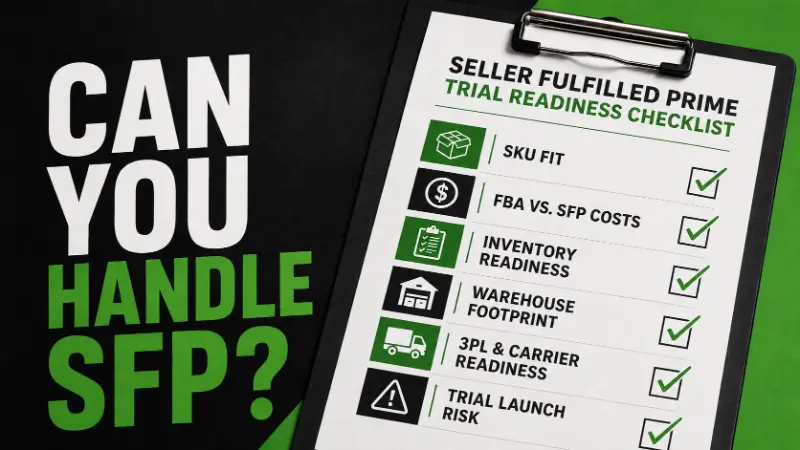
This checklist walks through the major decisions sellers should review before launching Seller Fulfilled Prime. It is designed to help you pressure-test your SKUs, FBA comparison, warehouse footprint, carrier strategy, 3PL readiness, and trial plan before the Prime badge is on the line.
SFP is difficult, but it is not impossible. The sellers who struggle are usually not the ones who fail to read the requirements. They are the ones who underestimate what those requirements mean operationally.
Watch: What to Fix Before Your SFP Trial Starts
The Seller Fulfilled Prime trial tests an operating setup, not just a seller’s ability to ship packages. In this video, Manish Chowdhary walks through the problems to check before you begin, including SKU selection, inventory availability, delivery promises, shipping settings, and carrier readiness.
The takeaway: Test the customer-facing delivery promise and the complete order-to-carrier workflow before starting the trial. Use the scorecard and steps below to document what is ready, who owns each remaining fix, and whether your chosen SKUs can support the trial under normal exceptions.
Download the Seller Fulfilled Prime Trial Scorecard
Check if your operations is ready for SFP trial with this downloadable scorecard. Pressure-test your SKUs, FBA comparison, warehouse footprint, margin resilience, 3PL readiness, and SFP trial plan before Prime performance is on the line.
Download the Seller Fulfilled Prime Trial Scorecard
Before You Start: Should This SKU Be in SFP at All?
Before you review cutoff times, carrier settings, warehouse coverage, or trial enrollment, start with a more basic question:
Does this SKU actually belong in Seller Fulfilled Prime?
This matters because SFP is not automatically cheaper than FBA. In many cases, FBA is a very strong default. Amazon stores inventory, picks, packs, ships, handles customer service, processes returns, and gives eligible products access to Prime delivery. Sellers should understand the broader tradeoffs between Fulfillment by Amazon and Fulfillment by Merchant before assuming SFP will be the better option. Under the merchant fulfilled network, the seller keeps those customer service inquiries and fulfillment responsibilities, which is one reason some merchants consider Amazon Seller Fulfilled Prime instead. For many standard-size products, that bundled service is difficult to beat with internal fulfillment or outsourced fulfillment.
That does not mean FBA is always better. It means FBA should be the benchmark.
SFP tends to become more interesting when one of two things is true, especially in the context of rising FBA fees and using SFP strategically:
First, the SKU may be a cost-saving candidate. Based on Cahoot’s experience comparing FBA and SFP costs across a large number of ASINs, meaningful savings are typically concentrated in Amazon’s Extra-Large size tier. This is a specific FBA size classification, not simply a product that happens to be large. Products in the Extra-Large tier exceed the dimensional limits of Amazon’s Small Bulky and Large Bulky categories, or have a shipping weight above 50 pounds when dimensional weight is considered. These ASINs often face significantly higher FBA fulfillment costs, making them the most likely candidates for SFP cost savings.
Second, the SKU may be a strategic-control candidate. In this case, SFP may not be cheaper than FBA, but it may still be worth considering because the seller needs more control over inventory, packaging, handling, replenishment, or returns, since the seller fulfilled prime program can let an online business ship from its own warehouse while still participating in the broader prime program.
A meltable product is a good example. If Amazon restricts meltable FBA inventory during certain warm-weather periods, the seller may need an alternative fulfillment path even if FBA is usually attractive. Special packaging, fragile handling, high-value inspection, inventory control, or returns strategy can also justify SFP for reasons beyond pure fulfillment cost.
The mistake is treating all of these scenarios the same.
If your goal is cost savings, the math has to prove SFP is cheaper than FBA. If your goal is control, then the business case should be honest about what that control is worth.
SFP fit checklist
Review each SKU before you go further:
- Is this SKU standard-size, oversize, or extra-large?
- What does FBA currently cost for this SKU?
- What would it cost to fulfill this SKU through your own operation or a 3PL?
- Have you included pick/pack, packaging, labor, shipping, software, exception handling, and returns?
- Is this SKU likely to require premium, air, or overnight shipping under SFP?
- Is there a non-cost reason to use SFP, such as meltable restrictions, special handling, branded packaging, inventory control, or FBA limitations?
- If FBA is cheaper, is the strategic reason for SFP strong enough to justify the extra complexity?
Reality check
If FBA already gives this SKU Prime eligibility at a lower total cost and Amazon handles the product well, SFP may not be the right cost-saving strategy.
That is not a failure. It is a good decision.
The goal is not to force SFP onto every product. The goal is to identify the products where SFP creates a real advantage.
One example is extremely large products that exceed normal parcel-shipping limits. Large projector screens are often packaged as long, narrow tubes. Some models can reach lengths of 117 inches, which exceeds the 108-inch maximum length accepted by UPS and FedEx for standard parcel shipments.
At first glance, these products may seem like ideal SFP candidates because Amazon FBA fulfillment fees can be very high. In our experience, some projector screens have incurred FBA fulfillment charges exceeding $50 per order. However, once sellers investigate alternatives, they often discover that outsourced fulfillment outside Amazon is not necessarily cheaper. The limited carrier options, special handling requirements, and oversized freight costs can make third-party fulfillment difficult to source and expensive to operate.
In cases like these, a high FBA fee alone is not enough reason to move a SKU into SFP. The real comparison is whether a reliable fulfillment alternative exists at a lower total cost. Sometimes the answer is yes. Sometimes Amazon’s expensive option is still the most practical one available.
Step 1: Select the Right SKUs for the SFP Trial
Once a SKU passes the first fit check, the next question is whether it is a good trial candidate.
Do not start with your whole catalog. SFP should begin with a controlled group of SKUs that can generate useful data without putting the entire operation at risk.
One of the most overlooked factors in SFP trial planning is sales volume.
Many sellers focus on the fact that Amazon’s trial only requires 100 shipped packages. On paper, that sounds manageable. In practice, 100 orders is a surprisingly small sample size when you consider the performance metrics required to pass.
For example, sellers must maintain the required on-time delivery performance throughout the trial. If you only ship 25 orders in a given week and one package arrives late due to a carrier issue, your metrics may still be fine. But if two packages are delayed by UPS or FedEx for reasons completely outside your control, your performance can drop below the required threshold very quickly.
The problem is not necessarily your operation. The problem is statistical volatility.
When order volume is low, every late package has an outsized impact on your metrics. A couple of carrier delays that would barely register in a larger sample can become the difference between passing and failing the trial.
This is why sellers should not simply look for SKUs that can generate 100 orders. They should look for SKUs that generate substantially more volume than the minimum requirement. Higher-volume SKUs create a larger performance buffer against the occasional carrier delay, weather event, missed scan, or carrier delivery exception.
Just as importantly, sellers need a plan to generate that volume during the trial.
Amazon does not display the Prime badge on your listings during the SFP trial period. That means your trial ASINs are competing against Prime-eligible products without receiving one of the biggest visibility and conversion advantages on the marketplace. If you simply enroll a SKU and wait for organic traffic to carry the trial, you may struggle to generate enough orders to produce meaningful results.
In many cases, advertising and promotions are not optional during the trial—they are part of the trial strategy.
Sponsored Products campaigns, coupons, deals, email marketing, social traffic, and other demand-generation efforts can help ensure your trial ASINs receive enough visibility to generate order volume. Think of these investments as giving your SFP trial products a fair fighting chance while they are temporarily operating without the Prime badge.
That matters because the stakes are high. Sellers only have a limited number of opportunities to pass the trial, so each attempt should be treated as valuable. A weak SKU selection strategy can burn a trial attempt even when the fulfillment operation itself is capable of meeting SFP requirements.
A good SFP trial SKU usually has six traits:
It has enough sales velocity to produce meaningful results and provide metric stability. If the SKU barely sells, the trial will not teach you much, and a small number of carrier exceptions can disproportionately affect performance.
It has enough margin to absorb exceptions. Even a strong SFP setup will occasionally face missed pickups, late carrier scans, regional disruptions, inventory mismatches, or orders that require more expensive service than expected. If one or two expensive shipments wipe out the margin, the SKU is fragile.
It has a realistic traffic-generation plan. Because the Prime badge is not displayed during the trial, sellers should know how they will drive visibility and demand to the ASIN rather than relying entirely on organic rankings.
It is operationally predictable. The best trial SKUs are not the ones that require special handling every time, constant manual inspection, odd packaging, or unusual carrier decisions.
It has stable inventory. SFP puts pressure on inventory accuracy. If a SKU is frequently oversold, backordered, manually adjusted, or spread thin across multiple locations, it can create avoidable trial risk.
It can realistically meet the delivery promise from the selected fulfillment location. A SKU may look profitable on average but become unworkable if too many orders require expensive shipping to hit the promised date.
SKU selection checklist
Before adding a SKU to the SFP trial, confirm:
- The SKU has enough sales velocity to produce useful trial data.
- The SKU generates significantly more volume than the minimum trial requirement.
- The SKU provides enough order volume that occasional carrier delays will not disproportionately impact performance metrics.
- There is a realistic plan to drive additional traffic and sales volume to the trial ASIN if needed.
- Advertising, promotions, or external traffic efforts are aligned with the trial timeline.
- The SKU has enough margin to absorb occasional premium shipping.
- The SKU is not operationally messy to pick, pack, label, or hand off.
- The SKU has stable inventory and a reliable replenishment plan.
- The SKU can meet the expected delivery promise from the planned fulfillment location.
- The SKU does not depend on every shipment going perfectly to remain profitable.
- The SKU belongs in either a cost-saving bucket or a strategic-control bucket.
Trial SKU categories
It helps to divide SKUs into three groups:
Strong SFP candidates are SKUs where the economics, inventory, fulfillment process, delivery coverage, sales volume, and traffic-generation plan all look workable.
Conditional SFP candidates are SKUs where SFP may work, but only if a specific risk is controlled. That risk might be warehouse coverage, inventory depth, carrier cost, exception response, insufficient order volume, or the need for additional traffic generation.
Poor SFP candidates are SKUs where FBA is cheaper, inventory is unstable, fulfillment is messy, sales volume is too low, traffic is difficult to generate, or the model only works under perfect conditions.
Do not be afraid to exclude SKUs. A smaller, cleaner trial is usually better than a broader trial filled with avoidable risk. Just make sure the SKUs you do choose generate enough volume—or can be supported with advertising and traffic-driving efforts—to give you a realistic chance of passing the trial without being derailed by a handful of carrier exceptions.
Step 2: Make Sure the SKU Can Absorb Shipping Shocks
Many sellers focus on the average shipping cost when evaluating SFP. The bigger risk is the occasional shipment that becomes unexpectedly expensive.
Even with a well-designed SFP operation, there will be situations where you need to upgrade service to protect delivery performance. An order may come from a distant region. A carrier lane may underperform. A warehouse may miss a cutoff. Amazon system timing may leave less fulfillment time than expected. In some cases, the only practical solution is to use a much more expensive shipping service than originally planned.
These situations are usually infrequent, but they matter because they can erase the profit from multiple normal orders.
That is why margin matters so much when selecting SFP SKUs.
One Cahoot merchant running Seller Fulfilled Prime through five fulfillment locations provides a good real-world example. Their average shipping cost using ground service is about $18 per order. However, roughly 2% of recent orders required either 2nd Day Air or Next Day Air to protect the delivery promise, increasing shipping costs to between $23 and $47 on those shipments.
At first glance, a 2% exception rate may not sound significant. But if a SKU only has a few dollars of contribution margin after fulfillment and shipping, those occasional air shipments can quickly consume profits. The merchant’s program works because the products enrolled in SFP have enough margin to absorb those exceptions without turning the overall SKU unprofitable.
That is the mindset sellers should adopt when evaluating trial candidates.
Do not ask whether the SKU is profitable when everything goes according to plan. Ask whether it remains profitable when a small percentage of orders require substantially more expensive shipping.
The goal is not to eliminate shipping shocks. The goal is to choose products that can absorb them without destroying profitability.
Margin resilience checklist
Before launching SFP, answer:
- What is the expected shipping cost under normal conditions?
- What is the expected shipping cost when expedited service is required?
- How often might premium shipping be needed?
- Does the SKU remain profitable if 2 percent of orders require air service?
- Does the SKU remain profitable if 5 percent of orders require overnight shipping?
- Does the SKU remain profitable if 10 percent of orders require overnight shipping?
- How many expensive shipments can the SKU absorb before margins become unacceptable?
- What is the maximum shipping cost this SKU can tolerate?
- What is the stop-loss threshold for the trial?
Reality check
If a single overnight shipment can wipe out the profit from several orders, the SKU may not be a strong SFP candidate.
A useful stress test is to model something similar to the Cahoot merchant example above: average ground shipping around $18, with approximately 2% of orders requiring air services costing $23 to $47. If the SKU still produces acceptable margins under those conditions, it is much more likely to succeed in a real SFP environment.
The best SFP SKUs have enough margin to survive occasional shipping surprises without turning negative. Those surprises are part of operating Seller Fulfilled Prime, and planning for them upfront is far better than discovering them during the trial.
Step 3: Inventory Activation Readiness
This step is intentionally placed after warehouse footprint planning because the question is no longer where inventory should live.
The question is whether inventory is actually ready before you turn SFP on.
One of the most expensive mistakes sellers make is enabling SFP shipping templates before inventory has been fully received, reconciled, and made available across the fulfillment network. On paper, the warehouse footprint looks ready. In reality, inventory is still in transit, sitting on a receiving dock, waiting to be checked in, or not yet synced across systems.
The moment SFP goes live, Amazon starts making delivery promises based on the fulfillment setup you’ve configured. If inventory is not truly ready, orders can immediately start routing in ways you did not expect.
That often creates two bad outcomes.
The first is operational. Orders may need to be fulfilled from backup locations that were never intended to handle that volume. Inventory mismatches can trigger cancellations, delays, or manual intervention, undermining many of the advantages described in broader guides to winning on Amazon Seller Fulfilled Prime.
The second is financial. Sellers may suddenly find themselves paying for overnight or premium shipping simply to protect delivery promises that should never have been made in the first place.
In other words, warehouse footprint determines where inventory should be.
Inventory activation readiness determines when you should turn SFP on.
Inventory activation checklist
Before enabling SFP shipping templates, confirm:
- Inventory has been physically received at every planned fulfillment location.
- Inventory has been checked in and is available for picking.
- Inventory counts are accurate across Amazon, your OMS, your WMS, and any 3PL systems.
- Inventory synchronization has been tested.
- Routing logic is directing orders to the correct fulfillment locations.
- Safety stock levels have been established.
- Replenishment inventory is already in motion if needed.
- No location is relying on inventory that is still inbound.
- Trial SKUs have enough available inventory to support expected demand.
- A test order has been run to verify fulfillment and routing behavior.
The “don’t turn it on yet” test
Before activating SFP, ask a simple question:
If 50 orders arrived today, could every fulfillment location ship its assigned orders immediately?
If the answer is no because inventory is still being received, counted, transferred, or synchronized, wait.
A few extra days of preparation is usually far cheaper than a week of overnight shipments, delivery exceptions, and damaged metrics.
Timing matters more than most sellers realize
Many sellers focus heavily on network design and carrier strategy but underestimate activation timing.
The difference between turning SFP on Monday versus turning it on Friday after inventory is fully received may seem minor. In practice, that timing decision can determine whether the trial starts smoothly or begins with avoidable exceptions.
The goal is not simply to have inventory somewhere in the network.
The goal is to have inventory fully available, visible, and ready for fulfillment before Amazon starts making Prime delivery promises.
Step 4: Choose the Right Warehouse Footprint
This is where many SFP evaluations go wrong.
Sellers often focus on whether a warehouse can physically ship orders. Amazon cares about something different: whether your fulfillment network can consistently generate the delivery promises required for your SKU’s size tier.
The key word is promises.
Seller Fulfilled Prime delivery speed metrics are based on what Prime customers see on the product page before they buy, not how quickly you ship after the order is placed. Amazon measures the percentage of Prime customer page views that display delivery promises within specific timeframes.
For example, if a customer views your listing and sees a same-day or next-day delivery promise, that page view counts toward the ≤1-day metric. If they see a two-day promise, it counts toward the ≤2-day metric. If they see a three-day or longer promise, it does not help your delivery speed metrics even if you ultimately ship the order perfectly.
This distinction is critical because warehouse location, operating schedules, carrier coverage, and shipping templates all influence the delivery promise shown to customers.
Understand your size tier first
Amazon evaluates delivery speed requirements differently depending on the product’s size tier.
A product is considered standard-size if all of the following are true:
- Longest side is 18 inches or less
- Median side is 14 inches or less
- Shortest side is 8 inches or less
- Weight is 20 pounds or less
A product is considered oversize if it exceeds any standard-size threshold but does not qualify as extra-large.
A product is considered extra-large if it meets any of the following:
- Longest side is 96 inches or more
- Length plus girth is 130 inches or more
- Weight is 50 pounds or more
- Television with a longest side of 40 inches or more
Amazon displays each item’s assigned size tier within Seller Central, and sellers should verify this before evaluating SFP eligibility.
Why warehouse distribution matters
The warehouse footprint required for SFP is largely determined by the delivery speed metrics Amazon expects for that size tier.
Current minimum requirements are:
| Size Tier | ≤1 Day Promise | ≤2 Day Promise |
| Standard-size | 30% | 70% |
| Oversize | 10% | 45% |
| Extra-large | N/A | 15% |
Beginning July 6, 2026, Amazon will increase these requirements:
| Size Tier | ≤1 Day Promise | ≤2 Day Promise | ≤5 Day Promise |
| Standard-size | 40% | 75% | 90% |
| Oversize | 15% | N/A | 80% |
| Extra-large | N/A | 25% | 60% |
These changes matter because they directly affect how many fulfillment nodes a seller may need.
Historically, some sellers could achieve the oversize requirement with only two strategically located warehouses because they only needed to generate a 10% one-day promise rate. Once that requirement increases to 15%, many two-node networks will struggle to provide enough one-day coverage.
This is where limitations of smaller 3PL networks often become visible. A provider may be excellent operationally, but if they only operate two warehouses, they may not have enough geographic reach to generate the delivery promises required for certain SFP size tiers —making it important to evaluate specialized Amazon SFP 3PL fulfillment services that can provide broader coverage.
Delivery promises are not shipping speeds
One of the most common SFP misunderstandings is assuming that fast shipping automatically creates fast delivery promises.
It does not.
Imagine a customer views your listing on Saturday afternoon after your warehouse cutoff time.
Your warehouse does not operate Sunday.
The order cannot leave until Monday.
Even if you use overnight shipping, the earliest delivery may be Tuesday.
From Amazon’s perspective, that customer saw a three-day delivery promise when they viewed the listing. That page view does not help your one-day or two-day delivery speed metrics.
This is why sellers often need significantly more one-day coverage than the minimum requirement suggests.
Weekend operations, carrier schedules, holidays, cutoff times, and regional transit times all create page views that naturally produce slower delivery promises. To offset those weaker periods, sellers need stronger coverage during the rest of the week.
For example, if a large percentage of your customers are located in a region that currently receives a two-day promise, adding inventory closer to that region may convert many of those customers into one-day promise customers. That improvement can have a meaningful impact on delivery speed metrics without requiring expensive air shipments.
The goal is ground shipping, not air shipping
A healthy SFP network is usually designed around ground transportation.
The objective is to place inventory close enough to customers that most orders can meet the required delivery promise using economical ground services. If your network depends heavily on overnight air shipments to maintain compliance, profitability can deteriorate quickly.
When evaluating warehouse footprint, ask:
- How many customers can receive a one-day promise using ground shipping?
- How many customers can receive a two-day promise using ground shipping?
- Which regions require air services?
- What percentage of orders would require premium transportation?
- Does the economics still work if carrier costs increase?
The best SFP networks are typically those that maximize delivery speed through inventory placement rather than transportation spend.
Warehouse footprint checklist
Before launching SFP, review:
- Which size tier each trial SKU belongs to.
- The delivery speed requirements for that size tier.
- Which customer regions can receive one-day promises from the current network.
- Which customer regions can receive two-day promises from the current network.
- Which regions require premium shipping.
- Whether additional fulfillment nodes would improve delivery promise coverage.
- Whether the SKU has enough volume to justify distributed inventory.
- Whether adding nodes would create inventory fragmentation risk.
- Whether routing logic can automatically select the correct fulfillment location.
- Whether warehouse operating schedules support the desired delivery promises.
- Whether weekend operations are helping or hurting delivery speed metrics.
Practical guidance
Do not assume every SKU belongs in SFP.
The delivery speed requirements themselves should influence SKU selection.
Standard-size products generally face the most demanding delivery speed expectations while often benefiting from the strongest FBA economics. In many cases, sellers must build substantial one-day coverage to satisfy standard-size requirements.
Oversize and extra-large products may be more attractive SFP candidates because FBA economics can be less favorable and delivery speed requirements are somewhat less aggressive. That does not make them easy, but it can make the business case more realistic.
The warehouse footprint should follow the SKU strategy, not the other way around.
A seller should first determine which products belong in SFP, then build the fulfillment network necessary to support the required delivery promises for those products.
Step 5: Pressure-Test Warehouse Operations
A warehouse that can fulfill ecommerce orders is not automatically ready for Seller Fulfilled Prime.
SFP creates a different level of operational pressure because the delivery promise is tied directly to Prime customer expectations and Amazon’s ongoing performance requirements. Orders need to move on time, tracking needs to update correctly, and exceptions need to be handled quickly. More importantly, the warehouse must be able to operate within Amazon’s specific SFP rules, not just general ecommerce best practices.
The first operational question is same-day execution. Amazon requires zero-day handling time for Prime orders that arrive before the applicable order cutoff. Can SFP orders be picked, packed, labeled, and handed off the same day when required? Not on the best day. Not when volume is light. Reliably.
The second question is cutoff readiness. Amazon’s SFP policy requires sellers to configure order cutoff times of at least 2:00 p.m. local time Monday through Friday and at least 10:30 a.m. local time on Saturdays and Sundays. This requirement alone eliminates many fulfillment operations from serious SFP consideration. A surprising number of 3PLs stop processing same-day orders at noon or earlier. If a warehouse cannot consistently support Amazon’s required cutoff windows, it may not be operationally compatible with SFP regardless of how well it performs for other channels.
The third question is weekend operations. Amazon requires SFP sellers to operate on at least one weekend day by receiving, packing, and shipping Prime orders on Saturday, Sunday, or both. Amazon’s policy explicitly states that removing Prime listings, toggling Prime eligibility, reducing Prime order limits, or taking other actions to avoid weekend operations harms customer trust and violates SFP policy.
Technically, some sellers have attempted to manually disable Prime templates over the weekend and re-enable them on Monday to avoid weekend fulfillment requirements. One Amazon seller who used to manage SFP internally used this approach. In practice, however, it required constant manual intervention every week, including disabling Prime templates, adjusting advertising, monitoring listings, and restoring everything on Monday. Beyond the operational burden, Amazon’s policy now specifically discourages this type of workaround. For most sellers, six-day operations are effectively a requirement for sustainable SFP participation.
The fourth question is prioritization. SFP orders should not sit in the same queue as every other order if that creates risk. If the warehouse is also supporting Shopify, Walmart, wholesale, replenishment, returns, or B2B orders, the SFP process needs clear priority rules.
The fifth question is exception response. Every fulfillment operation has exceptions. The difference with SFP is that exceptions need fast ownership because Amazon reviews performance continuously and can disable Prime offers when requirements are missed repeatedly.
Just as important is the ability to recover from exceptions without disrupting the customer promise. A missed carrier pickup, weather event, warehouse outage, inventory discrepancy, or even an Amazon system delay should not automatically become a late shipment. For example, if a UPS truck fails to arrive at a Pennsylvania warehouse and dozens of Prime orders miss their planned handoff, can those orders be quickly rerouted to another warehouse that has inventory and can still reach the customer on time? If a snowstorm shuts down an Indiana facility for a day, can your systems automatically shift fulfillment to another node without requiring hours of manual intervention?
SFP operations need contingency plans for these scenarios because they happen more often than sellers expect. The strongest SFP networks are not the ones that never experience disruptions. They are the ones that detect problems quickly and recover before customers notice. Even Amazon occasionally introduces edge cases, such as orders appearing after the configured cutoff but still requiring same-day shipment. Your systems and operations team need visibility into these exceptions and a process for resolving them before they impact performance metrics.
Warehouse operations checklist
Before launching SFP, confirm:
- SFP orders can be identified clearly.
- SFP orders can be prioritized in the warehouse.
- Pick/pack/ship can happen same day when required.
- The warehouse can support Amazon’s required order cutoff times.
- Carrier pickup schedules align with those cutoff times.
- Staff coverage supports weekend operations.
- Weekend orders will be received, packed, and shipped according to policy.
- There is a documented process for missed picks, label failures, inventory mismatches, and late carrier pickups.
- There is a documented contingency plan for missed carrier pickups, warehouse closures, and severe weather events.
- Orders can be reassigned to another fulfillment location when necessary.
- Someone owns exception resolution daily.
- The warehouse can recover from volume spikes without sacrificing SFP orders.
- The team has run a dry test before live trial volume starts.
Specific failure modes to watch
The most dangerous SFP problems are often small operational misses that compound.
A label fails.
A picker cannot find the item.
A carrier scan is missing.
A batch misses cutoff by 15 minutes.
An order is routed to the wrong node.
A weekend order sits until Monday.
A carrier misses a scheduled pickup.
A warehouse closes unexpectedly due to weather or a local disruption.
An Amazon order arrives with an unexpected same-day shipping requirement.
None of these problems seem dramatic in isolation. But under SFP, the customer promise does not care whether the issue was small internally. If the delivery promise is missed, the metric is at risk.
One of the most common readiness mistakes is assuming that a warehouse that performs well for ordinary ecommerce fulfillment is automatically ready for SFP. In reality, cutoff times, weekend operations, and exception recovery are often the first points of failure. Sellers should verify these capabilities explicitly before enrolling in the trial rather than discovering the gap after Prime orders begin flowing.
Step 6: Ask Better Questions Before Choosing a 3PL
If you plan to use a 3PL for Seller Fulfilled Prime, do not ask—especially when evaluating options like the best 3PL companies for Amazon SFP:
Can this 3PL ship Amazon orders?
Ask:
Can this 3PL protect the Prime promise for the specific SKUs, size tiers, delivery requirements, inventory footprint, and exception scenarios our SFP program will face?
Many 3PLs can fulfill marketplace orders. Far fewer can consistently support Amazon’s SFP requirements around delivery promises, cutoff times, weekend operations, inventory placement, carrier performance, and exception recovery.
Focus on SFP-specific capabilities
If you are formalizing your search, using a structured RFP template for 3PL partner evaluation can help you compare providers on the SFP-specific capabilities that matter most.
A strong SFP evaluation starts with the work you already completed earlier in this checklist:
- Which SKUs are good SFP candidates?
- Which size tiers do they belong to?
- What delivery promises are required?
- How many fulfillment nodes are needed?
- How much premium shipping exposure can the SKU absorb?
- What happens when inventory, carrier, or warehouse issues occur?
If a 3PL cannot answer those questions in operational detail, they may not be ready to support your SFP program.
Key questions to ask
Ask the 3PL:
- Which SFP size tiers can your network realistically support?
- Which regions can receive one-day and two-day delivery promises?
- Which regions require premium or air shipping?
- How do you prioritize SFP orders inside the warehouse?
- What are your weekday and weekend cutoff times?
- Which weekend days do you operate and which carriers pick up?
- How do you route orders across multiple fulfillment nodes?
- Can orders be reassigned if the preferred location cannot ship?
- How do you monitor late shipments, missed pickups, and tracking issues?
- What happens when inventory is unavailable, a carrier misses pickup, or a facility experiences disruption?
- Can you show reporting that separates SFP performance from other order types?
Watch for weak answers
Be cautious if the conversation stays at a high level:
- “We can ship fast.”
- “We have Amazon integrations.”
- “We do two-day shipping.”
- “We handle Prime.”
- “We have multiple warehouses.”
Those statements may be true, but they do not prove the provider can support SFP.
A strong answer connects warehouse footprint, delivery promise coverage, cutoff readiness, weekend operations, inventory routing, and exception recovery into one operating model.
If the 3PL cannot clearly explain how they protect the Prime promise when things go wrong, they may not be the right partner for SFP.
Step 7: Define Trial Success Before Launch
Passing the SFP trial is important, but it is not the only definition of success.
A seller can pass the trial and still discover that the model is too expensive, too fragile, too dependent on air shipping, or too operationally stressful to maintain.
That is why success should be defined before launch.
The trial should answer more than one question. It should not only prove that you can meet Amazon’s requirements for a short period. It should prove that the SFP model is worth continuing after the trial ends.
At minimum, your trial should answer five questions:
- Did we meet Amazon’s performance requirements?
- Did the selected SKUs preserve acceptable margin?
- Did the warehouse footprint generate the delivery promises we expected?
- Did warehouse operations and exception recovery work under real pressure?
- Do we believe this model can survive normal post-trial conditions without constant manual intervention?
If the answer to the first question is yes but the other four are no, be careful. Passing the trial may prove that your operation can perform temporarily. It does not automatically prove that SFP is the right long-term model.
Define why you are doing SFP
Before launching the trial, define the business reason for SFP.
Your reason may be cost savings, but that should only be true if the FBA comparison supports it.
Your reason may be operational control. That could include special handling, better inventory visibility, branded packaging, meltable product constraints, reduced FBA dependency, or more control over returns.
Your reason may be strategic flexibility. Some sellers want the ability to maintain Prime eligibility without putting every unit into Amazon’s network.
These are all valid reasons, but they are not the same reason. Each one requires different success metrics.
- A cost-saving SFP trial should be judged heavily on contribution margin.
- A control-driven SFP trial should be judged on whether the seller gains meaningful operational control without creating unacceptable delivery or margin risk.
- A flexibility-driven SFP trial should be judged on whether the seller can maintain Prime performance without becoming dependent on fragile manual workarounds.
Define success by SKU, not just by program
Do not judge SFP only at the program level.
A trial can look successful overall while hiding weak SKUs inside the mix. One SKU may be profitable, operationally clean, and easy to support. Another may require too much premium shipping, too much manual intervention, or too much inventory movement.
Define success for each trial SKU.
For each SKU, know:
- Why the SKU was included.
- Whether it is a cost-saving candidate or strategic-control candidate.
- What FBA would have cost.
- What SFP actually cost.
- How often premium shipping was required.
- Whether the SKU generated enough order volume.
- Whether inventory stayed available.
- Whether the SKU created operational exceptions.
- Whether the SKU should stay in SFP after the trial.
This matters because the right post-trial decision may not be “continue SFP” or “stop SFP.”
The right decision may be:
- Keep these SKUs in SFP.
- Remove these SKUs from SFP.
- Delay expansion until inventory is better distributed.
- Use SFP only for extra-large products.
- Use SFP only for specific regions.
- Keep FBA for standard-size products where Amazon is still the better economic option.
Trial success checklist
Before launching the trial, define:
- The SKUs included in the trial.
- The reason each SKU is included.
- Whether each SKU is a cost-saving or strategic-control candidate.
- The current FBA cost benchmark for each SKU.
- The expected SFP margin for each SKU.
- The maximum acceptable premium-shipping exposure.
- The maximum acceptable exception rate.
- The minimum acceptable order volume.
- The advertising or traffic plan needed to generate trial volume.
- The expected delivery promise coverage by size tier.
- The warehouse locations supporting each SKU.
- The daily owner for SFP metric review.
- The person authorized to pause, remove, or adjust SKUs.
- The threshold for stopping the trial.
- The post-trial decision process.
Stop-loss examples
A stop-loss rule could look like:
- Pause SFP enrollment for a SKU if more than 10 percent of orders require premium shipping for two consecutive weeks.
- Remove a SKU from SFP if contribution margin drops below target after including expedited shipping and exception costs.
- Pause expansion if the warehouse footprint cannot generate enough one-day or two-day delivery promises without too much air shipping.
- Remove a SKU from SFP if it repeatedly creates inventory exceptions, wrong-node routing, or manual intervention.
- Delay expansion if advertising is required to generate trial volume but the added acquisition cost makes the economics unattractive.
The exact rule is less important than having one before the trial starts. Without a stop-loss rule, sellers can keep pushing forward simply because they have already invested time into the setup.
Do not confuse trial survival with long-term readiness
A trial is a controlled window. Ongoing SFP participation is the real operating model.
During the trial, the team may watch every order closely, manually intervene when exceptions appear, and spend more than usual to protect performance. That may be acceptable during launch. It is not sustainable forever.
Before deciding to continue after the trial, ask:
- Did we need unusual manual effort to make the trial work?
- Did we rely on expensive upgrades more often than expected?
- Did the 3PL require constant follow-up?
- Did our inventory stay clean across nodes?
- Did our delivery promise coverage improve as expected?
- Did the program remain profitable after all costs were included?
- Would this still work during peak season?
If the model only works because everyone is watching it every hour, it is not truly ready.
Reality check
The goal is not just to pass the SFP trial.
The goal is to prove that SFP is worth continuing.
A smart seller knows before launch what success looks like, what failure looks like, and when to stop before the program becomes a margin drain.
Step 8: Prepare for the Actual SFP Trial Process
Only after the previous checks are complete should sellers move into trial setup.
By this point, you should already know:
- Which SKUs belong in SFP.
- Why each SKU belongs in SFP.
- Whether the economics work compared with FBA.
- Whether each SKU can absorb shipping shocks.
- Whether inventory is ready to activate.
- Whether the warehouse footprint can generate the required delivery promises.
- Whether warehouse operations can support cutoff, weekend, and exception requirements.
- Whether your 3PL, if you use one, can protect the Prime promise.
- What success and stop-loss thresholds look like.
If those answers are not clear, do not treat the trial as the place to figure them out.
The trial should validate your operating model, not invent it.
Understand the enrollment process
Amazon’s Seller Fulfilled Prime process has two stages:
- Prequalify for the SFP trial.
- Pass the trial and graduate into the program.
To prequalify for the trial, sellers must have a domestic U.S. address as their default shipping address, maintain an Amazon Professional selling account, and have shipped at least 100 seller-fulfilled packages during the previous 90 days. Amazon also requires sellers to maintain a cancellation rate below 2.5%, a valid tracking rate above 95%, and a late shipment rate below 4% during the previous 90 days.
Amazon also now allows sellers to enroll in SFP trials by size tier. Standard-size, oversize, and extra-large tiers are evaluated independently, with different delivery-speed expectations and performance requirements for each tier. Sellers are not required to enroll in every tier at the same time and can choose only the size tiers that make sense for their business. Once registered, sellers gain access to the Prime shipping template for the size tier or tiers they selected. The trial officially begins on the following Sunday at 12:00 a.m. PST and runs for four weeks (28 days), and is governed by Amazon’s evolving Seller Fulfilled Prime policy guidelines.
Know what happens during the trial
Once registered, sellers gain access to the Prime shipping template for their selected size tier(s). The trial then runs for Amazon’s required evaluation period and is subject to the same core SFP policies that apply to enrolled sellers.
Products do not receive the Prime badge during the trial. Prime branding is applied only after successful completion and enrollment.
That creates a practical challenge: trial ASINs must generate enough order volume without the Prime badge. If advertising, promotions, coupons, or other demand-generation tactics are needed, plan them before the trial begins.
Sellers should also remember that Amazon limits SFP trial attempts to three per calendar year, making each trial worth protecting.
Confirm the setup before launch
Before launch day, confirm:
- Professional selling account status.
- SFP prequalification and trial registration access.
- Selected size tier(s) and trial SKU list.
- FBA vs. SFP cost comparison for each SKU.
- Prime shipping template setup.
- Inventory received and available at planned locations.
- Safety stock and replenishment plans.
- Carrier services mapped by region and size tier.
- Routing logic and tracking updates tested.
- Advertising or traffic plan prepared.
- Daily metric owner and exception owner assigned.
- Stop-loss thresholds documented.
- Post-trial decision process defined.
- Prime order volume limits configured appropriately.
Plan around timing
Amazon limits the number of SFP trial attempts per calendar year, and upcoming changes to SFP and Premium Shipping requirements will make each attempt even more worth protecting.
Avoid launching before inventory is fully available, routing has been tested, or demand-generation plans are ready. Also review Amazon’s trial graduation restrictions around major sales events and peak shopping periods. During certain periods, sellers may pass the trial but experience delays before receiving Prime badging.
When in doubt, delay the start date until the operating model is ready.
Trial launch checklist
Before launch day, confirm:
- You meet all prequalification requirements.
- The selected size tier(s) are appropriate.
- Every enrolled SKU has passed the FBA vs. SFP fit check.
- Inventory is available and fulfillment locations are ready.
- Routing, carrier services, and tracking have been tested.
- Warehouse staff know how to prioritize SFP orders.
- Weekend operations and carrier pickups are understood.
- Order cutoff times meet Amazon’s minimum requirements.
- Prime order volume limits have been reviewed.
- Exception owners and review processes are in place.
- Stop-loss thresholds are documented.
- The post-trial decision process is clear.
Reality check
Do not launch SFP because the setup is mostly ready.
Launch when the weak points that could damage the trial have been addressed.
The best trial is boring. Orders route correctly. Inventory is available. Carrier services match the delivery promise. Exceptions are caught early. Metrics are reviewed daily. The team knows when to pause.
That is what readiness looks like.
Red Flags That Mean You Should Delay SFP
Seller Fulfilled Prime is not impossible. But some sellers should delay the trial until the weak points are fixed.
Delay SFP if:
- FBA is already cheaper and there is no strong strategic-control reason to use SFP.
- The SKU only works if every shipment goes perfectly.
- You have not modeled premium or overnight shipping exposure.
- The SKU does not generate enough order volume for a stable trial.
- You do not have a traffic plan to support trial ASINs while they lack the Prime badge.
- Inventory is inbound, unreconciled, or not fully available at the planned fulfillment locations.
- Inventory is inaccurate or frequently out of stock.
- The warehouse footprint cannot generate the required delivery promises for the SKU’s size tier.
- The model depends heavily on air shipping to compensate for poor inventory placement.
- The warehouse cannot reliably process Prime orders same day when required.
- The warehouse cannot support Amazon’s cutoff and weekend fulfillment expectations.
- The carrier plan depends on best-case delivery performance.
- The 3PL cannot explain SFP-specific failure modes.
- No one owns daily exception review.
- You have not defined when to pause or stop.
- You are pursuing SFP because the Prime badge sounds attractive, not because the SKU economics and operating model support it.
This is not meant to discourage sellers from SFP. It is meant to prevent avoidable failures.
The sellers most likely to succeed are not the ones who assume SFP will be easy. They are the ones who respect the difficulty, narrow the trial, choose the right SKUs, model the economics, activate inventory carefully, build the right warehouse footprint, and prepare for exceptions before they happen.
Seller Fulfilled Prime Readiness Scorecard
Use this scorecard before launching the trial.
The goal is not to get a perfect score. The goal is to identify whether your SFP plan is ready to test, needs more preparation, or should be delayed before you risk a trial attempt.
Score each category from 0 to 3:
3 = Ready
2 = Mostly ready, but needs validation
1 = High risk
0 = Not ready or unknown
Some categories carry more weight because they can make or break the trial. For example, poor SKU economics, weak margin resilience, or an unworkable warehouse footprint can make SFP a bad idea even if the rest of the setup looks organized.
| # | Category | Weight | Score 3 = Ready | Score 2 = Mostly Ready | Score 1 = High Risk | Score 0 = Not Ready / Unknown | Your Score | Weighted Score |
| 1 | FBA vs SFP economic fit | 2x | We know FBA cost, expected SFP cost, premium-shipping exposure, and the reason this SKU belongs in SFP. | We have a rough FBA vs SFP comparison, but some cost assumptions still need validation. | We believe SFP may be cheaper, but we have not modeled the full cost. | We are assuming SFP will be cheaper without proving it. | ||
| 2 | SKU readiness | 2x | Trial SKUs have margin, sales velocity, predictable handling, traffic-generation support, and enough order volume to create metric stability. | SKUs look promising, but sales volume, traffic generation, or handling complexity still needs validation. | SKUs have some attractive traits but lack margin, volume, or operational predictability. | We are enrolling too many SKUs, choosing low-volume SKUs, or choosing SKUs without a clear reason. | ||
| 3 | Margin resilience | 2x | We know how much premium shipping the SKU can absorb and have defined stop-loss thresholds. | We have modeled average shipping cost and some premium-shipping scenarios, but need better exception modeling. | The SKU appears profitable under normal shipping but becomes fragile when premium shipping is added. | The SKU only works financially if every shipment goes cheaply. | ||
| 4 | Inventory activation readiness | 1.5x | Inventory is received, reconciled, synced, visible, and ready to ship from every planned fulfillment location. | Inventory is available in the main locations, but activation timing, replenishment, or system sync still needs validation. | Some inventory is available, but one or more locations rely on inbound, recently transferred, or manually reconciled stock. | We are relying on inventory that is inbound, unreconciled, unavailable for picking, or not synced across systems. | ||
| 5 | Warehouse footprint | 2x | Our fulfillment location or locations can generate the required delivery promises for the SKU’s size tier economically. | Coverage is mostly workable, but some regions, time windows, or lanes need review. | The footprint can technically support SFP but depends too heavily on premium shipping or narrow coverage assumptions. | The footprint creates too much premium shipping risk or cannot generate enough delivery promise coverage. | ||
| 6 | Warehouse operations | 2x | SFP orders can be prioritized, fulfilled same day when required, supported through cutoff and weekend requirements, and escalated quickly. | The process exists but has not been fully tested under trial conditions. | The warehouse can fulfill orders but lacks a dedicated SFP priority path, exception process, or weekend/cutoff readiness. | SFP orders will be handled like ordinary orders with no special priority or exception path. | ||
| 7 | Carrier and exception recovery | 1.5x | Carrier services, pickup timing, tracking flow, missed pickup processes, rerouting logic, and exception ownership have been tested. | The carrier plan exists, but exception recovery needs more validation. | Carrier services are selected, but late scans, missed pickups, weather disruptions, or rerouting processes are not well defined. | We are assuming carriers will perform perfectly and have no clear recovery process. | ||
| 8 | 3PL readiness | 1x | The 3PL understands SFP-specific operations, size-tier requirements, delivery promise coverage, cutoff readiness, weekend operations, routing, and exception recovery. | The 3PL can fulfill Amazon orders but needs more SFP-specific validation. | The 3PL gives partial answers but cannot clearly explain how it protects SFP orders under exception scenarios. | The 3PL gives vague answers about speed, Prime, Amazon support, or two-day shipping. | ||
| 9 | Trial success definition | 1.5x | We know what success means by SKU, including margin, volume, delivery coverage, exception rate, and post-trial decision criteria. | We know the broad goal but lack clear SKU-level success or stop-loss rules. | Passing the trial is the primary goal, but margin, exception rate, and continuation criteria are unclear. | Passing the trial is the only success metric we have defined. | ||
| 10 | Trial launch readiness | 1.5x | SKUs, size tiers, templates, carrier settings, inventory, routing, traffic plan, owners, and escalation paths are ready. | Setup is mostly complete, but ownership, traffic, timing, or monitoring still needs work. | The launch plan exists but depends on unresolved assumptions. | We are planning to learn the operating model during the trial. | ||
| Total |
How to calculate your SFP readiness score
Add up your weighted points.
If you are using all 10 categories, the maximum score is 51 points.
If you are not using a 3PL, remove the 3PL readiness category. In that case, the maximum score is 48 points.
Then calculate:
Your score ÷ maximum possible score = readiness percentage
| Readiness Score | What It Means | Recommendation |
| 85%–100% | Strong readiness | Prepare for launch after a final requirements and setup check. |
| 70%–84% | Close, but gaps remain | Fix weak spots before launching. Pay special attention to any weighted 2x category scored below 3. |
| 50%–69% | Not ready for launch | Continue planning, but do not start the trial yet. Too many operational or financial risks remain. |
| Below 50% | Delay SFP | Revisit SKU selection, FBA comparison, inventory activation, warehouse footprint, and exception recovery before continuing. |
Automatic delay triggers
Regardless of total score, delay SFP if any of the following categories score 0:
- FBA vs SFP economic fit
- SKU readiness
- Margin resilience
- Warehouse footprint
- Warehouse operations
- Trial launch readiness
These categories are foundational. A high score in easier areas cannot compensate for a zero in one of these areas.
Also delay SFP if any of the following are true:
- FBA is already cheaper and there is no strong strategic-control reason to use SFP.
- Inventory is not fully received, reconciled, and available for picking.
- The warehouse cannot support Amazon’s cutoff and weekend fulfillment expectations.
- The SKU only works financially if every shipment goes cheaply.
- You do not know who owns daily exception review.
- You have not defined when to pause or stop.
The purpose of the scorecard is not to encourage sellers to force a passing score. It is to make the go/no-go decision clearer before the trial begins.
Final Takeaway: SFP Is Hard, But It Is Not a Mystery
Seller Fulfilled Prime is difficult because it forces sellers to connect strategy, finance, fulfillment, inventory, carriers, software, and customer promise into one operating model. That complexity is also what makes it valuable. For the right SKU, with the right warehouse footprint and operating discipline, SFP can provide more control over Prime fulfillment without placing all inventory into FBA.
The program rewards preparation, not guessing. Before launching a trial, sellers should be able to answer a few core questions:
- Should this SKU be in SFP instead of FBA?
- Can this SKU absorb shipping shocks?
- Can we generate enough trial volume without the Prime badge?
- Is inventory fully activated and ready to ship?
- Can our warehouse footprint generate the required delivery promises?
- Can our operation handle cutoff, weekend, and exception requirements?
- Can our 3PL, if used, protect the Prime promise under pressure?
- Do we know when to pause or stop?
If you can answer those questions confidently, you are much closer to a successful SFP trial. If not, delay the launch, address the weak points, and return with a stronger operating plan.
Feeling Overwhelmed? Cahoot Can Help Evaluate SFP Readiness
Seller Fulfilled Prime is not something most sellers should approach casually. The program can work, but only when SKU selection, fulfillment coverage, carrier strategy, technology, and economics are aligned.
Cahoot helps ecommerce sellers evaluate whether SFP makes sense, identify which SKUs are worth testing, compare SFP against FBA, assess warehouse footprint, and build a practical plan to earn and maintain Prime performance.
Request an SFP Readiness Assessment to pressure-test your operation before launching the trial.
[CTA: Request an SFP Readiness Assessment]
Frequently Asked Questions
What is the Seller Fulfilled Prime trial?
The Seller Fulfilled Prime trial is the evaluation period sellers must complete before their enrolled products receive Prime badging through Seller Fulfilled Prime. During the trial, sellers need to prove they can meet Amazon’s SFP performance requirements while fulfilling Prime orders from their own warehouse, a 3PL, or another non-FBA fulfillment setup.
The trial should not be treated as a casual test. It should validate an operating model that has already been planned: SKU selection, inventory readiness, warehouse coverage, carrier setup, tracking flow, exception handling, and trial success criteria.
Do products get the Prime badge during the SFP trial?
No. Products do not receive the Prime badge during the Seller Fulfilled Prime trial. Prime branding is applied only after the seller successfully completes the trial and is enrolled in the program.
This matters because trial ASINs may need a traffic plan. If a seller is relying only on organic demand, they may struggle to generate enough trial orders without the conversion benefit of the Prime badge.
Is Seller Fulfilled Prime cheaper than FBA?
Not always. In many cases, FBA is difficult to beat because it bundles storage, fulfillment, shipping, customer service, returns, and Prime eligibility. Seller Fulfilled Prime may be cheaper for certain products, especially extra-large or FBA-constrained SKUs, but sellers should not assume SFP is a cost-saving strategy until they compare the full cost.
A fair comparison should include pick/pack, packaging, shipping, premium shipping exposure, labor, software, returns, exception handling, and any 3PL costs.
Which products are best for Seller Fulfilled Prime?
The best SFP candidates usually have enough margin, enough sales volume, stable inventory, predictable fulfillment requirements, and realistic delivery coverage from the seller’s fulfillment network.
Extra-large products, products with high FBA fees, meltable items, fragile or high-value products, and SKUs that require more inventory or handling control may be stronger candidates. Standard-size products may still work, but they often face stronger FBA economics and more demanding delivery-speed expectations.
Why does SKU selection matter so much for SFP?
SKU selection matters because a weak SKU can make a strong operation look bad. Low-volume SKUs can create metric volatility during the trial. Low-margin SKUs may not survive occasional air or overnight shipments. Operationally messy SKUs can create avoidable exceptions.
A good SFP trial SKU should generate enough volume to produce meaningful trial data, while still being simple enough to fulfill consistently and profitable enough to absorb normal shipping shocks.
Why does warehouse footprint matter for Seller Fulfilled Prime?
Warehouse footprint matters because SFP delivery speed metrics are influenced by the delivery promises customers see before they buy. Those promises depend on where inventory is located, which regions can be reached quickly, warehouse operating schedules, cutoff times, carrier coverage, and shipping templates.
A seller may ship orders quickly after purchase and still struggle if the fulfillment footprint does not generate enough one-day or two-day delivery promises for the relevant size tier.
Can a 3PL support Seller Fulfilled Prime?
A 3PL can support Seller Fulfilled Prime, but only if it understands the SFP-specific operating requirements. Sellers should not rely on vague claims like “we ship fast” or “we support Amazon orders.”
A strong SFP-capable 3PL should be able to explain how it handles delivery promise coverage, cutoff times, weekend operations, SFP order prioritization, multi-node routing, carrier pickup timing, tracking updates, inventory visibility, and exception recovery.
What are the biggest reasons sellers should delay SFP?
Sellers should delay SFP if the SKU economics do not work, FBA is clearly cheaper without a strong strategic-control reason, inventory is not fully received and available, the warehouse footprint cannot support delivery promises, the operation cannot support cutoff or weekend requirements, or the model depends too heavily on premium shipping.
Sellers should also delay if no one owns daily exception review or if the team has not defined stop-loss thresholds before launch.
How do you know if you are ready for the SFP trial?
You are closer to SFP trial readiness when you can clearly answer these questions:
- Which SKUs belong in SFP and why?
- How does SFP cost compare with FBA for each SKU?
- Can each SKU absorb occasional premium shipping?
- Is inventory fully received, synced, and available to ship?
- Can the warehouse footprint generate the required delivery promises?
- Can the operation handle cutoff times, weekend operations, and exceptions?
- Does the 3PL, if used, understand SFP-specific requirements?
- Do you know when to pause or stop?
If several answers are unclear, the better move is to delay the trial and fix the weak points first.
What should sellers do before starting a Seller Fulfilled Prime trial?
Before starting the trial, sellers should compare SFP against FBA, choose a controlled set of trial SKUs, model margin resilience, activate inventory properly, validate warehouse footprint, confirm carrier and tracking setup, verify warehouse cutoff and weekend readiness, evaluate any 3PL partner, and define trial success criteria.
The trial should validate the operating model, not invent it.
Written By:

Rinaldi Juwono
Rinaldi Juwono leads content and SEO strategy at Cahoot, crafting data-driven insights that help ecommerce brands navigate logistics challenges. He works closely with the product, sales, and operations teams to translate Cahoot’s innovations into actionable strategies merchants can use to grow smarter and leaner.

Turn Returns Into New Revenue
Related Articles
Shopify Estimated Delivery Date: A Complete Guide for Ecommerce Stores
A Shopify estimated delivery date is the specific arrival date or date range shown on a product page before purchase, so shoppers know when an order is expected to arrive.

10 Best European 3PLs for Ecommerce Sellers in 2026
Bigblue is the best overall choice among the best European 3PLs in this comparison: one provider with 11 fulfilment centres across France, Spain, Italy, the UK, and Germany, its ow...
How Much Does Seller Fulfilled Prime Cost? Calculate It for Your SKU
Seller Fulfilled Prime sounds attractive until you start thinking about the bill.