
Prime Day Everywhere: How Sellers Prepare for Cross-Channel Demand Spikes

Last updated on June 19, 2026
In this article
 17 minutes
- Prime Day Deals Are Starting to Look Like a Summer Deal Week
- This Is Not Cyber Week, But It Creates a Smaller Version of Peak Planning
- Why Loading Up FBA Is No Longer Enough
- The Real Risk Is Inventory in the Wrong Place
- Prime Day Inventory Planning Should Include Flexible Stock
- Promotions Drive Demand, Order Fulfillment Decides Whether Sellers Capture It
- A Prime Day Fulfillment Checklist for Sellers
- What Sellers Should Watch in Prime Day Performance After This Year's Sale
- Conclusion
- Frequently Asked Questions
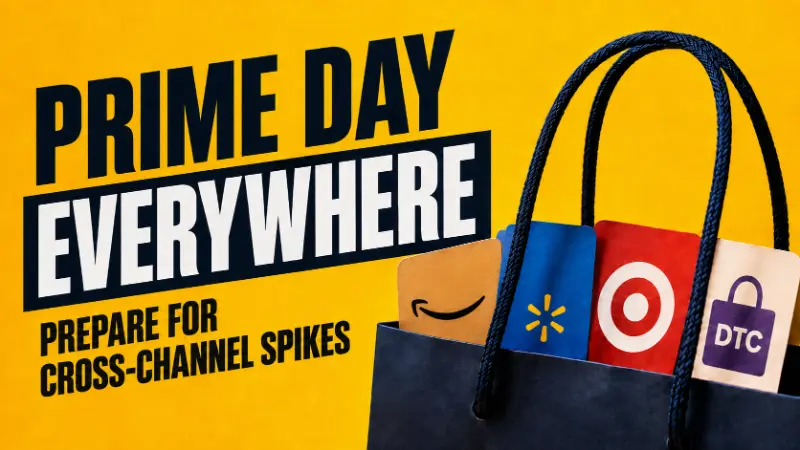
Prime Day used to be mostly an Amazon planning exercise. This year, with Walmart and Target running overlapping deal events the same week, the question for sellers has changed: what happens if Prime Day demand shows up across several channels at once, and is your inventory in the right place to capture it?
If shoppers respond to the broader summer deal window, Prime Day could quietly become a recurring cross-channel sale period. That is good news for sellers, but only if inventory and fulfillment capacity are set up to serve orders outside Amazon, not just inside it.
Prime Day Deals Are Starting to Look Like a Summer Deal Week
For 2026, Amazon moved Prime Day earlier than usual. The event runs June 23 to 26, four days of Prime-exclusive deals across 35-plus categories, making this Prime Day 2026 and putting it a month earlier than the usual July timing. Walmart Deals runs June 22 to 28, a seven-day window that brackets Prime Day on both sides, with Walmart+ members getting early access on June 22. Target Circle Deal Days runs June 23 to 26, with Target Circle 360 members getting early access on June 22. Best Buy is running its own Tech Fest the same week. Prime Day 2025 also lasted four days, creating an extended window sellers should expect again. That longer format kept 40% of shoppers browsing longer, which matters for Prime Day shoppers and planning during Prime Day week.
That kind of calendar alignment is not accidental. Amazon trained shoppers to expect a summer deal moment, and the other retailers want a share of that attention. When Walmart shifts its summer event up by two to three weeks to line up with Amazon, and Target lands its window inside the same four-day block, the message is clear: each retailer is fighting for the same shopper at the same time.
The honest framing is that this year is a test. If shoppers respond meaningfully across all three retailers, the pattern will likely repeat and probably expand. If most of the activity stays on Amazon, the cross-channel hype fades. Either way, sellers have to plan as if the demand could show up anywhere, because by the time it is clear which retailer is winning, the event is already over.
This Is Not Cyber Week, But It Creates a Smaller Version of Peak Planning
Prime Day is not Q4. Holiday demand has natural urgency built in: gifts that have to arrive by a date, gatherings, school breaks, travel, shipping cutoffs, Christmas morning, and year-end deadlines that nothing else can replace. Shoppers spend even when prices are not great, because the calendar forces their hand.
Prime Day is a manufactured sales event. It is still a major sales event and a big sales event—Prime Day 2025 generated $24.1 billion in sales—but operationally it belongs with summer sales events, not Q4, much like the fall Prime events and Q4 deal periods that have their own Lightning Deal submission timelines. Customers browse, compare across retailers, and cherry-pick discounts. June demand is not going to equal November demand, and sellers should not staff up or buy in as if it will.
But if Amazon, Walmart, Target, and DTC promotions all hit the same week, the seller still faces a smaller version of the peak-season problem. Demand can spike across several channels at once. Order routing decisions that were easy in May get harder when three channels are all moving. Carrier pickups need to clear faster. A 3PL that was running smoothly suddenly has a busier week than expected. The volume will not be Cyber Week volume, but the operational shape rhymes with it.
Why Loading Up FBA Is No Longer Enough
FBA still matters for Amazon Prime Day. For Amazon demand, nothing else routes orders, communicates delivery promises, or handles returns the same way, so sellers need enough FBA inventory to keep products Prime badge ready before the Prime Day window opens. Sellers who under-invest in FBA going into Prime Day usually regret it.
The issue is that FBA solves for one channel. For multichannel sellers, that is part of the answer, not the whole answer. If too much inventory ships into FBA, sellers may end up short on units to fulfill Walmart orders, Target Plus orders, Shopify orders, or marketplace orders that come in during the same window. If too much inventory is held back to keep DTC flexible, the Amazon listing goes out of stock, the BuyBox is lost, the deal page underperforms, and the ad spend that drove traffic gets wasted, so monitoring inventory levels and the Inventory Performance Index in Seller Central helps protect availability.
The right question is not “how much should I send to FBA.” It is “how much do I commit to Amazon, and how much do I keep available for everywhere else?” The seller who can answer that question with a clear number and a clear placement plan is already ahead of most of the field. For multichannel sellers, Prime Day preparation increasingly depends on multichannel fulfillment, not just Amazon fulfillment, and many will benefit from a hybrid FBA vs FBM fulfillment strategy that keeps options open when demand spikes. For Prime Day 2026, sellers should plan ahead around key dates so inventory must arrive at Amazon by May 27 through fulfillment centers.
The Real Risk Is Inventory in the Wrong Place
A seller can have enough total inventory and still lose sales if that inventory is sitting somewhere it cannot reach the customer who wants it, especially when stock is in the wrong place and teams miss key demand signals.
A few common ways this shows up during a cross-channel deal week:
- Stock is loaded into FBA or low-cost Amazon AWD bulk storage, but Walmart and DTC orders come in faster than expected, and the only available units are locked behind Amazon’s network.
- Inventory is concentrated in one warehouse on one coast, and orders from the opposite coast either ship late or eat the margin on expedited carriers.
- A non-Amazon channel outperforms the forecast, and the seller cannot replenish it quickly because the units are already committed elsewhere, so forecasts should use sales data from previous Prime Days or past Prime Days to decide placement.
- A surprise winning SKU drives more orders than the 3PL was staffed for, and the pick rate slips. Promised delivery dates slip with it.
- Delivery promises on a product detail page get less competitive because the nearest unit is three zones away from the buyer.
The underlying problem is the same. Prime Day preparation is not just an inventory quantity question. It is an inventory placement and flexibility question. Distributed fulfillment matters when sellers need inventory close enough to customers to protect delivery promises across channels, and options like Merchant Fulfilled Prime as an FBA alternative can support that strategy, and using historical sales data to forecast Prime Day demand helps avoid excess inventory in the wrong network while still protecting sales volume in the right one.
Prime Day Inventory Planning Should Include Flexible Stock
A useful way to think about Prime Day inventory is in three buckets, and sellers should start early on inventory planning rather than waiting until the last minute:
- Committed inventory. Stock already allocated to FBA, Walmart Fulfillment Services, Target retail partners, or specific channel promotions, including Prime Day promotions that make inventory channel-specific. Once it ships, it serves that channel and only that channel for the duration of the event.
- Flexible inventory. Stock that can support DTC orders, marketplace spikes, and routing decisions made during the event. This is the bucket that lets the seller respond to demand rather than guess at it in advance.
- Reserve inventory. Safety stock for surprise winners, late-event demand, replenishment after early stockouts, and the first week of July when the event is done but momentum may carry; this bucket should also reflect which SKUs drove the most sales in prior events.
Flexible inventory is more valuable when sellers do not know which channel will win the shopper. Amazon may win on some categories where price competition is brutal, especially when brands follow a dedicated Prime Day fulfillment and promotion playbook. Walmart may win where there are fewer direct competitors and where Walmart+ members convert. Target may win on home, beauty, and seasonal categories that match its audience. DTC may win when the brand has a better bundle, loyalty offer, or repeat customer relationship, and an established brand can lean more confidently on repeat demand than an unknown launch.
The job is not just to order more units. The job is to keep enough units available, in the right network, to follow demand once it shows up.
Promotions Drive Demand, Order Fulfillment Decides Whether Sellers Capture It
Channel strategy matters during Prime Day. Amazon is the most price-competitive and crowded environment for many categories. Walmart may have fewer direct competitors for some products and a different buyer profile. Target plays well in specific categories. DTC preserves the most margin and the most customer data, but the seller has to do the work of fulfilling the order on time. Prime Day shoppers often expect deep discounts, with 33% needing at least 30% off and 20% looking for 50% or more before a deal feels worthwhile.
Different channels may deserve different promotional strategies, ad budgets, and discount depths. That includes choosing the right promotion types and deciding when a price discount is the best deal for the channel. That is a real conversation worth having before the event starts. Sales on Amazon often prompt competitors to run matching prices, so sellers need a channel-aware pricing plan to maximize sales and increase sales without eroding margin.
The harder truth is that even the best channel and pricing strategy fails if the inventory is locked in the wrong place, or if the seller cannot ship the order profitably on time. A winning promotion that creates orders the operation cannot fulfill is just a refund queue and a stack of bad reviews. Fast shipping promises across channels are increasingly table stakes, whether a seller uses Amazon Multi-Channel Fulfillment (MCF) or another network, and same-day fulfillment from a regional node is sometimes the difference between winning Prime Day and watching the conversion go to a competitor, which also shapes overall sales performance.
A Prime Day Fulfillment Checklist for Sellers
This is the practical part. A Prime Day checklist that actually helps a multichannel operator should cover the following, because this level of preparation is what makes a successful event during a major sales window:
- Forecast demand by channel, not just total sales. Build a working estimate for Amazon, Walmart, Target, DTC, and any other relevant marketplace. A blended forecast hides the question of where the inventory should sit.
- Decide how much inventory must go to FBA. Use Seller Central for deal planning and account checks before shipping decisions are finalized, then lock in the FBA send-in number with a clear rationale: expected sell-through, ad spend, deal page traffic, replenishment lead time. Be honest about whether shipping more in actually helps, or just strands units after the event.
- Map promotional timing early. Plan prime day deals and amazon deals well in advance, including lightning deals, prime exclusive discounts, prime exclusive price discounts, and prime exclusive best deals. Deals can be submitted starting April 6, 2026, Amazon recommends submitting by April 30, 2026, and Lightning Deals can run for up to 12 hours.
- Reserve inventory for Walmart, Target, DTC, and other non-Amazon channels. Treat these as real demand sources, not leftovers. If Walmart Deals runs from June 22 through 28, the Walmart-allocated stock has to last the full window, not just the Amazon window.
- Identify flexible inventory that can be routed where demand appears. This is the bucket that protects sellers from being wrong about which channel wins. Keep a portion of stock in a network that can ship to any channel quickly.
- Confirm 3PL capacity before the sale period. Talk to fulfillment partners now. Confirm staffing, cutoff times, pick rates, and carrier handoffs for the week of June 22. Surprise volume is a planning failure, not a 3PL failure.
- Check carrier cutoffs and delivery promises. Verify what the seller can actually promise on each channel during the event, and make sure the channel listings reflect those promises. With 88% of amazon prime members planning to shop, sellers should expect sustained order flow across the four-day window. Overpromising delivery during a deal week is one of the fastest ways to generate refunds and negative feedback.
- Confirm order routing rules. Make sure DTC and marketplace orders route to the warehouse that can hit the promised delivery date, not just the warehouse with the most stock. Bad routing during a peak quietly destroys margin.
- Monitor inventory daily during the event. Daily is not optional during a four-day window. Sell-through can move fast, and decisions about pulling listings, raising prices, or shifting stock have to be made the same day, especially with so many prime members expected to keep shopping throughout the event.
- Watch for stockouts and stranded inventory. Stockouts on a hot listing kill momentum. Stranded units in the wrong network kill margin after the event. Both deserve a clear owner.
- Review post-event inventory quickly to avoid Q3 overstock drag. A week after the event is the right time to look at what is left, what is on its way in, and what should be repositioned, marked down, or held for fall promotions.
Sellers who can meet Amazon’s delivery standards from their own network may also want to evaluate Seller Fulfilled Prime as part of the Prime Day readiness conversation, particularly if FBA placement decisions are constraining their multichannel plan, and Seller Central is also where sellers should verify account health before the event.
What Sellers Should Watch in Prime Day Performance After This Year’s Sale
This year is the test. The post-event signals that matter most are not the headline gross numbers Amazon or Walmart will announce, but the details that show true Prime Day performance. They are the operational signals that tell sellers how to plan next year.
Things worth watching:
- Whether non-Amazon channels see meaningful sales lift, and how results compare across multiple channels and sales channels, or whether the buzz stayed mostly on Amazon.
- Which categories perform outside Amazon. Because Prime Day typically touches nearly every product type sold on Amazon, category-specific lift matters more than overall event hype; home, beauty, electronics, apparel, and grocery may behave very differently.
- Whether buyers actively compare prices across retailers, or simply default to whichever app they already have open.
- Whether DTC demand rises during the event, gets cannibalized by marketplace deals, or both, and whether brands can turn event-driven new customers into customer loyalty after the sale.
- Whether fulfillment capacity outside FBA becomes a real bottleneck, especially for sellers that leaned too heavily on Amazon-only fulfillment.
If the cross-channel pattern holds, sellers should expect Prime Day preparation to look more like a small peak-season plan every year, with a real role for FBA alternatives and a real expectation of distributed inventory across multiple networks.
Conclusion
Prime Day may not become another Cyber Week overnight. The urgency is different, the buyer behavior is different, and a manufactured sales event has limits the holidays do not. But if Walmart, Target, and other retailers keep turning Amazon’s event into a broader summer sale period, sellers will need to prepare differently than they did three years ago, and use this year’s results to plan for the next big sales event.
The winners over the next few seasons will not just be the brands with the deepest discounts. They will be the brands with enough flexible inventory, non-Amazon fulfillment capacity, and the ability to drive traffic from outside Amazon, plus the operational discipline to serve demand wherever it actually shows up. That is the real Prime Day preparation question, and it does not get easier by waiting until July to answer it.
Frequently Asked Questions
How should sellers prepare for Prime Day?
Sellers should build a channel-by-channel demand forecast, start early, and update product listings about six weeks before the event so the algorithm has time to react. Sellers should decide how much inventory to commit to FBA versus other channels, keep a flexible inventory bucket that can serve DTC and marketplace spikes, confirm 3PL capacity and carrier cutoffs before the event, and plan to monitor inventory daily during the sale window. Those updates should include stronger titles with relevant keywords, clearer bullet points, high-quality images, and A+ Content to improve engagement and trust. Cross-channel planning matters more than it used to because Walmart and Target are running overlapping events the same week. Listings should also be structured for ai shopping assistants and search visibility before Prime Day promotions begin.
How much inventory should sellers send to FBA for Prime Day?
There is no universal answer, but the right approach is to base the FBA commitment on expected Amazon sell-through, ad spend, deal page traffic, inventory levels, demand signals, and healthy replenishment timing, not on a round number or a percentage of total stock. Sending too much risks stranded inventory after the event. Sending too little risks losing the BuyBox during peak demand and wasting ad spend on out-of-stock listings. Sellers should also use historical sales data and previous Prime Days to estimate how much inventory delivered the strongest sell-through. For Prime Day 2026, have inventory arrive at Amazon by May 27 to reduce splits and protect in-stock levels during the Prime Day window.
Why does Prime Day inventory planning matter for multichannel sellers?
Because Walmart Deals, Target Circle Deal Days, and DTC promotions are now running the same week as Prime Day. Inventory committed to FBA is not available for Walmart, Target, or DTC orders, so sellers who plan only for Amazon may have plenty of total stock but still lose orders on other channels. Cross-channel inventory placement is the planning problem, not just total quantity. Multichannel sellers should also plan their amazon store alongside off-Amazon channels, because prime day sales can shift between them unexpectedly.
Is Prime Day becoming like Cyber Week?
Not yet, and probably not soon. Prime Day 2026 is happening a month earlier than many sellers are used to, which is another reason to plan ahead for a compressed summer calendar. Prime Day lacks the natural calendar urgency of Q4 holidays. But the 2026 alignment of Amazon, Walmart, Target, and Best Buy events into one June week is a meaningful test. If shoppers treat late June as a deal-shopping period and other retailers see real sales lift, sellers should expect summer to start looking more like a mini peak season every year.
How can sellers prevent stockouts during Prime Day?
Forecast demand by channel rather than in aggregate, keep a flexible inventory bucket that can be routed to whichever channel is moving fastest, confirm 3PL capacity and carrier cutoffs before the event, and monitor inventory daily during the sale. Stranded inventory in the wrong network causes most preventable stockouts, so placement decisions before the event matter as much as total units on hand. Fast responses to customer inquiries during the event also help preserve customer satisfaction when shipping promises are under pressure. Forecast demand by channel rather than in aggregate, keep a flexible inventory bucket that can be routed to whichever channel is moving fastest, confirm 3PL capacity and carrier cutoffs before the event, and monitor inventory daily during the sale, with extra protection against stockouts for household essentials and other fast-moving repeat-purchase items.
Written By:

Indy Pereira
Indy Pereira helps ecommerce brands optimize their shipping and fulfillment with Cahoot’s technology. With a background in both sales and people operations, she bridges customer needs with strategic solutions that drive growth. Indy works closely with merchants every day and brings real-world insight into what makes logistics efficient and scalable.

Turn Returns Into New Revenue

Related Articles

Why Cross-Border DTC Brands Are Moving Fulfillment Inside the US
Cross-border ecommerce fulfillment is the process of shipping ecommerce orders across national borders—often from warehouses outside the United States to U.
Crafting a Return Policy that Drives Customer Loyalty and Reduces Returns
Let’s talk about ecommerce returns policies.

Cheapest Shipping from USA to UK: What It Really Costs
Shipping from the USA to the UK is one of the most common international routes for ecommerce brands, and it is also one of the most misunderstood from a cost perspective.