
DSCO Fulfillment Explained: What Sellers Still Get Wrong
In this article
 15 minutes
- What DSCO actually does vs what it does not do
- Why sellers confuse EDI compliance with fulfillment readiness
- Order Fulfillment Strategies
- Retailers that rely heavily on DSCO
- Cancellation and late-shipment penalties tied to DSCO metrics
- Real operational examples sellers underestimate
- The role of 3PLs in DSCO success
- What “DSCO readiness” actually looks like in practice
- Strategic takeaway for operations leaders
- Frequently Asked Questions
DSCO fulfillment is the order-communication layer in a retailer drop ship program: it standardizes how retailers and suppliers exchange orders, inventory, shipment confirmations, and tracking, but it does not do the physical fulfillment work of picking, packing, or shipping. For sellers, ecommerce operators, fulfillment managers, and operations leaders onboarding to retailer drop shipping, the most common failure mode is treating EDI compliance as the finish line instead of the starting gun.
DSCO can standardize retailer communication, but it cannot make your warehouse hit SLAs. That distinction is where strong EDI still loses to weak execution. DSCO is valuable because it creates a common language between retailers and suppliers, so a retailer can scale drop ship without custom one-off connections for every brand. That standardization is real. DSCO’s features, such as real-time validations and robust data standardization, further enhance order fulfillment efficiency and accuracy. It is also the reason the operational gaps show up so fast: once DSCO orders start flowing, retailers judge you on what customers actually experience: ship speed, cancellation rate, tracking reliability, and whether returns and post-purchase support work cleanly.
DSCO provides 100% data standardization with over 70 real-time validations to ensure inventory, product, and shipping data accuracy.
This guide explains what DSCO does and does not do, why EDI compliance is not the same as fulfillment readiness, where operations break under retailer expectations, how 3PL and in-house fulfillment strategies affect performance, and what teams need to put in place to become operationally DSCO-ready. The hard truth is simple: sellers fail DSCO programs when their warehouse operations cannot meet retailer SLAs, not because of EDI issues, and confusing those two can lead to chargebacks, missed scorecards, and lost retail program eligibility.
What DSCO actually does vs what it does not do
DSCO sits in the “communication and compliance” layer of drop shipping. It helps retailers and suppliers manage the entire process of order processing across channels without relying on manual email threads and spreadsheets. In practice, dsco order fulfillment typically includes:
- Receiving sales orders from retail channels in a standardized format
- Passing updates back to the retailer on acknowledgments, cancellations, shipments, and tracking
- Synchronizing inventory levels so a retailer site can decide what to sell
- Supporting consistent status events that feed vendor scorecards and customer service workflows
The integration manager feature of DSCO allows users to track inventory levels and order status in real-time.
That is what DSCO does.
What DSCO does not do is what most sellers secretly need it to do:
- It does not pick, pack, and ship orders
- It does not control your fulfillment centers, labor planning, or cutoffs
- It does not prevent inventory mismatch between your systems and what is physically on the shelf
- It does not force a carrier scan to happen on time
- It does not protect you from shipping costs caused by poor cartonization or service level mistakes
- It does not fix reverse logistics or improve your returns disposition process
DSCO can streamline the connection and make data flow faster. It cannot make execution better. If your warehouse can only ship in two to three business days, DSCO will not change that. If your inventory accuracy is weak, DSCO will not magically reconcile it. DSCO is a mirror. It reflects your operation back to the retailer with timestamps.
Efficient logistics integration with DSCO ensures that product data, order fulfillment, and inventory levels are accurately synchronized across all sales channels.
Why sellers confuse EDI compliance with fulfillment readiness
This is the single most common operational misunderstanding in dsco fulfillment.
Sellers spend weeks or months getting certified, validating test transactions, and proving the connection works. The integration feels like the “hard part” because it involves outside teams, project plans, and unfamiliar concepts. Once the platform connection is live, everyone wants to believe the account is ready to scale.
But EDI compliance is about message correctness. Fulfillment readiness is about outcome reliability. Efficiently and reliably fulfilling orders is critical for successful dsco fulfillment, as it ensures customer satisfaction and supports business growth.
You can be perfectly compliant and still fail a drop shipping program in your first week if:
- You acknowledge orders on time but ship late
- You send inventory feeds on schedule but oversell due to bad counts. Real-time inventory synchronization is essential for DSCO users to avoid overselling products.
- You generate labels quickly but miss carrier pickup windows
- You provide tracking numbers that do not scan for 24 hours
- You ship partials or substitute SKUs to “save the sale” and trigger chargebacks
Retailers do not grade you on how clean your integration looks. They grade you on the DSCO metrics tied to customer experience: ship on time, ship complete, ship accurately, and keep cancellations low. DSCO makes these metrics measurable, not negotiable.
Order Fulfillment Strategies
Order fulfillment is the backbone of any successful ecommerce business. In the world of DSCO order fulfillment, the right strategy can mean the difference between scalable growth and operational headaches. For ecommerce stores, the challenge isn’t just about getting products out the door—it’s about doing so cost effectively, with real-time tracking, and without hidden fees eating into your margins.
One of the most impactful moves is partnering with a third party logistics (3PL) provider. Companies like LMS Logistics Solutions have demonstrated that leveraging a comprehensive suite of fulfillment services—such as those offered by 3PL Central—can drive efficiency and accuracy. With inventory integrations that automatically update inventory levels and real-time tracking numbers, businesses can maintain near-perfect inventory accuracy and keep customers informed every step of the way.
When evaluating a fulfillment partner, look beyond the upfront cost. Scrutinize for hidden fees, reverse logistics capabilities, and the ability to scale with your business. Cost savings aren’t just about the cheapest rate—they’re about the total cost of ownership, including support, integration, and the flexibility to adjust as your operations grow. Solutions like Extensiv’s DSCO integration offer step integration specific instructions, making it easier to connect your ecommerce order sources, manage inventory, and streamline the entire process from order to delivery.
Drop shipping is another strategy that can help ecommerce businesses expand their assortment without the burden of holding inventory. By working closely with suppliers and retailers, you can fulfill orders directly from the source, reducing shipping costs and allowing your business to focus on sales and growth. This model is especially useful for businesses with limited storage or those looking to test new products without a large upfront investment.
Shipping labels and tracking numbers play a pivotal role in customer satisfaction. Providing real-time tracking and clear communication builds trust and reduces customer service overhead. Whether you’re using your own fulfillment centers, a 3PL, or leveraging Amazon FBA to tap into Amazon’s distribution network, the ability to offer reliable shipping and tracking is non-negotiable.
Distribution strategy matters, too. By creating a network of fulfillment centers—either through your own operations or with a 3PL—you can reach customers faster and more cost effectively, no matter where they are. This is especially important for high-volume products or when serving a wide geographic area.
Ultimately, the most successful ecommerce businesses treat fulfillment as a core competency, not an afterthought. They work closely with their fulfillment partners, suppliers, and retailers to ensure seamless integration and communication. They commit to going the extra mile for customers, providing real-time support, and adjusting their processes as the business scales.
In summary, order fulfillment strategies are not one-size-fits-all. Whether you’re leveraging DSCO integrations, drop shipping, 3PLs, or Amazon FBA, the key is to build a flexible, cost-effective operation that prioritizes customer experience. By focusing on the right partnerships, technology, and processes, your ecommerce store can fulfill orders efficiently, support growth, and stay ahead in a competitive market.
Retailers that rely heavily on DSCO
You do not need a long list to understand the implication, but it helps to name the pattern.
Several large retail programs use DSCO or DSCO-connected infrastructure to run drop ship at scale, particularly in categories like apparel, footwear, accessories, home, and specialty retail. DSCO also supports e-commerce and digital sales channels, enabling smooth management and fulfillment of online orders. You will often see DSCO in the background for retailers that run high-SKU catalogs and rely on brands to fulfill orders directly to consumers under tight standards. Integration with various e-commerce order sources allows for streamlined fulfillment and efficient inventory tracking. The operational theme is consistent across these programs: the retailer owns the customer experience, and you are expected to execute like a first-party warehouse.
DSCO connects to over 60 order destinations, including major retailers like Nordstrom and Kohl’s, simplifying data exchange.
If your team is used to marketplace fulfillment or slower B2B shipping cadences, DSCO-based drop shipping can feel unforgiving. That is because it is.
Cancellation and late-shipment penalties tied to DSCO metrics
DSCO is often described as “communication standardization,” but the commercial teeth are in the scorecard.
Retailers use DSCO metrics to calculate:
- Cancellation rate
- Late shipment rate
- On-time carrier scan adherence
- Tracking timeliness and validity
- Sometimes, defect proxies like returns, customer contacts, or delivery exceptions
When you miss, the consequences are usually economic before they are relational.
Common penalty mechanisms include:
- Per-order chargebacks for late shipments or cancellations
- Fee schedules tied to repeat SLA misses
- Removal from drop ship eligibility after sustained underperformance
- Reduced assortment visibility or limited product eligibility for high intent shoppers
Transparent pricing models are crucial in dsco fulfillment, as they help eCommerce businesses clearly understand the cost structures and avoid unexpected or hidden fees.
This is why dsco fulfillment problems rarely show up as an “EDI error.” They show up as margin erosion. A program can look profitable on paper until you layer in hidden fees from late shipments, expedited shipping used to recover SLAs, and cancellations that create customer service overhead.
DSCO validates supplier invoices for accuracy before routing them to retailers for payment, helping ensure financial accuracy and cost control.
The operational lesson is not “avoid penalties.” It is to understand that DSCO makes your fulfillment performance legible to the retailer. If your operation is not already built to hit strict shipping and accuracy targets, the fees are a symptom, not the disease.
Real operational examples sellers underestimate
Most DSCO failures are boring. They are also expensive. These are the patterns that repeatedly sink accounts. To avoid these common DSCO fulfillment failures, it is essential to integrate systems and processes between your e-commerce platform and third-party logistics providers, ensuring seamless data synchronization and operational efficiency.
Integrating DSCO with third-party logistics services helps to save time and money.
Late ship caused by warehouse reality, not system timing
A DSCO order arrives at 2:10 PM. Your warehouse cut-off for same-day picking is 1:00 PM. Your team treats the order like any other ecommerce order and plans to pick it tomorrow.
From the retailer’s perspective, that order is already aging. If the program expects shipment within 24 hours, you are now living inside a clock you did not design. Your integration might be flawless, but you are operationally late before anyone touches a box.
This is why operations leaders should treat dsco orders as a distinct order class with its own routing rules, labor priority, and exception escalation.
Inventory mismatch that turns into cancellations
Your inventory integration sends 42 units available. The warehouse actually has 19, because:
- Cycle counts are infrequent
- Damaged inventory is not quarantined properly
- Returns are not reconciled quickly
- Multiple order sources are drawing from the same pool without real time locking
The retailer sells 10 units. You can ship 8. You cancel 2.
That might feel like “normal ecommerce.” In a DSCO program, it is a scorecard hit. Repeat it often enough and you look unreliable. Retailers care about cancellation rate because cancellations are customer pain and customer service cost. DSCO simply makes that pain attributable.
Carrier scans that do not happen when you think they do
A seller prints labels and sends tracking in time. The packages sit on the dock until the carrier arrives the next morning. Tracking shows “label created” but no acceptance scan.
Some retailers treat the first carrier scan as the real shipment event. Your DSCO status says shipped, but the carrier data says not yet. This gap can trigger late shipment flags even when your team believes they complied.
Operationally, this is solved by pickup discipline, dock processes, and cutoffs aligned to scan reality. “Label printed” is not “shipped” in retailer math.
Wrong service level or routing details that create downstream cost
Retailer drop ship programs often specify service levels, label formats, and packing requirements. Sellers sometimes treat these as administrative details, then discover the penalties later.
A common example is selecting a shipping method that is too slow to meet delivery expectations, then paying to upgrade shipments reactively. Another is failing to include the required packing slip or return label, triggering customer contacts and chargebacks.
None of this is fixed by DSCO. DSCO will happily transmit the shipment confirmation for a shipment that will arrive late.
The role of 3PLs in DSCO success
For brands onboarding to drop shipping, the 3PL question is not about convenience. It is about capability. Strategic partnerships and tailored services for clients are essential in DSCO fulfillment, as ongoing communication and understanding each client’s unique needs foster trust and deliver value.
A strong third party logistics partner can make dsco fulfillment viable because they already operate at the tempo retailers expect. Choosing a 3PL for DSCO orders requires evaluating their industry experience and technological capabilities. The right partner can help with:
- Cutoffs and labor models designed for rapid order processing
- Warehouse discipline around scan compliance and dock flow
- Inventory accuracy through tighter cycle counting and location control
- Standard operating procedures for pack rules, labels, and routing requirements
- Exception handling when a carrier misses pickup or an order needs intervention
A reliable 3PL should also offer modern integration technology to ensure efficient order fulfillment.
This does not mean “use a 3PL and you are safe.” Retailers hold the seller accountable, not the warehouse vendor. If your 3PL misses SLAs, your account takes the hit. The practical implication is that DSCO success requires operational governance regardless of who runs the building.
Operations leaders should treat the 3PL relationship like a program, not a purchase order. You need:
- Shared SLA definitions that match retailer requirements
- Daily visibility into backlog, late risk, and cancellation drivers
- A process for inventory reconciliation and dispute resolution
- Escalation paths for carrier issues and peak volume planning
Flexibility in scaling services is also important when selecting a 3PL for DSCO orders.
If you are running your own warehouse, the same governance still applies. The only difference is who you can fire.
What “DSCO readiness” actually looks like in practice
Most sellers think readiness means the connection is stable. Retailers think readiness means the order experience is stable.
DSCO readiness in operations terms looks like:
- Warehouse cutoffs aligned to retailer ship windows
- Order processing that prioritizes DSCO orders without starving other channels
- Inventory levels that reflect reality, not accounting optimism
- Tracking that scans fast and stays valid through delivery
- Clear playbooks for exceptions: backorders, damages, carrier misses, address issues
- Reverse logistics that does not collapse customer confidence
Notice what is not on that list. It is not a step integration specific instructions document. It is not a deep dive into EDI schemas. The challenge is execution.
This is also why sellers get surprised by DSCO. DSCO makes it easy to start. It does not make it easy to be good.
Strategic takeaway for operations leaders
If you want one mental model for dsco fulfillment, use this:
DSCO standardizes communication. Retailers evaluate execution.
Treat DSCO like a spotlight, not a shield. It will highlight where your operation is strong and where it is fragile. If you are fragile, you will see it first through cancellation and late shipment penalties, then through lowered assortment access, then through program risk.
The correct posture is not to obsess over the integration. It is to build a fulfillment operation that can meet retailer SLAs consistently, even during peak demand, even when a carrier misses a scan, even when inventory is tight. That is what retailers are buying from you when they approve you for drop shipping.
Frequently Asked Questions
What is DSCO fulfillment?
DSCO fulfillment refers to operating a retailer drop ship program where DSCO standardizes order, inventory, and shipment communications, while the seller still performs the physical fulfillment work.
What does DSCO do in drop shipping?
DSCO standardizes retailer and supplier communication for orders, inventory updates, shipment confirmations, and tracking so retailers can scale drop ship programs without custom integrations.
What does DSCO not do for sellers?
DSCO does not execute fulfillment. It does not pick, pack, ship, manage carrier pickups, correct inventory accuracy, or ensure you meet retailer SLAs.
Why do sellers fail DSCO programs even when EDI is working?
They confuse EDI compliance with fulfillment readiness. Retailers score performance based on cancellations, late shipments, and tracking quality, which are operational outcomes.
What DSCO metrics typically trigger penalties?
Retailers commonly penalize high cancellation rates, late shipment rates, missing or delayed tracking, and shipment events that do not meet required timing thresholds.
How do carrier scans impact DSCO performance?
Many retailers treat the first carrier acceptance scan as the proof of shipment timing. A label can be created and tracking sent, but if the package is not scanned promptly, it can still count as late.
How can a 3PL help with DSCO success?
A capable 3PL can improve ship speed, inventory accuracy, scan discipline, and exception handling. The seller must still govern the partnership to meet retailer SLAs.
What operational changes matter most for DSCO readiness?
Tight cutoffs, prioritized order processing, accurate inventory levels, consistent carrier pickups, reliable tracking, and strong exception handling matter more than integration effort.
Written By:

Indy Pereira
Indy Pereira helps ecommerce brands optimize their shipping and fulfillment with Cahoot’s technology. With a background in both sales and people operations, she bridges customer needs with strategic solutions that drive growth. Indy works closely with merchants every day and brings real-world insight into what makes logistics efficient and scalable.

Turn Returns Into New Revenue
Related Articles
What Is Demand Planning? How It Impacts Inventory, Forecasting, and Profitability
Demand planning is the process of estimating future customer demand so that a business can align its inventory, procurement, and operations to meet that demand without carrying mor...
Walmart Officially Allows Amazon Multi-Channel Fulfillment (MCF)
Big news for multichannel sellers: Walmart now officially allows Amazon Multi-Channel Fulfillment (MCF), Amazon’s service for using its fulfillment network to ship orders from mult...
Why Small Ecommerce Brands Are Winning with AI (While Enterprises Struggle)
Conventional wisdom says large companies should dominate AI adoption.
Apparel Returns Are Getting Harder to Avoid. Brands Need to Make Them Cheaper to Handle
In this article
19 minutes
- GLP-1s Are Accelerating an Apparel Problem That Already Existed
- The Real Issue Is Fit Volatility
- Size Guides Help, but They Cannot Eliminate Body-Change Uncertainty
- Adjusting Size Curves Is Not as Simple as Ordering More Small Sizes
- Raising Prices or Charging Return Fees Can Backfire
- Apparel Brands Need a Returns Survival Strategy
- 7 Start With the Low-Hanging Fruit: Cheaper Return Shipping Labels and Faster Restocking
- 8 Make Store Credit Exchanges Easier Than Refunds
- 9 Treat Damaged Returns Data as Operational Intelligence
- Peer-to-Peer Returns Could Be the Bigger Long-Term Opportunity
- 11 The Brands That Win Will Recover More Resale Value From Returns
- Frequently Asked Questions
Apparel returns are climbing again, and a meaningful share of the increase is tied to customers whose bodies are changing faster than their wardrobes can keep up. According to Narvar data cited by the Wall Street Journal, apparel exchanges involving customers sizing down hit a record 14.6% in 2025, and retailers are increasingly attributing the shift to the rapid adoption of GLP-1 weight-loss drugs.
But the GLP-1 story is only the latest pressure on a system that was already strained. Apparel has always carried fit uncertainty, and fit uncertainty has always driven bracketing, exchanges, and refunds. What is changing is the speed of body change among a growing slice of customers, which makes sizing demand harder to predict and return volume harder to absorb. The smart response is not to chase the perfect prevention strategy. It is to make the returns that do happen cheaper, faster, and less destructive to margin.
GLP-1s Are Accelerating an Apparel Problem That Already Existed
Apparel returns have always been the highest-friction category in ecommerce. Shoppers cannot try the product before it arrives, so they hedge. They order two sizes. They order the same dress in three colors. They keep what fits and ship the rest back. Bracketing is not a flaw in customer behavior. It is a rational response to the gap between a product page and a fitting room.
GLP-1 medications add a new layer to that uncertainty. Customers actively losing weight may move through one, two, or three sizes within a single buying cycle. A shopper who ordered a medium in March may need a small by July, then need to repurchase the same wardrobe staple a few months later. Some of those purchases will be returns. Some will be exchanges. Some will be brand new orders placed before the previous garment has even been worn.
This is not a story about careless shoppers. It is a story about a category whose fundamental friction (you cannot try it on) is now compounding with a customer base whose fundamental measurements are in motion. That legitimate friction exists alongside edge cases like wardrobing and other return abuse, but it is not the primary driver of the current spike. The Wall Street Journal has reported that several apparel retailers are now seeing return pressure they directly attribute to GLP-1-driven size changes, and the trend appears to be widening rather than fading.
The Real Issue Is Fit Volatility
Retail Dive and other industry observers have started using the term “fit volatility” to describe what is happening. The phrase is useful because it points past any single cause. GLP-1s are part of it. So are pandemic-era body composition changes, the rise of athleisure cuts that fit unpredictably across brands, inconsistent vanity sizing, and the broader collapse of standardized size charts across global manufacturing.
Fit volatility means the same customer may move across sizes faster than a brand’s merchandising and planning cycle can react. A buyer who plans size curves a year in advance, based on last year’s sell-through, is working with data that may already be stale by the time the season hits. That mismatch shows up in two places: inventory imbalance at the SKU level and returns at the customer level.
For ecommerce operators, fit volatility is less a marketing problem and more a forecasting problem. It puts pressure on size-curve planning, reorder timing, markdown discipline, and reverse logistics capacity all at once. And because ecommerce returns were never designed for scale and high ecommerce return rates can erode profit margins, the systems most brands rely on tend to bend under that pressure rather than absorb it cleanly.
Size Guides Help, but They Cannot Eliminate Body-Change Uncertainty
The first instinct for most apparel brands is to fix the front end. Better size charts. More detailed product descriptions. Model measurements on every page. Fabric composition and stretch percentages. AI-driven fit quizzes. User-uploaded reviews with height, weight, and usual size. All of this helps, and brands that have invested in it generally see lower return rates than brands that have not.
But these tools share a common limitation. They assume the customer knows their current size. For a shopper whose body has not changed in years, that assumption usually holds. For a shopper actively losing weight, gaining muscle, recovering from pregnancy, or transitioning through any other period of body change, the assumption breaks. No size chart can tell a customer what size they will be in six weeks. No fit quiz can predict the rate at which a GLP-1 user will move from a large to a medium.
Front-end tools reduce returns from confusion. They do not reduce returns from change. Brands that overinvest in fit prevention without also investing in returns operations end up with a polished website and a backed-up returns dock.
Adjusting Size Curves Is Not as Simple as Ordering More Small Sizes
A reasonable next instinct is to shift the size curve. If more customers are sizing down, order more smalls. This is partially correct and operationally dangerous if applied too aggressively.
Demand may shift, but it rarely shifts cleanly. Consider what is actually happening across a typical apparel customer base:
- Some long-time customers are sizing down by one or two sizes and staying there.
- Some customers who were previously outside the brand’s size range are now entering it, often at the upper end of the brand’s smaller sizes.
- Some customers who were previously inside the brand’s range are now leaving it, either because they sized down below the brand’s smallest offering or because their proportions changed in ways that do not match the brand’s fit block.
- Some customers are moving through multiple sizes within a single season and buying intermittently at each one.
These movements partially offset each other in ways that are hard to see in aggregate sales data until after the season is over. A brand that responds by simply doubling its small allocation may end up overstocked on smalls and stocked out of mediums by midseason. The size curve question deserves a careful, SKU-level look, not a blanket adjustment.
Raising Prices or Charging Return Fees Can Backfire
When returns get expensive, the temptation is to charge for them. Raise prices to absorb the cost. Add a return shipping fee or restocking fee. Restrict free exchanges. Tighten the return window. Each of these levers has its place, and each has real downsides.
Blanket price increases punish every customer for the behavior of some customers. The shopper who orders one item in their correct size and keeps it pays the same surcharge as the shopper who brackets three sizes and returns two. Over time, that erodes loyalty among exactly the customers a brand most wants to retain, undermining the goal of using an exceptional returns program to encourage customer loyalty.
Return fees can reduce frivolous returns, but they cut differently when the underlying cause is legitimate fit uncertainty. A customer who is actively losing weight is not abusing the system by returning a pair of jeans that no longer fits. Charging that customer a fee may recover a few dollars of label cost while sending a message that erodes their willingness to buy again. Free returns can also lift conversion rates by roughly 8-12%, because they increase shopper confidence, which is why the tradeoff is difficult and why many marketplaces publish detailed returns policy standards for sellers. There is no free returns such thing in practice, and the right answer is rarely a flat policy applied to every customer and every SKU.
Stricter return windows have the cleanest case, particularly for seasonal apparel where late returns destroy resale value. But even here, the gain is small compared to what better operations can deliver on the back end.
Apparel Brands Need a Returns Survival Strategy
The more durable answer is operational. If fit volatility means more returns are coming, the goal is to make those returns survivable. That means lowering the cost per return, which in many cases can exceed $20 per return, shortening the cycle time, and recovering more of the original value from each returned unit.
This is a different mental model than most apparel brands operate with today. Returns are usually treated as a cost center to minimize. A returns survival strategy treats them as an inventory recovery flow to optimize, with fast intake as the key operational lever for companies managing reverse logistics and optimizing reverse logistics end-to-end. The hidden cost of returns is rarely just the return shipping label. It is the label plus the inbound transit time plus the inspection labor plus the restocking delay plus the markdown that gets applied because the item came back too late to sell at full price, and those delays can reduce resale value by 1-2% per day. Each of those is operationally addressable.
Many apparel returns still take 5-7 days to process on average, while industry best practice is 24-48 hours for intake processing.
The brands that pull this off tend to share a common framing: they think about returns as a margin lever, not as an unavoidable tax on ecommerce. The full solution stack has four parts, and it mirrors what it takes to craft an effective ecommerce returns program:
- Reduce unnecessary returns where the front end can help.
- Make unavoidable returns cheaper and faster to process.
- Recover more value from each returned unit through resale, exchange, or rerouting.
- Explore advanced models such as peer-to-peer returns where the operational complexity is manageable.
The first lever has the most attention and the lowest ceiling. The next three are where the durable margin lives and can transform performance.
7 Start With the Low-Hanging Fruit: Cheaper Return Shipping Labels and Faster Restocking
Most apparel brands are overpaying on return shipping. The return label is often generated through the same carrier and service level used for outbound shipping, even though returns are almost never time-sensitive in the same way. Switching to the cheapest acceptable service for return shipping is one of the fastest wins available, and it requires no change to customer-facing policy.
A few operational levers that consistently move the cost-per-return number:
- Route return labels to the lowest-cost carrier service that meets the brand’s acceptable transit window, rather than defaulting to expedited service.
- Consolidate returns at regional processing points before sending them deeper into the network, instead of shipping every package all the way back to a central warehouse.
- Inspect and restock returned items within a defined service-level target; best practice is to process intake within 24-48 hours so seasonal merchandise rejoins available inventory before its sell-through value collapses.
- Reduce the number of warehouse touches per return. Every additional handling step adds labor cost and delays restocking.
- Capture damaged returns and items not in new condition into a separate workflow before they contaminate sellable inventory.
Fast intake and routing decisions matter because seasonal apparel loses margin quickly, whether goods arrive in a box, enter through a box-free drop model such as Happy Returns-style drop-off networks, or depend on access to the right processing workflow used by many brands.
For seasonal apparel, restocking speed is often more valuable than shipping cost. A swimsuit returned in July that gets back on the shelf in August is worth significantly more than the same swimsuit restocked in October. The difference is pure margin recovery, and it is entirely a function of how fast the operations team can move.
8 Make Store Credit Exchanges Easier Than Refunds
When a customer returns an item because it does not fit, the brand has two possible outcomes, and making a return or exchange easier than a refund usually leads to the better one. The customer gets their money back and may or may not buy again. Or the customer gets a different size, color, or item, and the original transaction is preserved.
Online apparel returns usually start with an online request and securely packing the item.
Exchange-first workflows nudge that second outcome. They are not about denying refunds. They are about making the exchange path easier to find, faster to complete, and more rewarding than the refund path. Common tactics include offering exchanges with no shipping fee while charging a small fee for refunds, sending the replacement size before the original return arrives, or giving store credit at a slight premium to the refund amount. When a refund is chosen, it is typically issued after the returned order is received and processed within 7 business days.
The economics are clear. A successful exchange preserves the gross sale, avoids the payment processing fee on a refund, and keeps the customer in the brand’s ecosystem. A refund does the opposite. For apparel specifically, where the underlying reason for return is usually fit rather than dissatisfaction with the product, the exchange path is often what the customer actually wanted in the first place.
Returns management software has gotten genuinely good at facilitating these workflows on the customer-facing side, whether through broad platforms or focused tools like a Shopify-oriented returns solution such as Return Prime. Customer-facing software often lets shoppers create an exchange request through their account. The harder part is operational: making sure the inventory is actually available at the exchange location, making sure the replacement ships fast enough to feel like a same-day decision, and making sure the original item gets processed quickly enough to support the next exchange. Software improves the workflow. It does not by itself change where the inventory physically lives.
9 Treat Damaged Returns Data as Operational Intelligence
Every return carries information. Why was it returned? Was it the size, the fit, the fabric, the color, the photo accuracy, or the delivery timing? Discrepancies in color, fabric quality, or style account for 11% of apparel returns. Was the customer in a region with unusual return rates? Was the SKU one that consistently runs small or large compared to the size chart?
Most brands collect this data in a basic form through return reason codes, including where consumers saw one thing on the product page and received another. Far fewer use it as planning input. A returns data set that is actually wired into merchandising and operations can answer questions that change buying decisions:
- Which SKUs have return rates more than two times the brand average, and what do those SKUs have in common?
- Which size in which silhouette has the highest size-down exchange rate, and how should next season’s size curve respond?
- Which fabrics or constructions correlate with higher fit complaints, regardless of size?
- Which customer segments are exchanging into smaller sizes most rapidly, and how should marketing communicate with them?
The signal is there in the data. Most brands just do not have the workflow to surface it in time to act on it. Building that capability is one of the highest-leverage investments an apparel operations team can make, because it improves both prevention and recovery at the same time.
Peer-to-Peer Returns Could Be the Bigger Long-Term Opportunity
The deepest inefficiency in apparel reverse logistics is the assumption that every returned item must travel back to a central warehouse before it can be sold again. That assumption made sense when ecommerce returns were a fraction of forward shipments. It makes less sense when return rates in apparel routinely cross 20%, 30%, or more for certain categories.
Peer-to-peer returns propose a different model. When a customer returns an item, the brand identifies another customer who has just ordered the same SKU, and routes the returned item directly from the first customer to the second. The brand still controls the transaction, the customer experience, and the financial reconciliation. What changes is the physical path of the inventory. Instead of two long-haul shipments and a warehouse touch, there is one shorter shipment and no warehouse touch at all.
The contrast with traditional warehouse returns is structural. Warehouse returns optimize for centralized control and standardized inspection. Peer-to-peer returns optimize for speed and reduced handling cost. Both have a place, and for apparel the right answer is probably a blend.
Apparel adds real complexity that other categories do not face. Garments need condition checks. Tags need to be present. Hygiene standards matter, particularly for intimates, swimwear, and certain athletic categories. Fraud controls have to be tight enough that a customer cannot ship a damaged item to another buyer. Brand-specific rules about repackaging, presentation, and customer experience have to be honored. These are solvable problems, but they are not trivial, and any brand exploring peer-to-peer returns for apparel should plan carefully for the specific SKUs and conditions where the model fits.
The opportunity, though, is significant. Even a partial peer-to-peer flow that captures the easiest 10% or 20% of eligible returns can meaningfully reduce reverse logistics costs and improve inventory turnover on fast-moving SKUs.
11 The Brands That Win Will Recover More Resale Value From Returns
Apparel returns are not going back to pre-2020 levels. GLP-1 adoption is one reason, but it is not the only reason and it will not be the last reason. Fit volatility is a structural condition of the category now, and any brand operating in apparel ecommerce should plan for it as a permanent feature rather than a passing trend.
The brands that handle this well will share a few characteristics. They will keep investing in fit tools and size guides without expecting those tools to solve the problem alone. They will be careful with blunt instruments like return fees and price increases. They will treat their returns process as an inventory recovery operation, not a reverse shipping pipeline. They will measure cost per return, cycle time, and resale value recovered the same way they measure outbound fulfillment performance. And they will keep looking at structural changes, including peer-to-peer flows, that change what returns actually cost.
GLP-1s are the current stress test. There will be another one. The brands that build the operational muscle to make returns survivable now will be the ones still expanding margin when the next shift in customer behavior arrives.
Frequently Asked Questions
Are GLP-1 drugs increasing apparel returns?
Yes, and the evidence is becoming clearer. Wall Street Journal reporting on Narvar data shows apparel exchanges involving customers sizing down reached a record 14.6% in 2025, and multiple retailers attribute part of that shift to GLP-1 adoption. The drugs are not the only driver of higher apparel returns, but they are accelerating an underlying fit-volatility trend that was already in motion.
Why do apparel customers return so many items?
Fit uncertainty is the dominant reason. Customers cannot try clothing before it arrives during online shopping, and over 52% of apparel returns are due to size confusion, so many order multiple sizes or styles intending to keep only what fits. This is called bracketing, and it is a rational response to the gap between a product page and a fitting room. Body changes, inconsistent sizing across brands, and fabric or cut differences from what the customer expected also contribute.
Can better size guides reduce apparel returns?
They help, but they have limits. Detailed size charts, model measurements, fabric composition, fit quizzes, and customer reviews can all lower return rates by reducing confusion. What they cannot solve is body-change uncertainty. When a customer is actively moving across sizes, no size guide can predict where they will be by the time the package arrives.
Should apparel brands charge return fees?
Cautiously, if at all. Return fees can reduce some abusive behavior, but they often punish customers whose returns are caused by legitimate fit issues outside their control, and when refunds are chosen, some retailers deduct return shipping costs from the refund amount, leaving the shopper responsible for part of the loss. The brands that have introduced return fees have seen mixed results, with some reporting reduced bracketing and others reporting lost loyalty and lower repeat purchase rates. A blanket fee is usually worse than a more targeted policy combined with better operations on the back end, because there is no such thing as a truly costless return even when a policy appears generous.
How can apparel brands reduce the cost of returns?
The biggest gains come from operational changes rather than policy changes. Many retailers allow 30 to 90 days for returns, with returns accepted within 30 days of purchase being a common standard. Apparel usually must be unworn, unwashed, and include original tags and any accessories. For online returns, customers often cover return shipping costs. Lower-cost return shipping services, faster inspection and restocking, exchange-first workflows, smarter routing of returns to regional processing points, and reducing the number of warehouse touches per return all compound into significant savings. Treating returns as an inventory recovery flow rather than a cost center is the broader mindset shift that supports all of these tactics.
What are peer-to-peer returns?
Peer-to-peer returns route a returned item directly from the returning customer to a new customer who has just purchased the same SKU, instead of sending it back to a central warehouse for inspection and restocking. The brand still controls the transaction and customer experience, including confirming the item was delivered before any refund is issued. The model can significantly reduce reverse logistics costs and speed up inventory turnover, though apparel adds complexity around condition checks, tags, hygiene, and fraud controls that brands need to plan for carefully. Standard returns processing often takes 5-7 days. Refunds are commonly processed within 7 business days of receipt once that workflow is completed.
Written By:
Indy Pereira
Indy Pereira helps ecommerce brands optimize their shipping and fulfillment with Cahoot’s technology. With a background in both sales and people operations, she bridges customer needs with strategic solutions that drive growth. Indy works closely with merchants every day and brings real-world insight into what makes logistics efficient and scalable.
Turn Returns Into New Revenue
Related Articles

How Much Does Seller Fulfilled Prime Cost? Calculate It for Your SKU
Seller Fulfilled Prime sounds attractive until you start thinking about the bill.
Amazon AWD Size Limits Changed: What Bulky Sellers Must Do Before Q4 2026
Beginning July 31, 2026, Amazon AWD stopped accepting new sortable sellable units at or above 18x14x8 inches or 20 lb, so any unit that meets or exceeds those thresholds is no long...
Why Even a 4:30 PM Cutoff Cannot Solve Amazon’s 40% One-Day SFP Rule
An established ecommerce merchant shipping more than 20,000 monthly orders from Pennsylvania had already pushed its cutoff to 4:30 PM Eastern Time and was willing to use Next Day A...
Amazon’s July 2026 Seller Fulfilled Prime Speed Changes: What Sellers Need to Know
In this article
17 minutes
- Amazon Is Raising the SFP Delivery-Speed Bar on July 6, 2026
- What Is Changing in the July 2026 SFP Requirements?
- The Biggest Issue Is the Customer-Facing Delivery Promise
- Standard-Size Sellers Face the Most Direct One-Day Delivery Pressure
- Oversize and Extra-Large Products Still Need a Faster Fulfillment Plan
- Sellers Should Audit Their SFP Dashboard Before July 2026
- The July 2026 Update Rewards Better Fulfillment Network Design
- What Sellers Should Do Now
- Where Cahoot Fits
- Frequently Asked Questions
Amazon is raising the minimum delivery-speed requirements for Seller Fulfilled Prime, effective July 6, 2026. The update tightens the percentage of Prime customer page views that must show fast delivery dates across standard-size, oversize, and extra-large products, and it signals that Amazon expects the Prime badge to reflect a faster, more reliable customer-facing promise.
This article focuses on the July 2026 delivery-speed changes specifically. If you already run an SFP program, the practical question is whether your current fulfillment network, shipping templates, cutoff times, and carrier mix can still produce the delivery dates Amazon will require on offer pages. Sellers who designed their operation around speed of promise, not just speed of pick-pack, are positioned to absorb this change. Sellers who built their model around a single warehouse and a generous handling buffer may need to make structural decisions before the deadline.
Amazon Is Raising the SFP Delivery-Speed Bar on July 6, 2026
Amazon has announced updated minimum delivery-speed requirements for Amazon Seller Fulfilled Prime, Amazon’s Prime program for eligible third-party sellers, citing rising customer expectations and improvements in fulfillment speed across the marketplace. To remain eligible for SFP starting July 6, 2026, Prime offers must meet new thresholds for how often Prime customer page views show fast delivery dates.
The change is meaningful for two reasons, and it follows earlier updates like the June 29, 2025 adjustments to SFP and Premium Shipping performance requirements. First, the tighter SFP speed thresholds raise the standard across every size tier. Second, the metric Amazon evaluates is the delivery date shown to the shopper on the offer page, not the speed at which an order eventually ships. That distinction is what most directly affects compliance, conversion, and Prime badge stability.
Amazon has stated that all other SFP eligibility requirements remain unchanged. The on-time delivery requirement, valid tracking rate, cancellation thresholds, buy shipping usage, and weekend operations expectations carry over as they exist today. What is changing is the speed metric and the percentage of page views that must show qualifying delivery dates, while the Prime badge continues to function as Prime branding tied to fast, reliable delivery.
What Is Changing in the July 2026 SFP Requirements?
The new thresholds vary by size tier. Amazon delivered over 13 billion items same-day or next-day in 2025, which helps explain the higher customer expectations behind these changes and continues the trend of increasingly demanding Seller Fulfilled Prime requirements. Here is a side-by-side view of the current and July 2026 requirements:
| Size Tier | Delivery Window | Current Requirement | July 2026 Requirement |
| Standard-size | 1 day | 30% of Prime page views | 40% of Prime page views |
| Standard-size | 2 days | 70% of Prime page views | 75% of Prime page views |
| Standard-size | 5 days | (existing) | 90% of Prime page views |
| Oversize | 1 day | 10% of Prime page views | 15% of Prime page views |
| Oversize | 5 days | (existing) | 80% of Prime page views |
| Extra Large | 2 days | 15% of Prime page views | 25% of Prime page views |
| Extra Large | 5 days | (existing) | 60% of Prime page views |
The percentages refer to Prime customer page views of your offer, not to orders. Two listings with very different order volumes can have very different page-view-weighted delivery promises depending on where shoppers are browsing from.
You can monitor your current performance against these thresholds in the Seller Fulfilled Prime performance dashboard in Seller Central, including the speed metric calculations Amazon will use to assess compliance.
The Biggest Issue Is the Customer-Facing Delivery Promise
The metric Amazon uses for SFP speed eligibility is the delivery date a Prime customer sees on the offer page before they buy, which is central to any strategy for winning on Seller Fulfilled Prime. That promise is generated in Seller Central through Amazon’s new delivery promise tool, which acts as the delivery promise tool by using ZIP-code-level inputs from your shipping template, cutoff times, warehouse locations, carrier transit times, and weekend shipping availability to determine SFP delivery dates. If a shopper in Texas views your offer and the calculated delivery date is four days out, that page view counts against your one-day and two-day thresholds even if the order, once placed, ships the same hour.
This is why operational speed alone is not enough. A warehouse that picks and packs in 30 minutes still cannot show a one-day delivery date to a customer who is three transit days away by ground. The promise on the page is what Amazon evaluates, and that promise is a function of network design, not pick speed.
The downstream effects matter as well. The delivery date shown to a Prime customer influences conversion. A tighter promise wins more sales. A looser promise loses them to competing Prime offers. The July 2026 update is essentially Amazon telling sellers that the floor for an acceptable Prime promise is moving up.
Standard-Size Sellers Face the Most Direct One-Day Delivery Pressure
For standard-size products, the one-day page-view requirement moves from 30% to 40%, and the two-day requirement moves from 70% to 75%. The five-day threshold is set at 90%.
The one-day jump is the most operationally demanding. Producing a one-day delivery date for 40% of US-based Prime page views typically requires inventory in multiple regions, late cutoff times, reliable ground service across short zones, and in many cases weekend pickup or injection. Sellers running a single East Coast or single West Coast warehouse will struggle with this threshold, and single-warehouse SFP sellers are the most exposed because ground one-day coverage from a single node only reaches a fraction of the US population while Prime browsing is distributed nationally.
The two-day move from 70% to 75% is smaller in absolute terms, but it pushes the edge of what a two-node network can cover with standard ground. Many sellers who comfortably hit 70% today will find that small gaps in carrier coverage, holiday cutoffs, or weekend handling pull them under 75%.
See the Standard-Size Rule in Practice
The 40% one-day threshold is measured from the promises shown to eligible Prime shoppers, not the percentage of orders shipped by air. This video uses a Pennsylvania warehouse with a 4:30 PM Eastern cutoff to show why West Coast browsing can create a one-day coverage gap.
The takeaway: Audit delivery promises by customer location and time of day before assuming a later cutoff or faster shipping service closes the gap.
Oversize and Extra-Large Products Still Need a Faster Fulfillment Plan
For oversize products, the one-day requirement moves from 10% to 15% of Prime page views, with 80% needing to show a delivery date within five days. For extra-large products, the two-day requirement rises from 15% to 25%, with 60% needing to show a delivery date within five days.
These numbers look smaller than the standard-size thresholds, but they are arguably harder to hit. Oversize and extra-large items often ship via different carrier networks, with longer transit times, fewer same-day pickup options, and limited weekend service. Packaging and dimensional weight matter more, and rate shopping across carriers becomes a real constraint.
Consider the oversize change specifically. Moving from 10% to 15% one-day page-view coverage may sound minor, but it can materially change the fulfillment footprint required to stay compliant. Historically, some oversize sellers have met the older threshold with two strategically located warehouses. Under the new 15% threshold, many two-node networks may struggle to generate enough one-day promise coverage, especially when customer demand is distributed across regions that are not close to those warehouses.
This is why sellers should not evaluate a fulfillment provider only by asking whether it has multiple warehouses or whether it can ship fast. The better question is whether the network can produce the required customer-facing delivery promises for the seller’s actual SKU mix, size tiers, customer geography, cutoff times, weekend operations, and carrier lanes.
Adding more warehouses is not automatically the answer either. More nodes can improve delivery promise coverage, but they can also create inventory fragmentation, replenishment complexity, and routing risk. The right footprint depends on SKU velocity, margin, size tier, demand geography, and the cost of premium shipping. A well-designed two-node network with the right carrier coverage and late cutoffs can sometimes outperform a poorly placed four-node network, especially when paired with specialized Amazon SFP 3PL fulfillment services. Cahoot’s Seller Fulfilled Prime trial checklist is a useful starting point for thinking through these tradeoffs.
Sellers Should Audit Their SFP Dashboard Before July 2026
The Seller Fulfilled Prime performance dashboard and account health view show your current speed metric performance broken down by size tier. This is the most direct view of where you stand against the new thresholds and how to manage seller fulfilled products under the coming rules.
Things to check now:
- Current one-day, two-day, and five-day page-view percentages by size tier
- Trend over the last 30 to 90 days, not just the most recent snapshot; export 90 days of shipment data to assess delivery performance against the new standards
- Whether performance varies meaningfully across regions or carriers
- Gather shipping times and cut-off data before September 2026 so your inputs are ready for analysis and template updates
- Whether weekend orders pull your numbers down; weekends are excluded from speed metric evaluation until October 17, 2026, but you still need to prepare weekend operations
- Whether specific SKUs or size tiers drag the overall percentage
Waiting until June 2026 to look at the dashboard is risky; many sellers are already exploring how using SFP to fight rising FBA fees fits into their broader fulfillment strategy. If your current performance is below the new thresholds, the operational changes required, whether that means adjusting shipping templates, adding a warehouse, changing carriers, or extending cutoff times, take weeks or months to implement, validate, and measure. Use this data to understand the new speed metric calculation and review the underlying speed metric calculations before Amazon tightens enforcement. Amazon is also rolling out tools and resources to support sellers, but waiting reduces the time you have to test changes. Sellers who lose Prime eligibility during the lead-up to Prime Day will feel the cost in both badge loss and conversion.
The July 2026 Update Rewards Better Fulfillment Network Design
The structural takeaway is that the new requirements reward sellers whose fulfillment network is designed to produce strong delivery promises before orders come in, whether through SFP itself or alternative models like Merchant Fulfilled Prime as an FBA alternative. Reactive speed, fast picking after an order lands, is not the same as proactive speed, having inventory close enough to the customer that the offer page already shows a one-day or two-day date.
The variables that drive promise quality include:
- Inventory placement across regions, weighted by where Prime customers actually browse
- Prime shipping templates that reflect realistic handling and transit times, with shipping settings automation helping align promises with actual handling and transit capabilities
- Cutoff times that are late enough to capture afternoon orders without overpromising
- Weekend operations, both pickup and delivery, with weekend shipping availability feeding the promise shown by zip code
- Carrier service selection, including the use of two or more carriers for redundancy and lane coverage
- Size-tier classification accuracy, since misclassified items distort the speed metric
- Packaging for oversize and extra-large items that keeps them eligible for ground service rather than freight
Sellers who treat these as a connected system, rather than as separate Seller Central settings, will find the new thresholds manageable, since these settings feed both the delivery promise and broader account health monitoring. Sellers who optimize one variable at a time tend to chase the metric without ever stabilizing it.
For a deeper view on what a sustainable SFP operating model looks like, the Seller Fulfilled Prime operating model article and the SFP carrier on-time delivery article are useful follow-ups.
What Sellers Should Do Now
A practical preparation checklist:
- Pull your current SFP performance dashboard and benchmark each size tier against the July 2026 thresholds
- Identify the regions where your one-day and two-day promises fall short
- Review your Prime shipping templates and confirm handling times, cutoffs, and transit times reflect reality
- Audit weekend operations, including Saturday pickup and Sunday delivery where applicable
- Confirm carrier coverage across the lanes that matter for your SKU mix, and consider whether a second carrier or an FBM shipping and fulfillment partner reduces risk
- Verify size-tier classifications, especially for items near the standard/oversize boundary
- Model what a network change, whether an additional node, a relocation, or a 3PL partnership, would do to your page-view coverage
- Tighten the linkage between marketing-driven demand and inventory placement, since Prime Day prep starts well before July and effective Prime Day order and fulfillment planning requires long lead times
The point of the checklist is not to do everything. It is to surface where your current operation has the least margin against the new thresholds, so you can prioritize.
Where Cahoot Fits
Cahoot has supported Seller Fulfilled Prime sellers for years, including through prior program changes and tightening eligibility rules, as reflected in multiple order fulfillment services reviews from merchants. The work tends to come down to the same set of decisions: how to place inventory, how to set shipping templates, how to choose carriers, how to handle weekends, and how to keep the customer-facing promise strong without overcommitting.
For sellers who need faster page-view coverage without relying on a single centralized warehouse, Cahoot’s distributed fulfillment network and SFP expertise can help close the gap. We do not guarantee Prime eligibility, no fulfillment partner can, but we can help you build the operating model that gives your offers the best chance of meeting the new thresholds. The Amazon SFP fulfillment services page is the right starting point if you want to talk through your specific size tiers and geography.
You can read Amazon’s official announcement on the Seller Fulfilled Prime help page in Seller Central.
Frequently Asked Questions
What changes to Seller Fulfilled Prime take effect on July 6, 2026?
Amazon Seller Fulfilled Prime (SFP) is raising the minimum delivery-speed requirements. For standard-size products, 40% of Prime customer page views must show a one-day delivery date (up from 30%), 75% must show a two-day date (up from 70%), and 90% must show a five-day date. For oversize products, 15% must show a one-day date (up from 10%) and 80% must show a five-day date. For extra-large products, 25% must show a two-day date (up from 15%) and 60% must show a five-day date. These are the updated delivery speed requirements and tighter SFP speed thresholds effective July 6, 2026.
Are all SFP eligibility requirements changing in July 2026?
No. Amazon has stated that all other SFP eligibility requirements remain unchanged. The July 6, 2026 update applies specifically to the delivery-speed thresholds measured by Prime customer page views, meaning it is limited to the prime speed rules and sfp delivery speed rules rather than the rest of the program requirements.
What does Amazon mean by Prime customer page views?
Page views refer to instances where a Prime customer views your offer page. The delivery date shown on that page is what Amazon measures for the speed metric evaluation, and this is based on page-view-weighted delivery promises rather than orders. The percentages in the new requirements are share of qualifying page views, not share of orders.
Why do the July 2026 SFP changes matter for sellers?
The customer-facing delivery promise drives both Prime eligibility and conversion. Tighter minimum delivery speed thresholds matter because the Prime badge influences search visibility and conversion, so sellers need stronger inventory placement, faster carrier coverage, and better shipping template settings to maintain the Prime badge and remain competitive in Prime filtered search results.
Do the new SFP speed requirements apply to oversize and extra-large products?
Yes. The new thresholds apply across standard-size, oversize, and extra-large size tiers, with different percentage requirements for each. Oversize and extra-large items often require different carrier networks and packaging strategies, which can make the thresholds operationally harder to hit despite lower headline percentages.
How should sellers prepare for the July 2026 SFP changes?
Start with the SFP performance dashboard in Seller Central. Benchmark current performance against the new thresholds, identify weak regions, review shipping templates and cutoff times, audit weekend operations, confirm carrier coverage, and model whether a network change is needed. The earlier this work happens, the more room there is to adjust before the deadline and before Prime Day. Amazon is also taking steps to support sellers with webinars on the new requirements scheduled for June 8 and June 15, 2026.
Can a 3PL help sellers meet the new SFP delivery-speed requirements?
A 3PL can help, particularly one with a distributed network that improves one-day and two-day page-view coverage. But a 3PL is not a default answer. The right choice depends on SKU velocity, margin, size tier, customer geography, and the cost of premium shipping. Sellers should evaluate any fulfillment partner by whether its network can produce the required delivery promises for their specific business, not by warehouse count alone.
Written By:

Rinaldi Juwono
Rinaldi Juwono leads content and SEO strategy at Cahoot, crafting data-driven insights that help ecommerce brands navigate logistics challenges. He works closely with the product, sales, and operations teams to translate Cahoot’s innovations into actionable strategies merchants can use to grow smarter and leaner.
Turn Returns Into New Revenue
Related Articles
What Is Demand Planning? How It Impacts Inventory, Forecasting, and Profitability
Demand planning is the process of estimating future customer demand so that a business can align its inventory, procurement, and operations to meet that demand without carrying mor...
Why 100% P2P Adoption Is the Wrong Goal
Peer-to-peer returns let customers send eligible returned items directly to other customers instead of routing every package back through the warehouse, cutting shipping and proces...
Walmart Officially Allows Amazon Multi-Channel Fulfillment (MCF)
Big news for multichannel sellers: Walmart now officially allows Amazon Multi-Channel Fulfillment (MCF), Amazon’s service for using its fulfillment network to ship orders from mult...
Amazon’s Handling Time Crackdown Rewards Sellers That Can Ship Fast Reliably
In this article
15 minutes
- Amazon Is Tightening SKU Specific Handling Time Accuracy for Seller-Fulfilled SKUs
- Why Amazon Needed to Fix Handling Time Promises
- What Sellers Need to Check Before Amazon Updates Their SKUs
- This Is Bigger Than a Settings Update
- Faster Handling Times Can Become a Sales Advantage
- Sellers That Cannot Ship Fast Consistently Risk Falling Behind
- The Real Requirement Is Reliable Same-Day or Next-Day Fulfillment
- How Better Fulfillment Infrastructure Helps Sellers Compete
- Seller Fulfilled Prime Is the Bigger Opportunity for Strong Operators
- Accurate Delivery Promises Are Becoming the New Marketplace Baseline
- Frequently Asked Questions
Starting June 29, 2026, Amazon will begin monitoring seller-fulfilled SKUs for handling time accuracy and may adjust handling times on listings that consistently ship faster than stated. The change is designed to make promised delivery dates reflect real shipping behavior rather than padded settings, and it creates a clear advantage for sellers whose fulfillment operation can support faster promises consistently.
That last part is the point most operators are missing. This is not a Seller Central housekeeping task. Amazon is repositioning handling time from a static seller preference to a performance signal that shapes the delivery promise customers see at the offer level. For sellers that already ship quickly and reliably, that is good news. For sellers that rely on padded handling times to absorb operational variability, it exposes a gap that will only get more expensive as the marketplace gets faster.
Amazon Is Tightening SKU Specific Handling Time Accuracy for Seller-Fulfilled SKUs
The new requirement applies to seller-fulfilled SKUs, not FBA inventory. Amazon will track SKU-level handling time accuracy, comparing what sellers have set against how those SKUs actually ship. When a SKU consistently ships at least one day faster than its stated handling time, Amazon may flag it.
Sellers will have 30 days to update flagged SKUs. If they do not update within that window, Amazon may manage handling time on those SKUs directly. To reduce risk during the transition, Amazon will provide late shipment rate protection for 180 days on SKUs it manages.
Amazon recommends enabling amazon’s automated handling time, a feature meant to reduce late shipments and improve OTDR by setting automated handling time AHT and aligning handling times based on a SKU’s recent shipping performance. Manual SKU-specific handling times are still allowed as long as they accurately reflect actual fulfillment. Three categories are explicitly excluded: custom products, handmade products, and Heavy and Bulky less-than-truckload shipments. Those exclusions exist because the underlying fulfillment process is variable in ways automated tracking cannot fairly evaluate.
For most standard seller-fulfilled SKUs, however, the message is direct. Handling time should match shipping reality, and Amazon is willing to enforce that if sellers do not. Many merchants use specialized Amazon FBM shipping and order fulfillment services to keep those promises achievable at scale.
Why Amazon Needed to Fix Handling Time Promises
Two-day handling has been the comfortable default for a long time. It was the historical norm, it gave sellers buffer when fulfillment hit a slow day, and once it was set on a SKU, most sellers never went back to revisit it. Operations improved over the years, but the settings did not always catch up.
The result is a marketplace where many delivery promises are slower than the actual fulfillment can support. Amazon has stated that more than 87% of U.S. seller-fulfilled orders are handled within one day, while many sellers continue to display SKU-specific handling times that overestimate how long it actually takes to ship. Those promised delivery dates are calculated by adding handling time to estimated transit time, so an overstated day handling time pushes the expected ship window later than necessary. That gap costs Amazon and sellers in the same place: at the offer.
Total delivery time is the sum of handling time and transit time, which is why inflated settings make offers look slower by extending the lead time shown to buyers.
When a buyer sees a delivery date two or three days later than necessary, the offer looks less competitive than it really is. That is a customer experience problem before it is a compliance problem. The buyer either waits longer than they needed to, or they pick a faster offer from someone else. Amazon’s interest is making sure the promise on the page reflects what the operation can do. Sellers that benefit from that alignment are the ones already shipping fast.
What Sellers Need to Check Before Amazon Updates Their SKUs
The practical work for sellers between now and June 29 is straightforward, but it requires segmentation rather than a blanket change.
Start by reviewing active seller-fulfilled SKUs and identifying which ones have manually set handling times in Amazon Seller Central under shipping settings. For each Amazon seller, compare the stated handling time against actual recent shipping performance. Many SKUs that were set to two-day handling years ago are now reliably shipping in one day or same day. Those are the listings most likely to be flagged, and they are also the ones most likely to gain competitiveness from an update.
For SKUs with stable, predictable fulfillment, the automated handling time feature can be enabled as the simplest path forward. Amazon will base the handling time on actual performance, which keeps the setting aligned without requiring ongoing manual review. If sellers need more control, they can disable it and manually set handling time.
Manual handling times still make sense for SKUs with legitimate prep complexity. A few examples where a longer handling time may be appropriate:
- Custom products built to order
- Handmade products with variable production time
- Heavy and Bulky LTL shipments, where pallet delivery can add extra prep time beyond the default handling time
- Fragile items requiring extra packaging or inspection
- Kitted or bundled items assembled per order
- Inspection-heavy products such as electronics requiring QC
- Seasonal or low-velocity products with irregular fulfillment cadence
- Products fulfilled from a slower warehouse or supplier location
SKU-specific settings can override the baseline when product details justify it.
The mistake to avoid is treating every SKU the same. Some products genuinely need more time, and shortening their handling time will create late shipments rather than competitive advantage. Segment the catalog by fulfillment profile, then make the right call for each segment. For multi-node operations, this is also a good moment to revisit automated order routing so that fast-handling SKUs are routed to the warehouses that can actually support faster handling.
This Is Bigger Than a Settings Update
The temptation is to treat this as a checkbox exercise in Seller Central. That misreads the direction Amazon is heading.
Delivery promises are becoming more performance-based. Handling time is shifting from a static seller preference to a reflection of actual fulfillment behavior. The promise customers see at the offer level is increasingly a function of what the seller’s operation has actually been doing, not what the seller would prefer to commit to.
That shift is positive for sellers with strong operations because their real speed will start showing up in the delivery promise. It is uncomfortable for sellers that depend on padded handling times to hide operational variability, because the buffer is being removed. Amazon’s framing is customer experience, but the structural change is the same either way: real speed is going to matter more than declared speed.
Faster Handling Times Can Become a Sales Advantage
Amazon has stated that every one-day improvement in promised delivery time can lead to an average 5% increase in sales. That number is an Amazon claim and an average, not a guaranteed result for any individual seller. The underlying logic is what matters.
Faster promised delivery makes offers more attractive at the moment of decision. Buyers hesitate less. Comparison against competing offers tips toward the faster option. On products where the buyer is choosing between similar listings, the delivery date often does the deciding. When promises get more accurate across the marketplace, the lift has to come from somewhere. In many categories, that demand will move from sellers with slower, padded promises to sellers whose listings now display faster delivery dates because their operation supports them.
This is the broader pattern of fulfillment as a demand accelerator. Operational capability is no longer just a cost center or a compliance line. It directly shapes the offer customers see and the conversion that follows.
Sellers That Cannot Ship Fast Consistently Risk Falling Behind
For standard seller-fulfilled SKUs, same-day and next-day handling are becoming less of a bonus and more of a competitive baseline. That is not a guess about where the marketplace is heading. It is the direct implication of Amazon tightening the link between actual shipping behavior and the delivery promise shown to customers.
The risk is not that Amazon punishes sellers. The risk is that competing offers start showing faster delivery dates while a seller’s own listings continue to display slower ones. Buyers do not always know which seller is faster. They see the date on the page and choose accordingly.
This does not mean every SKU should be forced into one-day handling. Some products legitimately need more time, and the exclusions Amazon built into the rule reflect that reality. The question is narrower: on SKUs that should be able to ship quickly, is the operation actually supporting it, or is the handling time padded because the fulfillment is inconsistent, making it harder to meet shipping deadlines and maintain performance? Sellers in the second category will increasingly find themselves at a conversion disadvantage relative to operators that can promise speed and deliver on it.
The Real Requirement Is Reliable Same-Day or Next-Day Fulfillment
Updating handling time in Seller Central does not create operational capacity. It only changes what the seller has committed to. Whether the operation can hit that commitment consistently is a separate question, and it is the one that matters for late shipment rate, account health, and customer experience over time.
Reliable fast handling requires several pieces working together, often coordinated through robust ecommerce fulfillment software:
- Pick, pack, and ship processes that perform consistently under volume
- Clear carrier pickup cutoffs that match the handling time promise
- Inventory accuracy so orders do not stall on stock issues
- Warehouse coverage close enough to customers to support fast transit
- Labor and fulfillment support that absorbs volume spikes without slipping
- Order routing technology that sends each order to the node that can ship it on time
- SKU-level visibility into whether a given product can actually support a faster promise
Faster promises only help when the fulfillment operation can repeatedly hit them. A SKU that ships in one day eight times out of ten is not ready for a one-day handling commitment. The cost of a missed promise shows up in late shipment rate, in account health, and in customer trust, and those costs compound. Sellers building toward this should think of it as a reliable one-day shipping capability, not just a settings change.
How Better Fulfillment Infrastructure Helps Sellers Compete
The durable answer to Amazon’s handling time tightening is not a quick toggle in Seller Central. It is fulfillment infrastructure that makes fast, accurate promises safe to offer.
Better infrastructure helps sellers navigate Amazon’s system and maintain more accurate handling times as volume grows. It helps ship more orders same day or next day without scrambling. It distributes inventory closer to customers, which improves delivery speed without leaning entirely on expensive expedited shipping. Purpose-built ecommerce order fulfillment services that outclass traditional 3PLs support more accurate handling time settings because the underlying behavior is more predictable. And it protects customer experience as volume grows, which is the point at which most operations start to slip.
Cahoot helps ecommerce sellers and Amazon merchants support faster, more reliable fulfillment through its fulfillment network and technology. Its order fulfillment services for ecommerce companies are built to improve delivery speed and cost simultaneously. Cahoot has years of experience supporting same-day fulfillment for brands running Seller Fulfilled Prime and can help sellers build the operational foundation behind faster delivery promises. The objective is not just hitting a handling time number on paper. It is having an operation reliable enough that the faster number becomes safe to promise.
Seller Fulfilled Prime Is the Bigger Opportunity for Strong Operators
Amazon’s handling time update matters for all seller-fulfilled sellers, but it is especially relevant for sellers thinking about Seller Fulfilled Prime. Faster handling time is part of the foundation for SFP, but it is not the whole picture, and sellers weighing the program should understand what it takes to win on Amazon Seller Fulfilled Prime.
SFP requires broader operational discipline. Sellers evaluating it need to look at SKU fit, warehouse coverage, carrier performance, cost structure, inventory readiness, and the risk of the trial period itself. Failing the trial has consequences for relisting, and the requirements are stricter than what most standard seller-fulfilled accounts deal with day to day.
For sellers that can already support reliable same-day or next-day fulfillment, SFP becomes a larger opportunity to improve offer competitiveness with the Prime badge. For sellers still working to get standard seller-fulfilled handling consistent, SFP is a step further out. Either way, reviewing the latest Amazon Seller Fulfilled Prime requirements alongside the SFP trial checklist is worth doing before committing to the trial, because the readiness assessment matters more than the application itself.
Accurate Delivery Promises Are Becoming the New Marketplace Baseline
Amazon’s handling time crackdown should be read as good news for sellers that can ship fast reliably. It helps turn real operational speed into better customer-facing delivery promises, which is the direct path to more competitive offers. Sellers leveraging a peer-to-peer order fulfillment service that beats old 3PLs are often better positioned to meet these faster standards. It also exposes sellers whose fulfillment operation is slower or less consistent than the marketplace increasingly expects, because the buffer that used to hide that gap is going away.
The right response is not to simply shorten handling times in Seller Central and hope the operation holds. The right response is to build fulfillment that makes fast, accurate promises safe to offer in the first place. That is operational work, not a settings change, and the sellers who do it now will be positioned for whatever Amazon tightens next.
The sellers that win will not be the ones with the most padded handling times. They will be the ones that can promise speed because their fulfillment operation can actually deliver it.
Frequently Asked Questions
What is Amazon’s new handling time requirement?
Amazon will begin monitoring seller-fulfilled SKUs for handling time accuracy. If a SKU consistently ships at least one day faster than its stated handling time, Amazon may flag the listing and ask the seller to update the setting. If the seller does not update within 30 days, Amazon may manage the handling time on that SKU directly.
When does Amazon’s handling time requirement start?
June 29, 2026.
What happens if I ship faster than my stated Amazon handling time?
Amazon may flag the SKU. Sellers then have 30 days to update the handling time to reflect actual performance. If the seller does not update, Amazon may manage the handling time on that SKU and will provide late shipment rate protection for 180 days during the transition.
Should Amazon sellers use Automated Handling Time?
For SKUs with stable, predictable fulfillment, Amazon’s automated handling time is a reasonable option because it keeps the setting aligned with actual performance without manual review. Sellers can disable it if they need more control, and SKU-specific settings can override the default when appropriate. For SKUs with seasonal patterns, prep complexity, or variable fulfillment requirements, manual SKU-level settings may still be the better choice as long as they are accurate.
Why does Amazon care about handling time accuracy?
Handling time directly affects the delivery date customers see on the listing. When stated handling time is slower than actual shipping performance, the delivery promise is slower than it needs to be, which hurts customer experience and purchase decisions. Amazon wants the promise on the page to reflect what sellers actually do. Accurate handling times help maintain better delivery promises and reduce avoidable performance issues for the business.
Can faster handling times increase Amazon sales?
Amazon has stated that every one-day improvement in promised delivery time can lead to an average 5% increase in sales. That is an Amazon average, not a guaranteed result for any specific seller. The underlying logic is that faster delivery promises make offers more competitive at the moment of decision.
Does this rule apply to FBA orders?
No. The requirement applies to seller-fulfilled SKUs. FBA orders are handled by Amazon’s fulfillment network and are not affected by this update.
How can sellers support faster handling times reliably?
Reliable fast handling depends on consistent pick, pack, and ship processes, clear carrier pickup cutoffs, accurate inventory, warehouse coverage close to customers, intelligent order routing, and enough labor capacity to absorb volume spikes. Many sellers work with fulfillment partners to build this capability without taking on the full operational footprint themselves. Those partners become especially important around peak events like Prime Day, when preparation for Amazon and beyond this Prime Day can strain in-house operations. Larger catalogs may use an inventory loader to update SKU-specific handling settings at scale.
How does Seller Fulfilled Prime relate to faster handling times?
Faster handling can be part of the operational foundation for SFP, but SFP requires broader readiness across warehouse coverage, carrier performance, SKU fit, and trial readiness. Sellers thinking about SFP should evaluate the full picture before applying, not just handling time settings. When unusual operational constraints arise, sellers preparing for SFP may also need to submit a request through Amazon for an exception or extension.
Written By:
Rinaldi Juwono
Rinaldi Juwono leads content and SEO strategy at Cahoot, crafting data-driven insights that help ecommerce brands navigate logistics challenges. He works closely with the product, sales, and operations teams to translate Cahoot’s innovations into actionable strategies merchants can use to grow smarter and leaner.
Turn Returns Into New Revenue
Related Articles
How Much Does Seller Fulfilled Prime Cost? Calculate It for Your SKU
Seller Fulfilled Prime sounds attractive until you start thinking about the bill.
Amazon AWD Size Limits Changed: What Bulky Sellers Must Do Before Q4 2026
Beginning July 31, 2026, Amazon AWD stopped accepting new sortable sellable units at or above 18x14x8 inches or 20 lb, so any unit that meets or exceeds those thresholds is no long...
Why Even a 4:30 PM Cutoff Cannot Solve Amazon’s 40% One-Day SFP Rule
An established ecommerce merchant shipping more than 20,000 monthly orders from Pennsylvania had already pushed its cutoff to 4:30 PM Eastern Time and was willing to use Next Day A...
Best Seller Fulfilled Prime 3PLs 2026: Which Providers Are Actually Worth Evaluating?
In this article
27 minutes
- Why the SFP 3PL Market Is Harder to Evaluate Than It Looks
- How We Evaluated SFP 3PL Providers
- Quick Comparison: SFP 3PLs Worth Evaluating
- AMZ Prep: Meltables and Special-Handling SFP Contender
- STORD / Ware2Go: UPS-Rooted Network and Cost Benchmark
- MyFBAPrep: Amazon-Focused SFP Contender to Validate
- Red Stag Fulfillment: Extra-Large and Bulky-Product SFP Specialist
- Cahoot: Consultative SFP Operating Partner
- Providers We Did Not Include in the Main Shortlist
- How to Choose Which SFP 3PL to Talk to First
- Useful Next Steps Before Choosing an SFP 3PL
- Final Takeaway
- Frequently Asked Questions
Seller Fulfilled Prime is not a normal 3PL search.
If you are looking for a third-party logistics provider that can support Amazon Seller Fulfilled Prime, the first challenge is not comparing prices. It is figuring out which providers are actually worth talking to.
That sounds simple, but the market is noisy. Many fulfillment companies say they support Amazon sellers. Some mention Amazon FBM, FBA prep, marketplace fulfillment, two-day shipping, Prime-like delivery, or fast nationwide fulfillment. Those services may be useful, but they are not the same as being ready to support Seller Fulfilled Prime.
SFP is harder than ordinary Amazon fulfillment because the provider is not just shipping orders. The provider has to help protect the Prime promise under Amazon’s performance requirements, delivery speed expectations, cutoff rules, weekend operations, inventory constraints, carrier behavior, and exception scenarios.
That is why this list is intentionally narrow.
We did not include every 3PL that mentions Amazon. We looked for providers that show public evidence of Seller Fulfilled Prime capability, current SFP understanding, and enough operational specificity to justify a serious sales conversation.
The result is not a universal ranking. It is a practical shortlist of SFP 3PLs that appear worth evaluating for different seller situations.
Which 3PLs support Seller Fulfilled Prime?
The U.S. Seller Fulfilled Prime 3PL providers currently worth evaluating include AMZ Prep, STORD / Ware2Go, MyFBAPrep, Red Stag Fulfillment, and Cahoot. They are not interchangeable: each is more relevant for a different combination of product type, warehouse coverage, operating support, cost priorities, and SFP experience.
Before selecting a provider, verify that it can support your specific SKU size tiers, delivery-promise coverage, weekend operations, carrier strategy, SFP trial, reporting, and exception-management requirements.
Not Sure Whether Your Operation Is Ready for SFP?
Cahoot helps sellers evaluate SKU fit, fulfillment coverage, SFP versus FBA economics, carrier exposure, trial readiness, and the operating model required to protect Prime performance.
Explore Cahoot SFP FulfillmentWhy the SFP 3PL Market Is Harder to Evaluate Than It Looks
A seller searching for “Seller Fulfilled Prime 3PL” is usually trying to answer a practical question:
Who can actually help me do SFP without wasting my time?
The hard part is that many providers use language that sounds close to SFP without proving they support the actual program. For example:
- “Amazon fulfillment”
- “FBM fulfillment”
- “FBA prep”
- “marketplace fulfillment”
- “two-day shipping”
- “fast nationwide delivery”
- “Prime-like experience”
Those are not automatically bad signs. A provider can be excellent at Amazon fulfillment and still not be the right partner for SFP.
The problem is that Seller Fulfilled Prime has become more demanding than old “two-day delivery” messaging suggests. SFP success depends on whether the seller can generate the delivery promises Amazon expects, ship on time, protect tracking and on-time delivery metrics, handle weekend requirements, maintain clean inventory, and recover quickly when something breaks.
A provider that only says “we offer two-day delivery” may not be saying enough.
For serious SFP sellers, the better question is:
Can this provider help protect Prime performance for my specific SKUs, size tiers, customer geography, inventory footprint, and margin profile?
Watch: 10 Questions to Ask an SFP 3PL
A provider’s warehouse count or two-day shipping claim does not tell you whether it can support your Seller Fulfilled Prime program. Use these questions to pressure-test SKU fit, customer-facing delivery coverage, trial support, carrier contingencies, weekend operations, and what happens when inventory or shipping performance goes wrong.
The takeaway: Ask each provider to show how its proposed locations, stocked SKUs, carrier services, cutoffs, and exception process would work for your size tiers and demand geography. Use those answers while reviewing the evaluation criteria and provider shortlist below.
How We Evaluated SFP 3PL Providers
We used seven filters to decide which providers belonged in the shortlist.
1. Clear Seller Fulfilled Prime Service Evidence
We looked for providers with a dedicated Seller Fulfilled Prime page or clear public SFP service language. We did not want to imply that a company offers SFP just because it supports Amazon orders or marketplace fulfillment.
2. U.S. Market Relevance
This article focuses on the U.S. Seller Fulfilled Prime market. Some providers support Amazon fulfillment globally, but their SFP offering may be more relevant to Europe, Canada, or other markets.
U.S. sellers need to evaluate each provider against U.S.-specific carrier networks, warehouse locations, delivery-promise coverage, size-tier requirements, weekend operations, and Amazon program rules. The number of fulfillment locations required will depend on the seller’s SKUs, customer geography, service levels, and acceptable premium-shipping exposure.
3. Current SFP Understanding
Older SFP messaging often focuses on two-day shipping. That is no longer enough. Modern SFP evaluation has to account for one-day and two-day delivery promise requirements, size-tier differences, weekend fulfillment, cutoff discipline, tracking, and OTDR protection, along with Amazon’s core performance metrics, including an on time delivery rate of at least 93.5% and a valid tracking rate of at least 99%.
4. Operational Specificity
We gave more weight to providers that discuss real SFP operating issues, including same-day pick and pack, weekend fulfillment, size tiers, routing, premium-shipping exposure, OTDR protection, carrier strategy, delivery-promise coverage, and preparation for the SFP trial.
Generic speed claims are weaker than provider language that demonstrates an understanding of how SFP is actually launched, monitored, and protected.
5. Use-Case Clarity
The right SFP provider depends on why the seller is using SFP.
A seller with meltable products may need a very different fulfillment partner from a seller with extra-large products. A seller trying to compare SFP against FBA may need consultative analysis before they need a warehouse quote. A seller that already understands its SKU economics may prioritize price and network scale.
We looked for providers that appear relevant to specific SFP use cases.
6. Evidence Quality
A dedicated SFP page is a start. Stronger evidence includes calculators, SFP-specific guides, videos, references to trial requirements, claims about actual SFP shipping volume, or detailed language around operational processes.
7. Caveats and Limitations
A credible SFP provider should not make SFP sound easy for every seller and every product. SFP is SKU-specific, margin-sensitive, and operationally demanding. Providers that acknowledge limits are often easier to trust than providers that only make broad fulfillment claims.
Evaluate Your SFP Readiness Before Comparing Rate Cards
A provider shortlist is only useful after you understand which SKUs belong in SFP, what delivery coverage they require, and whether your margins and operating processes can withstand the program.
Use the SFP Trial ChecklistQuick Comparison: SFP 3PLs Worth Evaluating
| Provider | Short positioning | Most relevant when | Main caveat to validate |
| AMZ Prep | Meltables and special-handling SFP contender | You sell meltables, temperature-sensitive products, oversized products, or Amazon-heavy inventory that needs specialized handling | Validate U.S. node coverage, SKU-level economics, delivery-promise coverage, and premium-shipping exposure |
| STORD / Ware2Go | UPS-rooted network and cost benchmark | You want to benchmark a large-network, UPS-familiar, potentially cost-competitive SFP option | Validate how much strategic SFP planning, trial support, and exception recovery assistance you receive |
| MyFBAPrep | Amazon-focused SFP contender to validate | You want an Amazon-centric prep and fulfillment provider whose public SFP language demonstrates operational fluency | Validate whether public fluency translates into actual SFP execution, coverage, reporting, and support depth |
| Red Stag Fulfillment | Extra-large and bulky-product SFP specialist | You sell extra-large, heavy, bulky, or non-standard products where specialized handling matters | Validate whether its two-node footprint can support current SFP delivery-promise requirements for your catalog |
| Cahoot | Consultative SFP operating partner | You need help deciding whether SFP makes sense, which SKUs belong in the program, how SFP compares to FBA, and how to launch without putting Prime performance or margin at risk | May not be the simplest option if you only want the lowest fulfillment rate card |
AMZ Prep: Meltables and Special-Handling SFP Contender
Why AMZ Prep Made the Shortlist
AMZ Prep has a relatively strong public SFP presence compared to many providers we reviewed. Their SFP content goes beyond generic “we ship fast” messaging and speaks directly to Amazon Seller Fulfilled Prime.
They also publish a meaningful amount of SFP-related content, including material around weekend shipping, SFP vs. FBA, profitability, and SFP operational requirements. That does not necessarily prove execution quality, but it does suggest familiarity with the topics sellers evaluate when considering SFP.
One important caveat is that AMZ Prep originated in Canada and has historically had a strong presence there. While the company publicly markets SFP services in the U.S., sellers should not assume that Canadian SFP experience automatically translates into proven U.S. SFP execution. The U.S. market has different carrier dynamics, delivery-promise requirements, and operational challenges that should be validated directly.
Where AMZ Prep Seems Most Relevant
AMZ Prep appears most relevant for sellers with meltables, temperature-sensitive products, oversized products, special-handling products, or Amazon-heavy fulfillment operations.
The meltables angle is the most distinctive part of their positioning. AMZ Prep specifically calls out cold storage and temperature-controlled fulfillment, which may be relevant for sellers that cannot rely on FBA during certain seasonal restrictions or need year-round temperature control.
That is a more specialized use case than simply serving Amazon sellers in general. Many providers support Amazon fulfillment. Fewer publicly emphasize cold storage and temperature-controlled capabilities as part of their offering.
What Stands Out
AMZ Prep’s public content demonstrates awareness of several SFP-specific operational topics. Their messaging references multi-warehouse coverage, weekend operations, special product categories, and the challenges associated with maintaining Prime eligibility.
That level of specificity is helpful during the research phase because it gives sellers more information to evaluate than a generic fulfillment page. However, sellers should be careful not to confuse detailed marketing content with proven operational performance. The key question is whether the company’s actual U.S. network, processes, and support structure can consistently deliver against SFP requirements.
What to Validate Before Choosing AMZ Prep
Sellers should carefully validate the details that determine whether AMZ Prep is the right fit for their specific catalog:
- Which U.S. fulfillment nodes would support your SKUs?
- What delivery-promise coverage can those nodes generate?
- How much of the model can run through ground shipping?
- Which orders would require premium services?
- How does pricing compare with FBA by SKU?
- How does AMZ Prep handle exceptions, missed pickups, tracking issues, and inventory mismatches?
- What level of hands-on SFP planning is included before launch?
- How much U.S.-specific SFP volume do they currently support?
- Can they provide examples of successful U.S. SFP implementations for products similar to yours?
Bottom Line
AMZ Prep is worth evaluating, particularly for sellers with meltables, temperature-sensitive products, oversized items, or other products that require specialized handling. Its public SFP positioning is more detailed than many competitors, but sellers should independently validate the strength of its U.S. SFP operations rather than relying solely on marketing claims or experience in other markets.
STORD / Ware2Go: UPS-Rooted Network and Cost Benchmark
Why STORD / Ware2Go Made the Shortlist
Ware2Go has a dedicated Amazon SFP page and makes specific claims around Saturday fulfillment, same-day fulfillment, SFP warehouse coverage, and nationwide one- to two-day delivery; in practice, SFP commonly needs a minimum of 4 locations, while six locations can cover over 90% of 1- and 2-day shipping speed. Ware2Go also says a meaningful share of its shipping volume is tied to Amazon SFP, which is more useful than a vague “years of experience” claim.
STORD acquired Ware2Go from UPS, so sellers should evaluate the combined STORD / Ware2Go offer rather than treating them as unrelated companies.
Where STORD / Ware2Go Seems Most Relevant
STORD / Ware2Go is most relevant for sellers who want to benchmark a large-network, UPS-familiar, cost-competitive SFP option.
The UPS lineage matters. A major SFP failure mode is the carrier side of the operation: missed pickups, late scans, weak handoff discipline, or poor alignment between warehouse cutoff times and carrier movement. Ware2Go’s history as a UPS company may be relevant for sellers who care about UPS familiarity and carrier coordination.
This does not automatically make STORD / Ware2Go the right choice. It does make them worth evaluating.
What Stands Out
The most useful part of Ware2Go’s public SFP positioning is not just that it has many warehouses. Several providers claim broad network coverage.
What stands out more is that Ware2Go discusses SFP-specific network configuration and provides a calculator-style experience for thinking through population coverage. That suggests the company understands SFP as a coverage and promise problem, not merely a warehouse-count problem.
The broader STORD + Ware2Go combination also gives sellers access to a much larger organization than many independent fulfillment providers. Depending on your priorities, that can be either a strength or a concern. Larger organizations may offer more infrastructure, technology, and network depth, but sellers should validate whether they will receive the level of hands-on attention, responsiveness, and strategic guidance they want during an SFP launch.
What to Validate Before Choosing STORD / Ware2Go
Sellers should validate whether the buying experience is consultative enough for their needs.
Specific questions to pressure-test:
- Do they help analyze whether SFP makes sense by SKU?
- Do they compare SFP economics against FBA?
- Do they explain which warehouse configuration supports your exact catalog?
- Do they model premium-shipping exposure?
- Do they help prepare for the SFP trial, or primarily provide a network and price structure?
- How do they handle missed pickups, late scans, inventory exceptions, and wrong-node routing?
- How much human support is available during launch and ongoing performance review?
- Will you have access to dedicated contacts who understand your business, or will support feel more standardized across a large customer base?
Bottom Line
STORD / Ware2Go should be on the shortlist for sellers who want to benchmark a large-network, UPS-rooted, potentially cost-competitive SFP option. The main question is how much strategic and operational guidance comes with the network, and whether the experience feels sufficiently hands-on for your business.
MyFBAPrep: Amazon-Focused SFP Contender to Validate
Why MyFBAPrep Made the Shortlist
MyFBAPrep’s public SFP language is stronger than many generic fulfillment providers we reviewed. Instead of only saying “two-day delivery,” their content uses more operator-aware terms around SFP trials, same-day pick/pack, OTDR protection, overnight labels, routing, and trial eligibility.
That does not prove execution quality by itself, but it does show they understand the conversation serious SFP sellers are having.
Where MyFBAPrep Seems Most Relevant
MyFBAPrep is most relevant for sellers who want an Amazon-focused prep, FBM, and SFP partner that appears fluent in Amazon fulfillment operations.
This is not the same as saying they are the best option. It means their public messaging is specific enough to justify a conversation if the seller wants an Amazon-centric provider and is comparing several SFP options.
What Stands Out
The most notable thing about MyFBAPrep is the specificity of the language. Many providers mention SFP at the surface level. MyFBAPrep’s content appears more aware of the details sellers care about: trials, performance protection, pick/pack timing, routing, and SFP eligibility.
That makes them more credible than providers that rely only on broad Amazon fulfillment language.
What to Validate Before Choosing MyFBAPrep
Because we have less nonpublic market intelligence about MyFBAPrep, sellers should treat them as promising but still unproven until validated directly.
Key items to validate:
- Which nodes are actually SFP-capable?
- Which size tiers do they support well?
- How do they calculate one-day and two-day delivery-promise coverage?
- How do they support weekend operations?
- What happens when a carrier misses pickup?
- How do they protect tracking and OTDR?
- What WMS or system do they use for real time inventory tracking, cross-node inventory updates, and broader inventory management, and does it rely on advanced technology?
- How much support do they provide before and during the SFP trial?
- Can they show SFP-specific reporting?
Bottom Line
MyFBAPrep is worth evaluating because its SFP content sounds more operationally fluent than most generic 3PL pages. Buyers should still validate whether that fluency translates into actual SFP execution.
Red Stag Fulfillment: Extra-Large and Bulky-Product SFP Specialist
Why Red Stag Made the Shortlist
Red Stag is one of the clearer providers in the market because it does not try to position itself as the right fit for every seller.
Its SFP offering is focused on oversize, extra-large, heavy, bulky, and non-standard products. That specialization makes it relevant for a specific segment of sellers, but it also creates an important question: whether its two-warehouse model can still support the delivery-promise coverage required under Amazon’s newer SFP standards.
Where Red Stag Seems Most Relevant
Red Stag is most relevant for sellers with extra-large, heavy, bulky, or non-standard products where ordinary FBA economics may be unattractive and specialized fulfillment matters.
This is a different use case from sellers trying to run a broad standard-size SFP program. Sellers evaluating Red Stag should weigh the benefits of a focused operation against the potential limitations of a smaller fulfillment footprint.
What to Validate Before Choosing Red Stag
The main caveat is coverage under the newer SFP requirements.
Amazon’s newer requirements raise the bar for delivery-promise coverage across size tiers. For oversize products, the one-day delivery promise requirement increases from the prior 10% threshold to 15%, and upcoming changes to SFP and Premium Shipping requirements will continue to tighten performance expectations. A two-warehouse model that may have been workable under the older requirement may need to be revalidated under the newer one.
Sellers should ask:
- Which of your products qualify as oversize versus extra-large?
- What one-day and two-day delivery-promise coverage can Red Stag generate for those SKUs?
- Does the two-warehouse model still meet the newer requirements for your customer geography?
- Which orders would require premium shipping?
- What happens if one node cannot ship?
- How does Red Stag manage weekend operations and carrier handoff for SFP?
Bottom Line
Red Stag is most relevant for sellers with extra-large, heavy, bulky, or oversized products. Before moving forward, sellers should carefully validate whether its two-node footprint can support their required delivery-promise coverage under the latest SFP standards.
Cahoot: Consultative SFP Operating Partner
Why Cahoot Made the Shortlist
Cahoot is different from providers that start by quoting a fulfillment rate card.
For serious SFP sellers, the most important question is often not “what is your pick-pack fee?” It is whether SFP should be used at all, which SKUs belong in the program, how SFP compares to FBA, and what operating model is required to protect Prime performance without destroying margin.
Cahoot is most relevant when the seller needs help answering those questions before committing.
But the consultative approach is only part of the story. Seller Fulfilled Prime is an operational program, and many failures happen after launch when unexpected exceptions begin to accumulate. Cahoot’s model is designed not only to help sellers enter SFP intelligently, but also to actively manage the operational realities that can threaten Prime performance over time.
Where Cahoot Seems Most Relevant
Cahoot is most relevant for sellers who want a consultative SFP operating partner rather than just a warehouse vendor.
Learn more about Cahoot’s Seller Fulfilled Prime fulfillment services, including support for network planning, trial preparation, order routing, carrier execution, performance monitoring, and ongoing SFP operations.
That includes sellers who need help with:
- Deciding whether SFP makes sense compared with FBA
- Identifying which SKUs belong in SFP
- Analyzing SKU-level margin and shipping exposure
- Understanding size-tier requirements
- Designing a fulfillment footprint
- Reducing premium-shipping dependency
- Preparing for the SFP trial
- Recovering from operational and carrier exceptions
- Protecting Prime performance after launch
Sellers still evaluating their operational readiness can use the Seller Fulfilled Prime Trial Checklist to review SKU selection, inventory placement, carrier setup, warehouse operations, shipping templates, and exception planning before entering the trial.
In many cases, the value is in the upfront analysis. A seller can waste a lot of time and money trying to launch SFP for the wrong products, from the wrong nodes, with the wrong cost assumptions.
Cahoot is also particularly relevant for sellers who recognize that SFP success depends on exception management. Prime metrics are often damaged not by normal orders, but by edge cases: late-arriving orders that still need same-day fulfillment, weather disruptions, carrier service failures, inventory imbalances, warehouse outages, or unexpected spikes in demand.
What Stands Out
Cahoot’s strength is the amount of SFP thinking that happens before launch.
A serious SFP plan should start with SKU data, FBA cost comparison, delivery-promise coverage, margin resilience, inventory readiness, and carrier risk. Cahoot helps sellers evaluate whether the program makes sense before Prime performance is on the line.
That matters because SFP is not automatically cheaper than FBA. For many standard-size products, FBA may still be the better economic option. SFP becomes more interesting when the seller has a real cost-saving opportunity, a strategic-control reason, a special-handling need, an FBA limitation, or a catalog where distributed fulfillment can create a sustainable Prime model.
A provider that simply quotes a rate card may not help the seller discover those differences.
What also differentiates Cahoot is the focus on operational monitoring after launch. Rather than treating fulfillment as a simple warehouse transaction, Cahoot actively watches for exceptions that could impact Prime performance and works to resolve them before they become metric problems.
Examples include:
- Orders that arrive unusually late in the day but still require same-day fulfillment
- Inventory shortages at one fulfillment location that require rerouting to another node
- Carrier disruptions that threaten delivery commitments
- Severe weather events that impact specific warehouses or regions
- Capacity constraints that require shifting order volume across the network
- Emerging patterns that could negatively affect on-time shipment or delivery performance
The goal is not merely to ship orders. The goal is to preserve Prime eligibility and performance by identifying risks early and responding before they cascade into missed promises, late deliveries, or account-level issues.
What to Validate Before Choosing Cahoot
Sellers should still validate the specific SFP model for their business:
- Which SKUs should be considered for SFP?
- What does FBA cost today?
- What would SFP cost after fulfillment, shipping, exceptions, software, and returns?
- Which nodes would support the program?
- What delivery-promise coverage can those nodes generate?
- How much premium shipping would be required?
- What operational changes are needed before launch?
- How are fulfillment exceptions monitored and escalated?
- What happens when weather, carrier issues, or inventory constraints threaten Prime performance?
- What should trigger a pause, SKU removal, or expansion?
Bottom Line
Cahoot is most relevant for sellers who do not just want a fulfillment quote. It is for sellers who want help deciding whether SFP is a good idea, how to make the economics work, and how to protect Prime performance once the program is live.
The combination of upfront SKU-level analysis, fulfillment-network planning, and ongoing exception management makes Cahoot particularly relevant for sellers who view Seller Fulfilled Prime as a long-term operational strategy rather than simply another shipping program.
Providers We Did Not Include in the Main Shortlist
We also reviewed several providers that mention SFP, Amazon fulfillment, or fast delivery but did not make the main shortlist.
This does not mean these companies are bad fulfillment providers. Some may be strong for other Amazon or ecommerce use cases. We simply would not treat them as primary U.S. Seller Fulfilled Prime options based on the public evidence and market context we reviewed.
| Provider | Why we did not include them in the main shortlist |
| Fulfillment-Box | The public SFP messaging appears more global and EU-oriented, including DHL-oriented language that does not map cleanly to U.S. SFP operations. |
| Encore Fulfillment | The public positioning appears focused on generic two-day delivery rather than the deeper requirements of modern SFP. |
| ShipMonk | SFP appears to have been removed from visible page copy, and direct market feedback indicates they do not currently support SFP. Metadata alone is not enough to include them. |
| Fulfyld | The provider has an SFP page, but the messaging appears vague and somewhat outdated, with heavy emphasis on two-day delivery and unclear same-day or next-day SFP specifics. |
| ShipCalm | We did not find a dedicated SFP service page with enough current public evidence to treat ShipCalm as a serious SFP provider. |
| Staci Americas | Staci mentions SFP, but the public messaging appears centered on nationwide two-day shipping and lacks the modern SFP operating specificity we looked for. |
How to Choose Which SFP 3PL to Talk to First
The right SFP 3PL depends on what problem you are actually trying to solve.
| Your situation | Providers to evaluate first |
| You need help deciding whether SFP makes sense at all | Cahoot |
| You need SKU-level SFP vs. FBA analysis before launch | Cahoot |
| You sell meltables or temperature-sensitive products | AMZ Prep, Cahoot |
| You sell extra-large, bulky, or heavy products | Red Stag, AMZ Prep, Cahoot |
| You want to benchmark a large-network, UPS-rooted option | STORD / Ware2Go |
| You want an Amazon-focused prep and SFP provider to validate | MyFBAPrep, AMZ Prep |
| You mostly want the cheapest rate card | STORD / Ware2Go may be worth benchmarking, but validate support depth carefully |
Are you trying to reduce cost versus FBA? Gain more control over inventory or packaging? Handle products FBA does not manage well? Support meltables? Improve flexibility? Avoid overdependence on Amazon’s fulfillment network?
The answer changes which provider belongs on your shortlist.
Useful Next Steps Before Choosing an SFP 3PL
If you are still early in the SFP decision process, do not start by asking for rates.
Start by understanding whether your SKUs belong in SFP at all.
Useful resources:
- Seller Fulfilled Prime Trial Checklist
- Seller Fulfilled Prime Readiness Checklist
- SFP vs. FBA cost comparison guide
- SFP ultimate selling guide
Final Takeaway
The U.S. Seller Fulfilled Prime 3PL market is smaller—and more specialized—than it first appears.
Many fulfillment providers can handle Amazon orders. Far fewer demonstrate a clear understanding of modern SFP requirements, and fewer still offer meaningful guidance throughout the process of launching and operating an SFP program.
That is why there is no single “best” Seller Fulfilled Prime 3PL.
The right provider depends on your goals, products, and operational constraints. Sellers with meltables or temperature-sensitive inventory may gravitate toward AMZ Prep. Sellers with oversized or bulky products may find Red Stag more relevant. Those looking for a large-network option may want to benchmark STORD / Ware2Go. Sellers seeking an Amazon-focused fulfillment partner may choose to evaluate MyFBAPrep. And sellers who want a more guided approach—from evaluating SKU fit and preparing for the trial to managing performance and scaling the program over time—may benefit from a consultative partner like Cahoot.
Before requesting quotes, take the time to understand your SKU economics, delivery-promise requirements, warehouse footprint needs, and the role SFP is expected to play alongside—or instead of—FBA.
The providers on this list are not interchangeable. The best choice is the one that aligns with your catalog, margins, fulfillment strategy, and ability to maintain Prime performance over the long term.
Frequently Asked Questions
What is the best 3PL for Seller Fulfilled Prime?
There is no single best Seller Fulfilled Prime 3PL for every seller. The prime badge can materially improve click-through and conversion, with some sellers citing a 20–25% sales lift. The right provider depends on your products, size tiers, customer geography, margin profile, inventory strategy, and reason for using SFP.
For example, AMZ Prep may be relevant for meltables or temperature-sensitive products. Red Stag may be relevant for extra-large, heavy, or bulky products. STORD / Ware2Go may be worth benchmarking if you want a large-network, UPS-rooted option. MyFBAPrep may be worth validating if you want an Amazon-focused fulfillment provider with SFP-aware messaging. Cahoot may be the stronger fit if you need help deciding whether SFP makes sense, which SKUs belong in the program, and how to protect Prime performance after launch.
The right question is not simply “who is the best?” The better question is “which provider is best suited to my SFP use case?” That matters because the coveted prime badge only helps if your operator can sustain Amazon’s standards, and missing performance metrics can mean losing it.
Which 3PL Companies Currently Support Seller Fulfilled Prime?
The U.S. providers currently worth evaluating include AMZ Prep, STORD / Ware2Go, MyFBAPrep, Red Stag Fulfillment, and Cahoot. Each provider serves a different type of seller, so inclusion in the shortlist does not mean every provider can support every SFP catalog.
Sellers should verify current SFP support directly, including which fulfillment locations are SFP-capable, which product size tiers are supported, what delivery-promise coverage the network can generate, how weekend orders are handled, and how carrier or inventory exceptions are managed.
Can Any 3PL Support Seller Fulfilled Prime?
No. Many 3PLs can fulfill orders for Amazon, but that is different from supporting Seller Fulfilled Prime.
SFP requires more than basic Amazon fulfillment, FBM support, or standard order fulfillment. A provider needs to understand Amazon’s delivery promise requirements, same-day handling expectations, weekend operations, tracking requirements, carrier performance, inventory accuracy, and exception recovery. A 3PL that only says it offers “two-day shipping” may not be showing enough evidence of current SFP readiness.
Is Two-Day Shipping Enough for Seller Fulfilled Prime?
No. Two-day shipping language is not enough by itself.
Seller Fulfilled Prime is evaluated around the delivery promises shown to customers and the seller’s ability to meet Amazon’s performance requirements. That means warehouse location, carrier coverage, cutoff times, weekend operations, size tier, inventory placement, shipping methods, and prime shipping template setup can all affect whether an offer is truly SFP-ready.
A provider that only promotes nationwide two-day delivery may still be useful for ordinary fulfillment, but serious SFP sellers should look for more specific operational proof.
What Should I Look for in a Seller Fulfilled Prime 3PL?
Start with public evidence that the provider actually supports Seller Fulfilled Prime, not just Amazon orders.
Then look for signs that the provider understands current SFP operations, including size-tier requirements, same-day fulfillment, weekend operations, delivery-promise coverage, premium-shipping exposure, carrier performance, OTDR protection, tracking accuracy, exception handling, and customer service inquiries.
The strongest providers should also be able to explain which SKUs are good SFP candidates and which SKUs may be better left in FBA.
Is SFP Cheaper Than FBA?
Sometimes, but not always.
FBA should usually be the benchmark because Amazon’s fulfillment service bundles picking, packing, shipping, fulfillment fees, customer service, and Prime eligibility, and those charges affect overall profitability comparisons with FBA. SFP can make economic sense when a seller has the right SKU profile, margin structure, warehouse footprint, and strategy for controlling shipping expenses.
SFP may also make sense for reasons beyond cost, such as inventory control, branded packaging, special handling, meltable restrictions, returns strategy, or reducing dependence on FBA. But sellers should not assume SFP is cheaper until they compare the full cost by SKU.
Which Products Are Usually Better Candidates for SFP?
SFP is usually more attractive when a SKU has enough margin, predictable handling, stable inventory, and a clear reason to be fulfilled outside FBA.
Some sellers explore SFP for extra-large, heavy, bulky, temperature-sensitive, fragile, high-value, or special-handling products. Others use SFP for strategic control rather than direct cost savings.
Standard-size products can work in SFP, but they often face tougher delivery-promise expectations and may already have strong FBA economics. That is why SKU-level analysis matters before choosing a provider.
Do I Need Multiple Warehouses for Seller Fulfilled Prime?
Often, yes, especially for standard-size products that need broad fast-delivery coverage. In practice, many sellers need at least four warehouses for SFP logistics, and reaching strong one-day coverage often requires six fulfillment centers to support nationwide delivery coverage.
SFP performance depends on the delivery promises customers see before they buy. If inventory is too far from customers, the seller may need more expensive shipping services to meet the promise, or the listing may fail to generate enough qualifying one-day or two-day delivery promises.
Some oversized or extra-large products may have different requirements, but sellers should validate the network against their actual SKU size tier and customer geography rather than assuming one or two warehouses are enough.
What Is the Difference Between an Amazon 3PL and an SFP 3PL?
An Amazon 3PL may support ecommerce fulfillment, FBA prep, FBM fulfillment, marketplace orders, labeling, storage, or inventory services for Amazon sellers. These providers may also support an ecommerce business across channels without necessarily being SFP-ready.
An SFP 3PL needs to support a more demanding operating model. It must help protect the Prime promise through fast fulfillment, correct routing, accurate tracking, weekend operations, carrier discipline, delivery-promise coverage, inventory accuracy, and exception recovery.
A provider can be strong at Amazon fulfillment and still not be a strong SFP partner.
Should I Choose an SFP 3PL Before Deciding Which SKUs Belong in SFP?
No. Ideally, SKU selection should come first.
Before choosing a provider, sellers should know why they are considering SFP, which SKUs might qualify, how those SKUs compare against FBA, what size tiers they fall into, how much margin they can absorb, and whether the delivery promise can be supported economically.
If you choose a provider before understanding the SKU economics, you may end up designing an SFP program around the wrong products.
What Questions Should I Ask an SFP 3PL Before Signing?
Once you have a shortlist, ask deeper operational questions:
- Which SFP size tiers can your network realistically support?
- What one-day and two-day delivery-promise coverage can you generate for my SKUs?
- How much of my order volume can ship by ground?
- What shipping labels and carrier tooling do you use to manage SFP orders and pickups?
- Which orders would require premium shipping?
- Do you support same-day pick/pack for SFP orders?
- Which weekend days do you operate?
- How do you handle missed carrier pickups, late scans, and tracking issues?
- Can orders be rerouted if one warehouse cannot ship?
- Do you help compare SFP cost against FBA by SKU?
- What reporting do you provide for SFP performance?
These questions are usually better asked after you have narrowed the field to providers that appear worth evaluating.
Find Out Whether Cahoot Is the Right SFP Partner for Your Catalog
Cahoot can help evaluate your SKU economics, fulfillment footprint, delivery-promise coverage, carrier exposure, trial readiness, and ongoing operating requirements before you commit inventory or put Prime performance at risk.
Discuss Your SFP RequirementsWritten By:

Manish Chowdhary
Manish Chowdhary is the founder and CEO of Cahoot, the most comprehensive post-purchase suite for ecommerce brands. A serial entrepreneur and industry thought leader, Manish has decades of experience building technologies that simplify ecommerce logistics—from order fulfillment to returns. His insights help brands stay ahead of market shifts and operational challenges.
Turn Returns Into New Revenue
Related Articles
How Much Does Seller Fulfilled Prime Cost? Calculate It for Your SKU
Seller Fulfilled Prime sounds attractive until you start thinking about the bill.
Amazon AWD Size Limits Changed: What Bulky Sellers Must Do Before Q4 2026
Beginning July 31, 2026, Amazon AWD stopped accepting new sortable sellable units at or above 18x14x8 inches or 20 lb, so any unit that meets or exceeds those thresholds is no long...
Why Even a 4:30 PM Cutoff Cannot Solve Amazon’s 40% One-Day SFP Rule
An established ecommerce merchant shipping more than 20,000 monthly orders from Pennsylvania had already pushed its cutoff to 4:30 PM Eastern Time and was willing to use Next Day A...
SFP Trial Checklist: Are You Ready for Seller Fulfilled Prime?
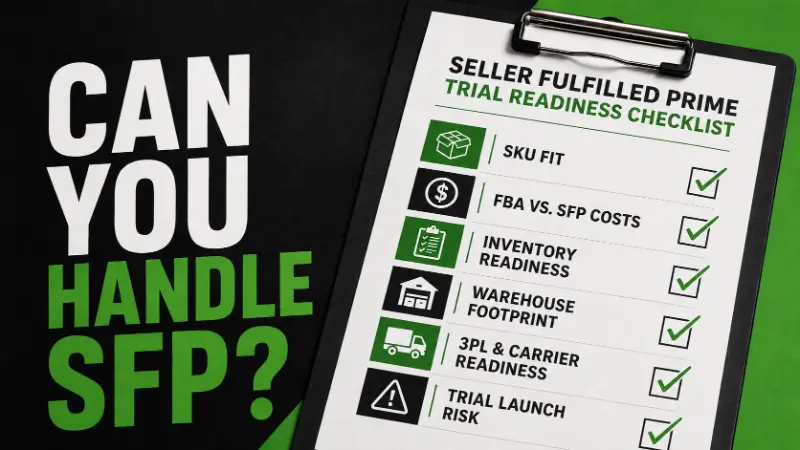
In this article
51 minutes
- Download the Seller Fulfilled Prime Trial Checklist
- Before You Start: Should This SKU Be in SFP at All?
- Step 1: Select the Right SKUs for the SFP Trial
- Step 2: Make Sure the SKU Can Absorb Shipping Shocks
- Step 3: Inventory Activation Readiness
- Step 4: Choose the Right Warehouse Footprint
- Step 5: Pressure-Test Warehouse Operations
- Step 6: Ask Better Questions Before Choosing a 3PL
- Step 7: Define Trial Success Before Launch
- Step 8: Prepare for the Actual SFP Trial Process
- Red Flags That Mean You Should Delay SFP
- Seller Fulfilled Prime Readiness Scorecard
- Final Takeaway: SFP Is Hard, But It Is Not a Mystery
- Feeling Overwhelmed? Cahoot Can Help Evaluate SFP Readiness
- Frequently Asked Questions
Seller Fulfilled Prime can be one of the most powerful programs available to Amazon sellers, but it is not something to enter casually.
The appeal is obvious. With Seller Fulfilled Prime, sellers can display the Prime badge on eligible products while fulfilling those orders from their own facility, a third-party logistics provider, or another fulfillment setup outside of Amazon FBA. That means more control over inventory, packaging, fulfillment strategy, and operational flexibility while still offering the Prime experience customers expect.
But SFP is not just a badge. It is an operating commitment.
Amazon requires sellers to prequalify, complete a trial, and continuously meet program performance requirements after enrollment. During the trial, sellers need to prove that their operation can support fast, reliable delivery before Prime branding is applied to their products. After enrollment, performance is still monitored, and failure to maintain the new, stricter SFP requirements can put Prime eligibility at risk.
That is why the right question is not simply:
Can we sign up for SFP?
The better question is:
Should we use SFP for this SKU, and can our fulfillment model support it profitably under real-world conditions?
This checklist walks through the major decisions sellers should review before launching Seller Fulfilled Prime. It is designed to help you pressure-test your SKUs, FBA comparison, warehouse footprint, carrier strategy, 3PL readiness, and trial plan before the Prime badge is on the line.
SFP is difficult, but it is not impossible. The sellers who struggle are usually not the ones who fail to read the requirements. They are the ones who underestimate what those requirements mean operationally.
Watch: What to Fix Before Your SFP Trial Starts
The Seller Fulfilled Prime trial tests an operating setup, not just a seller’s ability to ship packages. In this video, Manish Chowdhary walks through the problems to check before you begin, including SKU selection, inventory availability, delivery promises, shipping settings, and carrier readiness.
The takeaway: Test the customer-facing delivery promise and the complete order-to-carrier workflow before starting the trial. Use the scorecard and steps below to document what is ready, who owns each remaining fix, and whether your chosen SKUs can support the trial under normal exceptions.
Download the Seller Fulfilled Prime Trial Scorecard
Check if your operations is ready for SFP trial with this downloadable scorecard. Pressure-test your SKUs, FBA comparison, warehouse footprint, margin resilience, 3PL readiness, and SFP trial plan before Prime performance is on the line.
Download the Seller Fulfilled Prime Trial Scorecard
Before You Start: Should This SKU Be in SFP at All?
Before you review cutoff times, carrier settings, warehouse coverage, or trial enrollment, start with a more basic question:
Does this SKU actually belong in Seller Fulfilled Prime?
This matters because SFP is not automatically cheaper than FBA. In many cases, FBA is a very strong default. Amazon stores inventory, picks, packs, ships, handles customer service, processes returns, and gives eligible products access to Prime delivery. Sellers should understand the broader tradeoffs between Fulfillment by Amazon and Fulfillment by Merchant before assuming SFP will be the better option. Under the merchant fulfilled network, the seller keeps those customer service inquiries and fulfillment responsibilities, which is one reason some merchants consider Amazon Seller Fulfilled Prime instead. For many standard-size products, that bundled service is difficult to beat with internal fulfillment or outsourced fulfillment.
That does not mean FBA is always better. It means FBA should be the benchmark.
SFP tends to become more interesting when one of two things is true, especially in the context of rising FBA fees and using SFP strategically:
First, the SKU may be a cost-saving candidate. Based on Cahoot’s experience comparing FBA and SFP costs across a large number of ASINs, meaningful savings are typically concentrated in Amazon’s Extra-Large size tier. This is a specific FBA size classification, not simply a product that happens to be large. Products in the Extra-Large tier exceed the dimensional limits of Amazon’s Small Bulky and Large Bulky categories, or have a shipping weight above 50 pounds when dimensional weight is considered. These ASINs often face significantly higher FBA fulfillment costs, making them the most likely candidates for SFP cost savings.
Second, the SKU may be a strategic-control candidate. In this case, SFP may not be cheaper than FBA, but it may still be worth considering because the seller needs more control over inventory, packaging, handling, replenishment, or returns, since the seller fulfilled prime program can let an online business ship from its own warehouse while still participating in the broader prime program.
A meltable product is a good example. If Amazon restricts meltable FBA inventory during certain warm-weather periods, the seller may need an alternative fulfillment path even if FBA is usually attractive. Special packaging, fragile handling, high-value inspection, inventory control, or returns strategy can also justify SFP for reasons beyond pure fulfillment cost.
The mistake is treating all of these scenarios the same.
If your goal is cost savings, the math has to prove SFP is cheaper than FBA. If your goal is control, then the business case should be honest about what that control is worth.
SFP fit checklist
Review each SKU before you go further:
- Is this SKU standard-size, oversize, or extra-large?
- What does FBA currently cost for this SKU?
- What would it cost to fulfill this SKU through your own operation or a 3PL?
- Have you included pick/pack, packaging, labor, shipping, software, exception handling, and returns?
- Is this SKU likely to require premium, air, or overnight shipping under SFP?
- Is there a non-cost reason to use SFP, such as meltable restrictions, special handling, branded packaging, inventory control, or FBA limitations?
- If FBA is cheaper, is the strategic reason for SFP strong enough to justify the extra complexity?
Reality check
If FBA already gives this SKU Prime eligibility at a lower total cost and Amazon handles the product well, SFP may not be the right cost-saving strategy.
That is not a failure. It is a good decision.
The goal is not to force SFP onto every product. The goal is to identify the products where SFP creates a real advantage.
One example is extremely large products that exceed normal parcel-shipping limits. Large projector screens are often packaged as long, narrow tubes. Some models can reach lengths of 117 inches, which exceeds the 108-inch maximum length accepted by UPS and FedEx for standard parcel shipments.
At first glance, these products may seem like ideal SFP candidates because Amazon FBA fulfillment fees can be very high. In our experience, some projector screens have incurred FBA fulfillment charges exceeding $50 per order. However, once sellers investigate alternatives, they often discover that outsourced fulfillment outside Amazon is not necessarily cheaper. The limited carrier options, special handling requirements, and oversized freight costs can make third-party fulfillment difficult to source and expensive to operate.
In cases like these, a high FBA fee alone is not enough reason to move a SKU into SFP. The real comparison is whether a reliable fulfillment alternative exists at a lower total cost. Sometimes the answer is yes. Sometimes Amazon’s expensive option is still the most practical one available.
Step 1: Select the Right SKUs for the SFP Trial
Once a SKU passes the first fit check, the next question is whether it is a good trial candidate.
Do not start with your whole catalog. SFP should begin with a controlled group of SKUs that can generate useful data without putting the entire operation at risk.
One of the most overlooked factors in SFP trial planning is sales volume.
Many sellers focus on the fact that Amazon’s trial only requires 100 shipped packages. On paper, that sounds manageable. In practice, 100 orders is a surprisingly small sample size when you consider the performance metrics required to pass.
For example, sellers must maintain the required on-time delivery performance throughout the trial. If you only ship 25 orders in a given week and one package arrives late due to a carrier issue, your metrics may still be fine. But if two packages are delayed by UPS or FedEx for reasons completely outside your control, your performance can drop below the required threshold very quickly.
The problem is not necessarily your operation. The problem is statistical volatility.
When order volume is low, every late package has an outsized impact on your metrics. A couple of carrier delays that would barely register in a larger sample can become the difference between passing and failing the trial.
This is why sellers should not simply look for SKUs that can generate 100 orders. They should look for SKUs that generate substantially more volume than the minimum requirement. Higher-volume SKUs create a larger performance buffer against the occasional carrier delay, weather event, missed scan, or carrier delivery exception.
Just as importantly, sellers need a plan to generate that volume during the trial.
Amazon does not display the Prime badge on your listings during the SFP trial period. That means your trial ASINs are competing against Prime-eligible products without receiving one of the biggest visibility and conversion advantages on the marketplace. If you simply enroll a SKU and wait for organic traffic to carry the trial, you may struggle to generate enough orders to produce meaningful results.
In many cases, advertising and promotions are not optional during the trial—they are part of the trial strategy.
Sponsored Products campaigns, coupons, deals, email marketing, social traffic, and other demand-generation efforts can help ensure your trial ASINs receive enough visibility to generate order volume. Think of these investments as giving your SFP trial products a fair fighting chance while they are temporarily operating without the Prime badge.
That matters because the stakes are high. Sellers only have a limited number of opportunities to pass the trial, so each attempt should be treated as valuable. A weak SKU selection strategy can burn a trial attempt even when the fulfillment operation itself is capable of meeting SFP requirements.
A good SFP trial SKU usually has six traits:
It has enough sales velocity to produce meaningful results and provide metric stability. If the SKU barely sells, the trial will not teach you much, and a small number of carrier exceptions can disproportionately affect performance.
It has enough margin to absorb exceptions. Even a strong SFP setup will occasionally face missed pickups, late carrier scans, regional disruptions, inventory mismatches, or orders that require more expensive service than expected. If one or two expensive shipments wipe out the margin, the SKU is fragile.
It has a realistic traffic-generation plan. Because the Prime badge is not displayed during the trial, sellers should know how they will drive visibility and demand to the ASIN rather than relying entirely on organic rankings.
It is operationally predictable. The best trial SKUs are not the ones that require special handling every time, constant manual inspection, odd packaging, or unusual carrier decisions.
It has stable inventory. SFP puts pressure on inventory accuracy. If a SKU is frequently oversold, backordered, manually adjusted, or spread thin across multiple locations, it can create avoidable trial risk.
It can realistically meet the delivery promise from the selected fulfillment location. A SKU may look profitable on average but become unworkable if too many orders require expensive shipping to hit the promised date.
SKU selection checklist
Before adding a SKU to the SFP trial, confirm:
- The SKU has enough sales velocity to produce useful trial data.
- The SKU generates significantly more volume than the minimum trial requirement.
- The SKU provides enough order volume that occasional carrier delays will not disproportionately impact performance metrics.
- There is a realistic plan to drive additional traffic and sales volume to the trial ASIN if needed.
- Advertising, promotions, or external traffic efforts are aligned with the trial timeline.
- The SKU has enough margin to absorb occasional premium shipping.
- The SKU is not operationally messy to pick, pack, label, or hand off.
- The SKU has stable inventory and a reliable replenishment plan.
- The SKU can meet the expected delivery promise from the planned fulfillment location.
- The SKU does not depend on every shipment going perfectly to remain profitable.
- The SKU belongs in either a cost-saving bucket or a strategic-control bucket.
Trial SKU categories
It helps to divide SKUs into three groups:
Strong SFP candidates are SKUs where the economics, inventory, fulfillment process, delivery coverage, sales volume, and traffic-generation plan all look workable.
Conditional SFP candidates are SKUs where SFP may work, but only if a specific risk is controlled. That risk might be warehouse coverage, inventory depth, carrier cost, exception response, insufficient order volume, or the need for additional traffic generation.
Poor SFP candidates are SKUs where FBA is cheaper, inventory is unstable, fulfillment is messy, sales volume is too low, traffic is difficult to generate, or the model only works under perfect conditions.
Do not be afraid to exclude SKUs. A smaller, cleaner trial is usually better than a broader trial filled with avoidable risk. Just make sure the SKUs you do choose generate enough volume—or can be supported with advertising and traffic-driving efforts—to give you a realistic chance of passing the trial without being derailed by a handful of carrier exceptions.
Step 2: Make Sure the SKU Can Absorb Shipping Shocks
Many sellers focus on the average shipping cost when evaluating SFP. The bigger risk is the occasional shipment that becomes unexpectedly expensive.
Even with a well-designed SFP operation, there will be situations where you need to upgrade service to protect delivery performance. An order may come from a distant region. A carrier lane may underperform. A warehouse may miss a cutoff. Amazon system timing may leave less fulfillment time than expected. In some cases, the only practical solution is to use a much more expensive shipping service than originally planned.
These situations are usually infrequent, but they matter because they can erase the profit from multiple normal orders.
That is why margin matters so much when selecting SFP SKUs.
One Cahoot merchant running Seller Fulfilled Prime through five fulfillment locations provides a good real-world example. Their average shipping cost using ground service is about $18 per order. However, roughly 2% of recent orders required either 2nd Day Air or Next Day Air to protect the delivery promise, increasing shipping costs to between $23 and $47 on those shipments.
At first glance, a 2% exception rate may not sound significant. But if a SKU only has a few dollars of contribution margin after fulfillment and shipping, those occasional air shipments can quickly consume profits. The merchant’s program works because the products enrolled in SFP have enough margin to absorb those exceptions without turning the overall SKU unprofitable.
That is the mindset sellers should adopt when evaluating trial candidates.
Do not ask whether the SKU is profitable when everything goes according to plan. Ask whether it remains profitable when a small percentage of orders require substantially more expensive shipping.
The goal is not to eliminate shipping shocks. The goal is to choose products that can absorb them without destroying profitability.
Margin resilience checklist
Before launching SFP, answer:
- What is the expected shipping cost under normal conditions?
- What is the expected shipping cost when expedited service is required?
- How often might premium shipping be needed?
- Does the SKU remain profitable if 2 percent of orders require air service?
- Does the SKU remain profitable if 5 percent of orders require overnight shipping?
- Does the SKU remain profitable if 10 percent of orders require overnight shipping?
- How many expensive shipments can the SKU absorb before margins become unacceptable?
- What is the maximum shipping cost this SKU can tolerate?
- What is the stop-loss threshold for the trial?
Reality check
If a single overnight shipment can wipe out the profit from several orders, the SKU may not be a strong SFP candidate.
A useful stress test is to model something similar to the Cahoot merchant example above: average ground shipping around $18, with approximately 2% of orders requiring air services costing $23 to $47. If the SKU still produces acceptable margins under those conditions, it is much more likely to succeed in a real SFP environment.
The best SFP SKUs have enough margin to survive occasional shipping surprises without turning negative. Those surprises are part of operating Seller Fulfilled Prime, and planning for them upfront is far better than discovering them during the trial.
Step 3: Inventory Activation Readiness
This step is intentionally placed after warehouse footprint planning because the question is no longer where inventory should live.
The question is whether inventory is actually ready before you turn SFP on.
One of the most expensive mistakes sellers make is enabling SFP shipping templates before inventory has been fully received, reconciled, and made available across the fulfillment network. On paper, the warehouse footprint looks ready. In reality, inventory is still in transit, sitting on a receiving dock, waiting to be checked in, or not yet synced across systems.
The moment SFP goes live, Amazon starts making delivery promises based on the fulfillment setup you’ve configured. If inventory is not truly ready, orders can immediately start routing in ways you did not expect.
That often creates two bad outcomes.
The first is operational. Orders may need to be fulfilled from backup locations that were never intended to handle that volume. Inventory mismatches can trigger cancellations, delays, or manual intervention, undermining many of the advantages described in broader guides to winning on Amazon Seller Fulfilled Prime.
The second is financial. Sellers may suddenly find themselves paying for overnight or premium shipping simply to protect delivery promises that should never have been made in the first place.
In other words, warehouse footprint determines where inventory should be.
Inventory activation readiness determines when you should turn SFP on.
Inventory activation checklist
Before enabling SFP shipping templates, confirm:
- Inventory has been physically received at every planned fulfillment location.
- Inventory has been checked in and is available for picking.
- Inventory counts are accurate across Amazon, your OMS, your WMS, and any 3PL systems.
- Inventory synchronization has been tested.
- Routing logic is directing orders to the correct fulfillment locations.
- Safety stock levels have been established.
- Replenishment inventory is already in motion if needed.
- No location is relying on inventory that is still inbound.
- Trial SKUs have enough available inventory to support expected demand.
- A test order has been run to verify fulfillment and routing behavior.
The “don’t turn it on yet” test
Before activating SFP, ask a simple question:
If 50 orders arrived today, could every fulfillment location ship its assigned orders immediately?
If the answer is no because inventory is still being received, counted, transferred, or synchronized, wait.
A few extra days of preparation is usually far cheaper than a week of overnight shipments, delivery exceptions, and damaged metrics.
Timing matters more than most sellers realize
Many sellers focus heavily on network design and carrier strategy but underestimate activation timing.
The difference between turning SFP on Monday versus turning it on Friday after inventory is fully received may seem minor. In practice, that timing decision can determine whether the trial starts smoothly or begins with avoidable exceptions.
The goal is not simply to have inventory somewhere in the network.
The goal is to have inventory fully available, visible, and ready for fulfillment before Amazon starts making Prime delivery promises.
Step 4: Choose the Right Warehouse Footprint
This is where many SFP evaluations go wrong.
Sellers often focus on whether a warehouse can physically ship orders. Amazon cares about something different: whether your fulfillment network can consistently generate the delivery promises required for your SKU’s size tier.
The key word is promises.
Seller Fulfilled Prime delivery speed metrics are based on what Prime customers see on the product page before they buy, not how quickly you ship after the order is placed. Amazon measures the percentage of Prime customer page views that display delivery promises within specific timeframes.
For example, if a customer views your listing and sees a same-day or next-day delivery promise, that page view counts toward the ≤1-day metric. If they see a two-day promise, it counts toward the ≤2-day metric. If they see a three-day or longer promise, it does not help your delivery speed metrics even if you ultimately ship the order perfectly.
This distinction is critical because warehouse location, operating schedules, carrier coverage, and shipping templates all influence the delivery promise shown to customers.
Understand your size tier first
Amazon evaluates delivery speed requirements differently depending on the product’s size tier.
A product is considered standard-size if all of the following are true:
- Longest side is 18 inches or less
- Median side is 14 inches or less
- Shortest side is 8 inches or less
- Weight is 20 pounds or less
A product is considered oversize if it exceeds any standard-size threshold but does not qualify as extra-large.
A product is considered extra-large if it meets any of the following:
- Longest side is 96 inches or more
- Length plus girth is 130 inches or more
- Weight is 50 pounds or more
- Television with a longest side of 40 inches or more
Amazon displays each item’s assigned size tier within Seller Central, and sellers should verify this before evaluating SFP eligibility.
Why warehouse distribution matters
The warehouse footprint required for SFP is largely determined by the delivery speed metrics Amazon expects for that size tier.
Current minimum requirements are:
| Size Tier | ≤1 Day Promise | ≤2 Day Promise |
| Standard-size | 30% | 70% |
| Oversize | 10% | 45% |
| Extra-large | N/A | 15% |
Beginning July 6, 2026, Amazon will increase these requirements:
| Size Tier | ≤1 Day Promise | ≤2 Day Promise | ≤5 Day Promise |
| Standard-size | 40% | 75% | 90% |
| Oversize | 15% | N/A | 80% |
| Extra-large | N/A | 25% | 60% |
These changes matter because they directly affect how many fulfillment nodes a seller may need.
Historically, some sellers could achieve the oversize requirement with only two strategically located warehouses because they only needed to generate a 10% one-day promise rate. Once that requirement increases to 15%, many two-node networks will struggle to provide enough one-day coverage.
This is where limitations of smaller 3PL networks often become visible. A provider may be excellent operationally, but if they only operate two warehouses, they may not have enough geographic reach to generate the delivery promises required for certain SFP size tiers —making it important to evaluate specialized Amazon SFP 3PL fulfillment services that can provide broader coverage.
Delivery promises are not shipping speeds
One of the most common SFP misunderstandings is assuming that fast shipping automatically creates fast delivery promises.
It does not.
Imagine a customer views your listing on Saturday afternoon after your warehouse cutoff time.
Your warehouse does not operate Sunday.
The order cannot leave until Monday.
Even if you use overnight shipping, the earliest delivery may be Tuesday.
From Amazon’s perspective, that customer saw a three-day delivery promise when they viewed the listing. That page view does not help your one-day or two-day delivery speed metrics.
This is why sellers often need significantly more one-day coverage than the minimum requirement suggests.
Weekend operations, carrier schedules, holidays, cutoff times, and regional transit times all create page views that naturally produce slower delivery promises. To offset those weaker periods, sellers need stronger coverage during the rest of the week.
For example, if a large percentage of your customers are located in a region that currently receives a two-day promise, adding inventory closer to that region may convert many of those customers into one-day promise customers. That improvement can have a meaningful impact on delivery speed metrics without requiring expensive air shipments.
The goal is ground shipping, not air shipping
A healthy SFP network is usually designed around ground transportation.
The objective is to place inventory close enough to customers that most orders can meet the required delivery promise using economical ground services. If your network depends heavily on overnight air shipments to maintain compliance, profitability can deteriorate quickly.
When evaluating warehouse footprint, ask:
- How many customers can receive a one-day promise using ground shipping?
- How many customers can receive a two-day promise using ground shipping?
- Which regions require air services?
- What percentage of orders would require premium transportation?
- Does the economics still work if carrier costs increase?
The best SFP networks are typically those that maximize delivery speed through inventory placement rather than transportation spend.
Warehouse footprint checklist
Before launching SFP, review:
- Which size tier each trial SKU belongs to.
- The delivery speed requirements for that size tier.
- Which customer regions can receive one-day promises from the current network.
- Which customer regions can receive two-day promises from the current network.
- Which regions require premium shipping.
- Whether additional fulfillment nodes would improve delivery promise coverage.
- Whether the SKU has enough volume to justify distributed inventory.
- Whether adding nodes would create inventory fragmentation risk.
- Whether routing logic can automatically select the correct fulfillment location.
- Whether warehouse operating schedules support the desired delivery promises.
- Whether weekend operations are helping or hurting delivery speed metrics.
Practical guidance
Do not assume every SKU belongs in SFP.
The delivery speed requirements themselves should influence SKU selection.
Standard-size products generally face the most demanding delivery speed expectations while often benefiting from the strongest FBA economics. In many cases, sellers must build substantial one-day coverage to satisfy standard-size requirements.
Oversize and extra-large products may be more attractive SFP candidates because FBA economics can be less favorable and delivery speed requirements are somewhat less aggressive. That does not make them easy, but it can make the business case more realistic.
The warehouse footprint should follow the SKU strategy, not the other way around.
A seller should first determine which products belong in SFP, then build the fulfillment network necessary to support the required delivery promises for those products.
Step 5: Pressure-Test Warehouse Operations
A warehouse that can fulfill ecommerce orders is not automatically ready for Seller Fulfilled Prime.
SFP creates a different level of operational pressure because the delivery promise is tied directly to Prime customer expectations and Amazon’s ongoing performance requirements. Orders need to move on time, tracking needs to update correctly, and exceptions need to be handled quickly. More importantly, the warehouse must be able to operate within Amazon’s specific SFP rules, not just general ecommerce best practices.
The first operational question is same-day execution. Amazon requires zero-day handling time for Prime orders that arrive before the applicable order cutoff. Can SFP orders be picked, packed, labeled, and handed off the same day when required? Not on the best day. Not when volume is light. Reliably.
The second question is cutoff readiness. Amazon’s SFP policy requires sellers to configure order cutoff times of at least 2:00 p.m. local time Monday through Friday and at least 10:30 a.m. local time on Saturdays and Sundays. This requirement alone eliminates many fulfillment operations from serious SFP consideration. A surprising number of 3PLs stop processing same-day orders at noon or earlier. If a warehouse cannot consistently support Amazon’s required cutoff windows, it may not be operationally compatible with SFP regardless of how well it performs for other channels.
The third question is weekend operations. Amazon requires SFP sellers to operate on at least one weekend day by receiving, packing, and shipping Prime orders on Saturday, Sunday, or both. Amazon’s policy explicitly states that removing Prime listings, toggling Prime eligibility, reducing Prime order limits, or taking other actions to avoid weekend operations harms customer trust and violates SFP policy.
Technically, some sellers have attempted to manually disable Prime templates over the weekend and re-enable them on Monday to avoid weekend fulfillment requirements. One Amazon seller who used to manage SFP internally used this approach. In practice, however, it required constant manual intervention every week, including disabling Prime templates, adjusting advertising, monitoring listings, and restoring everything on Monday. Beyond the operational burden, Amazon’s policy now specifically discourages this type of workaround. For most sellers, six-day operations are effectively a requirement for sustainable SFP participation.
The fourth question is prioritization. SFP orders should not sit in the same queue as every other order if that creates risk. If the warehouse is also supporting Shopify, Walmart, wholesale, replenishment, returns, or B2B orders, the SFP process needs clear priority rules.
The fifth question is exception response. Every fulfillment operation has exceptions. The difference with SFP is that exceptions need fast ownership because Amazon reviews performance continuously and can disable Prime offers when requirements are missed repeatedly.
Just as important is the ability to recover from exceptions without disrupting the customer promise. A missed carrier pickup, weather event, warehouse outage, inventory discrepancy, or even an Amazon system delay should not automatically become a late shipment. For example, if a UPS truck fails to arrive at a Pennsylvania warehouse and dozens of Prime orders miss their planned handoff, can those orders be quickly rerouted to another warehouse that has inventory and can still reach the customer on time? If a snowstorm shuts down an Indiana facility for a day, can your systems automatically shift fulfillment to another node without requiring hours of manual intervention?
SFP operations need contingency plans for these scenarios because they happen more often than sellers expect. The strongest SFP networks are not the ones that never experience disruptions. They are the ones that detect problems quickly and recover before customers notice. Even Amazon occasionally introduces edge cases, such as orders appearing after the configured cutoff but still requiring same-day shipment. Your systems and operations team need visibility into these exceptions and a process for resolving them before they impact performance metrics.
Warehouse operations checklist
Before launching SFP, confirm:
- SFP orders can be identified clearly.
- SFP orders can be prioritized in the warehouse.
- Pick/pack/ship can happen same day when required.
- The warehouse can support Amazon’s required order cutoff times.
- Carrier pickup schedules align with those cutoff times.
- Staff coverage supports weekend operations.
- Weekend orders will be received, packed, and shipped according to policy.
- There is a documented process for missed picks, label failures, inventory mismatches, and late carrier pickups.
- There is a documented contingency plan for missed carrier pickups, warehouse closures, and severe weather events.
- Orders can be reassigned to another fulfillment location when necessary.
- Someone owns exception resolution daily.
- The warehouse can recover from volume spikes without sacrificing SFP orders.
- The team has run a dry test before live trial volume starts.
Specific failure modes to watch
The most dangerous SFP problems are often small operational misses that compound.
A label fails.
A picker cannot find the item.
A carrier scan is missing.
A batch misses cutoff by 15 minutes.
An order is routed to the wrong node.
A weekend order sits until Monday.
A carrier misses a scheduled pickup.
A warehouse closes unexpectedly due to weather or a local disruption.
An Amazon order arrives with an unexpected same-day shipping requirement.
None of these problems seem dramatic in isolation. But under SFP, the customer promise does not care whether the issue was small internally. If the delivery promise is missed, the metric is at risk.
One of the most common readiness mistakes is assuming that a warehouse that performs well for ordinary ecommerce fulfillment is automatically ready for SFP. In reality, cutoff times, weekend operations, and exception recovery are often the first points of failure. Sellers should verify these capabilities explicitly before enrolling in the trial rather than discovering the gap after Prime orders begin flowing.
Step 6: Ask Better Questions Before Choosing a 3PL
If you plan to use a 3PL for Seller Fulfilled Prime, do not ask—especially when evaluating options like the best 3PL companies for Amazon SFP:
Can this 3PL ship Amazon orders?
Ask:
Can this 3PL protect the Prime promise for the specific SKUs, size tiers, delivery requirements, inventory footprint, and exception scenarios our SFP program will face?
Many 3PLs can fulfill marketplace orders. Far fewer can consistently support Amazon’s SFP requirements around delivery promises, cutoff times, weekend operations, inventory placement, carrier performance, and exception recovery.
Focus on SFP-specific capabilities
If you are formalizing your search, using a structured RFP template for 3PL partner evaluation can help you compare providers on the SFP-specific capabilities that matter most.
A strong SFP evaluation starts with the work you already completed earlier in this checklist:
- Which SKUs are good SFP candidates?
- Which size tiers do they belong to?
- What delivery promises are required?
- How many fulfillment nodes are needed?
- How much premium shipping exposure can the SKU absorb?
- What happens when inventory, carrier, or warehouse issues occur?
If a 3PL cannot answer those questions in operational detail, they may not be ready to support your SFP program.
Key questions to ask
Ask the 3PL:
- Which SFP size tiers can your network realistically support?
- Which regions can receive one-day and two-day delivery promises?
- Which regions require premium or air shipping?
- How do you prioritize SFP orders inside the warehouse?
- What are your weekday and weekend cutoff times?
- Which weekend days do you operate and which carriers pick up?
- How do you route orders across multiple fulfillment nodes?
- Can orders be reassigned if the preferred location cannot ship?
- How do you monitor late shipments, missed pickups, and tracking issues?
- What happens when inventory is unavailable, a carrier misses pickup, or a facility experiences disruption?
- Can you show reporting that separates SFP performance from other order types?
Watch for weak answers
Be cautious if the conversation stays at a high level:
- “We can ship fast.”
- “We have Amazon integrations.”
- “We do two-day shipping.”
- “We handle Prime.”
- “We have multiple warehouses.”
Those statements may be true, but they do not prove the provider can support SFP.
A strong answer connects warehouse footprint, delivery promise coverage, cutoff readiness, weekend operations, inventory routing, and exception recovery into one operating model.
If the 3PL cannot clearly explain how they protect the Prime promise when things go wrong, they may not be the right partner for SFP.
Step 7: Define Trial Success Before Launch
Passing the SFP trial is important, but it is not the only definition of success.
A seller can pass the trial and still discover that the model is too expensive, too fragile, too dependent on air shipping, or too operationally stressful to maintain.
That is why success should be defined before launch.
The trial should answer more than one question. It should not only prove that you can meet Amazon’s requirements for a short period. It should prove that the SFP model is worth continuing after the trial ends.
At minimum, your trial should answer five questions:
- Did we meet Amazon’s performance requirements?
- Did the selected SKUs preserve acceptable margin?
- Did the warehouse footprint generate the delivery promises we expected?
- Did warehouse operations and exception recovery work under real pressure?
- Do we believe this model can survive normal post-trial conditions without constant manual intervention?
If the answer to the first question is yes but the other four are no, be careful. Passing the trial may prove that your operation can perform temporarily. It does not automatically prove that SFP is the right long-term model.
Define why you are doing SFP
Before launching the trial, define the business reason for SFP.
Your reason may be cost savings, but that should only be true if the FBA comparison supports it.
Your reason may be operational control. That could include special handling, better inventory visibility, branded packaging, meltable product constraints, reduced FBA dependency, or more control over returns.
Your reason may be strategic flexibility. Some sellers want the ability to maintain Prime eligibility without putting every unit into Amazon’s network.
These are all valid reasons, but they are not the same reason. Each one requires different success metrics.
- A cost-saving SFP trial should be judged heavily on contribution margin.
- A control-driven SFP trial should be judged on whether the seller gains meaningful operational control without creating unacceptable delivery or margin risk.
- A flexibility-driven SFP trial should be judged on whether the seller can maintain Prime performance without becoming dependent on fragile manual workarounds.
Define success by SKU, not just by program
Do not judge SFP only at the program level.
A trial can look successful overall while hiding weak SKUs inside the mix. One SKU may be profitable, operationally clean, and easy to support. Another may require too much premium shipping, too much manual intervention, or too much inventory movement.
Define success for each trial SKU.
For each SKU, know:
- Why the SKU was included.
- Whether it is a cost-saving candidate or strategic-control candidate.
- What FBA would have cost.
- What SFP actually cost.
- How often premium shipping was required.
- Whether the SKU generated enough order volume.
- Whether inventory stayed available.
- Whether the SKU created operational exceptions.
- Whether the SKU should stay in SFP after the trial.
This matters because the right post-trial decision may not be “continue SFP” or “stop SFP.”
The right decision may be:
- Keep these SKUs in SFP.
- Remove these SKUs from SFP.
- Delay expansion until inventory is better distributed.
- Use SFP only for extra-large products.
- Use SFP only for specific regions.
- Keep FBA for standard-size products where Amazon is still the better economic option.
Trial success checklist
Before launching the trial, define:
- The SKUs included in the trial.
- The reason each SKU is included.
- Whether each SKU is a cost-saving or strategic-control candidate.
- The current FBA cost benchmark for each SKU.
- The expected SFP margin for each SKU.
- The maximum acceptable premium-shipping exposure.
- The maximum acceptable exception rate.
- The minimum acceptable order volume.
- The advertising or traffic plan needed to generate trial volume.
- The expected delivery promise coverage by size tier.
- The warehouse locations supporting each SKU.
- The daily owner for SFP metric review.
- The person authorized to pause, remove, or adjust SKUs.
- The threshold for stopping the trial.
- The post-trial decision process.
Stop-loss examples
A stop-loss rule could look like:
- Pause SFP enrollment for a SKU if more than 10 percent of orders require premium shipping for two consecutive weeks.
- Remove a SKU from SFP if contribution margin drops below target after including expedited shipping and exception costs.
- Pause expansion if the warehouse footprint cannot generate enough one-day or two-day delivery promises without too much air shipping.
- Remove a SKU from SFP if it repeatedly creates inventory exceptions, wrong-node routing, or manual intervention.
- Delay expansion if advertising is required to generate trial volume but the added acquisition cost makes the economics unattractive.
The exact rule is less important than having one before the trial starts. Without a stop-loss rule, sellers can keep pushing forward simply because they have already invested time into the setup.
Do not confuse trial survival with long-term readiness
A trial is a controlled window. Ongoing SFP participation is the real operating model.
During the trial, the team may watch every order closely, manually intervene when exceptions appear, and spend more than usual to protect performance. That may be acceptable during launch. It is not sustainable forever.
Before deciding to continue after the trial, ask:
- Did we need unusual manual effort to make the trial work?
- Did we rely on expensive upgrades more often than expected?
- Did the 3PL require constant follow-up?
- Did our inventory stay clean across nodes?
- Did our delivery promise coverage improve as expected?
- Did the program remain profitable after all costs were included?
- Would this still work during peak season?
If the model only works because everyone is watching it every hour, it is not truly ready.
Reality check
The goal is not just to pass the SFP trial.
The goal is to prove that SFP is worth continuing.
A smart seller knows before launch what success looks like, what failure looks like, and when to stop before the program becomes a margin drain.
Step 8: Prepare for the Actual SFP Trial Process
Only after the previous checks are complete should sellers move into trial setup.
By this point, you should already know:
- Which SKUs belong in SFP.
- Why each SKU belongs in SFP.
- Whether the economics work compared with FBA.
- Whether each SKU can absorb shipping shocks.
- Whether inventory is ready to activate.
- Whether the warehouse footprint can generate the required delivery promises.
- Whether warehouse operations can support cutoff, weekend, and exception requirements.
- Whether your 3PL, if you use one, can protect the Prime promise.
- What success and stop-loss thresholds look like.
If those answers are not clear, do not treat the trial as the place to figure them out.
The trial should validate your operating model, not invent it.
Understand the enrollment process
Amazon’s Seller Fulfilled Prime process has two stages:
- Prequalify for the SFP trial.
- Pass the trial and graduate into the program.
To prequalify for the trial, sellers must have a domestic U.S. address as their default shipping address, maintain an Amazon Professional selling account, and have shipped at least 100 seller-fulfilled packages during the previous 90 days. Amazon also requires sellers to maintain a cancellation rate below 2.5%, a valid tracking rate above 95%, and a late shipment rate below 4% during the previous 90 days.
Amazon also now allows sellers to enroll in SFP trials by size tier. Standard-size, oversize, and extra-large tiers are evaluated independently, with different delivery-speed expectations and performance requirements for each tier. Sellers are not required to enroll in every tier at the same time and can choose only the size tiers that make sense for their business. Once registered, sellers gain access to the Prime shipping template for the size tier or tiers they selected. The trial officially begins on the following Sunday at 12:00 a.m. PST and runs for four weeks (28 days), and is governed by Amazon’s evolving Seller Fulfilled Prime policy guidelines.
Know what happens during the trial
Once registered, sellers gain access to the Prime shipping template for their selected size tier(s). The trial then runs for Amazon’s required evaluation period and is subject to the same core SFP policies that apply to enrolled sellers.
Products do not receive the Prime badge during the trial. Prime branding is applied only after successful completion and enrollment.
That creates a practical challenge: trial ASINs must generate enough order volume without the Prime badge. If advertising, promotions, coupons, or other demand-generation tactics are needed, plan them before the trial begins.
Sellers should also remember that Amazon limits SFP trial attempts to three per calendar year, making each trial worth protecting.
Confirm the setup before launch
Before launch day, confirm:
- Professional selling account status.
- SFP prequalification and trial registration access.
- Selected size tier(s) and trial SKU list.
- FBA vs. SFP cost comparison for each SKU.
- Prime shipping template setup.
- Inventory received and available at planned locations.
- Safety stock and replenishment plans.
- Carrier services mapped by region and size tier.
- Routing logic and tracking updates tested.
- Advertising or traffic plan prepared.
- Daily metric owner and exception owner assigned.
- Stop-loss thresholds documented.
- Post-trial decision process defined.
- Prime order volume limits configured appropriately.
Plan around timing
Amazon limits the number of SFP trial attempts per calendar year, and upcoming changes to SFP and Premium Shipping requirements will make each attempt even more worth protecting.
Avoid launching before inventory is fully available, routing has been tested, or demand-generation plans are ready. Also review Amazon’s trial graduation restrictions around major sales events and peak shopping periods. During certain periods, sellers may pass the trial but experience delays before receiving Prime badging.
When in doubt, delay the start date until the operating model is ready.
Trial launch checklist
Before launch day, confirm:
- You meet all prequalification requirements.
- The selected size tier(s) are appropriate.
- Every enrolled SKU has passed the FBA vs. SFP fit check.
- Inventory is available and fulfillment locations are ready.
- Routing, carrier services, and tracking have been tested.
- Warehouse staff know how to prioritize SFP orders.
- Weekend operations and carrier pickups are understood.
- Order cutoff times meet Amazon’s minimum requirements.
- Prime order volume limits have been reviewed.
- Exception owners and review processes are in place.
- Stop-loss thresholds are documented.
- The post-trial decision process is clear.
Reality check
Do not launch SFP because the setup is mostly ready.
Launch when the weak points that could damage the trial have been addressed.
The best trial is boring. Orders route correctly. Inventory is available. Carrier services match the delivery promise. Exceptions are caught early. Metrics are reviewed daily. The team knows when to pause.
That is what readiness looks like.
Red Flags That Mean You Should Delay SFP
Seller Fulfilled Prime is not impossible. But some sellers should delay the trial until the weak points are fixed.
Delay SFP if:
- FBA is already cheaper and there is no strong strategic-control reason to use SFP.
- The SKU only works if every shipment goes perfectly.
- You have not modeled premium or overnight shipping exposure.
- The SKU does not generate enough order volume for a stable trial.
- You do not have a traffic plan to support trial ASINs while they lack the Prime badge.
- Inventory is inbound, unreconciled, or not fully available at the planned fulfillment locations.
- Inventory is inaccurate or frequently out of stock.
- The warehouse footprint cannot generate the required delivery promises for the SKU’s size tier.
- The model depends heavily on air shipping to compensate for poor inventory placement.
- The warehouse cannot reliably process Prime orders same day when required.
- The warehouse cannot support Amazon’s cutoff and weekend fulfillment expectations.
- The carrier plan depends on best-case delivery performance.
- The 3PL cannot explain SFP-specific failure modes.
- No one owns daily exception review.
- You have not defined when to pause or stop.
- You are pursuing SFP because the Prime badge sounds attractive, not because the SKU economics and operating model support it.
This is not meant to discourage sellers from SFP. It is meant to prevent avoidable failures.
The sellers most likely to succeed are not the ones who assume SFP will be easy. They are the ones who respect the difficulty, narrow the trial, choose the right SKUs, model the economics, activate inventory carefully, build the right warehouse footprint, and prepare for exceptions before they happen.
Seller Fulfilled Prime Readiness Scorecard
Use this scorecard before launching the trial.
The goal is not to get a perfect score. The goal is to identify whether your SFP plan is ready to test, needs more preparation, or should be delayed before you risk a trial attempt.
Score each category from 0 to 3:
3 = Ready
2 = Mostly ready, but needs validation
1 = High risk
0 = Not ready or unknown
Some categories carry more weight because they can make or break the trial. For example, poor SKU economics, weak margin resilience, or an unworkable warehouse footprint can make SFP a bad idea even if the rest of the setup looks organized.
| # | Category | Weight | Score 3 = Ready | Score 2 = Mostly Ready | Score 1 = High Risk | Score 0 = Not Ready / Unknown | Your Score | Weighted Score |
| 1 | FBA vs SFP economic fit | 2x | We know FBA cost, expected SFP cost, premium-shipping exposure, and the reason this SKU belongs in SFP. | We have a rough FBA vs SFP comparison, but some cost assumptions still need validation. | We believe SFP may be cheaper, but we have not modeled the full cost. | We are assuming SFP will be cheaper without proving it. | ||
| 2 | SKU readiness | 2x | Trial SKUs have margin, sales velocity, predictable handling, traffic-generation support, and enough order volume to create metric stability. | SKUs look promising, but sales volume, traffic generation, or handling complexity still needs validation. | SKUs have some attractive traits but lack margin, volume, or operational predictability. | We are enrolling too many SKUs, choosing low-volume SKUs, or choosing SKUs without a clear reason. | ||
| 3 | Margin resilience | 2x | We know how much premium shipping the SKU can absorb and have defined stop-loss thresholds. | We have modeled average shipping cost and some premium-shipping scenarios, but need better exception modeling. | The SKU appears profitable under normal shipping but becomes fragile when premium shipping is added. | The SKU only works financially if every shipment goes cheaply. | ||
| 4 | Inventory activation readiness | 1.5x | Inventory is received, reconciled, synced, visible, and ready to ship from every planned fulfillment location. | Inventory is available in the main locations, but activation timing, replenishment, or system sync still needs validation. | Some inventory is available, but one or more locations rely on inbound, recently transferred, or manually reconciled stock. | We are relying on inventory that is inbound, unreconciled, unavailable for picking, or not synced across systems. | ||
| 5 | Warehouse footprint | 2x | Our fulfillment location or locations can generate the required delivery promises for the SKU’s size tier economically. | Coverage is mostly workable, but some regions, time windows, or lanes need review. | The footprint can technically support SFP but depends too heavily on premium shipping or narrow coverage assumptions. | The footprint creates too much premium shipping risk or cannot generate enough delivery promise coverage. | ||
| 6 | Warehouse operations | 2x | SFP orders can be prioritized, fulfilled same day when required, supported through cutoff and weekend requirements, and escalated quickly. | The process exists but has not been fully tested under trial conditions. | The warehouse can fulfill orders but lacks a dedicated SFP priority path, exception process, or weekend/cutoff readiness. | SFP orders will be handled like ordinary orders with no special priority or exception path. | ||
| 7 | Carrier and exception recovery | 1.5x | Carrier services, pickup timing, tracking flow, missed pickup processes, rerouting logic, and exception ownership have been tested. | The carrier plan exists, but exception recovery needs more validation. | Carrier services are selected, but late scans, missed pickups, weather disruptions, or rerouting processes are not well defined. | We are assuming carriers will perform perfectly and have no clear recovery process. | ||
| 8 | 3PL readiness | 1x | The 3PL understands SFP-specific operations, size-tier requirements, delivery promise coverage, cutoff readiness, weekend operations, routing, and exception recovery. | The 3PL can fulfill Amazon orders but needs more SFP-specific validation. | The 3PL gives partial answers but cannot clearly explain how it protects SFP orders under exception scenarios. | The 3PL gives vague answers about speed, Prime, Amazon support, or two-day shipping. | ||
| 9 | Trial success definition | 1.5x | We know what success means by SKU, including margin, volume, delivery coverage, exception rate, and post-trial decision criteria. | We know the broad goal but lack clear SKU-level success or stop-loss rules. | Passing the trial is the primary goal, but margin, exception rate, and continuation criteria are unclear. | Passing the trial is the only success metric we have defined. | ||
| 10 | Trial launch readiness | 1.5x | SKUs, size tiers, templates, carrier settings, inventory, routing, traffic plan, owners, and escalation paths are ready. | Setup is mostly complete, but ownership, traffic, timing, or monitoring still needs work. | The launch plan exists but depends on unresolved assumptions. | We are planning to learn the operating model during the trial. | ||
| Total |
How to calculate your SFP readiness score
Add up your weighted points.
If you are using all 10 categories, the maximum score is 51 points.
If you are not using a 3PL, remove the 3PL readiness category. In that case, the maximum score is 48 points.
Then calculate:
Your score ÷ maximum possible score = readiness percentage
| Readiness Score | What It Means | Recommendation |
| 85%–100% | Strong readiness | Prepare for launch after a final requirements and setup check. |
| 70%–84% | Close, but gaps remain | Fix weak spots before launching. Pay special attention to any weighted 2x category scored below 3. |
| 50%–69% | Not ready for launch | Continue planning, but do not start the trial yet. Too many operational or financial risks remain. |
| Below 50% | Delay SFP | Revisit SKU selection, FBA comparison, inventory activation, warehouse footprint, and exception recovery before continuing. |
Automatic delay triggers
Regardless of total score, delay SFP if any of the following categories score 0:
- FBA vs SFP economic fit
- SKU readiness
- Margin resilience
- Warehouse footprint
- Warehouse operations
- Trial launch readiness
These categories are foundational. A high score in easier areas cannot compensate for a zero in one of these areas.
Also delay SFP if any of the following are true:
- FBA is already cheaper and there is no strong strategic-control reason to use SFP.
- Inventory is not fully received, reconciled, and available for picking.
- The warehouse cannot support Amazon’s cutoff and weekend fulfillment expectations.
- The SKU only works financially if every shipment goes cheaply.
- You do not know who owns daily exception review.
- You have not defined when to pause or stop.
The purpose of the scorecard is not to encourage sellers to force a passing score. It is to make the go/no-go decision clearer before the trial begins.
Final Takeaway: SFP Is Hard, But It Is Not a Mystery
Seller Fulfilled Prime is difficult because it forces sellers to connect strategy, finance, fulfillment, inventory, carriers, software, and customer promise into one operating model. That complexity is also what makes it valuable. For the right SKU, with the right warehouse footprint and operating discipline, SFP can provide more control over Prime fulfillment without placing all inventory into FBA.
The program rewards preparation, not guessing. Before launching a trial, sellers should be able to answer a few core questions:
- Should this SKU be in SFP instead of FBA?
- Can this SKU absorb shipping shocks?
- Can we generate enough trial volume without the Prime badge?
- Is inventory fully activated and ready to ship?
- Can our warehouse footprint generate the required delivery promises?
- Can our operation handle cutoff, weekend, and exception requirements?
- Can our 3PL, if used, protect the Prime promise under pressure?
- Do we know when to pause or stop?
If you can answer those questions confidently, you are much closer to a successful SFP trial. If not, delay the launch, address the weak points, and return with a stronger operating plan.
Feeling Overwhelmed? Cahoot Can Help Evaluate SFP Readiness
Seller Fulfilled Prime is not something most sellers should approach casually. The program can work, but only when SKU selection, fulfillment coverage, carrier strategy, technology, and economics are aligned.
Cahoot helps ecommerce sellers evaluate whether SFP makes sense, identify which SKUs are worth testing, compare SFP against FBA, assess warehouse footprint, and build a practical plan to earn and maintain Prime performance.
Request an SFP Readiness Assessment to pressure-test your operation before launching the trial.
[CTA: Request an SFP Readiness Assessment]
Frequently Asked Questions
What is the Seller Fulfilled Prime trial?
The Seller Fulfilled Prime trial is the evaluation period sellers must complete before their enrolled products receive Prime badging through Seller Fulfilled Prime. During the trial, sellers need to prove they can meet Amazon’s SFP performance requirements while fulfilling Prime orders from their own warehouse, a 3PL, or another non-FBA fulfillment setup.
The trial should not be treated as a casual test. It should validate an operating model that has already been planned: SKU selection, inventory readiness, warehouse coverage, carrier setup, tracking flow, exception handling, and trial success criteria.
Do products get the Prime badge during the SFP trial?
No. Products do not receive the Prime badge during the Seller Fulfilled Prime trial. Prime branding is applied only after the seller successfully completes the trial and is enrolled in the program.
This matters because trial ASINs may need a traffic plan. If a seller is relying only on organic demand, they may struggle to generate enough trial orders without the conversion benefit of the Prime badge.
Is Seller Fulfilled Prime cheaper than FBA?
Not always. In many cases, FBA is difficult to beat because it bundles storage, fulfillment, shipping, customer service, returns, and Prime eligibility. Seller Fulfilled Prime may be cheaper for certain products, especially extra-large or FBA-constrained SKUs, but sellers should not assume SFP is a cost-saving strategy until they compare the full cost.
A fair comparison should include pick/pack, packaging, shipping, premium shipping exposure, labor, software, returns, exception handling, and any 3PL costs.
Which products are best for Seller Fulfilled Prime?
The best SFP candidates usually have enough margin, enough sales volume, stable inventory, predictable fulfillment requirements, and realistic delivery coverage from the seller’s fulfillment network.
Extra-large products, products with high FBA fees, meltable items, fragile or high-value products, and SKUs that require more inventory or handling control may be stronger candidates. Standard-size products may still work, but they often face stronger FBA economics and more demanding delivery-speed expectations.
Why does SKU selection matter so much for SFP?
SKU selection matters because a weak SKU can make a strong operation look bad. Low-volume SKUs can create metric volatility during the trial. Low-margin SKUs may not survive occasional air or overnight shipments. Operationally messy SKUs can create avoidable exceptions.
A good SFP trial SKU should generate enough volume to produce meaningful trial data, while still being simple enough to fulfill consistently and profitable enough to absorb normal shipping shocks.
Why does warehouse footprint matter for Seller Fulfilled Prime?
Warehouse footprint matters because SFP delivery speed metrics are influenced by the delivery promises customers see before they buy. Those promises depend on where inventory is located, which regions can be reached quickly, warehouse operating schedules, cutoff times, carrier coverage, and shipping templates.
A seller may ship orders quickly after purchase and still struggle if the fulfillment footprint does not generate enough one-day or two-day delivery promises for the relevant size tier.
Can a 3PL support Seller Fulfilled Prime?
A 3PL can support Seller Fulfilled Prime, but only if it understands the SFP-specific operating requirements. Sellers should not rely on vague claims like “we ship fast” or “we support Amazon orders.”
A strong SFP-capable 3PL should be able to explain how it handles delivery promise coverage, cutoff times, weekend operations, SFP order prioritization, multi-node routing, carrier pickup timing, tracking updates, inventory visibility, and exception recovery.
What are the biggest reasons sellers should delay SFP?
Sellers should delay SFP if the SKU economics do not work, FBA is clearly cheaper without a strong strategic-control reason, inventory is not fully received and available, the warehouse footprint cannot support delivery promises, the operation cannot support cutoff or weekend requirements, or the model depends too heavily on premium shipping.
Sellers should also delay if no one owns daily exception review or if the team has not defined stop-loss thresholds before launch.
How do you know if you are ready for the SFP trial?
You are closer to SFP trial readiness when you can clearly answer these questions:
- Which SKUs belong in SFP and why?
- How does SFP cost compare with FBA for each SKU?
- Can each SKU absorb occasional premium shipping?
- Is inventory fully received, synced, and available to ship?
- Can the warehouse footprint generate the required delivery promises?
- Can the operation handle cutoff times, weekend operations, and exceptions?
- Does the 3PL, if used, understand SFP-specific requirements?
- Do you know when to pause or stop?
If several answers are unclear, the better move is to delay the trial and fix the weak points first.
What should sellers do before starting a Seller Fulfilled Prime trial?
Before starting the trial, sellers should compare SFP against FBA, choose a controlled set of trial SKUs, model margin resilience, activate inventory properly, validate warehouse footprint, confirm carrier and tracking setup, verify warehouse cutoff and weekend readiness, evaluate any 3PL partner, and define trial success criteria.
The trial should validate the operating model, not invent it.
Written By:
Rinaldi Juwono
Rinaldi Juwono leads content and SEO strategy at Cahoot, crafting data-driven insights that help ecommerce brands navigate logistics challenges. He works closely with the product, sales, and operations teams to translate Cahoot’s innovations into actionable strategies merchants can use to grow smarter and leaner.
Turn Returns Into New Revenue
Related Articles
What Is Demand Planning? How It Impacts Inventory, Forecasting, and Profitability
Demand planning is the process of estimating future customer demand so that a business can align its inventory, procurement, and operations to meet that demand without carrying mor...

The Shipping Speed Paradox: Why DTC Brands Are Slowing Down
Everyone’s talking about faster delivery.

Why Cross-Border DTC Brands Are Moving Fulfillment Inside the US
Cross-border ecommerce fulfillment is the process of shipping ecommerce orders across national borders—often from warehouses outside the United States to U.
Subscription Box Fulfillment: Why Recurring Orders Break Traditional 3PL Models

In this article
22 minutes
- Introduction to Subscription Box Fulfillment Services
- Kitting and assembly create fixed windows that conflict with continuous fulfillment
- Inventory forecasting must account for churn, which standard systems do not track
- Peak alignment between billing dates and ship dates creates artificial crunch points
- Labor planning for batch fulfillment conflicts with continuous order processing
- Operational failures in subscription fulfillment compound across cycles
- Technology in Subscription Fulfillment
- Performance Metrics and Monitoring
- What operations leaders should require from subscription fulfillment partners
- Conclusion and Future of Subscription Business
- Frequently Asked Questions
Subscription box fulfillment looks deceptively simple until you try to run it through a traditional 3PL built for one-off ecommerce orders. The recurring nature of subscription shipments creates operational demands that standard fulfillment operations are not designed to handle: predictable kitting windows, synchronized inventory arrivals, batch labor planning, and delivery timing aligned to billing cycles rather than purchase dates. When these requirements collide with warehouses optimized for individual order processing, the results are late boxes, wrong SKUs, and inventory drift that compounds month over month. Delays or errors in subscription box fulfillment can quickly damage a brand’s reputation and lead to decreased customer satisfaction.
For Shopify brands running subscription models (or considering them), understanding why subscription box fulfillment breaks traditional 3PL workflows is not academic. It is the difference between a subscription business that scales and one that spends every cycle firefighting fulfillment failures. Outsourcing Shopify order fulfillment can lead to significant cost savings and operational efficiency improvements. Reliable shipping and complete visibility into order and inventory status are essential for maintaining customer trust and retention.
Introduction to Subscription Box Fulfillment Services
Subscription box fulfillment services have become a cornerstone for ecommerce businesses looking to deliver curated experiences to their customers month after month. As the global subscription box market surges toward an estimated $62.89 billion by 2028, brands are increasingly turning to specialized box fulfillment providers to manage the complex logistics of recurring shipments. A top-tier subscription box fulfillment company does more than just pack and ship products—it ensures every box is assembled with care, features custom packaging, and arrives on time to delight subscribers. Branded boxes and thoughtful presentation are essential for building customer satisfaction and loyalty, while efficient subscription box fulfillment processes help brands scale without sacrificing quality. In a market where timely deliveries and memorable unboxing experiences drive retention, choosing the right fulfillment company is critical to the success of any subscription box business.
Kitting and assembly create fixed windows that conflict with continuous fulfillment
Standard ecommerce fulfillment processes orders as they arrive. A customer places an order at 2:14 PM, the warehouse picks and packs it by 4:00 PM, and it ships the same day. Subscription box fulfillment does not work this way. Curated subscription boxes require careful assembly, vendor coordination, and attention to detail to ensure each box meets high presentation standards and delivers a memorable customer experience. All boxes for a given cycle must be assembled in batches before any can ship, and that assembly cannot begin until every component for that month’s box has arrived and been staged.
This creates a compression problem. If your subscription box contains six SKUs, one custom insert, and branded packaging, the kitting process requires all seven elements to be on hand simultaneously. The use of custom boxes and custom branded packaging not only enhances the unboxing experience but also reinforces brand perception and can drive word-of-mouth marketing. A delay in any single component holds the entire batch. Traditional 3PLs are not built around this constraint. Their warehouse management systems prioritize order throughput (get orders out as fast as possible), not batch readiness (ensure all components are available before starting assembly).
The operational consequence is predictable: subscription brands frequently discover, three days before their ship date, that one SKU is still in transit from a supplier. Because traditional fulfillment centers lack visibility into component dependencies for kit assembly, they cannot alert the brand until the kitting window opens and workers discover the missing item. At that point, the brand faces a binary choice between delaying the entire cycle (missing committed delivery dates for thousands of subscribers) or shipping incomplete boxes (creating immediate customer service issues and churn risk). Quality control in the packing process is essential to ensure a consistent and high-quality unboxing experience, and the inclusion of custom inserts can further delight subscribers and create a unique, memorable interaction with the brand.
Kitting also introduces labor planning challenges that continuous fulfillment avoids. A warehouse handling individual orders can flex labor hour by hour based on inbound order volume. Subscription box assembly requires concentrated labor during a narrow window. If you ship 10,000 boxes per month, all 10,000 must be kitted, packed, and staged within a 48 to 72 hour period. Traditional 3PLs struggle to staff for this burst model because their labor allocation systems assume relatively constant daily volume, not monthly spikes.
Inventory forecasting must account for churn, which standard systems do not track
Traditional ecommerce inventory planning answers a straightforward question: based on recent sales velocity, how much stock should we hold? Subscription box fulfillment must answer a different question: based on expected active subscribers next month (accounting for new signups, cancellations, pauses, and skips), how much stock do we need for each component in next month’s box?
That distinction breaks most 3PL inventory management systems. Standard warehouse management software does not track subscriber counts, churn rates, or renewal timing. It tracks SKU velocity. If you sold 500 units of a product last month, it forecasts you will sell roughly 500 units next month. But subscription models do not work on sales velocity. They work on subscriber base multiplied by fulfillment rate. A brand with 5,000 active subscribers and 3% monthly churn needs inventory for approximately 4,850 boxes next month, not 5,000. If 10% of subscribers pause or skip that month, the actual requirement drops to 4,365 boxes. Predictive forecasting, which uses historical data and seasonal trends, can help brands anticipate order volumes and prevent stockouts in this dynamic environment.
Traditional 3PLs cannot make this calculation because they lack access to subscription platform data (active subscribers, churn trends, pause rates). The result is chronic inventory misalignment. Brands either overstock (because the 3PL ordered based on last month’s shipped volume without accounting for declining subscriber counts) or understock (because the 3PL did not forecast the spike from a successful marketing campaign that added 2,000 new subscribers three weeks before the ship date). To handle unexpected demand spikes from marketing or influencer activities, maintaining buffer inventory is essential.
This problem compounds when subscription boxes include variable SKUs. If your February box contains different products than your January box, you cannot rely on historical velocity at all. You need a forecast based entirely on projected active subscribers for February, adjusted for expected churn and skips. Most fulfillment companies do not have systems designed to make this calculation, and they lack integrations with the subscription management platforms (Recharge, Cratejoy, Bold Subscriptions) where this data lives. Efficient inventory management is necessary for successful subscription box fulfillment to prevent stockouts and delays.
The operational consequence is inventory drift. Month one, you are 200 units short on one SKU and delay shipments. Month two, you overcompensate and order 800 extra units, which sit in paid warehouse storage for six months before being liquidated. Month three, a supplier ships late and you discover the shortage too late to reorder. These are not isolated incidents. They are the predictable result of running subscription fulfillment through inventory systems that were never designed to synchronize stock levels with subscriber counts.
Peak alignment between billing dates and ship dates creates artificial crunch points
Most subscription businesses bill customers on a specific date (the 1st, the 15th, or the anniversary of their signup). Fulfillment centers ship boxes on a different schedule (when assembly is complete and carriers are scheduled for pickup). The gap between these two events creates a mismatch that traditional 3PLs struggle to manage. Shipping subscription boxes requires careful coordination to align shipping with customer billing cycles, ensuring that boxes are sent out on a recurring basis and meet customer expectations.
Consider a subscription box business that bills all customers on the 1st of the month. Customers expect their box to arrive shortly after billing. If fulfillment does not begin until the 10th (because that is when all components arrived and kitting started), and shipping takes until the 14th, and transit adds three to five days, subscribers do not receive their boxes until the 17th to 19th. That is a two-to-three-week lag between billing and delivery, which feels like broken promises to customers who were charged on the 1st. Rapid delivery is essential in subscription box fulfillment, and optimized logistics—such as strategic fulfillment centers and efficient shipping processes—help ensure orders are shipped on time and meet customer expectations.
Traditional 3PLs cannot fix this because they do not control the timing of component arrivals or supplier lead times. They fulfill orders when inventory is available, not when billing cycles dictate. Subscription brands need fulfillment partners who work backward from the required delivery date to establish firm deadlines for component receipt, kitting start, and batch ship dates. That requires proactive coordination between the brand, suppliers, and the fulfillment center, which is not part of standard 3PL workflows. Additionally, a clear returns management process is necessary to handle damaged items or cancellations, ensuring a smooth experience for subscribers.
The operational consequence is customer dissatisfaction that manifests as churn. Research consistently shows that timely delivery is one of the highest drivers of subscription satisfaction, and 17% of consumers will stop using a retailer after just one late delivery. When traditional fulfillment models push delivery dates deeper into the month (because they lack the systems to synchronize supplier arrivals with billing windows), brands pay the cost in subscriber retention.
Labor planning for batch fulfillment conflicts with continuous order processing
Traditional fulfillment centers staff to handle continuous order flow. Orders arrive throughout the day, picking happens continuously, packing stations run at steady utilization, and shipping occurs in regular waves. Subscription box fulfillment operates on a batch model: zero kitting activity for 25 days per month, then 48 to 72 hours of concentrated assembly where the entire monthly volume must be built, quality checked, and staged. Batch shipping allows brands to streamline logistics by shipping all boxes on a predetermined date each month, ensuring timely delivery to subscribers.
This creates a staffing problem that standard 3PL labor models cannot solve. If your subscription business ships 10,000 boxes per month and each box requires 8 to 12 minutes of assembly time (picking six SKUs, inserting branded materials, arranging products for presentation, packing, and sealing), you need approximately 1,300 to 2,000 labor hours compressed into a 3-day window. That is 16 to 25 full-time workers dedicated exclusively to your subscription kitting for three days straight, then reassigned to other work for the rest of the month. Custom kitting, which involves organizing items based on a picking list to create a cohesive package, is essential for delivering a consistent and high-quality experience to subscribers.
Traditional 3PLs resist this model because their operations are designed around stable daily labor allocation. They staff for average daily volume, not monthly peaks. When a subscription brand needs 20 workers for three days and then none for 25 days, the 3PL faces an impossible choice: either overstaff the facility (carrying unutilized labor most of the month) or understaff the subscription kitting window (missing deadlines and creating quality control failures).
The operational consequence is that subscription brands frequently discover their 3PL cannot complete kitting on schedule. Assembly starts on Monday morning with a target ship date of Wednesday afternoon, but by Tuesday evening only 60% of boxes are complete because the warehouse allocated insufficient labor. The 3PL extends the window to Friday, which pushes carrier pickup to Monday, which delays deliveries by a full week and triggers subscriber complaints. An assembly-line approach, where specific tasks are assigned to team members, can increase speed and reduce errors during the kitting process, helping to meet tight shipping deadlines.
Specialized subscription box fulfillment services solve this by organizing labor around batch cycles rather than continuous flow. They staff specifically for assembly windows, using flexible labor pools that ramp up during kitting periods and scale back between cycles. Traditional 3PLs built for continuous ecommerce order processing do not have these labor models in place.
Operational failures in subscription fulfillment compound across cycles
When standard ecommerce fulfillment fails, the impact is isolated to individual orders. A mis-pick affects one customer. A stockout delays one shipment. Subscription box fulfillment failures cascade across the entire subscriber base and carry forward into future cycles.
If kitting for your February cycle discovers that 200 units of one SKU are missing, you cannot ship 200 incomplete boxes. You either delay all 10,000 boxes (affecting every subscriber), or you ship 9,800 complete boxes and 200 substituted boxes (creating inconsistency that erodes the subscription value proposition). During box assembly, using a ‘golden sample’ as a benchmark for quality control ensures that every box matches the intended standard. Neither option is acceptable, but traditional 3PLs force you to choose because their systems do not prevent the stockout from occurring in the first place.
Worse, these failures create operational debt that accumulates month over month. If February boxes ship late, March kitting starts later (because your team is still resolving February issues), which compresses the March assembly window, which increases the likelihood of March delays. Maintaining quality control is crucial for subscription boxes, especially when they are meticulously assembled, to prevent these cascading issues. A subscription business that misses delivery windows two months in a row is no longer managing fulfillment. It is managing a crisis.
The most insidious failure mode is inventory drift caused by inaccurate kitting. If your subscription box contains six items but the warehouse occasionally packs only five (because they ran out of one SKU mid-batch and did not halt the process), your inventory records diverge from physical reality. The system shows 200 units of SKU A in stock, but the actual count is 400 because 200 boxes shipped without it. This drift makes it impossible to forecast accurately for future cycles, which creates more stockouts, which compounds the drift.
Traditional 3PLs struggle to prevent this because their quality control processes are designed for individual order accuracy, not batch kit consistency. They verify that the correct items went into each specific box, but they do not verify that all boxes in a batch contained identical kits unless explicitly programmed to do so. Subscription fulfillment requires batch-level quality control, where a variance of even one unit in any box triggers a halt and investigation. A memorable unboxing experience, made possible by consistent quality control, can increase customer loyalty and drive word-of-mouth marketing.
Technology in Subscription Fulfillment
Modern subscription fulfillment relies heavily on advanced technology to meet the demands of recurring orders and high customer expectations. Fulfillment companies are leveraging automation, artificial intelligence, and data analytics to streamline every aspect of the fulfillment process. Automated systems can forecast inventory levels with greater accuracy, reducing the risk of stockouts and overstocking, while AI-driven insights help personalize the customer experience and optimize order processing. Seamless platform integration with leading ecommerce platforms like Shopify, WooCommerce, and Amazon enables real-time tracking, automatic order updates, and efficient inventory management. By harnessing these technologies, fulfillment companies can provide a smoother, more reliable customer experience, minimize manual errors, and ensure that every subscription box order is processed and shipped with precision.
Performance Metrics and Monitoring
Success in the subscription box business hinges on the ability to monitor and optimize key performance metrics throughout the fulfillment process. Tracking metrics such as order accuracy, shipping times, inventory levels, and customer satisfaction allows brands to identify bottlenecks and continuously improve their operations. A reliable fulfillment partner should offer real-time tracking, detailed analytics, and transparent reporting, empowering businesses to make data-driven decisions. Monitoring on-time delivery rates, fulfillment accuracy, customer retention, and net promoter scores provides a clear picture of how well the box fulfillment process is meeting customer expectations. By keeping a close eye on these metrics, subscription box businesses can enhance customer satisfaction, boost retention, and ensure that every shipment reinforces their brand’s reputation for reliability and quality.
What operations leaders should require from subscription fulfillment partners
Subscription box fulfillment is not broken standard fulfillment. It is a fundamentally different operational model that requires purpose-built processes. Choosing the right fulfillment service and tailored fulfillment solutions can address your unique fulfillment needs and support business growth by enabling scalable, efficient operations. Brands evaluating 3PLs for subscription services should verify that potential partners can demonstrate:
Integration with subscription management platforms. The fulfillment company must pull subscriber counts, churn data, pause rates, and upcoming order volumes directly from Recharge, Cratejoy, or whichever platform manages your subscriptions. Manual CSV uploads are not sufficient because they introduce lag and human error.
Inventory planning based on subscriber forecasts, not SKU velocity. The system must calculate required inventory as (projected active subscribers) x (fulfillment rate) x (SKUs per box), adjusted for expected churn, pauses, and skips. Historical sales velocity is irrelevant.
Batch kitting capabilities with component dependency tracking. The warehouse must be able to stage all components for a cycle, verify complete availability before starting assembly, and halt kitting if any component is missing rather than shipping incomplete boxes.
Labor models designed for assembly bursts, not continuous processing. Ask how the 3PL staffs for subscription cycles. If they describe stable daily allocation, they do not understand the model. If they describe flex labor pools that ramp for kitting windows, they have experience with subscription fulfillment.
Delivery date-driven scheduling that works backward from customer expectations. The fulfillment partner should establish firm component receipt deadlines, kitting start dates, and batch ship dates based on when subscribers expect to receive boxes, not when inventory happens to arrive.
Automation and technology integration. Automation in subscription box fulfillment, such as automated renewal workflows and predictive restocking, streamlines processes, reduces human error, and supports business growth by enabling efficient scaling and improved accuracy.
The fundamental insight is that subscription box fulfillment is not a variant of ecommerce fulfillment. It is a different discipline with different constraints, and attempting to run it through systems designed for one-off orders creates predictable, recurring failures. Brands serious about subscription models and recurring revenue businesses need partners who understand that subscription box fulfillment services support business growth by handling everything from kitting and branded packaging to delivery optimization, ensuring recurring operational excellence, not improvisation every cycle.
Conclusion and Future of Subscription Business
The future of the subscription box business is bright, with more brands embracing subscription models to secure recurring revenue and foster customer loyalty. As competition intensifies, efficient subscription box fulfillment services will be the differentiator that sets successful brands apart. Outsourcing fulfillment to a trusted partner allows businesses to focus on growth, marketing, and product innovation, while ensuring that every box reaches customers on time and in perfect condition. Operational efficiency, powered by advanced technology and a customer-centric approach, will be essential for meeting evolving customer expectations and sustaining long-term growth. By choosing the right fulfillment partner and investing in scalable, tech-driven solutions, subscription businesses can deliver exceptional experiences, build lasting customer relationships, and thrive in the dynamic world of ecommerce.
Frequently Asked Questions
What makes subscription box fulfillment different from standard ecommerce fulfillment?
Subscription box fulfillment operates on fixed batch cycles where all boxes must be assembled simultaneously within narrow time windows, rather than processing individual orders continuously as they arrive. In this model, order details are typically transmitted and managed through integration with ecommerce platforms, allowing order information to be automatically imported into the fulfillment center’s system and automating the subscription fulfillment process. This requires synchronized inventory arrivals (all components must be on hand before kitting begins), concentrated burst labor (thousands of boxes assembled in 48 to 72 hours), and delivery timing aligned to billing cycles instead of purchase dates. Traditional ecommerce fulfillment systems are designed for continuous order flow and cannot handle these batch-based constraints.
Why do traditional 3PLs struggle with kitting and assembly for subscription boxes?
Traditional 3PLs prioritize order throughput (shipping individual orders as fast as possible) rather than batch readiness (ensuring all kit components are available before starting assembly). Their warehouse management systems lack visibility into component dependencies, so they cannot alert brands to missing SKUs until the kitting window opens and workers discover the shortage. This creates last-minute crises where brands must choose between delaying the entire cycle or shipping incomplete boxes. Additionally, traditional 3PLs struggle to staff for burst labor models, since their systems assume relatively constant daily volume rather than monthly assembly spikes.
How does inventory forecasting differ for subscription boxes versus standard ecommerce?
Subscription box inventory planning must forecast based on projected active subscribers (accounting for churn, pauses, and skips) multiplied by SKUs per box, rather than historical sales velocity. A brand with 5,000 subscribers and 3% monthly churn needs inventory for approximately 4,850 boxes, not 5,000. If 10% pause that month, the requirement drops to 4,365. Predictive forecasting, which uses historical data and seasonal trends to predict order volumes, along with real-time inventory syncing with ecommerce platforms, is essential for modern subscription box fulfillment workflows to prevent stockouts and ensure accurate inventory planning. Traditional 3PL inventory systems cannot make this calculation because they lack integration with subscription management platforms where subscriber data lives, resulting in chronic overstocking or understocking that compounds month over month.
What is the billing date versus ship date alignment problem in subscription fulfillment?
Most subscription businesses bill customers on specific dates (the 1st, 15th, or signup anniversary), but fulfillment centers ship when assembly is complete and inventory available. To optimize shipping costs, many fulfillment companies compare rates from a variety of carriers and use tools like ShipStation or EasyShip for rate shopping, helping identify the most cost-effective shipping routes and methods to reduce costs and improve delivery times. If billing occurs on the 1st but fulfillment does not begin until the 10th (when all components arrive), boxes may not deliver until the 17th to 19th. This two-to-three-week lag between billing and delivery creates customer dissatisfaction. Traditional 3PLs cannot solve this because they fulfill orders when inventory is ready, not when billing cycles dictate, and lack systems to work backward from required delivery dates to establish firm component receipt and kitting deadlines.
Why does batch fulfillment create labor planning problems for traditional 3PLs?
Subscription box assembly requires concentrated labor during narrow windows (1,300 to 2,000 hours compressed into 3 days for 10,000 boxes requiring 8 to 12 minutes each) rather than steady daily allocation. Automating tasks such as order processing and inventory management can greatly improve efficiency in subscription box fulfillment and help save time by streamlining these processes. Traditional 3PLs staff for average daily volume and cannot accommodate models requiring 20 workers for three days then none for 25 days. They must either overstaff the facility (carrying unutilized labor most of the month) or understaff kitting windows (missing deadlines). Specialized subscription fulfillment services solve this with flexible labor pools that ramp for assembly periods, which standard ecommerce 3PLs do not offer.
What are the operational consequences when subscription fulfillment fails?
Subscription failures cascade across the entire subscriber base and compound month over month. If 200 units of one SKU are missing during kitting, brands must delay all 10,000 boxes or ship incomplete boxes, both creating subscriber churn. Late February boxes delay March kitting start, compressing the March window and increasing March delay likelihood. Inventory drift from inaccurate kitting (boxes shipping with five items instead of six) causes records to diverge from physical reality, making future forecasting impossible and creating more stockouts. These are not isolated incidents but predictable results of running subscription fulfillment through systems designed for individual order processing.
What should brands require from subscription box fulfillment partners?
Brands should verify that 3PLs can demonstrate: (1) direct integration with subscription platforms like Recharge or Cratejoy to pull subscriber counts and churn data, not manual CSV uploads; (2) inventory planning based on projected active subscribers multiplied by SKUs per box rather than historical velocity; (3) batch kitting with component dependency tracking that verifies complete availability before starting assembly and halts if any component is missing; (4) labor models designed for assembly bursts with flex pools that ramp for kitting windows; (5) delivery date-driven scheduling that works backward from customer expectations to establish firm component receipt, kitting start, and batch ship deadlines.
Fulfillment solutions should be tailored to meet specific fulfillment needs, such as regulatory compliance and climate-controlled storage for meal kits, as well as consistent, automated shipments for replenishment boxes. Automation in subscription box fulfillment can greatly improve efficiency and accuracy, ensuring that each business’s unique requirements are met.
Can in-house fulfillment work for subscription boxes better than outsourcing?
In-house fulfillment provides complete control over kitting quality, brand consistency, and custom packaging, making it viable for brands shipping under 1,000 boxes monthly or those with highly complex curation requiring specialized knowledge. However, outsourcing subscription box fulfillment can help businesses scale, save time, and focus on business growth by leveraging the expertise and technology of fulfillment partners. In-house operations face the same batch labor, inventory synchronization, and timing challenges as traditional 3PLs, plus the burden of managing warehouse space, staffing fluctuations, and supplier coordination. Most brands transition to specialized subscription 3PLs when volume exceeds 2,000 to 5,000 boxes monthly or when operational complexity begins affecting delivery consistency and team bandwidth.
Written By:
Indy Pereira
Indy Pereira helps ecommerce brands optimize their shipping and fulfillment with Cahoot’s technology. With a background in both sales and people operations, she bridges customer needs with strategic solutions that drive growth. Indy works closely with merchants every day and brings real-world insight into what makes logistics efficient and scalable.
Turn Returns Into New Revenue
Related Articles
What Is Demand Planning? How It Impacts Inventory, Forecasting, and Profitability
Demand planning is the process of estimating future customer demand so that a business can align its inventory, procurement, and operations to meet that demand without carrying mor...
Why 100% P2P Adoption Is the Wrong Goal
Peer-to-peer returns let customers send eligible returned items directly to other customers instead of routing every package back through the warehouse, cutting shipping and proces...

Why More Automation Didn’t Lower Return Costs
Returns automation does improve returns operations: it cuts manual touches, smooths intake, speeds sorting, and makes workflow execution more consistent.
3PL Returns: How Outsourced Returns Actually Work and Where Brands Lose Money
In this article
26 minutes
- Introduction to Ecommerce Returns
- What 3PL returns means operationally
- The journey of a returned package through a 3PL facility
- Common reverse logistics disposition paths and their economic implications
- SLAs and where they break down
- Hidden costs in 3PL returns operations
- Benefits of Outsourcing Returns
- What brands should control versus what to outsource in returns management
- Common failure modes impacting customer satisfaction and how to prevent them
- Best Practices for 3PL Returns
- Technology and integration requirements
- When to keep returns in-house versus outsource
- Future of 3PL Returns
- Frequently Asked Questions
Most brands outsource returns to a 3PL expecting cost savings, but returns fail when disposition rules, SLAs, and audit controls are undefined. 3PLs can help brands save money by reducing logistics costs and achieving reverse logistics cost savings, especially by optimizing returns processing and warehouse operations. The real risk in 3PL returns is not software, but loss of visibility and accountability after the package arrives. Industry data shows that returns processing through 3PLs can take 10-14 days on average, with some operations extending to 20+ days during peak seasons. When brands lack defined disposition logic, clear SLAs, and audit mechanisms, they discover hidden costs through inventory shrinkage (2-5% of returned goods), delayed restocking that creates phantom stockouts, and billing disputes that can reach thousands monthly. High labor costs are a significant burden on third-party logistics providers in the logistics industry, and outsourcing returns to a 3PL can help mitigate risks associated with handling returns, such as high labor costs and inefficiencies.
For mid-market Shopify brands processing hundreds or thousands of returns monthly, understanding what actually happens inside a 3PL’s reverse logistics operation determines whether outsourcing reduces costs or simply moves complexity out of sight. The operational reality is that returns management requires as much strategic oversight as outbound fulfillment, regardless of which entity physically handles the packages.
Introduction to Ecommerce Returns
Ecommerce returns are an unavoidable aspect of running an online business, and how they are managed can make or break customer satisfaction and operational efficiency. The returns process involves much more than simply accepting products back—it requires careful coordination of receiving, inspecting, and processing returned items, all while keeping customers informed and happy. For many ecommerce companies, handling the entire returns process in-house can be time consuming and resource-intensive, especially as order volumes grow. This is where third party logistics providers (3PLs) play a critical role. By leveraging the expertise and infrastructure of third party logistics, ecommerce businesses can ensure a smooth process for both their operations and their customers. Effective management of ecommerce returns not only supports maintaining customer satisfaction but also drives operational efficiency, helping ecommerce companies stay competitive in a demanding market.
What 3PL returns means operationally
3PL returns refers to outsourcing the reverse logistics process to a third-party logistics provider who receives, inspects, processes, and dispositions returned merchandise on behalf of the brand. Unlike outbound fulfillment where the workflow is straightforward (pick, pack, ship), returns involve decision trees that directly impact inventory value, customer experience, and financial reconciliation.
The operational scope typically includes receiving returned packages from customers or carriers, performing initial inspection and condition assessment, executing disposition decisions based on predefined rules, updating inventory systems to reflect returned stock, processing refunds or exchanges according to brand policies, managing defective or damaged items, coordinating liquidation or disposal for unsellable goods, and providing reporting on return reasons, processing times, and disposition outcomes. The use of return merchandise authorization (RMA) numbers is standard practice to track and manage returned items throughout the entire process, ensuring transparency and efficient reverse logistics.
What 3PL returns does not automatically include unless explicitly contracted: customer-facing return portal management (this often remains with the brand or a separate software platform), return policy definition and updates, disposition logic creation, fraud detection and investigation, customer service for return inquiries, and strategic decision-making on how to handle edge cases.
The handoff point is critical. The entire process starts when a customer requests shipping details for reverse logistics, typically through the brand’s system (Shopify, a returns app, or custom portal), receives a prepaid return shipping label, and ships the package back. Once the return shipment arrives at the 3PL warehouse, the items are logged against their Return Merchandise Authorization (RMA) number. The 3PL’s responsibility is to process returns, manage refunds, and handle the returned merchandise according to the brand’s policies. Everything before arrival remains the brand’s operational responsibility unless additional services are contracted.
For brands accustomed to controlling outbound fulfillment details, the mental shift required for returns outsourcing is substantial. You cannot inspect what you cannot see, and once packages enter the 3PL facility, visibility depends entirely on the systems, processes, and SLAs you established upfront.
The journey of a returned package through a 3PL facility
When a return arrives at a 3PL warehouse, it enters a multi-stage process where each decision point creates opportunity for value recovery or value loss. The receiving stage involves scanning the return label or RMA number to log receipt in the warehouse management system, visual inspection of outer packaging for damage, and sorting into processing queues based on priority (date received, product type, or customer tier). Returns fulfillment often takes longer than initial order fulfillment due to the additional steps required in returns processing.
Initial inspection and condition assessment follows, where warehouse staff open the package and verify contents match the return authorization, inspect product condition against predefined criteria (new, like new, damaged, defective, missing components), photograph items when condition is questionable or high-value, and flag discrepancies between what was authorized and what arrived. A dedicated return warehouse with trained staff enables more efficient returns processing and professional handling of returned goods, reducing errors and processing time.
This inspection stage represents the first critical control point. 3PLs typically employ one of three inspection models: basic visual inspection taking 2-3 minutes per item, detailed inspection with functionality testing taking 5-10 minutes per item, or automated inspection using standardized checklists or AI-assisted imaging. The inspection depth directly correlates with accuracy of disposition decisions and restocking rates.
Disposition execution follows the inspection. Based on predefined rules (which should be documented in the 3PL contract), items are routed to restock (return to sellable inventory), refurbish (cleaning, repackaging, or minor repair before restocking), liquidation (sell to secondary market buyers at discounted rates), donation (transfer to charitable organizations), or destruction (dispose of unsellable, hazardous, or brand-protected items).
Inventory system updates should occur simultaneously with disposition, but this represents a common failure point. Many 3PLs operate on batch update cycles (end of day or end of shift) rather than real-time updates, creating windows where inventory shows as unavailable even though inspection determined it’s sellable. Reliance on manual processes in these updates can introduce inefficiencies and delays, impacting inventory management and operational speed. For high-velocity SKUs, a 12-hour lag between physical inspection and system update can trigger stockouts and lost sales.
Financial reconciliation closes the loop, with the 3PL billing for receiving fees, inspection fees, disposition fees, storage fees for items awaiting processing, and any value-added services (cleaning, repackaging, photography). Simultaneously, the brand must reconcile inventory value changes (full-price restock versus liquidation recovery versus total loss) and update customer accounts with refunds, store credit, or exchange shipping.
Common reverse logistics disposition paths and their economic implications
An effective 3PL returns strategy relies on several key components: implementing automated return systems, establishing dedicated inspection areas, and leveraging technology for integration with inventory systems. These elements streamline reverse logistics, reduce processing costs, and improve value recovery.
Restock represents the optimal outcome where returned items re-enter sellable inventory at full value. Industry benchmarks suggest that 40-60% of ecommerce returns qualify for direct restocking, though this varies dramatically by category (apparel sees lower rates due to wear and hygiene concerns, electronics higher rates if unopened). The economic value is straightforward: a $50 item restocked recovers $50 in inventory value minus processing costs (typically $3-8 per item for 3PL handling).
The timeline matters critically for restocking value. An item returned, inspected, and restocked within 3-5 days maintains full sellability. The same item taking 14-21 days to process may face markdown pressure due to seasonality shifts, new model releases, or simply aging in fast-moving categories. Fashion and electronics face the steepest depreciation curves, where a two-week delay can reduce sellable value by 10-20%.
Refurbish or repackage creates a middle path for items that are functionally sound but cosmetically imperfect or missing original packaging. This might involve cleaning, replacing damaged packaging, bundling with new accessories, or light repairs. 3PLs typically charge $5-15 per item for refurbishment services, and brands must decide whether the recovered value justifies the cost. A $100 item that can be refurbished for $10 and sold for $85 delivers $75 net value versus $0-20 from liquidation.
Liquidation channels vary in recovery rates. Wholesale liquidators typically pay 10-25% of retail value for bulk lots. Recommerce platforms (B-Stock, Optoro, Liquidity Services) may achieve 20-40% through competitive bidding. Direct-to-consumer outlets or flash sale sites can reach 40-60% if the brand controls the channel. The key variable is volume and product category. High-demand consumer electronics recover more than generic apparel. Large consistent volumes command better rates than sporadic small lots.
Destruction represents complete value loss plus disposal costs. Beyond the lost inventory value, 3PLs charge $2-10 per item for disposal depending on whether special handling is required (hazmat, data destruction, witnessed destruction for brand protection). Some categories demand destruction: recalled products, expired consumables, counterfeits, or items where brand integrity requires preventing secondary market sales. One brand reported destroying $50,000 in returned goods annually to prevent liquidation channel conflicts with authorized retailers.
The strategic decision framework requires calculating total value recovery across all paths. If 50% restock at 100% value, 30% liquidate at 25% value, and 20% destroy at 0% value, average recovery is 57.5% before processing costs. Processing costs of $6 per item average reduce net recovery to approximately 45-50% for a $50 average order value product. These economics explain why high return rates (above 20-25%) can eliminate profitability entirely for margin-constrained categories.
SLAs and where they break down
Standard 3PL returns SLAs typically promise 3-5 business days for inspection and disposition after receipt, 95-98% inventory accuracy in system updates, and 24-48 hours for reporting on return reasons and disposition outcomes. These SLAs sound reasonable but obscure critical gaps.
The “after receipt” qualifier creates the first gap. Receipt means when the 3PL scans the package into their facility, not when the customer ships it. If a customer ships Monday and the carrier delivers Thursday, that’s three days before the SLA clock starts. If the 3PL then takes five business days to process, total time from customer shipment to disposition is 8+ business days. For the customer expecting a refund, this timeline feels unacceptable even though the 3PL met their SLA. Effective communication during the returns process is essential for reducing customer anxiety and maintaining customer trust, as timely updates and transparency help reassure customers and foster loyalty.
Inventory accuracy SLAs measure whether the system reflects physical inventory correctly, not whether disposition decisions were correct. A 3PL can achieve 98% inventory accuracy while making poor disposition choices (liquidating items that should restock, or restocking items that should liquidate). The accuracy metric confirms the database matches the warehouse, not that the warehouse made optimal decisions.
Peak season carve-outs represent another common gap. Many 3PL contracts include provisions allowing extended processing times during Q4 (November-December) when return volumes spike 200-400%. These clauses may extend the 5-day SLA to 10-15 days, precisely when customers are most sensitive to refund timing. One Shopify brand reported 18-day average processing during December 2024, creating massive customer service burden and refund inquiries.
The most critical SLA gap involves exception handling. Standard SLAs govern routine returns, but 15-25% of returns are non-routine: wrong item received, damaged in transit, fraudulent return, missing components, or condition that doesn’t match inspection criteria. Most 3PL contracts don’t define SLAs for these exceptions, leading to items sitting in “pending review” queues for weeks while the brand and 3PL exchange emails about disposition authority.
Enforcement mechanisms for SLA violations are often weak. Contracts may promise “service credits” for missed SLAs, but these credits typically cap at 5-10% of monthly fees. If poor returns processing causes $10,000 in lost sales due to inventory delays, a $500 service credit provides inadequate remedy. The real cost of SLA failures isn’t the contractual penalty but the operational impact on inventory availability and customer satisfaction. Continuous improvement in returns management is vital for maintaining customer satisfaction and operational efficiency, ensuring that processes evolve to meet changing expectations and reduce recurring issues.
Hidden costs in 3PL returns operations
Shrinkage represents the most insidious hidden cost. Industry averages suggest 2-5% of returned inventory disappears between customer shipment and final disposition, with higher rates in certain categories (small valuable items like jewelry or electronics accessories). Shrinkage sources include theft, misplacement within the warehouse, incorrect disposition (items destroyed that should have been restocked), and data entry errors where items are written off in the system but physically present.
The financial impact compounds when shrinkage affects high-value items. A 3% shrinkage rate on $100,000 monthly return volume equals $3,000 monthly or $36,000 annually. Many brands don’t discover this loss because they lack independent audit mechanisms. The 3PL reports “received and processed 1,000 returns” and the brand accepts this number without verification against customer shipping data or carrier delivery confirmations.
Delayed restocking creates opportunity cost that doesn’t appear on 3PL invoices. When a bestselling SKU shows out-of-stock but 50 units sit in the returns processing queue, every day of delay costs potential sales. For an item selling 20 units daily at $40 margin, a one-week processing delay costs $5,600 in lost contribution margin. The 3PL’s processing fee might be $250, but the total cost to the brand is $5,850.
Billing complexity and disputes consume operational time. 3PL invoices for returns typically include per-item receiving fees, per-item inspection fees, per-item disposition fees that vary by path (restock cheaper than refurbish or liquidate), storage fees for items pending processing, special handling fees for exceptions, and miscellaneous fees for photography, additional packaging, or customer service inquiries.
Reconciling these invoices against actual return volume and expected costs requires dedicated financial operations resources. One mid-market brand reported spending 15-20 hours monthly on 3PL invoice reconciliation and dispute resolution, discovering overbilling errors averaging $800-1,200 monthly. Over a year, the discovered errors exceeded $10,000, but the labor cost to find them was nearly $8,000 (assuming $40/hour loaded cost).
Technology integration gaps create manual work and errors. If the 3PL’s WMS doesn’t integrate seamlessly with Shopify inventory management, someone must manually update stock levels, product condition codes, and disposition statuses. This manual work introduces lag (updates happen daily or weekly rather than real-time) and errors (data entry mistakes, missed updates during high-volume periods). Manual processes not only increase the risk of errors but also drive up operational costs, making 3PL returns less efficient and more expensive.
The quality control gap emerges when 3PL inspection standards don’t match brand standards. What the 3PL deems “like new” and restocks might fail the brand’s quality bar, leading to customer complaints, negative reviews, and returns of already-returned items. One apparel brand found that 15% of items their 3PL restocked were returned again within 30 days with condition complaints, effectively doubling the return rate and processing costs for those items. Poor returns management can directly result in negative reviews from customers, especially when expectations for product quality or refund speed are not met.
Many e-commerce businesses do not have the processes or staff in place for effective returns management, and returns management is often regarded as a major operational hurdle by warehouse operators.
Benefits of Outsourcing Returns
Outsourcing the returns process to a 3PL offers ecommerce businesses a range of strategic advantages. By entrusting the entire returns process to a specialized provider, brands can free up internal resources and focus on growth-driving activities. 3PLs are equipped to handle everything from receiving and inspecting returned products to processing refunds and restocking inventory, which helps reduce labor costs and improve inventory accuracy. Their advanced systems and processes also minimize errors and ensure that returned inventory is quickly made available for resale, supporting better cash flow and inventory management. Additionally, 3PLs provide valuable insights into customer return behavior and reasons for returns, enabling ecommerce companies to identify trends, address product issues, and optimize their operations. Ultimately, outsourcing returns to a 3PL enhances customer satisfaction by ensuring a fast, reliable, and transparent returns experience, giving ecommerce businesses a competitive edge.
What brands should control versus what to outsource in returns management
The strategic framework divides returns management into policy decisions (brand retains control), execution standards (brand defines, 3PL executes), and physical operations (3PL performs, brand audits).
Brand-controlled elements must include return policy definition (timeframes, conditions, refund versus store credit), disposition logic for each product category and condition, pricing for liquidation channels and markdown strategies, fraud detection thresholds and investigation protocols, customer communication templates and timing, and escalation procedures for exceptions requiring brand judgment.
These elements represent core business strategy and cannot be delegated without risking brand integrity and financial performance. A 3PL can advise based on industry benchmarks and operational feasibility, but the final policy decisions must remain with the brand owner.
Jointly defined execution standards include inspection criteria and condition definitions (what qualifies as “new” versus “like new” versus “damaged”), quality control sampling protocols, turnaround time expectations and prioritization rules, inventory system update timing and accuracy requirements, reporting frequency and metrics, and audit and verification procedures. Regulatory compliance is critical in returns processing, as the complexity of returns can lead to compliance issues that may result in delays and increased waste if not properly managed.
These standards should be documented in the 3PL contract with specific examples and photographic references. “Inspect for damage” is too vague. “Items with visible wear, stains, missing tags, or non-functional components must be photographed and flagged for brand review before disposition” provides actionable guidance.
3PL-executed physical operations include receiving and scanning returned packages, performing inspection according to defined standards, executing disposition based on brand logic, updating inventory systems, coordinating liquidation channel shipments, processing refunds and exchanges, and generating weekly or monthly reporting. 3PLs can also support sustainability by implementing efficient and environmentally responsible returns management practices, reducing waste and promoting operational efficiency.
The critical requirement is that 3PL execution follows brand standards, not 3PL convenience. If the brand requires same-day inventory updates but the 3PL operates on batch cycles, either the 3PL must change their process or the brand must find a different provider. Service requirements should drive vendor selection, not vendor limitations constraining brand operations.
Audit and verification mechanisms must be brand-controlled. Recommended practices include monthly physical inventory audits (comparing 3PL reported inventory to actual counts), disposition decision reviews (sampling 5-10% of processed returns to verify correct disposition), customer feedback monitoring (tracking complaints about refund timing or restocked item quality), financial reconciliation (comparing 3PL invoices to contractual rates and actual volumes), and performance metrics tracking (measuring actual processing times, restock rates, shrinkage, and customer satisfaction).
One sophisticated brand implements quarterly “mystery returns” where they ship known products in known conditions and track whether the 3PL correctly identifies the items, applies proper disposition, updates inventory accurately, and processes within SLA. This provides objective performance data beyond the 3PL’s self-reported metrics.
A simplified returns process not only enhances customer satisfaction but also encourages repeat purchases, supporting long-term customer loyalty.
Common failure modes impacting customer satisfaction and how to prevent them
The undefined disposition authority failure occurs when returns arrive in conditions not covered by the brand’s disposition logic. The 3PL doesn’t know what to do, items sit in pending queues, and inventory remains unavailable. Prevention requires comprehensive disposition matrices covering all realistic scenarios: new/unopened, opened but unused, light wear, moderate wear, damaged packaging only, functional defect, cosmetic defect, missing accessories, wrong item received, and suspected fraud.
The inspection quality failure happens when 3PL staff lack training, time, or incentive to inspect thoroughly. Items that should liquidate get restocked and later returned by customers, or items that could restock get unnecessarily liquidated. Poor returns management can lead to disgruntled customers, damaging brand reputation and customer loyalty. Prevention requires detailed inspection protocols with photographic examples, quality control sampling by the brand, and financial incentives tied to restock rates and customer satisfaction rather than processing speed alone.
The inventory lag failure creates phantom stockouts where items are physically available but show unavailable in the system for days or weeks. Prevention demands real-time or near-real-time inventory updates (within 2-4 hours of disposition) and system integration rather than manual data entry.
The billing opacity failure leaves brands unable to verify if they’re charged correctly. Prevention requires detailed invoicing with line-item charges tied to specific RMA numbers or return IDs, automated invoice validation against contracted rates, and monthly reconciliation processes.
The peak season capacity failure occurs when the 3PL underestimates Q4 volume and processing times balloon from 5 days to 20+ days. Prevention involves contractual capacity guarantees, early peak season planning (by June or July for Q4), temporary staffing plans, and alternative disposition paths (like temporarily halting liquidation to focus on restocking high-value items).
The customer experience disconnect failure happens when customers contact the brand about return status but the brand lacks real-time visibility into where the 3PL is in processing. Prevention requires customer-facing tracking integration, proactive status updates at key milestones (received, inspected, refund processed), and empowering customer service teams with 3PL system access. Best practices for 3PL returns management focus on creating a seamless, transparent, and efficient reverse logistics process that streamlines operations and enhances efficiency in handling customer returns.
Customer feedback during the returns process can inform product improvements and better inventory decisions.
Best Practices for 3PL Returns
To maximize the value of a 3PL returns process, ecommerce businesses should adopt several best practices. Start by establishing clear communication channels with your 3PL provider, ensuring that roles, responsibilities, and performance expectations are well defined from the outset. Implement a streamlined returns process that prioritizes both efficiency and customer satisfaction, with standard operating procedures that minimize delays and errors. Regular updates and transparent reporting from the 3PL are essential, allowing the ecommerce business to monitor the returns process and quickly identify areas for improvement. It’s also important to choose a 3PL that offers flexible and scalable solutions, so your returns management can adapt as your business grows or as return volumes fluctuate seasonally. By following these best practices, ecommerce companies can ensure an efficient, customer-centric, and scalable 3PL returns process that supports repeat business and brand loyalty.
Technology and integration requirements
Effective 3PL returns require integration between multiple systems: the ecommerce platform (Shopify), the returns management platform (if using dedicated software like Loop, Narvar, or Returnly), the third party logistics (3PL) provider’s warehouse management system, the brand’s inventory management system, the accounting system for financial reconciliation, and customer service tools. Third party logistics (3PL) providers play a crucial role in managing supply chain operations, including transportation, warehousing, inventory management, order fulfillment, and especially returns, ensuring an efficient supply chain for business success.
The minimum viable integration provides daily inventory updates via CSV or API, weekly returns reporting with disposition data and return reasons, and monthly financial reconciliation data. This enables basic operations but creates significant lag in inventory availability.
The optimal integration provides real-time inventory updates within 2-4 hours of disposition, real-time return tracking visible to customer service teams, automated financial reconciliation with anomaly flagging, and API-based data exchange eliminating manual data entry. Data feedback loops in returns management help identify product defects and marketing inaccuracies, allowing for improvements that lower future return rates and reduce future returns.
The technical capability gap often emerges here. Many 3PLs, particularly smaller regional providers, operate on legacy WMS platforms with limited API capabilities. They can provide data but only through manual exports and email. Advanced 3PLs may use AI-driven systems to detect return fraud, such as item swapping, during the inspection process. Brands accustomed to real-time ecommerce platforms find this unacceptable, but switching to a more technically capable 3PL may cost 20-30% more in processing fees.
The strategic question is whether the operational benefit of real-time data justifies the cost premium. For high-velocity businesses where inventory turns weekly and stockouts cost thousands in lost sales, the answer is typically yes. For slower-velocity businesses with longer planning cycles, daily batch updates may suffice.
When to keep returns in-house versus outsource
The decision framework balances volume, complexity, and strategic importance. For an online retailer, several key components must be considered when deciding whether to outsource returns, including the impact on customer loyalty. In-house returns make sense when monthly return volume is below 200-300 units (below this threshold, 3PL minimum fees often exceed in-house costs), when product inspection requires deep brand knowledge or specialized equipment, when return reasons provide critical product development feedback, when the brand operates its own warehouse for outbound fulfillment, or when tight control over customer experience and refund timing is competitively critical.
3PL returns make sense when monthly volume exceeds 500+ units and the brand lacks warehouse infrastructure, when returns processing distracts from core business operations, when seasonal volume spikes create capacity challenges (in-house team can’t scale for Q4 then downsize), when multiple fulfillment locations require distributed returns processing, or when the brand wants to consolidate logistics operations with a single partner handling both outbound and returns. 3PL providers can automate return processes, which improves workplace productivity rates.
The hybrid model splits returns by type: high-value or complex returns processed in-house where brand expertise adds value, while commodity or straightforward returns go to the 3PL. This requires clear allocation rules and typically higher operational complexity, but it optimizes for value recovery on items where inspection quality matters most. A well-managed returns process can enhance customer satisfaction and encourage repeat business.
Future of 3PL Returns
The future of 3PL returns is being shaped by rapid technological innovation and evolving consumer expectations. As shoppers demand faster, easier, and more sustainable returns, ecommerce businesses and their logistics partners must adapt to stay ahead. 3PL providers are increasingly investing in automation, artificial intelligence, and advanced data analytics to support efficient returns management and deliver a seamless customer experience. These technologies enable faster processing, better inventory control, and more accurate insights into return trends, all of which contribute to higher customer satisfaction. Additionally, the focus on sustainability is driving 3PLs to develop greener reverse logistics solutions, such as optimizing transportation routes and reducing waste. To meet rising consumer expectations, 3PLs are also offering more personalized and flexible returns options, supporting both customer convenience and brand loyalty. By embracing these trends, ecommerce companies and their logistics partners can create a future-ready returns process that enhances operational efficiency, supports sustainability, and keeps customers happy.
Frequently Asked Questions
What does 3PL returns actually mean and what do they handle?
3PL returns means outsourcing reverse logistics to a third-party logistics provider who receives, inspects, processes, and dispositions returned merchandise. The 3PL’s scope typically includes receiving returned packages, inspecting item condition, executing disposition decisions (restock, refurbish, liquidate, destroy), updating inventory systems, and providing reporting. What it doesn’t automatically include: customer-facing return portal management, return policy definition, disposition logic creation, customer service for return inquiries, or fraud detection. The 3PL’s responsibility typically begins when returned packages arrive at their facility, not when customers initiate returns.
What happens when a returned item arrives at a 3PL warehouse?
The package enters a multi-stage process: receiving (scanning return label, logging in WMS, visual inspection of outer packaging), initial inspection (opening package, verifying contents, assessing condition against criteria, photographing questionable items), disposition execution (routing to restock, refurbish, liquidation, or destruction based on predefined rules), inventory system updates (returning sellable items to available inventory), and financial reconciliation (billing for processing fees, updating inventory values). The critical control point is inspection quality, which determines whether items are correctly dispositioned for maximum value recovery.
What are common return disposition paths and how much value do they recover?
Restock returns items to sellable inventory at full value (typically 40-60% of returns qualify, recovering 100% of inventory value minus $3-8 processing costs). Refurbish involves cleaning or repackaging for $5-15 per item, recovering 70-90% of value. Liquidation sells to secondary markets, recovering 10-40% of retail value depending on category and channel. Destruction represents total loss plus $2-10 disposal costs. Average recovery across all paths typically reaches 45-50% of original value after processing costs. Timeline matters critically as items taking 14-21 days to process face 10-20% value depreciation in fast-moving categories.
What are typical 3PL returns SLAs and where do they break down?
Standard SLAs promise 3-5 business days for inspection and disposition after receipt, 95-98% inventory accuracy, and 24-48 hour reporting. Breakdowns occur because “after receipt” starts when the 3PL scans packages (not when customers ship), adding carrier transit time. Peak season carve-outs extend processing to 10-15 days during Q4. Inventory accuracy measures system accuracy, not disposition decision quality. Exception handling (15-25% of returns) often lacks defined SLAs, causing items to sit in pending queues. Enforcement mechanisms are weak, with service credits capping at 5-10% of fees while operational impacts from delays can cost 10-100x more.
What hidden costs appear in 3PL returns that don’t show on invoices?
Shrinkage averages 2-5% of return value ($36,000 annually on $100,000 monthly returns) through theft, misplacement, incorrect disposition, or data errors. Delayed restocking creates opportunity costs when bestsellers show out-of-stock while units sit in processing (one week delay on a 20-unit/day SKU at $40 margin costs $5,600 in lost sales). Billing reconciliation consumes 15-20 hours monthly, discovering $800-1,200 in overbilling errors. Quality control gaps cause 15% of restocked items to be returned again with condition complaints. Technology integration gaps require manual updates introducing lag and errors.
What should brands control versus outsource in returns management?
Brands must control policy decisions including return timeframes, disposition logic, liquidation pricing, fraud thresholds, customer communication, and exception handling. Jointly define execution standards including inspection criteria, quality sampling, turnaround times, inventory update timing, reporting metrics, and audit procedures. Outsource physical operations including receiving, inspection (following brand standards), disposition execution, system updates, liquidation coordination, and refund processing. Maintain audit mechanisms including monthly inventory audits, disposition decision reviews (sampling 5-10% of returns), customer feedback monitoring, financial reconciliation, and performance metrics tracking. The 3PL executes operations, but the brand defines standards and verifies compliance.
Written By:
Rinaldi Juwono
Rinaldi Juwono leads content and SEO strategy at Cahoot, crafting data-driven insights that help ecommerce brands navigate logistics challenges. He works closely with the product, sales, and operations teams to translate Cahoot’s innovations into actionable strategies merchants can use to grow smarter and leaner.
Turn Returns Into New Revenue
Related Articles
What Is Demand Planning? How It Impacts Inventory, Forecasting, and Profitability
Demand planning is the process of estimating future customer demand so that a business can align its inventory, procurement, and operations to meet that demand without carrying mor...
Why 100% P2P Adoption Is the Wrong Goal
Peer-to-peer returns let customers send eligible returned items directly to other customers instead of routing every package back through the warehouse, cutting shipping and proces...
Walmart Officially Allows Amazon Multi-Channel Fulfillment (MCF)
Big news for multichannel sellers: Walmart now officially allows Amazon Multi-Channel Fulfillment (MCF), Amazon’s service for using its fulfillment network to ship orders from mult...
How Rithum Fulfillment Works (And How to Choose the Right 3PL)
In this article
15 minutes
- How Rithum evolved from two competing platforms into commerce middleware
- The order lifecycle from retailer purchase to customer delivery
- Retailer SLAs demand near-perfect execution with significant financial penalties
- Why sellers struggle after Rithum implementation
- What qualified 3PLs need to handle Rithum-connected orders
- Integration architecture connects WMS to retail channels
- Selecting the right fulfillment partner determines retail dropship success
- Frequently Asked Questions
Rithum is the middleware providing the orchestration and data routing needed for seamless order fulfillment, routing orders between retailers like Target Plus, Nordstrom, and Walmart to your fulfillment operation. However, it won’t pick, pack, or ship a single product—those physical actions are handled by your 3PL, in-house warehouse, or Amazon’s Multi-Channel Fulfillment service. By accurately managing inventory levels and order quantities, sellers can feel confident in the reliability of their integrated ecommerce solution, knowing that Rithum orchestrates the entire order fulfillment process.
This distinction matters because retailers like Walmart require 99% on-time shipping with $5-per-order penalties for violations, while Nordstrom cancels orders entirely if shipment doesn’t occur within one business day. When inventory sync fails or carrier performance drops, Rithum’s orchestration capabilities become irrelevant. Rithum maintains real-time inventory levels across all connected channels to prevent overselling and automatically syncs your Amazon inventory quantities with your channels. Your 3PL relationship determines whether you meet these unforgiving standards or face suspension from programs that took months to join. Rithum uses machine learning to provide accurate delivery dates at the time of purchase, accounting for variables like carrier performance, but successful implementation also depends on having the needed information, configuration, and support in place.
How Rithum evolved from two competing platforms into commerce middleware
Rithum emerged in December 2023 when CommerceHub and ChannelAdvisor unified under a single brand following CommerceHub’s $23.10 per share acquisition of ChannelAdvisor in November 2022. The combined company also absorbed DSCO, a distributed inventory platform acquired in 2020, and Cadeera, an AI company. This consolidation brought together CommerceHub’s enterprise retailer integration strengths (primarily EDI-based connections with major retailers) and ChannelAdvisor’s marketplace listing and advertising platform serving 40,000+ companies globally.
The platform now operates three core systems under the Rithum umbrella. OrderStream from the CommerceHub legacy handles enterprise dropship and retailer integration through EDI and SFTP connections. DSCO provides a modern API-first architecture supporting dropship, marketplace, and buy-online-pickup-in-store workflows. The original ChannelAdvisor platform manages multichannel marketplace listings and digital marketing across 420+ marketplace integrations, allowing users to list products across multiple marketplaces and efficiently manage their catalog.
What unifies these components is their function as translation and routing software sitting between sellers and retail channels. Rithum normalizes purchase orders, inventory feeds, and shipment confirmations across different file formats and retailer-specific requirements. When Home Depot sends an EDI 850 purchase order or Nordstrom expects an ASN within 24 hours of shipment, Rithum handles format compliance and data routing, but the warehouse operations remain entirely your responsibility. To learn more about how these integrations work together, visit the dedicated Rithum fulfillment page or documentation.
If you want to learn more about the unified Rithum platform and how to list your products efficiently, visit this page for additional resources and support.
The order lifecycle from retailer purchase to customer delivery
Understanding exactly how orders flow through Rithum reveals where seller responsibility begins and ends. When a customer orders from Target.com or Nordstrom.com, the retailer generates a purchase order transmitted to Rithum’s network. Rithum validates the order against product catalog and inventory data, then routes it to your designated fulfillment endpoint based on pre-configured business rules. Rithum provides an Order Summary page to help users manage their open orders. You can click on the Order Summary page to quickly see the status of all your open orders, which are categorized based on their current state in the order fulfillment lifecycle. Rithum provides real-time visibility into the entire order lifecycle from pick and pack to final delivery.
Your 3PL receives the order via SFTP, API, or EDI connection, typically as an EDI 940 warehouse shipping order. The 3PL acknowledges receipt, picks and packs the product, generates a shipping label, and ships with the carrier. Critically, shipment confirmation data (tracking number, carrier, service level, and ship date) must flow back through Rithum to the retailer via an EDI 856 advance shipment notice, often required same-day for retailers like Nordstrom.
The business rules you configure in Rithum determine routing logic. Orders can route based on warehouse proximity to customers, inventory availability at specific locations, carrier service levels required to meet delivery promises, or cost optimization. You can set quantity buffers to hide listings when stock falls below thresholds and establish priority-based distribution center selection. But these rules only work if your inventory data is accurate and your 3PL can execute within the required timeframes. Depending on your retailer’s business rules, you may be able to partially ship an order when you have enough stock on hand to fulfill some items. You may need to split the items into separate packages, known as a split shipment, when preparing an order for shipment.
You must review your new orders and determine how you plan to ship the items before you can ship your orders or create packing slips.
Sellers configure fulfillment endpoints for internal warehouses, Amazon FBA/MCF, Walmart Fulfillment Services, third-party 3PLs, or dropship supplier networks. Rithum’s recent RithumIQ AI engine claims 96% accuracy in delivery promise forecasting and up to 10% shipping cost savings through machine learning-based routing, but these benefits require accurate underlying data from fulfillment partners. Rithum provides predictive delivery dates at checkout, achieving up to 96% accuracy.
Retailer SLAs demand near-perfect execution with significant financial penalties
Each major retailer connected through Rithum enforces distinct compliance requirements with meaningful consequences for violations. These requirements explain why 3PL selection matters so critically. Missing a single metric can trigger chargebacks, payment denials, or program suspension. Managing order quantities accurately is essential to meet retailer requirements and avoid backorders or inventory discrepancies.
Walmart’s Drop Ship Vendor program sets the most stringent bar: 99% on-time shipping, ≤0.1% backorder rate, and line-level order acknowledgment within four business hours. Orders received before the local warehouse cutoff (typically noon) must ship the same day. Chargebacks include $5 per purchase order for late shipments and $5 per unit for rejected or backordered items. Two or more ignored order alerts trigger a suspension warning, with minimum seven-day suspensions for non-response.
Nordstrom requires shipment within one business day of order receipt. Failure means Nordstrom cancels the order and you receive no payment. The advance shipment notice must transmit the same day as physical shipment. Nordstrom supplies shipping labels through their UPS account, and using the wrong carrier account means no payment. Monthly scorecards track performance across timeliness, compliance, and fulfillment accuracy, with $10 fees per non-compliant invoice.
Managing multiple retailer SLAs can be complex, but Rithum pulls orders from all sales channels into a single platform, providing a unified view of every order. Automation in Rithum helps to eliminate manual errors, achieving up to 40% reduction in errors.
Target Plus requires fulfillment within 24 business hours with a maximum five-business-day transit time. Sellers must use Target-branded packing slips, maintain $5 million commercial general liability insurance, and accommodate all carrier service levels. Amazon and Walmart fulfillment services are explicitly prohibited, requiring US-based fulfillment from your own operation or 3PL.
Best Buy’s Supplier Direct Fulfillment expects shipment within two business days with monthly SLA targets: 99% adjusted fill rate, 95% shipped-on-time rate, 99% timely ship notices, and 95% timely inventory advice. Performance reviews occur weekly at the warehouse level, and orders unfulfilled within 30 calendar days are automatically cancelled.
Macy’s Vendor Direct Fulfillment also requires shipment within two business days, but critically mandates that sellers cancel orders if product won’t ship within that window, regardless of reason. Out-of-stock items must be cancelled and communicated within one business day.
Why sellers struggle after Rithum implementation
Industry analysis reveals consistent patterns of post-implementation difficulty rooted in platform limitations, inventory synchronization failures, and the inherent complexity of multi-retailer dropship operations. According to a 2025 Threecolts analysis, brands commonly wait months before going live while being billed, with setup involving endless back-and-forth, rigid templates, and a one-size-fits-all workflow.
Inventory accuracy problems compound exponentially with scale. Unlike owned inventory with direct warehouse visibility, retail dropship requires suppliers to accurately report real-time availability across multiple locations. A Rithum and eTail industry report found 40% of companies cite inventory coordination across platforms as their top challenge, with 33% citing marketplace data integration as their second-biggest issue. When a store shows 100 units available but the supplier has zero, the seller faces refunds, angry customers, and potential account suspension. Errors add up to $8,000 to $15,000 in lost profit annually from preventable mistakes.
Multi-location fulfillment complexity creates routing failures where orders route to distant warehouses while closer facilities have stock, or split shipments divide orders across multiple locations unnecessarily. Without proper systems, gaining visibility across multiple warehouses requires calling or emailing each warehouse, waiting for responses, and manually aggregating information. By the time you have the answer, it’s already outdated. A nationwide network can resolve these challenges by increasing efficiency and visibility.
Platform rigidity forces businesses into workflows that don’t adapt to their needs. Custom rules for inventory allocation or specific sequences require additional payment and long waits, with results often partial fixes or compromises that never fully solve the underlying need. However, businesses can expand product assortments without carrying inventory through Rithum. Rithum also allows businesses to test new product categories through dropshipping or private marketplaces without the risk of owning inventory. Adding new channels becomes especially painful. Each marketplace has unique requirements, forcing teams to map attributes manually, reformat catalogs, and wait on slow updates. For successful integration, the needed steps include providing all required information, configuring system connections, and ensuring ongoing support to address marketplace-specific requirements.
Integration failures between Rithum and WMS/ERP systems create disconnects where orders don’t fulfill on time, inventory shows as available when it’s not, and tracking information doesn’t reach customers. Traditional integrations require 60 to 90 days of custom development, with each new client bringing unique tech stacks, data models, and business rules.
What qualified 3PLs need to handle Rithum-connected orders
Selecting a 3PL for retail dropship through Rithum requires specific capabilities that many fulfillment providers lack. The core requirement is certified EDI compliance supporting essential transactions. The required EDI transactions can be listed as follows: EDI 850 (purchase orders), 855 (acknowledgments), 856 (advance ship notices), 810 (invoices), 940 (warehouse shipping orders), and 945 (warehouse shipping confirmations).
Multi-warehouse networks provide geographic coverage enabling one-to-two-day delivery to 96%+ of the US population, with automated order routing based on inventory availability, customer proximity, and SLA requirements. When items are unavailable at one location, orders automatically route to alternative facilities. This redundancy proves critical when individual warehouse disruptions would otherwise cause SLA violations.
Real-time inventory synchronization must flow bidirectionally from WMS to Rithum to prevent overselling, and from sales channels back through the system to maintain accurate availability and quantities across 420+ connected marketplaces. The National Retail Federation reports inventory distortion costs retailers billions annually, making immediate sync of every order, receipt, transfer, and adjustment essential to ensure correct quantities are reflected at all times.
Carrier diversification protects against single-carrier disruptions while enabling rate shopping for cost optimization. Required capabilities include integration with UPS, FedEx, USPS, DHL, and regional carriers, plus support for retailer-supplied shipping labels where programs like Nordstrom provide their own UPS account credentials.
Technical integration typically occurs through SFTP file automation (every Rithum account includes unique SFTP credentials), AS2 protocol for secure data exchange, or REST APIs with webhooks for real-time connectivity. File formats use specific extensions: .neworders for incoming orders, .confirm for acknowledgments, .inventory for stock updates, and .shipment for tracking confirmations.
ChannelAdvisor provides launch services to assist customers with setting up their ChannelAdvisor Fulfillment Services account. The ChannelAdvisor Launch Team is responsible for establishing the necessary calls with customers during the setup process, and customers will have access to the Launch Team via email for the duration of the services period. The number of calls with the ChannelAdvisor Launch Team will not exceed three per Fulfillment Endpoint.
Integration architecture connects WMS to retail channels
Rithum’s integration architecture supports multiple data exchange methods depending on retailer requirements and seller technical capabilities. API-based connections use REST architecture with JSON format, requiring Content-Type, API-Key, Timestamp, and Authorization headers with HMAC signature or access token authentication. Webhooks enable real-time event-driven data push for immediate updates.
EDI connections remain essential for major retailers who require specific document formats. The workflow proceeds from retailer purchase order (EDI 850) through supplier acknowledgment (EDI 855) to warehouse shipping instruction (EDI 940), warehouse confirmation (EDI 945), advance ship notice (EDI 856), and invoice (EDI 810). Each retailer may require different EDI formats, which Rithum translates through its Universal Connection Hub that normalizes supply chain communications across different file formats.
WMS integration connects through pre-built connectors from providers like Extensiv, Shipedge, Logiwa, and Deposco, or through integration platforms like Cleo, TrueCommerce, and SPS Commerce. Pre-built integrations can deploy in under one hour with documentation available on the integration documentation page. To learn more about setup options, click on the integration documentation page for detailed guidance.
SKU mapping across channels requires maintaining a master database with external identifier mappings. A single product may have different SKUs per channel or retailer, requiring one-to-many mapping relationships. Rithum’s Shadow SKU functionality enables channel-specific presentation while maintaining internal inventory consistency. Poor SKU mapping drives 10%+ error rates that cascade into fulfillment failures.
To learn more about Rithum’s integration architecture, visit the dedicated resource page for additional information.
Selecting the right fulfillment partner determines retail dropship success
The fundamental truth of Rithum-connected retail dropship is that platform capabilities become irrelevant without execution excellence at the fulfillment level. Sellers choosing 3PLs should feel confident in their fulfillment partner’s ability to meet retailer requirements. Sellers should verify specific capabilities: certified Rithum or CommerceHub integration through EDI or API, multi-warehouse network with intelligent order routing, real-time inventory synchronization with sub-15-minute update frequency, and multi-carrier relationships enabling rate shopping across UPS, FedEx, USPS, and regional carriers.
Critical performance metrics to require contractually include 99.5%+ order accuracy (with some 3PLs guaranteeing 99.9%), same-day fulfillment for orders received by cutoff, inventory accuracy matching physical counts to recorded inventory, and OTIF (on-time, in-full) rates meeting or exceeding retailer thresholds. Rithum computes SLA performance based on retailer-provided delivery dates and notifies suppliers of each order that misses requirements, but that notification arrives too late if your 3PL already failed.
Top 3PLs with demonstrated retail dropship expertise are providing comprehensive support for ecommerce businesses by managing the entire order fulfillment process. This includes providers like a2b Fulfillment (specializing in Amazon FBM/SFP and Walmart DSV), ShipBob (distributed inventory with 2-day express shipping), Red Stag Fulfillment (zero shrinkage guarantee with 99.9% accuracy), and DCL Logistics (40+ years of fulfillment SLA expertise). Integration platform partners like Extensiv 3PL Warehouse Manager, Pipe17, and ConnectPointz provide pre-built CommerceHub/Rithum connectors that accelerate deployment.
Frequently Asked Questions
Is Rithum a 3PL or fulfillment provider?
No. Rithum is order orchestration and retail connectivity software that routes orders between retailers and your fulfillment operation. It does not warehouse inventory, pick and pack orders, or ship products. All physical fulfillment happens through your chosen 3PL, in-house warehouse, or fulfillment service like Amazon MCF. Rithum handles order translation, inventory sync, and retailer integration, but execution responsibility sits entirely with your fulfillment partner.
How does Rithum connect to retailers like Target Plus and Nordstrom?
Rithum maintains pre-built integrations with 420+ retail channels through EDI connections, API partnerships, and SFTP file exchanges. When a customer purchases on Target.com or Nordstrom.com, the retailer sends a purchase order to Rithum in their required format (typically EDI 850). Rithum normalizes this data and routes it to your designated fulfillment endpoint based on business rules you configure. Your 3PL then fulfills the order and sends shipment confirmation back through Rithum to the retailer.
What happens if my 3PL misses a retailer SLA deadline?
Consequences vary by retailer but typically include financial penalties and potential program suspension. Walmart charges $5 per order for late shipments and $5 per unit for backorders. Nordstrom cancels orders and you receive no payment if shipment doesn’t occur within one business day. Best Buy tracks weekly performance at the warehouse level with monthly scorecards. Repeated violations can result in account suspension from retail programs, which often take months to rejoin.
Can I use Amazon FBA or Walmart fulfillment services for Rithum orders?
It depends on the retailer. Target Plus explicitly prohibits using Amazon or Walmart fulfillment services, requiring US-based fulfillment from your own operation or a third-party 3PL. Other retailers may allow it if the fulfillment partner can meet their specific SLA requirements and technical integration needs. Check individual retailer program terms before configuring fulfillment endpoints, as violations can result in immediate suspension.
Why do multi-warehouse 3PLs reduce order cancellation risk?
Multi-warehouse networks provide inventory redundancy and geographic distribution. When one location is out of stock or experiences disruptions, orders automatically route to alternative facilities that have inventory. This prevents the order cancellations that occur when single-warehouse operations run out of stock or face localized issues like weather delays, labor shortages, or carrier disruptions. Geographic distribution also enables faster delivery times, helping meet strict retailer transit requirements.
How long does it take to integrate a 3PL with Rithum?
Integration timelines vary by technical approach. Pre-built EDI or API connectors from certified 3PL partners can deploy in under one hour with proper documentation. Custom API integrations typically require two to six weeks for development, testing, and certification. Traditional EDI connections need careful setup and retailer-specific testing before production go-live, often requiring 60 to 90 days for full deployment across multiple retail channels. Choose 3PLs with existing Rithum or CommerceHub certifications to minimize implementation time.
Written By:
Indy Pereira
Indy Pereira helps ecommerce brands optimize their shipping and fulfillment with Cahoot’s technology. With a background in both sales and people operations, she bridges customer needs with strategic solutions that drive growth. Indy works closely with merchants every day and brings real-world insight into what makes logistics efficient and scalable.
Turn Returns Into New Revenue
Related Articles
What Is Demand Planning? How It Impacts Inventory, Forecasting, and Profitability
Demand planning is the process of estimating future customer demand so that a business can align its inventory, procurement, and operations to meet that demand without carrying mor...
Walmart Officially Allows Amazon Multi-Channel Fulfillment (MCF)
Big news for multichannel sellers: Walmart now officially allows Amazon Multi-Channel Fulfillment (MCF), Amazon’s service for using its fulfillment network to ship orders from mult...
Why Small Ecommerce Brands Are Winning with AI (While Enterprises Struggle)
Conventional wisdom says large companies should dominate AI adoption.
LTL vs FTL: Complete Guide to Choosing the Right Freight Shipping Method

Choosing between LTL vs FTL shipping is a common dilemma in logistics. Selecting the right freight shipment method is crucial, as it impacts costs, delivery speed, and overall supply chain efficiency. Should you ship your goods as less than truckload (LTL) or spring for a full truckload (FTL)? The decision isn’t always straightforward, each freight shipping method has its own benefits and drawbacks. But making the right choice can lead to big cost savings, faster delivery times, and fewer headaches in your supply chain.
What Are LTL and FTL in Freight Shipping?
LTL (Less Than Truckload) shipping is for shipments that don’t fill a full truck. In LTL, your freight shares trailer space with other shippers’ freight, and you’re charged only for the portion of the truck you use. Shipments are considered LTL based on their volume or pallet count, and a shipment that does not fill a full truck is classified as an LTL shipment. LTL carriers combine multiple shippers’ freight, meaning multiple shippers share the same trailer for cost efficiency. LTL consolidates multiple smaller shipments and partial loads to optimize available space and reduce shipping costs. LTL carriers combine multiple shipments on one truck, which means your freight will likely make multiple stops or transfers through hub terminals on the way to its destination. This is ideal for a smaller shipment (a handful of pallets) where using a whole truck would be wasteful. LTL lets you pay for just what you need.
FTL (Full Truckload) shipping is when one shipper uses an entire truck for a single shipment. FTL provides dedicated space for a single shipper, utilizing all available space in the trailer exclusively for your freight. An FTL shipment is ideal for large, time-sensitive, or high-value freight. The trailer is fully dedicated to your freight and goes straight from pickup to final destination with no extra stops. FTL is usually chosen for large shipments (enough to fill most or all of a trailer) or for time-sensitive deliveries that need the quickest route. Because your freight isn’t handled or transferred along the way, there’s less risk of damage and generally faster transit times with FTL. Truckload freight refers to both FTL and LTL, and choosing between FTL and LTL depends on your shipment size and logistics needs.
LTL and FTL are the two main options for freight shipping, and selecting the right one depends on your specific requirements.
Key Differences Between LTL and FTL
Both LTL and FTL will get your goods from point A to point B, but they do it in different ways. Here are the major differences to consider:
- Cost: LTL shipping is usually the lower cost option for smaller loads because you pay only for the portion of trailer space you use. FTL costs more since you’re paying for the entire truck, but it becomes more cost-effective as your shipment size approaches a full truckload (the bigger your load, the better value FTL gets per unit of freight). Shipping rates for LTL are often more economical for smaller loads due to shared costs, while in FTL, the shipper pays for exclusive use of the truck, which provides direct service and faster delivery.
- Transit Time: FTL shipments are generally faster. The truck goes directly from origin to destination with no extra stops. LTL shipments are slower because the truck makes multiple stops or transfers to accommodate other freight, which can add a few days to delivery time. FTL offers more predictable delivery dates and delivery timelines, making it ideal for time-sensitive shipments, while LTL delivery windows are more estimated and flexible.
- Handling & Risk: LTL involves more handling; your goods might be loaded and unloaded multiple times at various terminals. More touches mean a higher chance of damage or loss, so packaging needs to be very secure. FTL, by contrast, involves less handling (once your freight is loaded, it stays on that same truck until delivery), so the risk of damage is lower.
- Shipment Size: LTL handles shipments that only use part of a trailer, whereas FTL is meant for shipments large enough to fill most or all of a trailer. There are no hard and fast rules for when to choose LTL or FTL; sometimes consolidating your freight into one FTL shipment is more efficient, especially for large or time-sensitive loads.
These differences mean that neither option is “better” in an absolute sense, it depends on your specific shipping needs. Next, we’ll look at when it makes sense to choose LTL and when FTL might be the better fit.
When to Use LTL Shipping
LTL freight is best when your shipment is relatively small and time is not ultra-critical. LTL often involves multiple LTL deliveries, which can require careful coordination to manage several smaller shipments efficiently. If you’re shipping only a few pallets and can allow a longer transit time (LTL may take a bit longer due to stops), then LTL will provide significant cost savings over paying for a whole truck. To minimize damage during the LTL shipping process, it is important to ensure that your goods are properly packaged.
When to Use FTL Shipping
FTL freight is best suited for transporting large quantities of goods, making it ideal for large shipments or situations requiring speed and special care. If you have enough freight to fill most of a trailer (for example, approaching 10 or more pallets), it’s usually more practical to book a full truckload. FTL freight shipping is preferred by businesses that need speed, efficiency, and direct delivery for bigger loads, as it allows the entire truck to be dedicated to a single shipment.
FTL is also the right choice when you need a faster, direct delivery or when shipping high-value or fragile goods that you prefer not to mix with other shipments. A dedicated FTL truck gives you that exclusive space, less handling, and more control over timing.
Conclusion
Deciding between LTL and FTL comes down to balancing cost, speed, and shipment size. If you have smaller shipments and want to save on shipping costs, LTL freight is a flexible solution, you’ll trade off a bit of transit time for cost efficiency. If you need faster delivery, have a large load, or want minimal handling, FTL is worth the higher price for the dedicated service.
Many businesses actually use a mix of both LTL and FTL, depending on the situation. For example, we at Cahoot often remind businesses to evaluate each shipment’s urgency, size, and value case by case. Sometimes it even makes sense to consolidate multiple LTL shipments into one FTL if that provides better efficiency. The goal is to get your freight to its destination on time at a reasonable cost, whether that means LTL, FTL, or a combination.
By understanding the differences and strategic trade-offs of LTL vs FTL, you can make smarter shipping decisions that improve your supply chain efficiency and keep costs under control. In other words, use whichever truckload shipping approach best meets your needs, so your freight arrives safely, on schedule, and at a cost that makes sense for your business.
Frequently Asked Questions
What’s the difference between LTL and FTL?
LTL shares truck space with other shipments; FTL dedicates the whole truck to one shipment.
How do I choose between LTL and FTL?
Pick LTL for smaller, less urgent shipments; choose FTL for large, time-sensitive, or fragile loads.
How many pallets count as LTL vs FTL?
Up to about 6 – 10 pallets is typically LTL; beyond that, FTL or partial truckload makes more sense.
Which is cheaper, LTL or FTL?
LTL is cheaper for small loads. Once your shipment nearly fills a truck, FTL is usually more cost-efficient.
Do I need to know the freight class?
Yes for LTL, since pricing depends on freight class. FTL doesn’t use it the same way.
Written By:

Jeremy Stewart
Jeremy Stewart leads customer success at Cahoot, helping merchants achieve high-performance logistics through smart technology and process optimization. With a background in both ecommerce operations and client services, Jeremy ensures that every merchant using Cahoot gets measurable results—whether they’re scaling from one warehouse to many or managing complex returns.
Turn Returns Into New Revenue
Related Articles
What Is Demand Planning? How It Impacts Inventory, Forecasting, and Profitability
Demand planning is the process of estimating future customer demand so that a business can align its inventory, procurement, and operations to meet that demand without carrying mor...
Why 100% P2P Adoption Is the Wrong Goal
Peer-to-peer returns let customers send eligible returned items directly to other customers instead of routing every package back through the warehouse, cutting shipping and proces...
Walmart Officially Allows Amazon Multi-Channel Fulfillment (MCF)
Big news for multichannel sellers: Walmart now officially allows Amazon Multi-Channel Fulfillment (MCF), Amazon’s service for using its fulfillment network to ship orders from mult...