
USPS Is Moving From 166 to 139 DIM. Bulky Ecommerce Packages Will Feel It

Last updated on June 24, 2026
In this article
 13 minutes
- What USPS Is Changing on July 12
- Why the DIM Divisor Matters
- How a 47 lb DIM Shipment Can Become 59 lb
- Big Bulky Packages Were Never USPS’s Sweet Spot
- Why UPS and FedEx May Be Better Options for Some Bulky Shippers
- Which Ecommerce Products Are Most Exposed?
- What Ecommerce Brands Should Audit Before July 12
- Packaging Still Matters Even If You Change Carriers
- Carrier Routing Needs to Get Smarter
- The New Fulfillment Reality: Inches Are Margin
- Frequently Asked Questions
A large ecommerce package does not need to get heavier for the shipping invoice to go up.
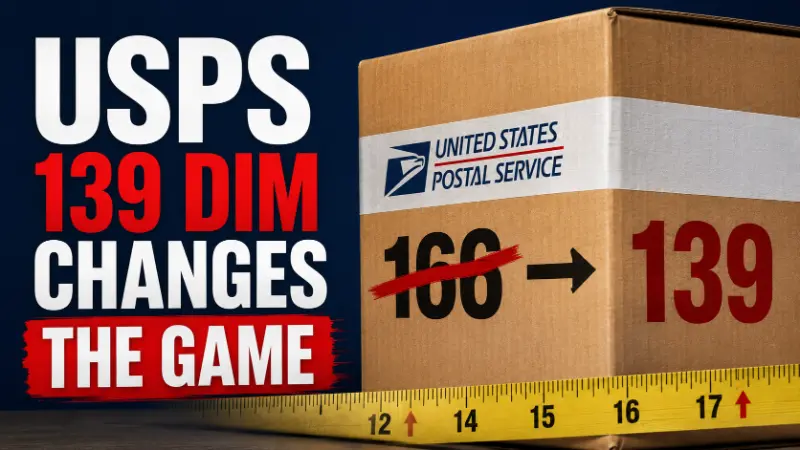
Starting July 12, USPS is changing how it calculates dimensional weight for several package services. The agency plans to move its DIM divisor from 166 to 139 and round fractional package dimensions up to the next whole inch.
That sounds like carrier math.
For ecommerce brands, it is margin math.
The change affects large, lightweight packages that exceed 1 cubic foot and are subject to dimensional weight pricing. For bulky products, the same item, in the same box, going to the same customer may be billed at a higher weight simply because the pricing formula changed.
This matters most for sellers of low-density products: ride-on toys, pillows, pet beds, backpacks, lamps, baby gear, home decor, lightweight furniture parts, and other items that take up more space than their scale weight suggests.
The practical takeaway is simple: wasted inches are becoming more expensive.
What USPS Is Changing on July 12
USPS is making two major changes to dimensional pricing for several package services.
First, USPS will begin rounding package dimensions up to the next whole inch. A side that measures 12.2 inches will be treated as 13 inches. A side that measures 16.7 inches will be treated as 17 inches.
Second, USPS will change the dimensional weight divisor from 166 to 139.
The affected services include:
- USPS Ground Advantage
- Parcel Select
- Priority Mail
- Priority Mail Express
The change applies to packages over 1 cubic foot that are subject to dimensional weight pricing.
USPS has tightened dimensional pricing before. Cahoot previously covered an earlier USPS dimensional pricing change when the agency moved toward a 166 divisor. This new update goes further by moving from 166 to 139 and adding stricter rounding rules.
Why the DIM Divisor Matters
Dimensional weight is a way for carriers to price packages based on the space they occupy, not just the package weight or the actual scale weight, and carriers bill whichever is higher.
The basic formula is:
Length × width × height ÷ DIM divisor = dimensional weight
A lower divisor creates a higher dimensional weight for the same package.
That is why the move from 166 to 139 matters. The product does not change. The box does not change. But the billed weight can increase because the formula becomes less forgiving.
If you need a deeper primer on how this works, Cahoot’s guide to dimensional weight pricing explains how carriers convert package size into billable weight.
How a 47 lb DIM Shipment Can Become 59 lb
Here is a practical ecommerce example.
Consider a toddler ride-on plastic car, such as a Cozy Coupe-style toy. The product itself is not extremely heavy, but the package is bulky.
Using package dimensions of 29.3 × 16.7 × 15.8 inches, you can figure the cubic volume from length x width x height, or length x width x height / width x height volume math as shown in the rounded example, for roughly 7,731 cubic inches before rounding.
| Scenario | Calculation | DIM Weight |
| Old USPS divisor | 7,731 ÷ 166 = 46.6 | 47 lb |
| New USPS divisor, no rounding | 7,731 ÷ 139 = 55.6 | 56 lb |
| New USPS divisor, with rounding | 30 × 17 × 16 = 8,160 ÷ 139 = 58.7 | 59 lb |
| That is the real impact. |
The same large toy package can move from a 47 lb dimensional weight to a 59 lb dimensional weight.
Nothing about the product changed. Nothing about the customer changed. Nothing about the delivery promise changed.
The package simply gets billed differently, which helps determine dimensional weight when a parcel is large but light.
That 12 lb increase in billed weight is the kind of change that can quietly turn a profitable order into a margin problem, especially for sellers offering free or flat-rate shipping.
Big Bulky Packages Were Never USPS’s Sweet Spot
The obvious 3PL takeaway is that large, bulky items were never USPS’s strongest lane to begin with.
USPS can be excellent for many ecommerce shipments, especially across many domestic services, small residential parcels, lightweight items, and certain nationwide delivery use cases. But large packages create a different network problem.
A large package consumes truck space, sortation space, and delivery vehicle capacity regardless of how little it weighs. Parcel carriers do not only manage pounds. They manage cube.
That is why this change should not be viewed only as a rate update. It is also a network signal, similar to how carriers structure pricing for shipping heavy items to maximize profit.
By moving from 166 DIM to 139 DIM and rounding package dimensions up, USPS is reducing one of the pricing advantages that may have made some bulky shipments look attractive under the old math.
The practical effect is that USPS is making large, lightweight packages less attractive to ship through its network.
That does not mean USPS is the wrong choice for every package. There are still USPS use cases that can make sense, including certain flat-rate shipping scenarios. Cahoot’s guide to USPS flat rate boxes explains when flat-rate packaging can be useful and when it may not be the best fit.
But for big bulky products, the old assumption that USPS is automatically the cheaper option deserves another look.
Why UPS and FedEx May Be Better Options for Some Bulky Shippers
UPS and FedEx are not always the most affordable option for every large package. Their published dimensional rules can also be expensive, and many bulky shipments can trigger additional handling, large package, or oversize surcharges.
But for shippers with meaningful volume, non-USPS carriers may offer more room for negotiation.
Depending on package profile, volume, zone distribution, and contract structure, shippers may be able to negotiate:
- steeper discounts for heavier or larger packages
- better minimum charge terms
- discounts or concessions on additional handling fees
- more favorable treatment for large-package surcharges
- custom incentives based on predictable shipping volume
That matters because the headline DIM factor and dim weight pricing are only one part of the total shipping cost.
For bulky products, the carrier agreement can matter as much as the formula. A shipper with poor UPS or FedEx terms may still find USPS competitive on certain lanes. A shipper with strong negotiated discounts may find that UPS, FedEx, or another carrier produces better landed cost for large-package profiles, especially when they partner with a fulfillment provider that beats traditional 3PLs as outlined in Cahoot vs. ShipMonk fulfillment comparison.
Cahoot has also covered how UPS and FedEx dimensional weight rules have changed over time, which is important context for understanding why USPS is now moving closer to private-carrier practices.
The point is not to abandon USPS across the board.
The point is to stop treating carrier selection as static.
After July 12, bulky-package shippers should rerun the math.
Which Ecommerce Products Are Most Exposed?
The most exposed products are not always the heaviest products.
They are often products with a large package cube and relatively low actual package weight.
Examples include:
- ride-on toys and large plastic toys
- pillows, bedding, and cushions
- pet beds and bulky pet products
- backpacks, bags, and luggage
- lamps and home decor
- baby gear and nursery products
- lightweight furniture parts
- foldable or assembled household products
- oversized subscription boxes
- apparel bundles shipped in oversized cartons
The shared pattern is low density.
The parcel is large and light relative to its actual package weight.
This is why ecommerce furniture and home goods sellers already feel dimensional weight pressure so heavily. Cahoot’s article on how to ship furniture without destroying margins explains why DIM weight, packaging, and fulfillment location can determine whether bulky orders remain profitable.
What Ecommerce Brands Should Audit Before July 12
Before the USPS change takes effect, ecommerce brands should identify where they are most exposed.
Start with SKUs that ship in packages over 1 cubic foot. Then calculate the new billable weight by comparing actual weight and expected DIM under the 139 divisor with rounded dimensions, and consider how packaging rules across different channels, such as Amazon’s expanded FBA box size limits, interact with USPS dimensional changes.
At minimum, shippers should audit:
- SKUs with package dimensions over 1 cubic foot, or 1,728 cubic inches
- actual weight versus dimensional weight
- old billed weight versus new billed weight, including the pound impact at the SKU level
- accurate measurement of package dimensions after you measure every side before rounding up
- USPS services currently used for bulky products
- UPS and FedEx alternatives for the same package profiles
- additional handling or large-package surcharge exposure
- shipping rules inside the OMS, WMS, or shipping platform
- free shipping thresholds and marketplace shipping promises
- SKU-level margin by channel after the new billing math
This is also a good time to revisit broader ground shipping costs. Using multi-carrier shipping software for ecommerce alongside Cahoot’s guide on how to reduce ground shipping costs covers additional ways brands can manage transportation costs without sacrificing delivery speed.
The key is to model the impact at the SKU level.
A blended shipping-cost average can hide the problem. One product may barely change. Another may jump enough to erase the margin on an entire product line.
Packaging Still Matters Even If You Change Carriers
Switching carriers does not fix bad packaging or a poor package shape.
If a product ships in an oversized carton, it will usually be expensive somewhere. UPS, FedEx, USPS, and regional carriers may price that package differently, but none of them want to move wasted air for free.
That is why brands should look at packaging before assuming the answer is only a new carrier contract.
Questions to ask include:
- Are we using the smallest box that safely protects the product? Can we trim fractions of an inch where possible, since USPS rounds up and that extra size can raise postage?
- Are warehouse teams selecting the right carton consistently?
- Do we have too many orders shipping in fallback boxes?
- Are bundles or kits creating unnecessary cube?
- Can the product packaging be redesigned to reduce empty space? For compressible goods, would mailers reduce volume?
- Do our systems recommend cartons based on actual item dimensions?
This is where cartonization becomes more than a warehouse efficiency tool. It becomes a shipping-cost control mechanism, especially when merchants use smart cartonization software to save big on shipping.
Cahoot’s article on cartonization software explains how better box selection can reduce waste, improve packing consistency, and help retailers and 3PLs control fulfillment costs.
When the DIM divisor drops, every unnecessary inch becomes more expensive.
Carrier Routing Needs to Get Smarter
The USPS change also increases the importance of carrier routing.
A shipping rule that worked under the old dimensional pricing model may not work after July 12. A service that used to be the cheapest option for a bulky package may become less competitive once the new billed weight is calculated.
That creates risk for brands relying on static shipping rules.
For example, a seller may have rules that default certain package types to USPS Ground Advantage because it historically performed well. After the divisor change, the better option may be UPS Ground, FedEx Ground, a regional carrier, or a different service depending on distance, zone, package size, promised delivery date, and negotiated discounts.
This is where ecommerce shipping software and multi-carrier logic become more important. Next-generation ecommerce shipping software for warehouse automation and Cahoot’s guide on how to save money with ecommerce shipping software explain how automation, rate shopping, and carrier selection can help brands reduce shipping costs.
But software only works if the inputs are accurate.
If item dimensions, box dimensions, product weights, or shipping rules are outdated, the system may still choose the wrong service.
The July 12 change is a good trigger to clean up the data brands need to choose the right shipping service when they send packages.
The New Fulfillment Reality: Inches Are Margin
For ecommerce brands, the USPS DIM change is not just about one carrier.
It is part of a broader shift in parcel pricing. Carriers are getting more precise about charging for the space packages occupy inside their networks.
That means shipping cost optimization cannot stop at rate negotiation.
Brands need to manage their operations with robust ecommerce fulfillment software for intelligent order routing:
- package dimensions
- carton selection
- DIM weight exposure
- carrier contracts
- surcharge rules
- shipping software logic
- fulfillment location strategy
- SKU-level profitability
The brands that handle this well will not simply look for the cheapest label. They will build fulfillment operations that reduce wasted cube, route orders intelligently, and match each package to the right carrier and service.
That is where distributed fulfillment can also matter. Placing inventory closer to customers can reduce zones, improve delivery promises, and give brands more flexibility in carrier selection. For bulky products, shorter shipping distances can help brands pay less for shipping and preserve margin.
Cahoot helps ecommerce brands reduce fulfillment and shipping costs through distributed fulfillment, intelligent order routing, and multi-carrier optimization, offering ecommerce order fulfillment services that outclass traditional 3PLs. For brands shipping large or bulky products, the goal is not just to move packages. It is to move them through a reliable network that manages large, low-density shipments at the right cost, using peer-to-peer order fulfillment services for ecommerce companies and a peer-to-peer order fulfillment network that beats old 3PLs.
The USPS change makes one thing clear:
Inches are no longer just packaging details. They are billable weight.
Frequently Asked Questions
What is USPS changing about dimensional weight pricing?
Starting July 12, USPS is moving its dimensional weight divisor from 166 to 139 for several package services and rounding fractional package dimensions up to the next whole inch. This can increase billed weight for large, lightweight packages.
Which USPS services are affected by the 139 DIM divisor change?
The change affects USPS Ground Advantage, Parcel Select, Priority Mail, and Priority Mail Express packages over 1 cubic foot when they move through the post office network to Zones 5–9 and are subject to dimensional weight pricing.
Why does moving from 166 DIM to 139 DIM increase billed weight?
Dimensional weight is calculated the way USPS measures one dimension after another in the formula: multiply length, width, and height, then divide by the DIM divisor to determine billed weight; one cubic foot equals 1,728 cubic inches. A lower divisor produces a higher dimensional weight for the same package, which can increase the billed weight.
What types of ecommerce products are most affected?
Large, lightweight products are most exposed. Examples include ride-on toys, pillows, pet beds, backpacks, baby gear, home decor, lightweight furniture parts, and other bulky products with low actual weight relative to package size.
Should ecommerce brands stop using USPS for bulky packages?
Not necessarily. USPS may still make sense for some shipments. But brands shipping bulky products should rerun the math after July 12 and compare USPS against UPS, FedEx, regional carriers, and negotiated carrier agreements.
How can ecommerce brands reduce DIM weight exposure?
Brands can reduce exposure by right-sizing packaging, improving carton selection, auditing package dimensions, using smarter carrier routing, negotiating better carrier terms, and reviewing SKU-level profitability after the new DIM math takes effect.
Written By:

Indy Pereira
Indy Pereira helps ecommerce brands optimize their shipping and fulfillment with Cahoot’s technology. With a background in both sales and people operations, she bridges customer needs with strategic solutions that drive growth. Indy works closely with merchants every day and brings real-world insight into what makes logistics efficient and scalable.

Turn Returns Into New Revenue

Related Articles

Save Money With Ecommerce Shipping Software: Next-Gen Solutions
Shipping costs are one of the biggest challenges for ecommerce businesses today, and understanding them is essential to reducing expenses and increasing profit margins.

Shipping Software for Ecommerce Fulfillment: The Next Generation of Shipping Simplified
Ecommerce has transformed the way people shop, but behind every seamless online purchase is a complex fulfillment operation.

10 Best European 3PLs for Ecommerce Sellers in 2026
Bigblue is the best overall choice among the best European 3PLs in this comparison: one provider with 11 fulfilment centres across France, Spain, Italy, the UK, and Germany, its ow...