
Amazon’s July 2026 Seller Fulfilled Prime Speed Changes: What Sellers Need to Know

Last updated on June 23, 2026
In this article
 17 minutes
- Amazon Is Raising the SFP Delivery-Speed Bar on July 6, 2026
- What Is Changing in the July 2026 SFP Requirements?
- The Biggest Issue Is the Customer-Facing Delivery Promise
- Standard-Size Sellers Face the Most Direct One-Day Delivery Pressure
- Oversize and Extra-Large Products Still Need a Faster Fulfillment Plan
- Sellers Should Audit Their SFP Dashboard Before July 2026
- The July 2026 Update Rewards Better Fulfillment Network Design
- What Sellers Should Do Now
- Where Cahoot Fits
- Frequently Asked Questions
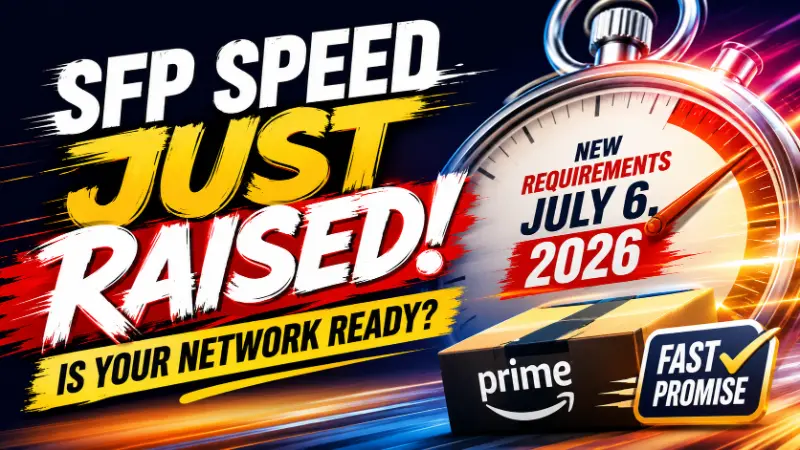
Amazon is raising the minimum delivery-speed requirements for Seller Fulfilled Prime, effective July 6, 2026. The update tightens the percentage of Prime customer page views that must show fast delivery dates across standard-size, oversize, and extra-large products, and it signals that Amazon expects the Prime badge to reflect a faster, more reliable customer-facing promise.
This article focuses on the July 2026 delivery-speed changes specifically. If you already run an SFP program, the practical question is whether your current fulfillment network, shipping templates, cutoff times, and carrier mix can still produce the delivery dates Amazon will require on offer pages. Sellers who designed their operation around speed of promise, not just speed of pick-pack, are positioned to absorb this change. Sellers who built their model around a single warehouse and a generous handling buffer may need to make structural decisions before the deadline.
Amazon Is Raising the SFP Delivery-Speed Bar on July 6, 2026
Amazon has announced updated minimum delivery-speed requirements for Amazon Seller Fulfilled Prime, Amazon’s Prime program for eligible third-party sellers, citing rising customer expectations and improvements in fulfillment speed across the marketplace. To remain eligible for SFP starting July 6, 2026, Prime offers must meet new thresholds for how often Prime customer page views show fast delivery dates.
The change is meaningful for two reasons, and it follows earlier updates like the June 29, 2025 adjustments to SFP and Premium Shipping performance requirements. First, the tighter SFP speed thresholds raise the standard across every size tier. Second, the metric Amazon evaluates is the delivery date shown to the shopper on the offer page, not the speed at which an order eventually ships. That distinction is what most directly affects compliance, conversion, and Prime badge stability.
Amazon has stated that all other SFP eligibility requirements remain unchanged. The on-time delivery requirement, valid tracking rate, cancellation thresholds, buy shipping usage, and weekend operations expectations carry over as they exist today. What is changing is the speed metric and the percentage of page views that must show qualifying delivery dates, while the Prime badge continues to function as Prime branding tied to fast, reliable delivery.
What Is Changing in the July 2026 SFP Requirements?
The new thresholds vary by size tier. Amazon delivered over 13 billion items same-day or next-day in 2025, which helps explain the higher customer expectations behind these changes and continues the trend of increasingly demanding Seller Fulfilled Prime requirements. Here is a side-by-side view of the current and July 2026 requirements:
| Size Tier | Delivery Window | Current Requirement | July 2026 Requirement |
| Standard-size | 1 day | 30% of Prime page views | 40% of Prime page views |
| Standard-size | 2 days | 70% of Prime page views | 75% of Prime page views |
| Standard-size | 5 days | (existing) | 90% of Prime page views |
| Oversize | 1 day | 10% of Prime page views | 15% of Prime page views |
| Oversize | 5 days | (existing) | 80% of Prime page views |
| Extra Large | 2 days | 15% of Prime page views | 25% of Prime page views |
| Extra Large | 5 days | (existing) | 60% of Prime page views |
The percentages refer to Prime customer page views of your offer, not to orders. Two listings with very different order volumes can have very different page-view-weighted delivery promises depending on where shoppers are browsing from.
You can monitor your current performance against these thresholds in the Seller Fulfilled Prime performance dashboard in Seller Central, including the speed metric calculations Amazon will use to assess compliance.
The Biggest Issue Is the Customer-Facing Delivery Promise
The metric Amazon uses for SFP speed eligibility is the delivery date a Prime customer sees on the offer page before they buy, which is central to any strategy for winning on Seller Fulfilled Prime. That promise is generated in Seller Central through Amazon’s new delivery promise tool, which acts as the delivery promise tool by using ZIP-code-level inputs from your shipping template, cutoff times, warehouse locations, carrier transit times, and weekend shipping availability to determine SFP delivery dates. If a shopper in Texas views your offer and the calculated delivery date is four days out, that page view counts against your one-day and two-day thresholds even if the order, once placed, ships the same hour.
This is why operational speed alone is not enough. A warehouse that picks and packs in 30 minutes still cannot show a one-day delivery date to a customer who is three transit days away by ground. The promise on the page is what Amazon evaluates, and that promise is a function of network design, not pick speed.
The downstream effects matter as well. The delivery date shown to a Prime customer influences conversion. A tighter promise wins more sales. A looser promise loses them to competing Prime offers. The July 2026 update is essentially Amazon telling sellers that the floor for an acceptable Prime promise is moving up.
Standard-Size Sellers Face the Most Direct One-Day Delivery Pressure
For standard-size products, the one-day page-view requirement moves from 30% to 40%, and the two-day requirement moves from 70% to 75%. The five-day threshold is set at 90%.
The one-day jump is the most operationally demanding. Producing a one-day delivery date for 40% of US-based Prime page views typically requires inventory in multiple regions, late cutoff times, reliable ground service across short zones, and in many cases weekend pickup or injection. Sellers running a single East Coast or single West Coast warehouse will struggle with this threshold, and single-warehouse SFP sellers are the most exposed because ground one-day coverage from a single node only reaches a fraction of the US population while Prime browsing is distributed nationally.
The two-day move from 70% to 75% is smaller in absolute terms, but it pushes the edge of what a two-node network can cover with standard ground. Many sellers who comfortably hit 70% today will find that small gaps in carrier coverage, holiday cutoffs, or weekend handling pull them under 75%.
See the Standard-Size Rule in Practice
The 40% one-day threshold is measured from the promises shown to eligible Prime shoppers, not the percentage of orders shipped by air. This video uses a Pennsylvania warehouse with a 4:30 PM Eastern cutoff to show why West Coast browsing can create a one-day coverage gap.
The takeaway: Audit delivery promises by customer location and time of day before assuming a later cutoff or faster shipping service closes the gap.
Oversize and Extra-Large Products Still Need a Faster Fulfillment Plan
For oversize products, the one-day requirement moves from 10% to 15% of Prime page views, with 80% needing to show a delivery date within five days. For extra-large products, the two-day requirement rises from 15% to 25%, with 60% needing to show a delivery date within five days.
These numbers look smaller than the standard-size thresholds, but they are arguably harder to hit. Oversize and extra-large items often ship via different carrier networks, with longer transit times, fewer same-day pickup options, and limited weekend service. Packaging and dimensional weight matter more, and rate shopping across carriers becomes a real constraint.
Consider the oversize change specifically. Moving from 10% to 15% one-day page-view coverage may sound minor, but it can materially change the fulfillment footprint required to stay compliant. Historically, some oversize sellers have met the older threshold with two strategically located warehouses. Under the new 15% threshold, many two-node networks may struggle to generate enough one-day promise coverage, especially when customer demand is distributed across regions that are not close to those warehouses.
This is why sellers should not evaluate a fulfillment provider only by asking whether it has multiple warehouses or whether it can ship fast. The better question is whether the network can produce the required customer-facing delivery promises for the seller’s actual SKU mix, size tiers, customer geography, cutoff times, weekend operations, and carrier lanes.
Adding more warehouses is not automatically the answer either. More nodes can improve delivery promise coverage, but they can also create inventory fragmentation, replenishment complexity, and routing risk. The right footprint depends on SKU velocity, margin, size tier, demand geography, and the cost of premium shipping. A well-designed two-node network with the right carrier coverage and late cutoffs can sometimes outperform a poorly placed four-node network, especially when paired with specialized Amazon SFP 3PL fulfillment services. Cahoot’s Seller Fulfilled Prime trial checklist is a useful starting point for thinking through these tradeoffs.
Sellers Should Audit Their SFP Dashboard Before July 2026
The Seller Fulfilled Prime performance dashboard and account health view show your current speed metric performance broken down by size tier. This is the most direct view of where you stand against the new thresholds and how to manage seller fulfilled products under the coming rules.
Things to check now:
- Current one-day, two-day, and five-day page-view percentages by size tier
- Trend over the last 30 to 90 days, not just the most recent snapshot; export 90 days of shipment data to assess delivery performance against the new standards
- Whether performance varies meaningfully across regions or carriers
- Gather shipping times and cut-off data before September 2026 so your inputs are ready for analysis and template updates
- Whether weekend orders pull your numbers down; weekends are excluded from speed metric evaluation until October 17, 2026, but you still need to prepare weekend operations
- Whether specific SKUs or size tiers drag the overall percentage
Waiting until June 2026 to look at the dashboard is risky; many sellers are already exploring how using SFP to fight rising FBA fees fits into their broader fulfillment strategy. If your current performance is below the new thresholds, the operational changes required, whether that means adjusting shipping templates, adding a warehouse, changing carriers, or extending cutoff times, take weeks or months to implement, validate, and measure. Use this data to understand the new speed metric calculation and review the underlying speed metric calculations before Amazon tightens enforcement. Amazon is also rolling out tools and resources to support sellers, but waiting reduces the time you have to test changes. Sellers who lose Prime eligibility during the lead-up to Prime Day will feel the cost in both badge loss and conversion.
The July 2026 Update Rewards Better Fulfillment Network Design
The structural takeaway is that the new requirements reward sellers whose fulfillment network is designed to produce strong delivery promises before orders come in, whether through SFP itself or alternative models like Merchant Fulfilled Prime as an FBA alternative. Reactive speed, fast picking after an order lands, is not the same as proactive speed, having inventory close enough to the customer that the offer page already shows a one-day or two-day date.
The variables that drive promise quality include:
- Inventory placement across regions, weighted by where Prime customers actually browse
- Prime shipping templates that reflect realistic handling and transit times, with shipping settings automation helping align promises with actual handling and transit capabilities
- Cutoff times that are late enough to capture afternoon orders without overpromising
- Weekend operations, both pickup and delivery, with weekend shipping availability feeding the promise shown by zip code
- Carrier service selection, including the use of two or more carriers for redundancy and lane coverage
- Size-tier classification accuracy, since misclassified items distort the speed metric
- Packaging for oversize and extra-large items that keeps them eligible for ground service rather than freight
Sellers who treat these as a connected system, rather than as separate Seller Central settings, will find the new thresholds manageable, since these settings feed both the delivery promise and broader account health monitoring. Sellers who optimize one variable at a time tend to chase the metric without ever stabilizing it.
For a deeper view on what a sustainable SFP operating model looks like, the Seller Fulfilled Prime operating model article and the SFP carrier on-time delivery article are useful follow-ups.
What Sellers Should Do Now
A practical preparation checklist:
- Pull your current SFP performance dashboard and benchmark each size tier against the July 2026 thresholds
- Identify the regions where your one-day and two-day promises fall short
- Review your Prime shipping templates and confirm handling times, cutoffs, and transit times reflect reality
- Audit weekend operations, including Saturday pickup and Sunday delivery where applicable
- Confirm carrier coverage across the lanes that matter for your SKU mix, and consider whether a second carrier or an FBM shipping and fulfillment partner reduces risk
- Verify size-tier classifications, especially for items near the standard/oversize boundary
- Model what a network change, whether an additional node, a relocation, or a 3PL partnership, would do to your page-view coverage
- Tighten the linkage between marketing-driven demand and inventory placement, since Prime Day prep starts well before July and effective Prime Day order and fulfillment planning requires long lead times
The point of the checklist is not to do everything. It is to surface where your current operation has the least margin against the new thresholds, so you can prioritize.
Where Cahoot Fits
Cahoot has supported Seller Fulfilled Prime sellers for years, including through prior program changes and tightening eligibility rules, as reflected in multiple order fulfillment services reviews from merchants. The work tends to come down to the same set of decisions: how to place inventory, how to set shipping templates, how to choose carriers, how to handle weekends, and how to keep the customer-facing promise strong without overcommitting.
For sellers who need faster page-view coverage without relying on a single centralized warehouse, Cahoot’s distributed fulfillment network and SFP expertise can help close the gap. We do not guarantee Prime eligibility, no fulfillment partner can, but we can help you build the operating model that gives your offers the best chance of meeting the new thresholds. The Amazon SFP fulfillment services page is the right starting point if you want to talk through your specific size tiers and geography.
You can read Amazon’s official announcement on the Seller Fulfilled Prime help page in Seller Central.
Frequently Asked Questions
What changes to Seller Fulfilled Prime take effect on July 6, 2026?
Amazon Seller Fulfilled Prime (SFP) is raising the minimum delivery-speed requirements. For standard-size products, 40% of Prime customer page views must show a one-day delivery date (up from 30%), 75% must show a two-day date (up from 70%), and 90% must show a five-day date. For oversize products, 15% must show a one-day date (up from 10%) and 80% must show a five-day date. For extra-large products, 25% must show a two-day date (up from 15%) and 60% must show a five-day date. These are the updated delivery speed requirements and tighter SFP speed thresholds effective July 6, 2026.
Are all SFP eligibility requirements changing in July 2026?
No. Amazon has stated that all other SFP eligibility requirements remain unchanged. The July 6, 2026 update applies specifically to the delivery-speed thresholds measured by Prime customer page views, meaning it is limited to the prime speed rules and sfp delivery speed rules rather than the rest of the program requirements.
What does Amazon mean by Prime customer page views?
Page views refer to instances where a Prime customer views your offer page. The delivery date shown on that page is what Amazon measures for the speed metric evaluation, and this is based on page-view-weighted delivery promises rather than orders. The percentages in the new requirements are share of qualifying page views, not share of orders.
Why do the July 2026 SFP changes matter for sellers?
The customer-facing delivery promise drives both Prime eligibility and conversion. Tighter minimum delivery speed thresholds matter because the Prime badge influences search visibility and conversion, so sellers need stronger inventory placement, faster carrier coverage, and better shipping template settings to maintain the Prime badge and remain competitive in Prime filtered search results.
Do the new SFP speed requirements apply to oversize and extra-large products?
Yes. The new thresholds apply across standard-size, oversize, and extra-large size tiers, with different percentage requirements for each. Oversize and extra-large items often require different carrier networks and packaging strategies, which can make the thresholds operationally harder to hit despite lower headline percentages.
How should sellers prepare for the July 2026 SFP changes?
Start with the SFP performance dashboard in Seller Central. Benchmark current performance against the new thresholds, identify weak regions, review shipping templates and cutoff times, audit weekend operations, confirm carrier coverage, and model whether a network change is needed. The earlier this work happens, the more room there is to adjust before the deadline and before Prime Day. Amazon is also taking steps to support sellers with webinars on the new requirements scheduled for June 8 and June 15, 2026.
Can a 3PL help sellers meet the new SFP delivery-speed requirements?
A 3PL can help, particularly one with a distributed network that improves one-day and two-day page-view coverage. But a 3PL is not a default answer. The right choice depends on SKU velocity, margin, size tier, customer geography, and the cost of premium shipping. Sellers should evaluate any fulfillment partner by whether its network can produce the required delivery promises for their specific business, not by warehouse count alone.
Written By:

Rinaldi Juwono
Rinaldi Juwono leads content and SEO strategy at Cahoot, crafting data-driven insights that help ecommerce brands navigate logistics challenges. He works closely with the product, sales, and operations teams to translate Cahoot’s innovations into actionable strategies merchants can use to grow smarter and leaner.

Turn Returns Into New Revenue

Related Articles
FedEx 2027 Rate Increase: How 5.9% Becomes 32.4% on One Package
FedEx’s announced 2027 rate increase averages 5.

Seller Fulfilled Prime for Oversized Items: The FBA vs. SFP Math Sellers Need to Run
Seller Fulfilled Prime can work for oversized and bulky items, but it is not automatically cheaper than FBA.

Choosing a European 3PL: What US Ecommerce Brands Should Look For
US ecommerce brands should judge a European 3PL on four practical tests: the right EU and UK stock footprint, delivery coverage from named warehouses, a local customer experience, ...