
5 Brutal Truths About Ecommerce Profitability (from Ugly Talk NYC)

In this article
 14 minutes
- Meet the Panelists Featured Here
- Brutal Truth #1: The ZIRP Era Is Dead
- Brutal Truth #2: Old Tracking Playbooks Are Broken
- Brutal Truth #3: CAC Math Is a Lie in 2025
- Brutal Truth #4: Less Is More — SKUs, Content, Channels
- Brutal Truth #5: AI Will Not Save You Without Context
- The Playbook That Replaces the Old One
- Full Session Video
- Frequently Asked Questions
- Speaker Bios
In August 2025, founders and operators packed a standing room only space at NomadWorks in Times Square, New York City for Ugly Talk NYC: Building Profitable Ecommerce in a Downward Market, a panel designed to cut through the noise. No “growth hacks.” No feel-good fluff. Just raw, unfiltered truth about why ecommerce profitability has never been harder, and what you need to do about it now.
If you’re reading this, you’re not looking for theory. You want survival strategies. This article distills the 5 brutal truths shared on stage, each a direct challenge to the old playbooks that no longer work. It distills the sharpest insights from blends them with current data and outside examples, and leaves you with a focused playbook for the second half of 2025. Use it as the pillar article that spawns your clips, carousels, emails, and deep-dives.
Meet the Panelists Featured Here
- Manish Chowdhary — Founder & CEO, Cahoot (panel moderator)
- London Glorfield — Founder, Kickback (screenless electronics)
- Maya Juchtman — Senior Director, Marketing & Partnerships, Roswell NYC
- Sabir Semerkant — Founder, Growth by Sabir, helped drive $1B+ in ecommerce growth
(Detailed bios appear at the end of this article.)
Brutal Truth #1: The ZIRP Era Is Dead
Panel moderator Manish Chowdhary opened with a stark reminder:
“For a long time until very recently we were in a zero interest rate phenomenon and money was easy, money was flowing. When that happens, fundamentals go out the door which means weak businesses thrive or appear to thrive. There are 10 ecommerce darlings … Stitch Fix, Grove Collaborative, even Olaplex are penny stocks. They probably won’t be trading on the New York Stock Exchange for much longer now.”
For a decade, zero interest rates hid a lot of sins. That era really is over. The Federal Reserve kept policy tight through mid-2025 as inflation and growth data stayed mixed; capital is scarce again and the bar for profitability is higher. Translation: if your growth story depends on forever-cheap money, it is not a story anymore.
At the same time, the rules of trade changed. In 2025 the White House directed sweeping tariff actions, including reciprocal tariffs, a new tariff commission, and orders to suspend de minimis entry benefits to certain countries for national security and unfair trade concerns. If you import, your landed-cost model changed whether you noticed or not. Plan pricing, assortment, and cash cycles accordingly.
Panelists underscored how the “free money plus cheap acquisition” era minted fragile brands.
“Weak businesses thrived under cheap money. Today, those same brands say ‘I don’t want to be like me.’” — Manish.
This is a hard reset: brands that looked unstoppable during the ZIRP boom are collapsing. A harsh reminder that product love without durable unit economics does not keep the lights on. The takeaway is not doom; it is clarity. Rebuild your plan around cash margin, inventory turns, and repeat behavior instead of “fundraising as a strategy.”
What to do next:
- Re-forecast demand with tariff-inclusive costs, not “last year plus five percent.” Build A/B/C scenarios that stress test your cash conversion cycle under higher duties and slower demand.
- Renegotiate with suppliers using tariff math as leverage. Lock freight earlier and shorten cash exposure windows where possible.
- Tighten SKU economics: kill long-tail variants that tie up working capital and complicate replenishment. We revisit SKU discipline in Brutal Truth #4.
Brutal Truth #2: Old Tracking Playbooks Are Broken
The story is not “iOS killed the Pixel” and that is the end. It started with Apple’s App Tracking Transparency (ATT) and Mail Privacy Protection, then spread to browser privacy defaults, ad blockers, and a shifting timeline for third-party cookies in Chrome. Treating the Meta Pixel as gospel in 2025 is how you fly blind.
Email metrics are distorted too. The panel called out inflated open rates: those “35% opens” many teams celebrate are not real if a big chunk of your audience is on Apple Mail with MPP. Litmus and others confirm that MPP obscures open behavior and that “open” is no longer a reliable KPI. Expect inconsistent handling of MPP across email service providers and move your reporting toward clicks, conversions, revenue, and deliverability health.
“You need to manage ecommerce like your Charles Schwab or Fidelity account, money management first, not blind ad spend.” — Sabir.
The fix is a hybrid, first-party stack:
- Pixel + Conversions API (CAPI) with deduplication. Send server-side events, include event IDs, and deduplicate against browser events. This is Meta’s own recommendation for restoring signal quality post-ATT.
- Aggregated Event Measurement and prioritized web events, plus server-to-server purchase reporting, to stabilize performance reporting.
- Email reality check: prune disengaged segments, build exclusion rules, and monitor sender reputation daily. Spray-and-pray is a deliverability death spiral.
- Measure beyond last-click. Use modeled attribution and incrementality testing where possible; treat platform-reported ROAS as a directional input, not financial truth.
“I just looked at a few accounts recently…their deliverability [was] horrible. But they came to me and they were like, ‘Oh I’m seeing 35% open rates. 30% open rates, that’s fine, right?’ Actually no. If you’re sending to lists and you’re not doing exclusions and you’re not actually thinking about Apple privacy which auto inflates. So those numbers, that open rate, that’s not real, that’s Apple privacy, Google and Hotmail inflating that. So your open rate is actually probably going to be more like 10.” — Maya.
Why this matters: brands that relied on Meta Pixel lost signal, misallocated budget, and watched revenue wobble when the ground shifted. Hybrid tracking, server events, and healthier email lists (even is leaner) help you defend spend and redirect dollars faster.
Brutal Truth #3: CAC Math Is a Lie in 2025
“CAC isn’t one number anymore, layered strategy required.” — Summary of Maya’s segment.
CAC used to be a single dashboard tile. Now it is a portfolio of acquisition costs across funnel stages and channels. Top-of-funnel stories are expensive and slow, but they seed cheaper retargeting, stronger LTV, and more resilient cohorts. Roswell’s work with Hyperlite illustrates this: brand and experience up top, brand-aware retargeting down-funnel, and a different CAC expectation for each layer.
When you treat CAC as a single number, you are tempted to shut off expensive awareness that actually lowers blended CAC over time. In 2025, the math that matters is blended CAC to contribution margin by cohort, with inventory and cash timing in the same equation.
A tighter model:
- Top-funnel CAC: higher; track assist value, search lift, and branded queries.
- Mid-funnel CAC: creative-led; expect decays in 3 – 6 weeks as creative burns out. Rotate on a schedule.
- Bottom-funnel CAC: cheaper retargeting; cap frequency, and watch saturating segments.
- Community CAC: Discord, events, direct mail; small volumes, high LTV, exceptional payback.
Finally, build a channel-shift reflex. If 70% of spend sits on Meta and performance degrades, rebalance to 70% Google, 30% Meta overnight; the panel was blunt that single-platform dependency is a solvency risk now.
Brutal Truth #4: Less Is More — SKUs, Content, Channels
SKUs. The room agreed: assortment bloat is a silent margin killer. If you have “30 orders and 300 SKUs,” you do not have a marketing problem, you have a focus problem. Ship the hero, kill the laggards, and stop coloring the T-shirt sixteen ways.
“If you can’t make your hero product succeed in a big way, these chotchkes are not going to save you. That’s just a pure distraction. And I can tell you from my own personal experience, we throw away that stuff because nobody wants it. We can’t even get pennies on the dollar. The brand may associate such deep emotional and financial value to that, but it has zero or very little value outside. So you have to be very, very consider it in your product skus election. Just because one customer says, I wanted a small burgundy, that is not a reason to produce that in small burgundy.” — Manish.
Outside the room, SKU discipline shows up in the data. Post-pandemic, CPG leaders that rationalized assortments saw service levels recover and productivity improve; fewer SKUs meant fewer changeovers and better on-shelf availability. Ecommerce is no different: fewer variants mean faster replenishment, fewer stockouts, and cleaner creative.
Content. Volume for volume’s sake is out. London put it plainly: Kickback moved from “posting 10 times a day” to scripted, value-driven content, because audiences are saturated and can sniff filler. Manish’s team blasted out 300 AI-generated videos in a week and one handcrafted video outperformed all of them combined by ~100x. That is not a cute anecdote, it is a strategy correction: quality over volume.
Channels. Kickback treats channels like a portfolio. TikTok is growth equity, Instagram is the S&P, email is for committed audiences, Discord and physical mail are VIP touchpoints. That last one matters. London’s team sends text-first emails and literal playlists, and then backs it up with quarterly handwritten notes. Community intimacy beats blast discounts.
Direct mail is back in the mix. Panelists see postcards and letters driving meaningful second-purchase behavior; Sabir cited 14 – 20% response rates in recent campaigns and argued that, for the first time in years, a stamped postcard can be cheaper than a Meta click. Meanwhile, stamp prices rose again in July 2025 to 80¢ for a First-Class Forever stamp, which is still a modest input compared to volatile CPCs. The point is not that mail is “cheap,” it is that it can be predictable, targeted, and human in a way digital often is not.
Brutal Truth #5: AI Will Not Save You Without Context
“AI is like hiring interns from MIT, University of Penn, Harvard, or Yale, really smart, really smart kids, right? Phenomenal. Very intelligent. They have amazing intelligence, but they just don’t know how to use it. It’s my job to guide them.” — Sabir.
Generative tools are incredible force multipliers, and they also flood the feed with sameness. When everyone can ship 100 posts a day, quality becomes the only differentiator. That is visible in search as well. Google’s evolving guidance keeps prioritizing E-E-A-T (experience, expertise, authoritativeness, and trust) and people-first content; gaming systems with AI-written mush is a fast track to nowhere.
London’s read on Gen Z is instructive: they spot AI instantly and reward brands that feel human. Use AI to research, draft, and speed checks, then layer on your voice, data, and video craft. Manish’s 100x lesson is the headline here, and it pairs with a second one from the panel: optimize for AI discovery, not just traditional SEO. Package your catalogs and content so LLMs can “see” them, test queries in AI products, and partner with publishers those models cite. That is the new distribution.
“The reality on the ground is that most brands, they’re so obsessed with paying Meta ads and Google Ads that they’re not focused on the organic strategies where they need to be developing. Especially AI. SEO is a thing right now where you can, you can package your content and actually feed it so that it can get discovered by AI engines. Because that’s where we are going, you know. And if you are optimizing your business based on what worked in 2022, that was a different part, different world at that time, right? It doesn’t exist. That world doesn’t exist right now.” — Sabir.
The Playbook That Replaces the Old One
1) Operate like a money manager. Review spend daily; shift between channels quickly; protect cash; model tariffs explicitly; keep a rolling 13-week cash forecast.
2) Rebuild measurement. Pixel + CAPI with deduplication; AEM-prioritized events; click- and conversion-centric email analytics; full-funnel blended CAC.
3) Design for repeat behavior. Fewer products, tighter variants, faster replenishments, and community touchpoints that earn a second purchase.
4) Make fewer, better assets. Script, storyboard, and ship formats the audience would watch even if your brand name disappeared.
5) Treat physical mail and in-channel communities as profit centers. When done thoughtfully, they compound LTV while ad channels churn.
Full Session Video
[Embed the full recording here once live on YouTube or Vimeo. Use chapters by question for skimmability.]
Frequently Asked Questions
What is the single biggest profitability mistake brands are making in 2025?
Treating growth like it is still 2019. Cheap money and cheap acquisition masked weak unit economics. Today, you must run a tariff-aware P&L, operate with cash discipline, and design your plan around repeat purchase, not just net-new.
How exactly has Apple changed the way we measure marketing?
ATT and MPP broke legacy habits. App-level tracking is limited; email “opens” are inflated or meaningless. Shift to first-party data, Pixel + CAPI with deduplication, prioritized events, and conversion-level outcomes. Make “deliverability health” and “incremental revenue” your email KPIs.
Are third-party cookies still going away?
Chrome’s timing has been fluid and subject to regulatory review, but the direction is the same: less cross-site tracking, more privacy-preserving APIs. Plan as if third-party cookies are not dependable and invest in first-party audiences and server-side measurement now.
Why is direct mail suddenly on everyone’s roadmap?
Because it creates a human moment, is targetable, and, for many segments, has become cost-competitive with paid clicks again. Stamp prices rose to 80¢ in July 2025, yet response rates on targeted house-file mailings can be multiples of cold digital traffic. Use it for high-value cohorts and second-purchase nudges.
What does “Less Is More” mean in practice?
Cut SKUs aggressively, ship only what you can replenish, and make media you are proud to sign. Treat content and assortments like constrained resources. The panel’s best-performing video was a single crafted piece, not 300 AI clones.
How should I think about CAC now?
Make CAC layered: top-funnel story costs more and pays off in retargeting and LTV; mid-funnel burns out faster; bottom-funnel is cheaper but finite. Report blended CAC to contribution margin by cohort, not a single number.
Is email still worth the work?
Yes, but only if you run it like deliverability-first CRM. Build exclusions, cull dead segments, personalize copy, and measure clicks, conversions, and revenue. “Set and forget” is how you get clipped in 2025.
Speaker Bios
Manish Chowdhary — Manish Chowdhary is the Founder & CEO of Cahoot, the most comprehensive post-purchase logistics platform for ecommerce brands. We help merchants scale profitably with a bundled suite of services that includes:
- Fast, cost-effective fulfillment (1-day and 2-day nationwide coverage)
- AI-powered multi-warehouse shipping software that selects the cheapest label automatically
- An industry-first peer-to-peer returns solution that eliminates return shipping and restocking costs
With over 100 warehouses and advanced shipping automation, we help brands maintain control, boost speed, and cut logistics costs without the overhead of traditional 3PLs. I’m passionate about helping ecommerce businesses grow smarter. If you’re looking to improve your margins, delight customers, and future-proof your logistics, let’s connect.
My work has been recognized with multiple industry accolades, most recently winning the SaaStock USA Global Pitch Competition 2024. I’m passionate about using technology and collaboration to push the boundaries of ecommerce and logistics and create new opportunities for merchants worldwide.
London Glorfield — London is a founder and creative strategist who’s built at the intersection of culture and product his entire career. A former RCA-signed artist, he previously ran a creative direction firm and a Squarespace-style software startup. He is currently reimagining consumer electronics with Kickback.world, a fashion-forward audio brand rooted in youth culture and design.
Maya Juchtman — Maya is a creative marketing strategist and partnerships leader known for blending brand storytelling with performance. As Senior Director of Marketing & Partnerships at Roswell NYC, a Webby Award–winning Shopify Plus agency, she’s helped brands like Brixton, Hyperlite, and Curious Elixirs scale through thoughtful strategy and standout campaigns. With a background in customer experience and leading brands through start-up to acquisition, she brings a human-first, culturally aware lens to every project, building community, driving growth, and pushing the boundaries of what digital marketing can be.
Sabir Semerkant — Sabir is the go-to eCommerce growth strategist, credited with over $1B in revenue for 200+ brands from Canon to Sour Patch Kids. Backed by Gary Vee and Neil Patel, Sabir’s Rapid 2X method delivers 2X growth in 12–18 months profitably. Since 2024, it’s powered 70+ brands across 17 industries with an average 108% lift. His Rapid 2X Protocol is the unfair advantage for any eCom brand with product–market fit, engineered to scale revenue and profit even in down markets. Want real talk? Sabir reveals why most brands will fail in 2025 and exactly how to make sure yours isn’t one of them.
Written By:

Jeremy Stewart
Jeremy Stewart leads customer success at Cahoot, helping merchants achieve high-performance logistics through smart technology and process optimization. With a background in both ecommerce operations and client services, Jeremy ensures that every merchant using Cahoot gets measurable results—whether they’re scaling from one warehouse to many or managing complex returns.

Turn Returns Into New Revenue
Related Articles
Walmart Officially Allows Amazon Multi-Channel Fulfillment (MCF)
Big news for multichannel sellers: Walmart now officially allows Amazon Multi-Channel Fulfillment (MCF), Amazon’s service for using its fulfillment network to ship orders from mult...

Why More Automation Didn’t Lower Return Costs
Returns automation does improve returns operations: it cuts manual touches, smooths intake, speeds sorting, and makes workflow execution more consistent.

Shopify Subscription Payment Change: Why It Could Hurt Reactivation
Shopify changed how subscription payment information is handled at cancellation.
Are You Overpaying for Fulfillment? 5 Hidden Fees to Watch

If your 3PL pricing looks fine on the sales deck but ugly on the invoice, you are not alone. Fulfillment fees hide in packing tables, DIM math, “miscellaneous” surcharges, and account management fees that quietly grow. An additional fee for large items, custom packaging, or international shipping can also appear unexpectedly on invoices. Here’s a practical breakdown of the five most common hidden costs in ecommerce fulfillment in 2025, how to spot them, and how to negotiate them out.
1) DIM weight and oversize surprises
Carriers increasingly bill by dimensional weight. UPS’s 2026 Daily Rates took effect January 26, 2026, so any UPS-based DIM-weight benchmark should be checked against the current UPS rate guide. UPS lists a divisor of 139 for Daily Rates, and FedEx uses similar guidance; whichever is greater, DIM or actual weight, wins. If your 3PL’s cartonization drifts, you pay more shipping fees than planned. Review carton libraries and require periodic cube audits.
2) Peak and demand surcharges you didn’t model
Expect time-limited holiday price changes and peak surcharges across USPS, UPS, and FedEx this Q4. USPS has already posted its 2025 holiday adjustments, with specific per-package increases by service and zone. FedEx continues to adjust surcharges and recently increased late payment fees to 9.9% of overdue balances. Your 3PL should forecast these into your fulfillment cost model and update your pricing models ahead of peak season. On March 25, 2026, USPS announced a transportation-related time-limited price change that would increase base postage prices for Priority Mail Express, Priority Mail, USPS Ground Advantage, and Parcel Select by 8 percent from April 26, 2026 through January 17, 2027.
3) Inbound receiving and special projects that balloon
“Standard receiving” might sound simple, but many third-party logistics providers bill by the hour for complex inbounds, relabeling, or inventory inspection. Setup fees may also apply during the onboarding process, covering initial integration and service setup, and these one-time charges can vary depending on the complexity of your requirements. Typical ranges vary widely, and container handling can also add fees. Insist on service level agreements that define when hourly rates kick in and cap spend per container or inbound receipt.
4) Account management and “program” fees
Some fulfillment providers add a monthly account management line or a “program fee” that doesn’t correlate to measurable value, no SLA, no deliverables. If the fee funds actual logistics operations (dedicated analyst, weekly optimization, custom reporting, support, technology upgrades), great. If not, move to custom pricing where the monthly cost ties to volume or outcomes.
5) Packaging and special handling multipliers
Pick and pack is only part of the story. The packing process, including kitting and assembly, can involve additional steps to meet specific client requirements and may impact overall costs. Boxes, mailers, poly, dunnage, and inserts can add real dollars per order. Ask for pack fees by material type, whether you can bring your own custom-branded packaging, and how “oversize handling” triggers. Publish a packaging bill of materials in your RFP so quotes are comparable. Reference tables from reputable 3PL pricing explainers to benchmark.
Flat Rate Pricing: Is It the Solution to Hidden Fees?
Flat rate pricing has become an attractive option for many ecommerce businesses aiming to simplify their fulfillment costs and avoid the headache of hidden fees. With this pricing model, your fulfillment provider charges a single, fixed shipping cost per order, regardless of the package’s actual weight, dimensions, or destination. For online stores juggling multiple SKUs and fluctuating order volumes, this can make budgeting and cost analysis much more straightforward.
The biggest advantage of flat rate pricing is predictability. Instead of worrying about surprise surcharges, fluctuating shipping rates, or unexpected account management fees, you know exactly what your shipping cost will be for each order. This transparency helps ecommerce businesses avoid hidden costs that often sneak into invoices, like fuel surcharges, residential delivery fees, or delivery area surcharges. By rolling these into a single flat rate, fulfillment providers make it easier to calculate your total fulfillment cost and plan your logistics operations with confidence.
Flat rate pricing can also drive cost savings by streamlining your fulfillment process. With fewer variables to track, your team spends less time calculating shipping costs and more time focusing on inventory management, optimizing storage space, and improving customer experience. Many fulfillment services that offer flat rate pricing also bundle in warehousing fees, packaging materials, and even custom packaging options, further reducing the risk of additional fees cropping up later.
However, flat rate pricing isn’t a one-size-fits-all solution. If your ecommerce business regularly ships large, heavy, or unusually shaped items, a flat rate may not reflect your actual shipping cost, and you could end up paying more than you would with a customized pricing model. Flat rate pricing also tends to be less flexible than tiered or weight-based pricing models, which can be adjusted as your order volume or shipping needs change. For some businesses, especially those with highly variable shipments, a more tailored fulfillment strategy may deliver better cost savings.
When evaluating flat rate pricing, consider how it impacts your warehousing costs and inventory management. Some fulfillment providers include storage fees in their flat rate, while others charge separately based on the amount of storage space your inventory occupies. Make sure you understand exactly what’s included in the flat rate and how it aligns with your business operations.
How To Calculate Your Total Fulfillment Cost
- Order fulfillment: The order fulfillment process includes receiving inventory, storage, picking, packing, and shipping, with each stage contributing to the overall cost.
- All-in per order: pick fee + additional picks + packaging + shipping label + surcharges + storage amortized + returns share + account management fees + pick and pack fee + labor costs.
- Storage: rate per storage space unit (bin, shelf, pallet, cubic foot) plus any long-term or specialized storage lines; model seasonal inventory peaks. Storage costs can be calculated as a fixed fee or flat rate, and storage fees may vary depending on space utilization and duration.
- Inbound: receiving method (per pallet, per carton, hourly), labeling, and non-compliance penalties. Inbound shipping is also a cost factor when sending inventory to fulfillment centers.
- Reverse logistics: expected return rate and per-unit processing cost.
- Shipping rates: lane-level quotes for your top SKUs and destinations; ensure major carriers and regionals are included with negotiated shipping rates. Shipping carriers and pick and pack fees can vary depending on the provider and order volume.
Cost structures for fulfillment companies and fulfillment partners can vary depending on the provider, and many fulfillment providers offer customized solutions for online stores to achieve lower costs and total cost transparency. FedEx package standard list rates for U.S., U.S. export, and U.S. import services increased an average of 5.9% effective January 19, 2026, so 3PL quote comparisons should be refreshed against the 2026 rate book.
Fulfillment centers and fulfillment companies may use standard packing materials, but higher costs can result from special handling or hazardous materials.
Outsourcing logistics to a third-party logistics (3PL) provider can help achieve cost savings and optimize the supply chain.
It is important to compare total costs, including all fulfillment costs across providers, and all fees, to avoid surprises.
Negotiation Scripts That Work
- “Cap my hourly.” If hourly receiving is unavoidable, cap hours per inbound and include auto-approval thresholds.
- “Publish the pack BOM.” Fix the unit price of each packaging material item for 6 – 12 months.
- “Show me DIM control.” Quarterly cartonization audit with sample orders and photos, or fee credits.
- “Outcome-based account management.” Tie the monthly fee to specific deliverables and SLA improvements, not a vague “program.”
Where Cahoot Saves Money By Design
- Bulk purchasing power on materials across our network reduces pack fees.
- Cartonization and rate-shop automation curb DIM surprises.
- Multi-node placement reduces zones, so you pay ground, not air.
- Transparent invoices with line-item detail keep you in control.
Frequently Asked Questions
What is the right DIM divisor to use in 2025?
UPS lists 139 for Daily Rates, and FedEx applies dimensional weight rules with similar divisors. Always check current carrier guides; your divisor may vary by service.
Will there be 2025 holiday surcharges?
Yes. USPS has posted time-limited holiday increases for October 2025 – January 2026, and FedEx/UPS maintains demand surcharge frameworks. Model these in your fulfillment pricing now.
Are account management fees normal?
They exist, but should buy value, analytics, continuous improvement, and SLA oversight. If you cannot tie the line to outcomes, negotiate it out, or convert to custom pricing.
How do I compare 3PL quotes apples to apples?
Normalize to an all-in fulfillment cost per top SKU and destination: storage, picks, pack materials, label, surcharges, and returns. Use an identical packaging bill of materials for all bidders.
How does Cahoot help me avoid hidden costs?
We quote transparently, automate rate-shopping and cartonization, and place inventory near demand to lower logistics costs while meeting customer expectations on shipping speed.
Written By:
Jeremy Stewart
Jeremy Stewart leads customer success at Cahoot, helping merchants achieve high-performance logistics through smart technology and process optimization. With a background in both ecommerce operations and client services, Jeremy ensures that every merchant using Cahoot gets measurable results—whether they’re scaling from one warehouse to many or managing complex returns.
Turn Returns Into New Revenue
Related Articles
Walmart Officially Allows Amazon Multi-Channel Fulfillment (MCF)
Big news for multichannel sellers: Walmart now officially allows Amazon Multi-Channel Fulfillment (MCF), Amazon’s service for using its fulfillment network to ship orders from mult...

The Shipping Speed Paradox: Why DTC Brands Are Slowing Down
Everyone’s talking about faster delivery.

Why Cross-Border DTC Brands Are Moving Fulfillment Inside the US
Cross-border ecommerce fulfillment is the process of shipping ecommerce orders across national borders—often from warehouses outside the United States to U.
How to Choose a 3PL for Pet Products: Temperature, Turnaround, and Trust

In this article
9 minutes
- Why Pet Is Different
- The Three T’s: Temperature, Turnaround, Trust
- Sustainability and Environmental Responsibility
- Technology And Innovation In Pet Product Fulfillment
- Risk Management And Mitigation
- The Pet 3PL Checklist (Copy/Paste To Your RFP)
- Inventory Management Strategy For Pet Brands
- How Cahoot Helps Pet Brands Win
- Frequently Asked Questions
Pet customers are loyal, vocal, and absolutely unforgiving when order fulfillment goes sideways. If the food arrives warm, the treats crumble, or the litter leaks, they do not reorder. That is why choosing a 3PL for pet products is less about cheap storage and more about temperature control, effective inventory management, and spotless compliance. The pet industry sets unique standards for logistics, requiring specialized solutions to meet regulatory requirements and the growing demands of pet owners. A pet products business must also ensure that high-quality products reach customers, maintaining quality assurance and safety throughout the supply chain. You also need to make sure your 3PL can meet the demanding performance metrics for your channels, such as Chewy Marketplace, for example.
Why Pet Is Different
Pet isn’t “just another CPG.” Dry pet food needs cool, dry storage, typically under 80°F; moisture swings and heat degrade nutrients and oil stability. Wet food and fresh formulas add temperature-controlled storage and stricter handling. These aren’t nice-to-haves; they’re FDA-anchored realities under the Food Safety Modernization Act’s (FSMA) Preventive Controls for Animal Food and related guidance.
Beyond the FDA, labels and handling instructions often follow the Association of American Feed Control Officials (AAFCO) model guidance, storage directions, ingredient statements, and clarity on life-stage. Your 3PL must respect those labels and keep documentation on hand for audits. To ensure compliance with all relevant regulations, it is essential to follow proper procedures throughout the supply chain. Careful handling and precise handling of pet products are critical to maintain product quality and safety during storage, packing, and transportation.
Meanwhile, demand is resilient. U.S. pet spending reached about $152 billion in 2024 and is projected to hit roughly $157 billion in 2025. That means opportunity for brands that safeguard product safety and customer loyalty with reliable shipping and delivery speed.
The Three T’s: Temperature, Turnaround, Trust
Temperature. Your 3PL should provide documented temperature and humidity controls for dry, canned, and fresh categories, with sensor logs you can audit. For fresh and refrigerated diets, verify the cold chain plan, from dock to reliable carriers to the final destination.
Turnaround. Pet shoppers reorder frequently, often on a weekly cadence. That means consistent same-day pick, accurate inventory management strategies, and backup labels when carriers miss pickups. Efficient order processing and expertise in fulfilling orders are essential to achieve accurate delivery and meet customer expectations. The metric that matters is SLA adherence across seasonal demand, not the one perfect day.
Trust. Trust equals compliance plus transparency. You need FSMA Part 507 awareness (sanitation, pest control, recall readiness) and clean warehouse management system records. Ask for mock recall drill results and how quickly they can isolate lots by stock levels and real-time inventory tracking. Real-time visibility in pet care fulfillment ensures customers can track their orders and builds trust in your brand.
Sustainability and Environmental Responsibility
Sustainability is no longer optional in the pet products industry; it’s a core expectation from both pet owners and retail partners. The environmental impact of pet supplies fulfillment, from packaging waste to carbon emissions, is under increasing scrutiny. Leading 3PLs are stepping up by offering eco-friendly packaging options, such as biodegradable bags and recyclable materials, that help reduce landfill waste without compromising product safety. Optimizing shipping routes and consolidating orders can further cut down on carbon emissions, making the entire supply chain more efficient and environmentally responsible.
Energy-efficient warehouse operations, like LED lighting and smart climate controls, not only lower the carbon footprint but also contribute to cost savings for pet products businesses. Waste reduction programs, including recycling initiatives and responsible disposal of damaged goods, help ensure that every step of the fulfillment process aligns with sustainability goals. By choosing a 3PL that prioritizes environmental responsibility, pet products businesses can strengthen their brand reputation, meet evolving market demands, and deliver the level of customer satisfaction today’s eco-conscious consumers expect.
Technology And Innovation In Pet Product Fulfillment
Technology is transforming the way pet products businesses manage inventory, fulfill orders, and meet customer expectations. A modern warehouse management system (WMS) is the backbone of efficient pet products fulfillment, providing real-time tracking of inventory, optimizing stock levels, and ensuring accurate order fulfillment. Automated packaging and labeling systems streamline the fulfillment process, reducing errors and speeding up operations, key to meeting the fast turnaround times pet owners demand.
Advanced solutions like AI-powered inventory forecasting and predictive analytics allow pet products businesses to anticipate seasonal demands and unexpected market changes, minimizing missed sales opportunities and excess stock. These tailored solutions not only improve inventory accuracy but also drive cost savings and timely delivery across every sales channel. By leveraging the latest technology, 3PL providers can offer scalable, efficient operations that keep pet products businesses ahead of the curve and ensure a positive customer experience from click to doorstep.
Risk Management And Mitigation
Risk is a constant in the pet products industry, whether it’s a product recall, supply chain disruption, or regulatory change. Effective risk management is essential for protecting your brand and maintaining customer loyalty. A 3PL with deep experience in the pet products industry will proactively identify potential risks, from inventory shortages to compliance gaps, and develop contingency plans to keep your supply chain resilient.
This means implementing strict quality control measures, maintaining transparent pricing, and ensuring regulatory compliance at every stage of the fulfillment process. Real-time inventory tracking and regular audits help prevent missed sales opportunities and reduce unnecessary labor or capital expenditures. Ongoing training and inspections ensure that every team member is prepared to handle unexpected challenges, safeguarding both product integrity and customer experience. By partnering with a 3PL that prioritizes risk management, pet products businesses can confidently scale operations, protect their reputation, and deliver the reliable service that keeps pet owners coming back.
The Pet 3PL Checklist (Copy/Paste To Your RFP)
- Storage specs per SKU: dry kibble below 80°F, moisture control, separation from cleaners and chemicals.
- Lot and expiration control with FEFO (First Expired, First Out), plus expired inventory quarantine procedures.
- Pest management plan aligned to Part 507 GMPs, with logs.
- Dock-to-door cold chain validation for refrigerated or frozen lines.
- Carrier matrix that matches the weight and cube of bulk pet food and grooming supplies; not every lane is UPS Ground.
- Packaging SOPs: protective packaging for cans and glass, poly-in-box for oils, liners for dusty litter SKUs.
- Returns triage: when to destroy vs restock to protect pet health.
- Transparent pricing: no mystery “food handling” fee; itemized fulfillment services, hidden fees called out.
- Recall readiness: mock recall completed in the last 12 months; time to isolate all affected lots.
- Data access: real-time inventory, aging, and real-time tracking through your OMS.
- Customized solutions: ensure the 3PL can provide customized solutions for different pet products, including specialized warehousing and packaging as needed.
- Pet products fulfillment strategy: confirm there is a robust pet products fulfillment strategy in place to address product handling, inventory accuracy, and timely delivery.
- Managing inventory: prioritize effective systems for managing inventory, including forecasting and coordination to avoid stockouts or overstock.
- Outsourced pet products fulfillment: consider the benefits of outsourced pet products fulfillment for efficiency, scalability, and proper handling of industry-specific requirements.
Inventory Management Strategy For Pet Brands
- Pet brands often experience seasonal demands, requiring them to adapt their inventory strategies to handle fluctuations in order volume and product mix.
- Segment storage by risk and velocity. Keep fast movers close to carriers, slow movers deeper in the building to save warehouse space.
- Efficient management of pet supply, including pet food, treats, and health items, is crucial, especially when segmenting inventory to ensure timely fulfillment and compliance.
- Forecast by reorder cadence. Autoship means steady rhythm with occasional spikes; tune labor and slots accordingly.
- Leveraging outsourced pet products services can help brands handle inventory fluctuations and scale operations up or down as needed.
- Smaller shipments to test new flavors or bag sizes, then ramp. This reduces missed sales opportunities and obsolescence.
- Dual-node setup for national coverage, so your customers expect 1 – 2 day delivery without air. That is pure cost savings.
- Risk management: diversify suppliers, pre-approve alternates, and lock in packaging conversions well before unexpected market changes.
How Cahoot Helps Pet Brands Win
We run pet-friendly SOPs: temp monitoring for dry zones, FEFO allocations, protective pack recipes for cans and fragile jars, and scalable solutions across our network of distribution centers. We provide personalized service and tailored fulfillment solutions for pet brands, ensuring expert handling of diverse products like pet beds and other pet essentials. Add multi-node routing to keep timely delivery and on-time delivery consistent without paying for air. And because we operate as a transparent fulfillment partner, our transparent pricing lets you see the true landed cost per order.
Frequently Asked Questions
What regulations apply to pet food storage in 3PLs?
FSMA’s Preventive Controls for Animal Food and 21 CFR Part 507 require GMPs, sanitation, pest control, and records for facilities that manufacture, process, pack, or hold animal food. Your 3PL must comply.
Do dry kibble products really need temperature control?
Yes. FDA and AAFCO guidance recommend keeping dry food under about 80°F, away from moisture and heat, to maintain nutrient integrity and shelf life.
How fast should a pet 3PL ship?
Same-day fulfillment for orders before cutoff and predictable 1–3 day ground delivery for most ZIPs. Reliability matters more than a single headline speed.
How do pet products 3PLs handle recalls and lot tracking?
Insist on lot-level granularity, FEFO, and a proven mock recall. The 3PL should be able to locate, quarantine, and report affected inventory within hours.
How does Cahoot reduce pet fulfillment costs?
By placing inventory near demand, optimizing cartons, and using regional carriers for heavy items, we cut shipping costs while maintaining customer satisfaction and brand loyalty.
Written By:

Indy Pereira
Indy Pereira helps ecommerce brands optimize their shipping and fulfillment with Cahoot’s technology. With a background in both sales and people operations, she bridges customer needs with strategic solutions that drive growth. Indy works closely with merchants every day and brings real-world insight into what makes logistics efficient and scalable.
Turn Returns Into New Revenue
Related Articles
Walmart Officially Allows Amazon Multi-Channel Fulfillment (MCF)
Big news for multichannel sellers: Walmart now officially allows Amazon Multi-Channel Fulfillment (MCF), Amazon’s service for using its fulfillment network to ship orders from mult...
The Shipping Speed Paradox: Why DTC Brands Are Slowing Down
Everyone’s talking about faster delivery.
Why Cross-Border DTC Brands Are Moving Fulfillment Inside the US
Cross-border ecommerce fulfillment is the process of shipping ecommerce orders across national borders—often from warehouses outside the United States to U.
Walmart 3PL Success: Why Most 3PLs Don’t Support Walmart Properly (And How to Vet Them)
If you sell on Walmart Marketplace, your 3PL can make or break your growth. Selling on Walmart Marketplace gives you the opportunity to reach millions of customers, expanding your potential audience significantly. The platform is surging, the buyers are trained on fast delivery, and Walmart’s physical stores quietly turbocharge the last mile. Most third-party logistics providers still operate with an “Amazon-only” mindset. That’s why so many Walmart orders get stuck, misrated, or delayed.
Here’s the playbook I use to evaluate a Walmart 3PL, so you get the upside of Walmart Fulfillment Services, cost savings on shipping, and a better customer experience without surprise hidden fees.
Walmart Marketplace Is A Different Animal
Walmart’s Marketplace isn’t a niche anymore. Seller count and volume have accelerated through 2025, with Marketplace Pulse tracking a 30 percent increase in sellers in the first five months alone and a rapid influx of international sellers. Translation, more competition, and a higher bar for fast delivery and customer expectations.
And Walmart keeps leaning into its superpower, stores. The company extended delivery coverage to 12 million more households in 2025 using geospatial routing, letting multiple Walmart stores fulfill a single order. That store network, rebranded as Accelerated Pickup and Delivery (APD), turns physical stores into fulfillment centers for real-time speed. Walmart fulfillment centers and warehouses are strategically located to enable fast delivery and efficient inventory management. These Walmart fulfillment centers and warehouses play a key role in storing products and supporting the fulfillment center network. Effective warehousing and storing inventory are essential for meeting Walmart’s delivery expectations and ensuring accurate, timely order fulfillment.
If your 3PL can’t plug into that ecosystem, or at least align to its service levels, your Walmart orders will lag.
Why Most 3PLs Miss The Mark On Walmart
1. They copy-paste Amazon SOPs. Routing rules, order management systems, and fulfillment process logic often assume Amazon’s cutoffs and zones. Walmart’s promise logic is different, and Walmart fulfillment windows require different carriers, shipping costs math, and cubic foot handling. If your 3PL doesn’t tune templates for Walmart, you eat hidden costs and miss same-day shipping promises. Understanding Walmart’s requirements is essential for 3PL success, as optimizing your supply chain and ensuring compliance are key to smooth operations. When evaluating a third-party logistics (3PL) provider, consider key factors like lead times, return processes, and pricing to ensure efficient order management and customer satisfaction. Choosing the right fulfillment partner can be a game-changer for Walmart sellers, enabling you to deliver products reliably and on time, and taking advantage of advanced 3PL services and technology can further optimize your operations.
2. They don’t model store-adjacent speed. Walmart’s network reduces zones for last-mile lanes. Your 3PL should steer Walmart Marketplace sellers toward regional carriers or local injection that mirrors APD pace, not default to national major carriers every time. Recent data shows Walmart customers leaned heavily into same-day during summer deal weeks, because stores are everywhere. When it comes to delivering orders quickly, fulfillment speed is critical; your 3PL must be capable of delivering orders quickly to meet customer expectations and ensure they are delivered accurately.
3. They skip WFS knowledge. Even if you don’t use Walmart Fulfillment Services (WFS), your 3PL should know the program’s fulfillment fees, storage rules, hazmat items policies, and routing guide, because those benchmarks anchor buyer expectations, and they’re often cheaper than you think. As of April–July 2025, Walmart publicized that WFS averages about 15 percent less than “the competition” with clear storage/optional fee tables and peak windows. Testing shipments with your 3PL before full rollout is important for quality and compliance, and helps ensure smooth scaling of your operations.
4. They don’t support Walmart-specific data flows. You need real-time tracking in Seller Center, clean inbound receiving for fulfillment centers, and order processing events that match Walmart’s performance scorecards. A 3PL that can’t expose these events reliably will ding your customer satisfaction and rank. It is also important to promptly mark orders as shipped once they are dispatched, maintaining transparency and trust with your customers.
5. They hide fees. Watch for “Walmart handling” surcharges, unexpected packaging materials fees, and shipping weight upcharges for large cube items. If you can’t audit fulfillment fees per order, you can’t scale. For large or bulk items, having freight options is essential to ensure efficient and cost-effective shipping.
The 12-Point Walmart 3pl Vetting Checklist
1. Native Walmart integration, not a connector-of-a-connector. Test order create, cancel, ship confirm, returns, and real-time tracking.
2. Walmart promises parity. Can they meet WFS-like SLAs on 1 – 2 days to core zip clusters, and do they simulate Walmart’s promise windows before you publish offers?
3. Regional carrier bench. Ask for their on-time performance across Zones 5 – 8 for your top five lanes. If they only quote national carriers, expect higher shipping costs.
4. Store-adjacent injection. Do they support scheduled late pickups or local injection to mirror APD speed near key Walmart stores?
5. Dim and cube handling. Walmart’s heavy and oversize rules differ; ensure cartonization and cubic foot billing are transparent.
6. Peak season plan. Can they surge headcount and dock space for peak season without “capacity caps”? Get last Q4’s throughput.
7. Hazmat and temperature control. If you sell aerosols or meltables, confirm temperature control zones and hazmat credentialing.
8. Returns and reverse logistics. How fast can they receive, grade, and restock?
9. Value-added services. Kitting, relabels, packaging materials swaps, and order management exceptions.
10. Inventory management maturity. Cycle counting, shrink reporting, and slotting tuned for your top SKUs.
11. Transparent pricing. Line-item fulfillment services by pick, pack, dunnage, storage; no “Walmart” surcharge.
12. Case studies on Walmart. Ask for references from marketplace sellers with your weight and cube profile.
When To Mix WFS And A 3PL
WFS is compelling, especially for fast movers that fit the fee table. You still need a third-party logistics partner for multichannel work, oversized items, or SKUs that perform better outside WFS. WFS publishes current pricing, optional services, and routing guides. Use those to set target service levels for your 3PL.
A hybrid model works: let WFS carry your highest-velocity Walmart SKUs, and use a vetted Walmart 3PL for the long tail and multi-channel orders (Shopify, DTC, marketplaces). Walmart has also been investing in seller services and embedded finance to speed payouts, another reason volume is migrating. Your 3PL should be ready to ride that wave, not fight it.
Practical Takeaways
- Treat Walmart like Walmart, not Amazon. Different promise logic, different network, different fulfillment solutions.
- Build a carrier mix that prefers short zones and regional speed.
- Benchmark against WFS fees and SLAs, even if you don’t use them.
- Demand transparency on hidden costs and fulfillment operations.
- Use Walmart’s store network to your advantage; shorter delivery equals happier customers, higher sales, better rank.
Cahoot supports Walmart out of the box: multi-node routing, regional carriers, WFS-aware promise modeling, and transparent order fulfillment costs you can audit down to the SKU.
Frequently Asked Questions
What makes a Walmart 3PL different from an Amazon-only 3PL?
Walmart’s promise logic, store-adjacent fulfillment, and WFS benchmarks require different routing, carrier selection, and service windows. A Walmart-ready 3PL maps to APD coverage and WFS-like SLAs rather than cloning Amazon rules.
Should I use Walmart Fulfillment Services or a 3PL?
Use WFS for fast movers that fit the fee table. Pair a 3PL for oversized items, bundles, and multi-channel work. Many brands run both to balance cost savings, fast delivery, and control.
How fast is Walmart really growing in 2025?
Marketplace seller growth has accelerated through 2025, and Walmart reported strong ecommerce momentum into FY25. That means more competition and higher expectations on speed and price.
What hidden fees should I watch for in Walmart fulfillment?
Look for cartonization upcharges, “Walmart handling” adders, hazmat surcharges, peak storage, and mis-billed shipping weight on large cube items. Compare against WFS’s public rate card to catch anomalies.
How does Cahoot help Walmart Marketplace sellers?
We tune routing to Walmart’s speed map, leverage regional carriers to shorten zones, expose granular cost lines, and support hybrid WFS + 3PL strategies so you can fulfill orders faster, at lower total cost.
Written By:
Jeremy Stewart
Jeremy Stewart leads customer success at Cahoot, helping merchants achieve high-performance logistics through smart technology and process optimization. With a background in both ecommerce operations and client services, Jeremy ensures that every merchant using Cahoot gets measurable results—whether they’re scaling from one warehouse to many or managing complex returns.
Turn Returns Into New Revenue
Related Articles
Walmart Officially Allows Amazon Multi-Channel Fulfillment (MCF)
Big news for multichannel sellers: Walmart now officially allows Amazon Multi-Channel Fulfillment (MCF), Amazon’s service for using its fulfillment network to ship orders from mult...
The Shipping Speed Paradox: Why DTC Brands Are Slowing Down
Everyone’s talking about faster delivery.
Why Cross-Border DTC Brands Are Moving Fulfillment Inside the US
Cross-border ecommerce fulfillment is the process of shipping ecommerce orders across national borders—often from warehouses outside the United States to U.
“Trade Enforcement” Crackdown: New Rules that Could Kill Your Ecommerce Business
In this article
11 minutes
- Why The Pressure Is Rising (And Why Ecommerce Feels It First)
- The Five Most Common Potholes I See In 2025 (And How They Escalate)
- What Actually Happens When You’re Flagged (Beyond The Fine Print)
- DDP: Keep It, Fix It, Or Sunset It?
- The Practical Compliance Stack (What High-Performing Merchants Are Already Doing)
- The Omnichannel Wrinkle Most Teams Miss
- Logistics Strategy As A Compliance Strategy
- A 30-Day Sprint To De-Risk (Without Pausing Growth)
- The Mindset Shift That Separates Survivors From Strugglers
- Frequently Asked Questions
Trade rules used to be a background task. In 2025, they’re a front-of-house risk. Customs is asking harder questions. Penalties are steeper. And the playbook that worked when duties were low and parcel flows were lightly scrutinized? That playbook is retired.
I’m speaking as a logistics operator who works with ecommerce brands every day. The short version: enforcement is up, tolerance for “close enough” is down, and the burden of proof sits squarely with importers and their vendors. Let’s review how tariff policy, country-of-origin rules, DDP flows, and forced-labor screening converge, and what smart teams are doing now to reduce risk without slowing growth.
Why The Pressure Is Rising (And Why Ecommerce Feels It First)
Multiple forces are pushing enforcement to the top of the agenda this year:
- Tariff exposure is higher. Broader and/or higher duties increase the incentive to under-value or misclassify, and regulators respond by tightening audits, detentions, and penalties.
- Country-of-origin (COO) is decisive. Origin dictates duty rate and eligibility under trade programs. Transshipment and “last-touch” assembly to disguise origin are specific enforcement targets.
- De minimis scrutiny is real. Effective August 29, 2025, imported goods from all countries valued at or below $800 are no longer eligible for duty-free de minimis treatment, and that suspension remains in effect in 2026.
- Forced-labor rules (e.g., UFLPA) bite. If CBP suspects a link to forced labor in the supply chain, they can detain shipments until you prove otherwise. For seasonal brands, a multi-week detention can be fatal to margin and cash flow.
- Data analytics at the border. Customs systems flag anomalies: repeated “just under” values, implausible tariff codes for the product type, and IORs with inconsistent histories.
For ecommerce, the pain shows up faster: detention of a few containers, a batch of small parcels flagged, or a post-entry demand for duties/penalties can erase a quarter’s profit. Even if you clear it up, the operational whiplash (stockouts, customer delays, returns surge) lingers.
The Five Most Common Potholes I See In 2025 (And How They Escalate)
1) Misclassification (the wrong HTS code)
It often starts innocently, copying a competitor’s code, reusing a legacy code, or “choosing the lower rate” when two codes seem plausible. When the rate delta is large, auditors assume motive.
How it escalates: Repeated misclassification can trigger penalties, prior-entry reviews, or a full audit. In worst cases, it becomes a False Claims Act issue (government alleging underpayment of duties over time).
What to do instead: Build a defensible classification file for each SKU: product specs, composition, function, classification logic, and ruling references. Require supplier spec sheets. Re-review codes when products change materials or features.
2) Undervaluation (declaring less than the true transaction value)
Under pressure, some suppliers propose “commercial” and “customs” invoices with different values, or omit “assists” (molds, artwork, free components you provide) from valuation.
How it escalates: If discovered, CBP (Customs and Border Protection) can assess duties on the real value plus penalties and interest. Repeat issues risk referral to the DOJ or civil False Claims Act (FCA) action. Banks and marketplaces also get spooked by headline violations.
What to do instead: Document the full consideration paid for the goods and include assists where applicable. Align finance, procurement, and logistics so the customs value precisely matches your books.
3) Country-of-origin errors (and transshipment)
Relabeling or “light assembly” in a third country doesn’t necessarily change origin. If the COO is wrong, the duty rate and program eligibility are wrong.
How it escalates: CBP can detain, demand proof of substantial transformation, and assess back duties. If they see intent, penalties rise.
What to do instead: Map your product’s transformation steps. Keep supplier affidavits and manufacturing records. When in doubt, ask a broker or attorney for a written origin determination.
4) DDP flows with opaque importers of record
Delivered Duty Paid (DDP) makes for a frictionless customer experience, but introduces blind spots. If a logistics intermediary is the Importer of Record (IOR) for many small parcels, you need to know exactly how they declare value, classification, and origin.
How it escalates: If the IOR under-declares or uses suspect codes, your parcels get detained or returned. Even if the IOR is legally liable, your brand takes the hit with customers and marketplaces.
What to do instead: Demand transparency from any DDP partner: who is IOR, what values/codes are used, and how compliance is monitored. Consider shifting to bulk import as your IOR (pay duties cleanly once), then fulfill domestically for speed and predictability.
5) Forced-labor concerns (UFLPA and beyond)
If any component is suspected of being made with forced labor, CBP can detain it. The hard part: the presumption flips, you must prove your goods are clean.
How it escalates: Weeks of detention, missed sales windows, and, in some cases, denial of entry. CBP’s UFLPA enforcement focuses on high-priority sectors, including Apparel, Footwear, and Textiles, Automotive and Aerospace, Base Metals, and Consumer Electronics.
What to do instead: Collect supplier attestations and traceability data down to raw materials where feasible. Maintain a dossier you can furnish quickly if asked (bills of materials, chain of custody, and audit summaries).
What Actually Happens When You’re Flagged (Beyond The Fine Print)
Let’s demystify the play-by-play:
- Administrative delay: CBP requests information or issues a detention notice. Meanwhile, inventory is stuck.
- Clock starts: You provide documents within a short window. If you scramble for proof, your ops team scrambles too.
- CBP decision: Release, rework, re-export, or seizure, plus potential duty adjustments.
- After-action: Even if released, your IOR is put on a watch list; future entries see more scrutiny.
- Financial echo: Freight sits longer (demurrage/detention), promotions slip, cancellations rise. Your returns team gets slammed weeks later.
The tangible cost is bigger than the duty bill: missed velocity, customer trust, and internal time. That’s why prevention wins the ROI contest every time.
DDP: Keep It, Fix It, Or Sunset It?
DDP shines for CX: no surprise charges, faster door-to-door. The problem isn’t DDP itself; it’s opaque DDP. If you can’t audit the IOR’s declarations, you’re borrowing risk at high interest.
Decision framework:
- Keep DDP if you can fully audit values, codes, and COO, and your categories are low-risk.
- Fix DDP by moving IOR to your entity (or a transparent partner), with your codes and values, and pre-agreed documentation standards.
- Sunset DDP for high-risk lines and import in bulk to U.S. facilities you control; ship domestically for reliability.
A lot of brands are landing on a hybrid: DDP for low-risk SKUs and bulk import for everything seasonal or compliance-sensitive.
The Practical Compliance Stack (What High-Performing Merchants Are Already Doing)
Think of this as your operating system for 2025. It’s not glamorous, but it’s how you keep selling when others get sidelined.
1) Governance: make someone the owner
Assign a trade compliance owner, often in ops or finance, with authority to set policy and say “no” when shortcuts are proposed. Publish a one-page policy: classification rules, valuation requirements (including assists), COO standards, and who can approve exceptions.
2) Product data discipline
Create (and maintain) a spec file for each SKU: materials, function, key dimensions, use case. Tie that to your HTS justification, COO evidence, and any rulings or broker memos. When product changes, the spec and code get reviewed. No exceptions.
3) Broker and partner alignment
Choose brokers who explain their reasoning and document it. Ask your freight forwarders and parcel partners how they monitor compliance. If anyone suggests “we can lower your duty with a different code,” you’ve found a weak link.
4) Documentation muscle
Keep clean records for five years: invoices, packing lists, purchase orders, payment proofs, supplier declarations, bills of lading, and correspondence. For UFLPA-sensitive goods, maintain traceability artifacts up front instead of chasing them later.
5) Internal controls and audit rhythm
Implement a pre-filing review on risky entries (new SKUs, new suppliers, tariff-sensitive lines). Run a quarterly mini-audit: sample 20 – 50 entries, verify codes/values/COO, and fix upstream root causes. Audit findings go to leadership, not to shame, but to fund fixes.
6) Sourcing strategy that respects reality
If duty rates spike on a core line, don’t just tweak codes; re-evaluate sourcing. Consider nearshoring or alternate suppliers with a cleaner COO and better documentation habits. Build that analysis into your gross margin planning, not as a last-minute emergency.
7) Plan for the worst (because it’s cheaper than the worst)
Draft a detention playbook: who compiles documents, what proof you provide for value/COO, what you’ll concede quickly to get goods released, and when you escalate to counsel. When hours matter, the team needs a script.
8) When to call a lawyer (and when to self-disclose)
If you discover past underpayments or suspect a systemic error, consider a voluntary disclosure through counsel. Penalties can be substantially reduced when you come forward first. This is not a sign of weakness; it’s how sophisticated companies fix problems before they become catastrophes.
The Omnichannel Wrinkle Most Teams Miss
Marketplace rules are converging with trade enforcement. For example, Amazon requires country-of-origin information for goods shipped across borders to customers in the EU and UK through FBA Export programs. Meanwhile, retailers (B2B) push import reps and origin attestations into vendor standards. Translation: your sales channels are becoming compliance checkpoints. If you centralize product truth (specs, codes, COO, compliance docs), you’ll satisfy both customs and channels, and you’ll do it once.
Logistics Strategy As A Compliance Strategy
How you fulfill orders can raise or lower risk:
- Bulk import + domestic fulfillment reduces customs touchpoints and concentrates documentation into fewer entries you can control and defend. It also stabilizes lead times and avoids consumer-facing customs delays.
- Distributed inventory (multiple U.S. nodes) shortens zones and speeds delivery, but requires tighter inventory control and returns routing. Make sure your WMS/3PL can track lots/serials if you need that for audits.
- Returns processing should include basic QC and disposition rules. If you re-export returns or do cross-border returns, align those flows with customs filings to avoid mismatches.
Light Cahoot note: in our network work, we see brands move from risky DDP to bulk import with domestic 1 – 2 day coverage. It’s not just a shipping speed upgrade; it’s a compliance posture upgrade. You consolidate exposure, standardize documentation, and get predictable operations for peak.
A 30-Day Sprint To De-Risk (Without Pausing Growth)
You don’t need a six-month overhaul to be safer by next month. Here’s a pragmatic sprint:
Week 1: Map the risk
- List the top 50 SKUs by revenue. Confirm codes, COO, and values.
- Flag sensitive materials (cotton, polysilicon) and high-duty categories.
- Identify DDP lanes and who is the IOR.
Week 2: Fix the easy stuff
- Correct obvious misclassifications; document logic.
- Update invoices to include assists where missing.
- Get supplier origin attestations for flagged SKUs.
Week 3: Partner alignment
- Brief your broker and forwarder on your policy; ask for their ideas.
- If DDP is opaque, demand transparency or begin shifting those SKUs to bulk import.
Week 4: Institutionalize
- Publish your one-pager compliance policy and assign an owner.
- Schedule the quarterly mini-audit and a tabletop “detention drill.”
- Add compliance checkpoints to your new product introduction (NPI) process.
You’ll come out with cleaner data, aligned partners, and a plan if a shipment gets flagged. That’s real insurance you can feel.
The Mindset Shift That Separates Survivors From Strugglers
The winners don’t treat customs as a form to fill; they treat it as an operating capability. They build product truth, choose partners who document, and rehearse the bad days so they aren’t bad for long. They also use trade reality to make better business calls, where to source, what to price, and which SKUs deserve expansion.
And they don’t wait for a notice of action to get with the program. They act now because the cheapest time to fix compliance is before anyone asks.
Frequently Asked Questions
What is driving the increase in trade enforcement in 2025?
Rising geopolitical tensions, tariff disputes, and renewed focus on supply chain transparency have prompted regulators to increase enforcement actions. Agencies are targeting misclassification, false country-of-origin labeling, and duty evasion more aggressively.
Which violations are ecommerce sellers most at risk for?
Common pitfalls include incorrect HTS codes, undervaluing shipments to avoid duties, failing to update country-of-origin information, and ignoring new tariff requirements. Even small oversights can trigger fines or shipment seizures.
How can ecommerce brands reduce compliance risk?
Maintain accurate product data, regularly review tariff classifications, and ensure all suppliers follow current labeling and documentation requirements. Investing in compliance audits and training can help prevent costly mistakes.
What happens if a shipment is found non-compliant?
Consequences range from delayed deliveries and financial penalties to the loss of import privileges. In severe cases, businesses can face reputational damage and long-term operational disruptions.
How does Cahoot help sellers stay compliant?
While Cahoot does not act as a customs broker, its fulfillment network and technology are built to support sellers’ compliance needs, including accurate order data, transparent shipping documentation, and partnerships with trusted logistics providers. Our network of freight forwarders are all experts and can consult with sellers one-on-one to clarify any questions they may have.
Written By:
Jeremy Stewart
Jeremy Stewart leads customer success at Cahoot, helping merchants achieve high-performance logistics through smart technology and process optimization. With a background in both ecommerce operations and client services, Jeremy ensures that every merchant using Cahoot gets measurable results—whether they’re scaling from one warehouse to many or managing complex returns.
Turn Returns Into New Revenue
Related Articles
Walmart Officially Allows Amazon Multi-Channel Fulfillment (MCF)
Big news for multichannel sellers: Walmart now officially allows Amazon Multi-Channel Fulfillment (MCF), Amazon’s service for using its fulfillment network to ship orders from mult...
Why More Automation Didn’t Lower Return Costs
Returns automation does improve returns operations: it cuts manual touches, smooths intake, speeds sorting, and makes workflow execution more consistent.
Shopify Subscription Payment Change: Why It Could Hurt Reactivation
Shopify changed how subscription payment information is handled at cancellation.
Flexport’s $5,000 Monthly Minimum: What It Really Means and How to Respond

In this article
6 minutes
- What Changed (And Why Timing Matters)
- Who’s Most Affected
- Why Flexport Would Make This Move (The Business Logic)
- The Part Nobody Says Out Loud: Indecision Is The Most Expensive Option
- How To Decide: A Quick Financial Model That Actually Helps
- What To Look For In A Modern Fulfillment Partner (A Practical Checklist)
- Migration Without The Mayhem (A Realistic 30/60/90)
- The Bigger Strategic Takeaway
- Bottom Line
- Frequently Asked Questions
Flexport’s shock move to a $5,000 monthly minimum fee has me, and a lot of ecommerce folks, doing double takes. When a fulfillment partner suddenly wants five grand a month just to play ball, you know something big is up. Is it a cash grab, a pivot to enterprise clients, or a bit of both? All I know is it’s making small and mid-sized sellers very nervous, right on the cusp of peak season. Let’s connect the dots on why the change is happening, who’s affected, and how to make a smart, low-risk pivot if it’s time to move.
What Changed (And Why Timing Matters)
Flexport previously introduced a lower monthly minimum ($500 that went into effect in July 2025); now the new floor is $5,000 per month starting in 2026. The practical effect: if total eligible fulfillment charges don’t hit $5K in a given month, the account pays the difference. For high-volume programs, this is noise. For long-tail or seasonal brands, it’s a budget line item that can overshadow margins, particularly in shoulder months before and after peak.
The timing matters. Q4 is when nobody wants to switch warehouses, yet Q1 is when many realize they can’t carry a $5K retainer through softer months. The risk isn’t just cost, it’s opportunity cost: funds tied up in minimums aren’t available for ad spend, inventory buys, or conversion optimization that actually drives growth.
Who’s Most Affected
This policy naturally favors enterprise and upper mid-market sellers with steady, diversified volume. Brands below that line face three predictable issues:
- Spend variability. Even healthy DTC brands can dip below thresholds off-peak. Paying to “top up” an invoice for unused capacity is hard to justify.
- Single-channel exposure. If most orders ride one channel (e.g., pure DTC), any seasonal dip increases the odds of missing the minimum.
- Complexity premiums. Niche products (oversize, hazmat, kitting) can already carry handling premiums; layering a high monthly minimum increases effective cost per order further.
In short: if your monthly spend frequently sits under $5K, the policy isn’t just a price, it’s a filter. Flexport is concentrating resources on larger programs that keep buildings and teams fully utilized.
Why Flexport Would Make This Move (The Business Logic)
Running a national fulfillment network is capital-intensive. Labor volatility, real estate costs, inventory carrying friction, and parcel rate dynamics put pressure on contribution margins. High minimums guarantee a revenue floor, simplify capacity planning, and prioritize “dense” accounts with smoother demand curves. There’s also a quality-of-service argument: fewer small accounts can mean more focus per large account, which can raise service consistency metrics that enterprises care about.
Zooming out, this aligns with a broader industry trend: many logistics providers are rationalizing their account portfolios, fewer logos, deeper relationships, tighter SLAs, better unit economics. It’s not inherently anti-small-business; it’s a statement about fit.
The Part Nobody Says Out Loud: Indecision Is The Most Expensive Option
Brands often wait until fees hit the P&L to explore alternatives. That delay compresses transition timelines and raises migration risk during high-velocity periods. A better approach is a two-lane plan:
- Lane A: Renegotiate or right-size with your current provider (if your growth path will soon exceed $5K consistently).
- Lane B: Stage a low-risk migration path now (parallel onboarding, dark launch, and ramp) so you’re not forced into a rushed move when an invoice surprises you.
Treat this as optionality engineering. You’re buying a real option to change providers without disrupting peak.
How To Decide: A Quick Financial Model That Actually Helps
Skip generic “compare pick/pack fees” spreadsheets. Build a simple model around the effective cost per shipped order across months:
- Inputs: projected monthly order count, average lines per order, weight/zone mix, storage needs, returns rate, value-added services (kitting, FBA prep, labeling), and expected surge weeks.
- Add provider terms: minimums (if any), onboarding fees, per-SKU fees, project work, storage tiers, and long-term storage thresholds.
- Output: blended cost per order by month, then a rolling 12-month view.
If the curve spikes in low months because of a high minimum, you have a structural mismatch. If a prospective partner shows a smoother curve, even if some unit rates are higher, that stability is often worth more than chasing the lowest headline fee.
What To Look For In A Modern Fulfillment Partner (A Practical Checklist)
Use this as your RFP backbone and internal scorecard:
- Network fit: Facilities where your customers are. Can they reach 95%+ of orders in 2 days with sane parcel spend?
- Peak playbook: Documented surge staffing, cutoffs, capacity reservations, blackout dates, and comms cadence. Ask for their last peak postmortem.
- Omnichannel readiness: Shopify/Commerce (Formerly BigCommerce) + marketplaces (Amazon, Walmart, Target, TikTok Shop), retail EDI, wholesale/B2B, and basic FBA prep capability.
- Returns & exchanges: Prepaid flows, disposition rules, refurbishment, grading photos, automated refunds/credit rules.
- SLA clarity: Receiving, pick/pack cutoffs, same-day rate, weekend ops, accuracy guarantees, and what credits actually apply if they miss.
- Billing transparency: Line-item detail and self-serve reporting so finance isn’t decoding mystery charges at month’s end.
- Data & visibility: Order status, inventory aging, serial/lot support, backorder handling, and webhooks for your downstream systems.
- Integration effort: Native connectors and implementation timeline. Weeks, not months, is realistic for most DTC stacks if the provider is organized.
- Change management: Dedicated onboarding PM, sample test plan, SKU audit, packaging standards, and go-live rollback plan.
- Cultural fit: How they escalate issues, how often they proactively communicate, and whether leadership shows up when it counts.
Light Cahoot note: Cahoot operates a collaborative network model focused on fast, affordable DTC fulfillment and omnichannel support. Sellers we work with often care most about nationwide 2-day coverage, reliable peak performance, transparent billing, and a straightforward and quick onboarding path. If you’re evaluating options, those are useful criteria, regardless of which partner you pick.
Migration Without The Mayhem (A Realistic 30/60/90)
Days 0–30: Plan
- Freeze the SKU list (rationalize variants, confirm barcodes, set carton & case specs).
- Export the order/inventory history you need for demand planning and slotting.
- Lock packaging standards (mailers vs. cartons, dunnage, sustainability requirements).
- Schedule sandbox connections and a sample order test plan.
Days 31–60: Parallelize
- Ship seed inventory to 1–2 nodes; run dark orders (live picks that don’t ship) to test SLAs and WMS events.
- Turn on 5–10% of live traffic for a clearly labeled subset (e.g., West Coast orders <3 lbs).
- Run daily scorecards: receiving time, pick accuracy, scan compliance, carrier performance, support responsiveness.
Days 61–90: Ramp
- Shift 50–80% of traffic. Keep some volume with the legacy provider as a safety valve through the first cycle of returns.
- Migrate remaining nodes/regions.
- Conduct a post-go-live review and lock Q4 surge capacity in writing (dates, volumes, incentives).
This staggered approach lowers risk and gives you real performance data before you bet the brand on a new setup.
The Bigger Strategic Takeaway
Flexport’s $5,000 minimum isn’t an indictment of small brands; it’s a portfolio strategy decision. For many sellers, it’s the nudge to step back and ask: Is my fulfillment model aligned with how my business actually grows? If you’re subsidizing unused capacity to hit a line on an invoice, it’s a mismatch. If you’re locked into a footprint that doesn’t match your demand map, it’s a mismatch. You get the idea.
Use this moment to build a fulfillment stack that earns its keep every month, transparent, resilient, scalable, and tied to outcomes you can measure: faster delivery, higher conversion, lower WISMO, fewer cancellations, better post-purchase NPS, and cleaner financials. If Flexport’s new structure fits that vision for you, great. If not, now you’ve got a plan to move, thoughtfully, not frantically.
Bottom Line
This policy sets a high bar. Some brands clear it; many won’t. What matters is not reacting with frustration but responding with structure: model the costs honestly, pressure-test alternatives, and stage a migration path that protects Q4 while setting you up for a steadier 2026. The logistics market is big. There’s room to find the right fit, and to make fulfillment a strategic advantage, not a fixed cost you have to explain every month.
Frequently Asked Questions
Why did Flexport raise its monthly minimum fee to $5,000?
Flexport has not publicly detailed the exact reasoning, but industry watchers speculate the move aligns with a strategic shift toward larger, higher-volume clients that can meet the new threshold consistently. It may also be aimed at improving profitability and operational efficiency as fulfillment costs rise.
Who will be most affected by the $5,000 minimum fee?
Small and mid-sized ecommerce brands that don’t generate enough volume to justify the new fee will feel the most impact. Many of these sellers will now explore alternative fulfillment solutions ahead of peak season to avoid margin erosion.
What should sellers consider before switching from Flexport?
Evaluate potential fulfillment partners on cost structure, geographic network coverage, service level agreements, technology integrations, and scalability. Sellers should also consider the provider’s track record with on-time delivery, returns handling, and peak season performance.
Could this signal a trend among other fulfillment providers?
While most providers have not announced such steep minimum fee hikes, the move could prompt competitors to reevaluate pricing models, especially if labor, real estate, and transportation costs continue to climb.
Can Cahoot help sellers affected by Flexport’s new policy?
Cahoot works with brands of all sizes to create flexible, cost-efficient fulfillment strategies. While every seller’s needs differ, Cahoot’s distributed network model often provides competitive alternatives for those no longer a fit for Flexport’s pricing.
Written By:
Jeremy Stewart
Jeremy Stewart leads customer success at Cahoot, helping merchants achieve high-performance logistics through smart technology and process optimization. With a background in both ecommerce operations and client services, Jeremy ensures that every merchant using Cahoot gets measurable results—whether they’re scaling from one warehouse to many or managing complex returns.
Turn Returns Into New Revenue
Related Articles
Walmart Officially Allows Amazon Multi-Channel Fulfillment (MCF)
Big news for multichannel sellers: Walmart now officially allows Amazon Multi-Channel Fulfillment (MCF), Amazon’s service for using its fulfillment network to ship orders from mult...
Why More Automation Didn’t Lower Return Costs
Returns automation does improve returns operations: it cuts manual touches, smooths intake, speeds sorting, and makes workflow execution more consistent.
Shopify Subscription Payment Change: Why It Could Hurt Reactivation
Shopify changed how subscription payment information is handled at cancellation.
How to Manage USPS Peak Season 2025 Rate Hikes and Protect Margins
In this article
10 minutes
Brace yourselves, USPS is doing it again with a holiday “temporary” rate hike for shipping. As an ecommerce operator, you’ve probably learned to bake these annual USPS surcharges into your peak season planning (even if they still sting). For USPS Peak Season 2025, the Postal Service will levy extra charges on most package shipping services from October 5, 2025 through January 18, 2026 (pending Postal Regulatory Commission approval). That means for the entirety of Q4 and the early January return season, you’ll be paying more for USPS Priority Mail, Priority Mail Express, USPS Ground Advantage, and Parcel Select packages. How much more? On average, about 4% – 6% more per package, according to USPS, roughly a 5.1% surcharge on Ground Advantage and 4.1% on Priority Mail shipments. In practice, the surcharges are flat dollar amounts by weight and zone. A lightweight local package might only cost an extra $0.30 to $0.40 (for commercial vs. retail customers), but a heavier box going cross-country could see around a $6 – $7 hike. And if you’re shipping big stuff via Priority Mail Express, brace for up to a $16 increase on the heaviest long-distance parcels. In short, every domestic parcel shipped with the Postal Service during the holidays will cost more, with the exact pain determined by package weight and distance.
USPS isn’t doing this just for fun; they have their reasons (even if we don’t love it). The Postal Service says the temporary price change is needed to cover extra handling costs and to keep its rates in line with private competitors during the holiday surge. Essentially, UPS and FedEx slap peak surcharges on shippers each year, and USPS doesn’t want to leave money on the table. In the USPS press release, they explicitly stated that this peak pricing aligns with “competitive practices” and is part of their Delivering for America plan to restore financial stability. And boy, does USPS need the money; they reported a $3.1 billion loss in the quarter leading up to this announcement. Rising costs and lower mail volumes have put them deep in the red, so hiking package rates is one way to claw back revenue. It’s worth noting that these holiday surcharges have become a yearly tradition since 2020 (with a brief pause in 2023). Even though USPS calls them “temporary,” often some of that increase sticks around or gets baked into the next general rate increase. As a longtime fulfillment provider, I’ve seen those postage costs ratchet up year after year. So while USPS wants a successful peak season operationally, they also want to make sure we shippers are sharing the burden of all those extra trucks, overtime hours, and elf hats (okay, maybe not the hats) that come with the holidays.
Impact on Ecommerce Sellers and Shippers
So, what does this mean for those of us sending out tons of packages during the holidays? In a nutshell: higher shipping costs and tighter margins. If you offer “free shipping” to customers, these surcharges eat directly into your profit per order. For example, if you normally spend $8 to ship a medium parcel and now it’s $9, that dollar is coming out of your bottom line unless you adjust prices. For merchants who charge customers for shipping, there’s a decision to make: do you raise your rates at checkout to pass on these extra fees? You might have to, especially on heavy items where an extra $5 – $7 is non-trivial. The challenge is doing so without scaring off potential customers. Holiday shoppers are price-sensitive, and a sudden jump in shipping costs could lead to cart abandonment. It’s a delicate balance.
Marketplace sellers face an extra wrinkle: platforms like eBay and Etsy charge their commission (final value fee) on the total transaction, including shipping. That means whenever USPS raises shipping rates, marketplaces get an automatic fee boost from your higher shipping charge. Ouch. It’s like a tax on top of a tax. For eBay sales, I know that a $0.50 postage increase might only marginally affect buyers, but it will also slightly increase the fee eBay takes. Multiply that across hundreds of orders, and it adds up. Postal Service surcharges can also influence shipping strategy. Some sellers might shift more volume to UPS or FedEx if those carriers turn out cheaper for certain weights, though keep in mind UPS and FedEx have their own peak surcharges (often targeted at large volume shippers or oversized packages) rather than a blanket increase on all parcels. So definitely compare rates on a case-by-case basis. Sometimes USPS will still be the most cost-effective even with the surcharge, especially for light packages and/or short distances. But for heavy boxes or Zone 8 shipments, UPS Ground might beat USPS Ground Advantage this year, depending on negotiated rates.
One often overlooked impact: package weight and dimensions optimization. With these flat surcharges kicking in at weight breakpoints, it’s a good reminder to optimize packaging. If you can reduce a package’s weight below 11 lbs (where a big jump occurs) or keep it in a lower zone by shipping from a closer warehouse, you should. For instance, the surcharge for a Ground Advantage package 0 – 3 lbs going far (Zones 5 – 9) is $0.50, but 4 – 10 lbs is $1.00. That’s double. If you can shave a pound or two off through smarter packing or split shipments by region to use nearer fulfillment centers, you can save that $0.50 per package. Over thousands of orders, it matters. This is where having a fulfillment partner like Cahoot with a nationwide network helps; you can forward-position inventory so that most customers are in Zones 1 – 4, where surcharges are much lower (e.g., $0.40 instead of $0.90 for a small parcel). It’s a strategy of “ship shorter distances” to mitigate costs. And you can quickly scale outsourced fulfillment up or down to match your real-time demand.
Strategies to Mitigate the Surcharge Surge
We can’t avoid the USPS hikes, but we can get creative to lessen the impact. Here are a few tactics either we (Cahoot) or our clients are using and recommending this peak season:
- Plan Pricing and Promotions Thoughtfully: Knowing shipping will cost more, consider adjusting your pricing or promo strategy. This might mean raising product prices a tad or setting a higher free shipping threshold to cover the difference. Alternatively, you could run a holiday sale on items but make it conditional on buying two or more units, that way you get more revenue per shipment (and effectively dilute the shipping cost per item).
- Use Multiple Carriers: Rate-shop every order through your shipping software. If UPS or FedEx can deliver a package cheaper (accounting for their surcharges too), use them. USPS is often best for small parcels, but as weight increases, the calculus can change. Having all three major carriers enabled offers flexibility. And don’t forget regional carriers; they sometimes don’t add surcharges or have lower base rates for nearby zones.
- Optimize Packing: This is a great time to review packaging. Can you use a smaller box or poly mailer to reduce dimensional weight? Can you remove unnecessary packing weight (without compromising product safety)? Even a few ounces off might keep you in a lower weight tier for the surcharge. Also, if you sell bundles, see if splitting into two lighter shipments (to avoid a heavy surcharge band) makes sense cost-wise, or vice versa, combining items to ship fewer packages.
- Leverage Fulfillment Centers in Strategic Locations: As mentioned, if you have the capability to ship from multiple warehouses, do it. The shorter the distance a package travels, the lower the zone and usually the lower the surcharge. My company Cahoot, for instance, places inventory in different regions, so an order to California ships from our West Coast node, arriving faster and incurring, say, a Zone 2 or 3 surcharge (just cents) instead of Zone 8 ($$$). If you’re FBA-only, you can’t control from which warehouse Amazon ships each order, but for your own site orders or Seller Fulfilled Prime, consider a fulfillment partner or 3PL network to distribute inventory.
- Communicate with Customers: This might not reduce costs, but it can preserve trust. If you do have to increase shipping fees or product prices due to carrier rates, be transparent. Customers remember how a company handles things during the crunch. A small note like “Due to seasonal USPS postage increases, our shipping rates will be slightly higher from Oct–Jan” can help manage expectations. Some sellers even encourage customers to order before a certain date to “beat the holiday shipping rush,” indirectly getting them to purchase early, before surcharges kick in on October 5.
Lastly, don’t forget that these surcharges will end (at least this round). Come mid-January, rates should revert to normal (or whatever the new normal is after any general increases). I always mark my calendar for the end date so I can monitor the new state of things. But I won’t be shocked if USPS announces that, say, certain “temporary” increases will roll into a permanent rate hike soon after. It’s happened before. The Postal Service knows that once we adjust to paying a bit more, we barely notice when it becomes the new baseline. Cynicism aside, the best approach is to adapt and control what we can. By optimizing our shipping processes and maybe tightening our belt elsewhere during peak, we can absorb this hit. After all, everyone is facing the same USPS surcharges, so in a way it’s a level playing field. If you manage them smarter than the next guy, that becomes a competitive advantage.
Bottom Line
The USPS peak season rate hike is a headache, but it’s not a show-stopper. As a shipper, treat it as a cost of doing holiday business and use it as motivation to streamline everything you can. And when you see those mail trucks hauling away your piles of Q4 orders, it’s okay to grumble a little about the extra fees, but then get back to work making sure your customers get their packages on time. Happy (expensive) holidays!
Frequently Asked Questions
When will the USPS peak season 2025 temporary price change take effect?
The Postal Service will apply temporary price changes from October 5, 2025, through January 18, 2026, pending Postal Regulatory Commission review, affecting multiple package shipping services.
Which USPS services are affected by the 2025 peak season rate hikes?
Priority Mail, Priority Mail Express, USPS Ground Advantage, and Parcel Select will all see surcharges, impacting commercial domestic competitive parcels and package services by weight and zone.
Why is the Postal Service raising rates for peak season 2025?
USPS says the temporary price change is needed to cover extra handling costs during high-volume periods and to keep rates in line with competitive practices used by other major carriers.
How much will USPS peak season 2025 surcharges cost shippers?
Surcharges range from around $0.30 for lightweight local USPS Ground Advantage parcels to as much as $16 for heavy Priority Mail Express shipments traveling long distances.
How can ecommerce sellers reduce the impact of USPS peak season rate hikes?
Sellers can optimize package weight, forward-position inventory to lower zones, use multiple carriers for package shipping services, and adjust pricing to cover extra handling costs while maintaining a successful peak season.
Written By:
Jeremy Stewart
Jeremy Stewart leads customer success at Cahoot, helping merchants achieve high-performance logistics through smart technology and process optimization. With a background in both ecommerce operations and client services, Jeremy ensures that every merchant using Cahoot gets measurable results—whether they’re scaling from one warehouse to many or managing complex returns.
Turn Returns Into New Revenue
Related Articles
Walmart Officially Allows Amazon Multi-Channel Fulfillment (MCF)
Big news for multichannel sellers: Walmart now officially allows Amazon Multi-Channel Fulfillment (MCF), Amazon’s service for using its fulfillment network to ship orders from mult...
Why More Automation Didn’t Lower Return Costs
Returns automation does improve returns operations: it cuts manual touches, smooths intake, speeds sorting, and makes workflow execution more consistent.
Shopify Subscription Payment Change: Why It Could Hurt Reactivation
Shopify changed how subscription payment information is handled at cancellation.
Tips for Combatting Higher Ground Shipping & Delivery Costs

Let me say it plainly: Ground shipping is no longer cheap. Not in 2025. The economy-tier services ecommerce brands relied on to keep costs down are rising faster than any other mode. And the kicker? You probably didn’t notice because they rose quietly. Just a few cents here, a new surcharge there. But it’s compounding…fast.
According to the latest TD Cowen/AFS Freight Index, ground parcel rate per package was forecast at 29.5% above the January 2018 baseline in Q2 2025, which AFS said still represented a 2.6% year-over-year increase. That’s faster than air. Faster than LTL. And definitely faster than most brands can react.
Also, ground parcel rates hit 32% above the January 2018 baseline in Q2, an all-time high, even though average diesel prices fell. That tells you rate increases aren’t tied to fuel, they’re strategic margin plays.
Why is ground shipping getting more expensive?
FedEx and UPS aren’t running charities. In 2025, both carriers quietly inflated their accessorial fees, extended delivery-area surcharges (DAS), and repriced how they interpret “residential” addresses.
UPS, for example, now applies a Remote Area Surcharge to 15% more ZIP codes than in 2024. Combine that with the standard rate increases, and you’re looking at a 10–15% total effective increase for some DTC brands shipping to suburbs.
What’s driving it?
- FedEx’s network restructuring under its “Network 2.0” initiative
- UPS’s post-Teamsters contract cost recovery
- Fewer economy packages post-COVID peak = lower density = higher per-package costs
- Carriers are padding revenue per stop while demand softens
The Hidden Cost Curve: What the Data Tells Us
The logistics world has been quietly boiling, and most ecommerce operators don’t even realize how cooked they are until the Q4 freight invoices hit like a hammer. That’s why I wanted to step back and show what’s really going on with ground shipping costs, both over time and across weight and zone variables.
When you zoom out, the real story isn’t just one rate hike or another DAS update; it’s the slow, compounding weight of cost acceleration over time. That’s why we analyzed both the long-term parcel index trend and current 2025 rate tables from UPS and FedEx to show what’s happening beneath the surface.
Ground Parcel Index Trend (2018–2025): The Slow Burn That’s Now a Blaze
First, we charted the TD Cowen/AFS Ground Parcel Index from 2018 to 2025. This isn’t just any index; it’s an aggregated pulse check on ground parcel shipping costs across major carriers (UPS, FedEx, and USPS), normalized for inflation, fuel surcharges, and accessorial fees.
If you look at the trendline, you’ll see a gentle incline in the early years. Then 2020 hits. COVID disruptions + ecommerce boom = a sharp climb in rates. What’s surprising, though, is what happened next. You might expect some post-pandemic relief. Nope. The index kept climbing. By Q2 2025, it’s at its highest level ever, driven not by pandemic chaos, but by calculated carrier pricing strategies, DIM weight enforcement, and fewer carrier incentives for SMBs.
Takeaway: If you’re budgeting based on 2022 assumptions, you’re underwater. Index data shows that ground rates have structurally shifted up, and the new normal is…not normal at all. There’s a new silent tax on every ecommerce order, especially for brands that haven’t updated their logistics strategies in years.
Chart 1: FedEx and UPS Ground Parcel Index (2018–2025).
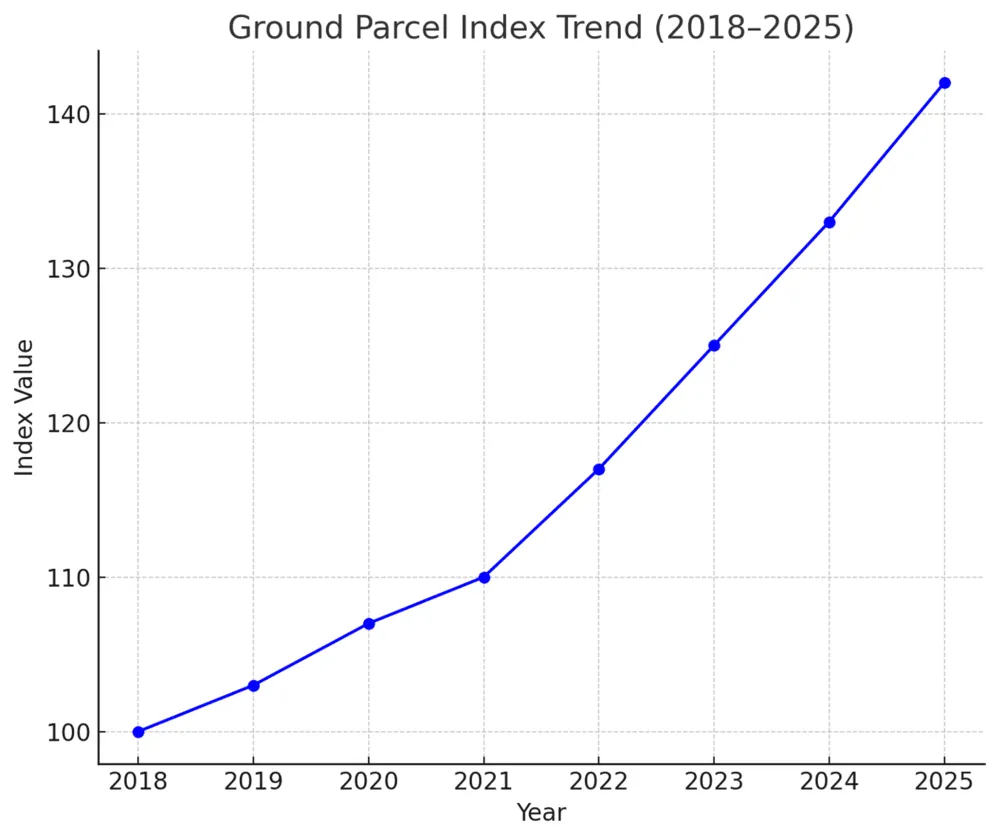
Billed Weight vs. Cost-Per-Package (Multi-Zone): The Hidden Geometry of Shipping Pain
The second chart shows the cost curve for shipping a package via ground, depending on billed weight and destination zone. This was derived by synthesizing rate tables from the official 2025 UPS and FedEx rate guides you can download right now. We simulated realistic pricing across Zones 2 through 8, for packages up to 50 lbs.
What becomes clear fast is this:
- Zone distance has a nonlinear impact. The same 10 lb box costs nearly 30–40% more to ship to Zone 8 than Zone 2.
- Weight-based costs aren’t flat. Each extra pound adds more than just weight; it multiplies cost, especially past the 10–15 lb range where rate brackets steepen.
- You’re probably getting crushed on midweight, long-zone shipments. That 18 lb box going to Zone 7 is silently eroding your margin every time you offer free shipping.
Takeaway: The average ecommerce merchant is overpaying because they’re not engineering for zone or weight efficiency. They’re just printing labels and hoping for the best. Big mistake.
Chart 2: Billed Weight vs. Cost-Per-Package by Zone (FedEx & UPS, 2025).
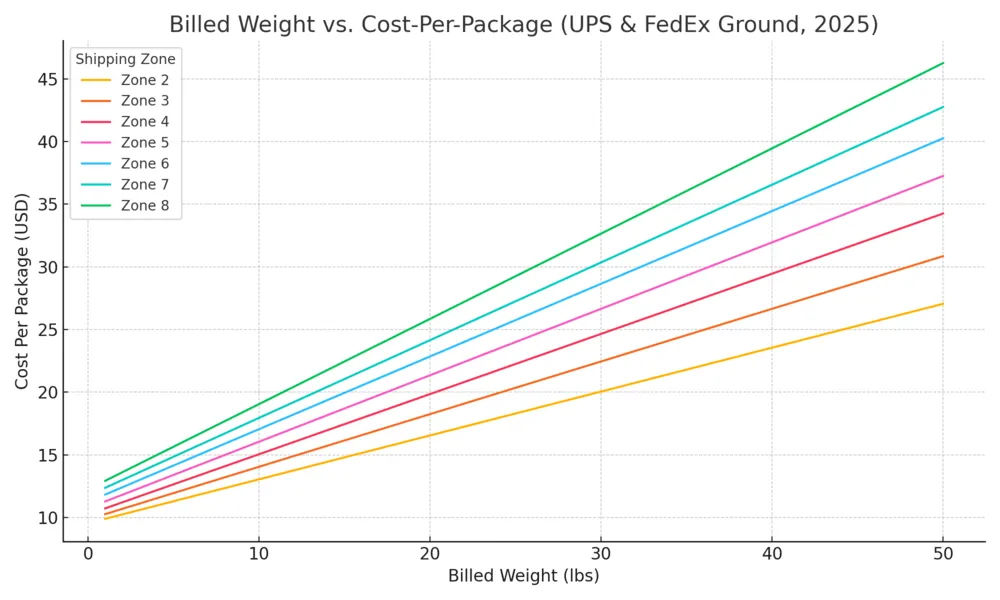
Key insights include:
- Zone escalation is brutal. The same 3 lb package can cost 2× as much going to Zone 8 versus Zone 2. A single-warehouse model is bleeding you dry on long-haul orders.
- Billed weight ≠ actual weight. Dimensional weight pricing inflates cost, especially when packaging isn’t optimized. A 2 lb item in a 12 × 12 × 10 box can be billed at 8+ lbs.
- Carrier policies diverge fast. USPS Ground Advantage offers strong pricing in Zones 2–5 for lightweight packages, while UPS’s negotiated discounts become more competitive at higher weights and volumes. FedEx Ground Economy is a contract-only service, and FedEx says it is the only way to deliver to domestic P.O. boxes.
- Flat rate isn’t always flat. Priority Mail Flat Rate boxes are convenient, but often more expensive than zone-based pricing for 2–5 lb packages going to Zones 2–4.
Takeaway: Don’t just look at average shipping cost. Build a dynamic model that accounts for zone distribution, dimensional weight risk, and carrier behavior. It sounds scarier than it really is: modern technology can help. For the rest of 2025 and into 2026, optimizing for billable weight and fulfillment geography isn’t a “nice-to-have.” It’s a survival strategy.
Practical Advice for Q3/Q4 2025 and Into 2026
USPS announced an 8% transportation-related time-limited price increase effective April 26, 2026 for Priority Mail, Priority Mail Express, USPS Ground Advantage, and Parcel Select, so every ground-shipping example should be checked against the current USPS price files before publication.
So what’s the fix? Firstly, we’re seeing that brands are shifting lower-value, lightweight shipments to slower, economy service tiers, like FedEx Ground Economy or UPS Ground Saver, to soften cost spikes. But while slowing down your low-value shipments can help, it shouldn’t be the only lever you pull. You still have customer expectations to meet. Let’s dig into how you can keep up, fiercely and intelligently.
1. Shift Volume Strategically, Don’t Just Rant About Rates
The index shows that shippers are diverting lightweight parcels to slower service levels this quarter. That shift drove down cost per package but raised average billed weight, leading to surprising rate hikes in the index data.
Here’s what to test:
- Pilot deferred services for small items (under 2–3 lbs) and see if the slower ETA is worth the savings.
- Never just blanket shift—test geographically. Maybe shift East Coast to Ground Saver and keep West on Priority.
That data-backed nuance lets you stay lean without tanking delivery promises.
2. Audit Surcharges Like a Hunter, Because Carriers Are Hunting Yours
FedEx’s 2026 rate changes add a cubic-volume trigger above 10,368 cubic inches for Additional Handling Surcharge — Dimension and a cubic-volume trigger above 17,280 cubic inches plus a 110-lb trigger for Oversize Charge, so packaging comparisons should be refreshed before reusing 2025 examples.
UPS’s 2026 rate guide shows the Ground residential surcharge rising from $3.34 to $3.55 and the Area Surcharge — Residential rising from $6.15 to $6.55, so 2025 surcharge examples should be refreshed before publication.
UPS raised its ground fuel surcharge by 15%, FedEx by 12%, even though diesel dropped by 8% YoY. That’s not cost pass-through, it’s revenue arbitrage.
And surcharges aren’t limited to fuel. UPS added fees for:
- Print services
- Payment processing
- Paper invoices
- Zone realignment errors
Every surprise fee is a profit leak if you don’t audit. Run monthly invoice audits using a service such as Refund Retriever or Cahoot’s Carrier Invoice Report to claw back charges and prevent reoccurrence. Benchmark your rates quarterly for visibility over time.
3. Optimize Packaging: Because Every Inch Costs
Don’t ignore the weight/zone multiplier. Carriers LOVE dimensional weight. As zones shift and surcharges rise, oversized packages are now a double penalty. Smart brands:
- Use polybags or bubble mailers for soft goods
- Right-size boxes using cartonization logic
- Use postage scale logs to track size variance
It’s: smaller box → less DIM weight → fewer zones crossed → lower shipping expenses across your program.
4. Leverage USPS When It Makes Sense
With FedEx/UPS squeezing margins, USPS Ground Advantage and Media Mail suddenly look powerful again. They’re slower, yes, but for low-cost items, the trade-off can be entirely worth it.
USPS even rolled out Priority Next-Day service in over 60 markets (and growing), blurring the line between economy and faster options. That’s something to pinch-test.
Note: Priority Mail Next-Day is a separate, contract-only service for businesses with negotiated service agreements that offers next-day delivery to locations within 150 miles of participating USPS locations. Minimum volumes may apply.
5. Customer Communication = Margin Protection
Don’t hide slower service under a free shipping flag. Instead:
- During checkout, call out “Delivered in 4–7 business days via Economy Ground” with real-time tracking links.
- Offer delivery upgrades at purchase for fast-moving or high-value SKUs.
- Use delivery expectations as a conversion tool, not a surprise to the customer.
Clear language prevents complaints, WISMO cases, and refund requests that eat margins.
6. Regional Carriers & Hybrid Last-Mile Models
Major carriers aren’t always cheaper. Some brands are partnering with regional carriers or using local couriers in high-density zones. That often cuts costs without sacrificing delivery time.
Examples I’ve seen work:
- A local carrier picks up in NYC or LA, then delivers packages in bulk to FedEx/UPS/USPS for the final mile.
- A hybrid mix of FedEx/UPS + USPS for rural zones.
This strategy especially helps when mode-shifting lightweight volume away from big carriers. When you’re shipping high volume and low-margin items — think apparel, small electronics, beauty, or anything lightweight — every few cents saved per shipment adds up. These hybrid models help:
- Lower cost-per-package
- Improve delivery coverage in tricky zones
- Avoid rate hikes from major carriers
7. Explore Hybrid Fulfillment
If your 3PL is stuck in one location, you’re likely hitting long zones by default. Spreading inventory closer to customers can drastically reduce the average shipping zone and cost.
8. Re-evaluate your free shipping threshold
If your AOV is $42 and your average shipping cost is $14, you’re giving away margin with every “free” shipment.
Final Thoughts: Deep Insights You Won’t Hear at Conferences
With national carrier surcharges climbing again, regional and hybrid carrier strategies aren’t a “nice-to-have”; they’re an edge. More brands will shift this way as delivery economics get tighter, especially for free shipping models or returns.
1. Carriers aren’t passing through costs, they’re engineering margin. Fuel surcharge hikes even as diesel drops prove the point.
2. Volume shifting is the insurer of margin in a hypercharged rate environment. But it demands smart segmentation; customers are willing to wait, until they aren’t.
3. Invoice audits deliver net margin boosts. Often reclaiming unseen dollars if you missed subtle new fees.
4. Packaging isn’t just aesthetics, it’s your Zone Minimizer 2.0. Even an inch past the threshold can break the unit cost math.
5. Communication is your invisible margin guardrail. Customers who understand delivery trade-offs don’t return orders or create customer service tickets; they convert quietly and joyfully.
Look, this isn’t a temporary blip; it’s a pricing realignment. There’s blood in the water. And those who treat it like a rounding error are the ones who’ll be squeezed hardest. With carriers shifting to aggressive surcharge strategies and volume declines ongoing, the brands that survive (and thrive) are those that pivot fast, audit hard, and control the conversation.
And you don’t need to choose between slow, cheap shipping and fast, expensive shipping. You need better shipping math. The brands winning in 2025 aren’t necessarily paying less; they’re paying smarter. Every package is a micro-optimization opportunity. And in this new era of quiet cost creep, your bottom line depends on seeing and solving for the full picture.
Frequently Asked Questions
Should I always redirect lightweight shipments to economy services?
If you’re scaling shipping and have many items under 3 lb, testing slower economy options like FedEx Ground Saver or USPS Ground Advantage is smart, especially when rate drops are significant and customer expectations can be managed.
How often should I audit shipping invoices?
Monthly or quarterly audits work best to catch fuel surcharge hikes, zone realignment fees, and other hidden charges that carriers apply mid-cycle without warning.
Are regional carriers worth the complexity?
Yes, in high-density zones they can cut costs by up to 20%, while reducing reliance on large-carrier surcharges. But you need solid tracking and exception management controls in place.
How can I package smarter to reduce DIM weight?
Use cartonization software to right-size boxes, choose bubble mailers or polybags for lightweight items, and keep a log of package size variances, especially if you’re using automated packing stations.
Will shifting ground volume hurt customer satisfaction?
Not if it’s communicated correctly. By clearly labeling delivery expectations and offering optional upgrades at checkout, most customers see slower ground as an acceptable trade-off for free or lower-cost shipping.
Written By:
Jeremy Stewart
Jeremy Stewart leads customer success at Cahoot, helping merchants achieve high-performance logistics through smart technology and process optimization. With a background in both ecommerce operations and client services, Jeremy ensures that every merchant using Cahoot gets measurable results—whether they’re scaling from one warehouse to many or managing complex returns.
Turn Returns Into New Revenue
Related Articles
Walmart Officially Allows Amazon Multi-Channel Fulfillment (MCF)
Big news for multichannel sellers: Walmart now officially allows Amazon Multi-Channel Fulfillment (MCF), Amazon’s service for using its fulfillment network to ship orders from mult...
Why More Automation Didn’t Lower Return Costs
Returns automation does improve returns operations: it cuts manual touches, smooths intake, speeds sorting, and makes workflow execution more consistent.
Shopify Subscription Payment Change: Why It Could Hurt Reactivation
Shopify changed how subscription payment information is handled at cancellation.
How to Choose the Best Walmart 3PL

I’ve spent the past eight years helping ecommerce businesses grow, ship faster, and adapt to Walmart’s ever-changing fulfillment demands. I work hand-in-hand with warehouse operators and 3PL partners every day. And if there’s one thing I’ve learned, it’s this: not all 3PLs are built to handle Walmart. The right Walmart 3PL should align with your business model and support your long-term goals for growth and efficiency.
So let’s break down how to choose the best Walmart 3PL, whether you’re evaluating Walmart Fulfillment Services (WFS), looking to optimize order fulfillment, or just want to avoid hidden costs that quietly eat your margins. Remember, your choice of fulfillment partner can directly impact your business’s success on the Walmart platform, affecting everything from delivery speed to customer satisfaction.
Let’s dive into what matters most when finding the best fulfillment partner for your needs.
What Makes Walmart Fulfillment So Different?
Walmart’s ecommerce ecosystem isn’t plug-and-play like Amazon’s FBA. Their fulfillment process is strict, yet flexible, if you know what you’re doing. Sellers need to meet exact fulfillment requirements, comply with shipping speed standards, and deliver a seamless customer experience that rivals their physical stores.
That’s where a solid 3PL comes in.
But what you really need is one that understands the nuances of Walmart Marketplace, offers real-time inventory tracking, and doesn’t vanish when something goes wrong. It’s crucial to choose a 3PL that can seamlessly integrate with Walmart’s systems and your ecommerce platform for efficient operations.
WFS vs. Walmart-Compatible 3PLs
Walmart Fulfillment Services (WFS) is one of Walmart’s primary fulfillment options, alongside seller fulfillment through another B2C U.S. warehouse with returns capability. It’s streamlined and deeply integrated. But WFS doesn’t work for every ecommerce seller. In these cases, outsourcing fulfillment to a third-party logistics provider (3PL) can address specific business and fulfillment needs, offering greater flexibility and control.
Why? Because you give up control—over your inventory management, your branding, and sometimes even your pricing flexibility.
A great 3PL, on the other hand, gives you:
- Multi-channel fulfillment
- Fulfillment solutions tailored to your unique needs, ensuring compliance and efficiency
- Flexible shipping options beyond WFS’s constraints
- Lower fulfillment fees (in many cases)
- More control over packaging materials and branding
Many of the sellers I’ve worked with start with WFS, but graduate to a more customized 3PL when their business outgrows the box. As your business evolves, matching different fulfillment solutions to your changing needs drives optimal growth.
Key Factors to Consider
If you’re serious about choosing the right fulfillment partner, here’s what to prioritize:
- Walmart compliance: Can your 3PL fulfill Walmart orders on time and according to spec?
- Fulfillment operations: Do they support fast delivery, accurate order processing, and smooth returns? Look for reliable fulfillment and ensure orders are processed efficiently to meet Walmart’s strict standards.
- Order tracking & shipping carriers: Does the 3PL offer real-time order tracking and integrate with major shipping carriers to provide timely updates and enhance transparency and customer satisfaction?
- Cost savings: Watch out for hidden fees and opaque pricing. Ask for transparency, and consider how shipping rates and weight affect costs.
- Peak season readiness: Can they scale with your volume during Q4 and beyond?
- Technology stack: Are they using order management systems that give you visibility and control?
A strong 3PL partner should also provide value-added services such as custom packaging or kitting, backed by deep supply chain expertise.
I’ve seen sellers burn through 3PLs simply because they didn’t ask the right questions early on. The best ones feel more like partners than vendors, supporting your growth every step of the way.
Inventory Management for Walmart Sellers
Inventory management is the backbone of any successful ecommerce business, and for Walmart sellers it’s even more critical. With customer expectations for fast delivery and reliable service at an all-time high, having the right products in the right place at the right time can make or break your Walmart Marketplace performance.
To stay ahead, Walmart sellers should invest in advanced technology solutions—real-time tracking and robust order management systems that integrate with your ecommerce platform and 3PL.
Outsourcing inventory management to a reliable 3PL unlocks cost savings and efficiency. A trusted partner handles everything from receipt and storage to shipping and returns, freeing your team to focus on customer engagement and growing your business.
Implement best practices like just-in-time replenishment, demand forecasting, and regular audits to fine-tune stock levels, reduce waste, and stay ready to fulfill Walmart orders at a moment’s notice.
In today’s competitive marketplace, effective inventory management is a must for Walmart sellers seeking high customer satisfaction, competitive pricing, and scalable growth.
Cahoot: A Walmart 3PL Built for Marketplace Sellers
Our network is built with Walmart sellers in mind. We help clients meet aggressive same-day shipping SLAs, reduce shipping costs, and avoid chargebacks due to fulfillment mistakes.
Here’s what sets Cahoot apart:
- Walmart-optimized workflows and shipping logic
- Strategically located nationwide fulfillment centers to ensure fast, accurate order processing, and support Walmart’s performance requirements.
- Integrated order routing across channels
- Full transparency with real-time tracking
- Ability to provide temperature control for perishable goods, ensuring compliance with Walmart’s standards
We’re not just managing shipments, we’re helping brands run leaner, faster, and more profitably inside the Walmart ecosystem.
Cahoot’s fulfillment centers are designed to meet Walmart’s requirements for shipping, labeling, and inventory management. Our customer service team efficiently handles inquiries, including order tracking and returns, to enhance the overall customer experience.
Final Thoughts
Choosing a Walmart 3PL isn’t about picking the biggest name—it’s about aligning your operations with a partner that understands Walmart’s expectations and your growth goals.
If you want a 3PL provider that actively improves your margins, Cahoot’s worth a look.
Frequently Asked Questions
What is a Walmart 3PL and how is it different from Walmart Fulfillment Services (WFS)?
A Walmart 3PL is a third-party logistics provider that helps Marketplace sellers fulfill orders outside of WFS. Unlike WFS, you retain control over inventory, branding, and pricing.
Does Walmart allow sellers to use their own fulfillment partners?
Yes. While Walmart promotes WFS, third-party sellers can use their own 3PLs as long as they meet Walmart’s fulfillment and shipping performance standards.
What are the benefits of using a Walmart 3PL over WFS?
Benefits include more flexible pricing, better control of multi-channel inventory, branded packaging, and scalable peak-season capacity.
How does a Walmart 3PL impact customer satisfaction and shipping speed?
The right 3PL boosts speed and accuracy by reducing processing delays, leading to better reviews and fewer complaints.
How can Cahoot help with Walmart fulfillment?
Cahoot offers Walmart-compliant 3PL services with fast shipping, nationwide coverage, and cost-effective rates, supporting both WFS-alternative and hybrid models.
Written By:
Jeremy Stewart
Jeremy Stewart leads customer success at Cahoot, helping merchants achieve high-performance logistics through smart technology and process optimization. With a background in both ecommerce operations and client services, Jeremy ensures that every merchant using Cahoot gets measurable results—whether they’re scaling from one warehouse to many or managing complex returns.
Turn Returns Into New Revenue
Related Articles
Walmart Officially Allows Amazon Multi-Channel Fulfillment (MCF)
Big news for multichannel sellers: Walmart now officially allows Amazon Multi-Channel Fulfillment (MCF), Amazon’s service for using its fulfillment network to ship orders from mult...
Why More Automation Didn’t Lower Return Costs
Returns automation does improve returns operations: it cuts manual touches, smooths intake, speeds sorting, and makes workflow execution more consistent.
Shopify Subscription Payment Change: Why It Could Hurt Reactivation
Shopify changed how subscription payment information is handled at cancellation.
Amazon Expands FBA Box Size: What Sellers Need to Know
In this article
4 minutes
The content of this article covers Amazon’s recent FBA box‐size update, the AWD implications, pros and cons of the change, smart questions to ask, seller feedback, Cahoot’s solution, and FAQs—all in one place.
What Really Changed, and Why It Matters
As of June 20, 2025, Amazon raised the maximum allowable carton length for FBA shipments from 25 inches to 36 inches. Width, height, and the 50-pound weight limit remain unchanged. If you’re wondering whether this move is a big deal, the answer is yes, but with caveats.
This change opens the door for smarter packaging strategies. Think: better product bundling, reduced outer box count, and possibly some cost savings on inbound shipping if you optimize correctly. But before you go redesigning every carton, hold up—this doesn’t necessarily extend to AWD (Amazon Warehousing and Distribution), where size restrictions still apply in most cases.
The AWD Confusion Factor
A lot of sellers on Amazon forums and LinkedIn have been asking: “Does this apply to AWD too?” The short answer is: no, not really. AWD still enforces its own packaging criteria, especially around conveyable cartons. One seller summed it up well: “FBA might let me go long now, but AWD’s still playing by the old rulebook.”
The takeaway? Don’t assume this is a one‐size‐fits‐all update. Multichannel sellers and anyone using AWD for upstream storage should keep using separate carton spec templates.
Why Amazon Made This Move Now
This isn’t random. 2025 has been packed with changes to FBA and AWD capacity policies, fees, and prep requirements. This latest shift comes after Amazon:
- Reduced peak storage limits to ~5 months of forecasted sales
- Rolled out smart storage rate tiers for AWD
- Cracked down on inventory performance metrics
In that context, the 36-inch change looks less like a gift and more like an efficiency nudge. Amazon wants you to ship smarter, not bigger. But if bigger helps you ship smarter, you now have the green light.
The Pros, and the Not-So-Obvious Cons
The Good:
The Gotchas:
Smart Questions to Ask Right Now
- Which of my ASINs can benefit from the 36-inch allowance?
- Are my 3PLs or prep centers even aware of the change?
- Do I need to maintain separate carton rules for FBA vs AWD?
- Is my packaging team trained to avoid dimensional-weight traps?
What Sellers Are Saying
One seller on the forums wrote, “It’s about time… my standard lamps have been costing me extra for repackaging for years.” Another added, “Unless AWD follows suit, this just adds another layer of complexity.”
We’re seeing the same split across LinkedIn: half of the brands are optimistic, the other half are cautious. Everyone wants more flexibility, but not at the cost of downstream penalties or confusion.
Cahoot’s Edge: No Length Caps, No Guesswork
Here’s where we come in. At Cahoot, we don’t impose arbitrary box-length limits. Whether you ship 12 inches or 42 inches, our peer-to-peer fulfillment network accommodates your carton, not the other way around.
And because we operate channel-agnostic, there’s no need to split inventory or set up redundant prep processes just to comply with Amazon’s shifting rules. When Amazon changes the rules, we don’t scramble. Our systems are already built for flexibility.
Final Thought
Amazon’s carton-length change is an opportunity, if you know how to use it. It’s not a magic solution, but for the right SKUs, it can open up serious efficiency. Just make sure your fulfillment strategy isn’t relying on assumptions. Because at Amazon, the rules always change.
Frequently Asked Questions
What’s the new FBA box length limit?
The new maximum is 36 inches in length. Weight (50 lbs max), width, and height restrictions remain the same.
Does this apply to Amazon AWD?
No. AWD still enforces a 25-inch limit for conveyable cartons. Check your spec sheets before making changes.
Will this reduce shipping costs?
It can, especially if you bundle multiple units in one carton. But watch for dimensional weight traps.
Can Cahoot handle boxes over 36 inches?
Yes. Cahoot imposes no size limits on cartons, making it ideal for larger or irregularly shaped products.
Do I need to update my packaging workflows?
Probably. Most sellers will benefit from revisiting their pack plans and checking how their software handles the new dimensions.
Written By:
Indy Pereira
Indy Pereira helps ecommerce brands optimize their shipping and fulfillment with Cahoot’s technology. With a background in both sales and people operations, she bridges customer needs with strategic solutions that drive growth. Indy works closely with merchants every day and brings real-world insight into what makes logistics efficient and scalable.
Turn Returns Into New Revenue
Related Articles
Walmart Officially Allows Amazon Multi-Channel Fulfillment (MCF)
Big news for multichannel sellers: Walmart now officially allows Amazon Multi-Channel Fulfillment (MCF), Amazon’s service for using its fulfillment network to ship orders from mult...
Why Small Ecommerce Brands Are Winning with AI (While Enterprises Struggle)
Conventional wisdom says large companies should dominate AI adoption.
Top 12 Shipping Strategies For Making Free Shipping Profitable
For ecommerce sellers, shipping is more than just getting a package from point A to point B — it’s the invisible backbone, quietly shaping customer satisfaction, operational costs,...