
Amazon FBA Changes Quantity Limits Again!
In this article
 6 minutes
Here we go again with yet another tightening of Amazon FBA quantity limits. For many, this latest change means a reduction of overall account-level inventory limits. Most sellers will be affected by this change. But, considering that Amazon made this change just a few weeks before Prime Day ‘21, what will FBA do when space is really strained in Q4? For actionable advice on improving IPI scores and developing alternative fulfillment strategies that can mitigate risk and maximize Amazon sales in Q4 and beyond, check our article and on-demand webinar on How To Improve Your IPI Score & Maximize Amazon Sales
Sellers that are overly dependent on FBA for eCommerce order fulfillment may find themselves poorly positioned to take advantage of Amazon’s Q4 ‘21 sales opportunities that are expected to be the largest on record. Before it is too late, sellers should consider alternative or backup fulfillment strategies that will free them from this latest Amazon restriction or other changes likely to follow as we get closer to the holiday season. And, do not expect much advance notice from Amazon.
What Is Amazon’s New Inventory Restriction?
Amazon announced that effective April 22, 2021, FBA inventory limits are now set at the account-level and based on storage type rather than at the ASIN-level. In other words, there are no longer limits on the number of units that can be stored; however, there are new limits on the total volume of storage space available to hold those ASINs. Because this change impacts total storage limits, it also impacts restock limits. This change responds to seller feedback from a July 2020 ASIN-level quantity limit restriction driven by Covid-19 supply-chain challenges.
Amazon quantity limits, including this new account-level inventory restriction, are impacted by several factors. The two primary factors are the sellers’ Inventory Performance Index (IPI) score and Amazon FBA’s overall storage capacity. Amazon’s IPI score is essentially a measurement of inventory turnover; how efficiently sellers manage their FBA sell-through rates and inventory levels. The faster inventory moves through FBA, the higher the sellers’ IPI score. IPI scores take a hit when ASINs run out of stock or if inventory sits stagnant in FBA fulfillment centers, which leads to a reduction in sellers’ inventory limits. To make matters worse, Amazon has increased the IPI threshold multiple times throughout 2020 and 2021.
Why Has Amazon Restricted Inventory Limits?
62% of consumers start their search on Amazon, and Amazon saw a 40%+ growth in GMV. Consequently, Amazon fulfillment centers are bursting at the seams, and there’s no end in sight. Amazon currently has over 110 fulfillment centers in the US, but there is simply more inventory being sent to Amazon than they can handle.
What Does The New Inventory Restriction Mean for Sellers?

The intention was to give sellers more flexibility with inventory shipments. However, the response on seller forums is mixed. Sellers whose catalogs comprise primarily small and light items that are fast-moving all year round will be relatively unaffected by this change. On the other hand, sellers whose catalog is a mix of various weights and volumes and sellers whose sell-through rates ebb and flow throughout the year may need to make drastic changes. In addition, merchants that plan to launch new products may suffer, especially the newer sellers who do not have a proven track record on the Amazon marketplace.

Sellers who reach their inventory limit will no longer be able to stock up or send full container loads to Amazon at the beginning of the Q4 holiday shopping season or before a sales event like Amazon Prime Day. This is because additional shipments would be a policy violation. Instead, sellers will need to route shipments to 3PL warehouses and then send multiple just-in-time shipments to Amazon. As a result, these sellers will suffer significantly increased costs and greater complexities with their supply chain logistics.
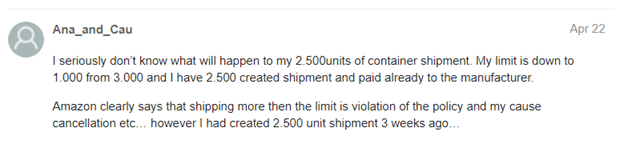
Sellers that based their supply chain logistics around the earlier ASIN level limits are frustrated with yet another unilateral decision with little to no advance notice. Others are equally discontented by not being able to send more inventory for fast-moving ASINs. Here are a few comments from a seller forum that sum up the overall sentiment around this change.


What Can Sellers Do About The New FBA Inventory Restrictions?
Amazon’s repeated and unilateral changes to inventory restrictions have clearly frustrated many sellers. And as the saying goes, “Fool me once …”. So, whether it’s this latest restriction or others likely to follow in Q4, two things are clear;
- 63% of consumers start their search on Amazon, so regardless of this or any other new restrictions, your products must continue to be offered on Amazon.
- Merchants can’t sit idle. They must seek to understand their options now and be ready to quickly pivot to alternative fulfillment services if necessary to save Q4 sales.
Here’s a quick overview of Amazon FBA alternatives.
Switch to Fulfillment by Merchant (FBM)
As an Amazon seller, you can always switch to offering FBM. However, in addition to the logistics hassles of fulfilling all of your own orders, it is impossible to win the buy box with slow standard shipping, so the outcome would likely be a significant drop in sales. If sellers need to contract with new 3PLs, they could consider using a 3PL Request for Proposal Template to compare apples to apples.
Ship Prime Offers Via Seller Fulfilled Prime (SFP)
If you are one of a handful of SFP merchants that have maintained Prime eligibility after the new amazon SFP requirements, you’re in good shape. If you have trouble scaling up, you can contract with multiple 3PLs or seek out an Amazon SFP Fulfillment Partner who is savvy with meeting Amazon SFP delivery speed metrics.
Join a Peer-to-Peer Fulfillment Network
An innovative and affordable alternative to working with 3PLs is outsourcing fulfillment to a peer-to-peer (P2P) e-commerce order fulfillment network. Like FBA, this model enables members to offer nationwide 1-day or 2-day delivery, in addition to the standard economy delivery. A P2P network comprises highly experienced and proven sellers who offer up existing space and resources to provide order fulfillment to other merchants. As a result, costs are generally lower than what you get with a 3PL fulfillment center, and multi-channel sales are the norm. A P2P network can be a good option whether or not the merchant has warehouses of their own. In addition, merchants with excess warehouse space and fulfillment capacity can tap a new revenue stream by fulfilling orders for others.
Written By:

Indy Pereira
Indy Pereira helps ecommerce brands optimize their shipping and fulfillment with Cahoot’s technology. With a background in both sales and people operations, she bridges customer needs with strategic solutions that drive growth. Indy works closely with merchants every day and brings real-world insight into what makes logistics efficient and scalable.

Turn Returns Into New Revenue
Related Articles
The Shipping Speed Paradox: Why DTC Brands Are Slowing Down
Everyone’s talking about faster delivery.

Why Cross-Border DTC Brands Are Moving Fulfillment Inside the US
Cross-border ecommerce fulfillment is the process of shipping ecommerce orders across national borders—often from warehouses outside the United States to U.
Shopify Estimated Delivery Date: A Complete Guide for Ecommerce Stores
A Shopify estimated delivery date is the specific arrival date or date range shown on a product page before purchase, so shoppers know when an order is expected to arrive.
How to Successfully Offer a One-Day Shipping Program
In 2025, Amazon said Prime members received over 13 billion items the same or next day globally and over 8 billion in the U.S., and Prime now offers free delivery on over 300 million items with tens of millions available for Same-Day or Next-Day Delivery.
Amazon has been a pioneer in setting new customer expectations. Online shoppers weren’t really asking for free two-day delivery until Amazon made it available as part of its Prime membership in February 2005‑—that changed the online world forever. Today customers expect free two-day shipping on all their online purchases anywhere.
Amazon is at it again and now getting customers addicted to free one-day shipping. If you are a third-party seller, you too now must adapt to offering free one-day delivery if you wish to maintain high visibility, especially on marketplaces. It won’t be long before Amazon will prioritize two-day shipping offers organically over the others when it comes to buy box occupancy. Without one-day shipping offers, you might also have to spend more on ads in order to drive traffic to your listings. So getting your ducks in a row now will pay dividends soon besides contributing to more sales now.
It’s, however, no surprise that offering one-day shipping is both very expensive and stressful, given the high performance standards demanded by Amazon. Where there are challenges, there are opportunities. This is one such opportunity that growth-minded Sellers can capitalize on today before the others catch on the bandwagon.
Operational Excellence
In March 2026, Amazon introduced 1-hour and 3-hour delivery options in a growing number of cities and towns, with over 90,000 products available for delivery in three hours or less.
Seller Fulfilled Prime performance requirements now include at least 99% on-time shipment, at least 98% Buy Shipping usage, no more than 0.5% seller-initiated cancellations, and at least 97% on-time delivery for Prime orders shipped outside Buy Shipping; Amazon says delivery-speed thresholds are refreshed quarterly. Without a reliable order fulfillment team and the right technology, it will be difficult to achieve the metrics required for the program: 99% on-time shipment rate, 95% on-time delivery rate, and <1.5% cancellation rate.
Below are some best practices we’ve learned at Cahoot that will help you prepare to offer one-day shipping:
Get ecommerce orders out on time
Seller Fulfilled Prime orders where the customer receives same-day, one-day, or two-day delivery are expected to ship on the day the order is received during configured operating days and order cut-off times, and sellers must configure order cut-off times to 2:00 p.m. or later Monday-Friday and 10:30 a.m. or later Saturday-Sunday. Pay close attention to the following:
- Thoughtful storage strategy. Keep in mind that picking staff would spend most of their time walking through the warehouse, and a well-thought-out storage strategy would go a long way in improving operational efficiency. It is good practice to segment products and store them separately based on popularity and affinity. Don’t forget to regularly audit this because demands may shift due to product life cycle and seasonality.
- Efficient Picking Methods. Picking is a crucial step in the order fulfillment operation, and errors in picking would result in a lot of wasted time. Clearly marked bins for different SKUs and automated picking can improve the accuracy tremendously.
- Automated Label Printing. With little time to process orders especially towards the cutoff times, it becomes paramount to generate the best shipping labels automatically from your shipping software. Manually comparing services and carriers is prone to human errors and takes away precious time that can be spent elsewhere.
- Properly trained staff. It is imperative to make sure workers (especially seasonal staff) can navigate your warehouse quickly, safely and pick-and-pack accurately. You can start the new workers with standard orders as they improve their speed and performance before fulfilling one-day orders.
Deliver orders on time
Below are some pitfalls to avoid in the order fulfillment process that delay package arrivals:
- Address verification and label quality. Having correct address down to the zip code +4 including “floor” or “suite” where applicable, makes a difference. Make sure your printed labels are clear, bold, and easy to read and not faded or dull (may happen to laser printers).
- No distinct sounds and smells. Packages with odd smells and sounds will get pulled aside during sorting at the carrier facilities for further inspections. While packing make sure to seal scented products properly and to turn off items or toys that make noises.
- Pick the right carrier and service. Lastly, make sure the carrier you’ve selected for 1-day orders has an excellent record of on-time delivery. A cheap but questionable service is not suitable for one-day shipping because you’ll be penalized heavily for late deliveries.
Maintain a low order cancellation rate
Having orders with no items to fulfill them due to inventory issues can force you to cancel an order, which will hurt your performance metrics. To improve inventory accuracy and visibility, implement a Warehouse Management System (WMS) and/or an Order Management System (OMS) and do not rely on human-managed spreadsheets.
Make one-day delivery profitable nationwide
In 2025, Amazon expanded Same-Day and Next-Day Delivery to over 4,000 smaller cities, towns, and rural communities across 44 states.
There are limitations to having a single order fulfillment center for one-day shipping. A guaranteed next-day express shipping service is four times as expensive than the economical ground shipping. Unless you skyrocket your retail price accordingly, you won’t be able to make money off the transaction.
The simplest way to expand your order fulfillment nationwide is through outsourcing. There are marketplace-owned services like Amazon FBA and Shopify Fulfillment Network, which offer good rates nationwide, but charge extra for one-day orders. There are also third-party logistics (3PL) providers that offer nationwide reach but typically require minimum-commitment contracts and upfront fees. Many 3PLs do not have the ability to support all the Amazon Seller Fulfilled Prime requirements. Outsourcing order fulfillment could also make it difficult to maintain your hard-earned negotiated carrier rates because most providers like to use their own accounts for shipping for the mark-up.
A new option for offering one-day shipping nationwide is to use a peer-to-peer order fulfillment network like Cahoot, where top-rated sellers collaborate by pooling their resources to offer one-day and two-day shipping at the price of ground shipping or less. Cahoot offers the most economical way for brands and retailers to offer super fast shipping to its customers on all sales channels without sacrificing their profit margins.
Written By:
Indy Pereira
Indy Pereira helps ecommerce brands optimize their shipping and fulfillment with Cahoot’s technology. With a background in both sales and people operations, she bridges customer needs with strategic solutions that drive growth. Indy works closely with merchants every day and brings real-world insight into what makes logistics efficient and scalable.
Turn Returns Into New Revenue
Related Articles
The Shipping Speed Paradox: Why DTC Brands Are Slowing Down
Everyone’s talking about faster delivery.
Why Cross-Border DTC Brands Are Moving Fulfillment Inside the US
Cross-border ecommerce fulfillment is the process of shipping ecommerce orders across national borders—often from warehouses outside the United States to U.
Shopify Estimated Delivery Date: A Complete Guide for Ecommerce Stores
A Shopify estimated delivery date is the specific arrival date or date range shown on a product page before purchase, so shoppers know when an order is expected to arrive.
Maximizing Warehouse Efficiency: 11 Essential Strategies for Success
In this article
9 minutes
- How to Measure Warehouse Efficiency
- Optimizing Warehouse Layout and Traffic Flow
- Implementing Advanced Inventory Management Systems for Warehouse Operations
- Adopting Automation and Robotics
- Enhancing Employee Training and Engagement
- Utilizing Data Analytics for Continuous Improvement
- Implementing Lean Inventory Practices
- Enhancing Safety Measures
- Regular Maintenance of Equipment
- Streamlining Communication Channels
- Customizing Storage Solutions
- Conclusion
- Frequently Asked Questions
Efficiency is the backbone of successful warehouse operations. As businesses grow and consumer demands evolve, warehouses must continually refine their processes to stay competitive. Whether it’s optimizing layouts, integrating automation, or enhancing employee training, each improvement contributes to a smoother, faster, and more cost-effective operation. By implementing strategic measures, warehouses can maximize their potential, reduce waste, and improve overall productivity. This article explores a range of strategies to achieve a highly efficient warehouse.
1. How to Measure Warehouse Efficiency
It is absolutely necessary for warehouses to find ways to measure efficiency and identify areas for improvement. Common key performance indicators (KPIs) such as inventory turnover, order cycle time, and perfect order rate can be used to measure warehouse efficiency.
Inventory turnover indicates how often inventory is sold and replaced over a period, reflecting the effectiveness of inventory management, while order cycle time measures the time taken from order placement to delivery, highlighting the speed of warehouse operations. The perfect order rate tracks the percentage of orders delivered without errors.
In addition to those metrics, warehouse managers can use metrics such as storage capacity utilization, labor productivity, and equipment utilization to measure the efficiency of specific aspects of their business. By regularly reviewing these KPIs, warehouse managers can pinpoint inefficiencies and implement targeted improvements to optimize warehouse operations.
2. Optimizing Warehouse Layout and Traffic Flow
A warehouse’s layout can significantly improve or significantly harm efficiency. Optimizing existing warehouse space with a well-designed floor plan can prevent bottlenecks, reduce excessive travel time, and make it easier to locate products. By optimizing warehouse space, businesses can reduce unnecessary movement and streamline workflows.
One effective approach is to position high-demand items closer to packing and shipping areas. This ensures that frequently picked products are easily accessible, reducing the time employees spend retrieving them. Categorizing products based on size and weight also enhances picking speed and accuracy.
Another key consideration is the design of pathways. Wide, clearly marked aisles prevent congestion and allow for the smooth movement of personnel and equipment, such as forklifts and pallet jacks. Regularly reassessing the layout based on inventory trends and operational needs ensures that the warehouse remains adaptable to changes in demand.
3. Implementing Advanced Inventory Management Systems for Warehouse Operations
Managing inventory efficiently is essential for preventing overstocking, stockouts, and misplacement of goods. Advanced inventory management systems (IMS) provide real-time tracking and visibility, helping warehouses maintain optimal stock levels and optimize warehouse efficiency through the use of warehouse management systems (WMS).
Modern IMS solutions incorporate barcode scanning and RFID technology to accurately track inventory movement. These tools reduce human errors, improve order accuracy, and minimize delays caused by misplaced items. Additionally, cloud-based inventory management allows for seamless integration with other business systems, providing instant updates on stock levels, supplier shipments, and order processing.
Automating inventory tracking also enables better demand forecasting. By analyzing historical sales data and market trends, warehouses can anticipate demand fluctuations and adjust inventory levels accordingly. This prevents excess stock from occupying valuable storage space while ensuring that popular products are readily available.
4. Adopting Automation and Robotics
Automation is transforming the warehousing industry by increasing efficiency, accuracy, and speed. Implementing automated solutions reduces reliance on manual labor for repetitive tasks, allowing employees to focus on more complex responsibilities.
Automated guided vehicles (AGVs) and conveyor systems streamline material handling by transporting goods efficiently throughout the warehouse. Robotics, such as automated picking and sorting systems, further enhance productivity by reducing errors and accelerating order fulfillment.
While the initial investment in automation can be significant, the long-term benefits—such as reduced labor costs, increased processing speed, and improved accuracy—justify the expense. Additionally, integrating warehouse management systems (WMS) with automation ensures seamless coordination between various operational processes, further optimizing efficiency.
5. Enhancing Employee Training and Engagement
Even with advanced technology, human employees remain (and will remain) a crucial element of a well-managed warehouse operation. Well-trained and motivated staff contribute significantly to streamlined operations and improved accuracy. Regular training programs ensure that employees are proficient in using warehouse technology, safety protocols, and best practices.
Engagement is equally important. Incentivizing employees with performance-based rewards encourages efficiency and accuracy. Open communication channels, feedback mechanisms, and a positive work environment foster a sense of ownership among workers, increasing productivity and reducing turnover rates.
6. Utilizing Data Analytics for Continuous Improvement
Data-driven decision-making is a powerful tool for warehouse optimization. By analyzing key performance indicators (KPIs) and evaluating and streamlining warehouse processes, businesses can identify inefficiencies and make informed improvements.
Metrics such as order accuracy rates, picking and packing times, and inventory turnover ratios provide insights into operational strengths and weaknesses. Predictive analytics can also enhance efficiency by anticipating demand patterns, optimizing workforce allocation, and minimizing waste. By leveraging data analytics, warehouses can continuously refine their processes and maintain a competitive edge.
7. Implementing Lean Inventory Practices
Adopting lean inventory management principles helps minimize waste and maximize resource utilization. The Just-in-Time (JIT) inventory system is a popular lean approach that ensures stock arrives only when needed, reducing storage costs and excess inventory. Implementing JIT requires strong supplier relationships and precise demand forecasting to avoid stockouts.
Lean inventory practices emphasize efficiency in every aspect of warehouse management, from procurement to fulfillment. By maintaining optimal stock levels and eliminating unnecessary storage, warehouses can reduce costs while improving service levels.
8. Enhancing Safety Measures
A safe warehouse is an efficient warehouse. Aside from their toll on personal health, workplace injuries and accidents lead to downtime, decreased productivity, and increased operational costs. Prioritizing safety measures ensures a secure working environment and smooth operations.
Regular safety training, clear signage, and well-maintained equipment help prevent accidents. Implementing ergonomic workstations reduces strain-related injuries among employees. Additionally, enforcing proper safety protocols for operating machinery, handling hazardous materials, and lifting heavy objects minimizes risks.
Investing in safety not only protects employees but also enhances overall efficiency by preventing disruptions caused by workplace incidents. A culture of safety encourages employees to adhere to best practices, creating a more productive work environment.
9. Regular Maintenance of Equipment
Warehouse equipment plays a vital role in daily operations, and its reliability is crucial for efficiency. Regular maintenance prevents unexpected breakdowns that can disrupt workflows and delay order fulfillment.
A preventive maintenance program ensures that forklifts, conveyor belts, and other machinery remain in optimal working condition. Scheduling routine inspections, replacing worn-out components, and addressing minor issues before they escalate prolong the lifespan of equipment and reduce downtime.
Additionally, maintaining accurate records of maintenance activities allows managers to track equipment performance and plan for necessary upgrades or replacements. A proactive approach to maintenance keeps warehouse operations running smoothly and efficiently.
10. Streamlining Communication Channels
Effective communication is the backbone of a well-coordinated warehouse. Miscommunication can lead to errors, delays, and inefficiencies, making it essential to establish clear communication channels between employees and departments.
Implementing communication tools such as warehouse management software (WMS) with real-time messaging features enhances coordination. Regular team meetings ensure that staff are aligned on operational goals, workflow changes, and performance expectations.
Encouraging an open-door policy where employees can voice concerns and suggest improvements fosters collaboration and innovation. By maintaining clear and transparent communication, warehouses can minimize misunderstandings and enhance overall productivity.
11. Customizing Storage Solutions
Optimizing storage systems improves space utilization and accessibility, leading to more efficient warehouse operations. Customizable storage solutions cater to the specific needs of different products, enhancing organization and retrieval speed.
Adjustable shelving, modular racking, and vertical storage units maximize available space while ensuring easy access to items. Implementing clear labeling systems further streamlines picking and stocking processes. In addition, regularly assessing storage requirements and reconfiguring layouts based on inventory trends helps warehouses maintain efficiency. Customizing storage solutions to fit the business’s needs prevents wasted space and enhances operational flow.
Conclusion
Improving warehouse efficiency requires a combination of strategic planning, technological integration, and workforce optimization. By continuously evaluating and refining processes, warehouses can achieve greater productivity, reduce costs, and enhance customer satisfaction. The key to success lies in embracing innovation, fostering a culture of efficiency, and staying adaptable to industry changes. With a commitment to continuous improvement, warehouses can position themselves as leaders in operational excellence.
Frequently Asked Questions
What are some cost-effective ways small warehouses can improve efficiency without investing in expensive automation?
Small warehouses can enhance efficiency by optimizing their layout to reduce unnecessary movement, implementing lean inventory practices to minimize waste, and utilizing affordable inventory management software to track stock levels more accurately. Training employees to follow standardized workflows and adopting basic automation tools, such as barcode scanners, can also help improve speed and accuracy. Additionally, regularly analyzing key performance metrics can help small warehouses identify inefficiencies and make strategic improvements without requiring a large financial investment.
What are the biggest challenges warehouses face when trying to implement new efficiency strategies?
One of the most common challenges is employee resistance to change, as new processes or technology may require additional training and adaptation. High upfront costs for automation and technology upgrades can also be a barrier, especially for smaller operations. Furthermore, integrating new systems with existing workflows can be complex and time-consuming, potentially causing temporary disruptions. To overcome these obstacles, warehouses should prioritize phased implementation, provide comprehensive training, and ensure clear communication about the benefits of the changes to gain employee buy-in.
What strategies can warehouses use to manage seasonal demand fluctuations?
Seasonal demand can create significant operational challenges, including stock shortages, overstocking, and increased labor costs due to fluctuating order volumes. Warehouses can prepare by analyzing historical sales data to anticipate demand spikes and adjust inventory levels accordingly. Implementing flexible storage solutions, such as temporary shelving or rented warehouse space, can help accommodate excess stock when needed. Additionally, hiring temporary workers and cross-training existing employees can ensure that labor capacity aligns with seasonal surges, preventing bottlenecks and maintaining order fulfillment efficiency.
How can warehouses incorporate sustainability into their efficiency strategies, and what are the benefits?
Warehouses can improve efficiency while promoting sustainability by adopting energy-efficient lighting, optimizing transportation routes to reduce fuel consumption, and using eco-friendly packaging materials. Implementing waste reduction strategies, such as recycling programs and reusable packaging, can further enhance environmental responsibility. Not only do these practices help reduce operational costs, but they also improve a company’s reputation and align with increasing consumer demand for sustainable business practices. By integrating sustainability into warehouse operations, businesses can create long-term cost savings while contributing to a greener supply chain.
Written By:
Indy Pereira
Indy Pereira helps ecommerce brands optimize their shipping and fulfillment with Cahoot’s technology. With a background in both sales and people operations, she bridges customer needs with strategic solutions that drive growth. Indy works closely with merchants every day and brings real-world insight into what makes logistics efficient and scalable.
Turn Returns Into New Revenue
Related Articles
The Shipping Speed Paradox: Why DTC Brands Are Slowing Down
Everyone’s talking about faster delivery.
Why Cross-Border DTC Brands Are Moving Fulfillment Inside the US
Cross-border ecommerce fulfillment is the process of shipping ecommerce orders across national borders—often from warehouses outside the United States to U.
Shopify Estimated Delivery Date: A Complete Guide for Ecommerce Stores
A Shopify estimated delivery date is the specific arrival date or date range shown on a product page before purchase, so shoppers know when an order is expected to arrive.
Can Multiple Distribution Centers Reduce Shipping Costs and Time
In this article
1 minute
Some days you might feel like you’re caught between the proverbial rock and a hard place. Like clockwork, carriers increase their charges. The competition is absorbing more of their shipping costs and offering “free” shipping. The customer’s “point, click and deliver” mentality is here to stay.
The cost of shipping and the time to get the package to the customer affects many customers’ decisions to buy from your business. As these trends continue, multiple distribution centers may be the best bet to reduce shipping costs and deliver faster to the customer. As an alternative to internally managing additional facilities, we recommend companies evaluate the use of 3PL as a major way to reduce start up investment and shorten the schedule. You may be able to reach 80% of your customers in 1-2 days via ground from two strategically placed centers.
However, multi-DC strategies are not the right strategy for every company because of the added expenses, inventory required and managing a second remote center.
Written By:

Manish Chowdhary
Manish Chowdhary is the founder and CEO of Cahoot, the most comprehensive post-purchase suite for ecommerce brands. A serial entrepreneur and industry thought leader, Manish has decades of experience building technologies that simplify ecommerce logistics—from order fulfillment to returns. His insights help brands stay ahead of market shifts and operational challenges.
Turn Returns Into New Revenue
Related Articles
The Shipping Speed Paradox: Why DTC Brands Are Slowing Down
Everyone’s talking about faster delivery.
Why Cross-Border DTC Brands Are Moving Fulfillment Inside the US
Cross-border ecommerce fulfillment is the process of shipping ecommerce orders across national borders—often from warehouses outside the United States to U.
Shopify Estimated Delivery Date: A Complete Guide for Ecommerce Stores
A Shopify estimated delivery date is the specific arrival date or date range shown on a product page before purchase, so shoppers know when an order is expected to arrive.
16 Fulfillment Metrics Every Ecommerce Company Should Monitor

In this article
1 minute
“If you cannot measure it, you cannot improve it,” said famed British physicist Lord Kelvin about scientific experimentation over 100 years ago.
It’s still pertinent today as you seek to improve ecommerce operations, remain competitive and improve our profitability and customer service. In order to improve operations, you first need to measure key fulfillment metrics such as total cost per order (CPO), shipped cost per carton, cost per line and cost unit. Once you understand what these metrics show, you can then develop options for processes that reduce steps and cost, or improve service levels such as order turnaround time.
What key fulfillment metrics do you monitor and use to improve your performance? Here are 16 we recommend you use as a starting point.
Written By:
Indy Pereira
Indy Pereira helps ecommerce brands optimize their shipping and fulfillment with Cahoot’s technology. With a background in both sales and people operations, she bridges customer needs with strategic solutions that drive growth. Indy works closely with merchants every day and brings real-world insight into what makes logistics efficient and scalable.
Turn Returns Into New Revenue
Related Articles
The Shipping Speed Paradox: Why DTC Brands Are Slowing Down
Everyone’s talking about faster delivery.
Why Cross-Border DTC Brands Are Moving Fulfillment Inside the US
Cross-border ecommerce fulfillment is the process of shipping ecommerce orders across national borders—often from warehouses outside the United States to U.
Shopify Estimated Delivery Date: A Complete Guide for Ecommerce Stores
A Shopify estimated delivery date is the specific arrival date or date range shown on a product page before purchase, so shoppers know when an order is expected to arrive.
How to Win in an Amazon Prime World
In this article
A 5% increase in customer retention can improve a company’s profitability by 75%, according to Bain research. Yet most retailers are more focused on acquisition and conversion than retention. Despite investing billions in this pursuit, ecommerce has created a “customer experience gap” for retailers unable to engage customers at key post-purchase moments. Brands are learning the hard way that lackluster engagement and an afterthought communication strategy is a guaranteed way to lose loyalty.
To address this important issue Pulse Commerce conducted mystery shopping at nearly 500 leading U.S. online merchants prior to the 2017 peak holiday shopping season. The result is a picture of true behavior rather than survey feedback, and benchmarking by product category for comparison to peers as well as to Amazon.
Written By:
Manish Chowdhary
Manish Chowdhary is the founder and CEO of Cahoot, the most comprehensive post-purchase suite for ecommerce brands. A serial entrepreneur and industry thought leader, Manish has decades of experience building technologies that simplify ecommerce logistics—from order fulfillment to returns. His insights help brands stay ahead of market shifts and operational challenges.
Turn Returns Into New Revenue
Related Articles
The Shipping Speed Paradox: Why DTC Brands Are Slowing Down
Everyone’s talking about faster delivery.
Why Cross-Border DTC Brands Are Moving Fulfillment Inside the US
Cross-border ecommerce fulfillment is the process of shipping ecommerce orders across national borders—often from warehouses outside the United States to U.
Shopify Estimated Delivery Date: A Complete Guide for Ecommerce Stores
A Shopify estimated delivery date is the specific arrival date or date range shown on a product page before purchase, so shoppers know when an order is expected to arrive.
Warehouse Picking Process: Pick and Pack Fulfillment – An Ecommerce Guide | Cahoot

In this article
16 minutes
- What is Warehouse Picking?
- Why Pick and Pack Fulfillment Quality Matters for Customer Satisfaction
- Pick and Pack Warehouse Picking Strategies
- Technology in Warehouse Picking
- Warehouse Order Picking Best Practices
- Common Challenges in Warehouse Picking
- How Does Pick and Pack Work for Fragile Items?
- Future Trends in Warehouse Picking
- Cahoot: The Best Pick and Pack Fulfillment Service
- Frequently Asked Questions
Simply put, “pick and pack” is the process of picking a customer’s order off of a shelf (or wherever it’s stored) and packing it in a box to be shipped to the customer. If you’re a new seller with just a few orders a day, you’re probably doing your own picking and packing – maybe out of your living room! The time, energy, and focus it takes to correctly pick and pack order after order quickly overwhelms sellers as they grow, though, which is why most turn to a 3PL and outsource their ecommerce order fulfillment once they get traction in the market. As you can imagine, picking and packing gets a lot more complex in a warehouse optimized for speedy and accurate ecommerce fulfillment. Read on to learn how pick and pack quality impacts your ecommerce store, how the experts optimize their order picking, and how you can find the best pick and pack fulfillment service for your needs.
What is Warehouse Picking?
Warehouse picking is the process of selecting and retrieving products from a warehouse or storage facility to fulfill customer orders. It is a critical component of the supply chain and plays a vital role in ensuring customer satisfaction. The picking process involves several steps, starting with receiving products into the warehouse, storing them in designated locations, and then picking the items as orders come in. Strategic planning, coordination, and execution are essential to ensure efficiency and accuracy in warehouse picking. By optimizing these processes, businesses can improve their overall operational efficiency and deliver a better experience to their customers.
Why Pick and Pack Fulfillment Quality Matters for Customer Satisfaction
Picking speed is an essential behind-the-scenes metric for ecommerce stores because it dictates order cutoffs and on-time delivery. These metrics in turn have a big impact on your conversion rate and repeat customer rate, and therefore your overall growth!
Your order cutoff time is the time in the day before which a customer has to place an order that can be shipped out that same day. Faster, more efficient picking operations can set later order cutoffs. In the days of 7 day shipping, this wasn’t such a big deal. With the rise of 1 and 2-day shipping, though, missing an order cutoff means a customer has to wait twice as long to receive their package. According to McKinsey, 2021 research, almost half of omnichannel consumers will shop elsewhere when delivery times are too long. when the estimated delivery time is too long – so an early cutoff means lost customers.
Picking accuracy is perhaps even more important than picking speed. As more sellers pile into ecommerce, price and advertising competition continue to rise, squeezing margins. Repeat customers who don’t need advertising to convert are critical to a seller’s ability to build a sustainable long-term business model. Sending customers the wrong order kills a brand’s image, likely loses the chance to create a long-term customer, and on top of that incurs return shipping fees.
Finally, intelligent packing can make the difference between a profitable sale and an unprofitable one. How? It’s all in the box.
It’s easy enough to set rules that guide which single item orders are put in which boxes. But what about multi-item or multi-quantity orders? They can quickly get confusing for warehouse personnel, and workers under pressure to go fast default to using too-big boxes to fit all the items. That, in turn, increases the dimensional weight of the box, which increases the cost of the shipping label.
Top ecommerce fulfillment 3PLs like Cahoot have efficient picking operations that work quickly while minimizing errors and cost. Cahoot’s processes enable 2 pm cutoff times that are a full two hours later than the industry standard, while its teams use barcode scanners to eliminate errors. When every single pick is checked by a computer, the order is right every time. Finally, Cahoot software creates intelligent and dynamic rules even for the most complicated multi-item orders that minimize shipping cost, saving you money.
Pick and Pack Warehouse Picking Strategies
How does picking and packing work in an ecommerce warehouse? The answer varies widely based on the sophistication of the operation and what types of items they’re working with. Automation also has a huge impact on how warehouses pick and pack, with the most tech-forward operations leaning heavily on robots and conveyor belts to quickly move items to humans doing the picking and packing. Different warehouse picking strategies can be employed to optimize efficiency and accuracy, depending on the specific needs of the operation.
Piece Pick and Pack
Piece Picking is the most straightforward method. Fulfillment personnel will pick orders one at a time as they come in, moving about the warehouse to pick items before returning to a packing station to prep the package for handoff to a carrier.
In most warehouses, each item will be stored in its own bin or case in a distinct location. When an order comes in, warehouse software will automatically generate a “pick list” that tells the worker where each item is stored in the warehouse. That way, the worker knows where to go to find each item and can grab them one at a time.
While this is the simplest pick and pack method, it’s also the least efficient, and most medium-to-large warehouses have moved past it.
Batch pick and pack
Batch Picking is similar to Piece Picking in that workers still move about the warehouse picking items for individual orders, but in Batch Picking, workers pick items to fulfill more than one order at a time.
Intelligent warehouse management software (WMS) guides this process to its optimal level of efficiency. Larger warehouses with more orders coming in have more opportunities for personnel to pick for multiple orders at once. Let’s say that four orders come in for the same pack of soap within three minutes of one another; in this simple example, the WMS will send just one worker to pick the soap for all four orders, bring it all back to a packing station, and to pack all the orders sequentially. Of course, this saves several trips to the soap shelf and helps the warehouse run more efficiently.
Zone pick and pack
Zone Picking is the first big step up in complexity, and it involves splitting the entire warehouse into different “zones” and giving different workers responsibility for each zone. Order pickers stay in their zone, and they pick items from their assigned zone only. Instead of the worker passing from zone to zone, they pass the picking box or cart over to the next zone from which it needs items. Once all of the needed items have been picked, they’re passed to the packing station, which is a separate and final zone.
Warehouses that use Zone Picking often have automated parts of the process – for instance, many will have conveyor belts that connect different zones to one another. That makes handoffs between personnel in different zones much quicker and more efficient, freeing them up to focus on fast and accurate picking. Each zone will also connect to the packing station via conveyor belt, so that orders of single units can quickly be passed up to the packing station for shipping.
Wave pick and pack
Finally, Wave Picking combines Zone Picking and Batch Picking. Each zone picks a large amount of items needed for orders in a batch, and then that batch is combined with batches from each other zone and sent up to the packing station. Workers at the packing station then grab what they need for orders from the batches packed from each zone to prepare for shipping.
Like Zone Picking, Wave Picking benefits significantly from automation and is frequently employed in large, sophisticated ecommerce fulfillment facilities.
Technology in Warehouse Picking
Technology plays a vital role in enhancing warehouse picking processes. Some of the most common technologies used in warehouse picking include:
- Warehouse Management Systems (WMS): A WMS is a software solution that manages and optimizes warehouse operations, including picking, packing, and shipping. It helps streamline the entire picking process by providing real-time data and insights, ensuring that orders are fulfilled accurately and efficiently.
- Voice Picking: Voice picking uses voice commands to guide pickers through the picking process. This hands-free technology improves accuracy and efficiency by allowing pickers to focus on their tasks without the need to handle paper lists or devices. Voice-directed picking with natural language processing moves beyond simple voice commands to systems that understand more complex natural language, reducing errors and training time.
- Collaborative Mobile Robots (Cobots): Employing collaborative robots (cobots) that can safely work alongside human pickers in shared workspaces, performing tasks like transporting picked items or assisting with heavy lifting. These robots are designed to work alongside human pickers, handling repetitive and labor-intensive tasks, enhancing productivity and reducing the physical strain on workers.
- Barcode Scanning: Barcode scanning, (a.k.a. Pick Scanning), uses barcodes to track and verify products throughout the picking process. This technology improves accuracy by ensuring that the correct items are picked and reduces the likelihood of errors leading to re-picks (which also reduces the likelihood of working putting the mis-pick back in the wrong bin location).
- Automated Guided Vehicles (AGVs): AGVs are robotic vehicles that automate the transportation of products within the warehouse. They improve efficiency by reducing the time and labor required to move items from one location to another, allowing human workers to focus on more complex tasks.
Warehouse Order Picking Best Practices
Implementing best practices in warehouse order picking can help improve efficiency, accuracy, and customer satisfaction, while limiting the amount of financial waste. Some of the most effective best practices include:
- Optimizing Warehouse Layout: A well-organized warehouse layout can significantly reduce travel time for pickers, improving overall picking efficiency. Grouping frequently picked items together and placing them in easily accessible locations can streamline the picking process.
- Implementing Efficient Picking Methods: Utilizing efficient picking methods, such as Batch Picking or Zone Picking, can enhance productivity and reduce labor costs. These methods allow pickers to handle many orders simultaneously or focus on specific zones, minimizing unnecessary movement. Personalized picking instructions based on worker experience tailors picking workflows to individual worker experience levels, optimizing for both speed and accuracy.
- Utilizing Technology: Leveraging technology, such as WMS or VoicePicking, can improve accuracy and efficiency in the picking process. These tools provide real-time data and guidance, helping pickers make informed decisions and reducing the likelihood of errors. Using computer vision to identify items during picking is another technology that reduces errors and speeds up verification.
- Providing Continuous Training: Continuous training for pickers is essential to maintain high levels of accuracy and efficiency. Regular training sessions can help workers stay updated on best practices, new technologies, and safety protocols, reducing errors and improving overall performance.
Common Challenges in Warehouse Picking
Warehouse picking is a complex process that presents several challenges, including:
- Inaccurate Inventory: Inaccurate inventory records can lead to picking errors, delays, and lost sales. Ensuring accurate inventory management is crucial to avoid these issues and maintain efficient warehouse operations.
- Inefficient Picking Routes: Inefficient picking routes can cause pickers to travel long distances within the warehouse, leading to longer pick times and higher labor costs. Optimizing picking routes through strategic planning and technology can help reduce travel time which improves efficiency.
- Labor-Intensive Processes: Manual picking processes can be labor-intensive, leading to higher labor costs and potential errors. Automating repetitive tasks and utilizing technology can help reduce the physical strain on workers and improve accuracy.
- Lack of Training: Untrained or poorly trained staff can lead to mistakes, inefficiencies, and safety risks. Providing comprehensive training and ongoing education for warehouse staff is essential to ensure smooth and accurate picking processes.
- Compliance and Regulations: Warehouses must comply with various industry regulations and standards, which can be challenging to manage. Staying updated on regulatory requirements and implementing compliance measures is crucial to avoid penalties and maintain operational efficiency.
How Does Pick and Pack Work for Fragile Items?
When picking and packing fragile items, speed becomes less important than the safety of the goods. After all, sending items that arrive broken is even worse than sending items slowly; you’ll have to write off the value of the broken items and pay to ship out replacements.
Picking and packing fragile items so that they don’t break in the warehouse or during transit used to come down to the experience and know-how of individual staff. Like most processes in the warehouse, though, guesswork is being replaced by intelligent automated rules to ensure that products arrive safely.
Consider our example below of a host of fragile goods from a fine Italian food purveyor. Each item is a damage risk, making an order with all of them a nightmare for most warehouse personnel.
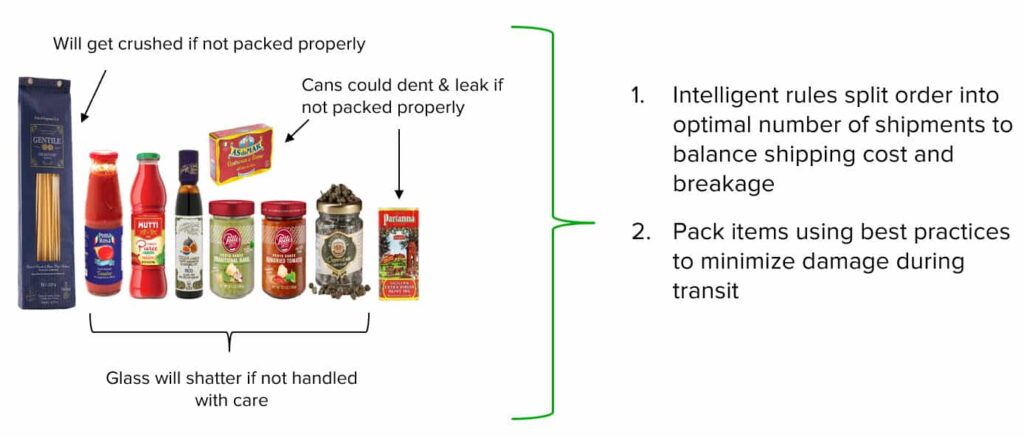
An intelligent shipping software will make the difficult feasible by splitting the order into a number of shipments that finely balances shipping cost and breakage risk. It will then give guidance to the packing station on how to precisely protect and package each item to fit into the smallest box that will prevent damage in transit.
Many warehouses are set up for peak speed and efficiency, and thus, they don’t have the flexibility to intelligently adapt to different types of goods that need different treatment. That’s where Cahoot sets itself apart.
Future Trends in Warehouse Picking
Recent warehouse-operations research from Zebra shows AI is already being used for inventory optimization and cost optimization, so AI in warehouse picking is now an active operations tool, not just a future trend.
The world of warehouse picking is constantly evolving, driven by technological advancements, changing consumer demands, and global economic shifts. Some of the future trends in warehouse picking include:
- Adoption of Artificial Intelligence: Artificial intelligence is expected to play a larger role in warehouse picking, automating tasks, and improving efficiency. AI-powered systems can analyze data, dynamically calculate the most efficient picking routes in real-time, considering factors like traffic, order priority, and worker location, and predict demand, enhancing overall warehouse operations.
- Increased Use of Robotics: Robotics is expected to become more prevalent in warehouse picking, automating tasks, and improving efficiency. Advanced robots can handle complex picking tasks, work alongside human workers, and adapt to changing warehouse environments.
- Growing Importance of Sustainability: Sustainability is becoming increasingly important in warehouse picking, with companies looking for ways to reduce their environmental impact. Implementing eco-friendly practices such as reducing waste and optimizing energy use can help warehouses become more sustainable.
- Blockchain for supply chain transparency and tracking: Using blockchain technology to track items throughout the supply chain with up to the minute status and location.
- Increased Focus on Customer Satisfaction: Customer satisfaction is becoming increasingly important in warehouse picking, with companies looking for ways to improve delivery times and fulfillment accuracy. Enhancing the picking process through technology and best practices can help meet customer expectations and drive business growth.
By staying ahead of these trends and continuously improving their picking processes, warehouses can ensure they remain competitive and meet the evolving needs of their customers.
Cahoot: The Best Pick and Pack Fulfillment Service
Cahoot’s integration catalog now also includes Rithum, DSCO, NetSuite, Orderful, and Amazon Buy Shipping.
Cahoot’s nationwide network of over 100 warehouses provides affordable national ecommerce order fulfillment for online merchants. Our wide and diverse network enables us to fulfill a wide variety of needs, from sellers who need absolute peak speed at minimum cost to those that have fragile items or others that require special handling.
Our fulfillment centers are outfitted with dedicated personnel and technology that confers all the benefits of a top pick and pack service:
- Efficient picking enables late (2pm local time) order cutoffs
- Barcode scanning all but eliminates fulfillment defects
- Intelligent pick and pack software optimizes box size for every order, minimizing shipping cost for simple and complex orders
- Lowest cost by design
Unlike other providers, Cahoot also has the flexibility to work alongside existing merchant-owned warehouses (if you have them). We know that many merchants with non-standard items and order profiles carefully manage fulfillment themselves due to how difficult the process can be. Cahoot will analyze your existing network and customer base, then add a few locations of our own to seamlessly extend your network into a nationwide footprint.
With this approach, you can continue to get value out of your existing assets while delighting your customers and your bottom line with affordable fast shipping. Of course, our approach works just as well for merchants who want to fully outsource their fulfillment, and we’d be more than happy to take that on. Getting started with Cahoot is fast and easy – with pre-built integrations for major ecommerce channels like Amazon, Walmart, Shopify, and BigCommerce, we can get merchants started in as little time as it takes to send us your inventory. Talk to one of our experts today and explore how we can be the key that unlocks the next level of your profitable ecommerce growth.
Frequently Asked Questions
What is warehouse picking?
Warehouse picking is an order fulfillment process where item(s) from a customer order are retrieved from their inventory location(s) in a fulfillment or distribution center such as in a bin or on a shelf or pallet. Warehouse picking is the step that occurs before products are packaged and shipped out to their destination.
What is the picking process in a warehouse?
Warehouse picking is the process of finding items within a warehouse or fulfillment center and preparing them for shipment to customers. But there’s a lot of different ways to go about warehouse picking to ensure that it’s done as effectively and efficiently as possible.
What do you do as a warehouse picker?
Warehouse pickers are responsible for finding, picking, and packing goods for dispatch. They work in various locations, including e-commerce warehouses, wholesalers, and cold storage warehouses. It’s a physically demanding role that involves bending, lifting, and carrying products.
How to do picking in warehouses?
There are many strategies for picking in warehouses, which include batch picking, wave picking, zone picking, and piece picking. The best strategy for your warehouse picking setup will depend on the order volume running through your warehouse, the total number of SKUs in storage, your total number of pickers working at the same time, the type of facility you have, and the inventory management system and other technologies you have at your disposal. The different picking methods each have their own advantages and drawbacks.
What is voice picking in a warehouse?
Voice picking is a method of warehouse picking where pickers are equipped with a headset and microphone so they can easily communicate with the warehouse manager about picking details. Some systems are connected with an automated management system, which eliminates the need for a human on the other end of the line. Similar to other wearable warehouse picking options, voice picking has proven to be a time-efficient method and it also cuts down the likelihood of picking errors.
Written By:
Indy Pereira
Indy Pereira helps ecommerce brands optimize their shipping and fulfillment with Cahoot’s technology. With a background in both sales and people operations, she bridges customer needs with strategic solutions that drive growth. Indy works closely with merchants every day and brings real-world insight into what makes logistics efficient and scalable.
Turn Returns Into New Revenue
Related Blog Posts
Everyone’s Building Ecommerce Fulfillment Networks, But They’re Not So Fulfilling for Sellers
In this article
11 minutes
- Multi-Channel Selling is More Profitable
- Amazon FBA: Penalizing Multi-Channel Order Fulfillment
- Shopify Order Fulfillment Network (Flexport)
- Walmart Fulfillment Services (WFS)
- Fulfilled by TikTok (FBT): The New Kid On the Block
- Be Careful Jumping Onto the Bandwagon
- The Future of Order Fulfillment is Wide Open
- Offer 1-day and 2-day shipping at ground rates or less.
Seeing the success of Amazon’s outsourced fulfillment service Fulfilled By Amazon (FBA), marketplaces and e-commerce platforms are racing to build their own e-commerce order fulfillment networks. Undoubtedly, it is beneficial for sellers to have access to third-party fulfillment services wherever they choose to sell, but at what cost? Do these marketplaces have the sellers’ best interests at heart?
Multi-Channel Selling is More Profitable
When Third-party Sellers first started selling online, the first questions were, “Should I sell on Amazon or eBay besides my e-commerce website?” However, over time, that question has changed into, “How do I sell on both, as well as Walmart and other marketplaces when they make sense for my business?”. In fact, with the current e-commerce trend, it is almost imperative for online sellers to sell on multiple channels to survive, let alone grow. Numerous studies show that retailers selling on two or more sales channels have a healthier bottom line, on average, than those that don’t. But it gets complicated. Now, each platform has its e-commerce order fulfillment service and prioritizes the display and, thus, the sale of items fulfilled through them.
Let’s take a closer look at each.
Amazon FBA: Penalizing Multi-Channel Order Fulfillment
Amazon launched its third-party marketplace to satisfy customer demand for a broader assortment of products. Third-party (3P) Sellers add products much faster than Amazon, sourcing all the items themselves and helping build the “everything store” behemoth. According to recent data, over 60% of all physical goods sold on Amazon are from Third-party Sellers, meaning most products sold on the platform come from independent sellers rather than Amazon itself.
Then came Fulfillment by Amazon (FBA), a large-scale distributed warehousing and order fulfillment network for its Third-party Sellers. FBA helps Amazon offer nationwide 1- and 2-day delivery to customers (and regional same-day delivery) even if a 3P Seller sold the item. Commanding approximately 37.6% of all U.S. e-commerce spending in 2023, Amazon negotiated unbeatable shipping rates from all major carriers and offered incredibly low fulfillment fees to sellers. Opting for FBA gives Sellers a distinct advantage within the Amazon ecosystem. FBA sellers are more likely to win the “buy box” and are outright forgiven for any shipping-related customer complaints.
However, using FBA to fulfill non-Amazon orders is not as rewarding financially. Amazon uses FBA to deliver an excellent shopping experience for Amazon customers and power its famous growth flywheel by prioritizing its FBA services for its marketplace customers. The fees for non-Amazon orders are much higher, sometimes by as much as 30–50%. Moreover, Walmart outright banned FBA from its platform due to Amazon’s aggressive branding on boxes. In recent years, Walmart has approved using either Flexport or ShipBob fulfillment services to fulfill Walmart orders, but not both.
Shopify Order Fulfillment Network (Flexport)
Shopify started as an e-commerce platform that enabled sellers to quickly create their own professional online store independent of marketplaces. With its vibrant app ecosystem, Shopify aims to be a one-stop shop for small and midsize online sellers.
One of its growth strategies has been the app marketplace. Shopify’s incredible store diversity also means a high demand for specialized features. Keeping up with this expectation through Shopify’s development team is very challenging. Therefore, they’ve created an app marketplace to serve their sellers’ growing needs quickly. Through the marketplace, third-party companies can build and monetize specialty apps that augment and extend Shopify’s native functionality.
To continue fueling its growth, Shopify launched additional services to power more parts of the seller’s business and capture a larger share of the wallet. These services include Shopify Payments, Point-of-Sale, Shopify Capital, and Shipping Label printing. Small and midsize (SMB) sellers need these services, and they like the simplicity of a one-stop shop. These value-added services have increased Shopify’s revenue per seller over time.
Shopify also tossed its hat into the e-commerce order fulfillment ring as an extension of the same strategy. ‘Shopify Fulfillment Network’ (sold to and rebranded as Flexport in mid-2023 but still operating the Shopify Fulfillment Network app) is geared towards Shopify sellers with options such as custom packaging. The pricing and shipping speed aren’t expected to be near FBA (at least not in the near term), as Shopify does not own any logistics infrastructure. However, there are plans to partner with other warehouses and Third-party Logistics (3PL) providers. Smaller Shopify sellers who fulfill orders by themselves may find it a step up, but it’s too early to say. One thing we know for sure is that fulfilling orders through Shopify will not boost their “buy box” chances on Amazon. Shopify is serious about this move, as demonstrated by their acquisition of 6 River Systems for $450 M in September 2019.
Walmart Fulfillment Services (WFS)
Walmart introduced a fulfillment network similar to FBA in 2020 called Walmart Fulfillment Services (WFS). Third-party Sellers ship their inventory to Walmart’s network of over 40 domestic fulfillment centers for storage and then e-commerce orders are picked, packed, and shipped to customers. Walmart reported recently that 66% of its third-party Sellers use the service to ship more than half of Walmart Marketplace orders (up from fulfilling only ~25% of e-commerce orders just three years ago). The program aims to take the fulfillment burden off its Seller partners and increase delivery speeds for the end customers (often within 2 days). It also supports customer service for WFS‑fulfilled orders and handles returns, which frees up Sellers to focus on growing their business.
Unlike Amazon, Walmart ships approximately half of its e-commerce orders from its 4,600+ physical stores. This is possible because a store is within 10 miles of ~90% of the US population. While WFS rates are reported to be about 15% lower than competitors’, the captive order fulfillment services are tied to product discoverability on the marketplace, making participation more or less mandatory for merchants that choose to partner with Walmart.
The strategic bet paid off big time, as Walmart’s marketplace grew to become the second-largest in the US, edging out eBay.
Fulfilled by TikTok (FBT): The New Kid On the Block
Despite being the newest social commerce platform in the US, TikTok Shop is already estimated to be the third largest, trailing only Facebook and Instagram. In a strategic move that mimics the fulfillment services competitors that came before it, TikTok Shop launched Fulfilled by TikTok (FBT) in late 2024 to manage the storage, picking, packing, and shipping of orders placed on TikTok for its creators and brands. Sellers will like that inventory can also be intelligently distributed to support the same nationwide fast delivery at ground shipping rates that other fulfillment networks offer.
It remains to be seen if there will be a captive component to FBT such that product discovery and sales are undeniably linked to using the new service. Still, since the native influencer- and creator-first nature of TikTok and TikTok Live drive much of TikTok Shop’s traffic, it may be some time before a long-term stickiness strategy is developed. We know now that early users will benefit from subsidized storage and shipping costs, as well as ‘free’ customer service for order and shipping support. Customizable ‘badges’ help early users stand out from the competition.
Be Careful Jumping Onto the Bandwagon
So, nearly every major marketplace in the U.S. now has a preferred e-commerce order fulfillment network. Using a non-preferred fulfillment network has definite downsides, some outright punitive. These moves contradict the trend of multichannel selling and come at the sole expense of Sellers.
So why not sign up for all the order fulfillment networks?
It’s not even about the fees these networks charge, which can be significant for any business. The large hidden costs come from maintaining inventory at multiple locations. Let’s break it down:
- Redundant inventory in key markets: Imagine a merchant who wants to offer fast shipping to customers in California and operates on three different marketplaces. The merchant would then need to store its inventory in California at three separate warehouses for each marketplace. After accounting for safety stock, that’s a lot of excess capital tied up unnecessarily.
- Multiple inbound shipments: If a merchant signs up with three fulfillment networks, they must ship their inventory to three warehouses in every major region. This will be more expensive because they’ll be splitting their one big inbound shipment into multiple smaller inbounds.
- Safety stock: Splitting the same amount of inventory between multiple warehouses instead of one or two increases the amount of safety stock merchants must maintain. The square root law of inventory calculates the additional safety stock that needs to be kept on hand as the number of fulfillment centers increases.
- Clearance through multiple channels: If a product doesn’t sell well, merchants will incur the cost of clearing the dead stock through each of these redundant fulfillment centers.
- Returns through multiple channels: Sellers must also compensate or pay for restocking returns on every platform, which can be as high as 20% in some product categories.
Apart from the tangible costs, managing multiple fulfillment programs can cause headaches—for example, the added complexity of juggling multiple contracts, billing audits, and keeping track of ever-changing rates and terms. Furthermore, holding more inventory exposes sellers to a higher risk of losses from shifts in customer demand or during a recession. If a Seller opts to go with an unaffiliated third-party logistics provider, they become a buy box pariah on every platform.
It is hard to ignore the environmental costs, too. The inefficiencies of excess inventory at its core result in a larger carbon footprint through excess transportation and warehousing operations. The repercussions are brutal to ignore when humanity is inching towards irreversible damage to the climate every day. Sellers are losing, and so is our planet!
The Future of Order Fulfillment is Wide Open
The platforms and marketplaces are doing what’s best for them. They are building their e-commerce order fulfillment networks to drive revenue and lock Sellers into their platforms. However, what’s best for marketplaces may not be best for Sellers. Captive order fulfillment services add unnecessary costs and do not scale to a seamless customer experience across channels.
The optimal future of order fulfillment is customer-centric. It means delivering goods to customers how they prefer, not limited to the options the seller or the fulfillment partner thrust upon them. The options should not be limited to lightning-fast delivery or Buy Online Pickup in Store (BOPIS). They should also allow the customer to choose greener delivery options for the Earth or the ability to have the order delivered the same day from a local store without costing an arm and a leg. When order fulfillment networks operate under this new paradigm, they’d be able to offer these options (and more) to merchants of all sizes, and such services will not be a luxury limited to large multi-billion dollar retailers (think Amazon-Kohls or Amazon-Staples) as an example.
The future of e-commerce order fulfillment must also be efficient, where all supply chain constituents work together to serve the customer profitably and responsibly. Instead of walls and hurdles preventing growth and advancement, true next-generation fulfillment solutions will facilitate collaboration between all value chain members. It will unite the manufacturers, the retailers, and everyone in between, including the competitors. At Cahoot, we firmly believe that customer centricity and merchant profitability will continue to suffer unless we re-imagine and re-design our captive order fulfillment models. You can read more about the future of order fulfillment and how our solution can help you get there today.
Written By:
Manish Chowdhary
Manish Chowdhary is the founder and CEO of Cahoot, the most comprehensive post-purchase suite for ecommerce brands. A serial entrepreneur and industry thought leader, Manish has decades of experience building technologies that simplify ecommerce logistics—from order fulfillment to returns. His insights help brands stay ahead of market shifts and operational challenges.
Turn Returns Into New Revenue
Related Articles
The Shipping Speed Paradox: Why DTC Brands Are Slowing Down
Everyone’s talking about faster delivery.
Why Cross-Border DTC Brands Are Moving Fulfillment Inside the US
Cross-border ecommerce fulfillment is the process of shipping ecommerce orders across national borders—often from warehouses outside the United States to U.
Shopify Estimated Delivery Date: A Complete Guide for Ecommerce Stores
A Shopify estimated delivery date is the specific arrival date or date range shown on a product page before purchase, so shoppers know when an order is expected to arrive.
Merchant Fulfilled Prime: Fulfilled By Amazon (FBA) Alternatives

In this article
38 minutes
Listen to Maximizing Ecommerce Ep. #153 here.
Podcast: Maximizing Ecommerce Merchant Fulfilled Prime (FBA Alternatives)
Cahoot is a network of order fulfillment centers and warehouses belonging to other sellers who have very efficient operations of their own and high performance metrics. Cahoot offers sellers an opportunity to make money by monetising unused space in their warehouses. Cahoot offers an Amazon FBA-like service where they distribute inventory throughout the country for sellers to achieve one-day delivery, two-day delivery, cost-effectively and affordably.
Cahoot is channel agnostic and supports whatever is most beneficial for the client, including sending inventory to Amazon FBA, utilizing Cahoot’s warehouse network to fulfill other orders, and achieving two-day delivery across the USA. Cahoot is a great backup option for every seller, even if they are using Amazon FBA. Cahoot supports what is best for the client, not just Amazon, and offers a lower order fulfillment cost structure by design, providing high levels of service at an affordable price.
Kevin Sanderson: You are listening to The Maximizing E-commerce podcast, helping you build an ecommerce business you can be proud of. And now your host, Kevin Sanderson.
Kevin Sanderson: All right. So, it’s super important that we are as profitable as possible, get our goods from point A to point B to our customers, because if we don’t get them fulfilled, there is really no sales, and we don’t want that because we want things to get to the customers, so they come back to Amazon or wherever it is they’re buying. So, I’m excited because we have someone on today who we shared the stage with at the recent Surge Summit in Tampa. we have Manish Chowdhary from Cahoot who’s joining us. So Manish, thank you for joining us on Maximizing E-commerce.
Manish Chowdhary: Thanks for having me, Kevin. I’m really excited to be here.
Kevin Sanderson: Yeah, I’m excited to have this conversation too, because I’m trying to think of how to articulate what I’m literally feeling right now, and that is, I came to the realization, which maybe some people already realized this, that Amazon switched fairly recently from purely weight based order fulfillment fees to now… What’s the word I’m looking for? Volumetric. And volumetric could be you have it in a poly bag and there’s space in the poly bag, and so, instead of the product being maybe X size, if it goes a little bit beyond that, even if it’s just a poly bag that’s going to bend and fold and whatever, they’re charging you for that. So now it’s increased the order fulfillment fees on just about everything that I have. And I’ve started noticing this in forums and Facebook groups too, people complaining about this. So total side notes, I’m excited to talk about alternate solutions here.
Manish Chowdhary: Yeah, I mean there were, actually, believe it or not, Amazon went through four pricing changes this year alone.
Kevin Sanderson: Oh, wow. I didn’t realize it was that many.
Manish Chowdhary: That we are aware of. In fact, probably five.
Kevin Sanderson: Well, they could have snuck one somewhere and nobody noticed.
Manish Chowdhary: No, no, actually, I will give you the timeline. February 1, 2022, Amazon announced the previously increased price changes to Fulfillment By Amazon (FBA). They do that every year. And so that went into effect, what carriers call GRI, which is general rate increase. You probably heard FedEx raising their rates by 6.8%. So Amazon FBA is no exception to the rule, so they raised their rates on February 1st, 2022. Then they claimed inflation as… They had the lowest profit or a really bad quarter for Q1, and they came back with a 5% increase, what they called the inflation surcharge on April 28th, 2022.
Manish Chowdhary: And then, as we all know, Kevin, that October one, which is Q4, storage fee at Amazon FBA triples, so from 83 cents to $2.40 cents per cubic foot per month is not an increase, but it is certainly an increase over last year. And then, more recently, just a couple of weeks ago, Amazon came up with the first ever peak order fulfillment surcharge, which is six to 8%, which will go into effect on October 15. So, the thing that Amazon FBA is the cheapest solution is sellers got to take a look at their books very closely. And by the way, in addition to these four, earlier this year, this was I think January or February, what you were talking about, is Amazon made changes to a small and light program, which used to be primarily based on weight and now it’s called dimensional weight. And they implemented that, so that had a massive impact in terms of fee increases for a number of small and light shipments.
Kevin Sanderson: And mine’s not even small and light. It’s never been small and light. So maybe they’ve expanded that program. So side note, when this is all over, I’ll have to go back and find… Because I’m sure there was an announcement, and I’ll be honest, I don’t read all the announcements from them. Sorry, Amazon. But at the end of the day, they probably gave me the information, but I just didn’t check it. Well, let’s go back in time. You and I were chatting on a bus because we were going out from the hotel where the Surge Summit was. The night before, you and I were on a panel together about shipping logistics, and we were chatting about your ecommerce business model, which I thought was pretty unique and interesting. And you were telling me a little bit about your background. So before we get into your current business model, let’s go back in time and just describe how you got into the whole ecommerce logistics, shipping, order fulfillment world, because it wasn’t the same path that I usually hear with people.
Manish Chowdhary: Well, thank you, Kevin. Yeah, I’ve been involved with ecommerce since 1999. I was a student at the University of Bridgeport, Connecticut back then, and that’s when I started my first business out of my dorm room at the University of Bridgeport. And somehow we got involved with ecommerce and I loved it. And we were building a custom ecommerce website, and then we built one of the first turnkey ecommerce platforms.
Kevin Sanderson: Oh wow. Just so everybody understands, this is years before there was ever a Shopify, WooCommerce, BigCommerce. There was nothing, right? There was no out of the box ecommerce platform other than you wanted to hire a developer.
Manish Chowdhary: Right. There was Yahoo. Yahoo was what Shopify is today or what Salesforce cloud would be. All the top ecommerce brands, the Adidas of the world, I think were on Yahoo ecommerce platform. Yahoo was the Google of the day, if you remember.
Kevin Sanderson Okay, yeah, yeah. Back when people would go to Yahoo to look for things. And who’s Google? Yeah. Yeah.
Manish Chowdhary: Yeah. So I started building an ecommerce website. My background is computer science and got involved helping someone who… This was the first ecommerce platform. Before the word ecommerce platform existed we used to call it shopping cart software. Turnkey shopping cart software that you could do it yourself. Super easy. This is long before Shopify and so on. So, that’s where I got my start in ecommerce. Since then, I’ve been speaking with merchants, to the same kind of merchants, more or less. Of course, everybody’s GMV has ballooned 10 times, a hundred times in the last-
Kevin Sanderson: Just for the audience who’s not familiar, GMV means what?
Manish Chowdhary: Gross merchandise value, meaning the amount of sales on the internet.
Kevin Sanderson: Oh, okay. Yeah. Yeah.
Manish Chowdhary:
Yeah. It used to be a time when people were, they would check their email once every two days and if they got the sale… And now of course we have emails on our phone, which wasn’t the case back then.
Kevin Sanderson:
Oh yeah, yeah. Your phone literally was for calling.
Manish Chowdhary: That’s right.
Kevin Sanderson: Back in the day, there wasn’t even text messages on it. It was kind of a novelty that you didn’t have to be connected to a cord in your house or within 20 feet of the cordless phone receiver in your house. So you could go somewhere else and call other people. And that was still fairly novel in the late 90s, early 2000s.
Manish Chowdhary: Yeah.
Kevin Sanderson: So, speaking of this journey you were pretty early on in some of this, which is kind of fascinating to me. Not kind of, it is fascinating to me. You shared a story with me when we were on the bus going back to the hotel from this… We had gone on a cruise that they had us go on that evening, which was really fun. Total side note there. But you were telling me the story of you were starting to notice some patterns in where stuff was shipping from that maybe there was some inefficiencies in the system.
Manish Chowdhary: Yes.
Kevin Sanderson: Can you describe that?
Manish Chowdhary: Yes.
Kevin Sanderson: If I remember correctly?
Manish Chowdhary: Great memory, Kevin.
Kevin Sanderson: I try. I try. Yeah.
Manish Chowdhary: So yes, this was during that time we actually plotted sales data from camera sellers in the US. So I remember vaguely there were about 70 camera sellers and we plotted the sales data on the map of the US. And of course, products like digital cameras or… The world was moving from film like Kodak films to digital. And I remember Canon and Nikon were at the top of the game. I remember some products like Canon, Elf, Nikon, CoolPix, these two products that stuck with me, they used to be the best-sellers, the top sellers. And when we plotted that sales data, there was a fascinating observation that the same item, the same product was traveling from a seller, say in New York to a customer in California at the same exact time the product was traveling from a seller in California to a customer say in New Jersey. And that was happening 40% of the time, if I remember correctly.
Kevin Sanderson: Got it. So sometimes they’re literally, the trucks could be crossing each other going across the country, because there’s no Amazon FBA fulfillment algorithms.
Manish Chowdhary: Well, even if there was Amazon FBA fulfillment, even Amazon FBA hasn’t solved this problem because if you are a seller X, selling-
Kevin Sanderson: Oh, that’s true.
Manish Chowdhary: And then seller Y in California. But the fundamental macro issue was why this inefficiency? Why should the same item travel 7,000 miles cross-country in two opposite directions? Both sellers lose because they’re paying for exorbitant shipping cross-country, both customers lose because they’re paying for that. Those were the days, there was no such thing as free shipping, customers were paying, and both the customers were waiting eight to 10 days to get their items. And the environment was suffering at the same time because of so much carbon emission. So, this was not helping anyone.
Kevin Sanderson: Nobody was winning.
Manish Chowdhary: Except UPS, FedEx… And I don’t know if that’s called winning, but nonetheless, that’s when I applied for my first US patent and said, “This should not be,” because if you think from a macro perspective, that level of inefficiency should not exist regardless of who sold what to whom. And that is where I built the intellectual property and said, “Hey, I’m going to create an exchange and optimize ecommerce regardless of who sold what to whom we will… And the way we’re going to do it is we are going to reduce the miles that our product travels so that it’s cheaper and faster. That was the vision. And that is what translated into Cahoot many years later. And this is long before Amazon Prime. Amazon Prime didn’t even exist. In fact, the Amazon Marketplace did not exist. So I had seen that trend that at some point, what’s good at the macro level from first principles is always good and your time will come when the economic incentives align, when this would make sense. So that is the genesis of Cahoot.
Kevin Sanderson: Got it. So Cahoot, just so folks who are not familiar, you basically offer something… Forgive me, this could be a horrible analogy, but something if you took Fulfillment By Amazon (FBA), how they’ve got order fulfillment centers all over and you mixed it with a third party logistics (3PL) company, which most 3PLs have a location. Maybe they have a location in Miami or they’re located in California, opposite sides of the country. Or sometimes there’s one that maybe has a location in Miami, one in Oklahoma, and one in Portland. And so, they have three locations across the country, so to speak. You’re kind of mixing them together to make an Amazon FBA out of multiple third party logistics (3PL) companies. Am I understanding this correctly?
Manish Chowdhary: Yeah. So Cahoot is a network of order fulfillment centers and fulfillment warehouses belonging to other sellers who have very efficient operations of their own and high performance metrics. So a seller, let’s say a seller who has 50,000 square feet warehouse and has 10, 20, 30,000 square feet of unused space that they’re not utilizing, they can come join Cahoot as an order fulfillment partner. And for the very first time they have an opportunity to make money, with the space that’s going idle, your rent doesn’t change whether you use half the warehouse or use the full warehouse, your utilities don’t change. So this is such a, I think a wonderful idea and option for merchants who have their warehouse to participate in the order fulfillment economy and Cahoot stitches that altogether, makes it super-duper simple for fulfillment partners to operate.
Manish Chowdhary: And what’s the net benefit to our clients? Our clients are sellers. They get an Amazon FBA like service. For them, all of this is behind the scenes. They’re looking for distributed order fulfillment so that they can achieve one day delivery, two-day delivery, cost effectively, affordably, and without any penalties for, “I will only fulfill this channel and my pricing is this for this channel.” No, an order is an order is an order, and we need to help that customer meet their expectations wherever they sell, wherever they want the inventory to be, and Cahoot intelligently distributes the inventory. And the benefit is it’s a lower cost structure by design. And that’s where our clients win because they get a high level of service at an affordable price.
Kevin Sanderson: Got it. So basically, if I’m understanding correctly, what you’re doing is there’s warehouses throughout the country that are already operating, they already have space. In most cases, they’re not necessarily filling to the exact brim, so to speak. There’s other space they might have and you’re giving them a way to monetize that space, which creates efficiency from a macro perspective. And then at the same time too, being able to distribute inventory throughout the country for sellers so that they can get it relatively quickly to their customers as opposed to if they’re only in Miami. Sure, the East coast is great if they’re only in California, the West coast is great, but either way, what about the people in the middle of the country where it might take longer?
Kevin Sanderson: So you’re helping to solve some of that problem, which is a unique thing there. So help me understand, one of the things I think people might be thinking in their heads is, okay, but if I had something like that, Amazon likes FBA inventory and the customer likes Prime. So what would be the benefit to the customer or to the seller to be involved either 100% or probably better said to mix it up a little bit, because I know people look for backup plans, especially around the holidays coming up.
Manish Chowdhary: Yeah, that’s a great question, Kevin. Cahoot is channel agnostic. We are the most merchant centric order fulfillment services network on the market because we support whatever is most beneficial for the client. If a client wants to send some of the inventory to FBA, then Cahoot would gladly support that. In addition to, utilizing our network to fulfill other orders. If you think from a seller’s perspective, the seller does not differentiate that, “Oh, I need a warehouse for FBA. I need a separate warehouse that’s going to send my inventory to Walmart fulfillment services. I need a third warehouse to send my wholesale orders, and then I need to now contract with three, four different 3PLs to achieve two-day delivery across the US. So from a seller’s perspective, FBA is not the solution to all their problems because if you’re selling on Shopify, you don’t want to pay multi-channel fulfillment rates.
Manish Chowdhary: I mean, FBA on one hand, we just heard that FBA is rolling out some new services like Amazon warehouse and distribution, and they want to offer long-term storage. And on the very same day, we heard on the Surge Summit from the stage from one of the largest sellers that their inventory limits have been slashed to a very, very low number. So, Amazon is a great service, but sellers have to recognize that Amazon does what’s best for Amazon and the sellers need to have a backup option. It’s like a backup hard drive on your computer. You’re not going to go around with no backup because things can fail and things do fail, and we’ve learned repeatedly that Amazon will cut your inventory without limits, and what are you going to do? So, Cahoot is a great option to have for every seller, even if they’re using FBA. And Cahoot’s position is we will support what’s best for the merchant, B2B, B2C, and Seller Fulfilled Prime (SFP). And those are all two opposite ends of the spectrum. And I’m sure you may have questions on Seller Fulfilled Prime (SFP), which I can tackle.
Kevin Sanderson: Yeah. Okay. So yeah, Seller Fulfilled Prime (SFP). That’s the part that I think probably just got some people really thinking there like, okay, you can still get the Prime badge but be seller fulfilled. Now, the part that’s scary for a lot of people is if Amazon screws up order fulfillment, it’s their problem. If you take that on as the merchant, regardless of you physically putting the boxes as the seller and putting labels on them and putting them into the post office, or you hire someone; you as the seller in your account are responsible for it. And then Seller Fulfilled Prime (SFP) is another level because you can’t just say, “Oh yeah, we’ll ship it in seven to 10 days like you could with other merchant fulfilled options.” So what are the requirements for Seller Fulfilled Prime (SFP)?
Manish Chowdhary: Yeah, Seller Fulfilled Prime (SFP) is the gold standard of fulfillment. And Cahoot is one of the very, very few networks that can handle Seller Fulfilled Prime (SFP) confidently. In fact, if you went and spoke with the traditional third party logistics (3PL) company, they’ll flat out tell you no, and you definitely don’t want to take a chance because as you said, the risk is so high, the standards are so high, unforgiving… And I’ll explain what that means.
Kevin Sanderson: Yes, please explain the unforgiving standard.
Manish Chowdhary: Seller Fulfilled Prime (SFP)’s standard is you need to have 99.5% on time shipping. You need to have 2:00 PM-
Kevin Sanderson: Okay, hold on. So that means, you can only make a mistake one out of 200 times.
Manish Chowdhary: That’s right.
Kevin Sanderson: Right? Did I get the math right?
Manish Chowdhary: Yes, you got the math right. Yeah. One mistake out of every 200 orders you need to deliver… You need to ship six days a week, which means you have to pick Saturday or Sunday to also ship on. You need to have a cutoff time of 2:00 PM, same day cut off time. Means if an order comes in by 2:00 PM you must ship it the same day. Then you need to use Amazon Buy shipping to purchase all shipping labels. So even if you have the best fulfillment operations, if your technology is not rock solid, you’ll get screwed up there. You don’t want to email your shipping labels to your order fulfillment partner. That is a bad idea. And now, on top of that, where things get really tricky is what Amazon defines as page view metrics. So, in order to qualify and remain in good standing for the Seller Fulfilled Prime (SFP) program, every seller must meet one day, two-day delivery page view metrics. And I’ll break that down for you.
Kevin Sanderson: Okay, yeah. Help me understand what that means.
Manish Chowdhary: Meaning, Amazon Prime have moved Seller Fulfilled Prime (SFP) away from two day delivery. Two-day delivery is yesterday’s news. In fact, day before yesterday. For Seller Fulfilled Prime (SFP), for standard size items, you need to have at least 20% of page views to the consumers on amazon.com that promise one day delivery. In addition to-
Kevin Sanderson: Okay. So time out.
Manish Chowdhary: Yeah.
Kevin Sanderson: How does the page view know whether it’s one or two days? You have to be communicating that to Amazon? That if a customer lives in Tennessee, it’s going to be X number of days versus if they live in Utah?
Manish Chowdhary: So essentially that’s the reason why you need at least four to five warehouses. You cannot achieve Seller Fulfilled Prime (SFP) using a single warehouse if you are shipping using economical ground shipping. So these are all managed through the shipping templates in Amazon Seller Central. So if you go on Amazon Seller Central, you can go create all your warehouses and then you create shipping templates. And shipping templates are what informs Amazon and thereby the consumers what to promise to the shopper on amazon.com. So Amazon, of course, as you know, is fanatical about customer experience, so they want 20% of the page views to promise one day delivery.
Kevin Sanderson: Got it. So 20% of the time someone lands on that page, they’re promised one day delivery.
Manish Chowdhary: Right.
Kevin Sanderson: Now, theoretically more people are probably in population centers. That probably helps you a little bit, but you have to make sure that you can do one day delivery to a lot of the population centers and things of that nature.
Manish Chowdhary: Yeah, it gets tricky.
Kevin Sanderson: It does. It sounds like, oh, that’s easy enough, but there probably is some threading of the needle there.
Manish Chowdhary: It’s far from easy.
Kevin Sanderson: Yes.
Manish Chowdhary: I’ll give you an example.
Kevin Sanderson: Okay.
Manish Chowdhary: If you have a 2:00 PM cutoff in New York, which is where a lot of people live, right? Meaning that’s the same day promise, a customer that’s visiting your webpage, let’s say at 7:00 PM, you can’t ship that product today. So, that automatically means if you’re going to ship tomorrow, it’ll be delivered the day after tomorrow. One day became two days.
Kevin Sanderson: Got it, got it. Okay.
Manish Chowdhary: So you need to have 40%… And this is accrued math, of course. At least 40% of the US population covered within one day radius in order to scrape by the Seller Fulfilled Prime (SFP) account help metrics for standard sized items.
Kevin Sanderson: Got it. So they’re not saying by 2:00 PM you must have 20%. It’s total. So if most of your shoppers are shopping at night, you better hope that you have a better chunk of the pre 2:00 PM crowd covered.
Manish Chowdhary: Yeah, this is what makes it… And this is where the world is going. If you are sending your other orders from other channels and taking three days, I mean, you’re doing massive disservice. Why is Amazon growing so fast? Why do customers come to Cahoot is of course, not only for programs like Seller Fulfilled Prime (SFP), but once your inventory is distributed in the Cahoot network, then you can offer the same Prime like shipping promise on your website. Imagine not having to pay 15%, 20% in commission and you’re building a brand and because your inventory is already there, and that’s where the scales begin to tilt. And by the way, we covered one day metric, but there’s also two day metrics for the rest. And as I said, six-day shipping, late cutoff, all of these make things very complicated. And that’s the reason why traditional players cannot affordably offer the service without… For example, if you have to rush the order using next day air, that will erode all your margins for the next hundred orders possibly.
Kevin Sanderson: Yeah, that would be crazy. Okay. All right, so let’s get into this now. So how did you go from back when either Clinton was still the president or maybe Bush’s first term, basically a long time ago, realizing there was inefficiencies of cameras crossing over each other, going from one end of the country to another, just based on where the seller was to coming up with this idea of a fulfillment services network?
Manish Chowdhary: Yeah, essentially the idea was to create a network that would enable people to collaborate. And in order for merchants to collaborate in some fashion, you need an independent body that’s a governing body. Without governance, nothing works, you need to have the rules, you need to provide the decorum. It’s no different than a marketplace like Uber or Airbnb for the drivers and the riders to collaborate. Essentially, they’re collaborating. On Airbnb, the renters and the hosts are collaborating. It’s a different service. With Cahoot, it’s merchants who are collaborating with other merchants under the Cahoot umbrella who sets the rules and holds people accountable and so on. And that’s what we built the Cahoot network to essentially, one, enable sellers who have warehouses. There are about 2 million sellers in the US and if any of the listeners have a warehouse and have spare capacity and they have excellent metrics, I invite them to come check out Cahoot. Fill out the Contact Us form, and we can get in touch with you if you want to join as an order fulfillment partner and make some money.
Kevin Sanderson: Well, let’s get into your current network. We can get into the how someone joins as we get further into this, because I’m just intrigued. So how many warehouses are there currently in the network?
Manish Chowdhary: They’re multi dozen warehouses and that number keeps growing.
Kevin Sanderson: Okay.
Manish Chowdhary: We have a very large network. We cover the entire nation in one day, two day shipping. And so, essentially the clients get an Amazon FBA-like service sellers can deploy their inventory and if they need Amazon FBA assistance… But we are not an Amazon FBA forwarding service. If somebody wants just Amazon FBA forwarding, then that’s not Cahoot. There are a lot of other services that just do Amazon FBA forwarding.
Kevin Sanderson: Got it. Yeah, there’s a lot of warehouses for that, but you’re doing a specific service of basically getting it closer to the customer so that when the customer orders on Amazon, they can still get Prime or they order on Walmart and then get whatever badge it is there or whatever, Shopify stores, whatever. So it doesn’t have to just be Amazon inventory. So this could be either Amazon has become cost prohibitive for the seller for whatever reason, and they need to look into other options. Their inventory was cut back, they just want a second backup just because, like right now, I can ship in 15,000 units and last year at this time, I think I had a thousand units I could send in total.
Manish Chowdhary: But-
Kevin Sanderson: You’re all over the place. up and down.
Manish Chowdhary: When is a thousand going to reduce to 750, you have no idea.
Kevin Sanderson: Yeah, exactly. Exactly. I almost wake up in sweats on Monday mornings… Not wearing sweatpants, but in cold sweats, what is my number going to be this week? Sometimes it goes up by 5,000 and sometimes it goes down by 5,000, and thankfully I’m never right on the edge. So anyone that says to me like, “Oh, should I just send all my stuff on Amazon?” I’m like, “Absolutely not, because they could just cut it.” And they’ve done that before when they get close to the holidays and they’re like, “Oh, we’re filling up more than we thought we would.” So they just cut it off and now all of a sudden you can’t send in the popular stuff that you were hoping to send in, so you have to have something to do. And so hopefully your dining room has a lot of space, but for a lot of people that might not be the case.
Kevin Sanderson: So, for a seller, let’s just say, we can use Amazon as an analogy just because I think most people, probably most of their sales are coming out from Amazon and we’re talking about Seller Fulfilled Prime (SFP) and things of that nature. So Amazon processes, I go into Sellers Central and I say, “Here’s what I’m sending you, Amazon. Here’s the quantities, where do you want me to send it?” And hopefully it all goes to one place. Sometimes they split it up and they say, “Send it here, here, here, here, and here.” Walk me through what does the process look like If I have just for the sake of example, a thousand units I want to send to Cahoot? What happens?
Manish Chowdhary: The process is very similar to Fulfillment By Amazon (FBA). You’ll create an inbound in Cahoot, and Cahoot will guide you through where the inventory needs to be based on your requirements. Some sellers don’t want to distribute. They’re not targeting two-day delivery for whatever reason. Distributed order fulfillment is more expensive than shipping everything from Florida, as you know, because there’s a cost of movement of goods and so on.
Manish Chowdhary: I mean, that’s why Amazon… Even Amazon FBA charges you more to send you inventory to one location versus sending it to all the different locations that Amazon wants. It’s not free even at Amazon FBA. So it’s essentially the same network, similar network, but we charge the same low fees for all channels, whether it’s an Amazon order, it’s a Walmart order, whether it is a Shopify order, eBay, we have all the order fulfillment integrations, so we will connect. We’ll get the order, we will optimize to make sure that the right packaging, you’re paying the lowest shipping cost possible, and we give you all the visibility once the order is shipped and we write the information back to Amazon. So it’s a pretty set and forget, it’s very similar to just managing your inbounds on Amazon and then watching-
Kevin Sanderson: So if I have a thousand units, does Cahoot say X number here, X number here, X number there if I want it distributed? Or does Cahoot distribute around for me as time happens? As one area gets depleted, for example.
Manish Chowdhary: It’s a collaborative process because if you’re doing Seller Fulfilled Prime (SFP), we will provide you with more guidance, but you have more control. With Amazon, you have little to no control. Amazon dictates because Cahoot is doing full service fulfillment, remember Cahoot is not just doing Amazon sales. So, you may have wholesale orders, you may have stuff that needs to go to Amazon FBA. So for us, the problem is a little bit more complicated than just serving the customers on amazon.com.
Kevin Sanderson: Got it. So you have something that’s about a pound on Amazon, and let’s just say that’s four bucks for the fulfillment fee. Is it a similar fulfillment fee? Is it a little bit more, a little bit less on Cahoot? And where does the cost of the actual storage compare?
Manish Chowdhary: Yeah, I mean, Cahoot overall is going to be more cost-efficient because when you look at Fulfillment By Amazon (FBA), you got to look at all the fees, you got to look at the storage fees, you got to look at how long it takes for you to receive your end box. And frankly, Amazon FBA is very attractive for what I call small and light. Amazon FBA fees undoubtedly are very attractive. So Cahoot will be very comparable to Fulfillment By Amazon (FBA), and if you have larger products, if you have slightly what Amazon would call standard oversize or oversize items, and that’s where Cahoot rates are going to be dramatically lower.
Manish Chowdhary: Cahoot overall is very, very affordable on par with Amazon FBA, but there are few pockets where Amazon has its own delivery trucks, whereas Cahoot relies on carriers. Third-party carriers like UPS, FedEx DHL and all that. So, the way we like to educate our clients is to think about all the different channels you want to sell on, all the different things you need to manage and maintain and so on. And we are there not to replace Fulfillment By Amazon (FBA) if that doesn’t make sense. We are there to support whatever order fulfillment strategy that’s best for the seller.
Kevin Sanderson: Okay, interesting. So yeah, this is an interesting network that here you are, you saw an inefficiency in the system, so to speak, and you’ve created a system around it, which helps to essentially give people an alternative to Fulfillment By Amazon (FBA) in general, if maybe their oversized items and the pricing doesn’t make sense with Amazon FBA or they just want an alternative because they can still keep the seller fulfilled badge, knowing that at the holidays you could have stuff in fulfillment center processing for two weeks and it just sucks.
Manish Chowdhary: Every seller, including you, Kevin, should have an Amazon FBA backup because otherwise you’re putting all your eggs in one basket and that’s never a good idea. Certainly not in Amazon’s basket. You want to have a backup so that you can turn it on whenever you think is required, whenever you need it, because you can’t send all your inventory to Fulfillment By Amazon (FBA). There are all kinds of delays getting inventory from overseas if it’s coming. And almost every seller should be selling on multiple channels. Nobody should limit it to one channel only. And we know that MCF, multi-channel order fulfillment, is more expensive, so why should it be more expensive? If the cost of shipping is the same, it’s just… So the way we like to think about it is that Cahoot has created the most merchant friendly order fulfillment solution on the market because we’re agnostic. We are there to support the seller, help them sell more, help them make more profit, and if we can be part of their journey, we’d be great.
Kevin Sanderson: Awesome. Now, one thing I think people would be curious about, who are sellers that are thinking about going onto this… Because Airbnb, I think we’ve all had great experiences, Uber, we’ve all had great experiences, but you always hear the horror stories. Who are these people? And there’s always this bad apple. So what does it take just either if someone’s interested in it potentially because they have a warehouse and may be interested in joining a network like Cahoot? Or they are a seller and they’re just like, who are these people who are going to be storing my inventory? Kind of walk us through what that looks like? How does someone get onboarded? What do you look for in an order fulfillment partner and what are they held to?
Manish Chowdhary: Thank you. That’s a great question, Kevin. Becoming a Cahoot order fulfillment partner is a by invitation only program, so even if you went to our website, you may not find… Because we have to be very selective in who we allow from a fulfillment partner, because as you heard, supporting seller fulfillment Prime is playing with fire. It’s not for the faint of heart. So we need to ensure that we are selecting these partners very carefully. There are two million sellers out there in the US, many million globally. So we invite them to come, submit, contact us, we will get in touch with you. Cahoot does a lot of due diligence to make sure that the program is the right fit for them and they’re the right fit for us.
Manish Chowdhary: If they have excess capacity and they’re doing a great job of fulfillment for themselves, they should consider applying because there’s more than one way to make money. One is to sell more goods, and the second is to fulfill. You’re already fulfilling orders, might as well just fulfill a few more. And I think that’s a great way to make extra cash, and it’s super-duper simple. So, from horror stories, it’s really some things that are within Cahoot and our fulfillment partner’s controls. Some are not, like inclement weather. That happens. I live close to New York, we get snow storms here. Just yesterday there was a hurricane in Florida, which-
Kevin Sanderson: Oh, yeah, we’re recording it. Oh no, it hasn’t even made land yet. In fact, last night I was-
Manish Chowdhary: Okay, sorry.
Kevin Sanderson: Dodging tornado. Yeah, I happen to be on the east coast, this is on the west coast, so I’m very familiar with what you’re talking about. So we’re lucky to be even having this conversation that I have internet right now. Anyway, sorry, side note. But yeah, stuff happens.
Manish Chowdhary: So carriers sometimes may have difficulty picking up. When the pandemic hit, carriers were completely blocked. They had no space in their trucks. So if you suddenly ran a special sale and instead of getting 10 orders a day and you got thousand orders, I mean, FedEx, their space doesn’t have elastic capacity that they can elongate by click of a button or manufacture trucks digitally. So, those are real world physical challenges that we deal with. Those are things that planning for capacity… But our order fulfillment partners have been great. They have always stood their ground and they have delivered. So generally speaking, most of the problems that we’ve seen have been outside our control, and we speak with our fulfillment partners regularly. So it’s not just a digital platform that you have no connection with, human connection, whether it is staffing.
Manish Chowdhary: People do fall sick. During the pandemic we had people in the warehouse that had COVID, they had to be isolated. These are… Amazon shutdown several warehouses during that time, so all the same challenges. It is about great governance, clear expectations, good communication, and great technology and system. From a technology standpoint, we often encounter bugs or issues with buy shipping, but we have to use buy shipping for Prime orders to get the label. So our technology has to be resilient to deal with those challenges. Sometimes it’s an inconvenience. Let’s say buy shipping is not returning the economy ground shipping method because it’s only returning expensive two day air label, so that costs our sellers money, and we are very sensitive to that. However, it’s also important to protect the account, those metrics, because in order to save 20 bucks, if the account is endangered of the health of the account, that is going to be a far more expensive problem than 20 bucks.
Kevin Sanderson: True. Because if you get one out of 200 that you get a grace on.
Manish Chowdhary: So those are the problems that we’ve seen, but our technology is resilient, our fulfillment partners are awesome, and we’ve been very fortunate that way, and we want to keep it that way.
Kevin Sanderson: Awesome. So for somebody who wanted to learn more, either as a seller or potentially if they had a warehouse, where would they go?
Manish Chowdhary: Go to www.cahoot.ai. If you’re interested in availing yourself of Cahoot’s, affordable fulfillment services, just fill out the Contact Us form. There’s also a live chat option. If you’re looking to join as a fulfillment partner, we are glad to have you. We’d love to invite you. Just fill out the Contact Us form, and then a representative, a fulfillment expert, will be in touch and we will determine if we are the right fit. But we are here to help our customers. If we can add value, that’s what we like to see.
Kevin Sanderson: Awesome. And spell Cahoot, just for folks who are not familiar.
Manish Chowdhary: Yeah, Cahoot is a play… You know how Slack, when you are using Slack at work, you are in cahoots. So C-A-H-O-O-T.ai. It’s singular. Cahoot.ai is the URL. You can check us out. And yeah, if there’s any questions we can answer for them, we’ll be happy to.
Kevin Sanderson: Awesome. If you’re listening to the audio podcast, that’ll be in the show notes. And if you’re listening or watching on YouTube, it’ll be in the description down below. So Manish, this is an interesting conversation and I am fascinated with what you’ve built here. So, thank you so much for coming on.
Manish Chowdhary: Kevin, thank you so much for having me. And thank you to all your listeners for listening to me. And if Cahoot can be of help, please just check us out and we’d love to chat and share notes, and we learn as much from sellers as much as we have to share our expertise with them. So I always enjoy those conversations.
Kevin Sanderson: Awesome. Thanks so much.
Manish Chowdhary: Thank you. Bye.
Speaker 1: Thank you for listening to the Maximizing E-Commerce Podcast. If you found this episode helpful, you can get more episodes by subscribing on iTunes or wherever you enjoy listening to podcasts.
Written By:
Manish Chowdhary
Manish Chowdhary is the founder and CEO of Cahoot, the most comprehensive post-purchase suite for ecommerce brands. A serial entrepreneur and industry thought leader, Manish has decades of experience building technologies that simplify ecommerce logistics—from order fulfillment to returns. His insights help brands stay ahead of market shifts and operational challenges.
Turn Returns Into New Revenue
Related Articles
The Shipping Speed Paradox: Why DTC Brands Are Slowing Down
Everyone’s talking about faster delivery.
Why Cross-Border DTC Brands Are Moving Fulfillment Inside the US
Cross-border ecommerce fulfillment is the process of shipping ecommerce orders across national borders—often from warehouses outside the United States to U.
Shopify Estimated Delivery Date: A Complete Guide for Ecommerce Stores
A Shopify estimated delivery date is the specific arrival date or date range shown on a product page before purchase, so shoppers know when an order is expected to arrive.
Shopify Order Fulfillment: Guide to Choosing the Right Order Fulfillment Option
You’ve put countless hours into creating your product, perfecting your Shopify website, and marketing to grab attention. But have you paid enough attention to your fulfillment strategy? It’s not just a cost center – the difference between poor and great fulfillment has a huge impact on your customer experience and revenue growth.
Depending on what type of product you sell, you have a lot of options for fulfillment. The pros and cons can be tough to parse, and it gets complicated in a hurry.
In this blog post, we’ll explore why fulfillment is so important for ecommerce, your options for Shopify fulfillment, and how to choose the fulfillment service that’s right for you.
Why Your Shopify Order Fulfillment Service Matters
Simply put, a great fulfillment strategy is the difference between keeping up with Amazon and getting buried by it. If you can’t deliver orders quickly, customers will immediately look for a similar product with better shipping options on a marketplace. Surveys show 83% of online shoppers compare prices to a competing product on Amazon when shopping online.
Amazon, Walmart, and eBay have set the bar high for order fulfillment, and unfortunately customers now expect the same high standards from online brands as well.
Ignore fast and free shipping at your own risk – 70% of US consumers expect free shipping even on orders under $50, and 48% of all cart abandonment is caused by unexpected shipping costs.
Having great Shopify order fulfillment will improve your cart conversion and customer satisfaction, leading to more immediate revenue as well as repeat customers.
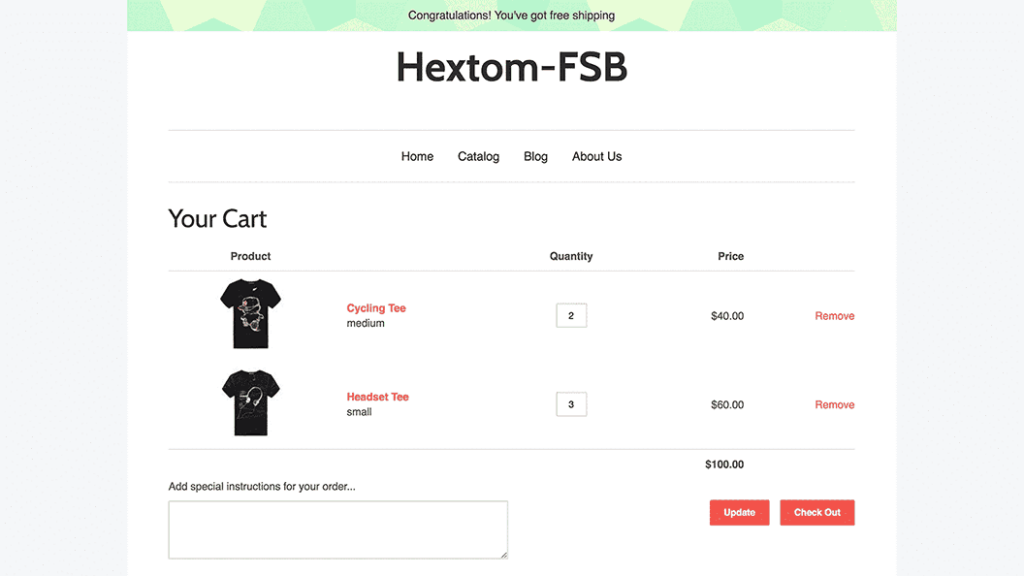
So you’re convinced – you need to offer fast & free shipping on Shopify, and it can’t break the bank. What are your options?
Fulfillment Services for Shopify Sellers
There are several main fulfillment options every Seller on Shopify can choose from:
- Self-Fulfillment
- Dropshipping
- Using a 3PL Provider
Each fulfillment strategy has its own unique pros and cons. Let’s go over these Shopify fulfillment options in detail:
Self-Fulfillment
If you’re selling small, low-cost items to a fairly local customer base, then self-fulfillment may be the best Shopify fulfillment strategy for your business.
Small items are easier to store yourself, and if your customer base is local, you won’t have to pay too much for shipping. Moreover, products will arrive relatively quickly to the customer because they don’t have too far to go.
Self-fulfillment also means you’ll have full control over product and fulfillment quality. You can choose where and how your products are stored, ensuring that they’re in the best condition possible when they get to customers. If there are errors in fulfillment, you have the power to immediately fix issues. Additionally, self-fulfillment can lead to higher storage costs, especially as your inventory grows, impacting your overall profitability.
The main drawbacks of self-fulfillment are that it’s extremely time-consuming and it isn’t cost-effective in the long run. If you’re fulfilling your own orders, your success comes with a price; more and more of your time will be consumed by managing operations. Every second spent on logistics is a second not spent on growing your top-line revenue. So most brands that start out self-fulfilling choose to outsource fulfillment as they grow.
Dropshipping
Dropshipping is a good option if you have the resources to find reliable suppliers and can successfully manage your relationships with them. With dropshipping, the entire fulfillment process is handled by the supplier or manufacturer, which means you don’t have to invest as much time in it – but you also don’t have control over it.
The key benefit of dropshipping isn’t to be underestimated; you can simplify a huge part of the logistics value chain. Instead of having to worry about shipping products from your manufacturer to a middle location, and then from that middle location to the customer, it goes straight from the manufacturer to the customer.
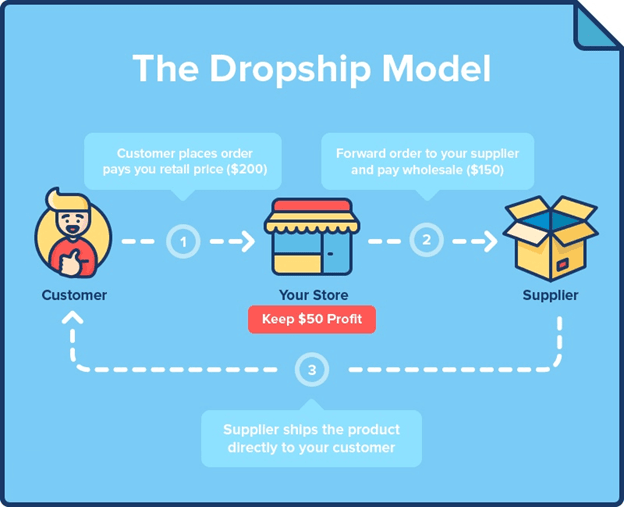
The main drawbacks of dropshipping are a lack of control over product quality and a poor delivery experience.
For quality, you don’t get to inspect the product before it gets to the customer. You have to rely entirely on the dropshipper, and when things go wrong, you’re left on the outside looking in.
Just as importantly, your customers won’t be delighted by fulfillment provided by dropshippers. Since they’re almost always shipping from one location, the delivery won’t be fast for customers across the country, which can negatively impact customer satisfaction. Since they’re often shipping long distances, shipping is also more expensive than it needs to be as well.
Using a Third-Party Fulfillment Provider
If you’re looking for a Shopify order fulfillment service that offers the benefits of self-fulfillment without all the hassle, then using a third-party provider is your best bet.
The best 3PLs will give you access to a nationwide network of warehouses and carriers, so shipping products will take less time than if you were going it alone – in most cases within one or two days. Furthermore, if a 3PL places your inventory across the country strategically, you’ll always pay ground rates for shipping, so fast delivery will come at low prices.
Third-party logistics providers also work with shipping carriers to negotiate discounted shipping costs, further improving your profitability.
In addition, some 3PLs can even support dropshipping services.
Like dropshipping, trusting a third party means giving up some control over your product before it gets to the customer. This challenge can become apparent with 3PLs that aren’t built for ecommerce, as products get damaged in their rush to fulfill orders. Modern 3PL networks that specialize in ecommerce, though, have very low defect rates and may even improve on your own delivery record.
Of the three Shopify fulfillment options, using a third-party provider is the best option for most Shopify stores. It’s a question of when, not if for most Sellers. Many assume that they need thousands of orders before they can get a good deal with a 3PL, but today’s tech-enabled fulfillment networks are built to be easy to use for merchants of all sizes.
So, if you’re looking for a 3PL, how do you choose one that’s right for you?
Shopify’s Fulfillment Network
The Shopify Fulfillment Network (SFN) is a 3PL fulfillment service designed to streamline the order fulfillment process for Shopify Sellers. With a 3PL network of warehouses across the United States (SFN no longer operates in Canada as of 2023), the Shopify Fulfillment Network allows businesses to store, manage, and ship their products efficiently. This network is built to provide fast and reliable delivery, ensuring that customers receive their orders promptly and in excellent condition. However, this service was announced in 2019 and still outsources fulfillment through Flexport.
Using the Shopify Fulfillment Network (powered by Flexport) offers several advantages for online Sellers, making it an attractive option for Shopify businesses looking to enhance their fulfillment capabilities:
- Fast and Reliable Delivery: SFN’s strategically located fulfillment centers enable businesses to offer fast and reliable delivery to their customers. This can significantly boost customer satisfaction and loyalty, as timely deliveries are a key factor in the overall shopping experience.
- Simplified Order Fulfillment Process: SFN handles the entire fulfillment process, from storage to shipping. This allows businesses to focus on other critical aspects of their operations, such as marketing and product development, without worrying about the logistics of order fulfillment. However, there are some fulfillment limitations that come with this simplified fulfillment process.
- Increased Efficiency: By utilizing SFN’s network of fulfillment centers and advanced technology, businesses can streamline their fulfillment process. This not only reduces costs but also improves operational efficiency, allowing for better resource allocation and management.
- Scalability: SFN is designed to scale with businesses as they grow. Whether you’re a small startup or an established enterprise, SFN can accommodate your needs, allowing you to expand your operations without the hassle of managing fulfillment logistics.
Choosing the Right Shopify Order Fulfillment Service for Your Store
It’s one thing to decide to work with a 3PL provider and another thing entirely to find one that has the right Shopify fulfillment network that your business needs to scale. Here are the key factors you’ll have to consider:
- Shipping speed SLAs (what shipping options will they enable?)
- Fulfillment costs and methods (how much do different options cost?)
- Inventory management options (do they help you efficiently manage inventory?)
- What other providers do they integrate with, and how?
- Customization & special services (e.g., assembly, packaging)
The best Shopify fulfillment services are built for fast & free ecommerce – that means they’ll enable fast delivery for your customers, but do so in a low-cost way. They should have pre-built integrations with Shopify and ecommerce platforms to make your life easy. Finally, you should look for a provider that helps you intelligently manage inventory to optimize capital.
For more in-depth guidance on how to choose a 3PL, use our 3PL RFP template to easily collect the information you need to make the right choice.
Cahoot – Your Best Option for Shopify Order Fulfillment
Cahoot’s fulfillment network of over a hundred warehouse locations is built for ecommerce. We’ll help you level the playing field with marketplaces and delight your customers with a stellar, Amazon-like delivery experience – right on your Shopify store.
Price: Our innovative peer-to-peer model offers low-cost, fast fulfillment by design. As a result, our pricing is typically lower than that of traditional 3PLs, 3PL networks, Shopify Fulfillment Network, and even marketplace fulfillment solutions like Amazon Multi-Channel Fulfillment.
Shipping Flexibility: Cahoot also offers the option to ship on your existing carrier accounts, allowing you to maintain your purchasing power and volume discounts.
Speed: Cahoot’s Shopify fulfillment service will enable you to turn on conversion-boosting fast and free shipping badges. We’ll strategically distribute your inventory to our warehouses locations across the country so that no matter where an order comes from, it’ll be fulfilled by a nearby warehouse. The customer gets their item in one to two days, but you pay cheap ground shipping rates.
Reliability: Our barcode scanning technology powers 99.95% on-time delivery and a 99.99% accuracy rate.
Easy Onboarding: With Cahoot, you can go from sign up to shipping in just two weeks. Our pre-built integration with Shopify makes setup a breeze.
Customer Service: You’ll have a dedicated customer support team that is always ready to help you every step of the way.
Cahoot is committed to helping Shopify Sellers grow their businesses with our fast and affordable ecommerce fulfillment service.
If you’d like to find out how Cahoot can help your business, please get in touch with us. We can’t wait to show you how Shopify fulfillment was meant to be.
Frequently Asked Questions
How can I fulfill orders on Shopify?
The main ways to fulfill Shopify Orders are directly shipping yourself, dropshipping, or using a 3PL.
Are there any limitations with Shopify Fulfillment Network?
Not all products are eligible for the SFN; you can review the list here.
Are all 3PLs the same?
No! 3PLs are different, and choosing the right 3PL for your business is an important decision.
Written By:
Indy Pereira
Indy Pereira helps ecommerce brands optimize their shipping and fulfillment with Cahoot’s technology. With a background in both sales and people operations, she bridges customer needs with strategic solutions that drive growth. Indy works closely with merchants every day and brings real-world insight into what makes logistics efficient and scalable.
Turn Returns Into New Revenue
Related Articles
Why More Automation Didn’t Lower Return Costs
Returns automation does improve returns operations: it cuts manual touches, smooths intake, speeds sorting, and makes workflow execution more consistent.
Shopify Subscription Payment Change: Why It Could Hurt Reactivation
Shopify changed how subscription payment information is handled at cancellation.
The Shipping Speed Paradox: Why DTC Brands Are Slowing Down
Everyone’s talking about faster delivery.