
Is AI Commerce Already Here? Lessons From Cahoot’s Ugly Talk Panel
In this article
 13 minutes
Last week in New York, Cahoot hosted a panel called Ugly Talk: Selling in a World Run by Algorithms. The goal of the discussion was simple: move past the hype around artificial intelligence and have an honest conversation about how algorithms are already shaping ecommerce.
The panel brought together operators and technologists who work directly in the ecommerce ecosystem. The discussion also introduced the concept of an agentic ecosystem—a complex, interconnected system that includes AI platforms, autonomous agents, infrastructure, payment systems, and enablers like traditional e-commerce platforms and fraud prevention tools. Participants included Manish Chowdhary, CEO of Cahoot; Nihar Kulkarni of Roswell NYC; Frank Pacheco, who leads Amazon strategy and execution for Nearly Natural; and YiQi Wu, co-founder of Aimerce. Rather than delivering prepared presentations, the group spent the evening debating how discovery, advertising, and customer data are changing the way products are found and purchased online.
One question kept resurfacing throughout the discussion:
Is AI commerce already here, or are we still early?
The answer, as it turned out, depended on who you asked.
These ideas are part of a broader framework for understanding how AI is reshaping ecommerce. The evolution of ecommerce is being driven not only by AI but also by new technologies that are disrupting traditional commerce and forcing fundamental changes in business models and customer engagement. For a complete breakdown of how discovery systems, product pages, brand authority, behavioral data, and fulfillment infrastructure interact, see The AI Commerce Playbook for Ecommerce Brands.
The Debate Around Agentic Commerce
“For the last twenty years ecommerce has largely been built around interfaces designed for humans — search bars, product grids, ads, landing pages. But something subtle is happening now. The first decision is increasingly being made by machines.” — Manish Chowdhary, Cahoot
Some panelists argued that the shift toward AI-driven discovery is already underway. Consumers are experimenting with conversational search interfaces, recommendation systems are becoming more sophisticated, and AI assistants are beginning to influence how shoppers evaluate products. This represents a significant transformation in the retail and e-commerce landscape fueled by AI advancements.
From this perspective, AI commerce isn’t something that will arrive years from now. It’s already emerging in subtle ways across the ecommerce ecosystem, fundamentally transforming the customer journey at every touchpoint.
Others on the panel took a more cautious view. While AI tools are improving quickly, the amount of ecommerce traffic coming directly from AI discovery interfaces remains small. Most shoppers today still rely on familiar channels: Google searches, marketplace browsing, paid ads, and social media recommendations.
Both perspectives reflect different parts of the same reality. The technology is advancing quickly, but consumer behavior takes longer to shift. This signals the emergence of a new paradigm in commerce driven by AI and automation.
That dynamic is typical whenever a new discovery system begins to emerge.
Ecommerce Has Seen This Pattern Before
For most of the history of online retail, product discovery has been controlled by a small number of dominant platforms. The evolution of e-commerce has seen a transformation from simple online catalogs to intelligent, AI-powered experiences that are reshaping how consumers find and purchase products.
In the early days of ecommerce, Google search became the primary gateway to online shopping. Brands learned to optimize their websites and product pages for search rankings. Entire industries emerged around keyword research, backlinks, and technical SEO, as well as practices to protect product listings from search suppression and other threats. E-commerce platforms were essential components of this ecosystem, enabling transactions and supporting the growth of online retail.
Later, marketplaces like Amazon introduced a different discovery model. Instead of competing for visibility on search engines, sellers competed inside marketplace ranking algorithms. Market and product research for Amazon sellers became critical, and reviews, pricing, fulfillment performance, and sales velocity became key signals influencing which products appeared first.
Social media platforms created yet another layer of algorithmic discovery. Instead of actively searching for products, consumers increasingly encountered them through feeds, influencer content, and targeted advertising, which in turn forced brands to rethink how they built a multichannel fulfillment and sales strategy.
Each shift changed how ecommerce brands competed for visibility. To remain competitive as discovery models evolve, businesses must adapt their existing systems—including legacy e-commerce platforms and fulfillment infrastructures—to support new technologies and consumer behaviors, especially as options like peer-to-peer fulfillment networks and Buy with Prime reshape expectations for fast, low-cost delivery.
The discussion at Ugly Talk suggested that AI-driven discovery may represent the next stage in that evolution.
How AI Changes Product Discovery
“Algorithms are deciding what products get recommended, what ads get shown, and what listings surface. In some cases, they may even decide what products get bought on behalf of the consumer.” — Manish Chowdhary
Traditional ecommerce search relies heavily on keywords. A shopper enters a phrase, and the platform returns a list of products that match those terms.
AI-driven discovery systems operate differently. Because they rely on language models and contextual understanding, they can interpret broader intent rather than just matching keywords. Generative AI leverages natural language processing to understand and process customer queries, enabling more conversational and intuitive interactions.
Instead of typing “carry-on luggage,” a shopper might ask an AI assistant a more natural question:
What’s the best lightweight suitcase for international travel?
Rather than returning a page of links, the AI might generate a synthesized answer that recommends several products, summarizes customer reviews, and explains why certain brands are a good fit.
In that scenario, the customer never performs a traditional search. The AI acts as an intermediary that interprets the question and generates product suggestions, and can even complete transactions or tasks on the user’s behalf, such as tracking price drops or executing purchases automatically.
For ecommerce brands, this creates a new kind of visibility challenge. Products may be surfaced not simply because they contain the right keywords, but because the system interprets them as relevant to the customer’s intent. The integration of AI transforms the entire shopping journey, making it more efficient, personalized, and predictive from product discovery to post-purchase services.
When Optimization Backfires
One moment during the panel highlighted how changes in discovery systems can have unexpected consequences.
Frank Pacheco, who works directly on Amazon strategy and execution for the home decor brand Nearly Natural, described a situation that many ecommerce operators will recognize. Product listings are often optimized aggressively for search algorithms, sometimes by adding keywords that improve ranking but do not accurately reflect the product itself.
In one example discussed during the panel, a product listing was updated to include a feature keyword that appeared highly relevant to search queries. The change improved visibility and conversion rates, at least initially. But over time, customers began purchasing the product with the expectation that it included that specific feature. When they discovered the feature did not exist, return rates increased and customer complaints followed.
The example illustrated an important point raised during the discussion: optimizing for algorithms without aligning with the real product experience can create operational problems later.
As discovery systems become more sophisticated, the signals they interpret may also become more nuanced. Instead of simply matching keywords, AI systems may rely more heavily on product context, reviews, and customer behavior. Additionally, automating tasks such as currency conversions, tax calculations, and compliance processes can streamline business operations and reduce manual effort, further enhancing efficiency across various functions, and educational resources like on-demand ecommerce strategy webinars can help operators keep pace with these changes.
That shift could make traditional keyword-driven optimization strategies less effective over time. As AI-driven systems become more complex, risk management becomes increasingly important to address challenges and vulnerabilities such as systemic failures, accountability issues, and data sovereignty concerns.
Building Consumer Trust in AI Commerce
As AI agents become the primary interface between consumers and online marketplaces, building consumer trust is emerging as a cornerstone for the widespread adoption of AI commerce. In this new era, where AI systems increasingly shape the entire shopping experience, businesses must prioritize transparency, accountability, and security to foster lasting relationships with their customers.
One of the most effective ways to build brand loyalty and customer loyalty is by leveraging AI-powered tools that deliver personalized shopping experiences. Generative AI can analyze customer data to recommend products tailored to individual preferences, while dynamic pricing models ensure that consumers receive fair and competitive offers. These innovations not only meet rising consumer expectations but also help brands stand out in a crowded digital world.
However, personalization alone is not enough. To truly earn consumer trust, businesses must ensure their AI systems are explainable, fair, and unbiased. This means deploying machine learning algorithms that actively detect and mitigate bias, conducting regular audits, and providing clear explanations for how decisions are made. Transparency around the collection and use of customer data is equally critical. By offering tiered access and opt-out options, businesses empower consumers to control their own information, reinforcing a sense of security and respect.
Visibility and credibility also play a vital role in trust-building. By investing in search engine optimization (SEO) and optimizing for search engines, businesses can increase their reach and connect with a broader target audience. A strong presence on online marketplaces, supported by trustworthy product data and transparent business practices, further enhances consumer confidence.
Staying agile is essential in this rapidly evolving landscape. AI-powered analytics platforms, such as those offered by Google Cloud, provide actionable insights into consumer behavior, enabling businesses to adapt quickly to shifting customer needs and preferences. By continuously refining their strategies based on real-time data, brands can future-proof their operations and maintain a competitive edge.
Ultimately, building consumer trust in AI commerce requires a multifaceted approach—one that combines advanced AI-powered tools, a commitment to transparency and fairness, robust SEO strategies, and a willingness to adapt quickly. For senior partners and decision makers at global leaders in commerce, prioritizing consumer trust is not just a best practice—it’s a necessity for thriving in the new era of agentic commerce. By doing so, businesses can ensure they remain relevant, resilient, and ready to meet the demands of tomorrow’s digital consumers.
Early Signals From the Market
Although AI-driven commerce is still developing, several signals suggest that the shift is beginning.
Major technology platforms are investing heavily in conversational shopping tools designed to help consumers compare products and make purchasing decisions. Ecommerce platforms are experimenting with AI-powered assistants that guide shoppers through product categories. Even advertising systems are evolving to incorporate machine learning models that determine which products are shown to which audiences. At the core of these advancements are powerful AI engines, which drive advanced search functionalities, product data enrichment, and supply chain optimization.
Operators on the panel noted that these changes are still subtle. Most ecommerce traffic continues to flow through traditional discovery channels. Google searches, marketplace browsing, and paid advertising remain the dominant sources of product discovery. “Right now the traffic coming from AI agents is still very small — less than half a percent of our sales. But it has already grown from almost nothing to something measurable.” — Frank Pacheco, Nearly Natural
But the emergence of new discovery tools suggests the environment is evolving. Businesses must stay agile to respond to new API strategies and platform interfaces, ensuring they can quickly adapt to technological innovations and maintain seamless agent interactions.
AI-driven tools are also enhancing customer engagement and improving consumer experiences by enabling personalized, dynamic, and tailored interactions that drive loyalty and satisfaction.
In addition, AI is optimizing logistics and fulfillment by improving inventory management, dynamically considering shipping costs, selecting cost effective fulfillment solutions, accommodating delivery preferences, and streamlining the supply chain for greater efficiency and speed—making advanced ecommerce shipping software for warehouse automation a core part of competitive operations.
In the early stages of technological shifts, the numbers rarely look dramatic. What matters is the direction of change.
Why Ecommerce Operators Should Pay Attention
For brands and ecommerce operators, the key takeaway from the panel discussion was not that AI commerce has already transformed online retail.
It hasn’t.
But history suggests that discovery systems tend to reshape the competitive landscape over time. Companies that recognize these shifts early often gain a meaningful advantage by rethinking and expanding their business models to adapt to agentic commerce and AI-driven transformation.
Brands that understood search engine optimization early were able to capture organic traffic before the field became crowded. Sellers who learned how Amazon’s ranking systems worked were able to dominate marketplace categories.
The same pattern could emerge with AI-driven discovery, especially as agent to agent interactions—where AI agents representing buyers and retailers conduct transactions autonomously—become more prevalent and rely on robust order fulfillment integrations with ecommerce partners to execute seamlessly across channels.
Understanding how AI systems interpret product information, brand authority, and customer behavior may eventually become a critical part of ecommerce strategy. Additionally, integrating and evolving payment systems to support AI-driven, autonomous transactions will be essential for staying competitive, just as selecting the right Amazon-focused 3PL shipping partners is critical for meeting service-level expectations in marketplace-driven commerce.
The Shift Is Beginning, But Not Finished
If the Ugly Talk panel made anything clear, it’s that the ecommerce industry is still in the early chapters of the AI commerce story.
The technology is evolving quickly, but the ecosystem has not yet fully adapted. Retail businesses are actively adapting their operations and technology infrastructure to thrive in an AI-native environment, focusing on modernization and strategic innovation. As recent news about ecommerce fulfillment innovations and partnerships shows, consumers are experimenting with new discovery tools, platforms are building new recommendation systems, and ecommerce operators are beginning to observe small changes in how shoppers find products.
For now, traditional discovery channels still dominate.
But the emergence of AI-assisted shopping suggests that the next phase of ecommerce competition may revolve around how algorithms interpret and recommend products, with a strong emphasis on creating seamless experiences for customers.
In other words, the rules of visibility may be changing again, as AI transforms the decision making process for both businesses and consumers.
And as the panel discussion made clear, the brands that begin paying attention now will be better positioned when those changes accelerate, especially if they stay close to the latest ecommerce logistics, fulfillment, and supply chain events shaping the next generation of commerce.
Click to learn how the first layer of modern ecommerce is discovery.
Written By:

Manish Chowdhary
Manish Chowdhary is the founder and CEO of Cahoot, the most comprehensive post-purchase suite for ecommerce brands. A serial entrepreneur and industry thought leader, Manish has decades of experience building technologies that simplify ecommerce logistics—from order fulfillment to returns. His insights help brands stay ahead of market shifts and operational challenges.

Turn Returns Into New Revenue
Related Articles

Amazon FBM Prepaid Return Labels What Changes December 18 and What Sellers Should Do
Starting December 18, 2026, covered US seller-fulfilled Amazon returns require a prepaid return label, and heavy and bulky items are temporarily excluded, according to a seller not...

Which SKUs Should Not Be in Seller Fulfilled Prime?
Seller Fulfilled Prime SKUs are the individual products an Amazon seller chooses for SFP based on whether each one can protect both the Prime promise and the seller’s margin.

Prime Day 2026 Results: What Ecommerce Sellers Should Learn from the Numbers
Prime Day 2026 started on June 23 at 12:01 a.
Shipping Insurance for High-Value Items: Carrier Liability vs Third-Party Coverage
In this article
19 minutes
- Introduction to Shipping High-Value Items
- Supply Chain Risks and Vulnerabilities
- Carrier liability is not insurance, and the distinction matters
- The $1,000 ceiling and other exclusions most merchants miss
- Why claims get denied and what the data shows
- Third-party coverage changes the cost and claims equation
- Operational requirements that determine whether claims succeed
- Customer Experience and Shipping Insurance
- Best Practices for Shipping
- Technology and Insurance Integration
- When self-insuring makes financial sense
- Frequently Asked Questions
Most ecommerce losses on high-value shipments are not caused by theft. They result from mismatched liability limits, policy exclusions, and claims processes that work against the shipper. Merchants who rely on default carrier coverage typically discover the gap between what they assumed was covered and what actually gets paid only after a package is lost or damaged. Understanding the structural differences between carrier liability, declared value coverage, and third-party insurance is the single most important step an operations leader can take before shipping valuable items.
This distinction matters because the default protection included with every shipment from major carriers caps out at $100 per package. For any brand shipping high-value goods (jewelry, electronics, luxury apparel, custom products), that $100 ceiling covers a fraction of the actual replacement cost. The good news: once you understand how each layer of coverage works, building an insurance strategy that fits your product mix, volume, and risk tolerance is straightforward. Shipping insurance can provide complete coverage for a broad range of high-value items, ensuring your valuable shipments are fully protected.
Introduction to Shipping High-Value Items
Shipping high-value items is a task that demands meticulous planning and attention to detail. Whether you’re sending precious metals, luxury goods, or other valuable shipments, the stakes are high—any loss or damage can result in significant financial loss and reputational harm. That’s why shipping insurance is essential for anyone shipping high-value items. By partnering with a trusted insurance provider, shippers can secure comprehensive coverage that protects their value items from the moment they leave the warehouse until final delivery. This extra layer of protection ensures that even if the unexpected happens, your high-value shipments are covered, and your business is shielded from costly setbacks. For businesses and individuals alike, investing in shipping insurance is a proactive step to safeguard luxury goods and precious items, providing peace of mind and financial security throughout the shipping process.
Supply Chain Risks and Vulnerabilities
The journey of high-value items through the supply chain is fraught with potential risks and vulnerabilities. From the initial handoff at the warehouse to the final delivery, high-value shipments can be exposed to theft, mishandling, environmental hazards, and even customs delays. Each stage of the supply chain presents unique challenges that can jeopardize the safety of value items and result in financial loss. To protect these shipments, businesses must identify high-risk points—such as transit hubs, storage facilities, and last-mile delivery routes—and implement robust security measures. Proactive risk management, including regular audits and contingency planning, is crucial for minimizing disruptions and ensuring the safe delivery of high-value items. By understanding and addressing these supply chain vulnerabilities, businesses can better protect their valuable shipments and maintain customer trust.
Carrier liability is not insurance, and the distinction matters
Both UPS and FedEx include $100 of declared value coverage per package at no extra charge. USPS includes up to $100 of coverage for Priority Mail, Priority Mail Express, and Ground Advantage shipments. These defaults apply automatically, and for shipments under $100, they may be sufficient. Beyond that threshold, the economics and the fine print diverge quickly.
This distinction matters because the default protection included with every shipment from major carriers caps out at $100 per package. Standard carrier liability generally covers only up to $100 unless a higher declared value is paid, and you may need to purchase additional insurance for shipments valued over $100 to ensure full protection.
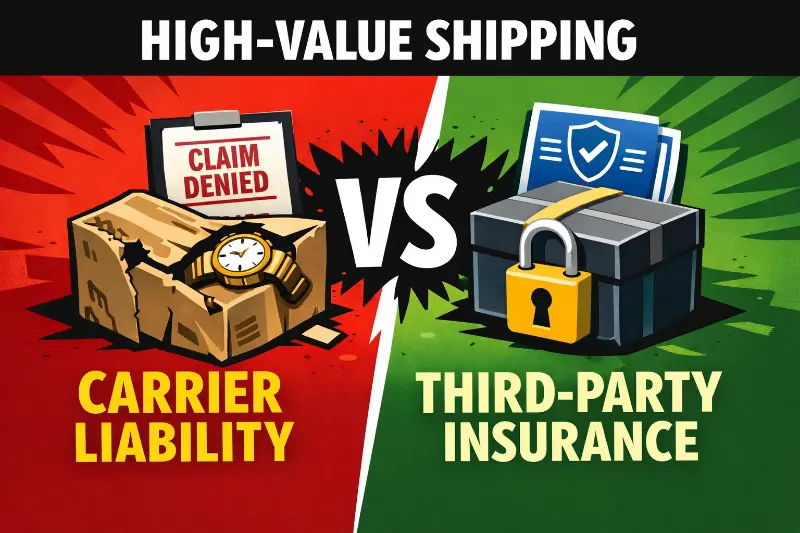
The critical distinction that most merchants overlook: declared value coverage is not insurance. FedEx states this explicitly in its service guide. UPS uses similar language. Declared value sets the carrier’s maximum liability, meaning it caps what the carrier will pay, not what the carrier owes. To collect on a declared value claim, the shipper must prove the carrier was at fault for the loss or damage. That burden of proof is significant. If the carrier can attribute the issue to inadequate packaging, an excluded item category, or any cause outside its direct handling, the claim gets denied. Insurance limits and maximum declared values apply, and if your shipment exceeds these limits, you must purchase additional insurance to cover the full value.
USPS is the exception among major carriers in that it uses the term “insurance” and provides indemnity coverage. However, USPS caps standard insured mail at $5,000 per package domestically (Registered Mail extends to $50,000 but requires in-person mailing and chain-of-custody protocols). International coverage varies dramatically by destination country, with some nations capping coverage well below $1,000.
For merchants shipping high-value items, the surcharge math also deserves attention. Carrier declared value fees typically run $1.05 to $1.90 per $100 of coverage above the included default. Insurance rates are typically based on the declared value and can vary depending on package type. On a $2,000 item, that translates to roughly $20 to $36 in declared value surcharges with a carrier. Third-party insurance providers, by contrast, typically charge $0.50 to $1.25 per $100 of coverage, representing savings of 50 to 80 percent on the premium alone. Many third-party providers offer competitive rates, making them a cost-effective option for insuring high-value shipments.
The $1,000 ceiling and other exclusions most merchants miss
Beyond the default $100 cap, carriers impose category-specific limits that create coverage gaps for common ecommerce products. FedEx limits declared value to $1,000 for artwork, paintings, sculptures, antiques, collectibles, fine jewelry, precious metals, furs, and musical instruments (whether they are old, customized, or both). Items shipped in a FedEx Envelope or Pak are capped at $500 regardless of actual value. UPS imposes similar restrictions, limiting international jewelry shipments to $2,500 CAD without a special high-value waiver agreement. Many carriers have coverage limits and exclusions that can expose businesses to financial risk when shipping valuable goods.
These are not obscure edge cases. A Shopify brand selling handcrafted jewelry, vintage furniture, limited-edition prints, or high-end watches will hit these limits routinely. The carrier will accept the package, charge for shipping, and even collect the declared value surcharge. But if a claim arises, the payout caps at the category limit, not the declared amount.
Several other exclusions apply universally across carriers. Consequential damages (lost revenue, business interruption, customer acquisition costs) are never covered. Losses caused by weather events, natural disasters, or civil unrest fall outside carrier liability. Coverage applies only while the package is in the carrier’s custody, meaning porch theft after confirmed delivery is excluded. And perhaps most consequentially, damage attributed to improper packaging results in automatic denial. When evaluating insurance options, keep in mind that the best shipping carrier will have insurance options to cover your most expensive SKU without exceeding its maximum value for coverage.
Why claims get denied and what the data shows
Inadequate packaging is the leading cause of claim denials across all carriers. Carriers publish specific packaging guidelines covering box strength ratings, cushioning materials, void fill, and drop-test standards. A shipment that fails to meet these requirements, even if the carrier clearly mishandled it, faces a strong likelihood of denial. USPS reports an approximate 38 percent claim rejection rate, while industry analysis suggests UPS and FedEx deny roughly 30 to 50 percent of claims depending on the type (damage claims are denied more frequently than loss claims). The claim process for shipping insurance for high-value items requires careful attention—documentation like photos and recent appraisals is crucial for claims on high-value items.
Other common denial triggers include late filing (each carrier enforces strict windows, ranging from 21 to 60 days depending on the carrier and claim type), missing documentation (no photos, no proof of value, no original packaging retained), and misdeclared value. You must provide proof of value, such as invoices or receipts, when filing a claim for high-value items, and documentation of damage at the receiving process is essential. Claims for high-value items typically have shorter filing deadlines, often between 15 to 30 days. Filing a claim after disposing of the original packaging is almost always fatal to the claim regardless of how strong the other evidence may be.
The timeline compounds the problem. Carrier claims processes typically take 30 to 90 days from filing to resolution. Shipping insurance claims can take several months to resolve, which can create financial burdens for shippers. During that period, the merchant has already absorbed the cost of a replacement or refund. For high-value shipments, that cash flow gap can be operationally significant. To file a claim for shipping insurance, you must provide essential documentation such as the value of the insured item, tracking number, carrier’s name, and a description of the contents, and you must prove the carrier is responsible for the loss or damage to receive reimbursement.
Third-party coverage changes the cost and claims equation
Third-party shipping insurance operates on a fundamentally different model. Rather than requiring proof of carrier fault, most third-party policies function as “all-risk” coverage: any cause of loss or damage during transit is covered unless specifically excluded. Selecting ‘All-Risk’ coverage offers the most comprehensive protection and complete coverage for a broad range of high-value items, including international shipments. This shifts the burden of proof from the shipper to the insurer. Coverage typically extends door-to-door rather than only while in the carrier’s possession, and most providers cover porch theft, which carrier liability does not. Third-party shipping insurance generally provides coverage for theft after delivery, which is a limitation of standard carrier options. One-time shipping insurance is also available as a straightforward, single-use coverage option that can be quickly purchased online.
Claims resolution is substantially faster. Industry benchmarks show third-party providers resolving claims in 7 to 10 business days on average, with some providers processing approvals in under 48 hours. Several providers offer paperless claims portals, eliminating the multi-step documentation processes that carriers require. Secursus.com displays an online calculator to check the price for insuring a package in real time.
For cost comparison, consider a $1,000 item. Carrier declared value surcharges run approximately $12 to $20. Third-party insurance for the same value typically costs $5 to $10. At $5,000, the gap widens further: carriers charge roughly $50 to $95 while third-party providers charge $25 to $38. Third-party insurance can be up to 50% cheaper than limited liability coverage offered by carriers, and specialized third-party insurance for shipping high-value items often provides better, more cost-effective coverage. Specialty providers serving luxury goods, fine jewelry, and high-value merchandise offer coverage up to $150,000 per package, well beyond the $50,000 ceiling that UPS and FedEx impose. Specialized third-party insurers can offer coverage limits ranging from $150,000 to $200,000 per package for high-value items, and Parcel Pro provides package insurance that aligns with the true value of your shipment, ensuring full value reimbursement in case of loss, damage, or theft. UPS Capital is a provider of specialized shipping insurance solutions, and UPS offers insurance options that can cover packages valued up to $50,000, depending on how you ship. You can insure a FedEx package for up to $50,000 with certain overnight, 2-day, or 3-day services, and FedEx has a high-value jewelry program with insurance limits of $100,000 for domestic parcels, available to shippers with a FedEx account. Package insurance is available for high-value shipments and can provide full value reimbursement in case of loss, damage, or theft.
The tradeoffs are real, though. Third-party providers maintain their own exclusion lists (perishables, cash equivalents, hazardous materials subject to USPS hazmat rules, and sometimes specific electronics categories). International coverage limits and pricing vary by provider and destination. And integration quality matters: the most effective implementations automate insurance purchasing at the label-creation stage based on order value rules, eliminating the risk of human error on high-value shipments. Many specialty providers and fulfillment centers also offer extra services such as kitting, pick and pack fulfillment, and specialized handling to enhance the customer experience and differentiate your brand.
Operational requirements that determine whether claims succeed
Successful claims depend on documentation assembled before the shipment leaves the warehouse, not after a problem arises. The operational requirements are consistent across both carrier and third-party claims:
- Photograph each order at the packing station before sealing, capturing items alongside the invoice or packing slip with serial numbers visible
- Document packaging materials and process (cushioning, void fill, box condition) with timestamped images linked to order IDs
- Retain all original packaging and damaged goods until the claim is fully resolved, as carriers may require physical inspection
- File claims within the carrier’s or insurer’s deadline (ranging from 21 to 120 days depending on provider and claim type)
- Maintain proof of value through commercial invoices, purchase receipts, detailed packing slips, or professional appraisals, particularly for items without standard retail pricing
High-value products often require special handling and meticulous receiving processes to ensure proper documentation for claims.
Warehouse teams that build these steps into standard operating procedures convert claims documentation from a reactive scramble into a routine workflow. Overhead cameras at packing stations, barcode-linked video logging, and automated claim-filing software all reduce the per-order cost of maintaining claims-ready records. Documentation, security cameras, and professional claims handling, supported by advanced ecommerce shipping software, maximize shipping insurance reimbursement and protect high-value inventory.
Customer Experience and Shipping Insurance
Delivering a positive customer experience is vital for any business, especially when shipping high-value items. Customers expect their valuable shipments to arrive safely and on time, and offering shipping insurance as part of thoughtful free shipping pricing strategies is a powerful way to meet—and exceed—those expectations. By providing insurance coverage for high-value items, businesses demonstrate a commitment to customer satisfaction and service excellence. This not only builds trust and loyalty but also supports business growth by encouraging repeat purchases and positive word-of-mouth. Shipping insurance also helps reduce the risk of disputes and costly claims, streamlining the resolution process if issues arise. Ultimately, investing in shipping insurance enhances the overall customer experience, protects your business reputation, and ensures that both you and your customers are covered when it matters most.
Best Practices for Shipping
To ensure the safe and secure delivery of high-value shipments, businesses should follow a set of proven best practices. Start by selecting a reputable shipping carrier with a strong track record for handling high-value items, and always purchase shipping insurance to protect against potential loss or damage. Use high-quality packaging materials and reinforce packages to withstand the rigors of transit, clearly labeling contents and value where appropriate. Maintain detailed records for each shipment, including tracking numbers and delivery confirmation, to facilitate quick resolution in case of shipping issues. It’s also important to have a response plan in place for any incidents, ensuring that your team can act swiftly to protect your packages and minimize disruption. By adhering to these best practices, you can significantly reduce risk and ensure your high-value items reach their destination safely.
Technology and Insurance Integration
Advancements in technology have transformed the way businesses manage high-value shipments and shipping insurance. Modern shipping platforms now offer seamless integration with insurance providers, allowing businesses to purchase coverage, factor in FedEx and UPS surcharge mitigation strategies, and track high-value shipments in real time. This integration enhances operational efficiency by automating insurance decisions based on shipment value and streamlining the claims process with digital documentation and faster approvals. Real-time tracking and automated alerts provide greater visibility and control, enabling businesses to respond quickly to any issues and deliver a superior customer experience. As technology continues to evolve, integrating shipping insurance solutions will become even more essential for protecting high-value shipments, improving service, and driving business success.
When self-insuring makes financial sense
For high-volume merchants shipping lower-value products, self-insurance deserves serious consideration. The calculation is straightforward: if your annual expected loss (total shipments multiplied by your loss/damage rate multiplied by average item value) is lower than the total annual premium you would pay for insurance, self-insuring saves money. Not everyone needs shipping insurance, but companies shipping high-value items cannot afford shrinkage as a cost.
Industry loss and damage rates for ecommerce typically fall between 1 and 3 percent of shipments, though this varies significantly by product category, carrier, packaging quality, whether you’re shipping heavy items, and season. A merchant shipping 10,000 packages per month at an average value of $40 with a 2 percent damage rate faces roughly $96,000 in annual expected losses. At $0.50 per package for third-party insurance, annual premiums would total $60,000, making insurance the better choice. But for a similar merchant shipping $15 average-value items, the expected loss drops to $36,000, and self-insuring with a reserve fund becomes more attractive.
The hybrid approach is most common among mid-market operators: self-insure items below a set threshold (often $50 to $100), purchase third-party coverage for items above that threshold, and use specialty coverage for anything above $5,000. Setting aside 1 to 3 percent of shipping spend in a dedicated reserve fund provides the financial cushion for self-insured losses.
Frequently Asked Questions
What is the difference between carrier liability and shipping insurance?
Carrier liability (also called declared value coverage) sets the maximum amount a carrier will pay for loss or damage, but requires the shipper to prove the carrier was at fault. It is not insurance. FedEx and UPS explicitly state this in their service guides. To collect on a declared value claim, shippers must demonstrate carrier negligence and meet strict packaging requirements. True shipping insurance (available from USPS or third-party providers) functions as all-risk coverage where any cause of loss or damage during transit is covered unless specifically excluded, shifting the burden of proof from shipper to insurer.
How much does carrier declared value coverage cost compared to third-party insurance?
Carrier declared value fees typically run $1.05 to $1.90 per $100 of coverage above the included $100 default. For a $2,000 item, this translates to roughly $20 to $36 in surcharges. Third-party insurance providers typically charge $0.50 to $1.25 per $100 of coverage, representing 50% to 80% savings. For a $5,000 item, carriers charge approximately $50 to $95 while third-party providers charge $25 to $38. The cost gap widens as item value increases, making third-party insurance substantially more economical for high-value shipments.
What are the category-specific coverage limits carriers impose on high-value items?
FedEx limits declared value to $1,000 for artwork, paintings, sculptures, antiques, collectibles, fine jewelry, precious metals, furs, and musical instruments. Items shipped in FedEx Envelope or Pak are capped at $500 regardless of actual value. UPS imposes similar restrictions, limiting international jewelry shipments to $2,500 CAD without special agreements. These limits apply even if you pay for higher declared value coverage. Carriers will accept the package, charge shipping and declared value surcharges, but claims payout caps at the category limit, not the declared amount.
Why do carrier claims get denied and how common are denials?
Inadequate packaging is the leading cause of claim denials. Carriers enforce strict packaging guidelines covering box strength, cushioning, void fill, and drop-test standards. Even with clear carrier mishandling, shipments not meeting these requirements face denial. USPS reports approximately 38% claim rejection rate. Industry analysis suggests UPS and FedEx deny 30% to 50% of claims depending on type (damage claims denied more frequently than loss claims). Other common denial triggers include late filing (21-60 day windows), missing documentation (no photos, no proof of value, no original packaging retained), and misdeclared value.
How long do carrier claims take to resolve compared to third-party insurance claims?
Carrier claims processes typically take 30 to 90 days from filing to resolution. During this period, merchants have already absorbed replacement or refund costs, creating significant cash flow gaps on high-value shipments. Third-party insurance providers resolve claims in 7 to 10 business days on average, with some processing approvals in under 48 hours. Several third-party providers offer paperless claims portals that eliminate the multi-step documentation processes carriers require, further accelerating resolution timelines.
What documentation is required to successfully file a shipping insurance claim?
Successful claims require documentation assembled before shipment leaves the warehouse: (1) Photographs of each order at packing station before sealing, showing items alongside invoice/packing slip with serial numbers visible; (2) Documentation of packaging materials and process (cushioning, void fill, box condition) with timestamped images linked to order IDs; (3) All original packaging and damaged goods retained until claim fully resolved (carriers may require physical inspection); (4) Proof of value through commercial invoices, purchase receipts, or professional appraisals; (5) Claims filed within deadline (21-120 days depending on provider). Filing after disposing of original packaging is almost always fatal to claims.
When does self-insuring make more sense than purchasing shipping insurance?
Self-insurance makes financial sense when annual expected loss is lower than total annual insurance premiums. Calculate: (total shipments) x (loss/damage rate) x (average item value). Industry loss/damage rates typically fall between 1% and 3% of shipments. Example: 10,000 packages/month at $40 average value with 2% damage rate = $96,000 annual expected loss versus $60,000 in third-party premiums ($0.50/package), making insurance better. At $15 average value, expected loss drops to $36,000, making self-insurance with a reserve fund more attractive. The hybrid approach is most common: self-insure items below $50-$100, purchase coverage above that threshold.
What are the main advantages of third-party shipping insurance over carrier declared value coverage?
Third-party insurance offers: (1) All-risk coverage without requiring proof of carrier fault; (2) 50%-80% lower cost per dollar of coverage; (3) Claims resolution in 7-10 days versus 30-90 days for carriers; (4) Door-to-door coverage including porch theft (excluded from carrier liability); (5) Higher coverage limits (up to $150,000 per package versus $50,000 carrier ceiling); (6) Fewer category-specific exclusions for high-value items like jewelry and artwork; (7) Paperless claims portals versus multi-step carrier processes. Tradeoffs include third-party exclusion lists (perishables, hazardous materials), variable international coverage, and integration quality requirements.
Written By:

Rinaldi Juwono
Rinaldi Juwono leads content and SEO strategy at Cahoot, crafting data-driven insights that help ecommerce brands navigate logistics challenges. He works closely with the product, sales, and operations teams to translate Cahoot’s innovations into actionable strategies merchants can use to grow smarter and leaner.
Turn Returns Into New Revenue
Related Articles
Amazon FBM Prepaid Return Labels What Changes December 18 and What Sellers Should Do
Starting December 18, 2026, covered US seller-fulfilled Amazon returns require a prepaid return label, and heavy and bulky items are temporarily excluded, according to a seller not...
Which SKUs Should Not Be in Seller Fulfilled Prime?
Seller Fulfilled Prime SKUs are the individual products an Amazon seller chooses for SFP based on whether each one can protect both the Prime promise and the seller’s margin.
Prime Day 2026 Results: What Ecommerce Sellers Should Learn from the Numbers
Prime Day 2026 started on June 23 at 12:01 a.
Why Shipping Prices Are So High (And What Merchants Can Actually Control)
In this article
23 minutes
- Introduction to Shipping Costs
- Dimensional weight changed the economics of ecommerce shipping
- Shipping zones create a distance tax most merchants ignore
- Fuel, labor, and network congestion are structural forces, not temporary spikes
- Poor inventory placement compounds every other cost
- Returns quietly erode shipping budgets
- Shipping Insurance and Liability
- Technology and Shipping
- Third-Party Logistics (3PL)
- What merchants can and cannot control
- Conclusion and Recommendations
- Frequently Asked Questions
Shipping prices feel high because most merchants encounter the cost after it has already been locked in by poor routing, bad inventory placement, and inefficient service selection. The structural economics of parcel shipping have shifted dramatically since 2015, and the forces driving costs upward are real. The surge in online shopping and increased consumer demand during the pandemic put additional pressure on the shipping industry and contributed to higher shipping costs. Shipping costs today are influenced by these ongoing challenges, and shipping rates have increased since the pandemic’s disruptions. But the gap between what merchants assume they can control (carrier pricing) and what actually moves the needle (operational decisions) is where the real opportunity lives. Understanding that distinction is the difference between absorbing rising costs and actively managing them.
U.S. parcel shipping costs have increased more than 40% over the past five years, according to the Pitney Bowes Parcel Shipping Index. Annual carrier rate increases of 5.9% have become the norm, fuel surcharges have decoupled from actual fuel prices, and labor costs have permanently reset higher. None of those forces are going away. In addition, global supply chains have faced significant disruptions due to the COVID-19 pandemic, leading to ongoing shipping delays and higher costs that continue to affect shipping prices. But for every dollar a merchant spends on shipping, a meaningful share is determined not by carrier economics, but by decisions the merchant made (or failed to make) about packaging, inventory location, service selection, and return policy design.
Introduction to Shipping Costs
Shipping costs have become a central concern for many businesses, especially as ecommerce continues to grow and customer expectations for fast, affordable delivery rise. The cost of shipping is shaped by a complex mix of factors, including high shipping costs driven by fluctuating fuel prices, rising labor costs, and the specific shipping services selected. For many businesses, these expenses can quickly add up, impacting profit margins and overall competitiveness. As the cost of shipping continues to climb, understanding what drives these increases—and what can be done to achieve lower shipping costs—has never been more important. By analyzing the key contributors to shipping costs, such as fuel prices and labor costs, businesses can make informed decisions to optimize their shipping strategies and better manage their bottom line. In today’s market, a proactive approach to shipping is essential for controlling costs and maintaining a competitive edge.
Dimensional weight changed the economics of ecommerce shipping
The single most misunderstood cost driver in ecommerce shipping is dimensional weight (DIM weight). Before 2015, carriers charged ground shipments by actual weight alone. That year, UPS and FedEx expanded DIM weight pricing to all ground packages, fundamentally shifting from a weight-based to a space-based pricing model.
The formula is straightforward: multiply the package’s length, width, and height in inches, then divide by the carrier’s DIM factor (139 for UPS and FedEx commercial accounts, 166 for USPS on packages exceeding one cubic foot). The carrier compares DIM weight to actual weight and bills whichever is greater.
For ecommerce, this is particularly punishing. The average ecommerce package weighs 1 to 3 pounds but ships in a box roughly 18 by 16 by 6 inches. At a DIM factor of 139, that box calculates to about 12 pounds of billable weight. A 2-pound pillow in a 20-by-16-by-12-inch box becomes 28 pounds on the invoice. An estimated 70% of ecommerce packages are now billed by DIM weight rather than actual weight, according to Practical Ecommerce.
The problem compounds with poor packaging practices. The average ecommerce package contains over 50% empty space. Every unnecessary inch of box dimension inflates billable weight. The choice of packaging materials also plays a significant role in overall shipping and fulfillment costs, as using the right materials can reduce empty space, protect products, and help control expenses. And as of August 2025, both FedEx and UPS round every fractional inch upward to the next whole inch before calculating DIM weight, meaning a box measuring 11.1 inches on any side gets billed as 12. That seemingly small change pushes packages into higher weight tiers and can trigger additional handling surcharges.
The cost of shipping a package includes not just transportation, but also fuel, labor, packaging materials, and logistics infrastructure.
Shipping zones create a distance tax most merchants ignore
Shipping zones compound the DIM weight problem in ways that catch merchants off guard. Carriers divide the country into zones (typically 2 through 8 for domestic ground) based on the distance between origin and destination ZIP codes. Zone 2 covers roughly 50 to 150 miles from your warehouse. Zone 8 means coast to coast.
The cost difference is substantial. A 5-pound FedEx Ground package costs $11.98 to Zone 2 but $18.42 to Zone 8, a 54% premium. For heavier packages, the gap widens further. When you layer in fuel surcharges (currently around 18% for ground), residential delivery surcharges ($3.70 to $5.55 per package), and delivery area surcharges ($7.50 to $15.00 in thousands of ZIP codes), a Zone 8 shipment can cost 80 to 90% more than a Zone 2 shipment for the same item in the same box. Optimizing warehouse locations can reduce shipping zones, thus keeping down fees.
Here is where DIM weight and zones multiply together. A lightweight, bulky product that calculates to 37 pounds of DIM weight shipped to Zone 8 might cost $35 to $40. The same product at actual weight shipped to Zone 2 would cost around $12. The merchant who estimated shipping costs based on actual product weight and nearby customers is now looking at three to four times their expected cost per order. For a business shipping 1,000 packages monthly, the difference between serving primarily Zone 2 to 3 customers versus Zone 7 to 8 customers can exceed $100,000 in additional annual shipping costs, not to mention the additional costs that can arise from inefficient zone management.
Fuel, labor, and network congestion are structural forces, not temporary spikes
Beyond the mechanics of how carriers price individual packages, the base cost of moving goods through carrier networks has permanently increased. These are forces no individual merchant can influence, and understanding them matters because it clarifies where operational energy is better spent.
Fuel surcharges were introduced as temporary adjustments in the early 2000s. They are now permanent revenue tools. Fluctuations in global oil markets and oil prices have a direct impact on fuel costs, which in turn influence shipping expenses and fuel surcharges. When gas prices rise, carriers add fuel surcharges, especially for express shipping methods, leading to higher costs for shippers. Fuel costs surged during the pandemic, leading to increased shipping costs, and shipping companies often implement fuel surcharges to cope with fluctuating oil prices. According to parcel audit firm Shipware, the correlation between actual diesel prices and fuel surcharge percentages was 0.85 before COVID. By 2023 to 2025, that correlation flipped to negative 0.50, meaning surcharges continued rising even as fuel prices returned to historical norms. UPS Ground fuel surcharges currently sit at 18.25%, and FedEx has implemented multiple surcharge table increases through 2025 and into 2026.
Labor costs underwent a structural reset. Labor shortages in the shipping industry are also driving up costs. The 2023 UPS-Teamsters contract, the largest private collective bargaining agreement in North America, put $30 billion in new labor costs on the table over five years. Full-time UPS drivers will earn $49 per hour by 2027. Warehouse wages across the industry jumped from a pre-pandemic range of $14 to $18 per hour to roughly $23 per hour, a level that has not reverted. UPS has stated explicitly that these costs flow through to pricing.
Inflation has caused the cost of goods needed by shipping companies, including packaging and fuel, to rise, further increasing overall shipping expenses.
Annual General Rate Increases of 5.9% have become standard from both UPS and FedEx, with USPS implementing similar increases under its 10-year “Delivering for America” restructuring plan. But the stated 5.9% understates real-world impact. When surcharge increases, expanded delivery area surcharge ZIP codes, tighter DIM rounding rules, and mid-year adjustments are included, the effective annual cost increase for most merchants lands between 8 and 12%.
Meanwhile, last-mile delivery now accounts for 53% of total shipping costs, up from 41% in 2018. This is the most labor-intensive, least efficient segment of the supply chain, and it is where the majority of ecommerce spending concentrates.
Poor inventory placement compounds every other cost
Of all the factors within a merchant’s control, inventory placement has the largest impact on total shipping spend and the efficiency of order fulfillment. Where inventory is stored directly affects how quickly and cost-effectively customer orders can be picked, packed, and shipped.
A single warehouse on the East Coast means roughly 70% of customers may fall into Zones 5 through 8, where costs are highest and transit times are longest. A single warehouse on the West Coast creates the same problem in reverse.
Distributing inventory across two or three fulfillment locations can virtually eliminate Zone 7 and 8 shipments. Three strategically placed warehouses (typically West Coast, Central, and East Coast) can shift 85% of customers into Zones 1 through 4, reducing average shipping cost from roughly $12 to $7 per order. Industry data from multiple 3PLs shows that adding a second fulfillment center saves approximately 10% on parcel shipping costs, while a third location can push savings to 25 to 30%. A fulfillment partner, such as a 3PL provider, can manage shipping and distribution across these centers, leveraging their carrier relationships and expertise to negotiate better rates and streamline operations; understanding how to choose the right 3PL company is therefore critical for long-term cost control.
The savings also cascade. Lower zones mean faster ground transit times, which means fewer customers need expedited service to receive packages within expected windows. Brands using distributed inventory with ground shipping can reach 89% of the lower 48 states within two days, eliminating the need for express service on most orders and saving roughly 41% on delivery costs that would otherwise go to premium services. 3PLs often provide real-time inventory management systems to monitor stock levels, helping businesses avoid overstocking and reducing the costs associated with rush orders or stockouts, but merchants also need a clear understanding of 3PL costs for ecommerce fulfillment to evaluate the true impact on their shipping budgets.
There is an important caveat. Splitting inventory across locations adds complexity: duplicate safety stock, additional warehouse management overhead, increased fulfillment costs, and technology integration costs. While splitting inventory across multiple fulfillment centers can cut shipping costs and delivery times, it also increases the true cost of fulfillment. The economics generally favor distributed fulfillment only for merchants shipping 50 to 100 or more orders daily or generating $5 million or more in annual revenue. For smaller operations, the added costs of a second warehouse can outweigh the shipping savings.
Returns quietly erode shipping budgets
Returns are the most overlooked shipping cost multiplier in ecommerce, especially for online sales, which experience high return rates, and higher ecommerce return rates can significantly erode profit margins if not actively managed. The average online return rate sits at 20.4%, roughly three times the in-store rate, and many brands are now looking for strategies to address the rise of e-commerce return rates before these costs spiral further. For apparel and fashion brands, return rates regularly reach 25 to 40%. Each return triggers a cascade of costs that extend well beyond the return shipping label. Returns drive up shipping costs for ecommerce store owners, putting additional pressure on shipping budgets.
Processing a single return costs between $10 and $33 when accounting for the return label ($8 to $12), inspection and processing ($5 to $8), restocking ($2 to $4), and customer service overhead ($2 to $5). Only 48% of returned products are resold at full price, meaning inventory depreciation adds another 10 to 40% of product value on top of processing costs. At a 20% return rate on $500,000 in annual revenue, direct return processing costs alone reach $25,000 to $33,000 before any inventory markdowns.
For shipping budgets specifically, returns effectively double the transportation cost on every affected order. The outbound shipment and the return shipment both consume carrier capacity and carrier pricing, but only one of them generated revenue. This makes return rate reduction one of the highest-leverage operational improvements a merchant can pursue, and crafting the perfect e-commerce returns program is often just as impactful as negotiating carrier contracts. Better product descriptions address 22% of returns caused by items not matching expectations. Size and fit tools tackle the 67% of fashion returns driven by sizing issues. And exchange-first return flows retain revenue that refund-first policies surrender entirely.
Shipping Insurance and Liability
Shipping insurance and liability coverage are essential elements of the shipping process, providing businesses with a safety net against the unexpected. Whether shipping domestically or internationally, the risk of loss, theft, or damage to goods in transit is always present. Shipping insurance helps offset the cost of shipping by reimbursing businesses for the value of lost or damaged items, while liability coverage protects against potential legal claims that may arise from shipping incidents. However, these protections come at a price, adding to the overall cost of shipping. It’s important for businesses to carefully evaluate their shipping insurance options, balancing the cost of premiums with the level of risk they are willing to assume. By selecting the right coverage, businesses can safeguard their assets and ensure that the shipping process does not expose them to unnecessary financial risk, all while keeping a close eye on the total cost of shipping.
Technology and Shipping
Advancements in technology have dramatically reshaped the shipping industry, offering businesses new ways to reduce shipping expenses and enhance customer satisfaction. Automated shipping systems, real-time tracking, and advanced analytics now allow companies to manage their shipping operations with greater precision and efficiency. These innovations help reduce costs by optimizing delivery routes, minimizing delays, and streamlining the transport of goods. Technology has also enabled the rise of new shipping services, such as same-day delivery and dynamic rate shopping, which can improve delivery times and provide a better experience for customers while helping merchants react quickly to carrier rule changes like UPS matching FedEx on dimensional weight rounding. By embracing the latest shipping technologies, businesses can not only lower their shipping expenses but also ensure that their products arrive on time, boosting customer satisfaction and loyalty in a highly competitive market.
Third-Party Logistics (3PL)
Third-party logistics (3PL) providers have become indispensable partners for businesses navigating the complexities of the shipping industry, and for smaller brands in particular, choosing the best 3PL for small business can determine whether shipping costs scale efficiently as order volume grows. By outsourcing key logistics functions—such as warehousing, distribution, freight forwarding, and customs clearance—to a 3PL, companies can tap into specialized knowledge and benefit from advanced infrastructure without the need for significant internal investment. 3PL providers help reduce costs by leveraging economies of scale, optimizing shipping routes, and providing access to a broader range of shipping options. For many businesses, especially those experiencing growth or managing high order volumes or selling on major marketplaces like Wayfair, partnering with a 3PL can simplify the shipping process, improve efficiency, and free up resources to focus on core business activities by relying on the best 3PL for Wayfair order fulfillment or similar marketplace-specialized providers. Whether you’re a small business looking to scale or a large enterprise seeking to streamline operations, working with a 3PL can be a strategic move to stay competitive in the ever-evolving shipping industry.
What merchants can and cannot control
The most productive framing for shipping cost management is a clean separation between fixed market forces and controllable operational decisions. Merchants cannot influence base carrier rates, annual General Rate Increases, fuel surcharges, labor market dynamics, regulatory costs, peak season demand surcharges, or residential delivery surcharges. These are structural inputs set by carriers and the broader economy.
What merchants can control falls into several categories, ranked by typical cost impact:
- Inventory placement is the single largest lever at scale, capable of saving $20,000 or more per month for brands shipping 5,000 or more orders monthly, by reducing average shipping zones from 5 to 6 down to 2 to 3
- Packaging right-sizing delivers 20 to 40% reductions in DIM weight costs through tighter box selection, poly mailers for flexible goods, and elimination of excess void fill
- Return rate reduction through better product information, sizing tools, and exchange-first policies lowers the effective shipping cost per net sale
- Multi-carrier rate shopping saves $3 to $7 per package by comparing rates across carriers for each individual shipment in real time, rather than defaulting to a single carrier. Regularly comparing carrier rates helps businesses secure competitive rates and find better deals.
- Service level optimization matches delivery speed to actual customer expectations, using ground service from well-placed inventory instead of paying express premiums. Using ground shipping when speed isn’t critical can provide the best mix of cost and delivery time.
- Negotiating rates with carriers can lead to significant savings, especially for the business owner who leverages shipment volume or partners with 3PL providers. Most businesses rely on a combination of shipping methods and strategies to optimize costs, including diversifying shipping companies to reduce expenses.
- Using cloud-based shipping software can optimize shipping operations and further reduce costs.
Zone skipping (consolidating packages into bulk freight for injection closer to destinations) offers additional savings of 25 to 40% on long-distance routes, though it typically requires volume of 100 or more packages daily heading to the same region. Making shipping more cost-effective through shipment consolidation, leveraging economies of scale, and established carrier relationships can result in lower costs and more competitive rates for most businesses.
Conclusion and Recommendations
Shipping costs remain a complex challenge for businesses of all sizes, but with the right strategies, it is possible to manage and even lower shipping expenses. By understanding the many factors that influence shipping costs—from fuel prices and labor costs to packaging, insurance, and technology—businesses can make smarter decisions that protect their bottom line. To achieve lower shipping costs, companies should regularly compare carrier rates, take advantage of flat rate shipping options, and negotiate rates with shipping companies whenever possible. Investing in shipping insurance and liability coverage is also crucial to safeguard against unforeseen losses during transit. Additionally, leveraging technology and considering partnerships with third-party logistics providers can further streamline shipping operations and reduce costs. By staying informed about trends in the shipping industry and continuously optimizing their shipping process, businesses can deliver reliable service, keep customers happy, and maintain a strong position in the digital marketplace.
Frequently Asked Questions
Why do shipping prices keep increasing every year?
Shipping prices increase due to structural cost pressures that carriers face: annual labor cost increases (UPS drivers will earn $49/hour by 2027 following the 2023 Teamsters contract), with labor costs in the shipping industry rising due to increased wages since the pandemic, contributing to higher shipping rates. Shipping companies also incorporate fuel surcharges to adjust for fluctuating fuel costs, significantly increasing overall expenses. Inflation increases the cost of goods needed by shipping companies, including fuel, packaging, and labor, which in turn raises shipping costs. Fuel surcharges now operate as permanent revenue tools rather than temporary adjustments, and rising last-mile delivery costs now represent 53% of total shipping expenses. These factors have led to price increases and higher prices for both businesses and consumers. Major carriers implement annual General Rate Increases averaging 5.9%, but when surcharge increases, expanded delivery area surcharge zones, and DIM rounding rule changes are included, effective annual cost increases land between 8 and 12% for most merchants.
What is dimensional weight and why does it matter so much?
Dimensional weight (DIM weight) is calculated by multiplying a package’s length, width, and height in inches, then dividing by a carrier’s DIM factor (139 for UPS/FedEx commercial, 166 for USPS). Carriers bill whichever is greater: actual weight or DIM weight, which directly impacts shipping rates. This matters because an estimated 70% of ecommerce packages are now billed by DIM weight, not actual weight. A 2-pound pillow in a 20x16x12 inch box calculates to 28 pounds of billable weight. The average ecommerce package contains over 50% empty space, meaning most merchants pay to ship air unless they optimize packaging dimensions.
Shipping costs are influenced by both package dimensional weight and the destination address, so understanding how these factors affect shipping rates is essential for managing expenses.
How much do shipping zones affect the cost of shipping?
Shipping zones create massive cost differences based on distance, directly impacting shipping expenses. A 5-pound FedEx Ground package costs $11.98 to Zone 2 (50-150 miles) but $18.42 to Zone 8 (coast to coast), a 54% premium. When fuel surcharges (18%), residential delivery surcharges ($3.70-$5.55), and delivery area surcharges ($7.50-$15.00) are added, Zone 8 shipments can cost 80 to 90% more than Zone 2. For a business shipping 1,000 packages monthly, the difference between serving primarily Zone 2-3 versus Zone 7-8 customers can exceed $100,000 in additional annual shipping costs. Optimizing warehouse locations to reduce shipping zones is an effective way to keep down these fees and control overall shipping expenses.
How much can distributed inventory placement save on shipping costs?
Inventory placement is the single largest controllable cost lever. Three strategically placed warehouses (West Coast, Central, East Coast) can shift 85% of customers into Zones 1-4, reducing average shipping cost from roughly $12 to $7 per order. Industry data shows adding a second fulfillment center saves approximately 10% on parcel shipping costs, while a third location pushes savings to 25-30%. For brands shipping 5,000+ orders monthly, this translates to $20,000 or more in monthly savings.
Working with a fulfillment partner, such as a third-party logistics (3PL) provider, can help optimize distributed inventory placement by leveraging their expertise and established carrier relationships. 3PL providers can also negotiate better shipping rates due to their collective bargaining power from handling multiple clients’ shipments. However, distributed fulfillment economics generally favor merchants shipping 50-100+ orders daily or generating $5 million+ in annual revenue.
What are the hidden costs of returns on shipping budgets?
Returns double the transportation cost on affected orders because both outbound and return shipments consume carrier capacity but only one generates revenue. For ecommerce store owners, returns drive up shipping costs significantly, impacting overall shipping budgets, and as free returns come under pressure industry-wide, understanding whether free returns are coming to an end is increasingly important for pricing and policy decisions. At an average online return rate of 20.4% (25-40% for apparel), processing a single return costs $10-$33 when accounting for return label ($8-$12), inspection ($5-$8), restocking ($2-$4), and customer service ($2-$5). Returns also add complexity and expense to order fulfillment, as managing returns requires additional picking, packing, and inventory management to ensure timely delivery and restocking. Only 48% of returned products resell at full price. At a 20% return rate on $500,000 in annual revenue, direct return processing costs reach $25,000-$33,000 before inventory markdowns, making return rate reduction one of the highest-leverage operational improvements.
What shipping costs can merchants actually control versus what they cannot?
Merchants cannot control: base carrier rates, annual General Rate Increases, fuel surcharges, labor market dynamics, peak season surcharges, or residential delivery surcharges.
Merchants can control (ranked by impact):
(1) Inventory placement – saves $20,000+/month for brands shipping 5,000+ orders by reducing average zones;
(2) Packaging right-sizing – delivers 20-40% DIM weight cost reductions;
(3) Return rate reduction through better product information and exchange-first policies;
(4) Multi-carrier rate shopping – saves $3-$7 per package and helps merchants compare carrier rates regularly to find more competitive rates;
(5) Service level optimization – using ground from well-placed inventory instead of express;
(6) Negotiating rates with carriers can lead to lower costs and significant savings;
(7) Using cloud-based shipping software can optimize shipping operations, making shipping more cost-effective and reducing expenses;
(8) Diversifying shipping companies can help merchants achieve lower costs and access more competitive rates by leveraging different carrier strengths;
(9) Leveraging economies of scale, established carrier relationships, and industry knowledge can further help in making shipping more affordable and efficient.
How can merchants reduce dimensional weight costs?
Reduce DIM weight costs through packaging optimization: (1) Right-size boxes to eliminate the 50%+ empty space in average ecommerce packages; (2) Use poly mailers for flexible, non-fragile goods instead of boxes; (3) Reduce void fill materials (bubble wrap, packing peanuts) to minimum needed for protection; (4) Choose appropriate packaging materials, as they play a critical role in shipping costs, product safety, and customer satisfaction; (5) Remember that as of August 2025, carriers round every fractional inch upward, so a box measuring 11.1 inches on any side bills as 12 inches. Every unnecessary inch inflates billable weight. Industry data shows proper packaging optimization delivers 20-40% reductions in DIM weight costs.
The cost of shipping a package includes transportation, fuel, labor, packaging materials, and logistics infrastructure.
Is negotiating better carrier rates worth the effort?
Negotiating carrier rates has limited impact compared to operational improvements. While better rates help, the effective annual cost increase from carriers (8-12% including surcharges and rule changes) will erode negotiated discounts within 12-18 months. For a business owner, partnering with a 3PL provider can be a strategic move, as 3PLs leverage economies of scale to secure lower shipping rates that individual businesses may not be able to obtain. Most businesses benefit from 3PL providers’ established relationships with major carriers, which often result in more favorable shipping terms and reduced costs. Additionally, 3PLs can consolidate shipments from multiple clients, allowing for bulk shipping rates that further lower expenses. A merchant who negotiates a 5% better rate but ships oversized boxes from a single warehouse across the country will spend substantially more than a competitor with standard rates who right-sizes packaging, places inventory in 2-3 locations to reduce zones, and rate-shops across carriers per shipment. Operational decisions control a larger portion of total shipping spend than carrier contract terms.
Written By:
Rinaldi Juwono
Rinaldi Juwono leads content and SEO strategy at Cahoot, crafting data-driven insights that help ecommerce brands navigate logistics challenges. He works closely with the product, sales, and operations teams to translate Cahoot’s innovations into actionable strategies merchants can use to grow smarter and leaner.
Turn Returns Into New Revenue
Related Articles
Amazon FBM Prepaid Return Labels What Changes December 18 and What Sellers Should Do
Starting December 18, 2026, covered US seller-fulfilled Amazon returns require a prepaid return label, and heavy and bulky items are temporarily excluded, according to a seller not...
Which SKUs Should Not Be in Seller Fulfilled Prime?
Seller Fulfilled Prime SKUs are the individual products an Amazon seller chooses for SFP based on whether each one can protect both the Prime promise and the seller’s margin.
Prime Day 2026 Results: What Ecommerce Sellers Should Learn from the Numbers
Prime Day 2026 started on June 23 at 12:01 a.
What “Fulfilled by TikTok” Really Means for Ecommerce Sellers

In this article
19 minutes
- Introduction to Fulfilled by TikTok
- How inventory moves through TikTok's fulfillment network
- The real difference between seller-managed and platform-managed fulfillment
- Sellers do not control where inventory goes or how orders route
- Fee structures that compress margins faster than sellers expect
- Documented operational failures reveal infrastructure immaturity
- Benefits of Fulfilled by TikTok
- Inventory Management and Metrics
- Getting Started with FBT
- When FBT works and when it creates problems
- Frequently Asked Questions
Fulfilled by TikTok (FBT) is a platform-managed fulfillment program where TikTok stores, picks, packs, and ships orders on behalf of TikTok Shop sellers. For ecommerce operators evaluating this fulfillment option, the operational reality is more complex than the pitch: FBT trades packaging control, inventory flexibility, and margin transparency for faster delivery badges and metric protection. Whether that trade-off makes sense depends entirely on your product profile, channel mix, and tolerance for platform dependency. This article breaks down how FBT actually works, what it costs, and when it creates more problems than it solves.
Introduction to Fulfilled by TikTok
Fulfilled by TikTok (FBT) is a game-changing fulfillment service designed to simplify the order fulfillment process for TikTok Shop sellers. By leveraging TikTok’s robust logistics infrastructure and fulfillment expertise, FBT allows sellers to shift their focus from packing and shipping to what matters most—content creation, marketing, and driving sales. With FBT, TikTok Shop sellers can trust that their products will be stored, picked, packed, and shipped efficiently, ensuring a high level of customer satisfaction and a seamless customer experience. As a cornerstone of TikTok’s fulfillment services, FBT not only streamlines operations but also enhances the overall shopping journey for buyers, making it easier for sellers to grow their businesses within the dynamic TikTok Shop ecosystem.
How inventory moves through TikTok’s fulfillment network
At its core, FBT follows the same model as other platform-managed fulfillment services. Sellers ship inventory to TikTok’s designated fulfillment centers, and TikTok handles everything from that point forward: warehousing, order processing, picking, packing, shipping, and returns. TikTok manages inventory storage within its warehouse or fulfillment center, ensuring products are available and ready for efficient processing.
The inbound process starts in TikTok’s Seller Center portal, where sellers create shipments, assign SKUs, and schedule delivery appointments for pallet-sized loads. TikTok operates 14+ fulfillment centers across the United States, with hub consolidation points on both coasts. Sellers choose from three inbound methods: shipping to a single hub (East or West), shipping to both hubs, or shipping directly to multiple fulfillment centers. Each method carries different cost and compliance implications.
Once inventory arrives, TikTok’s system takes over order management entirely. When a customer places a TikTok Shop order, the platform’s routing system identifies the nearest warehouse holding that product and processes customer orders within 24 hours. TikTok is responsible for packing orders and shipping orders directly from its warehouses, using standardized packaging and handing parcels to carrier partners, with a delivery target of two to five business days. According to TikTok’s internal data, 82.7% of FBT orders arrive within three business days when a seller routes more than 30% of volume through the program.
Products listed through FBT receive a “Free 3-Day Delivery” badge visible to shoppers. TikTok claims this badge drives a 15 to 20% higher conversion rate and a 30%+ increase in daily product views. These are platform-reported figures, and operators should weigh them accordingly. The number of orders fulfilled and the efficiency of TikTok’s warehouses contribute to these performance metrics.
The real difference between seller-managed and platform-managed fulfillment
The distinction between fulfilling your own TikTok Shop orders and using FBT is not just operational convenience. It is a fundamental shift in who controls the customer experience.
With seller-managed fulfillment (or using a third party logistics provider such as those outlined in this guide to choosing the right 3PL company), sellers retain control over packaging, branding, carrier selection, and inventory allocation across channels. Sellers can choose fulfilling orders in house or opt for self fulfillment, giving them full control over the logistics process. Inventory can be allocated across different sales channels, such as a Shopify store, wholesale, and other platforms. A branded unboxing experience, custom inserts, and the ability to fulfill orders from a shared inventory pool serving Shopify, wholesale, and other channels all remain intact. The tradeoff is that sellers bear full responsibility for meeting TikTok’s performance metrics: a Valid Tracking Rate of 95% or higher, on-time delivery within six business days, and a Seller-Fault Cancellation Rate below 2.5%. For those who do not want to handle fulfillment in house, fulfillment experts at third party logistics providers can assist with efficient order management, especially when you understand how the best 3PLs for small business structure their services and pricing.
FBT removes that operational burden. Logistics-related issues (late dispatch, cancellations, shipping damage, and negative reviews tied to delivery problems) are excluded from seller performance metrics when using FBT. TikTok also reimburses sellers for lost or damaged packages. This metric protection is one of FBT’s most tangible benefits, particularly for sellers who struggle to maintain consistent fulfillment quality at scale.
But the cost of that protection is control. FBT ships in TikTok’s standardized packaging with no branded boxes, no inserts, and no custom materials. Sellers cannot select carriers or influence delivery routing. And critically, inventory stored in FBT warehouses can only fulfill TikTok Shop orders. That stock cannot be used for Shopify storefront orders, marketplace listings, or any other channel. For multi-channel ecommerce businesses, this creates a forced inventory split that complicates demand forecasting and reduces allocation efficiency.
Sellers do not control where inventory goes or how orders route
FBT’s inventory placement system requires sellers to follow TikTok’s routing guide and allocation recommendations regardless of which inbound method they choose. When shipping directly to multiple fulfillment centers (the option that avoids hub placement fees), TikTok specifies which locations to ship to and how much inventory each should receive. Sellers cannot freely select warehouses.
Non-compliance carries real financial penalties. Inbound incident fees start at $0.50 per unit for routing violations, including misrouted shipments, incorrect quantities, mislabeled cartons, and failure to meet arrival timelines. These fees are tiered by weight and add up quickly for large shipments.
On the outbound side, TikTok’s system automatically routes each order to the nearest warehouse holding the ordered product. Sellers have no ability to manually route individual orders or prioritize specific fulfillment centers. This automated routing is efficient when the network functions well, but it also means sellers have no recourse when specific warehouse locations underperform. TikTok does not operate all of its warehouses directly. It partners with external 3PL providers, known as TikTok partners, and service quality can vary between locations compared with more modern options like a peer-to-peer fulfillment network versus traditional 3PLs. The efficiency and reliability of fulfillment through TikTok partners can be significantly impacted by order volumes, especially during sales spikes or viral moments. As one logistics consultancy noted, “Your brand is at the mercy of whichever 3PL TikTok chooses for you.”
Fee structures that compress margins faster than sellers expect
FBT’s cost structure is an all-inclusive per-unit fulfillment fee covering pick, pack, packaging materials, and last-mile shipping. For single-unit orders, fees start at $3.58 per item in the lightest weight tier and increase with weight. Multi-unit orders from the same seller start at $2.86 per item (as of January 2026). Fees are calculated on the greater of actual unit weight or dimensional weight. However, sellers should be aware of potential additional fees for packaging non-compliance or when selecting special logistics services, which can increase overall fulfillment costs.
These fulfillment costs stack on top of TikTok’s referral fee (approximately 6% of the sale price for most categories) and a transaction fee of roughly 3.78%. For a $50 product shipped as a single unit, minimum platform fees reach approximately $8.47 before accounting for product cost, advertising, or affiliate commissions. That represents about 17% of the sale price before cost of goods. For some sellers, the availability of express shipping options and the benefit of faster shipping can help justify these higher fees, as they can improve customer satisfaction and boost sales performance, especially when balanced against how ecommerce return rates affect profit margins.
The margin pressure intensifies for lower-priced products. A $12 item faces minimum platform fees of $4.30 or more, consuming roughly 36% of the sale price in fees alone. Add affiliate commissions (commonly 10 to 20% on TikTok Shop) and the economics become difficult to sustain.
Storage fees add another layer. TikTok offers 60 days of free storage per inbound shipment. After that, daily fees per cubic foot escalate on a tiered schedule: modest rates through 270 days, then a sharp increase to $0.25 per cubic foot per day after 365 days. For slow-moving inventory management scenarios, these storage fees accumulate well above industry averages for warehouse space. Hub placement fees ($0.31 to $0.45+ per unit depending on hub location and weight) and a $3 return handling fee per item further erode margins on products with high return rates.
Documented operational failures reveal infrastructure immaturity
The risks of FBT are not theoretical. Investigative reporting from Modern Retail in early 2026 documented several significant operational failures with TikTok shipping, highlighting the challenges of maintaining reliable shipping through TikTok’s logistics services.
One agency executive reported that TikTok’s warehouse shipped entire case packs of three units as individual orders instead of breaking them into single units. This error persisted for approximately one month, resulting in losses exceeding six figures for the affected brand. During peak holiday season, another brand found that orders tagged with the “Free 3-Day Delivery” badge were severely delayed, with shipments stuck for weeks. These operational failures can be especially damaging during flash sales or other high-volume events, where rapid fulfillment is critical to capitalize on viral demand. Customers repeatedly canceled orders and left negative reviews, and when the brand sought compensation, TikTok attributed the delays to third-party carrier partners.
These incidents reflect a fulfillment network that is still maturing. TikTok’s U.S. warehouse infrastructure has been operational for only a few years, and the reliance on a patchwork of 3PL partners introduces inconsistency. Sellers who depend on FBT for customer experience should understand that fulfillment quality is ultimately outside their control, and reliable shipping is not always guaranteed.
Policy volatility compounds the operational risk. In early 2026, TikTok announced it would discontinue independent seller shipping entirely, requiring all U.S. sellers to use FBT or TikTok-controlled logistics by March 31, 2026. After significant seller backlash, TikTok reversed the mandate on February 17, 2026, preserving seller shipping as an option. This reversal underscores a pattern of abrupt policy shifts that makes long-term operational planning difficult.
Benefits of Fulfilled by TikTok
Fulfilled by TikTok offers a host of benefits that can transform the way sellers operate on TikTok Shop. By outsourcing the entire fulfillment process to TikTok, sellers can significantly reduce fulfillment costs and eliminate the hassle of managing multiple fulfillment methods. FBT’s streamlined logistics help improve shipping lead times, resulting in faster deliveries and higher conversion rates. Sellers also enjoy robust seller protection, as FBT shields them from logistics-related issues and negative reviews tied to shipping or delivery problems. With free storage for a set period and no hidden fees, FBT helps sellers avoid the unexpected costs often associated with traditional fulfillment. The platform makes it easy to create inbound shipments, track inventory, and forecast replenishment needs, ensuring sellers can meet customer demand and provide a seamless shopping experience. By leveraging TikTok’s fulfillment network, sellers are well-positioned to drive business growth and customer satisfaction.
Inventory Management and Metrics
Effective inventory management is at the heart of success with Fulfilled by TikTok. Sellers must keep their TikTok Shop inventory levels accurate and ensure they have enough stock to meet customer demand. FBT provides real-time inventory tracking, allowing sellers to monitor stock, track orders, and optimize fulfillment metrics such as shipping lead times and orders delivered. By analyzing these key performance indicators, sellers can refine their fulfillment strategies, improve customer satisfaction, and make data-driven decisions to support business growth. TikTok’s network of fulfillment centers and warehouses further reduces shipping lead times, enabling fast delivery and helping sellers consistently meet customer expectations. With FBT, sellers gain the tools and insights needed to manage inventory efficiently and deliver a superior customer experience.
Getting Started with FBT
Getting started with Fulfilled by TikTok is designed to be straightforward and accessible for all TikTok Shop sellers. To begin, sellers simply log in to the Seller Center, select the “Fulfilled by TikTok” option, and follow the guided steps to create their first inbound shipment. Once registered, sellers ship their products to TikTok’s fulfillment centers, where TikTok handles storage, picking, packing, and shipping directly to customers. FBT integrates seamlessly with TikTok Shop sales, streamlining order management and fulfillment so sellers can focus on content creation and growing their business. By letting TikTok handle the logistics, sellers benefit from the platform’s extensive resources and fulfillment expertise, ultimately driving customer satisfaction, increasing sales, and setting the stage for long-term success.
When FBT works and when it creates problems
FBT delivers the most value for a specific seller profile: high-velocity, lightweight products with fast inventory turnover and no branded packaging requirements. If your best-selling SKUs are simple, standardized items (phone accessories, basic apparel, beauty consumables) that move through inventory in under 30 days, the conversion lift from the delivery badge and the metric protection may outweigh the costs and control tradeoffs.
Sellers without existing warehouse infrastructure also benefit. For a small independent company or small operations testing product-market fit on TikTok Shop, FBT eliminates the need for fulfillment staff, storage space, and carrier negotiations, though some may instead prefer dedicated ecommerce order fulfillment services that outclass traditional 3PLs. TikTok offers numerous benefits to these sellers, such as enabling sellers to focus on growth by handling logistics, warehousing, and delivery. The all-inclusive fee structure simplifies order fulfillment cost calculations, even if total costs are higher than a mature in-house operation. There are numerous benefits, including cost savings, improved customer loyalty through fast deliveries, and the ability to capitalize on TikTok’s virality for sales growth.
FBT creates problems in several clearly identifiable scenarios:
- Multi-channel sellers lose inventory flexibility because FBT stock cannot fulfill Shopify, wholesale, or other marketplace orders, forcing a separate demand forecast for TikTok alone
- Brands that depend on custom packaging sacrifice the unboxing experience entirely, since TikTok ships in standardized materials with no room for inserts or branded elements
- Low-margin products face unsustainable fee stacking when fulfillment costs, referral fees, transaction fees, and affiliate commissions combine
- Sellers with unpredictable viral demand face a forecasting dilemma, as inventory committed to FBT warehouses cannot be redirected during spikes on other channels
- Products requiring special handling, kitting, or assembly are poorly suited to TikTok’s standardized warehouse operations
For mid-market Shopify brands operating across multiple sales channels, the most practical approach is selective use: route a limited number of fast-moving, high-margin SKUs through FBT to capture the delivery badge benefits while maintaining fulfillment flexibility for the rest of your catalog, applying the same strategic thinking you would use when evaluating Shopify order fulfillment options. Keep FBT inventory allocation tight (under 30 days of supply) to stay within free storage windows, and maintain a parallel fulfillment capability through your existing 3PL or warehouse operation.
There are already success stories of sellers who have grown their business with FBT, showing how TikTok is enabling sellers to focus on scaling and customer satisfaction.
Frequently Asked Questions
What is Fulfilled by TikTok and how does it work?
Fulfilled by TikTok (FBT) is a platform-managed fulfillment program primarily used by TikTok Shop merchants—businesses that sell products through TikTok’s platform and leverage TikTok’s fulfillment services. Also known as FBT Fulfilled, this service is part of TikTok’s comprehensive fulfillment services, which manage storage, order picking, packing, shipping, and customer satisfaction. Sellers create inbound shipments through TikTok’s Seller Center, send inventory to designated warehouses, and TikTok handles all order fulfillment from that point forward. When customers place orders, TikTok’s system automatically routes them to the nearest warehouse holding that product and ships within 24 hours. Products fulfilled through FBT receive a “Free 3-Day Delivery” badge visible to shoppers.
How much does Fulfilled by TikTok cost?
FBT charges an all-inclusive per-unit fulfillment fee starting at $3.58 per item for single-unit orders in the lightest weight tier (as of January 2026). Multi-unit orders from the same seller start at $2.86 per item. These fees stack on top of TikTok’s 6% referral fee and 3.78% transaction fee. For a $50 product, minimum platform fees reach approximately $8.47 (about 17% of the sale price) before product cost or advertising. Storage is free for 60 days, then incurs daily fees per cubic foot on an escalating schedule. Hub placement fees range from $0.31 to $0.45+ per unit, and return handling costs $3 per item. Additional fees may apply for packaging compliance issues, non-compliance penalties, or when using special logistics services.
What is the difference between seller-managed fulfillment and Fulfilled by TikTok?
Seller-managed fulfillment (also known as self fulfillment or fulfilling orders in house, including using your own 3PL) lets you control packaging, branding, carrier selection, and inventory allocation across all sales channels. You can use the same inventory pool for TikTok Shop, Shopify, wholesale, and other marketplaces when your fulfillment tech stack is supported by robust order fulfillment integrations and ecommerce partners. However, you bear full responsibility for meeting TikTok’s performance metrics (95% Valid Tracking Rate, on-time delivery, cancellation rate below 2.5%). FBT removes this operational burden and excludes logistics-related issues from your seller performance metrics. But you lose all packaging control, cannot choose carriers, and inventory stored in FBT warehouses can only fulfill TikTok Shop orders, not other channels.
Can I control where my inventory is stored in TikTok’s fulfillment network?
No. TikTok’s inventory placement system specifies which fulfillment centers receive your inventory and how much each location should hold. Order volumes and various factors, such as sales spikes or regional demand, can influence which warehouse or fulfillment center is selected to receive inventory and how quickly orders are processed. Even when shipping directly to multiple warehouses (avoiding hub placement fees), sellers must follow TikTok’s routing guide. Non-compliance results in inbound incident fees starting at $0.50 per unit for routing violations, misrouted shipments, incorrect quantities, or missed arrival timelines. On the outbound side, TikTok’s system automatically routes each order to the nearest warehouse holding that product with no seller override capability.
What are the margin risks of using Fulfilled by TikTok?
FBT creates significant margin pressure through fee stacking. A $50 product faces approximately $8.47 in minimum platform fees (17% of sale price) before product cost. For a $12 item, minimum fees of $4.30+ consume roughly 36% of the sale price. Add affiliate commissions (commonly 10 to 20% on TikTok Shop) and margins compress rapidly. Storage fees after the 60-day free period escalate to $0.25 per cubic foot per day after 365 days. The $3 return handling fee per item erodes margins on products with high return rates. Low-margin products and lower-priced items face the most severe pressure from this fee structure.
What operational problems have sellers experienced with Fulfilled by TikTok?
Documented failures include TikTok warehouses shipping entire case packs of three units as individual orders instead of breaking them apart, causing six-figure losses for one brand over approximately one month. During holiday peak season, orders with “Free 3-Day Delivery” badges were severely delayed for weeks, stuck in TikTok’s fulfillment network with customers canceling and leaving negative reviews. These issues highlight the challenges of maintaining reliable shipping through TikTok Shipping and TikTok partners, as operational failures and delays with third-party carrier partners can undermine seller credibility and customer satisfaction. In early 2026, TikTok announced it would force all sellers to use FBT by March 31, 2026, then reversed the mandate on February 17, 2026 after seller backlash, illustrating policy volatility that complicates planning.
When does Fulfilled by TikTok make sense versus when should sellers avoid it?
FBT makes sense for high-velocity, lightweight products with fast inventory turnover (under 30 days), no branded packaging requirements, and sellers without existing warehouse infrastructure. For a small independent company, TikTok offers numerous benefits through FBT, such as cost savings, improved customer loyalty with fast deliveries, and the ability to capitalize on TikTok’s virality for sales growth, similar to how the right 3PL for your Shopify store can unlock scale on that channel. The delivery badge conversion lift and metric protection justify the costs for simple, standardized items like phone accessories or beauty consumables.
FBT creates problems for multi-channel sellers (inventory locked to TikTok only), brands requiring custom packaging (TikTok uses standardized materials only), low-margin products (unsustainable fee stacking), sellers with unpredictable viral demand (cannot redirect inventory to other channels), and products requiring special handling or kitting (TikTok’s standardized operations cannot accommodate).
There are also success stories of sellers who have grown their business with FBT, demonstrating the positive impact of the service for small independent companies.
Can I use Fulfilled by TikTok for some products and self-fulfill others?
Yes. The most practical approach for mid-market Shopify brands is selective use: route a limited number of fast-moving, high-margin SKUs through FBT to capture delivery badge benefits while maintaining fulfillment flexibility for the rest of your catalog through your existing 3PL or warehouse. For products that do not fit the FBT model, sellers can use self fulfillment or fulfilling orders in house, allowing them to manage storage, packing, and shipping independently, much like choosing between FBA vs FBM on Amazon based on control, cost, and service tradeoffs. Keep FBT inventory allocation tight (under 30 days of supply) to stay within free storage windows. This hybrid approach lets you benefit from the conversion lift and metric protection on products that fit FBT’s model while preserving packaging control, multi-channel inventory flexibility, and lower costs for products where FBT economics do not work, similar to leveraging specialized Amazon FBM shipping and order fulfillment services alongside platform-managed options.
Written By:
Rinaldi Juwono
Rinaldi Juwono leads content and SEO strategy at Cahoot, crafting data-driven insights that help ecommerce brands navigate logistics challenges. He works closely with the product, sales, and operations teams to translate Cahoot’s innovations into actionable strategies merchants can use to grow smarter and leaner.
Turn Returns Into New Revenue
Related Articles
Amazon FBM Prepaid Return Labels What Changes December 18 and What Sellers Should Do
Starting December 18, 2026, covered US seller-fulfilled Amazon returns require a prepaid return label, and heavy and bulky items are temporarily excluded, according to a seller not...
Which SKUs Should Not Be in Seller Fulfilled Prime?
Seller Fulfilled Prime SKUs are the individual products an Amazon seller chooses for SFP based on whether each one can protect both the Prime promise and the seller’s margin.
Prime Day 2026 Results: What Ecommerce Sellers Should Learn from the Numbers
Prime Day 2026 started on June 23 at 12:01 a.
OpenAI ACP vs Google UCP: What’s the Difference?

AI commerce protocols are not all trying to solve the same problem. OpenAI ACP vs Google UCP is a useful comparison because it separates decision-making from transaction execution. As agentic commerce evolves, new protocols are emerging to address the unique challenges of AI-driven ecommerce, and there is a growing need for an open standard to ensure interoperability between agents, systems, and services. If you run ecommerce operations, that distinction matters more than the branding, because it determines where your systems will need to integrate and what you can expect to control.
The confusion happens because both protocols sit under the umbrella of agentic commerce, and both are described as enabling AI agents to buy things. But they operate at different layers of the commerce lifecycle. ACP focuses on enabling an AI assistant to act as the shopping interface and coordinate purchasing decisions with merchants. UCP focuses on creating a common language for checkout flows so consumer surfaces can execute transactions reliably across many retailers, payment providers, and business backends. There are real differences between ACP and UCP in terms of their underlying philosophies, ecosystems, and control mechanisms, which can significantly impact which protocol best aligns with a merchant’s strategy. Once you see the layering, the “protocol wars” framing becomes less useful. These are not mutually exclusive building blocks. They can coexist in the same shopping journey.
Despite their architectural differences, both protocols share the same goal: enabling secure, tokenized payments efficiently and reliably within agent-driven retail environments.
What is OpenAI’s Agentic Commerce Protocol (ACP)?
OpenAI’s ACP, or OpenAI’s Agentic Commerce Protocol, is a protocol shaped around the idea that an AI assistant can guide a user through product discovery, selection, and delegated purchase actions. OpenAI’s ACP is an open, cross-platform protocol released under the Apache 2.0 license, allowing businesses to implement the specification for any AI assistant or payment processor. Launched in September 2025, ACP powers ‘ChatGPT Instant Checkout’, enabling seamless transactions directly within ChatGPT. ACP is primarily concerned with enabling AI agents to do three things cleanly:
- Retrieve structured product data so the agent can recommend items without guessing
- Confirm user intent and finalize what is being purchased
- Send an order and payment authorization to the merchant in a way that is secure and bounded
Merchants using ACP must support high-quality, structured product data, product feeds, endpoints, and webhooks to enable agent-initiated checkout and agentic payments. ACP is designed for broad adoption, independent of any single user interface, platform, or distribution surface.
The key concept is the agent as the interface. ACP assumes the user is inside an AI assistant experience, and the assistant is actively participating in the buyer journey. That includes conversational discovery, comparisons, and narrowing options. In that world, the protocol is a way to translate the agent’s “decision” into an executable order that a merchant can fulfill.
For merchants, ACP is essentially a way to accept orders that originate from an AI agent while preserving the merchant’s core responsibilities: pricing, inventory truth, order management, fulfillment, returns, and post-purchase support. ACP is not a marketplace model where the agent becomes the seller. It is a protocol for agent mediated ordering.
What is Google’s Universal Commerce Protocol (UCP)?
Universal Commerce Protocol is Google’s answer to the challenge of standardizing checkout and transaction execution across many consumer surfaces and merchant systems. UCP is primarily concerned with making the act of completing checkout less bespoke across the commerce ecosystem.
UCP is implemented within Google-owned surfaces, including Search AI Mode, the Gemini App, and Google Shopping. Google AI Mode plays a key role in enhancing product discoverability and visibility in these AI-powered environments. UCP is built on Merchant Center feeds and schemas, making it structured data-first and optimized for AI-enhanced discovery inside Google surfaces.
In practical terms, UCP is designed to create a common language between:
- Consumer surfaces such as search, shopping, and AI mode experiences
- Merchants and their business logic systems
- Payment providers and payment authorization flows
- Order management and status updates
UCP is compatible with existing protocols, including Google’s own Agent Payments Protocol (AP2), and was announced in January 2026. Merchants can customize their UCP integration and declare which payment methods they support, benefiting from reduced checkout friction. The model context protocol is also part of this open standard approach, enabling seamless shopping experiences across Google’s platforms.
Launch partners such as Lowe’s, Michaels, Poshmark, and Reebok have been early collaborators in deploying Google’s AI shopping assistants, helping to integrate UCP within Google Search and related surfaces.
The key concept is interoperability. UCP is not primarily about an agent making taste-based recommendations. It is about reliably completing checkout across different retailers and reducing integration complexity. It sits closer to the transaction layer than the preference formation layer.
For operators, UCP reads like a standardization effort that tries to make “complete checkout” and “complete transactions” consistent across platforms, rather than forcing every merchant to build a custom integration for every surface.
ACP is centered on the decision layer
When people say ACP is designed for AI agents making purchasing decisions, they are usually pointing to the workflow ACP prioritizes:
- The user expresses intent in an AI assistant
- The AI assistant discovers products using structured product data and user intent
- The AI assistant helps the user choose and confirms the purchase
- The AI assistant triggers a delegated payment and transmits an order to the merchant
ACP preserves merchant control over pricing, inventory, and fulfillment throughout this process, allowing merchants to maintain autonomy over their operations.
In other words, ACP optimizes the handoff from “the agent decided this is what you want” to “the merchant can now fulfill it.” It is closer to commerce discovery and conversational discovery than to generic payment rails. Structured product data is crucial here, as AI agents prioritize it over traditional SEO factors when making recommendations. Merchants should optimize their product data for agent consumption to improve visibility in AI-driven shopping. Agentic commerce opens new ways to connect with high-intent shoppers.
UCP is centered on the execution layer
When people say UCP focuses on standardizing checkout, they are usually pointing to the workflow UCP prioritizes:
- A consumer surface identifies a high intent shopper
- The surface needs to execute checkout with minimal friction
- The surface needs a consistent way to communicate with merchants and payment methods
- The merchant needs to execute order creation and update status through a standardized interface
UCP operates within a walled garden – a controlled, closed ecosystem tightly integrated with Google-owned platforms. Aggregator platforms may benefit from UCP’s omnichannel integration and the ability to leverage Google Shopping data.
In other words, UCP optimizes the handoff from “the user is ready to buy” to “the transaction is executed correctly across different merchants.” It is closer to the transaction data layer than to preference formation.
A simple mental model: who is the product interface?
A useful way to compare OpenAI ACP vs Google UCP is to ask: who owns the shopping interface at the moment of selection?
- With ACP, the AI assistant is explicitly the shopping interface. The user is talking to an agent. The agent is selecting products to show and guiding the decision. High-quality product feeds are essential for accurate product selection by AI agents.
- With UCP, the consumer surface is the shopping interface. The surface may have AI assistants embedded, but the core emphasis is that the surface can execute a purchase across many merchants consistently.
This is why the protocols can coexist. The agent can be where the user decides, and a standardized transaction protocol can be how the purchase is executed. Merchants need to prepare for both ACP and UCP, as they represent different demand channels in agentic commerce.
Discovery and consideration
ACP is more directly tied to discovery because it assumes the agent is helping the user discover products. That pulls in requirements around structured product data, product schema, and merchant feeds. Merchants should monitor product visibility, not just brand mentions, to understand their performance in AI shopping. It’s important for merchants to track product visibility across AI shopping surfaces, as the brands that win in agentic commerce will be those visible to AI agents during the discovery phase.
UCP can participate in discovery, but its clearer value is enabling commerce surfaces to transact. UCP is often discussed alongside consumer surfaces like search and shopping where high intent shoppers are already in motion.
Checkout and payment authorization
UCP is explicitly concerned with checkout execution and payment authorization across platforms and payment providers. If you think about the complexity of payment methods, fraud controls, tax calculations, and multi-item carts, this is where standardization offers real leverage.
ACP also deals with payment authorization, but typically through a delegated payments approach that keeps the user in control while letting the agent complete checkout. ACP’s payment posture is designed to be secure and bounded to the user’s intent.
Order management and post purchase support
UCP tends to extend naturally into order management, status updates, and post purchase support because a consistent transaction protocol often needs a consistent way to handle order state.
ACP can still support post purchase, but its defining feature is the agent driven decision and purchase initiation. The merchant still owns fulfillment and customer experience after the order is placed.
Transport and interoperability: how ACP and UCP connect with existing systems
When it comes to enabling agentic commerce at scale, the way protocols connect with existing systems – known as transport and interoperability – can make or break adoption. Both the universal commerce protocol (UCP) and agentic commerce protocol (ACP) are designed to let AI agents interact with merchants, products, and payments, but they take different technical paths to get there.
OpenAI’s Agentic Commerce Protocol (ACP) keeps things simple by relying exclusively on REST APIs for communication. This approach is familiar to most digital commerce teams and makes it straightforward to plug ACP into existing ecommerce stacks. For merchants and developers, this means less time spent wrestling with new integration patterns and more focus on providing clean product data and supporting agentic commerce. However, the REST-only approach can be limiting for organizations with more complex or modern architectures that might prefer gRPC or GraphQL for efficiency or flexibility.
Google’s Universal Commerce Protocol (UCP), on the other hand, is built for maximum adaptability. UCP supports multiple transport methods – including REST, gRPC, and GraphQL – so it can fit into a wider range of merchant and platform environments. This flexibility is especially valuable for larger retailers or platforms with diverse technical resources and legacy systems. The trade-off is that supporting multiple protocols can add complexity to implementation and ongoing maintenance, especially for teams less familiar with these technologies.
On the interoperability front, both protocols are designed to create a common language for commerce. ACP’s delegated payments system enables secure, tokenized transactions initiated by AI assistants, while UCP’s Agent Payments Protocol standardizes payment authorization and security across Google Pay, payment networks, and merchant systems. This ensures that, whether a user is checking out via an AI assistant or through Google Shopping, payment flows remain secure and consistent.
Structured data is another cornerstone of both protocols. ACP leans on product schema and structured product data to help AI agents understand and recommend products accurately, supporting robust commerce discovery and user intent matching. UCP leverages Google Merchant Center feeds, allowing merchants to provide detailed, up-to-date product information that powers Google Search, Google Shopping, and AI mode experiences. This structured approach is critical for AI shopping, as it ensures that product discovery and instant checkout are based on reliable, real-time data.
The visibility layer – how AI agents and surfaces discover and interact with merchants – also differs. ACP’s open web model allows AI assistants to discover products and merchants across the entire web, supporting a broad, decentralized approach to commerce discovery. In contrast, UCP’s integration with Google Search, Merchant Center, and the Gemini app creates a more curated, structured experience, where merchants can control how their products appear across Google’s AI surfaces and shopping journeys.
Ultimately, both the agentic commerce protocol and universal commerce protocol are designed to support the full commerce lifecycle, from product discovery to payment authorization and post-purchase support. The choice between them often comes down to your technical environment and strategic priorities: ACP offers simplicity and a direct path for AI assistants to interact with merchants, while UCP provides flexibility and deep integration with Google’s commerce ecosystem.
For merchants and developers, the key is to ensure your systems are ready to provide structured data, support secure payment flows, and integrate with the visibility layers that matter most for your audience. By understanding the transport and interoperability differences between ACP and UCP, you can make informed decisions about how to support agentic commerce and stay ahead in the evolving world of digital commerce.
Practical implications for ecommerce operators
If you are deciding where to invest attention, separate the integration problem from the operating problem.
Your product data becomes more critical, regardless of protocol
Both protocols depend on the merchant’s ability to provide accurate product data. In the AI shopping context, poor product data becomes a decision-quality problem, not just a listing quality problem. That includes:
- Consistent attributes and variation handling so the agent does not confuse options
- Accurate pricing, promotions, and availability
- Clear fulfillment promises and return policies
Shopify merchants, in particular, face unique analytics and attribution challenges when preparing for protocol pluralism and supporting high-quality product feeds. Addressing these challenges is essential to ensure accurate representation and performance tracking across multiple AI shopping protocols.
If your catalog is messy, the agent layer will make messy decisions. If your catalog is clean, agents and surfaces can represent you accurately.
Your fulfillment and post purchase execution still determines retention
Neither protocol fulfills orders for you. Operations leaders should treat these protocols as additional order sources, not as operational outsourcing. Your differentiation surface remains execution:
- Availability and inventory accuracy
- Fulfillment speed and reliability
- Exception handling and customer service throughput
- Returns, refunds, and post purchase trust
If agentic commerce increases the number of orders that happen without a user visiting your site, you will have fewer opportunities to correct misunderstandings. That raises the operational importance of accurate product data and predictable fulfillment.
Your channel mix may shift, but the constraints stay familiar
ACP aligns with the rise of AI assistants as a new discovery channel. For example, when a shopper asks an AI assistant to recommend running shoes, the AI can query product data and facilitate a direct purchase, making it crucial for merchants to optimize for this emerging channel. Merchants must also support product feeds and agent-initiated checkout for OpenAI’s ACP implementation, ensuring seamless order processing.
UCP aligns with large consumer surfaces reducing friction at checkout. If platforms can complete checkout without sending users through fragile handoffs, UCP style workflows change how you should think about conversion rate optimization.
In both cases, the core operator question is the same: can your stack accept orders cleanly and can your operations deliver the promise consistently.
Consider how you will measure performance without overclaiming visibility
Operators often ask what transaction data they receive and what visibility layer they lose. That depends more on the surface than the protocol. Protocols standardize how systems talk. They do not guarantee you will receive rich behavioral context. If the decision happened inside an AI assistant, you may not get the full shopping journey transcript. If the decision happened inside a platform surface, you may get aggregated signals rather than individual level pathing.
That is not a reason to avoid the channel. It is a reason to get comfortable measuring what you can reliably measure: order outcomes, return rates, cancellation drivers, and service performance.
ACP and UCP are not mutually exclusive
This is the most important clarification for reference use.
ACP and UCP can operate in different layers of the same journey:
- A user can discover and decide through an AI assistant using an ACP style interaction.
- The eventual checkout and transaction execution can still benefit from standardized execution patterns that look like UCP.
- A merchant can support both without treating them as a binary choice, because they address different moments in the commerce lifecycle.
In practice, you should expect multiple protocols in the ecosystem. That does not imply fragmentation is fatal. It implies you should design your commerce systems to be modular. A protocol is just a contract for how systems communicate. If your order management and checkout architecture is brittle, every new interface is painful. If it is modular, adding new order sources becomes manageable.
A grounded operator way to decide what matters
The best way to evaluate OpenAI ACP vs Google UCP is to start from your operating reality.
If your business depends on commerce discovery and customer acquisition, ACP matters because it represents the agent layer where discovery and selection happen. It is a new distribution surface for demand.
If your business depends on converting high intent shoppers efficiently, UCP matters because it targets checkout execution across platforms. It is a mechanism for reducing friction at the transaction point.
For most mid-market operators, the correct answer is not “pick one.” The correct answer is:
- Make your product data, inventory truth, and order handling robust enough to plug into both
- Treat each protocol as a potential order source, and focus on operational readiness
- Stay neutral and factual about what each protocol claims to do, and avoid assuming maturity until your partners confirm it for your exact stack
That is how operators avoid getting distracted by branding and stay focused on where AI actually intersects with commerce execution.
Frequently Asked Questions
What is OpenAI ACP?
OpenAI ACP is a protocol designed to let an AI assistant coordinate product discovery and a delegated purchase flow so an AI agent can place an order with a merchant on the user’s behalf.
What is Google UCP?
Google UCP is a protocol designed to standardize checkout and transaction execution across consumer surfaces, merchants, and payment providers using a common commerce language.
What is the main difference between OpenAI ACP vs Google UCP?
ACP is primarily oriented around the agent layer that helps users decide what to buy and then initiates a purchase. UCP is primarily oriented around standardizing how checkout is executed across platforms and merchants.
Do ACP and UCP solve the same problem?
They overlap in enabling AI driven commerce, but they solve different problems. ACP focuses on agent mediated buying decisions and order initiation. UCP focuses on transaction execution standardization and interoperability.
Are ACP and UCP mutually exclusive?
No. ACP and UCP are not mutually exclusive because they can operate in different layers of the same shopping journey, with an agent handling decision-making and a standardized protocol handling checkout execution.
What do ecommerce operators need to change to support these protocols?
Operators should focus on accurate structured product data, inventory truth, reliable order management integration, and fulfillment execution that can meet the promises represented by AI assistants and commerce surfaces.
Do these protocols replace a merchant’s existing checkout and OMS?
No. They are communication standards that connect external surfaces and agents to merchant systems. Merchants still own pricing, inventory, order processing, fulfillment, returns, and post purchase support.
Written By:
Rinaldi Juwono
Rinaldi Juwono leads content and SEO strategy at Cahoot, crafting data-driven insights that help ecommerce brands navigate logistics challenges. He works closely with the product, sales, and operations teams to translate Cahoot’s innovations into actionable strategies merchants can use to grow smarter and leaner.
Turn Returns Into New Revenue
Related Articles
Amazon FBM Prepaid Return Labels What Changes December 18 and What Sellers Should Do
Starting December 18, 2026, covered US seller-fulfilled Amazon returns require a prepaid return label, and heavy and bulky items are temporarily excluded, according to a seller not...
Which SKUs Should Not Be in Seller Fulfilled Prime?
Seller Fulfilled Prime SKUs are the individual products an Amazon seller chooses for SFP based on whether each one can protect both the Prime promise and the seller’s margin.
Prime Day 2026 Results: What Ecommerce Sellers Should Learn from the Numbers
Prime Day 2026 started on June 23 at 12:01 a.
Temu’s Shopify Integration Is a Survival Move – Not a Seller Windfall
In this article
18 minutes
- How Tariffs Broke Temu's Original Model
- The Local Seller Program as Risk Externalization
- Setting Up Seamless Integration
- Key Features of the Integration
- Managing Inventory with Inventory Sync
- The Pricing Control Problem
- The Etsy Comparison: Outlet Channel vs. Brand Channel
- When Temu Can Make Sense
- When Temu Does Not Make Sense
- Multi-Channel Implications
- Performance Monitoring and Analysis
- Temu Shopify Integration and Security
- The Survival Calculus
- Frequently Asked Questions
Temu’s Shopify integration is not about empowering U.S. merchants. It is a survival strategy designed to shift tariff exposure, inventory risk, and fulfillment complexity onto local sellers while Temu retains demand, customer data, and pricing power. Temu is one of the world’s fastest-growing e-commerce platforms, offering a sweeping array of products at wholesale prices. Temu’s selling point lies in its product diversity and preference for wholesale pricing. The prices Temu affords are an entrepreneur’s delight, trimming the fat on operational costs. For most brand-led Shopify stores, the upside is limited, but for the right inventory strategy, Temu can function as a low-competition outlet rather than a true growth channel. Entrepreneurs can cherry-pick from Temu’s product offerings to create a uniquely curated shop front. In enterprise environments, such integrated systems require significant expertise to ensure seamless operation and data flow.
The December 2025 launch of Temu’s official Shopify app came precisely as the platform faced existential pressure from tariff changes that destroyed its original business model. The ‘shopify temu integration’ refers to a third-party connector that links Shopify with Temu, enabling users to easily sync data between the two platforms and highlighting its quick setup process. Merchants can integrate Shopify with Temu using third-party tools like Commercium, which facilitate API integrations and data synchronization. Understanding this context is essential before any Shopify brand considers adding Temu as a sales channel.
How Tariffs Broke Temu’s Original Model
Temu’s explosive growth from 2022 through early 2025 was built on a single regulatory advantage: the de minimis exemption that allowed packages valued under $800 to enter the U.S. duty-free. At its peak, nearly 1.4 billion packages entered America annually through this provision, with Temu and Shein accounting for a substantial portion of that volume.
That model collapsed in 2025. The de minimis exemption ended for Chinese imports on May 2, 2025, followed by a complete elimination for all countries on August 29, 2025. Chinese imports now face tariffs as high as 145%, and packages that once cleared customs without inspection now require formal entry with 10-digit tariff codes.
The consequences for Temu were immediate. According to Retail TouchPoints, the platform paused U.S. advertising campaigns, removed large portions of its catalog, and watched prices on remaining items increase dramatically. Sensor Tower data showed Temu’s U.S. daily active users dropped 52% between March and May 2025. The company shifted its entire U.S. operation to only display products shipped from domestic warehouses, labeling items shipped from China as out of stock.
The Local Seller Program as Risk Externalization
Temu’s response to tariff pressure was not to absorb the new costs. Instead, the company launched its Local Seller Program in November 2024, allowing U.S.-based businesses to sell and fulfill orders domestically. Temu’s Local Seller Program provides access to its 160+ million monthly active shoppers across various markets. The December 2025 Shopify integration extends this lifeline to nearly 3 million U.S. merchants using Shopify’s platform.
This shift fundamentally changes who bears operational risk. Under Temu’s original consignment model, the platform handled everything: listing, marketing, fulfillment, customer service, and pricing. Sellers shipped inventory to Temu warehouses and got paid only after customers purchased.
The Local Seller Program inverts this arrangement:
- U.S. sellers must hold inventory domestically, tying up capital and absorbing obsolescence risk
- Sellers handle their own fulfillment, shipping orders within 24 to 48 hours using approved carriers
- Returns and customer service responsibilities shift to the merchant
- Payment arrives 14 or more days after order completion
- Tariff exposure for any imported inventory falls entirely on the seller
Sellers are also expected to maintain high quality in product listings, imagery, and operational processes to meet Temu’s marketplace standards.
The program allows fulfillment of orders within local markets, reducing shipping times.
What Temu keeps is everything that makes a marketplace valuable: traffic, customer relationships, transaction data, and pricing control. Sellers receive only name and shipping address for fulfillment. Buyers interact with Temu, not individual stores. There is no opportunity to build email lists, encourage direct purchases, or develop customer loyalty outside the platform.
To use the Temu Sales Channel app for Shopify integration, a Temu Seller Center account is required. Sellers can list and manage Temu products on the marketplace.
Setting Up Seamless Integration
Getting started with the Temu Shopify integration is designed to be straightforward, allowing sellers to quickly connect their Shopify store to Temu and begin expanding their sales channels. The process begins by installing the Temu Integration app from the Shopify App Store. With a free plan and a day free trial available—no credit card required—sellers can test out the integration’s key features before making any commitments.
Once the app is installed, sellers gain access to a suite of tools directly within their Shopify admin. This seamless integration enables efficient management of product listings, inventory sync, and Temu orders, all from a single dashboard. Sellers can easily connect their store, manage product data, and monitor inventory levels, streamlining operations and reducing the risk of overselling.
The integration also opens the door to new markets, allowing sellers to expand their reach to active buyers in the United Kingdom, Germany, and beyond. By centralizing order management and inventory control, the Temu Shopify integration empowers sellers to manage multiple platforms and sales channels with greater efficiency, helping them scale their business and access new customer bases with minimal friction.
Key Features of the Integration
The Temu Shopify integration is designed to provide Shopify store owners with a seamless way to expand their sales channels and streamline e-commerce operations. By connecting your Shopify store directly to Temu, the integration enables efficient management of product listings, inventory, and order fulfillment—all from within your familiar Shopify admin dashboard.
One of the standout features is real-time inventory sync, which ensures that stock levels are automatically updated across both platforms. This direct synchronization helps prevent overselling and reduces the risk of fulfillment errors, allowing merchants to manage their inventory with confidence. Product data, including descriptions, pricing, and images, can be transferred in bulk, making it easy to list multiple items on Temu without duplicating work.
The integration also supports bulk editing of product listings, so you can quickly adjust details or pricing for groups of products, saving valuable time as you scale your operations. With Temu’s rapidly gained popularity among active buyers, Shopify merchants can tap into a new audience while leveraging competitive pricing strategies to stay ahead in the crowded e-commerce landscape.
Order management is streamlined as well—Temu orders flow directly into your Shopify admin, allowing you to fulfill, track, and manage shipments alongside your other sales channels. This feature saves time and reduces complexity, especially for businesses already juggling multiple platforms like eBay or Amazon.
For merchants looking to expand internationally, the integration supports operations in key markets such as the United Kingdom and Germany, helping you reach millions of new shoppers without building separate infrastructure. The ability to manage all your sales channels, inventory levels, and product data from one place makes the Temu Shopify integration a practical tool for businesses aiming to streamline operations and maximize their reach in modern commerce.
Managing Inventory with Inventory Sync
For any e-commerce business, maintaining accurate inventory is essential to prevent lost sales and customer dissatisfaction. The Temu Shopify integration addresses this need with a robust inventory sync feature that automatically updates stock levels across both platforms. This feature saves sellers valuable time and effort by ensuring that product listings reflect real-time inventory, effectively preventing overselling and fulfillment errors.
Sellers can manage inventory levels, perform bulk edits on product listings, and transfer products between their Shopify store and Temu with ease. The inventory sync capability is a cornerstone of the Temu integration, supporting businesses as they scale and diversify their sales channels. By keeping stock data consistent and up-to-date, sellers can confidently expand their operations, access millions of potential customers, and streamline their management processes.
With the ability to sync inventory and product data across platforms, sellers can focus on growing their business, knowing that their inventory management is reliable and efficient. This integration not only supports operational efficiency but also enables sellers to expand into new markets and sales channels without the risk of inventory discrepancies.
The Pricing Control Problem
Unlike Amazon, eBay, or Etsy, where sellers set their own prices, Temu retains significant influence over retail pricing through its algorithm. The platform’s search results heavily favor the lowest-priced items in each category. Products that do not meet Temu’s competitive pricing thresholds may see reduced visibility or disappear from search results entirely.
This creates a structural tension for Shopify brands accustomed to controlling their own margins. Temu’s customer base expects deep discounts. Research from Omnisend found that 65% of Temu listings are marked down, with some discounts reaching 98%. The platform’s success relies on discount psychology as much as actual savings.
For brands with established pricing across other channels, this presents a real problem. Listing on Temu at prices that satisfy its algorithm may undercut positioning on Amazon, your own Shopify store, or retail partners. The seamless integration that syncs your Shopify products to Temu can quickly become a liability if price expectations diverge.
The Etsy Comparison: Outlet Channel vs. Brand Channel
A useful framework for evaluating Temu is comparing it to Etsy, not as a brand analog, but as a lesson in channel purpose.
Etsy functions as a brand-building channel for many sellers. Customers seek out unique, handmade, or specialty items. Sellers control their pricing, communicate with buyers, and build recognizable shop identities. Profit margins of 30% to 50% or higher are achievable because the platform’s customer base values differentiation over lowest price.
Temu operates on opposite principles. Customers arrive seeking the lowest possible price. Seller identity is essentially invisible. The platform’s bright orange packaging ensures customers know they bought from Temu, not from any individual merchant. This is functionally a white-label relationship where sellers provide inventory and fulfillment while Temu captures all brand equity.
This does not mean Temu has no value. It means the value is different. Etsy can be a growth channel for brand-building. Temu, for the right seller, can be an inventory liquidation channel or a way to move commodity products at volume without marketing investment.
When Temu Can Make Sense
Temu’s Shopify integration may work for specific scenarios:
Excess inventory liquidation. If you have overstock, discontinued items, or products approaching end of season, Temu’s traffic can move volume without cannibalizing your primary channels. The key is listing items you would not sell at full price elsewhere anyway. New vendors can start selling on Temu easily, taking advantage of seamless integration and broad market opportunities. Temu offers a reliable and efficient process from order to delivery that opens the door to customer satisfaction. Rapid dispatch and delivery from Temu lead to customer satisfaction and brand loyalty.
Commodity products with thin margins. If you sell generic items where brand differentiation is minimal and volume matters more than margin, Temu’s massive customer base offers reach you could not generate independently. Some sellers have reported moving hundreds of thousands of units through the platform. This is a great opportunity for new vendors to start selling quickly and reach international audiences with minimal technical hurdles. Temu’s rapid dispatch and delivery process also helps ensure customer satisfaction and repeat business.
Market testing. Temu’s lack of listing fees makes it possible to test new products with minimal upfront investment. If something gains traction on Temu, that signal may inform inventory decisions for other channels.
Geographic expansion. The Shopify integration enables access to Temu’s Local Seller Program in more than 30 markets, including Canada, the UK, Germany, Spain, and Australia. For brands already managing international fulfillment, this extends reach without building new infrastructure.
When Temu Does Not Make Sense
Temu is not appropriate for:
Brand-building. If your strategy depends on customer recognition, loyalty, or premium positioning, Temu works against those goals. Customers will not remember your brand. They will remember they bought something cheap on Temu.
Margin protection. If maintaining price integrity across channels matters to your business, the pressure to compete at Temu’s price points creates risk. Even if you list at higher prices, the platform’s algorithm may bury your listings.
Customer relationship development. You will not build an email list, retarget purchasers, or convert Temu buyers to direct customers. The platform owns the relationship entirely.
Products requiring education or support. Temu’s customer base expects simple, low-touch transactions. Complex products with high return potential or significant customer service needs will generate friction.
Multi-Channel Implications
For Shopify brands already selling across Amazon, their own storefront, and potentially other marketplaces, adding Temu requires careful consideration of channel strategy. Integrating Shopify with Temu allows merchants access to over 30 markets and enables centralized management of orders and inventory. If you are not using the official sales channel, using third-party apps is necessary to import products from Temu. Solutions like M2E Cloud – Temu Importer enable near real-time inventory synchronization with Temu, preventing overselling. Commercium allows you to sell on over 200+ marketplaces across the globe with a single premium subscription and offers a generous free forever plan. Inventory sync happens near real-time and all other sync happens within 5-10 minutes with Commercium, which also supports connectivity with a wide variety of ERPs and Order Management Systems. M2E offers a 30-day free trial for users to test the platform without any credit card required. Commercium pricing depends on the number of SKUs you want to manage across different selling channels or the number of orders you receive per month, with a monthly allowance defining the cap on sales volume per period. For assistance, pricing inquiries, or custom integration requests, contact Commercium support directly through their prompt and direct communication channels. You can link Shopify with Temu by simply using Commercium, which connects Shopify with Temu by connecting to their APIs. The Temu Shopify integration allows for automatic translation of product titles and descriptions, and the integration with Shopify is intuitive, empowering users to leverage both platforms to their fullest.
The operational integration is straightforward. Temu’s Shopify app offers one-click product sync, real-time inventory updates, and automated order coordination. Integration features include the ability to create and manage product listings, transfer product data, and switch between subscription plans as your business needs grow. Some platforms offer a monthly subscription model for access to integration features. Compliance with data security and operational standards is essential in integration solutions to ensure safety and reliability. Technically, you can be selling on Temu within hours of installation.
The strategic integration is harder. Questions to answer before connecting:
- Which products, if any, should be listed on Temu versus reserved for higher-margin channels?
- How will Temu pricing affect price perception on Amazon or your own store?
- Do you have fulfillment capacity to handle Temu’s 24 to 48 hour shipping requirements alongside existing orders?
- What happens to your brand if customers see the same product at dramatically different prices across channels?
The smartest approach treats Temu as a distinct inventory channel with its own product selection, not a mirror of your full catalog. Sync excess inventory, test items, or commodity SKUs. Keep differentiated products and brand-building efforts on channels where you control the customer relationship.
Performance Monitoring and Analysis
Success in e-commerce depends on the ability to monitor, analyze, and adapt to changing business conditions. The Temu Shopify integration equips sellers with powerful tools to track performance across all their sales channels. Through the integration, sellers can access detailed data on sales, customer behavior, and product performance, helping them make informed decisions and refine their competitive pricing strategies.
Sellers can monitor their monthly allowance, track order management metrics, and analyze customer data to identify trends and opportunities for growth. The integration’s features extend to logistics and shipping, allowing businesses to streamline operations and improve fulfillment efficiency. By leveraging these insights, sellers can optimize their product offerings, enhance the customer experience, and drive higher sales.
With centralized access to performance data and management tools, sellers can create a seamless shopping experience for their customers, adapt quickly to market changes, and scale their business with confidence. The Temu Shopify integration turns data into actionable intelligence, supporting smarter decision-making and sustained growth in a competitive e-commerce landscape.
Temu Shopify Integration and Security
Security and compliance are top priorities for any e-commerce business, and the Temu Shopify integration is built with these concerns in mind. The integration employs advanced security measures to protect both business and customer data, ensuring that transactions and information remain safe from breaches or unauthorized access.
Sellers can trust that their operations are compliant with regulations in key markets, including the United Kingdom and Germany. The Temu integration is designed to meet stringent data protection standards, giving sellers peace of mind as they expand their sales channels and start selling to new audiences. With secure data handling and robust compliance protocols, sellers can focus on growing their business without worrying about security risks.
By choosing the Temu Shopify integration, sellers gain access to a secure, compliant platform that supports their e-commerce ambitions while safeguarding sensitive information. This commitment to security and compliance allows businesses to operate confidently, knowing that their data and their customers’ data are protected at every step.
The Survival Calculus
Temu’s Shopify integration is best understood as regulatory arbitrage 2.0. Having lost the de minimis advantage that powered its growth, the platform is constructing a new model where American sellers provide the tariff-compliant supply chain, inventory capital, and fulfillment infrastructure that Temu can no longer economically operate itself.
In exchange, sellers receive traffic they could not generate independently. Temu spent billions on advertising to build its user base. No individual seller can replicate that customer acquisition. But dependency on Temu’s traffic creates lock-in without the ability to build portable brand equity.
The platform’s future remains uncertain. Regulatory scrutiny continues, with the FTC and Congress both examining Temu’s business practices. A bill signed in July 2025 will end de minimis for all countries by 2027, potentially forcing another business model shift. The platform’s path forward depends on whether it can build a seller ecosystem that remains attractive as its original cost advantages continue eroding.
For Shopify merchants, the question is not whether Temu offers access to customers. It does, at massive scale. The question is whether that access is worth providing inventory, fulfillment, and risk absorption to a platform fighting for survival while surrendering pricing control and customer ownership in the process.
Frequently Asked Questions
Is Temu’s Shopify integration free to use?
Temu currently does not charge subscription or listing fees for U.S. merchants. However, sellers are responsible for shipping costs, and the platform may charge fulfillment fees if using Temu partner logistics. Payment processing fees of approximately 2.9% plus $0.30 per transaction apply.
What control do sellers have over pricing on Temu?
Limited control. Unlike Amazon or Etsy, Temu’s algorithm heavily influences pricing visibility. Products priced above competitive thresholds may see reduced search placement. The platform’s customer base expects deep discounts, which can conflict with brand pricing strategies on other channels.
Can I build customer relationships through Temu?
No. Temu controls the customer relationship entirely. Sellers receive only shipping information needed for fulfillment. There is no ability to communicate with buyers, build email lists, or encourage direct purchases outside the platform.
How does Temu compare to selling on Amazon or Etsy?
Temu offers lower fees but significantly less seller control. Amazon allows pricing autonomy and brand-building through storefronts and A+ content. Etsy emphasizes seller identity and supports premium positioning. Temu functions more as a commodity outlet where seller identity is essentially invisible.
Why did Temu launch this integration now?
The timing directly follows the collapse of Temu’s original business model. The removal of the de minimis exemption and tariffs on Chinese imports forced Temu to pivot toward U.S.-based sellers who can provide tariff-compliant fulfillment. The Shopify integration extends this pivot to millions of potential merchants.
Should my Shopify brand add Temu as a sales channel?
It depends on your goals. Temu can work for inventory liquidation, commodity products, or market testing. It is not appropriate for brand-building, margin protection, or customer relationship development. Evaluate whether the traffic access justifies surrendering pricing control and brand visibility.
Written By:
Rinaldi Juwono
Rinaldi Juwono leads content and SEO strategy at Cahoot, crafting data-driven insights that help ecommerce brands navigate logistics challenges. He works closely with the product, sales, and operations teams to translate Cahoot’s innovations into actionable strategies merchants can use to grow smarter and leaner.
Turn Returns Into New Revenue
Related Articles
Amazon FBM Prepaid Return Labels What Changes December 18 and What Sellers Should Do
Starting December 18, 2026, covered US seller-fulfilled Amazon returns require a prepaid return label, and heavy and bulky items are temporarily excluded, according to a seller not...
Which SKUs Should Not Be in Seller Fulfilled Prime?
Seller Fulfilled Prime SKUs are the individual products an Amazon seller chooses for SFP based on whether each one can protect both the Prime promise and the seller’s margin.
Prime Day 2026 Results: What Ecommerce Sellers Should Learn from the Numbers
Prime Day 2026 started on June 23 at 12:01 a.
AI Shopping Won’t Reward the Best Brands. It Will Reward the Most Honest Ones

In this article
15 minutes
- Agentic Commerce Is No Longer Theoretical
- What Is Agentic Commerce?
- The Agentic Ecosystem
- The Funnel Collapses into a Single AI Shopping Agents Conversation
- Execution of Agentic Transactions Has Become a Selection Filter
- Brand Storytelling Doesn’t Offset Fulfillment Failure
- What Breaks for Sellers Who Overpromise?
- Universal Checkout Protocol: A Glimpse of Agentic Commerce in Action
- Infrastructure and Security in Agentic Commerce
- Fulfillment Accuracy and Fraud Detection Become Ranking Constraints
- What Merchants Still Control - And What Agents Take Over
- The Operational Shift Ahead
- Frequently Asked Questions
Agentic Commerce Is No Longer Theoretical
The age of AI-powered shopping isn’t on the horizon – it’s already unfolding. With Shopify’s release of native checkout inside AI interfaces like ChatGPT (via Universal Checkout Protocol), agentic commerce has entered live environments where AI agents not only assist shoppers but actively complete transactions on their behalf. We are at an inflection point in AI adoption, as these technologies transition from assisted to autonomous systems, marking a pivotal change in the industry. Shopify merchants are among those benefiting from these new AI-powered shopping features and integrations. AI Mode is emerging as a new interface paradigm for shopping, expanding capabilities beyond traditional browsing to include autonomous checkout and purchase confirmation.
Unlike past AI applications limited to search or recommendations, agentic commerce introduces AI agents that move beyond suggestion. They execute. This shift is transforming online shopping, as global retailers are exploring and implementing agentic commerce to stay competitive in the evolving online shopping landscape. Widespread adoption of AI-enabled conversational interfaces and agentic commerce is rapidly transforming business models, customer engagement, and market dynamics across industries. That distinction reshapes not only how discovery happens, but how retailers are selected – and which are excluded. This represents a paradigm shift in commerce, fundamentally changing how businesses and consumers interact in the digital ecosystem. More than half of consumers anticipate using AI assistants for shopping by the end of 2025, indicating a significant shift in consumer behavior and underscoring the need for retailers to adapt rapidly. Traffic to US retail sites from GenAI browsers and chat services increased 4,700% year-over-year in July 2025, showing rapid adoption of AI-driven shopping.
In the near future, AI-driven shopping platforms will extend current browsing and comparison functions to include features like price tracking, purchase confirmation, and fully autonomous checkout, further accelerating the transformation of commerce.
What Is Agentic Commerce?
Agentic commerce refers to a shopping model where autonomous agents-AI-driven systems-manage the entire buying journey: from discovery to evaluation to checkout. These agents are not passive helpers; they act on behalf of the shopper. To do that, they must interpret product data, validate transaction logic, and ensure fulfillment promises can be honored. Agentic AI is the underlying technology enabling these autonomous, goal-driven systems, allowing them to initiate, learn from, and complete complex, multi-step tasks independently. AI agents act as digital proxies, interpreting needs, goals, and constraints for consumers or businesses.
Agentic shopping is transforming online retail by automating and personalizing the process, fundamentally changing consumer behavior and purchasing decisions. Traditional consumer journeys are being redefined as digital proxies and AI-powered agents now navigate and influence the entire shopping process, requiring a fundamental rethinking of engagement strategies. Consumer purchasing decisions are increasingly shaped by AI agents, shifting the focus from traditional marketing to AI-driven decision-making processes that proactively respond to consumer intent. For example, 61 percent of Gen Z consumers now start their product research with AI tools rather than traditional search engines. Half of all consumers now use AI when searching the internet, reflecting a significant shift in how consumers interact with digital platforms.
This evolution reframes ecommerce infrastructure. Retailers are no longer building experiences only for human eyes. The focus is shifting from designing for human shoppers to designing for machines, as AI agents become the primary audience for product data and digital experiences. They must expose structured truth that machines can read, verify, and act upon. Generative AI is a key enabler of agentic commerce, automating tasks, creating content, and enhancing customer interactions to improve efficiency and user experience.
AI shopping agents could drive roughly a quarter of all e-commerce, amounting to around $10 to $12 trillion in annual online sales by 2030.
The Agentic Ecosystem
The agentic ecosystem is rapidly emerging as the backbone of next-generation online shopping, connecting AI agents, AI platforms, payment providers, and retailers in a seamless digital network. At the heart of this ecosystem lies the Agentic Commerce Protocol (ACP), a universal commerce protocol that establishes a common language for secure, transparent, and efficient AI commerce.
AI shopping agents, empowered by the ACP, can autonomously navigate the entire shopping journey-from product discovery and evaluation to instant checkout-across multiple retailers and platforms. These shopping agents interact directly with commerce protocols, accessing real-time inventory, pricing, and fulfillment data to make informed purchasing decisions on behalf of consumers, all with minimal human intervention.
AI platforms and payment providers play a crucial role in this ecosystem, ensuring that agentic transactions are not only fast and frictionless but also secure and compliant with industry standards. By leveraging the universal commerce protocol, these stakeholders enable shopping agents to complete purchases, process payments, and manage sensitive payment credentials without exposing consumers to unnecessary risk.
For retailers, participating in the agentic ecosystem means making their product data, policies, and inventory accessible and verifiable by AI agents. This shift allows businesses to reach consumers through new AI-powered channels, while also benefiting from streamlined operations and enhanced fraud detection.
As the agentic ecosystem continues to evolve, it is redefining the way people shop online-ushering in a new era of digital commerce where AI agents, supported by robust protocols and infrastructure, deliver personalized, efficient, and trustworthy shopping experiences from start to finish.
The Funnel Collapses into a Single AI Shopping Agents Conversation
Traditional ecommerce unfolds over multiple touchpoints: search, comparison, cart, checkout. But AI collapses that funnel into a single moment. In a conversation like “Find me a 48-inch desk that ships by Friday and is returnable for free,” the agent must: AI powered search enables agents to instantly process and act on shopper requests, leveraging real time insights and a deep understanding of preferences and product data. Natural language interfaces allow shoppers to interact with agents seamlessly, making the shopping experience more conversational and personalized.
- Search eligible inventory
- Validate fulfillment timelines
- Confirm return terms
- Check price and payment methods
- Complete the transaction
- Earn extra revenue by fulfilling eCommerce orders for other merchants
AI agents can scan several platforms, filter results against individual preferences, compare features and prices, and make context-aware recommendations. These agents can also interact and collaborate with other agents to fulfill complex requests.
All of this happens mid-conversation, not across five browser tabs. Peak intent is no longer nudged down the funnel – it either converts instantly or disappears.
Execution of Agentic Transactions Has Become a Selection Filter
In agentic commerce, execution quality is not a post-purchase variable. It’s a selection filter upstream in the buying decision.
AI agents require structured inputs to verify fulfillment feasibility. If a retailer’s shipping time is ambiguous, returns unclear, or inventory inaccurate, the agent cannot confidently recommend or transact with them. To enable this, agentic commerce requires retailers to update their technology stack and existing systems to ensure data is structured and accessible for AI agents. The Model Context Protocol (MCP) is emerging as a standard for secure and seamless AI integration, acting as a universal adaptor for interactions between AI agents and back-end systems, and enabling interoperability and scalable deployment. As a result, the seller is skipped – not out of malice, but out of logic.
This means things that previously fell under “ops” – like accurate stock, timely delivery, and policy transparency – now determine visibility and eligibility in AI-led shopping environments. Agentic commerce automates tasks in marketing, inventory, and customer service, boosting operational efficiency.
Businesses can implement the Agentic Commerce Protocol (ACP) to transact with any AI agent or payment processor.
Brand Storytelling Doesn’t Offset Fulfillment Failure
Brand still matters in agentic commerce. A brand signals trust, identity, and aspiration. But the days of brand storytelling papering over operational shortfalls are ending. As AI agents increasingly influence purchasing decisions, brand loyalty and customer relationships are being redefined-AI agents now prioritize operational truth and real-time data over traditional marketing, shifting the focus from emotional connection to utility and trust built through AI interactions. Ethical considerations in AI governance are critical here, as responsible AI practices, regulatory compliance, and the integration of ethical standards into daily operations ensure trustworthy and fair AI deployment.
AI agents do not forgive missed promises. If a brand’s delivery estimate fails or the return process contradicts what was structured in its protocol, the agent will learn – and avoid the merchant in future queries. In this paradigm, operational honesty becomes the brand. This shift also transforms customer engagement, as retailers must leverage AI-driven personalization and seamless, autonomous shopping experiences to maintain relevance and loyalty.
Retailers that used to rely on slick marketing while tolerating backend chaos will find themselves deprioritized. Not because they’re disliked – but because they’re unreliable in structured logic.
Additionally, the emergence of agentic commerce threatens traditional revenue streams, particularly from advertising, as consumers shift towards AI-driven experiences. To remain competitive, businesses must ensure discoverability by enhancing earned visibility and capitalizing on emerging paid advertising opportunities.
What Breaks for Sellers Who Overpromise?
Overpromising introduces ambiguity that agents cannot resolve. Specific breaking points include:
- Late delivery: If fulfillment timelines are untrustworthy, agents cannot offer the product for date-sensitive requests.
- Unclear returns: Ambiguity around return fees or timeframes results in agents skipping the listing altogether.
- Inaccurate inventory: If availability can’t be guaranteed, agents avoid the risk of transaction failure.
- Hidden costs: Surprise fees (e.g., handling charges) are incompatible with agentic transparency, and are therefore filtered out.
Agentic commerce introduces new risks such as Bot Takeovers (BTOs), where authorized shopping agents can be compromised, making advanced fraud detection essential. The rise of agentic payments-autonomous payment methods executed by AI agents-brings new risks and accountability challenges, as these systems must ensure secure, verifiable transactions. Traditional fraud prevention tools must evolve to verify agent identities and establish protocol-level trust, ensuring secure, autonomous payments. Payment networks are rapidly evolving to support agentic payments, implementing delegated-auth tokens, dispute artifacts, and standard protocols to facilitate secure, autonomous transactions in this AI-driven environment. Additionally, concerns regarding data privacy and data ownership are heightened, as vast user data influences agent decisions and compliance with local regulations becomes critical. Businesses need to build the capabilities to differentiate between benign agents and malicious bots. Trust in AI agents is a significant challenge, since consumers may hesitate to share sensitive information with them. The ambiguity of accountability in agentic commerce complicates determining who is responsible for errors made by AI agents. Systemic risk also arises from the interconnectedness of AI agents, where a single error can have widespread consequences across multiple systems. The emergence of agentic payments is supported by collaborative standards like AP2, which involve players across North America, Europe, and Asia Pacific.
Importantly, agents don’t negotiate or rationalize – they calculate. Retailers who haven’t structured their policies in machine-readable formats (like UCP) will be invisible in these conversations, no matter how persuasive their branding.
Universal Checkout Protocol: A Glimpse of Agentic Commerce in Action
Google and Shopify’s Universal Checkout Protocol offers a clear glimpse into how this system works. It allows AI interfaces like ChatGPT to access product catalogs, confirm shipping and return policies, and execute purchases without redirecting users to traditional ecommerce pages. Shopify’s announcement framed this as “AI commerce at scale”. Platforms like Google Pay are also being integrated to facilitate seamless, in-platform agent-led transactions.
This model demonstrates how discovery, evaluation, and transaction are converging. It’s not just conversational UI – it’s protocol-enforced integrity. Agent-led transactions require new trust, accountability, and governance frameworks to ensure secure and verifiable payments. The existing payments infrastructure will encounter significant structural challenges as commerce transitions from direct user interactions to agent-initiated transactions.
Infrastructure and Security in Agentic Commerce
As agentic commerce becomes the new standard, the importance of robust infrastructure and airtight security cannot be overstated. The Agentic Commerce Protocol (ACP) is at the heart of this transformation, providing a common language that enables AI agents and businesses to interact seamlessly and securely throughout the entire shopping journey.
With AI shopping agents now responsible for everything from product discovery to instant checkout, retailers must ensure their systems can handle secure, real-time exchanges of payment credentials and transaction data. The ACP standardizes these interactions, allowing shopping agents to verify details, process payments, and complete purchases with minimal human input-while maintaining the highest levels of trust and data protection.
For retailers, this means investing in scalable, resilient infrastructure that can support agentic transactions at scale. As more consumers rely on AI shopping agents to navigate the digital world, only those businesses that prioritize security and interoperability will stay ahead in the next era of commerce. Adopting a universal commerce protocol isn’t just about compliance-it’s about enabling agents to deliver a seamless, secure customer experience from start to finish.
Fulfillment Accuracy and Fraud Detection Become Ranking Constraints
In agentic environments, fulfillment truth is not optional. It is part of the ranking algorithm that determines whether a product is even presented.
Agents pre-filter based on:
- In-stock status
- Delivery windows
- Return rules
- Total cost (including shipping and taxes)
- Overcoming Amazon’s inventory limits and order fulfillment alternatives
Actionable insights from fulfillment data enable agents to dynamically adapt and make better recommendations. By enabling agents to autonomously process and act on these insights, businesses can streamline operations and enhance personalization. If those values are undefined or misleading, the agent cannot include the product in results. Success for businesses in agentic commerce depends on data quality; messy product data leads to missed offers. This creates a new standard: operational execution becomes table stakes for being surfaced at all.
What Merchants Still Control – And What Agents Take Over
In this emerging architecture, merchants retain control over:
- Pricing
- Inventory availability
- Shipping policies and speed
- Returns terms
- Product content and taxonomy
- Merchants can also develop and utilize their own agents to enhance automation and customer interaction.
What shifts to the agent includes:
- Selection logic (based on shopper intent)
- Feasibility checks (can this product be delivered as promised?)
- Purchase execution (payment, confirmation)
Agents often operate across multiple systems, which introduces the need for careful management of risk and accountability. While agents function with minimal human intervention, users delegate authority by setting parameters within which the agents execute tasks.
Merchants don’t lose ownership of customers – but they do lose the ability to fudge details during the funnel. The agent sees and verifies everything upfront.
The Operational Shift Ahead
Agentic commerce doesn’t punish bad actors. It excludes unreliable ones – mechanically, quietly, and without appeal.
For retailers, this isn’t a marketing challenge. It’s an execution mandate. Business development, new business models, and changes to the operating model are essential for success in agentic commerce. Upgrading technology infrastructure and focusing on faster time to market are key for retail businesses to stay competitive. Industry leaders are actively shaping standards and best practices for agentic commerce, influencing the direction of payment solutions and interoperability. Fulfillment precision, delivery truth, and policy clarity are no longer operations problems. They’re discoverability problems. In the new AI shopping paradigm, the most honest brands win – not because of narrative, but because of math.
Companies need to rethink their existing business models to adapt to the emerging reality of agentic commerce. Retailers must make their platforms discoverable by agents to avoid becoming invisible in agentic commerce. Businesses must optimize product directories for agent readability to thrive in the agentic commerce era. Retailers must invest in AI technologies to reclaim relevance and assert their presence within AI ecosystems. Businesses should focus on building an efficient, intuitive API infrastructure tailored to agentic needs. Companies that move first to adapt to agentic commerce will help shape the future of consumer engagement.
Frequently Asked Questions
What Is the Universal Commerce Protocol (UCP)?
The Universal Commerce Protocol (UCP) is an open standard co-developed by Google in collaboration with industry leaders including Shopify, Etsy, Wayfair, Target, and Walmart, and is co-developed and endorsed by more than 20 partners across the ecosystem.
Is this live or still in development?
It’s live. Shopify, Google, and others have begun implementing UCP-enabled agentic commerce through tools like Copilot Checkout. This is no longer hypothetical.
Do merchants lose access to customers?
No. Orders are still routed through merchant systems. However, visibility is increasingly mediated by agents, not search engines.
Does this mean websites go away?
Not at all. Websites remain important, especially for brand and merchandising. But transactions will increasingly happen off-site via embedded AI interfaces.
Do I need to be on Shopify to participate?
No. While Shopify is a leading UCP contributor, the protocol is designed to be open. Any platform can adopt it to support agentic commerce.
Written By:
Rinaldi Juwono
Rinaldi Juwono leads content and SEO strategy at Cahoot, crafting data-driven insights that help ecommerce brands navigate logistics challenges. He works closely with the product, sales, and operations teams to translate Cahoot’s innovations into actionable strategies merchants can use to grow smarter and leaner.
Turn Returns Into New Revenue
Related Articles
Amazon FBM Prepaid Return Labels What Changes December 18 and What Sellers Should Do
Starting December 18, 2026, covered US seller-fulfilled Amazon returns require a prepaid return label, and heavy and bulky items are temporarily excluded, according to a seller not...
Which SKUs Should Not Be in Seller Fulfilled Prime?
Seller Fulfilled Prime SKUs are the individual products an Amazon seller chooses for SFP based on whether each one can protect both the Prime promise and the seller’s margin.
Prime Day 2026 Results: What Ecommerce Sellers Should Learn from the Numbers
Prime Day 2026 started on June 23 at 12:01 a.
Universal Commerce Protocol (UCP) Explained: How Agentic Commerce Works

In this article
17 minutes
- Introduction to Universal Commerce
- Technical Overview of UCP
- Agentic Commerce: Action-Taking AI Agents
- How UCP Checkout Differs from a Traditional Checkout
- AI Commerce Today: Where It’s Happening
- How Agentic Checkout Looks in Practice
- Merchant Control vs. Agent Actions
- UCP Roadmap and Future Development
- Frequently Asked Questions
The Universal Commerce Protocol (UCP) is an open standard co-developed by Google in collaboration with industry leaders including Shopify, Etsy, Wayfair, Target, and Walmart, and is co-developed and endorsed by more than 20 partners across the ecosystem. UCP is an open-source project that invites developers, businesses, and platform architects to contribute. In plain terms, UCP lets an AI “agent” treat any store like a programmable service rather than a website. The protocol defines how agents can discover products, understand checkout requirements, and complete purchases on behalf of a shopper in a structured way.
Merchants expose a machine-readable manifest (via APIs) of their catalog and checkout capabilities, and AI agents query that manifest to drive the sale. UCP was built to solve fragmented commerce journeys that lead to abandoned carts and frustrated shoppers. In practice, UCP allows an agent to:
- Discover products: AI assistants use UCP to query a merchant’s inventory and retrieve up-to-date product details, prices, availability, variants, images and descriptions via standard API calls.
- Handle checkout logic: UCP provides the agent with all the rules and inputs needed for checkout. This includes shipping methods, taxes, return policies, discount or promo codes, loyalty points, recurring subscription terms, etc. These are delivered in a structured data format, so the agent knows exactly what options to present or apply. For example, loyalty rewards or a special “guest checkout” rule are encoded in the protocol rather than hidden in a page UI. UCP uses reverse-domain naming for extensions, allowing merchants and agents to define their capabilities without needing approval.
- Complete transactions: UCP lets the agent assemble a cart and submit the order. It negotiates payment via the user’s preferred method (credit card, digital wallet, etc.) in a standard way. The protocol is payment-agnostic (it can work with any processor) and preserves the merchant’s checkout flow. UCP supports complex cart logic, dynamic pricing, tax calculations, and more across millions of businesses through unified checkout sessions. UCP features a modular payment architecture that separates payment instruments from payment handlers, promoting interoperability and payment method choice. Payment handlers are published by providers and selected during transactions, enabling flexible and dynamic payments. UCP uses OAuth 2.0 for secure account linking and AP2 for secure payment processing, and it uses tokenized payments, verifiable credentials, and cryptographic proof of user consent for every transaction to protect sensitive user information. UCP creates a transparent accountability trail between merchants, credential providers, and payment services, helping to ensure each transaction is secure. In short, the AI can finalize the purchase without manual page browsing, because it follows the machine-readable steps defined by the merchant.
These core capabilities – product discovery, checkout negotiation, and transaction completion – are what make UCP a “universal language” for e-commerce. The protocol is not a marketplace or app; it’s an industry standard supported by major partners such as American Express, Best Buy, Home Depot, Mastercard, and Stripe, demonstrating broad support across the ecosystem. It acts like an abstraction layer that translates between different store systems and AI interfaces. The result is that agents (whether built by Google, Microsoft, or others) can plug into any UCP-enabled store with minimal custom integration. UCP allows merchants to define their own bespoke functionality and capabilities, while maintaining security through proven standards for account linking, payment processing, and protecting customer data.
Introduction to Universal Commerce
The Universal Commerce Protocol (UCP) is ushering in a new era of digital shopping by redefining how businesses and consumers connect across the online ecosystem. As a groundbreaking commerce protocol, UCP is designed to create a seamless, unified shopping journey for everyone – no matter where they shop or which device they use. Developed as an open standard through the collaboration of industry leaders like Google, Shopify, and major retailers, UCP establishes a universal language for commerce that works across platforms, including Google’s AI Mode and the Gemini app.
By adopting the Universal Commerce Protocol, merchants can tap into the full potential of agentic commerce, where AI-powered agents handle everything from product discovery to checkout. This means shoppers enjoy a more intuitive, personalized experience, while retailers can reach consumers wherever they are – whether in search, chat, or voice interfaces. UCP is designed to break down barriers between different commerce systems, making it easier for businesses to participate in universal commerce and for shoppers to get what they need, when and where they want it. As the protocol gains traction, it’s set to become the new standard for digital commerce, benefiting both industry and consumers alike.
Technical Overview of UCP
UCP is built with flexibility and scalability at its core, enabling it to support a diverse range of commerce capabilities and extensions. The protocol’s architecture is designed to facilitate smooth, secure interactions between consumer-facing surfaces, businesses, and payment providers, ensuring a frictionless shopping experience from discovery to checkout. Thanks to its layered protocol design, UCP can be easily integrated with existing commerce infrastructure, allowing merchants to adopt the protocol without overhauling their current systems.
One of UCP’s standout features is its support for customizable capabilities and extensions. Merchants can define their own business logic, add new features, and tailor the protocol to fit their unique needs – whether that means supporting subscriptions, loyalty programs, or special promotions. UCP also accommodates a wide variety of payment methods, including Google Pay, PayPal, and other popular providers, making it easy for shoppers to pay however they prefer. This extensibility ensures that as new commerce trends and technologies emerge, UCP can evolve to support them, keeping the shopping experience fresh and relevant across all surfaces and platforms.
Agentic Commerce: Action-Taking AI Agents
UCP is the backbone of agentic commerce – a new mode of shopping where AI does the heavy lifting of the transaction. Unlike a simple chatbot or recommendation engine, an agentic shopping assistant acts. It can autonomously plan and carry out a purchase under user guidance. For example, imagine telling an AI: “Find me a lightweight suitcase under $200 and buy it.” An agentic commerce system could search multiple stores, compare options, handle any questions (“Should it be black or grey?”), and complete the checkout – all within the same flow. This is different from a traditional AI assistant that only suggests products or answers questions. AI platforms provide the foundational technology that enables streamlined business onboarding, integration with APIs, and enhanced user experiences through compatible frameworks.
In the agentic commerce model, the AI agent behaves like a diligent digital personal shopper. It follows the user’s instructions (and even proactively asks clarifying questions), then executes the purchase when the customer is ready. For instance, Microsoft’s Copilot example illustrates this: a shopper asks for a dress recommendation, the AI compares options, answers follow-ups, and the user decides – all in one conversation. Copilot Checkout can then finalize the order without the customer leaving the chat. The agent handles the multi-step process from intent to purchase seamlessly. These AI-powered tools and standards are designed to help retailers and consumers by simplifying connections, improving discovery, and enabling smarter shopping experiences. In short, agentic commerce goes “beyond chat” by converting conversation into action.
How UCP Checkout Differs from a Traditional Checkout
UCP-enabled checkouts are fundamentally different from the web pages shoppers see today. The key difference is machine-readable logic instead of visual UI. A traditional checkout page is designed for humans, often requiring form-filling and clicking through dialogs. UCP, by contrast, encodes those steps in a standardized data format. This means:
- No scraping or browser simulation. AI agents don’t need to interpret HTML or navigate webpages. Instead, they query UCP endpoints directly. A merchant’s server publishes a UCP manifest (at a well-known URL) that tells the agent what actions are supported (product search, add-to-cart, apply-discount, etc.) and how to call them. This removes the fragile, one-off integrations that come with screen-scraping or custom bots.
- Structured inputs and negotiation. Information like shipping options, tax rules, return window, subscription details, and available discounts are all included as structured data. For example, UCP can represent a merchant’s entire loyalty program or subscription terms in JSON, so an agent can automatically apply earned points or set up recurring orders. This ensures the agent respects all business rules: “Your discount codes, shipping rules, taxes, and loyalty settings still apply – even if the purchase happens through an AI interface”. In other words, nothing “disappears” just because the agent is handling the sale. When the agent negotiates payment, payment handlers are published by providers, selected during transactions, and integrated into profiles to facilitate seamless and dynamic payment negotiations between merchants and consumers.
- Embedded commerce flows. With UCP, the checkout is often embedded in the AI interface rather than redirecting to a website. When a customer goes to buy, the agent will push all required data (address, payment, items) through UCP, and the order is recorded on the merchant’s side just as if the customer filled a cart on the site. The shopping experience stays within the conversation window, giving a seamless feel without sacrificing merchant control.
In summary, protocol-based checkout means the AI and merchant talk the same “language,” so the exchange is transparent and reliable for machines. This is unlike brittle scripts that try to click through a generic checkout page – UCP provides a clear, versioned protocol that can evolve with new commerce features (like loyalty or subscriptions) without breaking agents.
AI Commerce Today: Where It’s Happening
Agents are already starting to sell. UCP-powered shopping is rolling out on several platforms and surfaces:
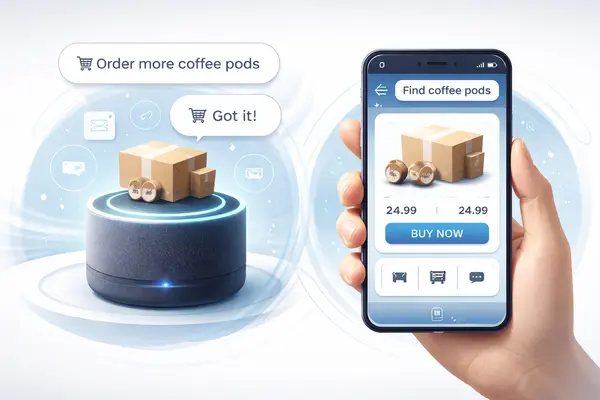
- AI Search & Smart Assistants: Google is launching UCP-powered shopping in its new AI search mode and Gemini app. Soon, when you search for a product in Google AI Mode, you can buy directly in the chat window. (For example, Target announced that shoppers will soon be able to browse and buy Target products right inside the Google Gemini app and Search AI Mode.) Google’s AI integrates with the Universal Commerce Protocol to enable seamless, agentic commerce actions across Google’s AI surfaces and shopping platforms, facilitating direct purchases and post-purchase support within AI-enhanced search environments. Similarly, Microsoft Copilot (in Bing and Windows) has enabled Copilot Checkout, an in-chat purchase feature for select retailers.
- Conversational Surfaces: Any app or device that can chat can also become a storefront. For instance, Google’s Business Agent lets users ask questions in Search and buy from a brand’s inventory without leaving the results page. The same could happen in messaging apps, voice assistants (like Alexa/Siri with shopping features), social media chatbots, or even productivity tools with AI assistants. The broad idea is that every place you can converse with an AI might one day handle commerce.
- Embedded E-commerce Tools: Companies are integrating shopping into tools people already use. Shopify’s “Agentic Storefront” concept means a brand can use Shopify’s backend to sell on AI channels even if it doesn’t have a Shopify website. That way, a retailer’s products and checkout live in Shopify but can be accessed by agents anywhere. Other commerce platforms (and payment partners like Stripe, PayPal, etc.) are also building UCP support so that AI agents have lots of stores to connect to.
In practice, this means AI commerce isn’t limited to one app. We’ll see it in search engines, voice assistants, chat apps, social media feeds – essentially any interface where people are asking questions or browsing interactively. For example, Google mentions “discovering and buying to post-purchase support” on any channel (search, shopping graph, etc.) and partners like Walmart, Etsy, Wayfair and Visa are involved. Major retailers such as Best Buy and Home Depot are also supporting or endorsing UCP, further expanding the protocol’s reach. Additionally, leading payment providers including American Express, Mastercard, and Stripe are collaborating with UCP to enable secure and efficient agentic commerce solutions across platforms and retail ecosystems. The key point: UCP is already being used by major players (Google, Shopify, Microsoft, retailers) to turn AI UIs into shopping surfaces.
How Agentic Checkout Looks in Practice
One concrete example of UCP in action is Microsoft’s Copilot Checkout. This feature lets customers buy products directly inside the Copilot chat (e.g. in Bing or Windows) without redirecting to the store’s site. Under the hood, Copilot Checkout uses a protocol like UCP to communicate with the retailer’s system. When you choose to pay, the agent calls the merchant’s checkout endpoint (via UCP) to submit the order. Importantly, this happens in an embedded frame in Copilot, so the entire experience stays in the conversation window.
From the merchant’s perspective, nothing magical happens: the sale is processed by their own checkout logic, and they remain the merchant of record. Microsoft states that “you stay the merchant of record. You own the transaction, the customer data, and the relationship” with customers who buy via Copilot. This means the merchant still sets the price, payment acceptance, shipping rules, and so on – the AI is simply filling in and submitting the order. For example, Urban Outfitters and Ashley Furniture announced they will use Copilot Checkout to sell in Bing. Shopify says: “If you’re on Shopify, you’ll automatically be able to sell in Copilot Checkout – no integration needed”.
Another example is coming from Google: Shopify merchants will soon be able to sell directly in Google Search’s AI Mode and the Gemini app using UCP. This “direct shopping” feature will use Google Pay behind the scenes, and again retailers remain the seller of record. (Customers will tap or click to buy in the Google interface, but the order will be owned by the original retailer.)
The pattern is consistent: the AI interface invokes the merchant’s checkout without losing any store-specific logic. The agent acts like a friendly front-end, but fulfillment, inventory, pricing, and post-sale support stay under the merchant’s control. This model – embedded checkout with UCP – is the opposite of third-party marketplaces. The brand does not hand off its customers to a new platform; it simply enables the agent to carry out its own checkout flow as if it were another channel.
Merchant Control vs. Agent Actions
UCP explicitly preserves merchant control over core business rules. In an agentic purchase:
- Merchants keep control of products and policies. The merchant decides what to sell, at what price, and under what conditions. All product data (images, descriptions, variants, pricing) still comes from the merchant. Likewise, shipping options, return policies, tax calculations, loyalty programs, subscriptions and discount codes are defined by the merchant’s backend. These rules are passed to the agent in UCP messages, but the merchant authored them. For example, “your discount codes, shipping rules, taxes, and loyalty settings still apply – even if the purchase happens through an AI interface”.
- Merchants remain merchant of record. The agent never replaces the checkout host. The retailer still processes the payment (via their payment gateway) and delivers the product. As noted earlier, with Copilot Checkout the retailer “owns the transaction, the customer data, and the relationship”. This also means the retailer is responsible for packing, shipping, and support. The AI agent simply initiates the order; fulfillment happens on the merchant’s side just like any normal order.
- Agents control selection and timing. The AI agent’s job is to find the right products and execute the purchase when the customer wants. The agent chooses the items (based on the conversation), decides when to hit “checkout,” and can even submit multiple payment attempts with the user’s saved methods if needed. However, the agent cannot override merchant constraints. It cannot, for example, promise a faster ship date than the merchant allows, or apply a discount that is not valid. It simply reads those constraints from UCP data and respects them. If a step requires human input – say the store requires the customer to pick a delivery date or upload a custom print file – the protocol includes a “continue” URL. The agent hands control back to the customer at exactly the right step in the merchant’s original interface. The customer finishes those steps, and UCP is designed so the agent can rejoin or complete the order afterward.
In short, UCP lets agents do the shopping work, but merchants keep the business logic. Pricing, inventory, branding, shipping options and after-sale service all stay with the merchant. The agent handles searching, decision support, and pushing through the checkout in the background, under the merchant’s pre-set terms.
The Universal Commerce Protocol is a new way for AI and stores to work together. It turns AI assistants into active shopping agents while keeping merchants fully in control of their business. As this standard rolls out, expect to see AI-powered checkout in many places – but always with the merchant managing pricing, shipping, and fulfillment on the backend.
UCP Roadmap and Future Development
The Universal Commerce Protocol is not a static solution – it’s a living, evolving standard designed to keep pace with the rapidly changing world of commerce. The UCP roadmap is packed with innovative features aimed at enhancing both the merchant and consumer experience. Upcoming developments include support for multi-item carts, seamless account linking for loyalty and rewards programs, and advanced post-purchase support, all of which will make the shopping journey even more streamlined and personalized.
As UCP continues to grow, its open-source foundation and collaborative development process ensure that it remains responsive to the needs of the entire commerce ecosystem. Industry leaders, merchants, and technology partners are all contributing to the protocol’s evolution, helping to shape the next generation of universal commerce. By joining the UCP ecosystem, businesses can future-proof their operations, offer cutting-edge shopping experiences, and ensure they’re never left behind as the industry moves forward. For consumers, this means more choice, convenience, and support at every stage of the purchase journey – heralding a new era in the future of commerce.
Frequently Asked Questions
Is this live yet?
UCP itself was announced in January 2026 and the first agentic shopping features are just rolling out. Google has said UCP will power “native shopping on Google Search and Gemini” soon. Microsoft’s Copilot Checkout is in limited US rollout for Shopify merchants. In practice, expect pilot programs and staged launches in 2026. It’s not fully widespread yet, but it’s already real – major players are integrating it now.
Do merchants lose customer ownership?
Not at all. UCP is designed so that the merchant stays the seller. In every agentic purchase, the retailer remains the merchant of record. This means the store gets the money, owns the order data, and keeps the customer for marketing/loyalty. The AI is only a guided interface, not a third-party middleman. Shopify’s announcement explicitly notes that merchants “retain sovereignty” and continue to own the checkout experience.
Does this replace my website or store?
No. Agentic commerce is an additional channel, not a substitute for your site. Customers will still visit the merchant’s website for trust, content, and richer experience. UCP is more like SEO or advertising: it helps your store appear in new places (AI chats, searches) but it doesn’t eliminate your own store. The Shopify team emphasizes that websites will remain important for branding and customer education. Think of UCP as letting more doors open to your store via AI, but you still need your storefront.
Is Shopify required to participate?
No. UCP is an open industry standard. Any merchant or platform can adopt it. Shopify is one founder and provides tools (even letting any brand use Shopify’s backend to get agentic exposure), but it’s not mandatory. In fact, by design “UCP isn’t locked to Shopify” – the whole e-commerce ecosystem can adopt it. Google, Mastercard, Visa, Stripe and others are already on board too. You don’t have to use Shopify; you just need your platform or an app/plugin to speak the UCP.
Written By:

Indy Pereira
Indy Pereira helps ecommerce brands optimize their shipping and fulfillment with Cahoot’s technology. With a background in both sales and people operations, she bridges customer needs with strategic solutions that drive growth. Indy works closely with merchants every day and brings real-world insight into what makes logistics efficient and scalable.
Turn Returns Into New Revenue
Related Articles
Amazon FBM Prepaid Return Labels What Changes December 18 and What Sellers Should Do
Starting December 18, 2026, covered US seller-fulfilled Amazon returns require a prepaid return label, and heavy and bulky items are temporarily excluded, according to a seller not...
Which SKUs Should Not Be in Seller Fulfilled Prime?
Seller Fulfilled Prime SKUs are the individual products an Amazon seller chooses for SFP based on whether each one can protect both the Prime promise and the seller’s margin.
Prime Day 2026 Results: What Ecommerce Sellers Should Learn from the Numbers
Prime Day 2026 started on June 23 at 12:01 a.
BFCM 2025 Exposed the Gap Between Brands Built for Growth and Brands Built for Scale
In this article
8 minutes
- Introduction
- Growth vs. Scale: What’s the Difference in Ecommerce?
- Why BFCM Exposes the Difference
- The Growth Trap: What Happens When Volume Outpaces Operations
- What Scalable Ecommerce Operations Look Like During BFCM
- The Metrics That Reveal Whether You’re Built for Scale
- How to Prepare for BFCM 2025 Without Breaking Your Business
- Conclusion: BFCM 2025 Will Reward Scale, Not Just Growth
- Frequently Asked Questions
Introduction
Black Friday Cyber Monday (BFCM) is no longer simply a seasonal sales spike—it has become a stress test for whether an ecommerce business is built for real growth or sustainable scale. Many ecommerce brands drove unprecedented sales through paid acquisition and promotional volume in 2020–2024, only to discover that scaling demand without scalable fulfillment, inventory, and shipping infrastructure produces customer friction, operational chaos, and margin destruction.
BFCM 2025 is expected to amplify this divide. Some brands will win not because they sell more, but because they can fulfill more profitably, reliably, and without breaking. Others will chase top-line growth only to experience out-of-stocks, carrier failures, late deliveries, refund requests, and return waves that erase their gains.
This article explains the fundamental difference between growth and scale in ecommerce, and how BFCM exposes which companies have truly built a scalable operation. We’ll break down common failure modes, key scaling metrics, and the operational strategies that allow brands to win the biggest shopping weekend of the year—without sacrificing customer experience or margins.
Growth vs. Scale: What’s the Difference in Ecommerce?
In ecommerce, growth means increasing demand—more orders, more customers, more revenue. Growth is typically fueled by marketing: paid ads, promotions, affiliate traffic, influencer campaigns, email blasts, and marketplace expansion. Growth is a top-line outcome.
Scale is different. Scale means your operation can handle more volume without a proportional increase in cost, complexity, or risk. Scaling is an operational outcome: it depends on fulfillment processes, inventory positioning, shipping strategy, systems integration, warehouse capacity, and return handling. Scale is the ability to grow profitably and consistently.
Many brands confuse the two. They assume that revenue growth equals business maturity. But BFCM reveals the truth: growth is easy to buy; scale must be built.
A simple way to think about it:
- Growth = more demand
- Scale = more volume with fewer problems
A business that grows without scaling becomes fragile. BFCM is when fragility turns into failure.
Why BFCM Exposes the Difference
BFCM creates a convergence of pressure points:
- Order volume spikes in 72 hours
- Carrier networks become congested
- Inventory accuracy matters more than ever
- Customer expectations for fast shipping increase
- Returns volume accelerates immediately after delivery
These conditions do not simply test marketing. They test the entire business system. If fulfillment is underbuilt, BFCM will overwhelm it. If inventory is mis-positioned, shipping becomes expensive and slow. If carrier strategy is weak, delivery promises collapse. If returns workflows are immature, the post-BFCM return wave becomes operational debt that drags into Q1.
Brands that are built for scale experience BFCM differently. They still feel the pressure, but they have designed systems to absorb it. Their operations do not break when demand spikes. They ship reliably. They protect margins. They deliver a customer experience that strengthens loyalty instead of damaging trust.
The Growth Trap: What Happens When Volume Outpaces Operations
Many ecommerce brands enter BFCM with a “growth-first” mindset. They focus heavily on driving demand and assume fulfillment will “figure it out.” This often produces predictable failure modes:
1. Stockouts and Inventory Inaccuracy
High-velocity demand exposes weak inventory controls. If your inventory system is not real-time and accurate, BFCM will cause:
- Overselling products that are not actually available
- Cancellations that harm marketplace performance and customer trust
- Backorders that create support tickets and refund requests
Brands built for scale use distributed inventory, tight sync, and demand forecasting. Brands built for growth alone often rely on a single node or manual inventory updates that fail under pressure.
2. Fulfillment Backlogs and Late Shipments
BFCM exposes whether your warehouse operations can handle surge throughput. Growth-first brands often face:
- Picking bottlenecks and packing shortages
- Staffing gaps and overtime cost explosions
- Orders that ship days late, missing marketplace SLAs
Late fulfillment does not just cost money—it destroys customer experience during the most visible moment of the year.
3. Margin Erosion from Panic Shipping
When orders are late or inventory is mis-positioned, brands often respond by upgrading shipping services to “save” delivery dates. This results in:
- Expedited shipping costs that wipe out promotional margins
- Zone 7/8 shipments from a single warehouse that drive cost inflation
- High surcharge exposure during peak carrier pricing windows
Brands that scale intentionally design fulfillment networks to avoid panic shipping. They route orders dynamically and position inventory closer to demand.
4. Customer Support Overload
Late shipments, stockouts, and unclear delivery promises generate customer contact volume. Growth-first brands often underestimate how fast support costs rise when operations break. The result is:
- Escalating ticket volume and response delays
- Negative reviews that permanently impact conversion
- Refund requests and chargebacks that compound margin loss
During BFCM, customer expectations are high. Failure is amplified, and damage lasts beyond the weekend.
What Scalable Ecommerce Operations Look Like During BFCM
Brands built for scale do not rely on heroics. They rely on systems. During BFCM, scalable operations show up in predictable ways:
1. Distributed Inventory and Smart Order Routing
Scalable brands avoid single-node fulfillment. They position inventory across multiple locations and use intelligent routing to ship from the best node based on:
- Customer location
- Inventory availability
- Carrier cost and performance
- Delivery promise requirements
This reduces shipping zones, lowers cost, and increases delivery speed without upgrading services.
2. Throughput-Ready Warehouse Processes
Scalable brands engineer fulfillment workflows so that doubling volume does not double complexity. They invest in:
- Batch picking and wave planning
- Pre-built kits and standardized packaging
- Labor planning and surge staffing readiness
- Automation where it matters (shipping, labeling, routing)
They do not wait until BFCM to discover bottlenecks.
3. Carrier Strategy Built for Peak Season
Scalable brands plan for peak pricing and congestion. They diversify carriers, monitor surcharge exposure, and avoid last-minute upgrades. Their shipping strategy includes:
- Multi-carrier rate shopping
- Fallback services when one network slows down
- Clear customer delivery promises that match reality
Scale means shipping remains predictable even when carrier networks are not.
The Metrics That Reveal Whether You’re Built for Scale
BFCM is when ecommerce metrics stop being theoretical and become real. The brands that scale are the ones that can maintain performance under pressure. Key indicators include:
- On-time shipment rate (did orders ship within promised windows?)
- On-time delivery rate (did customers receive orders when promised?)
- Cost per order shipped (did shipping costs spike under pressure?)
- Out-of-stock rate (did inventory accuracy survive demand spikes?)
- Customer contact rate (did support load stay stable?)
- Return processing time (did reverse logistics create post-BFCM operational debt?)
Brands built for growth alone often see these metrics collapse during BFCM. Brands built for scale stabilize them, even under high volume.
How to Prepare for BFCM 2025 Without Breaking Your Business
Preparing for BFCM is not just about launching a promotion. It is about ensuring the business system can survive the demand you create. Key preparation strategies include:
1. Forecast Demand and Stress Test Capacity
Forecast volume based on last year’s performance, growth rate, and planned marketing spend. Then compare forecast demand to:
- Warehouse throughput capacity
- Carrier pickup and transit capacity
- Inventory availability and replenishment lead times
If forecast demand exceeds capacity, growth will produce failure. Adjust accordingly.
2. Strengthen Inventory Positioning
Inventory that is positioned poorly becomes expensive and slow to ship. Prepare by:
- Splitting inventory closer to demand regions
- Using networked fulfillment to avoid zone inflation
- Improving inventory accuracy and real-time sync
BFCM is not the time to discover your inventory counts are wrong.
3. Build a Carrier Playbook
Carrier performance and peak surcharges shift quickly during BFCM. Build a playbook that includes:
- Primary and backup carriers by service level
- Surcharge exposure monitoring
- Rate shopping and dynamic carrier selection
- Customer messaging when networks slow down
Scale requires redundancy. Growth-only operations often have none.
Conclusion: BFCM 2025 Will Reward Scale, Not Just Growth
BFCM is not just a revenue event. It is an operational truth test. Brands that chase growth without scaling will generate volume they cannot fulfill profitably. Brands that have built scalable systems will win not only with revenue, but with customer loyalty, stronger margins, and repeat demand into Q1.
The difference is not marketing. It is operational maturity. BFCM 2025 will amplify this divide between ecommerce businesses built for growth and those built for scale—and the brands that invest in scalable fulfillment, inventory positioning, and shipping strategy will be the ones that emerge stronger.
Frequently Asked Questions
What is the difference between growth and scale in ecommerce?
Growth is increasing demand and revenue, often through marketing and promotions. Scale is the ability to handle increased volume without proportional increases in cost, complexity, or operational risk.
Why does BFCM expose operational weakness?
BFCM concentrates high volume, tight delivery expectations, carrier congestion, and inventory volatility into a short time window. Weak fulfillment, inventory, and shipping systems break under that pressure, leading to late shipments, margin loss, and customer dissatisfaction.
What metrics should ecommerce brands track during BFCM?
Key metrics include on-time shipment rate, on-time delivery rate, cost per order shipped, out-of-stock rate, customer contact rate, and return processing time.
How can ecommerce brands prepare for BFCM without destroying margins?
Brands can prepare by forecasting demand, stress testing fulfillment capacity, distributing inventory closer to demand, improving inventory accuracy, building a multi-carrier shipping strategy, and developing an operational playbook for surge conditions.
What sources were leveraged for BFCM 2025 metrics?
The Black Friday Cyber Monday 2025 metrics referenced in this article were sourced from publicly available Shopify disclosures, including Shopify’s official Newsroom recap and Shopify’s Investor Relations press release. A syndicated version of the same release distributed via Nasdaq was used for cross-verification.
- Shopify Newsroom BFCM 2025 recap: https://www.shopify.com/news/bfcm-data-2025
- Shopify Investor Relations press release: https://shopifyinvestors.com/media-center/news-details/2025/Shopify-Merchants-Achieve-Record-Breaking-14-6-Billion-in-Black-Friday-Cyber-Monday-Sales/default.aspx
- Nasdaq syndicated press release: https://www.nasdaq.com/press-release/shopify-merchants-achieve-record-breaking-146-billion-black-friday-cyber-monday-sales
Written By:
Rinaldi Juwono
Rinaldi Juwono leads content and SEO strategy at Cahoot, crafting data-driven insights that help ecommerce brands navigate logistics challenges. He works closely with the product, sales, and operations teams to translate Cahoot’s innovations into actionable strategies merchants can use to grow smarter and leaner.
Turn Returns Into New Revenue
Related Articles
Amazon FBM Prepaid Return Labels What Changes December 18 and What Sellers Should Do
Starting December 18, 2026, covered US seller-fulfilled Amazon returns require a prepaid return label, and heavy and bulky items are temporarily excluded, according to a seller not...
Which SKUs Should Not Be in Seller Fulfilled Prime?
Seller Fulfilled Prime SKUs are the individual products an Amazon seller chooses for SFP based on whether each one can protect both the Prime promise and the seller’s margin.
Prime Day 2026 Results: What Ecommerce Sellers Should Learn from the Numbers
Prime Day 2026 started on June 23 at 12:01 a.
AI Tools for Ecommerce: Choosing the Right Tech to Stay Competitive
In this article
6 minutes
- Why AI in Ecommerce Is No Longer Optional
- The Power of Data in Ecommerce
- Key Areas Where AI Tools Drive Impact
- Evaluating the Right AI Tools for Ecommerce
- Adoption Challenges: Data Quality and Trust
- The Future: Generative AI in Ecommerce
- Why Adoption Matters More Than Experimentation
- Conclusion
- Frequently Asked Questions
Why AI in Ecommerce Is No Longer Optional
AI has become the hidden engine driving the ecommerce industry. From automated inventory management to personalized recommendations, AI tools for ecommerce are reshaping how online businesses operate. Walmart, Amazon, and Shopify have already made AI a core part of their strategies, which means independent ecommerce businesses need to adopt the right AI technology, or risk falling behind. OpenAI now supports shopping discovery through structured product feeds in ChatGPT, and Shopify product data is already integrated into ChatGPT through Shopify Catalog.
AI tools are no longer a futuristic add-on; they are essential for analyzing customer data, predicting demand, improving customer satisfaction, and staying competitive in a market dominated by giants. Sellers who fail to implement AI-powered solutions will find themselves reacting to market trends rather than shaping them.
The Power of Data in Ecommerce
Ecommerce runs on customer data: purchase history, browsing behavior, customer interactions, and even customer feedback. AI tools allow retailers to analyze this data at scale, transforming raw information into valuable insights. These insights power predictive analytics and personalized recommendations that drive customer engagement and loyalty.
For example, using natural language processing, an AI system can analyze customer reviews and social media posts to identify product issues before they spiral into bad ratings. Competitor pricing can also be tracked in real time, helping retailers adjust pricing strategies dynamically.
Key Areas Where AI Tools Drive Impact
Inventory Management
Poor inventory management leads to either excess costs or missed sales. AI-powered inventory management tools use historical sales data and market trends to forecast demand, ensuring retailers avoid both overstocking and stockouts. These systems adapt to consumer demand patterns and can even factor in seasonality and marketing campaigns.
Marketing Strategies
AI marketing tools automate content creation, generate SEO optimized product descriptions, and evaluate messaging performance. For ecommerce businesses competing with retailers that have entire AI-driven marketing departments, tools that improve campaign targeting and analyze customer behavior are essential.
AI also powers personalized marketing. By analyzing transaction patterns and purchase history, businesses can create tailored email marketing campaigns, targeted promotions, and personalized shopping experiences that boost conversion rates.
Customer Experience
Customer experience is now a key differentiator. AI-powered chatbots and virtual assistants deliver real-time customer service, reducing reliance on human customer service agents while still providing seamless support. Personalized shopping experiences powered by AI keep customers engaged and increase satisfaction.
For instance, AI tools can analyze customer preferences and browsing behavior to make real-time product recommendations. Retail websites that fail to offer this level of personalization risk losing customers to competitors who can.
Supply Chain Optimization
Supply chain analytics powered by AI improves operational efficiency across the retail value chain. From supply chain management to store operations, AI tools help forecast demand, optimize logistics, and lower costs. For ecommerce platforms managing complex supply chains, these solutions ensure better supply chain management and keep customers happy with faster, more reliable deliveries.
Evaluating the Right AI Tools for Ecommerce
Not every tool labeled “AI” provides value. Ecommerce businesses must evaluate AI tools carefully. Factors to consider:
- Seamless integration with existing ecommerce platforms
- User-friendly interface for non-technical teams
- Detailed analytics to drive data-driven decisions
- Proven track record with leading retailers
- Ability to ensure data quality and protect customer data
Retailers should test AI algorithms against real customer behavior data before fully implementing them. Evaluating AI tools also means comparing ROI across customer retention, sales growth, and operational efficiency.
Adoption Challenges: Data Quality and Trust
NRF says retail companies are using artificial intelligence systems to enhance the customer experience, accelerate product development and improve operational efficiency, and it now advocates a uniform, risk-based federal framework for AI.
AI adoption isn’t without friction. The data retailers rely on often comes from multiple sources, sales data, purchase patterns, social media platforms, and customer feedback. Ensuring data quality is critical. If the data is incomplete or biased, predictive analytics and machine learning algorithms won’t provide accurate insights.
Customer trust is another challenge. Consumers want personalized shopping experiences, but they don’t want to feel surveilled. Retail businesses must balance the use of customer insights with transparent policies around data usage.
The Future: Generative AI in Ecommerce
In March 2026, Amazon introduced a canvas experience in Seller Central that combines AI-powered chat with personalized visual workspaces so sellers can analyze data and take action in real time.
Generative AI is emerging as the next wave. Gen AI solutions are now capable of writing product descriptions, generating marketing messages, and even designing personalized promotions. Ecommerce platforms that leverage generative AI in content creation and marketing campaigns will have an advantage in producing large volumes of high-quality, SEO optimized content quickly.
Retail companies that adopt these tools now will be positioned to remain competitive as generative AI reshapes the ecommerce industry.
Why Adoption Matters More Than Experimentation
AI tools are only valuable if they’re implemented strategically. Too many ecommerce businesses experiment with pilots but fail to integrate AI deeply into their operations. Leading retailers like Amazon and Walmart aren’t just using AI for marketing, they’re embedding AI across store operations, supply chains, and customer engagement. In June 2025, Walmart announced Sparky, a GenAI assistant that synthesizes reviews, offers occasion-based recommendations, and helps customers plan, compare, and purchase with confidence.
Independent ecommerce sellers need to follow suit. Using AI-powered tools for ecommerce isn’t about chasing hype; it’s about survival in a marketplace where data-driven decision making, predictive analytics, and customer-centric strategies are now table stakes.
Conclusion
The ecommerce sector is being redefined by artificial intelligence. Sellers who embrace AI technologies, from predictive analytics and automated inventory management to AI-powered marketing and generative AI, will stay ahead of consumer demand and competitor pricing pressures. Those who hesitate risk irrelevance.
Adopting the right AI tools for ecommerce allows retailers to gain valuable insights, improve customer satisfaction, and remain competitive against giants like Walmart, Amazon, and Shopify. In the future retail landscape, AI won’t just optimize ecommerce operations, it will decide who survives.
Frequently Asked Questions
What are the best AI tools for ecommerce businesses?
The best AI tools for ecommerce include AI-powered chatbots, predictive analytics platforms, AI marketing tools, and automated inventory management solutions. These tools improve customer satisfaction, boost sales, and optimize retail operations.
How can AI improve customer satisfaction in ecommerce?
AI improves customer satisfaction by analyzing customer interactions, purchase history, and browsing behavior to deliver personalized shopping experiences, real-time customer service, and targeted promotions that meet customer preferences.
How does AI impact inventory management in ecommerce?
AI-powered inventory management tools analyze historical sales data and forecast future customer demand. This ensures ecommerce businesses avoid stockouts, reduce excess inventory, and adapt quickly to market trends.
What role does generative AI play in ecommerce marketing?
Generative AI helps ecommerce companies create product descriptions, social media posts, email marketing campaigns, and other marketing materials at scale. These tools allow retailers to optimize marketing strategies and remain competitive.
Why should ecommerce businesses adopt AI tools now?
Adopting AI tools now ensures ecommerce businesses remain competitive as the retail industry embraces artificial intelligence. Early adoption allows retailers to gain valuable insights, improve customer retention, and build sustainable growth strategies before competitors dominate.
Written By:

Jeremy Stewart
Jeremy Stewart leads customer success at Cahoot, helping merchants achieve high-performance logistics through smart technology and process optimization. With a background in both ecommerce operations and client services, Jeremy ensures that every merchant using Cahoot gets measurable results—whether they’re scaling from one warehouse to many or managing complex returns.
Turn Returns Into New Revenue
Related Articles
Amazon FBM Prepaid Return Labels What Changes December 18 and What Sellers Should Do
Starting December 18, 2026, covered US seller-fulfilled Amazon returns require a prepaid return label, and heavy and bulky items are temporarily excluded, according to a seller not...
Which SKUs Should Not Be in Seller Fulfilled Prime?
Seller Fulfilled Prime SKUs are the individual products an Amazon seller chooses for SFP based on whether each one can protect both the Prime promise and the seller’s margin.
Prime Day 2026 Results: What Ecommerce Sellers Should Learn from the Numbers
Prime Day 2026 started on June 23 at 12:01 a.