
ShipStation Automation Rules Explained: Where Shipping Automation Breaks Down

Shipping automation rules look like a solved problem until your order mix shifts, your catalog grows, or your carrier contracts change. At that point, rules you wrote six months ago start quietly costing you money or degrading service in ways that are hard to trace. This article explains how ShipStation automation rules work at a functional level, where the logic tends to break under real operating conditions, and what a more adaptive approach to shipping automation actually looks like.
What ShipStation Automation Rules Actually Do
At their core, ShipStation automation rules are conditional logic statements managed within your account settings. To create and manage automation rules, navigate to your account, click the Settings gear icon, select Automation, and choose Automation Rules from the dropdown menu. Each rule follows the same structure: if an order matches specific criteria, then apply a defined action. Automation rules in ShipStation are actions that you want to apply to a set of orders that meet certain criteria, helping save time and improve efficiency.
The criteria side can draw on a wide range of order attributes: weight, dimensions, destination address type (residential vs. commercial), store of origin, product SKU, order tags, customer location, shipping service requested at checkout, and more. When setting up an automation rule, you must define the conditions (criteria) and actions for the rule, and you can set criteria based on order weight, address type, order tags, and other factors. Users must enter specific information into fields to define order criteria, such as weight, address type, or order tags. You can stack multiple criteria within a single rule, requiring that all conditions be met or that any one of them triggers the action.
To create a rule in ShipStation:
- Click ‘Create a Rule’ in the Automation Rules section of your account.
- Enter the rule name.
- Select the field and order criteria (such as weight, address type, or tags).
- Define the actions that should be applied when orders match the criteria.
The rules you can create include those that match specific order criteria, such as weight or destination, and the rule will apply when orders match those criteria.
The action side covers the most operationally significant shipping decisions. Common actions include:
- Assigning a carrier and service level, for example routing all orders under one pound to USPS Ground Advantage instead of USPS Priority Mail
- Setting a package type, such as applying a flat-rate envelope to orders matching specific weight and dimension thresholds
- Setting carrier, service, and package type (service and package type) combinations based on order attributes (set carrier service package)
- Adding or removing order tags to flag orders for manual review, holding, or downstream workflow steps
- Placing orders on hold, which pauses them from progressing to label creation
- Combining or splitting shipments when multiple orders share the same address
- Applying a shipping preset that bundles carrier, service, package type, and special service selections together
Shipping options can be automated based on things like order weight, address type, and tags, and automation rules can help select the cheapest shipping option for each order. Automation rules can automate actions based on specific criteria to streamline the shipping process and can automate almost any shipping-related task for online stores.
Rules execute in a defined sequence and can be ordered by priority, so rule conflicts get resolved by whichever rule has higher precedence in the stack.
This is functional, well-understood logic for routine operations. The problem is not the mechanism. The problem is what happens to that mechanism when the operating environment changes and the rules do not, which is why many ecommerce brands are turning to next-generation ecommerce shipping software for warehouse automation that can adapt to changing conditions without constant manual reconfiguration.
Where Static Rules Break Down
Order weight and dimension drift
Most automation rules that determine carrier and service selection are weight-based. For example, a rule might say: orders under 15 ounces go via USPS Ground Advantage; orders between 15 ounces and 2 pounds go via USPS Priority Mail; orders above 2 pounds go via a regional carrier. Using USPS First Class Mail for shipments under one pound is a common automation rule to save on shipping costs. Automation rules can be set to apply different shipping services for specific weight ranges, such as USPS Ground Advantage for orders under 16 oz and Priority Mail for heavier shipments. Automation rules can apply a specific shipping service based on the weight of the order, and weight-based shipping rules automatically assign carriers based on item weight.
That logic works until your supplier changes packaging, you add a bundle SKU, or a promotional period drives a different order mix than what the original thresholds were built around. Suddenly a meaningful share of orders that qualified as “lightweight” no longer do, and they get routed to Priority Mail at a cost 40% to 60% higher than necessary. No one gets an alert. The rule fires as designed. The bill just grows.
Address type misclassification
Residential and commercial address surcharges are significant cost variables with UPS and FedEx. Address type fields are used within shipstation automation rules to determine whether an address is residential or commercial, and this field can directly impact the shipping rate applied. Some shipping carriers offer different rates based on whether an address is residential or commercial, making accurate classification in the address type field critical. Rules that rely on address type fields often fire on the address classification as entered by the customer or pulled from the store, not on verified carrier data. When a customer enters a business address without the suite number, or enters a home address that was never verified against a carrier database, the surcharge applied at shipping can contradict the rule that was written to prevent it.
The rule creates false confidence. The actual charge on the carrier invoice reflects reality, not what the rule assumed.
Service level overspend as orders scale
A common configuration pattern is to default to a faster or more expensive service level as a fallback when no other rule matches. In these cases, this rule will apply, leading to potential overspend as orders are routed to the default option. The fallback rate is the percentage of orders that route to a catch-all or default rule rather than a specifically defined rule. ShipStation automation rules can be reordered to ensure the most important rules take precedence and reduce the fallback rate.
For a brand doing 200 orders a month, overspending on 15 fallback orders is a rounding error. For a brand doing 5,000 orders a month, that same failure rate in the rule stack might mean 375 orders per month routing to USPS Priority Mail when USPS Ground Advantage or a regional carrier would have delivered on time at a lower cost. At $2 to $4 of avoidable cost per order, that is $750 to $1,500 per month of silent waste that never shows up as a line item anywhere, which makes understanding your ecommerce order fulfillment costs and pricing structure critical when evaluating the true impact of automation decisions.
Rule conflicts and ordering problems
As rule stacks grow, conflicts between rules become more likely. A rule that applies a specific carrier to all orders over 5 pounds may conflict with a rule that applies a different service to all orders destined for a specific state. Depending on rule ordering, one wins and the other becomes irrelevant for that order segment, which may or may not be the intended behavior.
To efficiently manage complex rule sets, ShipStation allows you to create a copy of an existing automation rule. This makes it easy to build a series of similar automation rules by copying and then modifying specific criteria, helping you tailor each rule to different conditions or requirements.
Operators who inherited a rule stack from a predecessor, or who accumulated rules over many months without documentation, often cannot confidently explain what every combination of order attributes will produce at runtime. The rule stack becomes a black box that mostly works, which is exactly the condition that allows silent errors to persist.
Tagging and holds as manual work amplifiers
Tags and holds are genuinely useful when they are well-defined and actively maintained. Automation rules can use order tags as criteria to determine shipping services, and tags like ‘VIP’, ‘Fragile’, or ‘Gift’ can trigger further rules for handling orders based on customer history or item type. You can use tags to create automation rules that apply to specific products or customer orders in ShipStation. For example, if an order includes a specific tag such as ‘Rush’ or ‘Fragile’, a rule can be set so that the order is shipped using a particular method, like upgrading to Priority Mail. Order tagging for priority can assign tags like ‘Rush’ to ensure specific orders are processed first, and tags can be used in automation rules to determine shipping methods based on product types or customer preferences.
A rule that tags all international orders for manual review is helpful when the team has a clear process for what to do with that tag. But as the business changes, some holds become orphaned. Tags accumulate without clear meaning. The team reviews flagged orders as a habit without asking whether the tag still represents a real decision point.
In practice, many ecommerce operations teams using rules-based holds and tagging systems spend meaningful time each week processing flags that exist because no one audited the rule that created them after the underlying condition it was meant to address was resolved.
The Edge Case Problem
Rules are written for the expected. Real orders surface the unexpected.
Common edge cases that create exceptions and rework in rules-based shipping automation include:
- Multi-item orders where individual items qualify for different service rules but the combined weight or dimensions push the shipment into a different category
- Orders containing a mix of in-stock and backordered items where the split shipment logic was not anticipated by the rule set. As a step to handle complex orders, the Auto-Split feature can automatically create separate shipments for orders containing both warehouse-stocked and drop-shipped items.
- Address corrections that happen after a rule has already fired and assigned a service, requiring manual override
- Carrier-specific restrictions that are not encoded into the rule, such as USPS restrictions on certain product categories, service availability gaps by zip code, or size limits that the rule does not check
- PO Box and military address routing that requires USPS but conflicts with a weight-based rule that would otherwise send the order to a regional carrier that cannot serve those addresses
- Saturday or holiday delivery scenarios where the selected service does not actually provide the delivery date the rule was designed to guarantee
As another step to optimize shipping, orders can be routed to the closest warehouse based on the customer’s state or zip code to reduce shipping costs and transit time.
In the context of exception handling, you can automate the addition of a tax identifier number to orders based on destination requirements.
Each of these edge cases requires either a human to catch it in review, an additional rule to handle it, or an automation system capable of evaluating more context than a static rule set can hold. Many of these exceptions mirror broader carrier shipment exceptions and how to fix them fast, where address issues, delivery failures, or customs holds create downstream rework and customer friction. To improve your shipstation automation rules, always test your automation rules with sample orders to identify edge cases and update your rules accordingly.
The more SKUs and order types an operation manages, the higher the edge case rate. Operations leaders running multi-SKU catalogs across multiple sales channels frequently find that their rule stacks require ongoing attention just to maintain baseline performance, let alone improve it.
Why Auditing and Rule Governance Matter
The operational discipline most commonly missing from ecommerce shipping automation is not rule-writing. It is rule review—and the use of multi-carrier shipping software for ecommerce that can automatically validate addresses, compare rates, and reduce the number of brittle, manually maintained rules you rely on.
A rule that was correct when written can become incorrect as the business changes. Carrier rates change. Product weights change. Customer geography shifts. Promotional periods alter the typical order composition. None of these changes automatically invalidate a rule or generate an alert that the rule may now be producing suboptimal outcomes.
Effective rule governance means treating the automation rule stack as a living document, not a one-time configuration. In practice, this involves:
- Reviewing rule performance at defined intervals, at minimum quarterly, against actual shipping cost data
- Tracking the fallback rate, meaning the percentage of orders that route to a catch-all or default rule rather than a specific defined rule, and investigating when that rate rises
- Comparing the carrier and service distribution the rule stack produces against what an optimal routing decision would have produced given actual order attributes and carrier rates at the time
- Documenting the intent behind each rule, not just its logic, so that future changes can be evaluated against whether the original condition still applies
- Assigning ownership of the rule stack to a specific person or team so audits actually happen
When creating a new rule, you can also create a copy of an existing automation rule to make a series of similar rules, which can then be saved and updated as your business needs change. Whenever you make changes to rules, it is important to save and update the rule stack to ensure that each new rule is applied correctly and that your shipping automation remains effective.
Without this governance structure, most rule stacks drift. They become increasingly accurate for the order profile that existed when they were written and increasingly inaccurate for the order profile that exists today.
How More Adaptive Automation Reduces Cost and Errors
Static rules are limited because they encode logic once. The operating environment changes continuously. The gap between those two facts is where cost leaks and service failures live, especially when carriers introduce changes like UPS and FedEx dimensional weight policy updates that instantly alter the real cost of many packages.
More adaptive shipping automation approaches the problem differently. Instead of encoding fixed thresholds that apply regardless of current conditions, adaptive systems evaluate each order against live inputs: current carrier rates, actual delivery performance data by zone and service level, available inventory locations, and SKU-level cost-to-serve targets. Solutions like Cahoot’s ecommerce order fulfillment services that outclass traditional 3PLs pair this kind of cost-aware routing with fast 1–2 day delivery from a distributed network. Shipping automation rules can help adjust shipping settings based on order criteria such as weight and destination, ensuring that actions are only triggered when orders match specific parameters.
The practical difference shows up in a few specific ways.
Service selection based on actual rate cards, not fixed tiers. A static rule assigns USPS Ground Advantage to orders under 15 ounces. An adaptive system checks the actual rate for that specific weight, destination zip, and package dimensions and compares it across available services before selecting the lowest-cost option that meets the delivery commitment. As carrier rates change mid-contract or as dimensional weight calculations shift, the selection adjusts automatically. Adaptive systems can update order information with real-time rates to optimize shipping costs.
Routing decisions that incorporate inventory location. A rule-based system typically assigns a carrier and service based on order attributes alone, without knowing where inventory actually sits. When a brand operates multiple warehouse nodes, the fulfillment location changes the shipping zone and therefore the cost and transit time of any given carrier service. An order that should route to USPS Ground Advantage from a Chicago node might need USPS Priority Mail from a Los Angeles node to hit the same delivery date. Static rules cannot hold that context. Multi-node automation that connects fulfillment location to routing decisions can, as seen in order fulfillment services built for ecommerce companies that leverage distributed inventory to keep transit times short and costs low.
Exception handling without manual review queues. Rather than tagging orders with edge case attributes and routing them to a human, more capable automation systems can evaluate a broader set of conditions at decision time and resolve many exceptions programmatically. The hold queue shrinks because fewer orders need human judgment to proceed, similar to how Cahoot’s Amazon Buy Shipping integration for ecommerce order fulfillment automates label creation and tracking updates to reduce error-prone manual steps.
Ongoing cost-to-serve visibility. Adaptive systems generate audit trails that let operators see, at the order level, why a specific routing decision was made and what it cost relative to alternatives that were considered. This makes both auditing and optimization practical rather than aspirational, particularly when combined with a peer-to-peer order fulfillment service that outperforms legacy 3PLs by enforcing consistent operational standards across a distributed network.
Automation rules can help streamline the shipping process by applying specific actions to orders that match defined criteria, reducing manual intervention and improving efficiency. This kind of automation also makes it easier to adapt when marketplaces tighten expectations, such as Amazon’s new shipping and delivery policies for sellers that demand higher on-time performance and shorter transit commitments.
This is where Cahoot’s approach to shipping automation differs from a rules stack maintained by an operator. Cahoot applies cost-aware routing logic across network nodes, adjusting decisions as carrier rates, inventory positions, and order attributes change, without requiring operators to manually maintain the rules that govern those decisions. The goal is to eliminate the operational overhead of rule governance while keeping the cost and service outcomes that good automation is supposed to produce in the first place.
Frequently Asked Questions
What are ShipStation automation rules?
ShipStation automation rules are conditional logic configurations that automatically apply shipping decisions to orders based on defined criteria. When an order matches the conditions in a rule, ShipStation executes the corresponding action, such as assigning a carrier and service level, adding a tag, setting a package type, or placing the order on hold. Rules can be stacked and prioritized to handle different order scenarios without manual intervention on each order.
What types of actions can ShipStation automation rules perform?
The most common actions include assigning a specific carrier and service such as USPS Ground Advantage or USPS Priority Mail, setting a package type, adding or removing order tags, placing orders on hold for manual review, applying a preset configuration that bundles multiple settings, and combining or splitting shipments that share a destination address.
Why do ShipStation automation rules break down over time?
Static rules are written to reflect the order mix, carrier rates, and product weights that exist at a specific point in time. As any of those inputs change, the rules can produce suboptimal or incorrect routing decisions without generating any visible error. Common causes of rule degradation include changes in product weights or packaging, catalog expansion that introduces SKUs with different shipping profiles, shifts in customer geography that alter the typical destination zone, and carrier rate changes that make a previously correct service selection more expensive than alternatives.
How does automation overspend on shipping service levels?
Overspend typically occurs when a default or fallback rule assigns a faster, more expensive service level to orders that no other rule specifically addressed. At low order volumes this cost is minimal. At scale, even a 5% to 10% fallback rate across thousands of orders per month can produce significant unnecessary spend, particularly when the fallback is USPS Priority Mail for orders that would have arrived on time via USPS Ground Advantage or a regional carrier.
What is a shipping rule fallback rate and why does it matter?
The fallback rate is the percentage of orders that route to a catch-all or default rule rather than a specifically defined rule. A rising fallback rate typically signals that the rule stack has not kept pace with changes in order composition. Monitoring fallback rate as a regular metric helps operators identify when their rule stack needs review before the cost impact accumulates.
What are the most common edge cases that break automation rules?
Common edge cases include multi-item orders where combined weight or dimensions push the shipment into a different category than individual item rules anticipated, orders with backordered items that create split shipment scenarios, PO Box and military addresses that require USPS but conflict with weight-based rules favoring other carriers, address corrections that happen after a rule has already fired, and carrier-specific restrictions on product categories or destination zip codes that the rule set does not check.
How often should shipping automation rules be audited?
At minimum, a rule stack review should happen quarterly. More frequent reviews, monthly or after any significant catalog, carrier contract, or promotional change, reduce the window during which degraded rules can accumulate cost. Audits should compare the carrier and service distribution the rule stack actually produced against what optimal routing would have produced for the same order set, not just check whether rules fired correctly.
What does adaptive shipping automation do differently than static rules?
Adaptive shipping automation evaluates each order against live inputs including current carrier rates, actual delivery performance data, and available inventory locations, rather than fixed thresholds encoded at a point in time. This allows routing decisions to adjust as carrier rates change, as inventory positions shift across warehouse nodes, and as order attributes fall outside the scenarios that static rules were written to handle. The result is lower ongoing cost-to-serve and fewer exceptions requiring manual resolution.
How does multi-node fulfillment change shipping automation requirements?
When inventory is held at multiple warehouse locations, the optimal carrier and service selection for a given order depends on which node will fulfill it, because the shipping zone from that node to the destination address determines both cost and transit time. Static rules that assign a service without knowing fulfillment location can produce accurate-looking decisions that are actually wrong once inventory position is factored in. Automation that connects fulfillment routing to carrier selection can capture the cost savings available from distributing inventory closer to demand concentrations.
Written By:

Rinaldi Juwono
Rinaldi Juwono leads content and SEO strategy at Cahoot, crafting data-driven insights that help ecommerce brands navigate logistics challenges. He works closely with the product, sales, and operations teams to translate Cahoot’s innovations into actionable strategies merchants can use to grow smarter and leaner.

Turn Returns Into New Revenue

Related Articles

Top 12 Shipping Strategies For Making Free Shipping Profitable
For ecommerce sellers, shipping is more than just getting a package from point A to point B — it’s the invisible backbone, quietly shaping customer satisfaction, operational costs,...

Ecommerce Profit Leaks: The Hidden Ones That AI Is Finally Closing
Most ecommerce brands believe they understand their margins.

Why Cross-Border DTC Brands Are Moving Fulfillment Inside the US
Cross-border ecommerce fulfillment is the process of shipping ecommerce orders across national borders—often from warehouses outside the United States to U.
When SEO Optimization Creates Returns

In this article
 10 minutes
During Cahoot’s Ugly Talk: Selling in a World Run by Algorithms panel in New York, much of the conversation focused on how ecommerce brands adapt their product listings to perform well in discovery systems. Search engines and marketplace platforms rely heavily on structured signals—keywords, attributes, and descriptions—to determine which products appear when customers search.
Over time, ecommerce operators have learned how to shape their listings to match those signals, a process guided by search engine optimization (SEO) best practices. Product titles grow longer, feature lists become more detailed, and descriptions incorporate phrases that align with the language customers use when searching. Detailed, optimized product descriptions are especially important, as they help search engines better understand the products and enhance user engagement, ultimately improving rankings and visibility.
Incorporating phrases that align with customer language is crucial. Additionally, identifying and using trending keywords through tools like Google Trends or seasonal keywords to optimize your Amazon product listings helps ecommerce brands stay relevant in search results and capture seasonal or popular search traffic.
In many cases, this kind of optimization works exactly as intended. When a product listing better reflects how customers search, it becomes easier for algorithms to surface it. Visibility improves, more shoppers see the listing, and traffic increases.
But during the panel discussion, one moment highlighted a less obvious consequence of this process. The strategies used to improve discovery can sometimes create problems later in the customer experience—problems that only appear after the order has already been placed.
This article is part of a series inspired by Ugly Talk: Selling in a World Run by Algorithms, a live panel hosted by Cahoot in New York. The discussion brought together operators and technology leaders including Manish Chowdhary of Cahoot, Nihar Kulkarni of Roswell NYC, Frank Pacheco of Nearly Natural, and YiQi Wu of Aimerce.
Throughout the conversation, the panel explored how artificial intelligence, recommendation systems, and platform algorithms are changing how ecommerce brands compete for visibility and customers.
These ideas are part of a broader framework for understanding how AI is reshaping ecommerce. For a complete breakdown of how discovery systems, product pages, brand authority, behavioral data, and fulfillment infrastructure interact, see The AI Commerce Playbook for Ecommerce Brands.
The Pressure to Optimize for Search Engines
For ecommerce operators, the pressure to optimize listings for search algorithms is constant. Whether the product appears on Google, Amazon, or another marketplace, visibility often depends on how well the listing matches the phrases customers are searching for.
That reality shapes how product pages are written. Titles are expanded to include multiple keyword variations. Bullet points are adjusted to reflect common search queries. Features are described using the exact language shoppers type into search bars. However, it’s important to avoid keyword stuffing—overloading titles and descriptions with keywords can harm readability and search performance. Instead, focus on natural keyword integration to improve both user experience and search visibility.
All of these changes are designed to accomplish one goal: getting the product discovered.
And discovery matters. If a product never appears in search results, customers never have the opportunity to evaluate it. Effective ecommerce keyword optimization can significantly improve search engine rankings, but this must be balanced with clear, customer-friendly content.
But discovery is only the first step in the buying process. Once a shopper lands on a product page, the challenge changes entirely. At that point, the listing must help a human being understand what the product actually offers and whether it fits their needs.
When Keyword Research Shapes Expectations
During the panel discussion, one example illustrated how keyword optimization can sometimes influence customer expectations in unexpected ways.
A product listing had been updated to include a feature keyword that aligned with common search behavior. From an algorithmic perspective, the change worked. The listing became easier for discovery systems to surface, and the product began attracting more traffic. Effective keyword research can help ensure that only accurate and relevant keywords are used, reducing the risk of misrepresenting product features.
But the keyword carried a specific implication about the product’s capabilities.
Shoppers who encountered the listing interpreted the phrase literally. They assumed the product included that feature and purchased it with that expectation in mind. When the item arrived and the feature was not actually present, the result was predictable. Customers felt misled, complaints increased, and return requests followed. This example highlights the importance of understanding search intent to align product listings with what customers are actually seeking.
From a purely discovery-driven perspective, the optimization had succeeded. The product became more visible and attracted more buyers. But from a customer experience perspective, the change introduced a gap between the product description and the expectations customers formed while reading it.
Discovery and Conversion Are Not the Same
The example reflected a broader theme that emerged during the Ugly Talk discussion. Discovery optimization and customer conversion do not always operate in harmony.
Algorithms reward listings that contain relevant keywords and structured information. Using keyword tools can help identify the most effective keywords for both discovery and conversion, ensuring your content aligns with search intent and maximizes visibility.
But human shoppers do not read product pages the way algorithms do.
Customers are not scanning for keyword matches. They are trying to answer a much simpler question: Is this the right product for me?
To answer that question, they look for clarity, context, and trust signals. They want to understand what the product does, why it exists, and how it solves their problem.
When product pages become overloaded with phrases designed primarily to improve search ranking, that clarity can begin to disappear. Instead of guiding the customer toward a confident decision, the listing can unintentionally create confusion.
A strong internal linking structure can help guide customers to relevant information, improve user experience, and ensure they find the details they need to make informed decisions.
The result is a subtle but important misalignment between how the product is discovered and how it is understood.
The Operational Cost of Misalignment
When that misalignment occurs, the consequences rarely appear immediately. The product may initially perform well because the optimization succeeds in increasing traffic and driving purchases. Marketplace search plays a key role in this initial discovery, helping to drive brand awareness and attract new customers at the top of the funnel.
The real impact often surfaces later, once customers begin interacting with the product itself, with platforms like Amazon even flagging problematic listings with a “Frequently Returned” badge.
Shoppers who feel that a listing overstated or implied certain features may leave negative reviews. Others contact support teams seeking clarification about how the product works. Some simply return the item, believing it does not match what they thought they were buying, and a small portion may even exploit generous policies through returns and refund fraud.
From an operational perspective, each of these outcomes carries a cost, and they compound the broader financial and environmental pressures tied to the cost of free returns.
Returns increase shipping and handling expenses. Customer support teams spend additional time resolving misunderstandings. Negative reviews influence future conversion rates and shape how the product is perceived by future shoppers, making it critical for Amazon sellers in particular to analyze FBA returns for Amazon success.
What began as a small adjustment to improve discoverability can eventually ripple across multiple parts of the business, especially as many retailers struggle with the rise of e-commerce return rates.
As customer search behavior evolves, ongoing adjustments to product listings and ecommerce keyword optimization strategies are necessary to maintain alignment with what shoppers are actually searching for, and investing in Amazon market and product research helps ensure those changes are grounded in real demand and competition data.
A New Ecommerce SEO Challenge for Operators
As ecommerce discovery systems continue to evolve, the challenge for operators becomes more nuanced.
Visibility will always remain essential. Brands still need their products to appear when customers search. Discovery optimization will continue to play a central role in ecommerce strategy. “In the past I used titles like ‘olive tree artificial plant indoor decor’ because I was trying to hit every keyword. As AI systems got more sophisticated, that stopped working. Now the system is actually interpreting the intent of the buyer and the meaning of the content.” — Frank Pacheco, Nearly Natural
Implementing schema markup can enable rich snippets, which display enhanced information like star ratings, prices, and availability directly in search engine results, improving visibility and click-through rates. This also increases the chances of surfacing in AI overviews, which favor clear, structured content.
But optimization strategies must also account for the human experience that follows discovery.
A customer arriving on a product page should be able to understand what the product offers without interpreting a long list of keywords or marketing phrases. The listing should communicate the product’s value clearly and accurately while still satisfying the signals that discovery systems rely on. Placing the target keyword in title tags and meta descriptions is crucial for improving search visibility and attracting clicks.
Finding that balance is becoming one of the most important skills in modern ecommerce.
The Algorithm Era Requires Search Intent Clarity
One of the recurring themes throughout the Ugly Talk panel was that ecommerce now operates within a layered system of interpretation.
Algorithms influence discovery. Humans make purchasing decisions. Operations absorb the consequences when expectations are not met.
Each layer evaluates product information differently, and success increasingly depends on how well those layers align. Structured data markup can help search engines better understand website content and improve presentation in search results.
Optimizing for search visibility remains essential, but visibility alone is no longer enough. Ongoing keyword research helps ensure that content remains relevant and effective. The brands that succeed in the algorithm era will be the ones that pair discoverability with clarity, ensuring that the expectations created during discovery match the experience customers receive after the purchase.
Measuring SEO Success
For ecommerce brands, implementing an effective SEO strategy is only half the battle—the real value comes from measuring its impact. Understanding which efforts are driving results allows operators to refine their approach and maximize returns from organic search.
The most important key metrics to track include organic search traffic, keyword rankings, conversion rates, and revenue generated from organic search. Monitoring organic search traffic reveals how well your ecommerce SEO efforts are increasing visibility and attracting potential customers to your online store. Tracking keyword rankings helps you see where your product and category pages stand in search engine results pages, and whether your keyword strategy is helping you climb higher for the right keywords.
Conversion rates and revenue from organic search provide a direct link between your SEO strategy and business outcomes. By analyzing how many visitors from search engines actually make a purchase, and how much revenue those visits generate, you can assess the true effectiveness of your SEO efforts.
Regularly reviewing these key metrics ensures your ecommerce SEO remains aligned with both search engine algorithms and customer needs. With clear measurement, you can identify what’s working, spot new opportunities, and continually optimize your strategy for long-term growth.
In the next article, let’s learn how behind every recommendation system lies an enormous volume of behavioral data.
Written By:

Manish Chowdhary
Manish Chowdhary is the founder and CEO of Cahoot, the most comprehensive post-purchase suite for ecommerce brands. A serial entrepreneur and industry thought leader, Manish has decades of experience building technologies that simplify ecommerce logistics—from order fulfillment to returns. His insights help brands stay ahead of market shifts and operational challenges.
Turn Returns Into New Revenue
Related Articles

The Shipping Speed Paradox: Why DTC Brands Are Slowing Down
Everyone’s talking about faster delivery.
Ecommerce Profit Leaks: The Hidden Ones That AI Is Finally Closing
Most ecommerce brands believe they understand their margins.
Crafting a Return Policy that Drives Customer Loyalty and Reduces Returns
Let’s talk about ecommerce returns policies.
Why AI Still Recommends Nike and Coca-Cola

One of the more surprising moments during Cahoot’s Ugly Talk: Selling in a World Run by Algorithms panel in New York came when the discussion turned to a common assumption about artificial intelligence and ecommerce.
Many people believe that AI-powered shopping assistants will level the playing field for smaller brands. If customers stop typing short keywords into search engines and instead ask conversational questions, the thinking goes, algorithms might focus more on product relevance than brand recognition.
In theory, that would make it easier for lesser-known brands to compete with global incumbents.
But as the panelists discussed how AI discovery systems actually behave today, a different pattern began to emerge. “Structured product data matters, but the product itself matters just as much. When we look at AI search results today, top brands still appear at the top most of the time.” — YiQi Wu, Aimerce
Even when shoppers ask open-ended questions, the same familiar names often appear in recommendations. Brands like Nike or Coca-Cola show up repeatedly, even in situations where the question itself does not mention them. “Even if someone copied Nike’s website exactly, ten different versions wouldn’t outrank Nike. Brand authority still plays a huge role.” — YiQi Wu
This observation raised an interesting question during the discussion: if AI is supposed to change ecommerce discovery, why do the biggest brands still dominate the answers?
AI product recommendations analyze customer data to suggest relevant products based on user behaviors and preferences. Their effectiveness relies on the quality and completeness of the underlying product data. To implement AI-powered product recommendations, an ecommerce business typically needs to collect and store a large amount of data on their customers’ behavior. AI product recommendations can significantly increase customer engagement, average order value, conversion rates, and foster customer loyalty and retention by providing personalized suggestions and improving inventory management.
The answer may lie in how AI systems interpret information in the first place. AI-powered recommendations and AI product recommendation engines are now key technologies in ecommerce platforms and ecommerce business, personalizing shopping experiences and increasing sales by leveraging customer data and machine learning.
This article is part of a series inspired by Ugly Talk: Selling in a World Run by Algorithms, a live panel hosted by Cahoot in New York. The discussion brought together operators and technology leaders including Manish Chowdhary of Cahoot, Nihar Kulkarni of Roswell NYC, Frank Pacheco of Nearly Natural, and YiQi Wu of Aimerce.
Throughout the conversation, the panel explored how artificial intelligence, recommendation systems, and platform algorithms are changing how ecommerce brands compete for visibility and customers.
These ideas are part of a broader framework for understanding how AI is reshaping ecommerce. For a complete breakdown of how discovery systems, product pages, brand authority, behavioral data, and fulfillment infrastructure interact, see The AI Commerce Playbook for Ecommerce Brands.
AI product recommendations matter because they enhance customer engagement, satisfaction, and loyalty by delivering relevant, personalized suggestions at key touchpoints. The effectiveness of these systems depends on data quality, high quality data, and up-to-date data – high-quality structured data and data completeness are essential for accurate and effective AI product recommendations.
Introduction to AI Product Recommendations
AI-powered product recommendations have become a cornerstone of modern ecommerce, transforming the way online shoppers discover and engage with products. By harnessing the power of machine learning algorithms, ecommerce businesses can analyze vast amounts of customer data—including purchase history, browsing behavior, and demographic details—to deliver highly relevant product suggestions tailored to each individual customer. This personalized approach not only enhances the customer experience but also drives sales by encouraging customers to explore more products that match their preferences.
The impact of AI product recommendations extends beyond just suggesting items; it directly contributes to higher average order value and improved customer satisfaction. When customers receive recommendations that align with their interests and needs, they are more likely to add additional items to their cart, increasing the average order and boosting overall revenue for the business. Moreover, by consistently providing relevant product suggestions, ecommerce brands can foster stronger relationships with their customers, leading to greater loyalty and repeat purchases.
In today’s competitive ecommerce landscape, leveraging AI-powered product recommendations is essential for businesses looking to stand out and drive sales. By utilizing machine learning to analyze customer data and deliver personalized recommendations, brands can create a shopping experience that feels uniquely tailored to each shopper—ultimately improving customer satisfaction and increasing average order value.
How AI Algorithms Work
At the heart of effective product recommendations are sophisticated AI algorithms designed to collect and analyze customer data, uncovering patterns that reveal individual preferences and shopping habits. These algorithms draw from a variety of data points, such as browsing history, purchase history, and demographic details, to build a comprehensive profile of each customer’s behavior.
One of the most widely used approaches is collaborative filtering, which identifies patterns in customer behavior by analyzing the actions of similar customers. For example, if a group of shoppers with similar purchase histories and browsing habits frequently buy a particular product, the algorithm will suggest that product to others in the group. This method leverages the collective wisdom of the customer base to suggest products that are likely to resonate with each individual.
Content-based filtering takes a different approach by focusing on the attributes of products a customer has already shown interest in. By analyzing the features and characteristics of previously viewed or purchased items, the algorithm can recommend similar products that align with the customer’s established preferences.
By combining these techniques, AI algorithms can generate highly personalized product recommendations that guide customers toward relevant products, increasing the likelihood of conversion. The ability to identify patterns in customer behavior and suggest products that match their interests not only enhances the shopping experience but also drives sales and encourages repeat purchases. For ecommerce businesses, implementing AI-powered recommendation engines is a powerful way to deliver personalized product recommendations, improve customer engagement, and ultimately boost conversion rates.
Prominent Brands Get Mentioned More Frequently Due to Customer Satisfaction
AI models and recommendation engines do not simply scan product catalogs the way traditional search engines do. Instead, they rely on patterns learned from enormous amounts of data — product descriptions, customer reviews, brand mentions, online articles, and countless other sources of information across the internet. These systems analyze customer behavior, shopper preferences, and customer interactions to generate relevant recommendations tailored to each user.
In that environment, widely recognized brands possess an inherent advantage. They appear more frequently in conversations, reviews, and media coverage. They have years of accumulated customer feedback. Their products have been discussed, compared, and analyzed across thousands of different contexts.
All of this creates a dense network of signals that AI systems can interpret when generating recommendations. AI algorithms analyze various data points, including browsing habits and past purchases, to deliver tailored product suggestions. Recommendation engines use product attributes and focus on analyzing data to ensure the suggestions are as relevant as possible.
When an AI assistant attempts to answer a question about the best running shoes, or the most comfortable sneakers for standing all day, it is not simply scanning a list of products. It is drawing from patterns it has observed across the data it was trained on. AI-driven product recommendation engines continuously learn and refine their suggestions over time, becoming more accurate as they process more data and customer interactions. AI algorithms also clean and reformat raw data to make it useful for analysis, and continuous optimization is required to deliver highly relevant suggestions. Brands that consistently appear in those patterns naturally become easier for the system to recommend with confidence.
This does not mean the AI is intentionally favoring large companies. Rather, it reflects the reality that well-known brands leave a much larger footprint in the information ecosystem that AI systems rely on.
Established Brands Have Vast Customer Data
During the panel discussion, this point sparked a broader reflection about the relationship between brand authority and algorithmic discovery.
Large brands tend to accumulate advantages over time that extend beyond simple marketing budgets. They generate more reviews, more mentions, and more historical data about how customers interact with their products. Platforms record years of purchasing behavior and engagement metrics associated with those brands, including valuable data on past purchases that AI uses to deliver personalized content and a personalized experience. Media coverage reinforces their visibility, while consumer familiarity strengthens trust.
AI solutions and tailored recommendations further amplify these advantages by fostering customer retention, customer loyalty, and brand loyalty, ultimately leading to higher lifetime value. Personalized product recommendations foster customer loyalty and retention by creating a shopping experience that meets individual preferences. AI-powered product recommendations enhance customer engagement by providing tailored recommendations and personalized experiences that cater to individual preferences. In fact, 76% of consumers get frustrated when they do not receive personalized product recommendations during their shopping experience.
Taken together, these signals form a kind of informational gravity. The more often a brand appears in relevant contexts, the easier it becomes for algorithms — whether search engines, marketplaces, or AI systems — to interpret that brand as a credible recommendation.
AI product recommendations are also boosting sales and increasing sales by presenting customers with relevant products at the right time. AI-powered product recommendations can lead to a 70% increase in the likelihood of a customer making a purchase. Retail giants like Amazon attribute 35% of their total sales to their AI-powered product recommendation engine, demonstrating the significant impact of these technologies on revenue growth.
In that sense, AI discovery may not erase brand advantages as quickly as some observers expect. In fact, early recommendation systems sometimes appear to reinforce them.
For smaller ecommerce brands, this realization can feel discouraging at first. If AI systems rely heavily on existing signals of authority and recognition, does that mean emerging brands will struggle even more to gain visibility, even when they invest in building a direct-to-consumer Shopify website to control their customer data and experience or try to compete directly with marketplaces like Amazon?
The panelists suggested a more nuanced interpretation.
Brands Should Challenge with Consistency to Build Brand Loyalty
While established brands benefit from deeper pools of data, the signals that AI systems rely on are not fixed. Reviews accumulate. Product descriptions evolve. Customer conversations expand across platforms. Over time, the informational footprint of a brand can grow.
Smaller brands that consistently generate clear product data, strong customer experiences, and credible reviews gradually build the signals that algorithms interpret. It is crucial for ecommerce websites and ecommerce businesses to collect data from customer interactions, purchases, and reviews, as this enables AI-driven recommendations and AI solutions to deliver personalized shopping experiences and give brands a competitive edge. AI recommendation systems continuously learn from customer interactions and customer preferences, refining their suggestions over time to better match what customers based on their behaviors and needs are looking for.
AI-powered product recommendation engines also enhance product discovery, helping customers find relevant products more easily. For example, Sapphire, a leading Pakistani fashion retailer, achieved a 12X ROI by using AI-powered product recommendations to improve product discovery. A robust Product Information Management (PIM) system ensures product data is clean and consistent, further improving the quality of recommendations.
To evaluate the performance of AI recommendations, businesses should monitor metrics such as click-through rates and conversion rates. Managing the post-purchase experience with returns management software is also critical, since efficient, customer-friendly returns can significantly influence satisfaction and repeat purchase behavior, and choosing the best returns management software for ecommerce can turn returns into a driver of loyalty rather than a cost center. At the same time, data privacy and transparency are essential when implementing AI product recommendations to maintain customer trust.
By encouraging customers with just that—relevant, timely recommendations—smaller brands can create personalized shopping experiences that drive engagement and help them compete with larger players.
In other words, brand authority in an AI-driven discovery environment may function less like a permanent advantage and more like a signal that compounds over time.
The conversation ultimately returned to a broader theme that ran throughout the Ugly Talk panel. Algorithms are changing the mechanics of discovery, but they do not eliminate the underlying dynamics of trust, reputation, and customer experience.
Consumers still rely on signals that help them evaluate whether a product is credible. Algorithms simply interpret those signals in different ways.
For ecommerce operators, the lesson is not that AI discovery will automatically reward unknown brands or punish established ones. The more important insight is that visibility will increasingly depend on how product information, customer feedback, and brand reputation appear across the broader data environment that algorithms analyze.
In that sense, the emergence of AI-driven discovery does not reset the competitive landscape overnight.
But it does introduce a new layer of interpretation that brands will need to understand as these systems continue to evolve.
Click to continue learning how products that consistently earn positive feedback and customer trust generate signals that compound over time.
Written By:
Manish Chowdhary
Manish Chowdhary is the founder and CEO of Cahoot, the most comprehensive post-purchase suite for ecommerce brands. A serial entrepreneur and industry thought leader, Manish has decades of experience building technologies that simplify ecommerce logistics—from order fulfillment to returns. His insights help brands stay ahead of market shifts and operational challenges.
Turn Returns Into New Revenue
Related Articles
The Shipping Speed Paradox: Why DTC Brands Are Slowing Down
Everyone’s talking about faster delivery.
Ecommerce Profit Leaks: The Hidden Ones That AI Is Finally Closing
Most ecommerce brands believe they understand their margins.
Why Cross-Border DTC Brands Are Moving Fulfillment Inside the US
Cross-border ecommerce fulfillment is the process of shipping ecommerce orders across national borders—often from warehouses outside the United States to U.
Why Ecommerce Returns Were Never Designed for Scale

In this article
17 minutes
- Returns Were Episodic, Not Industrial
- The $396B to $890B Trajectory and the Average Ecommerce Return Rate
- Why Free Returns Worked for Customer Satisfaction, and Then Why They Stopped
- Reverse Logistics and Ecommerce
- Ecommerce Return Fraud
- The Macro Forces Converging in 2025
- The Structural Conclusion for Reverse Logistics
- Frequently Asked Questions
Ecommerce returns have grown from a manageable operational footnote into a $890 billion structural crisis, and the system retailers rely on to handle them was never built for this reality. The warehouse-centric model that underpins virtually every return policy in existence today was designed for a different era of commerce entirely, and no amount of software, carrier consolidation, or policy tightening changes that underlying fact. The average ecommerce return rate varies by sector and season, but often ranges from 15% to 30%, highlighting the scale of the challenge facing online retailers.
This is not a story about retailers doing returns wrong. It is a story about a system built for one set of conditions being asked to perform under conditions that bear no resemblance to the original design. Consumer expectations around flexible and convenient return policies have become a key factor influencing how retailers must adapt, adding to operational challenges. Understanding how that happened is the first step toward understanding why returns keep getting more expensive, more fraud-prone, and more damaging to the brands that rely on them, especially when considering the hidden costs associated with ecommerce returns, such as processing, shipping, and inventory loss.
Returns Were Episodic, Not Industrial
When retailers first extended return policies to online shoppers, the assumption was simple: returns would be occasional. A customer ordered something, it did not fit, they sent it back. The warehouse absorbed it, restocked it, and moved on. Returns were episodic events managed within normal operational rhythms, not a parallel industrial process requiring its own infrastructure, labor pools, and financial modeling. Store returns and return in-store options, where customers could bring online purchases back to physical locations, also provided convenience and helped build trust in the early days of ecommerce.
That assumption was reasonable at the time because ecommerce itself was still developing. The early environment looked nothing like today:
- Order volumes were modest by modern standards
- SKU counts were manageable
- Size and fit complexity was limited compared to the product categories that would later dominate online retail
- Consumer purchasing decisions happened at a more deliberate, human pace
- Reverse logistics flows were light enough that warehouses could absorb them without dedicated resources
In that context, free returns made sense as a trust-building tool. Buying sight unseen was still unfamiliar to many shoppers. Setting clear expectations for customers regarding returns was crucial to building confidence. A no-questions-asked return policy reduced friction, signaled confidence in the product, and helped convert browsers into buyers. Clear return policies also attracted potential customers and reduced hesitation, ensuring that shoppers felt secure in their purchasing decisions. Returns were not a cost center under scrutiny. They were a marketing line item that paid for itself in conversion lift.
What no one planned for was what happened when ecommerce scaled.
The $396B to $890B Trajectory and the Average Ecommerce Return Rate
The scale of what followed is not a spike or an anomaly. It is structural escalation, and the data from the past several years makes that clear.
A key metric to understand this trend is the average ecommerce return rate. The average ecommerce return rate was 16.9% in 2024, serving as a benchmark for the industry, with rates often spiking even higher during the holiday shopping season due to increased purchase volumes and gift returns.
U.S. retail returns stood at $396 billion in 2018. By 2021, that figure had jumped to $761 billion, a 78 percent increase in a single year. It climbed again to $816 billion in 2022, representing 16.5 percent of all retail sales. After a brief pullback to $743 billion in 2023, returns hit their highest recorded level in 2024: $890 billion, with online returns alone accounting for $247 billion of the 2023 total.
That trajectory is not driven by one bad year or one unusual event. It reflects a market that outgrew its own infrastructure. Returns nearly doubled in four years, without adjusting for inflation, ecommerce penetration, or the explosive growth in SKU counts across apparel, home goods, and consumer electronics. The escalation of returns has also led to rising costs for retailers, including increased shipping, processing, and logistical expenses, directly impacting profit margins and overall ecommerce profitability.
Major retailers have responded to these challenges by implementing extended holiday return windows and introducing fees for certain return methods, aiming to make return policies more sustainable and to manage return abuse.
The line from $396 billion to $890 billion is not volatility. It is a system behaving exactly as designed, just at a scale the design was never meant to handle.
Why Free Returns Worked for Customer Satisfaction, and Then Why They Stopped
Free returns did not fail because they were a bad idea. They failed because the conditions that made them workable changed faster than anyone recalibrated the policy, leading many retailers to question whether free ecommerce returns are coming to an end.
The acceleration began with COVID. The pandemic compressed years of ecommerce adoption into months. Consumers who had never bought apparel or home goods online were suddenly doing exactly that, and they were doing it in volume. Return rates followed. Bracketing, the practice of buying multiple sizes or colorways with the intention of returning what does not work, became normalized behavior for entire new cohorts of online shoppers, contributing to the broader rise of ecommerce return rates. Free return shipping quickly became a consumer expectation, with 79% of customers stating they won’t purchase from an online store that charges return shipping fees.
By mid-2025, ecommerce had stabilized at approximately 16.3 percent of U.S. retail, essentially matching the pandemic peak it hit in 2020. But that stabilization came with a troubling contradiction: return rates did not stabilize alongside it. Consumers had reverted to pre-COVID offline shopping habits in many ways, but they kept their online return habits. The behavior patterns baked in during the pandemic years proved far stickier than ecommerce growth itself. Managing customer returns effectively became crucial for controlling costs and improving customer satisfaction.
Free returns were never recalibrated for this reality. Policies designed for the exception became the default, and warehouses built to handle occasional reverse flows found themselves managing an industrial-scale reverse logistics operation they were never equipped to run efficiently. The costs associated with return shipping have a direct impact on both profitability and customer loyalty.
A positive customer returns experience can turn a one-time buyer into a repeat customer, and returns can be a core part of a customer retention program, especially when brands focus on crafting the perfect ecommerce returns program. Satisfied returners are more likely to make repeat purchases, while negative returns experiences can significantly affect customer loyalty and future purchase decisions, which is why an exceptional returns program to encourage customer loyalty is becoming a strategic priority.
Reverse Logistics and Ecommerce
Reverse logistics is the backbone of ecommerce returns management, encompassing every step required to move products from the customer back to the seller. In today’s ecommerce landscape, where customer expectations for hassle free return policies are higher than ever, a streamlined reverse logistics process is essential for online retailers aiming to deliver a superior customer experience.
Effective reverse logistics goes far beyond simply accepting returns. It involves the careful receipt, inspection, and processing of returned items, as well as the timely issuance of refunds or exchanges. When executed well, this process not only reduces costs associated with labor, shipping, and restocking, but also helps retain revenue that might otherwise be lost to inefficient handling or unsellable inventory.
For ecommerce businesses, investing in robust returns management systems can transform reverse logistics from a cost center into a source of competitive advantage. By minimizing friction in the returns process, retailers can boost customer satisfaction and foster customer loyalty, encouraging repeat purchases and positive online reviews. Additionally, efficient reverse logistics supports sustainability goals by reducing waste and ensuring that more products are recovered and resold rather than discarded, especially when retailers optimize reverse logistics end to end.
Ultimately, the ability to manage returns efficiently and transparently is a key differentiator in a crowded online marketplace. Retailers who prioritize the customer experience at every stage of the reverse logistics process are better positioned to retain revenue, reduce costs, and build lasting relationships with their customers.
Ecommerce Return Fraud
Ecommerce return fraud has emerged as a significant threat to online retailers, undermining both profit margins and customer trust. Return fraud occurs when individuals manipulate the returns process for personal gain—whether by sending back used or damaged goods, claiming an item was never received, or exploiting loopholes in return policies. According to the National Retail Federation, returns fraud and refund fraud cost the industry billions of dollars annually, making it a top concern for ecommerce businesses.
The rise of online shopping and the expectation of hassle free returns have created new opportunities for fraudulent activity. As return volumes increase, so does the challenge of distinguishing legitimate shoppers from those seeking to abuse the system. Common tactics include “wardrobing” (returning used items), empty box scams, and decoy returns, all of which can erode revenue and damage a retailer’s reputation.
To combat return fraud, online retailers are adopting a range of strategies. Offering store credit instead of cash refunds can deter fraudulent returns while still supporting customer satisfaction for legitimate customers. Advanced returns management systems, powered by AI and data analytics, help identify suspicious patterns and flag high-risk return requests before they impact the bottom line. Requiring proof of purchase and tracking returns data across channels further strengthens defenses against abuse, especially when paired with step-by-step returns fraud prevention tactics.
By proactively addressing return fraud, ecommerce businesses can protect their profit margins, maintain a positive customer experience, and secure a competitive advantage in the market. The goal is to create a returns process that is fair and convenient for genuine customers, while minimizing opportunities for exploitation and ensuring the long-term health of the business.
The Macro Forces Converging in 2025
The mismatch between the system’s design and its current workload has been widening for years, but several forces are now converging in ways that make the problem impossible to ignore at the executive level.
Logistics costs have risen sharply. Tariffs, carrier surcharges, driver shortages, and elevated warehousing costs mean that each return now costs more at every stage, not just in shipping but in labor, cardboard, and warehouse footprint. Reverse logistics costs, which include the expenses of processing, shipping, and handling returned items, have a significant impact on overall profitability and are now a critical focus for ecommerce businesses.
AI shopping agents are beginning to industrialize the return rate problem in ways that human behavior never could. Where a single indecisive consumer might bracket two sizes, an automated purchasing agent can place bulk orders across multiple configurations, test price thresholds, and initiate returns at machine speed. The consumer behavior that drove return rates to record levels was manageable at human scale. AI-assisted purchasing is not.
Return fraud has not stood still either. What was $27 billion in 2019 had grown to $101 billion by 2023, with projections approaching $125 billion in 2025. The warehouse-centric model creates opacity at every handoff, and fraudsters exploit every gap. More volume handled through more touchpoints means more opportunity for abuse, regardless of how many software-based controls are layered on top, underscoring the need for robust ecommerce return fraud vs. refund fraud prevention strategies.
As costs continue to rise, retailers are rethinking their return policies. Some are introducing fees for mail in returns or encouraging customers to use alternative options to better manage expenses. Offering multiple return options, such as drop off locations and in-person drop off points, can enhance customer convenience while reducing operational costs and emissions.
Sustainability pressure is arriving from both regulators and consumers. Roughly 44 percent of apparel returns never reenter inventory. They are liquidated, incinerated, or landfilled. As disclosure requirements around Scope 3 emissions tighten and consumer scrutiny of waste practices grows, the environmental cost of returns is becoming a reputational and compliance issue, not just an operational one. Green returns, which allow customers to keep low-value items while still receiving refunds, are being adopted to reduce reverse logistics costs and carbon emissions.
Optimizing reverse logistics may include negotiating better shipping rates for returns and using centralized hubs for faster processing. Modern ecommerce returns management technology addresses both operational costs and customer satisfaction. To succeed, retailers must align their returns management strategies with business outcomes, ensuring that technology investments directly support company goals and measurable results.
The Structural Conclusion for Reverse Logistics
Taken together, the ecommerce returns problem in 2025 is not a customer behavior problem or a policy enforcement problem. It is an architecture problem.
Returns as they are processed today are a margin destroyer. The true cost of returns extends far beyond the initial transaction, impacting ongoing operational expenses and lost revenue opportunities for any ecommerce business. Shipping costs accumulate in both directions. Warehouse labor handles intake, inspection, repackaging, and restocking. Inventory sits idle while resale value decays. Markdown pressure arrives whether or not the item ever sells again. The average fully loaded cost per return runs roughly $40, and for lower-priced items, that figure can exceed the original sale price entirely.
They are a fraud accelerator. Every additional handoff in the reverse logistics flow is a surface area for abuse. The warehouse-centric model does not reduce those handoffs. It concentrates them.
They are a sustainability liability. Every return doubles its shipping emissions at minimum, and a meaningful share of returned goods never reach a second buyer at all. As regulatory frameworks evolve, those waste outcomes will carry compliance consequences, not just reputational ones.
And they are eroding customer trust. When refunds are slow, communication is absent, and the overall post-purchase experience feels opaque, the loyalty value of an easy return policy disappears. Brands bear the operational cost without capturing the customer relationship benefit that justified the policy in the first place. Effective returns management can drive future sales and improve revenue retention by building trust and encouraging repeat purchases.
Ecommerce brands and ecommerce business leaders are adapting to these challenges, recognizing that effective returns management is essential for maintaining customer loyalty and profitability. Ecommerce returns management can be transformed into a competitive advantage by improving customer relationships and reducing operational costs. Analyzing data on future returns helps businesses improve inventory management, reduce return rates, and enhance the customer experience.
The system was designed for a world where returns were episodic and volumes were manageable. That world no longer exists. What exists instead is an industrial-scale reverse logistics operation running inside an infrastructure that was never designed to support it. Deciding whether to accept returns has both legal and operational implications, and ecommerce businesses must clearly disclose their return and refund policies to ensure compliance and transparency.
That is the foundational problem. The downstream consequences, what they cost, how fraud exploits them, and why the standard software responses have not solved them, each deserve their own examination. But none of those conversations make sense without first understanding that the failure is not operational. It is structural, and it started long before anyone noticed how large the bonfire had grown.
Encouraging exchanges over refunds can help ecommerce brands retain revenue and improve customer loyalty, turning returns management into a strategic advantage.
Frequently Asked Questions
Why have ecommerce returns grown so dramatically over the past decade?
Returns grew because ecommerce outgrew the model designed to contain them. Early policies assumed low volume, limited SKU complexity, and occasional reverse logistics needs. As ecommerce scaled into apparel, home goods, and consumer electronics, return volumes followed, and the infrastructure never caught up. Consumer behavior patterns like bracketing, normalized by free and hassle free return policies, compounded the problem. The rise of the online store and the ability to buy online and return in-store (BORIS) at a physical store or brick and mortar store have also contributed to increased return activity.
What does it mean that returns were “never designed for scale”?
It means the warehouse-centric model underpinning most return policies was built for an era when returns were occasional events, not a parallel industrial operation. The assumption was that warehouses could absorb returns as a side function. At modern ecommerce volumes, that assumption collapses under its own weight, especially as online merchants now need to integrate online returns portals and track returns across both online and physical stores.
How did COVID affect the trajectory of ecommerce return rates?
COVID accelerated ecommerce adoption by several years and normalized bracketing and high-volume online purchasing. Even after ecommerce growth plateaued at around 16 percent of U.S. retail, return behaviors established during the pandemic remained elevated. The growth in returns outlasted the conditions that created it, with more customers expecting to initiate returns through an online returns portal and track returns in real time.
What is the total cost of a returned item to a retailer?
The fully loaded average cost per return runs approximately $40, factoring in inbound and outbound shipping, warehouse labor for intake and inspection, repackaging, restocking, and markdown exposure. For lower-priced items, return processing costs can exceed the original sale price of the item. Hidden fees and the hidden costs of returns, such as potential loss of future sales due to poor return experiences, also impact retailers.
Why is return fraud growing alongside return volume?
The warehouse-centric model creates multiple anonymous handoffs between the customer and the eventual outcome. Each handoff is an opportunity for abuse. As return volume increases, so does the number of those handoffs, and fraud scales proportionally. Standard controls add friction but do not close the structural gaps the model creates. Online returns portals can help reduce fraud by providing better tracking and transparency for both you and your customers.
What is the sustainability impact of current ecommerce returns practices?
Every return effectively doubles its shipping emissions by adding a reverse logistics leg. Beyond transportation, approximately 44 percent of apparel returns never reenter saleable inventory. They are liquidated, incinerated, or discarded. As Scope 3 emissions disclosure requirements tighten globally, these outcomes are becoming compliance and reputational liabilities for retailers. Best practices now include using eco-friendly packaging and green shipping partners to reduce the environmental impact of ecommerce returns.
How does the free returns policy expectation affect brands today?
Free returns were introduced as a trust-building tool in early ecommerce when volumes were low. They have since hardened into a consumer expectation that the current operational model cannot support profitably at scale. The cost of honoring that expectation has grown faster than the revenue benefit it generates, particularly for mid-market and enterprise retailers operating high return-rate categories. Customers expect a hassle free return policy with no hidden fees, and 79% say they won’t purchase from an online store that charges return shipping fees.
What is the difference between a returns management system and fixing the actual returns problem?
Returns management systems improve the customer-facing experience and provide policy automation and analytics. They operate on top of the warehouse-centric reverse logistics model rather than replacing it. The expensive steps—inbound freight, inspection labor, repackaging, and restocking—remain intact. Better tooling for the existing model does not change the underlying cost structure that makes returns so damaging to margins. However, online merchants can use software to automate the process, offer an online returns portal for easy return initiation, generate a return label, and allow customers to track returns, benefiting both you and your customers by reducing workload and improving satisfaction.
Written By:
Manish Chowdhary
Manish Chowdhary is the founder and CEO of Cahoot, the most comprehensive post-purchase suite for ecommerce brands. A serial entrepreneur and industry thought leader, Manish has decades of experience building technologies that simplify ecommerce logistics—from order fulfillment to returns. His insights help brands stay ahead of market shifts and operational challenges.
Turn Returns Into New Revenue
Related Articles
The Shipping Speed Paradox: Why DTC Brands Are Slowing Down
Everyone’s talking about faster delivery.
Ecommerce Profit Leaks: The Hidden Ones That AI Is Finally Closing
Most ecommerce brands believe they understand their margins.
Crafting a Return Policy that Drives Customer Loyalty and Reduces Returns
Let’s talk about ecommerce returns policies.
Discovery, Conversion, and AI: The New Ecommerce Optimization Stack

During Cahoot’s Ugly Talk: Selling in a World Run by Algorithms panel in New York, the conversation kept circling back to a simple but powerful observation: ecommerce operators today are optimizing for more systems than ever before.
For years, the playbook was relatively straightforward. If a brand wanted customers to find its products online, the focus was on visibility. Traditional product discovery relied on manual research, interviews, and fragmented workflows that often slowed down the process.
Product pages needed to appear in search results when shoppers were looking for something specific.
But as the discussion unfolded during the panel, it became clear that modern ecommerce optimization has grown more complicated than that.
Today, brands are effectively balancing three different optimization layers at once. In the past, teams often used separate tools for research, feedback, and analysis, which led to silos and inefficiencies.
First, they need to be discovered. Then they need to convince a human shopper to buy. And increasingly, they may also need to be understood by AI systems that interpret and recommend products.
Each of these layers evaluates product information differently.
And sometimes, optimizing for one layer can make another harder.
This article is part of a series inspired by Ugly Talk: Selling in a World Run by Algorithms, a live panel hosted by Cahoot in New York. The discussion brought together operators and technology leaders including Manish Chowdhary of Cahoot, Nihar Kulkarni of Roswell NYC, Frank Pacheco of Nearly Natural, and YiQi Wu of Aimerce.
Throughout the conversation, the panel explored how artificial intelligence, recommendation systems, and platform algorithms are changing how ecommerce brands compete for visibility and customers. Endless alignment meetings were a common pain point in traditional product discovery processes, often stalling progress and delaying decisions.
These ideas are part of a broader framework for understanding how AI is reshaping ecommerce. Modern teams are adopting new workflows and AI-driven approaches to overcome the limitations of traditional methods. For a complete breakdown of how discovery systems, product pages, brand authority, behavioral data, and fulfillment infrastructure interact, see The AI Commerce Playbook for Ecommerce Brands.
Layer One: Product Discovery Process
The first layer of ecommerce optimization is discovery.
Search engines and marketplace search systems determine which products appear when customers look for something online. Whether a shopper searches on Google, Amazon, or another marketplace, the underlying process is similar: algorithms analyze product data and match it to search queries, which makes disciplined keyword research and seasonal optimization of Amazon product listings increasingly important. “Structured data is the necessary first step. It’s similar to traditional SEO — you have to index for the term before anything else matters.” — Frank Pacheco
For years, brands have optimized their listings around this system. Product titles, descriptions, and attributes are structured to match the phrases customers are likely to search for, especially on marketplaces like Amazon where investing in marketplace and product research can dramatically improve performance. Using high quality images is also crucial, as they improve visibility in visual search and AI-powered shopping platforms.
This approach has proven incredibly effective. Strong keyword optimization can dramatically improve visibility and drive significant traffic.
But discovery is only the first step in the buying process.
Appearing in search results does not guarantee that a shopper will actually purchase the product.
Layer Two: Conversion and Customer Behavior
Once a customer lands on a product page, a completely different challenge begins.
The goal is no longer simply to match keywords. The goal is to help a human shopper understand what the product is, why it matters, and whether it solves their problem.
During the panel discussion, one theme that surfaced repeatedly was the tension between discovery optimization and conversion clarity.
Product pages optimized heavily for search algorithms can sometimes become long lists of keywords and feature descriptions designed primarily to improve ranking. But when a human shopper arrives on that page, the information may not actually help them make a decision.
Customers rarely read product pages the way algorithms do. They look for signals of trust, clarity, and relevance. They want to understand quickly whether a product fits their needs.
To deliver real value to shoppers, brands must prioritize which features and content are truly worth building, ensuring that every element on the product page addresses genuine user needs rather than just boosting search visibility, a theme explored in depth across Cahoot’s educational ecommerce strategy webinars.
That means successful ecommerce content must often balance two competing goals: satisfying discovery algorithms while still telling a clear story to the human reading the page.
Layer Three: AI Interpretation and Human Judgment
A third layer is now beginning to emerge.
AI-driven discovery systems are starting to interpret product information in new ways. Instead of simply returning lists of search results, conversational interfaces can generate recommendations based on context and intent, further blurring the line between owned channels like Shopify and dominant marketplaces such as Amazon that DTC brands must learn to compete with strategically.
A shopper might ask an AI assistant for the best suitcase for international travel, or for a comfortable chair for working long hours at a desk. AI assistants now leverage large language models to simulate customer queries and provide highly personalized recommendations, enhancing the overall product discovery experience.
Rather than providing links alone, the AI may summarize reviews, compare features, and recommend specific products. “Research has shown that the exact same AI query produces the same result less than one percent of the time. The system is trying to produce a unique answer based on context.” — Nihar Kulkarni, Roswell NYC
In this environment, product visibility may depend less on matching exact keywords and more on how well the system understands the context of the product. “What you’re optimizing for now is the probability of visibility, not necessarily a fixed ranking.” — Nihar Kulkarni
Descriptions, reviews, and product data all become signals that help the AI determine whether an item is relevant to the shopper’s request. AI product discovery tools and product discovery AI platforms are enabling faster, smarter, and more autonomous product recommendations by integrating with existing workflows and learning from vast amounts of data, especially when they plug into robust ecommerce fulfillment and integration partners.
For ecommerce brands, this introduces yet another dimension to optimization. AI discovery allows brands to rapidly test ideas and validate concepts before investing significant resources, giving them a competitive edge in the market.
While AI product discovery and AI product platforms can automate and enhance many aspects of the process, they cannot fully replace humans or the need for human judgment. AI is best used to support rather than replace human judgment, surfacing insights and patterns that empower product teams to make smarter, faster decisions.
Customer and Competitive Intelligence
In today’s fast-moving ecommerce landscape, customer and competitive intelligence have become foundational to a successful product discovery process. Modern brands can no longer rely solely on intuition or manual research—AI tools are now essential for surfacing the insights that drive smarter decisions.
AI-driven product discovery tools can analyze massive volumes of data from multiple sources, including customer feedback, usage data, and real-time market signals. This enables product teams to gain a nuanced understanding of customer behavior, preferences, and pain points, while also keeping a close eye on competitor moves and emerging trends, which is critical when designing a resilient multichannel fulfillment and sales strategy.
Generative AI and advanced analytics platforms can sift through customer research, support tickets, app reviews, and even social media chatter to identify patterns and themes that might be buried in the noise. By leveraging AI-powered product discovery, brands can spot unmet customer needs, validate ideas, and prioritize opportunities with far greater speed and accuracy than traditional methods allow.
AI-powered shopping assistants and chatbots also play a key role in capturing customer intelligence. By analyzing interactions throughout the shopping journey, these systems provide valuable insights into user intent, preferences, and friction points—helping product teams refine offerings and optimize the customer experience.
However, while AI can surface patterns and provide recommendations, human judgment remains irreplaceable. Product managers and teams must use their expertise to validate assumptions, make strategic calls, and ensure that AI-driven insights align with broader business goals. The most effective discovery process combines the efficiency of AI with the critical thinking and creativity of human analysis.
When it comes to competitive intelligence, AI can monitor competitor moves, track shifts in market signals, and analyze customer feedback at scale. This empowers brands to identify areas of opportunity, anticipate market changes, and stay ahead of the competition, especially when paired with fulfillment innovations from Cahoot’s ecommerce logistics network.
Balancing Three Different Audiences in Product Discovery
The challenge for modern ecommerce operators is that none of these layers are disappearing.
Search algorithms still determine whether a product is discovered.
Human shoppers still decide whether to purchase.
And AI systems may increasingly influence which products are recommended during the discovery process.
In practice, that means ecommerce product pages are now being interpreted by three different audiences at the same time:
search engines
human shoppers
and AI systems
Each audience evaluates information differently. Making the right judgment calls is essential for balancing the needs of search engines, shoppers, and AI systems.
Understanding how to balance those signals may become one of the most important strategic challenges for ecommerce brands in the coming years. Meeting the table stakes of visibility, clarity, and AI-readiness is necessary but not sufficient for success.
Ultimately, great discovery is what differentiates leading ecommerce brands in a crowded market. Next, learn how AI systems become more capable of interpreting context, which means increasingly relying on signals that reflect brand credibility.
Written By:
Manish Chowdhary
Manish Chowdhary is the founder and CEO of Cahoot, the most comprehensive post-purchase suite for ecommerce brands. A serial entrepreneur and industry thought leader, Manish has decades of experience building technologies that simplify ecommerce logistics—from order fulfillment to returns. His insights help brands stay ahead of market shifts and operational challenges.
Turn Returns Into New Revenue
Related Articles
Top 12 Shipping Strategies For Making Free Shipping Profitable
For ecommerce sellers, shipping is more than just getting a package from point A to point B — it’s the invisible backbone, quietly shaping customer satisfaction, operational costs,...
The Shipping Speed Paradox: Why DTC Brands Are Slowing Down
Everyone’s talking about faster delivery.
Ecommerce Profit Leaks: The Hidden Ones That AI Is Finally Closing
Most ecommerce brands believe they understand their margins.
How Customer Data Trains AI Shopping Systems

In this article
11 minutes
- Introduction to Artificial Intelligence
- Behavioral Data Is the First Signal
- Customer Preferences Connect the Signals
- Advertising Data Feeds the Loop
- Product Data Still Matters
- How AI Algorithms Work
- Measuring Success with Conversion Rates
- Customer Engagement Strategies
- A New Layer of AI Powered Product Recommendations Discovery
During Cahoot’s Ugly Talk: Selling in a World Run by Algorithms panel in New York, much of the conversation centered on how artificial intelligence might influence the future of ecommerce discovery. But one of the most interesting parts of the discussion focused not on the visible interface of AI shopping assistants, but on the data systems operating behind them.
When customers interact with AI-driven discovery tools, it can feel as though the system simply understands what they want. A shopper asks a question, and the assistant responds with a recommendation that appears tailored to their needs.
But AI systems do not generate those recommendations out of thin air. An AI product recommendation engine powers these personalized experiences by leveraging advanced algorithms to deliver relevant product suggestions.
Behind the scenes, these engines collect data from various customer interactions, such as browsing history, purchase activity, and website analytics. They analyze customer behavior using historical data to generate AI-powered recommendations that are timely and relevant.
During the panel discussion, participants explored how these signals form a feedback loop that helps train modern recommendation systems. These systems are customer-based, meaning they tailor recommendations to individual behaviors and preferences, resulting in a more personalized experience.
This article is part of a series inspired by Ugly Talk: Selling in a World Run by Algorithms, a live panel hosted by Cahoot in New York. The discussion brought together operators and technology leaders including Manish Chowdhary of Cahoot, Nihar Kulkarni of Roswell NYC, Frank Pacheco of Nearly Natural, and YiQi Wu of Aimerce.
AI product recommendation systems collect data and use machine learning algorithms to analyze this data and deliver relevant product suggestions.
Throughout the conversation, the panel explored how artificial intelligence, recommendation systems, and platform algorithms are changing how ecommerce brands compete for visibility and customers.
Machine learning algorithms analyze customer browsing and purchasing history to identify patterns and preferences for product recommendations.
These ideas are part of a broader framework for understanding how AI is reshaping ecommerce. For a complete breakdown of how discovery systems, product pages, brand authority, behavioral data, and multichannel fulfillment infrastructure interact, see The AI Commerce Playbook for Ecommerce Brands.
AI analyzes various data points, such as browsing habits, past purchases, and product attributes, to deliver personalized recommendations.
The more clean and accurate data you have on what your shoppers do and what products they like, the better your AI recommendation system can learn and personalize its suggestions.
Introduction to Artificial Intelligence
Artificial intelligence (AI) is transforming the ecommerce landscape by enabling machines to perform tasks that once required human intelligence, such as learning from data, solving problems, and making decisions. In online shopping, AI is especially valuable for analyzing vast amounts of customer data to deliver personalized product recommendations. These AI-powered product recommendations are now a cornerstone of successful ecommerce businesses, helping to increase sales, improve customer satisfaction, and foster customer loyalty.
By leveraging advanced machine learning algorithms, AI systems can sift through customer data to identify patterns and preferences unique to each shopper. This allows ecommerce platforms to suggest relevant products that align with individual interests and needs. As a result, customers enjoy a more tailored shopping experience, while businesses benefit from higher conversion rates and stronger relationships with their audience. Ultimately, artificial intelligence and machine learning are driving a new era of product recommendations that not only boost sales but also enhance the overall customer experience.
Behavioral Data Is the First Signal
One of the most important sources of data for AI discovery systems is simple behavioral activity, which includes various data points and customer interactions such as browsing habits, purchase history, and product attributes.
Every time a shopper searches for a product, clicks on a listing, reads reviews, or compares options, they create signals that help platforms understand how people evaluate products.
Implicit data includes behaviors that show interest without explicit rating, such as clicks, views, and time spent on a page.
Over time, these patterns accumulate across millions of users. The system begins to recognize which products are frequently viewed together, which features attract attention, and which items ultimately convert into purchases.
Data collection in AI-driven systems tracks user clicks, searches, and purchases as key data points for analysis.
These patterns allow recommendation systems to infer what customers might be looking for, even when their questions are vague or open-ended.
In this sense, AI discovery systems are constantly learning from how shoppers behave.
Customer Preferences Connect the Signals
During the panel discussion, another point emerged that is often overlooked in conversations about AI shopping: behavioral data becomes much more powerful when it can be connected to a consistent identity.
In many ecommerce environments, that identity is tied to an email address or customer account.
Email addresses serve as durable identifiers that allow platforms to connect activity across multiple sessions and devices. A shopper might browse products on their phone, read reviews on a laptop, and complete a purchase later that evening. The email identity links those interactions together into a single behavioral profile, and browsing history is linked across devices to build a comprehensive understanding of the shopper’s preferences.
This allows recommendation systems to move beyond simple session-level signals and begin interpreting longer-term patterns in customer behavior.
Over time, these patterns help algorithms understand not just what a shopper is looking at in the moment, but what kinds of products they tend to prefer.
AI algorithms can process historical data across thousands of interactions to identify patterns in shopper behavior.
Advertising Data Feeds the Loop
Advertising systems play an important role in this data environment as well.
Every time a shopper clicks on an advertisement, interacts with a promoted product, or responds to a marketing email, the platform records another signal about how that customer responds to different types of offers. By analyzing data from these interactions—including customer preferences, browsing history, and behavioral data—AI-powered product recommendations can generate more personalized suggestions that enhance the shopping experience and increase sales.
These signals do more than simply inform advertising performance. They contribute to the broader data ecosystem that recommendation systems analyze.
When enough signals accumulate, algorithms can begin identifying patterns between advertising exposure, browsing behavior, and eventual purchases.
This feedback loop helps platforms refine their understanding of which products are relevant to which types of shoppers.
AI product recommendations should maintain consistency across all customer touchpoints to increase trust.
Product Data Still Matters
While behavioral signals are critical, the discussion during the Ugly Talk panel also emphasized that recommendation systems still rely heavily on product information itself.
Descriptions, attributes, customer reviews, and brand signals all contribute to how algorithms interpret a product’s relevance. Product attributes, along with high-quality data and up-to-date data, are crucial for AI product recommendations to deliver accurate and relevant suggestions.
If a product’s data is incomplete or inconsistent, the system may struggle to understand where it fits within the broader recommendation environment. Personalized content relies on accurate product attributes to tailor recommendations to individual users.
For ecommerce brands, this means that product data quality remains essential. Clear descriptions, consistent attributes, and accurate categorization all help ensure that algorithms can interpret the product correctly. High-quality, structured product data is essential for effective AI product recommendations, especially when combined with market and product research for marketplaces like Amazon.
In many cases, the combination of strong behavioral signals and well-structured product data determines whether a product becomes part of the recommendation set. A Product Information Management (PIM) system ensures product data is clean, consistent, and enriched for better recommendations.
The effectiveness of AI product recommendations relies on the quality and structure of the underlying product data.
How AI Algorithms Work
At the heart of AI-powered product recommendations are sophisticated algorithms designed to analyze customer data and predict what shoppers are most likely to buy. These AI algorithms process information such as purchase history, browsing behavior, and demographic details to identify patterns in customer behavior. By understanding how individual customers interact with products and what similar customers have purchased, these systems can deliver highly relevant product suggestions.
Machine learning algorithms, including collaborative filtering and content-based filtering, play a key role in this process. Collaborative filtering examines the behavior of similar customers to recommend products that others with comparable preferences have enjoyed. Content-based filtering, on the other hand, focuses on the attributes of products a customer has shown interest in, suggesting items with similar features. By continuously analyzing customer data and browsing behavior, AI algorithms can adapt to changing preferences and provide up-to-date, personalized recommendations. This not only increases the likelihood of conversion but also improves customer satisfaction by ensuring shoppers are presented with products that truly match their interests.
Measuring Success with Conversion Rates
To understand the impact of AI-powered product recommendations, ecommerce businesses rely on key metrics that reflect customer behavior and business outcomes, including how often purchases ultimately lead to returns. One of the most important metrics is conversion rates—the percentage of customers who make a purchase after receiving a product recommendation. High conversion rates indicate that the recommendations are relevant and persuasive, directly contributing to increased sales, but brands must also monitor the average ecommerce return rate to understand the full revenue impact.
In addition to conversion rates, businesses track average order value, customer satisfaction, and customer retention to gauge the effectiveness of their AI-powered product recommendations. Monitoring average order value helps businesses see if recommendations are encouraging customers to add more items to their carts, while customer satisfaction and retention rates reveal how well the recommendations are meeting shopper needs and fostering long-term loyalty. Because returns directly erode margins, brands also need to understand how ecommerce return rate affects profit margins when evaluating the true performance of their recommendation systems. By analyzing these key metrics, ecommerce brands can refine their AI strategies, optimize product recommendations, and ultimately drive sustained revenue growth.
Customer Engagement Strategies
Engaging customers is essential for ecommerce success, and AI-powered product recommendations offer powerful tools to boost customer engagement. By delivering personalized product suggestions based on individual customer preferences and behavior, businesses can encourage customers to explore more of their website and discover new, relevant products. This not only increases the likelihood of conversion but also enhances the overall shopping experience, especially when paired with an exceptional returns program that builds customer loyalty.
AI-powered product recommendations also open up cross-selling opportunities, allowing businesses to suggest complementary products that can increase the average order value. Personalized campaigns, such as targeted email marketing, can be crafted using insights from AI-driven recommendations, ensuring that each message resonates with the recipient’s unique interests. By creating a personalized shopping experience tailored to each individual customer, businesses can drive customer loyalty, improve customer satisfaction, and encourage repeat purchases. Ultimately, leveraging AI-powered product recommendations as part of a comprehensive customer engagement strategy helps ecommerce brands build lasting relationships and achieve higher sales.
A New Layer of AI Powered Product Recommendations Discovery
“Things like structured data, behavioral intent, and conversion rates are becoming increasingly important because that’s what machines and algorithms are looking for.” — Manish Chowdhary
The emergence of AI-driven discovery does not replace traditional ecommerce signals.
Search algorithms still influence visibility. Marketplace rankings still affect which products appear first in platform results. Human shoppers still make the final purchasing decision.
But AI recommendation systems add another layer of interpretation to this environment. AI-powered recommendations and sophisticated recommendation engines are now key drivers of this new discovery layer, leveraging machine learning to analyze customer data and deliver highly relevant product suggestions.
They attempt to synthesize behavioral data, identity signals, and product information into suggestions that match the shopper’s intent. These systems enhance tailored recommendations and improve product discovery by helping customers find relevant and new products more efficiently.
For ecommerce operators, this means that discovery is becoming less about isolated actions and more about interconnected data ecosystems.
AI product recommendations can introduce customers to new products they may not have discovered otherwise, enhancing product discovery, but brands must also be prepared to address the rise of e-commerce return rates that can accompany increased experimentation and purchasing.
Every click, review, purchase, and interaction contributes to the signals that shape how products are recommended. AI-driven product recommendation engines have revolutionized how businesses engage with their customers, boosting sales and enhancing user experience.
AI-powered product recommendations drive higher conversion rates and sales by presenting relevant products to customers at the right time.
Understanding how those signals accumulate may become an increasingly important part of ecommerce strategy as AI-driven discovery continues to evolve.
AI-powered recommendations can increase average order value through smart upselling and cross-selling, and can give ecommerce businesses a competitive edge by improving customer experience and increasing revenue. Click for additional insights into how inventory placement, warehouse efficiency, and carrier reliability all contribute to shaping customers’ perception of a brand after the purchase.
Written By:
Manish Chowdhary
Manish Chowdhary is the founder and CEO of Cahoot, the most comprehensive post-purchase suite for ecommerce brands. A serial entrepreneur and industry thought leader, Manish has decades of experience building technologies that simplify ecommerce logistics—from order fulfillment to returns. His insights help brands stay ahead of market shifts and operational challenges.
Turn Returns Into New Revenue
Related Articles
The Shipping Speed Paradox: Why DTC Brands Are Slowing Down
Everyone’s talking about faster delivery.
Ecommerce Profit Leaks: The Hidden Ones That AI Is Finally Closing
Most ecommerce brands believe they understand their margins.
Crafting a Return Policy that Drives Customer Loyalty and Reduces Returns
Let’s talk about ecommerce returns policies.
AI May Change Discovery. Fulfillment Still Wins the Sale.

During Cahoot’s Ugly Talk: Selling in a World Run by Algorithms panel in New York, much of the conversation focused on how artificial intelligence may reshape ecommerce discovery. Panelists discussed how conversational search, recommendation engines, and AI assistants could influence the way customers evaluate products online.
But as the discussion progressed, another point began to emerge.
Even if algorithms change how customers find products, the fundamental mechanics of ecommerce remain unchanged. Once a customer decides to buy, the experience shifts from digital discovery to physical delivery. The end-to-end process of fulfillment becomes critical for any ecommerce business, as it encompasses every step from order receipt to delivery and returns.
And that transition introduces an entirely different set of challenges.
AI systems can help customers choose a product, but they cannot determine whether the item arrives quickly, whether the packaging is correct, or whether the delivery experience meets the customer’s expectations.
Those outcomes depend on fulfillment, which directly impacts customer satisfaction.
This article is part of a series inspired by Ugly Talk: Selling in a World Run by Algorithms, a live panel hosted by Cahoot in New York. The discussion brought together operators and technology leaders including Manish Chowdhary of Cahoot, Nihar Kulkarni of Roswell NYC, Frank Pacheco of Nearly Natural, and YiQi Wu of Aimerce.
Throughout the conversation, the panel explored how artificial intelligence, recommendation systems, and platform algorithms are changing how ecommerce brands compete for visibility and customers.
These ideas are part of a broader framework for understanding how AI is reshaping ecommerce. For a complete breakdown of how discovery systems, product pages, brand authority, behavioral data, and fulfillment infrastructure interact, see The AI Commerce Playbook for Ecommerce Brands.
Discovery Is Changing in the Ecommerce Fulfillment Process
The emergence of AI-assisted shopping tools suggests that product discovery may become more conversational and context-driven in the coming years.
Instead of typing short search phrases into marketplaces or search engines, shoppers may increasingly ask open-ended questions about the products they need.
AI systems can then interpret those questions and generate recommendations based on product data, reviews, and contextual information.
This shift has the potential to reshape how ecommerce brands compete for visibility. The signals that influence discovery may expand beyond simple keyword matching to include broader signals such as brand authority, product context, and customer feedback.
But while the discovery layer evolves, the rest of the ecommerce process still depends on physical operations. When a customer places an online order through an online store, it triggers the order fulfillment process, which includes receiving, storing, picking, packing, and shipping the product to the customer.
The Moment That Still Matters Most
Once a customer decides to purchase a product, the experience moves from the digital world into the physical supply chain.
The item must be picked, packed, shipped, and delivered.
At this stage, the quality of the customer experience depends far less on algorithms and far more on logistics infrastructure. Fast delivery has become a standard expectation in order fulfillment, with customers now anticipating same-day or next-day shipping as the norm.
A product that arrives quickly and reliably reinforces the customer’s trust in the brand. Working with the right fulfillment partner can help ensure reliable order fulfillment and meet these expectations for fast delivery. A delayed shipment, damaged package, or incorrect order can undo the positive impression created during discovery.
No matter how sophisticated recommendation systems become, the physical delivery of the product remains the moment when customer expectations are ultimately confirmed or broken.
Inventory Management and Location Determine Delivery Speed
One of the key operational factors influencing customer experience is the location of inventory.
Products stored closer to customers can be delivered faster and at lower cost. Items stored in distant warehouses require longer shipping times and more expensive transportation.
Effective warehouse management and the use of a warehouse management system are essential for businesses to manage inventory efficiently and optimize delivery speed. These systems provide real-time visibility and automation, helping companies oversee stock levels and streamline order processing.
The entire fulfillment process begins with receiving inventory, which involves coordinating shipments and verifying contents to ensure accurate stock levels. Businesses may need to purchase inventory in advance to make sure products are available for fast delivery and to meet customer expectations.
During the panel discussion, Frank Pacheco of Nearly Natural shared an example that illustrates how sensitive ecommerce performance can be to delivery expectations. “I had a product that had been selling about forty thousand dollars a day for years. Then it got stuck in receiving and the delivery promise changed from two-day Prime to seven days.” Nothing about the product itself had changed. The price, reviews, and listing content remained the same. But the impact on sales was immediate. “Nothing else changed — same price, same ranking, same product. But we lost about seventy-five percent of daily sales just because the shipping speed changed.” The experience reinforced a simple but powerful reality: when customers believe a product will take longer to arrive, many will simply choose a faster option instead.
As ecommerce volumes grow and delivery expectations rise, brands increasingly need to think strategically about where inventory is placed.
The ability to distribute inventory across multiple locations allows companies to reduce transit times and improve delivery performance.
While AI discovery may influence which products customers consider, the placement of inventory ultimately determines how quickly those products can reach the customer’s door.
Order Processing and Management
Order processing and management are at the heart of a successful ecommerce fulfillment process. The fulfillment process begins the moment a customer places an order on your ecommerce platform, setting in motion a series of steps that directly impact customer satisfaction and loyalty. To meet customer expectations for fast, accurate delivery, ecommerce businesses must have a streamlined order management system capable of handling everything from order intake to final shipment.
A robust order management system is essential for tracking orders, managing inventory levels, and providing real-time updates to customers. Effective inventory management ensures that products are available when customer demand spikes, preventing costly stockouts or excess inventory that can tie up valuable warehouse space. By leveraging an advanced inventory management system, businesses can optimize inventory counts, improve inventory and order management, and maintain the right inventory levels to support business growth.
Choosing the right fulfillment model is another critical decision for ecommerce businesses. Many start with in-house fulfillment, managing order processing and inventory storage themselves. While this approach offers control, it can become challenging as order volumes increase and operational costs rise. At this stage, shifting from in-house logistics to a third-party logistics (3PL) provider can offer significant advantages. Third-party logistics partners bring expertise, fulfillment centers in strategic locations, and the ability to negotiate discounted shipping rates, all of which can reduce shipping costs and improve delivery speed.
For businesses experiencing rapid growth or seasonal demand, utilizing multiple fulfillment centers or third-party logistics alternatives to Amazon FBA can further enhance customer satisfaction by reducing transit times and fulfillment costs. This distributed approach allows for faster, more reliable delivery, which directly impacts customer trust and retention.
To ensure fulfillment excellence, ecommerce businesses should monitor key performance indicators such as order accuracy, on-time delivery, and customer feedback. Ecommerce shipping software for warehouse automation can automate order processing, provide real-time visibility into inventory and order status, and help manage multiple ecommerce sales channels efficiently. By continuously tracking these metrics, businesses can identify opportunities to improve operational efficiency, reduce fulfillment errors, and enhance the overall customer experience.
Ultimately, effective ecommerce fulfillment operations depend on aligning your fulfillment strategy with your business goals and customer expectations. Whether you manage fulfillment in-house or partner with a third-party logistics provider, turning ecommerce order fulfillment into a profit driver by investing in the right order management system, optimizing inventory management, and selecting the right fulfillment model are essential steps to improve customer satisfaction, build customer loyalty, and drive long-term business growth.
Algorithms Cannot Ship Packages
Artificial intelligence can assist with many aspects of ecommerce, from product recommendations to demand forecasting.
But the physical movement of goods still depends on warehouses, transportation networks, and fulfillment operations.
Even the most advanced AI-driven shopping interface cannot compensate for weak logistics infrastructure. If orders cannot be processed efficiently or delivered reliably, the customer experience suffers regardless of how the product was discovered.
For ecommerce brands, this creates a clear operational priority. Many businesses choose to outsource fulfillment to third-party logistics providers for small businesses to achieve cost savings and avoid significant upfront investment in infrastructure, technology, and facilities.
Discovery systems may evolve rapidly, but fulfillment capabilities remain the foundation of customer satisfaction.
The Real Competitive Advantage: Customer Satisfaction
The conversation at Ugly Talk ultimately reinforced a simple insight.
Algorithms influence how customers find products.
Operations determine whether the purchase experience succeeds.
Brands that invest heavily in discovery optimization but neglect fulfillment infrastructure may struggle to meet customer expectations once orders begin arriving.
On the other hand, companies that combine strong discovery strategies with reliable fulfillment operations—whether through traditional providers or peer-to-peer fulfillment networks vs traditional 3PLs—are far more likely to deliver the consistent experiences customers expect.
In the end, the future of ecommerce will likely involve both.
AI systems may help customers discover products more efficiently. But the brands that win long-term loyalty and drive customer retention will still be the ones that deliver those products quickly, accurately, and reliably. For Shopify merchants and Amazon sellers alike, selecting the best 3PL for your Shopify store or among top Amazon 3PL shipping companies for reliable fulfillment is central to meeting these expectations. Effective reverse logistics ensures a smooth returns process, while branded packaging enhances the unboxing experience and reinforces brand identity—both of which play a crucial role in building customer retention and encouraging repeat business.
Written By:
Manish Chowdhary
Manish Chowdhary is the founder and CEO of Cahoot, the most comprehensive post-purchase suite for ecommerce brands. A serial entrepreneur and industry thought leader, Manish has decades of experience building technologies that simplify ecommerce logistics—from order fulfillment to returns. His insights help brands stay ahead of market shifts and operational challenges.
Turn Returns Into New Revenue
Related Articles
The Shipping Speed Paradox: Why DTC Brands Are Slowing Down
Everyone’s talking about faster delivery.
Ecommerce Profit Leaks: The Hidden Ones That AI Is Finally Closing
Most ecommerce brands believe they understand their margins.
Why Cross-Border DTC Brands Are Moving Fulfillment Inside the US
Cross-border ecommerce fulfillment is the process of shipping ecommerce orders across national borders—often from warehouses outside the United States to U.
The AI Commerce Playbook for Ecommerce Brands

In this article
13 minutes
- Introduction to AI in Ecommerce
- Benefits of AI in Ecommerce
- Layer One: Discovery and Machine Learning Algorithms
- Layer Two: Conversion Experience
- Layer Three: Brand Authority Signals
- Layer Four: Customer Behavior Data Signals
- Layer Five: Fulfillment Execution and Operational Efficiency
- Visual Search and Ecommerce
- Why the Stack Matters
- The Future of Ecommerce Is Hybrid
Artificial intelligence is quickly becoming one of the most discussed forces shaping the future of ecommerce. The strategic importance of AI for ecommerce lies in its ability to enhance customer experiences, drive personalization, improve marketing, and boost operational efficiency, making it a critical component for online retailers.
From AI shopping assistants to conversational product discovery, industry conversations increasingly revolve around how algorithms might influence the way customers find and evaluate products online. New interfaces promise to simplify discovery, interpret shopper intent, and recommend products more intelligently than traditional search systems ever could.
But behind the excitement surrounding these tools lies a more practical question.
What does AI actually change about how ecommerce works?
That question became the central theme of Ugly Talk: Selling in a World Run by Algorithms, a panel discussion hosted by Cahoot in New York. The conversation brought together operators and technology leaders including Manish Chowdhary of Cahoot, Nihar Kulkarni of Roswell NYC, Frank Pacheco of Nearly Natural, and YiQi Wu of Aimerce.
Rather than focusing on speculative predictions about artificial intelligence, the discussion centered on something more useful: how ecommerce businesses and e commerce business models are adapting to algorithm-driven changes.
As the discussion unfolded, a pattern emerged. While the interfaces of ecommerce may evolve, the underlying mechanics of selling products online remain remarkably consistent. The real shift lies not in replacing the existing system, but in how different layers of the ecommerce ecosystem interact with one another.
Understanding those layers is the key to navigating AI-driven commerce.
This article brings together the core insights from the series into a practical framework for ecommerce operators navigating the rise of AI-driven commerce.
Introduction to AI in Ecommerce
Artificial intelligence is rapidly transforming the ecommerce industry, empowering businesses to deliver more personalized shopping experiences and operate with greater efficiency. By leveraging AI in ecommerce, brands can tap into advanced machine learning algorithms that analyze customer behavior, preferences, and purchase history to create tailored product recommendations and dynamic pricing strategies. These AI tools not only help ecommerce businesses better understand their customers, but also enable them to respond to changing market trends in real time.
AI-powered solutions are streamlining everything from inventory management to customer service. For example, AI-driven chatbots can provide instant, enhanced customer service by answering questions and resolving issues around the clock, while intelligent inventory management systems use predictive analytics to optimize stock levels and reduce operational costs. As a result, ecommerce businesses gain a significant competitive advantage, boosting customer satisfaction and driving revenue growth. In today’s ecommerce industry, adopting artificial intelligence is no longer optional—it’s essential for brands that want to stay ahead and deliver the personalized shopping experiences customers expect.
Benefits of AI in Ecommerce
The adoption of AI in ecommerce brings a host of benefits that can transform both the customer experience and business operations. AI systems excel at analyzing vast amounts of customer data, allowing ecommerce businesses to identify patterns in user behavior and predict future trends. This data-driven approach enables brands to launch personalized marketing campaigns that resonate with specific customer segments, ultimately improving customer retention and loyalty.
Operational efficiency is another major advantage. AI-powered tools can automate routine tasks, optimize supply chain management, and enhance fraud detection, all of which contribute to lower operational costs and improved profitability. For instance, AI technology can monitor transactions in real time to flag suspicious activity, protecting both the business and its customers. Additionally, AI-driven supply chain solutions help streamline logistics, ensuring products are delivered quickly and accurately.
The impact of these technologies is significant: studies show that ecommerce businesses leveraging AI see, on average, a 15% increase in sales and a 20% reduction in operational costs. By embracing artificial intelligence, ecommerce brands can stay ahead of the competition, deliver enhanced customer satisfaction, and drive sustainable growth.
Layer One: Discovery and Machine Learning Algorithms
The first layer of modern ecommerce is discovery.
For most of the internet’s history, discovery has been dominated by search engines and marketplace ranking systems. Customers type queries into search bars, and algorithms determine which products appear in response. Visibility has traditionally depended on structured data, keywords, and platform-specific ranking signals.
Artificial intelligence introduces a new interface to this familiar process. Instead of typing short phrases into a search bar, shoppers may increasingly interact with conversational systems that interpret broader questions using natural language processing and translate them into product recommendations.
A customer might ask for “a durable carry-on suitcase for frequent travel” rather than searching for a specific brand or model. AI systems can interpret that request, evaluate product attributes and reviews, and generate suggestions that appear tailored to the shopper’s needs. By analyzing customer data, these systems enable more relevant and personalized product recommendations.
Yet despite the sophistication of these systems, the underlying requirement remains the same: products must still be structured in ways that algorithms can understand. Product descriptions, attributes, images, and reviews all serve as signals that help recommendation engines interpret what a product is and when it should appear.
In that sense, AI changes the interface of discovery, but the foundational mechanics remain rooted in structured information.
Voice search is also emerging as a key AI-driven discovery method, allowing shoppers to find products using spoken queries and further enhancing the ecommerce experience.
Layer Two: Conversion Experience
Discovery brings a shopper to a product page. The next challenge is turning that interest into a purchase.
This is where the human side of ecommerce becomes most visible.
Many ecommerce pages today are optimized heavily for algorithmic discovery. They contain extensive keyword-rich descriptions and long lists of product attributes designed to improve search visibility. While these structures help ranking systems interpret the product, they often do little to help customers understand why the product is worth buying.
Conversion depends on something different. Shoppers need clear explanations, compelling visuals, and confidence that the product will solve the problem they have in mind.
During the panel discussion, one recurring theme was the tension between algorithm optimization and human persuasion. A page built purely for algorithms can easily become a wall of specifications. A page built purely for storytelling may lack the structure that helps discovery systems surface it. AI can help personalize customer interactions on product pages by tailoring product recommendations and automating communication, making the shopping experience more relevant and increasing the likelihood of conversion.
Successful ecommerce pages strike a balance between the two. They communicate clearly with algorithms while still guiding human readers toward a confident purchase decision.
Layer Three: Brand Authority Signals
As AI systems become more capable of interpreting context, they increasingly rely on signals that reflect brand credibility.
Customer reviews, historical purchase patterns, customer purchase history, and reputation across platforms all contribute to how recommendation systems evaluate products. These signals help algorithms distinguish between products that merely exist in a category and products that consistently satisfy customers. Additionally, customer feedback plays a crucial role in building authority, as AI tools can collect and analyze feedback to further enhance brand reputation.
In many cases, AI assistants may favor brands with stronger reputational signals because those signals suggest a lower risk of disappointing the shopper.
This dynamic reinforces something that experienced ecommerce operators already understand. Visibility alone is rarely enough. Products that consistently earn positive feedback and customer trust generate signals that compound over time. AI-driven personalization and service can also enhance customer loyalty, encouraging repeat business and stronger relationships.
As recommendation systems evolve, these reputation signals may become even more influential in determining which products are suggested to shoppers.
Layer Four: Customer Behavior Data Signals
Behind every recommendation system lies an enormous volume of behavioral data.
Every time a shopper searches for a product, reads reviews, compares alternatives, or completes a purchase, they generate signals that help platforms understand how customers evaluate products.
Over time, these signals accumulate across millions of interactions. Algorithms begin to identify patterns between browsing behavior, product interest, and purchase decisions. AI systems use these signals to identify customer behavior patterns, which improves the relevance and accuracy of product recommendations, a topic often explored in depth in educational ecommerce webinars for operators looking to sharpen their strategy.
In many ecommerce environments, these behavioral signals are tied to persistent identities such as customer accounts or email addresses. This allows platforms to connect activity across devices and sessions, building a richer understanding of individual customer preferences. Algorithms also analyze customer behavior to enable more targeted marketing campaigns and personalized messaging, especially when supported by robust order fulfillment integrations and ecommerce partners that keep data flowing smoothly across channels.
Advertising interactions, browsing history, and purchase data all feed into the same ecosystem. Past purchases are a key input for personalization, helping platforms suggest relevant products and cross-sell opportunities. Sales data and historical sales data are also used to refine recommendations and forecast demand. Historical data is essential for training algorithms and improving prediction accuracy across various ecommerce processes.
Together, these behavioral insights enable data-driven decision making, allowing businesses to optimize their ai ecommerce strategy for better performance and customer experience.
Layer Five: Fulfillment Execution and Operational Efficiency
Once a customer decides to buy, the experience moves beyond algorithms entirely and depends on the strength of your order fulfillment network.
At that moment, ecommerce transitions from digital discovery to physical execution.
The order must be picked and packed, shipped, and delivered. Delivery speed, packaging accuracy, and logistics reliability suddenly become the defining elements of the customer experience, and industry news about innovative fulfillment networks increasingly highlights how these elements differentiate leading brands.
No recommendation system can compensate for a poor delivery experience. A delayed shipment, damaged product, or incorrect order can erase the positive impression created during discovery.
This is why fulfillment remains one of the most important operational layers in ecommerce, and why operators closely follow logistics and fulfillment events to stay ahead of emerging best practices. Real-world order fulfillment case studies consistently show that while AI systems may influence which products customers consider, logistics infrastructure ultimately determines whether the purchase experience meets expectations.
Inventory placement, warehouse efficiency, and carrier reliability all shape how customers perceive a brand after the purchase, especially for brands executing a multichannel fulfillment and sales strategy across marketplaces and direct-to-consumer channels. Modern order fulfillment services for ecommerce companies rely on smart logistics solutions powered by AI that leverage real-time data from IoT devices, RFID tags, and sensors to optimize shipping routes, predict demand, and monitor inventory levels. These AI-driven logistics systems lead to improved operational efficiency by automating processes, reducing costs, and streamlining warehouse operations.
Visual Search and Ecommerce
Visual search is quickly emerging as a game-changer in the ecommerce industry, offering customers a more intuitive and engaging way to discover products. Powered by advanced AI algorithms, visual search technology allows shoppers to upload images—such as a photo of a product they like—and instantly find similar items within an online store. This seamless experience not only saves time but also enhances customer satisfaction by making it easier to find exactly what they’re looking for.
For ecommerce businesses, integrating AI-powered visual search can lead to higher conversion rates and a stronger competitive edge. Imagine a fashion retailer enabling customers to upload a picture of a dress they admire; the AI system analyzes the image and suggests matching or similar products available in the store. This level of convenience and personalization elevates the overall shopping experience, encouraging customers to explore more and make purchases with confidence.
By adopting visual search, ecommerce brands can meet evolving customer needs, improve user engagement, and ensure their online store stands out in a crowded marketplace. As visual search technology continues to advance, it will play an increasingly vital role in delivering the personalized, AI-powered experiences that today’s shoppers expect.
Why the Stack Matters
Looking at ecommerce through these layers helps clarify where AI actually fits into the system.
Algorithms may reshape discovery. Data systems may improve recommendations. But ecommerce success still depends on how well these layers work together.
A brand that invests heavily in algorithm optimization may struggle if its product pages fail to convert shoppers. A company with strong marketing may still disappoint customers if its fulfillment infrastructure cannot deliver orders reliably.
The brands that succeed in an AI-driven environment will be those that align discovery strategies with operational execution. Strategic ai implementation is essential, requiring careful planning, staff training, and integration of AI systems through effective data governance. AI agents—autonomous systems that leverage machine learning and NLP—play a key role in coordinating between discovery, conversion, and fulfillment, ensuring each layer communicates and operates efficiently. Visibility must connect to conversion, and conversion must connect to reliable delivery.
When those layers reinforce one another, the entire system becomes stronger.
The Future of Ecommerce Is Hybrid
The discussion at Ugly Talk ultimately revealed something reassuring for ecommerce operators.
Artificial intelligence may reshape the entry point into online shopping. Conversational interfaces and recommendation systems may change how customers discover products and compare options. Generative ai is also playing a growing role in content creation, from generating product descriptions and marketing content to enhancing customer engagement through personalized messaging and conversational chatbots.
But the fundamentals of ecommerce remain deeply rooted in the systems that support the purchase itself.
Customers still need clear product information. They still rely on reviews and brand reputation. And they still expect orders to arrive quickly and reliably once they click “buy.” Demand forecasting, powered by ecommerce ai, is becoming essential for optimizing inventory management and fulfillment, ensuring that products are available and delivered efficiently.
The future of ecommerce is therefore unlikely to be purely algorithmic. Instead, it will likely be a hybrid environment where intelligent discovery systems work alongside the operational infrastructure that actually delivers products to customers. Advanced ai models are enabling dynamic pricing optimization and personalized pricing strategies, allowing businesses to adjust prices in real time based on customer data, demand, and market conditions. Pricing optimization and competitor pricing are becoming more sophisticated with AI, as algorithms monitor market trends and competitor activities to maximize profitability and competitiveness.
For ecommerce operators, the challenge is not simply learning how AI works. Ecommerce ai will drive future marketing efforts by enabling more personalized campaigns and targeted recommendations, as well as powering customer service through advanced ai powered customer service platforms and chatbots.
It is learning how to operate effectively in a world where algorithms increasingly influence how products are discovered, while the fundamentals of commerce remain firmly grounded in the realities of execution.
Written By:
Manish Chowdhary
Manish Chowdhary is the founder and CEO of Cahoot, the most comprehensive post-purchase suite for ecommerce brands. A serial entrepreneur and industry thought leader, Manish has decades of experience building technologies that simplify ecommerce logistics—from order fulfillment to returns. His insights help brands stay ahead of market shifts and operational challenges.
Turn Returns Into New Revenue
Related Articles
Top 12 Shipping Strategies For Making Free Shipping Profitable
For ecommerce sellers, shipping is more than just getting a package from point A to point B — it’s the invisible backbone, quietly shaping customer satisfaction, operational costs,...
The Shipping Speed Paradox: Why DTC Brands Are Slowing Down
Everyone’s talking about faster delivery.
Ecommerce Profit Leaks: The Hidden Ones That AI Is Finally Closing
Most ecommerce brands believe they understand their margins.
Is AI Commerce Already Here? Lessons From Cahoot’s Ugly Talk Panel
In this article
13 minutes
Last week in New York, Cahoot hosted a panel called Ugly Talk: Selling in a World Run by Algorithms. The goal of the discussion was simple: move past the hype around artificial intelligence and have an honest conversation about how algorithms are already shaping ecommerce.
The panel brought together operators and technologists who work directly in the ecommerce ecosystem. The discussion also introduced the concept of an agentic ecosystem—a complex, interconnected system that includes AI platforms, autonomous agents, infrastructure, payment systems, and enablers like traditional e-commerce platforms and fraud prevention tools. Participants included Manish Chowdhary, CEO of Cahoot; Nihar Kulkarni of Roswell NYC; Frank Pacheco, who leads Amazon strategy and execution for Nearly Natural; and YiQi Wu, co-founder of Aimerce. Rather than delivering prepared presentations, the group spent the evening debating how discovery, advertising, and customer data are changing the way products are found and purchased online.
One question kept resurfacing throughout the discussion:
Is AI commerce already here, or are we still early?
The answer, as it turned out, depended on who you asked.
These ideas are part of a broader framework for understanding how AI is reshaping ecommerce. The evolution of ecommerce is being driven not only by AI but also by new technologies that are disrupting traditional commerce and forcing fundamental changes in business models and customer engagement. For a complete breakdown of how discovery systems, product pages, brand authority, behavioral data, and fulfillment infrastructure interact, see The AI Commerce Playbook for Ecommerce Brands.
The Debate Around Agentic Commerce
“For the last twenty years ecommerce has largely been built around interfaces designed for humans — search bars, product grids, ads, landing pages. But something subtle is happening now. The first decision is increasingly being made by machines.” — Manish Chowdhary, Cahoot
Some panelists argued that the shift toward AI-driven discovery is already underway. Consumers are experimenting with conversational search interfaces, recommendation systems are becoming more sophisticated, and AI assistants are beginning to influence how shoppers evaluate products. This represents a significant transformation in the retail and e-commerce landscape fueled by AI advancements.
From this perspective, AI commerce isn’t something that will arrive years from now. It’s already emerging in subtle ways across the ecommerce ecosystem, fundamentally transforming the customer journey at every touchpoint.
Others on the panel took a more cautious view. While AI tools are improving quickly, the amount of ecommerce traffic coming directly from AI discovery interfaces remains small. Most shoppers today still rely on familiar channels: Google searches, marketplace browsing, paid ads, and social media recommendations.
Both perspectives reflect different parts of the same reality. The technology is advancing quickly, but consumer behavior takes longer to shift. This signals the emergence of a new paradigm in commerce driven by AI and automation.
That dynamic is typical whenever a new discovery system begins to emerge.
Ecommerce Has Seen This Pattern Before
For most of the history of online retail, product discovery has been controlled by a small number of dominant platforms. The evolution of e-commerce has seen a transformation from simple online catalogs to intelligent, AI-powered experiences that are reshaping how consumers find and purchase products.
In the early days of ecommerce, Google search became the primary gateway to online shopping. Brands learned to optimize their websites and product pages for search rankings. Entire industries emerged around keyword research, backlinks, and technical SEO, as well as practices to protect product listings from search suppression and other threats. E-commerce platforms were essential components of this ecosystem, enabling transactions and supporting the growth of online retail.
Later, marketplaces like Amazon introduced a different discovery model. Instead of competing for visibility on search engines, sellers competed inside marketplace ranking algorithms. Market and product research for Amazon sellers became critical, and reviews, pricing, fulfillment performance, and sales velocity became key signals influencing which products appeared first.
Social media platforms created yet another layer of algorithmic discovery. Instead of actively searching for products, consumers increasingly encountered them through feeds, influencer content, and targeted advertising, which in turn forced brands to rethink how they built a multichannel fulfillment and sales strategy.
Each shift changed how ecommerce brands competed for visibility. To remain competitive as discovery models evolve, businesses must adapt their existing systems—including legacy e-commerce platforms and fulfillment infrastructures—to support new technologies and consumer behaviors, especially as options like peer-to-peer fulfillment networks and Buy with Prime reshape expectations for fast, low-cost delivery.
The discussion at Ugly Talk suggested that AI-driven discovery may represent the next stage in that evolution.
How AI Changes Product Discovery
“Algorithms are deciding what products get recommended, what ads get shown, and what listings surface. In some cases, they may even decide what products get bought on behalf of the consumer.” — Manish Chowdhary
Traditional ecommerce search relies heavily on keywords. A shopper enters a phrase, and the platform returns a list of products that match those terms.
AI-driven discovery systems operate differently. Because they rely on language models and contextual understanding, they can interpret broader intent rather than just matching keywords. Generative AI leverages natural language processing to understand and process customer queries, enabling more conversational and intuitive interactions.
Instead of typing “carry-on luggage,” a shopper might ask an AI assistant a more natural question:
What’s the best lightweight suitcase for international travel?
Rather than returning a page of links, the AI might generate a synthesized answer that recommends several products, summarizes customer reviews, and explains why certain brands are a good fit.
In that scenario, the customer never performs a traditional search. The AI acts as an intermediary that interprets the question and generates product suggestions, and can even complete transactions or tasks on the user’s behalf, such as tracking price drops or executing purchases automatically.
For ecommerce brands, this creates a new kind of visibility challenge. Products may be surfaced not simply because they contain the right keywords, but because the system interprets them as relevant to the customer’s intent. The integration of AI transforms the entire shopping journey, making it more efficient, personalized, and predictive from product discovery to post-purchase services.
When Optimization Backfires
One moment during the panel highlighted how changes in discovery systems can have unexpected consequences.
Frank Pacheco, who works directly on Amazon strategy and execution for the home decor brand Nearly Natural, described a situation that many ecommerce operators will recognize. Product listings are often optimized aggressively for search algorithms, sometimes by adding keywords that improve ranking but do not accurately reflect the product itself.
In one example discussed during the panel, a product listing was updated to include a feature keyword that appeared highly relevant to search queries. The change improved visibility and conversion rates, at least initially. But over time, customers began purchasing the product with the expectation that it included that specific feature. When they discovered the feature did not exist, return rates increased and customer complaints followed.
The example illustrated an important point raised during the discussion: optimizing for algorithms without aligning with the real product experience can create operational problems later.
As discovery systems become more sophisticated, the signals they interpret may also become more nuanced. Instead of simply matching keywords, AI systems may rely more heavily on product context, reviews, and customer behavior. Additionally, automating tasks such as currency conversions, tax calculations, and compliance processes can streamline business operations and reduce manual effort, further enhancing efficiency across various functions, and educational resources like on-demand ecommerce strategy webinars can help operators keep pace with these changes.
That shift could make traditional keyword-driven optimization strategies less effective over time. As AI-driven systems become more complex, risk management becomes increasingly important to address challenges and vulnerabilities such as systemic failures, accountability issues, and data sovereignty concerns.
Building Consumer Trust in AI Commerce
As AI agents become the primary interface between consumers and online marketplaces, building consumer trust is emerging as a cornerstone for the widespread adoption of AI commerce. In this new era, where AI systems increasingly shape the entire shopping experience, businesses must prioritize transparency, accountability, and security to foster lasting relationships with their customers.
One of the most effective ways to build brand loyalty and customer loyalty is by leveraging AI-powered tools that deliver personalized shopping experiences. Generative AI can analyze customer data to recommend products tailored to individual preferences, while dynamic pricing models ensure that consumers receive fair and competitive offers. These innovations not only meet rising consumer expectations but also help brands stand out in a crowded digital world.
However, personalization alone is not enough. To truly earn consumer trust, businesses must ensure their AI systems are explainable, fair, and unbiased. This means deploying machine learning algorithms that actively detect and mitigate bias, conducting regular audits, and providing clear explanations for how decisions are made. Transparency around the collection and use of customer data is equally critical. By offering tiered access and opt-out options, businesses empower consumers to control their own information, reinforcing a sense of security and respect.
Visibility and credibility also play a vital role in trust-building. By investing in search engine optimization (SEO) and optimizing for search engines, businesses can increase their reach and connect with a broader target audience. A strong presence on online marketplaces, supported by trustworthy product data and transparent business practices, further enhances consumer confidence.
Staying agile is essential in this rapidly evolving landscape. AI-powered analytics platforms, such as those offered by Google Cloud, provide actionable insights into consumer behavior, enabling businesses to adapt quickly to shifting customer needs and preferences. By continuously refining their strategies based on real-time data, brands can future-proof their operations and maintain a competitive edge.
Ultimately, building consumer trust in AI commerce requires a multifaceted approach—one that combines advanced AI-powered tools, a commitment to transparency and fairness, robust SEO strategies, and a willingness to adapt quickly. For senior partners and decision makers at global leaders in commerce, prioritizing consumer trust is not just a best practice—it’s a necessity for thriving in the new era of agentic commerce. By doing so, businesses can ensure they remain relevant, resilient, and ready to meet the demands of tomorrow’s digital consumers.
Early Signals From the Market
Although AI-driven commerce is still developing, several signals suggest that the shift is beginning.
Major technology platforms are investing heavily in conversational shopping tools designed to help consumers compare products and make purchasing decisions. Ecommerce platforms are experimenting with AI-powered assistants that guide shoppers through product categories. Even advertising systems are evolving to incorporate machine learning models that determine which products are shown to which audiences. At the core of these advancements are powerful AI engines, which drive advanced search functionalities, product data enrichment, and supply chain optimization.
Operators on the panel noted that these changes are still subtle. Most ecommerce traffic continues to flow through traditional discovery channels. Google searches, marketplace browsing, and paid advertising remain the dominant sources of product discovery. “Right now the traffic coming from AI agents is still very small — less than half a percent of our sales. But it has already grown from almost nothing to something measurable.” — Frank Pacheco, Nearly Natural
But the emergence of new discovery tools suggests the environment is evolving. Businesses must stay agile to respond to new API strategies and platform interfaces, ensuring they can quickly adapt to technological innovations and maintain seamless agent interactions.
AI-driven tools are also enhancing customer engagement and improving consumer experiences by enabling personalized, dynamic, and tailored interactions that drive loyalty and satisfaction.
In addition, AI is optimizing logistics and fulfillment by improving inventory management, dynamically considering shipping costs, selecting cost effective fulfillment solutions, accommodating delivery preferences, and streamlining the supply chain for greater efficiency and speed—making advanced ecommerce shipping software for warehouse automation a core part of competitive operations.
In the early stages of technological shifts, the numbers rarely look dramatic. What matters is the direction of change.
Why Ecommerce Operators Should Pay Attention
For brands and ecommerce operators, the key takeaway from the panel discussion was not that AI commerce has already transformed online retail.
It hasn’t.
But history suggests that discovery systems tend to reshape the competitive landscape over time. Companies that recognize these shifts early often gain a meaningful advantage by rethinking and expanding their business models to adapt to agentic commerce and AI-driven transformation.
Brands that understood search engine optimization early were able to capture organic traffic before the field became crowded. Sellers who learned how Amazon’s ranking systems worked were able to dominate marketplace categories.
The same pattern could emerge with AI-driven discovery, especially as agent to agent interactions—where AI agents representing buyers and retailers conduct transactions autonomously—become more prevalent and rely on robust order fulfillment integrations with ecommerce partners to execute seamlessly across channels.
Understanding how AI systems interpret product information, brand authority, and customer behavior may eventually become a critical part of ecommerce strategy. Additionally, integrating and evolving payment systems to support AI-driven, autonomous transactions will be essential for staying competitive, just as selecting the right Amazon-focused 3PL shipping partners is critical for meeting service-level expectations in marketplace-driven commerce.
The Shift Is Beginning, But Not Finished
If the Ugly Talk panel made anything clear, it’s that the ecommerce industry is still in the early chapters of the AI commerce story.
The technology is evolving quickly, but the ecosystem has not yet fully adapted. Retail businesses are actively adapting their operations and technology infrastructure to thrive in an AI-native environment, focusing on modernization and strategic innovation. As recent news about ecommerce fulfillment innovations and partnerships shows, consumers are experimenting with new discovery tools, platforms are building new recommendation systems, and ecommerce operators are beginning to observe small changes in how shoppers find products.
For now, traditional discovery channels still dominate.
But the emergence of AI-assisted shopping suggests that the next phase of ecommerce competition may revolve around how algorithms interpret and recommend products, with a strong emphasis on creating seamless experiences for customers.
In other words, the rules of visibility may be changing again, as AI transforms the decision making process for both businesses and consumers.
And as the panel discussion made clear, the brands that begin paying attention now will be better positioned when those changes accelerate, especially if they stay close to the latest ecommerce logistics, fulfillment, and supply chain events shaping the next generation of commerce.
Click to learn how the first layer of modern ecommerce is discovery.
Written By:
Manish Chowdhary
Manish Chowdhary is the founder and CEO of Cahoot, the most comprehensive post-purchase suite for ecommerce brands. A serial entrepreneur and industry thought leader, Manish has decades of experience building technologies that simplify ecommerce logistics—from order fulfillment to returns. His insights help brands stay ahead of market shifts and operational challenges.
Turn Returns Into New Revenue
Related Articles
The Shipping Speed Paradox: Why DTC Brands Are Slowing Down
Everyone’s talking about faster delivery.
Ecommerce Profit Leaks: The Hidden Ones That AI Is Finally Closing
Most ecommerce brands believe they understand their margins.
Why Cross-Border DTC Brands Are Moving Fulfillment Inside the US
Cross-border ecommerce fulfillment is the process of shipping ecommerce orders across national borders—often from warehouses outside the United States to U.
Shipping Insurance for High-Value Items: Carrier Liability vs Third-Party Coverage
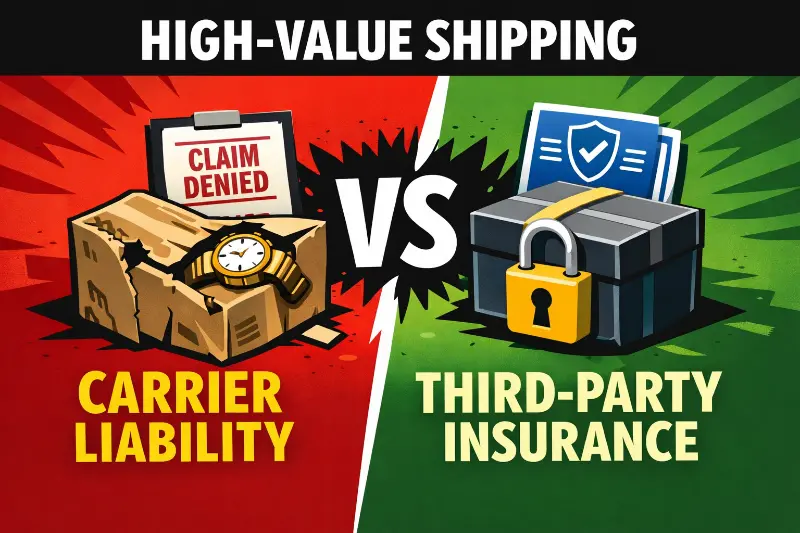
In this article
19 minutes
- Introduction to Shipping High-Value Items
- Supply Chain Risks and Vulnerabilities
- Carrier liability is not insurance, and the distinction matters
- The $1,000 ceiling and other exclusions most merchants miss
- Why claims get denied and what the data shows
- Third-party coverage changes the cost and claims equation
- Operational requirements that determine whether claims succeed
- Customer Experience and Shipping Insurance
- Best Practices for Shipping
- Technology and Insurance Integration
- When self-insuring makes financial sense
- Frequently Asked Questions
Most ecommerce losses on high-value shipments are not caused by theft. They result from mismatched liability limits, policy exclusions, and claims processes that work against the shipper. Merchants who rely on default carrier coverage typically discover the gap between what they assumed was covered and what actually gets paid only after a package is lost or damaged. Understanding the structural differences between carrier liability, declared value coverage, and third-party insurance is the single most important step an operations leader can take before shipping valuable items.
This distinction matters because the default protection included with every shipment from major carriers caps out at $100 per package. For any brand shipping high-value goods (jewelry, electronics, luxury apparel, custom products), that $100 ceiling covers a fraction of the actual replacement cost. The good news: once you understand how each layer of coverage works, building an insurance strategy that fits your product mix, volume, and risk tolerance is straightforward. Shipping insurance can provide complete coverage for a broad range of high-value items, ensuring your valuable shipments are fully protected.
Introduction to Shipping High-Value Items
Shipping high-value items is a task that demands meticulous planning and attention to detail. Whether you’re sending precious metals, luxury goods, or other valuable shipments, the stakes are high—any loss or damage can result in significant financial loss and reputational harm. That’s why shipping insurance is essential for anyone shipping high-value items. By partnering with a trusted insurance provider, shippers can secure comprehensive coverage that protects their value items from the moment they leave the warehouse until final delivery. This extra layer of protection ensures that even if the unexpected happens, your high-value shipments are covered, and your business is shielded from costly setbacks. For businesses and individuals alike, investing in shipping insurance is a proactive step to safeguard luxury goods and precious items, providing peace of mind and financial security throughout the shipping process.
Supply Chain Risks and Vulnerabilities
The journey of high-value items through the supply chain is fraught with potential risks and vulnerabilities. From the initial handoff at the warehouse to the final delivery, high-value shipments can be exposed to theft, mishandling, environmental hazards, and even customs delays. Each stage of the supply chain presents unique challenges that can jeopardize the safety of value items and result in financial loss. To protect these shipments, businesses must identify high-risk points—such as transit hubs, storage facilities, and last-mile delivery routes—and implement robust security measures. Proactive risk management, including regular audits and contingency planning, is crucial for minimizing disruptions and ensuring the safe delivery of high-value items. By understanding and addressing these supply chain vulnerabilities, businesses can better protect their valuable shipments and maintain customer trust.
Carrier liability is not insurance, and the distinction matters
Both UPS and FedEx include $100 of declared value coverage per package at no extra charge. USPS includes up to $100 of coverage for Priority Mail, Priority Mail Express, and Ground Advantage shipments. These defaults apply automatically, and for shipments under $100, they may be sufficient. Beyond that threshold, the economics and the fine print diverge quickly.
This distinction matters because the default protection included with every shipment from major carriers caps out at $100 per package. Standard carrier liability generally covers only up to $100 unless a higher declared value is paid, and you may need to purchase additional insurance for shipments valued over $100 to ensure full protection.
The critical distinction that most merchants overlook: declared value coverage is not insurance. FedEx states this explicitly in its service guide. UPS uses similar language. Declared value sets the carrier’s maximum liability, meaning it caps what the carrier will pay, not what the carrier owes. To collect on a declared value claim, the shipper must prove the carrier was at fault for the loss or damage. That burden of proof is significant. If the carrier can attribute the issue to inadequate packaging, an excluded item category, or any cause outside its direct handling, the claim gets denied. Insurance limits and maximum declared values apply, and if your shipment exceeds these limits, you must purchase additional insurance to cover the full value.
USPS is the exception among major carriers in that it uses the term “insurance” and provides indemnity coverage. However, USPS caps standard insured mail at $5,000 per package domestically (Registered Mail extends to $50,000 but requires in-person mailing and chain-of-custody protocols). International coverage varies dramatically by destination country, with some nations capping coverage well below $1,000.
For merchants shipping high-value items, the surcharge math also deserves attention. Carrier declared value fees typically run $1.05 to $1.90 per $100 of coverage above the included default. Insurance rates are typically based on the declared value and can vary depending on package type. On a $2,000 item, that translates to roughly $20 to $36 in declared value surcharges with a carrier. Third-party insurance providers, by contrast, typically charge $0.50 to $1.25 per $100 of coverage, representing savings of 50 to 80 percent on the premium alone. Many third-party providers offer competitive rates, making them a cost-effective option for insuring high-value shipments.
The $1,000 ceiling and other exclusions most merchants miss
Beyond the default $100 cap, carriers impose category-specific limits that create coverage gaps for common ecommerce products. FedEx limits declared value to $1,000 for artwork, paintings, sculptures, antiques, collectibles, fine jewelry, precious metals, furs, and musical instruments (whether they are old, customized, or both). Items shipped in a FedEx Envelope or Pak are capped at $500 regardless of actual value. UPS imposes similar restrictions, limiting international jewelry shipments to $2,500 CAD without a special high-value waiver agreement. Many carriers have coverage limits and exclusions that can expose businesses to financial risk when shipping valuable goods.
These are not obscure edge cases. A Shopify brand selling handcrafted jewelry, vintage furniture, limited-edition prints, or high-end watches will hit these limits routinely. The carrier will accept the package, charge for shipping, and even collect the declared value surcharge. But if a claim arises, the payout caps at the category limit, not the declared amount.
Several other exclusions apply universally across carriers. Consequential damages (lost revenue, business interruption, customer acquisition costs) are never covered. Losses caused by weather events, natural disasters, or civil unrest fall outside carrier liability. Coverage applies only while the package is in the carrier’s custody, meaning porch theft after confirmed delivery is excluded. And perhaps most consequentially, damage attributed to improper packaging results in automatic denial. When evaluating insurance options, keep in mind that the best shipping carrier will have insurance options to cover your most expensive SKU without exceeding its maximum value for coverage.
Why claims get denied and what the data shows
Inadequate packaging is the leading cause of claim denials across all carriers. Carriers publish specific packaging guidelines covering box strength ratings, cushioning materials, void fill, and drop-test standards. A shipment that fails to meet these requirements, even if the carrier clearly mishandled it, faces a strong likelihood of denial. USPS reports an approximate 38 percent claim rejection rate, while industry analysis suggests UPS and FedEx deny roughly 30 to 50 percent of claims depending on the type (damage claims are denied more frequently than loss claims). The claim process for shipping insurance for high-value items requires careful attention—documentation like photos and recent appraisals is crucial for claims on high-value items.
Other common denial triggers include late filing (each carrier enforces strict windows, ranging from 21 to 60 days depending on the carrier and claim type), missing documentation (no photos, no proof of value, no original packaging retained), and misdeclared value. You must provide proof of value, such as invoices or receipts, when filing a claim for high-value items, and documentation of damage at the receiving process is essential. Claims for high-value items typically have shorter filing deadlines, often between 15 to 30 days. Filing a claim after disposing of the original packaging is almost always fatal to the claim regardless of how strong the other evidence may be.
The timeline compounds the problem. Carrier claims processes typically take 30 to 90 days from filing to resolution. Shipping insurance claims can take several months to resolve, which can create financial burdens for shippers. During that period, the merchant has already absorbed the cost of a replacement or refund. For high-value shipments, that cash flow gap can be operationally significant. To file a claim for shipping insurance, you must provide essential documentation such as the value of the insured item, tracking number, carrier’s name, and a description of the contents, and you must prove the carrier is responsible for the loss or damage to receive reimbursement.
Third-party coverage changes the cost and claims equation
Third-party shipping insurance operates on a fundamentally different model. Rather than requiring proof of carrier fault, most third-party policies function as “all-risk” coverage: any cause of loss or damage during transit is covered unless specifically excluded. Selecting ‘All-Risk’ coverage offers the most comprehensive protection and complete coverage for a broad range of high-value items, including international shipments. This shifts the burden of proof from the shipper to the insurer. Coverage typically extends door-to-door rather than only while in the carrier’s possession, and most providers cover porch theft, which carrier liability does not. Third-party shipping insurance generally provides coverage for theft after delivery, which is a limitation of standard carrier options. One-time shipping insurance is also available as a straightforward, single-use coverage option that can be quickly purchased online.
Claims resolution is substantially faster. Industry benchmarks show third-party providers resolving claims in 7 to 10 business days on average, with some providers processing approvals in under 48 hours. Several providers offer paperless claims portals, eliminating the multi-step documentation processes that carriers require. Secursus.com displays an online calculator to check the price for insuring a package in real time.
For cost comparison, consider a $1,000 item. Carrier declared value surcharges run approximately $12 to $20. Third-party insurance for the same value typically costs $5 to $10. At $5,000, the gap widens further: carriers charge roughly $50 to $95 while third-party providers charge $25 to $38. Third-party insurance can be up to 50% cheaper than limited liability coverage offered by carriers, and specialized third-party insurance for shipping high-value items often provides better, more cost-effective coverage. Specialty providers serving luxury goods, fine jewelry, and high-value merchandise offer coverage up to $150,000 per package, well beyond the $50,000 ceiling that UPS and FedEx impose. Specialized third-party insurers can offer coverage limits ranging from $150,000 to $200,000 per package for high-value items, and Parcel Pro provides package insurance that aligns with the true value of your shipment, ensuring full value reimbursement in case of loss, damage, or theft. UPS Capital is a provider of specialized shipping insurance solutions, and UPS offers insurance options that can cover packages valued up to $50,000, depending on how you ship. You can insure a FedEx package for up to $50,000 with certain overnight, 2-day, or 3-day services, and FedEx has a high-value jewelry program with insurance limits of $100,000 for domestic parcels, available to shippers with a FedEx account. Package insurance is available for high-value shipments and can provide full value reimbursement in case of loss, damage, or theft.
The tradeoffs are real, though. Third-party providers maintain their own exclusion lists (perishables, cash equivalents, hazardous materials subject to USPS hazmat rules, and sometimes specific electronics categories). International coverage limits and pricing vary by provider and destination. And integration quality matters: the most effective implementations automate insurance purchasing at the label-creation stage based on order value rules, eliminating the risk of human error on high-value shipments. Many specialty providers and fulfillment centers also offer extra services such as kitting, pick and pack fulfillment, and specialized handling to enhance the customer experience and differentiate your brand.
Operational requirements that determine whether claims succeed
Successful claims depend on documentation assembled before the shipment leaves the warehouse, not after a problem arises. The operational requirements are consistent across both carrier and third-party claims:
- Photograph each order at the packing station before sealing, capturing items alongside the invoice or packing slip with serial numbers visible
- Document packaging materials and process (cushioning, void fill, box condition) with timestamped images linked to order IDs
- Retain all original packaging and damaged goods until the claim is fully resolved, as carriers may require physical inspection
- File claims within the carrier’s or insurer’s deadline (ranging from 21 to 120 days depending on provider and claim type)
- Maintain proof of value through commercial invoices, purchase receipts, detailed packing slips, or professional appraisals, particularly for items without standard retail pricing
High-value products often require special handling and meticulous receiving processes to ensure proper documentation for claims.
Warehouse teams that build these steps into standard operating procedures convert claims documentation from a reactive scramble into a routine workflow. Overhead cameras at packing stations, barcode-linked video logging, and automated claim-filing software all reduce the per-order cost of maintaining claims-ready records. Documentation, security cameras, and professional claims handling, supported by advanced ecommerce shipping software, maximize shipping insurance reimbursement and protect high-value inventory.
Customer Experience and Shipping Insurance
Delivering a positive customer experience is vital for any business, especially when shipping high-value items. Customers expect their valuable shipments to arrive safely and on time, and offering shipping insurance as part of thoughtful free shipping pricing strategies is a powerful way to meet—and exceed—those expectations. By providing insurance coverage for high-value items, businesses demonstrate a commitment to customer satisfaction and service excellence. This not only builds trust and loyalty but also supports business growth by encouraging repeat purchases and positive word-of-mouth. Shipping insurance also helps reduce the risk of disputes and costly claims, streamlining the resolution process if issues arise. Ultimately, investing in shipping insurance enhances the overall customer experience, protects your business reputation, and ensures that both you and your customers are covered when it matters most.
Best Practices for Shipping
To ensure the safe and secure delivery of high-value shipments, businesses should follow a set of proven best practices. Start by selecting a reputable shipping carrier with a strong track record for handling high-value items, and always purchase shipping insurance to protect against potential loss or damage. Use high-quality packaging materials and reinforce packages to withstand the rigors of transit, clearly labeling contents and value where appropriate. Maintain detailed records for each shipment, including tracking numbers and delivery confirmation, to facilitate quick resolution in case of shipping issues. It’s also important to have a response plan in place for any incidents, ensuring that your team can act swiftly to protect your packages and minimize disruption. By adhering to these best practices, you can significantly reduce risk and ensure your high-value items reach their destination safely.
Technology and Insurance Integration
Advancements in technology have transformed the way businesses manage high-value shipments and shipping insurance. Modern shipping platforms now offer seamless integration with insurance providers, allowing businesses to purchase coverage, factor in FedEx and UPS surcharge mitigation strategies, and track high-value shipments in real time. This integration enhances operational efficiency by automating insurance decisions based on shipment value and streamlining the claims process with digital documentation and faster approvals. Real-time tracking and automated alerts provide greater visibility and control, enabling businesses to respond quickly to any issues and deliver a superior customer experience. As technology continues to evolve, integrating shipping insurance solutions will become even more essential for protecting high-value shipments, improving service, and driving business success.
When self-insuring makes financial sense
For high-volume merchants shipping lower-value products, self-insurance deserves serious consideration. The calculation is straightforward: if your annual expected loss (total shipments multiplied by your loss/damage rate multiplied by average item value) is lower than the total annual premium you would pay for insurance, self-insuring saves money. Not everyone needs shipping insurance, but companies shipping high-value items cannot afford shrinkage as a cost.
Industry loss and damage rates for ecommerce typically fall between 1 and 3 percent of shipments, though this varies significantly by product category, carrier, packaging quality, whether you’re shipping heavy items, and season. A merchant shipping 10,000 packages per month at an average value of $40 with a 2 percent damage rate faces roughly $96,000 in annual expected losses. At $0.50 per package for third-party insurance, annual premiums would total $60,000, making insurance the better choice. But for a similar merchant shipping $15 average-value items, the expected loss drops to $36,000, and self-insuring with a reserve fund becomes more attractive.
The hybrid approach is most common among mid-market operators: self-insure items below a set threshold (often $50 to $100), purchase third-party coverage for items above that threshold, and use specialty coverage for anything above $5,000. Setting aside 1 to 3 percent of shipping spend in a dedicated reserve fund provides the financial cushion for self-insured losses.
Frequently Asked Questions
What is the difference between carrier liability and shipping insurance?
Carrier liability (also called declared value coverage) sets the maximum amount a carrier will pay for loss or damage, but requires the shipper to prove the carrier was at fault. It is not insurance. FedEx and UPS explicitly state this in their service guides. To collect on a declared value claim, shippers must demonstrate carrier negligence and meet strict packaging requirements. True shipping insurance (available from USPS or third-party providers) functions as all-risk coverage where any cause of loss or damage during transit is covered unless specifically excluded, shifting the burden of proof from shipper to insurer.
How much does carrier declared value coverage cost compared to third-party insurance?
Carrier declared value fees typically run $1.05 to $1.90 per $100 of coverage above the included $100 default. For a $2,000 item, this translates to roughly $20 to $36 in surcharges. Third-party insurance providers typically charge $0.50 to $1.25 per $100 of coverage, representing 50% to 80% savings. For a $5,000 item, carriers charge approximately $50 to $95 while third-party providers charge $25 to $38. The cost gap widens as item value increases, making third-party insurance substantially more economical for high-value shipments.
What are the category-specific coverage limits carriers impose on high-value items?
FedEx limits declared value to $1,000 for artwork, paintings, sculptures, antiques, collectibles, fine jewelry, precious metals, furs, and musical instruments. Items shipped in FedEx Envelope or Pak are capped at $500 regardless of actual value. UPS imposes similar restrictions, limiting international jewelry shipments to $2,500 CAD without special agreements. These limits apply even if you pay for higher declared value coverage. Carriers will accept the package, charge shipping and declared value surcharges, but claims payout caps at the category limit, not the declared amount.
Why do carrier claims get denied and how common are denials?
Inadequate packaging is the leading cause of claim denials. Carriers enforce strict packaging guidelines covering box strength, cushioning, void fill, and drop-test standards. Even with clear carrier mishandling, shipments not meeting these requirements face denial. USPS reports approximately 38% claim rejection rate. Industry analysis suggests UPS and FedEx deny 30% to 50% of claims depending on type (damage claims denied more frequently than loss claims). Other common denial triggers include late filing (21-60 day windows), missing documentation (no photos, no proof of value, no original packaging retained), and misdeclared value.
How long do carrier claims take to resolve compared to third-party insurance claims?
Carrier claims processes typically take 30 to 90 days from filing to resolution. During this period, merchants have already absorbed replacement or refund costs, creating significant cash flow gaps on high-value shipments. Third-party insurance providers resolve claims in 7 to 10 business days on average, with some processing approvals in under 48 hours. Several third-party providers offer paperless claims portals that eliminate the multi-step documentation processes carriers require, further accelerating resolution timelines.
What documentation is required to successfully file a shipping insurance claim?
Successful claims require documentation assembled before shipment leaves the warehouse: (1) Photographs of each order at packing station before sealing, showing items alongside invoice/packing slip with serial numbers visible; (2) Documentation of packaging materials and process (cushioning, void fill, box condition) with timestamped images linked to order IDs; (3) All original packaging and damaged goods retained until claim fully resolved (carriers may require physical inspection); (4) Proof of value through commercial invoices, purchase receipts, or professional appraisals; (5) Claims filed within deadline (21-120 days depending on provider). Filing after disposing of original packaging is almost always fatal to claims.
When does self-insuring make more sense than purchasing shipping insurance?
Self-insurance makes financial sense when annual expected loss is lower than total annual insurance premiums. Calculate: (total shipments) x (loss/damage rate) x (average item value). Industry loss/damage rates typically fall between 1% and 3% of shipments. Example: 10,000 packages/month at $40 average value with 2% damage rate = $96,000 annual expected loss versus $60,000 in third-party premiums ($0.50/package), making insurance better. At $15 average value, expected loss drops to $36,000, making self-insurance with a reserve fund more attractive. The hybrid approach is most common: self-insure items below $50-$100, purchase coverage above that threshold.
What are the main advantages of third-party shipping insurance over carrier declared value coverage?
Third-party insurance offers: (1) All-risk coverage without requiring proof of carrier fault; (2) 50%-80% lower cost per dollar of coverage; (3) Claims resolution in 7-10 days versus 30-90 days for carriers; (4) Door-to-door coverage including porch theft (excluded from carrier liability); (5) Higher coverage limits (up to $150,000 per package versus $50,000 carrier ceiling); (6) Fewer category-specific exclusions for high-value items like jewelry and artwork; (7) Paperless claims portals versus multi-step carrier processes. Tradeoffs include third-party exclusion lists (perishables, hazardous materials), variable international coverage, and integration quality requirements.
Written By:
Rinaldi Juwono
Rinaldi Juwono leads content and SEO strategy at Cahoot, crafting data-driven insights that help ecommerce brands navigate logistics challenges. He works closely with the product, sales, and operations teams to translate Cahoot’s innovations into actionable strategies merchants can use to grow smarter and leaner.
Turn Returns Into New Revenue
Related Articles
Top 12 Shipping Strategies For Making Free Shipping Profitable
For ecommerce sellers, shipping is more than just getting a package from point A to point B — it’s the invisible backbone, quietly shaping customer satisfaction, operational costs,...
The Shipping Speed Paradox: Why DTC Brands Are Slowing Down
Everyone’s talking about faster delivery.
Ecommerce Profit Leaks: The Hidden Ones That AI Is Finally Closing
Most ecommerce brands believe they understand their margins.