
Apparel Returns Are Getting Harder to Avoid. Brands Need to Make Them Cheaper to Handle

Last updated on June 30, 2026
In this article
 19 minutes
- GLP-1s Are Accelerating an Apparel Problem That Already Existed
- The Real Issue Is Fit Volatility
- Size Guides Help, but They Cannot Eliminate Body-Change Uncertainty
- Adjusting Size Curves Is Not as Simple as Ordering More Small Sizes
- Raising Prices or Charging Return Fees Can Backfire
- Apparel Brands Need a Returns Survival Strategy
- 7 Start With the Low-Hanging Fruit: Cheaper Return Shipping Labels and Faster Restocking
- 8 Make Store Credit Exchanges Easier Than Refunds
- 9 Treat Damaged Returns Data as Operational Intelligence
- Peer-to-Peer Returns Could Be the Bigger Long-Term Opportunity
- 11 The Brands That Win Will Recover More Resale Value From Returns
- Frequently Asked Questions
Apparel returns are climbing again, and a meaningful share of the increase is tied to customers whose bodies are changing faster than their wardrobes can keep up. According to Narvar data cited by the Wall Street Journal, apparel exchanges involving customers sizing down hit a record 14.6% in 2025, and retailers are increasingly attributing the shift to the rapid adoption of GLP-1 weight-loss drugs.
But the GLP-1 story is only the latest pressure on a system that was already strained. Apparel has always carried fit uncertainty, and fit uncertainty has always driven bracketing, exchanges, and refunds. What is changing is the speed of body change among a growing slice of customers, which makes sizing demand harder to predict and return volume harder to absorb. The smart response is not to chase the perfect prevention strategy. It is to make the returns that do happen cheaper, faster, and less destructive to margin.
GLP-1s Are Accelerating an Apparel Problem That Already Existed
Apparel returns have always been the highest-friction category in ecommerce. Shoppers cannot try the product before it arrives, so they hedge. They order two sizes. They order the same dress in three colors. They keep what fits and ship the rest back. Bracketing is not a flaw in customer behavior. It is a rational response to the gap between a product page and a fitting room.
GLP-1 medications add a new layer to that uncertainty. Customers actively losing weight may move through one, two, or three sizes within a single buying cycle. A shopper who ordered a medium in March may need a small by July, then need to repurchase the same wardrobe staple a few months later. Some of those purchases will be returns. Some will be exchanges. Some will be brand new orders placed before the previous garment has even been worn.
This is not a story about careless shoppers. It is a story about a category whose fundamental friction (you cannot try it on) is now compounding with a customer base whose fundamental measurements are in motion. That legitimate friction exists alongside edge cases like wardrobing and other return abuse, but it is not the primary driver of the current spike. The Wall Street Journal has reported that several apparel retailers are now seeing return pressure they directly attribute to GLP-1-driven size changes, and the trend appears to be widening rather than fading.
The Real Issue Is Fit Volatility
Retail Dive and other industry observers have started using the term “fit volatility” to describe what is happening. The phrase is useful because it points past any single cause. GLP-1s are part of it. So are pandemic-era body composition changes, the rise of athleisure cuts that fit unpredictably across brands, inconsistent vanity sizing, and the broader collapse of standardized size charts across global manufacturing.
Fit volatility means the same customer may move across sizes faster than a brand’s merchandising and planning cycle can react. A buyer who plans size curves a year in advance, based on last year’s sell-through, is working with data that may already be stale by the time the season hits. That mismatch shows up in two places: inventory imbalance at the SKU level and returns at the customer level.
For ecommerce operators, fit volatility is less a marketing problem and more a forecasting problem. It puts pressure on size-curve planning, reorder timing, markdown discipline, and reverse logistics capacity all at once. And because ecommerce returns were never designed for scale and high ecommerce return rates can erode profit margins, the systems most brands rely on tend to bend under that pressure rather than absorb it cleanly.
Size Guides Help, but They Cannot Eliminate Body-Change Uncertainty
The first instinct for most apparel brands is to fix the front end. Better size charts. More detailed product descriptions. Model measurements on every page. Fabric composition and stretch percentages. AI-driven fit quizzes. User-uploaded reviews with height, weight, and usual size. All of this helps, and brands that have invested in it generally see lower return rates than brands that have not.
But these tools share a common limitation. They assume the customer knows their current size. For a shopper whose body has not changed in years, that assumption usually holds. For a shopper actively losing weight, gaining muscle, recovering from pregnancy, or transitioning through any other period of body change, the assumption breaks. No size chart can tell a customer what size they will be in six weeks. No fit quiz can predict the rate at which a GLP-1 user will move from a large to a medium.
Front-end tools reduce returns from confusion. They do not reduce returns from change. Brands that overinvest in fit prevention without also investing in returns operations end up with a polished website and a backed-up returns dock.
Adjusting Size Curves Is Not as Simple as Ordering More Small Sizes
A reasonable next instinct is to shift the size curve. If more customers are sizing down, order more smalls. This is partially correct and operationally dangerous if applied too aggressively.
Demand may shift, but it rarely shifts cleanly. Consider what is actually happening across a typical apparel customer base:
- Some long-time customers are sizing down by one or two sizes and staying there.
- Some customers who were previously outside the brand’s size range are now entering it, often at the upper end of the brand’s smaller sizes.
- Some customers who were previously inside the brand’s range are now leaving it, either because they sized down below the brand’s smallest offering or because their proportions changed in ways that do not match the brand’s fit block.
- Some customers are moving through multiple sizes within a single season and buying intermittently at each one.
These movements partially offset each other in ways that are hard to see in aggregate sales data until after the season is over. A brand that responds by simply doubling its small allocation may end up overstocked on smalls and stocked out of mediums by midseason. The size curve question deserves a careful, SKU-level look, not a blanket adjustment.
Raising Prices or Charging Return Fees Can Backfire
When returns get expensive, the temptation is to charge for them. Raise prices to absorb the cost. Add a return shipping fee or restocking fee. Restrict free exchanges. Tighten the return window. Each of these levers has its place, and each has real downsides.
Blanket price increases punish every customer for the behavior of some customers. The shopper who orders one item in their correct size and keeps it pays the same surcharge as the shopper who brackets three sizes and returns two. Over time, that erodes loyalty among exactly the customers a brand most wants to retain, undermining the goal of using an exceptional returns program to encourage customer loyalty.
Return fees can reduce frivolous returns, but they cut differently when the underlying cause is legitimate fit uncertainty. A customer who is actively losing weight is not abusing the system by returning a pair of jeans that no longer fits. Charging that customer a fee may recover a few dollars of label cost while sending a message that erodes their willingness to buy again. Free returns can also lift conversion rates by roughly 8-12%, because they increase shopper confidence, which is why the tradeoff is difficult and why many marketplaces publish detailed returns policy standards for sellers. There is no free returns such thing in practice, and the right answer is rarely a flat policy applied to every customer and every SKU.
Stricter return windows have the cleanest case, particularly for seasonal apparel where late returns destroy resale value. But even here, the gain is small compared to what better operations can deliver on the back end.
Apparel Brands Need a Returns Survival Strategy
The more durable answer is operational. If fit volatility means more returns are coming, the goal is to make those returns survivable. That means lowering the cost per return, which in many cases can exceed $20 per return, shortening the cycle time, and recovering more of the original value from each returned unit.
This is a different mental model than most apparel brands operate with today. Returns are usually treated as a cost center to minimize. A returns survival strategy treats them as an inventory recovery flow to optimize, with fast intake as the key operational lever for companies managing reverse logistics and optimizing reverse logistics end-to-end. The hidden cost of returns is rarely just the return shipping label. It is the label plus the inbound transit time plus the inspection labor plus the restocking delay plus the markdown that gets applied because the item came back too late to sell at full price, and those delays can reduce resale value by 1-2% per day. Each of those is operationally addressable.
Many apparel returns still take 5-7 days to process on average, while industry best practice is 24-48 hours for intake processing.
The brands that pull this off tend to share a common framing: they think about returns as a margin lever, not as an unavoidable tax on ecommerce. The full solution stack has four parts, and it mirrors what it takes to craft an effective ecommerce returns program:
- Reduce unnecessary returns where the front end can help.
- Make unavoidable returns cheaper and faster to process.
- Recover more value from each returned unit through resale, exchange, or rerouting.
- Explore advanced models such as peer-to-peer returns where the operational complexity is manageable.
The first lever has the most attention and the lowest ceiling. The next three are where the durable margin lives and can transform performance.
7 Start With the Low-Hanging Fruit: Cheaper Return Shipping Labels and Faster Restocking
Most apparel brands are overpaying on return shipping. The return label is often generated through the same carrier and service level used for outbound shipping, even though returns are almost never time-sensitive in the same way. Switching to the cheapest acceptable service for return shipping is one of the fastest wins available, and it requires no change to customer-facing policy.
A few operational levers that consistently move the cost-per-return number:
- Route return labels to the lowest-cost carrier service that meets the brand’s acceptable transit window, rather than defaulting to expedited service.
- Consolidate returns at regional processing points before sending them deeper into the network, instead of shipping every package all the way back to a central warehouse.
- Inspect and restock returned items within a defined service-level target; best practice is to process intake within 24-48 hours so seasonal merchandise rejoins available inventory before its sell-through value collapses.
- Reduce the number of warehouse touches per return. Every additional handling step adds labor cost and delays restocking.
- Capture damaged returns and items not in new condition into a separate workflow before they contaminate sellable inventory.
Fast intake and routing decisions matter because seasonal apparel loses margin quickly, whether goods arrive in a box, enter through a box-free drop model such as Happy Returns-style drop-off networks, or depend on access to the right processing workflow used by many brands.
For seasonal apparel, restocking speed is often more valuable than shipping cost. A swimsuit returned in July that gets back on the shelf in August is worth significantly more than the same swimsuit restocked in October. The difference is pure margin recovery, and it is entirely a function of how fast the operations team can move.
8 Make Store Credit Exchanges Easier Than Refunds
When a customer returns an item because it does not fit, the brand has two possible outcomes, and making a return or exchange easier than a refund usually leads to the better one. The customer gets their money back and may or may not buy again. Or the customer gets a different size, color, or item, and the original transaction is preserved.
Online apparel returns usually start with an online request and securely packing the item.
Exchange-first workflows nudge that second outcome. They are not about denying refunds. They are about making the exchange path easier to find, faster to complete, and more rewarding than the refund path. Common tactics include offering exchanges with no shipping fee while charging a small fee for refunds, sending the replacement size before the original return arrives, or giving store credit at a slight premium to the refund amount. When a refund is chosen, it is typically issued after the returned order is received and processed within 7 business days.
The economics are clear. A successful exchange preserves the gross sale, avoids the payment processing fee on a refund, and keeps the customer in the brand’s ecosystem. A refund does the opposite. For apparel specifically, where the underlying reason for return is usually fit rather than dissatisfaction with the product, the exchange path is often what the customer actually wanted in the first place.
Returns management software has gotten genuinely good at facilitating these workflows on the customer-facing side, whether through broad platforms or focused tools like a Shopify-oriented returns solution such as Return Prime. Customer-facing software often lets shoppers create an exchange request through their account. The harder part is operational: making sure the inventory is actually available at the exchange location, making sure the replacement ships fast enough to feel like a same-day decision, and making sure the original item gets processed quickly enough to support the next exchange. Software improves the workflow. It does not by itself change where the inventory physically lives.
9 Treat Damaged Returns Data as Operational Intelligence
Every return carries information. Why was it returned? Was it the size, the fit, the fabric, the color, the photo accuracy, or the delivery timing? Discrepancies in color, fabric quality, or style account for 11% of apparel returns. Was the customer in a region with unusual return rates? Was the SKU one that consistently runs small or large compared to the size chart?
Most brands collect this data in a basic form through return reason codes, including where consumers saw one thing on the product page and received another. Far fewer use it as planning input. A returns data set that is actually wired into merchandising and operations can answer questions that change buying decisions:
- Which SKUs have return rates more than two times the brand average, and what do those SKUs have in common?
- Which size in which silhouette has the highest size-down exchange rate, and how should next season’s size curve respond?
- Which fabrics or constructions correlate with higher fit complaints, regardless of size?
- Which customer segments are exchanging into smaller sizes most rapidly, and how should marketing communicate with them?
The signal is there in the data. Most brands just do not have the workflow to surface it in time to act on it. Building that capability is one of the highest-leverage investments an apparel operations team can make, because it improves both prevention and recovery at the same time.
Peer-to-Peer Returns Could Be the Bigger Long-Term Opportunity
The deepest inefficiency in apparel reverse logistics is the assumption that every returned item must travel back to a central warehouse before it can be sold again. That assumption made sense when ecommerce returns were a fraction of forward shipments. It makes less sense when return rates in apparel routinely cross 20%, 30%, or more for certain categories.
Peer-to-peer returns propose a different model. When a customer returns an item, the brand identifies another customer who has just ordered the same SKU, and routes the returned item directly from the first customer to the second. The brand still controls the transaction, the customer experience, and the financial reconciliation. What changes is the physical path of the inventory. Instead of two long-haul shipments and a warehouse touch, there is one shorter shipment and no warehouse touch at all.
The contrast with traditional warehouse returns is structural. Warehouse returns optimize for centralized control and standardized inspection. Peer-to-peer returns optimize for speed and reduced handling cost. Both have a place, and for apparel the right answer is probably a blend.
Apparel adds real complexity that other categories do not face. Garments need condition checks. Tags need to be present. Hygiene standards matter, particularly for intimates, swimwear, and certain athletic categories. Fraud controls have to be tight enough that a customer cannot ship a damaged item to another buyer. Brand-specific rules about repackaging, presentation, and customer experience have to be honored. These are solvable problems, but they are not trivial, and any brand exploring peer-to-peer returns for apparel should plan carefully for the specific SKUs and conditions where the model fits.
The opportunity, though, is significant. Even a partial peer-to-peer flow that captures the easiest 10% or 20% of eligible returns can meaningfully reduce reverse logistics costs and improve inventory turnover on fast-moving SKUs.
11 The Brands That Win Will Recover More Resale Value From Returns
Apparel returns are not going back to pre-2020 levels. GLP-1 adoption is one reason, but it is not the only reason and it will not be the last reason. Fit volatility is a structural condition of the category now, and any brand operating in apparel ecommerce should plan for it as a permanent feature rather than a passing trend.
The brands that handle this well will share a few characteristics. They will keep investing in fit tools and size guides without expecting those tools to solve the problem alone. They will be careful with blunt instruments like return fees and price increases. They will treat their returns process as an inventory recovery operation, not a reverse shipping pipeline. They will measure cost per return, cycle time, and resale value recovered the same way they measure outbound fulfillment performance. And they will keep looking at structural changes, including peer-to-peer flows, that change what returns actually cost.
GLP-1s are the current stress test. There will be another one. The brands that build the operational muscle to make returns survivable now will be the ones still expanding margin when the next shift in customer behavior arrives.
Frequently Asked Questions
Are GLP-1 drugs increasing apparel returns?
Yes, and the evidence is becoming clearer. Wall Street Journal reporting on Narvar data shows apparel exchanges involving customers sizing down reached a record 14.6% in 2025, and multiple retailers attribute part of that shift to GLP-1 adoption. The drugs are not the only driver of higher apparel returns, but they are accelerating an underlying fit-volatility trend that was already in motion.
Why do apparel customers return so many items?
Fit uncertainty is the dominant reason. Customers cannot try clothing before it arrives during online shopping, and over 52% of apparel returns are due to size confusion, so many order multiple sizes or styles intending to keep only what fits. This is called bracketing, and it is a rational response to the gap between a product page and a fitting room. Body changes, inconsistent sizing across brands, and fabric or cut differences from what the customer expected also contribute.
Can better size guides reduce apparel returns?
They help, but they have limits. Detailed size charts, model measurements, fabric composition, fit quizzes, and customer reviews can all lower return rates by reducing confusion. What they cannot solve is body-change uncertainty. When a customer is actively moving across sizes, no size guide can predict where they will be by the time the package arrives.
Should apparel brands charge return fees?
Cautiously, if at all. Return fees can reduce some abusive behavior, but they often punish customers whose returns are caused by legitimate fit issues outside their control, and when refunds are chosen, some retailers deduct return shipping costs from the refund amount, leaving the shopper responsible for part of the loss. The brands that have introduced return fees have seen mixed results, with some reporting reduced bracketing and others reporting lost loyalty and lower repeat purchase rates. A blanket fee is usually worse than a more targeted policy combined with better operations on the back end, because there is no such thing as a truly costless return even when a policy appears generous.
How can apparel brands reduce the cost of returns?
The biggest gains come from operational changes rather than policy changes. Many retailers allow 30 to 90 days for returns, with returns accepted within 30 days of purchase being a common standard. Apparel usually must be unworn, unwashed, and include original tags and any accessories. For online returns, customers often cover return shipping costs. Lower-cost return shipping services, faster inspection and restocking, exchange-first workflows, smarter routing of returns to regional processing points, and reducing the number of warehouse touches per return all compound into significant savings. Treating returns as an inventory recovery flow rather than a cost center is the broader mindset shift that supports all of these tactics.
What are peer-to-peer returns?
Peer-to-peer returns route a returned item directly from the returning customer to a new customer who has just purchased the same SKU, instead of sending it back to a central warehouse for inspection and restocking. The brand still controls the transaction and customer experience, including confirming the item was delivered before any refund is issued. The model can significantly reduce reverse logistics costs and speed up inventory turnover, though apparel adds complexity around condition checks, tags, hygiene, and fraud controls that brands need to plan for carefully. Standard returns processing often takes 5-7 days. Refunds are commonly processed within 7 business days of receipt once that workflow is completed.
Written By:

Indy Pereira
Indy Pereira helps ecommerce brands optimize their shipping and fulfillment with Cahoot’s technology. With a background in both sales and people operations, she bridges customer needs with strategic solutions that drive growth. Indy works closely with merchants every day and brings real-world insight into what makes logistics efficient and scalable.

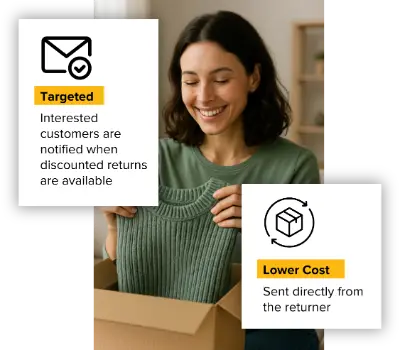
Turn Returns Into New Revenue
Related Articles

How Much Does Seller Fulfilled Prime Cost? Calculate It for Your SKU
Seller Fulfilled Prime sounds attractive until you start thinking about the bill.
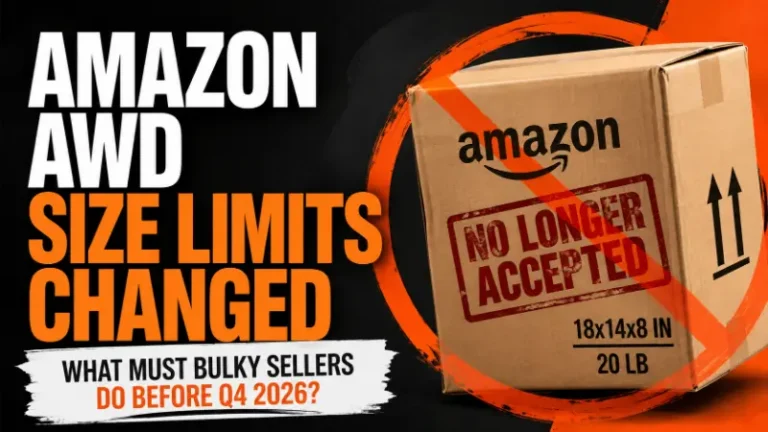
Amazon AWD Size Limits Changed: What Bulky Sellers Must Do Before Q4 2026
Beginning July 31, 2026, Amazon AWD stopped accepting new sortable sellable units at or above 18x14x8 inches or 20 lb, so any unit that meets or exceeds those thresholds is no long...
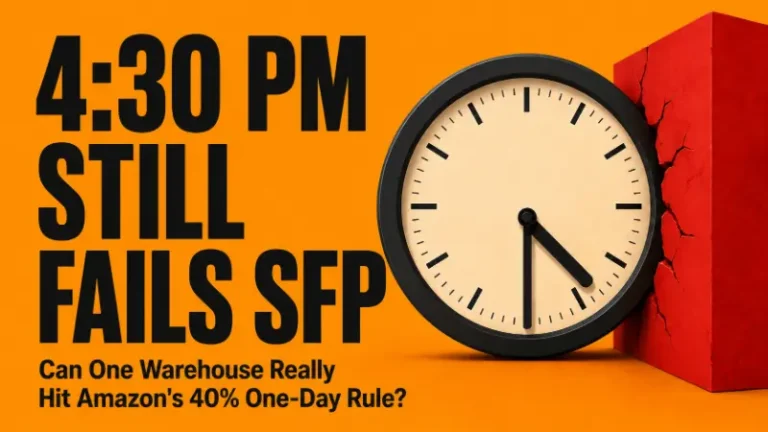
Why Even a 4:30 PM Cutoff Cannot Solve Amazon’s 40% One-Day SFP Rule
An established ecommerce merchant shipping more than 20,000 monthly orders from Pennsylvania had already pushed its cutoff to 4:30 PM Eastern Time and was willing to use Next Day A...