
Amazon’s New Coupon Display Changes How Shoppers Perceive Value

In this article
 11 minutes
Within the broader e-commerce landscape, Amazon stands out as a platform that continually enhances its features to improve the customer experience and requires business adaptability from sellers. Amazon is currently testing a new coupon display that shows the final price after the coupon is applied, rather than just the discount amount or percentage. This new format aims to simplify the shopping experience by allowing customers to see the exact price they will pay without needing to calculate the discount themselves. Most brands see this update as a positive change, as it simplifies price comparison for customers and could improve click-through rates and conversions. Official updates about such changes are communicated through Seller Central, Amazon’s hub for managing seller accounts and accessing important information.
The coverage of this change has mostly focused on the mechanics: how to set up coupons, whether to adjust coupon budgets, whether Prime Exclusive Discounts behave differently. That framing treats the update as an interface tweak with some operational implications.
That framing is too narrow. This is an economics shift disguised as a display change. And the sellers who do not understand the difference will misread the consequences for months.
What the Coupon Badge Was Actually Doing
Before getting into what changes, it is worth being precise about what the green coupon badge was doing for sellers who used it.
The badge was not just communicating a discount. It was doing psychological work at the point of attention, before a shopper had made any conscious decision to engage with the listing. A green badge showing “15% off with coupon” in search results functioned as a visual cue that interrupted the scroll, signaled deal availability, and created a moment of perceived value without requiring the shopper to read a word of copy or evaluate anything about the product itself. Research indicates that the presentation of discounts significantly influences consumer behavior and conversion: ‘cents-off’ coupons allow shoppers to see their savings clearly without calculations, while ‘percent-off’ coupons may require mental computation, which can deter some buyers.
That is the behavioral mechanism behind it. Shoppers do not consciously process every element of a search results page. They respond to signals. A green discount badge is a strong signal that something has changed about a price. It activates loss aversion and deal-seeking behavior that is largely automatic. The shopper clicks not because they compared the listing carefully but because the badge told them there was a deal to investigate. A survey revealed that many shoppers prefer seeing their total savings rather than just the final price after a discount, suggesting that familiarity with traditional coupon formats can impact how likely they are to convert.
For many sellers, that badge was doing a significant portion of the click-through lift on promoted or organic listings. It was not a supplement to a strong listing. For weaker listings, it was the primary conversion mechanism at the top of the funnel. The visibility and clarity of coupon displays can significantly affect click-through and conversion rates, as clearer pricing tends to facilitate faster shopper decision-making and helps more shoppers convert.
When the Cue Weakens, the Work Shifts
When the percentage-off badge is replaced by final price presentation, the buying cue changes in a specific and consequential way.
A final product price requires a reference point to be meaningful. A shopper looking at a price of $27.49 does not know whether that is a good deal without knowing the regular price, what competitors charge, or what they expected to pay. The percentage-off badge eliminated that cognitive step. It said, in effect, this is cheaper than it usually is. That was legible in under a second.
Showing the final product price allows shoppers to understand the cost without performing mental math, making it easier to evaluate value. It is also important for shoppers to compare the final price to the recent lowest price to ensure they perceive value and to remain compliant with Amazon’s pricing policies.
A final price says, this is the price. That is not valueless information, but it requires more cognitive processing. The shopper has to compare, recall, or estimate. Shoppers who were converting on the badge alone, responding to the visual cue without deeper evaluation, now have to do more work. Some of them will not bother.
This is how marketplace surface changes reshape economics without changing a single fee structure. The shopper experience shifts, behavior changes, and the conversion math for many listings moves without a single policy document announcing it—even as Amazon FBA fees continue to increase and put additional pressure on margins.
Who Loses the Most When the Badge Fades
Not every seller is equally affected. The impact depends on what the listing was actually doing for itself before the badge was available.
Low-differentiation commodity products are most exposed. If two listings in a category are functionally identical, and one had a green badge driving click-through, that seller was winning on the cue rather than on the product. When both listings present at a final price with no badge cue, the decision logic shifts. Shoppers now evaluate more deliberately: images, reviews, review count, seller history, shipping speed, and listing copy all matter more. A commodity listing without strong fundamentals was already fragile. Losing the coupon cue makes that fragility visible.
Listings with weak imagery or thin copy were partially compensated by the badge. A product image that is not quite right for the category, a title that is functional but not compelling, a bullet point structure that is adequate but not strong: all of these weaknesses are more exposed when the conversion aid at the top of the funnel disappears. The shopper who clicked on the badge and converted despite a weak listing interior is now less likely to click at all.
New sellers and new ASINs building review velocity through coupon promotions will see less efficient use of that tactic. Strategic coupon setup and running coupons have been key for generating early traction, but this is now affected by new eligibility requirements. As of March 2024, products must have a sales history and a discount price lower than the Was Price to be eligible for a coupon. Amazon now requires a verified sales history, and the coupon price must be lower than the product’s recent lowest price to ensure authenticity. This means new ASINs cannot immediately leverage coupons for launch, impacting their ability to drive initial demand and review velocity—making pre-launch Amazon Vine reviews an increasingly important alternative for early social proof. When planning coupon setup and running coupons, sellers must also consider inventory, stock, and demand planning, as increased coupon visibility can drive higher demand and risk stockouts if inventory is not managed properly.
Established listings with strong reviews and differentiated positioning are the least affected. Their conversion drivers were never primarily the badge. Shoppers click on them because of social proof, brand recognition, or clear category positioning. The coupon badge was incremental upside for these listings, not load-bearing infrastructure.
The Misdiagnosis Problem
Here is where the operational risk compounds. Many sellers who see performance decline after this display change will not correctly identify the cause.
They will look at their advertising data first. They will see that CTR dropped and CPC stayed flat or increased, meaning they are spending the same amount to generate fewer clicks. The first instinct will be to adjust bids, change keywords, refresh ad creative, or restructure campaign structure. Some of that work may produce marginal improvement. None of it addresses the actual problem.
The actual problem is that the listing was relying on a marketplace-provided conversion cue that is no longer working the same way. The fix is not in ad management. It is in listing fundamentals: imagery, title, copy, reviews, and offer design. But sellers who are primarily optimizing ads will not see that. They will spend months chasing a performance problem with the wrong tool. Without a plan and the use of analytics tools, sellers risk flying blind—making decisions without the data-driven insights needed to adapt to changes in coupon display and performance.
This is a version of the broader pattern that applies whenever platforms change their surfaces. The change creates a new environment. Sellers who understand what the environment was doing for them can adapt. Sellers who did not understand the mechanism cannot diagnose the shift accurately—just as many misread the impact of Amazon’s “Frequently Returned Item” badge on shopper trust and listing performance.
The Contrarian View: The Badge Was a Crutch
It is worth saying explicitly what the badge enabled at scale. For many sellers, it subsidized weak listing quality. A product with mediocre imagery, ordinary copy, and a modest review count could punch above its weight in click-through by posting a visible discount. The badge was effectively doing positioning work that the listing itself was not doing.
In that sense, the change is not only a threat to sellers. It is a correction toward quality. Listings that earn clicks because they are genuinely differentiated and well-presented will now compete more effectively against listings that were winning on coupon-badge visibility alone. The Amazon marketplace has always had a stated preference for better customer experience and stronger product quality. A display environment that forces shoppers to evaluate more deliberately, and forces sellers to earn clicks on fundamentals, is directionally consistent with that. As surface-level promotional cues become less effective, optimizing for profit and maintaining healthy margins is increasingly important. Sellers must track and adjust their strategies to protect profitability as fee structures and coupon display changes impact both margins and overall profit, using pricing strategies that keep free shipping profitable as a model for balancing customer appeal with unit economics.
Sellers who have invested in strong content, clear value communication, and genuine product differentiation have less to fear from this change than the short-term performance data might initially suggest. Their click-through may dip slightly as the overall environment adjusts. But the relative competitive advantage of their fundamentals increases.
What Marketplace Surface Changes Mean at a Structural Level
The coupon display shift is one instance of a pattern that operators should expect to encounter repeatedly. Marketplaces do not only extract value from sellers through fee increases and policy changes. They also reshape the economics of selling through surface changes that alter how value is communicated, how decisions are made, and what capabilities produce results.
In this evolving landscape, marketing strategies—including the use of promos, deals, best deals, and lightning deals—are increasingly influenced by changes in Amazon’s fee model and performance metrics. Starting June 2, 2025, Amazon will introduce a performance-based coupon fee structure, replacing the previous flat fee of $0.60 per unit sold with a coupon. Under this new fee model, sellers will pay a flat fee plus a percentage of the total sales amount for coupon-discounted products, which can significantly impact profit margins, especially for higher-priced items—just as the holiday peak FBA order fulfillment fee did in prior years. This structure favors low-to-mid-priced items and high-volume coupon campaigns. Sellers can now also prevent coupon stacking, allowing them to better control promotional costs and optimize their promo strategies.
Sales performance is now a critical factor in determining the cost-effectiveness of coupons and deals. The effectiveness of marketing campaigns, including PPC (pay-per-click) advertising, is closely tied to how well coupons and promos are integrated. Optimizing PPC campaigns with targeted coupon offers can improve advertising efficiency, boost conversion rates, and support overall sales performance, just as thoughtful marketing strategies for making free shipping profitable can turn cost centers into acquisition levers.
The shift toward agentic commerce and AI-assisted purchasing is the most consequential version of this pattern on the horizon. When shopping agents filter, rank, and select products on behalf of consumers, the visual and emotional cues that badges and promotional signals provide become irrelevant. The product has to communicate value through structured data, reviews, pricing consistency, and fulfillment reliability, because there is no human attention span scanning a results page for a green badge or evaluating which order fulfillment model best meets fast-shipping expectations. The coupon display change is a small step in that same directional pressure.
Brands that are operationally dependent on a single platform’s interface choices are inherently exposed to these shifts. The coupon badge today, something else tomorrow. Each change recalibrates who benefits. Sellers with strong fundamentals across imagery, copy, reviews, pricing, and fulfillment—along with resilient fulfillment strategies like using Seller Fulfilled Prime to fight rising FBA fees—tend to benefit from changes that reduce the effectiveness of surface-level shortcuts. Sellers whose performance is built on those shortcuts tend to suffer.
Margin pressure from surface changes compounds the margin pressure that comes from rising shipping costs, carrier surcharge increases, and hidden Amazon FBA fees that many sellers overlook. The sellers who weather this environment are not the ones with the most aggressive promotional tactics. They are the ones with the tightest operational fundamentals, the cleanest cost structures, and the most durable product positioning.
What to Do Now
The practical response to the coupon display change is not to abandon coupons. Coupons still affect price presentation in search results and still provide some conversion signal. The response is to stop treating the coupon badge as a substitute for listing quality. Instead, sellers should plan each campaign carefully, establish specific objectives—such as boosting sales or increasing brand awareness—and allocate a specific coupon budget to manage costs and maximize promotional impact.
Audit your highest-traffic ASINs for listing fundamentals. Are the main images hero-quality for the category, or are they functional but not compelling? Does the title communicate a clear positioning and include relevant keywords to maximize visibility, or is it a keyword string? Do the bullet points engage the target customer and address actual buying concerns, or do they describe features the customer was not asking about? Is the review count and rating where it needs to be relative to category competition?
For new ASINs, build the listing quality before leaning on promotional mechanics to drive initial velocity. Use keyword-rich titles, engaging bullet points, and high-quality images to maximize visibility and conversion rates for products with coupons. Coupons and early promotions can supplement momentum on a strong listing. They cannot generate durable traction on a weak one.
For established ASINs where performance declines after this change, resist the instinct to immediately adjust advertising. Audit the listing first. If the listing fundamentals are weak, fix those before spending more on ads to drive more traffic to an unconverted page. Additionally, track sales and units sold to evaluate the effectiveness of your coupon campaigns, and consider A/B testing coupon values to determine whether a dollar-off or percentage-based discount drives stronger conversions for your product. Leverage marketing channels such as social media, email marketing, and paid ads to generate more traffic and further boost sales.
Frequently Asked Questions
What is the Amazon coupon display change?
Amazon appears to be testing a change in how coupon savings are presented on product listings. Some listings are showing the final price more prominently instead of the green percentage-off badge that was previously common in search results. The change affects how visible discount cues are to shoppers scanning results.
Why does the coupon display change matter for sellers?
The green coupon badge was a visual conversion cue that triggered deal-seeking behavior before shoppers consciously evaluated a listing. When that cue is less visible, shoppers have to process more information to determine if a price represents value. Listings that relied on the badge to drive click-through may see weaker performance without changing anything about their advertising or pricing.
Does removing the badge cue hurt all Amazon sellers equally?
No. Sellers with strong listing fundamentals, including high-quality imagery, differentiated positioning, and strong review counts, are less affected because their conversions were not primarily driven by the badge. However, this change is particularly impactful for certain groups, especially those who relied heavily on the coupon badge for click-through—such as sellers with weaker listings or commodity products that used the badge as a primary click-through driver.
How should sellers respond to this change?
The priority is auditing listing fundamentals: imagery, title clarity, copy quality, and review strength. Sellers who improve these elements reduce their dependency on surface-level promotional cues. Adjusting advertising without improving listing quality is likely to produce diminishing returns.
Is this change permanent or a test?
Based on available reporting, this appears to be a test that Amazon is running on some listings and categories. The full scope and permanence of the change have not been announced. However, the directional trend of platforms moving toward final price presentation and reducing explicit promotional badges reflects broader commerce interface patterns, and sellers should prepare for this environment regardless of how the specific test resolves.
What does this mean for using Amazon coupons going forward?
Coupons remain a valid promo tool on Amazon and still affect pricing presentation in results. As one type of promo available to sellers, coupons should be integrated into a broader promotional strategy. The change affects how prominently the discount cue is displayed, not whether coupons work at all. The practical implication is that coupons should be viewed as one element of a complete listing strategy rather than as a standalone conversion mechanism.
Written By:

Rinaldi Juwono
Rinaldi Juwono leads content and SEO strategy at Cahoot, crafting data-driven insights that help ecommerce brands navigate logistics challenges. He works closely with the product, sales, and operations teams to translate Cahoot’s innovations into actionable strategies merchants can use to grow smarter and leaner.

Turn Returns Into New Revenue
Related Articles

Why Cross-Border DTC Brands Are Moving Fulfillment Inside the US
Cross-border ecommerce fulfillment is the process of shipping ecommerce orders across national borders—often from warehouses outside the United States to U.
Crafting a Return Policy that Drives Customer Loyalty and Reduces Returns
Let’s talk about ecommerce returns policies.

Cheapest Shipping from USA to UK: What It Really Costs
Shipping from the USA to the UK is one of the most common international routes for ecommerce brands, and it is also one of the most misunderstood from a cost perspective.
Why P2P Returns Are Not “Recommerce”

In this article
16 minutes
- Introduction to P2P Returns
- Recommerce Usually Means Used Goods
- P2P Returns Preserve Like-New Inventory
- Think Fitting Room, Not Flea Market
- Logistics and Operations: How P2P Returns Work in Practice
- Why the Distinction Matters for Trust and Margin
- Environmental Benefits of P2P Returns
- P2P Can Coexist With Recommerce, But It Is Not Recommerce
- The Mental Model That Actually Fits
- Frequently Asked Questions
Peer-to-peer returns are a logistics model, not a resale channel. When people hear that a returned item goes from one customer directly to another, they often reach for the nearest familiar category and file it under recommerce. That instinct is understandable, but it is strategically wrong, and the distinction matters more than most ecommerce operators realize. In this context, recommerce refers specifically to the process of reselling pre-owned or surplus products, emphasizing its role in secondhand ecommerce and circular economy initiatives.
Recommerce is built around the idea of selling goods that have already moved into a secondary-market frame: used items, recovered inventory, refurbished stock. It comes into play after something has already been classified as a used good. Recommerce providers and recommerce platforms play a crucial role in facilitating these transactions for brands and consumers, managing resale logistics, refurbishment, and consumer engagement. The business model of recommerce is structured around resale and recovery, aligning sustainability and profitability within a company’s overall operations. Peer-to-peer returns, by contrast, are about preventing that classification from happening at all. A like-new item that skips the trip back to the warehouse is not recommerce. It is first-sale inventory that moved directly to its next owner before anyone had a chance to treat it like used goods.
The global recommerce market is valued at $100 billion, growing at a rate five times faster than the broader retail market, and is expected to represent 23% of all retail by 2030.
Introduction to P2P Returns
Peer-to-peer (P2P) returns are transforming the landscape of ecommerce returns by streamlining the way products move between customers. Traditionally, when a customer wanted to return an item, it would travel back to a central processing center or warehouse before being restocked or resold. This process often led to increased shipping costs, excess packaging waste, and a slower returns process that could frustrate customers.
With P2P returns, the process is reimagined: instead of sending the item back to the merchant, the returning customer ships it directly to the next buyer. This peer-to-peer approach not only accelerates the returns process but also significantly reduces the resources required for each transaction. Customers benefit from faster resolutions and improved customer satisfaction, while ecommerce businesses see a reduction in operational costs and packaging waste. By keeping products in circulation and out of the warehouse, P2P returns offer a more efficient and customer-centric solution to the challenges of ecommerce returns.
Recommerce Usually Means Used Goods
The word recommerce has a specific gravity. When operators hear it, they picture resale platforms, secondary-market channels, trade-in programs, and refurbished inventory. That mental picture is accurate for what recommerce actually is. The resale business, built on the resale business model, leverages resale platforms to facilitate the sale of pre-owned and used products, enabling the efficient movement of goods within the circular economy.
Recommerce typically describes situations where goods have already fallen into a different value category. The item has been owned, used, returned through traditional recovery channels, and then made available again through a resale structure. Pre-owned, pre-owned items, and used products are sourced and processed through trade-ins, trade-in credit, and store credit programs, allowing consumers to exchange their goods for value and supporting sustainable consumption. The business logic is about recovering value that has already degraded. Resale as a service and third-party platforms enable brands to participate in the resale industry by managing resale operations, while various resale models support both peer-to-peer and take-back programs. Reverse commerce is another term used to describe the resale or reuse of previously owned items, highlighting its connection to sustainable supply chain practices. That is a legitimate and growing category of commerce, but it is a downstream activity.
The mental image it produces matters. “Recommerce” conjures flea markets, liquidation lots, and thrift-store bins. It implies that the item’s best days as a sellable product are behind it, and that the challenge now is to extract what residual value remains. The growth of the resale industry is driven by individual consumers actively participating in these programs, as well as many retailers and many brands recognizing the importance of integrating recommerce and reverse logistics into their business strategies.
The culture of disposable fashion generates around 17 million tons of textile waste annually in the U.S., with only 14-15% of discarded items being recovered, emphasizing the need for sustainable practices like recommerce to mitigate waste. During the holiday season of 2023, the resale market is expected to contribute to the prevention of 32 billion pounds of waste from ending up in landfills, showcasing the environmental benefits of recommerce. Implementing resale initiatives could lead to a reduction of annual carbon emissions by approximately 15-16% by the year 2040, highlighting the long-term sustainability benefits of recommerce.
That framing is completely wrong for the scenario peer-to-peer returns actually describe. If you want to understand what peer-to-peer returns are at a foundational level, the core definition is worth reading before going further.
P2P Returns Preserve Like-New Inventory
Here is the scenario peer-to-peer returns actually describe.
A customer orders a pair of pants online. They try them on once. The fit is wrong. They initiate a return. Another new customer has already found that same item, wants it at an open-box discount, and is ready to buy. In a P2P model, the first customer ships the item directly to the second customer. The merchant’s warehouse is never involved.
That item never went through a recovery loop. It was not inspected, re-tagged, put in a bin, or processed through a reverse logistics facility. It is the same highly sellable product it was when it shipped the first time, and it has moved to a new customer who wanted it. Quality control is maintained by minimizing handling, helping preserve the like-new condition of the item.
That is not recommerce. There is no secondary market. No resale channel. No recovery logic. The item retained its like-new condition and moved to its next buyer while that condition was still intact.
Peer-to-peer returns can enhance customer satisfaction by providing a quicker and more efficient returns process, as customers receive refunds faster than traditional models. When combined with an exceptional returns program that builds customer loyalty, this speed and simplicity can become a powerful differentiator. Items returned through a P2P system can often find a new home in just a few days, leading to faster inventory turnover.
Think Fitting Room, Not Flea Market
The fitting room analogy makes this concrete.
When someone tries on a shirt in a physical store and puts it back on the rack, no one treats that shirt as used merchandise. The item was tried on. It is back in circulation. It is still fully sellable. Retailers do not mark it down to clearance price and ship it to a liquidator because a customer touched it.
P2P Returns operate on the same logic. The item was tried on at home. The fit or the color was not right. Another buyer is willing to take it at an open-box discount and considers it like-new because, functionally, it is. The difference from a traditional return is that the item goes directly to that buyer instead of first going back to the warehouse to begin the traditional recovery process. This positive returns experience can foster repeat purchases, drive loyalty, and build customer loyalty by making the process seamless and trustworthy for customers.
Trade-in programs also effectively encourage customers to make repeat purchases, thereby increasing overall customer lifetime value, especially when they are designed as part of a broader ecommerce returns program that balances loyalty and costs.
Recommerce is the flea market at the end of that process, not the fitting room at the beginning of it.
What P2P returns protect is the item’s value before it enters any recovery system. A like-new returned item that gets dragged through the full warehouse loop will receive a markdown, a reprocessing cost, and a new classification as “used” or “open-box warehouse return” before it ever reaches its next buyer. P2P removes all of that friction by moving the item earlier in the chain, while the value is still fully intact. Additionally, P2P returns can reduce operational costs by eliminating the need for warehouse intake, inspection, and repackaging.
Logistics and Operations: How P2P Returns Work in Practice
The operational backbone of peer-to-peer returns relies on a sophisticated logistics process designed to maximize efficiency and minimize costs. When a customer initiates a return, the system first assesses the item’s condition and matches it with demand from other customers. If the item qualifies, a shipping label is automatically generated, directing the original customer to send the product straight to the next buyer—bypassing the traditional warehouse or processing center entirely.
This streamlined approach dramatically reduces reverse logistics costs, as items no longer need to be shipped back and forth between distribution centers. Logistics companies and technology providers play a pivotal role in enabling this process, offering the infrastructure and digital tools necessary to coordinate shipments, track inventory, and ensure a seamless customer experience, especially when they follow best practices for optimizing reverse logistics in ecommerce. By eliminating unnecessary steps in the reverse logistics process, P2P returns help ecommerce brands achieve greater operational efficiency and reduce the overall burden on their supply chain.
Why the Distinction Matters for Trust and Margin
Calling P2P returns recommerce is not just an imprecise label. It creates a real problem for how buyers perceive the item and how merchants price it.
When an item is framed inside a recommerce or resale mental model, buyers expect used-goods pricing and condition. They assume the item has passed through several hands and processes before reaching them. They discount the perceived value accordingly. Merchants who let their P2P offering drift into a recommerce frame are effectively giving away value they did not have to give away.
The economics of peer-to-peer returns depend on that value being preserved. The model works because a like-new item retains pricing power that a warehouse-processed open-box item does not. An item positioned as like-new and sold directly buyer-to-buyer commands a meaningfully different price than the same item that has been through a full returns processing cycle and relabeled as refurbished. Preserving this value leads to increased sales, higher profits, and more revenue generated for merchants, as digital recommerce platforms enable cost efficiencies and new income streams compared to traditional resale methods, especially in categories where ecommerce return rates can erode profit margins.
Merchants who mislabel P2P as recommerce also muddy the internal business case. The value proposition of P2P is that it skips the warehouse loop and keeps highly sellable inventory from being treated like recovered stock. P2P returns help reduce costs and avoid storage fees associated with traditional returns, further improving profit margins. In fact, P2P returns can cut return logistics costs by up to 60%, and cost reduction strategies can lower return-related losses from an average of $37 down to $15 per $100 item, which is especially important as many retailers struggle with the rise of ecommerce return rates. Ecommerce brands can also cut shipping and processing costs by up to 70% by implementing peer-to-peer returns, transforming a significant cost center into a revenue growth driver.
The label is not cosmetic. It shapes how the program is priced, positioned, and measured.
Environmental Benefits of P2P Returns
Beyond operational gains, peer-to-peer returns deliver substantial environmental benefits. By keeping products in active circulation and reducing the need for new manufacturing, P2P returns help cut down on packaging waste and lower carbon emissions associated with shipping and processing. This model is especially impactful for fashion retailers, who face mounting pressure to address the environmental impact of excess inventory and return waste and to implement eco-friendly returns practices that align with consumer expectations.
Encouraging customers to participate in P2P returns supports sustainable consumption habits, as it extends the lifecycle of products and reduces the demand for new goods. As more ecommerce brands and recommerce models adopt these practices, the industry moves closer to a circular economy—one where resources are used more efficiently and waste is minimized, mirroring broader shifts like the evolution of thrifting and mainstream secondhand shopping. For customers and businesses alike, P2P returns represent a practical step toward reducing environmental impact while maintaining high standards of service and satisfaction.
P2P Can Coexist With Recommerce, But It Is Not Recommerce
None of this means recommerce is irrelevant or that the two approaches are in conflict. A well-designed returns strategy often includes multiple paths for returned inventory, and a robust recommerce channel, built on a recommerce business model, is integrated into overall company strategy to maximize value recovery and sustainability.
Items that are not P2P-eligible, whether because of condition, category, or timing, may eventually find their way into recommerce or liquidation channels. That is appropriate. P2P handles the high-value portion of the return flow. Traditional downstream channels, often involving a distribution center and a logistics provider for inspection, restocking, or disposal, handle the rest, sometimes supported by a returns management solution like ZigZag or a platform such as Return Prime that focuses on the digital side of processing. For a full picture of where P2P fits and where it does not, where peer-to-peer returns don’t work is worth reviewing.
Approximately 30 to 60 percent of returns across most ecommerce operations are viable candidates for peer-to-peer routing or recommerce, depending on SKU mix, return reasons, and product categories.
But the point is that they serve different purposes at different points in the value chain. P2P comes first. It captures value before the item loses its like-new standing. Recommerce comes later and works with inventory that has already moved into a different category, allowing brands to participate directly in both P2P and recommerce processes for greater lifecycle management and sustainability.
These two approaches can coexist without being the same thing. They are not interchangeable.
The Mental Model That Actually Fits
P2P Returns are a logistics architecture, not a resale program. In the context of an ecommerce business, this architecture leverages advanced returns management systems and the expertise of a service provider to facilitate efficient, direct item transfers between customers. The defining feature is not that a second buyer gets the item. It is that the item moves directly to that buyer while still in highly sellable condition, before the warehouse handling and recovery processing that would otherwise erode its value and perception. Integrating resale software with existing systems, such as ERP, further streamlines these operations and enhances scalability.
A customer who receives a like-new item with no visible wear, shipped directly from the original buyer, has not purchased a used good in the way recommerce implies. They have purchased an item that was tried once and redirected before anyone processed it as a return. Throughout this process, the merchandise sold is carefully tracked and subjected to quality control measures to ensure a seamless experience and maintain high standards, much like store-based options such as Happy Returns’ drop-off reverse logistics model aim to simplify the customer experience.
Directly shipping the item reduces transit time and lowers carbon emissions, enhancing sustainability. The peer-to-peer returns model minimizes the environmental impact associated with traditional ecommerce returns by reducing the number of shipments and packaging waste. Waste reduction is a key benefit of the P2P model, supporting broader sustainability and circular economy goals.
That is a fundamentally different kind of transaction. It belongs in a fundamentally different mental category.
The moment you call it recommerce, you invite the wrong assumptions: used condition, depreciated value, secondary-market frame. Those assumptions are wrong, and they cost real margin when they shape how the program is built and communicated.
Frequently Asked Questions
What is the difference between peer-to-peer returns and recommerce?
Recommerce involves selling goods that have already moved into a secondary market or recovery channel, typically used, refurbished, or post-disposition inventory. Peer-to-peer returns involve like-new or open-box items that go directly from the returning customer to the next buyer without first going back to the merchant’s warehouse. The two approaches operate at different points in the value chain and serve different purposes.
Does calling P2P returns recommerce actually matter?
Yes. The label shapes buyer expectations, pricing logic, and how the business case is framed internally. When P2P is positioned as recommerce, buyers assume used-goods conditions and pricing, and merchants understate the value of the logistics model. The distinction directly affects margin and trust.
Are P2P returns the same as resale?
No. Resale and recommerce typically describe the sale of goods after they have been used, owned, or recovered. P2P returns describe a logistics model where a like-new returned item moves directly to the next customer instead of entering the traditional return processing loop. The item retains its like-new condition and value because it never went through warehouse recovery.
Can a brand use both peer-to-peer returns and recommerce?
Yes. The two approaches can coexist in a broader returns strategy. P2P returns handle the portion of return volume where items are still in highly sellable condition. Recommerce or other downstream recovery channels handle inventory that does not meet P2P eligibility criteria. They are complementary, not identical.
Is an open-box item sold through P2P considered a used good?
Not in the way recommerce implies. An item that was tried on once and shipped directly to the next buyer has not been through the handling, inspection, and reprocessing steps that typically define used or refurbished goods in a resale context. It is better understood as like-new inventory that moved to its next owner before the traditional return loop could degrade its value.
Where can I learn more about how peer-to-peer returns work in practice?
A detailed breakdown of how peer-to-peer returns actually work covers the operational mechanics step by step. For the financial case, the economics of peer-to-peer returns explains why skipping the warehouse preserves value and removes cost layers.
Written By:

Manish Chowdhary
Manish Chowdhary is the founder and CEO of Cahoot, the most comprehensive post-purchase suite for ecommerce brands. A serial entrepreneur and industry thought leader, Manish has decades of experience building technologies that simplify ecommerce logistics—from order fulfillment to returns. His insights help brands stay ahead of market shifts and operational challenges.
Turn Returns Into New Revenue
Related Articles
Crafting a Return Policy that Drives Customer Loyalty and Reduces Returns
Let’s talk about ecommerce returns policies.
Cheapest Shipping from USA to UK: What It Really Costs
Shipping from the USA to the UK is one of the most common international routes for ecommerce brands, and it is also one of the most misunderstood from a cost perspective.

Why Faster Refunds Made Returns More Expensive
Introduction Faster refunds feel like obvious progress.
What Regional Parcel Carriers Mean for Ecommerce Shipping Strategy
In this article
16 minutes
- Carrier Diversification Has Become the Default
- Reliability Has Overtaken Price
- The Orchestration Gap
- What Actually Changes When Regional Carriers Expand
- Four Ways Brands Fail to Benefit from More Carrier Options
- The Contrarian View: More Carrier Options Can Make Operations Worse
- What Brands Should Actually Do
- Frequently Asked Questions
Quick answer: Carrier diversification is no longer just a way to negotiate lower parcel rates. It has become customer-experience and resilience infrastructure. In 2026, 55% of surveyed retailers use carriers beyond UPS, FedEx, and USPS, and more than one-third shifted volume away from traditional carriers during the previous year. But signing more contracts is not a strategy by itself. Brands need order-level routing that can choose the right fulfillment node and carrier based on cost, promised delivery date, reliability, package profile, and current capacity—and reroute when performance breaks down.
The pressure is coming from both sides of the P&L. According to the AlixPartners 2026 Home Delivery Survey, 94% of consumers say free shipping affects their purchase decisions, while the expected time for free delivery has compressed from more than 3.5 days to 2.7 days. At the same time, 83% of retailers report higher home-delivery costs and 64% say home delivery is not accretive to profitability compared with an in-store transaction.
That combination changes the role of regional and alternative carriers. They are not simply cheaper substitutes for UPS or FedEx. They are additional paths through the last-mile network—paths that create value only when a brand can select and manage them intelligently.
Carrier Diversification Has Become the Default
The traditional assumption that ecommerce parcel shipping means choosing between UPS and FedEx, with USPS as a lower-cost fallback, no longer reflects the market. The AlixPartners survey found that 55% of retailers now use carriers outside those three networks, and more than one-third actively shifted volume away from traditional carriers in the past year.
The change is even clearer when looking at the complete carrier mix. FreightWaves’ analysis of the survey and parcel-market data reports that more than 90% of surveyed executives operate a mix of last-mile carriers, while 32% use four or more. What was once a negotiating hedge has become the operating model.
Parcel volume is moving accordingly. Alternative carriers—including networks such as OnTrac, Veho, UniUni, Better Trucks, Jitsu, SpeedX, and Gofo—handled 2.6 billion U.S. parcels in 2025, up 13% year over year. Their revenue increased 15.4%, even though the overall U.S. parcel market grew only 0.4%. That contrast matters: alternative carriers are gaining share in a market that is barely expanding overall.
The implication for ecommerce brands is not that every regional carrier should receive volume. It is that a shipping strategy built around one default carrier is becoming less competitive. Brands increasingly need several viable delivery paths so they can use the best-performing option for each order and shift volume when price, capacity, or service conditions change.
Reliability Has Overtaken Price
The most important finding in the AlixPartners survey is not simply that more retailers are diversifying. For the first time in the survey’s history, reliability displaced price as the leading criterion for selecting a primary carrier.
That change follows the customer. Consumers now expect free delivery in an average of 2.7 days, down from more than 3.5 days in prior years, and AlixPartners estimates that more than 20% of demand may be at risk when delivery expectations are not met. Speed created the pressure, but consistent execution determines whether the customer comes back.
More than 85% of consumers say a poor delivery experience reduces their willingness to repurchase from the retailer. Fifty-two percent would boycott a retailer after only one or two botched deliveries. And 84% say previous delivery experiences—including which carrier handled the package—influence where they choose to shop. The customer may blame the carrier first, but the retailer loses the relationship.
Retailers cannot solve this problem by simply buying faster service on every order. Home-delivery costs increased for 83% of surveyed retailers, and 64% say home delivery is not accretive to profitability compared with an in-store transaction. Brands therefore need to improve reliability while controlling an increasingly expensive cost center.
The data also points to a more nuanced answer than “ship everything faster.” More than 80% of consumers would accept slower shipping in exchange for an incentive. A mature carrier strategy should preserve premium speed where it changes the purchase decision, while offering a lower-cost no-rush option to customers who value an incentive more than speed.
The Orchestration Gap
The framing that regional carriers are simply cheaper is too shallow to be useful. A regional carrier can offer attractive economics and strong transit performance within its coverage area. But those benefits disappear when the order originates from the wrong warehouse, the package falls outside the carrier’s ideal profile, or the carrier is selected even though its recent performance in the destination market has deteriorated.
A low label price does not compensate for a missed customer promise. A carrier with competitive rates but inconsistent tracking creates customer-service costs that can erode the savings. Poorly handled delays and failed deliveries can compound the problem, making it important to understand carrier shipment exceptions and how to fix them fast.
The real question is whether a brand’s operational infrastructure can exploit carrier optionality in real time. For every order, the decision needs to consider:
- The fully landed shipping cost, including expected surcharges
- The customer’s promised delivery date and the carrier service capable of meeting it
- Recent on-time performance and exception rates for the origin-destination pair
- The fulfillment location holding inventory and its proximity to the customer
- The package’s weight, dimensions, contents, and carrier eligibility
- Current carrier capacity, service disruptions, and pickup constraints
That is the orchestration gap. A brand can possess several carrier contracts and still route poorly. A resilient multi-carrier network continuously evaluates the viable options and can shift orders away from a carrier, service, or region that is underperforming. The advantage is not having more names on a rate card. It is having more usable paths around failure.
What Actually Changes When Regional Carriers Expand
The expansion of regional carrier coverage changes the menu. It does not change the kitchen.
When regional and alternative carriers add markets, a brand with sufficient customer density in those areas gains another potential delivery path. The value of that path depends on whether the brand can make it available to the right orders without weakening the delivery promise.
To benefit from a regional carrier in a specific market, a brand needs:
- Shipping software that evaluates all eligible carrier services for each order rather than defaulting to a primary carrier
- Inventory positioned close enough to the delivery market for the carrier’s regional strength to be accessible
- Package configurations that do not trigger dimensional-weight penalties, size surcharges, or carrier restrictions that erase the advantage
- Checkout promises grounded in the carrier’s actual transit performance to the destination, not a generic estimate
- Monitoring that detects service degradation and routing logic capable of shifting future orders to another option
Consider a brand that adds a regional carrier contract but ships from one warehouse outside the carrier’s core service area. Its packaging triggers avoidable surcharges, its routing rules still default to a national carrier, and its checkout estimates are disconnected from actual carrier performance. That brand has not created a resilient network. It has added administrative complexity without capturing the economic or service benefit.
This is why inventory placement and carrier selection must work together. A regional carrier cannot create savings if inventory sits outside its useful service area. Likewise, a distributed fulfillment network cannot reach its potential if every order is routed through one default carrier regardless of destination, promise, or performance.
Four Ways Brands Fail to Benefit from More Carrier Options
Choosing the Wrong Carrier Because Decisions Are Manual
Manual carrier selection does not scale, and static rules often optimize for a simplified version of reality. An operations team working from rate sheets or general rules of thumb cannot consistently determine the best carrier for a specific package, destination, fulfillment location, delivery promise, and day.
Real-time ecommerce shipping software for warehouse automation can compare eligible services when the order is ready to ship. But the decision should not stop at the lowest displayed rate. The system also needs to account for surcharges, delivery-date feasibility, recent performance, and operational constraints. Otherwise, a brand may save on the label and lose more through refunds, support contacts, or customer churn.
Shipping from the Wrong Node and Losing the Savings
A regional carrier’s advantage is geographic. A brand with one West Coast warehouse cannot fully exploit a carrier whose strongest service area is in the Southeast. The package still needs an economically viable path from its origin to the customer, regardless of which carrier has attractive rates within the destination region.
Inventory positioning is therefore a prerequisite for carrier optionality. A distributed inventory model allows the brand to route the order from a nearby node and then select the carrier with the best combination of economics and delivery performance for that lane. Without distributed inventory, carrier choice is constrained by wherever the product happens to be stored. The relationship between inventory placement and parcel cost is explored further in Cahoot’s guide to national fulfillment services and network architecture.
Using the Wrong Package and Triggering Avoidable Cost
Carrier diversification does not fix poor packaging. An oversized box can raise the billable weight or trigger handling and size charges, eroding any advantage offered by the selected carrier. This risk has grown as UPS and FedEx dimensional-weight changes increase billable weight for many shipments.
Packaging optimization—the systematic matching of package dimensions to the products in each order—is an operating discipline that improves the economics of the entire carrier mix. It also determines whether a shipment fits a regional carrier’s accepted package profile. The connection between packaging, surcharges, and margin becomes especially important during periods of peak shipping surcharges.
Offering Weak Delivery Promises Because Systems Are Not Integrated
Adding a regional carrier without integrating its transit and performance data into checkout creates a disconnect. The carrier may be able to deliver faster in selected zip codes, but the customer still sees the same generic estimate. Or the brand may display an aggressive promise that the selected carrier cannot reliably meet.
That is especially dangerous when more than 20% of demand may be at risk if delivery expectations are missed. Brands offering expedited shipping options need promise logic that connects inventory availability, node selection, carrier eligibility, cutoff times, and real-world delivery performance.
Rate shopping, delivery promises, inventory positioning, and post-purchase communication cannot operate as isolated systems. They need to share the same view of the order and the network. That coordination is what turns carrier diversification into a customer-experience advantage.
The Contrarian View: More Carrier Options Can Make Operations Worse
More competition is good for shippers at the market level. At the individual brand level, however, more carriers can create more failure points.
Each new carrier may bring a new contract, rate card, pickup process, label integration, tracking feed, claims workflow, billing format, and set of package restrictions. If the brand’s systems cannot normalize those differences, the operations team inherits the complexity manually. The result can be slower fulfillment, inconsistent tracking, missed pickups, billing errors, and confused customer-service teams.
A static multi-carrier setup can also fail during the exact moment diversification is supposed to help. If a carrier experiences a regional disruption but routing rules continue assigning it orders, the brand has more contracts without more resilience. The network becomes resilient only when performance is monitored and orders can be shifted to a viable alternative before failures reach the customer.
That distinction matters: multiple carrier contracts create optionality; orchestration converts optionality into resilience. Brands that cannot integrate, monitor, and govern another carrier should close those gaps before adding one.
What Brands Should Actually Do
The practical response is not to sign contracts with every carrier that reaches a market where the brand has customers. It is to build a measurable multi-carrier operating model.
- Map demand against inventory and carrier coverage. Identify where order density, fulfillment nodes, and regional carrier service areas overlap. A carrier that cannot be used from the available inventory location is not a meaningful option.
- Define the delivery promise before optimizing cost. Determine which services can meet the customer’s promised date, then compare the fully landed cost among those viable options.
- Route at the order level. Evaluate origin, destination, package profile, price, service reliability, cutoff time, and capacity for every shipment rather than assigning one carrier to an entire region or channel.
- Monitor performance by lane and service. Network averages can hide local problems. Track on-time delivery, exceptions, tracking quality, claims, and customer contacts for the specific routes where each carrier receives volume.
- Build rerouting rules before disruption occurs. Set thresholds and fallback services so volume can shift when a carrier, service, or region underperforms.
- Segment speed instead of overspending on every order. Preserve faster service for orders and customers who require it, and test incentivized no-rush delivery for shoppers willing to trade speed for value.
This is where Cahoot’s combination of ecommerce order fulfillment services and intelligent shipping orchestration matters. Inventory placement determines which carrier options are physically and economically available. Automated rate shopping and routing determine which viable option should handle each order. The two decisions must work together.
The winners in the next phase of parcel diversification will not be the brands with the longest carrier lists. They will be the brands whose networks can consistently choose the right path—and change paths before a carrier failure becomes a customer failure.
Frequently Asked Questions
Are regional parcel carriers cheaper than UPS or FedEx?
They can be for the right shipment in the right market, but there is no universal savings percentage. The correct comparison includes the base rate, surcharges, package profile, fulfillment origin, destination, delivery promise, and expected service performance. A lower label price is not a savings if the shipment misses the promise or creates additional support and recovery costs.
What is the difference between regional, alternative, and national parcel carriers?
National carriers such as UPS and FedEx provide broad U.S. coverage and international services. Regional carriers specialize in defined geographic service areas. “Alternative carrier” is a broader category that can include regional parcel networks, crowdsourced or gig-based delivery platforms, and other providers outside UPS, FedEx, and USPS. Some alternative carriers combine several local networks to provide wider coverage.
Why has carrier reliability become more important than price?
Delivery performance now directly affects customer retention. More than 85% of consumers surveyed by AlixPartners say a poor delivery experience reduces their willingness to buy again, and 52% would boycott a retailer after only one or two botched deliveries. With consumers expecting free delivery in 2.7 days, retailers need carriers that can meet the promise consistently—not merely quote the lowest rate.
How does inventory positioning affect whether regional carriers are useful?
A regional carrier’s advantage is geographic. If inventory is stored outside its useful service area, the carrier may not be eligible or economical for the order. Distributed inventory allows the brand to fulfill closer to customer demand and makes more regional carrier options viable.
What should multi-carrier routing evaluate?
Order-level routing should evaluate the fulfillment origin, destination, promised delivery date, package dimensions and weight, carrier eligibility, landed cost, recent service performance, pickup cutoff, capacity, and active disruptions. Rate shopping is one part of the decision, not the entire decision.
What is the difference between having multiple carrier contracts and having a resilient carrier network?
Multiple contracts create options. A resilient network can use those options automatically. It monitors performance, identifies when a carrier or lane is underperforming, and reroutes eligible orders to another service without relying on manual intervention after customers have already been affected.
Is adding more carrier options always a good idea?
No. Each carrier adds integration, operating, billing, and performance-management requirements. A new carrier creates value only when it provides a viable service advantage and the brand can incorporate it into order-level routing, delivery promises, tracking, exception management, and fallback logic.
Written By:
Rinaldi Juwono
Rinaldi Juwono leads content and SEO strategy at Cahoot, crafting data-driven insights that help ecommerce brands navigate logistics challenges. He works closely with the product, sales, and operations teams to translate Cahoot’s innovations into actionable strategies merchants can use to grow smarter and leaner.
Turn Returns Into New Revenue
Related Articles
Why Cross-Border DTC Brands Are Moving Fulfillment Inside the US
Cross-border ecommerce fulfillment is the process of shipping ecommerce orders across national borders—often from warehouses outside the United States to U.
Crafting a Return Policy that Drives Customer Loyalty and Reduces Returns
Let’s talk about ecommerce returns policies.
Cheapest Shipping from USA to UK: What It Really Costs
Shipping from the USA to the UK is one of the most common international routes for ecommerce brands, and it is also one of the most misunderstood from a cost perspective.
Why Returns Became a Silent Margin Killer
In this article
18 minutes
- Introduction to Returns Management
- Returns Rarely Hit the P&L in One Place
- Shipping Is Only the Visible Part of the Reverse Logistics Damage
- The Returns Management Process
- The Real Margin Erosion in the Returns Management Process Spreads Across Teams
- Delay Turns a Return Into a Bigger Loss for Customer Satisfaction Than It First Appears
- What Makes Returns "Silent" Is What Makes Them Dangerous
- The Importance of Technology in Returns Management
- Brands Don't Just Have a Returns Problem — They Have a Visibility Problem Around Returns Data Loss
- Benefits of Effective Returns Management
- Frequently Asked Questions
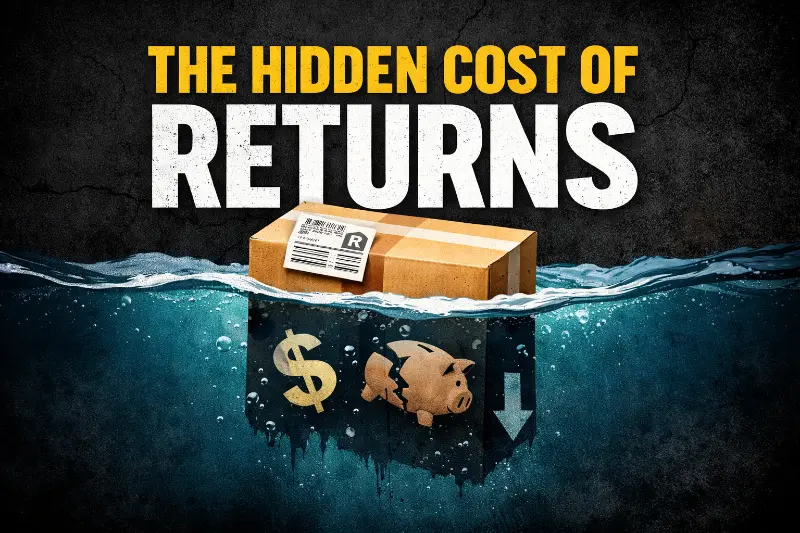
In today’s retail landscape, returns management quietly drains more margin than most ecommerce businesses realize — not because any single return is catastrophic, but because the losses fragment across teams, time horizons, and cost categories before anyone adds them up. The problem is not only that returns are expensive. It is that no one sees the whole bill at once.
Most brands feel the damage without modeling it as one problem. A return creates a shipping cost that ops can see, a labor cost that the warehouse absorbs, a markdown that merchandising owns, a service ticket that CX handles, and a wasted acquisition spend that marketing never connects back to the original order. By the time all of those losses have settled, they are sitting in five different budgets, reported to five different teams, and none of them are reading the same P&L line.
That distributed damage is exactly what makes returns a silent margin killer.
Introduction to Returns Management
Returns management is a foundational pillar of any successful e-commerce business, directly impacting customer satisfaction, operational efficiency, and long-term customer loyalty. In today’s competitive landscape, the ability to handle customer returns smoothly is not just a cost of doing business—it’s a strategic opportunity. The returns management process encompasses everything from the moment a customer initiates a return request to the final resolution, whether that means restocking, exchanging, or refunding the item.
Implementing returns management best practices is essential for maintaining customer satisfaction and building trust. A well-designed returns process reassures customers that their post-purchase experience will be hassle-free, which in turn fosters repeat business and strengthens brand loyalty. Moreover, efficient returns management helps reduce operational costs by streamlining workflows and minimizing unnecessary touchpoints. For e-commerce businesses, mastering the art of managing returns and building an exceptional returns program that drives customer loyalty can transform a potential pain point into a competitive advantage, ensuring that customer returns are handled with care and efficiency while supporting overall business growth.
Returns Rarely Hit the P&L in One Place
The common assumption is that a return creates one expense: the shipping label. That number is visible, trackable, and easy to report. It is also the smallest part of the problem.
When a returned item moves back through the system, it accumulates cost at every step. Transport in both directions. Intake labor. Inspection time. Repackaging materials. Delayed resale. Markdown pressure as the item sits unsellable. And in some cases, a total write-off if resale conditions have passed. These costs do not appear together on a single line. They land in separate departments, often in separate reporting periods, which is why the aggregate damage is almost always undercounted. As a result, the true financial impact of returns is frequently underestimated or overlooked, making it difficult for businesses to fully understand how returns affect profitability and cash flow.
Here is what that looks like in practice. A mid-sized apparel brand receives a returned jacket. The ops team logs the inbound label cost and the intake labor. That shows up in fulfillment. Three weeks later, the item gets marked down 25 percent because the selling window for that style has narrowed. That shows up in merchandising. The customer who returned it contacted support twice during the process. That shows up in CX. The paid social spend that drove the original purchase is never recovered. That sits in marketing. Four departments absorbed real losses from one return, and none of their reports reference each other. From the outside, returns looked manageable. From the inside, four teams quietly ate the damage.
This is not a rounding error. It is a structural visibility failure.
A finance team that reviews its returns line and sees only label costs is looking at the most visible fraction of the actual loss. The deeper damage — labor burden, markdown drag, wasted customer acquisition spend, inventory distortion — sits elsewhere in the business, categorized as something other than a returns problem. It is often treated as an operational variance, a cost-of-goods adjustment, or simply absorbed into overhead.
When losses are miscategorized, ownership is blurred. And when ownership is blurred, the business underreacts — not because the losses are small, but because no one is accountable for the full number.
Shipping Is Only the Visible Part of the Reverse Logistics Damage
Return labels get noticed because they are immediate and attributable. The label cost, along with return shipping expenses, hits the account right away. These costs are concrete and easy to dispute with a carrier.
The rest of the cost stack does not work that way.
Industry analysis puts the full average cost per return at roughly $40 once handling, repackaging, and secondary costs are included. Because ecommerce return rates directly affect profit margins, return cost as a share of sale price typically runs between 17 and 30 percent depending on category. That is before markdowns, fraud exposure, or wasted acquisition spend.
Consider a basic apparel example. A $59.99 item that ships back generates a visible label cost. But the same return also triggers intake labor, inspection time, potential repackaging, delayed inventory availability, and markdown pressure if resale is slow. If the item arrives after the peak selling window for that style, it may be resold at 30 percent off — still generating a loss even when it moves successfully. If customer acquisition cost is layered in, the original sale that was supposed to build a relationship has now become a net drain, underscoring why brands need to optimize reverse logistics across the entire return flow.
For a detailed breakdown of how those losses stack across a single return, the hidden economics of a $100 return makes the full cost model explicit. The purpose here is narrower: to recognize that label cost is the entry point of the damage, not the end of it.
Automation and technology can help businesses efficiently generate return labels as part of the returns process, streamlining reverse logistics and reducing manual workload, especially when supported by dedicated returns management software that automates key workflows.
The Returns Management Process
The returns management process begins the moment a customer initiates a return request, whether through an online portal or at a physical store. This process typically involves several critical steps: return merchandise authorization (RMA), product transportation, inspection and processing, customer resolution, and finally, restocking or responsible disposal of the returned item. Each stage of the returns process must be carefully managed to ensure operational efficiency and maintain high levels of customer satisfaction.
A seamless returns management process relies on clear communication and timely updates, keeping customers informed about the status of their return and expected resolution. Leveraging returns management software can automate many of these steps, from generating return labels to tracking return status and processing refunds. Selecting the best returns management software for your business ensures these workflows are tightly integrated with inventory and customer systems. This not only reduces manual errors but also enhances the overall customer experience by providing transparency and speed. Ultimately, a well-orchestrated returns management process ensures that both you and your customers benefit from a smooth, efficient, and satisfactory resolution to every return.
The Real Margin Erosion in the Returns Management Process Spreads Across Teams
One of the clearest ways to understand why returns stay under-owned is to map how a single return — often beginning with a return request — touches multiple functions, each of which experiences only its local version of the problem.
Operations sees the warehouse labor burden and the intake congestion. During high-return periods, inbound volume creates queue pressure, slows throughput, and pulls labor from other tasks. From an ops perspective, returns look like a staffing and throughput challenge.
Finance sees margin erosion in the aggregate but often without clear causal attribution. If returns are not modeled as a standalone cost center, the losses blend into COGS, warehouse overhead, or fulfillment variances. The erosion is real, but the source is not always legible.
Merchandising sees markdown pressure. When returned inventory sits in processing queues and misses its resale window, the only way to move it is through discounting. That discount pressure is treated as a merchandising decision, not a returns cost, even though the return caused it.
Marketing sees customer acquisition spend that never pays out. If a customer acquires through a paid channel, places an order, and returns it, the CAC for that customer is unrecoverable. The marketing team reports normal acquisition costs. The connection between that spend and the returned order is rarely drawn.
Customer service sees ticket volume, refund friction, customer complaints, and repeat contacts from customers waiting on resolutions. Each ticket has a handling cost, and high-return periods can quietly overwhelm CX capacity in ways that are attributed to service demand rather than returns policy. Proactive customer communication throughout the returns process is essential to manage expectations and reduce complaints.
Fraud and loss prevention sees leakage from wardrobing, item swapping, repeat abusers, return fraud, and fraudulent returns — exposure that grows with return volume and handoff complexity. Detecting and preventing returns fraud and refund fraud as a silent profit killer is critical to protecting revenue and minimizing losses.
No function sees the whole picture. Each team reacts locally. The business as a whole underreacts to a problem that is larger than any one team’s version of it.
Delay Turns a Return Into a Bigger Loss for Customer Satisfaction Than It First Appears
A return does not look catastrophic on day one. A label is generated, a refund is issued, and the item is on its way back. The immediate financial hit is visible and bounded.
What happens next is where the damage expands.
The returned items reach the warehouse and enter an intake queue. Inspection of these returned items takes time. Repackaging takes more. By the time the returned items are back in sellable condition and listed for resale, days or weeks have passed. If the item is seasonal — a holiday gift category, a summer apparel line, a trending style — that delay is not neutral. Every day in processing is a day of resale opportunity lost, and delayed refunds during this period can lead to customer dissatisfaction and lost future sales.
When the item finally becomes available again, it may require a markdown to move. That markdown is not a one-time reset — it pulls down the average selling price for the category and contributes to the inventory distortion that merchandising teams are managing separately from any returns context.
Time destroys value in ways that do not show up immediately on the return record. The markdown that happens three weeks after a return is rarely connected back to that return in most reporting systems. The inventory distortion it causes is absorbed as an operational reality. The write-off that eventually results — if resale never happens — lands in a different period entirely.
This delayed damage is part of why returns look manageable in the moment and only reveal their full cost later. It also helps explain why returns look manageable until they suddenly aren’t — a dynamic worth understanding if you’re thinking about what happens as return volume compounds over time. An efficient exchange process, as an alternative to refunds, can help mitigate these losses by converting returns into repeat sales and improving the overall customer experience, especially when it is part of a thoughtfully crafted e-commerce returns program that balances cost and loyalty.
What Makes Returns “Silent” Is What Makes Them Dangerous
The reason returns stay under-managed is not that brands do not care about the cost. It is that the cost never appears in one place at one time in a form that demands a unified response.
Each function sees a moderate, manageable version of the problem. Ops handles its labor burden. Finance notes the erosion. Merchandising takes the markdown. Marketing absorbs the CAC loss. CX works through the tickets. None of those signals is large enough, in isolation, to force a business-wide reckoning.
That fragmentation is not accidental. It is an emergent property of how returns move through the system. Every handoff creates a new cost center. Every delay pushes a loss into a future period. Every functional boundary turns a shared problem into a series of local inconveniences.
The business feels the aggregate damage without owning it clearly. Teams manage their slice without seeing the total. Leadership looks at returns as a line item — usually the label cost — and concludes that things are under control.
Meanwhile, the full margin erosion continues.
This is the point that is easy to miss: the danger of returns is not their scale in any given moment. It is their invisibility across moments. A return that costs $40 in real terms but shows up as $8 in one budget, $12 in another, $10 in a third, and $10 in a fourth is not a $40 problem that anyone is solving. It is four small problems that each seem manageable — and are collectively destroying margin.
Addressing returns management holistically delivers key benefits: businesses can cost effectively manage returns, retain revenue through strategies like exchanges and personalized recommendations, and work toward a seamless returns process that enhances customer trust and operational efficiency. A unified approach ensures the true impact of returns is visible and actionable, turning a fragmented challenge into an opportunity for improved profitability and customer loyalty.
The Importance of Technology in Returns Management
Technology has become indispensable in modern returns management, offering e-commerce businesses the tools they need to streamline the returns process, reduce costs, and boost customer satisfaction. Returns management software automates key steps such as return authorization, generating return labels, and processing refunds, ensuring a seamless experience for both customers and staff. Real-time updates and self-service options empower customers to track returns and receive timely resolutions, which enhances customer experience and builds loyalty.
Beyond automation, technology enables businesses to identify trends and patterns in returns data, providing actionable insights that can inform product improvements, inventory management, and future returns strategies. By leveraging advanced returns management solutions—from lightweight tools like the Return Prime returns solution for Shopify brands to full-stack platforms—e-commerce businesses can reduce operational costs, minimize errors, and make data-driven decisions that support business growth. In a landscape where customer expectations are higher than ever, investing in the best returns management software is a key step toward maintaining customer satisfaction and gaining a sustainable competitive advantage.
Brands Don’t Just Have a Returns Problem — They Have a Visibility Problem Around Returns Data Loss
The practical implication of all of this is straightforward, even if the fix is not easy.
Better returns management starts with better measurement—not just label cost, but the fully loaded cost across shipping, labor, markdowns, wasted CAC, customer service burden, fraud leakage, and especially reverse logistics costs. These reverse logistics costs, which include the expenses associated with the reverse logistics process—such as moving products back through the supply chain, restocking, refurbishing, or disposing of returned items—are a critical component of the total cost of returns. When those losses are consolidated into a single model alongside metrics like your average ecommerce return rate and its drivers, including the operational complexities and financial impact of reverse logistics, the picture looks different — and the business case for addressing returns as a strategic problem becomes much clearer.
This is why finance leaders need a model that goes beyond surface-level returns metrics. Reverse logistics focuses on asset recovery, sustainability, and maximizing value from returned products, which requires a comprehensive approach. How CFOs should evaluate returns strategy is a distinct discipline from how ops manages throughput or how merchandising tracks markdowns. Building that shared model is what turns a distributed problem into an ownable one.
Returns happen frequently in e-commerce, and both online retailers and physical stores must proactively manage them, especially as e-commerce return rates continue to rise across categories. Online shoppers expect convenient and transparent return processes, including clear policies on how and when to accept returns, and options like store credit or free return shipping to boost satisfaction and retention. Managing returns consistently across all sales channels and integrating them into the broader supply chain and retail operations is essential for efficiency and customer trust.
A robust returns management solution can automate and optimize the entire process, providing real-time analytics, branded portals, and seamless integration across sales channels. When that model and solution exist, the conversation changes. Returns stop being a logistics issue that ops is handling and start being a margin issue that the business is accountable for. That is when returns are becoming a board-level topic — not because volumes grew, but because the financial picture became clear enough to demand executive attention.
The companies that see the full loss first are the ones that act earliest. The ones that see only label costs tend to discover the real problem later, under worse conditions.
Benefits of Effective Returns Management
Adopting effective returns management best practices delivers a host of benefits for e-commerce businesses. First and foremost, it leads to improved customer satisfaction and increased customer loyalty by ensuring that returns are handled quickly, transparently, and fairly. A streamlined returns process reduces operational costs and reverse logistics expenses, turning what is often seen as a cost center into a source of revenue retention and business growth.
Effective returns management also enhances operational efficiency by minimizing bottlenecks, optimizing inventory management, and reducing labor costs associated with processing returns. Additionally, analyzing returns data provides valuable insights into product performance and customer behavior, enabling businesses to refine their offerings and reduce future returns. By prioritizing returns management as a strategic function, e-commerce businesses can transform returns from a significant challenge into a competitive advantage, driving repeat business and supporting long-term success.
Frequently Asked Questions
Why are returns considered a silent margin killer rather than a visible cost?
Returns are considered silent because the losses are distributed across multiple departments and time periods. Shipping costs appear immediately, but labor, markdowns, wasted customer acquisition spend, inventory distortion, and fraud leakage show up separately in different budgets. No single team sees the full damage, which is why the total loss is routinely undercounted and under-owned.
Which teams are most affected by return losses in an ecommerce business?
Returns create costs across operations, finance, merchandising, marketing, customer service, and fraud prevention. Operations absorbs intake labor and throughput drag. Finance sees margin erosion without always identifying returns as the cause. Merchandising manages markdown pressure from delayed resale. Marketing carries unrecoverable customer acquisition spend. Customer service handles ticket volume. Each team sees a local version of the problem, but rarely the aggregate.
Is the shipping label cost the biggest expense in a return?
No. Shipping is the most visible cost, but industry analysis puts the full average cost per return at roughly $40 when labor, handling, repackaging, and secondary costs are included. Return cost as a share of original sale price typically runs between 17 and 30 percent. When markdowns and wasted customer acquisition spend are added, the real loss is often far greater than the label cost alone.
Why does delay make returns more expensive over time?
Delay removes inventory from its resale window. An item that takes two to three weeks to pass through intake, inspection, and repackaging may return to availability after its optimal selling period has passed. That forces a markdown that would not have been necessary with faster processing. Seasonal items face this most acutely, but delay creates value erosion across most categories.
What does it mean that returns are “under-owned” as a margin problem?
Under-owned means no single function in the business carries full accountability for the total cost of returns. Because losses fragment across departments, each team manages its share but no one manages the whole. This creates a structural underreaction — the business knows returns are costly, but the distributed nature of the damage prevents a unified response. Fixing the visibility problem is often the precondition for fixing the margin problem.
At what point does the returns problem typically rise to executive or board-level attention?
Returns tend to reach executive attention when they are modeled as a combined margin problem rather than a series of departmental costs. That usually happens when finance builds a fully loaded returns cost model that consolidates shipping, labor, markdowns, fraud, and CAC losses in one place. Once the aggregate number is visible, the strategic case for addressing returns at a structural level becomes hard to dismiss.
Written By:
Manish Chowdhary
Manish Chowdhary is the founder and CEO of Cahoot, the most comprehensive post-purchase suite for ecommerce brands. A serial entrepreneur and industry thought leader, Manish has decades of experience building technologies that simplify ecommerce logistics—from order fulfillment to returns. His insights help brands stay ahead of market shifts and operational challenges.
Turn Returns Into New Revenue
Related Articles
Crafting a Return Policy that Drives Customer Loyalty and Reduces Returns
Let’s talk about ecommerce returns policies.
Cheapest Shipping from USA to UK: What It Really Costs
Shipping from the USA to the UK is one of the most common international routes for ecommerce brands, and it is also one of the most misunderstood from a cost perspective.
Why Faster Refunds Made Returns More Expensive
Introduction Faster refunds feel like obvious progress.
Recession Proof Businesses: 12 Models That Survive Economic Downturns
In this article
19 minutes
- What Actually Makes a Business Resilient
- 12 Business Models That Hold Up in Downturns
- Why Some "Recession Proof" Businesses Still Fail
- The Operational Angle: Margin, Logistics, and Returns
- Understanding Economic Downturns and Business Cycles
- Frequently Asked Questions
- Conclusion: Building for Resilience in Any Economy
Economic slowdowns redistribute demand. They do not eliminate it. Most businesses face significant challenges during an economic crisis, but some adapt and survive. Consumers still need food, healthcare, and shelter. Businesses still need cleaning, repairs, and logistics. Parents still need childcare. The question for any business is not whether a recession will change buying behavior, because it will, but whether the business sells something that remains necessary when discretionary spending contracts.
The phrase “recession proof” overpromises. No business model guarantees survival in an economic downturn regardless of how it is run. During an economic crisis, most businesses struggle, but adaptable business models characterized by flexibility and a willingness to adjust to changing market conditions are better positioned to thrive. What actually holds up are business models built around essential demand, with cost structures that allow margins to survive lower volumes, and operations flexible enough to adapt as conditions shift. The 12 categories below reflect those characteristics consistently across economic cycles.
What Actually Makes a Business Resilient
Before listing business types, it is worth being precise about what resilience actually means in an economic downturn, because the term is used loosely.
Demand stability is the most important characteristic. Businesses that sell goods or services people need regardless of their income level maintain volume during downturns. Businesses that sell goods or services people want but can postpone or eliminate contract sharply.
Margin durability matters as much as demand. A business with 50 percent gross margins can absorb volume decreases and still remain profitable. A business running on 10 percent margins may not survive a 15 percent revenue drop even if demand holds. Cost control in logistics, labor, and inventory becomes the deciding factor at thin margins.
Operational flexibility determines whether a business can respond to changing conditions rather than just surviving them. Businesses that can scale down costs as volume falls, shift product mix toward higher-demand categories, and reduce inventory risk through just-in-time or demand-driven purchasing hold up better than those locked into fixed cost commitments.
The contrarian insight worth making explicit: many businesses described as recession proof fail during recessions, not because their market dried up but because they were over-leveraged, under-capitalized, or operationally inflexible going into the downturn. The business category matters less than how the business within that category is structured and run.
12 Business Models That Hold Up in Downturns
1. Grocery and Essential Food Retail
People do not stop eating during recessions. They adjust what they buy and where they buy it, often trading down from restaurants to grocery stores and from premium brands to private label alternatives. Grocery businesses benefit from this trade-down effect because total food spending contracts less than restaurant spending. The grocery store industry is expected to grow at a compound annual growth rate of 3% from 2024 to 2030, reflecting rising demand for essential food products even during economic downturns.
For ecommerce brands in food and pantry categories, recessions often bring volume increases in shelf-stable staples, bulk formats, and value-positioned products. Discount retailers and thrift stores see increased traffic as consumers become more budget-conscious, sometimes engaging in retail therapy as a form of comfort during tough times. The operational challenge is margin management: consumers buying down in price and trading toward lower-cost options compresses unit economics just as volume increases.
2. Healthcare and Medical Services
Demand for health care is largely inelastic. People do not defer urgent medical care because of economic conditions, and chronic conditions require ongoing management regardless of household income changes. Health care and pharmaceuticals remain stable as people still require medical care and medications regardless of the economic situation. Elective procedures are more sensitive to economic pressure, but primary care, pharmaceuticals, and essential health services maintain relatively stable demand through downturns. The healthcare industry is projected to be one of the fastest growing sectors in the U.S. from 2022 to 2032, driven by an aging population and increased rates of chronic diseases.
Ecommerce brands in health and wellness categories, including supplements, over-the-counter health products, and personal care items marketed toward health outcomes, often see resilient demand during recessions, particularly products that offer a substitute for more expensive healthcare options. Healthcare services are considered essential as they remain in constant demand regardless of economic conditions.
3. Funeral Services
Funeral services represent one of the clearest examples of demand that does not respond to economic conditions. Death does not slow during recessions. Even when a recession hits, demand for funeral services remains stable. The total number of funerals conducted is determined by mortality rates, not by GDP growth. Pricing can compress as families seek lower-cost options, but volume is structurally stable. The funeral services industry contracted less than 1 percent in revenue during the Great Recession.
4. Auto Repair and Maintenance
During recessions, consumers keep vehicles longer rather than purchasing new ones. Car maintenance becomes a priority as consumers postpone buying new vehicles and invest in repairs, leading to higher demand for mechanics. This behavioral shift increases the volume of repair and maintenance work as older vehicles require more service. The same dynamic that suppresses auto sales supports auto repair businesses.
For ecommerce brands selling automotive parts, accessories, and maintenance supplies, recessions tend to increase the addressable market as more consumers attempt DIY maintenance to avoid labor costs and as the average age of vehicles on the road increases.
5. Home Repair and Maintenance Services
When housing markets weaken and people cannot afford to move, they invest in maintaining and improving the homes they are already in. Plumbing failures, electrical problems, and HVAC breakdowns do not wait for economic recovery. Essential home repair holds up well. Regular maintenance becomes even more important during a recession, as consumers tend to repair existing homes rather than buying new ones. Premium renovation projects that are discretionary contract more, but repair-oriented businesses targeting essential maintenance see relatively stable demand.
For ecommerce brands selling tools, hardware, or home improvement supplies, the shift toward homeowner-driven maintenance over contractor-driven renovation changes the product mix that performs best, but total category demand typically holds or increases in recessions.
6. Childcare Services
Working parents with children cannot simply stop working because of an economic slowdown. In many cases, economic pressure increases the number of dual-income households that need childcare as secondary earners return to work. Childcare demand is not perfectly inelastic, some families adjust by relying on family members or reducing hours, but the structural need for reliable childcare is not optional for most working parents. There is a rising demand for childcare services, and spending on children’s goods remains steady during downturns as parents prioritize their children’s needs. Childcare services are essential, as working parents continue to seek reliable options regardless of economic conditions.
7. Commercial and Residential Cleaning Services
Cleaning services split into two categories with different recession profiles. Residential cleaning is more discretionary and contracts when household budgets tighten. Commercial cleaning, serving healthcare facilities, food production environments, and regulated industries, is much more stable because it is legally required and operationally essential. Commercial cleaning services, in particular, are considered recession-proof businesses due to the ongoing demand for specialized cleaning standards in essential sectors such as healthcare facilities, educational institutions, and retail spaces, especially following increased sanitation needs after COVID-19. Both residential and commercial cleaning services are essential as they provide necessary sanitation and maintenance, which are critical regardless of the economic climate. Businesses targeting commercial and institutional cleaning have more recession-resistant revenue than those targeting residential customers.
8. Utility Services and Energy
Electricity, water, natural gas, and internet access represent essential infrastructure that consumers and businesses cannot easily reduce. Utility services provide essential services, and essential services like healthcare, utilities, and emergency repairs are inelastic in demand, meaning they are needed regardless of economic conditions. Utility services are among the most stable demand categories in any economic climate. Utility businesses are regulated industries with pricing controls and do not compete in traditional market terms, but the operational characteristic of non-discretionary demand is worth naming as a category.
For ecommerce brands, utility-adjacent products such as energy efficiency hardware, home energy monitoring equipment, and products that reduce utility costs can see increased demand during recessions as consumers look for ways to reduce ongoing bills.
9. Discount Retail and Resale
When consumer budgets contract, discount channels capture spending that previously went to full-price retail. Dollar stores, off-price retailers, and secondhand or resale platforms tend to see volume increases during recessions as value-seeking behavior intensifies. This is the trade-down effect in non-food categories.
For ecommerce brands, the recession period is a strategic inflection point on pricing and positioning. Brands that can credibly offer value relative to premium alternatives, or that operate in the resale or refurbished space, are better positioned than those selling premium-priced discretionary goods.
10. Tax Preparation and Financial Advisory Services
Tax obligations do not pause during recessions, and economic uncertainty increases the complexity of individual and business financial situations. Demand for tax preparation services tends to hold. Financial advisory services that focus on budgeting, debt management, and financial planning for stress-affected households see increased engagement during downturns. Financial planning services are essential as they help individuals and businesses manage their finances, especially during economic downturns when financial challenges arise. Advisory services helping businesses with cost restructuring are particularly in demand.
11. Logistics and Delivery Services
Essential goods still need to move during recessions, and the ongoing structural shift toward ecommerce means that last-mile delivery infrastructure remains in consistent demand regardless of broader economic conditions. Courier services are experiencing significant growth, with global parcel shipping volume projected to reach 256 billion parcels by 2027, driven by the rise of e-commerce and online shopping. This growth is supported by a strong compound annual growth rate, highlighting the resilience and expansion prospects of the sector. Carriers, freight companies, and fulfillment operations serving essential categories maintain relatively stable volume.
For ecommerce brands, the recession test for fulfillment operations is whether shipping costs and returns processing remain manageable at lower order volumes. A fulfillment cost structure built for peak season volume that is applied to a reduced-volume recession period can erode margins quickly.
12. Pet Care and Pet Supplies
Pet ownership rates are relatively stable through economic cycles, and the relationship between owners and their pets is resistant to spending cuts in ways that many other categories are not. Consumers will reduce spending on themselves before cutting back on pets. There is a constant demand for pet care services and products, as pets are increasingly viewed as family members and their care is prioritized even during tough economic times. Routine veterinary care, pet food, and basic pet supplies maintain demand relatively well during downturns.
For ecommerce brands in the pet category, the risk is in premium and luxury pet products rather than essentials. Gourmet treats, premium accessories, and high-end pet wellness products face more pricing pressure than food, basic care supplies, and routine health products.
13. Beauty and Personal Services
The beauty and personal services industry stands out as a recession proof business idea, consistently demonstrating resilience during tough economic times. Even when consumers cut back on discretionary spending, many continue to prioritize essential grooming and self-care services such as haircuts, nail care, and skincare. These services are not only important for maintaining a professional appearance but also provide a sense of normalcy and confidence during periods of economic uncertainty.
A phenomenon known as the “lipstick effect” often emerges during downturns, where people indulge in small luxuries like beauty services and products as a form of affordable comfort. This trend, combined with the influence of social media and the ongoing need for personal upkeep, ensures that beauty services remain in steady demand. According to the Bureau of Labor Statistics, employment for barbers, hairstylists, and cosmetologists is projected to grow 10% from 2020 to 2030—outpacing the average for all occupations. This growth is fueled by a rising population and an increasing emphasis on personal appearance, making beauty and personal services a recession resistant industry with continuous opportunities for entrepreneurs offering essential products and services.
Why Some “Recession Proof” Businesses Still Fail
The businesses described above operate in resilient demand categories. That does not protect any specific business within those categories from failure if the underlying operations are poorly structured.
Over-leverage is the most common failure mechanism. A grocery distribution business carrying significant debt from an expansion entered during the preceding growth period may face insolvency during a recession even if sales hold flat. The revenue line is stable. The debt service is not manageable at that revenue level.
Inventory risk accumulates in ways that are invisible during growth. An ecommerce brand in a recession-resistant category that is carrying excess inventory heading into a downturn faces a cash flow problem that its demand resilience does not solve. Dead stock consumes capital and incurs holding costs regardless of whether the category is essential.
Returns volume increases during recessions. Financially stressed consumers are more likely to return purchases, more likely to dispute charges, and more likely to buy multiples with the intention of returning some, amplifying broader trends of rising ecommerce return rates driven by behavior like bracketing and wardrobing and the need for crafting the perfect e-commerce returns program. Businesses without efficient reverse logistics operations absorb higher effective costs on each returned unit and benefit from optimizing reverse logistics, especially in categories where the average ecommerce return rate ranges from 15 to 30 percent. For ecommerce brands, a returns rate that was manageable at full-price margins becomes damaging at recession-driven promotional pricing because the cost of free returns and ecommerce return rates directly erode profit margins.
Operational cost structures built for growth do not automatically right-size for recessions. Warehouse space committed in long-term leases, staffing levels built for higher order volumes, and carrier contracts structured around volume commitments all become liabilities when volume contracts. The businesses that survive recessions are those that can reduce operational costs in proportion to volume reduction without triggering service failures. Companies with strong cash flow management and low debt are better able to navigate periods of reduced revenue during a recession, as successful recession-proof businesses often have high cash flow and minimal debt.
Additionally, support ensures smooth technology operation and minimizes work disruptions during challenging financial periods. It’s also important to note that job security can be lower in some roles, such as freelancing or virtual assistant positions, compared to traditional employment, especially during economic downturns. At the same time, retailers need to guard against returns fraud and refund fraud by detecting and preventing ecommerce returns fraud, and many will rely on returns management software or even evaluate the best returns management software for 2025 to keep operations efficient and protect margins.
The Operational Angle: Margin, Logistics, and Returns
For ecommerce brands evaluating their recession resilience, the most actionable questions are operational rather than strategic. A strong customer base is essential for resilience, as it helps sustain revenue even when demand fluctuates. Recession-proof industries tend to operate independently of broader economic trends, maintaining steady performance regardless of what’s happening in the stock market.
What is the gross margin at 70 percent of current volume? If the answer is negative or unsustainably thin, the business is not operationally resilient regardless of its demand category.
What happens to fulfillment costs per unit if order volume drops by 30 percent? Fixed components of fulfillment cost, including warehouse rent, minimum labor, and platform fees, do not scale down proportionally with volume. The per-unit cost rises as volume falls, compressing margins further at exactly the moment when pricing pressure from consumers is also increasing.
What is the returns rate under promotional pricing? If a brand reduces prices to maintain volume during a downturn, and returns rates are higher on discounted purchases, the effective margin per order may be worse than the margin at standard pricing with lower volume. Managing this tradeoff requires an exceptional returns program that drives loyalty, smart use of return labels and modern return options, and, for Shopify merchants, careful evaluation of tools like the Return Prime returns solution to keep the experience positive without letting costs spiral.
The brands best positioned to survive a recession are those that have answered these questions before the recession arrives, not during it. Businesses that thrive during a recession typically provide essential goods, services, or budget-friendly alternatives that consumers cannot cut from their budgets, which is a key characteristic of a recession proof industry.
Understanding Economic Downturns and Business Cycles
Economic downturns, or recessions, are periods when overall economic activity declines, often marked by two or more consecutive quarters of falling gross domestic product (GDP). During these times, many businesses face reduced sales, tighter cash flow, and increased financial pressure. However, not all businesses are affected equally. Some business models, especially those providing essential services or products, are more recession proof and can even thrive when economic conditions are challenging.
For small business owners and entrepreneurs, understanding the nature of business cycles and how economic downturns unfold is crucial. By recognizing which industries and business ideas are recession resistant, entrepreneurs can make informed decisions about where to invest their time and resources. This knowledge helps small businesses adapt to tough economic times, identify new opportunities, and build resilience against future economic uncertainty. Ultimately, focusing on recession proof business ideas and understanding the dynamics of economic activity can give small business owners a significant advantage in navigating unpredictable economic conditions.
Frequently Asked Questions
Are there any truly recession proof businesses?
No. No business is entirely immune to economic downturns. However, recession proof jobs are typically found in industries that serve fundamental human needs and maintain consistent demand even during downturns. What exists are business models in categories with stable, non-discretionary demand that, when operated with appropriate margins and cost structures, can maintain profitability at reduced economic activity. The business category matters, but operational fundamentals matter as much.
Which ecommerce categories hold up best during recessions?
Categories tied to essential goods, including food staples, health and personal care products, pet supplies, home maintenance items, and cleaning supplies, tend to maintain demand better than discretionary lifestyle, fashion, or luxury categories. Value-positioned products within any category perform better than premium-positioned ones as consumer budgets contract.
Both digital marketing and ecommerce sectors have shown continuous growth, even during economic downturns, making them strong contenders among recession proof businesses. For example, the beauty industry—including makeup and hair services—is projected to exceed $784.6 billion by 2027, with a strong compound annual growth rate, highlighting its resilience as consumers seek small indulgences. Similarly, the global baby product market is expected to grow at a compound annual growth rate of almost six percent between now and 2030, indicating consistent demand for child services and products.
What makes a business vulnerable during a recession even in a resilient category?
High leverage, excess inventory, inflexible cost structures, thin margins, and high returns rates are the primary vulnerabilities, and financial challenges can exacerbate these vulnerabilities during a recession. A business in a resilient demand category can still fail if it enters the downturn over-extended or if its operations cannot right-size costs in proportion to volume changes.
How should ecommerce brands prepare for a potential recession?
Practical preparation includes reducing excess inventory to free working capital, reviewing fulfillment cost structures for fixed cost exposure at lower volumes, modeling margin at 70 to 80 percent of current revenue, and stress-testing the impact of higher returns rates on effective margin. Preparing for an economic crisis as well as a recession ensures brands are ready for any financial downturn. Brands that understand their breakeven point at reduced volume are better positioned to make informed decisions quickly if conditions deteriorate.
Do discount businesses always thrive during recessions?
They tend to gain market share as consumers trade down, but growth is not guaranteed. Some consumers may even spend more money on small luxuries or essentials at discount retailers during downturns, seeking affordable ways to boost morale or meet needs. Discount businesses with thin margins must manage volume increases carefully to avoid operational strain. Profitability depends on whether the operational cost structure can absorb higher throughput without margin erosion.
Is a service business more recession resistant than a product business?
Not inherently. The determining factor is whether the service or product addresses essential demand. A premium spa service is vulnerable in a recession. A plumbing repair service is not. An ecommerce brand selling luxury goods is vulnerable. One selling essential household supplies is more resilient. The essential versus discretionary distinction matters more than the product versus service distinction.
Conclusion: Building for Resilience in Any Economy
Building a recession proof business is about more than just choosing the right industry—it requires strategic planning, adaptability, and a focus on providing essential services that people rely on regardless of the economic climate. By understanding economic downturns and business cycles, entrepreneurs can anticipate challenges and position their businesses to withstand tough economic times.
Success in any economy comes from offering recession proof business ideas that meet high demand, such as financial advisors, childcare services, and beauty services. These recession resistant businesses provide products and services that remain essential, even when consumers are looking to save money and cut costs. Small business owners who develop a solid business plan, stay flexible, and focus on resilience can not only survive but thrive during periods of economic uncertainty. By prioritizing essential services and adapting to changing economic conditions, businesses can build a foundation that supports long-term growth and stability, no matter what the future holds.
Written By:
Manish Chowdhary
Manish Chowdhary is the founder and CEO of Cahoot, the most comprehensive post-purchase suite for ecommerce brands. A serial entrepreneur and industry thought leader, Manish has decades of experience building technologies that simplify ecommerce logistics—from order fulfillment to returns. His insights help brands stay ahead of market shifts and operational challenges.
Turn Returns Into New Revenue
Related Articles
Crafting a Return Policy that Drives Customer Loyalty and Reduces Returns
Let’s talk about ecommerce returns policies.
Cheapest Shipping from USA to UK: What It Really Costs
Shipping from the USA to the UK is one of the most common international routes for ecommerce brands, and it is also one of the most misunderstood from a cost perspective.
Why Faster Refunds Made Returns More Expensive
Introduction Faster refunds feel like obvious progress.
What Is Demand Planning? How It Impacts Inventory, Forecasting, and Profitability

In this article
20 minutes
- Introduction to Demand Planning
- Demand Planning vs. Demand Forecasting: Understanding Customer Demand
- Why Poor Demand Planning Creates Inventory Risk
- The Cash Flow Connection
- A Practical Example: Two SKUs, Two Different Outcomes
- What a Demand Planning Process Actually Looks Like
- Demand Planners and Their Role
- Role of Technology in Demand Planning
- Measuring the Success of Demand Planning
- Common Demand Planning Failures in Ecommerce
- Frequently Asked Questions
Demand planning is the process of estimating future customer demand so that a business can align its inventory, procurement, and operations to meet that demand without carrying more stock than necessary. When it works, demand planning keeps shelves stocked, cash flowing, and fulfillment predictable. When it fails, the consequences show up in two painful and equally expensive directions: stockouts that lose sales and overstock that destroys margins. Demand planning is important because it enables proactive decision-making, reduces costs associated with excess inventory, and improves organizational alignment. Effective demand planning is crucial for minimizing disruptions, optimizing resource allocation, and enhancing customer satisfaction.
For ecommerce founders and operations leaders, demand planning is not an abstract supply chain discipline. It is the set of decisions that determines how much capital gets tied up in inventory, how often customers encounter out-of-stock messages, and how frequently the business has to markdown or liquidate product that should never have been purchased in those quantities. Demand planning integrates closely with inventory management and supply chain planning to optimize stock levels, streamline workflows, and ensure efficient fulfillment through order fulfillment services for ecommerce companies. As global supply chains become increasingly complex and volatile, demand planning helps businesses navigate these challenges by improving agility and responsiveness, and industry events focused on logistics and fulfillment can further sharpen these capabilities by exposing teams to emerging best practices and technologies (Cahoot News Events). Getting it right consistently is one of the highest-leverage operational improvements a growing brand can make. Demand planning requires a defined process to avoid chaos and ensure accountability, which is critical for overall performance.
Introduction to Demand Planning
Demand planning is a cornerstone of effective supply chain management, serving as the bridge between what customers want and how a business prepares to deliver it. At its core, the demand planning process involves gathering and analyzing historical data, monitoring market trends, and considering both internal and external factors that could influence future demand. By forecasting future customer demand with accuracy, businesses can make smarter decisions about production, inventory, and supply chain operations—ensuring that products are available when and where customers expect them.
A well-executed demand planning process doesn’t just help companies avoid costly stockouts or excess inventory; it also enables them to respond quickly to changing market conditions and evolving customer expectations. By aligning supply chain operations with anticipated demand, businesses can reduce costs, improve customer satisfaction, and maintain a competitive edge. In today’s fast-paced markets, effective demand planning is not just important—it’s essential for any company looking to thrive and grow, and the most successful brands turn ecommerce order fulfillment into a profit driver by tightly integrating planning with their logistics strategy.
Demand Planning vs. Demand Forecasting: Understanding Customer Demand
These two terms are used interchangeably in many contexts, but the distinction is worth making because it changes how you evaluate the work. Demand planning best practices include fostering collaboration, selecting appropriate software, and integrating with ERP systems to create a more responsive and data-driven supply chain process.
Demand forecasting is the analytical piece. It is the process of looking at historical sales data, market trends, seasonal patterns, promotional calendars, and external factors to produce a numerical estimate of what customers are likely to buy in a future period. Accurate data is essential in both forecasting and planning, as it eliminates outliers and inaccuracies, ensuring reliable forecasting models. Advanced forecasting techniques that combine qualitative and quantitative methods can further improve demand forecasting accuracy. Statistical forecasting uses complex algorithms to analyze historical data to develop demand forecasts. A good forecast answers the question: how many units of this SKU will we sell next month?
Demand planning is the broader operational process that uses the forecast as an input. It incorporates that estimate into decisions about how much to purchase, when to reorder, how to allocate inventory across channels or locations, and how to adjust when the forecast proves incorrect. An effective demand planning process requires a structured approach that integrates business knowledge, accurate data, cross-functional collaboration, and scalable technology to move from reactive to proactive planning. A good demand plan answers the question: given what we expect to sell, what do we actually need to do right now to be ready? Alongside demand planning, supply planning plays a critical role by coordinating production, procurement, and distribution strategies to ensure sufficient resources are available to meet forecasted demand, especially when navigating obstacles to building an efficient supply chain.
The practical implication of this distinction is that forecast accuracy, while important, is not the whole game. A business can have a reasonably accurate forecast and still make poor demand planning decisions. Buying the right quantity six weeks too late because the procurement cycle was not built around the forecast timeline is a planning failure, not a forecasting failure. Overriding a solid forecast because a sales team is optimistic about a new product launch and ordering twice the predicted volume is a planning failure. The forecast produced good information. The planning process did not act on it well. Implementing an effective demand planning process involves accurate data, collaboration, and scalable technology.
Why Poor Demand Planning Creates Inventory Risk
The most direct consequence of bad demand planning is an imbalance between the inventory you hold and the inventory you actually need. That imbalance always has a cost, regardless of which direction it goes. Maintaining sufficient inventory levels is crucial to avoid both stockouts and excess costs, ensuring customer demand is met efficiently.
When planning consistently underpredicts demand, stockouts become a recurring operational condition. Customers arrive, the product is unavailable, and they leave. In some cases they come back. Research suggests that roughly 69 percent of customers who experience a stockout purchase from a competitor instead. The lost revenue is immediate and visible. The damage to customer lifetime value is harder to see but often more significant. A customer who gets burned by an out-of-stock once is less likely to prioritize your brand the next time they need that category. Supply chain disruptions can result from inaccurate demand planning, leading to delays, lost sales, and operational inefficiencies, and following Cahoot in the news can highlight how innovative fulfillment networks are reshaping resilience in this space.
When planning consistently overpredicts demand, the business accumulates excess inventory. Each unit that sits beyond its expected sell-through window generates holding costs: storage fees, insurance, shrinkage, and the opportunity cost of capital that is locked in unsold goods instead of funding growth. Retail inventory distortion from overstocks and stockouts costs the industry an estimated $1.77 trillion globally each year, with roughly 44 percent of that attributable to overstock alone. Supply chain forecasts rely on accurate demand planning to avoid both overstock and stockouts, helping companies balance inventory and reduce unnecessary costs.
Excess inventory that ages long enough becomes dead stock, which is the most expensive outcome of chronic overplanning. Dead stock has to be written down, liquidated at deep discounts, or disposed of. None of those outcomes recover the full cost. The margin lost to a dead stock event is not just the discount applied at liquidation. It is the cumulative holding cost over the time the units sat, plus the carrying cost of the capital that was tied up while better opportunities were missed. To ensure efficient supply chain operations, it is essential to predict demand accurately using advanced forecasting methods and real-time data, supported by modern ecommerce fulfillment software that provides real-time visibility and smart inventory placement.
Effective demand planning significantly improves companies’ inventory and working capital management by providing clearer insight into what’s actually needed and when. Using demand forecasting to predict future demand trends leads to heightened company efficiency and increased customer satisfaction.
The Cash Flow Connection
Inventory is a cash flow instrument as much as it is an operational one. Every purchase order converts cash into product. Every sale converts product back into cash. The faster and more accurately that cycle runs, the more efficiently the business uses its working capital. Effective demand planning leads to heightened company efficiency by optimizing inventory levels and cash flow, resulting in better operational productivity and reduced costs.
Demand planning directly controls the pace and efficiency of that cycle. When planning decisions are driven by accurate demand signals, purchase orders are sized to match realistic sell-through timelines. Cash moves in and out of inventory efficiently. Inventory turns are healthy.
When planning is weak, the cycle breaks. Overbuying on a slow-moving SKU locks cash in inventory for months longer than projected. During that period, the business may lack the working capital to fund a reorder on a fast-moving SKU, invest in a marketing campaign, or take advantage of a supplier discount on a bulk purchase. Real-time visibility into inventory movements and the capabilities of your warehousing and fulfillment providers is essential for agile demand planning, as it enables businesses to quickly adapt to changes and avoid costly missteps (how to pick the right warehousing services provider), especially when partnering with ecommerce order fulfillment services that outclass traditional 3PLs. The cumulative effect of several poor demand planning decisions across a product catalog can create genuine cash flow pressure in a business that otherwise has good sales velocity.
For ecommerce brands operating at growth stage, this dynamic is particularly consequential. Growth requires capital. Capital tied up in excess inventory cannot be deployed elsewhere. Strong demand planning is one of the most direct levers for improving cash flow without adding revenue. Effective demand planning significantly improves inventory and working capital management by providing clearer insight into what’s actually needed and when.
A Practical Example: Two SKUs, Two Different Outcomes
Consider a brand that sells two products. Product A is a bestseller with steady weekly sales of around 200 units. Product B is a newer item with more variable demand, averaging around 60 units per week but spiking to 150 units during promotional periods. By using category segmentation, the demand planning team can tailor planning strategies specifically for high-priority products like Product A, optimizing demand management.
A demand planning team that analyzes historical data and aligns purchasing to real consumption patterns will size their Product A reorders around a predictable 6 to 8 week supply, taking into account supplier lead times and safety stock. For Product B, they will plan conservatively for baseline demand and build contingency into the promotional period with a targeted pre-season reorder. Scenario planning is also crucial here, as it allows the team to model best-case, worst-case, and expected-case scenarios, preparing for sudden demand spikes or drops.
A team without a structured demand planning process will often treat both products the same way. They see that Product B occasionally hits 150 units per week and order to that peak, resulting in chronic overstock during the weeks when demand returns to its baseline 60-unit level. Meanwhile, they underestimate a promotional lift for Product A and run into a stockout at exactly the moment when the product has the most marketing spend behind it. Without analyzing demand drivers—such as seasonality, promotions, or external market factors—they miss key insights into what causes demand fluctuations.
Neither failure is dramatic on its own. But repeated across dozens or hundreds of SKUs over multiple planning cycles, the pattern creates meaningful margin loss, elevated holding costs, and a cash flow profile that is harder to manage than the revenue numbers would suggest. Regularly reviewing actual sales against forecasts is essential to refine future demand plans and ensure alignment with evolving market conditions, and many brands accelerate this learning curve by tapping into expert-led ecommerce webinars that share proven approaches to demand planning and peak-season readiness (Educational Webinars – Cahoot Order Fulfillment) alongside dedicated guides for preparing for the peak holiday season.
What a Demand Planning Process Actually Looks Like
A functional demand planning process has several recognizable components, even if the tools and formality vary by business size. Analyzing historical data and integrating high-quality real-time data are critical for effective demand planning, as they ensure informed decision-making and eliminate data silos.
Historical sales analysis is the starting point. Before projecting forward, you need a clean view of what has actually sold, when it sold, and under what conditions. This means looking at unit velocity by SKU, identifying seasonal patterns, and separating baseline demand from demand that was driven by promotions, price changes, or one-off events. Historical data that has not been cleaned for anomalies will produce distorted forecasts. Automating data cleansing reduces manual errors and allows planners to focus on strategic decision-making rather than data entry.
External factor integration adjusts the baseline for what is different going forward. Planned promotions, new product launches, channel expansion, market trends, and supply chain lead-time changes all influence how much to order. A demand plan that only looks backward misses the signals that make the future different from the past.
Inventory position assessment connects the forecast to what you already have. The relevant question for a purchase decision is not just how much you expect to sell, but how much you need to buy given what is already in stock, what is on order, and what your reorder lead time is. Skipping this step is one of the most common ways excess inventory accumulates. A team that forecasts correctly but orders without checking current stock levels will double up on units that were already adequately covered.
Review and adjustment cycles keep the plan current. Demand planning is not a monthly exercise that gets filed away. It is a continuous process that should update as new sales data comes in, supply chain conditions change, and the promotional calendar evolves. A plan that was accurate in week one of the quarter may be significantly off by week six if the team has not incorporated new signals. The demand planning cycle is a systematic process involving defining process models, establishing performance metrics and KPIs, and using demand planning software to improve forecasting accuracy and supply chain performance.
Cross-functional alignment prevents the planning process from being undermined by decisions made elsewhere in the business. A sales team that commits to a volume promotion without notifying the planning team, or a marketing team that schedules a product launch without informing procurement, creates demand shocks that the plan cannot absorb because it did not know they were coming. Demand planning works best when it is connected to, not isolated from, the broader business operating rhythm. Market intelligence, which involves gathering and analyzing both external and internal data sources, plays a crucial role in informing demand planning decisions.
Demand planning spans several aspects, with the three primary areas being product portfolio management, statistical forecasting, and trade promotion management. Product portfolio management oversees the entire lifecycle of products, including resource allocation and strategic decision-making, while trade promotion management focuses on planning and optimizing marketing events to drive demand, which is especially important when ordering for Amazon and beyond on Prime Day. End-of-life planning is also essential for managing product transitions and ensuring a seamless phase-out process.
Choosing demand planning software that aligns with your company’s needs is crucial for automating tasks such as statistical analysis for forecasting and tracking KPIs, ultimately supporting more accurate and efficient demand planning.
Demand Planners and Their Role
Demand planners are the analytical minds behind a company’s ability to predict and respond to future demand. Their role is multifaceted: they dive deep into historical sales data, study market trends, and assess a wide range of internal and external factors that could impact demand patterns. Using advanced statistical forecasting techniques—including statistical models and machine learning algorithms—demand planners work to identify trends and project future demand with as much accuracy as possible.
But their job doesn’t stop at crunching numbers. Successful demand planners collaborate closely with sales teams, supply chain managers, and other stakeholders to ensure that the demand plan supports broader business goals. They act as a bridge between data-driven insights and real-world business decisions, helping to align inventory, procurement, and supply chain strategies with the company’s objectives. By continuously monitoring sales data and market conditions, demand planners play a critical role in helping businesses anticipate demand shifts, minimize risk, and stay ahead of the competition.
Role of Technology in Demand Planning
Technology has transformed the demand planning process, making it possible for businesses to analyze vast amounts of data and respond to demand shifts with greater speed and precision. Modern demand planning software, including enterprise resource planning (ERP) systems, enables companies to automate key aspects of the process, from data collection to forecast generation and performance tracking. These tools help businesses track forecast accuracy, monitor inventory levels, and make informed decisions that optimize supply chain operations while keeping an eye on order fulfillment costs and ecommerce fulfillment pricing across a multichannel fulfillment and sales strategy.
Artificial intelligence and machine learning are taking demand planning to the next level. By leveraging these technologies, companies can identify subtle demand patterns, anticipate market changes, and improve forecast accuracy—even in the face of complex or rapidly changing environments. With the right technology in place, businesses can streamline their demand planning process, respond proactively to demand shifts, and ensure that their supply chain remains agile and resilient.
Measuring the Success of Demand Planning
The effectiveness of a demand planning process is best measured by its impact on key business outcomes. Forecast accuracy is a primary metric—how closely did actual sales match the predicted demand? But other indicators are just as important: inventory levels, out of stock rates, and customer satisfaction all provide valuable insights into how well the demand planning process is working.
By tracking these key performance indicators, businesses can pinpoint areas for improvement and refine their approach to demand planning. Effective demand planning leads to lower out-of-stock rates, optimized inventory turnover, and increased customer satisfaction—all of which contribute to stronger financial performance and greater operational efficiency. Ultimately, a successful demand planning process helps businesses allocate resources wisely, reduce costs, and deliver on customer expectations, driving both short-term results and long-term growth.
Common Demand Planning Failures in Ecommerce
The failure modes in ecommerce demand planning are fairly consistent across brands, regardless of size. Integrating point-of-sale systems is crucial, as they provide real-time, up-to-date data that enhances demand planning accuracy and enables more agile decision-making.
Over-reliance on sales team input without data validation is one of the most common. Sales optimism is useful for setting aspirational targets. It is a poor basis for inventory purchasing decisions. When demand plans are built primarily from sales team projections rather than historical consumption data, they tend to systematically overestimate, resulting in excess inventory on new or aspirational products.
Treating all SKUs the same forecasting approach ignores the reality that different products require different planning logic. A high-velocity, stable SKU with two years of clean sales history should be planned differently from a new product with no history, or a seasonal item with a short demand window. Applying the same reorder frequency and buffer logic across the entire catalog produces predictable failures at both ends of the velocity spectrum. The supply chain management process relies on accurate demand planning to balance inventory levels and meet customer demand efficiently.
Neglecting supplier lead times in planning calculations means that even an accurate forecast produces the wrong purchase decision if the timing is off. A product with a 12-week supplier lead time needs a demand plan that looks 12 weeks forward at the point of the purchase order, not at the point when inventory is running low. Additionally, economic trends and market shifts can significantly impact demand planning, requiring businesses to stay alert to external factors that influence demand forecasts.
To avoid these failures, it is essential to predict future demand using both statistical and qualitative forecasting methods. Real-time demand sensing enables businesses to make adjustments to forecasts based on current data such as point-of-sale information and web traffic, as well as new sources like weather, infectious disease trends, and government data, helping to detect disruptions and demand influences in near real time.
Frequently Asked Questions
What is demand planning in simple terms?
Demand planning is the process of estimating how much of each product you will sell in a future period and using that estimate to decide what to buy, when to buy it, and how much inventory to hold. It turns a sales forecast into a purchasing and inventory strategy.
Digital enterprise architectures enable the integration of AI and machine learning into demand planning, allowing for real-time data updates and more agile operations.
What is the difference between demand planning and demand forecasting?
Demand forecasting produces a numerical prediction of future sales. Demand planning uses that prediction to make operational decisions: what to order, when to reorder, and how to allocate inventory. Forecasting is an input to planning. Planning is what determines actual inventory outcomes.
Looking ahead, the future of demand planning is rapidly evolving into a technology-driven process that leverages automation, AI, and integrated platforms to deliver more accurate, agile, and strategic forecasting and decision-making.
How does poor demand planning create dead stock?
When planning decisions result in purchasing more inventory than actual demand will absorb, the excess accumulates over time. Units that do not sell within their expected window incur holding costs and eventually require markdown or liquidation. Chronic overplanning across a catalog creates dead stock at a scale that significantly erodes margin.
Effective demand planning not only prevents excess inventory but also helps satisfy customers by ensuring products are available when needed, reducing the risk of lost sales.
How does demand planning affect cash flow?
Every purchase order converts working capital into inventory. If those purchases are well-matched to actual demand, inventory turns efficiently and cash returns quickly. When purchases exceed demand, cash is locked in slow-moving or unsold inventory for longer than planned, reducing the capital available for other uses.
What data is needed for effective demand planning?
The minimum inputs are historical sales data by SKU, current inventory levels, incoming purchase orders, supplier lead times, and a forward-looking calendar of promotions, launches, or other demand-influencing events. More sophisticated processes incorporate market trend data and external factors such as economic conditions or competitive dynamics.
How often should a demand plan be reviewed?
At minimum, demand plans should be reviewed monthly. For fast-moving categories, promotional periods, or businesses with volatile demand, weekly reviews are more appropriate. The plan should update whenever new sales data is available or when a significant change occurs in the business, supply chain, or market conditions.
Implementing automated forecasting, leveraging predictive analytics, and incorporating scenario planning enables businesses to review and adjust demand plans more frequently and accurately, especially in response to sudden disruptions or changing market dynamics.
Written By:

Indy Pereira
Indy Pereira helps ecommerce brands optimize their shipping and fulfillment with Cahoot’s technology. With a background in both sales and people operations, she bridges customer needs with strategic solutions that drive growth. Indy works closely with merchants every day and brings real-world insight into what makes logistics efficient and scalable.
Turn Returns Into New Revenue
Related Articles
Why Cross-Border DTC Brands Are Moving Fulfillment Inside the US
Cross-border ecommerce fulfillment is the process of shipping ecommerce orders across national borders—often from warehouses outside the United States to U.
Crafting a Return Policy that Drives Customer Loyalty and Reduces Returns
Let’s talk about ecommerce returns policies.
Cheapest Shipping from USA to UK: What It Really Costs
Shipping from the USA to the UK is one of the most common international routes for ecommerce brands, and it is also one of the most misunderstood from a cost perspective.
What Is JIT Management? Benefits, Risks, and When It Works

JIT management, short for Just-in-Time, is an inventory and production approach where goods are acquired, produced, or replenished only when they are needed to fulfill demand, rather than being stockpiled in anticipation of future orders. JIT is a strategy for optimizing business operations by streamlining workflows and improving efficiency across the company. The core premise is simple: just-in-time inventory held in a warehouse costs money without generating revenue, so the goal is to have as little of it as possible while still meeting customer demand.
In practice, JIT is not primarily an inventory strategy. It is a bet on supply chain reliability. The JIT inventory methodology is a production and inventory management strategy focused on minimizing inventory levels by producing and ordering goods only as needed. The entire model functions on the assumption that suppliers will deliver on time, that demand can be forecast accurately enough to trigger replenishment at the right moment, and that nothing in the chain between raw material and customer will break. When those assumptions hold, JIT delivers real and measurable operational advantages. When they do not, the absence of buffer inventory means the impact of any disruption is immediate and total.
How JIT Management Works
JIT operates on a pull system rather than a push system. In a traditional push inventory model, a business forecasts what it expects to sell, builds or orders that quantity, and pushes it into stock ahead of demand. In a JIT pull model, production or replenishment is triggered by actual demand signals rather than forecasts. Nothing is made or ordered until something downstream signals that it is needed.
The most well-known implementation is Toyota’s Production System, developed in Japan in the 1950s and 1970s. Toyota used Kanban cards, visual signals that triggered replenishment of components on the production line only when existing supply was depleted. The JIT manufacturing and manufacturing process at Toyota are optimized using the JIT method, which focuses on producing goods only as needed to minimize excess inventory and reduce costs. The goal was to produce exactly what was needed, in exactly the right quantity, at exactly the right time. Toyota received components from suppliers often within hours of installation on the assembly line, eliminating the warehouse of parts that most manufacturers assumed was necessary.
Dell provides the most widely cited modern example. Rather than building computers in advance and hoping customers would buy the configurations in stock, Dell assembled machines only after customers placed orders. Dell uses expected sales to align inventory with demand, ensuring components are ordered and stocked based on anticipated customer purchases. Components were delivered from suppliers in tight windows aligned with the production schedule. This allowed Dell to avoid the inventory obsolescence that plagued competitors who stocked finished goods that were already outdated by the time they sold.
For ecommerce and retail operations, JIT translates into ordering replenishment inventory from suppliers in smaller, more frequent batches timed to current sales velocity, rather than large periodic orders based on forecasted future demand. Inventory management systems and advanced ecommerce shipping software and ecommerce fulfillment software with smart inventory placement help monitor stock levels and reduce inventory waste by providing real-time tracking and automated alerts, ensuring that inventory is replenished only as needed. The warehouse or fulfillment center carries less on hand at any given time, which reduces storage costs, cuts the risk of dead stock, and keeps working capital from being locked in unsold goods.
The mechanics require three things to function: accurate demand forecasting to know when to trigger a replenishment order, reliable suppliers who can deliver within tight lead-time windows, and real-time inventory visibility to know when stock is reaching the reorder point. The importance of time JIT inventory is critical in ensuring timely replenishment, as goods must arrive exactly when needed to avoid stockouts and minimize inventory waste. Remove any one of those and the system begins to fail.
Supply Chain Considerations
Implementing a JIT inventory system hinges on the strength and reliability of your entire supply chain. Unlike traditional inventory strategies that rely on buffer stock to absorb shocks, JIT inventory management demands that every link in the chain—from raw materials to finished goods—operates with precision and minimal delay. This means that even minor supply chain disruptions, such as transportation delays or supplier hiccups, can halt production and jeopardize customer satisfaction, which is why robust order fulfillment integrations with marketplaces and shipping carriers are so important for real-time coordination.
To build a resilient JIT inventory management system, businesses must prioritize relationships with reliable suppliers who can consistently deliver on tight schedules. Establishing clear communication channels and performance expectations with suppliers is essential, as is developing contingency plans for unexpected disruptions. For example, identifying alternative suppliers or diversifying sourcing regions can help mitigate the risk of a single point of failure in your supply chain, and addressing key obstacles to building an efficient supply chain helps ensure your lean strategy remains resilient.
Accurate demand forecasting is another cornerstone of effective JIT inventory management. By analyzing sales trends, seasonality, and market shifts, businesses can align production schedules and inventory levels more closely with actual customer demand. This reduces the risk of excess inventory and unsold stock, while ensuring that enough inventory is always available to meet customer orders. Leveraging inventory management software with real-time inventory tracking and automated alerts can further enhance visibility and control, allowing businesses to respond quickly to changes in demand or supply chain conditions.
The Toyota Production System (TPS) exemplifies how integrating continuous improvement and waste reduction into every aspect of the production process—including supply chain management—can yield substantial cost savings and efficiency gains. TPS’s focus on minimizing waste, streamlining inventory movements, and fostering a culture of ongoing improvement has set the standard for JIT inventory systems worldwide. By adopting similar principles, businesses can tailor their JIT strategy to their unique operational needs, driving both production efficiency and customer satisfaction.
For ecommerce businesses, managing a JIT inventory system presents unique challenges. Inventory must often be tracked across multiple sales channels and fulfillment centers, making real-time visibility and coordination even more critical. Implementing robust inventory management software, leveraging order fulfillment services for ecommerce companies, and choosing the right warehousing services provider can automate replenishment, monitor inventory levels across locations, and help manage inventory during demand spikes—ensuring that customer demand is met without accumulating excess stock or incurring unnecessary storage costs.
Ultimately, the success of a JIT inventory management system depends on the ability to manage inventory proactively across the entire supply chain. By investing in reliable supply chain partnerships, leveraging technology for real-time inventory control, and continuously refining supply chain processes, businesses can reduce inventory costs, minimize waste, and improve production efficiency. Staying current with logistics, fulfillment, and supply chain events and educational webinars on ecommerce logistics and multi-channel fulfillment can also inform strategic improvements. This not only enhances customer satisfaction but also provides a competitive edge in today’s fast-paced markets.
The Real Benefits of JIT
The financial case for JIT is straightforward when the conditions support it.
Reduced inventory holding costs are the most direct benefit. Inventory sitting in a warehouse generates costs that accumulate continuously: storage fees, insurance, labor to manage and count it, and the risk of deterioration or obsolescence. Industry estimates consistently place inventory carrying costs at 20 to 30 percent of inventory value per year. A business holding $500,000 in average inventory is spending $100,000 to $150,000 annually just to keep it there. JIT reduces the average inventory on hand, which compresses those costs proportionally. Additionally, JIT helps minimize labor costs by reducing the amount of handling and storage required, streamlining operations and lowering overall labor expenses.
Improved cash flow follows directly. Capital that would have been tied up in excess stock is freed for other uses: marketing, product development, operational improvements, or debt reduction. For growth-stage ecommerce brands where cash flow is often the binding constraint, this is a meaningful advantage. Every dollar not sitting on a shelf is a dollar available to fund growth. By maintaining minimal inventory, JIT helps reduce costs and improve efficiency, ensuring resources are used more effectively across the business.
Reduced dead stock and obsolescence risk is a benefit that compounds over time. Brands that consistently overorder relative to demand accumulate slow-moving inventory that eventually becomes unsellable. JIT’s discipline of ordering to actual demand rather than optimistic forecasts prevents the structural overbuying that generates dead stock. For product categories with short life cycles, like consumer electronics, seasonal apparel, or trend-driven goods, this is operationally significant. Regularly identifying and clearing obsolete inventory is also crucial for optimizing storage space, reducing costs, and improving overall inventory efficiency.
Improved quality control emerges as a secondary benefit, particularly in manufacturing contexts. When production runs are smaller and more frequent, defects are identified faster because there is less in-process inventory to absorb and conceal them. A production defect on a batch of 100 units is caught after 100 units. On a batch of 10,000 units, it may not surface until the entire batch has moved downstream. JIT practices contribute to minimizing costs and improve efficiency throughout the production process by enabling faster detection and correction of issues.
The Risks That Are Systematically Underweighted
The risks of JIT are not theoretical. They are structural, and recent supply chain history has illustrated them at scale.
Supply chain disruption is the defining vulnerability. JIT eliminates the buffer inventory that absorbs shocks. When a supplier misses a delivery, when a port is congested, when a weather event delays inbound freight, or when a carrier capacity crunch extends lead times, a JIT operation has no reserve to draw from. Production halts. Fulfillment pauses. Customer orders cannot ship. The 1997 Aisin fire, which destroyed the sole facility supplying Toyota’s brake valves, nearly brought the entire Toyota production network to a standstill within days because there was no safety stock. The COVID-19 pandemic produced the same phenomenon at global scale, exposing how many industries had adopted JIT principles without building the supplier redundancy and geographic diversification that Toyota spent decades developing alongside its lean practices. Additionally, if demand drops unexpectedly, the lack of buffer inventory can result in unsold inventory that cannot be easily stored or managed—an issue frequently highlighted in news about evolving ecommerce fulfillment networks and partnerships.
Demand forecasting error is amplified, not buffered. In a JIT system, an unexpected demand spike cannot be met from stock because there is no meaningful stock to draw from. When demand exceeds forecast, the response is entirely dependent on how fast the supply chain can accelerate. If supplier lead times are four weeks and demand spikes in week one, customers wait four weeks or go elsewhere. Brands that adopt JIT without significantly investing in forecast accuracy essentially exchange one operational risk for another.
Single-supplier dependency is a concentration risk. JIT typically requires close, reliable relationships with a small number of preferred suppliers to achieve the lead-time precision the model demands. That concentration creates fragility. A supplier experiencing a labor dispute, a quality failure, a financial crisis, or a natural disaster puts the entire JIT-dependent operation at risk. Toyota’s own experience during semiconductor shortages in 2021 and 2022 demonstrated that even decades of supply chain mastery cannot fully immunize against disruption when the failure is systemic across an entire industry.
Loss of volume discounts is a real but often overlooked cost. JIT’s smaller, more frequent orders sacrifice the per-unit pricing advantage that comes with large batch purchases. Depending on the product and supplier relationship, this cost can partially or fully offset the holding cost savings that JIT is supposed to deliver. However, for businesses with limited storage space, the benefits of reducing inventory levels and minimizing the need for additional storage space may outweigh the loss of volume discounts.
JIT also helps optimize storage space by reducing the need for large warehouses, allowing businesses to operate more efficiently and lower their storage costs.
The Contrarian View: JIT Is Widely Misunderstood
One of the most persistent misconceptions about JIT is that its core purpose is to minimize inventory. This framing is wrong, and it is the source of much of the criticism JIT received following supply chain failures during the pandemic. While maintaining minimal inventory is a visible feature of JIT systems, the true goal is to create a responsive, efficient process that meets customer demand without unnecessary waste.
Toyota did not design JIT to minimize inventory. It designed JIT to expose waste and eliminate the root causes of production problems. Inventory, in Toyota’s framework, is a form of waste because it masks defects, covers up process inefficiencies, and hides supplier reliability issues. JIT forces problems to the surface by removing the buffer that conceals them. When a supplier is chronically unreliable, a JIT system will surface that unreliability immediately. In a high-inventory environment, the same unreliability can remain invisible for months because excess stock absorbs the delays. Just-in-time manufacturing, as developed in the Toyota Production System, focuses on waste reduction and continuous process improvement, not simply on reducing inventory levels.
The companies that adopted JIT principles purely to reduce inventory costs, without building the supplier relationships, process discipline, and continuous improvement culture that Toyota spent decades developing, were running a cost-reduction program, not a JIT program. They assumed the benefits without accepting the systemic commitments that make those benefits sustainable. When disruptions hit, they had the vulnerabilities of JIT without its underlying resilience mechanisms.
This matters for ecommerce brands evaluating JIT because the question is not whether to order less inventory. It is whether the entire operational and supplier ecosystem can support a lean model reliably enough to justify the absence of a buffer. For Amazon-focused brands, this includes aligning JIT practices with FBA constraints and maintaining a healthy Inventory Performance Index (IPI) score so storage limits do not undermine lean inventory strategies.
JIT in Ecommerce vs Manufacturing
JIT originated in manufacturing, where production cycles are relatively predictable, supplier relationships are long-term and deeply integrated, and demand signals from the assembly line are clear and continuous. These conditions are not replicated in most ecommerce environments, particularly in warehouse processes like pick and pack fulfillment for ecommerce orders.
Manufacturing JIT works because the trigger for replenishment is a physical signal in a controlled production process. Ecommerce JIT is working against consumer demand variability, longer and less predictable supplier lead times, seasonal and promotional spikes, and a customer base that expects immediate fulfillment regardless of what is in stock.
That does not mean JIT principles have no application in ecommerce. For stable, high-velocity SKUs with reliable supplier lead times, ordering in smaller, more frequent batches rather than large quarterly positions reduces holding costs and dead stock risk. For perishable goods or products with short shelf lives, JIT is essentially a necessity rather than a choice. For brands with limited warehouse space, reducing on-hand inventory through tighter replenishment cycles is operationally valuable. JIT also helps businesses optimize storage space by minimizing the amount of inventory kept on hand, freeing up valuable warehouse capacity and improving overall efficiency, which may eventually justify shifting from an in-house warehouse to a third-party logistics (3PL) provider.
Where JIT creates acute risk in ecommerce is in seasonal or trend-sensitive products where demand is inherently spiky and unpredictable, or where supplier lead times are long enough that a reorder triggered by current demand cannot arrive before stock depletes. The classic scenario: a brand operating near-JIT gets a viral social moment that drives 10x normal order volume. Supplier lead time is six weeks. The brand stocks out within 48 hours and spends six weeks apologizing to customers and watching competitors capture the demand they generated.
The practical ecommerce application of JIT is typically a hybrid: lean inventory positions on stable SKUs, with deliberately maintained safety stock on seasonal items, promotional inventory, and SKUs where the cost of a stockout in lost sales and customer lifetime value exceeds the carrying cost of the buffer. Effective time inventory management is crucial here, as coordinating replenishment and fulfillment based on real-time demand and operational timing helps minimize costs and increase efficiency and can even help turn ecommerce order fulfillment into a profit driver. The goal is not purity of the JIT model. It is the right amount of inventory for each SKU given its demand profile and supply chain reliability.
Frequently Asked Questions
What does JIT management mean?
JIT stands for Just-in-Time. JIT management is an inventory and operations approach where goods are ordered, produced, or replenished only when they are needed to fulfill actual demand, rather than being stocked in advance. The goal is to minimize inventory on hand while still meeting customer orders without delay.
Where did JIT originate?
JIT was developed as part of Toyota’s Production System in Japan in the decades following World War II. Toyota refined the approach through decades of supplier relationship building, process discipline, and continuous improvement culture. It became widely adopted in manufacturing globally during the 1980s and has since been adapted for retail and ecommerce contexts.
What are the main benefits of JIT inventory management?
The primary benefits are reduced inventory holding costs, improved cash flow from freeing capital previously tied up in stock, lower risk of dead stock and obsolescence, and greater operational efficiency. In manufacturing, JIT also tends to surface quality defects faster because smaller batch sizes make problems immediately visible.
What are the biggest risks of JIT?
The defining risk is supply chain disruption. JIT eliminates the buffer inventory that absorbs delays, so any failure in the supply chain, whether a supplier issue, a transportation delay, or a demand spike, has an immediate and direct impact on fulfillment. Overreliance on demand forecast accuracy, single-supplier concentration, and loss of volume discount pricing are additional structural risks.
Does JIT work for ecommerce businesses?
JIT principles can be applied in ecommerce, but rarely in their pure form. Ecommerce demand is more variable than manufacturing production schedules, and supplier lead times are often too long to support true JIT replenishment for all SKUs. Most ecommerce operations benefit from a hybrid approach: lean inventory positions on stable, predictable SKUs and deliberately maintained safety stock on seasonal, trend-sensitive, or high-value items where stockout costs are significant, especially for brands evaluating their Shopify order fulfillment options and 3PL strategies.
How is JIT different from just-in-case inventory management?
Just-in-case inventory management is the traditional approach of holding safety stock and buffer inventory to protect against demand variability and supply chain disruption. JIT replaces that buffer with reliable supply chains and accurate demand signals. JIT prioritizes cost efficiency and eliminates waste. Just-in-case prioritizes service continuity and resilience. Most sophisticated operations today use elements of both depending on the product and risk profile.
What conditions need to be in place for JIT to work effectively?
JIT requires accurate demand forecasting, reliable suppliers with consistent lead times, real-time inventory visibility, and strong supplier relationships. It also requires an organizational commitment to continuous improvement and the process discipline to identify and address problems before buffer inventory can mask them. Businesses without these foundations in place are taking on JIT’s risks without the operational infrastructure to manage them.
Written By:
Indy Pereira
Indy Pereira helps ecommerce brands optimize their shipping and fulfillment with Cahoot’s technology. With a background in both sales and people operations, she bridges customer needs with strategic solutions that drive growth. Indy works closely with merchants every day and brings real-world insight into what makes logistics efficient and scalable.
Turn Returns Into New Revenue
Related Articles
Why Cross-Border DTC Brands Are Moving Fulfillment Inside the US
Cross-border ecommerce fulfillment is the process of shipping ecommerce orders across national borders—often from warehouses outside the United States to U.
Crafting a Return Policy that Drives Customer Loyalty and Reduces Returns
Let’s talk about ecommerce returns policies.
Cheapest Shipping from USA to UK: What It Really Costs
Shipping from the USA to the UK is one of the most common international routes for ecommerce brands, and it is also one of the most misunderstood from a cost perspective.
What Is Dead Stock? Causes, Risks, and How to Avoid It
In this article
21 minutes
- What Dead Stock Actually Is
- The Upstream Causes Most Brands Miss
- The Financial Impact: What It Actually Costs
- The Contrarian View: Dead Stock Is Not Always a Failure
- Industry-Specific Challenges
- Prevention: Where the Real Work Happens
- Creating a Dead Stock Prevention Culture
- What to Do When Dead Stock Has Already Accumulated
- Conclusion
- Frequently Asked Questions
Dead stock is inventory that has not sold and is no longer expected to sell. It sits in warehouse space, generates no revenue, and accumulates costs every day it remains. For ecommerce brands and operations leaders, dead stock is one of the most financially damaging conditions a business can carry, precisely because it builds slowly and quietly until its weight becomes impossible to ignore.
The important reframe is this: dead stock is not primarily a warehouse problem. It is the result of upstream decisions that were made weeks, months, or even purchasing cycles before the product ever arrived on a shelf. Understanding dead stock means understanding how MOQ commitments, demand forecasting failures, and purchasing behavior compound over time into inventory that has no path to revenue.
What Dead Stock Actually Is
Dead stock refers to products that are new, often still in original packaging, but have no realistic prospect of selling at or near their original price. This distinguishes it from returned inventory, which came back from customers and may be resalable, and from safety stock, which is intentional reserve inventory held against demand uncertainty.
A product becomes dead stock when the conditions that made it purchasable no longer exist. The trend moved on. The season ended. A newer version replaced it. The marketing push that was supposed to drive demand never materialized. The demand forecast that justified the purchase order turned out to be significantly wrong.
In the fashion and sneaker industry, the term “deadstock” carries a different meaning entirely. In that context, deadstock refers to unworn, discontinued shoes or apparel still in original condition, often valued precisely because of their rarity. Deadstock items in these markets are typically brand-new, unsold inventory, often with their original tags attached, which makes them more desirable and authentic, especially in resale and vintage markets. In fashion, deadstock fabric refers to unsold, past-season fabrics—often leftover from previous collections—that can be repurposed or sold at a discount. These fabrics are valuable resources for designers and manufacturers looking to reduce waste and create unique pieces. That secondary market meaning is a reminder that inventory with no demand in one channel can sometimes find demand elsewhere, a point worth returning to when discussing remediation.
The Upstream Causes Most Brands Miss
Dead stock is treated too often as an inventory management failure when it is actually a purchasing and planning failure that shows up in the warehouse and impacts the entire company.
Minimum order quantities are one of the most direct structural causes. When a supplier requires a company to order 1,000 units to secure a viable unit cost, and realistic customer demand for that SKU is 400 units over the same period, 600 units of potential dead stock are created at the moment the purchase order is signed. The problem is not that the product failed to sell. The problem is that the MOQ committed the company to inventory it could not absorb. This happens repeatedly across catalogs when companies accept supplier MOQs without stress-testing them against actual demand data.
Demand forecasting errors are the other primary cause. Over-ordering and failing to accurately predict how much inventory is needed to meet customer demand are leading reasons companies accumulate dead stock. When a company overestimates how many units of a product will sell in a given period, it orders more than demand can absorb. Inaccurate demand forecasting can lead to dead stock accumulation when businesses miscalculate future demand. Optimistic sales projections, particularly for new products without historical data, new colorways or variants added speculatively, or products tied to a trend that the company assumed had more runway than it did, all generate excess stock that ages into dead stock. Poor forecasting is not always avoidable, but systematic overconfidence in projections is a pattern that can be identified and corrected.
Seasonality without discipline creates predictable dead stock cycles. Seasonal products have defined sell-through windows. If a company orders too much of a seasonal item, or orders it too late in the season, the inventory arrives into a closing window and cannot be cleared before demand drops off. Failing to adjust purchasing patterns for seasonal fluctuations can result in excess stock that remains unsold. What remains becomes dead stock unless it can be carried to the following season, at additional holding cost, with the risk that demand does not return at the same level. Seasonality factors play a crucial role in dead stock creation, particularly when companies do not align inventory with seasonal customer demand.
Supply chain disruption responses generated significant dead stock across many companies during and after 2020 to 2022. Companies often over-order safety stock to meet future needs, which can become excess inventory if demand normalizes. Brands that panic-ordered large quantities to buffer against supply uncertainty found themselves holding excess inventory after demand patterns normalized. Safety stock acquired under uncertainty became structural overstock when the threat passed. Supply chain disruptions have emerged as a significant contributor to dead stock in recent years.
Returns that never reenter the sellable inventory pool contribute to dead stock accumulation in a less obvious way. A returned item that is not inspected, refurbished, and relisted promptly may sit in a returns queue until its resale window closes. At scale, poor returns processing is a reliable secondary source of dead stock.
It is important to note the difference between slow-moving products and dead stock: slow-moving products may eventually sell, while dead stock remains unsold and completely stagnant. Monitoring slow-moving products helps companies prevent them from turning into dead stock and optimize inventory turnover.
The Financial Impact: What It Actually Costs
The direct cost of dead stock starts with the capital tied up in unsold units. For a brand that purchased 500 units of a product at $40 each, $20,000 in working capital is frozen the moment those units become unsellable. The most obvious cost of dead stock is lost revenue, and these direct costs immediately impact the company’s account and overall profitability. That capital cannot fund new product development, marketing campaigns, or reorders of faster-moving SKUs. It is simply gone from productive use.
Carrying costs compound the problem. A company’s total carrying costs can tie up as much as 20% to 30% of its capital at any given time. Carrying costs typically range from 15% to 30% of the inventory’s value annually, including expenses related to warehouse space, insurance, taxes, and opportunity costs of capital. Industry estimates consistently put inventory holding costs at 20 to 30 percent of inventory value per year. That means $20,000 in dead stock is generating $4,000 to $6,000 in annual holding costs on top of the sunk purchase cost, covering warehouse space, utilities, insurance, and the labor required to manage and count stock that is not moving. The longer an item is stored before selling it, the higher the item’s carrying costs become.
For brands on third-party fulfillment platforms, particularly Amazon FBA, the financial penalty is more explicit. Amazon’s long-term storage fees and aged inventory surcharges impose escalating charges on units that have not sold within defined windows. Dead stock in an FBA warehouse does not just sit passively. It generates monthly charges that erode the residual value of the inventory until the cost of removal or disposal exceeds the cost of simply paying the ongoing fees.
When dead stock is finally cleared, the mechanism for doing so almost always destroys margin. A clearance sale at 50 percent off recovers half the purchase cost, but none of the carrying cost already absorbed. Liquidation at pennies on the dollar recovers a fraction of the investment. Donation to charity provides a potential tax benefit but no revenue. Write-off closes the accounting but confirms the total loss. Dead stock not only costs money to obtain, but also costs you the profit from its sale that you were counting on.
A practical example illustrates the full picture. An electronics brand purchases 300 units of a tablet accessory for $50 each, forecasting strong demand based on early sales of a related product. The accessory sells 80 units in the first two months. Sales stall. The product sits for six months before the brand accepts it is unlikely to move at full price. By that point, the 220 unsold units represent $11,000 in frozen capital. Six months of carrying costs at 25 percent annually add approximately $1,375. A clearance sale at 40 percent of original price recovers roughly $4,400. The total loss on a purchase that seemed reasonable at the time is approximately $8,000, before accounting for the warehouse space consumed and the staff time invested in auditing, relisting, and eventually clearing the inventory.
Dead stock can lead to significant opportunity costs as money and resources tied up in dead inventory are not available to invest in inventory that could bring in more profits. This creates opportunity costs for the company, as warehouse space could otherwise be dedicated to new product lines or value-added services that might generate higher profit margins. Dead stock also creates multiple cascading inefficiencies throughout warehouse operations, complicating inventory counts and increasing the likelihood of errors in inventory records.
The Contrarian View: Dead Stock Is Not Always a Failure
Most inventory advice treats dead stock as a symptom of poor management, and in the majority of cases that framing is accurate. But a more nuanced view recognizes that some dead stock is the cost of doing business with range and ambition.
A brand that never generates dead stock is a brand that never takes a position on a new product, never tests a new category, and never bets on a trend. Pure conservatism in purchasing protects against dead stock but also limits upside. The goal is not zero dead stock. The goal is dead stock at a rate that reflects rational risk-taking rather than systematic forecasting failure or structural overcommitment via MOQ.
The brands that manage this best treat dead stock as a measurable operational metric with an acceptable threshold. They set a target for dead stock as a percentage of total inventory value, monitor it regularly, and investigate when it rises above that threshold. Regular dead stock takes—inventory audits focused on identifying unsellable or slow-moving inventory items—help companies pinpoint which inventory items have become dead stock and require action to minimize storage costs and optimize warehouse space. They distinguish between dead stock generated by deliberate product bets that did not pay off and dead stock generated by preventable errors in purchasing or demand planning. The first is a cost of growth. The second is waste.
Industry-Specific Challenges
Dead stock is a universal risk, but its causes and consequences can vary dramatically depending on the industry. In fashion, for example, the rapid turnover of trends means that stock can become dead almost overnight if consumer preferences shift or a season ends unexpectedly. Retailers in this space often face the challenge of predicting which styles will resonate, and overordering on a trend that fizzles can leave them with racks of unsellable merchandise. To mitigate this risk, many fashion brands are adopting “buy now, wear now” models, focusing on smaller, more frequent orders that align closely with current demand.
In the electronics industry, the pace of technological innovation creates a different kind of dead stock risk. New product launches and frequent upgrades can render existing inventory obsolete before it ever reaches customers. For electronics manufacturers and retailers, designing products with modular components or upgradable features can help extend the market life of inventory and reduce the volume of dead stock. Additionally, close monitoring of product life cycles and timely markdowns on older models are essential strategies for minimizing losses.
Understanding these industry-specific challenges is crucial for developing targeted approaches to dead stock management. By tailoring strategies to the unique risks of their sector, businesses can more effectively avoid accumulating dead stock and protect their bottom line.
Prevention: Where the Real Work Happens
Preventing dead stock requires changes at the purchasing and planning stage, not at the warehouse stage.
Right-sizing MOQ commitments is the most impactful single intervention for many brands. Before accepting a supplier’s minimum order quantity, a team should explicitly calculate how many weeks or months of supply that MOQ represents against realistic demand. If the MOQ requires more than 10 to 12 weeks of supply at current velocity, the risk of dead stock creation is meaningful. Negotiating lower MOQs, consolidating orders across SKUs to meet supplier thresholds, or accepting a higher per-unit cost at a lower quantity are all viable alternatives to systematically overbuying.
Demand planning grounded in data rather than optimism reduces the forecasting error that generates dead stock. This means using historical sales velocity as the primary input, applying seasonal adjustment factors based on past seasonal patterns, and treating new product projections with explicit conservatism until sales data exists. It also means separating the demand plan from the sales team’s revenue targets, which are aspirational, and building the purchasing plan around the more conservative of the two. Using inventory management software enables companies to make informed decisions about how much inventory to purchase and when, helping to prevent dead stock. Accurate demand forecasting, supported by real-time inventory visibility and analytics, is essential to prevent over-ordering and to better align inventory with future needs.
Variant discipline matters particularly for apparel, footwear, and consumer goods brands that offer products in multiple sizes, colors, or configurations. Each variant is its own SKU with its own demand profile. Adding variants speculatively, particularly colorways or sizes that have not been validated by customer data, creates multiple low-velocity SKUs where MOQ applies per variant. The resulting inventory commitment across the full variant matrix is frequently the origin of significant dead stock.
Early identification of slow-moving inventory gives a brand the maximum window to intervene before a slow-mover becomes unsellable. Inventory aging reports, velocity alerts set at 30 and 60 days of below-target turnover, and regular SKU-level reviews allow operations teams to begin clearance activity while the product still has market value. Regular inventory audits and predictive analytics can help identify products at risk of becoming dead stock by spotting early warning signs of declining demand, allowing proactive inventory adjustments. A product that has been moving slowly for 30 days can often be cleared at a modest discount. The same product at 120 days may require 60 to 70 percent off to move at all.
Managed use of alternative channels extends the clearance options available. Liquidation partners, outlet marketplaces, bundle strategies with faster-moving products, and B2B bulk buyers all represent channels that can absorb inventory at below-retail prices while recovering more than write-off value. For brands with charitable giving programs, donation of dead stock provides a tax benefit while clearing warehouse space, though the accounting treatment varies and should be confirmed with a tax advisor.
Adopting a Just-in-Time (JIT) approach can further reduce the risk of overstocking by ordering only as needed to meet existing demand, ensuring inventory levels are closely aligned with future needs.
Creating a Dead Stock Prevention Culture
Building a culture that actively works to avoid dead stock starts with organization-wide awareness and shared responsibility. Every team—from procurement and sales to marketing and warehouse operations—should understand how excess inventory and slow-moving items impact the company’s financial health and warehouse space. Regular training sessions and transparent communication about the direct and indirect costs of dead stock can help foster this awareness.
Leveraging inventory management software is a key step in this process. These tools provide real-time visibility into inventory levels, highlight slow-moving items, and generate alerts when stock is at risk of becoming dead. Regular inventory audits, supported by this technology, enable teams to identify patterns early and take corrective action—whether that means launching targeted clearance sales, bundling slow sellers with popular products, or exploring alternative sales channels such as online marketplaces or B2B buyers.
Aligning incentives is another powerful lever. For example, rewarding sales teams for moving older inventory before introducing new products encourages a focus on overall inventory health rather than just top-line sales. Cross-departmental meetings to review inventory performance and discuss strategies for improvement ensure that everyone is accountable for minimizing dead stock. By embedding these practices into daily operations, businesses can create a proactive culture that prioritizes inventory efficiency and reduces the risk of accumulating dead stock.
What to Do When Dead Stock Has Already Accumulated
For brands that are already holding significant dead stock, the priority is to stop the compounding. Every additional month of carrying costs reduces the recoverable value of the inventory. Acting early, even at a loss, is almost always better than waiting for a better opportunity that does not materialize. Utilizing alternative sales channels such as eBay, Amazon FBA, or specialized liquidation partners can help move dead stock and recover some value.
A structured clearance plan that sequences options from highest to lowest recovery is more effective than reacting opportunistically. Start with promotional pricing through your own channels, where margin recovery is highest. Move to bundle strategies that attach slow-moving units to fast-moving products without discounting either individually—this product bundling, or kitting, increases perceived value and can help recover some of the initial investment. Effective handling of dead stock can also involve offering deep discounts, selling products at a lower price through clearance sales or alternative channels to attract bargain shoppers, or liquidation. Donating dead stock can provide tax benefits and improve the company’s public image. Returning unsold inventory to suppliers or creating partnerships with other companies for co-branded promotions are additional strategies for offloading dead stock.
The accounting treatment for dead stock write-offs and write-downs has tax implications that vary by jurisdiction and business structure. The write-down reduces the book value of inventory, which affects reported gross margin and COGS. In some cases it creates a taxable loss that offsets income. Operations leaders should coordinate with their finance and tax team before executing large dead stock write-offs to ensure the timing and accounting treatment are optimized.
Conclusion
In conclusion, dead stock is a costly challenge that affects businesses of all sizes and industries, tying up valuable warehouse space, eroding profit margins, and limiting the ability to invest in new opportunities. The root causes—ranging from inaccurate demand forecasting and overordering to poor sales strategies—underscore the need for better inventory management and the adoption of inventory management software to enhance visibility and control.
By fostering a culture that values accurate demand forecasting, regular inventory reviews, and cross-functional collaboration, companies can make more informed purchasing decisions and respond quickly to shifts in market demand. Exploring alternative sales channels, such as online marketplaces, and considering charitable donations for unsold inventory can help recover some value from dead stock while freeing up space for new inventory.
Ultimately, effective dead stock management is about more than just clearing out unsold items—it’s about building a resilient supply chain and a business that can adapt to changing market conditions. With the right strategies and tools in place, businesses can protect their profit margins, optimize warehouse space, and ensure long-term sustainability and growth.
Frequently Asked Questions
What is dead stock in ecommerce?
Dead stock refers to inventory items that remain unsold and are considered unsellable, meaning they are unlikely to sell at a price that recovers the cost of goods. These inventory items typically consist of brand-new, unused products that have lost their market demand due to factors like trend shifts, poor forecasting, overordering, or the end of a seasonal window. Dead stock can also include damaged items, incorrect deliveries, leftover seasonal products, or expired raw materials.
What causes dead stock?
The most common causes are demand forecasting errors that lead to overbuying, over-ordering, MOQ commitments that force brands to purchase more inventory than demand can absorb, poor variant management that creates low-velocity SKUs, and seasonality mismanagement where inventory arrives too late in the selling window to be cleared. Over-ordering leads to dead stock accumulation when businesses order excess inventory without understanding future sales needs. Inaccurate demand forecasting can cause businesses to miscalculate future demand, resulting in excess inventory that becomes dead stock. Seasonality factors play a crucial role in dead stock creation, particularly when businesses fail to adjust their purchasing patterns to accommodate seasonal fluctuations in demand. Supply chain disruptions that prompted large precautionary orders have also been a significant structural cause for many brands in recent years, as companies over-order safety stock that later becomes excess inventory.
How does dead stock affect cash flow?
Dead stock locks working capital into inventory that generates no revenue. That capital cannot be reinvested in faster-moving products, marketing, or operations, resulting in an opportunity cost as resources are tied up in dead inventory instead of being used for more profitable inventory. Carrying costs continue to accumulate on unsold inventory at a rate of 20 to 30 percent of inventory value per year, meaning dead stock actively erodes cash flow beyond the initial purchase cost. Additionally, inventory that does not turn over within a fiscal year is typically classified as a liability in the company’s account, further impacting overall financial health.
How is dead stock different from slow-moving inventory?
Slow-moving products are items that sell below target velocity but still have a realistic chance of being sold at or near full price. In contrast, dead stock refers to inventory that remains completely stagnant and unsellable, with no realistic demand left. The distinction is important: while slow-moving products may eventually sell and can often be recovered through promotion or repositioning, dead stock typically requires clearance, liquidation, or write-off.
Can dead stock be sold or recovered?
In most cases, some recovery is possible. Selling products at a lower price through clearance sales or discount sections can help offload dead stock and attract bargain shoppers. Utilizing alternative sales channels such as eBay, Amazon FBA, or specialized liquidation partners can also help move dead stock and recover some costs. Bundle strategies, where dead stock units are combined with popular items, can help recover some of the initial investment without a headline discount. Liquidation partners and outlet marketplaces recover less but move volume at scale. Charitable donation provides a potential tax benefit in exchange for no revenue. The earlier recovery action is taken, the higher the recovery rate.
How do you prevent dead stock from building up?
Prevention starts at the purchasing stage. Right-sizing MOQ commitments against realistic demand data, using historical sales velocity rather than optimistic projections as the foundation for demand plans, adding new variants conservatively, and setting inventory aging alerts that trigger review before slow-movers become unsellable are the most reliable prevention strategies.
Leveraging inventory management software can help track stock levels in real time and prevent dead stock accumulation. Predictive analytics can identify products showing early warning signs of declining demand, enabling businesses to make informed decisions and proactively adjust inventory before items become dead stock. Regular inventory audits are also important, as they help identify slow-moving items early, allowing for timely action.
Regular SKU-level performance reviews ensure that underperforming products are identified and addressed before carrying costs compound.
What is the difference between dead stock and deadstock in fashion?
In general ecommerce and retail operations, dead stock refers to unsold inventory with no realistic path to sale at original price, representing a financial liability. Dead stock can include seasonal products, outdated technology, perished goods, overordered merchandise, and unsuccessful product lines.
In the fashion and sneaker industry, “deadstock” (or deadstock fabric) describes unworn, discontinued items or past-season, unsold fabrics leftover from previous collections that can be repurposed or sold at a discount. These deadstock items often retain their original tags, indicating they are brand-new and unused, which makes them more desirable and authentic, especially in the resale and vintage markets. The same word describes opposite conditions: worthless excess in one context and premium scarcity in another.
Written By:
Indy Pereira
Indy Pereira helps ecommerce brands optimize their shipping and fulfillment with Cahoot’s technology. With a background in both sales and people operations, she bridges customer needs with strategic solutions that drive growth. Indy works closely with merchants every day and brings real-world insight into what makes logistics efficient and scalable.
Turn Returns Into New Revenue
Related Articles
Why Cross-Border DTC Brands Are Moving Fulfillment Inside the US
Cross-border ecommerce fulfillment is the process of shipping ecommerce orders across national borders—often from warehouses outside the United States to U.
Crafting a Return Policy that Drives Customer Loyalty and Reduces Returns
Let’s talk about ecommerce returns policies.
Cheapest Shipping from USA to UK: What It Really Costs
Shipping from the USA to the UK is one of the most common international routes for ecommerce brands, and it is also one of the most misunderstood from a cost perspective.
What Is MOQ? Minimum Order Quantity Explained for Ecommerce
In this article
18 minutes
- Introduction to MOQ
- How Minimum Order Quantity Works in Practice
- Types of MOQs
- The Real Cost of a High MOQ
- Low Minimum Order Quantities
- Break Even Point
- MOQ and Dead Stock: A Direct Line
- Inventory Management Software
- Calculating MOQ Fit Before You Commit
- How to Negotiate MOQ With Suppliers
- Managing MOQ Across a Multi-SKU Catalog
- Frequently Asked Questions
MOQ, or minimum order quantity, is the smallest number of units a supplier will let you order at once. For ecommerce brands, it is one of the most consequential variables in inventory planning because it determines not just how much you buy, but how much capital you expose per SKU before a single unit sells.
Most operators encounter MOQ as a supplier constraint and treat it like a fixed rule. The more useful frame is to treat it as a risk variable. Both the seller and the buyer must consider MOQ in their inventory and supply chain planning. Every time you accept a supplier’s MOQ without stress-testing it against your demand data, you are making a bet on sell-through. Get that bet wrong often enough, and the result is dead stock, locked cash, and margin erosion that compounds quietly until it becomes a real problem.
Suppliers implement minimum order quantities to ensure production efficiency and profitability by covering fixed costs associated with production runs and administrative processes. MOQs are used to ensure production runs are economically viable. Suppliers set their own MOQs based on their business needs, production costs, inventory constraints, profit margins, and administration costs. Setting an MOQ helps optimize the supply chain, reduce costs, improve production efficiency, and strengthen supplier relationships.
Introduction to MOQ
Minimum Order Quantity (MOQ) is a foundational concept in both business and supply chain management. At its core, MOQ refers to the smallest number of units a supplier is willing to sell in a single transaction. For ecommerce businesses, understanding minimum order quantity moq is essential for effective inventory management and maintaining a healthy supply chain. The MOQ set by a supplier directly impacts how much inventory you need to purchase, how you allocate your capital, and how you plan your inventory replenishment cycles.
A well-managed MOQ helps businesses avoid overstocking, reduce storage costs, and ensure that inventory levels align with actual customer demand. On the supplier side, MOQs are used to ensure that production runs are economically viable, covering the costs of raw materials, labor, and logistics. For buyers, knowing how minimum order quantity works is key to negotiating favorable terms, optimizing order quantities, and building strong supplier relationships. In the following sections, we’ll explore the different types of MOQs and how they affect your business operations.
How Minimum Order Quantity Works in Practice
Suppliers set MOQs to protect their own economics. Running a production batch has fixed costs regardless of volume: machine setup, raw materials procurement, labor scheduling, and quality control. The supplier’s minimum order quantity is often determined by the minimum amount needed to cover production and administration costs. Below a certain order size, those fixed costs make the transaction unprofitable for the manufacturer. The MOQ is the floor where production still makes sense for them.
From the buyer’s side, that floor becomes your ceiling for flexibility. You cannot order less than the MOQ, which means that if your projected demand sits below it, you are overbuying by definition.
Consider a straightforward example. A brand sells a seasonal candle variant that moves about 400 units per quarter. The supplier’s MOQ is 1,000 units—a high minimum order quantity. This high MOQ can create challenges for inventory turnover and demand forecasting, as the brand must buy 2.5 quarters of supply in a single purchase. If the variant underperforms, sells through slowly, or gets discontinued, 600 units sit in a warehouse generating holding costs and tying up working capital that could fund a better-performing SKU.
Both parties often negotiate MOQs based on demand forecasts, historical sales data, and purchasing power to achieve mutually beneficial terms.
That gap between the MOQ and your realistic demand forecast is where inventory risk lives.
Types of MOQs
MOQs come in two main forms: simple and complex. A simple MOQ is straightforward—it might require you to order a minimum quantity of a single product or reach a minimum dollar amount per order. For example, a supplier may require a minimum quantity of 100 units or a $500 minimum order before processing your request.
Complex MOQs, on the other hand, involve multiple conditions. These could include combinations of minimum quantities across several SKUs, minimum dollar values, or even specific packaging requirements. For instance, a supplier might require you to order at least 50 units of each color variant, or a total of 200 units across a product line, or meet a certain spend threshold.
Suppliers set these minimums to manage their production costs and maintain efficient inventory levels. By establishing MOQs, they can ensure that each production run is cost-effective, administrative tasks are streamlined, and inventory turnover remains healthy. For buyers, understanding the type of MOQ in place is crucial for planning purchases and managing inventory efficiently.
The Real Cost of a High MOQ
The sticker price of an MOQ order is not the full cost. The full cost includes everything that happens after the inventory arrives.
Inventory holding costs accumulate the moment product hits your warehouse. Storage fees, insurance, shrinkage, and the labor required to manage stock all run on the clock. For brands using third-party logistics providers or Amazon FBA, those costs are explicit and itemized. For brands running their own warehouse space, they are often underestimated because they blend into general overhead. Ordering large quantities due to a high minimum order quantity can require businesses to possibly warehouse large quantities of stock, impacting warehouse capacity and storage space.
Cash flow is the more acute problem. A high MOQ order pulls a large amount of working capital forward, often weeks or months before the inventory starts generating revenue. For a growing ecommerce brand managing multiple SKUs, stacking several high-MOQ purchases in the same period can create serious cash pressure, limiting the ability to fund marketing, new product development, or operations. High MOQs can create cash flow constraints for smaller businesses and may serve as a barrier to entry for those unable to commit to such a large volume.
Dead stock is the downstream consequence. When MOQ-driven purchases outpace actual customer demand, excess inventory does not just cost money to store. It eventually forces a decision: run a discount to clear it, write it down, or liquidate it. Each option destroys margin. The brands most vulnerable are those with broad SKU catalogs, seasonal products, trend-sensitive items, or multiple variants (sizes, colors, configurations) where demand per variant is naturally fragmented. High minimum order quantities can lead to increased carrying costs, higher average stock levels, and a greater risk of excess inventory or obsolescence if demand does not meet expectations.
Ecommerce businesses on Amazon and Walmart marketplace face an amplified version of this problem because storage fees, Inventory Performance Index (IPI)-driven storage limits, and aging penalties make excess inventory progressively more expensive the longer it sits. Sellers must proactively manage Amazon inventory performance and storage limits to avoid tying up capital in slow-moving FBA stock.
High MOQs help suppliers protect their operations from the administrative burden and reduced profitability associated with processing numerous small orders, resulting in lower administrative costs.
Bulk orders often mean lower shipping and logistics costs per item.
Low Minimum Order Quantities
Low minimum order quantities (low MOQs) offer significant advantages, especially for startups and small businesses with limited resources. With a low MOQ, businesses can test new products, respond quickly to market trends, and enter new markets without committing to large inventory purchases. This flexibility is particularly valuable for companies operating in niche or seasonal markets, where customer demand can be unpredictable.
Low MOQs also allow businesses to maintain a diverse product range without tying up too much capital or exceeding their storage capacity. However, there are trade-offs: ordering in smaller quantities can lead to higher administrative costs per unit and may reduce the cost efficiency gained from bulk purchasing. To address these challenges, businesses can negotiate with suppliers for better terms, leverage inventory management software to optimize order quantities, and implement just-in-time inventory systems to keep inventory levels lean. Many brands also revisit their broader ecommerce supply chain efficiency strategy to reduce unstable costs and process bottlenecks. By balancing the benefits and drawbacks, companies can use low MOQs to support growth while managing risk and operational costs.
Break Even Point
The break-even point (BEP) is a vital metric when determining the right MOQ for your business. It represents the point at which your total revenue matches your total costs—including both fixed and variable production costs. Understanding your break-even point helps you calculate the minimum order quantity that will cover your expenses and start generating profit.
To find your BEP, use the formula: BEP = Fixed Costs / (Selling Price – Variable Costs). This calculation allows you to see how many units you need to sell at a given price to cover all your costs. By factoring in your MOQ requirements, you can determine whether your planned order size will help you reach profitability or if you need to adjust your MOQ strategy. Analyzing the break-even point ensures that your inventory levels are aligned with your business goals, minimizes total inventory costs, and supports healthy profit margins. This approach helps you make informed decisions about production, purchasing, and inventory management, ensuring your business remains financially sustainable while also creating room to optimize overall order fulfillment costs.
MOQ and Dead Stock: A Direct Line
Dead stock does not appear suddenly. It accumulates gradually, SKU by SKU, order by order, every time the MOQ accepted at purchase exceeds the demand that actually materializes.
Monitoring inventory turnover rates and regularly reviewing sales data can help identify low-demand or slow-turnover items, allowing businesses to optimize MOQs and negotiate better terms.
The pattern typically looks like this: a brand sources a new product and accepts the supplier’s MOQ to secure a competitive unit cost. Initial sales are promising. The next reorder goes through at the same MOQ. Demand softens slightly, but the order is already placed. By the third cycle, a portion of the inventory is aging. By the fourth, storage costs are eating into the margin the bulk pricing was supposed to protect.
Historical sales data can expose this dynamic early. If your weeks-of-supply metric consistently runs far above your target after each replenishment, your MOQ is structurally higher than your demand justifies. That is the signal to act, either by renegotiating the MOQ, adjusting order frequency, or rationalizing the SKU before dead stock compounds further.
For brands with large catalogs, this analysis matters at the variant level, not just the product level. A top-level SKU may appear healthy while a specific size or colorway quietly accumulates excess stock because the MOQ was set against aggregate demand, not variant-level demand.
Effective management of minimum order quantities can significantly impact cash flow, storage requirements, and overall operational efficiency and market competitiveness.
Inventory Management Software
Inventory management software (IMS) is an essential tool for businesses looking to manage their minimum order quantity moq effectively. IMS enables you to track inventory levels in real time, monitor supplier lead times, and optimize order quantities based on actual customer demand. By automating key processes, IMS helps reduce inventory costs, minimize stockouts, and improve overall operational efficiency.
With features like automated ordering, demand forecasting, and supplier performance tracking, inventory management software empowers businesses to make data-driven decisions about their MOQ strategy. IMS can also help calculate your economic order quantity (EOQ)—the optimal order quantity that minimizes total inventory costs by balancing ordering and holding costs. The EOQ formula is: EOQ = √((2 * Demand * Ordering Cost) / Holding Cost). By leveraging IMS to calculate EOQ and manage order quantities, businesses can ensure they are meeting customer demand without overstocking, reducing administrative costs, and maintaining optimal inventory levels. Ultimately, effective use of IMS supports strategic inventory management, cost savings, and a more agile, responsive supply chain, especially when paired with a thoughtful ecommerce order fulfillment profit strategy that treats fulfillment as a lever for growth rather than a pure cost center.
Calculating MOQ Fit Before You Commit
Before accepting any supplier MOQ, the calculation worth running is simple: divide the MOQ by your average monthly unit sales for that SKU. The result is the number of months of supply you are committing to in a single order. It is important to use demand forecasts to calculate minimum order quantity and ensure that your order size aligns with sales expectations, helping to avoid excess stock or stockouts.
If that number is two or three months, the risk is manageable for a stable product. If it stretches to six months or beyond, you are making a high-stakes forecast. For new products without sales history, any MOQ that requires months of supply is speculative by nature.
The economic order quantity (EOQ) framework offers a more rigorous version of this analysis. EOQ calculates the order size that minimizes total inventory costs by balancing ordering costs against holding costs. Businesses should calculate minimum cost order quantity by considering factors such as demand forecast, storage capacity, budget constraints, and lead times. Inventory management software and technology tools can help calculate minimum order quantity more precisely. If your EOQ sits below the supplier’s MOQ, you will structurally carry excess inventory on every cycle. The gap between your EOQ and the MOQ is a direct measure of the inefficiency you are accepting and a signal to evaluate more efficient ecommerce order fulfillment services that can support better inventory placement.
For products with proven demand and stable velocity, a high MOQ is often manageable. For long-tail SKUs, new variants, or seasonal items, even a moderate MOQ can create excess inventory risk that accumulates over time.
How to Negotiate MOQ With Suppliers
MOQ is a starting position, not an immovable policy. Suppliers set MOQs to protect their economics, but they may adjust MOQs based on market conditions, production efficiency, and customer relationships. This means there is usually room to negotiate when you can offer something in return.
Several approaches tend to work in practice:
- Commit to volume over time rather than in a single order. A supplier who sets an MOQ of 1,000 units may accept 500 units per order if you can demonstrate a reliable ordering cadence and annual purchase volume that covers their margin requirements.
- Consolidate SKUs into a single order. If you source multiple products from the same supplier, bundling orders can help you meet an aggregate MOQ threshold while distributing the quantity across items with stronger demand coverage.
- Start with a pilot order framing. For new products, presenting the first order as a market validation run with a firm commitment to scale can give a supplier confidence in the long-term relationship without requiring you to over-buy upfront.
- Offer favorable payment terms. Paying earlier, or in full at order, reduces supplier risk and often provides leverage to negotiate lower minimum quantities. Pairing this with the right warehousing and fulfillment services partner ensures that once inventory lands, it’s stored and processed efficiently.
- Ask about tiered pricing structures. Sometimes the unit economics at a lower order quantity are acceptable when you factor in reduced holding costs and eliminated dead stock risk. The bulk savings at the full MOQ may not justify the inventory carrying cost and write-down exposure.
- Engage in transparent discussions with suppliers about your business needs and sales projections. Clearly communicating your operational requirements and expected demand can help negotiate lower MOQs that better align with your business strategy.
- Consider offering volume discounts or other incentives. Providing tiered pricing or free shipping can encourage customers to place larger orders and help you meet supplier MOQs more efficiently.
- Time negotiations during slower seasons and propose bundling multiple SKUs. Suppliers may be more flexible with MOQs during off-peak periods, and bundling different products can help you reach the required MOQ while diversifying your inventory.
Maintaining healthy supplier relationships is the foundation for any of this to work. Suppliers who trust the buyer’s business and forecasts are more willing to flex on MOQ terms, particularly as order history builds. Maintaining open communication with suppliers is essential for negotiating flexible MOQ terms.
Managing MOQ Across a Multi-SKU Catalog
At scale, MOQ management becomes a portfolio problem. Each SKU in your catalog has its own demand profile, its own supplier MOQ, and its own risk exposure. Managing them individually is operationally intensive and tends to produce inconsistent outcomes.
Effective inventory management at this level requires demand-driven replenishment logic that compares each SKU’s forecasted consumption against its MOQ before the order is placed, not after. When forecasted demand falls below the MOQ threshold, the system should flag it for review rather than auto-reorder at the minimum. Regularly reviewing inventory levels and adjusting MOQ strategies according to changes in market demand is essential to ensure optimal stock levels and reduce unnecessary costs.
Inventory management software that surfaces weeks-of-supply, sell-through rate, and MOQ gap metrics per SKU gives operations teams the visibility to make those calls systematically. Using technology to automate inventory management helps businesses continuously monitor demand patterns and adjust MOQs as needed. Without that visibility, MOQ decisions default to manual judgment, which scales poorly and tends to favor over-ordering to avoid stockouts. Many operators supplement these tools with ongoing ecommerce logistics and fulfillment webinars to stay ahead of marketplace rule changes and best practices.
The broader strategic objective is a catalog where the MOQ-to-demand ratio stays within a manageable range across active SKUs. That often means pruning low-velocity variants, consolidating suppliers where possible, and setting explicit thresholds for when a SKU’s demand no longer justifies its supplier’s minimum. For marketplace sellers, diversifying beyond FBA with options like Merchant Fulfilled Prime and other FBA alternatives can also change how aggressively you need to buy against each MOQ. Balancing your own inventory and only holding as much inventory as needed helps optimize carrying costs and reduces risk.
Frequently Asked Questions
What does MOQ mean in ecommerce?
MOQ stands for minimum order quantity. It is the smallest number of units a supplier will sell in a single order. In ecommerce, it directly affects how much inventory you purchase per cycle, how much capital you commit upfront, and how much excess stock risk you carry per SKU.
How does minimum order quantity affect cash flow?
A high MOQ forces you to purchase more inventory than you may need in the near term, pulling working capital forward before that inventory generates revenue. For brands managing multiple SKUs simultaneously, stacking high-MOQ orders can significantly reduce cash flow flexibility and limit investment in other areas of the business, especially when layered on top of rising Amazon FBA fees and storage charges.
What is the difference between MOQ and economic order quantity?
MOQ is the minimum a supplier will accept. Economic order quantity (EOQ) is the order size that minimizes your total inventory costs, balancing ordering costs against holding costs. When your EOQ falls below a supplier’s MOQ, you will carry excess inventory on every replenishment cycle, increasing holding costs and dead stock risk.
Can you negotiate a supplier’s MOQ?
Yes. MOQ is often negotiable, particularly when you can offer a reliable order cadence, consolidated purchasing across multiple SKUs, or favorable payment terms. Suppliers set MOQs to protect their margins, so any negotiation that addresses their underlying economics gives you room to move.
How does a high MOQ lead to dead stock?
When the MOQ exceeds your actual demand for a SKU, every order cycle produces more inventory than you can sell in a reasonable timeframe. That excess accumulates as dead stock, incurring storage costs, tying up capital, and eventually forcing markdown or liquidation decisions that erode margin.
How do you calculate whether an MOQ is too high for your business?
Divide the MOQ by your average monthly unit sales for that SKU. The result tells you how many months of supply you are committing to in a single order. For stable, fast-moving products, several months of supply may be acceptable. For new, seasonal, or low-velocity SKUs, anything beyond a few weeks of supply represents meaningful inventory risk.
Written By:
Indy Pereira
Indy Pereira helps ecommerce brands optimize their shipping and fulfillment with Cahoot’s technology. With a background in both sales and people operations, she bridges customer needs with strategic solutions that drive growth. Indy works closely with merchants every day and brings real-world insight into what makes logistics efficient and scalable.
Turn Returns Into New Revenue
Related Articles
Why Cross-Border DTC Brands Are Moving Fulfillment Inside the US
Cross-border ecommerce fulfillment is the process of shipping ecommerce orders across national borders—often from warehouses outside the United States to U.
Crafting a Return Policy that Drives Customer Loyalty and Reduces Returns
Let’s talk about ecommerce returns policies.
Cheapest Shipping from USA to UK: What It Really Costs
Shipping from the USA to the UK is one of the most common international routes for ecommerce brands, and it is also one of the most misunderstood from a cost perspective.
Where Peer-to-Peer Returns Don’t Work And Why That’s Fine
Peer-to-peer returns are not a silver bullet, and any system claiming universal applicability in retail logistics is not serious. The credibility of P2P as a model rests precisely on knowing where it stops, which SKUs belong in it, and which ones still belong in a warehouse. That boundary is not a weakness. It is what makes the model implementable. Peer-to-peer returns operate by bypassing traditional financial institutions or intermediaries, enabling direct transactions between buyers and sellers.
For ecommerce operators who have spent years watching reverse logistics costs compound in the face of rising e-commerce return rates, the appeal of P2P is obvious. Eliminate the warehouse intake. Remove the redundant shipping leg. Stop the markdown spiral. The economics are compelling, and the structural logic holds. Peer-to-peer (P2P) returns in e-commerce allow items to be shipped directly from the original buyer to a new buyer instead of returning to a warehouse. But none of that changes the reality that a meaningful share of every return catalog will always require centralized handling. The retailers who understand that distinction early are the ones who will deploy P2P confidently and scale it without operational fragility. Sustainability benefits of P2P returns include reduced packaging waste and lower carbon emissions from shipping, aligning closely with broader initiatives to support eco-friendly returns.
This article is about scope. Where P2P works, where it does not, and what the realistic operating model actually looks like in a landscape where free returns are increasingly under pressure.
Why Boundaries Make a Model Stronger
Most operations problems get pitched as universal solutions. Returns software will fix your cost structure. Carrier consolidation will bend the curve. Scale will eventually solve the economics. These promises share a common flaw: they avoid acknowledging the conditions under which they fail.
P2P returns are built differently. The model is not designed to handle everything. It is designed to handle the right things, which in practice means the majority of recoverable, resalable inventory that currently gets routed backward through the supply chain for no structural reason. Specialized online platforms facilitate these returns by managing the process securely and efficiently.
When a system defines its own limits, it becomes more trustworthy, not less. The constraints below are not edge cases to be footnoted. They are load-bearing parts of how P2P gets deployed correctly.
P2P returns can reduce reverse logistics costs by roughly 70% by eliminating the need to return items to a warehouse, changing the underlying math of the cost of so-called “free” returns.
Where Peer-to-Peer Returns Do Not Work
Fragile Goods
Some products simply cannot reliably survive a second customer-initiated shipment. Glassware, ceramics, fragile electronics, and items requiring specialized cushioning fall into this category. When a customer packs a returned item for forwarding, they are not a trained warehouse associate. They do not have standardized materials, controlled processes, or inspection checklists.
For these SKUs, controlled inspection and professional repackaging still matter. A warehouse provides:
- Standardized outbound protection
- Condition verification before items move again
- Accountability if something arrives damaged
Routing fragile goods through P2P is not a cost-saving move. It is a customer experience liability. These items belong in traditional handling, and a well-configured P2P system routes them there automatically based on SKU flags and category rules.
Regulatory Constraints
Certain product categories face legal and compliance barriers that limit or prohibit resale or re-routing without centralized oversight. Cosmetics, personal care products, medical devices, consumables, and items with tamper-evident packaging requirements all fall into this zone.
The issue is not policy preference. It is chain-of-custody.
In these verticals:
- Resale may be prohibited outright by regulation
- Inspection requirements are non-negotiable and must be documented
- The condition of the item cannot be verified without a controlled process
P2P adoption in regulated categories is limited until regulatory frameworks evolve to accommodate forward-routing models. Until then, routing these returns through traditional inspection is not a workaround. It is the only legally defensible path.
Damaged or Defective Items
Not all returns are created equal. A customer returning a defective item out of the box is not the same as a customer returning an item that does not fit. P2P is designed for the latter, not the former.
Items that are defective out of the box, damaged in transit, or missing components require:
- Verification and root-cause analysis
- Vendor or carrier claims processing
- Controlled disposition, whether that means repair, replacement, or write-off
Forwarding a defective item directly to the next buyer is not P2P. It is a customer service failure waiting to happen. The distinction matters operationally: P2P eligibility checks should include return reason as a primary filter, routing defect and damage returns into traditional flows before they ever enter the P2P pipeline.
P2P is for recoverable inventory. Failure cases are not recoverable inventory.
Seasonality and Edge Cases
Timing creates a category of its own. End-of-season apparel, event-driven merchandise, and SKUs with expiring demand are not good P2P candidates, even if the items themselves are in perfect condition.
The logic is simple: if there is no downstream buyer, forwarding has no value. A P2P system routes items toward demand. When demand no longer exists for a given SKU, there is no one to route toward.
For these items, liquidation or recycling may still be the optimal path, ideally within a broader strategy for supporting eco-friendly returns. That is not a failure of P2P. It is the system working correctly by identifying that centralized disposition is the better outcome in that specific case.
Understanding Credit Risk
Credit risk sits at the heart of peer to peer lending. Simply put, it’s the risk that a borrower will fail to repay their loan, directly impacting the returns investors hope to earn. Unlike traditional financial institutions, where layers of regulation and established underwriting processes help manage this risk, peer to peer lending platforms must build their own systems for evaluating and pricing credit risk—often with more transparency and flexibility, but also with greater responsibility placed on both the platform and the investor.
Peer to peer lending platforms tackle credit risk through a combination of rigorous borrower assessments, income and employment verification, and detailed credit history checks. These steps help platforms assign risk grades and set appropriate interest rates, giving investors the information they need to make informed decisions. However, the responsibility doesn’t end there. Investors themselves play a crucial role in managing risk by spreading their investments across multiple loans—a strategy known as portfolio diversification. By lending money directly to a diverse group of borrowers, investors can reduce the impact of any single borrower default, smoothing out returns over time.
By bypassing traditional intermediaries, peer to peer lending offers the potential for higher returns than most traditional loans or savings products. But these higher returns come with inherent risks, including the possibility of borrower default and platform insolvency. That’s why careful consideration is essential. Investors should thoroughly research each platform, understand the loan term and credit risk associated with every investment, and take advantage of tools that support proper diversification. Many platforms now offer auto-invest features and risk management products, providing a safety net in the event of default and helping investors reduce risk.
Regulatory oversight is another key factor. As the peer to peer lending industry matures, platforms that prioritize compliance and transparency are better positioned to protect both investors and borrowers. Staying informed about regulatory changes and choosing platforms with strong governance can further reduce potential risks.
Ultimately, peer to peer lending empowers investors to participate directly in the lending market, offering a fast growing market with the potential for higher returns. By understanding credit risk, diversifying across multiple loans, and selecting reliable platforms, investors can navigate the inherent risks and position themselves to earn returns that outpace those available from traditional financial institutions. As the industry evolves, peer to peer lending is set to play an increasingly important role in the future of finance—rewarding those who approach it with research, discipline, and a clear understanding of risk.
Platform Stability and Security
When it comes to peer to peer lending, platform stability and security are not just technical details—they are the foundation of trust and the safety net for your investments. Unlike traditional financial institutions, where regulatory oversight and established processes provide a built-in layer of protection, peer to peer platforms must prove their reliability every day to both lenders and borrowers. Platform-related risks, such as potential bankruptcy, technical failures, and cybersecurity threats, can directly impact your investments.
Platform stability in peer to peer lending means more than just uptime or a slick interface. It’s about the platform’s ability to manage loans efficiently, handle repayments even during economic downturns, and maintain operations without exposing investors to unnecessary risk. Security, meanwhile, covers everything from safeguarding your personal data to preventing fraud and ensuring that every transaction is conducted with transparency and integrity. Cybercrime poses a significant threat to P2P lending platforms, with risks including data breaches and financial fraud.
For investors, choosing a reliable platform is the first and most important step. This means doing your research: look for platforms with a proven track record, read reviews from other investors, and dig into how the platform manages default risk and borrower vetting. A trustworthy peer to peer lending platform will be upfront about its risk management strategies, provide clear information on loan performance, and communicate openly about any issues that arise. Fraud or negligence by the platform or borrowers can cause significant financial losses. Additionally, P2P platforms often operate with limited credit evaluation tools and typically offer unsecured loans, which increases the potential for losses.
One of the main attractions of peer to peer lending is the potential for higher returns compared to traditional financial institutions. By bypassing traditional intermediaries, investors can often earn returns that outpace those of savings accounts or even some traditional loans. Interest rates and return rates are typically fixed and set upfront, providing predictable income for investors. However, these higher returns come with inherent risks—most notably, the risk of borrower default. Investors can lose both their principal investment and anticipated returns if borrowers fail to repay. To reduce risk, it’s essential to spread your investments across multiple loans and take advantage of portfolio diversification tools offered by the platform. Many platforms now provide auto-invest features and detailed loan listings, making it easier to lend money directly to a range of borrowers and minimize exposure to any single default.
Liquidity risk in P2P lending stems from the difficulty in accessing invested funds before the loan term ends. Investors may not be able to sell loans easily before the loan term ends, as secondary markets for selling loans can be limited or illiquid, affecting access to funds.
Regulatory oversight is another critical factor. The peer to peer lending industry is evolving rapidly, and platforms that prioritize compliance with relevant laws and regulations offer a safer environment for investors. Look for platforms that are transparent about their regulatory status and proactive in adapting to new rules—this is a sign of a company committed to sustainable growth and investor protection.
Market dynamics, valuation uncertainty, and the potential for economic downturns all play a role in the performance of peer to peer loans. A robust platform will help investors navigate these challenges by offering a wide range of loan options, providing detailed performance data, and implementing strong risk assessment techniques. Understanding the fee structure of a P2P lending platform is crucial for evaluating its overall cost-effectiveness. Regular updates on loan statuses and overall platform performance are indispensable for investors. Proper diversification and ongoing research are key to staying ahead in this fast growing market.
In summary, platform stability and security are essential for anyone considering peer to peer lending. By selecting a reliable platform that emphasizes stability, security, and regulatory compliance, investors can reduce risk and position themselves to earn higher returns. Peer to peer lending offers a compelling alternative to traditional financial institutions, with the advantages of lower interest rates for borrowers and attractive returns for investors—but only when approached with careful consideration of the inherent risks and a commitment to proper diversification.
The Hybrid Reality
Understanding where P2P does not work leads directly to the model that actually wins in practice: the hybrid.
No retailer will ever route 100% of returns peer-to-peer, and they should not try. Across most ecommerce operations, a realistic view of the return catalog looks like this:
- Roughly 60% of returns are viable P2P candidates: recoverable items in good condition with active downstream demand, primarily apparel, footwear, accessories, and durable home goods
- Roughly 40% of returns will continue to require traditional handling: defective items, regulated categories, fragile goods, and end-of-season inventory
That 40% is expected. It is not a gap in the model. It is the model working correctly.
The shift that matters is how warehouses are repositioned in this framework. In a P2P-enabled operation, a warehouse is no longer the default endpoint for every return that comes in. It becomes a specialized exception handler for the items that genuinely need centralized processing. That reframing changes the labor equation, the space equation, and the cost-per-return equation in ways that compound meaningfully at scale.
The visual that captures this well is a staged funnel: Quick Setup at the top, Hybrid Model in the middle, Effortless Scale at the base. Adoption is not a disruptive overhaul. It is a staged progression where eligibility rules are established, a pilot cohort is selected, and the system expands as evidence accumulates. That structure is what makes P2P scalable without requiring a full operational transformation upfront.
Why Hybrid Models Outperform Extremes
There is a tendency in operational strategy to prefer clean solutions. Either stay with the warehouse model or move everything to P2P. Neither extreme is operationally sound.
A pure warehouse model maximizes cost. Every return, regardless of whether it needs centralized handling, absorbs the full stack: inbound freight, inspection labor, repackaging, restocking delays, and markdown exposure, even when using convenience-focused solutions such as Happy Returns’ drop-off network. The economics are brutal on recoverable inventory that never needed to travel backward in the first place.
A pure P2P model is impractical. Fragile goods break. Defective items get forwarded to the wrong place. Regulated categories create liability. And the operational overhead of enforcing 100% routing compliance would eliminate much of the efficiency the model was meant to create.
The hybrid captures the upside of both without the fragility of either. Recoverable inventory moves forward efficiently. Items that need careful handling get it. The cost curve bends on the portion of returns where it can actually bend, which is where most of the margin damage was occurring anyway.
This is not a compromise position. It is the correct architecture for how returns actually behave across a real catalog.
Addressing the Objections
Skepticism toward P2P tends to cluster around four objections. Each one misunderstands what the model is actually trying to do.
Customers won’t accept this
Customer behavior has already shifted. Return fees are now common across major apparel retailers. Open box and like-new goods are normalized on every major marketplace. Sustainability awareness is rising among the consumer segments that drive ecommerce growth.
Acceptance hinges on outcomes, not routing diagrams. Customers do not care how an item gets to the next buyer. They care whether their refund arrives quickly, whether the process was clear, and whether the experience felt fair—the same pillars that underpin an exceptional returns program that builds loyalty. When P2P delivers faster refunds and transparent condition standards, the experience improves. The routing is invisible.
This adds friction
Compared to what? Traditional returns involve repackaging, printing labels, waiting weeks for warehouse processing, and receiving refunds only after inspection clears. P2P can reduce the number of steps, accelerate the refund timeline, and eliminate warehouse delays entirely for eligible items. The friction argument assumes that warehouse handling is somehow frictionless to customers. It is not.
We already have returns software
Returns management systems optimize requests, not routes. They improve the customer experience at the front end of a return, automate policy enforcement, generate labels, and provide analytics, and the right returns management software can make those front-end processes significantly more efficient. What they do not change is where inventory flows after the return is initiated. P2P complements RMS. It addresses the routing decision that RMS was never designed to make. These are not competing capabilities.
Scale will fix it
This has already been tested. Carrier consolidation, mega-warehouses, drop-off network expansion, none of these interventions have reduced per-return cost in any structural way. Scale optimizes throughput. It does not remove the underlying waste: the redundant shipping leg, the inspection labor, the markdown risk while inventory sits. Volume amplifies those costs rather than dissolving them. P2P changes direction. Scale does not.
What These Limits Prove
The limitations of peer-to-peer returns do not undermine the model. They define its realistic operating envelope, and that definition is precisely what makes it credible to finance leaders, operations teams, and executive buyers who have watched too many logistics innovations overpromise and underdeliver.
A system that claims to solve everything for every SKU in every category should be treated with skepticism. A system that says here is where it works, here is where it does not, and here is how the two paths coexist is a system that can actually be deployed.
The 60/40 split is not a concession. It is an honest representation of where the return losses are concentrated and where they can be structurally reduced. In most cases, most of the margin damage in returns flows from recoverable inventory that never needed to enter a warehouse in the first place. That is the portion P2P addresses. The rest continues exactly as it always has.
Credibility comes from boundaries.
The question for retailers is not whether peer-to-peer returns replace everything. The question is whether they can afford to keep routing the portion of returns that clearly should not go back at all through a system that was never designed to handle them efficiently in the first place.
For more on the full structural case for rethinking returns, see the canonical piece: The End of Traditional Returns.
Frequently Asked Questions
What are the main limitations of peer-to-peer returns?
Peer-to-peer returns are not suited for fragile goods that cannot survive customer-packed shipments, regulated product categories such as cosmetics and medical devices, items that are defective or damaged, and end-of-season SKUs with no remaining downstream demand—or for abuse patterns like wardrobing and similar return fraud. For these cases, traditional warehouse handling or a rules-driven platform like ZigZag’s returns management solution remains the appropriate path.
Does a P2P returns model mean eliminating warehouses entirely?
No. In a hybrid model, roughly 40% of returns still require centralized handling for defective, damaged, fragile, or regulated items. Warehouses shift from being the default endpoint for every return to being specialized exception handlers for the items that genuinely need them.
What percentage of returns are typically viable P2P candidates?
Across most ecommerce operations, approximately 60% of returns represent viable peer-to-peer candidates. These are recoverable items in good condition with active downstream demand, primarily apparel, footwear, accessories, and durable home goods. The remaining 40% continues through traditional reverse logistics.
Is peer-to-peer returns compatible with existing returns management software?
Yes. Returns management systems handle the customer-facing policy experience, approvals, and analytics. Peer-to-peer returns address routing, specifically where eligible inventory flows after a return is initiated. The two capabilities are complementary, not competing, and can be layered on top of solutions like Return Prime’s returns platform.
How does a hybrid returns model perform compared to a fully warehouse-centric model?
A hybrid model captures the cost reduction available on recoverable inventory, which is where most margin damage occurs, without requiring a disruptive overhaul of existing infrastructure. Purely warehouse-centric models absorb full reverse logistics cost on every return. Pure P2P models are impractical. Hybrid models capture the upside without the operational fragility of either extreme.
How should retailers start transitioning toward a hybrid P2P model?
The practical path is staged. Establish a baseline cost per return by category, define SKU eligibility based on condition, demand, and regulatory constraints, run a controlled pilot on a narrow product set, and expand based on evidence. Adoption does not require a full operational transformation upfront. It scales in proportion to the data it generates.
Written By:
Manish Chowdhary
Manish Chowdhary is the founder and CEO of Cahoot, the most comprehensive post-purchase suite for ecommerce brands. A serial entrepreneur and industry thought leader, Manish has decades of experience building technologies that simplify ecommerce logistics—from order fulfillment to returns. His insights help brands stay ahead of market shifts and operational challenges.
Turn Returns Into New Revenue
Related Articles
Crafting a Return Policy that Drives Customer Loyalty and Reduces Returns
Let’s talk about ecommerce returns policies.
Cheapest Shipping from USA to UK: What It Really Costs
Shipping from the USA to the UK is one of the most common international routes for ecommerce brands, and it is also one of the most misunderstood from a cost perspective.
Why Faster Refunds Made Returns More Expensive
Introduction Faster refunds feel like obvious progress.