
What Meta Reels Product Tagging Means for Ecommerce Fulfillment

To begin using Instagram Reels product tagging, brands must first set up Instagram Shopping by connecting their Instagram account to a Facebook Commerce Manager and uploading their product catalogues. Note: It is crucial to configure in-app shopping properly to enable the purchase option, allowing users to buy products directly through the app. Instagram introduced the Shopping feature in 2017, and it has since evolved to include product tags in Reels, Stories, and posts. Now, Meta is testing product tagging directly inside Instagram Reels, enabling brands to tag products in Reels, Stories, and posts, and allowing users to shop or view product details by tapping on the tags. Creators can tag up to 30 products from a single catalogue or collection in a single video, and users can view these by tapping the ‘View Products’ link in the caption. This seamless shopping experience lets users buy products directly through the app without leaving, across posts, Stories, and IGTV. Strategic tag placement is essential to ensure product tags are visible without obstructing key visual elements, and utilizing high-quality visuals and compelling images is crucial, as low-quality, blurry videos reduce engagement and diminish the effectiveness of shoppable content. Captions can include product tags or calls to action, and product tags can also be added to Stories, enhancing brand engagement through visual storytelling and feature integrations.
Most of the coverage of this development focuses on what it means for creators, for social commerce adoption, and for Meta’s advertising revenue. That is a legitimate frame for a media story. It is not the right frame for a brand operations story.
The real question is not whether product tagging in Reels helps content convert. It is what happens downstream when it does. Because when the distance between discovery and purchase compresses, the operational system behind the purchase either holds or it does not. And it holds in much less time than brands are accustomed to recovering from.
The Compression Problem
Traditional ecommerce acquisition followed a longer arc. A consumer saw an ad or a piece of content, visited a website, browsed, maybe saved the product, returned later, and converted on a second or third touchpoint. That sequence gave brands implicit recovery time. Inventory could be thin for a few days and no one would notice. A delivery promise window could be approximate and customers rarely complained on day two.
Instagram Reels product tagging compresses that sequence. Shoppers watching a creator video see a tagged product and can click or tap on the product tag, moving instantly from discovery to checkout. Every month, 130 million Instagram users tap on a shopping post to learn more about a product, demonstrating Instagram’s effectiveness as a product discovery platform. Shoppers can take action by clicking on product tags or calls-to-action to view product details and complete a purchase directly within the app, driving higher engagement and conversions. There is no browse session, no separate app open, no link-in-bio detour. The moment of intent is closer to the moment of purchase than any prior surface in the customer journey.
That compression is what makes this an operational story. When the path from attention to transaction shortens, inventory readiness, delivery promise accuracy, and post-purchase reliability all move from back-office concerns to brand-defining moments. Brands must ensure operational readiness to keep up with the fast pace of Instagram shopping. The window in which a brand can recover from a gap in any of those areas shrinks at the same rate as the discovery-to-purchase path.
What Breaks When Commerce Compresses
Four operational failure modes become more likely and more visible when a social content surface can drive transaction velocity at speed. To ensure a seamless user experience, it is crucial to regularly check and confirm inventory levels and delivery systems. Brands must also confirm their account setup and access permissions to enable Instagram Reels product tagging features, as by default, certain permission settings may restrict product tagging until adjusted. Additionally, brands should ensure operational readiness for live video shopping events, being prepared to manage product tags and inventory during live sessions, as proper account configuration is essential for managing product tags and facilitating in-app purchases.
Stockouts After a Content Spike
A piece of Reels content going viral is not a gradual event. It is a volume event with an unpredictable onset and a peak that can arrive within hours of posting. To avoid missed opportunities, brands should upload accurate inventory data and ensure product tags are updated to reflect real-time stock levels. If a creator tags a product that the brand has not positioned well in inventory, that product can go from in-stock to sold out before the brand’s team has processed what is happening.
The problem is not simply that the product ran out. The problem is that the moment the product is out of stock, every subsequent viewer of that Reel encounters a dead end. The tagged product leads to an unavailable listing. The brand absorbs the demand miss, and the creator’s content, which was generating value, is now surfacing a broken purchase experience to everyone who sees it later.
To reduce the risk of stockouts and maximize engagement, brands can use collection and carousel features to showcase multiple products within a Reel. This approach diversifies what is promoted and helps maintain a seamless shopping experience even if one item sells out.
Stockouts after a content spike are not new. What is new is that the spike can be driven by organic Reels discovery rather than by a brand-coordinated campaign, which means the brand’s inventory planning cycle had no signal to act on in advance.
Poor Delivery Promise Accuracy
When a consumer sees a product in a Reel and converts in seconds, their expectation clock starts immediately. They did not deliberate. They did not research. They made a fast decision based on a moment of engagement, which means their tolerance for friction or disappointment in the post-purchase experience is lower than for a considered purchase.
Delivery promise accuracy, the precision between what the checkout page promised and when the package actually arrives, is one of the highest-impact drivers of post-purchase satisfaction. It is crucial to check and confirm that delivery promise data is accurate and to ensure the checkout page reflects real-time carrier performance. A brand that promises four to six business days because that is what their checkout is configured to show, without that window being grounded in actual carrier performance from their fulfillment locations, is surfacing inaccurate information to customers who made an impulse-driven decision. The resulting experience is a mismatch between expectation and reality at the most emotionally sensitive point of the purchase cycle.
On a deliberate purchase, a customer might tolerate a one-day delivery miss as a minor inconvenience. On a fast impulse purchase driven by social content, a delivery miss registers differently, as confirmation that the decision was a mistake.
Cross-Country Shipping from Poor Inventory Placement
Many ecommerce brands still fulfill from a single warehouse or from a primary fulfillment node that is not positioned for national coverage. When a Reels video tags a product and drives purchases from customers distributed across the country, those orders ship from wherever the inventory is. To ensure cost efficiency and faster delivery, brands should check that their inventory is distributed across multiple locations and regularly review shipping zones, and consider leveraging national fulfillment services that provide geographically distributed nodes. Integrating with Facebook Commerce Manager can also help manage inventory and shop features more effectively, especially when linking Instagram Reels product tagging with your Facebook account.
Cross-country shipping is slower and more expensive than regional fulfillment. It is slower for the customer, increasing the probability of a delivery expectation mismatch. It is more expensive for the brand, particularly under current carrier pricing conditions where surcharges and zone-based pricing compound the cost of long-haul parcel movement. The brand is absorbing that cost on orders they did not plan for, driven by demand they could not predict, with inventory they positioned for a different volume assumption.
This is not a shipping cost story in isolation. It is an inventory positioning story. A brand with inventory distributed across multiple fulfillment nodes can route orders to the closest node, reduce transit time, reduce zone-based shipping costs, and fulfill a delivery promise that matches actual logistics reality, which is exactly what advanced ecommerce fulfillment software for smart inventory placement is designed to enable. A brand fulfilling from a single point has no such flexibility when an unplanned demand event arrives from an unanticipated geographic distribution. Brands managing rising carrier surcharges already understand the pressure on per-shipment margins. Reels-driven demand spikes concentrated in unfavorable shipping zones make that pressure sharper, which is why mastering order fulfillment costs and ecommerce fulfillment pricing becomes strategically important. For a deeper look at how carrier cost structures are affecting ecommerce margins, major carrier peak shipping surcharges are worth studying alongside this piece.
Returns Friction After Impulse-Driven Purchases
Purchases made in seconds based on social content have different return profiles than purchases made after deliberate research. The impulse buyer is more likely to return when the product arrives and does not match the impression created by the video. The sizing is different. The color reads differently in person. The product feels smaller or less substantial than it appeared in the content.
Impulse-driven return rates are structurally higher than considered-purchase return rates. A brand that does not have streamlined, low-friction reverse logistics absorbs that return volume at a higher cost per unit than a brand that does. Return processing, restocking, and any refurbishing required before an item can reenter sellable inventory all carry labor and time costs that are hidden in aggregate but material at volume. To minimize costs and delays, it is essential to ensure a streamlined returns process, optimize reverse logistics, and regularly check reverse logistics systems for efficiency.
The downstream margin impact of a Reels-driven demand spike that carries elevated return rates is not visible in the moment of the sale. It surfaces two to four weeks later in the returns data, especially for categories vulnerable to bracketing and high return intent that require a carefully crafted e-commerce returns program. By then, the content cycle has moved on, but the operational cost remains.
Why This Is Not a Creator Story or a Social Commerce Story
There is a version of this story that focuses on creator monetization, Meta’s affiliate infrastructure, and whether Reels product tagging will change the economics of influencer marketing. That is a real story. It is not this one.
The frame that matters for ecommerce operators is simpler: any feature that accelerates the path from discovery to purchase is a feature that raises the operational stakes for every transaction that flows through it. The demand side of the equation gets faster. The supply side, inventory, fulfillment, delivery, and returns, does not automatically get faster alongside it.
Brands should learn from data and find best practices to optimize their operational systems and ensure they are ready to meet increased demand, including turning ecommerce order fulfillment into a profit driver rather than a pure cost center by leveraging innovative order fulfillment services for ecommerce companies that lower costs while improving speed. It is also important to balance product mentions with authentic content to maintain follower engagement. Increasing engagement can be achieved by incorporating user-generated content, which provides valuable social proof. Both brands and consumers love the social shopping experience and influencer collaborations, as these foster positive relationships and brand affinity. Building a loyal tribe of customers through social media engagement and leveraging creators and influencers helps foster a sense of community and advocacy around the brand.
The gap between fast demand and slow execution is where margin is lost. It shows up in stockouts that miss a conversion window, in delivery promises that do not match actual performance, in shipping costs that exceed what a distributed inventory model would have produced, and in return rates that reflect the gap between social content impression and physical product reality.
This is what agentic commerce points toward as a broader trend: when the interface between discovery and transaction becomes faster and more automated, operational readiness becomes the competitive differentiator. The brands that capture compressing purchase windows are not the ones with the best content. They are the ones with the best execution infrastructure underneath the content.
What Operational Readiness Actually Looks Like
For ecommerce brands evaluating what Instagram Reels product tagging means for their operations, the relevant questions are concrete. To ensure operational readiness, brands must check and confirm that all systems—such as inventory management, fulfillment, and account permissions for product tagging—are in place and functioning. Regularly check and confirm processes to maintain seamless product tagging and shopping experiences. Brands should create monitoring systems to track content performance and inventory in real time, ensuring quick responses to viral content and inventory shifts. It is also important to be able to select and highlight specific products during live videos or Reels, as this maximizes engagement and allows you to showcase relevant items at key moments.
Is inventory positioned nationally, or is it concentrated in a single location? A brand fulfilling from one node has no geographic flexibility when demand arrives from across the country. Multi-node fulfillment is the structural answer, whether through a network of owned warehouses, a 3PL with distributed facilities, or a cooperative fulfillment model, or by using channel-specific services such as affordable Facebook order fulfillment to support social-driven sales or broader ecommerce order fulfillment services that outclass traditional 3PLs.
Are delivery promises at checkout grounded in actual carrier performance data from actual fulfillment locations? A checkout page that shows estimated delivery windows based on assumptions rather than real-time carrier data is surfacing inaccurate information to customers making fast decisions. Delivery promise accuracy requires the checkout logic to reflect where inventory actually is and how long it actually takes to move from that location to the customer’s zip code, often by integrating directly with marketplace tools like Amazon Buy Shipping for streamlined ecommerce order fulfillment.
Is there a process for monitoring content performance and cross-referencing it against inventory levels in real time? A brand that learns about a product going viral by checking their order management system two days later has no mechanism for proactive response. Brands with creator relationships embedded in their operations can receive signals about expected content performance in advance, giving the supply chain team at least partial lead time to position inventory appropriately.
Optimizing Reel captions with relevant keywords is recommended for better visibility in search results. As of March 2022, Instagram allows all users 18+ to tag products in posts, increasing opportunities for user-generated content and expanding access to product tagging features. Businesses that consistently use product tags across formats see an average 37% increase in sales. Instagram Reels allow for product tagging, enabling users to take action and browse products directly from the video, creating quick conversion opportunities. Incorporating trending audio and styles in product tagging can aid in increasing visibility. To enhance visibility, brands should tag products frequently in their Reels, with successful Shops posting product tags at least five times per month, and align these efforts with channel-ready fulfillment like Google Shopping delivery and shipping order fulfillment services to sustain fast, affordable delivery on incremental demand.
Is the returns process fast enough to restock high-return-rate SKUs without creating a phantom inventory problem? A product that is sold through a Reels spike and returned at a 25 percent rate needs to reenter available inventory within days of the return, not weeks. Solutions like Happy Returns’ drop-off return program can help accelerate customer refunds and intake, but they come with trade-offs that must be evaluated against your broader network, as illustrated in real-world order fulfillment case studies from ecommerce brands. Slow reverse logistics creates out-of-stock conditions on paper for inventory that is physically present but not yet processed.
Frequently Asked Questions
What is Instagram Reels product tagging?
Meta is testing a feature that allows creators to tag products and add product tags directly inside an Instagram Reels video. This enables users to shop and buy products seamlessly within the app, as tagged products link to purchase pages without requiring a separate link in bio or profile visit. This reduces the number of steps between seeing a product in content and making a purchase, creating a streamlined shopping experience.
Why does Reels product tagging matter for ecommerce operations?
When the path from discovery to purchase compresses, users can take action by tapping ‘View Products’ on a Reel to view product details and complete their purchase directly within the app. This fast transaction process means operational gaps that were previously recoverable become visible faster. To maximize the effectiveness of Instagram Reels product tagging, brands must ensure operational readiness—such as maintaining accurate inventory, reliable delivery promises, and efficient fulfillment—to support seamless shopping experiences. Stockouts after a content spike, inaccurate delivery promises, cross-country shipping from poorly positioned inventory, and elevated return rates all have a greater impact on brand performance and margin when transaction velocity increases.
What is the biggest operational risk from social commerce features like this?
The largest risk is inventory readiness. Before tagging products in Instagram Reels, check and confirm that your inventory and delivery systems are prepared to handle potential demand spikes. Regularly verify stock levels and confirm your fulfillment process to ensure you can meet increased orders. The second largest risk is delivery promise accuracy, since impulse-driven buyers have lower tolerance for expectation mismatches than deliberate purchasers. Ensuring best practices in both inventory management and delivery will help maintain a seamless customer experience, including proactively managing carrier shipment exceptions that can otherwise derail delivery promises.
How can brands prepare their fulfillment for social-driven demand spikes, especially on marketplaces like Amazon where FBM shipping and order fulfillment services must keep pace with volatile social-driven order volume?
The core preparation involves uploading inventory data to your online platforms, ensuring your Instagram account is set up as a business or creator account with proper access permissions for product tagging, and distributing inventory across multiple fulfillment locations to reduce cross-country shipping. Ground delivery promise logic in actual carrier performance data, create systems to monitor and respond to demand spikes, establish monitoring for content performance that can feed signals to the supply chain team, and streamline reverse logistics to handle elevated return rates efficiently with tools such as return management platforms like Return Prime.
Does this change how brands should think about inventory positioning, particularly for Shopify merchants choosing between different Shopify order fulfillment options or evaluating the best Shopify fulfillment services for nationwide shipping?
Yes. Single-node fulfillment is exposed by demand events that are geographically unpredictable. When a Reels video drives purchases from customers distributed nationally, a brand fulfilling from one warehouse cannot route orders to minimize transit time or shipping cost. Distributed inventory is the structural response to geographically unpredictable demand. To ensure your distributed inventory is showcased and promoted effectively, use Instagram’s collection and carousel features—these allow you to tag multiple products from your catalog within a Reel or post, making it easier for customers to browse and engage with your full product range while still preserving margin by mitigating FedEx and UPS surcharges through smarter shipping strategies.
Is this primarily a paid media or advertising story?
No. The operational frame is more relevant for brands than the advertising frame. The core issue is not whether Reels drives cheaper customer acquisition. It is whether a brand’s fulfillment, inventory, and post-purchase systems can execute reliably at the velocity and geographic distribution that Reels-driven demand creates. To enable Instagram shop features and product tagging in Reels, brands must integrate with Facebook Commerce Manager and ensure their operational systems are prioritized over advertising concerns.
Written By:

Rinaldi Juwono
Rinaldi Juwono leads content and SEO strategy at Cahoot, crafting data-driven insights that help ecommerce brands navigate logistics challenges. He works closely with the product, sales, and operations teams to translate Cahoot’s innovations into actionable strategies merchants can use to grow smarter and leaner.

Turn Returns Into New Revenue
Related Articles

Why Cross-Border DTC Brands Are Moving Fulfillment Inside the US
Cross-border ecommerce fulfillment is the process of shipping ecommerce orders across national borders—often from warehouses outside the United States to U.
Crafting a Return Policy that Drives Customer Loyalty and Reduces Returns
Let’s talk about ecommerce returns policies.

Cheapest Shipping from USA to UK: What It Really Costs
Shipping from the USA to the UK is one of the most common international routes for ecommerce brands, and it is also one of the most misunderstood from a cost perspective.
What Is a Flash Sale? Benefits, Risks, and Operational Challenges
A flash sale is a short-duration promotional event in which a brand offers discounted prices on select items for a defined window of time, typically anywhere from a few hours to 48 hours. The design is deliberate: urgency created by time limits and limited quantities drives consumers to make purchasing decisions faster than they otherwise would, compressing demand into a concentrated burst of order volume. The thrill of winning a great deal during flash sales adds an element of entertainment and excitement for consumers.
For ecommerce brands, understanding the benefits and advantages of a well-executed flash sale is key—it can clear excess inventory, boost brand awareness, create a competitive edge, and bring in new customers while boosting sales and brand visibility. Flash sales are used by both online and brick-and-mortar stores to drive traffic. For example, limited-time apparel discounts and surprise sales from retailers like Zulily or Gilt are classic flash sales. Retailers often employ countdown timers to create urgency, and the extreme time limit can reduce decision fatigue for consumers. The primary goal of a flash sale is to encourage impulse purchases by creating urgency and leveraging the fear of missing out among consumers. A poorly planned one can crash a website, overwhelm fulfillment capacity, trigger a wave of returns, and deliver margin outcomes that look worse after the event than before it.
Why Brands Run Flash Sales to Clear Excess Inventory
The appeal of the flash sale format is straightforward. Time pressure converts browsers into buyers. Scarcity signals create excitement that standard promotional pricing does not. And the concentrated format makes flash sales easier to promote with urgency across email, SMS, and social channels than an indefinite sale with no clear endpoint.
Ecommerce brands use flash sales for several distinct purposes, and the reason behind the event shapes how it should be structured:
Clearing excess inventory is one of the most operationally sound uses of a flash sale. A brand sitting on overstock of a slow-moving SKU, seasonal leftover, or a product being discontinued can use a flash sale with deep discounts on those specific items to convert dead stock into cash and recover warehouse space. The margin hit is absorbed on inventory that was not moving anyway.
Rewarding loyal customers through exclusive early access or member-only flash sales builds relationship value without the margin erosion that comes from running public discounts. A flash sale visible only to email subscribers or loyalty members provides the perception of exclusivity and the feeling of being valued without training the broader market to wait for deals.
Driving new customer acquisition is a legitimate goal, but it requires careful analysis of unit economics. Flash sales often attract new customers and first-time buyers, but a major challenge is converting these shoppers into loyal customers after the sale ends, as many may not return for future purchases. Additionally, flash sales can be used to re-activate dormant email subscribers, bringing them back into the customer journey. A customer acquired through a 50 percent discount on a first purchase has to return and buy at full price for that acquisition to make financial sense. Flash sales that acquire customers who are discount-motivated and never return at full price are not growth events. They are margin-eroding promotions that inflate order counts. Brands should focus on strategies that maximize the impact of flash sales for new customer acquisition.
Generating revenue during slow periods gives brands a tool for activating demand during historically low-traffic windows. An off-season flash sale can bridge revenue gaps, though the cost in margin per order needs to be weighed against what that demand would look like at standard pricing without the promotional push.
The Demand Spike Problem
The defining operational feature of a flash sale is the demand spike. Demand that would have been distributed across days, weeks, or months is collapsed into hours. The concentrated volume is precisely what makes the format effective from a marketing standpoint and precisely what makes it dangerous from an operations standpoint.
A brand that processes 200 orders per day and runs a flash sale that generates 2,000 orders in four hours has not just had a good day. It has presented its fulfillment infrastructure with a challenge it was not designed to handle at that ratio. Unless capacity was explicitly prepared in advance, every system that touches order processing comes under simultaneous stress: the website, the inventory management system, the warehouse pick-and-pack workflow, the carrier pickup volume, and the customer service queue.
Website performance failures during flash sales are common enough to be an expected risk rather than an edge case. A spike in concurrent sessions that exceeds server capacity produces slow load times or outright downtime at exactly the moment when customer intent is highest. Every second of downtime during a flash sale is lost revenue and broken brand credibility. Brands running flash sales on Shopify benefit from the platform’s infrastructure, but third-party apps, custom integrations, and poorly optimized themes can still produce performance degradation under load. Load testing before a high-volume event is not optional preparation. It is standard practice for any brand expecting meaningful traffic.
Inventory management during a flash sale requires real-time accuracy. Overselling, where a product sells more units than are physically in stock, is a frequent flash sale failure mode. A customer who completes a purchase and receives a cancellation notification a day later because the item was already sold out when they ordered has had a worse experience than if they had simply seen the item as unavailable. Overselling also drives a disproportionate share of post-sale customer service volume, refund processing, and negative reviews.
Fulfillment Bottlenecks
The order processing spike from a flash sale creates downstream pressure on fulfillment that often does not become visible until days after the event ends. Warehouse teams that were staffed for normal daily volume face a backlog of orders that arrive simultaneously rather than in a steady flow. Pick-and-pack throughput has a ceiling regardless of order volume. Packing stations, label printers, carrier pickups, and staging areas all have physical capacity limits.
Brands that run flash sales without pre-staging inventory near packing stations, without adding temporary labor or scheduling existing staff for extended shifts, and without coordinating increased carrier pickup volumes in advance will discover these limits painfully. The result is shipping delays that stretch beyond the delivery windows communicated to customers at checkout. Customers who purchased during a flash sale expecting two to three day delivery and received their order eight days later are not likely to return at full price. During and after a flash sale, it is crucial to provide excellent customer service to maintain customer satisfaction and foster loyalty. Excellent customer service can help mitigate negative experiences caused by fulfillment delays and ensure a positive perception of the company.
Third-party logistics providers are a partial solution to the capacity problem, but they require advance notification to prepare. A 3PL that is not told about an upcoming flash sale until the orders start flowing has the same capacity constraints as an in-house warehouse, which is especially problematic for small businesses relying on third-party logistics for warehousing and fulfillment. Communication with fulfillment partners well before the event, including a projected order volume range and a timeline, allows the partner to staff appropriately and pre-position inventory.
Carrier capacity is a separate constraint that brands frequently overlook. Scheduling a carrier pickup that is ten times the normal daily volume without coordination may result in a partial pickup or a missed pickup entirely. A brand shipping via UPS, FedEx, or a regional carrier should contact their account manager before a high-volume flash sale event to confirm pickup capacity and, if needed, schedule a supplemental pickup or arrange a drop-off to a hub facility, since broader supply chain inefficiencies and carrier reliability issues can amplify flash-sale-related bottlenecks.
Margin Erosion: The Math Brands Skip
Flash sales feel like revenue events. The order volume is high. The revenue number is large. The margin story is often quietly worse than it appears.
A product with a standard unit margin of 40 percent sold at a 40 percent discount is generating zero gross margin on every sale. When warehousing costs, payment processing fees, and shipping costs are applied against that order, the unit economics are negative. A flash sale that generates $80,000 in revenue at negative margin is not a success. It is an expensive exercise in revenue with no profit.
The break-even analysis for a flash sale requires calculating the actual gross margin at the discounted price after all variable costs, not just comparing the revenue to the cost of goods sold. For inventory clearance purposes, some margin sacrifice is rational because the alternative is holding costs and eventual write-off. For demand generation purposes, the margin arithmetic needs to close in a realistic customer lifetime value model.
The returns impact is often not modeled into flash sale planning at all. Flash sales generate higher return rates than standard purchase events for several reasons: customers buy impulsively under time pressure, customers purchase items they are less certain about because the low price reduces the psychological cost of a mistake, and some customers purchase multiples intending to return the sizes or styles that do not work. A flash sale with a 25 percent return rate has a meaningfully different margin profile than one with a 10 percent return rate. Return processing costs, restocking labor, and the possibility that returned items arrive in unsellable condition all reduce the effective margin of the event further.
The Contrarian View: Flash Sales Can Undermine Brand Positioning
Many ecommerce brands treat flash sales as a tactical revenue lever without considering their effect on brand perception and customer pricing expectations.
A customer who buys from a brand for the first time during a 60 percent off flash sale has established a reference price. When they return to the site and see standard pricing, they have a decision to make: pay the full price, wait for the next sale, or abandon the brand. Brands that run flash sales frequently are implicitly telling their customers that the real price is the sale price. Over time, this erodes willingness to pay at full price, suppresses organic demand, and creates a customer base that is structurally dependent on promotional events to engage.
This is not a theoretical risk. It is the documented pattern of brands that over-rely on promotional pricing as a demand driver. The flash sale format accelerates this dynamic because the urgency mechanics make the discount even more salient in the customer’s memory than a standard promotion would.
However, a positive flash sale experience can strengthen the company’s reputation and foster greater customer loyalty, as customers associate the company with value and excitement. Brands with strong brand equity, a loyal customer base, and disciplined promotional cadence can run flash sales without these consequences. Staying informed about ecommerce logistics and fulfillment trends through industry events and conferences can also help brands refine their flash sale strategies over time. The risk is highest for brands that use flash sales as a primary growth mechanism rather than as a deliberate, selective tool.
How to Run a Flash Sale Without Breaking Operations
For brands that have evaluated the economics and determined a flash sale makes sense, preparing your ecommerce store and store infrastructure is crucial for smooth execution. Robust ecommerce fulfillment software with real-time visibility and smart inventory placement can make that checklist far easier to execute at scale.
Flash Sale Operational Preparation Checklist:
- Identify your target audience and understand their preferences and buying behavior to maximize the effectiveness of your flash sale.
- Use multiple channels—such as email, social media, and website banners—to promote the flash sale, build anticipation, and drive customers to shop.
- Leverage flash sales as an effective way to sell products quickly and clear excess or slow-moving inventory from your ecommerce store.
- Set inventory limits per SKU and use platform-level inventory caps to prevent overselling. If a flash sale is limited to 500 units of a product, the system should stop accepting orders at 500, not at some downstream point after the warehouse has already committed to fulfillment.
- Communicate with all operational partners before the event: warehouse team or 3PL, carriers, customer service. Each group needs to know the expected volume, the timing, and what elevated response looks like for their function.
- Test the website under load before the event goes live. Tools that simulate concurrent users against a staging environment can identify performance bottlenecks before they affect real customers.
- Build the return policy for the event explicitly and display it prominently. A flash sale with no stated return policy creates customer service ambiguity that costs more to resolve than a clear policy stated upfront.
- Define a realistic shipping window at checkout that reflects actual fulfillment capacity during the event period, not standard processing time. Underpromising delivery time and meeting it is far better than overpromising and failing.
- Monitor order flow and inventory in real time during the event. Having a team member watching live order volume and inventory levels allows rapid intervention if a SKU sells out faster than expected or if a fulfillment bottleneck is emerging.
Frequently Asked Questions
What is a flash sale?
A flash sale is a short-duration promotional event where a brand offers steep discounts on select products for a defined time window, typically a few hours to 48 hours. The combination of limited time and limited quantities is designed to create urgency and drive concentrated purchase activity.
How long should a flash sale last?
Most flash sales run between four hours and 24 hours. The optimal duration depends on the size of the audience being reached and the depth of inventory available. Shorter windows create stronger urgency but require a larger active audience to generate meaningful volume. Longer windows give more customers the opportunity to participate but reduce the urgency signal.
Are flash sales good for ecommerce brands?
They can be, when used selectively with a clear objective, properly modeled unit economics, and adequate operational preparation. Used frequently or without planning, flash sales erode margins, train customers to expect discounts, and create fulfillment problems that damage customer experience.
What is the biggest operational risk of a flash sale?
Demand spikes that exceed fulfillment capacity are the most common operational failure mode. When orders arrive faster than a warehouse or 3PL can process them, shipping delays follow, customer expectations are broken, and customer service volume spikes. The second most common risk is overselling, where orders are accepted for inventory that is no longer available.
How do flash sales affect returns?
Flash sales typically generate higher return rates than standard purchases because customers buy under time pressure and with less deliberation than usual. Brands should model expected return rates into the margin analysis for any flash sale event and ensure reverse logistics capacity is available to handle the post-event return flow.
How can a brand avoid overselling during a flash sale?
Set hard inventory limits in the ecommerce platform or order management system that prevent additional orders once the allocated quantity is sold. Real-time inventory tracking during the event is essential. Brands using multiple sales channels simultaneously must ensure inventory is not double-allocated across channels without a centralized inventory pool.
Should flash sales be exclusive to existing customers?
For brands concerned about training the broader market to wait for discounts, offering flash sale access exclusively to existing email subscribers or loyalty members is a better-positioned strategy. It rewards loyalty, maintains urgency, and avoids the brand perception problems that come from making deep discounts visible to the general public.
Written By:
Rinaldi Juwono
Rinaldi Juwono leads content and SEO strategy at Cahoot, crafting data-driven insights that help ecommerce brands navigate logistics challenges. He works closely with the product, sales, and operations teams to translate Cahoot’s innovations into actionable strategies merchants can use to grow smarter and leaner.
Turn Returns Into New Revenue
Related Articles
Why Cross-Border DTC Brands Are Moving Fulfillment Inside the US
Cross-border ecommerce fulfillment is the process of shipping ecommerce orders across national borders—often from warehouses outside the United States to U.
Crafting a Return Policy that Drives Customer Loyalty and Reduces Returns
Let’s talk about ecommerce returns policies.
Cheapest Shipping from USA to UK: What It Really Costs
Shipping from the USA to the UK is one of the most common international routes for ecommerce brands, and it is also one of the most misunderstood from a cost perspective.
Common Objections to Peer-to-Peer Returns (And the Mistake Behind Each)
In this article
 20 minutes
- Objection #1 — How Do We Know the Item Is Actually Good?
- Objection #2 — Customers Won't Want Someone Else's Returned Item
- Objection #3 — Offering Like-New Items Will Hurt My New-Item Sales
- Objection #4 — This Sounds More Expensive, Not Less
- Objection #5 — This Adds Complexity to Our Operation
- Objection #6 — Do We Have to Switch Everything to P2P Right Now?
- Objection #7 — We Already Have Returns Software
- The Real Mistake Behind Most Objections
- Frequently Asked Questions
Most objections to peer to peer returns mistakes sound practical on the surface, but when you trace them back to their source, they are usually aimed at the wrong mental model of what the system actually does. This article will address the most common mistakes investors make in peer-to-peer lending, helping you recognize and avoid these pitfalls. Evaluating these objections with the right strategy is key to understanding the real advantage that P2P returns offer over traditional models.
If you are already familiar with what peer-to-peer returns are at a high level, this piece picks up where that overview leaves off. The goal here is not to explain the model from scratch. Instead, we’ll highlight common mistakes investors encounter and how to avoid them. It is to handle the concerns that come up once someone has heard the concept and started pushing back, and to show how peer-to-peer returns can be a powerful tool for brands and operators when used correctly. When investing in peer-to-peer lending, it’s crucial to diversify your portfolio—don’t put all your eggs in one basket. Spreading your investments across multiple loans, categories, and platforms helps minimize risk and reduces the chance of an overall loss if a single borrower defaults. Investors should aim for balanced, risk-adjusted returns rather than chasing high, risky gains. A well-diversified peer-to-peer lending portfolio might include dozens or even hundreds of loans across different loan types—such as personal loans, business loans, or property-backed loans—and platforms, which helps to balance overall loss with potential gains. Investors who do not diversify risk significant overall loss if they concentrate their funds in too few loans or platforms.
Objection #1 — How Do We Know the Item Is Actually Good?
The objection: If a returned item goes straight from one customer to the next, what stops the returner from sending something damaged, worn, or misrepresented?
The mistaken assumption: P2P means blind trust. No controls, no verification, no accountability.
The correction: Strong P2P systems do not skip verification. They structure it differently.
In a traditional warehouse return, verification happens at the inbound dock after the item has already traveled. In a well-built P2P system, trust is built through multiple checkpoints before and during the transfer. Inspection is a key part of this process and helps protect both buyers and sellers from fraud and misrepresentation. A borrower (the returner) submits condition information when initiating the return. AI and rules-based screening evaluate the item’s eligibility and flag fraud risk, playing a crucial role in preventing fraud and ensuring platform security. The buyer, who should be aware of the verification steps, confirms the item’s condition when it arrives. Refunds are tied to delivery confirmation rather than initiation.
Proper research and due diligence are essential for evaluating both the returns process and the credibility of P2P platforms, including their risk management and verification practices, as well as for implementing robust ecommerce returns fraud prevention strategies. Common errors in P2P returns often result from lack of inspection, poor communication, or improper packaging. Using standardized packaging guidelines can protect items for their second journey.
Think about how this works in adjacent systems. Ride-sharing platforms allow strangers to share vehicles because mutual accountability, rating systems, and real-time tracking create enough structure to make the exchange reliable. Marketplace platforms like eBay and Amazon have built enormous transaction volumes on layered trust signals, not blind faith. P2P returns use the same logic applied to physical goods.
The point is not that every returned item is verified with the same certainty as warehouse inspection. It is that verification happens at multiple checkpoints in a way that makes misrepresentation difficult and traceable, rather than easy and anonymous. For a closer look at how peer-to-peer returns actually work through that verification sequence step by step, the mechanics article covers it in full.
Objection #2 — Customers Won’t Want Someone Else’s Returned Item
The objection: Buyers will not accept goods that were previously owned by someone else. It hurts the brand.
The mistaken assumption: Every returned item is psychologically equivalent to a used or secondhand product.
The correction: Many P2P-eligible items are like-new or open-box, not meaningfully used goods in the way that objection implies.
There is a real category difference between a garment worn twice and then returned and a garment tried on once, found to be the wrong size, and returned in original packaging within a few days. P2P systems are designed to route the second type, not the first. Items with visible wear, damage, or condition issues are not P2P candidates. Fragile goods, such as glassware and electronics, are also not suitable for P2P returns because they require controlled inspection and professional repackaging to ensure safety and quality. Additionally, certain product categories—including cosmetics and medical devices—face legal and compliance barriers that limit or prohibit resale or re-routing without centralized oversight, making them unsuitable for P2P returns. These items belong in the warehouse path or disposition channel, as covered in the article on where peer-to-peer returns don’t work.
The mental model driving this objection is the flea market, not the fitting room. But the items eligible for P2P are closer to open-box electronics at Best Buy or a display-model appliance than they are to thrift-store purchases. Transparent labeling, clear condition standards, and modest pricing adjustments are what determine buyer acceptance. When considering financial and buyer trust factors, it’s important to note that traditional savings accounts offer instant access to funds and a reliable, low-risk way to store money—unlike P2P returns, which can involve higher risks and limited liquidity. When framed correctly, many shoppers actively prefer a like-new item at a slight discount over waiting for new inventory at full price, which generates additional income and profit for the brand. The benefits extend to both buyers, who enjoy lower prices and quality assurance, and brands, who recover value and strengthen customer trust when they encourage customer loyalty with an exceptional returns program.
Objection #3 — Offering Like-New Items Will Hurt My New-Item Sales
The objection: If we sell open-box versions of our products at a discount, buyers who would have paid full price will choose the cheaper option instead.
The mistaken assumption: Every lower-priced option automatically takes sales away from full-priced inventory.
The correction: Like-new and open-box items do not simply cannibalize existing demand. They can capture buyers who would otherwise leave entirely.
Consider who actually buys open-box. The buyer choosing a like-new item at a modest discount is often not the same person who was about to purchase new at full price. More often, it is a price-sensitive or hesitant buyer who was considering the product but was not going to convert at the standard price point. The like-new listing converts that buyer, adding revenue that would not have existed otherwise.
This is about widening the demand curve, not flattening it. Full-price buyers still have access to new inventory. The brand adds a second option that reaches a segment it was previously losing entirely. Done correctly, this protects margins on new-item inventory while activating buyers at the margin who were unconvertible before. By capturing new buyer segments, the business can achieve higher returns and make the program profitable, especially when it has taken the time to craft the perfect e-commerce returns program. The two price points serve different buyers, not the same one.
Objection #4 — This Sounds More Expensive, Not Less
The objection: Adding a second returns path means more technology, more coordination, and more cost. Why would this save money?
The mistaken assumption: P2P gets applied indiscriminately to every return, adding overhead without reducing the original cost.
The correction: Serious peer-to-peer (P2P) systems do not replace warehouse returns. They route only eligible items away from the warehouse when doing so makes economic sense for that specific return.
A non-sellable or damaged return still goes back to the warehouse path. A perfectly good return that has a willing buyer on the other side may go P2P. That routing decision is made per return, per SKU, based on condition, demand signals, and return reason. The system does not force a single path for all returns. It selects the right path for each.
The cost savings come from eliminating entire steps for the returns that qualify: no inbound freight, no receiving labor, no inspection queue, no repackaging, no markdown delay. For a $100 returned item, traditional handling can cost roughly $37 across shipping, labor, and markdown exposure. P2P handling for that same eligible item drops the loss to roughly $15. Peer-to-peer (P2P) return processes can reduce reverse logistics costs by up to 70%. That spread compounds quickly at scale and is a powerful lever for brands looking to optimize reverse logistics across their network. The economics of peer-to-peer returns cover the full breakdown if you want to run the numbers against your own return volume.
A hybrid returns model allows for a more efficient logistics process by enabling recoverable inventory to move forward directly to new buyers, while items needing careful handling are routed through traditional channels. This hybrid model captures the benefits of both peer-to-peer and traditional returns systems, allowing for cost reductions on recoverable inventory without the operational fragility associated with a pure P2P model. For brands, evaluating whether P2P returns are a good deal involves weighing these cost savings and efficiency gains against the added complexity. Optimizing the use of funds and leveraging available tools—such as automated routing and risk management features—helps ensure resources are allocated efficiently and unnecessary risk is avoided in the returns process, much like an ecommerce shipper weighing the tradeoffs of peer-to-peer fulfillment networks versus traditional 3PLs. The objection assumes the cost of adding a path. The reality is that eliminating unnecessary warehouse handling for a meaningful share of returns reduces total cost, even accounting for system overhead.
Objection #5 — This Adds Complexity to Our Operation
The objection: Managing two return paths is more complicated than managing one. Operations teams already have enough to handle.
The mistaken assumption: A second path automatically creates more chaos.
The correction: Complexity should be measured by waste, delay, rehandling, and exception load, not by the number of paths in the system.
The traditional warehouse-first model may look simpler on paper because everything goes to the same place. But that apparent simplicity creates a different kind of complexity. Items that never needed warehouse handling get routed there anyway, generating intake labor, queue delays, inspection time, and exception processing for returns that a direct-forward path would have resolved cleanly.
A warehouse-first system handling 10,000 returns a month, where 6,000 of those items were recoverable and could have gone P2P, is creating unnecessary operational load on every one of those 6,000 returns. The complexity is already there. It is distributed across inbound docks and receiving teams rather than visible in a routing diagram.
When a second path is added with clear eligibility criteria, the warehouse path becomes a specialized exception handler rather than the default endpoint for everything. The hybrid returns model enables a more efficient logistics process by routing recoverable inventory directly to new buyers, while items needing careful handling are sent through traditional channels, similar to how solutions like Happy Returns’ reverse logistics network balance convenience with centralized processing. For businesses, managing operational complexity effectively is crucial to maintaining efficiency and supporting long-term success as they scale or adapt to new return models. To efficiently manage different types of returns, it’s essential to have a clear plan and maintain focus on operational priorities. This approach typically reduces exception load, not increases it.
Objection #6 — Do We Have to Switch Everything to P2P Right Now?
The objection: Replacing our entire returns operation overnight is not realistic. We cannot just flip a switch.
The mistaken assumption: P2P only works as an all-or-nothing replacement of the existing system.
The correction: No serious P2P model asks for 100% immediate adoption. Hybrid and crawl-walk-run adoption are the correct model.
A brand can start with one category, one subset of SKUs, or one return reason type. It does not need to reroute every return on day one. The value of P2P is not contingent on full adoption. Even routing 30 to 40 percent of eligible returns away from the warehouse produces meaningful margin improvement. The rest continue through traditional flows exactly as they do today.
In fact, approximately 60% of returns in ecommerce are viable candidates for peer-to-peer (P2P) returns, while the remaining 40% require centralized handling due to factors like defects or regulatory constraints. Regulatory changes can also impact which returns are eligible for P2P processing, so a good plan should account for evolving requirements and maintain flexibility. Brands could potentially scale up P2P returns over time as they validate results and adapt to regulatory changes.
It’s important to note that end-of-season apparel and event-driven merchandise are not good candidates for P2P returns, as they may have no remaining downstream demand. In these cases, centralized disposition is a better option.
This is not a new concept for retail operations. Brands routinely pilot new logistics approaches at small scale, validate the economics, and expand methodically. P2P is no different. The detailed case for why 100% P2P adoption is the wrong goal covers exactly this, and why hybrid models are more durable than hard cutovers in practice.
Starting with the right subset of returns, after careful consideration of risk, scalability, regulatory changes, and platform terms, is essential. Validating the economics and building from there allows brands to plan for the long run and position themselves for future scalability and success. This sequence produces the evidence needed to justify broader adoption internally.
Objection #7 — We Already Have Returns Software
The objection: We use a returns management platform. We have portals, labels, analytics, and policy automation. Why would we need something else?
The mistaken assumption: Returns software and P2P solve the same problem.
The correction: Returns software handles workflow and visibility. P2P changes where eligible items go. These are different layers of the same operation.
A returns management system improves the experience of initiating a return, enforces policy rules, generates labels, and provides data on return reasons and disposition codes. That is genuinely valuable. But it does not change the routing logic. Items still flow back to a warehouse, a 3PL, or a centralized inspection facility. The RMS makes that flow more organized, not structurally different, even as it delivers many of the top benefits of using returns management software that ecommerce brands depend on. Managing each account within the system is crucial, and choosing a reliable platform with robust security and operational stability ensures that returns are processed efficiently and safely. When evaluating returns management platforms, it’s essential to consider their track record—past performance, reliability, and history of meeting user expectations are critical for assessing credibility and risk. Many new investors in P2P lending overlook the importance of platform reputation and credibility, which can lead to poor investment choices and losses. Regular updates from the platform help maintain transparency and keep users informed about returns activity and system changes, whether they use a specialist like the Return Prime returns solution for Shopify brands or a more enterprise-focused tool.
This is precisely the point in the analysis of why returns software doesn’t actually fix returns. Better tooling on top of a warehouse-centric model optimizes the front end of the return while accelerating volume into the most expensive back end. Cost per return does not meaningfully change because the cost-generating steps remain intact regardless of how polished the portal is.
P2P and an existing RMS are not competing. The RMS manages the policy, the customer experience, the label, and the data. P2P changes where the label sends the item for eligible returns. A brand that adds P2P routing does not discard its returns software. It adds a routing layer on top of or alongside it, often after evaluating the best returns management software options for their needs.
The Real Mistake Behind Most Objections
There is a consistent pattern running through every one of these objections. They are not wrong about the risks they identify. Condition matters. Customer perception matters. Cost matters. Complexity matters. Adoption pace matters. Software investment matters. Evaluating which factors truly matter is critical to understanding peer to peer returns mistakes and avoiding costly errors. Failing to recognize the importance of platform reputation, diversification, or fully understanding the terms and conditions can undermine investment success and expose investors to unnecessary risks. Protecting your wealth requires careful attention to detail and avoiding common mistakes that can erode returns over time. For long term success, investors must make informed, consistent decisions and only adjust their strategy for a good reason, rather than reacting emotionally or prematurely.
What they get wrong is which system they are actually evaluating.
Consider two common examples side by side. A retailer worries that open-box listings will pull full-price buyers toward cheaper options. But if the buyer choosing like-new is a hesitant shopper who was about to leave the site without purchasing anything, that is not cannibalization. That is a conversion that would not have happened otherwise. A different retailer worries that every return must become a P2P return immediately. But that assumes the model only works as a full replacement, when in practice serious systems apply each path, warehouse or P2P, to the returns it actually fits.
Both objections describe real risks. Neither objection is describing the actual model.
Most of these concerns assume a version of P2P that does not exist in serious implementations: one that blindly trusts returners, forces all items through a single path, cannibalizes full-price sales indiscriminately, and demands overnight adoption. Measured against what P2P actually does, most concerns either dissolve or become manageable operational questions rather than fundamental disqualifiers. Missing the return window can result in an automatic ‘sale final’ status on many platforms, so it’s important to act within deadlines—otherwise, unwanted outcomes can happen that are difficult to reverse. Failing to read and understand the terms and conditions of lending agreements can lead to unexpected fees and risks that significantly impact investments. Additionally, investors often make the mistake of selling their loans early, which can result in losses if they do not hold onto good loans long enough to earn sufficient interest.
The problem is usually the mental model, not the model itself. P2P should be evaluated on what it does, which is reroute eligible returns through a better path, not on what people assume it replaces.
Frequently Asked Questions
Is peer-to-peer returns just another term for recommerce or resale?
No. Peer-to-peer returns route like-new items directly from a returner to the next buyer within a brand’s own storefront, under the brand’s own policies and condition standards. Recommerce typically involves third-party platforms, resale marketplaces, or liquidation channels. P2P keeps the transaction inside the brand’s existing customer relationship and does not operate as a used-goods resale program. In the context of p2p lending, many investors mistakenly assume all peer-to-peer models are the same, but the credibility and reputation of lending platforms, as well as the way lenders manage risk, are crucial differences.
How does a P2P system know which returns are eligible?
Eligibility is determined by a combination of SKU type, return reason, condition data submitted by the returner, demand signals, and risk scoring. Items that are damaged, defective out of the box, damaged in transit, require inspection, or are otherwise unfit for direct forwarding should not be routed through P2P returns, as this can lead to customer service failures and operational inefficiencies. Not every return is a P2P candidate, and well-designed systems are built to make that distinction automatically, often by pairing P2P with a rules-driven portal such as the ZigZag returns management solution. Similarly, in p2p lending, lending platforms evaluate borrower creditworthiness and manage risk to determine which loans are suitable for investment, and lenders should diversify across multiple loans—including business loans—and platforms to mitigate risk.
What happens when a buyer receives a P2P item and is not satisfied with the condition?
A properly structured P2P system ties refunds to delivery confirmation and includes buyer confirmation of condition as part of the settlement process. If the item does not meet stated condition standards, disputes or dissatisfaction can happen, and the same dispute and resolution mechanisms that apply to any order apply here. Condition accountability is built into the transaction rather than verified only at a warehouse intake dock days after the fact. In p2p lending, understanding default rates and the risk of a single default is essential, as not spreading investments across enough loans can lead to significant losses if one borrower fails to repay.
Does adding a peer-to-peer path require replacing our existing returns portal?
No. P2P functions as a routing layer, not a replacement for returns management software. Your existing portal handles policy enforcement, customer experience, and label generation. P2P changes where the label sends the item for eligible returns. The two systems address different problems and can operate together. In p2p lending, lenders often mistakenly believe selling loans early is an easy exit strategy, but this can result in lower returns or misunderstandings about loan quality.
Do customers have to know their item is going to another customer?
Transparency is generally good practice and can build trust, but the framing matters more than the disclosure itself. Buyers purchasing a like-new listing know they are receiving an open-box item at a modest discount. The system does not require either the returner or the buyer to have a direct relationship with each other. Similarly, in p2p lending, many investors chase high interest rates without proper due diligence on borrowers or platforms, which can lead to significant losses. It’s important to balance the pursuit of interest with careful risk assessment.
How quickly can a brand start using peer-to-peer returns?
The right starting point is a narrow pilot, typically a single category or SKU set where return rates are high, items hold value well, and demand for like-new versions exists. Even a partial rollout on the right subset of returns produces measurable margin improvement without requiring the brand to overhaul its entire returns operation first. In p2p lending, starting with a small amount invested across many loans—including platforms like Lending Club—can help lenders reduce risk and build a more profitable, diversified portfolio.
How important is packaging in P2P returns?
Using proper packaging helps ensure that the product arrives safely and avoids damage during shipping. Proper packaging is essential to maintain item condition and customer satisfaction.
Written By:

Manish Chowdhary
Manish Chowdhary is the founder and CEO of Cahoot, the most comprehensive post-purchase suite for ecommerce brands. A serial entrepreneur and industry thought leader, Manish has decades of experience building technologies that simplify ecommerce logistics—from order fulfillment to returns. His insights help brands stay ahead of market shifts and operational challenges.
Turn Returns Into New Revenue
Related Articles
Crafting a Return Policy that Drives Customer Loyalty and Reduces Returns
Let’s talk about ecommerce returns policies.
Cheapest Shipping from USA to UK: What It Really Costs
Shipping from the USA to the UK is one of the most common international routes for ecommerce brands, and it is also one of the most misunderstood from a cost perspective.

Why Faster Refunds Made Returns More Expensive
Introduction Faster refunds feel like obvious progress.
Free Returns Aren’t Sacred — And Haven’t Been for Years

In this article
16 minutes
- Free Return Shipping Was a Growth Tactic, Not a Permanent Law
- The Old Promise Worked When the Economics Were Different
- Zara, H&M, ASOS, and PrettyLittleThing Show the Pattern
- Once Free Returns or Store Credit Become Negotiable, They Stop Being Sacred
- The Real Shift Is Psychological, Not Just Policy-Based
- Conclusion
- Frequently Asked Questions
For years, free returns were treated as an untouchable promise – the baseline expectation every ecommerce brand had to meet or risk losing customers forever. That promise has already been quietly renegotiated, and most of the market accepted the change without much fanfare. In fact, 79% of shoppers consider free returns an important factor when making a purchase, often prioritizing it over fast shipping or omnichannel returns. In 2022, customers returned nearly 17% of total merchandise purchased, totaling $816 billion, up from just 8% in 2019, highlighting the rapid growth and scale of returns. This surge in returns is significantly impacting retailer profit margins.
The big shift is not that a handful of brands now charge return fees. The big shift is that the market now accepts that they can. That distinction matters more than any individual policy announcement, and understanding it is what separates brands that are ahead of this moment from those still operating on assumptions that no longer reflect reality. The holiday season, in particular, drives high return rates and shapes how retailers approach their return policies, a dynamic that becomes clearer when you understand the average ecommerce return rate and its drivers.
Eighty-one percent of merchants are now charging a fee for at least some methods of returns, reflecting a broader trend as retailers seek to balance customer satisfaction with the need to protect profit. Today, shoppers expect free returns on almost everything they buy online, making it a key consideration for both consumers and retailers.
Free Return Shipping Was a Growth Tactic, Not a Permanent Law
Free returns did not emerge from some founding principle of fair commerce. They emerged from a specific set of conditions: rapid ecommerce growth, relatively cheap logistics, and an urgent need to win consumer trust for buying sight unseen. Free shipping and free returns became a major draw for 75% of shoppers, making online shopping more attractive and saving customers money by eliminating extra costs. However, some retailers are now limiting free returns to members or charging fees.
In that context, free returns made sense. They reduced friction, offset the anxiety of purchasing without physically handling a product, and, together with free shipping, helped brands compete for customer loyalty during the early expansion phase of online retail. Shoppers expect a hassle-free process for returns, often without needing to provide a reason. The tactic worked. And because it worked for long enough, it became culturally sticky.
That stickiness is what got misread as permanence.
Normalization is not the same as necessity. A policy can become widespread without becoming structurally sustainable. The circumstances that made free returns a viable growth tactic — cheap parcel rates, lower return volumes, less sophisticated consumer behavior around rising ecommerce return rates and bracketing — no longer describe the market most ecommerce brands operate in today. For a fuller account of why ecommerce returns were never designed for scale, that structural history is covered separately at [/ecommerce-returns-never-designed-for-scale].
The expectation that every brand must offer free returns, no exceptions, no conditions, belonged to a specific era. That era has ended. A 15- to 30-day window is standard for initiating returns, starting from the date of delivery, and there is no federal law in the U.S. requiring companies to accept returns unless the item is defective. Typically, free returns require items to be in their original, unused condition with tags attached, usually within a 14- to 30-day window.
The Old Promise Worked When the Economics Were Different
The economics underneath free returns have changed in ways that are hard to overstate. U.S. retail returns hit $890 billion in 2024, the highest level on record. Online return rates remain elevated even as ecommerce growth has plateaued. The cost of processing a single return — including inbound shipping, warehouse labor, inspection, repackaging, potential restocking fees, and markdown risk — runs roughly $40 on average across the industry. In fact, the cost of managing the returns process can account for up to 66% of the original item’s purchase price, significantly impacting how ecommerce return rates affect profit margins and strengthening the case for implementing returns management software to automate and control those costs. To manage these rising costs, retailers are experimenting with different forms of customer-initiated returns, such as mail-in, in-store, or curbside returns, each with varying operational expenses and implications for profitability, making it essential to focus on optimizing reverse logistics across the entire network.
That math did not exist in the early years of free-returns normalization. Brands could absorb episodic returns because volumes were manageable and logistics costs, including shipping cost and return shipping, were contained. Retailers often included a prepaid, pre-addressed return shipping label in the package or provided it online for free returns, making the process convenient for customers. The promise made sense against that backdrop, even though few brands fully understood the true cost of offering free returns.
Free returns significantly reduce the total cost of shopping, especially for categories like clothing and electronics or marketplace orders where sellers must analyze FBA returns for Amazon success, which has made them a preferred feature for many consumers, even as many retailers now question whether free returns are sustainable or coming to an end. Increasingly, customers may now have to pay for return shipping or fees, depending on the retailer’s policy.
What changed is not that brands suddenly became stingy. What changed is that returns stopped being episodic and became structural. Policies designed for edge cases became default consumer behavior at industrial scale. When the economics shifted underneath the promise, the promise became harder to keep — and brands started treating it accordingly, forcing operators to think harder about crafting the perfect e-commerce returns program instead of defaulting to blanket generosity. Notably, major retailers such as Macy’s have added shipping fees for returns, reflecting a broader trend among traditional brick-and-mortar stores adjusting their return procedures to manage costs.
The simplest framing is this: the conditions that made free returns a viable default no longer exist. The question of how that economic reality is reshaping return policies more broadly is one worth tracking at the operational level — and why retailers are quietly tightening returns policies is worth examining as a separate subject. For brands that want the executive framing, why returns are becoming a board-level topic is a related thread, as is the argument that sustainability didn’t kill returns — economics did, which clarifies what actually drove the shift for anyone tempted to credit ESG pressure with doing the heavy lifting.
Zara, H&M, ASOS, and PrettyLittleThing Show the Pattern
No single brand changing its returns policy proves a market shift. A pattern of brands across different markets, price points, and business models making similar moves is harder to dismiss.
Zara introduced return fees in multiple markets starting in 2022, charging the equivalent of roughly $3.95 to $4.95 depending on region. The predicted consumer revolt did not materialize. Sales were not visibly damaged. What happened instead was quieter: other brands took note, and H&M, Anthropologie, J.Crew, and Macy’s followed with comparable moves in subsequent months, with Macy’s now charging shipping fees for mail-in returns. Some retailers, including those shipping to Canada or based in Canada, have also adjusted their free returns policies to reflect regional logistics and customer expectations.
ASOS moved differently but toward the same conclusion. Rather than a flat fee, ASOS applied a Fair Use Policy that deducts $4.95 per returned parcel in the U.S. for customers identified as high-frequency returners. The message was clear: free returns are conditional, not universal, and repeat behavior has consequences.
PrettyLittleThing took an even more instructive path. The brand introduced a £1.99 return charge, drew attention for doing so, and later selectively restored free returns for its top-tier “Royalty” customers. That sequence — introduce a fee, adjust it, tier it — is not the behavior of a brand that treats free returns as sacred. It is the behavior of a retailer that treats returns generosity as a lever it can move up and down based on business objectives.
Taken together, these examples do not tell the story of a few outliers. They tell the story of an industry learning that the market will accept what was previously assumed to be unacceptable. That is the pattern. The individual policy details are secondary. At the same time, a significant number of retailers are increasingly offering free return shipping to enhance customer satisfaction and encourage purchases, using their policies as a way to encourage customer loyalty with an exceptional returns program. The Gap family of brands—including Old Navy, Gap, Banana Republic, and Athleta—is known for offering free return shipping, making it easier for customers to shop without worrying about return costs. Zappos is also recognized for its customer-friendly return policy, providing free returns and a 365-day return window, giving shoppers ample time to decide on their purchases. Many of these retailers also pair fast shipping with free returns, further improving the overall shopping experience for customers.
Once Free Returns or Store Credit Become Negotiable, They Stop Being Sacred
This is the core of the shift, and it is worth stating plainly.
Sacredness in business is not a legal status. It is a shared belief. Something is untouchable when brands believe they cannot touch it and customers believe they are owed it unconditionally. That mutual belief is what defined free returns for most of the last decade, especially as most items sold online are eligible for free returns if they are new and unopened, typically within a 30-day window from delivery.
What the Zara and H&M precedent established is that the belief was already weakening. When Zara introduced fees and the industry did not collapse, it demonstrated that consumers had already, at least partially, recalibrated their expectations. The policy change did not cause the expectation shift — it revealed that the shift had already happened.
Today, shoppers increasingly prefer box-free, drop-off free returns, and a lack of convenient return options has led half of shoppers to abandon their carts. The variety and clarity of return options have become central to customer satisfaction and confidence, which is why many brands are evaluating solutions like Happy Returns and its drop-off network model and rethinking how to support more eco-friendly returns in the process.
Once free returns become something brands feel comfortable adjusting, narrowing, tiering, or charging for, they have already lost their untouchable status. The negotiability is the signal, not the fee amount. A policy can be adjusted in small ways and still signal a fundamental change in how that policy is understood.
This is the distinction that matters most for ecommerce brands tracking the competitive landscape. The story is not really about what fee Zara charges or how ASOS applies deductions. The story is that the old social contract — the implicit agreement that free returns are a non-negotiable baseline — has already been rewritten by the market, largely without formal announcement.
The Real Shift Is Psychological, Not Just Policy-Based
Return fees and tighter eligibility windows matter operationally. But the more significant change is happening at the level of belief.
Consumer expectations are not static. They follow market behavior, and market behavior has been signaling for several years now that free returns are conditional. Customers who experienced the Zara change, adapted, and kept shopping have already internalized a different set of expectations than customers from five years ago. The window of what feels outrageous has moved.
This is how expectation resets work. They do not happen through announcements. They happen through accumulated experience of the market moving in a direction and discovering that the consequences are less severe than feared. Each brand that introduces a fee with minimal backlash lowers the perceived risk for the next brand to do the same. The practical distinction here is important: the expectation shift does not wait for full normalization. It happens earlier, in the gap between when a policy becomes acceptable and when the market openly admits it has accepted the change. Zara’s 2022 move illustrated exactly that — the absence of a consumer revolt was the signal, not the policy itself.
Retailers must balance customer satisfaction with cost control when designing return policies, ensuring a customer-friendly experience while managing reverse logistics costs. To qualify for a free return, items typically must be unused, unwashed, and in original packaging. When a return is processed, refunds are generally issued to the original method of payment, though some policies may offer store credit or an exchange after a certain period. Quick and convenient refund or exchange processes can further enhance customer loyalty and satisfaction, and many Shopify merchants lean on tools like the Return Prime returns solution or other returns management software platforms to operationalize that balance.
The practical implication for operators is that waiting to act is not the same as being protected by the old norm. The norm is already weakening. Brands that treat their current free-returns policy as an untouchable baseline may be protecting a perception that fewer and fewer customers actually hold.
What this means for broader strategy — including how the returns structure itself can be reimagined rather than just repriced — is the longer conversation. The question of why returns need to go forward, not back, sits at the center of that conversation and deserves its own treatment.
Conclusion
Free returns are no longer sacred because the market no longer treats them as untouchable. That shift started before most brands were ready to acknowledge it, and it has been accelerating since.
The lesson from Zara, H&M, ASOS, and PrettyLittleThing is not primarily about which fee to charge or which customers to exempt. It is that the old social contract was more fragile than it appeared, and that the moment brands started treating returns generosity as a lever rather than a law, the expectation reset was already underway.
Brands that understand this are in a better position to make deliberate choices about their returns policy — not because they want to extract fees from customers, but because they understand that the policy is a strategic variable, not a fixed obligation, especially when they factor in the risks and controls required to detect and prevent ecommerce returns fraud. That clarity is what separates reactive brands from those actually shaping what comes next.
Frequently Asked Questions
Are free returns really going away across ecommerce?
Free returns are not disappearing entirely, but they are no longer the default assumption they once were. A growing number of retailers have introduced fees, tiered return benefits, or conditional policies. The more accurate description is that free returns are becoming selectively offered rather than universally guaranteed. Brands are increasingly treating return generosity as a strategic lever, not a baseline requirement.
Why did free returns become so widespread in the first place?
Free returns normalized during a specific growth phase of ecommerce when logistics costs were lower, return volumes were more manageable, and brands needed to reduce purchase anxiety for consumers buying online without seeing products physically. The conditions that made free returns viable have changed significantly, but the expectation they created outlasted the economic assumptions behind them.
Did consumers push back when brands like Zara and H&M introduced return fees?
Not in the way that was predicted. When Zara introduced return fees in 2022, the anticipated consumer revolt largely did not materialize. Sales held, and other brands followed. That limited pushback is itself the signal — it suggests consumers had already adjusted their expectations enough to absorb the change without abandoning the retailers that made it.
Is the return-fee trend driven by sustainability concerns or economics?
Primarily economics. The logistics costs, labor costs, markdown losses, and even hidden drains like returns fraud and refund fraud and broader forms of ecommerce return and refund fraud associated with high return volumes created direct margin pressure that sustainability framing alone could not explain or solve. Economics did the work that many attributed to environmental awareness. The sustainability narrative followed, but the financial case came first.
What is the difference between an expectation shift and a policy change?
A policy change is a visible operational decision — a new fee, a shortened return window, a deduction on refunds. An expectation shift is a change in what consumers and brands mutually believe is negotiable. The policy changes happening across retail are evidence of the expectation shift, not the cause of it. Understanding that distinction matters because it explains why the trend is broader and more durable than any individual brand decision.
Does this mean brands should start charging for returns?
Not necessarily. The point is not that every brand should introduce fees. The point is that brands should understand that return generosity is now a strategic variable they control, not a fixed constraint imposed by consumer expectations. What they choose to do with that flexibility depends on their customer base, product category, competitive positioning, and margin structure. The obligation to offer free returns unconditionally no longer exists in the way it once appeared to.
What items are eligible for free returns, and how does this differ on large marketplaces like Amazon’s returns policy?
Eligible items for free returns usually weigh under 50 lbs and can be returned for any reason if they are in new and unused condition. Items marked as “final sale” usually cannot be returned unless defective. Common non-returnable items include perishable goods, personalized items, intimate apparel, and opened software or digital products.
How do I initiate a free return?
To initiate a free return, customers typically need their order number and should start the process from the date of delivery. The return process often involves accessing the retailer’s returns page, entering the order number, and following instructions to print a prepaid return label or select a drop-off location.
Written By:
Manish Chowdhary
Manish Chowdhary is the founder and CEO of Cahoot, the most comprehensive post-purchase suite for ecommerce brands. A serial entrepreneur and industry thought leader, Manish has decades of experience building technologies that simplify ecommerce logistics—from order fulfillment to returns. His insights help brands stay ahead of market shifts and operational challenges.
Turn Returns Into New Revenue
Related Articles
Crafting a Return Policy that Drives Customer Loyalty and Reduces Returns
Let’s talk about ecommerce returns policies.
Cheapest Shipping from USA to UK: What It Really Costs
Shipping from the USA to the UK is one of the most common international routes for ecommerce brands, and it is also one of the most misunderstood from a cost perspective.
Why Faster Refunds Made Returns More Expensive
Introduction Faster refunds feel like obvious progress.
Why 100% P2P Adoption Is the Wrong Goal

In this article
14 minutes
- 100% Peer to Peer Returns Is the Wrong Goal
- The Best Returns Strategy Uses More Than One Path
- Some Returns Still Belong at the Warehouse for Reverse Logistics
- The Real Win Is Capturing the Perfectly Good Returns
- Adoption Should Be Crawl, Walk, Run
- Cahoot Supports Both Paths
- Hybrid Is the Correct Model, Not a Fallback
- Frequently Asked Questions
Peer-to-peer returns do not work by replacing your entire returns operation overnight, and the brands evaluating them should stop measuring them that way. Many retailers are exploring peer-to-peer returns as a solution to the challenges posed by high ecommerce returns rates. Ecommerce returns present unique operational and financial challenges that peer-to-peer models aim to address. The right question is not whether P2P can handle every single return. The right question is which returns should stop making an unnecessary trip back to the warehouse in the first place.
That distinction matters because the all-or-nothing mental model is the single biggest source of hesitation among operators who are otherwise ready to act. They hear “peer-to-peer returns” and picture a forced migration away from the warehouse. In peer-to-peer return models, the retailer manages the returns process by providing oversight and logistical support, such as supplying the shipping label, even as the actual exchange occurs directly between customers. What they should picture is a smarter routing decision sitting alongside everything they already run. Some returns belong in the warehouse. Many do not. A returns strategy that recognizes the difference between those two categories is not incomplete. It is correct.
100% Peer to Peer Returns Is the Wrong Goal
Say it plainly: the goal of peer-to-peer returns is not to force 100% of returns through a single new path. That framing sets up a failure condition from the start. No returns operation will ever route every item peer-to-peer, and attempting to do so would create more problems than it solves.
The question operators actually need to ask is simpler: which returns should skip the trip back to the warehouse entirely?
A customer returns a shirt that did not fit. It has been tried on once. The item is in perfectly sellable condition. That return never needed to visit a receiving dock, move through an inspection queue, get re-shelved, and wait weeks to find a buyer at a markdown. It was a recoverable item being treated as a warehouse problem by default. Returned items like these can be routed directly to other customers, reducing unnecessary handling and delays.
That default assumption is what peer-to-peer returns challenges. If you want to understand what peer-to-peer returns are at a foundational level, the full definition is covered in what peer-to-peer returns are. The point here is narrower: the model does not demand universality. It demands selectivity. Traditional returns processes often generate significant return waste, both in terms of cost and environmental impact, especially when brands offer broadly advertised free returns in ecommerce without fully accounting for the financial and ecological tradeoffs.
Brands that spend their time asking “Can P2P replace everything?” will keep arriving at the wrong answer. Brands that ask “Where does routing items back to the warehouse create the most avoidable cost?” will find the real opportunity quickly. Peer-to-peer returns allow customers to return unwanted items directly to others, streamlining the process and reducing operational burdens.
The Best Returns Strategy Uses More Than One Path
Here is the contrarian truth in this conversation: needing a hybrid model is not a sign that peer-to-peer returns are incomplete. It is a sign that the returns strategy is grounded in operational reality rather than ideology.
Different returns have fundamentally different characteristics, and treating them identically is where the existing system breaks down. Consider two returns that arrive on the same day for the same brand. The first is a pair of sneakers returned because the buyer ordered the wrong size. The box is intact, the shoes are unworn, and resale demand for that SKU is strong. The second is a jacket that arrived with a broken zipper and visible damage from transit. Both returns enter the same queue under a warehouse-centric model. This approach increases shipping costs and labor costs due to unnecessary handling and processing at the distribution center, which is especially painful as ecommerce return rates continue to rise across categories. One of them had no business being there.
That is the operational failure a hybrid model fixes. Peer-to-peer returns reduce the need for manual intervention, streamlining the process and improving efficiency. P2P routing is not applied universally. It is applied selectively, to the returns that fit. The warehouse handles the rest. Neither path cannibalizes the other. They operate in parallel, with each return assigned to the path that reflects its actual condition and suitability.
A hybrid model is not a stepping stone to something better. It is the destination.
Some Returns Still Belong at the Warehouse for Reverse Logistics
The hybrid model has credibility because some returns genuinely do require centralized handling. Getting specific about which ones matters, because the examples make the logic obvious.
A customer receives a jacket with a manufacturing defect. The zipper is broken. That item cannot go to the next buyer. It requires inspection, root-cause documentation, and potentially a vendor claim. Centralized quality control at the processing center ensures that only items meeting strict standards are resold. It belongs in the warehouse flow.
A package arrives damaged in transit. The product inside was crushed during shipment. That return needs carrier claims processing and controlled disposition. Identifying the root causes of such returns helps improve future product quality and reduce repeat issues. The warehouse is the right endpoint, and any damage caused during transit must also be managed alongside carrier shipment exceptions that can disrupt delivery timelines and customer experience.
An item comes back missing components, such as a coffee maker returned without its carafe and filter basket. It is not in sellable condition. Routing it peer-to-peer would mean the next buyer receives an incomplete product. That outcome is worse than the original return cost.
Regulated or non-eligible items, including certain cosmetics, medical-adjacent products, or consumables with tamper-evident requirements, carry legal constraints on resale. Those categories require warehouse handling regardless of condition, often with tightly controlled return shipping label workflows to ensure compliance and traceability.
For a full treatment of the categories and edge cases where peer-to-peer returns are not suitable, where peer-to-peer returns don’t work covers the full landscape. The purpose here is to name the warehouse-worthy scenarios clearly, because doing so makes the overall hybrid argument more credible, not less. A system that knows when to stop is a system operators can actually trust.
The Real Win Is Capturing the Perfectly Good Returns
The leverage in peer-to-peer returns lives in a specific category: the subset of returns that were never warehouse problems to begin with.
These are the returns where the item is intact, the condition is sellable, and the only thing sending it back to the warehouse is the default assumption that all returns must go backward. That assumption is the cost driver. Breaking it for the right items is where the economics shift.
If you want to understand the full economics of peer-to-peer returns, the detailed breakdown is available in the economics of peer-to-peer returns. The operational point here is that P2P does not need to handle all returns to create meaningful value. The majority of recoverable margin lives in the subset of items that should have bypassed the warehouse entirely, which is the same cohort that needs to be prioritized when crafting an effective ecommerce returns program.
Think about the shirt that fit fine and came back unworn. The shoes that were the wrong color, returned in original packaging. The kitchen accessory tried once and sent back in perfect condition. Each of these items has a next buyer. Each of these items loses value every day it sits in a receiving queue. Routing these items forward, directly to the next customer, captures that value before it erodes. This approach also reduces packaging waste and carbon emissions by minimizing unnecessary shipments, complementing more traditional options such as Happy Returns-style drop-off networks that focus on convenience within a warehouse-centric model.
That is where P2P creates leverage, and that leverage compounds as more of those returns are identified and rerouted. Peer-to-peer returns reduce costs and streamline the supply chain, contributing to a lower environmental impact.
The insight is not that P2P is universally better. The insight is that the best returns are being systematically mistreated by the default routing assumption, and fixing that for the recoverable subset is where the real win is.
Adoption Should Be Crawl, Walk, Run
Brands do not need to replace their entire returns infrastructure to start creating value from peer-to-peer returns. The correct adoption model is staged, selective, and deliberately small at the start.
Begin with a narrow category. Apparel is a natural starting point for many brands because the return rates are high, the items are durable, and the resale demand is predictable. Identify the SKUs where items come back most often in good condition. High-volume SKUs are particularly well-suited for peer-to-peer returns due to their consistent demand and scalability, making operations more efficient as the program grows and pairing well with modern returns management software platforms that can automate routing rules. That is the first cohort.
Run a controlled pilot. Track which returns qualify for P2P routing, how buyers respond to the open-box listings, and how the economics compare against the traditional warehouse flow for the same category. Treat it as a live data collection exercise, not a full rollout.
Once the pilot validates the economics and the operational flow, expand SKU coverage and increase scope. The returns strategy roadmap covers the full crawl-walk-run adoption logic in detail, including how to establish a cost baseline before making any changes, how to define SKU eligibility, and how to design guardrails as the program scales. Future proofing the returns process ensures adaptability and resilience as business needs evolve, especially when supported by returns management software that centralizes policies, workflows, and data.
The key point here is simpler: partial adoption still creates real value. A brand that routes 30% of its returns peer-to-peer is not running a broken implementation. It is running the correct model for the current phase of adoption. The value does not require completeness. It requires starting with the right returns and building from there. Improving the returns process can also enhance customer loyalty by providing a more seamless and satisfying experience, especially when paired with an exceptional returns program designed around loyalty.
That is operational discipline. It is not a limitation.
Cahoot Supports Both Paths
One concern that comes up during evaluation is whether adopting peer-to-peer returns means losing access to the standard warehouse path for returns that need it. It does not.
Non-P2P returns, including damaged items, defective goods, regulated products, and anything not in sellable condition, still move through the traditional warehouse flow. That capability does not go away. Warehouse returns remain fully supported for the cases that require centralized handling, inspection, or controlled disposition.
What changes is the default assumption. Instead of sending every return backward regardless of condition, the system evaluates each return and routes it to the path that fits. Eligible items move forward to the next buyer. To facilitate this, the retailer provides a shipping label so both the sender and other customers can complete the transaction directly, ensuring accountability and a smooth process. Additionally, offering store credit can incentivize customers to participate in the peer-to-peer returns process and improve overall satisfaction. Everything else moves through the standard process it always has.
If you want to understand what the mechanics of that routing decision look like in practice, how peer-to-peer returns actually work walks through the operational flow step by step.
Hybrid Is the Correct Model, Not a Fallback
The right frame for peer-to-peer returns is not “does this replace what we have?” The right frame is “which returns were being handled the expensive way when they never needed to be?”
When you approach it from that angle, the hybrid model stops feeling like a compromise and starts feeling like the only sensible answer. The warehouse handles what requires centralized control. P2P handles what never needed to go there. Both paths operate at the same time. Neither replaces the other.
Brands can start that process with a narrow pilot, prove the economics in a controlled environment, and expand deliberately over time. They do not need to overhaul their entire returns operation to get started. They need to identify the returns that are already costing them the most, determine which of those were recoverable items being treated as warehouse problems, and change the routing for that subset. This approach reduces the returns burden on warehouse operations and provides valuable insights into return patterns and customer behavior.
That is the goal. Not 100% P2P. Not a complete migration. A smarter path for the returns that never needed to go backward in the first place.
Frequently Asked Questions
Does adopting peer-to-peer returns mean removing the warehouse from the returns process entirely?
No. Peer-to-peer returns add a smarter routing path for eligible items. The warehouse path remains available for damaged returns, defective items, regulated goods, and anything not in sellable condition. Both paths operate simultaneously.
What percentage of returns should go peer-to-peer?
There is no universal target. In practice, roughly 60% of returns across many ecommerce operations are viable P2P candidates. That number varies by category, SKU mix, and return reason. The correct approach is to evaluate returns by eligibility, not to set an arbitrary percentage and force volume through a single path.
What types of returns still belong in the warehouse flow?
Returns involving manufacturing defects, items damaged in transit, items missing components, and regulated or non-eligible goods still require centralized handling. These categories need inspection, controlled disposition, or compliance-driven processing that the P2P path is not designed to handle.
Can a brand start with peer-to-peer returns for just one product category?
Yes, and that is the recommended approach. Starting with a narrow category, such as apparel with high return rates and predictable resale demand, allows brands to validate the economics before expanding. Partial adoption creates real value and does not require a complete operational overhaul.
Does hybrid adoption mean the system is incomplete or in a transitional state?
No. Hybrid is the correct operating model, not a stepping stone to something else. Not all returns are suitable for the same path. A strategy that routes different returns to different endpoints based on condition and eligibility is not incomplete. It is operationally accurate.
How is peer-to-peer returns different from existing returns software?
Returns management systems improve the customer experience for initiating returns and help enforce policy rules, whether through full-stack platforms or lighter tools like Return Prime’s return management solution. They do not change where returned inventory goes. Peer-to-peer returns change the routing logic itself, so that eligible items move forward to the next buyer instead of backward through the warehouse. Traditional returns involve multiple steps—such as warehouse intake, inspection, and repackaging—and often rely on traditional financial institutions for processing refunds, which adds cost and delay. Peer-to-peer models streamline the process by bypassing traditional financial institutions, reducing costs and improving efficiency. The two approaches address different parts of the problem and can operate together.
Do customers accept open-box or like-new listings from peer-to-peer returns?
Open-box and like-new purchasing behavior is already well-established across major marketplaces. Acceptance depends on clear condition labeling, transparent pricing, and fast refund cycles. When those elements are in place, buyers respond to value rather than to how an item was routed. However, inexperienced human feedback can sometimes lead to inconsistencies in assessing item condition, so clear guidelines and technology support are important to maintain quality.
How does peer-to-peer lending relate to peer-to-peer returns?
Peer-to-peer lending (also known as P2P lending) is a financial model where individual lenders use online lending platforms to lend money directly to individual borrowers, bypassing traditional banks and traditional financial institutions. These platforms connect individual borrowers and individual lenders, allowing people to borrow money directly and lend money, often at attractive interest rates and with potentially high returns for investors. Lenders earn money through interest payments, and the process involves evaluating risk, as higher interest rates may reflect higher risk profiles. Like peer-to-peer returns, P2P lending operates outside the scope of traditional returns and traditional banks, offering new opportunities and risks in personal finance by streamlining transactions and reducing reliance on intermediaries. Both models highlight the benefits and challenges of bypassing traditional financial institutions, including efficiency, attractive returns, and the need for careful risk management.
Written By:
Manish Chowdhary
Manish Chowdhary is the founder and CEO of Cahoot, the most comprehensive post-purchase suite for ecommerce brands. A serial entrepreneur and industry thought leader, Manish has decades of experience building technologies that simplify ecommerce logistics—from order fulfillment to returns. His insights help brands stay ahead of market shifts and operational challenges.
Turn Returns Into New Revenue
Related Articles
Crafting a Return Policy that Drives Customer Loyalty and Reduces Returns
Let’s talk about ecommerce returns policies.
Cheapest Shipping from USA to UK: What It Really Costs
Shipping from the USA to the UK is one of the most common international routes for ecommerce brands, and it is also one of the most misunderstood from a cost perspective.
Why Faster Refunds Made Returns More Expensive
Introduction Faster refunds feel like obvious progress.
Why Returns Need to Go Forward, Not Back
In this article
21 minutes
- Returns Did Not Break Because Retailers Failed
- What the Industry Got Wrong About Consumer Expectations
- Why This Moment Is Different
- The Turning Point in the Returns Process Is Routing Logic
- What Peer-to-Peer Returns Process Actually Changes
- What Peer-to-Peer Actually Represents
- The Strategic Choice Ahead for Customer Loyalty
- Closing
- Frequently Asked Questions
The future of ecommerce returns will not be decided by better software or bigger warehouses. It will be decided by whether the industry is willing to question the assumption that has governed reverse logistics since the beginning: that returned goods must travel backward through the supply chain before they can move forward again.
With the rapid rise of online shopping, return rates have surged, creating new challenges for ecommerce retailers. According to the National Retail Federation, nearly 30% of all online purchases are returned, compared to just 8.9% in physical stores, and in 2023, total returns for the retail industry amounted to $743 billion in merchandise. These numbers align with broader benchmarks on the average ecommerce return rate and reflect the structural forces behind the rise of e-commerce return rates.
That assumption made sense once. It no longer does. And the evidence is not subtle.
Returns Did Not Break Because Retailers Failed
This is the part most industry conversations skip.
There is a comfortable narrative in retail operations that returns became a problem because brands got too generous, or moved too fast, or failed to anticipate scale. That framing is wrong, and it matters that it is wrong, because misdiagnosing the cause leads to misaligned solutions.
Returns did not break because retailers executed poorly. They broke because the system they were built on no longer fits reality. Returns cost merchants significant amounts—reports estimate that returns cost merchants $100 for an ecommerce order, with much of the stock thrown away, donated, or sold off to liquidators, highlighting how ecommerce return rates affect profit margins.
The original return model was designed for a specific set of conditions. Returns were built for low volume, human-paced decision-making, cheap labor, invisible waste, and centralized infrastructure. Every assumption embedded in warehouse-centric reverse logistics depended on those conditions holding.
Modern commerce operates under none of them.
SKU counts exploded. Consumer expectations hardened around instant refunds and frictionless experiences. Ecommerce penetration normalized, then plateaued, while return rates stayed elevated. Fraud scaled alongside volume. Labor costs rose. Sustainability became a reporting requirement, not a PR gesture. And the economics of routing every return through a centralized distribution center quietly became untenable at scale, especially as returns fraud and refund fraud amplified the financial impact. The eCommerce returns market is projected to reach $644 billion by 2026, driven by the increasing number of online shoppers and rising customer expectations regarding returns, making it critical for merchants to develop a clear returns strategy to optimize returns and control costs.
Understanding why returns were never designed for ecommerce scale is the first step toward understanding why surface-level fixes keep falling short. The returns process was an episodic function retrofitted onto an industrial reality it was never meant to absorb.
What the Industry Got Wrong About Consumer Expectations
The industry recognized the problem. The response, however, was structural preservation dressed up as innovation.
Over the past decade, retailers and vendors pursued five primary strategies. They added software layers. They expanded warehouses. They consolidated carriers. They tightened policies. And they shifted risk to customers.
Each of these bought time. None changed the direction of the system.
Returns Management Systems improved the customer experience at the front end. Self-serve portals, branded return flows, policy automation, and analytics dashboards all represent genuine progress on UX. But they route returned items back to the same warehouses, through the same labor queues, with the same markdown exposure waiting at the end. A better on-ramp to a broken road is still a broken road.
Scale was supposed to help. The logic was intuitive: more volume should produce lower unit costs, more warehouse efficiency, better resale outcomes. The warehouse-centric return loop does not behave that way. Returns suffer from diseconomies of scale. Higher volume increases inbound congestion, makes labor harder to staff and manage, amplifies fraud exposure, and slows the inventory velocity that determines recovery value. By the time total U.S. retail returns reached $890 billion in 2024, the highest level on record, scale had proven it was not the solution. It was an accelerant.
Carrier consolidation followed the same pattern. UPS acquiring Happy Returns and its drop-off return network was the clearest signal that the industry was betting on convenience and physical reach rather than structural redesign. Drop-off networks improved the customer experience at the front of the returns process. Items still funneled back into centralized facilities. The cost structure remained.
Policy tightening, charging return fees, shortening windows, restricting eligible categories, transferred some pain from retailer to consumer. That is a real lever, and its normalization by brands like Zara and H&M demonstrated that consumers will adapt when the entire market moves together, even as free returns increasingly come to an end. However, clear and flexible return policies are crucial for building customer trust and avoiding negative reviews, as poor return experiences can quickly erode confidence and damage reputation. In fact, more than half of online shoppers have decided against making a purchase due to a company’s poor return policy, highlighting the importance of flexible and reasonable return policies in building customer loyalty. But tighter policies reduce return volume at the margins. They do not change the economics of the returns that still happen.
The result, across all of these approaches, is the same: a system that has been optimized repeatedly without being changed fundamentally.
Why This Moment Is Different
The forces now converging on returns are not cyclical. They are structural, and they are arriving simultaneously.
Platforms are making returns visible and punitive. Amazon introduced product-level visibility on frequently returned items and seller penalties tied to excessive return rates. This is not just a policy change. It is a signal that returns are becoming a reputational variable, not just an operational cost. Consumer behavior is being shaped by this visibility in ways that will compound over time.
Retailers are normalizing return fees. What began as a cautious experiment by a handful of major apparel brands has become an industry pattern. Consumers who once would have churned over a return fee now accept them as a standard part of the ecommerce returns process. That expectation reset is durable, and it signals that the social contract around free returns has been renegotiated.
Carriers are consolidating without lowering cost. FedEx launched Easy Returns in 2025, joining UPS in the race to own return entry points. The pattern is clear: carriers are competing for first-mile control, not for structural cost reduction. More drop-off locations do not eliminate the warehouse step. They extend the foyer.
Regulators are targeting waste and emissions. France has banned the destruction of unsold goods. The EU has moved against fashion landfilling. The SEC has signaled that Scope 3 emissions disclosures, which include reverse logistics, are coming for U.S. companies. Extended Producer Responsibility frameworks are spreading. For global brands, these are not future risks. They are current compliance requirements.
Consumers are recalibrating expectations. The same shoppers accepting return fees are also paying attention to sustainability. Research consistently shows that a majority of consumers say environmental impact influences purchasing decisions. Returns that visibly generate waste are a brand risk that grows over time, not one that fades.
Boards are asking harder questions. Returns now appear in conversations about margin durability, working capital efficiency, Scope 3 liabilities, and fraud exposure. The question has shifted from “how do we manage return costs?” to “why are return costs rising faster than revenue, and which portion of this is actually controllable?”
Returns have a significant impact on profitability for online retailers, with retailers typically losing 10% to 20% of the merchandise value on returns. This loss complicates pricing and discount strategies and puts additional pressure on operational efficiency, raising hard questions about the true cost and sustainability of free returns. To address these challenges, online retailers must invest in the right technology—such as ERP, OMS, and inventory management systems—to streamline returns processes and control costs. AI-driven automation is also shaping the future of ecommerce returns by reducing high logistics costs and helping meet rising customer expectations for seamless, sustainable experiences.
Taken together, these forces tell a clear story. The old model is not just inefficient. It is unstable. Instability of this kind does not resolve through incremental adjustment. It resolves through structural change.
The Turning Point in the Returns Process Is Routing Logic
Every solution covered above, from returns software to carrier drop-off networks to policy tightening, attempts to reduce pain without changing the core assumption. The assumption is that returned items must travel backward through the supply chain before they can re-enter the market.
That assumption is the problem.
The turning point is not better tooling, stricter rules, or additional warehouse capacity. The turning point is changing routing logic itself.
Peer-to-peer returns challenge the most fundamental constraint in reverse logistics by inverting the direction of flow. Instead of routing returned goods back to a warehouse for intake, inspection, repackaging, and eventual resale, P2P forwards eligible items directly from the returning customer to the next buyer. The return stops moving backward. It becomes a forward-moving transaction.
Automation streamlines handling return requests and issuing return labels, allowing customers to quickly download labels and ship items directly to the next buyer. This not only improves efficiency and customer satisfaction but also helps get items back on virtual shelves faster. Machine learning can optimize where returned goods are sent, minimizing transportation costs and improving inventory levels by ensuring returned products are routed to the most appropriate locations. These technologies help optimize returns by making the process more effective, efficient, and profitable.
The mechanical shift is straightforward. A buyer initiates a return through a standard branded portal. The system evaluates eligibility based on SKU type, condition thresholds, return reason, and demand signals. If the item qualifies, a “Like New” listing is generated on the same product page as the new item, priced at a modest discount. The returner receives a label addressed to the next buyer, not to a warehouse. Tracking confirms delivery. Refund is issued. Inventory, financials, and order records update automatically.
What changes is where the item goes. Everything else, the branded portal, the policy logic, the carrier infrastructure, the customer communication, stays the same.
What Peer-to-Peer Returns Process Actually Changes
When routing changes, the consequences are not incremental. They are categorical.
Entire cost layers disappear. There is no inbound dock. No receiving labor. No inspection queues. No re-shelving. No redundant inbound shipment. In a traditional returns flow, every returned item accumulates cost at each stage of the reverse journey. In fact, returns can drain up to two-thirds of an item’s original value, affecting not only shipping and restocking but also causing inventory disruptions and customer dissatisfaction. In a P2P flow, those stages do not exist for eligible items. The cost is not reduced. It is removed.
Inventory velocity improves. In traditional flows, items wait days or weeks while they move through intake and inspection before becoming available for resale. During that time, seasonal demand decays and markdown pressure builds. In P2P, items move immediately to the next buyer. Value is captured once, intentionally, not eroded over time through repeated discounts. Improved inventory levels and product quality, supported by better product descriptions and enhanced product listings, can reduce returns and enhance customer satisfaction. Providing customers with detailed product information and gathering feedback helps improve product quality and reduce returns. AI can also analyze customer data to improve product descriptions and sizing charts, reducing misfit rates and further minimizing returns.
Fraud opportunities shrink. Traditional returns create fraud exposure at every handoff. Wardrobing, item swapping, and empty box scams all exploit the opacity and delay built into multi-step warehouse processing. When a return travels point-to-point, with refunds tied to confirmed delivery, the attack surface collapses. There is no anonymous warehouse queue where conditions cannot be verified. Fewer handoffs mean fewer cracks to exploit.
Waste declines. A traditional return travels twice before reaching the next buyer: outbound to the original customer, back to the warehouse, and often a third time to a resale or liquidation channel. P2P removes one full shipping leg and the associated packaging. Across millions of returns, the reduction in emissions and material waste is substantial and aligns with broader strategies for supporting eco-friendly ecommerce returns.
Sustainability becomes measurable, not rhetorical. Scope 3 emissions reporting, which increasingly includes reverse logistics, becomes a tractable problem when shipping legs are eliminated by design rather than optimized at the margins. ESG disclosures gain specificity. Regulatory narratives gain credibility. Consumer-facing sustainability claims become verifiable.
This is not optimization. It is structural realignment. The distinction matters because optimization preserves the underlying system while extracting incremental efficiency. Structural realignment changes what the system does by default.
What Peer-to-Peer Actually Represents
There is a risk of misframing peer-to-peer returns as a product feature or a policy configuration. That framing is both inaccurate and strategically unhelpful.
Peer-to-peer is not a feature. It is not a tool. It is not a policy tweak.
It represents a different way of thinking about what returns are and where they belong in the commerce cycle. In the traditional model, returns are a reversal, a transaction going backward, generating cost and consuming time before value can be recovered. In the P2P model, returns are forward-moving transactions, recoverable value flows, and shared accountability events between the returning customer, the next buyer, and the brand.
Returns become strategic infrastructure rather than operational cleanup. Optimizing returns in this way and crafting the perfect ecommerce returns program can drive long term profitability and provide a competitive advantage by reducing operational costs and enhancing customer satisfaction. Offering store credit as a resolution option can help retain customer loyalty and appeal to future customers, especially when used to address return fraud or clarify policies. Additionally, a clear and comprehensive returns policy that transparently explains fees and offers multiple options can reduce lost sales by setting realistic expectations and improving the overall customer experience.
That distinction has practical implications. It means the question facing logistics and operations teams is not “how do we process returns faster?” It is “how do we change where eligible returns go so that processing becomes unnecessary?” The question facing finance leaders is not “how do we reduce cost per return by a few dollars?” It is “how do we eliminate entire cost categories for the majority of our returns volume?” The question facing board members is not “what are our return metrics this quarter?” It is “do our returns flow in a direction aligned with how modern commerce actually works?”
There is also an important constraint embedded in this framing. P2P returns coexist with warehouses. They respect constraints. They do not pretend to solve everything.
Fragile goods that require professional repackaging still route through traditional flows. Regulated categories with chain-of-custody requirements remain warehouse-dependent. Defective items still need verification and root-cause analysis. End-of-season merchandise without downstream demand is a liquidation case, not a P2P case.
In practice, roughly 60% of returns across most ecommerce operations are viable P2P candidates. The remaining 40% continue through existing reverse logistics channels. Warehouses do not disappear. They become specialized exception handlers rather than default endpoints. That is a meaningful shift in what warehouses are for, not an elimination of what they do.
The credibility of P2P as a model rests precisely on this restraint. A system that acknowledges its boundaries is one that can be implemented with discipline.
The Strategic Choice Ahead for Customer Loyalty
Every retailer now faces a decision, whether made explicitly or by default through inaction.
Option one is to continue absorbing return losses and hope that incremental fixes keep pace with escalating costs, fraud, regulation, and competitive pressure. This means continued investment in returns software that improves UX without changing economics, warehouse capacity that scales costs alongside volume, carrier relationships that optimize convenience without eliminating structural waste, and policy adjustments that transfer pain without resolving it. Protecting margin in this scenario requires careful management of shipping costs and return shipping, as these expenses can significantly erode profits—especially considering that the cost of processing an online return averages 21% of an order’s value.
Option two is to redesign returns as a system that reflects how commerce actually works today. That means auditing return flows against fully loaded cost structures, identifying the subset of SKUs and categories where P2P economics deliver the clearest advantage, piloting with controlled scope to generate evidence rather than assumptions, and building the guardrails, condition standards, and fraud controls that make the model trustworthy at scale. Improving efficiency through technology investments and leveraging data analytics to understand customer behavior are critical to optimizing returns and reducing unnecessary costs.
Doing nothing is not neutral. Doing nothing is a decision to let costs, fraud, and waste compound.
Return losses do not stay constant while the organization evaluates alternatives. Every year of delay locks in avoidable cost, increases regulatory exposure, normalizes inefficient behavior, and weakens competitive position relative to operators who have already begun the transition. Structural problems do not self-correct. They intensify.
The companies that act early will define the standard. Those that wait will inherit it on worse terms.
For CFO-level evaluation of what this transition means for gross margin and capital efficiency, the core question is not whether returns are expensive. That has been established. The question is whether the organization is structurally equipped to reduce that expense by eliminating cost categories rather than managing them. For board-level framing, the question is whether returns are treated as a strategic capability or as a tolerated liability. Those two framings produce very different investment decisions.
Closing
Returns have been treated as a back-office problem for long enough that the assumption calcified. They are not a back-office problem. They are a test of whether ecommerce infrastructure can evolve without breaking under its own weight.
The scale is no longer deniable. The economics are no longer manageable through incremental improvement. The regulatory environment is no longer optional. The consumer expectations are no longer stable. The fraud exposure is no longer containable through reactive detection.
Peer-to-peer returns do not promise perfection. They offer something more valuable: a credible path out of a system that no longer works. One that changes direction rather than adding complexity. One that reduces cost by eliminating stages rather than optimizing them. One that turns returns from a structural liability into a structural advantage for the operators willing to rethink the routing.
A hassle-free returns process creates a positive experience, keeps customers happy, and encourages future purchases. According to a survey, 96% of shoppers are more likely to purchase again if returns are hassle-free, showing that a smooth return process can encourage customer loyalty with an exceptional returns program.
Returns don’t need to go back. They need to go forward.
Frequently Asked Questions
What does it mean to say the future of ecommerce returns requires structural change rather than optimization?
Optimization improves how the existing system performs. Structural change alters what the system does by default. The current warehouse-centric returns model can be optimized through better software, more efficient labor, and improved analytics, but the core cost drivers: two shipping legs, intake labor, inspection, repackaging, and markdown delay, remain in place regardless of how well the front end is managed. Structural change means changing routing logic so that a significant portion of returns never enter that loop at all. This includes offering flexible options such as online returns, mail-in returns, and in-store returns, where customers can return items in store regardless of their initial purchase channel (for example, buy online, return in store), enhancing convenience and reducing costs.
Why have returns management software platforms not solved the cost problem?
Returns Management Systems have meaningfully improved the customer experience and process visibility on the front end of the returns process. What they have not changed is where returned items go. In almost every case, RMS platforms still route eligible returns back to a warehouse, a 3PL, or a centralized inspection facility. The expensive steps: inbound freight, receiving labor, repackaging, restocking, and markdown exposure, remain intact. Better tooling accelerates volume into the same reverse flow. It does not remove the flow. However, many platforms now offer self-service portals for online returns, allowing customers to initiate returns, download shipping labels for mail-in returns, and track status—reducing customer service inquiries by up to 50%.
How does peer-to-peer returns work mechanically?
A buyer initiates a return through a standard branded portal. The system evaluates the item’s eligibility based on SKU type, condition, return reason, and demand signals. If eligible, a “Like New” listing is generated at a modest discount. The returning customer receives a shipping label addressed to the next buyer rather than to a warehouse. Tracking confirms delivery to the new buyer, the returner is refunded, and all inventory and financial records update automatically. The warehouse intake step is eliminated for that transaction.
Which product categories are well suited to peer-to-peer returns?
Apparel, footwear, and accessories are high-fit candidates because they carry stable resale value, tolerate consumer packaging, and generate high return rates with predictable demand. Durable home goods and non-fragile consumer items are medium-fit. Fragile goods, regulated categories such as cosmetics or medical devices, defective or damaged items, and end-of-season merchandise with limited remaining demand are not well suited. P2P is a hybrid strategy. The goal is not to route 100% of returns peer-to-peer but to identify the majority of recoverable volume where the model delivers clear advantage.
What happens to the 40% of returns that do not qualify for peer-to-peer?
They continue through existing reverse logistics channels. Warehouses do not disappear under a P2P model. They become specialized exception handlers for defective, damaged, regulated, or otherwise non-recoverable items rather than the default endpoint for all returns. The operational shift is in what warehouses are responsible for, not whether they exist.
Why is fraud exposure lower in a peer-to-peer returns model?
Traditional returns create fraud opportunities at every handoff. Wardrobing, item swapping, and empty box scams all depend on the opacity and delay built into multi-step warehouse processing. In a point-to-point flow where refunds are tied to confirmed delivery and items never pass through anonymous warehouse queues, the attack surface shrinks materially. Fewer touchpoints mean fewer opportunities to exploit gaps in condition verification.
Is the normalization of return fees by major retailers a sign that the old model is breaking?
Yes. Zara, H&M, Anthropologie, J.Crew, and others introducing paid return fees is not primarily a revenue strategy. It is a signal that the economics of free returns have become unsustainable across the industry. Consumer backlash was widely predicted and largely did not materialize, which indicates that the expectation reset is durable. The entire market moving together on fees shows that tolerance for absorbing full return costs has reached its limit, even if the structural problem underneath those costs has not yet been addressed. For low-value items, retailers are increasingly offering returnless refunds, allowing customers to keep or donate the item. At the same time, shoppers may face increased friction for returns, such as fees or mandatory use of specific drop-off locations.
How is technology being used to improve the returns process?
Retailers are leveraging self-service portals for online returns, enabling customers to initiate returns, print shipping labels for mail-in returns, and track their return status—reducing customer service inquiries by 50%. Augmented Reality (AR) tools are being used to help customers visualize products before purchasing, which has led to a 20% to 40% decrease in return rates for brands using AR. High quality images, especially in Amazon A+ Content, also help customers better understand products, reducing incorrect sizing issues and overall return rates. AI is increasingly used to create dynamic, personalized return experiences, automate return eligibility, provide instant refunds, and suggest personalized exchanges. AI also scans for return fraud, such as item swapping or serial returners, by assigning risk scores to transactions, and analyzes customer data to improve product descriptions and sizing charts, further reducing misfit rates and returns due to incorrect sizing.
Written By:
Manish Chowdhary
Manish Chowdhary is the founder and CEO of Cahoot, the most comprehensive post-purchase suite for ecommerce brands. A serial entrepreneur and industry thought leader, Manish has decades of experience building technologies that simplify ecommerce logistics—from order fulfillment to returns. His insights help brands stay ahead of market shifts and operational challenges.
Turn Returns Into New Revenue
Related Articles
Crafting a Return Policy that Drives Customer Loyalty and Reduces Returns
Let’s talk about ecommerce returns policies.
Cheapest Shipping from USA to UK: What It Really Costs
Shipping from the USA to the UK is one of the most common international routes for ecommerce brands, and it is also one of the most misunderstood from a cost perspective.
Why Faster Refunds Made Returns More Expensive
Introduction Faster refunds feel like obvious progress.
Amazon Discover Unmet Demand: What Sellers Should Know
In this article
17 minutes
Amazon has added a Discover Unmet Demand view inside the Amazon Product Opportunity Explorer that surfaces search clusters where shoppers are clicking but converting below the expected benchmark for that category and price range. This view helps sellers analyze what Amazon customers are searching for and clicking on, uncovering product opportunities by highlighting areas where shoppers are searching but not finding what they want. The premise is straightforward: if people are searching, clicking, and not buying, something they want is not available or not well represented. Find those gaps and fill them.
That premise is not wrong. But it is incomplete in ways that matter economically. Low conversion is a signal, not a diagnosis. The difference between a signal that points toward a real market gap and one that points toward weak intent, broad browsing, or demand that cannot be profitably served is precisely the judgment that the tool does not provide. For example, shoppers may be clicking on certain clicked products but not purchasing them, indicating unmet demand or issues with the current offerings. That judgment is now the real differentiator, not access to the dashboard.
What the Feature Actually Shows
Product Opportunity Explorer has existed for several years as a way for sellers to explore search term clusters, review counts, sales velocity, and conversion patterns within Amazon’s category structure. The Discover Unmet Demand view is a filtered lens on top of that data, surfacing clusters where the click-to-purchase ratio falls below what Amazon’s systems expect given the category and price point. The tool categorizes products into niches, which are defined as collections of search terms and products that represent specific customer needs, and niche metrics are updated weekly. Sellers can analyze multiple niches to compare demand and competition across different product categories.
The intent is to highlight places where demand is being expressed but not fulfilled to an adequate standard, helping reveal what customers are looking for but not finding. Sellers can use the tool to identify unmet customer demand by analyzing niche metrics, example niches, and detailed information about product categories, which complements broader Amazon market and product research strategies focused on understanding demand, competition, and profitability. The tool helps sellers identify opportunities by revealing where customers are looking for products that are not being met. In theory, a seller looking at these clusters is seeing a prioritized list of where shoppers searched, found something close to what they wanted, clicked on it, and did not buy. The interpretation Amazon is implicitly offering is: this is where you might win.
That interpretation requires much more scrutiny than the dashboard provides, but the tool does provide valuable insights into customer search behavior and market gaps.
Why Low Conversion Is Easy to Misread
Conversion below benchmark is a compound outcome. It reflects the interaction between what shoppers were actually looking for, what listings were available, what prices were presented, and whether purchase intent existed in the first place. Analyzing what customers are searching for and the individual search terms they use can help sellers understand whether low conversion is due to unmet demand or simply weak intent. Each of those factors tells a different story about whether a gap is real and commercially actionable, and it’s crucial to look for clear signals that indicate genuine market gaps rather than weak or misleading intent.
Broad queries with weak intent produce low conversion structurally and do not indicate a product opportunity. A search term like “gifts for him under $50” generates enormous click volume across dozens of categories. Shoppers are browsing, not buying. They have not decided what they want. They may not buy anything on this session. Low conversion on a query like this is not evidence that no product meets the need. It is evidence that the need is not well-formed enough to close a transaction.
A seller who sees a high-volume, low-conversion cluster built around gift-oriented or exploratory searches and interprets it as an unmet demand opportunity is solving the wrong problem. No product, regardless of how well positioned, will convert exploratory browsing into a purchase reliably. The intent is simply not there to close.
Category-level browsing masquerading as product-level intent appears frequently in the data. A shopper searching “kitchen storage” is not necessarily looking for a specific product they cannot find. They may be early in a longer purchase journey, comparing options, or satisfying curiosity. The low conversion that results does not mean the category is underserved. It may mean the query is functioning as navigation rather than purchase intent. However, when high search volume is paired with poor conversion on specific individual search terms, it can indicate prospective niches where the products customers want are not being met. In these cases, knowing how many reviews a product has is essential for evaluating both the level of competition and the depth of customer feedback, helping sellers assess whether the demand is truly unmet or simply underserved.
Demand that exists but cannot be profitably served is a distinct failure mode that the tool cannot identify. Imagine a cluster of search terms indicating that shoppers want a specific combination of features at a specific price point. The conversion is low because current listings do not match the combination. A seller might read this as a product development opportunity. But the reason no listing matches the combination may be that it is economically impossible to produce at the price point shoppers expect. The demand is real. The gap is real. The commercial opportunity is not. Analyzing customer reviews, especially 1-star to 3-star reviews, can reveal pain points and unmet needs, helping sellers understand if the gap is due to unserviceable demand or fixable product shortcomings. At the same time, a high number of positive reviews can indicate strong product quality and a competitive market, which may raise the barrier for new entrants. Negative review mining can also reveal recurring phrases that indicate unmet consumer needs across multiple brands, signaling broader market demands.
This is the most consequential version of the misread. A seller who invests in sourcing, development, or inventory based on a signal that reflects economically unserviceable demand has made a capital allocation mistake that the data itself did not warn them about. Even when using lower-cost bulk storage options like Amazon AWD bulk storage and auto-replenishment, misunderstanding true demand can lock capital into inventory that will never turn profitably.
The Overcrowding That Follows Better Tools
Here is a dynamic that every Amazon seller using Amazon’s own demand signals should think carefully about. Leveraging up-to-date data and data-driven insights is crucial for Amazon sellers to stay ahead of the competition when using the Discover Unmet Demand feature. In fact, in 2024, 89% of Amazon sellers used AI-driven tools for advanced product research and optimization, up from 62% in 2023, highlighting the growing importance of data analysis for identifying market gaps. These AI-driven tools help sellers accelerate product research, enabling them to quickly identify high-potential products, source efficiently, and stay ahead of market competition, especially when paired with ongoing educational webinars on Amazon and ecommerce strategy.
When Amazon surfaces a Discover Unmet Demand view inside a widely used seller tool, the set of sellers reviewing those clusters is not small. Product Opportunity Explorer has been promoted through Seller Central, through Amazon’s seller education webinars, and across the seller community for years. Sophisticated Amazon sellers have been using it. Agencies have been using it. The Discover Unmet Demand overlay makes the lowest-conversion clusters more findable and easier to act on, which means more sellers will act on the same signal simultaneously. Sellers closely monitor growth and growth trends—such as increases in search volume, sales, and niche demand—to identify emerging opportunities before they become crowded.
A search cluster that appears to represent a gap today may be crowded with new product launches within two to three quarters of the feature gaining adoption. The apparent whitespace fills in. Conversion remains low because the category is now competitive rather than under-supplied. The sellers who launched into it are now in a commodity battle, not a gap market.
This is the contrarian read on better marketplace tools: they democratize intelligence in ways that reduce the durable advantage of that intelligence. When everyone sees the same signal, the signal leads to the same response, which produces crowding rather than differentiation. Monitoring growth trends can help sellers anticipate when a niche is about to become saturated, particularly around events like Prime Day where Prime Day order preparation and fulfillment choices can determine whether increased demand translates into profit or erodes margin. The sellers who benefit are those who move fastest, execute most cleanly, or bring something to the market that cannot be instantly replicated by the next seller who reads the same dashboard. Many successful Amazon sellers believe that understanding unserved niches offers a faster route to profitability, as fewer listings target these demands and increase search visibility.
What Operational Follow-Through Actually Requires
Assuming a seller identifies a cluster that reflects genuine unmet demand with real commercial intent and a serviceable price point, these steps are critical for building a successful business on Amazon. The tool’s work is done at that point. Everything that creates actual competitive advantage happens in what follows.
Sourcing and product development require lead time, supplier relationships, and capital commitment. A seller who identifies an opportunity in January and can source, develop, and list a product by March has a window before the cluster becomes crowded. A seller who identifies the same opportunity but needs nine months of sourcing time is entering a different competitive environment.
Inventory positioning determines whether a launched product can meet the demand it captures. Utilizing historical sales volume helps sellers understand seasonality and informs inventory management strategies, ensuring stock levels align with expected demand fluctuations. Choosing the right products to sell based on data-driven insights is essential for maximizing inventory efficiency and sales performance. A product that starts to convert well and runs out of stock within weeks of launch loses its momentum at the worst possible moment. Amazon’s ranking algorithms favor consistent availability. A new listing that goes out of stock loses the rank gains it earned and has to rebuild from a lower position. For more on how inventory positioning affects fulfillment economics, the patterns around Amazon’s holiday peak order fulfillment fee increases are relevant context for how rising shipping and handling costs interact with margin on new product launches.
Pricing and positioning at launch require a view of the existing competition in the cluster, not just the gap that the tool surfaced. Tracking sales history, units sold, and sales rank—such as those shown on Amazon’s Best Sellers, Movers & Shakers, and New Releases lists—enables sellers to forecast the potential success of new products and understand current market trends. Evaluating how many products are already in the niche helps assess competition and market saturation, informing pricing and positioning strategies. For some sellers, programs like Amazon Seller Fulfilled Prime (SFP) also change the pricing and positioning equation by trading FBA fees for direct control over fast shipping performance. A seller entering a cluster because conversion is low needs to understand whether the current listings are low-converting because they are priced wrong, because they have poor imagery, because they have no reviews, or because the product is genuinely inadequate. The answer determines whether a well-executed listing at the right price can win, or whether the cluster is structurally difficult regardless of listing quality. Predictive analytics using historical sales data and machine learning can also help forecast emerging trends before they saturate the market, giving sellers a competitive edge.
Merchandising and bundling can create differentiation where product parity otherwise exists. A cluster where individual items convert poorly may convert better for a thoughtfully designed bundle that solves a use case more completely than any single product in the category. Protecting those differentiated bundles from search suppression, listing hijackers, and stockouts requires proactive Amazon listing protection and stockout prevention practices that go beyond the initial product idea. That bundling decision requires judgment about the shopper’s underlying need, which is not visible in the conversion data alone.
Identifying opportunities through effective product research and operational follow-through is ultimately about discovering profitable niches and high potential products to sell. This approach enables sellers to strategically grow their business by targeting segments with strong demand and growth prospects.
Better Dashboards Do Not Create Better Decisions
The Discover Unmet Demand view is a more targeted version of the same type of signal that product research tools have been surfacing for years. Search volume, click patterns, conversion rates, and competitive density are not new data points. What changes is the accessibility of those signals directly inside Seller Central, without needing a third-party tool or a custom data pull. Leveraging resources such as Amazon’s analytics tools, webinars, seller communities, and advanced platforms with customizable filters allows sellers to gain visibility into customer frustration and prevailing search trends, making it easier to identify unmet demand and generate new product ideas from data-driven insights.
Accessibility is valuable. However, a truly data-driven approach is essential for effective product research and decision-making. The distance between having a signal and making a good decision based on it has not shrunk. That distance is filled by category expertise, customer understanding, supplier relationships, capital allocation discipline, and execution speed. None of those things are delivered by a dashboard, and many sellers ultimately need a scalable order fulfillment network for Amazon and multichannel sales to translate good product decisions into reliable delivery performance.
The pattern that plays out repeatedly when platforms give sellers more data is that the data creates the illusion of reduced uncertainty. A seller who sees a low-conversion cluster and interprets it as a validated opportunity has not done less work than before the tool existed. They have done less obvious work, which is not the same thing. The evaluation steps that convert raw demand data into a confident sourcing decision should include analyzing product listings—especially bullet points, images, and specifications—to identify gaps and improve differentiation.
This is the operational judgment problem that surfaces in agentic commerce contexts as well. Better automated signals surface more information faster, but the quality of decisions made from that information still depends on the judgment of the operator interpreting it. Access to better tools raises the floor of what sellers can see. It does not raise the ceiling of what they can execute. Optimizing your Amazon store for visibility and growth, and ensuring your product listings use clear bullet points to quickly convey product value, are crucial steps for success.
The Practical Filter Before Acting on This Data
For sellers who want to use Discover Unmet Demand responsibly, the filter before acting on any cluster is a series of questions the tool cannot answer.
Is the search intent in this cluster transactional or exploratory? Can you tell from the query structure and the click patterns whether shoppers have a specific product in mind or are browsing? If the intent is exploratory, pass.
Is the demand servable at the price point the search data implies? Do the products shoppers are clicking reflect a price expectation that leaves room for healthy margin after sourcing, fulfillment, advertising, and Amazon fees? Given current shipping cost and carrier surcharge pressures, this question carries more weight than it did in lower-cost fulfillment environments. Additionally, monitoring seasonal trends can help optimize inventory positioning and stock levels to better match demand fluctuations throughout the year.
Why are current listings converting poorly? Is it poor images, weak copy, missing reviews, incorrect price positioning, or a genuinely absent product type? Monitoring customer feedback and customer preferences—such as analyzing reviews and what shoppers are searching for—can help identify market gaps, new niches, and unmet demand. Monitoring customer reviews, especially negative ones, can reveal repeated suggestions for product improvements, indicating broader unserved market needs. If the answer is execution problems in current listings rather than an absent product, a better-executed listing wins without requiring a new product development cycle.
How long will it take to bring a product to market, and how many other sellers have access to the same signal? If sourcing takes six months and the cluster is prominently featured in a widely used seller tool, the competitive landscape in that cluster will be meaningfully different by the time a new product is ready to list. Consider timing your launch around upcoming events or micro-holidays that can drive demand in certain niches.
A seller who works through those questions honestly will pass on most of the clusters that Discover Unmet Demand surfaces. That is not a failure of the tool or of the seller. It is what responsible demand signal interpretation looks like. In competitive or emerging categories, using sponsored products ads can help increase visibility for new product launches and attract targeted traffic, while alternative fulfillment strategies—such as peer-to-peer fulfillment networks to overcome Amazon inventory limits or broader peer-to-peer order fulfillment models beyond FBA—can ensure that demand you do pursue can actually be served profitably.
Frequently Asked Questions
What is Amazon’s Discover Unmet Demand feature?
Discover Unmet Demand is a view inside Amazon’s Product Opportunity Explorer that highlights search clusters where shoppers are clicking on products but converting below the expected benchmark for that category and price range. Amazon positions it as a way for sellers to identify gaps in the product selection.
Does low conversion on a search cluster mean there is a real market gap?
Not necessarily. Low conversion can reflect weak purchase intent, exploratory browsing, overly broad queries, price expectations that make the demand unserviceable, or competitive issues with existing listings rather than an absent product type. Interpreting the signal requires additional analysis that the tool does not provide.
What are the most common mistakes sellers make with this data?
The most common mistakes are acting on clusters driven by exploratory rather than transactional intent, confusing poor listing execution by current sellers with a product-level gap, and underestimating how quickly other sellers respond to the same signals from the same tool, turning apparent whitespace into a crowded launch environment.
How does a seller know if an unmet demand signal is worth pursuing?
The evaluation requires checking whether purchase intent is transactional, whether the demand is servable at a margin-positive price point after all costs, why current listings are converting poorly, and how much time is required to bring a competitive product to market relative to how quickly the cluster will attract other sellers.
Does having access to better Amazon data create a competitive advantage?
Access to the data creates a potential advantage, but realizing it requires the judgment to interpret signals correctly, the supplier relationships to act quickly, and the operational discipline to execute at the right inventory level and price point. When many sellers have access to the same data, the advantage shifts toward those who interpret and execute better, not those who simply found the feature first.
How does this tool connect to broader fulfillment and operational decisions?
A product launch decision driven by demand data requires inventory commitment, sourcing lead time, and fulfillment cost modeling before it is complete. A seller who identifies a genuine demand gap but cannot bring product to market profitably given their current sourcing and shipping cost structure has not identified an opportunity. They have identified a situation that requires better operational infrastructure before it becomes one.
Written By:
Rinaldi Juwono
Rinaldi Juwono leads content and SEO strategy at Cahoot, crafting data-driven insights that help ecommerce brands navigate logistics challenges. He works closely with the product, sales, and operations teams to translate Cahoot’s innovations into actionable strategies merchants can use to grow smarter and leaner.
Turn Returns Into New Revenue
Related Articles
Why Cross-Border DTC Brands Are Moving Fulfillment Inside the US
Cross-border ecommerce fulfillment is the process of shipping ecommerce orders across national borders—often from warehouses outside the United States to U.
Crafting a Return Policy that Drives Customer Loyalty and Reduces Returns
Let’s talk about ecommerce returns policies.
Cheapest Shipping from USA to UK: What It Really Costs
Shipping from the USA to the UK is one of the most common international routes for ecommerce brands, and it is also one of the most misunderstood from a cost perspective.
Why Shopify’s Subscription Payment Change Could Hurt Reactivation
Shopify changed how subscription payment information is handled at cancellation. When a customer cancels a subscription, their payment details, including credit card information, are now deleted after 24 hours. Shopify will delete all payment details from the account, ensuring that no card information remains linked to the subscription or payment profile. Customers can access their account to view or update their payment method at any time. If that customer decides to return after the window closes, they have to re-enter their payment information from scratch. Shopify does not allow updating details on an existing card; instead, customers must add a new payment method if their card details change. The frictionless reactivation path that previously existed, where a former subscriber could be brought back with minimal steps, is now shorter and more conditional.
The coverage of this change has mostly framed it as a billing workflow update or a security improvement. Both characterizations are plausible. Neither one addresses what actually matters for merchants operating subscription businesses on Shopify.
The real issue is behavioral. This change compresses the window in which a merchant can recover a canceling customer before the relationship becomes significantly harder to restart. Users can manage their payment method by signing into their customer account and accessing subscription details. And when that window shrinks, the downstream effect is not just on reactivation flows. It is on the quality of the merchant’s retention behavior during that compressed window, and on what it exposes about the health of the relationship that was there before the cancellation happened.
The 24-Hour Window and What It Changes
Before this change, payment details persisted after a subscription cancellation. A customer who canceled but had their information stored could be reactivated through a single click or confirmation, without re-entering a card number. That path was convenient for the customer and operationally simple for the merchant. Win-back campaigns could work on longer timelines because the friction of returning was low.
The 24-hour deletion window changes the economics of that timeline. A merchant now has a brief period in which a canceled customer can be recovered with low friction intact. After that window closes, the customer must re-enter payment information to restart, which is a meaningful friction increase. If a payment card is removed, the subscription will continue to bill according to its existing schedule, and the user will be notified by email summarizing their active subscriptions. Some portion of customers who might have reactivated passively will not complete the re-entry step. The effective recovery rate on post-24-hour win-back campaigns drops for behavioral reasons entirely separate from offer quality or messaging relevance.
For subscription-heavy brands, this matters more than it might appear. Subscription businesses are often built on the assumption that a certain percentage of cancellations are soft churns, customers who paused for budget reasons, life circumstances, or momentary dissatisfaction, who will return without significant intervention if the path back is easy. The 24-hour window does not eliminate those customers as potential reactivations. It increases the effort required from them and from the merchant to close the return. Users will receive a notification if their payment card is removed.
What Happens Inside the Compressed Window
The following are typical merchant responses to a shorter recovery window: compressing their save and reactivation strategy into that window. More urgency, more messaging, more offers, all concentrated into 24 hours of communication after a cancellation.
That sounds like a reasonable adaptation. In practice it often produces worse outcomes than it prevents.
Rushed save flows created in response to a compressed timeline tend to be noisier and less personalized than well-designed retention communication. A merchant whose save strategy was built for a longer win-back arc is not going to build a better 24-hour version overnight. They are going to take the same elements, compress the timeline, and increase the volume. The customer who just canceled receives multiple messages, often multiple emails, in a short window. The pressure reads as desperation rather than value.
Discounting under time pressure is the most common lazy response to a tightened reactivation window. If the standard tool for win-back is a discount offer, and the window to deploy it is now 24 hours instead of several weeks, the offer gets sent faster and at higher urgency. The customer learns to expect a discount when they cancel, which trains churn behavior rather than reversing it. Customers who would have stayed without an offer now learn to cancel and wait for one.
Customer messaging density in the 24-hour window can cross into a territory that harms the brand relationship rather than repairing it. Merchants often send multiple emails within this period. A customer who canceled because they felt the subscription was no longer relevant to their life does not typically need three emails and two SMS messages in the same day to be persuaded otherwise. What they need is a reason to reconsider, delivered in a way that respects the relationship. Time pressure rarely produces that. It produces noise.
Lower-quality win-back strategy is the downstream result when merchants optimize for speed rather than substance. The 24-hour window does not create the conditions for thoughtful, segmented retention communication. It creates the conditions for a reactive campaign designed to avoid losing payment details, which is a different objective than actually understanding why a customer left and whether the brand can credibly address that.
The Contrarian View: This Exposes What Was Already Broken
Here is the argument that matters more than the tactical implications of the 24-hour window.
For merchants whose reactivation strategy was primarily working because re-entry was frictionless, the Shopify subscription payment change does not create a new problem. It surfaces an existing one.
A subscription that a customer is canceling is a relationship that has already failed to demonstrate enough value to be worth keeping. Customers can manage their subscription contract directly through the store or shop interface, where they have the ability to update payment methods, modify products, change product quantity, and adjust delivery frequency. Modifying these aspects of the subscription contract also updates the billing frequency. The fact that some percentage of those customers came back when reactivation was effortless does not mean the merchant had a retention strategy. It means they had a frictionless pathway. Those are not the same thing. One is built on the quality of the product and the relationship. The other is built on reducing the activation energy required to return.
When the platform removes that frictionless pathway, the merchants who are most exposed are the ones who were relying on it as a retention mechanism rather than as a nice-to-have convenience. Their numbers will look worse after this change. But the change did not make their business worse. It made visible something that was already weak.
The merchants least affected by this change are those who had built the relationship well enough before cancellation that a customer returning later is willing to re-enter their payment information. That is not a high bar. It is the bar for having a subscription product the customer actually values. If the customer values the product but had a timing or budget issue, they will come back and they will fill in a card number. The willingness to take that small step is a signal of relationship quality that frictionless reactivation was previously masking.
What Strong Post-Purchase Design Actually Protects
The Shopify subscription payment change is a small instance of a larger dynamic: platform dependency creates exposure whenever the platform changes its surface, and the merchants most exposed are those whose business model depends on specific platform behaviors rather than on the quality of the customer relationship. Merchants can use the Shopify admin to access the Subscriptions section of the billing page, where Shopify will show the active subscriptions. Users can click a link to navigate directly to the subscription management page from the billing page to view or modify their subscription details.
This connects to the pattern visible in agentic commerce shifts and in how marketplaces and platforms reshape merchant economics through interface and workflow changes rather than through explicit fee increases. The merchant whose retention relied on frictionless reactivation was not paying attention to where the leverage actually sat. The leverage was with the platform, not with the relationship.
Strong post-purchase relationship design is the structural hedge against this kind of exposure. A customer who feels well-served, whose expectations were set accurately, whose questions were answered without friction, and who trusts the brand to deliver consistently, is a different kind of subscription risk than a customer who stayed subscribed because canceling and returning was roughly symmetrically effortless.
The post-purchase communication design, including onboarding sequences for new subscribers, milestone acknowledgments, product education, proactive status communications, and an exceptional returns program that builds loyalty, is what builds the relationship that makes reactivation less dependent on frictionless payment mechanics. Merchants who have invested in that communication layer are less affected by the 24-hour deletion because their customers were never primarily staying out of inertia.
For subscription brands that also manage fulfillment complexity and broader supply chain obstacles they need to overcome, there is an additional compounding pressure worth noting. A customer who cancels partly because of a delivery experience problem is not a candidate for a 24-hour win-back no matter how the payment handling works. The underlying delivery and fulfillment cost pressures that affect the post-purchase experience, including decisions about whether to lean on programs like Amazon’s Buy with Prime for DTC brands or alternative peer-to-peer fulfillment networks that respond to the Amazon Prime effect, are a separate but related set of forces that shape whether subscription customers stay or leave in the first place. Addressing those operational fundamentals is upstream of any retention window conversation.
What Merchants Should Actually Do
The practical response to the Shopify subscription payment change is not to build a better 24-hour save flow. The save flow matters, but it is the last line of defense, not the primary strategy.
A key step is ensuring the store owner performs changes to payment methods to avoid potential service interruptions. If a primary payment method fails, Shopify will attempt to charge any backup payment methods on file, so adding a backup payment method is recommended. Multiple payment methods can be managed by designating one as the main method in the payment settings. Users can add a new payment method, such as PayPal, in the billing section of the Shopify admin. Charges for third-party apps are billed separately but usually use the same primary billing method set for the Shopify store. To manage payment methods, use the Shopify admin go navigation (e.g., Apps > Subscriptions), select the contract associated with your subscription, and edit the payment methods section in your account settings. You can switch payment methods for your subscription contracts, and Stripe integration may be involved in updating or creating new payment methods. Support resources are available for troubleshooting payment method issues, including those related to Stripe, just as evaluating fulfillment partners such as Cahoot vs. ShipMonk for scalable order fulfillment or broader order fulfillment services for ecommerce companies is part of reducing operational friction.
The response is to invest in the relationship quality that makes the 24-hour window less consequential in the first place.
That means building onboarding communication that helps new subscribers understand the full value of what they have subscribed to, before they reach a point of considering cancellation. It means designing pause and defer options that give customers a lower-friction exit than cancellation, capturing the intent to return without requiring the full exit and re-entry cycle. It means segmenting the subscriber base by engagement signals and identifying at-risk subscribers before they reach the cancellation decision, rather than after.
For the 24-hour window itself, a simple, non-pressured single communication that acknowledges the cancellation, offers a genuine reason to reconsider without urgency or excessive discounting, and makes the path to return clear and easy is better than multiple messages attempting to manufacture urgency. The goal is to make the brand present and accessible, not to recreate the pressure of a time-limited offer.
For customers who do not return within the window, a longer-arc win-back sequence that focuses on product updates, new offerings, relevant reasons to reconsider, and convenient touchpoints such as thoughtfully designed returns and exchanges through solutions like Happy Returns’ reverse logistics network can still convert them when paired with an order fulfillment strategy that acts as a profit driver. The friction of re-entering payment information is real, but it is not prohibitive for a customer who genuinely wants to return. Addressing that step explicitly, by making the re-entry process as clear and simple as possible, removes the technical barrier without requiring the brand to panic-message in the first 24 hours.
Frequently Asked Questions
What is the Shopify subscription payment change?
Shopify changed how payment details are handled when a customer cancels a subscription. Users can manage their Shop Pay subscriptions and payment methods by signing in to their account through a web browser, including on a mobile device. Payment information is now deleted 24 hours after cancellation. Customers who want to reactivate after that window closes must re-enter their payment details, whereas previously their stored information remained available.
Why does the 24-hour deletion window matter for merchants?
It shortens the window in which a merchant can recover a canceling customer without requiring them to re-enter payment information. After 24 hours, any reactivation attempt involves more friction for the customer, which reduces the likelihood that soft churns, customers who might have returned naturally, will complete the return.
What is the biggest mistake merchants make in response to this change?
Compressing their entire save strategy into the 24-hour window with more urgency, more messaging, and more discounting. This approach tends to produce lower-quality retention behavior that harms the brand relationship rather than repairing it, and trains customers to cancel in anticipation of a discount offer.
How does strong post-purchase communication reduce exposure to this change?
Customers who have had a high-quality post-purchase experience, including clear communication, accurate expectations, and genuine perceived value, are more willing to re-enter payment details when they want to return. The 24-hour window is less consequential for merchants whose subscribers stayed because of product and relationship quality rather than frictionless inertia.
Is this change specific to Shopify Subscriptions or does it affect third-party subscription apps?
The change affects how Shopify handles subscription payment contracts at the platform level. The specific behavior for third-party subscription apps may vary depending on how they integrate with Shopify’s payment infrastructure. Merchants using apps built on Shopify’s native subscription APIs are most directly affected.
Should merchants prioritize win-back campaigns within the 24-hour window?
A single, calm, non-pressured communication within the window is appropriate. Stacking multiple messages with escalating urgency is likely to produce worse outcomes than saying nothing because it signals desperation and may damage the relationship further. The window is an opportunity for a clear, low-pressure acknowledgment rather than a compressed retention campaign.
Written By:
Rinaldi Juwono
Rinaldi Juwono leads content and SEO strategy at Cahoot, crafting data-driven insights that help ecommerce brands navigate logistics challenges. He works closely with the product, sales, and operations teams to translate Cahoot’s innovations into actionable strategies merchants can use to grow smarter and leaner.
Turn Returns Into New Revenue
Related Articles
Why Cross-Border DTC Brands Are Moving Fulfillment Inside the US
Cross-border ecommerce fulfillment is the process of shipping ecommerce orders across national borders—often from warehouses outside the United States to U.
Crafting a Return Policy that Drives Customer Loyalty and Reduces Returns
Let’s talk about ecommerce returns policies.
Cheapest Shipping from USA to UK: What It Really Costs
Shipping from the USA to the UK is one of the most common international routes for ecommerce brands, and it is also one of the most misunderstood from a cost perspective.
Peer-to-Peer vs Warehouse Returns: A Structural Comparison
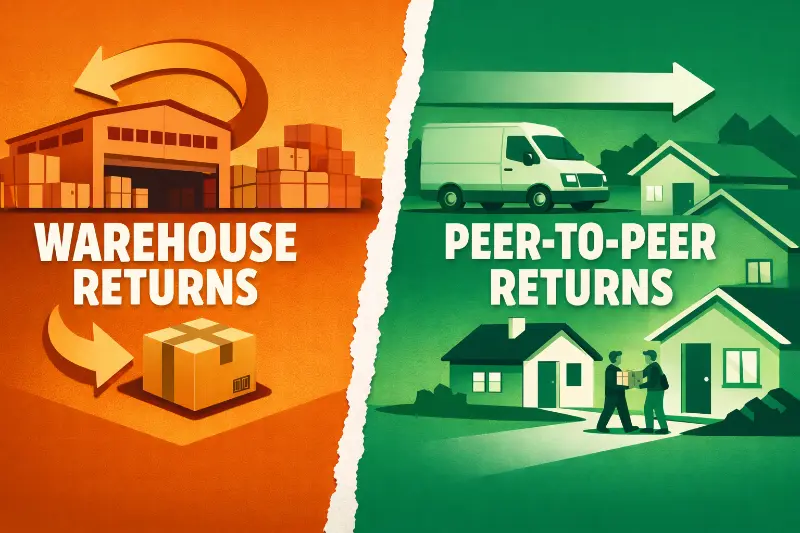
In this article
13 minutes
- Warehouse Returns Are Built Around a Centralized Reverse Logistics Loop
- Peer-to-Peer Returns Are Built Around Forward Routing
- This Is an Architecture Decision, Not a Workflow Tweak
- Convenience Can Improve the Experience Without Changing the System
- Once Routing Changes, Everything Else Changes With It
- Not Every Return Needs the Same Path
- Conclusion
- Frequently Asked Questions
Most returns content compares portals, labels, and drop-off options. The more important question is where the inventory goes next. Peer-to-peer returns and warehouse returns are not two slightly different versions of the same process. They are different routing systems, and that difference changes transport, labor, recovery speed, fraud exposure, and markdown risk.
That distinction matters because ecommerce returns are large enough to shape operating strategy, not just post-purchase workflow. Average ecommerce return rates are high enough that the approved source pack uses NRF and Happy Returns data showing that retailers estimated 16.9% of annual sales would be returned in 2024, totaling $890 billion. In 2025, total retail returns are estimated to reach $849.9 billion, with 19.3% of online sales expected to be returned, highlighting the significant impact of returns on ecommerce businesses. At that scale, routing is not a minor process preference. It determines how many shipping legs, queue points, labor touches, and resale delays get built into the system before optimization even starts.
In the traditional warehouse-centric return loop, ecommerce returns are sent back to a brand or warehouse processing center, where items are inspected, restocked, and eventually resold. This process adds extra steps, costs, and delays, amplifying the true cost of “free” returns for retailers. In contrast, peer-to-peer returns allow the original buyer to ship the item directly to a new customer, bypassing the processing center entirely, which reduces costs, speeds up refunds, and improves sustainability.
Warehouse Returns Are Built Around a Centralized Reverse Logistics Loop
Traditional returns start from one assumption: the item needs to go back to a warehouse, return center, or DC before it can re-enter commerce. That creates the familiar reverse flow: the customer initiates the return, the item ships backward into the network, it enters centralized intake, it gets inspected, then it is repackaged, restocked, liquidated, or disposed. That is the logic behind the warehouse-centric return loop.
The important point is not that warehouses sometimes execute returns badly. It is that inbound shipping, centralized labor, queue time, and resale delay are built into the model itself, which is why a high ecommerce return rate can erode profit margins through reverse logistics costs. Two shipping legs are unavoidable. Labor is unavoidable. Delay is unavoidable. Markdown exposure is unavoidable. In this architecture, value recovery happens only after the item travels backward, waits, gets touched, and gets processed. The cash flow impact is similar to operating a bank account that constantly loses value through fees and delays, draining resources. Compared to the safety and predictability of bank deposits, traditional returns expose retailers to more risk and uncertainty, with no federal insurance or guarantees. The slow and costly nature of traditional returns is much like the low yields of traditional savings accounts—inefficient and uncompetitive compared to modern alternatives. Additionally, traditional return processes can take several weeks for customers to receive their refunds, which negatively impacts satisfaction. In contrast, peer-to-peer returns can reduce costs associated with return shipping, warehouse labor, and customer service, making the process more efficient than traditional returns.
Peer-to-Peer Returns Are Built Around Forward Routing
Peer-to-peer returns start from a different assumption. Drawing a parallel to peer p2p lending, peer to peer lending, peer lending, marketplace lending, and lending platforms, which use online platforms to connect individual lenders directly with individual borrowers, peer-to-peer returns leverage online platforms to connect returners directly with the next customer. Instead of treating the warehouse as the default destination, the system checks whether the return is eligible to move directly to the next buyer. Much like loan listings in social lending, where individual lenders review and fund requests from individual borrowers, peer-to-peer returns enable a direct connection between the returner and the next customer, bypassing traditional intermediaries.
In the approved framing for what peer-to-peer returns are, the customer still initiates the return through a branded experience, but an eligible item is rerouted, not reprocessed. A like-new or open-box listing can be created, and the returner uses a shipping label to send the item directly to the next customer instead of back to centralized intake. This process allows customers to ship returned items directly to new buyers, bypassing the warehouse, which reduces costs and speeds up the resale process. Additionally, peer-to-peer returns enhance sustainability by reducing carbon emissions and packaging waste associated with traditional return logistics, as items are forwarded directly to new customers.
That sounds like a simple change, but it is not a cosmetic one. It changes where the item goes next, how many handoffs it experiences, how quickly it can be resold, and which cost layers disappear altogether. For the detailed mechanics, see how peer-to-peer returns actually work. The point here is narrower: peer-to-peer returns are a forward-moving routing model for eligible inventory.
This Is an Architecture Decision, Not a Workflow Tweak
This is the center of the comparison. Most teams frame returns decisions around refund timing, portal design, label convenience, or drop-off experience. Those choices matter, but they sit on top of a more consequential design choice: does returned inventory move backward to a centralized intake node, or can eligible inventory move forward to the next buyer? That routing assumption is what changes cost, speed of recovery, inventory velocity, and fraud surface area, especially as ecommerce return rates continue to rise—much like how peer to peer investing decisions impact risk, liquidity, and returns for investors.
A returned shirt makes the difference easy to see. In a warehouse model, it ships back to a return center, waits for intake, gets checked, gets rebagged or restocked, and only then has a chance to re-enter demand. In a peer-to-peer model, that same eligible shirt can move directly from the returner to the next buyer with no inbound warehouse handling at all. The item did not change. The route did. That is why the system changed with it.
This routing decision parallels the way investors approach peer-to-peer lending platforms, where individual and institutional investors lend money directly to borrowers, bypassing traditional financial institutions and traditional banks. Investors must assess credit risk, liquidity risk, and the risks involved—such as borrower defaults—when evaluating loan offers and deciding how to allocate money across loans. Just as investors can spread capital across multiple loans to mitigate the impact of borrower defaults and align with their risk tolerance and financial goals, brands must make informed decisions about routing to balance higher returns, attractive returns, and lower risk in their returns process.
Peer-to-peer lending platforms match lenders with borrowers, assess borrower creditworthiness, and assign risk grades that determine interest rates. These platforms offer attractive interest rates and higher returns compared to traditional loans or savings accounts, but also come with higher risk, especially since many loans are unsecured and not government-insured, meaning loss of capital is possible. P2P loans are fixed-income assets with defined interest rates and repayment schedules, making them less volatile than stocks, but liquidity risk remains since investments are often tied up for 3–5 years unless a secondary market is available. Economic downturns can increase borrower defaults, impacting net returns. The regulatory landscape is also fragmented, with some states limiting or prohibiting peer-to-peer investing.
Ultimately, just as investors in peer-to-peer lending must weigh the risks and benefits of lending money to borrowers—considering factors like good credit, business loans, personal loans, lower interest rates, and the ability for the borrower to repay—brands must evaluate whether backward or forward routing best aligns with their operational risk tolerance and financial objectives. Both models require careful risk management and a clear understanding of the potential for higher returns versus the risks involved.
Convenience Can Improve the Experience Without Changing the System
This is where modern returns conversations often get confused. Better portals, easier labels, and box-free drop-off can improve the customer experience and boost customer satisfaction by making returns less of a hassle, but they do not fundamentally change the inventory path. Customers prefer a return process that is quick and easy, as they dislike the hassle of traditional return methods that involve printing labels and waiting for refunds, which is why many brands focus on streamlining return labels and digital alternatives. Peer-to-peer returns can improve customer satisfaction by providing a quicker and more convenient process, allowing customers to receive refunds faster than traditional methods. That is why returns software doesn’t actually fix returns. Software improves intake, not routing. Convenience does not equal structural change.
The source pack gives concrete examples. UPS acquired Happy Returns’ reverse logistics network in 2023, and FedEx launched FedEx Easy Returns in 2025. Those are meaningful signals that the market is investing in faster, easier return entry. But they are also evidence that the industry is still strengthening collection and reverse logistics infrastructure, not necessarily escaping it. The point is not that convenience is unimportant. The point is that modern returns convenience and modern returns redesign are not the same thing. Peer-to-peer returns can significantly reduce shipping costs and eliminate return shipping and restocking fees, which can average 20% of revenue for ecommerce businesses. Additionally, by forwarding items directly to new customers, peer-to-peer returns help reduce packaging waste and lower the carbon emissions associated with traditional return logistics, enhancing sustainability efforts.
Amazon’s “frequently returned” visibility adds another signal. Returns are no longer just a back-room operating issue. They are visible enough to influence the shopping experience itself. That does not prove peer-to-peer is the right answer for every category. It does show that the old model is under pressure in ways shoppers can increasingly see.
Once Routing Changes, Everything Else Changes With It
The cost difference starts with routing. In a warehouse model, backward movement creates inbound transport, intake labor, queue-driven delay, avoidable rehandling, and repeated markdown exposure by design. In a forward-routing model, eligible items can skip warehouse intake, redundant shipping, and some of the labor tied to centralized inspection and restocking. As many retailers reassess whether free returns are still sustainable, routing becomes a first-order lever. For ecommerce businesses, especially ecommerce brands and small business owners, peer-to-peer returns can significantly reduce costs by eliminating return shipping and restocking fees, which can average 20% of revenue. This model also allows for faster resale of returned items, as products can be sold directly to new customers without going through traditional return processing, thus improving cash flow. In fact, ecommerce businesses can resell returned items quickly, often at 85-95% of retail value, without incurring additional shipping and handling costs. Additionally, peer-to-peer returns enhance sustainability efforts and reduce environmental impact by lowering carbon emissions and packaging waste associated with traditional return logistics, as items are forwarded directly to new customers instead of being shipped back to warehouses. That is the basic logic behind the hidden economics of a return and the economics of peer-to-peer returns.
Time is the hidden destroyer here. The approved source pack is explicit that teams underestimate returns when they flatten them into an average and ignore how costs stack across shipping, labor, delay, markdown pressure, and fraud exposure. Time destroys value in reverse logistics because every extra queue pushes recovery farther away from fresh demand. Delay creates markdown drag.
Routing also changes control. A warehouse-centric model creates more handoffs and more opacity. A shorter chain changes the fraud equation because accountability is clearer when fewer parties touch the item. It also changes the role of the warehouse. Once selective forward routing exists, the warehouse stops being the default destination for everything and becomes an exception handler for the returns that truly need centralized processing, while lighter-weight tools like a returns management solution such as Return Prime can focus on policy, routing rules, and customer communication instead of owning all the physical logistics.
Not Every Return Needs the Same Path
A credible comparison has to say this plainly: not every SKU belongs in peer-to-peer. Fragile items, defective items, regulated goods, and timing-sensitive returns may still need warehouse handling. That is the hybrid reality, and it is why where peer-to-peer returns don’t work matters as much as the upside case.
The point is not to replace warehouses with ideology. The point is to stop sending every return through the same expensive path by default. Peer-to-peer is most credible as a selective structural layer for eligible inventory, while warehouses continue to handle exceptions, defects, and non-qualifying items. Warehouses still matter, just not for every return. That is the practical middle ground.
Conclusion
When operators say they want a better returns process, they usually mean a better front door. But the real comparison starts after the customer clicks return. Warehouse returns optimize the backward loop. Peer-to-peer returns reroute eligible items out of it. One model tries to manage transport, labor, delay, and markdown exposure more efficiently. The other changes the route so some of those layers never appear in the first place. That is why this is not a portal decision. It is an architecture decision. And it is also why returns need to go forward, not back.
Frequently Asked Questions
Are peer-to-peer returns just another kind of returns portal?
No. A portal can exist in either model. The structural difference is what happens after return initiation. In a warehouse model, the item goes back to centralized intake. In a peer-to-peer model, an eligible item can be rerouted directly to the next buyer.
Do peer-to-peer returns replace warehouses?
No. The approved model is explicitly hybrid. Warehouses still matter for defective, fragile, regulated, or timing-sensitive returns. Peer-to-peer is a selective structural layer for eligible inventory, not a universal replacement.
Why doesn’t box-free drop-off solve the same problem?
Because easier return entry is not the same as changing the inventory route. The source pack uses UPS and Happy Returns plus FedEx Easy Returns as evidence that convenience infrastructure is improving even while reverse logistics infrastructure remains central.
What kinds of returns are best suited for peer-to-peer?
The approved framing centers peer-to-peer on eligible, resellable items that can move forward as like-new or open-box inventory. Damaged, highly fragile, regulated, or otherwise unsuitable items are better candidates for warehouse handling.
Why does routing matter so much economically?
Because routing determines which costs exist at all. Backward movement adds transport, labor, queue time, and delay. Forward movement can remove some of those layers before optimization begins. That is why the gap starts with path design, not just better processing after the item has already come back.
Written By:
Manish Chowdhary
Manish Chowdhary is the founder and CEO of Cahoot, the most comprehensive post-purchase suite for ecommerce brands. A serial entrepreneur and industry thought leader, Manish has decades of experience building technologies that simplify ecommerce logistics—from order fulfillment to returns. His insights help brands stay ahead of market shifts and operational challenges.
Turn Returns Into New Revenue
Related Articles
Crafting a Return Policy that Drives Customer Loyalty and Reduces Returns
Let’s talk about ecommerce returns policies.
Cheapest Shipping from USA to UK: What It Really Costs
Shipping from the USA to the UK is one of the most common international routes for ecommerce brands, and it is also one of the most misunderstood from a cost perspective.
Why Faster Refunds Made Returns More Expensive
Introduction Faster refunds feel like obvious progress.
Does UPS Deliver on Saturdays? UPS Weekend Delivery Explained

In this article
14 minutes
- Yes, UPS Delivers on Saturdays
- Saturday Delivery Is Not the Same as Universal Weekend Delivery
- Does UPS Deliver on Sunday?
- Which UPS Services Offer Saturday Delivery?
- Does UPS Ground Deliver on Saturday?
- How Much Does UPS Saturday Delivery Cost?
- Does UPS Offer Saturday Pickup?
- How Late Does UPS Deliver on Saturday?
- UPS vs. FedEx, USPS, and Amazon Weekend Delivery
- What Saturday Delivery Means for Ecommerce Sellers
- Weekend Delivery Depends on Fulfillment, Not Just the Carrier
- How Cahoot Helps Sellers Compete on Fast Delivery
- How to Check Whether Your UPS Package Will Arrive Saturday
- The Bottom Line on UPS Saturday Delivery
- Frequently Asked Questions
Yes, UPS delivers on Saturdays for many residential and commercial packages. UPS says it offers Monday through Saturday delivery service for residential and commercial parcels, but standard UPS delivery does not run on Sunday. UPS delivers packages on weekends, especially to meet the needs of e commerce businesses, as the demand for faster shipping in online retail continues to grow. Most packages are generally delivered by 8 p.m., though the final delivery time can vary by route, package volume, weather, holidays, and destination.
For consumers, the answer is simple: UPS Saturday delivery is available for many packages, but you should check your tracking number for the latest details. For ecommerce sellers, the bigger question is whether UPS delivers on weekends is particularly relevant for e commerce operations aiming to meet customer expectations, while also considering if Saturday delivery actually helps you improve the customer promise without creating unnecessary shipping costs, operational stress, or missed expectations at checkout.
Yes, UPS Delivers on Saturdays
UPS does deliver on Saturdays, and Saturday delivery is now part of many UPS weekend delivery options. This can include ground residential delivery packages, commercial parcels, and certain air services, depending on the selected service, destination, package weight, and shipper settings.
That does not mean every UPS package will arrive on Saturday. Availability can vary by location, service level, whether the destination is a residential address or business address, and how UPS defines a business day for the specific service. A package moving through UPS Ground, UPS 2nd Day Air, Next Day Air, UPS SurePost, or another service may have different Saturday delivery rules.
The best way to confirm whether a specific UPS package will arrive on Saturday is to check the tracking number. UPS tracking is the source of truth for a live shipment because it reflects the selected service, current scan history, destination, and final delivery status.
Saturday Delivery Is Not the Same as Universal Weekend Delivery
A common mistake is assuming that “UPS weekend delivery” means UPS delivers every package on both Saturday and Sunday. That is not how it works.
UPS offers Saturday delivery for many shipments, but Sunday delivery is not standard. UPS’s weekend delivery page says UPS offers Monday through Saturday delivery for residential and commercial parcels and that there are no Sunday deliveries. UPS’s weekend services primarily focus on Saturday deliveries, with limited or no standard Sunday service.
That distinction matters. If a customer asks whether UPS delivers on weekends, the short answer is: yes, UPS delivers on Saturdays, but standard UPS Sunday delivery is not available. If a package is urgent, the shipper may need a special service or a different delivery option rather than assuming it can arrive on Sunday.
Does UPS Deliver on Sunday?
For standard UPS delivery, no. UPS does not generally deliver on Sunday. Most UPS locations are not open for standard deliveries on Sunday, and UPS open hours typically cover Monday through Saturday.
There may be edge cases involving urgent services, special arrangements, final-mile partnerships, or nonstandard delivery situations, but those should not be treated as normal UPS Sunday delivery. Consumers should check tracking details. Ecommerce sellers should never promise Sunday delivery at checkout unless the selected service specifically supports it.
This is especially important for ecommerce brands because shoppers often compare UPS, FedEx, USPS, and Amazon orders without understanding that each carrier has different weekend delivery rules. If your checkout promise says an order will arrive “this weekend,” customers may interpret that as Saturday or Sunday. Your carrier selection may not support that.
Which UPS Services Offer Saturday Delivery?
Saturday delivery can depend on the UPS service used, the destination, and whether the shipment qualifies. UPS lists Saturday delivery as available for services such as UPS 2nd Day Air and UPS 3 Day Select on its domestic shipping services page.
Here is a practical overview:
| UPS Service | Saturday Delivery Notes |
| UPS Ground | Saturday ground deliveries may be available for many residential packages, depending on location, destination, and service eligibility. |
| UPS 2nd Day Air | Saturday delivery may be available depending on the selected service and destination. UPS lists Saturday delivery as available for UPS 2nd Day Air. |
| UPS Next Day Air | Saturday delivery may be available for time sensitive shipments in eligible areas. Shippers should confirm availability and any additional fees during label creation. |
| UPS SurePost | SurePost deliveries may involve USPS for final delivery, making weekend and even Sunday delivery possible in some cases. SurePost is an exception among UPS services, as its integration with USPS allows for some weekend and Sunday deliveries, depending on USPS weekend schedules and the destination. |
| UPS Express Critical | Designed for urgent deliveries and special shipping needs. This may be relevant for urgent shipments, but it is not the same as standard Saturday ground delivery. |
The main point: do not assume Saturday delivery applies just because UPS transports the package. Confirm the selected service, destination, and delivery options before promising a Saturday arrival.
Does UPS Ground Deliver on Saturday?
UPS Ground can deliver on Saturday in many cases, especially for residential deliveries. In fact, ground residential deliveries on Saturdays are often included at no additional cost for eligible addresses. However, eligibility depends on the shipment, destination, and service availability.
For shoppers, this means a UPS Ground package may arrive Saturday, but it is not something to guess from the service name alone. Check tracking.
For ecommerce sellers, this matters because Saturday ground deliveries can sometimes improve delivery speed without paying for a more expensive air service. If a Friday shipment can reach a nearby residential customer on Saturday by ground, that may be more cost-effective than upgrading every order to UPS 2nd Day Air.
But this only works if the seller’s fulfillment process supports it. If the order misses the warehouse cutoff, sits unprocessed until Monday, or cannot be picked up on Saturday, the theoretical Saturday delivery advantage disappears.
How Much Does UPS Saturday Delivery Cost?
UPS Saturday delivery cost can vary. The final cost may depend on the selected service, package weight, destination, residential or commercial delivery type, shipper account settings, and whether Saturday delivery is included or added as an option. For many ground residential deliveries, there is no additional cost for Saturday delivery, but other UPS services may incur extra fees for Saturday service.
Some Saturday delivery options may be included for certain services or regions, while others may involve additional fees. That is why sellers should confirm the final cost during label creation, rate shopping, or checkout configuration rather than relying on a blanket rule.
For ecommerce brands, the cost question should be broader than “Does UPS charge extra for Saturday delivery?” The better question is:
Does Saturday delivery help us meet a faster delivery promise at a cost that still protects margin?
Sometimes the answer is yes. Sometimes the added fee or required service upgrade makes the order unprofitable. The right choice depends on shipping costs, package weight, destination, order value, customer expectations, and available carrier options, and whether expedited shipping options actually improve the overall economics.
Does UPS Offer Saturday Pickup?
Yes, UPS offers Saturday pickup options. UPS says it offers Saturday package car pickup services, which can help businesses that want to move orders into the shipping process before Monday. UPS offers Saturday pickups for various services, and customers can schedule a UPS pickup on Saturdays depending on their location and service requirements.
Saturday pickup is different from Saturday delivery. A package can be delivered on Saturday even if the seller does not use Saturday pickup. Likewise, a seller may want Saturday pickup so weekend orders begin moving sooner, even if final delivery happens the following week.
This distinction is important for ecommerce sellers. If your warehouse closes Friday afternoon and does not process orders again until Monday, Saturday delivery alone may not help your customers. To make weekend delivery useful, you may also need weekend ecommerce order fulfillment services, Saturday pickup, accurate cutoff times, and carrier services that match your delivery promises.
UPS Store hours and pickup availability can vary by location, so customers and sellers should check local details before assuming a drop-off or pickup option is open on Saturday.
How Late Does UPS Deliver on Saturday?
UPS says most packages are generally delivered by 8 p.m.
That does not mean every Saturday package will arrive at the same time. Delivery times depend on driver route, destination, service level, package volume, weather, holidays, and operational conditions. A package marked “out for delivery” may still arrive later in the day.
For a specific package, the tracking number is the best place to check. If the shipment has a guaranteed delivery commitment, tracking and service details should show the relevant information. If the package does not have a specific guaranteed delivery time, customers should avoid assuming it will arrive in the morning or early afternoon.
UPS vs. FedEx, USPS, and Amazon Weekend Delivery
Consumers often search UPS weekend delivery alongside FedEx Home Delivery, USPS weekend delivery, Priority Mail, and Amazon orders because weekend delivery expectations have changed. Many shoppers now expect packages to move or arrive on Saturdays, and some expect Sunday delivery as well. Saturday delivery and pickup services are most widely available in major metropolitan areas, where demand and logistical efficiency are highest.
But carriers do not all operate the same way.
FedEx, USPS, Amazon, and UPS each have different delivery services, pickup rules, final delivery networks, and weekend coverage. USPS may deliver certain mail and packages on weekends. Amazon orders may arrive on weekends depending on the fulfillment network and local delivery capacity. FedEx Home Delivery has its own residential delivery model.
For ecommerce sellers, the lesson is simple: do not build checkout promises around assumptions. Build them around the actual carrier service, customer location, fulfillment cutoff, and delivery estimate, whether you’re managing your own store or relying on marketplaces like those that benefit from fast eBay fulfillment.
What Saturday Delivery Means for Ecommerce Sellers
Saturday delivery can be a real advantage for ecommerce brands, especially Shopify merchants using dedicated fulfillment services, but only when the operation behind it is ready.
For example, Saturday delivery can help reduce the Friday-to-Monday delivery gap. A package shipped on Friday may be able to reach certain residential customers on Saturday instead of waiting until Monday. That can improve customer satisfaction, reduce “Where is my order?” tickets, and make a brand’s delivery promise more competitive.
Saturday delivery can also help with time sensitive shipments. If a customer needs an item before the weekend, a seller may be able to use UPS Saturday delivery options or specialized Amazon SFP 3PL fulfillment services instead of automatically upgrading to the most expensive urgent delivery service.
But there is a hard truth here: carrier availability does not fix weak fulfillment execution.
If inventory is too far from the customer, if orders are not picked and packed quickly, if cutoff times are unrealistic, or if the wrong service is selected at label creation, Saturday delivery will not save the customer experience. It may only add cost.
Weekend Delivery Depends on Fulfillment, Not Just the Carrier
Many ecommerce sellers focus on whether UPS, FedEx, or USPS can deliver on Saturday. That is only one part of the shipping process.
To use Saturday delivery effectively, a seller needs to answer several operational questions, especially if they also sell on marketplaces with strict fast-shipping standards such as Walmart’s TwoDay and ThreeDay delivery requirements:
- Is the inventory close enough to the customer for ground delivery to arrive on Saturday?
- Can the warehouse process Friday and weekend orders fast enough?
- Is Saturday pickup available?
- Does the checkout promise account for weekends and holidays?
- Are customer support teams prepared to explain Saturday and Sunday delivery differences?
- Does the selected service support the promised delivery date?
- Are additional fees worth the customer experience benefit, and do you have proof from fulfillment service reviews that your partners can consistently deliver on those promises?
This is where distributed fulfillment can make a meaningful difference. When inventory is placed closer to customers, more orders can reach buyers quickly by ground. Leveraging specialized order fulfillment services for ecommerce companies can reduce the need to pay extra for air services and make fast delivery more affordable.
How Cahoot Helps Sellers Compete on Fast Delivery
Cahoot does not control UPS delivery days, and Saturday delivery is ultimately determined by the carrier, service, destination, and shipment details.
Where Cahoot can help is in the fulfillment strategy behind the shipment. Ecommerce brands need more than a carrier that offers Saturday delivery. They need ecommerce fulfillment software that supports inventory placement, order routing, fulfillment execution, and shipping choices that make fast delivery practical and cost-aware.
With a smarter fulfillment network and multi-carrier shipping software for ecommerce, sellers may be able to reach more customers in fewer days, use ground services more effectively, reduce unnecessary expedited shipping costs, and set more accurate delivery expectations at checkout. That is the operational advantage: not simply knowing that UPS delivers on Saturdays, but building a fulfillment process that can use weekend delivery without damaging margins.
How to Check Whether Your UPS Package Will Arrive Saturday
If you are waiting for a UPS package, follow these steps:
- Check your UPS tracking number.
- Review the selected service.
- Look at the estimated delivery date.
- Confirm whether the destination is eligible for Saturday delivery.
- Watch for updates such as “out for delivery” or “delivery attempted.”
- Contact UPS or the shipper if the shipment is urgent.
If you are an ecommerce seller, check Saturday delivery availability during label creation or rate shopping. Do not rely on a general rule. Confirm the service, destination, final cost, and any added charge before presenting Saturday delivery as an option to customers, and make sure your multi-carrier shipping software accurately reflects those options.
The Bottom Line on UPS Saturday Delivery
UPS does deliver on Saturdays for many residential and commercial packages. Saturday delivery may apply to UPS Ground, air services, and other UPS delivery options depending on the shipment, destination, and selected service.
But UPS Saturday delivery is not the same as universal weekend delivery. Standard UPS Sunday delivery is not available, Saturday pickup is separate from Saturday delivery, and the final cost can vary.
For consumers, the best move is to check the tracking number. For ecommerce sellers, the better move is to build a fulfillment operation that can use Saturday delivery intelligently: close inventory, realistic cutoffs, accurate checkout promises, and carrier choices that balance speed with cost.
FAQs About UPS Saturday Delivery
Does UPS deliver on Saturdays?
Yes, UPS delivers on Saturdays for many residential and commercial packages. Availability depends on the selected service, destination, package type, and shipper settings.
Does UPS deliver on Sundays?
Standard UPS delivery does not usually run on Sunday. UPS says it offers Monday through Saturday delivery service for residential and commercial parcels and that there are no Sunday deliveries.
Does UPS Ground deliver on Saturday?
UPS Ground may deliver on Saturday for many residential packages, depending on the shipment and destination. Check the tracking number or confirm availability during label creation.
Does UPS 2nd Day Air deliver on Saturday?
UPS lists Saturday delivery as available for UPS 2nd Day Air, but availability can depend on destination and shipment details.
How much does UPS Saturday delivery cost?
UPS Saturday delivery cost can vary based on service, package weight, destination, account settings, and whether Saturday delivery is included or added. Check UPS rates during label creation or contact UPS for the final cost.
Does UPS offer Saturday pickup?
Yes, UPS offers Saturday pickup options, including Saturday package car pickup services. Pickup availability can vary by location and business setup.
What is the latest time UPS delivers on Saturday?
UPS says most packages are generally delivered by 8 p.m. Actual delivery times can vary by route, volume, weather, service, and destination.
Can ecommerce sellers offer Saturday delivery at checkout?
Yes, but only if the selected carrier service, destination, fulfillment cutoff, pickup schedule, and delivery estimate support it. Sellers should avoid promising Saturday delivery unless they can confirm availability and cost.
Is Saturday delivery guaranteed?
Not always. Some services may include specific delivery commitments, while others provide estimated delivery windows. Check the selected service and UPS tracking details for the most accurate information.
Written By:
Rinaldi Juwono
Rinaldi Juwono leads content and SEO strategy at Cahoot, crafting data-driven insights that help ecommerce brands navigate logistics challenges. He works closely with the product, sales, and operations teams to translate Cahoot’s innovations into actionable strategies merchants can use to grow smarter and leaner.
Turn Returns Into New Revenue
Related Articles
Why Cross-Border DTC Brands Are Moving Fulfillment Inside the US
Cross-border ecommerce fulfillment is the process of shipping ecommerce orders across national borders—often from warehouses outside the United States to U.
Crafting a Return Policy that Drives Customer Loyalty and Reduces Returns
Let’s talk about ecommerce returns policies.
Cheapest Shipping from USA to UK: What It Really Costs
Shipping from the USA to the UK is one of the most common international routes for ecommerce brands, and it is also one of the most misunderstood from a cost perspective.