
Overcoming Amazon’s Inventory Limits: Order Fulfillment Alternative
In this article
 22 minutes
Listen to podcast here.
Podcast Episode 185 – Avoiding FBA Limits with an Alternative Order Fulfillment Network with Cahoot
The Smartest Amazon Seller Podcast discussed the issue of warehouse inventory limits, which is becoming a major challenge for all Amazon sellers. Amazon’s warehouse inventory limits are getting lower as Q4 ramps up, leading to difficulty for sellers to send everything into FBA – Fulfilled By Amazon. The problem is exacerbated by Amazon’s challenge in hiring order fulfillment workers across its warehouses. The podcast host, Scott Needham, invited Manish from Cahoot to discuss an alternative solution. Cahoot is a company that has created a peer-to-peer network for order fulfillment, allowing sellers to use its warehouses to store their products and deliver them to customers. Cahoot was first trying to do a co-mingled Fulfilled By Merchant (FBM) solution, but has now pivoted to an order fulfillment services network. Its order fulfillment services are intended to create efficiency, reduce order shipping costs and transit time, and make it easy for sellers to operate in a highly profit-challenged environment. The podcast discussed how Cahoot’s order fulfillment service can help sellers overcome the problem of Amazon’s strict inventory limits.
Scott Needham:
Welcome to the Smartest Amazon Seller Podcast, your host, Scott Needham. I am an Amazon seller for 10 years, and in my 10th year, I’m actually literally about to wrap up, hit 10 years. Something has happened again, that’s become an issue for all Amazon sellers, that if you’re really paying attention, inventory limits are, they’re getting lower as Q4 ramps up, which is kind of, it’s the opposite of what we want. Usually you want your limits to go up when you, because right now you want to spend all your money to buy inventory to bulk up for the next eight weeks. I’m recording this right before November. So a lot of people are getting challenged. They can’t send everything into FBA, and if you don’t have an alternative solution, you’re kind of stuck. So I’ve got with me someone that has an alternative solution that I actually think is quite scalable. I’ve got Manish from Cahoot. Manish, welcome.
Manish:
Scott, thank you for having me.
Scott Needham:
So let’s just chat through this. If we’re talking big picture, how I see things, Amazon, because of COVID and 2021 and 2020, they increase their capacity considerably. Actually, I’m seeing reports that they increased it too much, but they also have a different problem. If you increase your capacity, they also have to have employees to do that, and they have hired hundreds of thousands of people, but they’ve also had huge turnover, lots of turnover. So much that they do have a business challenge in that they are exhausting the number of people that are available for employment across some of the warehouses that they serve in different markets. So that leads me to think, inventory limits, they’re going to be around. It’s going to be cyclical. Who knows? We’re fighting against market forces, bigger market forces. Are there a hundred thousand people that can work in this capacity in this market? And that’s either a yes or no, and if not, then they can’t receive everything. So that’s how I would set the stage. And why, again, a year after the worst of these inventory limits, we’re seeing this again. How do you see this?
Manish:
Well, that’s a great question, Scott. And you said it right. Half of Americans of the available workforce has either applied or worked at Amazon or has worked and quit at Amazon. So Amazon is running out of order fulfillment workers to hire, and that’s no secret. I mean, everybody knows that. So you have a bit of a dichotomy. On one hand, two quarters ago, Amazon came out and blamed their excess build, they actually added more warehouses in 2020 and 2021 than they had done in the previous 18 years of their operation. So they went all in, and then of course they came back and they said, “Oh, we made less money because we overbuilt. We have tons of excess capacity. We’re going to go rent out or sublease, hundred million or so square feet of space.”
And then you as a seller, and many others that I speak with regularly, are complaining that their stock limits are down. So it’s highly confusing for the seller because they’re getting news from both sides of their mouth, and that’s not… So the reality is, what we believe and suspect, that while the facilities might have been built, they are not online. So you could count them as overbuilding, but they’re not enough. They’re not online. They don’t have enough order fulfillment workers to make those facilities work. And that’s why the sellers are continually facing strict inventory limits at FBA. So it’s a real problem.
Scott Needham:
I’ve got two selling businesses that I check in on every day. One of them does have limits, and the other one actually has the opposite of the problem, has actually more space than we need. So it affects people at different sizes in different ways. And every business model is slightly different. And some people can transition to FBM on their own and some people can’t. Just like I do think one of the benefits of E-commerce is you can work out of your house and you don’t have to ever touch inventory if you are using, if you’re being creative, if you’re aware of either prep centers or 3PLs, whatever.
I’ve been aware of Cahoot for a while, and if I get anything wrong about your background, but you guys have slightly pivoted in that Cahoot was first trying to do a co-mingled FBM solution. Where if I was selling Head & Shoulders shampoo and I had it in my warehouse, in my backyard in Utah, but the customer was in New Jersey, if someone else had that same product, that same skew in New Jersey, they could satisfy the customer for about half the price. And now you created this peer-to-peer network for order fulfillment. And that’s a really creative and interesting solution, kind of a hard problem to solve because of all the different variables. But that’s how Cahoot started, right?
Manish:
Yes, we are… We’ve been fanatically focused on optimization. And the idea is how do you reduce the shipping costs, the transit time, and make it easy for sellers to operate in a highly profit challenged environment? So all our solutions are intended to create efficiency. And yes, you’re right about our history.
Scott Needham:
You had to create a lot of tech, tech that you actually still use, but you guys now lean in a little bit more to an order fulfillment services network. So basically an alternative to FBA. And if say someone wants to sell 10,000 units of Head & Shoulders shampoo, they get to utilize your network as opposed to FBA. And I actually think there’s a few cool things that we’re going to talk about with the Cahoot network that are kind of different, never heard of before. And I was like, “Okay, this is a worthwhile conversation and worth exploring.”
Manish:
Absolutely. I mean, sellers can, we believe in supporting the sellers wherever they sell. Cahoot takes a full service approach to fulfillment. So we support, if the merchants want to send some inventory to FBA, we also support the highest standard in fulfillment, which is Seller Fulfilled Prime (SFP). Which is very, very hard to find a solution for because of the extremely stringent metrics. So if you are listening, and if you’re a seller that has Seller Fulfilled Prime (SFP), you should hang onto it.
And if you wanted to do FBM and if you were affected by FBA restock limits or you are unhappy with the receiving delays, which we know there’s a long receiving delay at FBA, or other challenges. Like returns, so that’s a big problem because your return rate is 20% generally higher with FBA than FBM or if you’re selling on other marketplaces and channels, whether Shopify, your website, on Walmart, eBay, other places, because every seller ought to be selling on multiple channels. So you can come to Cahoot and Cahoot can provide an Amazon FBA like service, and it’s an alternative to FBA so that you can continue selling regardless of whether you can get your inventory into FBA or not.
Scott Needham:
I mean, Seller Fulfilled Prime (SFP), it’s tough. I’ve done it, seen it work out, seen us get kicked off a few times as you need to get stuff out the door fast. So right now people need space, they need alternatives to FBA. And you guys, very straightforward, kind of offer your network. And you could even make some comparison to an Uber model for shipping and FBM and so much that you actually have some sellers that join the network and make their warehouse available, whether it’s space-
Manish:
That’s right.
Scott Needham:
And fulfillment.
Manish:
Right. That’s right. I mean, what’s unique about Cahoot is it’s a peer-to-peer network. So essentially it’s a peer-to-peer collaboration platform. So on one side of our network, the demand side, which is ecommerce brands and retailers that are looking for affordable fulfillment services, akin to if you were looking to outsource your fulfillment, some are part of it. So we would support that and we would place our client’s inventory at one or more warehouses in the Cahoot network. And Cahoot provides a very, a technologically advanced solution. So we connect directly with the sales channels, we have deep integrations with every popular channel out there. And then we provide a very simple pricing to our clients so that they don’t have to deal with the complexities of, “Hey, what’s the SLA in California? And what’s the storage fees at California versus New York or versus Miami?” Or what have you.
Because sellers are looking for simplicity, they’re looking for predictability, and they’re looking for one throat to choke, so as to speak, when it comes to holding people accountable. And that’s what Cahoot provides. And that’s the only reason why Cahoot is able to achieve Amazon Seller Fulfilled Prime (SFP) metrics, which is frankly very difficult to achieve through traditional 3PLs. So that’s a demand side of our network. And on the supply side, these are warehouses that belong to other ecommerce brands and retailers that have excess capacity in their warehouse. So right now, if you are running your own warehouse and you’ve got five, 10, 20,000 square feet of excess space, it’s literally sitting idle. You’re not making any money. Your rent, your mortgage, your utilities are the same. So you have the opportunity for the very first time to join the order fulfillment services network and make some extra cash.
Scott Needham:
Yeah. I’ve definitely had a facility where we’ve had tens of thousands of square feet and I’m like, if you push us, yeah, we could actually set aside 10,000 and utilize the space better. And especially… Certain parts of the season, there’s always more ways to utilize space better. We’re not always great at that. But if there’s an economic incentive, like what you guys have, to be able to rent some of the space, basically take your rental costs down, that’s very interesting. And obviously there’s some areas of the country that are just more in demand, California and the northeast coast, because that’s where most ships are coming in. So that’s really interesting. And I like seeing what solutions work for some people. People ask me frequently, and sometimes there’s just always trade-offs. What would you describe, how expensive is it to fulfill Seller Fulfilled Prime (SFP) through your network? Because I think people still want the Prime badge, but they don’t want to, we can’t pay $30 for every single shipment.
Manish:
No, nobody does, Scott. I think that is not a economically viable solution for vast majority of the sellers. So what Cahoot does is, you’re utilizing the economy ground shipping to ship the items and still meet that one-day, two-day delivery requirements of Seller Fulfilled Prime (SFP).
Scott Needham:
Is that because you guys are, because you’re distributing the inventory across the network?
Manish:
That’s right. In order to achieve two-day delivery target, Scott, you need at least four to five strategically placed warehouses. And in order to achieve one-day delivery target using economy ground like a UPS ground or FedEx ground, you need nine locations. And so what Cahoot does is places the inventory based on the demographic of your customers so that we can continue, one, meeting the SFP metrics that is needed in order to protect your account. And number two, do it affordably using the ground service. So you actually pay less than you would pay from your single warehouse.
Scott Needham:
Do you have sellers split up the shipment? Obviously that happens at the beginning, but do you ever do any transshipping yourselves or is that kind of like you’d rather replenish through having the seller replenish one at a time?
Manish:
I mean, both options are available on the Cahoot network. So essentially sellers can ship directly to the warehouses that they have been assigned based on the data. So we are very, very data driven. So that’s how we are able to minimize cost. Or in many cases, we would have a hub location that would act as your primary reservoir for inventory, and then we would trickle in the inventory across the nation as the demand warrants. So it’s the model behind the scenes is not fundamentally much different than how Amazon runs its own FBA network.
Scott Needham:
Yeah, that sounds exactly like that. You must have some pretty big warehouses.
Manish:
We have large and small because Cahoot was always designed to level the playing field. So if you had a warehouse that had 10,000 square feet, we don’t want to exclude that because there is power in numbers. There is a power in working with entrepreneurs, and some of them are absolutely top-notch. I mean, they do phenomenal job. And that’s probably the reason, or one of the very important reasons why Cahoot is able to offer the industry’s highest order fulfillment standards at a lower cost.
Scott Needham:
You know what? You make me feel like the world is just bigger. I just keep learning and just figuring out there’s this whole network going on and I haven’t even been… Keenly aware of it. I don’t know. It means there’s a ton of sellers that need this and then there’s a ton of warehouses that can meet Seller Fulfilled Prime (SFP). That’s not easy. And to make that, to get, like you said, nine different locations across the US and this was happen-
Manish:
It may look daunting to others, but it is business as usual at Cahoot. This is what we do, and we have been doing this for several years and we are the best in class when it comes to that level of accountability. Because I think there’s another big development that you may or may not be familiar with, Scott, is this Amazon Buy with Prime. So this concept of Seller Fulfilled Prime (SFP) is coming to every channel. And if your sellers are not aware, the audience is not aware, I’ve got a really awesome presentation on Buy with Prime and how that is going to affect the consumer expectation on every channel because this whole Seller Fulfilled Prime (SFP), or Prime-like delivery is going to be expected on every channel, on and off Amazon. And there’s a whole presentation, if people are interested, they can check it out on our resource library at www.cahoot.ai.
Scott Needham:
Interesting. So I mean, obviously some of your clients are multichannel, not just Amazon. Sure, there was a few different ways to go with that. What do you think someone that’s brand new, starting out, selling on anywhere, what would their experience be like? This is where I’m actually going to is you talked about accountability and that you, accountability to me means that you kind of need a web portal. You need to be able to see a view of your inventory and receiving and all things that are going on through hopefully what is on your website. Can you run me through that?
Manish:
Yeah, I mean, we have a best in class software. Everything is on the web. So the seller can pretty much access, if you’re familiar, akin to Amazon Seller Central, you know, will log in, you’ll see the movement of your orders. Orders are coming in from all the integrated channels, then your current inventory position at each of the locations where your inventory is currently situated. So you have realtime visibility into that and also realtime visibility into how orders are being picked, packed, and shipped. And additionally, you can also stay on top of the delivery to make sure that the orders are being delivered on time. In fact, we go one step further because we hold the carriers accountable as well. So if the carriers, they miss the SLA or if Cahoot misses the SLA, we like to expose that to our audience, to our sellers. Because for us, it’s a network, which is you are, we are in it together, and therefore it’s very important that we are making that information available so that all parties are holding each other accountable.
Scott Needham:
Love it. That’s awesome. And is there any part of this network? I feel like we’ve covered the very immediate need that a lot of people have. I do think that having an FBM alternative to FBA is good diversity, especially in Q4. What part of what you guys do, do you feel like we haven’t covered yet?
Manish:
Well, one, I think the whole net impact of this innovation is lower cost, higher quality. People think that if you need higher quality, you need to pay more. And Cahoot is turning that on its head that because of this peer-to-peer network, we’re able to lower cost than the traditional options that you may have available. Number two, it’s a myth that FBA is cheaper or cheapest for everything. That is a big myth that is not true. FBA fees have gone up 30% in the last two years, so you should look at your rates today, not two weeks from now, not two months from now. So you would be shocked that FBA is not cheap and certainly not for multichannel fulfillment. So if you’re using FBA to fulfill your website orders or Walmart orders, you should look at that again. And Cahoot is able to offer something very affordable. Besides that, we also have the best in class shipping software, which-
Scott Needham:
Well-
Manish:
So if you have a warehouse… sorry about that.
Scott Needham:
No, you win me over with pricing. Pricing matters. If people were to take a loan, yeah, the interest rate matters. Money is money. So 6% is a higher interest rate than 3%. But in similar, shipping is shipping. Where if you’re paying a dollar extra in one spot versus another, you can’t ignore that over time.
Manish:
And this is the benefit of the network, as you know, is it just keeps getting stronger by the day. And then our goal is to return the additional benefit back to our members, back to our, on both sides of the aisle. So we welcome anybody who is listening, who has a warehouse that is either thinking about utilizing their excess capacity, they should come check us out at www.cahoot.ai, fill out the contact us form, we’ll get in touch. And if you are a seller that is reliant exclusively on FBA, my strong advice to you would be that you should have an option, you should have a backup. It’s just like your computer hard drive. You always want a backup. You don’t want all your eggs in one basket. Even if it is the best basket in the world, you need, you must have a backup to protect your business.
Scott Needham:
In some situations, it’s not the best basket. But I mean, I do love FBA. They’ve kind of created something awesome, but it doesn’t work in every situation, especially the multichannel, like you were saying.
Manish:
And we recognize that, Scott, unlike our competition, that takes probably a hard line. I mean, we support FBA, we support the seller. For us, it’s about supporting the seller. So what’s best for the seller is how we like to empower them and how we like to support them.
Scott Needham:
Awesome. Well, Manish, tell me what is the most important tool that you use that helps you do your business? I mean, I will accept any answer other than Gmail.
Manish:
Well, Scott, we use a number of technologies and tools internally. I mean, the few things that comes to my mind is from a… We use Marketo as our email sales intelligence software. That is-
Scott Needham:
As I understand, Marketo is like, that’s enterprise grade. That’s a pretty robust tool.
Manish:
It is owned by Adobe now. It is a competitor to HubSpot. It is an enterprise grade technology that allows us to communicate with our-
Scott Needham:
I did not expect that. And you might be one of the first people I’ve ever met that’s actually used it. Why is it better than HubSpot?
Manish:
Well, I haven’t done the deep comparison with HubSpot. I think it just plays, I think Marketo existed prior to HubSpot. Certainly it has a very strong integration with salesforce.com, which is our CRM.
Scott Needham:
Okay.
Manish:
And we live in this new world where sales intelligence plays a huge role, that if I’m trying to contact you, what time would be ideal to contact you? Things like that can make or break, let’s say, depending on your routine, you may be a evening person versus somebody else may be a morning person. So if you send the wrong, even if you send the best message at the wrong time, it may not get noticed and things like that. So that’s one of the tools we use.
Scott Needham:
Awesome. Cool. All right. Well Manish, thank you so much. This is a really timely thing. If people want to learn more and maybe get pricing, figure out if this is a solution that works for them, it’s cahoot.ai, right?
Manish:
Yes. www.cahoot.ai. That’s C-A-H-O-O-T.ai. And just fill out the contact us form, and we’ll, a live human will be in touch very quickly.
Scott Needham:
Okay. Awesome. All right. Well thank you, Manish. This is very illuminating. Hopefully everyone, the quantity limits aren’t killing your business too much. They’re a little ugly at times. It’s cost us plenty of money in years past and fought some awkward situations. So figure it out, if you ever have any questions, you could reach out to Manish, you could reach out to me. It’s an interesting thing other than how to get your inventory limits higher? I don’t always know because Amazon’s not very consistent.
Manish:
And there are some tools that I’ve got a nice webinar on how to clean up your account on Amazon so that you make the most of your limits that you already have. So I encourage people to check out the resource library because many times there are many things you could do and you should be doing in order to make the most of the limits you have, rather than letting the limit be underutilized or wasted. So there are things that you could do and you should do.
Scott Needham:
Yep. Awesome. All right, well we’ll wrap up there. Manish, thank you for coming on so much.
Manish:
Scott, thank you for having me.
Scott Needham:
Okay. And to everyone else, have a good Q4. Stay listening. So happy. I’ve been doing this podcast for three years and we’re only getting… I enjoy it. It’s fun. It’s great. Okay, hopefully everyone have a great day. We’ll see you.
Written By:

Indy Pereira
Indy Pereira helps ecommerce brands optimize their shipping and fulfillment with Cahoot’s technology. With a background in both sales and people operations, she bridges customer needs with strategic solutions that drive growth. Indy works closely with merchants every day and brings real-world insight into what makes logistics efficient and scalable.

Turn Returns Into New Revenue
Related Articles
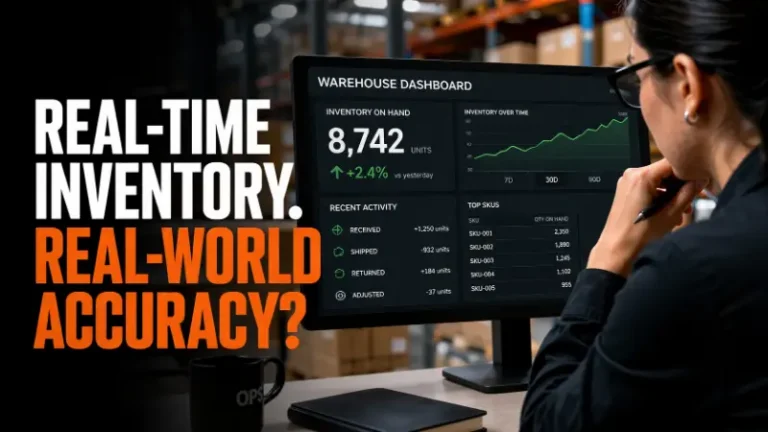
What Is a Perpetual Inventory System? How It Works in Ecommerce
A perpetual inventory system is an inventory management approach in which stock levels are updated continuously and automatically every time a transaction occurs.
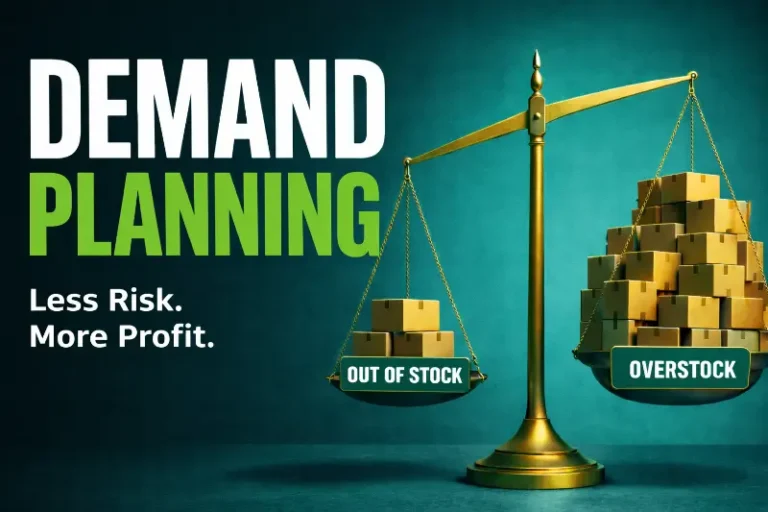
What Is Demand Planning? How It Impacts Inventory, Forecasting, and Profitability
Demand planning is the process of estimating future customer demand so that a business can align its inventory, procurement, and operations to meet that demand without carrying mor...

The Shipping Speed Paradox: Why DTC Brands Are Slowing Down
Everyone’s talking about faster delivery.
Amazon FBA Fees to Increase in 2022
In this article
6 minutes
On January 18, 2022, Amazon will increase FBA fees for fulfillment, removal, and disposal. It will then follow up on those changes with increases to storage fees on February 1st, along with a brand-new long-term storage fee that will kick in on inventory sooner than the current 365 days.
Many Amazon FBA sellers struggle with the slim margins imposed by fierce competition, so even seemingly small changes have an outsized impact on a business plan. Read on to make sure that you know exactly how much more you’ll have to pay Amazon in 2022 in FBA fees, and decide whether it’s time to come up with an Amazon FBM backup plan.
How are Amazon FBA Fees Changing in 2022?
Unsurprisingly, Amazon FBA fees in 2022 will increase across the board. All of the biggest categories will see increases – fulfillment fees, storage fees, and removal and disposal. So – what are those changes?
Amazon FBA Fulfillment Fee Changes
Amazon will hit every size tier with a fulfillment fee increase, and percentage increases will range from 2% on the low end to as much as 12% on the high end.
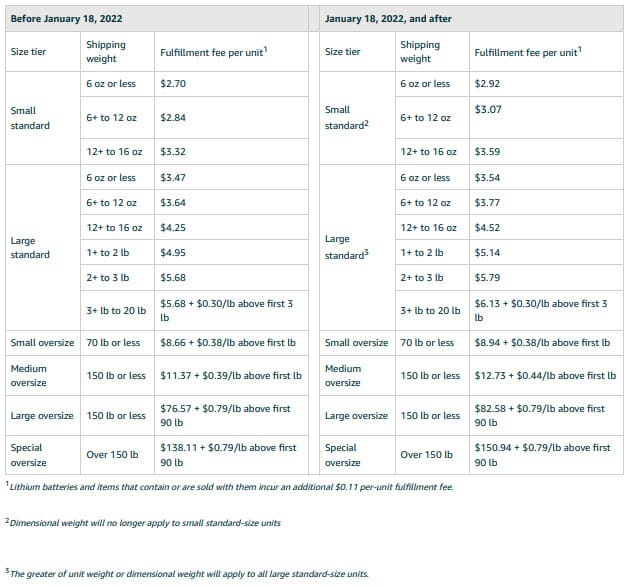
Source: Amazon Seller Central
Notably for many sellers, each of the Small Standard categories will see an increase of 8%. For the smallest items, that will result in a $0.22 increase, and for the larger items in that range, the fee will go up by $0.27. It sounds like a small increase, but sellers know how much even ten cents matters for small, low-margin products. This change will cut already-thin margins and likely force some sellers into the unenviable choice of either dropping part of the product line or raising prices and risking a severe drop in sales.
An Amazon FBA seller on r/FulfillmentByAmazon sums up the dilemma well: “If I was assessed the [2022] FBA fees retroactively for the past 4 months it would average out to a cut of 22.5% at the unit level net profit. All you can do is raise prices, but when Amazon is your competitor, that’s not always possible. Great.”
Amazon FBA Storage Fee Changes
Of course, Amazon isn’t stopping at raising fulfillment fees. They will make two separate changes to FBA Storage Fees – 1) they’ll raise rates and 2) they’ll institute a new, more punishing long-term storage fee.
FBA Storage Fees will increase by $0.08 per cubic foot, or 10.6% on February 1st, 2022. Like the fulfillment fee rate increase, this is a seemingly small change, but given that Amazon FBA sellers are already operating in a cutthroat, low-margin environment, the overall effect of a few small changes to fees can be punishing.
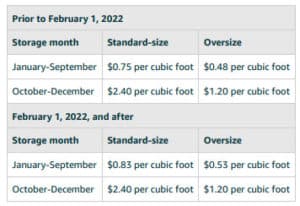
On top of that, Amazon is also tightening their definition of long-term storage. On May 15th, 2022, they will introduce a brand-new “aged inventory surcharge” to units that have been in Amazon’s fulfillment centers for 271 to 365 days. While that time period used to accrue zero additional storage fees, it will now add $1.50 per cubic foot on top of regular storage fees, nearly tripling storage cost.
There’s simply more demand for FBA than Amazon can fulfill, so they’re able to make changes like this to squeeze more out of sellers and cut all but the best sellers out of their network. This is the logical extension of changes like their April 2021 adjustment to FBA inventory limits, which are designed to optimize what inventory sellers place with FBA and punish those who don’t adhere to their ever-stricter standards.
Amazon FBA Removal and Disposal Fee Changes
Finally, Amazon is more than doubling the Removal or Disposal Order Fee for most SKUs. Missing on a new product, or getting undercut and outcompeted is about to become a lot more expensive. If you keep trying to sell a struggling product, you’ll face the early kick-in to long-term storage fees as detailed above. If you decide to cut the product, you’ll pay much more per unit.
In fact, every product size except for the smallest will see its Removal or Disposal Order Fee more than double. A SKU between 1-2 lbs, for instance, will increase for $0.35 to $0.75 per unit – a 114% jump.
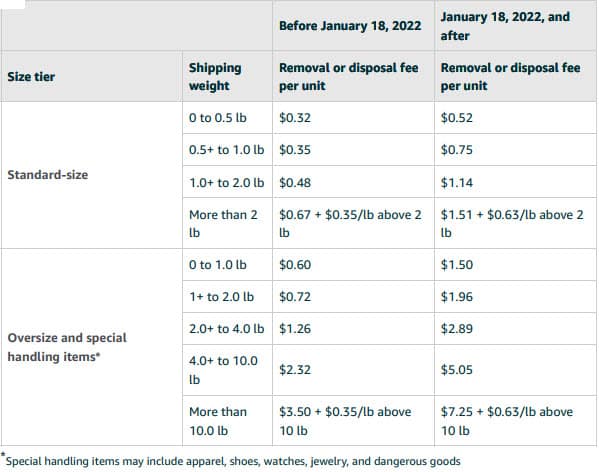
As mentioned above, this change is aimed squarely at removing all but the fastest-moving SKUs from Amazon FBA. If you’re uncertain about how a new product will perform, or you see existing products getting undercut and pushed out of the Buy Box by cheap competition (or competition from Amazon itself), then you need an efficient Amazon FBM solution to keep selling.
Cahoot’s Alternative to Amazon FBA
Cahoot’s excellent FBA alternative can fully replace FBA or serve as an affordable backup. And it’s much more than that – it’s the most flexible solution in the marketplace and easily integrates and ships orders for every eCommerce sales channel. With our innovative peer-to-peer fulfillment network, multi-channel fulfillment with nationwide 1-day and 2-day delivery is the norm.
Unlike other networks that are collections of 3PLs, Cahoot’s innovative approach empowers merchants across the country to fulfill orders for one another. Our peer-to-peer network is a collective of highly vetted eCommerce retailers who offer up excess warehouse space and resources to provide high-quality order fulfillment to other merchants.
As a result, costs are typically lower than what you get with a traditional 3PL fulfillment company, and service levels are higher. Merchants can use the network solely for outsourced fulfillment – similar to FBA, or they can choose to fulfill orders for other merchants and offset some of their own outsourced fulfillment costs.
Written By:

Jeremy Stewart
Jeremy Stewart leads customer success at Cahoot, helping merchants achieve high-performance logistics through smart technology and process optimization. With a background in both ecommerce operations and client services, Jeremy ensures that every merchant using Cahoot gets measurable results—whether they’re scaling from one warehouse to many or managing complex returns.
Turn Returns Into New Revenue
Related Articles
How Much Does Seller Fulfilled Prime Cost? Calculate It for Your SKU
Seller Fulfilled Prime sounds attractive until you start thinking about the bill.
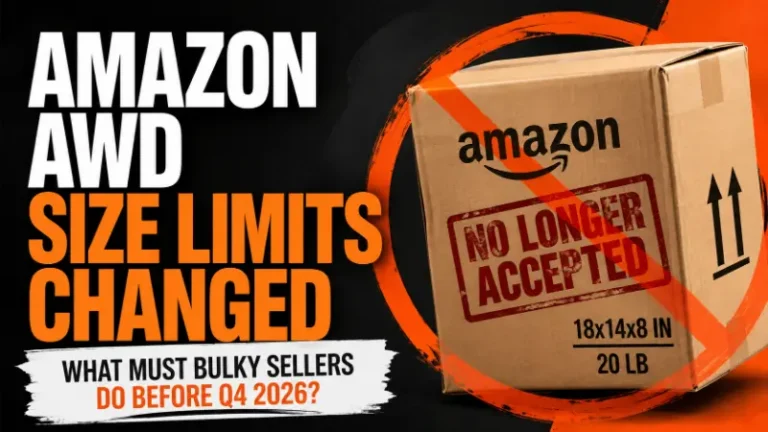
Amazon AWD Size Limits Changed: What Bulky Sellers Must Do Before Q4 2026
Beginning July 31, 2026, Amazon AWD stopped accepting new sortable sellable units at or above 18x14x8 inches or 20 lb, so any unit that meets or exceeds those thresholds is no long...
Why Even a 4:30 PM Cutoff Cannot Solve Amazon’s 40% One-Day SFP Rule
An established ecommerce merchant shipping more than 20,000 monthly orders from Pennsylvania had already pushed its cutoff to 4:30 PM Eastern Time and was willing to use Next Day A...
Amazon’s One-Day Shipping: The Real Story for Retailers
In this article
If Amazon owns nearly half of the $513 billion U.S. ecommerce market, why the need to offer one-day free delivery? The key to this decision is Amazon’s singular obsession with customer centricity and an appreciation for indirect results that don’t even register on the radar of some competitors.
If Amazon owns nearly half of the $513 billion U.S. ecommerce market, why the need to offer one-day free delivery? The key to this decision is Amazon’s singular obsession with customer centricity and an appreciation for indirect results that don’t even register on the radar of some competitors.
Insights abound for those able to get past the headlines. Here are three of the most important takeaways that were either overlooked or under-covered in the media frenzy.
- Rock the Customer Experience or Die
- ROI Needs a Radical Rethink
- Double Down on Innovation, Play to Your Strengths
With the expenses involved in offering free shipping, it’s not hard to see why Amazon’s annual shipping bill is set to exceed $7 billion dollars according to the latest estimates. Retailers often opt to pass these costs on to their customers or offer ecommerce order fulfillment options that won’t leave them substantially in the red, but they’re missing the point.
Written By:

Manish Chowdhary
Manish Chowdhary is the founder and CEO of Cahoot, the most comprehensive post-purchase suite for ecommerce brands. A serial entrepreneur and industry thought leader, Manish has decades of experience building technologies that simplify ecommerce logistics—from order fulfillment to returns. His insights help brands stay ahead of market shifts and operational challenges.
Related Articles
What Is a Perpetual Inventory System? How It Works in Ecommerce
A perpetual inventory system is an inventory management approach in which stock levels are updated continuously and automatically every time a transaction occurs.
What Is Demand Planning? How It Impacts Inventory, Forecasting, and Profitability
Demand planning is the process of estimating future customer demand so that a business can align its inventory, procurement, and operations to meet that demand without carrying mor...
The Shipping Speed Paradox: Why DTC Brands Are Slowing Down
Everyone’s talking about faster delivery.
Overcoming FBA Restrictions with Agile Fulfillment
In this article
10 minutes
Agile ecommerce order fulfillment alternatives to make the switch to FBM
Amazon Sellers are Awash with Disruptions
Back in 2020, the Amazon FBA (Fulfilled by Amazon) community was shaken by Amazon’s decision to restrict the kinds of inventory it’s receiving until April 5, 2020. Shipments of inventory turned away, and many FBA sellers left to fend for themselves amid the crisis. Many sellers who still have FBA inventory are panicking after seeing delivery dates pushed to April, and some items would even take a month to deliver. Many voiced concerns about losing an entire month of sales.
Update: To learn about the latest FBA restrictions and to discover how to mitigate risk and maximize Amazon sales in Q4 and beyond, check our article and on-demand webinar on How To Improve Your IPI Score & Maximize Amazon Sales
Amazon SFP Sellers are Also Hitting Bumps
As merchants rush to convert their listings to Fulfilled by Merchant (FBM), some merchants on the Cahoot Order Fulfillment Network have reported that Amazon has started assigning weekend delivery dates to some Seller Fulfilled Prime (SFP) orders. It’s unclear at this time as to the reasons or which orders or merchants are impacted. One example is a medical supply Cahoot merchant in California. The merchant received several prime orders with a Saturday delivery deadline. Unfortunately, the only delivery option available through Amazon for the deadline was a $120 one-day air service for a $40 item. This is most likely a glitch in Amazon systems. Still, Sellers enrolled in Seller Fulfilled Prime must meet Amazon’s current performance requirements, and ongoing failure to meet them may lead to Prime offers being disabled and disenrollment from the program.
Agile Ecommerce Order Fulfillment is the Present and the Future
COVID-19 situation has exposed a fundamental flaw of over-reliance on a single fulfillment channel. Just like an investor would diversify its portfolio between multiple asset classes, Amazon Sellers should not rely exclusively on FBA for their order fulfillment. A 2025 McKinsey survey found that 90% of consumers are willing to wait two or three days for delivery when shipping is free. There are order fulfillment options that are within your reach, and some of them can even be set up and running in a matter of days.
At Cahoot, we believe in agile order fulfillment that can quickly adapt to changes. Agile fulfillment requires three parts: (1) Flexibility, (2) Resilience, and (3) Scalability. Flexibility implies fulfillment that follows the money, so you can quickly adapt and make changes—for example, quickly adding order fulfillment capabilities in regions where demand is concentrated. If you get a surge of orders from California, having a fulfillment option regional or local to in California would help you lower shipping costs while speeding up deliveries. Flexibility also means the ability to shift fulfillment locations when demand patterns change naturally or as a result of new sales channels or marketing campaigns.
Resilience in ecommerce order fulfillment means making sure your pick, pack, and ship operations continue during disruptions. Major events like the Amazon FBA restriction won’t bring your business down if you have redundant fulfillment capabilities.
Scalability means ensuring your order fulfillment capacity can scale to support your business’ growth and downturn. Having multiple fulfillment options and the technologies that tie them all together can minimize disruptions as your business grow. The aim here is to right-size your operations to suit your business demands while optimizing costs
4 Order Fulfillment Alternatives for Amazon Sellers
Below are 4 popular agile order fulfillment options for sellers to consider.
Own Warehouse
Setting up order fulfillment operations within your own warehouse could be a reasonable stop-gap measure if you have the systems, supplies, and staff. This is a good redundancy strategy to continue selling if FBA goods ever go out of stock.
However, continuing to do order fulfillment using a single fulfillment center is unsustainable when compared to the cost and speed of FBA. Fulfilling 1-day or 2-day delivery prime orders from a single location is very costly. A guaranteed next-day express shipping service is four times the cost of an economical ground shipping.
Pros:
- Suitable for a temporary back-up option for FBA
- At full capacity utilization, order fulfillment can be very economical
- Complete control over your operations and full flexibility in how you package your items
Cons:
- Requires considerable time and resources to find, train and manage staff and day-to-day operations
- Limited coverage via Ground service to deliver orders within 1-Day and 2-Day
- Reaching and maintaining full capacity utilization year-round is very hard
- May not be suitable for Amazon orders if the Operations are brand new which can lead to unacceptance fulfillment defect rates
3PL (Third Party Logistics)
3PLs can provide flexibility by allowing you to add order fulfillment locations faster than building your own warehouses. Smaller 3PLs may be willing to offer lower prices to compensate for their limited coverage.
Smaller 3PLs are a good choice if you already have your own order fulfillment operations and are only looking for a new location to have better two-day ground coverage. Smaller 3PLs are often mom-and-pop operations with limited technology and capacity. Hence, limited in scalability. If you’re looking to offer free one- or two-day shipping across the U.S., working strictly with small 3PLs can be complicated. It may require working with multiple companies, integrating all of their systems to yours, and maintaining them regularly. Plus, you will not have the flexibility to re-calibrate your fulfillment in response to changing customer demand patterns. And, you will be impacted if your single 3PL site has to shut down or downsize their operations for whatever reason.
Pros:
- Add new locations to complement your own order fulfillment
- Access to discounted freight and parcel shipping rates negotiated by the 3PL
- Supports multichannel order fulfillment
Cons:
- Limited capacity and flexibility. They often require long-term contracts with a minimum volume commitment for favorable pricing.
- Limited technology to provide real-time visibility and intelligence into the orders and fulfillment
- Difficult to reliably achieve economical 1 or 2-day delivery nationwide.
- Support for Seller-Fulfilled Prime orders may be limited due to demanding SLAs and special requirements. In 2025, Amazon updated Seller Fulfilled Prime so performance metrics are evaluated separately for standard size, oversize, and extra-large tiers, and the trial now runs four full weeks under weekly performance tracking.
On-Demand Warehousing
On-demand warehousing or 4PLs (Fourth Party Logistic Model) are services that manage multiple 3PLs so merchants can quickly add warehouses as needed. They help merchants find new warehouses that fit their location, timing, or special handling needs (e.g., hazmat, temperature-controlled, perishables, to name a few). Companies such as Flexe, Flowspace, and Ware2Go are platforms that connect 3PLs who have excess storage space with sellers who need them. 4PLs make it simpler for merchants to work with multiple 3PLs because merchants only need to integrate with the 4PL and have the flexibility of short-term space rentals (instead of the long-term commitment typically required by 3PLs).
4PLs generally provide customer support and additional services such as receiving inbound shipments, storage, pick-and-pack, and outbound shipping. But through multiple facilities in distributed geography instead of just one.
Like 3PLs above, merchants need to make sure the 3PLs they are working with are capable of offering 1-day or 2-day delivery nationwide. Not all 4PLs are geared toward fast and cost-effective B2C e-commerce order fulfillment as some tend to specialize in services such as bulk store replenishments, short-term storage facilities, or FBA inventory prep. Because 4PLs are primarily selling 3PL storage and fulfillment services, sellers have to figure out how to optimize their overall costs and business operations by themselves.
Pros:
- Only pay for warehouse space you need without the long-term commitment.
- Minimize complexity from integrating with multiple 3PLs to just one 4PL
- Storage fees may be cheaper than conventional 3PL models because warehouses on the platform mostly list their unused space.
- Supports multichannel orders
Cons:
- Does not specialize in Amazon eCommerce order fulfillment.
- Support for nationwide Amazon Seller-Fulfilled Prime (SFP) fulfillment could be unpredictable, where the performance metrics are very demanding and there is little to no room for errors.
- Space availability varies frequently and dependent on the 3PL partners who are simultaneously servicing their own clients and other platforms.
- Potentially more expensive than a traditional 3PL for eCommerce order fulfillment because both the warehouse and the platform need to make money.
Peer-to-Peer Order FulfillmentTM
Services like Cahoot offer Peer-to-Peer eCommerce Order fulfillmentTM, which is a hybrid between in-house fulfillment and 3PLs. It combines the flexibility and reach of a 4PL with the cost efficiency of in-house fulfillment. In the peer-to-peer model, ecommerce sellers exchange warehouse space and fulfillment services. Under this model, merchants who currently do their own order fulfillment can now work together in a coalition and offer free and fast shipping to each others’ customers wherever they may be located.
Peer–to–peer model offers the most agile order fulfillment because it connects ecommerce sellers to a network of trusted peers, thereby creating a very large network.
First, it provides unparalleled flexibility because online retailers can quickly and easily re-calibrate their fulfillment strategy and locations in response to their inventory demand graph as opposed to serving all customer orders from a fixed fulfillment configuration. This enables Amazon sellers to win the buy box more often and without undue compromise to their margins.
Second, it provides resilience because online sellers collaborate with multiple geographically distributed fulfillment nodes simultaneously on a large-scale global network. So if one partner falters, the merchant can still continue their operations without any business disruption.
Third, peer-to-peer order fulfillment provides high scalability due to the sheer number of high-performing members on the network who each has varying scales of warehouse capacity and resources.
Peer-to-peer’s workshare model allows for the lowest overall storage and order fulfillment costs compared to other options.It takes mere days to start having your stuff fulfilled through Cahoot, and you can get shipping in no time. To learn more or get started, contact us today.
Pros:
- Peer-to-peer gives brands and retailers access to the widest range of ecommerce order fulfillment locations, both domestic and international.
- Overall storage and fulfillment fees are the lowest because of its unique “workshare” model.
- Works with other merchants of repute who have a proven record of handling fast same-day SFP orders and defect-free operations.
- Scales easily and cost-effectively to support the most demanding SLAs
Cons:
- Not always a solution for newer merchants as acceptance into the network requires a proven track record of high-performance fulfillment that can be verified
- Does not offer custom branding or packaging inserts currently.
- Merchants may need to arrange for inbound freight to the receiving warehouses.
- Not suitable for drop-ship merchants or ones who carry just-in-time inventory.
Written By:
Manish Chowdhary
Manish Chowdhary is the founder and CEO of Cahoot, the most comprehensive post-purchase suite for ecommerce brands. A serial entrepreneur and industry thought leader, Manish has decades of experience building technologies that simplify ecommerce logistics—from order fulfillment to returns. His insights help brands stay ahead of market shifts and operational challenges.
Turn Returns Into New Revenue
Related Articles
What Is a Perpetual Inventory System? How It Works in Ecommerce
A perpetual inventory system is an inventory management approach in which stock levels are updated continuously and automatically every time a transaction occurs.
What Is Demand Planning? How It Impacts Inventory, Forecasting, and Profitability
Demand planning is the process of estimating future customer demand so that a business can align its inventory, procurement, and operations to meet that demand without carrying mor...
The Shipping Speed Paradox: Why DTC Brands Are Slowing Down
Everyone’s talking about faster delivery.
Amazon FBA Fees Explained: A Seller’s Breakdown

In this article
10 minute
- What Is Amazon FBA?
- Benefits of Using Amazon FBA
- Comprehensive Breakdown of FBA Fees
- Amazon SIPP Program: What It Is & How It Saves You Money
- Calculating Amazon FBA Seller Fees
- FBA vs FBM vs SFP: Which Fulfillment Model Is Best?
- FBA vs 3PL: Which Is More Cost-Effective?
- Is Amazon FBA Right for You?
- Frequently Asked Questions
Have you ever wondered how Amazon merchants selling $2 items can possibly make a profit? The truth is that they are not.
In fact, most Sellers fail to calculate all of the fees associated with selling on Amazon and end up losing money as a result. To make matters worse, Amazon doesn’t exactly make it easy for merchants to tabulate all of the costs associated with selling on its marketplace and there are many hidden costs that Amazon doesn’t tell you about.
This guide will walk you through everything you need to know about FBA, including how it works, the full breakdown of Amazon fees, hidden costs that Sellers often overlook, and comparisons with alternative fulfillment options like FBM (Fulfilled by Merchant), SFP (Seller Fulfilled Prime), and third-party logistics (3PL) providers.
What Is Amazon FBA?
FBA is a fulfillment service where Amazon stores, picks, packs, and ships products on behalf of its third-party (3P) Sellers. Additionally, it manages customer service and returns, making it an attractive option for businesses that want to scale without handling logistics themselves.
For Sellers looking to maximize their business potential, Amazon offers a professional selling plan that includes additional tools, services, and reporting features.
How FBA Works: Step-by-Step
- Send Inventory to Amazon – Sellers ship products to Amazon’s fulfillment centers. They can choose to split inbound inventory and ship to the addresses Amazon provides, or Amazon will charge an inbound placement fee for distributing inventory on their behalf. This fee varies based on the product’s size and shipping weight.
- Storage – Amazon stores the inventory until an order is placed.
- Order Processing & Shipping – Once a customer makes a purchase, Amazon picks, packs, and ships the order.
- Customer Service & Returns – Amazon manages inquiries, returns, and refunds for FBA orders.
Benefits of Using Amazon FBA
- Prime Eligibility – Products are automatically eligible for Amazon Prime’s fast, free shipping, making them more attractive to buyers.
- Hands-Free Logistics – Amazon handles storage, shipping, customer service, and returns.
- Scalability – Sellers can scale their business without worrying about fulfillment logistics or hiring staff.
- Better Buy Box Placement – FBA products often have an edge in winning the Buy Box, increasing sales potential.
- Revenue Calculator – A tool that helps Sellers estimate referral fees and potential profits, assisting in making informed decisions about their fulfillment methods.
However, these benefits come with a cost. Let’s break down the fees involved.
Comprehensive Breakdown of FBA Fees
Amazon FBA fees vary based on product size, weight, and storage duration. Understanding the various selling fees is crucial for accurately calculating total selling costs and maintaining profitability. Below is a detailed breakdown.
1. Fulfillment Fees (Per Unit)
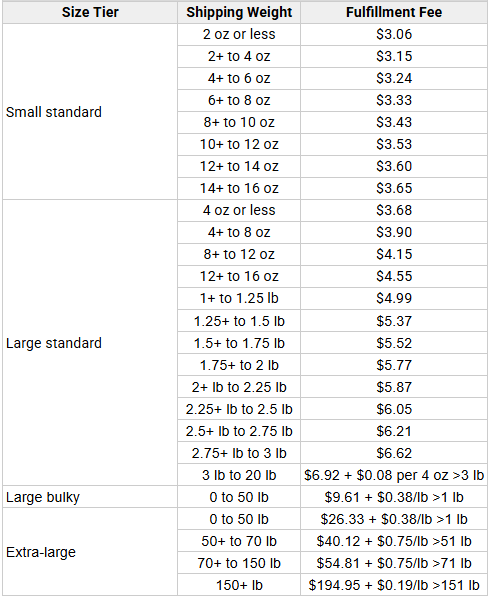
FBA fulfillment fees cover picking, packing, and shipping and are determined by the size and weight of the item, and it’s important to understand these fees for effective pricing strategies.
2. Monthly Storage Fees
Amazon’s 2026 monthly inventory storage rates are $0.99 per cubic foot for standard-size items and $0.78 per cubic foot for oversized items from January through September, and $3.63 and $2.43 per cubic foot, respectively, from October through December. Amazon charges Sellers a monthly fee for storing inventory in its fulfillment centers. The following are the 2026 base monthly rates and they increase as Storage Utilization Surcharges are applied after 22 weeks in storage. For standard-size products in non-peak season, these surcharges increase the total storage cost by more than 56% after week 22, and nearly double after 28 weeks in storage, etc. This assumes products are not classified as ‘dangerous’:
Period |
Standard Size (per cubic foot) |
Oversized (per cubic foot) |
|---|---|---|
January – September |
$0.99 |
$0.78 |
October – December (Peak) |
$3.63 |
$2.43 |
3. Long-Term Storage Fees
If inventory is stored for over 365 days, Amazon applies long-term storage fees (called the Aged Inventory Surcharge):
- $6.90 per cubic foot OR
- $0.15 per unit (whichever is greater)
Sellers need to closely monitor inventory levels to avoid these charges.
4. Referral Fees
Referral fees are percentage-based fees on each sale, varying by category. It’s the base fee that’s paid by all Amazon Sellers for the privilege of selling on the Amazon marketplace, whether orders are Seller-fulfilled (a.k.a. FBM) or fulfilled by Amazon (FBA). Most categories are charged between 8-15%.
Product Category |
Referral Fee |
|---|---|
Electronics |
8% |
Beauty & Health |
15% |
Books |
15% |
Apparel |
17% |
5. Removal & Disposal Fees
If a Seller wants to remove inventory from Amazon warehouses, Amazon now charges removal and disposal fees on a per-unit basis as each unit is processed; current removal order fees include $0.84 for 0 to 0.5 lb, $1.53 for 0.5+ to 1.0 lb, $2.27 for 1.0+ to 2.0 lb, $2.89 plus $1.06 per lb above 2 lb, and $27.04 per oversize unit, while disposal orders are charged at $15.38 per unit.
Disposal fees are slightly lower but still add up over time.
6. Returns Processing Fees
For certain categories like apparel and shoes, Amazon charges the Seller for returns based on the product’s size tier and shipping weight, but Amazon does not charge returns processing fees for watches, jewelry, luggage, or handbags & sunglasses.
7. Refund Administration Fees
Refund administration fees are an essential aspect of Amazon FBA fees that Sellers need to be aware of. When a customer requests a refund, Amazon charges a refund administration fee equal to the lesser of $5.00 or 20% of the referral fee for the item.
These fees are deducted from the Seller’s Amazon account balance. If the account balance is insufficient, the refund administration fees are charged to the Seller’s credit card. It’s crucial for Sellers to monitor these fees closely, as they can add up quickly, especially in categories with high return rates. Keeping an eye on refund administration fees and understanding their impact on your overall profitability is vital for effective financial management.
8. Low-Inventory-Level Fee and Aged Inventory Surcharge
Amazon imposes a Low-Inventory-Level Fee (in addition to other storage fee types) to encourage Sellers to manage their inventory efficiently and maintain sufficient inventory to fulfill new orders. This fee applies only to standard-size products when both short-term and long-term historical days of supply are below 28 days, and current rates range from $0.32 to $1.11 per unit depending on size tier.
In addition to the Low-Inventory-Level Fee, Amazon also charges an Aged Inventory Surcharge for items stored for more than 365 days. This surcharge is $6.90 per cubic foot per month. To avoid these fees, Sellers should regularly review their inventory levels and remove slow-moving or obsolete items. Effective inventory management can help minimize these additional costs and improve overall profitability.
Hidden or Lesser-Known Amazon FBA Seller Fees
Sellers often overlook these extra costs:
- Unplanned Services Fees – Charged when inventory arrives without proper labeling or packaging.
- Inbound Shipping Costs – Amazon doesn’t cover shipping to their warehouses, Sellers must pay for it.
- Selling Plan Fees – Costs associated with the Individual or Professional selling plans, providing access to various tools and services.
Amazon SIPP Program: What It Is & How It Saves You Money
The Ships in Product Packaging (SIPP) program lets Sellers send products in their own packaging (or native retail packaging), eliminating Amazon’s additional packing materials.
SIPP Fee Discounts
By participating in SIPP, Sellers receive discounts on fulfillment fees ranging from $0.04 to $1.32 per unit, depending on size and weight. Compared to standard FBA fees, SIPP reduces costs while supporting sustainability.
Program |
Fee Reduction |
|---|---|
SIPP (Standard-Size) |
$0.04 – $0.23 per unit |
SIPP (Large Bulky, <50 lb) |
$0.58 – $1.32 per unit |
Calculating Amazon FBA Seller Fees
Amazon’s 2026 fee update says standard-size products priced between $10 and $50 will see fulfillment fees increase by an average of $0.08 per unit. Calculating Amazon FBA Seller fees can be complex, but understanding the various fees involved is crucial for maintaining profitability. Here’s a step-by-step guide to help you navigate the process:
- Determine Your Selling Plan Fee: Choose between the Individual plan, which costs $0.99 per item sold, or the Professional plan, which has a monthly subscription fee of $39.99.
- Calculate Your Referral Fee: This fee is a percentage of the total sales price and varies by product category, typically ranging from 5% to 15%.
- Calculate Your Fulfillment Fee: Fulfillment fees vary by category, size, weight, and price band, and Amazon’s 2026 update says standard-size products priced between $10 and $50 will see fulfillment fees increase by an average of $0.08 per unit (apparel has slightly higher fees.)
- Calculate Your Shipping Cost: This is the cost of shipping the item to the customer, which can vary depending on the shipping carrier and method.
- Add Any Additional Fees: These may include high-volume listing fees, rental book service fees, or refund administration fees.
By following these steps, you can get a clear picture of your Amazon FBA Seller fees and ensure that your pricing strategy covers all costs, helping you maintain profitability.
FBA vs FBM vs SFP: Which Fulfillment Model Is Best?
Fulfillment Model |
Best For |
Prime Eligibility |
Control Over Shipping |
Storage & Shipping Costs |
|---|---|---|---|---|
FBA |
High-volume Sellers |
✅ Yes |
❌ No |
Moderate to High FBA fulfillment costs |
FBM (Fulfilled by Merchant) |
Low-margin or niche Sellers |
❌ No |
✅ Yes |
Can be lower depending on product size and weight |
SFP (Seller Fulfilled Prime) |
Established Sellers with robust logistics |
✅ Yes |
✅ Yes |
Varies depending on ship distance and speed requirements |
Which One Should You Choose?
- FBA: Best for Sellers who prioritize Prime eligibility and hands-off logistics.
- FBM: Ideal for low-margin products or Sellers that either have their own fulfillment infrastructure or partner with a modern and high-quality 3PL.
- SFP: Works well for brands who want Prime benefits and either have established fulfillment capabilities or outsource fulfillment to a 3PL that supports SFP.
FBA vs 3PL: Which Is More Cost-Effective?
A third-party logistics provider (3PL) can be an alternative to FBA. Here’s how they compare:
Factor |
Amazon FBA |
3PL Provider |
|---|---|---|
Fulfillment Cost |
High unless products are small and light |
Lower for higher order volumes |
Brand Control |
Limited |
Full control |
Customer Service |
Amazon handles |
Seller handles |
Storage Fees |
Monthly charges, punitive long-term fees |
Monthly charges, long-term fees vary but are lower |
3PLs are best for Sellers who need lower storage fees, more branding control, and multi-channel fulfillment. FBA is best for Sellers looking for speed, Prime access, and hands-free logistics.
Is Amazon FBA Right for You?
Amazon FBA is a powerful fulfillment option, but understanding the full cost structure is key to maintaining profitability. While FBA provides logistical ease, Prime access, and customer service, it also comes with various fees that can quickly destroy margins, making a business unprofitable if they’re unable to actively manage the program.
To maximize profits:
- Track your FBA fees regularly using the reports available in the Professional Selling plan and optimize inventory to avoid long-term storage charges.
- Consider SIPP if your products qualify for reduced fulfillment fees.
- Compare FBA with FBM, SFP, and 3PLs to find the best fulfillment model for your business.
With the right strategy, Amazon FBA can be a game-changer for your ecommerce success! It just takes work and reliable monitoring to make adjustments before fees get out of control.
Frequently Asked Questions
What is Amazon FBA?
Amazon FBA is a fulfillment service offered by Amazon that allows Sellers to store their products in Amazon’s fulfillment centers. Amazon handles the packaging, shipping, and customer service for these products.
How much does Amazon FBA cost?
Amazon FBA costs vary depending on the product size, weight, and shipping method. Sellers can expect to pay a flat fulfillment fee per unit, ranging from $3.06 to $6.62 for standard-size items under 3 pounds. Larger and heavier items can expect to pay between $9.61 and $194.95, or more if a product is more than 150 pounds.
What is the difference between Amazon FBA and FBM?
Amazon FBA is a fulfillment service where Amazon handles the logistics, while FBM (Fulfillment by Merchant) is a fulfillment method where the Seller manages the packaging, shipping, and customer service themselves.
How do I calculate my Amazon FBA Seller fees?
To calculate your Amazon FBA Seller fees, you need to determine your selling plan fee, referral fee, fulfillment fee, shipping cost, and any additional fees. Understanding these components will help you price your products effectively and maintain profitability.
Written By:
Jeremy Stewart
Jeremy Stewart leads customer success at Cahoot, helping merchants achieve high-performance logistics through smart technology and process optimization. With a background in both ecommerce operations and client services, Jeremy ensures that every merchant using Cahoot gets measurable results—whether they’re scaling from one warehouse to many or managing complex returns.
Turn Returns Into New Revenue
Related Blog Posts
Amazon Buy With Prime: A Game-Changer for Customers, But a Trojan Horse for Merchants

In this article
20 minutes
Podcast: Ecommerce Wizards Podcast – What is Amazon’s Buy With Prime Button?
Guillaume Le Tual, host of the E-Commerce Wizards Podcast, interviews Manish Chowdhary, CEO of Cahoot, about Amazon Buy With Prime. The service allows merchants to install the Amazon Prime button on their product page, shopping cart, and checkout. Customers can then log in to their Amazon Prime account to check out and receive one or two-day free shipping, free returns, and no minimums. For customers, it’s a great service, but for ecommerce merchants, it’s a Trojan Horse. Amazon Prime circumvents the entire order checkout process from the merchant’s platform, and payment processing goes through Amazon, which also collects data about the customer and charges the seller for order fulfillment. While Amazon FBA can be a benefit for merchants who lack a strong shipping distribution system, there’s also a cost of 15% that some merchants say is too high to make a profit. Amazon Prime service is a big deal for merchants because it can replace their whole checkout experience and be a disadvantage for them.
Guillaume:
Hello, everyone. Guillaume Le Tual here, host of the E-Commerce Wizards Podcast, where I feature leaders in e-commerce and business.
Today, for a second time, our guest is Manish Chowdhary, who’s the CEO of Cahoot. And we’re going to have a chat together about what is Amazon Buy With Prime.
Speaker 3:
This episode is brought to you by MageMontreal. If a business wants a powerful e-commerce online store that will increase their sales, or to move piled up inventory to free up cash reserves, or to automate business processes to reduce human processing errors, our company, MageMontreal, can do that. We’ve been helping e-commerce stores for over a decade.
Here’s the catch. We’re specialized and only work on the Adobe Magento e-commerce platform, also known as Adobe Commerce. We’re among only a handful of certified companies in Canada. We do everything Magento-related.
If you know someone who needs design, support, training, maintenance, or a new e-commerce website, email our team at support@magemontreal.com, or go to magemontreal.com. That’s M-A-G-E montreal.com.
Guillaume:
So Manish, thanks for being here for a second recording.
Manish:
Thank you for having me, Guillaume. Thank you very much.
Guillaume:
All right, can you enlighten us? What is, first of all, Amazon Buy With Prime?
Manish:
Amazon Buy With Prime is the Amazon’s mission to dominate the world, as it always does. But let’s break it down.
What Amazon Buy With Prime is, it’s essentially an option for websites outside of Amazon to install the familiar Amazon Prime button on the product page, in their shopping cart and checkout. So the user, instead of checking out through your native platform’s shopping cart and checkout, you can check out by logging into your Amazon Prime account, as you would on your Amazon.com website.
And as a result of that, you will get all the benefits of Amazon Prime, which is one or two-day free shipping, free returns, and also there’s no minimum and so on. So you log in, and you check out using Amazon, and then Amazon will ship the item to you from its FBA, Fulfillment by Amazon Warehouse, and you’ll get it in one or two days.
So great service for the consumer, but of course, not so great for the sellers, which I can talk about further.
Guillaume:
Yes, exactly. From an entrepreneurship and business point of view, it’s like, oh, big red flags here showing up. So, okay, what do you see as a red flag for merchants here?
Manish:
Right. So for the merchants, for the sellers, I call Amazon Buy With Prime a Trojan Horse. It’s essentially, what Amazon did with its AWS, the web services or the hosting division, they started using the web hosting for themselves. And then they converted that into a mass service that we all, many of us use, Amazon’s Web Hosting Services.
So this is Amazon’s attempt to basically get into the 3PL, the order fulfillment world. They built the Amazon FBA for themselves, for products that are sold on Amazon, and now they’re opening this up to the larger internet. So if you are selling on your own website, how can Amazon participate and get a share of that wallet from your website, because they have 150 million subscribers? But essentially, what Buy With Prime is doing is essentially encapsulating three different Amazon services into one, which is Amazon Advertising, Amazon FBA, Fulfillment by Amazon, and Amazon Payment.
So essentially, when the user checks out using the Buy With Prime, it completely circumvents the entire checkout process from the platform, and it basically puts payment processing with Amazon. And then, of course, Amazon collects all the rich data about the customer. What are you buying? When are you buying? And also, Amazon gets to charge the sellers for order fulfillment.
And so, this is a very, very attractive service for the consumer. But of course, for the seller, it creates a lot of challenges. And I can continue to elaborate, but basically, it’s a Trojan Horse and there are lots of disadvantages for the sellers, and there are some advantages as well, to be fair.
Guillaume:
Yeah. I like your term, Trojan Horse, and it is a powerful move from Amazon. You can see, for example, Shopify CEO, that will slip up about this at first and say, “Yeah, yeah, we’ll do it.” And then they will backtrack on this, and say, “No way,” because it would replace Shop Pay, which is one of the competitive advantage of Shopify.
So, it is a big deal for a merchant to have your whole checkout experience totally replaced by Amazon. So yes, on the positive side, if you don’t have a strong distribution system already in place, having Amazon FBA, Fulfilled by Amazon, can be a strong benefit. But also, there’s a cost to this, and the cost is not always the best.
I know some merchants that say, “If I sell myself and I fulfill myself, I make money. If I use FBA, well, it’s not worth the trouble anymore. I don’t make much money anymore.” You know? So there’s that aspect, about the extra 15%, it can make a difference. For the merchant, cost will not be zero to fulfill themself, obviously. But that 15% sometimes is too much for merchant, that it doesn’t make it worth it for them to run the business if all the sales will come into that channel, with FBA.
Also, you give up a lot of your control. That order is going to go into Amazon. How much control do you retain personally as a merchant over this transaction? How much information do you have about the customer? How much customer service do you need to do? And so on. Perhaps you can elaborate a little bit on that aspect.
Manish:
Absolutely. All good points, Guillaume. But even beyond that, Buy With Prime infiltrates the entire customer journey from discovery, conversion, post purchase, which includes fulfillment as you said, and the repeat purchase. And I’ll give you some example for each one.
Discovery is essentially, Amazon, you would install a familiar Buy With Prime, the blue Amazon Prime, with the swoosh, the very familiar icon that we know. So now, that will get installed, say, right below your Add to Cart button, if you’re on a Magento site, for example. And so, just imagine the button itself on your site is a reminder for the customer to go check out Amazon, because you’re putting Amazon branding on your product details page and so on. So the Amazon, even if you acquired this traffic and brought it to your website, now the customer is being potentially invited to go, reminded of their Prime membership, so that they can possibly go on Amazon and compare prices and so on. So that could lead to siphoning of traffic. That’s one.
On the conversion side, most ecommerce brands, most websites, retailers, like to encourage larger shopping carts. We know that on your DTC website, most brands have free shipping on orders over, say, $49. So, it’s not free-free for buying a toothpick or buying a toothbrush, but that’s what you get with Amazon Prime.
Amazon Prime does not have those limits. So if you’re a Prime member, the people could actually, this could lead to lower cart size on your DTC site, as opposed to encouraging a larger cart. That’s the conversion part.
And then, let’s say you add the item to the shopping cart and you abandon the cart. We know that 85% of the Amazon Prime members visit Amazon.com at least once a week, and 45% of them make a purchase, a transaction, once a week. That’s a very high repeat loyalty that these Amazon Prime subscribers have to Amazon. And part of it is because they’ve paid $139, $140 annual membership, so they want to exploit that.
But imagine somebody added the item to the shopping cart and they didn’t check out. Now, it’ll be very difficult for the brand to re-market to this customer. And if they hop over to Amazon once a week, they might be targeted with the ads of another product that competes with this product. And you are the one who helped add that item to the cart in the first place.
So, those are some of the challenges on the order fulfillment side to continue with that school of thought. The product is going to come in an Amazon branded box. We’ve all seen the familiar Prime tape that goes on the brown box, with Amazon advertising. So, you bought the item from this DTC brand that’s looking to promote its ecommerce brand, its value proposition to the customer. But the customer is being reminded of Amazon every step of the way. And so, that is not very good.
And then finally, on the repeat purchase, the customers are more likely to go back to Amazon. And if you are selling on Amazon, you’ll have to not pay anywhere between that eight to 20% commission. So there are many aspects of it is not so enticing for the seller. And of course, there are some advantages which I can cover as well, Guillaume, to be fair.
Guillaume:
We’ll cover after. I think we’re not done with the downsides, quite frankly, which to me is way larger than the upside. Because if you want to use Amazon’s email, FBA or whatever, fulfillment services and so on, well, you can just list your product on the marketplace.
Also, Amazon’s fees, the normal fees plus the fees for fulfillment, they are fair when Amazon is bringing you the customer. And it’s the reason why you want to put your products on the marketplace in the first place, because Amazon is going to bring you traffic, going to bring new customers there.
But if you paid for the customers yourself separately, maybe with your own Google Ads, your own marketing efforts and so on, and then you’re still going to pay all those costs and send over the customer to Amazon, and then you sort of lose traction. And I really like your other point. What if the customer does not buy right away? It happens. You add stuff to cart, you don’t finish, get interrupted, kids calling you, whatever. You come back, and then you’re going to see ads and similar product, maybe cheaper on Amazon. It is really a Trojan Horse. From my point of view, it is a really big mistake from business point of view.
I am all for selling on marketplaces like Amazon. Do it. Go for it if it makes sense for your business. It’s a good idea. But your own website, your own .com or whatever, is a separate thing, is a way to diversify. So, you do not want to tie it even more to Amazon. And Amazon is just trying to take buys more and more into what it currently does not control.
It would prefer that all transaction worldwide goes on Amazon, and they don’t currently control all those independent websites. Now, that’s one way to sort of control them, to a great extent. So, I see more negative than positive. But let’s go with the positive. Let’s be fair. So, what’s the positive?
Manish:
Well, positive is, if you have a website, an ecommerce brand that’s not very well-known, and you don’t have a lot of customer trust, Amazon Prime button can install that trust. It’s sort of like many websites that I don’t want to check out and provide my credit card information to that website, because maybe I don’t have trust.
And that is how PayPal gained prominence in the first place. People love checking out through PayPal. And consumers, of course, we all want that free one-day, two-day delivery. So, if the brand does not have the ability, if the seller’s not utilizing services like Cahoot, it would be very difficult for them to offer that level of service.
So, this would be a great way for them to get traction, if they don’t want to take any hassle with fulfillment, operations and logistics, and even customer care. Because remember, as part of the Prime purchase, you’re also delegating a lot of your customer service to Amazon. So, whether it’s a good thing or a bad thing. But that’s certainly like, I’ll give you an example, and we actually did the study.
So the Skullcandy, you’re probably familiar, it’s a very popular headphones brand, very popular with gamers. And they’re selling a product that, let’s say they’re offering four to seven-day delivery, which is what we found when we checked their website, when we did the study about a few months ago, in the summer.
And then another company called Razer, which is an up and coming brand, and if they installed Buy With Prime, and both the products are priced equally, as a consumer you might be motivated to check out through Buy With Prime on Razer.
So in the absence of date certain shipping, let’s say I have a birthday party, I need to buy a gift and I need to have it arrive by Saturday. Today is Thursday. So, my options are very limited. So it can be quite advantageous in those cases for the people who don’t want to fully outsource fulfillment to FBA.
And just to add to that, by the way, the cost of fulfilling orders with Amazon through Buy With Prime is not the same as if the order arrived on Amazon.com. Because Amazon makes the 15, whatever, 15% commission on those, they will not make that commission on these orders. And therefore, these orders will be classified as multichannel order fulfillment.
And we know that if you try to get a Magento order Fulfilled By Amazon (FBA), you pay more. So it’s not the same low price that if the order originated on Amazon. And we’ve done some calculation, in many cases, it works out to be 51% more expensive to do multichannel fulfillment. And of course, if you want the map, there’s tons of webinars on our Cahoot.ai, on the Resources section. Check out or contact us, we’ll be happy to elaborate on that multichannel fulfillment.
Guillaume:
And just to clarify it, so you’re saying that 51%, just to be sure I understood it well. So 51% more expensive from multichannel fulfillment if you send the order then to Amazon, so if it came from your on e-commerce store, is that what you’re saying?
Manish:
That’s right. Because, let’s say, you’re selling socks. I have black socks and I have red socks. And Amazon FBA, routine FBA will cost you $4 and 22 cents. But if I send Amazon that order from Magento to fulfill, it’ll cost me $6 and 31 cents to ship the same identical item. The only difference is this is a Magento order versus an Amazon.com order.
Now further, let’s say a customer buys a pair of black socks and a pair of red socks. Amazon treats them as two unique items. They don’t put them all together. What’s the composite weight? The weight of the items, the two pairs of socks, is not going to be different. You’ll pay double because you’re paying 4.22 for one pair, you’ll pay $8 and 44 cents for two pairs of socks. And if it was a multichannel, if it was a Magento order, it’ll be $12 and 74 cents. That’s how we arrived at the 51% more expensive amount.
Guillaume:
Okay. So, it is not optimized in the merchant’s favor for cost saving and bundling boxes and so on, because actually Amazon will typically ship to you in all separate boxes as fast as it can. But somebody’s paying for all this, this, quote, unquote, free shipping. The merchant’s paying for it.
Manish:
Well, that is just the way Amazon’s pricing model. So the product may still arrive in the same box, but the way how FBA prices its services, it does not. It simply looks at a price, flat price per item. Per item. Now it does not take the weight into consideration.
So FBA, especially multichannel fulfillment through FBA, becomes quite pricey when you have larger number of units per order. So, if you’re a apparel ecommerce brand, if they try to do multichannel order fulfillment, let’s say you have a Magento store or a Shopify store, and you want to get those orders fulfilled through FBA, the cost will add up and it becomes quite expensive. Because apparel, and certain product categories, lend themselves for larger number of units, average number of units per order.
Guillaume:
Okay. All right. Okay, thanks for that clarification. Is there anything else that people should know about the Amazon Buy With Prime?
Manish:
I think you covered it. Shopify has banned it. Shopify, they’ve openly come out and say that this is against the Terms of Service, and you’ll get a big warning if you’re a Shopify merchant.
It’s still a By-invitation Only program. We know a little about it so far. So, I think merchants should… Essentially, this is a call to action for brands and retailers, that faster shipping, the two-day shipping, it used to be an Amazon thing. Now it’s going to be an internet thing. It is what’s expected from you.
So I would encourage brands and retailers to look at their order fulfillment strategy, their operation strategy. You don’t need to go build tens of warehouses. That’s very expensive. In fact, right now, the warehouse rents are at all-time high, Guillaume, all-time high. And the vacancy is an all-time low. So even if you wanted to go and look for warehouses in California, or the West Coast of the US, you can’t find them.
If you find them, you’re going to have to sign a multi-year lease. You’re going to have to make a very large capital investment. It’s like the days of, you know, we no longer see competitive advantage in owning servers in the age of cloud computing.
So order fulfillment is going through a similar transition, that services like Cahoot are democratizing that service. And in fact, if you have excess capacity in your warehouse, we encourage you to come apply at Cahoot.ai, to join as a fulfillment partner.
So this is my recommendation for brands and retailers, to not take delivery and shipping lightly. In fact, we have a saying internally in our circles, that half your shopping experience is now your shipping experience. So, you got to really think of it from a customer experience standpoint.
Guillaume:
Yes. Okay. And I think this is pretty good coverage for Amazon Buy With Prime. It can be seductive for some consumers to check out at equal price point and so on. I’m going to benefit from that checkout experience. But you can compete with it, no matter the size of the merchant. It’s more a question of, can you deliver quickly? Can you write the date of arrival on your own website?
And of course, inviting Amazon on your own .com is, generally speaking, a very bad idea as a business move. It should be a diversification, unless it’s sort of a mini site that you more or less don’t care about. That is just a marketing site that is there to drive traffic, a bit like some brands have a lot of mini sites, and blogs, and so on that just drive traffic to a store. Then, if that’s the role of your small e-commerce store, that would be perfectly fine.
But if it’s your real, branded e-commerce store that you care to build a brand and brand value, I would not invite Amazon, as much as possible, on that site. I think it’s a bad business move.
So, that’s it. Well, Manish, thank you for this discussion. If people want to get in touch with you, what’s the best way?
Manish:
Well, hop over to www.cahoot.ai. That’s singular. And fill out the Contact Us form. I would love to chat with you.
And you can also find me on LinkedIn. Just Google, well LinkedIn, my name. Search my name on LinkedIn, with Cahoot, and I will personally respond to you.
So I’d love to chat with merchants, brands, retailers. Because there’s much to learn from practitioners, as much as we know about logistics, and share stories and try to find a better way to do business, that puts more money in the pockets of the business owners.
Guillaume:
All right. Well, Manish, thank you for being here today.
Manish:
Thank you for having me.
Written By:
Jeremy Stewart
Jeremy Stewart leads customer success at Cahoot, helping merchants achieve high-performance logistics through smart technology and process optimization. With a background in both ecommerce operations and client services, Jeremy ensures that every merchant using Cahoot gets measurable results—whether they’re scaling from one warehouse to many or managing complex returns.
Turn Returns Into New Revenue
Related Articles
What Is a Perpetual Inventory System? How It Works in Ecommerce
A perpetual inventory system is an inventory management approach in which stock levels are updated continuously and automatically every time a transaction occurs.
What Is Demand Planning? How It Impacts Inventory, Forecasting, and Profitability
Demand planning is the process of estimating future customer demand so that a business can align its inventory, procurement, and operations to meet that demand without carrying mor...
The Shipping Speed Paradox: Why DTC Brands Are Slowing Down
Everyone’s talking about faster delivery.
For Prime 1-Day Shipping, Amazon Wants Sellers to Send It More Stuff
In this article
Amazon is offering steep discounts of up to 75% on warehouse storage fees to incentivize merchants to store more of their popular products with the company, in an effort to facilitate its transition to a one-day shipping standard for Prime members, according to CNET.
The promotion will begin in June and run through January; to qualify, sellers will need to have sold 60 or more of a product per month or have products specifically selected by Amazon. They’ll also have to keep the level of inventory they supply to Amazon at a certain level.
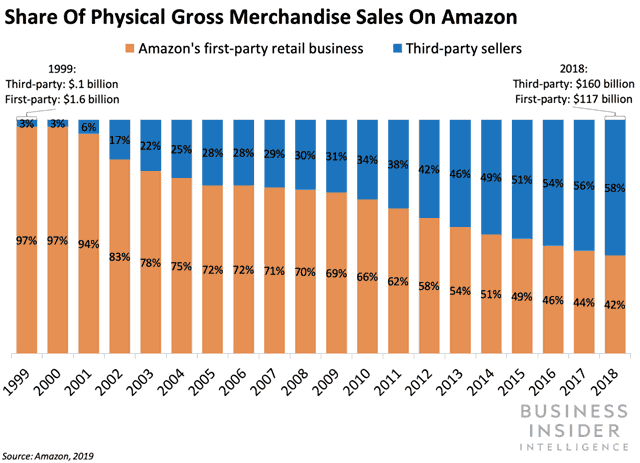
Here’s what it means: The push for one-day free shipping can’t be a unilateral move by Amazon: It’ll need sellers to work with it.
One-day shipping is likely feasible for Amazon, but more than half its sales come from third-party sellers, making them critical to achieving this new goal. Third-party merchants were responsible for 58% of Amazon’s sales in 2018, an enormous jump from 3% in 1999.
Because of this, if Amazon wants to have any chance of making the lion’s share of the items on its marketplace available for one-day delivery, it’ll need help from those sellers. It shouldn’t be too difficult to get them on board, though, given that one-day shipping is likely to increase consumers’ enthusiasm for Amazon, leading to more sales for the sellers working with it.
The bigger picture: Amazon’s one-day shipping goal will highlight the importance of its relationship with sellers (both FBA and FBM doing their own ecommerce order fulfillment) as well as the fine-grain control it has over its private-label products.
Written By:
Jeremy Stewart
Jeremy Stewart leads customer success at Cahoot, helping merchants achieve high-performance logistics through smart technology and process optimization. With a background in both ecommerce operations and client services, Jeremy ensures that every merchant using Cahoot gets measurable results—whether they’re scaling from one warehouse to many or managing complex returns.
Related Articles
What Is a Perpetual Inventory System? How It Works in Ecommerce
A perpetual inventory system is an inventory management approach in which stock levels are updated continuously and automatically every time a transaction occurs.
What Is Demand Planning? How It Impacts Inventory, Forecasting, and Profitability
Demand planning is the process of estimating future customer demand so that a business can align its inventory, procurement, and operations to meet that demand without carrying mor...
The Shipping Speed Paradox: Why DTC Brands Are Slowing Down
Everyone’s talking about faster delivery.
Amazon and Apple Get Co-Opetitive
In this article
More Apple products are getting the stamp of approval from Amazon, which will officially enable the sale of a range of new devices on-site from the tech brand.
Amazon is approving the sale of the latest iPad Pro, iPhone and Apple Watch models by authorized resellers rather than just through the third-party marketplace, according to TechCrunch. Independent sellers will, in fact, have their listings removed. Amazon already allows the official sale of some products, such as laptops and Beats headphones.
The change in the trade partner relationship raises questions about the extent to which Amazon considers Apple to be a competitor and what Amazon’s long-term plan might be for the device market. The two companies have been involved in an ongoing push/pull over their competitive devices, with Amazon sometimes removing Apple products from its site or Apple refusing to play ball with Amazon in some other manner.
Written By:
Jeremy Stewart
Jeremy Stewart leads customer success at Cahoot, helping merchants achieve high-performance logistics through smart technology and process optimization. With a background in both ecommerce operations and client services, Jeremy ensures that every merchant using Cahoot gets measurable results—whether they’re scaling from one warehouse to many or managing complex returns.
Related Articles
Walmart Officially Allows Amazon Multi-Channel Fulfillment (MCF)
Big news for multichannel sellers: Walmart now officially allows Amazon Multi-Channel Fulfillment (MCF), Amazon’s service for using its fulfillment network to ship orders from mult...
Shopify Subscription Payment Change: Why It Could Hurt Reactivation
Shopify changed how subscription payment information is handled at cancellation.

Why Cross-Border DTC Brands Are Moving Fulfillment Inside the US
Cross-border ecommerce fulfillment is the process of shipping ecommerce orders across national borders—often from warehouses outside the United States to U.
Amazon Officially Calls Out UPS and FedEx as Competitors
In this article
Amazon has long downplayed its delivery ambitions, claiming its own shipping and delivery services are only intended to “supplement” existing partners such as UPS and FedEx, saying it just wanted to address capacity shortfalls. Until now, that is.
Amazon has long downplayed its delivery ambitions, claiming its own shipping and delivery services are only intended to “supplement” existing partners such as UPS and FedEx, saying it just wanted to address capacity shortfalls. Until now, that is.
In its 2018 10K filing, Amazon for the first time listed “transportation and logistics services” as a competitive sector in the boilerplate “risk factors” section, along with the existing list of categories including “physical, ecommerce, and omnichannel retail, ecommerce services, digital content and electronic devices, web and infrastructure computing services.”
Amazon clearly needs to get a handle on the growth of its shipping spend, which hit $27.7 billion in 2018, up 31% from $21.1 billion in 2017 and up a whopping 72% from $16.2 billion in 2016. For 2018, fulfillment represented 14.6% of Amazon’s net sales. Analysts see the company’s many and growing logistics initiatives as a way to offset some of that cost.
Written By:
Jeremy Stewart
Jeremy Stewart leads customer success at Cahoot, helping merchants achieve high-performance logistics through smart technology and process optimization. With a background in both ecommerce operations and client services, Jeremy ensures that every merchant using Cahoot gets measurable results—whether they’re scaling from one warehouse to many or managing complex returns.
Related Articles
Walmart Officially Allows Amazon Multi-Channel Fulfillment (MCF)
Big news for multichannel sellers: Walmart now officially allows Amazon Multi-Channel Fulfillment (MCF), Amazon’s service for using its fulfillment network to ship orders from mult...
Shopify Subscription Payment Change: Why It Could Hurt Reactivation
Shopify changed how subscription payment information is handled at cancellation.
Why Cross-Border DTC Brands Are Moving Fulfillment Inside the US
Cross-border ecommerce fulfillment is the process of shipping ecommerce orders across national borders—often from warehouses outside the United States to U.
Amazon FBA and FBM: Your Guide to Amazon Fulfillment
More than 60% of sales in the Amazon store are from independent sellers—most of which are small and medium-sized businesses. One of the biggest enablers of that tremendous growth was Amazon’s launch of Fulfillment by Amazon, or FBA, which today dominates the logistics landscape for third-party sellers.
However, merchants still have the option to fulfill their own Amazon orders using Amazon’s Fulfillment by Merchant (FBM) option. Self-fulfilling merchants have also been given access to the coveted Prime badge in recent years through the Seller-Fulfilled Prime (SFP) program, although the standards to qualify are extremely high and require an elevated level of organization from participating merchants.
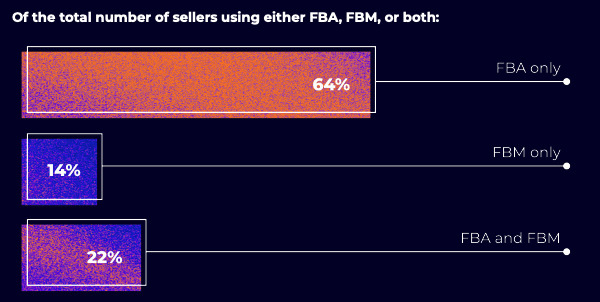
Source: Jungle Scout
In 2024, 36% of Amazon sellers used at least some FBM – and that number has fluctuated significantly in recent years as Amazon has rolled out significant changes to the FBA and SFP programs.
In this post, we’ll explore the relative advantages of FBA vs FBM and how you can make the choice that’s right for your business.
What’s the Difference Between Amazon FBA and FBM?
When it comes to selling on Amazon, understanding the differences between Fulfillment by Amazon (FBA) and Fulfillment by Merchant (FBM) is crucial. Amazon FBA allows sellers to outsource their logistics to Amazon entirely. This means that once your products are in Amazon’s fulfillment centers, Amazon takes care of the rest, ensuring fast and reliable delivery to customers. This method is particularly beneficial for sellers who want to leverage Amazon’s vast fulfillment network and focus more on marketing and growing their business.
Amazon’s fulfillment centers are used for storing and shipping products efficiently. Additionally, Amazon’s fulfillment network allows sellers to outsource order packing, shipping, and customer service. It’s a full solution that qualifies products for the coveted Prime badge and covers customer support on the back-end.
On the other hand, Amazon FBM puts the responsibility of storage, packing, and shipping on the seller. This can be done either by the seller themselves or through a third-party logistics provider. While this method requires more hands-on management, it offers greater control over the fulfillment process and can be more cost-effective for certain types of products. Understanding these two fulfillment methods and their respective advantages can help you make an informed decision that aligns with your business goals.
In short, FBM is the description for 3rd party sellers that don’t use FBA for fulfillment. With FBM, the seller (or a third-party logistics company that the seller hires) handles storage, picking & packing, and shipping for products sold on Amazon.
What are the Relative Advantages of FBA and FBM?
Fulfillment strategy is an underappreciated aspect of ecommerce, and both FBA and FBM bring their own advantages and disadvantages that can make or break a seller. It is crucial to compare FBA costs with other fulfillment options using tools like the FBA Revenue Calculator to make an informed decision. So, what are the most essential differences between the two approaches?
Prime Badge Eligibility
First up: the all-important Prime badge. Use FBA to deliver orders with the speed and reliability customers love. That can help you increase sales and repeat purchases.
FBA makes it simple – if your product is in FBA, it gets the badge.
FBM is more complicated, and depends on whether your fulfillment approach qualifies for Seller Fulfilled Prime (SFP). SFP sets rigorous targets for how quickly merchants deliver items to customers, as of course fast & free shipping is the central value proposition of the Prime subscription. Amazon now requires seller-fulfilled products to maintain at least a 90% OTDR without promise extensions, and it recommends 95% or greater OTDR for a great customer experience. Amazon temporarily closed the SFP program to new enrollments in 2021, partly as a result of declining delivery metrics, but reopened it with new guidelines and requirements in late 2023.
What is the FBA Capacity Limit?
Due to the sheer number of sellers using FBA, Amazon can’t always keep up with demand for the program. They’ve responded by establishing rules for what inventory sellers can place in their warehouses, which can leave sellers unable to place all the products they’d like in FBA. These are now called FBA Capacity Limits, and they are adjusted monthly to reflect seller demand and Amazon’s space constraints.
Sellers who need to accommodate significant demand fluctuations can manage their FBA inventory alongside FBM options to maximize profits and maintain customer satisfaction without sacrificing the benefits of FBA fulfillment.
FBM, on the other hand, is only limited by how much warehouse space a seller can rent or purchase on their own or by how much space they can get from a 3PL. 3PL space is essentially limitless from the perspective of an individual Amazon seller, so you’ll never ‘run out’ of space for FBM.
What are Fulfillment Costs for FBA and FBM?
Amazon says a 3.5% fuel and logistics-related surcharge will apply to US FBA fulfillment fees starting April 17, 2026.
Amazon says holiday peak fulfillment fees will apply from October 15, 2025 through January 14, 2026 across FBA, Remote Fulfillment with FBA, MCF, and Buy with Prime.
FBA and FBM each have their own unique cost advantages – neither is best 100% of the time.
FBA charges fees based on fulfillment, storage, and optional services like labeling and removal. The fulfillment fee is calculated per unit, based on size and weight, and covers picking, packing, and shipping. Storage fees vary depending on time of year, with higher rates during Q4 due to increased demand. While FBA streamlines logistics and qualifies products for Prime shipping, sellers must account for additional costs like long-term storage and low inventory fees, which can add up for slow-moving products.
On the other hand, FBM sellers avoid Amazon’s fulfillment and storage fees by handling their own shipping and logistics. While they still pay referral fees (a percentage of the item’s selling price, varying by category), they can often save on fulfillment costs for slower-moving products. FBM works well for customized items, low-margin goods, or products with unpredictable demand, where sellers can maintain more control over costs and inventory. However, since FBM products don’t automatically qualify for Prime, they may face lower conversion rates compared to FBA listings.
In summary, for high-demand products with consistent sales velocity, FBA is often the better choice due to fast Prime shipping and reduced logistical hassle. Meanwhile, FBM is preferable for custom, niche, or handmade items, where sellers can optimize shipping costs and avoid high storage fees. The best option depends on a seller’s business model, cost structure, and ability to manage fulfillment independently.
Control of the Customer Experience
If you use FBA, then Amazon controls your customer experience – full stop. Your item will ship in Amazon boxes, with Amazon branding, and issues will be handled (or not) by Amazon’s customer service.
In contrast, with FBM, you’ll own much of the post-purchase experience. That means that you have the opportunity to use the unboxing experience to cross and upsell, for instance, and you’ll also handle issues with fulfillment. However, FBM merchants must take care that any inserts in their shipments comply with Amazon guidelines, or risk their selling privileges being revoked. In general, samples, thank you notes, requests for feedback, QR codes for additional information, and small thank-you gifts are permitted, but offering incentives for reviews or any other tactics to engineer reviews are not allowed. If there is doubt, be sure to check the Amazon guidelines thoroughly when designing inserts and other unboxing extras.
So, FBA makes fulfillment easy, but it can also represent a missed opportunity to upgrade the customer experience. With FBM, you can turn your post-purchase process into value added for the customer, build loyalty, and increase your profit-boosting repeat rate. Additionally, successful resolution of customer issues can actually increase customer loyalty, so with a great customer service team you can turn the challenges presented by FBM into opportunities.
Maximize Your Time with FBM and a 3PL Partner
As a seller, you want to focus on selling, not logistics. FBA handles fulfillment for you, so less of you and your team’s time will have to go into operations. This difference between FBA and FBM is especially apparent if you’re fulfilling orders yourself, in which case you could be buried by a surge in orders.
On the other hand, FBM with a trusted third party logistics (3PL) provider can be just as easy, if not easier, than FBA. Just like FBA, a great 3PL will take fulfillment off of your hands and leave the majority of your time free to focus on growth.
Enabling Multi-Channel Growth
Amazon FBA and FBM are powerful tools for sellers looking to expand their business across multiple sales channels. By outsourcing fulfillment to Amazon, sellers can concentrate on marketing and selling their products, while Amazon handles the logistics. This is particularly advantageous for those aiming to grow beyond Amazon and sell on other platforms, such as their own website or other marketplaces.
With Amazon FBA, sellers can utilize Amazon’s fulfillment network to ship orders from any sales channel, making inventory management and order fulfillment across multiple channels more streamlined.
Amazon FBA can be used to fulfill orders for select ecommerce shopping carts like Shopify, and when it does so it’s called Amazon Multi Channel Fulfillment (MCF). This integration allows Amazon sellers to maintain a consistent and efficient fulfillment process, regardless of where the sale originates. By leveraging FBA, sellers can ensure that their products are delivered quickly and reliably, enhancing customer satisfaction and driving growth across all their sales channels.
More and more sellers are pursuing a multi-channel sales and fulfillment strategy that diversifies their portfolio and gives them more avenues for growth. Utilizing other sales channels as part of a broader strategy can significantly enhance operational efficiency and sales opportunities.
Amazon MCF uses the exact same infrastructure as FBA, but it also comes with all of the drawbacks associated with FBA fulfillment, and has a more expensive fee structure. As you can see in the below table, MCF is significantly more expensive than FBA. It will deliver your products fairly quickly, but it doesn’t guarantee the same SLAs as FBA. On top of that, your orders for non-Amazon products will ship in Amazon boxes. Not ideal!
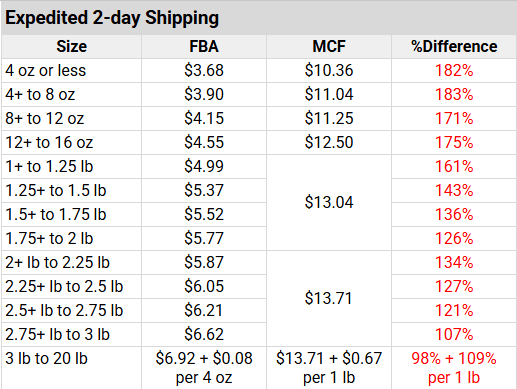
On the other hand, FBM with a great third party logistics (3PL) provider can also unlock multi-channel growth for you, without the fees associated with MCF. The best 3PLs integrate seamlessly with all major marketplaces and shopping carts, so getting your operations set up with a new channel can be as simple as a few clicks.
Amazon Buy with Prime
FBM is designed for sellers that want to sell on Amazon and handle their own fulfillment, but Amazon has an additional offering for sellers that want to leverage Amazon’s vast logistics network not through any third-party sales channel or marketplace, but from their own direct-to-consumer (DTC) websites.
Amazon’s Buy with Prime program allows ecommerce merchants to offer Prime benefits—such as fast, free shipping and easy returns—from their native websites. One of the biggest advantages of the program is that it boosts conversion rates, as Prime members are more likely to complete purchases when they see the familiar Prime badge, and they already trust Amazon’s fulfillment network. Sellers can benefit from Amazon logistics without being restricted to Amazon’s marketplace, giving them more control over branding and customer relationships while still benefiting from fast, reliable shipping.
However, Buy with Prime comes with added costs and limitations. Sellers must pay fulfillment fees, payment processing fees, and referral fees, which can be higher than handling fulfillment independently. Additionally, while Amazon handles shipping and returns, sellers lose some control over customer data, as Amazon processes payments for Buy with Prime orders. This means sellers may have limited access to valuable customer insights that could otherwise be used for marketing and retargeting. Despite these trade-offs, Buy with Prime can be a strong choice for brands looking to boost trust and conversions while outsourcing fulfillment. That said, it may not be cost-effective for all merchants, especially those with thin margins or specialized shipping needs.
How to choose FBA vs FBM for your business
When considering whether FBA, FBM, or a mix of the two is right for your business, ask yourself a few questions:
- Do you need the Prime badge to succeed?
- What size are your products?
- Do you have plans to sell on channels other than Amazon?
- Are you comfortable with letting Amazon dictate the customer experience?
- How accurately can you predict demand?
You only need FBA if you’re selling only on Amazon, you’re comfortable letting Amazon control your customer experience, and you can predict demand fairly easily. FBA will take care of fulfillment for you and qualify you for Prime, enabling you to focus your efforts on growing on the channel.
If you have multi-channel growth ambitions you’re probably going to need to fulfill yourself or an additional fulfillment partner other than Amazon, so the sooner you can consolidate operations under one roof, the better it is for your efficiency. If you want to use the post-purchase experience to improve your customer loyalty and repeat rate, you’ll need FBM as well.
Using Both FBA and FBM
Many successful Amazon sellers find that a hybrid approach, using both FBA and FBM, can be the most effective strategy. By leveraging the strengths of each fulfillment method, sellers can optimize their operations and maximize profitability. For instance, using FBA for products that are eligible for Prime shipping and have high demand can help boost sales and take advantage of Amazon’s efficient logistics. Meanwhile, FBM can be used for slower-moving items or those with special shipping requirements, providing greater control and potentially lower fulfillment costs.
This dual approach allows sellers to diversify their fulfillment strategy, reducing reliance on a single method and increasing flexibility. It also helps in managing fulfillment costs more effectively, as sellers can choose the most cost-efficient method for each product. Additionally, by using both FBA and FBM, sellers can better handle fluctuations in demand and avoid stockouts, ensuring a more resilient and adaptable business model. This strategy not only enhances operational efficiency but also opens up new opportunities for growth across various sales channels.
Cahoot: Your Best FBM Solution
Cahoot’s FBM fulfillment services will fuel your profitable growth on Amazon and unlock opportunity on all other ecommerce channels at the same time. Unlike most other 3PLs, we’ve built our network to the highest standard, so we enable affordable Seller Fulfilled Prime for many of our FBM clients.
On top of that, our innovative peer-to-peer fulfillment network offers low-cost, fast fulfillment by design. We’re changing the industry by empowering merchants with excess warehouse space and resources to provide high-quality order fulfillment to other merchants. Unlike other 3PLs, we empower merchants to help other merchants, and our community levels the playing field with Amazon. Thanks to our unique model, our pricing is typically lower than what you’ll find from other 3PLs, but we can beat them on fulfillment speed and reliability.
If you’d like to find out how Cahoot can help your business, please get in touch with us. We can’t wait for you to join our community and boost your profitable growth.
Frequently Asked Questions
What are the total costs of using Amazon FBA?
Sellers considering using FBA fulfillment should take all fees into account when considering it as a fulfillment solution. These fees include fulfillment fees, monthly inventory storage fees, referral fee, selling plan charges, advertising fees, and return or repackaging fees. Amazon provides this revenue calculator tool to help sellers make informed decisions about their product fulfillment.
How do I get products ready for Amazon FBA?
Amazon increased the maximum US FBA box length from 25 inches to 36 inches on June 20, 2025, and the maximum box dimensions are now 36 inches by 25 inches by 25 inches, with a 50 lb weight limit.
Amazon requires that products arriving at FBA fulfillment centers should arrive ready to ship and any products that sell as a single unit must be packaged together on arrival. Products must also must be properly barcoded with a UPC, ISBN, EAN, or FNSKU, depending on the seller’s account settings. Cartons or case packs with multiple units should not have a scannable barcode.
What are the total costs of using Amazon FBM?
Amazon charges a monthly subscription fee to sell on the platform, which depends on the seller plan selected. There are also per-order and referral fees. No fulfillment or storage fees are applicable since the Amazon fulfillment center network is not being used, but sellers must fulfill their own orders or seek a 3PL partner.
Written By:
Indy Pereira
Indy Pereira helps ecommerce brands optimize their shipping and fulfillment with Cahoot’s technology. With a background in both sales and people operations, she bridges customer needs with strategic solutions that drive growth. Indy works closely with merchants every day and brings real-world insight into what makes logistics efficient and scalable.
Turn Returns Into New Revenue
Related Articles
What Is a Perpetual Inventory System? How It Works in Ecommerce
A perpetual inventory system is an inventory management approach in which stock levels are updated continuously and automatically every time a transaction occurs.
What Is Demand Planning? How It Impacts Inventory, Forecasting, and Profitability
Demand planning is the process of estimating future customer demand so that a business can align its inventory, procurement, and operations to meet that demand without carrying mor...
The Shipping Speed Paradox: Why DTC Brands Are Slowing Down
Everyone’s talking about faster delivery.