
How AI Inventory Management Is Transforming Ecommerce Backoffice Systems

In this article
 8 minutes
Agentic AI, an emerging paradigm in artificial intelligence, emphasizes autonomy and decision-making capabilities in software systems. By enabling AI to perform tasks with minimal human intervention, agentic AI offers significant advantages in industries where efficiency, precision, and cost containment are critical. Its application in ecommerce is revolutionizing complex workflows, especially in order and inventory management, where speed and accuracy are essential for meeting customer expectations and fostering loyalty.
Order and Inventory Management Systems serve as the back office central nervous system for ecommerce businesses, handling product stocking, shipping, tracking, returns processing, customer service activities, and master product catalog maintenance. Integrating agentic AI into these systems enhances their ability to make real-time adjustments based on market fluctuations, predict consumer demand patterns, and optimize stock levels automatically. This reduces human error, streamlines workflows, and improves operational efficiency.
This combination of Agentic AI and Order and Inventory Management Systems marks a significant advancement beyond traditional automation. Leveraging machine learning algorithms, AI not only executes tasks but also analyzes data, predicts trends, and proactively optimizes business processes independently.
Introduction to AI in Inventory Management
AI in inventory management uses artificial intelligence technologies to automate and optimize inventory processes. By analyzing historical sales data, market trends, and other factors, AI predicts future demand and helps businesses maintain optimal inventory levels. This leads to improved operational efficiency, cost reduction, and enhanced customer satisfaction.
AI inventory management software employs machine learning and real-time data analysis to deliver valuable insights for demand forecasting, inventory tracking, and supply chain optimization. Continuous monitoring of inventory levels and data analysis enables businesses to meet customer demand while avoiding overstocking or stockouts, which optimizes cash flow.
The adaptability provided by AI enables businesses to respond effectively to market fluctuations and changing consumer behavior. This adaptability is essential for achieving and maintaining a competitive edge today.
Key Applications of AI
AI transforms inventory management through several key applications. Demand forecasting uses extensive historical data to accurately predict future demand, allowing businesses to adjust inventory levels to meet customer needs without excess stock.
Inventory optimization continuously analyzes stock levels to reduce carrying costs and minimize excess inventory, enhancing supply chain efficiency and generating significant cost savings and optimizing capital utilization.
Supply chain optimization benefits from real-time insights provided by AI, improving coordination across the supply chain, reducing delays, and boosting overall operational efficiency.
Additionally, AI automates routine tasks and provides actionable insights that drive business growth, enabling companies to operate more efficiently, lower costs, and improve customer satisfaction. This results in greater agility and competitiveness in the market. Let’s get a little more granular:
1. Demand Forecasting
Artificial Intelligence (AI) Agents are highly specialized applications built from a foundation of Large Language Models (LLM) and Natural Language Processing (NLP) capabilities (think ChatGPT or Llama by Meta AI), but instead of just returning an answer from a huge database of content built from webpages in the public domain, they can understand private, proprietary data and then “act” on the initial result to complete a workflow or achieve an outcome. The technology will transform how business operates across every sector. By integrating real-time Order and Inventory Management data with real-time news and events, AI agents predict demand with precision, enable real-time inventory tracking to enhance operational efficiency, automate customer service decisions and actions, help businesses maintain optimal inventory levels and improve inventory accuracy, remove waste from the fulfillment workflow, and finally enable a desirable returns solution. As ecommerce businesses embrace these advancements, they will not only streamline their operations but also build the agility needed to thrive in an increasingly complex and competitive industry.
2. Proactive Customer Support
AI agents can analyze customer data and purchase history to identify potential issues and proactively notify Sellers, (such as an order with a high likelihood of a return), and/or reach out to customers proactively to offer support and make changes to orders if needed (e.g. if an item runs small and the customer has returned similar items in a similar size). Further, they can provide automated outreach with personalized product recommendations, increasing customer satisfaction and sales.
3. Optimize Distributed Inventory Strategies
One of the biggest cost centers in ecommerce is shipping cost. Shipping is not free, nor has it ever been. Today’s retailers and brands are distributing inventory to 2 or more fulfillment centers to optimize delivery time and shipping cost. This is done by either opening and operating multiple warehouses, or partnering with a 3PL/4PL that can extend existing capabilities. AI agents can intelligently predict nationwide demand and create an accurate distribution plan to optimize placement and minimize the cost of transferring inventory between locations later.
4. Optimize Fulfillment Cost and Workflows
Ecommerce merchants traditionally have humans use their experience to ship orders, but that approach is well known to be error-prone and contributes to higher fulfillment defect rates, and costs the company unnecessary capital to correct the mistakes (late delivery, shipped wrong item, etc.). Modern shipping software removes the human and creates the optimal shipping label that will deliver the order on time, every time. And now, combining that intelligence with AI agents, Order Management Systems (OMSs) can get even more granular and monitor weather conditions along shipping lanes, and then reroute orders to fulfillment centers that can deliver them by the promised delivery date, preventing a bad customer experience, and thus, limiting the likelihood of a return.
5. Make Returns Profitable
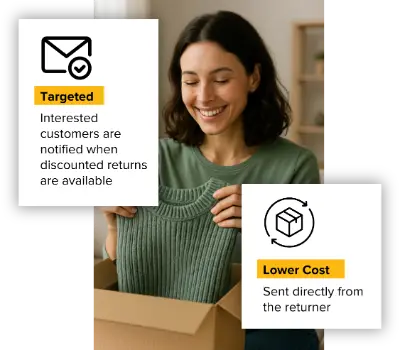
Ecommerce return rates have been steadily rising, often reaching 20–30% across the industry, and certain industries such as apparel, luxury goods, and electronics can see return rates as high as 40% or more as customers struggle to find the right fit without trying items on. It’s critical to manage returns effectively to retain as much revenue as possible and maintain a healthy bottom line. New AI-assisted returns technologies such as the Cahoot Peer-to-Peer Returns Solution are eliminating returns altogether by enabling the return to be shipped directly to the next customer, saving significant money and time for everyone.
Final Thoughts
Agentic AI is not just another incremental upgrade, it represents a paradigm shift in ecommerce operations. By entrusting routine yet complex back-office tasks to autonomous, data-driven agents, businesses unlock real-time responsiveness, razor-sharp forecasting accuracy, and seamless scalability. From anticipating demand surges to dynamic order routing and even transforming returns into revenue opportunities, AI-powered Order and Inventory Management Systems elevate efficiency and customer satisfaction in one fell swoop. As retail continues to evolve, companies that embrace agentic AI will gain the agility, cost savings, and strategic insights needed to stay ahead in an ever-more competitive landscape. The future of ecommerce back office systems is intelligent, proactive, and fundamentally human-centered, empowered by AI.
Frequently Asked Questions
What is “agentic AI”, and how does it differ from traditional AI in inventory management?
Traditional AI in inventory systems typically automates specific tasks, like sending low-stock alerts, based on predefined rules. Agentic AI goes a step further by making autonomous decisions and executing workflows end-to-end. In ecommerce back offices, that means AI agents can not only flag a potential stockout but also reorder, reassign inventory across warehouses, and even adjust pricing without human intervention, dramatically increasing speed and reducing manual errors.
How does AI-driven demand forecasting improve stock levels?
By ingesting historical sales data, real-time order volumes, market trends, and external factors (e.g., news, promotions), AI agents generate highly accurate short- and long-term demand predictions. This enables systems to automatically trigger restocks or redistribute inventory to regional fulfillment centers just before demand peaks, avoiding both costly overstocks and lost sales due to stockouts.
Can AI inventory management really reduce fulfillment costs?
Absolutely. AI agents analyze shipping lanes, carrier rates, and warehouse proximities to recommend the most cost-efficient fulfillment routes. For example, if bad weather threatens a shipping corridor, the system can reroute orders to a nearer fulfillment node, preventing delays and penalty fees. Over time, these continuous optimizations often shave several percentage points off overall fulfillment spend.
In what ways does AI enhance the returns process, and even make returns profitable?
Rising return rates can erode margins. AI-powered returns solutions (like peer-to-peer routing) direct unwanted items straight to another buyer rather than back to a central warehouse, saving transport and handling costs. They can also predict which orders are likely to be returned, based on sizing data or past customer behavior, and proactively offer exchanges or upsells before the return even happens, recouping revenue that might otherwise be lost.
How quickly can businesses see ROI after integrating AI into their OMS/IMS?
While results vary by scale and complexity, many merchants report measurable gains—5–15% reduction in carrying costs and a 10–20% improvement in on-time fulfillment performance—within 3–6 months of deploying agentic AI modules. Faster, error-free restocking alone can pay for the technology investment, and the compounding efficiency gains across customer support, shipping, and returns accelerate ROI further over time.
Written By:

Manish Chowdhary
Manish Chowdhary is the founder and CEO of Cahoot, the most comprehensive post-purchase suite for ecommerce brands. A serial entrepreneur and industry thought leader, Manish has decades of experience building technologies that simplify ecommerce logistics—from order fulfillment to returns. His insights help brands stay ahead of market shifts and operational challenges.

Turn Returns Into New Revenue
Related Articles
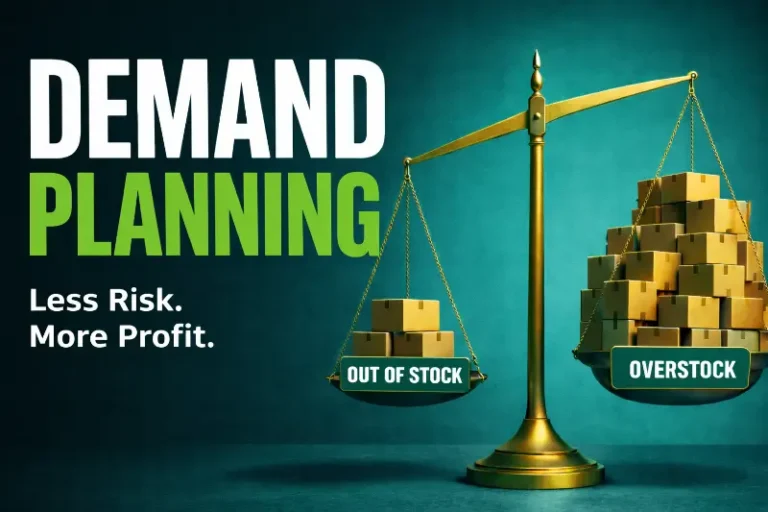
What Is Demand Planning? How It Impacts Inventory, Forecasting, and Profitability
Demand planning is the process of estimating future customer demand so that a business can align its inventory, procurement, and operations to meet that demand without carrying mor...

The Shipping Speed Paradox: Why DTC Brands Are Slowing Down
Everyone’s talking about faster delivery.

Why Cross-Border DTC Brands Are Moving Fulfillment Inside the US
Cross-border ecommerce fulfillment is the process of shipping ecommerce orders across national borders—often from warehouses outside the United States to U.
Amazon Seller Fulfilled Prime Guide: Requirements, Costs and How SFP Works
In this article
32 minutes
- What is Seller Fulfilled Prime?
- Why Seller Fulfilled Prime Is More Relevant Than Ever
- Diversify Beyond FBA
- Current Seller Fulfilled Prime Requirements
- The Competitive Advantages of Seller Fulfilled Prime
- Why Seller Fulfilled Prime Is Difficult to Operate
- Seller Fulfilled Prime Success Checklist
- Frequently Asked Questions
Watch On-Demand Webinar:
Amazon SFP – How To Sell and Win
Amazon reopened enrollment for Seller Fulfilled Prime (SFP) in 2023, giving qualified merchants another way to earn the Prime badge without sending inventory into Fulfillment by Amazon. Since then, SFP has evolved into a more demanding and closely monitored fulfillment program. Sellers must complete prequalification and a trial, maintain strict delivery and tracking performance, meet minimum shipment-volume expectations, and satisfy delivery-speed requirements that vary by product size tier.
Amazon tightened several enrollment, performance, and enforcement requirements in 2025 and raised the delivery-speed thresholds again in July 2026. Succeeding with SFP now requires the right SKUs, sufficient order volume, accurate size-tier classifications, strategically placed inventory, reliable carrier coverage, disciplined weekend operations, and technology that can select the right fulfillment location and shipping service for every order.
Most people are familiar with the requirements that Amazon expects Sellers to meet, but far fewer are aware of the roadblocks that make success hard to achieve. An even smaller number are aware of the strategies they can deploy to meet Amazon’s criteria and surpass them. We’ve outlined all of that and more in our Ultimate Guide:
- We start by helping you understand what the program actually is and its benefits.
- Despite the daunting SFP requirements, the reward can be immense – we highlight the value that success in the program can deliver to your business.
- However, SFP success is not easy, and many Sellers find the program extremely challenging – we do a deep dive into the most common stumbling blocks that trip up even experienced Amazon merchants.
- Finally, we give you an essential cheat sheet needed to start selling and winning on Amazon Seller Fulfilled Prime!
One critical aspect to consider is the Seller Fulfilled Prime cost. Understanding the financial implications, including the program fee per item sold, percentage fees, and minimum fees, is essential for assessing potential profitability and managing profit margins effectively.
What is Seller Fulfilled Prime?
Before we do a deep dive, it’s essential to understand – what is the Seller Fulfilled Prime program?
Definition and Benefits of Seller Fulfilled Prime
Seller Fulfilled Prime (SFP) is an Amazon program that allows qualified third-party Sellers to display the Prime badge on eligible offers while fulfilling orders from their own facilities or a qualified 3PL network. Sellers must meet Amazon’s delivery-speed, on-time delivery, tracking, cancellation, weekend-operation, and returns requirements. When the model fits the SKU and the operation is capable of supporting it, SFP can improve visibility and conversion while giving the Seller more control over inventory and fulfillment.
The benefits of SFP include:
- Increased Visibility and Credibility: Listings with the Prime badge are more likely to be seen and trusted by customers.
- Greater Control: Sellers have more options and control over their fulfillment process and inventory management compared to using Fulfilled by Amazon (FBA).
- Brand Building: Sellers can build their brand, including flexibility to provide unique experiences for customers, such as custom packaging, while maintaining Prime status.
- Increased Sales and Profits: The Prime badge can lead to higher sales and better profit margins.
- Amazon’s Customer Service: Access to Amazon’s customer service and support for handling customer service inquiries, but the ability to own customer service if desired.
- Alternative Cost Structure: SFP can avoid certain FBA fees and may improve economics for selected products, particularly SKUs for which FBA is expensive or operationally restrictive. Sellers must still compare the full cost of warehousing, pick and pack, parcel transportation, software, returns, and exception handling.
- Improved Support for Challenging SKUs: The ability to meet the consumer expectation for free and fast shipping even on slow-moving, seasonal, larger-sized, and heavier SKUs.
While all these are great, the biggest one for any Seller is that the program allows your product listings on the Amazon Marketplace to feature the coveted Prime badge. With over 180 million subscribers in the United States in 2025, Amazon’s loyalty program has a great promise for the end customer – pay $139 (plus taxes) annually, and Amazon will deliver you stuff for free in under two days.
The program has far more profound implications for Sellers – their ranking on Amazon search results and ability to win the “Buy Box” is heavily and positively influenced by ensuring their products are Prime eligible. It’s also no secret that most shoppers on Amazon toggle the filter when browsing the store just to see products that qualify for Prime. All this means that an Amazon merchant’s survival, let alone success, largely depends on ensuring each SKU is Prime-eligible.
Seller Fulfilled Prime offers Sellers the best of both worlds – the Prime badge and autonomy over order fulfillment. However, it isn’t all smooth sailing, and Sellers have tended to shy away from the program because of its exacting standards. However, there are indications that the present time is a good one to begin seriously considering enrolling in the program.
“Cahoot has amazing technology in addition to their large warehouse network, sort of like FBA but without the hefty fees or restrictions. Cahoot saved our peak-selling season!”
~ Joel Frankel, Fames Chocolates
Speak to a fulfillment expert
How Seller Fulfilled Prime Works
To participate in SFP, sellers must meet Amazon’s stringent performance requirements. These include:
- Own Warehouse: Sellers must have their own warehouse, (or partner with a robust and capable modern 3PL), and an Amazon Professional Seller account.
- Premium Shipping Options: Offering premium shipping options to customers.
- Exceptional Performance Metrics: Consistently exceeds for the On-Time Delivery, Valid Tracking, and Delivery Speed metrics while maintaining a very low Order Cancellation Rate.
- Supported Carriers: Delivering orders with Amazon’s approved Seller Fulfilled Prime carriers.
- Amazon Returns Policy: Agreeing to the Amazon Returns Policy.
Eligible Sellers must complete an SFP trial before the Prime badge is displayed on their offers. The trial aligns with four complete performance weeks, running Sunday through Saturday, and requires the Seller to meet Amazon’s applicable shipment-volume, delivery-speed, and performance requirements without receiving the conversion benefit of the Prime badge.
After graduation, Amazon evaluates performance and eligibility separately for Standard-size, Oversize, and Extra Large products. A performance issue in one size tier does not automatically disqualify the Seller from the other tiers. Sellers can participate in the tiers their fulfillment operation can support, but they must continue meeting the applicable speed, volume, and performance requirements after enrollment.
Why Seller Fulfilled Prime Is More Relevant Than Ever
Several reasons have combined to make Seller Fulfilled Prime more relevant than ever before for Sellers, some of Amazon’s own making along with others that are not as palatable to the company:
The “Prime Effect”: Everybody Wants Fast Shipping
When Amazon first introduced Prime in 2005, it announced that it would ship customer orders over $35 for free in 2 days. At the time, people in the industry thought that the company had lost its mind and that this strategy would surely fail. It took competitors over a decade to offer free 2-day shipping – retailers like eBay and Walmart introduced their competing services only in 2017.
However, when Prime moved from its 2-day timeline to free 1-day shipping in 2019, Walmart and BestBuy responded almost immediately, offering customers the same experience. That captures just how much Amazon has raised the bar and redefined customer expectations – the Prime effect means that all of us expect everything delivered in under two days for free.
The stakes are high for ecommerce merchants across every channel – it does not matter whether you serve customers through a Shopify storefront, eBay, Amazon, or Walmart – you have to meet the consumer expectation for fast order fulfillment.
Shipping is no longer a back-office operation; it has become the defining element of the customer experience.
The company that created the Prime Effect is arguably the most customer-obsessed organization in the world. For years, Amazon has focused relentlessly on creating value for its customers – often at the expense of Sellers on its platforms. At every turn, the company has weaponized the size of its customer base and the network effects of its marketplace model to squeeze Sellers while delighting customers.
People, regulators, and governments aiming to call out the company on some of these practices have been met with a frequent refrain, “As long as the end customer is happy, how does it matter?” But why are customers so happy with Amazon, and how does the company have so many of them (most of whom are Prime members)? The most important reason is Amazon’s ability to ship products in under two days, nearly always on time.
“Cahoot allows us to offer 2-day shipping on our website in addition to driving more sales nationwide SFP on Amazon. This app saves us a ton of time and money every single day!”
~ OZ Medical
Speak to a fulfillment expert
Diversify Beyond FBA
For Sellers operating on Amazon, the approach has often been relatively straightforward: let Amazon FBA take care of it all and only use Fulfilled By Merchant (FBM) or SFP as a backup in the rare event of an emergency. However, given how FBA has repeatedly proven to quickly and substantially change program requirements and fees, a backup may no longer suffice – Sellers may need to devise an entirely new order fulfillment strategy.
Sellers Have Traditionally Relied on FBA
According to Jungle Scout, 64% of Amazon Sellers use FBA exclusively to deliver their orders, with only 14% choosing to completely cut ties with FBA and handle everything independently.
There are good reasons for this. Amazon’s Featured Offer and search systems consider factors that include price, availability, delivery speed, and Seller performance. FBA offers are automatically Prime eligible, while qualified SFP offers can also compete strongly when the Seller consistently meets Amazon’s operating standards.
The right question is not whether every FBA SKU should also become SFP. The better question is which SKUs benefit from a hybrid strategy. Sellers may use FBA for products where Amazon’s bundled fulfillment economics are difficult to beat, while using SFP for products that require more inventory control, special handling, branded packaging, seasonal flexibility, or a different cost structure.
SFP should therefore be evaluated at the SKU and size-tier level. Duplicating listings or applying SFP to the entire catalog without modeling inventory, fulfillment, and parcel costs can create operational risk and destroy margin.
Current Seller Fulfilled Prime Requirements
Well, technically, you do have more to do than just duplicate your listings. You have to fulfill the orders with fast and free shipping, and you must meet the uncompromising performance metrics.
Seller Fulfilled Prime Requirements
Core Performance Requirements
- On-Time Delivery Rate: Maintain an On-Time Delivery Rate of at least 93.5%. A delivery is on time when it arrives on or before the date promised to the customer at checkout.
- Valid Tracking Rate: Maintain a Valid Tracking Rate of at least 99%. Tracking must include a carrier scan that makes the shipment trackable to the customer.
- Seller-Initiated Cancellation Rate: Keep the cancellation rate below 0.5% for Prime orders.
- Returns and Customer Experience: Follow Amazon’s current seller-fulfilled returns rules and use the required return-label workflows, subject to Amazon’s category and item-level exemptions.
- Weekend Operations: Operate on at least one weekend day and configure order cutoffs and carrier pickups that support the delivery promises shown to customers.
Delivery-Speed Requirements by Product Size Tier
Amazon measures delivery speed using the promises shown to Prime customers when they view a product detail page, not simply how quickly completed orders eventually arrive. As of July 6, 2026, SFP offers must meet the following minimum thresholds:
| Product size tier | Delivery within 1 day | Delivery within 2 days | Delivery within 5 days |
|---|---|---|---|
| Standard-size | 40% of Prime customer page views | 75% of Prime customer page views | 90% of Prime customer page views |
| Oversize | 15% of Prime customer page views | No separate minimum specified | 80% of Prime customer page views |
| Extra Large | No one-day minimum | 25% of Prime customer page views | 60% of Prime customer page views |
Order cutoffs, handling time, weekend schedules, inventory availability, customer location, and the selected ship-from facility all affect whether a page view qualifies. Amazon evaluates performance and eligibility separately for Standard-size, Oversize, and Extra Large products, so each tier should be treated as its own operating model. See our detailed explanations of the July 2026 SFP delivery-speed requirements and the 2025 SFP trial, volume, and appeals rules.
Prequalification and the SFP Trial
- Maintain an Amazon Professional Selling account and satisfy Amazon’s current prequalification standards for self-fulfilled shipment volume and performance.
- Complete a trial aligned to four full performance weeks, Sunday through Saturday.
- Ship at least 100 trial packages while meeting the applicable SFP delivery-speed and performance requirements.
- The Prime badge is not displayed during the trial, so Sellers need enough existing demand or a deliberate traffic-generation plan to produce sufficient order volume.
- Sellers may begin no more than three SFP trials per calendar year, and a trial cannot graduate if it overlaps an Amazon-designated restricted graduation period before a major retail event.
Requirements After Enrollment
- Fulfill at least 100 Prime packages per calendar month, with volume distributed reasonably throughout the month.
- Amazon may apply dynamic Prime-order limits when shipment volume is too low or overly concentrated.
- Continue meeting the applicable performance and delivery-speed requirements for each enrolled product size tier.
OTDR Protection and Appeals
Amazon provides On-Time Delivery Rate protection for qualifying one-day, two-day, and standard-shipping offers when the Seller enables Shipping Settings Automation, purchases an “OTDR Protected” label through Amazon Buy Shipping or Veeqo, and ships the item on time. This protection does not excuse a late warehouse handoff.
SFP operators should also maintain an evidence package for appeals, including order IDs, tracking scans, warehouse timestamps, carrier advisories, and affected ZIP codes. Amazon’s 2025 rules introduced tighter appeal filing and response windows, so recovery procedures should be documented before a metric failure occurs.
The critical thing to remember (which is the kick in the teeth for Sellers) is that Amazon FBA does not face any penalties for missing any of these performance metrics – whereas the onus is on the SFP merchant to diligently track these metrics and ensure you never fall below the minimums. To enable Prime shipping, Sellers must adjust their shipping templates and make specific selections in Seller Central to choose delivery regions for Prime service.
If this list appears daunting, you’re not alone – many Sellers feel these criteria are tough to meet. So before even looking at where the challenges and roadblocks lie, it’s worth asking – why is it worth being part of the program, and what value can it deliver to your business?
“Amazon SFP is such a demanding program, it is very difficult to find partners with the ability to pull this off. Cahoot is clearly geared towards Amazon Seller Fulfilled Prime, and excels at it via a network of strong fulfilment partners and a deeply knowledgeable team.”
~ Cali’s Books
Speak to a fulfillment expert
The Competitive Advantages of Seller Fulfilled Prime
While these are all great benefits for Sellers and provide their businesses with significant competitive advantages, making a success of the SFP program is highly challenging. Most merchants know that the requirements list is rigorous and demanding, but few are aware of the exact stumbling blocks that trip up people. Fewer are aware of solutions available to overcome these roadblocks and win at SFP.
Why Seller Fulfilled Prime Is Difficult to Operate
While the list of criteria is long and rigorous, we’ve identified the most challenging aspects of the program that trips up most Sellers:
Nationwide Fast Delivery Forces Most Sellers to Use Expensive Air Shipping
- In the past, Amazon had “regional Seller Fulfilled Prime” – which allowed Sellers to manage order fulfillment in certain geographical parts of the country while still having the Prime badge on their product listings.
- The Regional SFP program allowed merchants who owned a single warehouse or worked with a traditional 3PL with a single warehouse location to meet the program’s requirements through economical ground shipping.
- However, Amazon now expects Sellers to make products across every size tier available within 3-5 days (at the most) across the entire continental U.S. – additionally, at least 75% of Prime customer page views for Standard-size offers must display a delivery date within two days, while at least 40% must display a one-day promise.
- The new requirements eliminate the possibility of regional models working any longer – having your inventory stationed in just one location means that shipments to certain parts of the country cross multiple shipping zones. The only way to deliver orders on time in such “single-node” operations is by using expensive air shipments. Making expensive shipments by air completely nullifies any cost savings merchants hoped to achieve when leaving FBA – in fact, it could worsen things.
- It becomes vital in such a scenario to use an SFP fulfillment partner with a strategically located network of fulfillment centers, such as Cahoot, whereby it is possible to cover the entire country in 2 days while still using economical ground shipping rather than express air shipments. Such a network is one of the very few ways it is still possible to both have nationwide coverage and significant cost savings over FBA.
- Lastly, Sellers must ensure that their product listings are classified correctly by Amazon. The metric for % of product detail pageviews that must promise a certain delivery speed is based on the size tier the item falls into (if an oversized or extra large item is classified as standard sized by mistake, you will be under pressure to get a large number of orders of those items delivered in under 2 days).
Amazon Expects Delivery in 2 Calendar Days, While Carriers Operate on Business Days
Amazon now expects Sellers to make Prime deliveries in 2 calendar days (necessitating the need to work with carriers that support weekend pickup and delivery). This requirement has caused Sellers a lot of pain and grief, and here’s why:
The Misleading Page Views Metric
Editor note: Replace the previous delivery-speed graphic with a new visual showing the July 6, 2026 thresholds: Standard-size 40% within one day, 75% within two days, and 90% within five days; Oversize 15% within one day and 80% within five days; Extra Large 25% within two days and 60% within five days.
The July 2026 delivery-speed thresholds make the page-view metric even more important. At least 40% of Prime customer page views for Standard-size offers must display a delivery date within one day, while at least 75% must display a delivery date within two days. But when does your listing promise 1-day delivery, and when does it promise 2-day delivery? Let’s understand this with a few examples:
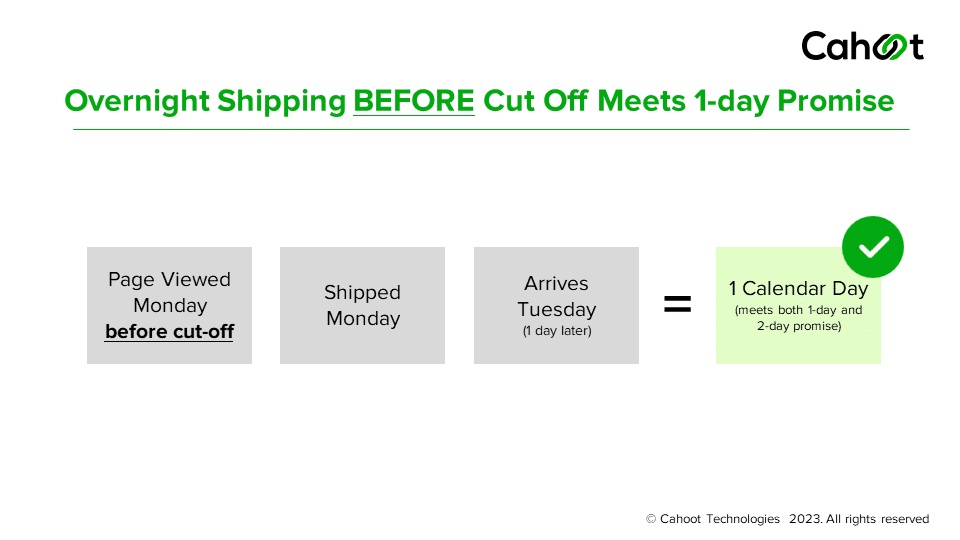
Let’s imagine every order is delivered the very next day after it ships. If a customer views your order on a Monday and places their order before the cutoff time, you will ship it that same day, and it reaches the customer the next day. In this case, Amazon displays a 1-day delivery promise and this page view counts towards your 1-day metrics.
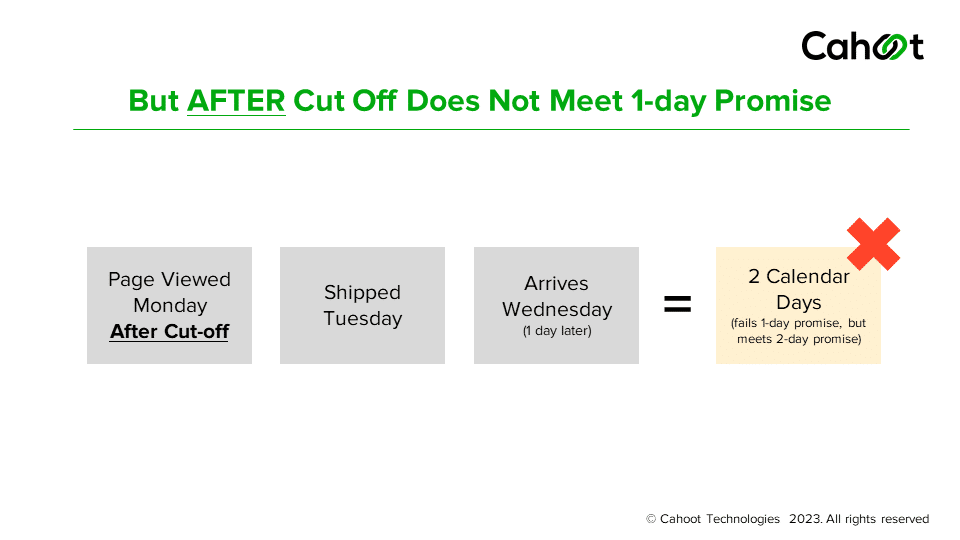
In this second case, when a customer looks at the product detail page after the cutoff time, you ship the order the next day after it is placed, and it reaches the customer the following day. This therefore fails to meet the 1-day promise, but meets the 2-day delivery promise (which means that if a 2-day promise was made after Monday’s order cutoff time, one-day shipping still needs to be used to deliver it in 2 calendar days).
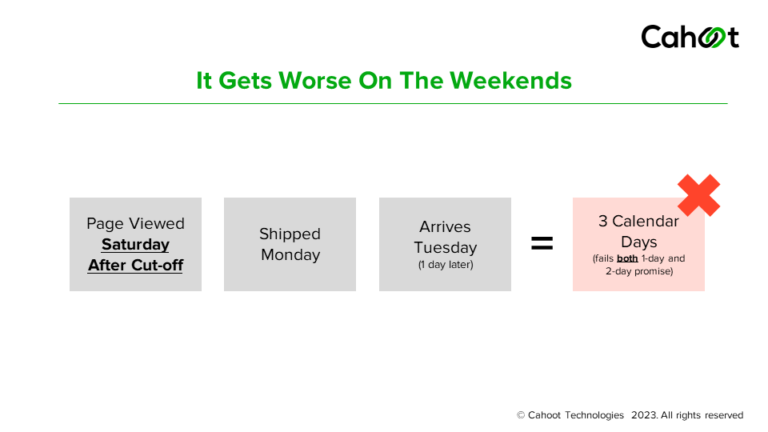
In this last case, it gets really bad. If a customer views your listing on a Saturday evening, the item is expected to ship on Monday (assuming you don’t ship Sundays) and it will be delivered to them on Tuesday – a full 3 days later.
In this case, such a page view counts toward neither the 1-day nor 2-day metrics. The implication is clear – your listings will display 2-day and even 3-day delivery promises for significant periods of time. The mapping between the number of warehouses you have, the percentage of the US population you can service with 1-day delivery, and the % page views that actually promise 1-day delivery is not linear. This graphic illustrates that:
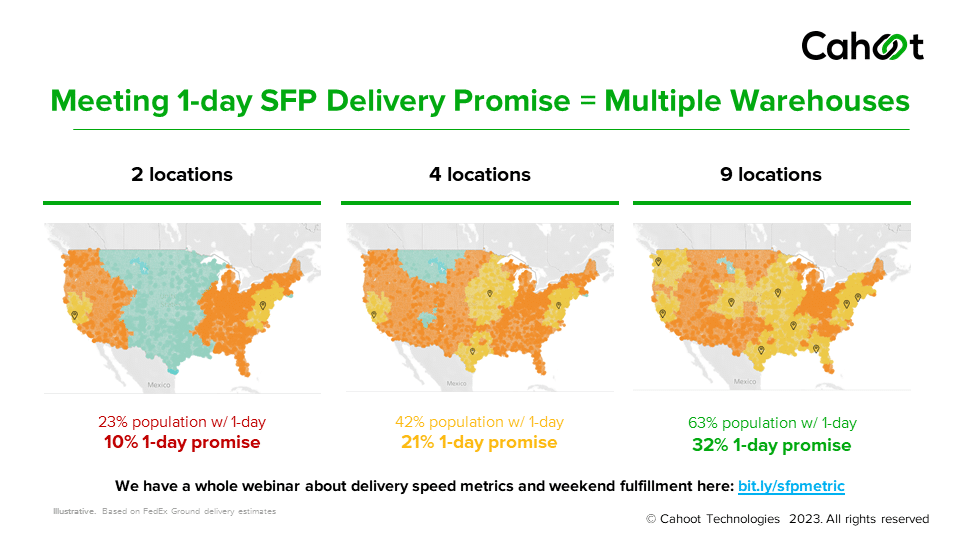
If you have warehouse locations, you can cover 42% of the US population with 1-day delivery. But different customers look at your product detail pages at different times of the day, and see different delivery speed promises. As per our research, in reality, only 21% of page views may actually promise 1 calendar day delivery. To meet the new Seller Fulfilled Prime delivery requirements, it could take as many as six to nine strategically located warehouses. These demanding metrics mean that traditional 3PLs will find it nearly impossible to help Seller Fulfilled Prime merchants (learn more about why traditional 3PLs are failing, and how peer-to-peer order fulfillment networks are designed to help you find success on SFP here). It becomes crucial for merchants to partner with order fulfillment networks that have warehouses at different strategic locations across the country, ensuring customers from anywhere see fast delivery promises. While merchants may want to upgrade to a fulfillment partner who is better positioned to meet these requirements, it’s easier said than done to leave your current 3PL for better alternatives. Many merchants don’t know how to evaluate and find the perfect fulfillment partner for them. If you’re looking for a step-by-step guide on migrating fulfillment partners, check out our guide here!
The Juggling Act Between Cut-off Times, Economical Shipping, and Meeting SLAs
With Seller Fulfilled Prime, a late cut-off time can potentially increase the number of orders your carrier picks up the same day, boosting your 1 and 2-day delivery metrics. If FBA faces any issues or does not meet the delivery promise shown to the customer on the product listing, there are no penalties for Amazon – but a Seller must meet the 93.5% on-time delivery criteria. Here’s a graphic demonstrating how delivery timelines look like when operating with a 2 PM cutoff time (based on our discussion of the page views metric):
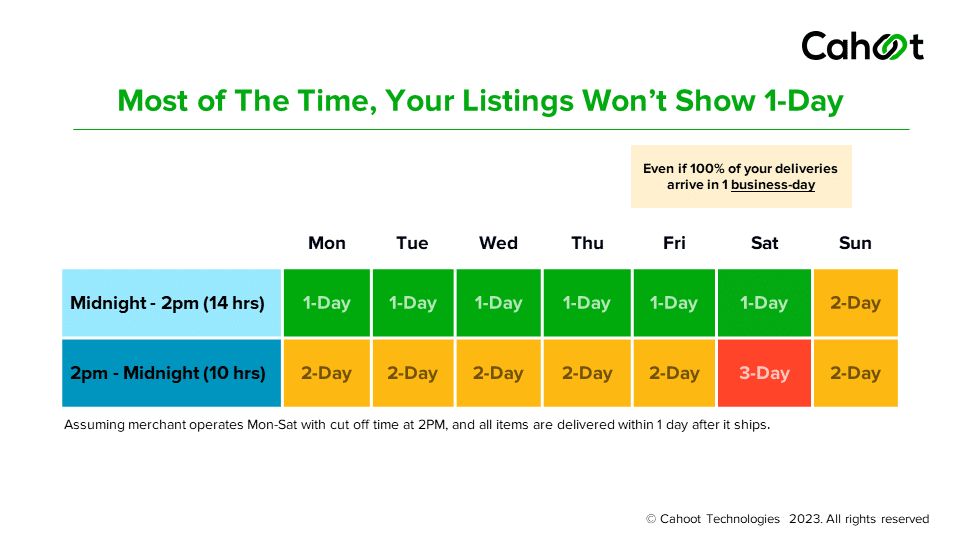
Sellers must carefully make the tradeoff between increasing their cutoff times (if they can schedule a late pickup with their carriers) versus also ensuring that those orders reach the customer the next day. Increasing the cutoff times increases the percentage of page views that promise 1 and 2-day delivery, but you must ensure that you can actually get the product to the customer’s doorstep within the time you’re promising. Here also, Sellers need to strategically place their inventory in a network of warehouses to avoid shipping orders placed close to cut-off times through expensive overnight air shipments. Placing inventory in different strategically located warehouses will enable nationwide coverage through economical ground shipping, all while meeting the customer’s expectations. Pay attention to time zones. A 2PM cutoff time is specific to the local time zone, so an order received before 5PM Eastern Time may need to ship from a western time zone to deliver on time, depending on the delivery promise. This makes it essential that your promotional activities (advertising, marketing) also closely follows the local time zones of the eyeballs you’re trying to reach. But it’s all very doable and Cahoot offers SFP consulting services to help. Reach out if you’d like to talk.
The shift to calendar days has had the most significant impact on the operational side of things – Sellers now have to plan a whole different way of running their business and schedules, which have also become challenges:
Operational Excellence Needed
Challenging to Staff And Operate Warehouses on Weekends
As we’ve mentioned before, staffing is often the biggest bottleneck towards finding success with order fulfillment. With weekend pick up and delivery expected to meet the calendar day-based SLAs, most merchants with a single warehouse or those working with 3PLs face difficulties succeeding in the program. If you own and operate your warehouses, paying your staff to work on the weekends or hiring additional people may eat into your margins to unfeasible extents. Traditional 3PLs, which are asset-heavy, also face cost pressures around labor – which they may be forced to pass onto Sellers. While these options erode any cost savings that Sellers see over FBA, you are not without alternatives – consider platforms like Cahoot, where each of our fulfillment centers is vetted for operational excellence and meets all the challenging requirements.
Arranging for Carrier Pickups on Weekends
| Pickup day | FedEx | UPS | USPS | OnTrac |
|---|---|---|---|---|
| Saturday pickup |
Limited Eligible shippers and locations |
Available Select areas and accounts |
Generally available With normal Saturday mail service |
Contract dependent Varies by market and account |
| Sunday pickup |
Limited Enrollment may be required |
Generally unavailable | Generally unavailable |
Contract dependent Varies by market and account |
Important: Weekend pickup availability depends on the origin location, shipper volume, carrier account agreement, service level, scheduled pickup arrangement and applicable fees. Sellers should confirm Saturday and Sunday tender capability for each fulfillment location directly with the carrier.
In addition to warehousing, your carriers are another critical element in making your logistics work. Not all carriers offer weekend pick up and delivery – some may require you to be a large shipper and maintain minimum order volumes. All this means you may have to contact your account manager at the various carriers and enquire about possible options that may incur additional fees. However, while all this can be done, the biggest reason Sellers shy away from SFP is the heavy amount of process management, collaboration, and busy work needed to keep this operation running.
Managing Weekend Operations Can Overwhelm Sellers
It becomes easier to understand why so many Sellers shy away from Seller Fulfilled Prime – between working with multiple 3PLs to ensure your inventory covers the country, to operating and staffing your warehouses on the weekend as well as coordinating with your shipping carriers to arrange for weekend pickups, it can seem incredibly overwhelming and drain your bandwidth, time, and resources. You might often wonder whether managing so many stakeholders and sifting through so much busy work is worth it when FBA offers you only one party to work with – even if that party is Amazon, whose interests often tend to be misaligned with yours. It does not have to be this way – Sellers must spend time identifying partners who provide a unified experience where they get to work with just one vendor. Platforms like Cahoot help Sellers meet and exceed the SFP program requirement while ensuring you deal with only one company rather than coordinating between multiple 3PLs and carriers, preserving precious time and resources for you and your business.
Choosing Between Shipping Cost and OTDR Protection
Amazon does not universally require SFP Sellers to purchase every label through Buy Shipping. Sellers may sometimes find lower rates or better service choices through their own carrier accounts or shipping technology. However, label cost is only one side of the decision.
Amazon states that qualifying one-day, two-day, and standard-shipping offers receive On-Time Delivery Rate protection when Shipping Settings Automation is enabled, the Seller ships on time, and an “OTDR Protected” label is purchased through Amazon Buy Shipping or Veeqo. A cheaper external label may therefore reduce transportation cost but forgo an important form of metric protection.
The right approach is to evaluate the cost difference against the operational risk on each order. Sellers need technology that can compare carrier services, warehouse locations, delivery promises, and protection status before selecting a label. Cahoot’s shipping software rate shops across carriers and fulfillment locations while accounting for the delivery date promised to the customer.
So while a lot can potentially go wrong, Sellers can also make the program work for them and find success by following specific, vital strategies. Start finding success in the SFP program by using the tricks and recommendations in our SFP Cheat Sheet!
“Cahoot is a game-changer. Their fully automatic shipping label creation intelligently assigns the best carrier and shipping service for all my orders across all my channels.”
~ LoveOurPrices.com
Speak to a fulfillment expert
Seller Fulfilled Prime Success Checklist
To enable Prime shipping, sellers must adjust their shipping templates and make specific selections in Seller Central and add all the warehouse addresses orders will ship from to support delivery regions for Prime service.
- Choose SFP SKUs Deliberately: Start with products whose economics, sales velocity, handling requirements, and inventory profile fit SFP. Do not assume every SKU should be enrolled.
- Confirm the Correct Size Tier: Verify whether each ASIN is Standard-size, Oversize, or Extra Large because Amazon applies different delivery-speed thresholds and evaluates performance separately by tier.
- Model One-, Two-, and Five-Day Page-View Coverage: Measure the promises customers will actually see after cutoffs, weekends, holidays, and inventory availability are considered.
- Build the Right Warehouse Footprint: There is no universal facility count that guarantees compliance. Depending on the size tier, demand distribution, carrier coverage, and inventory depth, economical one- and two-day coverage may require four, six, or even nine strategically located facilities.
- Plan Trial Traffic: The Prime badge is not displayed during the trial. Select SKUs with enough natural demand or support them with advertising and promotions so the trial produces sufficient volume.
- Maintain a Performance Buffer: Low order volume makes every carrier delay disproportionately damaging. Aim materially above the minimum shipment requirement.
- Configure Cutoffs and Weekend Operations: Warehouse schedules and carrier pickups must support the promises displayed to customers, including at least one weekend operating day.
- Balance Label Cost Against OTDR Protection: A cheaper external label may not provide the same metric protection as a qualifying OTDR-protected label purchased through Amazon Buy Shipping or Veeqo.
- Monitor Performance by Size Tier: Review Standard-size, Oversize, and Extra Large performance separately and adjust SKU enrollment, inventory placement, and shipping templates accordingly.
- Keep Appeal Evidence Ready: Preserve scans, timestamps, carrier notices, affected ZIP codes, and order-level records so an appeal can be filed quickly.
- Maintain Monthly Volume: Fulfill at least 100 Prime packages each month and distribute volume reasonably throughout the month to avoid dynamic order limits.
- Compare SFP Against FBA Continuously: Include storage, pick and pack, packaging, transportation, software, returns, and exception handling in the comparison.
Succeeding in this program is challenging, but we think these tips are a great place to start. As Q4 and the holiday season approach, now is the time for Sellers looking to diversify their order fulfillment beyond FBA and offer fast, profitable free shipping across every SKU to identify a partner who can help you win at Amazon Seller Fulfilled Prime. If you’d like to understand how Cahoot can be with you every step of the way, just fill out this form, and we’ll be in touch!
Frequently Asked Questions
What is Seller Fulfilled Prime on Amazon?
Seller Fulfilled Prime allows you to list your products as Prime-eligible and handle the fulfillment yourself.
What is the difference between seller-fulfilled and Amazon fulfilled?
Logistics. Within the framework of Fulfillment by Amazon (FBA), the platform handles the entire logistics process – from product storage in warehouses to dispatching. Seller Fulfilled Prime (SFP) leaves you 100% in charge of everything in this regard, yet forces you to cover dispatch fees at your own cost.
How do you pre qualify for the Seller Fulfilled Prime trial?
Amazon requires a Professional Selling account and evaluates recent self-fulfilled shipment volume and performance before allowing a Seller to begin the SFP trial. Because Amazon may update the precise prequalification thresholds in Seller Central, confirm the current values in the SFP enrollment dashboard before applying.
What is the difference between SFP and FBA?
FBA offers scalability and customer trust but comes with higher costs and limited control. FBM provides cost savings and customization options but requires more time and effort. SFP combines Prime eligibility with control over costs but has stricter requirements and operational challenges.
Is Seller Fulfilled Prime worth it?
Seller Fulfilled Prime can be worthwhile for SKUs where the Prime badge, inventory control, special handling, or an alternative fulfillment model creates enough value to justify the operational burden. It is not automatically cheaper than FBA. Sellers should compare the full cost and delivery requirements for each SKU and size tier before enrolling.
Written By:

Indy Pereira
Indy Pereira helps ecommerce brands optimize their shipping and fulfillment with Cahoot’s technology. With a background in both sales and people operations, she bridges customer needs with strategic solutions that drive growth. Indy works closely with merchants every day and brings real-world insight into what makes logistics efficient and scalable.
Turn Returns Into New Revenue
Related Blog Posts
How to Use a Fulfillment Cost Calculator for DIY Estimates
In this article
13 minutes
- Introduction to Fulfillment
- Fulfillment Centers and Costs
- Why 3PLs Can Offer a Cost-Effective Solution
- Understanding Fulfillment Fees
- Factors Affecting Fulfillment Costs
- Strategic Advantages of Partnering with a 3PL
- Comparing Costs and Potential Savings
- Best Practices for Fulfillment
- Why Partnering with a 3PL Makes Sense
- Final Thoughts
- Frequently Asked Questions
Handling ecommerce order fulfillment in-house (DIY) often seems like the logical choice for businesses that want control over their operations. However, the true costs of a do-it-yourself (DIY) approach can quickly add up, and many of the expenses are not immediately obvious.
The most common in-house fulfillment costs include warehouse space, labor, packaging, shipping, and general operational overhead. Leasing or buying a warehouse, outfitting it with equipment like shelving, forklifts, pallet jacks, packing stations with computers and printers, plus covering utility bills, is just the beginning. On top of that, hiring, training, and managing employees to handle picking, packing, and shipping orders is a continuous commitment. Seasonal spikes in demand can make staffing both challenging and costly. Other factors, such as purchasing packaging materials and paying carrier fees, further contribute to the overall liability. Specific fees are often calculated based on estimates and rates applied by fulfillment companies.
Take a simple example: an ecommerce business processes 10,000 orders each month and spends $20,000 on rent, labor, and supplies. This puts the cost per order at $2. Adding an average shipping fee of $10 per package brings the total fulfillment cost to $12. If the average order value is $60, the cost of fulfillment alone eats up 20% of the sale price. These figures don’t even account for the cost of fulfillment defects, reverse logistics, software and technology investments, insurance, equipment maintenance, in-house or outsourced accounting staff, or the opportunity cost of time spent managing logistics rather than growing the business. Additionally, it’s important to estimate storage costs based on cubic feet for determining monthly expenses. Storage fees are typically applied monthly by 3PLs per cubic foot.
Introduction to Fulfillment
Fulfillment refers to the process of getting products from a warehouse to a customer’s doorstep, involving inventory management, packing, and shipping. It is a central aspect of ecommerce businesses, as it directly affects customer satisfaction and loyalty. Fulfillment costs, including warehousing, packaging, and shipping expenses, can significantly impact a business’s bottom line. Understanding fulfillment costs and fees is essential for businesses to make informed decisions about their logistics and supply chain management. A cost calculator can be a useful tool for estimating fulfillment costs and comparing prices among different fulfillment services.
Fulfillment Centers and Costs
Fulfillment centers are warehouses where products are stored, packed, and shipped to customers, and they can be operated by businesses themselves or outsourced to third-party logistics (3PL) providers. The costs of operating a fulfillment center can be significant, including expenses such as labor, equipment, and rent. Businesses should consider the costs and benefits of operating their own fulfillment center versus outsourcing to a 3PL provider. A fulfillment center can provide businesses with more control over their inventory and shipping, but it may also require significant investments in equipment, staff, and technology. The cost of shipping and handling can also vary depending on the location and capacity of the fulfillment center.
Why 3PLs Can Offer a Cost-Effective Solution
Third-party logistics (3PL) providers often outperform in-house fulfillment when it comes to cost-effectiveness. By working with many brands and retailers, 3PLs achieve economies of scale that most businesses can’t match. And while additional fees may apply for specific services such as protective packaging for fragile items and fees related to hazmat storage and peak season storage, they can be lower than your own costs, and may not even apply to you.
One key reason for their cost advantage is their strategically located warehouses. By positioning fulfillment centers near major cities, 3PLs can reduce shipping distances and “final mile” shipping costs. These providers also negotiate bulk shipping discounts with carriers, which aren’t typically available to smaller businesses shipping lower volumes. Savings also extend to shipping supplies, as 3PLs purchase mass quantities of boxes, mailers, and void fill in bulk and pass those lower costs on to their clients. Their pricing models provide a clear breakdown of core costs. There are no hidden fees in 3PL pricing, ensuring customers pay only for the services they use. Actual 3PL invoices can still include accessorial charges, carrier surcharges, and service-specific fees depending on the provider and shipment profile.
Another benefit of 3PL partnerships is the advanced technology they typically use. Their systems are designed to streamline operations, from inventory management and order tracking to automated shipping processes that ensure fulfillment accuracy. For businesses managing fulfillment in-house, replicating these technologies would require a significant investment, not to mention the expertise needed to run them effectively.
For instance, let’s say an ecommerce business transitions from in-house fulfillment to a 3PL. If their DIY fulfillment cost per order was $12, a 3PL might offer the same service for $8 per order, thanks to better shipping rates and operational efficiencies. Over time, these savings add up substantially, and they only get better as businesses grow. Saving $4 per order across an average 10,000 orders per month is half a million dollars per year!
Understanding Fulfillment Fees
Fulfillment fees are charges associated with the processing and shipping of orders, and they can vary among different fulfillment service providers. These fees may include costs such as receiving, storing, picking, packing, and shipping, as well as additional services like returns processing and customer support. Businesses should carefully review the fulfillment fees and terms of their service provider to ensure they understand all the costs involved. A cost calculator can help businesses estimate their fulfillment fees and compare prices among different providers. It is essential to consider all the factors that affect fulfillment fees, including the type and weight of products, packaging materials, and shipping destinations.
Factors Affecting Fulfillment Costs
Fulfillment costs can vary depending on several factors, including the type and weight of products, packaging materials, and shipping destinations. Additional fees may apply for services such as gift wrapping, express shipping, or storage during peak seasons. The number of orders, units, and pallets can also impact fulfillment costs, as well as the level of customization required for packaging and shipping. Businesses should consider these factors when calculating their fulfillment costs and choosing a fulfillment service provider. A fulfillment fee is typically charged per unit or order, and it may include costs such as labor, materials, and shipping expenses.
Strategic Advantages of Partnering with a 3PL
Outsourcing fulfillment doesn’t just save money; it also provides strategic benefits that can help businesses expand and grow. One of the most significant advantages is the ability to scale fulfillment capacity up and down as volume changes. As an ecommerce business expands, for example, managing fulfillment in-house often requires more warehouse space, additional staff, and higher overhead costs. A 3PL, however, is already equipped to handle growth organically. Whether it’s a seasonal surge or a long-term increase in orders, 3PLs can adjust seamlessly to meet an ecommerce business’s needs.
Another advantage is faster and more efficient shipping, leading to faster and cheaper delivery to customers. Many 3PLs operate a nationwide network of fulfillment centers, allowing their clients to store inventory closer to their customers. This reduces transit times and shipping costs while improving customer satisfaction and encouraging loyalty and repeat business. Offering two-day delivery (or better) becomes much more feasible when orders are shipped from regional warehouses rather than a single central location. Additionally, 3PLs can cater to specific requirements, such as special storage conditions and packaging materials, ensuring customized services tailored for individual businesses.
Advanced technology integration is one more area where 3PLs excel. They make it easy to connect to, and support, omni-channel Sellers, automating order routing, distributed inventory management, tracking notifications, and even shipment exception visibility and handling. The risk of errors is diminished and visibility is enhanced with these technologies, saving businesses from having to manage customer service WISMO messages (“Where Is My Order?”), and decreasing the number of returned orders, letting them focus on other areas of their operation.
Comparing Costs and Potential Savings
To decide whether outsourcing to a 3PL is the right move, businesses need to conduct a detailed review of their current costs and compare them to the estimates of what a 3PL would charge. This means tallying up all in-house expenses, including facilities, labor, storage, shipping supplies, and shipping postage, and then factoring in indirect costs such as time spent managing logistics, customer service, equipment costs (one-time and ongoing maintenance and supplies), and software.
Most 3PLs charge for receiving inventory, storage, picking and packing, materials, and shipping costs. Shipping spend should be refreshed against current USPS, UPS, and FedEx pricing because base rates, surcharges, and peak fees change regularly. While these fees might seem high at first glance, the savings they offer in carrier rates, packaging, and operational efficiencies often more than offset them. Businesses should also consider indirect savings like freeing up internal resources to focus on product development or marketing instead of logistics.
For example, a business spending $20,000 a month on in-house fulfillment might find that outsourcing to a 3PL reduces that figure to $14,000, saving $6,000. These savings can then be reinvested into growing the business or improving the customer experience (or taking a vacation). Over time, the reduced stress and increased operational efficiency that come with outsourcing ecommerce order fulfillment can have a big impact on the overall health of the business.
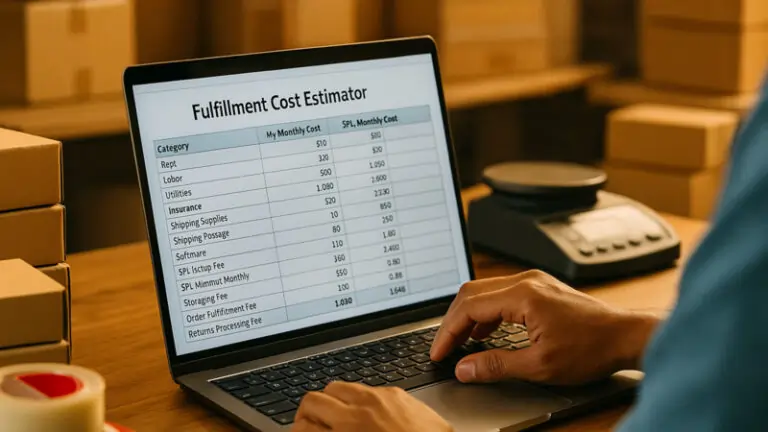
Use the table below to enter your monthly DIY order fulfillment costs and compare them to illustrative 3PL estimate ranges. These figures are directional only and should be validated against live quotes and current carrier rate tables. Make some assumptions, such as the number of hours spent on inventory prep, time spent on B2B operations, whether inventory will be shipped to a 3PL directly from suppliers or processed locally first, the cost of order fulfillment defects and subsequent returns, ergonomics, worker injuries, etc. The 3PL average costs below assume that products are standard size, as defined by Amazon FBA. Be sure to include all relevant details to get an accurate comparison.
|
Category
|
My Monthly Cost
|
3PLs Monthly Cost
|
|---|---|---|
|
Rent
|
|
NA
|
|
Labor
|
|
NA
|
|
Utilities
|
|
NA
|
|
Insurance
|
|
NA
|
|
Labor (Inventory Prep, Special Projects)
*3PL average: $42/hr |
|
|
|
Shipping Supplies
*3PL average: $0.40 – $1.25 per piece |
|
|
|
Shipping Postage
*3PL average: $8/shipment |
|
|
|
Customer Service
|
|
NA
|
|
Operations Management Time
|
|
NA
|
|
Equipment, Maintenance, & Supplies
|
|
NA
|
|
Software
*3PL average: $99/mo |
|
|
|
3PL Setup Fee
*3PL average: $0 – $999 |
NA
|
|
|
3PL Minimum Monthly
*3PL average: $49 – $499/mo |
NA
|
|
|
Receiving Fee
*3PL average: $42/hr |
|
|
|
Storage Fee
*3PL average: $0.56 – $0.89/ft3 |
|
|
|
Order Fulfillment Fee
*3PL average: $1.80 – $3.00/unit |
|
|
|
Returns Processing Fee
*3PL average: $2.99/unit |
|
|
|
Indirect Costs
|
|
NA
|
|
Total Costs:
|
|
|
Note: These figures are directional planning inputs, not current industry-wide averages. Actual quotes vary by product dimensions, weight, order profile, packaging requirements, provider fee structure, carrier contracts, seasonality, and applicable surcharges.
Best Practices for Fulfillment
To optimize their fulfillment operations, businesses should consider implementing best practices such as streamlining their inventory management, using efficient packaging materials, and providing clear shipping instructions. It is also essential to monitor and analyze fulfillment costs and performance regularly to identify areas for improvement. Businesses should consider using a cost calculator to estimate their fulfillment costs and compare prices among different service providers. Providing excellent customer service and support is also crucial for building customer loyalty and trust. By following these best practices, businesses can improve their fulfillment operations, reduce costs, and increase customer satisfaction.
Why Partnering with a 3PL Makes Sense
The decision to outsource fulfillment to a 3PL goes beyond cutting costs. It’s about positioning the business for long-term success. By working with a 3PL, businesses gain access to resources and expertise that would be expensive or impossible to build in-house. From advanced technology and strategic warehouse locations to robust carrier relationships, 3PLs provide the tools needed to compete in a complex ecommerce environment, with financial feasibility universally covered.
Outsourcing also allows businesses to focus on what they do best. Rather than worrying about packing boxes or negotiating with carriers, they can direct their energy toward areas that drive revenue, like creating new products or improving customer engagement and loyalty, which leads to increased customer lifetime value. In today’s interconnected world, partnering with a 3PL ensures that businesses can scale their operations globally, leveraging international logistical solutions and real-world data.
Final Thoughts
Choosing between in-house (DIY) fulfillment and outsourcing to a 3PL requires careful thought. While managing fulfillment internally offers control, it often comes with hidden costs and challenges that can limit growth. On the other hand, 3PLs may limit control, but they provide cost efficiencies that often reduce the overall cost of fulfillment operations while also supporting the ability to scale effortlessly with a pay-as-you-go model.
Ultimately, the best choice depends on a brand or retailer’s unique needs and goals. A wide range of services offered by 3PLs allows for customization and transparency in pricing based on specific business requirements. For many, partnering with a 3PL is the smarter move because it eliminates the mundane, routine work by offloading it to professionals at a predictable cost. By outsourcing fulfillment, businesses can save money, improve efficiency, and focus on what really matters: delivering exceptional value to their customers and boosting their ability to sell more effectively.
Frequently Asked Questions
What expenses should I include when estimating DIY fulfillment costs?
When calculating in-house fulfillment costs, account for warehouse rent or mortgage; utilities; shelving, forklifts, and packing-station equipment; labor for picking, packing, and management; packaging materials; carrier fees; software subscriptions; insurance; and maintenance. Don’t forget indirect costs like returns processing, fulfillment errors, and the opportunity cost of time spent on logistics.
How do I calculate my cost per order for DIY fulfillment?
Tally your total monthly fulfillment expenses—rent, labor, supplies, and shipping postage—and divide by total orders processed. For example, $20,000 in monthly costs for 10,000 orders yields a $2 cost per order before shipping. Adding an average $10 shipping fee brings total fulfillment cost to $12 per order.
How can a 3PL provider lower my fulfillment costs?
3PLs leverage economies of scale: they negotiate bulk shipping discounts, purchase packaging in volume, and deploy strategically located warehouses to cut final-mile fees. Their advanced fulfillment technology automates inventory management and shipping, driving down per-order costs compared to a small-to-mid-sized business handling fulfillment internally.
What strategic advantages do 3PL partnerships offer beyond cost savings?
Outsourcing to a 3PL provides scalable capacity—seamlessly handling seasonal spikes without extra facility leases or staffing. A distributed network of fulfillment centers shortens transit times, enabling faster delivery and boosting customer satisfaction. Plus, integrated order-management systems reduce errors and free your team to focus on growth activities like marketing and product development.
How do I compare my DIY fulfillment costs to 3PL quotes?
Create a comprehensive cost model listing all in-house expenses: facilities, labor, supplies, software, and overhead. Then gather 3PL pricing for receiving, storage, pick & pack, materials, and shipping. Compare total monthly DIY vs. 3PL costs side by side—factoring in hidden savings like reduced WISMO customer inquiries and fewer returns—to determine the best fit for your business.
Written By:
Indy Pereira
Indy Pereira helps ecommerce brands optimize their shipping and fulfillment with Cahoot’s technology. With a background in both sales and people operations, she bridges customer needs with strategic solutions that drive growth. Indy works closely with merchants every day and brings real-world insight into what makes logistics efficient and scalable.
Turn Returns Into New Revenue
Related Articles
What Is Demand Planning? How It Impacts Inventory, Forecasting, and Profitability
Demand planning is the process of estimating future customer demand so that a business can align its inventory, procurement, and operations to meet that demand without carrying mor...
The Shipping Speed Paradox: Why DTC Brands Are Slowing Down
Everyone’s talking about faster delivery.
Why Cross-Border DTC Brands Are Moving Fulfillment Inside the US
Cross-border ecommerce fulfillment is the process of shipping ecommerce orders across national borders—often from warehouses outside the United States to U.
Seller Fulfilled Prime (SFP) & Premium Shipping Requirements Changed June 29, 2025: A Side-by-Side Deep Dive

In this article
7 minutes
- Trial Enrollment & Graduation Windows for Seller Fulfilled Prime
- Monthly Volume & Enrollment Requirements
- Size-Tier Misclassification & Network Disruptions
- Appeals Process Overhaul
- OTDR Protection via Amazon-Managed Shipping Tools
- Premium Shipping Changes
- Putting It All Together: A Seller’s Checklist
- Final Thoughts
Effective June 29, 2025, Amazon rolled out tighter performance guardrails for two of its marquee shipping programs: Seller Fulfilled Prime (SFP) and Premium Shipping. Seller Fulfilled Prime work refers to the process by which eligible third-party Sellers can fulfill Prime orders directly from their own warehouses, provided they meet Amazon’s strict performance requirements. For Sellers, these changes aren’t mere tweaks; they reshape how you qualify, stay in, and recover from hiccups in these programs. Below, we’ll walk through each key requirement as it stands today versus what you’ll need to hit after the effective date, with real-world examples to illustrate exactly what’s at stake. For a rundown of all program requirements, see the full Seller Fulfilled Prime Program and Premium Shipping policies.
Trial Enrollment & Graduation Windows for Seller Fulfilled Prime
Before June 29:
- Sellers can request an SFP trial, but graduation is subject to restricted periods around major shopping events and a limit of three trial attempts per calendar year.
- The SFP trial period lasts for 30 days and includes specific performance metrics that must be achieved to qualify for official enrollment in the program.
- Graduation from trial depends on meeting the required performance metrics during the trial and not falling within a restricted graduation period.
After June 29:
- Three Trials Max per Year: You’ll be capped at 3 trial attempts in each calendar year. Any trial that begins before June 29, 2025 doesn’t count toward this limit.
- Quiet Periods Around Major Events: If your 30-day trial spans the 30 days leading up to Prime Days, Black Friday through Christmas, etc., you cannot graduate. This ensures Sellers are battle-tested before the busiest season.
Sellers must successfully complete the trial period by meeting specific performance requirements to gain access to Prime branding.
Why This Matters: Imagine you enroll in an SFP trial mid-October, aiming to graduate in time for Black Friday. Under the new rule, even flawless performance won’t earn you Prime status, you’ll have to re-enroll after the holidays. Plan your trials for quieter times (e.g., late January) to avoid losing a precious attempt.
Monthly Volume & Enrollment Requirements
Before June 29:
- Sellers must consistently ship Prime packages and ship at least 100 Prime packages per month to maintain SFP enrollment without reduced order limits.
- If you miss on-time metrics, Amazon sends warning emails, but your enrollment status remains until metrics severely degrade.
After June 29:
- Minimum 100 SFP Shipments/Month: You must deliver at least 100 Prime-eligible packages each calendar month, spread reasonably across weeks, to maintain the Prime badge.
- Dynamic Order Limits: Fall below 100 (or cluster all shipments in one week), and Amazon will impose a reduced daily Prime order limit until you return to consistent volume.
- Exemption for Fix-Ups: If you get a second warning for missing any metric, you can pause Prime (no shipments) for a week to get your house in order, and that period won’t count against your enrollment.
Practical Example: You shipped 15 Prime packages in the first 3 weeks of May, then scrambled to ship 90+ in the final week. In June, you’ll wake up to find your Prime orders capped at a fraction of normal volume. Better to target 25–30 SFP orders per week and build in some slack.
Size-Tier Misclassification & Network Disruptions
Before June 29:
- Listing ASINs in the wrong size tier might trigger warning emails, but rarely leads to immediate suspension. Misclassification can also result in higher storage fees, impacting overall profitability.
- Late deliveries during huge storms or carrier outages may or may not be excluded automatically.
After June 29:
- Strict Misclassification Guardrails: Repeatedly offering a product under the wrong size-tier can lead to blocking of SFP offers or Prime status suspension/revocation for those ASINs.
- Automatic OTDR Exclusions for Major Disruptions: Clearer language confirms that any late deliveries from Amazon-identified large-scale carrier or weather events are excluded from your OTDR automatically.
Scenario: If you classify a product under the wrong size tier, Amazon may block SFP offers for the ASIN or take other enforcement action until the product dimensions and size tier are corrected. You’ll need to correct the tier and appeal to restore it—costly downtime.
Appeals Process Overhaul
Before June 29:
- You have a sliding window to dispute removals, but timelines and submission limits are vague.
After June 29:
- 14-Day Filing Window: From the date you receive a notice (e.g., “Your SFP status is paused due to low OTDR”), you have 14 calendar days to open an appeal.
- 4-Day Response to Requests: If Amazon asks for more details, you have 4 days to reply, or your appeal is closed.
- Limit of 3 Appeals/Quarter: You can file up to 3 appeals per quarter (overturned appeals don’t count). Appeals require supporting data (order IDs, tracking numbers, ZIP codes, proof of carrier delays).
Why It’s Tougher: Say your OTDR dips because a regional carrier hub froze over two days. You’ll need to create a case including tracking scans, carrier advisories, and order logs quickly, or forfeit that appeal.
OTDR Protection via Amazon-Managed Shipping Tools
Before June 29:
- Seller Fulfilled Prime and Premium Shipping offers can receive OTDR protection from late deliveries when Shipping Settings Automation is enabled, you purchase labels marked ‘OTDR Protected’ through Amazon Buy Shipping or Veeqo, and you ship on time.
After June 29:
- “OTDR Protected” Labels: If you enable Shipping Settings Automation in your Prime templates and purchase “OTDR Protected” labels through Amazon Buy Shipping, any late deliveries on Standard (for SFP) or Premium shipping won’t hurt your OTDR.
- Continued Exclusion of Major Disruptions: Same carve-out for large-scale network events.
Bottom Line: Automate shipping profiles and purchase labels using Buy Shipping API, and you effectively get “insurance” against minor late-delivery slips.
Premium Shipping Changes
Amazon’s Premium Shipping program (items promised in 1–3 business days) gets its own tightening:
|
Requirement
|
Today
|
After June 29
|
|---|---|---|
|
OTDR Threshold
|
97%
|
93.5%
|
|
Measurement Window
|
Rolling 30-day period
|
Weekly (Sun–Sat)
|
|
Enforcement Steps
|
Removal upon sustained dip
|
3-strike system:
1st miss – warning email 2nd miss – warning email 3rd miss in 4 consecutive weeks – removal |
|
Warning Reset
|
None
|
4 consecutive perfect weeks clears prior infraction
|
Key Impact: Under the new cadence, a single bad week can put you on notice, and three such weeks in a month spells immediate removal from Premium Shipping. You’ll need more consistent performance throughout each month, not just a healthy 30-day aggregate. Sellers must successfully complete the new performance metrics to maintain their status in the Premium Shipping program.
Putting It All Together: A Seller’s Checklist
- Schedule Your SFP Trial Smartly: Avoid major sale seasons; plan for Q1.
- Lock Down 100+ Prime Shipments/Month: Automate your SFP orders to spread volume evenly across weeks.
- Clean Up Your ASIN Tiering: Audit listings for correct size tiers and package profiles.
- Enable Shipping Automation + Protected Labels: In Seller Central > Fulfillment Settings, turn on SFP/Premium templates and default to OTDR-protected labels.
- Monitor Weekly OTDR: Invest in an operations dashboard that can track your OTDR by week for both SFP and Premium orders.
- Prepare an Appeals Kit: Create a template for submitting an appeal with sections for order logs, tracking scans, and carrier advisories so you can file within 14 days. Cases created after 14 calendar days will not be considered.
- Build in Buffer for Disruptions: If large-scale transportation issues affect your network, monitor carrier conditions, increase handling time if pickups are delayed, or set your account inactive if you cannot ship at all. Consider outsourcing your SFP fulfillment to a distributed fulfillment network that organically solves for carrier network disruptions and ensures the highest performance metrics for continued program eligibility and enrollment.
- Understand SFP Program Requirements: Familiarize yourself with the stringent requirements of the SFP program and adapt to changing Amazon policies to maintain your SFP status.
Final Thoughts
These new Seller Fulfilled Prime (SFP) and Premium Shipping requirements underscore Amazon’s push for ultra-reliable, ultra-consistent delivery, a win for customers, and a heavier lift for Sellers. But by meeting these new standards, (whether independently or with the help of a distributed fulfillment network), Sellers can maintain access to Prime branding and the substantial customer base of Amazon Prime members, mitigating the risk to the sales opportunities afforded by the Amazon Seller Fulfilled Prime Program.
By understanding the before-and-after, planning trial timing, automating wherever possible (especially Prime shipping options), and building a rapid-response appeals process, you can not only stay enrolled in SFP and Premium Shipping programs but thrive in them.
Watch the Video
Written By:

Jeremy Stewart
Jeremy Stewart leads customer success at Cahoot, helping merchants achieve high-performance logistics through smart technology and process optimization. With a background in both ecommerce operations and client services, Jeremy ensures that every merchant using Cahoot gets measurable results—whether they’re scaling from one warehouse to many or managing complex returns.
Turn Returns Into New Revenue
Related Blog Posts
How Ecommerce Returns Management Software Boosts Efficiency and Customer Loyalty

In this article
9 minutes
- Why Returns Management Can’t Be an Afterthought
- What Returns Management Software Actually Does
- The ROI of Returns Management Solutions
- Why Reverse Logistics Matters
- Strategies for Reducing Returns
- Choosing the Right Returns Management Software
- Measuring Success: KPIs and Analytics for Returns Management
- My Perspective After a Decade in the Trenches
- The Future of Returns Management in Ecommerce
- Frequently Asked Questions
Returns used to be the messy backroom of ecommerce, hidden, clunky, and full of manual work. Not anymore. Commerce returns have emerged as both a major challenge and a significant opportunity for online retailers. In 2025, ecommerce returns management has become a strategic lever for customer loyalty, profit recovery, and operational speed. The importance of ecommerce returns management now extends beyond logistics, shaping competitive advantage and customer satisfaction in the digital age. After many years working with ecommerce brands and managing a distributed warehouse network, I’ve seen how the right returns management platform transforms what’s usually a pain point into a growth engine for both you and your customers.
Why Returns Management Can’t Be an Afterthought
Returns aren’t just a post-purchase nuisance. They are a customer experience touchpoint that directly affects customer lifetime value. The National Retail Federation reports that returns accounted for more than 17% of total retail sales in 2024. Return rates are even higher for online purchases compared to physical store sales, making a seamless returns process critical for ecommerce success. Every poor return experience risks losing customers, negative feedback, and lower repeat business.
I’ve seen merchants attempt to manage returns through spreadsheets and email threads, but it’s not scalable. The lack of a structured returns process and a clear returns policy leads to lost sales, inventory mismatches, refund delays, and angry customers by creating confusion and unmet expectations. Without the right returns management software, your customer service team spends hours just sending return labels and processing refunds manually.
What Returns Management Software Actually Does
Good returns management software offers far more than a shipping label creation tool. It’s a comprehensive, all-in-one platform that automates and streamlines the entire process, from return authorization to inventory management and refund reporting. Key features typically include:
- Automated returns authorization to speed up approvals and reduce manual intervention.
- A customizable returns portal where customers can initiate and track their returns and exchanges.
- Self-service return portals that let online shoppers initiate returns without emailing support.
- Dynamic return rules for exchanges, store credit, or refunds, helping to protect profit margins.
- Streamlined returns processing to reduce support tickets and speed up the entire process.
- Real-time returns tracking functionality to keep both merchants and customers updated on return status.
- Automated exchange process options to encourage customers to swap products rather than request refunds.
- Automatic refunds processing capabilities to ensure timely and accurate refunds.
- Initiating refunds automatically once returns are approved, reducing manual errors.
- Real-time tracking of returns data, giving you insight into why products are being sent back.
- Integration with warehouse management systems ensures that inventory updates are instantly applied upon receipt.
- Fraud detection to combat return fraud and identify stolen merchandise patterns.
Merchants using returns management software often see customer satisfaction rise because the process is quick, transparent, and easy to navigate.
The ROI of Returns Management Solutions
A well-optimized returns management process offers key benefits that go beyond cost savings, including improved customer satisfaction, increased operational efficiency, and more revenue for your business.
Returns may feel like a cost center, but a well-optimized returns management process can actually increase revenue. How? By:
- Boosting customer loyalty with frictionless refunds and exchanges.
- Reducing reverse logistics expenses through automated label creation and bulk carrier discounts.
- Using returns data to improve product descriptions and reduce future returns.
- Recovering sales via store credit or streamlined exchange processes instead of one-click refunds.
- Retaining more revenue by minimizing unnecessary returns through efficient returns management.
From my experience, ecommerce businesses that prioritize customer satisfaction during the returns stage—by streamlining the process and offering easy-to-use return labels—see higher repeat business and better reviews. That translates to stronger brand loyalty, a healthier bottom line, and helps retain future customers.
Why Reverse Logistics Matters
The reverse logistics process—moving items from customers back to warehouses or physical stores—is more complex than most merchants realize. Without software, this process eats into profit margins and clogs warehouse management systems.
Modern returns management platforms integrate directly with inventory management tools, ensuring returned products are inspected, restocked, or flagged for disposal quickly. These integrations help maintain accurate inventory levels by seamlessly updating stock data during the returns process, preventing overselling or shortages. This saves time and prevents inventory from sitting idle, which otherwise delays future sales.
Offering unlimited returns—while once a popular strategy to attract customers—can create significant operational challenges for reverse logistics and inventory management due to increased processing costs and complexity.
Strategies for Reducing Returns
Reducing returns is not just about protecting your bottom line; it’s about building trust and loyalty with your customers. For ecommerce businesses, a proactive approach to minimizing returns can significantly enhance customer satisfaction and streamline the returns process. One of the most effective strategies is to provide customers with comprehensive, accurate product information. High-quality images, detailed specifications, and authentic customer reviews help set clear expectations, reducing the chances of disappointment and unnecessary returns.
Another powerful tactic is to offer pre-sale consultations, such as live chat or virtual shopping assistance, to guide customers toward the right purchase. Post-sale follow-ups, like satisfaction surveys or helpful tips for product use, can address potential issues before they lead to a return. By making the returns process itself more transparent and user-friendly—through features like a self-service return portal and clear return policies—ecommerce businesses can further boost customer loyalty and reduce the volume of returns.
Ultimately, these strategies not only decrease return rates but also enhance customer satisfaction, turning first-time buyers into repeat customers and advocates for your brand.
Choosing the Right Returns Management Software
When evaluating a returns management solution for your online store, look for:
- Scalable features that match both current needs and future returns volume.
- Multi-channel support for both online returns and store returns.
- Customer communication tools to keep customers informed of their return status.
- Reporting capabilities for refund reports, product performance, and fraud analytics.
- Easy integration with your ecommerce platform and shipping carriers.
- Consider returns management software that offers free returns and free shipping options to enhance customer experience.
The best tools don’t just manage returns—they improve the customer experience, turning a negative moment into an opportunity to strengthen relationships. The right returns management solution can integrate with your store to streamline returns and exchanges.
Measuring Success: KPIs and Analytics for Returns Management
To truly optimize your returns management process, it’s essential to measure what matters. Ecommerce businesses should track key performance indicators (KPIs) such as return rate, reasons for return, customer satisfaction scores, and net promoter score. By analyzing returns data, you can uncover patterns, like which products are most frequently returned and why, which empowers you to make informed decisions about inventory management, product descriptions, and future product development.
For example, if returns data reveals that a particular item is often sent back due to sizing issues, you can update your sizing guides or add more detailed fit information to reduce future returns. Monitoring customer satisfaction throughout the returns process also helps identify pain points and opportunities to enhance the customer experience. Leveraging these analytics not only improves your returns management but also supports smarter business decisions, leading to higher customer satisfaction and increased revenue for your ecommerce business.
My Perspective After a Decade in the Trenches
I’ve seen brands waste thousands of dollars and countless hours on manual returns. Conversely, I’ve seen what happens when they adopt modern returns management software: faster processing, happier customers, and better informed decisions about product quality and operations.
Returns are often dismissed as unavoidable losses, but they’re actually a lens into your customer expectations, product quality, and operational gaps. Brands that treat returns as part of their customer experience strategy, rather than as an afterthought, see measurable lifts in customer lifetime value. Collecting and analyzing customer feedback is essential for continuously improving the returns process and ensuring it meets customer needs.
Even small changes, like offering free return shipping with a clear return policy, can dramatically improve repeat business. And when you combine those practices with a modern returns management platform, you’re not just reducing costs—you’re building long-term trust. Providing accurate product descriptions also helps reduce returns and strengthens customer trust.
The Future of Returns Management in Ecommerce
Looking ahead, the future of returns management in ecommerce is all about delivering a seamless, customer-focused experience that drives both customer satisfaction and loyalty. As online shopping continues to expand, ecommerce businesses must prioritize efficient, transparent, and flexible returns processes to stay competitive. By investing in accurate product information, simplifying the returns process, and harnessing the power of returns data analytics, businesses can reduce return rates, improve operational efficiency, and foster long-term customer relationships.
Returns management software will play a pivotal role in automating and optimizing these processes, helping ecommerce businesses save time, reduce costs, and make data-driven decisions. Those who embrace a proactive, customer-centric approach to returns management will not only meet but exceed customer expectations, turning returns from a challenge into a strategic advantage. In the evolving world of ecommerce, prioritizing returns management is key to building customer loyalty, enhancing customer satisfaction, and driving sustainable business growth.
Returns are going to keep rising. The question is whether you’ll treat them as a competitive advantage or let them chip away at your business.
Frequently Asked Questions
What is ecommerce returns management software?
It’s a comprehensive returns management solution designed to automate and streamline the returns process, from issuing return labels to tracking returned inventory and processing refunds or exchanges.
How does ecommerce returns management software boost customer satisfaction?
By providing a clear, fast, and self-service returns experience, customers feel informed and cared for. This improves overall trust and encourages repeat purchases.
Can ecommerce returns management platforms reduce costs?
Yes. Automation reduces labor hours, prevents errors, and cuts carrier costs by using bulk return labels and smarter reverse logistics routing.
Why is reverse logistics important?
Reverse logistics affects inventory turnover, customer wait times, and overall efficiency. Software ensures products move smoothly back into inventory or secondary channels.
Does Cahoot offer returns management capabilities?
Yes. Cahoot’s returns management tools integrate with ecommerce platforms and warehouse management systems, providing fast processing, cost savings, and actionable returns data.
Written By:
Manish Chowdhary
Manish Chowdhary is the founder and CEO of Cahoot, the most comprehensive post-purchase suite for ecommerce brands. A serial entrepreneur and industry thought leader, Manish has decades of experience building technologies that simplify ecommerce logistics—from order fulfillment to returns. His insights help brands stay ahead of market shifts and operational challenges.
Turn Returns Into New Revenue
Related Articles
What Is Demand Planning? How It Impacts Inventory, Forecasting, and Profitability
Demand planning is the process of estimating future customer demand so that a business can align its inventory, procurement, and operations to meet that demand without carrying mor...
Why 100% P2P Adoption Is the Wrong Goal
Peer-to-peer returns let customers send eligible returned items directly to other customers instead of routing every package back through the warehouse, cutting shipping and proces...
Walmart Officially Allows Amazon Multi-Channel Fulfillment (MCF)
Big news for multichannel sellers: Walmart now officially allows Amazon Multi-Channel Fulfillment (MCF), Amazon’s service for using its fulfillment network to ship orders from mult...
What is a WMS (Warehouse Management System) and How Does It Work?

A Warehouse Management System (WMS) is software that streamlines warehouse operations. It helps manage everything from inventory tracking to order fulfillment, making warehouse processes more efficient. If you’re looking to reduce errors and improve productivity, understanding WMS is a must.
Key Takeaways
- A Warehouse Management System (WMS) optimizes warehouse operations by managing tasks like inventory tracking, receiving, picking, packing, and shipping using real-time data.
- Implementing a WMS leads to significant cost savings by reducing labor costs, minimizing errors, and improving operational efficiency through automation and effective resource management.
- Selecting the right WMS requires careful consideration of factors like business size, industry needs, vendor reputation, and the need for flexibility in cloud-based solutions.
Understanding Warehouse Management Systems
A Warehouse Management System (WMS) is a software solution designed to manage and optimize warehouse operations, enhancing overall supply chain efficiency. Imagine having a tool that not only tracks inventory but also manages receiving, put-away, picking, packing, and shipping—all under one unified interface. This is precisely what a WMS does. Leveraging real-time data ensures smooth and efficient warehouse processes, reducing errors and enhancing productivity through inventory management software.
One of the key advantages of a WMS is its ability to provide real-time inventory tracking. This means that at any given moment, you can know exactly what inventory you have, where it is located, and its status. This level of visibility is crucial for efficient warehouse management and can significantly reduce the time spent searching for items or dealing with stock discrepancies. Moreover, a WMS helps in maximizing labor and space utilization, ensuring that resources are used optimally.
But the benefits of a WMS extend beyond the four walls of the warehouse. Implementing a WMS can lead to internal process optimization that benefits the entire supply chain. It enables businesses to respond quickly to fulfillment needs in a dynamic, omnichannel economy. Streamlining processes like receiving, storage, picking, packing, and shipping, a WMS improves supply chain management and ensures accurate and timely order fulfillment.
Key Benefits of Implementing a WMS
The implementation of a warehouse management system can lead to significant reductions in operating expenses by optimizing the use of warehouse space. Imagine cutting down labor costs and minimizing errors through automation and real-time inventory tracking. This is one of the key benefits of a WMS—it brings about cost savings and new efficiencies. Automating key tasks and optimizing inventory management, a WMS reduces manual errors and boosts productivity.
Beyond cost savings, a WMS improves operational efficiency through waste reduction and effective labor management. It boosts flexibility and reduces errors in picking and shipping, which translates to improved customer service.
Real-time visibility into inventory levels enables better supply management and customer satisfaction. With a WMS, businesses can achieve efficient warehouse management, ensuring smooth and streamlined warehouse workflows.
Core Functions of a WMS
A warehouse management system is designed to optimize warehouse operations through several core functions, including receiving, storage, and distribution management. These core functions are essential for efficient warehouse management and ensure that every process within the warehouse runs smoothly. From the moment goods enter the warehouse to the time they leave, a WMS manages every step with precision and accuracy.
Smart warehouses today rely heavily on automation to enhance productivity, accuracy, and efficiency. Warehouse automation can streamline various workflows. This includes data collection, barcoding, scanning, picking and packing, and shipping.
Key features to look for in a WMS include real-time inventory tracking, efficient order management, and robust reporting and analytics capabilities. Manufacturers, for instance, use WMS for tracking components and finished goods, facilitating just-in-time production, and reducing waste.
Receiving and Put-Away
Receiving and put-away are critical processes in warehousing, and a WMS supports various activities involved in these steps. Imagine a system that seamlessly integrates with mobile devices, allowing warehouse workers to scan barcodes and update inventory in real-time. This integration is crucial for frontline warehouse efficiency and ensures that items are stored accurately and quickly.
With a WMS, receiving operations become more streamlined. The system can validate and reconcile items against digital purchase orders, minimizing errors.
Once items are received, the put-away process is guided by the WMS, which recommends optimal storage locations based on current inventory levels and warehouse space availability. This not only speeds up the process but also ensures that inventory is stored in a manner that maximizes space utilization and facilitates easy retrieval.
Inventory Management
Inventory management is at the heart of efficient warehouse operations, and a WMS plays a pivotal role in this area. Real-time inventory visibility is achieved through technologies like barcoding and RFID, allowing for precise tracking of materials. Knowing exactly what inventory you have, its location, and status at any given moment is crucial for supply chain management and informed decision-making.
WMS solutions enhance inventory accuracy by providing tools for real-time tracking and automated reporting of stock levels. Automatic identification and data capture (AIDC) technology includes methods like barcodes and RFID.
Materials can be effectively traced using specific identification methods like lot and serial numbering, ensuring that inventory levels are accurate and up-to-date. This not only improves operational efficiency but also enhances customer satisfaction by ensuring that orders are fulfilled accurately and on time.
Order Picking and Packing
Order picking and packing are core steps in the order fulfillment process, and a WMS enhances efficiency in these areas by guiding the storage, retrieval, and packing of items using various picking technologies. Modern WMS supports radio frequency, pick-to-light, pick-to-voice, and even robotics integrations to optimize the picking process. Voice-picking technology, for instance, allows operators to pick items using spoken instructions, facilitating hands-free communication and task completion.
Augmented Reality (AR) smart glasses further enhance the picking process by allowing warehouse operators to execute tasks hands-free while displaying bin locations and other critical information.
Mobile devices also play a significant role in streamlining the order picking and packing process by providing real-time communication and data access. These technologies ensure that orders are picked and packed accurately and efficiently, reducing errors and improving productivity.
Shipping and Logistics Integration
Shipping and logistics integration is a vital component of a warehouse management system, ensuring that goods are delivered to customers on time and in perfect condition. A WMS integrates with advanced tools, including transportation management systems and augmented reality applications, to streamline shipping activities. This integration allows for improved coordination between warehousing and shipping, ensuring faster delivery times and better customer service.
WMS solutions also allow for efficient management of inbound and outbound shipments, improving overall customer service levels. Envision a system that can automatically generate essential shipping documents, reducing the time and effort required for manual paperwork.
By ensuring that shipments are accurately tracked and managed, a WMS enhances logistics processes and ensures that goods reach their destination without delays.
Labor Management
Effective labor management is crucial for maintaining productivity and efficiency in warehouse operations, and a WMS provides valuable insights into workforce productivity. It can optimize scheduling and task assignment based on real-time data. A WMS can enhance labor management by providing real-time data on workforce productivity, enabling better task allocation and performance tracking.
WMS systems help improve labor utilization by matching tasks to the right employees based on their skills and availability. This optimization leads to enhanced overall labor productivity and efficiency, ensuring that warehouse workers are utilized effectively. By providing insights into workforce productivity, a WMS helps businesses manage their labor costs and improve overall operational efficiency.
Types of Warehouse Management Systems
Warehouse management systems can be categorized into standalone systems, cloud-based options, and integrated ERP solutions. Standalone systems provide specialized features tailored for distribution center operations, but they may face integration difficulties with existing software. These systems are ideal for businesses that require specific functionalities and do not need extensive integration with other systems.
On the other hand, cloud-based WMS are often more accessible and scalable compared to on-premise solutions. They allow for easier updates and management, making them suitable for businesses that need flexibility and scalability. Additionally, cloud-based WMS systems allow for improved collaboration and data sharing across teams.
ERP module-based WMS integrates with broader enterprise resource planning systems, facilitating streamlined processes across various business functions. These solutions offer the advantage of a unified system that manages multiple aspects of the business, from inventory to accounting.
Advanced Technologies in WMS
The integration of advanced technologies in warehouse management systems has revolutionized warehouse operations, making them more efficient and accurate. Automation and robotics, mobile devices and wearables, and AI and IoT are some of the key technologies that enhance WMS functionalities. Warehouses utilizing robots and automated guided vehicles streamline storage retrieval processes, and mobile devices provide real-time updates on inventory levels.
These technologies help simplify various warehouse processes, from receiving to shipping, reducing errors, and improving overall efficiency. For instance, ecommerce businesses leverage WMS to handle high volumes of orders and ensure timely delivery, while pharmaceutical companies use WMS to maintain strict inventory controls and compliance with regulatory requirements. Cold storage facilities and retail businesses also benefit from WMS by improving inventory turnover rates and customer service through better stock management.
Automation and Robotics
Automation technologies integrated with a WMS can also consolidate operations within a warehouse. Imagine robots speeding up the picking process, improving worker safety, and boosting morale. Automated guided vehicles (AGVs) speed up inventory storage and retrieval, improve efficiency, reduce human errors, and scale with demand.
Automated picking technologies, such as pick-to-voice and pick-to-light, can also significantly raise productivity and accuracy rates. A modern WMS can assist in labor management by forecasting needs and optimizing tasks based on worker skills.
Integrating automation and robotics enables businesses to achieve efficient warehouse management and unified operations.
Mobile Devices and Wearables
Mobile devices, such as handheld scanners and tablets, are essential tools in warehouses for improving inventory accuracy and aiding in various tasks. Warehouse employees can access information on the go, accelerate effective communications, and reduce the time spent on manual data entry. Real-time updates provided by mobile devices inform decision-making by offering immediate visibility into inventory levels and order statuses.
Wearable technology, such as smart glasses and wrist-mounted devices, can be integrated into warehouse systems to further enhance operational efficiency. These wearables provide hands-free access to data, which increases productivity and safety for warehouse workers.
AI and IoT Integration
AI enhances warehouse management systems by improving performance, gathering data, tracking packing, recommending product locations, and analyzing efficiency. AI Agents can gather data from various internal and external sources, locate products quickly, provide efficiency reports, and automatically create purchase orders with vendors to replenish inventory.
IoT integrates with WMS and manages the location of products, routing of products within warehouse workflows, and helps to develop pull-based supply chains. IoT enables warehouses to monitor environmental conditions and mitigate risks through data.
Choosing the Right WMS for Your Business
Selecting the right warehouse management system for your business involves thorough research and careful consideration of various factors. Evaluating different WMS options includes researching vendors, considering customer reviews, and assessing their track records in the industry. Evaluating the level of customer support and compatibility with existing systems is also super important.
Cloud-based WMS software, which typically adopts a software-as-a-service (SaaS) pricing model, offers flexibility and scalability as your business needs change. Key factors to consider when selecting a WMS include your business size, specific industry requirements, and unique operational needs. By carefully evaluating these aspects, you can choose a WMS that aligns with your business goals and enhances your warehouse operations.
Summary
In summary, a warehouse management system (WMS) is a powerful tool that optimizes warehouse operations and enhances supply chain efficiency. From real-time inventory tracking to automated order picking and shipping integration, a WMS brings numerous benefits that can transform your business. Implementing a WMS can lead to significant cost savings, improved productivity, and better customer service, making it an important investment for any business involved in warehousing and distribution.
The impact of a well-implemented WMS is profound. Businesses that leverage the advanced functionalities and technologies of a WMS achieve higher accuracy, efficiency, and customer satisfaction, all leading to top line revenue growth. If you’re looking to take your warehouse operations to the next level, consider investing in a WMS tailored to your specific needs. Embrace the future of warehouse management and watch your business thrive.
Frequently Asked Questions
What is a Warehouse Management System (WMS)?
A Warehouse Management System (WMS) is software that helps streamline warehouse operations by tracking inventory and managing processes like receiving, storing, picking, packing, and shipping. It’s all about making your warehouse run smoother!
How does a WMS improve inventory management?
A WMS boosts your inventory management by offering real-time tracking and utilizing barcoding and RFID technologies, which means you’ll have clear visibility and accuracy of your stock levels. This leads to more efficient operations and less room for errors.
What are the key benefits of implementing a WMS?
Implementing a WMS brings significant benefits like cost savings, improved efficiency, and real-time inventory visibility, all while reducing errors and boosting customer satisfaction. It’s a smart move for streamlining operations!
What types of WMS are available?
There are primarily three types of Warehouse Management Systems (WMS): standalone systems, cloud-based options, and integrated ERP solutions. Each type has its unique benefits, so you can choose one that best fits your business needs.
How do advanced technologies like AI and IoT enhance WMS?
Advanced technologies like AI and IoT significantly boost WMS by offering valuable data insights, streamlining operations, and facilitating more responsive supply chains. They also help monitor conditions to reduce risks, making warehouse management smarter and more efficient.
Written By:

Rinaldi Juwono
Rinaldi Juwono leads content and SEO strategy at Cahoot, crafting data-driven insights that help ecommerce brands navigate logistics challenges. He works closely with the product, sales, and operations teams to translate Cahoot’s innovations into actionable strategies merchants can use to grow smarter and leaner.
Turn Returns Into New Revenue
Related Articles
What Is Demand Planning? How It Impacts Inventory, Forecasting, and Profitability
Demand planning is the process of estimating future customer demand so that a business can align its inventory, procurement, and operations to meet that demand without carrying mor...
The Shipping Speed Paradox: Why DTC Brands Are Slowing Down
Everyone’s talking about faster delivery.
Why Cross-Border DTC Brands Are Moving Fulfillment Inside the US
Cross-border ecommerce fulfillment is the process of shipping ecommerce orders across national borders—often from warehouses outside the United States to U.
Cross-Docking: Benefits, Types, and Best Practices Explained
In this article
18 minutes
- Key Takeaways
- Understanding Cross-Docking
- Advantages of Cross-Docking
- Cross-Docking vs Drop Shipping
- Cross-Docking vs Direct Shipment
- Cross-Docking vs. Traditional Warehousing
- Types of Cross-Docking
- Cross-Docking Facilities
- Challenges and Solutions in Cross-Docking
- Common Categories and Industries That Use Cross-Docking
- Best Practices for Effective Cross-Docking
- How Cahoot Supports Cross-Docking: A Practical Example
- Summary
- Frequently Asked Questions
Cross-docking is a logistics strategy that transfers products directly from inbound to outbound shipments, reducing storage time and costs. This method speeds up the supply chain and enhances delivery efficiency. In this article, you’ll learn about the benefits, types, and best practices of cross-docking.
Key Takeaways
- Cross-docking enables the rapid transfer of goods from inbound to outbound transport, minimizing storage times and reducing warehousing costs.
- This logistics strategy significantly enhances supply chain efficiency, offering benefits such as cost savings, improved inventory management, and streamlined delivery processes.
- Effective implementation of cross-docking requires timely coordination between stakeholders, robust scheduling, and continuous improvement practices to address logistical challenges.
Understanding Cross-Docking
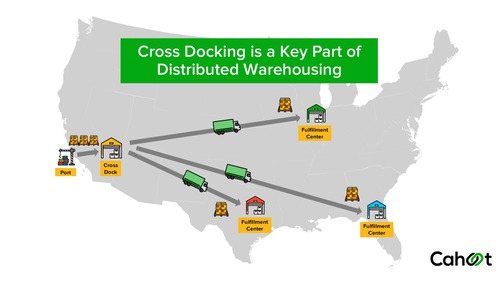
Cross-docking is a logistics process that minimizes storage and handling time by directly transferring products from inbound shipments to outbound transport. The primary goal is to reduce the time products spend in the supply chain, enhancing delivery efficiency and cutting warehousing costs. This method involves various types, such as pre-distribution, post-distribution, and continuous approaches, each supporting specific logistical needs, including Cross-docking services.
At the core of cross-docking lies in its ability to streamline the shipping process, ensuring that products move swiftly through the supply chain. Minimizing storage time leads to less inventory handling, less capital tied up in inventory for less time, and reduced warehousing costs for businesses.
What is Cross-Docking?
Cross-docking is a logistics process where products from a supplier or manufacturing plant are distributed directly to a customer or retail reseller with minimal handling and storage time. Unlike traditional warehousing, where goods are stored for extended periods, cross-docking facilities are designed for rapid movement and redistribution of goods. This approach ensures that products are sorted and dispatched almost immediately after their arrival at a logistics facility.
The primary goal of cross-docking in supply chain management is to speed up the supply chain process by reducing the need for long-term storage and minimizing handling costs. Cross-docking facilities, often referred to as cross-docks, are strategically located hubs that facilitate the direct transfer of goods from inbound to outbound transport.
Utilizing a specialized layout that minimizes storage time allows cross-docking warehouses to ensure efficient redistribution of products. This method significantly differs from traditional warehousing, focusing on fast movement and less inventory handling. The efficiency gained through cross-docking operations can lead to substantial cost savings and improved supply chain performance.
Key Steps in the Cross-Docking Workflow
The cross-docking workflow involves several key steps designed to ensure the swift movement of goods through the supply chain. It begins with receiving goods, where products are unloaded from inbound trucks at the receiving dock. This step involves minimal handling, allowing items to be quickly sorted.
Once the goods are received, they are sorted according to orders or delivery routes and redirected for immediate delivery. This sorting process is important for consolidating shipments and ensuring that products are directed to their correct destinations. The efficiency of this step is determined by the strategic layout of cross-docking facilities, which minimizes the distance goods need to travel within the warehouse. Finally, the sorted products are loaded onto outbound vehicles for delivery to their final destinations.
Advantages of Cross-Docking
Cross-docking offers numerous advantages that make it an attractive logistics strategy for many businesses. One of the primary benefits is cost savings, as it reduces the need for extensive warehousing and minimizes handling and storage expenses by cutting down on storage time and the number of human touches.
Another major advantage of cross-docking is improved efficiency. Facilitating the swift movement of goods from inbound to outbound shipments enhances delivery speed and reduces lead times. This approach also improves inventory management by minimizing excess inventory and reducing the risk of overstocking or stockouts. Together, these benefits contribute to a more streamlined and cost-effective supply chain operation.
Cost Savings
Cross-docking can lead to significant cost savings for businesses by reducing various expenses associated with traditional warehousing. Labor costs are decreased since products require less handling, leading to a reduced need for workforce management, resulting in cost savings in supply chain operations. Additionally, lower utility expenses result in more economical storage costs. By minimizing long-term storage and excessive handling, cross-docking helps businesses achieve a more cost-effective logistics strategy.
Improved Efficiency
Cross-docking enhances efficiency, allowing goods to move swiftly to their destinations. Allowing products to be sorted and dispatched almost immediately drastically cuts down on delivery times.
Regularly evaluating cross-docking processes helps identify areas for further simplification and even more efficiency. This continuous improvement loop ensures that the cross-docking operation remains streamlined and effective, ultimately leading to improved service levels and reduced costs.
Enhanced Inventory Management
Cross-docking minimizes the need to keep excess inventory to meet fulfillment expectations, helping businesses maintain optimal stock levels and reduce the chance of overstocking and stockout situations.
Machine learning and genAI applications in cross-docking can significantly improve demand forecasting by analyzing historical shipping data, real-time market trends, and geopolitical events to optimize inventory levels and capital spending. Leveraging advanced technologies to optimize inventory management ensures timely deliveries and reduces warehousing costs.
Cross-Docking vs Drop Shipping
Cross-docking and drop shipping are two distinct logistics strategies, each with its own set of advantages and disadvantages. Cross-docking focuses on the immediate transfer of goods between inbound and outbound transport, reducing storage duration and lowering costs associated with warehousing and handling. It improves supply chain efficiency by minimizing the need for long-term storage and reducing inventory touches.
On the other hand, drop shipping allows businesses to reduce the initial investment and ongoing costs associated with buying and holding inventory by having suppliers ship products directly to customers after the purchase is made. While this method also eliminates the need for inventory management and storage, it can lead to longer delivery times and increased transportation costs, which erodes margins and risks long-term customer loyalty typically (at least partially) attributed to fast and free shipping.
Cross-Docking vs Direct Shipment
When comparing cross-docking with direct shipment, both methods offer unique benefits and challenges. cross-docking allows fulfillment centers to ship internationally without altering their established processes, making it a versatile option for global logistics. However, one major drawback is that it can extend transit times, leading to longer customer wait times for receiving orders.
Direct shipment, or hubless shipping, allows retailers to fulfill orders directly from their warehouses to international customers, bypassing the need for a cross-dock center. This method can reduce transit times but may require more complex logistics management and higher inventory holding costs.
Cross-Docking vs. Traditional Warehousing
Cross-docking and traditional warehousing represent two different approaches to logistics management, each with its own set of advantages and disadvantages. The cross-docking process prioritizes rapid movement of goods, significantly decreasing the time required to get products from suppliers to customers. This method generally incurs lower operational costs related to physical storage space and inventory management compared to traditional warehousing.
However, traditional warehousing allows for better adaptability to changes in demand and inventory, serving as a buffer to manage variability. This flexibility can be crucial in industries with fluctuating demand patterns. And taking advantage of economies of scale and negotiating bulk purchases increases margins and profitability. But the extended margins on one side may be lost to fixed operating costs on the other, so businesses should understand the strengths and weaknesses of each approach and choose the one that best aligns with their operational goals and customer needs.
Types of Cross-Docking
Cross-docking can be categorized into various types, each serving distinct logistical needs. The primary types include pre-distribution, post-distribution, and continuous cross-docking. Each type is defined by the timing of product sorting and the specific logistical requirements it addresses.
Pre-distribution cross-docking involves sorting goods before they arrive at the distribution center, while post-distribution cross-docking sorts products after they reach the facility. Continuous cross-docking emphasizes an uninterrupted flow of goods through the facility, ensuring rapid transfers and meeting consistent product demand.
Additionally, consolidation and deconsolidation methods facilitate direct product shipment without prior storage, optimizing fulfillment efficiency.
Pre-Distribution Cross-Docking
Pre-distribution cross-docking involves sorting goods according to their final destination before they arrive at the distribution center. In this approach, products are sorted and designated for their final destinations before arriving at the cross-dock facility. This method streamlines logistics by ensuring timely delivery based on prior customer demand.
Organizing products before they arrive at the distribution center minimizes handling and storage time, enhancing overall supply chain efficiency. This approach is particularly beneficial for industries with predictable demand patterns and well-defined delivery routes.
Post-Distribution Cross-Docking
In post-distribution cross-docking, the final destinations of goods are determined after they have reached the distribution center. This method involves sorting and allocating products to their next destinations based on real-time demand and supplier decisions. Providing more flexibility in determining shipping destinations allows post-distribution cross-docking to adapt to changing market conditions and customer needs.
This approach allows suppliers to make informed decisions about product allocation, ensuring optimal delivery routes and minimizing excess inventory. Post-distribution cross-docking is ideal for industries with variable demand patterns and the need for agile logistics management.
Continuous Cross-Docking
Continuous cross-docking is a logistics strategy that emphasizes an uninterrupted flow of goods through the facility. This process minimizes storage time as goods move directly from inbound to outbound transport without intermediate storage. Maintaining a steady flow of products facilitates rapid transfers and meets consistent product demand in continuous cross-docking.
This approach is particularly effective for high-volume industries with steady demand, such as retail and ecommerce. Continuous cross-docking ensures that products are always on the move, reducing the need for long-term storage and maximizing supply chain efficiency.
Consolidation and Deconsolidation
Consolidation and deconsolidation cross-docking are methods that facilitate direct product shipment without prior storage, enhancing transportation efficiency. In consolidation cross-docking, multiple smaller shipments are temporarily set aside and merged into a larger shipment for more efficient transport. This method reduces transportation costs by maximizing load capacity and minimizing the number of trips required.
Deconsolidation cross-docking, on the other hand, entails breaking down large shipments into smaller, easier-to-handle deliveries for further distribution. This approach is beneficial for distributing products to multiple locations or end-users.
Both methods involve some level of product handling in the warehouse, but they significantly reduce long-term storage needs and improve overall supply chain efficiency.
Cross-Docking Facilities
The design and infrastructure of cross-docking facilities play a decisive role in overall efficiency of operations. Optimizing the layout of these facilities can significantly reduce travel time and enhance material flow, ensuring that goods move swiftly from inbound to outbound shipments. Strategic layout design, including the placement of receiving docks and loading docks, is essential for minimizing the movement distance of goods.
Automation is another critical aspect of cross-docking facilities. Implementing automated systems for transferring goods can increase operational efficiency and reduce the risk of product damage. Improvements in infrastructure and technology, such as layout design optimization and automation, contribute significantly to the success of cross-docking operations.
Cross-Docking Terminals
A cross-docking terminal is a specialized facility designed for the swift movement and redistribution of shipments, differing significantly from a standard warehouse that is geared towards storing and managing inventory over a longer period. These terminals typically feature configurations like I-shaped or T-shaped layouts to facilitate numerous loading and unloading docks. Unlike traditional warehouses, cross-docking terminals have doors on both sides to streamline the unloading and loading process for efficient goods movement.
The primary focus of cross-docking terminals is to ensure rapid transfer and sorting of goods, prioritizing efficiency over long-term storage. A well-designed cross-docking facility should feature optimized layouts and adequate handling equipment to ensure efficiency.
Cross-docking terminals facilitate the quick turnover of goods and play a vital role in enhancing supply chain operations.
Role of Digital Technology
In 2025, Walmart said its global supply chain was being reengineered with real-time AI and automation, with predictive systems already sorting produce, rerouting inventory, and pre-assembling orders in multiple markets.
Digital technology plays a pivotal role in enhancing cross-docking operations by enabling real-time tracking and management of inventory and locations within the facility. Implementing tracking systems allows for early identification of issues, which is crucial for maintaining quality throughout the cross-docking process. Automated sorting systems are integral in cross-docking to improve efficiency by minimizing manual sorting and reducing errors in the handling process.
Walmart has said it is deploying autonomous forklifts in multiple distribution centers and scaling real-time AI and automation across its supply chain. In April 2024, Walmart said it was rolling 19 autonomous forklifts across four high-tech distribution centers, showing how automation is already being deployed at scale in warehouse operations. Advanced communication technologies, such as cloud platforms and EDI, improve real-time data sharing, enhancing coordination among all parties involved in the cross-docking process.
These technological advancements are essential for maintaining smooth and efficient cross-docking operations.
Machine Learning and Analytics
Machine learning and analytics are powerful tools that can significantly improve the accuracy of demand forecasting and analytics processes in cross-docking. By analyzing historical shipping data and patterns, machine learning algorithms can optimize inventory levels, ensuring that products are available when needed while minimizing excess inventory.
This technology enhances the overall efficiency of cross-docking operations, leading to better supply chain management and improved customer satisfaction.
Challenges and Solutions in Cross-Docking
While cross-docking offers numerous benefits, it also presents several challenges that businesses must address to ensure successful implementation. One major challenge is the complexity of coordinating various stakeholders involved in the supply chain. Effective management of multiple stakeholders is essential to ensure precise timing and operations, as delays can disrupt the entire cross-docking program and lead to disappointed customers.
Another significant challenge is the high cost associated with setting up the necessary infrastructure for cross-docking operations. Investments in advanced sorting technologies and staff training can mitigate these expenses, but the initial supply chain costs can be substantial.
Additionally, maintaining stringent quality control is crucial to ensure product integrity and customer satisfaction. By addressing these challenges, businesses can optimize their cross-docking operations to be more robust, resulting in greater operational efficiency.
Coordination Complexity
Cross-docking requires effective management of multiple stakeholders to ensure precise timing and operations. Successful cross-docking relies on precise synchronization between inbound and outbound transportation schedules, which can be challenging to achieve. Maintaining real-time communication among all stakeholders helps ensure accurate information flow and timely decision-making in cross-docking operations.
Regular assessment of cross-docking processes is essential to identify areas for improvement and adapt to changing operational demands. By continuously evaluating and refining their cross-docking practices, businesses can overcome coordination complexities.
Infrastructure Costs
Depending on the volume needs of the business, setting up a cross-docking facility can incur substantial initial investments, particularly when incorporating advanced sorting technologies, but investments in technology and staff training can mitigate these expenses. Strategic planning and resource allocation help businesses reduce the financial burden of infrastructure needs and help to achieve long-term benefits.
Despite the high initial costs, cross-docking offers significant cost savings in the long run by reducing labor, storage, and management expenses. By minimizing long-term storage and excessive handling, cross-docking helps businesses achieve a more cost-effective business model.
Quality Control
Quality control is essential in cross-docking to ensure product integrity and customer satisfaction. The quick assessment of damage during unloading allows for immediate action on compromised products, maintaining high standards of quality throughout the cross-docking process. Implementing robust quality control measures helps businesses maintain the trust and satisfaction of their customers.
Regular monitoring and evaluation of quality control processes are crucial for identifying and addressing potential issues. Maintaining stringent quality control ensures that cross-docking operations remain efficient and reliable.
Common Categories and Industries That Use Cross-Docking
Cross-docking is widely used in various industries, particularly those dealing with perishable or time-sensitive items. The retail sector, for instance, utilizes cross-docking to enhance order speed and minimize inventory costs, ensuring quick delivery of goods to consumers. Fast-moving sectors like fashion, electronics, and groceries significantly benefit from cross-docking by meeting the demands for speedy delivery.
Other industries that leverage cross-docking include food and beverage, automotive, ecommerce, and healthcare. In the automotive industry, cross-docking supports Just-in-Time manufacturing, ensuring timely delivery of components and minimizing warehousing needs. Ecommerce companies also benefit from cross-docking by streamlining their supply chains, ensuring efficient logistics and rapid fulfillment.
Best Practices for Effective Cross-Docking
Effective cross-docking implementation relies on seamless collaboration between suppliers, manufacturers, and retailers to avoid disruptions. Timely coordination between inbound and outbound shipments is critical, as delays can disrupt the entire operation. Continuous communication and real-time updates among all parties involved ensure smooth and efficient cross-docking activities.
Implementing a well-defined management system and regularly evaluating cross-docking processes are essential for overcoming logistical challenges related to timing and space management. By following best practices, businesses can achieve successful cross-docking operations and enhance their supply chain efficiency.
Efficient Scheduling
Accurate shipment scheduling is vital to ensure timely arrivals and departures and minimize idle time at cross-dock facilities. Precise scheduling is critical in cross-docking to synchronize inbound and outbound shipments and prevent operational delays. Creating a well-planned transportation schedule ensures that inbound and outbound shipments are coordinated to avoid delays and maximize throughput.
Effective scheduling helps businesses maintain a steady flow of goods, reducing the risk of bottlenecks and enhancing overall supply chain efficiency. By investing in robust scheduling systems, companies can achieve significant planning and operational benefits in their cross-docking operations.
Real-Time Communication
Maintaining continuous communication between all parties involved is crucial for the smooth execution of cross-docking. Real-time communication ensures that any issues or delays are promptly addressed, minimizing the impact on the overall operation. Advanced communication technologies, such as cloud platforms and EDI, enable instant updates and coordination among suppliers, manufacturers, and retailers, enhancing the efficiency of cross-docking processes.
Fostering open and transparent communication channels ensures that all stakeholders are aligned and informed, leading to more effective and efficient cross-docking operations. Regularly updating and refining communication protocols is essential for maintaining high standards in cross-docking activities.
Continuous Improvement
Continuous improvement in cross-docking processes is key to maintaining efficiency and customer satisfaction. Regular evaluation of cross-docking practices helps identify areas for enhancement, contributing to overall efficiency and effectiveness. By continuously refining their operations, businesses can achieve faster product turnover and quicker order fulfillment, enhancing customer satisfaction.
Implementing a culture of continuous improvement ensures that cross-docking operations remain agile and responsive to changing market conditions. Regularly assessing processes and making necessary adjustments helps businesses maintain high standards in supply chain management and achieve long-term success.
How Cahoot Supports Cross-Docking: A Practical Example
Many Cahoot clients supplement their traditional warehousing and ecommerce order fulfillment operations with a cross-dock program. After setting up relationships with vendors, Sellers create large product catalogs and list the items across their sales channels. After the daily order cutoff time, (usually 5 or 6 pm local time), the list of SKUs and quantities are sent to the vendors as a purchase order where the order is picked and packed into a bulk shipment and delivered by the next morning or following day. The bulk delivery is unpacked, items are matched to orders, fulfilled same-day and handed over to carriers for final-mile delivery.
Many vendors that support these cross-docking relationships approve regional ambassadors as their go-to partners in those regions, but not in distant regions. By partnering with the Cahoot elastic warehousing network, new regions are opened up for those Sellers allowing them to ship and deliver orders faster across the nation, rather than limited to a particular region. New vendors become available, product catalogs grow and provide more opportunities for discoverability and sales, and Sellers increase revenue and profitability, besides reducing fulfillment expenses by outsourcing the remote fulfillment operations and improving margins even more.
Contact us to learn more.
Summary
Cross-docking is a powerful logistics strategy that offers numerous benefits, including cost savings, improved efficiency, and enhanced inventory management. By minimizing storage and handling time, businesses can achieve faster deliveries and reduce warehousing costs, leading to a more streamlined and cost-effective supply chain operation.
Successful cross-docking implementation requires careful planning, effective coordination, and continuous improvement. By following best practices and leveraging advanced technologies, businesses can optimize their cross-docking operations and achieve greater supply chain efficiency. As logistics and supply chain management continue to evolve, cross-docking will remain a vital strategy for businesses looking to enhance their operations and meet the demands of an increasingly competitive market.
Frequently Asked Questions
What is the primary goal of cross-docking in supply chain management?
The primary goal of cross-docking in supply chain management is to expedite the supply chain and fulfillment workflows by minimizing storage time and lowering handling costs. This approach enhances efficiency and responsiveness in product distribution.
What is cross-docking?
Cross-docking is an efficient logistics method that enables products to move directly from suppliers to customers or retailers with minimal handling and storage in between. This approach streamlines operations and reduces delivery times.
Which companies leverage cross-docking to streamline their operations?
Walmart is a documented example of a company that uses cross-docking, and many retailers and manufacturers use the method to improve distribution efficiency.
What are the advantages of cross-docking?
Cross-docking offers significant advantages such as expedited delivery times, minimized storage and transportation costs, and reduced labor expenses. Additionally, it lowers the risk of spoilage, damage, or theft due to limited handling of goods.
What is a cross-docking terminal?
A cross-docking terminal is a specialized facility focused on the rapid transfer and reallocation of shipments, in contrast to traditional warehouses that primarily store inventory for extended periods. This efficiency in handling logistics streamlines the supply chain process.
Written By:
Jeremy Stewart
Jeremy Stewart leads customer success at Cahoot, helping merchants achieve high-performance logistics through smart technology and process optimization. With a background in both ecommerce operations and client services, Jeremy ensures that every merchant using Cahoot gets measurable results—whether they’re scaling from one warehouse to many or managing complex returns.
Turn Returns Into New Revenue
Related Articles
What Is Demand Planning? How It Impacts Inventory, Forecasting, and Profitability
Demand planning is the process of estimating future customer demand so that a business can align its inventory, procurement, and operations to meet that demand without carrying mor...
Walmart Officially Allows Amazon Multi-Channel Fulfillment (MCF)
Big news for multichannel sellers: Walmart now officially allows Amazon Multi-Channel Fulfillment (MCF), Amazon’s service for using its fulfillment network to ship orders from mult...
Why Small Ecommerce Brands Are Winning with AI (While Enterprises Struggle)
Conventional wisdom says large companies should dominate AI adoption.
How to Lower Shipping Cost Without Compromising Delivery Speed

In this article
10 minutes
- The True Cost of Shipping
- Why Shipping Costs So Often Outpace Revenue
- Understanding What Drives Shipping Costs
- 1. Choose the Right Packaging
- 2. Use Multi-Carrier Rate Comparison
- 3. Negotiated & Volume Discounts
- 4. Flat Rate Shipping and Free Shipping Thresholds
- 5. Audit Invoices and Billing Discrepancies
- 6. Consider Regional and Hybrid Carriers
- 7. Optimize International and Cross-Border
- Leverage Shipping Technology and Software
- Delivering Excellent Customer Service Without Raising Costs
- Frequently Asked Questions
Shipping costs can feel like a runaway train; you want to slow them down, but not at the expense of your customers’ expectations. After a decade in ecommerce and fulfillment, I’ve seen brands slugged by one-size-fits-all shipping policies. When you treat shipping as a profit lever instead of pure cost, sudden wins emerge around shipping strategy, packaging choices, and carrier comparison.
Let’s break down exactly how you can cut shipping costs without slowing down delivery time or destroying customer trust.
The True Cost of Shipping
Shipping costs are more than just a line item; they can make or break your business’s profitability, especially for small businesses navigating the world of ecommerce. As online shopping continues to surge, finding the cheapest shipping method becomes a top priority for retailers looking to stay competitive. The true cost of shipping depends on several factors, including package weight, dimensions, and the destination. With so many shipping services and shipping options available, from USPS to UPS and FedEx, it’s essential to understand how different shipping rates and flat rate shipping options can impact your bottom line.
Savvy businesses know that the cheapest shipping isn’t always about cutting corners; it’s about making informed choices. By comparing carrier rates, leveraging flat rate shipping, and streamlining your shipping process with the right technology, you can save money without sacrificing speed or reliability. Whether you’re shipping a single package or managing bulk orders, understanding your options is the first step toward a more cost-effective shipping strategy.
Why Shipping Costs So Often Outpace Revenue
Between fuel surcharges, dimensional weight, and peak-season add-ons, your average shipping fee isn’t static; it’s a multi-headed beast. A Linnworks report (July 2025) found 40 % of retailers say shipping costs are their #1 headache—every overpaid label is money you can’t reinvest in growth.
Another silent killer? Lack of transparency. If your shipping zones and costs aren’t communicated clearly, expect cart abandonment or WISMO spikes. Unclear shipping costs can create confusion about product prices and the total order value, making customers question the final amount they’ll pay and eroding trust in your pricing. I’ve seen brands lose customers, not because shipping was slow, but because it was unpredictable.
Understanding What Drives Shipping Costs
USPS raised competitive shipping prices effective January 18, 2026, so any cost example in this section should be checked against the current USPS price files before publishing.
USPS has also announced a transportation-related time-limited price change that starts April 26, 2026, so shipping-cost examples should be checked against the current USPS price files before publication.
Shipping costs are shaped by a mix of variables that can quickly add up if not managed carefully. The main drivers include package weight, dimensions, shipping zones, and the desired delivery speed. Each of these factors influences the shipping rate you’ll pay, and even small changes can lead to significant savings.
Using a multi-carrier shipping rate calculator is a smart way to determine the cheapest shipping rates for each order. Many businesses also take advantage of negotiated UPS, FedEx, and USPS discounts to reduce shipping costs on domestic shipments. Volume discounts and bulk shipping can further cut shipping costs, especially if you consistently ship large quantities.
To maintain steady shipping costs, it’s important to develop a shipping strategy that leverages discounted shipping rates and prioritizes the cheapest shipping options for each order. By understanding how shipping zones, package size, and weight affect your shipping rate, you can make informed decisions that help you cut shipping costs while still meeting your customers’ delivery speed expectations.
1. Choose the Right Packaging
Packaging choice directly affects dimensional weight pricing. DIM weight charges by space (cubic volume), not actual weight.
Focusing on:
- Package dimensions: even 2–3 extra inches matters.
- Packaging materials: polybags or bubble mailers can cut waste and weight. Bubble wrap is a lightweight packing material that cushions fragile items and fills empty space, helping protect products during shipping and reducing costs.
- Custom vs standard: custom packaging sized close to your product dimensions may cost more in some cases, but can reduce damages, improve efficiency, and lead to cost savings. Some carriers also offer free packaging options, which can further reduce costs.
Selecting the right packing supplies, such as poly mailers, envelopes, tape, and bubble wrap, minimizes shipping costs and improves efficiency.
One Shopify guide from June 2025 shows USPS flat-rate boxes are often the fastest and cheapest shipping method for common 2–3 day parcels.
To further reduce package weight, use smaller boxes and lightweight materials whenever possible.
2. Use Multi-Carrier Rate Comparison
USPS might be cheapest for small items; UPS or FedEx might beat them on heavier ones. That’s why it’s important to compare carriers, including major carriers like USPS, UPS, and FedEx, for each shipment to ensure you get the best rates.
Rate-shopping software (like Cahoot and Shippo) can automate comparisons:
- Provide instant access to live shipping rates from multiple major carriers
- Auto-select the cheapest shipping rates that still meet your delivery expectations
- Print shipping labels with no manual switching
On Reddit, a Shopify merchant wrote:
“USPS cubic rates are the cheapest for most of our 1–10 lb items. UPS only wins on heavy boxes.”
That’s the power of dynamic rate-shopping: your checkout becomes a mini-negotiator. The Linnworks report specifically called rate-shopping one of the top 6 ways to slash shipping costs this year.
3. Negotiated & Volume Discounts
If you ship over minimum volumes, you can tap into discounted shipping rates. Many carriers have minimum volume requirements to qualify for discounted rates and shipping discounts, so small businesses need to be aware of these thresholds to access lower prices. UPS/FedEx both offer volume-based tiers, but only if you hit those thresholds.
Platforms like Easyship and Cahoot offer collective volume discounts to small brands, helping you access cheaper shipping rates by pooling shipments to meet minimum volume requirements. This allows small businesses to benefit from shipping discounts and discounted rates that would otherwise be unavailable.
Even USPS has programs like USPS Ground Advantage and Media Mail, which often beat UPS and FedEx on low-weight but non-time-sensitive parcels.
Negotiating directly with carriers or using shipping platforms is key to unlocking discounted rates and shipping discounts for your business.
4. Flat Rate Shipping and Free Shipping Thresholds
Flat-rate shipping options, such as USPS Priority Mail Flat Rate boxes, offer predictable pricing and come with free packaging, which adds meaningful additional savings per shipment.
Use them wisely:
- Offer free shipping only over an AOV threshold that covers your average shipping cost.
- Use flat-rate only when it’s actually cheaper than the carrier quote.
Shopify and Linnworks agree: stacking a free shipping threshold can increase AOV, spreading fixed shipping costs across more items.
5. Audit Invoices and Billing Discrepancies
Ever audit your carrier invoices? One audit uncovered thousands in refunds due from carrier overcharges, like charges for “Paper Commercial Invoice Service” that were mistakenly added for every international shipment.
Implement a quarterly invoice audit or use software that flags:
- Fuel surcharge changes
- Dimensional weight mischarges
- Paper invoice fees
You’d be surprised how costs can shrink overnight.
6. Consider Regional and Hybrid Carriers
Large carriers may not always win. A HubBox case study says pickup at checkout can save as much as $5 per package and an average of 30% on shipping costs.
Plus, regional carriers often have fewer additional fees or surcharges. Pair them with USPS for last-mile and you get competitive rates that keep delivery costs low and on-time delivery high.
7. Optimize International and Cross-Border
USPS revised international competitive service prices effective January 18, 2026, so cross-border rate checks should be refreshed before quoting landed cost.
If you’re shipping globally, factors like duties and fees matter, but international shipping costs also kill margins if unmanaged. Linnworks flags this as a top 3 challenge for 2025. Finding cost-effective solutions for international shipments is essential for maintaining profitability and customer satisfaction.
Solutions:
- Pre-calculate duties and taxes at checkout
- Use DDP or prepaid customs
- Use a shipping tool that shows most shipping carriers for international lanes
- Consider expedited or optimized shipping methods to offer faster shipping for international customers
Segment international orders differently. Don’t treat them like domestic, or you’ll lose 10–20 % to surprise fees and abandoned carts.
Leverage Shipping Technology and Software
Modern shipping technology and software are game-changers for businesses aiming to reduce costs and streamline their shipping process. With the right shipping software, you can easily compare carrier rates, print shipping labels, and track shipments, all from a single dashboard. This not only saves time but also ensures you’re always getting the cheapest shipping rates available.
Services like USPS Ground Advantage and USPS Priority Mail offer competitive rates and fast delivery times, making them excellent choices for businesses that need to balance cost and speed. Shipping rate calculators built into these platforms help you identify the most cost-effective shipping services for each package, whether you’re sending lightweight parcels or heavier shipments.
Automating your shipping process with software reduces manual data entry, minimizes errors, and allows you to print shipping labels instantly. By integrating these tools into your workflow, you can reduce costs, improve delivery times, and provide a seamless shipping experience for your customers, all while staying ahead of the competition.
Delivering Excellent Customer Service Without Raising Costs
Providing top-notch customer service doesn’t have to mean higher shipping expenses. By leveraging shipping technology and adopting a smart shipping strategy, you can offer fast, reliable shipping options that delight customers without straining your budget. Setting a free shipping threshold encourages larger orders, helping to offset shipping costs while meeting customer expectations for free shipping.
Choosing the right packaging materials and considering shipping insurance can further enhance the customer experience, ensuring products arrive safely and on time. Data and analytics tools can help you fine-tune your shipping strategy, identifying opportunities to reduce costs and improve delivery times.
Remember:
1. Shipping costs and delivery speed don’t have to trade off; smart packaging, rate-shopping, and audit discipline let brands cut costs and keep promises.
2. Dimensional weight is a stealth margin-killer: shrink boxes, and you shrink costs.
3. Rate comparisons = real negotiating power: small brands can access big discounts when they shop across carriers.
4. Oversight matters: invoices are full of surprise charges, but an audit saves the net margin.
5. Customer expectations shape cost: free shipping succeeds when paired with transparency, and funds future scalability.
Ultimately, the key is to align your shipping options with customer expectations, offering the speed and reliability they want, while using cost-effective solutions to protect your margins. With the right approach, you can deliver excellent customer service and maintain a healthy bottom line.
Frequently Asked Questions
What is the cheapest shipping method for small ecommerce items?
USPS Ground Advantage is a lower-cost option for lightweight parcels (under 10 lb), and USPS Priority Mail Flat Rate boxes can be cost-effective for items that fit the box. Compare rates using a shipping rate calculator like Cahoot.
How do I reduce dimensional weight charges?
Use right-sized packaging materials, minimize empty air space, and choose polybags or bubble mailers for lightweight products. Dimensional weight pricing applies when package volume exceeds actual weight.
Can small businesses get discounted shipping rates?
Yes, through negotiated volume discounts, or by using 3PL/4PLs or shipping platforms that pool volume. Many offer discounted shipping rates for brands shipping over minimum volumes.
Does offering free shipping hurt margins?
Not if your free shipping threshold is above average shipping cost, and if the checkout communicates savings clearly. Customers often spend more to qualify, and you lock in larger orders.
Should I audit my shipping invoices?
Absolutely. Carriers frequently include unexpected surcharges, and they’re not immune to billing errors. Regular audits (or software) can identify and help recover overcharges like fuel surcharges or incorrect invoice fees.
Written By:
Rinaldi Juwono
Rinaldi Juwono leads content and SEO strategy at Cahoot, crafting data-driven insights that help ecommerce brands navigate logistics challenges. He works closely with the product, sales, and operations teams to translate Cahoot’s innovations into actionable strategies merchants can use to grow smarter and leaner.
Turn Returns Into New Revenue
Related Articles
What Is Demand Planning? How It Impacts Inventory, Forecasting, and Profitability
Demand planning is the process of estimating future customer demand so that a business can align its inventory, procurement, and operations to meet that demand without carrying mor...
Why 100% P2P Adoption Is the Wrong Goal
Peer-to-peer returns let customers send eligible returned items directly to other customers instead of routing every package back through the warehouse, cutting shipping and proces...
Walmart Officially Allows Amazon Multi-Channel Fulfillment (MCF)
Big news for multichannel sellers: Walmart now officially allows Amazon Multi-Channel Fulfillment (MCF), Amazon’s service for using its fulfillment network to ship orders from mult...
Top 7 Ecommerce Return Strategies and Overcoming Reverse Logistics Challenges

In this article
8 minutes
- What Are Ecommerce Returns and Return Policy?
- The Impact of Ecommerce Returns on Customer Satisfaction and Repeat Business
- Challenges in Ecommerce Returns and Customer Satisfaction
- Creating an Effective Ecommerce Return Policy
- Strategies for Reducing Ecommerce Return Rates
- The Cost of Ecommerce Returns
- Mitigating Return Fraud in Ecommerce
- Top 7 Reverse Logistics Strategies for Ecommerce
- Conclusion
- Frequently Asked Questions
Returns are an inevitable part of ecommerce. The average ecommerce return rate varies across different product categories, with some sectors like fashion experiencing return rates as high as 30%. While they offer customers the flexibility to shop with confidence, they also present significant challenges for retailers. Let’s delve into what ecommerce returns entail, the hurdles they introduce, and effective strategies to manage them.
What Are Ecommerce Returns and Return Policy?
Ecommerce returns, also known as customer returns, refer to the process where customers send back products they’ve purchased online to the retailer or manufacturer. This can occur for various reasons, such as receiving defective items, incorrect sizes, or simply a change of mind. The process of handling these returns, known as reverse logistics, involves the movement of goods from the customer back to the Seller, encompassing activities like transportation, inspection, refurbishment, and restocking.
The Impact of Ecommerce Returns on Customer Satisfaction and Repeat Business
Ecommerce returns can significantly influence customer satisfaction. When online shoppers find it easy to return products that do not meet their expectations, their overall shopping experience improves. As many as 84% of online shoppers review a retailer’s return policy before making a purchase. A clear and generous return policy not only enhances customer satisfaction but also fosters customer loyalty and encourages repeat business. Conversely, a complicated or restrictive return policy can lead to frustration and a loss of trust in the retailer. Therefore, ecommerce businesses must prioritize creating a customer-friendly returns process to maintain a positive customer experience.
Challenges in Ecommerce Returns and Customer Satisfaction
Managing ecommerce returns is fraught with challenges that can impact a retailer’s profitability and customer satisfaction:
- High Return Rates: Online purchases, especially in categories like fashion, often see return rates as high as 30%, significantly higher than brick-and-mortar stores. This surge is partly fueled by practices like ‘wardrobing‘ and ‘bracketing‘, where customers buy multiple sizes or styles with the intention of returning unwanted items.
- Operational Costs: Processing returns involves costs related to shipping orders back to Sellers, inspection, repackaging, restocking, and reselling, reshipping to new customers. These expenses quickly erode most profit margins, making efficient reverse logistics crucial.
- Inventory Management: Returned products re-entering the supply chain can disrupt inventory levels, leading to challenges in demand forecasting and storage.
- Environmental Impact: The logistics of returns contribute to higher carbon emissions, and improperly managed returns can result in waste, raising sustainability concerns.
Creating an Effective Ecommerce Return Policy
NRF’s 2025 Retail Returns Landscape found that 82% of consumers say free returns are an important consideration when shopping online, 76% say they are more likely to choose a return option that provides an instant refund or exchange, and 71% say they are less likely to shop with a retailer again after a poor returns experience.
Crafting an effective ecommerce return policy requires careful consideration of several key factors. First and foremost, the policy should be clear and easy to understand, with prominent links available on the website and mobile app (if applicable). It should outline the conditions, procedures, and timeframes for returns, as well as any associated costs or fees. Flexibility is also key; allowing customers to easily initiate returns and exchanges can significantly enhance their experience which promotes trust in the brand and increases the likelihood of reengagement in the future. Additionally, communicating the return policy clearly at the time of purchase helps set customer expectations and avoid misunderstandings. By focusing on these elements, ecommerce businesses can create a return policy that supports customer satisfaction and loyalty.
Strategies for Reducing Ecommerce Return Rates
Ecommerce businesses can employ several strategies to reduce return rates effectively. One of the most impactful approaches is to provide detailed and accurate product descriptions, including high-quality images and videos. This helps customers make informed purchasing decisions, reducing the likelihood of returns due to product mismatch. Offering free return shipping can also encourage customers to make purchases with confidence, knowing they can return items without additional costs. Additionally, leveraging data analytics to identify patterns and trends in returns allows businesses to make targeted improvements to their products and services. By implementing these strategies, ecommerce businesses can minimize return rates and enhance customer satisfaction.
The Cost of Ecommerce Returns
Appriss Retail’s 2026 Total Retail Loss Benchmark Report says returns cost retailers an average of 30% of an item’s value to process.
Ecommerce returns can be a significant financial burden for online retailers, with the cost to process a return can be around 30% of the item’s original value. These costs include shipping, restocking, and customer service expenses. Returns can also disrupt inventory management, as returned products may need to be restocked or resold. To mitigate these costs, ecommerce businesses can offer store credit or exchanges instead of refunds, encouraging customers to make additional purchases. Utilizing data analytics to identify and address the root causes of returns can also help reduce return rates and associated costs. By adopting these strategies, online retailers can better manage the financial impact of ecommerce returns.
Mitigating Return Fraud in Ecommerce
NRF’s 2025 Retail Returns Landscape found that 9% of all returns are fraudulent, and 85% of retailers say they are using AI to detect or prevent return fraud.
Return fraud poses a significant challenge for ecommerce businesses, with 9% of all returns fraudulent. To combat this issue, ecommerce businesses can implement several strategies. Utilizing data analytics to identify patterns and trends in returns can help flag suspicious activity. Requiring customers to provide proof of purchase or identification when initiating a return adds an extra layer of security. Additionally, employing technology such as RFID tags or serial numbers to track products and verify their authenticity can further reduce the risk of return fraud. By taking these steps, ecommerce businesses can protect their bottom line and ensure a more secure returns process.
Top 7 Reverse Logistics Strategies for Ecommerce
To navigate these challenges, retailers can implement the following strategies:
- Develop a Customer-Centric Returns Policy
- Description: Craft a clear, transparent, and flexible returns policy that outlines the conditions and process for returns.
- Importance: A customer-friendly policy engenders trust and encourages repeat business. When customers know they can return products hassle-free, they’re more likely to make a purchase.
- Risks of Neglect: A confusing or rigid returns policy can deter potential buyers and harm the brand’s reputation.
- Leverage Technology for Returns Management
- Description: Utilize software solutions to automate and track the returns process, providing real-time data and analytics. Keeping customers informed about their return’s status throughout the process can enhance customer satisfaction and loyalty.
- Importance: Technology streamlines operations, reduces errors, and offers insights into return patterns, helping to identify and address root causes.
- Risks of Neglect: Without automation, the returns process can become inefficient, leading to delays and increased operational costs.
- Implement Quality Control Measures
- Description: Conduct thorough inspections before shipping to ensure products meet quality standards, reducing the likelihood of returns due to defects.
- Importance: High-quality products lead to higher customer satisfaction and fewer returns.
- Risks of Neglect: Poor quality control can result in a higher volume of returns, increased costs, and damage to brand reputation.
- Offer Accurate Product Descriptions and Images
- Description: Provide detailed and accurate product information, including high-quality images, to set correct customer expectations.
- Importance: Clear product representation helps customers make informed decisions, reducing returns due to unmet expectations.
- Risks of Neglect: Misleading or inadequate product information can lead to dissatisfaction and increased return rates.
- Analyze Return Data
- Description: Regularly review return data to identify trends and common reasons for returns.
- Importance: Understanding why products are returned enables retailers to make necessary adjustments, whether in product design, description, or quality.
- Risks of Neglect: Ignoring return data prevents the identification of systemic issues, leading to recurring problems and customer dissatisfaction.
- Optimize Packaging
- Description: Use packaging that protects products during transit and is easy for customers to reuse if they need to make a return.
- Importance: Proper packaging minimizes damage during shipping and simplifies the returns process for customers.
- Risks of Neglect: Inadequate packaging can lead to product damage, increased returns, and higher costs.
- Educate Customers
- Description: Provide guidance on product usage, sizing charts, and care instructions to help customers make informed purchases.
- Importance: Educated customers are less likely to make returns due to misunderstandings or incorrect usage.
- Risks of Neglect: Lack of customer education can lead to misuse, dissatisfaction, and increased return rates.
Conclusion
Online shopping returns are a complex but manageable aspect of online retail. By implementing customer-centric policies, leveraging technology, ensuring product quality, providing accurate information, analyzing return data, optimizing packaging, and educating customers, retailers can effectively navigate the challenges of reverse logistics. These strategies not only reduce operational costs but also increase the likelihood of establishing a customer relationship and loyalty, leading to long-term success.
Frequently Asked Questions
Why are ecommerce return rates so high?
Ecommerce return rates are higher than in-store purchases because customers can’t physically inspect items before buying. Factors like incorrect sizing, unmet expectations, and bracketing (ordering multiple sizes or styles) contribute to high return rates.
How can businesses reduce return rates?
Businesses can minimize returns by offering accurate product descriptions, high-quality images, and clear sizing guides. Investing in quality control, analyzing return data, and providing excellent customer education also play key roles.
What are the biggest challenges in managing ecommerce returns?
The main challenges include high processing costs, inventory disruptions, potential fraud, and environmental impact. A well-structured reverse logistics strategy helps mitigate these issues.
How can retailers prevent return fraud?
Retailers can combat return fraud by using data analytics to detect suspicious activity, requiring proof of purchase, tracking serial numbers, and implementing stricter return policies for high-risk items.
What role does packaging play in reducing returns?
Secure, well-designed packaging prevents damage during transit and makes it easier for customers to return items if necessary. Sustainable, reusable packaging also improves cost efficiency and reduces waste.
Written By:
Jeremy Stewart
Jeremy Stewart leads customer success at Cahoot, helping merchants achieve high-performance logistics through smart technology and process optimization. With a background in both ecommerce operations and client services, Jeremy ensures that every merchant using Cahoot gets measurable results—whether they’re scaling from one warehouse to many or managing complex returns.
Turn Returns Into New Revenue
Related Blog Posts
Amazon FBA Prep Services: What Sellers Need to Know
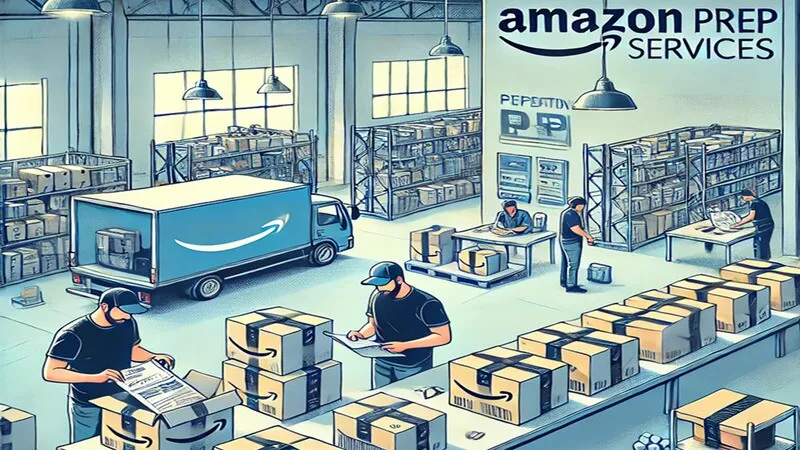
In this article
13 minutes
- Understanding Amazon FBA Prep Service Requirements
- What Are FBA Prep Services?
- The Benefits of Using FBA Prep Services
- Common Services Offered by FBA Prep Companies
- How to Choose the Right FBA Prep Service
- Understanding Amazon FBA Prep Services Pricing
- Top Amazon FBA Prep Centers for Ecommerce Fulfillment
- Amazon FBA Fulfillment Costs and Strategies
- Setting Up Your FBA Prep Service Relationship
- Potential Challenges and Solutions
- Conclusion
- Frequently Asked Questions
Selling on Amazon through the Fulfillment by Amazon (FBA) program offers tremendous opportunities for ecommerce entrepreneurs. The ability to leverage Amazon’s vast fulfillment network allows sellers to focus on growing their businesses rather than handling logistics. However, before products can enter Amazon’s fulfillment centers, they must meet specific preparation requirements. This is where FBA prep services come into play, offering a crucial intermediary step that can streamline operations and prevent costly mistakes, ultimately supporting the success of your Amazon business.
Understanding Amazon FBA Prep Service Requirements
Amazon maintains strict standards for products entering their fulfillment centers. These requirements ensure efficient processing, storage, and shipping of items to customers. Typical preparation needs include proper packaging, labeling, bundling, and protection measures tailored to different product categories.
For instance, fragile items require additional cushioning, while clothing might need polybags with suffocation warnings. Some products have category-specific packaging requirements, and expiration-dated products must display the expiration date on the outer box and on the individual units. Inventory that arrives with non-compliant or unsafe packaging may be refused or disposed of at the seller’s expense and may be ineligible for reimbursement.
These requirements can become overwhelming, especially for new sellers or those expanding their product lines. Meeting Amazon’s specifications demands time, knowledge, specialized materials, and dedicated workspace. This complexity has given rise to specialized FBA prep services that bridge the gap between manufacturers and Amazon’s fulfillment centers. As of January 1, 2026, Amazon no longer offers prep and item labeling services for FBA shipments in the US store, so sellers must handle prep internally or use a third-party prep provider.
What Are FBA Prep Services?
FBA prep services are third-party operations that handle the preparation of inventory according to Amazon’s guidelines before sending products to fulfillment centers. These specialized services act as intermediaries between suppliers or manufacturers and Amazon, ensuring products meet all requirements before entering the FBA ecosystem.
These services typically offer comprehensive solutions for the Amazon FBA seller, including receiving inventory from suppliers, inspecting for quality issues, preparing according to Amazon’s category-specific guidelines, labeling with Amazon barcodes, and finally shipping to designated fulfillment centers. Many also provide additional services such as photography, bundling, kitting, and removal of supplier packaging.
The primary goal of prep services is to ensure products comply with Amazon’s requirements, preventing costly rejections or penalties while saving sellers valuable time and resources.
The Benefits of Using FBA Prep Services
Outsourcing preparation tasks to specialized services offers numerous advantages for FBA sellers of all sizes.
Time savings represent one of the most significant benefits. Properly preparing inventory for Amazon can be labor-intensive and time-consuming. By delegating these tasks to professionals, sellers can redirect their energy toward strategic activities like product sourcing, marketing, and business growth.
Cost efficiency also plays a crucial role. While prep services charge fees, they often prove more economical than handling preparation in-house, especially when considering the expenses of warehouse space, packaging materials, equipment, and labor. For many sellers, the economies of scale achieved by prep services translate to lower per-unit costs.
Professional expertise is another key advantage. Established prep services stay current with Amazon’s frequently updated requirements and possess the knowledge to handle various product types correctly. Their experience minimizes the risk of costly mistakes that could lead to inventory rejections, returns, or customer dissatisfaction.
Scalability benefits become apparent as businesses grow. Using prep services eliminates the need to expand physical workspace or hire additional staff during growth phases or seasonal peaks. These services can typically accommodate fluctuating inventory volumes without requiring sellers to adjust their infrastructure.
Geographic advantages also merit consideration. Strategically located prep services can reduce shipping costs and transit times to Amazon’s fulfillment centers. Some services maintain facilities near major Amazon hubs, optimizing the final delivery leg of the supply chain.
Common Services Offered by FBA Prep Companies
The scope of fulfillment services offered varies between providers, but most cover fundamental preparation needs while offering specialized options for specific requirements.
Inspection serves as the foundation of quality control. Prep services examine incoming inventory for manufacturing defects, shipping damage, or inconsistencies before proceeding with preparation, potentially saving sellers from customer returns and negative reviews.
Packaging and protection ensure products arrive at customers in perfect condition. Services apply appropriate packaging materials according to Amazon’s guidelines and product vulnerability, which may include bubble wrap, air pillows, polybags, or custom solutions.
Labeling represents a critical compliance element. Prep services print and apply Amazon-compliant FNSKU labels, ensuring proper inventory tracking within Amazon’s system. Some also handle hazmat labels, expiration dates, or country of origin markings as required.
Bundling and kitting capabilities allow sellers to create multi-product offerings without handling the assembly themselves. Prep services can combine separate items into cohesive packages according to sellers’ specifications, creating value-added product bundles.
Inventory management features often include real-time tracking systems that allow sellers to monitor their products throughout the preparation process. Many services offer online portals where sellers can view inventory status, preparation progress, and shipping confirmations.
How to Choose the Right FBA Prep Service
Selecting an Amazon prep center requires careful consideration of several factors to ensure alignment with business needs.
Location considerations should account for proximity to suppliers and Amazon fulfillment centers. Strategic positioning can minimize shipping costs and transit times, accelerating inventory availability and reducing logistics expenses.
Pricing structures vary significantly between providers. Some charge per unit, others by weight, and some use hybrid models that include storage fees or minimum monthly charges. Understanding the fee structure and comparing total costs based on your specific product profile is essential.
Service capabilities should match your product requirements. Some prep services specialize in certain categories like apparel or electronics, while others provide broader support. Confirming they can handle your specific preparation needs prevents potential complications.
Technological integration capabilities merit evaluation, particularly for high-volume sellers. Services offering integration with inventory management systems, Amazon Seller Central, or other e-commerce platforms can streamline operations and reduce manual data entry.
Reputation and reliability should be thoroughly vetted. Reading reviews, requesting references, and testing services with small shipments before committing to larger volumes can prevent costly partnerships with underperforming providers.
Understanding Amazon FBA Prep Services Pricing
Amazon FBA prep services pricing can vary widely depending on the provider and the specific services offered. Typically, these services charge either by the item or by the volume of products being prepped. Some providers may also impose storage fees if products are held at their facility before being shipped to Amazon’s fulfillment centers.
When selecting an FBA prep service, it’s crucial to consider the pricing options and ensure they align with your business needs. Some providers offer discounts for bulk orders or long-term contracts, which can be beneficial for high-volume sellers. Others may charge extra for specialty services like kitting or bundling, so it’s important to understand all potential costs upfront.
To get the best value for your money, research and compare the pricing of different FBA prep services. Look for providers that offer transparent pricing, flexible payment options, and a clear breakdown of their services and costs. This due diligence can help you avoid unexpected expenses and ensure that the prep service you choose supports your business’s financial health.
Top Amazon FBA Prep Centers for Ecommerce Fulfillment
Choosing the right Amazon FBA prep center is crucial for the success of your ecommerce business. Here are some top Amazon FBA prep centers known for their reliability and comprehensive services:
- AMZ Prep: A full-service FBA partner with a global reach, AMZ Prep offers a wide range of services including FBA prep, shipping, and storage. Their extensive network and expertise make them a strong choice for sellers looking to streamline their operations.
- ShipMonk: Known for its strong focus on customer service, ShipMonk provides services such as opening and repackaging goods, labeling, and shipping. Their attention to detail and customer-centric approach make them a popular choice among Amazon sellers.
- Fulfillment by Amazon (FBA): Amazon maintains a vetted directory of third-party service providers, including FBA preparation services. Amazon no longer offers prep and item labeling services for FBA shipments in the US store.
- Cahoot: While FBA Prep isn’t Cahoot’s primary business model, we do have a business unit and workflow within the Cahoot software that guides users on exactly how to request prep and forwarding to FBA fulfillment centers.
When choosing an FBA prep center, consider factors such as their experience with Amazon, understanding of FBA prep requirements, pricing, and customer service. Look for providers that offer flexible services, transparent pricing, and a strong focus on customer satisfaction to ensure a smooth and efficient fulfillment process.
Amazon FBA Fulfillment Costs and Strategies
Amazon FBA fulfillment costs can be a significant expense for ecommerce businesses, but with the right strategies, you can minimize these costs and maximize your profits. Here are some tips to help you reduce your Amazon FBA fulfillment costs:
- Optimize Your Product Packaging: Proper packaging can help reduce shipping costs and prevent damage to your products. Using the right materials and packaging techniques can also ensure compliance with Amazon’s guidelines.
- Use Amazon’s Fulfillment Centers: Amazon’s fulfillment centers are strategically located to minimize shipping costs and ensure fast delivery. By utilizing these centers, you can take advantage of Amazon’s logistics network to improve efficiency and reduce expenses.
- Take Advantage of Amazon’s Free Services: Amazon offers a range of free services, including free storage for a limited time and customer returns handling. Leveraging these services can help you save money and streamline your operations.
- Monitor Your Inventory Levels: Keeping track of your inventory levels can help you avoid additional costs for aged inventory and ensure you’re not overstocking. Regularly reviewing your inventory can also help you make informed decisions about restocking and managing your supply chain.
- Use Amazon’s Revenue Calculator: Amazon’s revenue calculator can help you estimate your FBA costs and compare them to your own fulfillment method. This tool can provide valuable insights into your cost structure and help you identify areas for improvement.
By implementing these strategies, you can reduce your Amazon FBA fulfillment costs and increase your profits, ensuring a more efficient and profitable ecommerce business.
Setting Up Your FBA Prep Service Relationship
Establishing a smooth working relationship with your chosen prep service involves several key steps.
Initial onboarding typically requires creating an account with the prep service and providing essential business information. This process often includes completing seller profiles, specifying preparation instructions, and setting up billing arrangements.
Amazon permissions must be properly configured to allow the prep service to work on your behalf. This usually involves adding them as secondary users in Seller Central with appropriate permission levels. Properly configuring Amazon permissions ensures that the prep service can manage your FBA shipments efficiently and in compliance with Amazon’s standards.
Communication protocols should be clearly established, defining primary contact methods, response timeframes, and escalation procedures for urgent issues. Regular check-ins and feedback sessions can help optimize the partnership over time.
Standard operating procedures documentation proves invaluable for consistent operations. Developing clear instructions for how products should be handled, special preparation requirements, and quality standards ensures the prep service understands your expectations.
Performance monitoring should be ongoing, tracking key metrics like processing times, error rates, and overall cost-effectiveness. Regular performance reviews help identify improvement opportunities and ensure the service continues meeting business needs.
Potential Challenges and Solutions
While Amazon prep centers offer significant benefits, certain challenges may arise that require proactive management.
Quality control inconsistencies can occur, especially with high-volume operations or staff turnover. Establishing clear quality standards, conducting random inspections, and providing feedback on issues can help maintain consistent preparation quality.
Communication breakdowns represent another common challenge. Maintaining open channels, documenting instructions clearly, and establishing regular update mechanisms can prevent misunderstandings and ensure timely problem resolution.
Seasonal capacity constraints may affect service levels during peak periods like Q4. Planning ahead, providing volume forecasts to your prep service, and potentially distributing inventory across multiple services for critical periods can mitigate these challenges.
Conclusion
For Amazon sellers seeking to optimize their operations, FBA prep services offer a valuable solution that balances efficiency, compliance, and scalability. By understanding the range of services available, carefully selecting the right partner, and establishing clear working relationships, sellers can leverage these specialized intermediaries to streamline their supply chains and focus on strategic business growth.
Some prep services also offer multi-channel fulfillment, enabling sellers to expand their reach beyond Amazon to other platforms like Walmart and eBay. Whether you’re a new seller looking to avoid the learning curve of Amazon’s requirements or an established business seeking to scale without expanding infrastructure, the right prep service can transform your FBA operations. As with any business partnership, success depends on careful selection, clear communication, and ongoing management – but with these elements in place, prep services can become a cornerstone of an efficient, profitable Amazon selling strategy.
Frequently Asked Questions
What is Amazon FBA prep?
Amazon FBA prep refers to the process of preparing products for sale on Amazon, including packaging, labeling, and shipping. This ensures that products meet Amazon’s requirements and are ready for fulfillment.
What are the benefits of using an FBA prep service?
Using an FBA prep service can help you save time, reduce costs, and ensure compliance with Amazon’s guidelines. These services handle the intricate details of preparation, allowing you to focus on growing your business.
How do I choose the right FBA prep service?
When choosing an FBA prep service, consider factors like their experience with Amazon, understanding of FBA prep requirements, pricing, and customer service. Look for providers that offer transparent pricing and flexible services tailored to your needs.
What are the costs associated with FBA prep services?
FBA prep services typically charge by the item or by the volume of products being prepped. Some providers may also charge storage fees if products are held at their facility before being shipped to Amazon. It’s important to understand all potential costs upfront.
Can I use an FBA prep service for specialty products?
Yes, many FBA prep services offer specialty services like kitting, bundling, and custom packaging for products that require special handling. These services can help ensure that your products are prepared correctly and meet Amazon’s specific requirements.
Written By:
Indy Pereira
Indy Pereira helps ecommerce brands optimize their shipping and fulfillment with Cahoot’s technology. With a background in both sales and people operations, she bridges customer needs with strategic solutions that drive growth. Indy works closely with merchants every day and brings real-world insight into what makes logistics efficient and scalable.
Turn Returns Into New Revenue
Related Articles
What Is Demand Planning? How It Impacts Inventory, Forecasting, and Profitability
Demand planning is the process of estimating future customer demand so that a business can align its inventory, procurement, and operations to meet that demand without carrying mor...
Walmart Officially Allows Amazon Multi-Channel Fulfillment (MCF)
Big news for multichannel sellers: Walmart now officially allows Amazon Multi-Channel Fulfillment (MCF), Amazon’s service for using its fulfillment network to ship orders from mult...
The Shipping Speed Paradox: Why DTC Brands Are Slowing Down
Everyone’s talking about faster delivery.