
Is AI Commerce Already Here? Lessons From Cahoot’s Ugly Talk Panel
In this article
 13 minutes
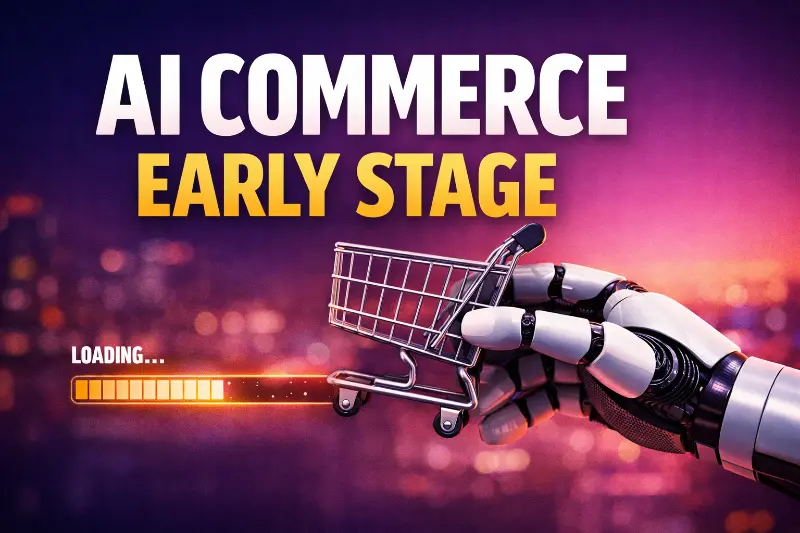
Last week in New York, Cahoot hosted a panel called Ugly Talk: Selling in a World Run by Algorithms. The goal of the discussion was simple: move past the hype around artificial intelligence and have an honest conversation about how algorithms are already shaping ecommerce.
The panel brought together operators and technologists who work directly in the ecommerce ecosystem. The discussion also introduced the concept of an agentic ecosystem—a complex, interconnected system that includes AI platforms, autonomous agents, infrastructure, payment systems, and enablers like traditional e-commerce platforms and fraud prevention tools. Participants included Manish Chowdhary, CEO of Cahoot; Nihar Kulkarni of Roswell NYC; Frank Pacheco, who leads Amazon strategy and execution for Nearly Natural; and YiQi Wu, co-founder of Aimerce. Rather than delivering prepared presentations, the group spent the evening debating how discovery, advertising, and customer data are changing the way products are found and purchased online.
One question kept resurfacing throughout the discussion:
Is AI commerce already here, or are we still early?
The answer, as it turned out, depended on who you asked.
These ideas are part of a broader framework for understanding how AI is reshaping ecommerce. The evolution of ecommerce is being driven not only by AI but also by new technologies that are disrupting traditional commerce and forcing fundamental changes in business models and customer engagement. For a complete breakdown of how discovery systems, product pages, brand authority, behavioral data, and fulfillment infrastructure interact, see The AI Commerce Playbook for Ecommerce Brands.
The Debate Around Agentic Commerce
“For the last twenty years ecommerce has largely been built around interfaces designed for humans — search bars, product grids, ads, landing pages. But something subtle is happening now. The first decision is increasingly being made by machines.” — Manish Chowdhary, Cahoot
Some panelists argued that the shift toward AI-driven discovery is already underway. Consumers are experimenting with conversational search interfaces, recommendation systems are becoming more sophisticated, and AI assistants are beginning to influence how shoppers evaluate products. This represents a significant transformation in the retail and e-commerce landscape fueled by AI advancements.
From this perspective, AI commerce isn’t something that will arrive years from now. It’s already emerging in subtle ways across the ecommerce ecosystem, fundamentally transforming the customer journey at every touchpoint.
Others on the panel took a more cautious view. While AI tools are improving quickly, the amount of ecommerce traffic coming directly from AI discovery interfaces remains small. Most shoppers today still rely on familiar channels: Google searches, marketplace browsing, paid ads, and social media recommendations.
Both perspectives reflect different parts of the same reality. The technology is advancing quickly, but consumer behavior takes longer to shift. This signals the emergence of a new paradigm in commerce driven by AI and automation.
That dynamic is typical whenever a new discovery system begins to emerge.
Ecommerce Has Seen This Pattern Before
For most of the history of online retail, product discovery has been controlled by a small number of dominant platforms. The evolution of e-commerce has seen a transformation from simple online catalogs to intelligent, AI-powered experiences that are reshaping how consumers find and purchase products.
In the early days of ecommerce, Google search became the primary gateway to online shopping. Brands learned to optimize their websites and product pages for search rankings. Entire industries emerged around keyword research, backlinks, and technical SEO, as well as practices to protect product listings from search suppression and other threats. E-commerce platforms were essential components of this ecosystem, enabling transactions and supporting the growth of online retail.
Later, marketplaces like Amazon introduced a different discovery model. Instead of competing for visibility on search engines, sellers competed inside marketplace ranking algorithms. Market and product research for Amazon sellers became critical, and reviews, pricing, fulfillment performance, and sales velocity became key signals influencing which products appeared first.
Social media platforms created yet another layer of algorithmic discovery. Instead of actively searching for products, consumers increasingly encountered them through feeds, influencer content, and targeted advertising, which in turn forced brands to rethink how they built a multichannel fulfillment and sales strategy.
Each shift changed how ecommerce brands competed for visibility. To remain competitive as discovery models evolve, businesses must adapt their existing systems—including legacy e-commerce platforms and fulfillment infrastructures—to support new technologies and consumer behaviors, especially as options like peer-to-peer fulfillment networks and Buy with Prime reshape expectations for fast, low-cost delivery.
The discussion at Ugly Talk suggested that AI-driven discovery may represent the next stage in that evolution.
How AI Changes Product Discovery
“Algorithms are deciding what products get recommended, what ads get shown, and what listings surface. In some cases, they may even decide what products get bought on behalf of the consumer.” — Manish Chowdhary
Traditional ecommerce search relies heavily on keywords. A shopper enters a phrase, and the platform returns a list of products that match those terms.
AI-driven discovery systems operate differently. Because they rely on language models and contextual understanding, they can interpret broader intent rather than just matching keywords. Generative AI leverages natural language processing to understand and process customer queries, enabling more conversational and intuitive interactions.
Instead of typing “carry-on luggage,” a shopper might ask an AI assistant a more natural question:
What’s the best lightweight suitcase for international travel?
Rather than returning a page of links, the AI might generate a synthesized answer that recommends several products, summarizes customer reviews, and explains why certain brands are a good fit.
In that scenario, the customer never performs a traditional search. The AI acts as an intermediary that interprets the question and generates product suggestions, and can even complete transactions or tasks on the user’s behalf, such as tracking price drops or executing purchases automatically.
For ecommerce brands, this creates a new kind of visibility challenge. Products may be surfaced not simply because they contain the right keywords, but because the system interprets them as relevant to the customer’s intent. The integration of AI transforms the entire shopping journey, making it more efficient, personalized, and predictive from product discovery to post-purchase services.
When Optimization Backfires
One moment during the panel highlighted how changes in discovery systems can have unexpected consequences.
Frank Pacheco, who works directly on Amazon strategy and execution for the home decor brand Nearly Natural, described a situation that many ecommerce operators will recognize. Product listings are often optimized aggressively for search algorithms, sometimes by adding keywords that improve ranking but do not accurately reflect the product itself.
In one example discussed during the panel, a product listing was updated to include a feature keyword that appeared highly relevant to search queries. The change improved visibility and conversion rates, at least initially. But over time, customers began purchasing the product with the expectation that it included that specific feature. When they discovered the feature did not exist, return rates increased and customer complaints followed.
The example illustrated an important point raised during the discussion: optimizing for algorithms without aligning with the real product experience can create operational problems later.
As discovery systems become more sophisticated, the signals they interpret may also become more nuanced. Instead of simply matching keywords, AI systems may rely more heavily on product context, reviews, and customer behavior. Additionally, automating tasks such as currency conversions, tax calculations, and compliance processes can streamline business operations and reduce manual effort, further enhancing efficiency across various functions, and educational resources like on-demand ecommerce strategy webinars can help operators keep pace with these changes.
That shift could make traditional keyword-driven optimization strategies less effective over time. As AI-driven systems become more complex, risk management becomes increasingly important to address challenges and vulnerabilities such as systemic failures, accountability issues, and data sovereignty concerns.
Building Consumer Trust in AI Commerce
As AI agents become the primary interface between consumers and online marketplaces, building consumer trust is emerging as a cornerstone for the widespread adoption of AI commerce. In this new era, where AI systems increasingly shape the entire shopping experience, businesses must prioritize transparency, accountability, and security to foster lasting relationships with their customers.
One of the most effective ways to build brand loyalty and customer loyalty is by leveraging AI-powered tools that deliver personalized shopping experiences. Generative AI can analyze customer data to recommend products tailored to individual preferences, while dynamic pricing models ensure that consumers receive fair and competitive offers. These innovations not only meet rising consumer expectations but also help brands stand out in a crowded digital world.
However, personalization alone is not enough. To truly earn consumer trust, businesses must ensure their AI systems are explainable, fair, and unbiased. This means deploying machine learning algorithms that actively detect and mitigate bias, conducting regular audits, and providing clear explanations for how decisions are made. Transparency around the collection and use of customer data is equally critical. By offering tiered access and opt-out options, businesses empower consumers to control their own information, reinforcing a sense of security and respect.
Visibility and credibility also play a vital role in trust-building. By investing in search engine optimization (SEO) and optimizing for search engines, businesses can increase their reach and connect with a broader target audience. A strong presence on online marketplaces, supported by trustworthy product data and transparent business practices, further enhances consumer confidence.
Staying agile is essential in this rapidly evolving landscape. AI-powered analytics platforms, such as those offered by Google Cloud, provide actionable insights into consumer behavior, enabling businesses to adapt quickly to shifting customer needs and preferences. By continuously refining their strategies based on real-time data, brands can future-proof their operations and maintain a competitive edge.
Ultimately, building consumer trust in AI commerce requires a multifaceted approach—one that combines advanced AI-powered tools, a commitment to transparency and fairness, robust SEO strategies, and a willingness to adapt quickly. For senior partners and decision makers at global leaders in commerce, prioritizing consumer trust is not just a best practice—it’s a necessity for thriving in the new era of agentic commerce. By doing so, businesses can ensure they remain relevant, resilient, and ready to meet the demands of tomorrow’s digital consumers.
Early Signals From the Market
Although AI-driven commerce is still developing, several signals suggest that the shift is beginning.
Major technology platforms are investing heavily in conversational shopping tools designed to help consumers compare products and make purchasing decisions. Ecommerce platforms are experimenting with AI-powered assistants that guide shoppers through product categories. Even advertising systems are evolving to incorporate machine learning models that determine which products are shown to which audiences. At the core of these advancements are powerful AI engines, which drive advanced search functionalities, product data enrichment, and supply chain optimization.
Operators on the panel noted that these changes are still subtle. Most ecommerce traffic continues to flow through traditional discovery channels. Google searches, marketplace browsing, and paid advertising remain the dominant sources of product discovery. “Right now the traffic coming from AI agents is still very small — less than half a percent of our sales. But it has already grown from almost nothing to something measurable.” — Frank Pacheco, Nearly Natural
But the emergence of new discovery tools suggests the environment is evolving. Businesses must stay agile to respond to new API strategies and platform interfaces, ensuring they can quickly adapt to technological innovations and maintain seamless agent interactions.
AI-driven tools are also enhancing customer engagement and improving consumer experiences by enabling personalized, dynamic, and tailored interactions that drive loyalty and satisfaction.
In addition, AI is optimizing logistics and fulfillment by improving inventory management, dynamically considering shipping costs, selecting cost effective fulfillment solutions, accommodating delivery preferences, and streamlining the supply chain for greater efficiency and speed—making advanced ecommerce shipping software for warehouse automation a core part of competitive operations.
In the early stages of technological shifts, the numbers rarely look dramatic. What matters is the direction of change.
Why Ecommerce Operators Should Pay Attention
For brands and ecommerce operators, the key takeaway from the panel discussion was not that AI commerce has already transformed online retail.
It hasn’t.
But history suggests that discovery systems tend to reshape the competitive landscape over time. Companies that recognize these shifts early often gain a meaningful advantage by rethinking and expanding their business models to adapt to agentic commerce and AI-driven transformation.
Brands that understood search engine optimization early were able to capture organic traffic before the field became crowded. Sellers who learned how Amazon’s ranking systems worked were able to dominate marketplace categories.
The same pattern could emerge with AI-driven discovery, especially as agent to agent interactions—where AI agents representing buyers and retailers conduct transactions autonomously—become more prevalent and rely on robust order fulfillment integrations with ecommerce partners to execute seamlessly across channels.
Understanding how AI systems interpret product information, brand authority, and customer behavior may eventually become a critical part of ecommerce strategy. Additionally, integrating and evolving payment systems to support AI-driven, autonomous transactions will be essential for staying competitive, just as selecting the right Amazon-focused 3PL shipping partners is critical for meeting service-level expectations in marketplace-driven commerce.
The Shift Is Beginning, But Not Finished
If the Ugly Talk panel made anything clear, it’s that the ecommerce industry is still in the early chapters of the AI commerce story.
The technology is evolving quickly, but the ecosystem has not yet fully adapted. Retail businesses are actively adapting their operations and technology infrastructure to thrive in an AI-native environment, focusing on modernization and strategic innovation. As recent news about ecommerce fulfillment innovations and partnerships shows, consumers are experimenting with new discovery tools, platforms are building new recommendation systems, and ecommerce operators are beginning to observe small changes in how shoppers find products.
For now, traditional discovery channels still dominate.
But the emergence of AI-assisted shopping suggests that the next phase of ecommerce competition may revolve around how algorithms interpret and recommend products, with a strong emphasis on creating seamless experiences for customers.
In other words, the rules of visibility may be changing again, as AI transforms the decision making process for both businesses and consumers.
And as the panel discussion made clear, the brands that begin paying attention now will be better positioned when those changes accelerate, especially if they stay close to the latest ecommerce logistics, fulfillment, and supply chain events shaping the next generation of commerce.
Click to learn how the first layer of modern ecommerce is discovery.
Written By:

Manish Chowdhary
Manish Chowdhary is the founder and CEO of Cahoot, the most comprehensive post-purchase suite for ecommerce brands. A serial entrepreneur and industry thought leader, Manish has decades of experience building technologies that simplify ecommerce logistics—from order fulfillment to returns. His insights help brands stay ahead of market shifts and operational challenges.

Turn Returns Into New Revenue
Related Articles

10 Best European 3PLs for Ecommerce Sellers in 2026
Bigblue is the best overall choice among the best European 3PLs in this comparison, while everstox, Paxon (including Active Ants), Fulfillment-Box, and Bleckmann are stronger picks...
Why Returns Are Becoming a Board-Level Topic
Returns have quietly become one of the most consequential financial problems in ecommerce, and boards are finally being forced to confront what operators have known for years: retu...

UCP Isn’t About Checkout. It’s About Who Gets to Understand Demand
Merchants are about to transact through AI agents without learning how the decision happened.
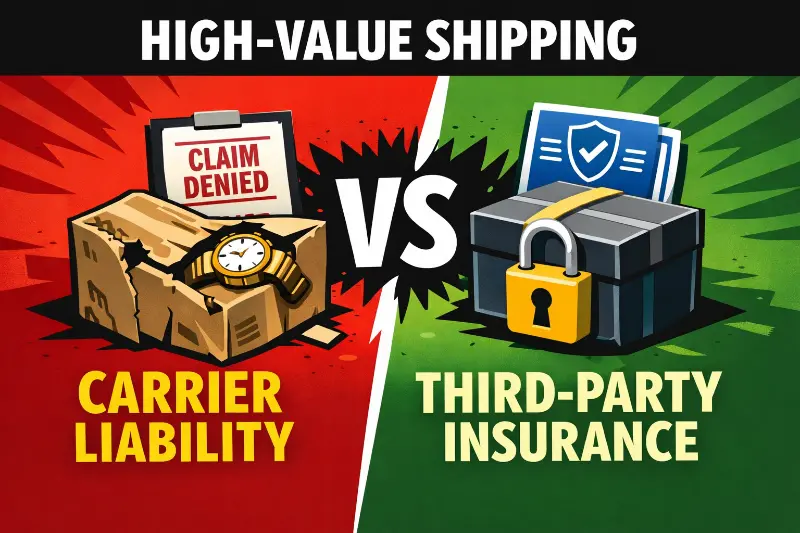
Shipping Insurance for High-Value Items: Carrier Liability vs Third-Party Coverage
In this article
19 minutes
- Introduction to Shipping High-Value Items
- Supply Chain Risks and Vulnerabilities
- Carrier liability is not insurance, and the distinction matters
- The $1,000 ceiling and other exclusions most merchants miss
- Why claims get denied and what the data shows
- Third-party coverage changes the cost and claims equation
- Operational requirements that determine whether claims succeed
- Customer Experience and Shipping Insurance
- Best Practices for Shipping
- Technology and Insurance Integration
- When self-insuring makes financial sense
- Frequently Asked Questions
Most ecommerce losses on high-value shipments are not caused by theft. They result from mismatched liability limits, policy exclusions, and claims processes that work against the shipper. Merchants who rely on default carrier coverage typically discover the gap between what they assumed was covered and what actually gets paid only after a package is lost or damaged. Understanding the structural differences between carrier liability, declared value coverage, and third-party insurance is the single most important step an operations leader can take before shipping valuable items.
This distinction matters because the default protection included with every shipment from major carriers caps out at $100 per package. For any brand shipping high-value goods (jewelry, electronics, luxury apparel, custom products), that $100 ceiling covers a fraction of the actual replacement cost. The good news: once you understand how each layer of coverage works, building an insurance strategy that fits your product mix, volume, and risk tolerance is straightforward. Shipping insurance can provide complete coverage for a broad range of high-value items, ensuring your valuable shipments are fully protected.
Introduction to Shipping High-Value Items
Shipping high-value items is a task that demands meticulous planning and attention to detail. Whether you’re sending precious metals, luxury goods, or other valuable shipments, the stakes are high—any loss or damage can result in significant financial loss and reputational harm. That’s why shipping insurance is essential for anyone shipping high-value items. By partnering with a trusted insurance provider, shippers can secure comprehensive coverage that protects their value items from the moment they leave the warehouse until final delivery. This extra layer of protection ensures that even if the unexpected happens, your high-value shipments are covered, and your business is shielded from costly setbacks. For businesses and individuals alike, investing in shipping insurance is a proactive step to safeguard luxury goods and precious items, providing peace of mind and financial security throughout the shipping process.
Supply Chain Risks and Vulnerabilities
The journey of high-value items through the supply chain is fraught with potential risks and vulnerabilities. From the initial handoff at the warehouse to the final delivery, high-value shipments can be exposed to theft, mishandling, environmental hazards, and even customs delays. Each stage of the supply chain presents unique challenges that can jeopardize the safety of value items and result in financial loss. To protect these shipments, businesses must identify high-risk points—such as transit hubs, storage facilities, and last-mile delivery routes—and implement robust security measures. Proactive risk management, including regular audits and contingency planning, is crucial for minimizing disruptions and ensuring the safe delivery of high-value items. By understanding and addressing these supply chain vulnerabilities, businesses can better protect their valuable shipments and maintain customer trust.
Carrier liability is not insurance, and the distinction matters
Both UPS and FedEx include $100 of declared value coverage per package at no extra charge. USPS includes up to $100 of coverage for Priority Mail, Priority Mail Express, and Ground Advantage shipments. These defaults apply automatically, and for shipments under $100, they may be sufficient. Beyond that threshold, the economics and the fine print diverge quickly.
This distinction matters because the default protection included with every shipment from major carriers caps out at $100 per package. Standard carrier liability generally covers only up to $100 unless a higher declared value is paid, and you may need to purchase additional insurance for shipments valued over $100 to ensure full protection.
The critical distinction that most merchants overlook: declared value coverage is not insurance. FedEx states this explicitly in its service guide. UPS uses similar language. Declared value sets the carrier’s maximum liability, meaning it caps what the carrier will pay, not what the carrier owes. To collect on a declared value claim, the shipper must prove the carrier was at fault for the loss or damage. That burden of proof is significant. If the carrier can attribute the issue to inadequate packaging, an excluded item category, or any cause outside its direct handling, the claim gets denied. Insurance limits and maximum declared values apply, and if your shipment exceeds these limits, you must purchase additional insurance to cover the full value.
USPS is the exception among major carriers in that it uses the term “insurance” and provides indemnity coverage. However, USPS caps standard insured mail at $5,000 per package domestically (Registered Mail extends to $50,000 but requires in-person mailing and chain-of-custody protocols). International coverage varies dramatically by destination country, with some nations capping coverage well below $1,000.
For merchants shipping high-value items, the surcharge math also deserves attention. Carrier declared value fees typically run $1.05 to $1.90 per $100 of coverage above the included default. Insurance rates are typically based on the declared value and can vary depending on package type. On a $2,000 item, that translates to roughly $20 to $36 in declared value surcharges with a carrier. Third-party insurance providers, by contrast, typically charge $0.50 to $1.25 per $100 of coverage, representing savings of 50 to 80 percent on the premium alone. Many third-party providers offer competitive rates, making them a cost-effective option for insuring high-value shipments.
The $1,000 ceiling and other exclusions most merchants miss
Beyond the default $100 cap, carriers impose category-specific limits that create coverage gaps for common ecommerce products. FedEx limits declared value to $1,000 for artwork, paintings, sculptures, antiques, collectibles, fine jewelry, precious metals, furs, and musical instruments (whether they are old, customized, or both). Items shipped in a FedEx Envelope or Pak are capped at $500 regardless of actual value. UPS imposes similar restrictions, limiting international jewelry shipments to $2,500 CAD without a special high-value waiver agreement. Many carriers have coverage limits and exclusions that can expose businesses to financial risk when shipping valuable goods.
These are not obscure edge cases. A Shopify brand selling handcrafted jewelry, vintage furniture, limited-edition prints, or high-end watches will hit these limits routinely. The carrier will accept the package, charge for shipping, and even collect the declared value surcharge. But if a claim arises, the payout caps at the category limit, not the declared amount.
Several other exclusions apply universally across carriers. Consequential damages (lost revenue, business interruption, customer acquisition costs) are never covered. Losses caused by weather events, natural disasters, or civil unrest fall outside carrier liability. Coverage applies only while the package is in the carrier’s custody, meaning porch theft after confirmed delivery is excluded. And perhaps most consequentially, damage attributed to improper packaging results in automatic denial. When evaluating insurance options, keep in mind that the best shipping carrier will have insurance options to cover your most expensive SKU without exceeding its maximum value for coverage.
Why claims get denied and what the data shows
Inadequate packaging is the leading cause of claim denials across all carriers. Carriers publish specific packaging guidelines covering box strength ratings, cushioning materials, void fill, and drop-test standards. A shipment that fails to meet these requirements, even if the carrier clearly mishandled it, faces a strong likelihood of denial. USPS reports an approximate 38 percent claim rejection rate, while industry analysis suggests UPS and FedEx deny roughly 30 to 50 percent of claims depending on the type (damage claims are denied more frequently than loss claims). The claim process for shipping insurance for high-value items requires careful attention—documentation like photos and recent appraisals is crucial for claims on high-value items.
Other common denial triggers include late filing (each carrier enforces strict windows, ranging from 21 to 60 days depending on the carrier and claim type), missing documentation (no photos, no proof of value, no original packaging retained), and misdeclared value. You must provide proof of value, such as invoices or receipts, when filing a claim for high-value items, and documentation of damage at the receiving process is essential. Claims for high-value items typically have shorter filing deadlines, often between 15 to 30 days. Filing a claim after disposing of the original packaging is almost always fatal to the claim regardless of how strong the other evidence may be.
The timeline compounds the problem. Carrier claims processes typically take 30 to 90 days from filing to resolution. Shipping insurance claims can take several months to resolve, which can create financial burdens for shippers. During that period, the merchant has already absorbed the cost of a replacement or refund. For high-value shipments, that cash flow gap can be operationally significant. To file a claim for shipping insurance, you must provide essential documentation such as the value of the insured item, tracking number, carrier’s name, and a description of the contents, and you must prove the carrier is responsible for the loss or damage to receive reimbursement.
Third-party coverage changes the cost and claims equation
Third-party shipping insurance operates on a fundamentally different model. Rather than requiring proof of carrier fault, most third-party policies function as “all-risk” coverage: any cause of loss or damage during transit is covered unless specifically excluded. Selecting ‘All-Risk’ coverage offers the most comprehensive protection and complete coverage for a broad range of high-value items, including international shipments. This shifts the burden of proof from the shipper to the insurer. Coverage typically extends door-to-door rather than only while in the carrier’s possession, and most providers cover porch theft, which carrier liability does not. Third-party shipping insurance generally provides coverage for theft after delivery, which is a limitation of standard carrier options. One-time shipping insurance is also available as a straightforward, single-use coverage option that can be quickly purchased online.
Claims resolution is substantially faster. Industry benchmarks show third-party providers resolving claims in 7 to 10 business days on average, with some providers processing approvals in under 48 hours. Several providers offer paperless claims portals, eliminating the multi-step documentation processes that carriers require. Secursus.com displays an online calculator to check the price for insuring a package in real time.
For cost comparison, consider a $1,000 item. Carrier declared value surcharges run approximately $12 to $20. Third-party insurance for the same value typically costs $5 to $10. At $5,000, the gap widens further: carriers charge roughly $50 to $95 while third-party providers charge $25 to $38. Third-party insurance can be up to 50% cheaper than limited liability coverage offered by carriers, and specialized third-party insurance for shipping high-value items often provides better, more cost-effective coverage. Specialty providers serving luxury goods, fine jewelry, and high-value merchandise offer coverage up to $150,000 per package, well beyond the $50,000 ceiling that UPS and FedEx impose. Specialized third-party insurers can offer coverage limits ranging from $150,000 to $200,000 per package for high-value items, and Parcel Pro provides package insurance that aligns with the true value of your shipment, ensuring full value reimbursement in case of loss, damage, or theft. UPS Capital is a provider of specialized shipping insurance solutions, and UPS offers insurance options that can cover packages valued up to $50,000, depending on how you ship. You can insure a FedEx package for up to $50,000 with certain overnight, 2-day, or 3-day services, and FedEx has a high-value jewelry program with insurance limits of $100,000 for domestic parcels, available to shippers with a FedEx account. Package insurance is available for high-value shipments and can provide full value reimbursement in case of loss, damage, or theft.
The tradeoffs are real, though. Third-party providers maintain their own exclusion lists (perishables, cash equivalents, hazardous materials subject to USPS hazmat rules, and sometimes specific electronics categories). International coverage limits and pricing vary by provider and destination. And integration quality matters: the most effective implementations automate insurance purchasing at the label-creation stage based on order value rules, eliminating the risk of human error on high-value shipments. Many specialty providers and fulfillment centers also offer extra services such as kitting, pick and pack fulfillment, and specialized handling to enhance the customer experience and differentiate your brand.
Operational requirements that determine whether claims succeed
Successful claims depend on documentation assembled before the shipment leaves the warehouse, not after a problem arises. The operational requirements are consistent across both carrier and third-party claims:
- Photograph each order at the packing station before sealing, capturing items alongside the invoice or packing slip with serial numbers visible
- Document packaging materials and process (cushioning, void fill, box condition) with timestamped images linked to order IDs
- Retain all original packaging and damaged goods until the claim is fully resolved, as carriers may require physical inspection
- File claims within the carrier’s or insurer’s deadline (ranging from 21 to 120 days depending on provider and claim type)
- Maintain proof of value through commercial invoices, purchase receipts, detailed packing slips, or professional appraisals, particularly for items without standard retail pricing
High-value products often require special handling and meticulous receiving processes to ensure proper documentation for claims.
Warehouse teams that build these steps into standard operating procedures convert claims documentation from a reactive scramble into a routine workflow. Overhead cameras at packing stations, barcode-linked video logging, and automated claim-filing software all reduce the per-order cost of maintaining claims-ready records. Documentation, security cameras, and professional claims handling, supported by advanced ecommerce shipping software, maximize shipping insurance reimbursement and protect high-value inventory.
Customer Experience and Shipping Insurance
Delivering a positive customer experience is vital for any business, especially when shipping high-value items. Customers expect their valuable shipments to arrive safely and on time, and offering shipping insurance as part of thoughtful free shipping pricing strategies is a powerful way to meet—and exceed—those expectations. By providing insurance coverage for high-value items, businesses demonstrate a commitment to customer satisfaction and service excellence. This not only builds trust and loyalty but also supports business growth by encouraging repeat purchases and positive word-of-mouth. Shipping insurance also helps reduce the risk of disputes and costly claims, streamlining the resolution process if issues arise. Ultimately, investing in shipping insurance enhances the overall customer experience, protects your business reputation, and ensures that both you and your customers are covered when it matters most.
Best Practices for Shipping
To ensure the safe and secure delivery of high-value shipments, businesses should follow a set of proven best practices. Start by selecting a reputable shipping carrier with a strong track record for handling high-value items, and always purchase shipping insurance to protect against potential loss or damage. Use high-quality packaging materials and reinforce packages to withstand the rigors of transit, clearly labeling contents and value where appropriate. Maintain detailed records for each shipment, including tracking numbers and delivery confirmation, to facilitate quick resolution in case of shipping issues. It’s also important to have a response plan in place for any incidents, ensuring that your team can act swiftly to protect your packages and minimize disruption. By adhering to these best practices, you can significantly reduce risk and ensure your high-value items reach their destination safely.
Technology and Insurance Integration
Advancements in technology have transformed the way businesses manage high-value shipments and shipping insurance. Modern shipping platforms now offer seamless integration with insurance providers, allowing businesses to purchase coverage, factor in FedEx and UPS surcharge mitigation strategies, and track high-value shipments in real time. This integration enhances operational efficiency by automating insurance decisions based on shipment value and streamlining the claims process with digital documentation and faster approvals. Real-time tracking and automated alerts provide greater visibility and control, enabling businesses to respond quickly to any issues and deliver a superior customer experience. As technology continues to evolve, integrating shipping insurance solutions will become even more essential for protecting high-value shipments, improving service, and driving business success.
When self-insuring makes financial sense
For high-volume merchants shipping lower-value products, self-insurance deserves serious consideration. The calculation is straightforward: if your annual expected loss (total shipments multiplied by your loss/damage rate multiplied by average item value) is lower than the total annual premium you would pay for insurance, self-insuring saves money. Not everyone needs shipping insurance, but companies shipping high-value items cannot afford shrinkage as a cost.
Industry loss and damage rates for ecommerce typically fall between 1 and 3 percent of shipments, though this varies significantly by product category, carrier, packaging quality, whether you’re shipping heavy items, and season. A merchant shipping 10,000 packages per month at an average value of $40 with a 2 percent damage rate faces roughly $96,000 in annual expected losses. At $0.50 per package for third-party insurance, annual premiums would total $60,000, making insurance the better choice. But for a similar merchant shipping $15 average-value items, the expected loss drops to $36,000, and self-insuring with a reserve fund becomes more attractive.
The hybrid approach is most common among mid-market operators: self-insure items below a set threshold (often $50 to $100), purchase third-party coverage for items above that threshold, and use specialty coverage for anything above $5,000. Setting aside 1 to 3 percent of shipping spend in a dedicated reserve fund provides the financial cushion for self-insured losses.
Frequently Asked Questions
What is the difference between carrier liability and shipping insurance?
Carrier liability (also called declared value coverage) sets the maximum amount a carrier will pay for loss or damage, but requires the shipper to prove the carrier was at fault. It is not insurance. FedEx and UPS explicitly state this in their service guides. To collect on a declared value claim, shippers must demonstrate carrier negligence and meet strict packaging requirements. True shipping insurance (available from USPS or third-party providers) functions as all-risk coverage where any cause of loss or damage during transit is covered unless specifically excluded, shifting the burden of proof from shipper to insurer.
How much does carrier declared value coverage cost compared to third-party insurance?
Carrier declared value fees typically run $1.05 to $1.90 per $100 of coverage above the included $100 default. For a $2,000 item, this translates to roughly $20 to $36 in surcharges. Third-party insurance providers typically charge $0.50 to $1.25 per $100 of coverage, representing 50% to 80% savings. For a $5,000 item, carriers charge approximately $50 to $95 while third-party providers charge $25 to $38. The cost gap widens as item value increases, making third-party insurance substantially more economical for high-value shipments.
What are the category-specific coverage limits carriers impose on high-value items?
FedEx limits declared value to $1,000 for artwork, paintings, sculptures, antiques, collectibles, fine jewelry, precious metals, furs, and musical instruments. Items shipped in FedEx Envelope or Pak are capped at $500 regardless of actual value. UPS imposes similar restrictions, limiting international jewelry shipments to $2,500 CAD without special agreements. These limits apply even if you pay for higher declared value coverage. Carriers will accept the package, charge shipping and declared value surcharges, but claims payout caps at the category limit, not the declared amount.
Why do carrier claims get denied and how common are denials?
Inadequate packaging is the leading cause of claim denials. Carriers enforce strict packaging guidelines covering box strength, cushioning, void fill, and drop-test standards. Even with clear carrier mishandling, shipments not meeting these requirements face denial. USPS reports approximately 38% claim rejection rate. Industry analysis suggests UPS and FedEx deny 30% to 50% of claims depending on type (damage claims denied more frequently than loss claims). Other common denial triggers include late filing (21-60 day windows), missing documentation (no photos, no proof of value, no original packaging retained), and misdeclared value.
How long do carrier claims take to resolve compared to third-party insurance claims?
Carrier claims processes typically take 30 to 90 days from filing to resolution. During this period, merchants have already absorbed replacement or refund costs, creating significant cash flow gaps on high-value shipments. Third-party insurance providers resolve claims in 7 to 10 business days on average, with some processing approvals in under 48 hours. Several third-party providers offer paperless claims portals that eliminate the multi-step documentation processes carriers require, further accelerating resolution timelines.
What documentation is required to successfully file a shipping insurance claim?
Successful claims require documentation assembled before shipment leaves the warehouse: (1) Photographs of each order at packing station before sealing, showing items alongside invoice/packing slip with serial numbers visible; (2) Documentation of packaging materials and process (cushioning, void fill, box condition) with timestamped images linked to order IDs; (3) All original packaging and damaged goods retained until claim fully resolved (carriers may require physical inspection); (4) Proof of value through commercial invoices, purchase receipts, or professional appraisals; (5) Claims filed within deadline (21-120 days depending on provider). Filing after disposing of original packaging is almost always fatal to claims.
When does self-insuring make more sense than purchasing shipping insurance?
Self-insurance makes financial sense when annual expected loss is lower than total annual insurance premiums. Calculate: (total shipments) x (loss/damage rate) x (average item value). Industry loss/damage rates typically fall between 1% and 3% of shipments. Example: 10,000 packages/month at $40 average value with 2% damage rate = $96,000 annual expected loss versus $60,000 in third-party premiums ($0.50/package), making insurance better. At $15 average value, expected loss drops to $36,000, making self-insurance with a reserve fund more attractive. The hybrid approach is most common: self-insure items below $50-$100, purchase coverage above that threshold.
What are the main advantages of third-party shipping insurance over carrier declared value coverage?
Third-party insurance offers: (1) All-risk coverage without requiring proof of carrier fault; (2) 50%-80% lower cost per dollar of coverage; (3) Claims resolution in 7-10 days versus 30-90 days for carriers; (4) Door-to-door coverage including porch theft (excluded from carrier liability); (5) Higher coverage limits (up to $150,000 per package versus $50,000 carrier ceiling); (6) Fewer category-specific exclusions for high-value items like jewelry and artwork; (7) Paperless claims portals versus multi-step carrier processes. Tradeoffs include third-party exclusion lists (perishables, hazardous materials), variable international coverage, and integration quality requirements.
Written By:

Rinaldi Juwono
Rinaldi Juwono leads content and SEO strategy at Cahoot, crafting data-driven insights that help ecommerce brands navigate logistics challenges. He works closely with the product, sales, and operations teams to translate Cahoot’s innovations into actionable strategies merchants can use to grow smarter and leaner.
Turn Returns Into New Revenue
Related Articles
10 Best European 3PLs for Ecommerce Sellers in 2026
Bigblue is the best overall choice among the best European 3PLs in this comparison, while everstox, Paxon (including Active Ants), Fulfillment-Box, and Bleckmann are stronger picks...
Why Returns Are Becoming a Board-Level Topic
Returns have quietly become one of the most consequential financial problems in ecommerce, and boards are finally being forced to confront what operators have known for years: retu...
UCP Isn’t About Checkout. It’s About Who Gets to Understand Demand
Merchants are about to transact through AI agents without learning how the decision happened.
Why Shipping Prices Are So High (And What Merchants Can Actually Control)
In this article
23 minutes
- Introduction to Shipping Costs
- Dimensional weight changed the economics of ecommerce shipping
- Shipping zones create a distance tax most merchants ignore
- Fuel, labor, and network congestion are structural forces, not temporary spikes
- Poor inventory placement compounds every other cost
- Returns quietly erode shipping budgets
- Shipping Insurance and Liability
- Technology and Shipping
- Third-Party Logistics (3PL)
- What merchants can and cannot control
- Conclusion and Recommendations
- Frequently Asked Questions
Shipping prices feel high because most merchants encounter the cost after it has already been locked in by poor routing, bad inventory placement, and inefficient service selection. The structural economics of parcel shipping have shifted dramatically since 2015, and the forces driving costs upward are real. The surge in online shopping and increased consumer demand during the pandemic put additional pressure on the shipping industry and contributed to higher shipping costs. Shipping costs today are influenced by these ongoing challenges, and shipping rates have increased since the pandemic’s disruptions. But the gap between what merchants assume they can control (carrier pricing) and what actually moves the needle (operational decisions) is where the real opportunity lives. Understanding that distinction is the difference between absorbing rising costs and actively managing them.
U.S. parcel shipping costs have increased more than 40% over the past five years, according to the Pitney Bowes Parcel Shipping Index. Annual carrier rate increases of 5.9% have become the norm, fuel surcharges have decoupled from actual fuel prices, and labor costs have permanently reset higher. None of those forces are going away. In addition, global supply chains have faced significant disruptions due to the COVID-19 pandemic, leading to ongoing shipping delays and higher costs that continue to affect shipping prices. But for every dollar a merchant spends on shipping, a meaningful share is determined not by carrier economics, but by decisions the merchant made (or failed to make) about packaging, inventory location, service selection, and return policy design.
Introduction to Shipping Costs
Shipping costs have become a central concern for many businesses, especially as ecommerce continues to grow and customer expectations for fast, affordable delivery rise. The cost of shipping is shaped by a complex mix of factors, including high shipping costs driven by fluctuating fuel prices, rising labor costs, and the specific shipping services selected. For many businesses, these expenses can quickly add up, impacting profit margins and overall competitiveness. As the cost of shipping continues to climb, understanding what drives these increases—and what can be done to achieve lower shipping costs—has never been more important. By analyzing the key contributors to shipping costs, such as fuel prices and labor costs, businesses can make informed decisions to optimize their shipping strategies and better manage their bottom line. In today’s market, a proactive approach to shipping is essential for controlling costs and maintaining a competitive edge.
Dimensional weight changed the economics of ecommerce shipping
The single most misunderstood cost driver in ecommerce shipping is dimensional weight (DIM weight). Before 2015, carriers charged ground shipments by actual weight alone. That year, UPS and FedEx expanded DIM weight pricing to all ground packages, fundamentally shifting from a weight-based to a space-based pricing model.
The formula is straightforward: multiply the package’s length, width, and height in inches, then divide by the carrier’s DIM factor (139 for UPS and FedEx commercial accounts, 166 for USPS on packages exceeding one cubic foot). The carrier compares DIM weight to actual weight and bills whichever is greater.
For ecommerce, this is particularly punishing. The average ecommerce package weighs 1 to 3 pounds but ships in a box roughly 18 by 16 by 6 inches. At a DIM factor of 139, that box calculates to about 12 pounds of billable weight. A 2-pound pillow in a 20-by-16-by-12-inch box becomes 28 pounds on the invoice. An estimated 70% of ecommerce packages are now billed by DIM weight rather than actual weight, according to Practical Ecommerce.
The problem compounds with poor packaging practices. The average ecommerce package contains over 50% empty space. Every unnecessary inch of box dimension inflates billable weight. The choice of packaging materials also plays a significant role in overall shipping and fulfillment costs, as using the right materials can reduce empty space, protect products, and help control expenses. And as of August 2025, both FedEx and UPS round every fractional inch upward to the next whole inch before calculating DIM weight, meaning a box measuring 11.1 inches on any side gets billed as 12. That seemingly small change pushes packages into higher weight tiers and can trigger additional handling surcharges.
The cost of shipping a package includes not just transportation, but also fuel, labor, packaging materials, and logistics infrastructure.
Shipping zones create a distance tax most merchants ignore
Shipping zones compound the DIM weight problem in ways that catch merchants off guard. Carriers divide the country into zones (typically 2 through 8 for domestic ground) based on the distance between origin and destination ZIP codes. Zone 2 covers roughly 50 to 150 miles from your warehouse. Zone 8 means coast to coast.
The cost difference is substantial. A 5-pound FedEx Ground package costs $11.98 to Zone 2 but $18.42 to Zone 8, a 54% premium. For heavier packages, the gap widens further. When you layer in fuel surcharges (currently around 18% for ground), residential delivery surcharges ($3.70 to $5.55 per package), and delivery area surcharges ($7.50 to $15.00 in thousands of ZIP codes), a Zone 8 shipment can cost 80 to 90% more than a Zone 2 shipment for the same item in the same box. Optimizing warehouse locations can reduce shipping zones, thus keeping down fees.
Here is where DIM weight and zones multiply together. A lightweight, bulky product that calculates to 37 pounds of DIM weight shipped to Zone 8 might cost $35 to $40. The same product at actual weight shipped to Zone 2 would cost around $12. The merchant who estimated shipping costs based on actual product weight and nearby customers is now looking at three to four times their expected cost per order. For a business shipping 1,000 packages monthly, the difference between serving primarily Zone 2 to 3 customers versus Zone 7 to 8 customers can exceed $100,000 in additional annual shipping costs, not to mention the additional costs that can arise from inefficient zone management.
Fuel, labor, and network congestion are structural forces, not temporary spikes
Beyond the mechanics of how carriers price individual packages, the base cost of moving goods through carrier networks has permanently increased. These are forces no individual merchant can influence, and understanding them matters because it clarifies where operational energy is better spent.
Fuel surcharges were introduced as temporary adjustments in the early 2000s. They are now permanent revenue tools. Fluctuations in global oil markets and oil prices have a direct impact on fuel costs, which in turn influence shipping expenses and fuel surcharges. When gas prices rise, carriers add fuel surcharges, especially for express shipping methods, leading to higher costs for shippers. Fuel costs surged during the pandemic, leading to increased shipping costs, and shipping companies often implement fuel surcharges to cope with fluctuating oil prices. According to parcel audit firm Shipware, the correlation between actual diesel prices and fuel surcharge percentages was 0.85 before COVID. By 2023 to 2025, that correlation flipped to negative 0.50, meaning surcharges continued rising even as fuel prices returned to historical norms. UPS Ground fuel surcharges currently sit at 18.25%, and FedEx has implemented multiple surcharge table increases through 2025 and into 2026.
Labor costs underwent a structural reset. Labor shortages in the shipping industry are also driving up costs. The 2023 UPS-Teamsters contract, the largest private collective bargaining agreement in North America, put $30 billion in new labor costs on the table over five years. Full-time UPS drivers will earn $49 per hour by 2027. Warehouse wages across the industry jumped from a pre-pandemic range of $14 to $18 per hour to roughly $23 per hour, a level that has not reverted. UPS has stated explicitly that these costs flow through to pricing.
Inflation has caused the cost of goods needed by shipping companies, including packaging and fuel, to rise, further increasing overall shipping expenses.
Annual General Rate Increases of 5.9% have become standard from both UPS and FedEx, with USPS implementing similar increases under its 10-year “Delivering for America” restructuring plan. But the stated 5.9% understates real-world impact. When surcharge increases, expanded delivery area surcharge ZIP codes, tighter DIM rounding rules, and mid-year adjustments are included, the effective annual cost increase for most merchants lands between 8 and 12%.
Meanwhile, last-mile delivery now accounts for 53% of total shipping costs, up from 41% in 2018. This is the most labor-intensive, least efficient segment of the supply chain, and it is where the majority of ecommerce spending concentrates.
Poor inventory placement compounds every other cost
Of all the factors within a merchant’s control, inventory placement has the largest impact on total shipping spend and the efficiency of order fulfillment. Where inventory is stored directly affects how quickly and cost-effectively customer orders can be picked, packed, and shipped.
A single warehouse on the East Coast means roughly 70% of customers may fall into Zones 5 through 8, where costs are highest and transit times are longest. A single warehouse on the West Coast creates the same problem in reverse.
Distributing inventory across two or three fulfillment locations can virtually eliminate Zone 7 and 8 shipments. Three strategically placed warehouses (typically West Coast, Central, and East Coast) can shift 85% of customers into Zones 1 through 4, reducing average shipping cost from roughly $12 to $7 per order. Industry data from multiple 3PLs shows that adding a second fulfillment center saves approximately 10% on parcel shipping costs, while a third location can push savings to 25 to 30%. A fulfillment partner, such as a 3PL provider, can manage shipping and distribution across these centers, leveraging their carrier relationships and expertise to negotiate better rates and streamline operations; understanding how to choose the right 3PL company is therefore critical for long-term cost control.
The savings also cascade. Lower zones mean faster ground transit times, which means fewer customers need expedited service to receive packages within expected windows. Brands using distributed inventory with ground shipping can reach 89% of the lower 48 states within two days, eliminating the need for express service on most orders and saving roughly 41% on delivery costs that would otherwise go to premium services. 3PLs often provide real-time inventory management systems to monitor stock levels, helping businesses avoid overstocking and reducing the costs associated with rush orders or stockouts, but merchants also need a clear understanding of 3PL costs for ecommerce fulfillment to evaluate the true impact on their shipping budgets.
There is an important caveat. Splitting inventory across locations adds complexity: duplicate safety stock, additional warehouse management overhead, increased fulfillment costs, and technology integration costs. While splitting inventory across multiple fulfillment centers can cut shipping costs and delivery times, it also increases the true cost of fulfillment. The economics generally favor distributed fulfillment only for merchants shipping 50 to 100 or more orders daily or generating $5 million or more in annual revenue. For smaller operations, the added costs of a second warehouse can outweigh the shipping savings.
Returns quietly erode shipping budgets
Returns are the most overlooked shipping cost multiplier in ecommerce, especially for online sales, which experience high return rates, and higher ecommerce return rates can significantly erode profit margins if not actively managed. The average online return rate sits at 20.4%, roughly three times the in-store rate, and many brands are now looking for strategies to address the rise of e-commerce return rates before these costs spiral further. For apparel and fashion brands, return rates regularly reach 25 to 40%. Each return triggers a cascade of costs that extend well beyond the return shipping label. Returns drive up shipping costs for ecommerce store owners, putting additional pressure on shipping budgets.
Processing a single return costs between $10 and $33 when accounting for the return label ($8 to $12), inspection and processing ($5 to $8), restocking ($2 to $4), and customer service overhead ($2 to $5). Only 48% of returned products are resold at full price, meaning inventory depreciation adds another 10 to 40% of product value on top of processing costs. At a 20% return rate on $500,000 in annual revenue, direct return processing costs alone reach $25,000 to $33,000 before any inventory markdowns.
For shipping budgets specifically, returns effectively double the transportation cost on every affected order. The outbound shipment and the return shipment both consume carrier capacity and carrier pricing, but only one of them generated revenue. This makes return rate reduction one of the highest-leverage operational improvements a merchant can pursue, and crafting the perfect e-commerce returns program is often just as impactful as negotiating carrier contracts. Better product descriptions address 22% of returns caused by items not matching expectations. Size and fit tools tackle the 67% of fashion returns driven by sizing issues. And exchange-first return flows retain revenue that refund-first policies surrender entirely.
Shipping Insurance and Liability
Shipping insurance and liability coverage are essential elements of the shipping process, providing businesses with a safety net against the unexpected. Whether shipping domestically or internationally, the risk of loss, theft, or damage to goods in transit is always present. Shipping insurance helps offset the cost of shipping by reimbursing businesses for the value of lost or damaged items, while liability coverage protects against potential legal claims that may arise from shipping incidents. However, these protections come at a price, adding to the overall cost of shipping. It’s important for businesses to carefully evaluate their shipping insurance options, balancing the cost of premiums with the level of risk they are willing to assume. By selecting the right coverage, businesses can safeguard their assets and ensure that the shipping process does not expose them to unnecessary financial risk, all while keeping a close eye on the total cost of shipping.
Technology and Shipping
Advancements in technology have dramatically reshaped the shipping industry, offering businesses new ways to reduce shipping expenses and enhance customer satisfaction. Automated shipping systems, real-time tracking, and advanced analytics now allow companies to manage their shipping operations with greater precision and efficiency. These innovations help reduce costs by optimizing delivery routes, minimizing delays, and streamlining the transport of goods. Technology has also enabled the rise of new shipping services, such as same-day delivery and dynamic rate shopping, which can improve delivery times and provide a better experience for customers while helping merchants react quickly to carrier rule changes like UPS matching FedEx on dimensional weight rounding. By embracing the latest shipping technologies, businesses can not only lower their shipping expenses but also ensure that their products arrive on time, boosting customer satisfaction and loyalty in a highly competitive market.
Third-Party Logistics (3PL)
Third-party logistics (3PL) providers have become indispensable partners for businesses navigating the complexities of the shipping industry, and for smaller brands in particular, choosing the best 3PL for small business can determine whether shipping costs scale efficiently as order volume grows. By outsourcing key logistics functions—such as warehousing, distribution, freight forwarding, and customs clearance—to a 3PL, companies can tap into specialized knowledge and benefit from advanced infrastructure without the need for significant internal investment. 3PL providers help reduce costs by leveraging economies of scale, optimizing shipping routes, and providing access to a broader range of shipping options. For many businesses, especially those experiencing growth or managing high order volumes or selling on major marketplaces like Wayfair, partnering with a 3PL can simplify the shipping process, improve efficiency, and free up resources to focus on core business activities by relying on the best 3PL for Wayfair order fulfillment or similar marketplace-specialized providers. Whether you’re a small business looking to scale or a large enterprise seeking to streamline operations, working with a 3PL can be a strategic move to stay competitive in the ever-evolving shipping industry.
What merchants can and cannot control
The most productive framing for shipping cost management is a clean separation between fixed market forces and controllable operational decisions. Merchants cannot influence base carrier rates, annual General Rate Increases, fuel surcharges, labor market dynamics, regulatory costs, peak season demand surcharges, or residential delivery surcharges. These are structural inputs set by carriers and the broader economy.
What merchants can control falls into several categories, ranked by typical cost impact:
- Inventory placement is the single largest lever at scale, capable of saving $20,000 or more per month for brands shipping 5,000 or more orders monthly, by reducing average shipping zones from 5 to 6 down to 2 to 3
- Packaging right-sizing delivers 20 to 40% reductions in DIM weight costs through tighter box selection, poly mailers for flexible goods, and elimination of excess void fill
- Return rate reduction through better product information, sizing tools, and exchange-first policies lowers the effective shipping cost per net sale
- Multi-carrier rate shopping saves $3 to $7 per package by comparing rates across carriers for each individual shipment in real time, rather than defaulting to a single carrier. Regularly comparing carrier rates helps businesses secure competitive rates and find better deals.
- Service level optimization matches delivery speed to actual customer expectations, using ground service from well-placed inventory instead of paying express premiums. Using ground shipping when speed isn’t critical can provide the best mix of cost and delivery time.
- Negotiating rates with carriers can lead to significant savings, especially for the business owner who leverages shipment volume or partners with 3PL providers. Most businesses rely on a combination of shipping methods and strategies to optimize costs, including diversifying shipping companies to reduce expenses.
- Using cloud-based shipping software can optimize shipping operations and further reduce costs.
Zone skipping (consolidating packages into bulk freight for injection closer to destinations) offers additional savings of 25 to 40% on long-distance routes, though it typically requires volume of 100 or more packages daily heading to the same region. Making shipping more cost-effective through shipment consolidation, leveraging economies of scale, and established carrier relationships can result in lower costs and more competitive rates for most businesses.
Conclusion and Recommendations
Shipping costs remain a complex challenge for businesses of all sizes, but with the right strategies, it is possible to manage and even lower shipping expenses. By understanding the many factors that influence shipping costs—from fuel prices and labor costs to packaging, insurance, and technology—businesses can make smarter decisions that protect their bottom line. To achieve lower shipping costs, companies should regularly compare carrier rates, take advantage of flat rate shipping options, and negotiate rates with shipping companies whenever possible. Investing in shipping insurance and liability coverage is also crucial to safeguard against unforeseen losses during transit. Additionally, leveraging technology and considering partnerships with third-party logistics providers can further streamline shipping operations and reduce costs. By staying informed about trends in the shipping industry and continuously optimizing their shipping process, businesses can deliver reliable service, keep customers happy, and maintain a strong position in the digital marketplace.
Frequently Asked Questions
Why do shipping prices keep increasing every year?
Shipping prices increase due to structural cost pressures that carriers face: annual labor cost increases (UPS drivers will earn $49/hour by 2027 following the 2023 Teamsters contract), with labor costs in the shipping industry rising due to increased wages since the pandemic, contributing to higher shipping rates. Shipping companies also incorporate fuel surcharges to adjust for fluctuating fuel costs, significantly increasing overall expenses. Inflation increases the cost of goods needed by shipping companies, including fuel, packaging, and labor, which in turn raises shipping costs. Fuel surcharges now operate as permanent revenue tools rather than temporary adjustments, and rising last-mile delivery costs now represent 53% of total shipping expenses. These factors have led to price increases and higher prices for both businesses and consumers. Major carriers implement annual General Rate Increases averaging 5.9%, but when surcharge increases, expanded delivery area surcharge zones, and DIM rounding rule changes are included, effective annual cost increases land between 8 and 12% for most merchants.
What is dimensional weight and why does it matter so much?
Dimensional weight (DIM weight) is calculated by multiplying a package’s length, width, and height in inches, then dividing by a carrier’s DIM factor (139 for UPS/FedEx commercial, 166 for USPS). Carriers bill whichever is greater: actual weight or DIM weight, which directly impacts shipping rates. This matters because an estimated 70% of ecommerce packages are now billed by DIM weight, not actual weight. A 2-pound pillow in a 20x16x12 inch box calculates to 28 pounds of billable weight. The average ecommerce package contains over 50% empty space, meaning most merchants pay to ship air unless they optimize packaging dimensions.
Shipping costs are influenced by both package dimensional weight and the destination address, so understanding how these factors affect shipping rates is essential for managing expenses.
How much do shipping zones affect the cost of shipping?
Shipping zones create massive cost differences based on distance, directly impacting shipping expenses. A 5-pound FedEx Ground package costs $11.98 to Zone 2 (50-150 miles) but $18.42 to Zone 8 (coast to coast), a 54% premium. When fuel surcharges (18%), residential delivery surcharges ($3.70-$5.55), and delivery area surcharges ($7.50-$15.00) are added, Zone 8 shipments can cost 80 to 90% more than Zone 2. For a business shipping 1,000 packages monthly, the difference between serving primarily Zone 2-3 versus Zone 7-8 customers can exceed $100,000 in additional annual shipping costs. Optimizing warehouse locations to reduce shipping zones is an effective way to keep down these fees and control overall shipping expenses.
How much can distributed inventory placement save on shipping costs?
Inventory placement is the single largest controllable cost lever. Three strategically placed warehouses (West Coast, Central, East Coast) can shift 85% of customers into Zones 1-4, reducing average shipping cost from roughly $12 to $7 per order. Industry data shows adding a second fulfillment center saves approximately 10% on parcel shipping costs, while a third location pushes savings to 25-30%. For brands shipping 5,000+ orders monthly, this translates to $20,000 or more in monthly savings.
Working with a fulfillment partner, such as a third-party logistics (3PL) provider, can help optimize distributed inventory placement by leveraging their expertise and established carrier relationships. 3PL providers can also negotiate better shipping rates due to their collective bargaining power from handling multiple clients’ shipments. However, distributed fulfillment economics generally favor merchants shipping 50-100+ orders daily or generating $5 million+ in annual revenue.
What are the hidden costs of returns on shipping budgets?
Returns double the transportation cost on affected orders because both outbound and return shipments consume carrier capacity but only one generates revenue. For ecommerce store owners, returns drive up shipping costs significantly, impacting overall shipping budgets, and as free returns come under pressure industry-wide, understanding whether free returns are coming to an end is increasingly important for pricing and policy decisions. At an average online return rate of 20.4% (25-40% for apparel), processing a single return costs $10-$33 when accounting for return label ($8-$12), inspection ($5-$8), restocking ($2-$4), and customer service ($2-$5). Returns also add complexity and expense to order fulfillment, as managing returns requires additional picking, packing, and inventory management to ensure timely delivery and restocking. Only 48% of returned products resell at full price. At a 20% return rate on $500,000 in annual revenue, direct return processing costs reach $25,000-$33,000 before inventory markdowns, making return rate reduction one of the highest-leverage operational improvements.
What shipping costs can merchants actually control versus what they cannot?
Merchants cannot control: base carrier rates, annual General Rate Increases, fuel surcharges, labor market dynamics, peak season surcharges, or residential delivery surcharges.
Merchants can control (ranked by impact):
(1) Inventory placement – saves $20,000+/month for brands shipping 5,000+ orders by reducing average zones;
(2) Packaging right-sizing – delivers 20-40% DIM weight cost reductions;
(3) Return rate reduction through better product information and exchange-first policies;
(4) Multi-carrier rate shopping – saves $3-$7 per package and helps merchants compare carrier rates regularly to find more competitive rates;
(5) Service level optimization – using ground from well-placed inventory instead of express;
(6) Negotiating rates with carriers can lead to lower costs and significant savings;
(7) Using cloud-based shipping software can optimize shipping operations, making shipping more cost-effective and reducing expenses;
(8) Diversifying shipping companies can help merchants achieve lower costs and access more competitive rates by leveraging different carrier strengths;
(9) Leveraging economies of scale, established carrier relationships, and industry knowledge can further help in making shipping more affordable and efficient.
How can merchants reduce dimensional weight costs?
Reduce DIM weight costs through packaging optimization: (1) Right-size boxes to eliminate the 50%+ empty space in average ecommerce packages; (2) Use poly mailers for flexible, non-fragile goods instead of boxes; (3) Reduce void fill materials (bubble wrap, packing peanuts) to minimum needed for protection; (4) Choose appropriate packaging materials, as they play a critical role in shipping costs, product safety, and customer satisfaction; (5) Remember that as of August 2025, carriers round every fractional inch upward, so a box measuring 11.1 inches on any side bills as 12 inches. Every unnecessary inch inflates billable weight. Industry data shows proper packaging optimization delivers 20-40% reductions in DIM weight costs.
The cost of shipping a package includes transportation, fuel, labor, packaging materials, and logistics infrastructure.
Is negotiating better carrier rates worth the effort?
Negotiating carrier rates has limited impact compared to operational improvements. While better rates help, the effective annual cost increase from carriers (8-12% including surcharges and rule changes) will erode negotiated discounts within 12-18 months. For a business owner, partnering with a 3PL provider can be a strategic move, as 3PLs leverage economies of scale to secure lower shipping rates that individual businesses may not be able to obtain. Most businesses benefit from 3PL providers’ established relationships with major carriers, which often result in more favorable shipping terms and reduced costs. Additionally, 3PLs can consolidate shipments from multiple clients, allowing for bulk shipping rates that further lower expenses. A merchant who negotiates a 5% better rate but ships oversized boxes from a single warehouse across the country will spend substantially more than a competitor with standard rates who right-sizes packaging, places inventory in 2-3 locations to reduce zones, and rate-shops across carriers per shipment. Operational decisions control a larger portion of total shipping spend than carrier contract terms.
Written By:
Rinaldi Juwono
Rinaldi Juwono leads content and SEO strategy at Cahoot, crafting data-driven insights that help ecommerce brands navigate logistics challenges. He works closely with the product, sales, and operations teams to translate Cahoot’s innovations into actionable strategies merchants can use to grow smarter and leaner.
Turn Returns Into New Revenue
Related Articles
10 Best European 3PLs for Ecommerce Sellers in 2026
Bigblue is the best overall choice among the best European 3PLs in this comparison, while everstox, Paxon (including Active Ants), Fulfillment-Box, and Bleckmann are stronger picks...
Why Returns Are Becoming a Board-Level Topic
Returns have quietly become one of the most consequential financial problems in ecommerce, and boards are finally being forced to confront what operators have known for years: retu...
UCP Isn’t About Checkout. It’s About Who Gets to Understand Demand
Merchants are about to transact through AI agents without learning how the decision happened.
How to Get Cheaper Shipping Rates Without Chasing Carrier Discounts

In this article
20 minutes
- Introduction to Shipping Costs
- Why discounts alone deliver diminishing returns
- The real lever is decision-making before you print shipping labels
- Service-level discipline: the ground vs air misuse problem
- Zone avoidance via inventory placement
- Cartonization and dimensional optimization
- Flat Rate Shipping: When It Makes Sense
- International Shipping Options for Cost Control
- Automation rules and exception handling
- Returns and reshipment as hidden cost drivers
- Avoiding Extra Charges in Your Shipping Operations
- A clear framework for prioritizing savings levers
- What ecommerce operators should evaluate when comparing options
- Frequently Asked Questions
Cheaper shipping rates are usually won or lost before a label is printed. If you want to know how to get cheaper shipping rates, stop treating discounts as the main lever and start treating shipping as a set of controllable decisions. The biggest savings come from service discipline, dimensional efficiency, inventory proximity, and automation that prevents avoidable mistakes.
Many businesses now access shipping discounts and instant access to lower rates through third-party shipping platforms, but the most significant savings come from operational improvements that address the root causes of high shipping costs.
Most mid-market Shopify brands spend too much time trying to access discounted shipping rates and not enough time reducing the conditions that cause high shipping costs in the first place. Carrier discounts matter, but they deliver diminishing returns because they do not fix the upstream decisions that create unnecessary spend: choosing air when ground would arrive on time, shipping from the wrong node into high shipping zones, paying dimensional weight pricing because cartonization is sloppy, or leaking margin through returns and reshipment. This article lays out a clear framework to prioritize savings levers that actually move your average shipping cost without relying on negotiation narratives.
Introduction to Shipping Costs
Shipping costs are one of the most significant expenses for ecommerce businesses, especially for small businesses looking to stay competitive. Understanding what drives shipping rates is the first step toward finding the cheapest shipping rates and optimizing your shipping strategy. The cheapest shipping method for your business will depend on several factors, including package weight, dimensions, shipping zones, and delivery speed. Major carriers like USPS, UPS, and FedEx each offer a range of shipping services and rates, so it’s important to compare carrier rates before making a decision. By analyzing these variables and choosing the right shipping options, businesses can keep shipping costs low, improve customer satisfaction, and protect their margins. For small businesses, even small reductions in shipping expenses can make a big difference in profitability and customer loyalty.
Why discounts alone deliver diminishing returns
Carrier discounts feel like a clean solution because they are easy to understand. You compare carrier rates, you see a lower line item, and you assume you are done. The problem is that discounts apply to the spend you generate. If your shipping strategy generates the wrong spend, you just get a discounted version of the wrong spend. Shipping discounts, such as USPS discounts or volume-based rates that require minimum volumes, are helpful for reducing costs, but they do not address the root causes of high shipping expenses.
Diminishing returns show up in three ways.
First, the easy wins get captured quickly. Once you have baseline discounted shipping rates through a shipping platform or minimum volume program, incremental reductions are typically smaller than the operational mistakes you are still making daily.
Second, discounts do not protect you from the parts of shipping costs that are driven by behavior. Residential surcharges, fuel surcharges, dimensional weight charges, and FedEx and UPS surcharges that keep expanding each year are not solved by a better base rate. If your packages are oversized relative to actual weight, dimensional weight pricing will eat your discount. If your routing logic is inconsistent, you will overpay in shipping zones you could avoid.
Third, discount focus often creates the wrong incentives internally. Teams chase a cheaper shipping method on paper while ignoring the operational requirement: deliver on the promised delivery time with stable shipping costs. The result is a system that looks “cost effective” in rate tables but creates customer service load, reships, and returns, which are the most expensive shipping expenses you can incur.
If you want cheapest shipping rates at scale, treat discounts as a tailwind, not a strategy.
The real lever is decision-making before you print shipping labels
Shipping is a sequence of decisions that happen in a predictable order:
- Where the order ships from
- What service level is selected
- What packaging is used
- How exceptions are handled when something does not fit the happy path
At this stage, it is essential to compare rates and shipping carriers using shipping platforms to compare shipping rates. This helps ensure you are making the most cost-effective decisions for each shipment.
Each decision is a lever. Each lever can be systematized. Most merchants keep these levers manual or inconsistent, then try to compensate with carrier discounts.
When operators ask how to get cheaper shipping rates, the answer is usually “make fewer expensive decisions by default.”
Service-level discipline: the ground vs air misuse problem
Service-level discipline is the fastest way to reduce shipping costs without changing carriers. The mistake is not using air. The mistake is using air as a habit.
Air becomes default when teams conflate delivery speed with shipping method. The correct lens is delivery time, not service branding. If ground arrives within the delivery window, air is waste. If your shipping platform auto-selects a fast shipping option because the rules are simplistic, you will pay for speed you did not need. Shipping speed directly impacts shipping cost—the faster the delivery speed, the more you’ll end up paying. Balancing cost and speed is crucial to optimize expenses and meet customer expectations.
Service discipline is operational, not philosophical:
- Define delivery promises that match your actual fulfillment capability.
- Map service levels to delivery time targets by shipping zone, not by intuition.
- Enforce rules that prevent premium services from being selected when a ground service meets the same delivery time.
Different courier services can provide vastly different delivery lead times, so comparing options is important. For shipping heavy items such as 50-pound packages, FedEx Express Saver is often the cheapest shipping service in the U.S., providing a good balance of cost and delivery time.
This is where many merchants lose money quietly. They say they need “fast shipping,” but the real requirement is “on-time delivery.” If you understand when to use expedited shipping and faster delivery options, and when you can meet on-time delivery with ground, you have found cheaper shipping.
Service discipline also protects you from the opposite problem: choosing the cheapest way to ship that breaks customer expectations. When you miss delivery time, you pay twice: once in refunds or appeasements, and again in reshipment or returns.
Zone avoidance via inventory placement
Zone avoidance is the lever most brands underuse because it looks like a network problem. In reality, it is a decision problem.
Shipping zones are a proxy for distance. In domestic shipping, services like USPS split the United States into different shipping zones based on the distance your package has to travel. The further the destination address is from the origin shipping zone, the higher the shipping rate will be. Shipping costs can vary significantly based on the shipping zone, making inventory placement a key lever for cost control. Distance drives cost. If you regularly ship from one location to far zones, your shipping rates will be structurally high no matter how good your discounted shipping rates are.
Inventory placement solves this by reducing average shipping distance:
- Place inventory closer to where orders occur.
- Use multiple fulfillment centers when volume supports it.
- Keep popular SKUs in proximity to demand so you avoid long-haul shipments.
This is not about building a complicated network. It is about reducing the portion of orders that default into expensive shipping zones.
Operationally, zone avoidance requires discipline in how you allocate inventory. Many brands split inventory across locations without thinking about SKU velocity, then create stockouts that force shipping from a far node anyway. The goal is not “more nodes.” The goal is “fewer far shipments.”
If your order sources are concentrated, even a simple two-node strategy can reduce shipping distance meaningfully. If demand is diffuse, the leverage comes from putting the highest-velocity products in the right place and letting slower items ship from a central location.
Zone avoidance also reduces delivery time variability. That helps service-level discipline because you can confidently select ground shipping more often when proximity is engineered into the network.
Cartonization and dimensional optimization
Dimensional weight pricing is where brands bleed money without realizing it. Many operators obsess over package weight and ignore package size. To calculate shipping costs, carriers use either the actual weight or the dimensional (DIM) weight—whichever is higher. The size of the package determines how much space it occupies in transit, and carriers price many shipments based on dimensional weight, which means volume matters as much as actual weight. Dimensional weight is calculated by dividing the package’s dimensions by a specified divisor, and USPS, UPS, and FedEx each calculate shipping costs differently, so it’s important to compare options to find the cheapest way to ship a package.
Cartonization is the operational practice of choosing the right box for the order. If you ship small items in oversized packaging, you are buying air. Dimensional optimization reduces shipping costs by shrinking the package size relative to product volume. Choosing packaging that fits your product snugly and using smaller, lightweight materials can help reduce shipping costs by lowering DIM weight and avoiding unnecessary fees. Accurate weighing and measuring of packages is crucial to avoid adjustment fees, which can occur if the carrier determines the package was heavier or larger than reported.
There are three practical ways brands fail cartonization:
- Too many box sizes, creating picking errors and slow packing
- Too few box sizes, forcing oversized packaging for mixed carts
- No carton logic, so packers choose boxes by habit
Dimensional optimization is not about packing supplies aesthetics. It is about preventing dimensional weight charges that invalidate your cheapest shipping rates. Product prices can be affected by shipping costs, and pricing strategies that make free shipping profitable often integrate shipping costs into product prices to help maintain profitability and provide transparent pricing for customers. Shipping insurance can protect against losses and should be considered as part of your overall shipping cost strategy.
The operational wins come from:
- Rationalizing box sizes around your most common cart profiles
- Using mailers when they protect the product and reduce package size
- Designing packaging materials to protect product without excess volume
- Auditing dimensional outcomes so you see where package size is driving cost
A useful mental model is to treat packaging as a product decision. If your packaging inflates dimensional weight, your shipping costs become a tax on every order. That tax is often larger than any carrier discount delta you will negotiate.
Flat Rate Shipping: When It Makes Sense
Flat rate shipping can be a game-changer for businesses that want to maintain steady shipping costs and simplify their shipping process. Services like USPS Flat Rate boxes offer predictable pricing regardless of the package’s weight or shipping zone, making it easier to budget and avoid surprises. Flat rate shipping is especially cost effective when you’re shipping items of similar size and weight, or when you want to offer customers a consistent shipping rate at checkout. By using flat rate boxes, you also save on packaging materials, since the boxes are provided for free. However, it’s important to compare flat rate shipping with other shipping services to ensure it’s truly the cheapest way to ship for each order. Strategic use of flat rate shipping can help reduce shipping costs, streamline operations, and support a more predictable bottom line.
International Shipping Options for Cost Control
International shipping often comes with higher shipping costs and added complexity, but there are ways to keep international shipping costs under control. Choosing the right shipping services is key—USPS Priority Mail Express and FedEx International Economy are popular options that balance delivery speed and cost for global shipments. To find the cheapest shipping options, always compare carrier rates for each destination and consider using flat rate boxes or poly mailers to minimize packaging costs and avoid dimensional weight surcharges. Staying informed about international shipping regulations and leveraging shipping platforms with real-time tracking can help you manage shipping expenses and provide a better experience for your global customers. By taking a strategic approach to international shipping, businesses can reduce costs, avoid unnecessary fees, and support sustainable international growth.
Automation rules and exception handling
Once you have service discipline, inventory placement, and cartonization in place, the next savings lever is preventing “expensive exceptions” from becoming normal.
Using ecommerce shipping software for warehouse automation and a multi-carrier shipping rate calculator can help automate decision-making, compare rates across carriers, and save money by selecting the most cost-effective shipping options for each order. Shipping software can also streamline operations, reduce manual errors, and provide access to discounted shipping rates. Many shipping platforms offer tools to track shipping trends and costs, helping businesses identify further savings opportunities.
Automation rules should do two things, especially when you’re dealing with carrier shipment exceptions and how to fix them fast:
- Make the right decision by default
- Escalate the edge cases early so they do not turn into late shipments or reships
In practice, this means your shipping platform and order management system should encode rules like:
- If ground meets the delivery time, do not allow an air upgrade without explicit exception handling.
- If a SKU is stocked in multiple locations, route based on lowest landed cost that still meets delivery time.
- If a shipment is likely to incur dimensional weight charges above a threshold, flag it for packaging review.
- If an order has address risk or service constraints, hold it briefly for validation rather than shipping and paying correction fees later.
Exception handling matters because shipping gets expensive when you are reactive. A missed carrier pickup becomes an air upgrade. A packaging mistake becomes a damage claim. A routing mistake becomes a zone eight shipment that could have been zone three.
Automation does not eliminate exceptions. It prevents exceptions from becoming invisible cost drivers.
Returns and reshipment as hidden cost drivers
Returns are not just reverse logistics. They are a shipping cost multiplier.
The visible cost is the outbound label, including how you generate and manage return shipping labels in ecommerce. The hidden costs include:
- Return shipping label cost
- Handling labor and processing time
- Repackaging and restocking
- Damage and write-offs
- Reshipments when a replacement is needed
Reshipment is often the most expensive outcome because you pay outbound shipping twice, and you usually expedite the second shipment to protect customer experience. Using shipping insurance, especially third-party options like Shipsurance, can help save money by covering losses on high-value items, reducing the financial impact of returns and reshipments.
If you want to get cheaper shipping rates in a way that holds over time, you have to reduce the conditions that create returns and reships:
- Fit and expectation accuracy in product data and merchandising
- Packaging that prevents damage
- Service discipline that avoids late deliveries that trigger refunds and replacements
- Clear policies that reduce customer confusion and unnecessary shipments
This is why shipping strategy cannot live only in the shipping label workflow. It has to connect to product decisions, packaging materials, reverse logistics optimization, and customer experience. If your return rate is high, your shipping costs will never feel steady because you are paying for second and third movements.
Avoiding Extra Charges in Your Shipping Operations
Hidden fees and extra charges can quickly inflate your shipping costs if you’re not careful. To reduce shipping costs, start by validating delivery addresses before printing shipping labels—address errors can lead to costly surcharges and failed deliveries. Use address validation tools to catch mistakes early and avoid unnecessary delivery fees. Accurately weighing and measuring each package is also essential, as incorrect information can trigger adjustment fees or dimensional weight charges. Choosing the right packaging materials and maintaining accurate packing slips and documentation for each shipment helps minimize dimensional weight and keeps shipping expenses in check. Regularly reviewing your shipping data can reveal patterns in extra charges, allowing you to adjust your shipping strategy and optimize your shipping process. By staying proactive and detail-oriented, you can avoid hidden costs and keep your shipping operations running efficiently.
A clear framework for prioritizing savings levers
Operators often ask for the cheapest shipping method or a shipping rate calculator that compares carrier rates. That is useful, but it is not the framework. Here is the framework that prioritizes levers in the order they typically deliver durable savings:
Bulk shipping and combining multiple shipments can help you access shipping discounts and achieve significant savings, especially when you negotiate rates with carriers for high shipping volumes. By leveraging volume discounts and using third-party platforms with pre-negotiated rates, businesses can optimize cost efficiency. However, it’s important to balance cost and service quality to ensure you meet customer expectations while maximizing savings.
Start with service discipline
This is the fastest lever because it does not require physical changes. It requires rules. Optimizing shipping speed is crucial—choosing slower delivery speeds when possible can significantly reduce shipping costs without sacrificing service quality. Fix ground vs air misuse first because it directly reduces premium service spend.
Then fix packaging and dimensional weight
Dimensional optimization is the second lever because it reduces shipping costs across every carrier and every service. It is structural.
To calculate shipping costs accurately, you need to use right-sized packaging, as carriers often charge based on the greater of actual weight or dimensional (volumetric) weight. Using the right packaging can minimize shipping costs by reducing dimensional weight charges.
Then reduce shipping zones through inventory placement
Zone avoidance is powerful, but it requires inventory strategy and operational coordination. Once service and packaging are disciplined, proximity becomes the next major driver.
For domestic shipping, using regional carriers for local deliveries can help reduce costs compared to national carriers.
Then automate the decisions and manage exceptions
Automation rules lock in the gains. Exception handling prevents backsliding. This is where steady shipping costs come from: fewer surprises, fewer expensive last-minute fixes.
Shipping software can streamline shipping operations, making it easier to manage multiple carriers and services.
Finally, treat returns and reshipments as a shipping cost problem
If you ignore reverse logistics, you will misread your true shipping expenses. Reducing returns is not only about margins. It is about lowering the number of shipments per customer outcome.
Using shipping insurance, including third-party options like Shipsurance, can help save on coverage for high-value items and mitigate the costs of returns and reshipments.
Carrier discounts sit around all of this. They help, but they are not first. They amplify the system you build. If the system is undisciplined, discounts amplify waste less. If the system is disciplined, discounts become real savings.
What ecommerce operators should evaluate when comparing options
If your search intent includes evaluating options, focus less on which shipping services promise cheapest shipping rates and more on which operational approach makes good decisions consistently. Using a shipping rate calculator to compare shipping rates and shipping carriers for every shipment can help identify the most cost-effective options. A multi-carrier shipping strategy allows businesses to optimize costs by selecting the best carrier for each shipment.
Ask questions like:
- Can our systems route orders based on inventory proximity and delivery time?
- Do we have packaging standards that prevent dimensional weight surprises?
- Are we using flat rate shipping only when it matches the cart profile, or as a habit?
- Do we have visibility into hidden costs like reshipments, address corrections, and damage?
- Can we maintain steady shipping costs through automation rather than manual heroics?
- Are we consistently using a multi-carrier shipping rate calculator to compare rates and compare shipping rates for every order?
The goal is not to chase carrier discounts. The goal is to make cheaper shipping the default outcome of a better system.
Frequently Asked Questions
How do I get cheaper shipping rates without negotiating carrier discounts?
Focus on decisions before labels are printed: service-level discipline, inventory placement to avoid high shipping zones, dimensional optimization, and automation that prevents expensive exceptions. You can also access shipping discounts through platforms like ShipStation or Shippo, which provide pre-negotiated discounted shipping rates without the need for direct carrier negotiations.
Why do carrier discounts have diminishing returns for shipping costs?
Shipping discounts reduce the rate you pay, but they do not fix upstream waste like air overuse, oversized packaging that triggers dimensional weight pricing, and long-distance shipments from poor inventory placement. While shipping discounts can help lower costs, implementing a comprehensive shipping strategy that leverages these discounted shipping rates is necessary to maintain steady shipping costs over time.
What is service-level discipline in shipping?
Service-level discipline means choosing shipping services based on delivery time requirements, not habit, and avoiding air services when ground meets the same delivery time. This involves selecting the appropriate shipping speed to match customer expectations and order urgency. Different courier services can provide vastly different delivery lead times, so comparing options is essential for cost-effective and timely shipping.
How does inventory placement reduce shipping rates?
Placing inventory closer to demand reduces average shipping distance and shipping zones, which structurally lowers shipping costs and makes ground shipping viable more often. In domestic shipping, using regional carriers for local deliveries can further reduce costs by taking advantage of lower rates for nearby destinations.
What is cartonization and why does it affect shipping costs?
Cartonization is selecting the right box or mailer for each order. It directly affects dimensional weight charges, which can raise shipping costs even when package weight is low. To calculate shipping costs accurately, it’s important to use right-sized packaging to minimize dimensional weight charges.
How do automation rules lower shipping expenses?
Automation rules standardize routing and service selection, flag packaging edge cases, and escalate exceptions early so they do not turn into late shipments, reships, or higher-cost services. Shipping software can help automate these processes and streamline operations, making it easier to manage multiple carriers and services.
Why do returns and reshipments increase shipping costs so much?
Returns add reverse shipping, processing labor, and restocking costs. Reshipments often require a second outbound shipment, sometimes expedited, which multiplies shipping expense per order. Using shipping insurance, including third-party options like Shipsurance, can help save on coverage for high-value items and mitigate the costs associated with returns and reshipments.
What is the best framework for prioritizing shipping savings levers?
Start with service-level discipline, then fix packaging and dimensional weight, then reduce zones through inventory placement, then automate decisions and exception handling, and finally reduce returns and reshipments as hidden cost drivers.
In addition, consider implementing bulk shipping strategies by combining multiple shipments to benefit from volume discounts. If your shipping volume is high, negotiate rates with carriers to achieve significant savings. When applying these strategies, it’s important to balance cost and service quality to ensure you meet customer expectations while optimizing expenses.
Written By:

Indy Pereira
Indy Pereira helps ecommerce brands optimize their shipping and fulfillment with Cahoot’s technology. With a background in both sales and people operations, she bridges customer needs with strategic solutions that drive growth. Indy works closely with merchants every day and brings real-world insight into what makes logistics efficient and scalable.
Turn Returns Into New Revenue
Related Articles
10 Best European 3PLs for Ecommerce Sellers in 2026
Bigblue is the best overall choice among the best European 3PLs in this comparison, while everstox, Paxon (including Active Ants), Fulfillment-Box, and Bleckmann are stronger picks...
Why Returns Are Becoming a Board-Level Topic
Returns have quietly become one of the most consequential financial problems in ecommerce, and boards are finally being forced to confront what operators have known for years: retu...
UCP Isn’t About Checkout. It’s About Who Gets to Understand Demand
Merchants are about to transact through AI agents without learning how the decision happened.
What “Fulfilled by TikTok” Really Means for Ecommerce Sellers

In this article
19 minutes
- Introduction to Fulfilled by TikTok
- How inventory moves through TikTok's fulfillment network
- The real difference between seller-managed and platform-managed fulfillment
- Sellers do not control where inventory goes or how orders route
- Fee structures that compress margins faster than sellers expect
- Documented operational failures reveal infrastructure immaturity
- Benefits of Fulfilled by TikTok
- Inventory Management and Metrics
- Getting Started with FBT
- When FBT works and when it creates problems
- Frequently Asked Questions
Fulfilled by TikTok (FBT) is a platform-managed fulfillment program where TikTok stores, picks, packs, and ships orders on behalf of TikTok Shop sellers. For ecommerce operators evaluating this fulfillment option, the operational reality is more complex than the pitch: FBT trades packaging control, inventory flexibility, and margin transparency for faster delivery badges and metric protection. Whether that trade-off makes sense depends entirely on your product profile, channel mix, and tolerance for platform dependency. This article breaks down how FBT actually works, what it costs, and when it creates more problems than it solves.
Introduction to Fulfilled by TikTok
Fulfilled by TikTok (FBT) is a game-changing fulfillment service designed to simplify the order fulfillment process for TikTok Shop sellers. By leveraging TikTok’s robust logistics infrastructure and fulfillment expertise, FBT allows sellers to shift their focus from packing and shipping to what matters most—content creation, marketing, and driving sales. With FBT, TikTok Shop sellers can trust that their products will be stored, picked, packed, and shipped efficiently, ensuring a high level of customer satisfaction and a seamless customer experience. As a cornerstone of TikTok’s fulfillment services, FBT not only streamlines operations but also enhances the overall shopping journey for buyers, making it easier for sellers to grow their businesses within the dynamic TikTok Shop ecosystem.
How inventory moves through TikTok’s fulfillment network
At its core, FBT follows the same model as other platform-managed fulfillment services. Sellers ship inventory to TikTok’s designated fulfillment centers, and TikTok handles everything from that point forward: warehousing, order processing, picking, packing, shipping, and returns. TikTok manages inventory storage within its warehouse or fulfillment center, ensuring products are available and ready for efficient processing.
The inbound process starts in TikTok’s Seller Center portal, where sellers create shipments, assign SKUs, and schedule delivery appointments for pallet-sized loads. TikTok operates 14+ fulfillment centers across the United States, with hub consolidation points on both coasts. Sellers choose from three inbound methods: shipping to a single hub (East or West), shipping to both hubs, or shipping directly to multiple fulfillment centers. Each method carries different cost and compliance implications.
Once inventory arrives, TikTok’s system takes over order management entirely. When a customer places a TikTok Shop order, the platform’s routing system identifies the nearest warehouse holding that product and processes customer orders within 24 hours. TikTok is responsible for packing orders and shipping orders directly from its warehouses, using standardized packaging and handing parcels to carrier partners, with a delivery target of two to five business days. According to TikTok’s internal data, 82.7% of FBT orders arrive within three business days when a seller routes more than 30% of volume through the program.
Products listed through FBT receive a “Free 3-Day Delivery” badge visible to shoppers. TikTok claims this badge drives a 15 to 20% higher conversion rate and a 30%+ increase in daily product views. These are platform-reported figures, and operators should weigh them accordingly. The number of orders fulfilled and the efficiency of TikTok’s warehouses contribute to these performance metrics.
The real difference between seller-managed and platform-managed fulfillment
The distinction between fulfilling your own TikTok Shop orders and using FBT is not just operational convenience. It is a fundamental shift in who controls the customer experience.
With seller-managed fulfillment (or using a third party logistics provider such as those outlined in this guide to choosing the right 3PL company), sellers retain control over packaging, branding, carrier selection, and inventory allocation across channels. Sellers can choose fulfilling orders in house or opt for self fulfillment, giving them full control over the logistics process. Inventory can be allocated across different sales channels, such as a Shopify store, wholesale, and other platforms. A branded unboxing experience, custom inserts, and the ability to fulfill orders from a shared inventory pool serving Shopify, wholesale, and other channels all remain intact. The tradeoff is that sellers bear full responsibility for meeting TikTok’s performance metrics: a Valid Tracking Rate of 95% or higher, on-time delivery within six business days, and a Seller-Fault Cancellation Rate below 2.5%. For those who do not want to handle fulfillment in house, fulfillment experts at third party logistics providers can assist with efficient order management, especially when you understand how the best 3PLs for small business structure their services and pricing.
FBT removes that operational burden. Logistics-related issues (late dispatch, cancellations, shipping damage, and negative reviews tied to delivery problems) are excluded from seller performance metrics when using FBT. TikTok also reimburses sellers for lost or damaged packages. This metric protection is one of FBT’s most tangible benefits, particularly for sellers who struggle to maintain consistent fulfillment quality at scale.
But the cost of that protection is control. FBT ships in TikTok’s standardized packaging with no branded boxes, no inserts, and no custom materials. Sellers cannot select carriers or influence delivery routing. And critically, inventory stored in FBT warehouses can only fulfill TikTok Shop orders. That stock cannot be used for Shopify storefront orders, marketplace listings, or any other channel. For multi-channel ecommerce businesses, this creates a forced inventory split that complicates demand forecasting and reduces allocation efficiency.
Sellers do not control where inventory goes or how orders route
FBT’s inventory placement system requires sellers to follow TikTok’s routing guide and allocation recommendations regardless of which inbound method they choose. When shipping directly to multiple fulfillment centers (the option that avoids hub placement fees), TikTok specifies which locations to ship to and how much inventory each should receive. Sellers cannot freely select warehouses.
Non-compliance carries real financial penalties. Inbound incident fees start at $0.50 per unit for routing violations, including misrouted shipments, incorrect quantities, mislabeled cartons, and failure to meet arrival timelines. These fees are tiered by weight and add up quickly for large shipments.
On the outbound side, TikTok’s system automatically routes each order to the nearest warehouse holding the ordered product. Sellers have no ability to manually route individual orders or prioritize specific fulfillment centers. This automated routing is efficient when the network functions well, but it also means sellers have no recourse when specific warehouse locations underperform. TikTok does not operate all of its warehouses directly. It partners with external 3PL providers, known as TikTok partners, and service quality can vary between locations compared with more modern options like a peer-to-peer fulfillment network versus traditional 3PLs. The efficiency and reliability of fulfillment through TikTok partners can be significantly impacted by order volumes, especially during sales spikes or viral moments. As one logistics consultancy noted, “Your brand is at the mercy of whichever 3PL TikTok chooses for you.”
Fee structures that compress margins faster than sellers expect
FBT’s cost structure is an all-inclusive per-unit fulfillment fee covering pick, pack, packaging materials, and last-mile shipping. For single-unit orders, fees start at $3.58 per item in the lightest weight tier and increase with weight. Multi-unit orders from the same seller start at $2.86 per item (as of January 2026). Fees are calculated on the greater of actual unit weight or dimensional weight. However, sellers should be aware of potential additional fees for packaging non-compliance or when selecting special logistics services, which can increase overall fulfillment costs.
These fulfillment costs stack on top of TikTok’s referral fee (approximately 6% of the sale price for most categories) and a transaction fee of roughly 3.78%. For a $50 product shipped as a single unit, minimum platform fees reach approximately $8.47 before accounting for product cost, advertising, or affiliate commissions. That represents about 17% of the sale price before cost of goods. For some sellers, the availability of express shipping options and the benefit of faster shipping can help justify these higher fees, as they can improve customer satisfaction and boost sales performance, especially when balanced against how ecommerce return rates affect profit margins.
The margin pressure intensifies for lower-priced products. A $12 item faces minimum platform fees of $4.30 or more, consuming roughly 36% of the sale price in fees alone. Add affiliate commissions (commonly 10 to 20% on TikTok Shop) and the economics become difficult to sustain.
Storage fees add another layer. TikTok offers 60 days of free storage per inbound shipment. After that, daily fees per cubic foot escalate on a tiered schedule: modest rates through 270 days, then a sharp increase to $0.25 per cubic foot per day after 365 days. For slow-moving inventory management scenarios, these storage fees accumulate well above industry averages for warehouse space. Hub placement fees ($0.31 to $0.45+ per unit depending on hub location and weight) and a $3 return handling fee per item further erode margins on products with high return rates.
Documented operational failures reveal infrastructure immaturity
The risks of FBT are not theoretical. Investigative reporting from Modern Retail in early 2026 documented several significant operational failures with TikTok shipping, highlighting the challenges of maintaining reliable shipping through TikTok’s logistics services.
One agency executive reported that TikTok’s warehouse shipped entire case packs of three units as individual orders instead of breaking them into single units. This error persisted for approximately one month, resulting in losses exceeding six figures for the affected brand. During peak holiday season, another brand found that orders tagged with the “Free 3-Day Delivery” badge were severely delayed, with shipments stuck for weeks. These operational failures can be especially damaging during flash sales or other high-volume events, where rapid fulfillment is critical to capitalize on viral demand. Customers repeatedly canceled orders and left negative reviews, and when the brand sought compensation, TikTok attributed the delays to third-party carrier partners.
These incidents reflect a fulfillment network that is still maturing. TikTok’s U.S. warehouse infrastructure has been operational for only a few years, and the reliance on a patchwork of 3PL partners introduces inconsistency. Sellers who depend on FBT for customer experience should understand that fulfillment quality is ultimately outside their control, and reliable shipping is not always guaranteed.
Policy volatility compounds the operational risk. In early 2026, TikTok announced it would discontinue independent seller shipping entirely, requiring all U.S. sellers to use FBT or TikTok-controlled logistics by March 31, 2026. After significant seller backlash, TikTok reversed the mandate on February 17, 2026, preserving seller shipping as an option. This reversal underscores a pattern of abrupt policy shifts that makes long-term operational planning difficult.
Benefits of Fulfilled by TikTok
Fulfilled by TikTok offers a host of benefits that can transform the way sellers operate on TikTok Shop. By outsourcing the entire fulfillment process to TikTok, sellers can significantly reduce fulfillment costs and eliminate the hassle of managing multiple fulfillment methods. FBT’s streamlined logistics help improve shipping lead times, resulting in faster deliveries and higher conversion rates. Sellers also enjoy robust seller protection, as FBT shields them from logistics-related issues and negative reviews tied to shipping or delivery problems. With free storage for a set period and no hidden fees, FBT helps sellers avoid the unexpected costs often associated with traditional fulfillment. The platform makes it easy to create inbound shipments, track inventory, and forecast replenishment needs, ensuring sellers can meet customer demand and provide a seamless shopping experience. By leveraging TikTok’s fulfillment network, sellers are well-positioned to drive business growth and customer satisfaction.
Inventory Management and Metrics
Effective inventory management is at the heart of success with Fulfilled by TikTok. Sellers must keep their TikTok Shop inventory levels accurate and ensure they have enough stock to meet customer demand. FBT provides real-time inventory tracking, allowing sellers to monitor stock, track orders, and optimize fulfillment metrics such as shipping lead times and orders delivered. By analyzing these key performance indicators, sellers can refine their fulfillment strategies, improve customer satisfaction, and make data-driven decisions to support business growth. TikTok’s network of fulfillment centers and warehouses further reduces shipping lead times, enabling fast delivery and helping sellers consistently meet customer expectations. With FBT, sellers gain the tools and insights needed to manage inventory efficiently and deliver a superior customer experience.
Getting Started with FBT
Getting started with Fulfilled by TikTok is designed to be straightforward and accessible for all TikTok Shop sellers. To begin, sellers simply log in to the Seller Center, select the “Fulfilled by TikTok” option, and follow the guided steps to create their first inbound shipment. Once registered, sellers ship their products to TikTok’s fulfillment centers, where TikTok handles storage, picking, packing, and shipping directly to customers. FBT integrates seamlessly with TikTok Shop sales, streamlining order management and fulfillment so sellers can focus on content creation and growing their business. By letting TikTok handle the logistics, sellers benefit from the platform’s extensive resources and fulfillment expertise, ultimately driving customer satisfaction, increasing sales, and setting the stage for long-term success.
When FBT works and when it creates problems
FBT delivers the most value for a specific seller profile: high-velocity, lightweight products with fast inventory turnover and no branded packaging requirements. If your best-selling SKUs are simple, standardized items (phone accessories, basic apparel, beauty consumables) that move through inventory in under 30 days, the conversion lift from the delivery badge and the metric protection may outweigh the costs and control tradeoffs.
Sellers without existing warehouse infrastructure also benefit. For a small independent company or small operations testing product-market fit on TikTok Shop, FBT eliminates the need for fulfillment staff, storage space, and carrier negotiations, though some may instead prefer dedicated ecommerce order fulfillment services that outclass traditional 3PLs. TikTok offers numerous benefits to these sellers, such as enabling sellers to focus on growth by handling logistics, warehousing, and delivery. The all-inclusive fee structure simplifies order fulfillment cost calculations, even if total costs are higher than a mature in-house operation. There are numerous benefits, including cost savings, improved customer loyalty through fast deliveries, and the ability to capitalize on TikTok’s virality for sales growth.
FBT creates problems in several clearly identifiable scenarios:
- Multi-channel sellers lose inventory flexibility because FBT stock cannot fulfill Shopify, wholesale, or other marketplace orders, forcing a separate demand forecast for TikTok alone
- Brands that depend on custom packaging sacrifice the unboxing experience entirely, since TikTok ships in standardized materials with no room for inserts or branded elements
- Low-margin products face unsustainable fee stacking when fulfillment costs, referral fees, transaction fees, and affiliate commissions combine
- Sellers with unpredictable viral demand face a forecasting dilemma, as inventory committed to FBT warehouses cannot be redirected during spikes on other channels
- Products requiring special handling, kitting, or assembly are poorly suited to TikTok’s standardized warehouse operations
For mid-market Shopify brands operating across multiple sales channels, the most practical approach is selective use: route a limited number of fast-moving, high-margin SKUs through FBT to capture the delivery badge benefits while maintaining fulfillment flexibility for the rest of your catalog, applying the same strategic thinking you would use when evaluating Shopify order fulfillment options. Keep FBT inventory allocation tight (under 30 days of supply) to stay within free storage windows, and maintain a parallel fulfillment capability through your existing 3PL or warehouse operation.
There are already success stories of sellers who have grown their business with FBT, showing how TikTok is enabling sellers to focus on scaling and customer satisfaction.
Frequently Asked Questions
What is Fulfilled by TikTok and how does it work?
Fulfilled by TikTok (FBT) is a platform-managed fulfillment program primarily used by TikTok Shop merchants—businesses that sell products through TikTok’s platform and leverage TikTok’s fulfillment services. Also known as FBT Fulfilled, this service is part of TikTok’s comprehensive fulfillment services, which manage storage, order picking, packing, shipping, and customer satisfaction. Sellers create inbound shipments through TikTok’s Seller Center, send inventory to designated warehouses, and TikTok handles all order fulfillment from that point forward. When customers place orders, TikTok’s system automatically routes them to the nearest warehouse holding that product and ships within 24 hours. Products fulfilled through FBT receive a “Free 3-Day Delivery” badge visible to shoppers.
How much does Fulfilled by TikTok cost?
FBT charges an all-inclusive per-unit fulfillment fee starting at $3.58 per item for single-unit orders in the lightest weight tier (as of January 2026). Multi-unit orders from the same seller start at $2.86 per item. These fees stack on top of TikTok’s 6% referral fee and 3.78% transaction fee. For a $50 product, minimum platform fees reach approximately $8.47 (about 17% of the sale price) before product cost or advertising. Storage is free for 60 days, then incurs daily fees per cubic foot on an escalating schedule. Hub placement fees range from $0.31 to $0.45+ per unit, and return handling costs $3 per item. Additional fees may apply for packaging compliance issues, non-compliance penalties, or when using special logistics services.
What is the difference between seller-managed fulfillment and Fulfilled by TikTok?
Seller-managed fulfillment (also known as self fulfillment or fulfilling orders in house, including using your own 3PL) lets you control packaging, branding, carrier selection, and inventory allocation across all sales channels. You can use the same inventory pool for TikTok Shop, Shopify, wholesale, and other marketplaces when your fulfillment tech stack is supported by robust order fulfillment integrations and ecommerce partners. However, you bear full responsibility for meeting TikTok’s performance metrics (95% Valid Tracking Rate, on-time delivery, cancellation rate below 2.5%). FBT removes this operational burden and excludes logistics-related issues from your seller performance metrics. But you lose all packaging control, cannot choose carriers, and inventory stored in FBT warehouses can only fulfill TikTok Shop orders, not other channels.
Can I control where my inventory is stored in TikTok’s fulfillment network?
No. TikTok’s inventory placement system specifies which fulfillment centers receive your inventory and how much each location should hold. Order volumes and various factors, such as sales spikes or regional demand, can influence which warehouse or fulfillment center is selected to receive inventory and how quickly orders are processed. Even when shipping directly to multiple warehouses (avoiding hub placement fees), sellers must follow TikTok’s routing guide. Non-compliance results in inbound incident fees starting at $0.50 per unit for routing violations, misrouted shipments, incorrect quantities, or missed arrival timelines. On the outbound side, TikTok’s system automatically routes each order to the nearest warehouse holding that product with no seller override capability.
What are the margin risks of using Fulfilled by TikTok?
FBT creates significant margin pressure through fee stacking. A $50 product faces approximately $8.47 in minimum platform fees (17% of sale price) before product cost. For a $12 item, minimum fees of $4.30+ consume roughly 36% of the sale price. Add affiliate commissions (commonly 10 to 20% on TikTok Shop) and margins compress rapidly. Storage fees after the 60-day free period escalate to $0.25 per cubic foot per day after 365 days. The $3 return handling fee per item erodes margins on products with high return rates. Low-margin products and lower-priced items face the most severe pressure from this fee structure.
What operational problems have sellers experienced with Fulfilled by TikTok?
Documented failures include TikTok warehouses shipping entire case packs of three units as individual orders instead of breaking them apart, causing six-figure losses for one brand over approximately one month. During holiday peak season, orders with “Free 3-Day Delivery” badges were severely delayed for weeks, stuck in TikTok’s fulfillment network with customers canceling and leaving negative reviews. These issues highlight the challenges of maintaining reliable shipping through TikTok Shipping and TikTok partners, as operational failures and delays with third-party carrier partners can undermine seller credibility and customer satisfaction. In early 2026, TikTok announced it would force all sellers to use FBT by March 31, 2026, then reversed the mandate on February 17, 2026 after seller backlash, illustrating policy volatility that complicates planning.
When does Fulfilled by TikTok make sense versus when should sellers avoid it?
FBT makes sense for high-velocity, lightweight products with fast inventory turnover (under 30 days), no branded packaging requirements, and sellers without existing warehouse infrastructure. For a small independent company, TikTok offers numerous benefits through FBT, such as cost savings, improved customer loyalty with fast deliveries, and the ability to capitalize on TikTok’s virality for sales growth, similar to how the right 3PL for your Shopify store can unlock scale on that channel. The delivery badge conversion lift and metric protection justify the costs for simple, standardized items like phone accessories or beauty consumables.
FBT creates problems for multi-channel sellers (inventory locked to TikTok only), brands requiring custom packaging (TikTok uses standardized materials only), low-margin products (unsustainable fee stacking), sellers with unpredictable viral demand (cannot redirect inventory to other channels), and products requiring special handling or kitting (TikTok’s standardized operations cannot accommodate).
There are also success stories of sellers who have grown their business with FBT, demonstrating the positive impact of the service for small independent companies.
Can I use Fulfilled by TikTok for some products and self-fulfill others?
Yes. The most practical approach for mid-market Shopify brands is selective use: route a limited number of fast-moving, high-margin SKUs through FBT to capture delivery badge benefits while maintaining fulfillment flexibility for the rest of your catalog through your existing 3PL or warehouse. For products that do not fit the FBT model, sellers can use self fulfillment or fulfilling orders in house, allowing them to manage storage, packing, and shipping independently, much like choosing between FBA vs FBM on Amazon based on control, cost, and service tradeoffs. Keep FBT inventory allocation tight (under 30 days of supply) to stay within free storage windows. This hybrid approach lets you benefit from the conversion lift and metric protection on products that fit FBT’s model while preserving packaging control, multi-channel inventory flexibility, and lower costs for products where FBT economics do not work, similar to leveraging specialized Amazon FBM shipping and order fulfillment services alongside platform-managed options.
Written By:
Rinaldi Juwono
Rinaldi Juwono leads content and SEO strategy at Cahoot, crafting data-driven insights that help ecommerce brands navigate logistics challenges. He works closely with the product, sales, and operations teams to translate Cahoot’s innovations into actionable strategies merchants can use to grow smarter and leaner.
Turn Returns Into New Revenue
Related Articles
10 Best European 3PLs for Ecommerce Sellers in 2026
Bigblue is the best overall choice among the best European 3PLs in this comparison, while everstox, Paxon (including Active Ants), Fulfillment-Box, and Bleckmann are stronger picks...
Why Returns Are Becoming a Board-Level Topic
Returns have quietly become one of the most consequential financial problems in ecommerce, and boards are finally being forced to confront what operators have known for years: retu...
UCP Isn’t About Checkout. It’s About Who Gets to Understand Demand
Merchants are about to transact through AI agents without learning how the decision happened.
Why Amazon’s Record Prime Delivery Speeds Are About Inventory, Not Vans

In this article
18 minutes
- The real speed lever is where products live before orders happen
- Groceries and everyday essentials are the demand engine, not an afterthought
- AI forecasting turns demand signals into placement decisions
- Why chasing Amazon's speed without Amazon's scale erodes margin
- What operations leaders should actually take from Amazon's playbook
- Speed is a conversion tool, not a default operating principle
- Frequently Asked Questions
Amazon did not set its third consecutive Prime delivery speed record by adding trucks or hiring more workers. It did it by deciding, months in advance, exactly where 13 billion packages should be sitting before customers ever clicked “buy.” That distinction matters enormously for every Shopify brand and operations leader watching Amazon prime same-day delivery coverage and wondering whether they need to match it. The short answer: you probably should not try, at least not the way Amazon does it.
Amazon Prime Same-Day Delivery, first introduced to Prime members in 2015, is a fast and convenient shipping option that allows Amazon Prime members to choose FREE Same-Day Delivery on millions of eligible items. Amazon Prime membership is required for free same-day delivery, and orders must be over $25 in most cities to qualify. This service is available in more than 9,000 U.S. cities and towns, including major metropolitan areas like Chicago, San Francisco, Atlanta, Boston, and Seattle. To check if Amazon same day delivery is available in your area, customers can visit amazon.com/samedaystore or log into their Amazon account and select a delivery address. Customers should look for the ‘FREE Delivery Today’ badge next to the product name and can filter search results by ‘Get It Today’ to ensure eligibility. Same-day delivery is generally restricted to residential addresses and is not available for P.O. Boxes or military addresses. Same-Day Delivery has limited availability, is subject to a daily cutoff time that varies by city, and is not offered on major holidays such as Christmas Day, Thanksgiving Day, and New Year’s Day.
In February 2026, Amazon announced that over 8 billion items reached U.S. Prime members the same or next day in 2025, a 30%-plus increase over the prior year. Same day delivery volume alone surged 70% year over year. Nearly 100 million U.S. customers used same-day delivery at least once. Amazon itself was explicit about the cause: “The company’s speed improvements come primarily from placing products closer to customers. The teams picking, packing, and driving to customers’ homes are doing the exact same work for orders that arrive the same or next day as orders that used to arrive in two or more days.” The workers did not get faster. The inventory got closer.
The real speed lever is where products live before orders happen
Amazon’s delivery time advantage is an inventory placement story disguised as a shipping story. Starting in 2023, the company restructured its entire U.S. fulfillment network from one national system into eight (now ten) interconnected regional networks. Amazon operates a vast network of fulfillment centers, including hundreds of smaller distribution centers that store popular items closer to customers. Fulfillment centers are strategically located near major metropolitan areas to reduce delivery times. The overnight result: local fulfillment jumped from 62% to 76% of all customer orders being filled entirely within each region. Packages stopped crossing the country. They started crossing the city.
The numbers confirm the strategy. By mid-2025, the average distance traveled by packages fell 12% year over year. Orders shipping directly from a single fulfillment center to the customer (no intermediate stops) rose 40%. Across the regionalized network, total package touches dropped 20% and miles traveled fell 19%. CFO Brian Olsavsky called inventory placement “our number-one operational priority,” and the results show why. Amazon’s cost to serve customers fell year over year for the first time since 2018, even as delivery speed accelerated. The global FBA cost per unit dropped to roughly $4.50 in 2023, down from $4.76 the prior year. Amazon has significantly increased the number of fulfillment centers over the years to improve delivery efficiency.
This is the part most coverage misses. Amazon did not just get faster. It got faster while getting cheaper. That combination is only possible when the primary lever is proximity, not velocity. Moving a package 141 miles instead of 450 miles (the reduction Amazon’s network optimization achieved, according to NBER research) costs less and arrives sooner. No amount of expedited shipping can replicate that math.
The fulfillment centers powering this strategy are purpose-built. Amazon’s sub-same-day (SSD) facilities stock roughly the top 100,000 SKUs for delivery within a short drive radius. Each site processes around 40,000 packages daily. Amazon’s fulfillment centers can be very large, with some occupying over a million square feet. The company increased same-day delivery sites by more than 60% in 2024, expanding free same day delivery to over 140 metro areas and eventually to more than 4,000 smaller cities and towns across 44 states. Amazon employs a system where items are tracked through a computer system from the moment they are received until they are delivered. The logistics of Amazon SFP fulfillment involve receiving an order, pulling the product from the box, packaging it, and shipping it within a tight timeframe. The result is a broad selection of eligible items available for next day delivery or faster in locations that, just two years ago, considered two-day shipping ambitious. Amazon’s ability to offer same-day delivery on many items is a key differentiator, giving customers access to a wide selection with unprecedented speed.
Amazon’s use of local warehouses, distribution centers, and private couriers allows packages to be delivered anytime within a specified window, increasing convenience for customers who need flexibility in their delivery schedules. While much of Amazon’s internal process is proprietary, outsiders can only guess at the full extent of their logistical optimizations that make such rapid and flexible delivery possible.
Groceries and everyday essentials are the demand engine, not an afterthought
The most revealing data point in Amazon’s 2025 announcement: half of all items delivered to U.S. Prime members the same or next day were groceries and everyday essentials. That amounts to 4 billion items, a record. This is not a coincidence. It is the structural foundation of the entire same day delivery model.
Amazon has expanded its grocery selection for same-day delivery by 30% over the past four months, and the service now covers more than 2,300 markets. Millions of items across Amazon, including perishable groceries, household essentials, electronics, media, beauty, home, pets, and apparel, are eligible for Same-Day Delivery. Produce, dairy products, meat, seafood, baked goods, and frozen food are among the grocery items eligible for same-day delivery. Amazon Prime’s same-day delivery also allows customers to combine purchases from Amazon Fresh or Whole Foods Market with other Amazon.com orders.
Groceries and household essentials solve the hardest problem in distributed inventory: demand certainty. Bananas, paper towels, laundry detergent, and batteries are purchased on predictable, recurring schedules. Amazon confirmed that 49 of the top 50 most-repurchased items in its rural same-day delivery areas are everyday essentials. Nine of the top ten bestselling same-day items nationally are perishable groceries (bananas, avocados, strawberries, and similar staples). This predictability allows Amazon to stock fulfillment centers with high confidence that the inventory will sell, reducing the obsolescence risk that makes distributed inventory so expensive for everyone else.
The grocery category also creates a powerful demand density flywheel. Customers who add fresh groceries to their same-day orders shop approximately twice as often as those who do not. They also add 3x more items per order, according to Olsavsky. Perishable grocery sales through Amazon’s same-day network grew 30x over the course of 2025 after the company integrated thousands of fresh items into its existing delivery infrastructure. Everyday essentials grew more than twice as fast as all other categories in Q1 2025.
For operations leaders, the takeaway is critical: Amazon’s same day delivery economics work in large part because grocery and essentials demand is frequent, predictable, and geographically dense. That combination lets Amazon justify stocking locations in thousands of cities with products it knows will move. A Shopify brand selling specialty products with irregular demand patterns faces a fundamentally different inventory equation.
AI forecasting turns demand signals into placement decisions
Knowing that customers buy bananas is not enough. Amazon needs to know how many bananas to stock at each of its fulfillment centers, across each of its ten U.S. regions, adjusted for weather, season, local preferences, and promotional events. That is where AI-driven forecasting transforms the business model.
Amazon’s Supply Chain Optimization Technologies (SCOT) organization builds the models that predict demand for every product at every location. In June 2025, Amazon deployed a new foundational AI forecasting model (live in the U.S., Canada, Mexico, and Brazil) that incorporates time-bound data like weather patterns and holiday schedules alongside regional demand signals. The results: a 20% improvement in regional forecasts for millions of popular items and a 10% improvement in national forecasts during deal events. Andy Jassy noted on the Q3 2025 earnings call that the company has “extended regionalization to what we do with our inbound delivery to be much more efficient in being able to get more items closer to customers more quickly.”
Doug Herrington, CEO of Worldwide Amazon Stores, described the objective as “perfect placement”: maximizing the probability that when a customer places an order, the product is already in the fulfillment center closest to them. Amazon also achieved a nearly four-day reduction in U.S. inbound lead times (the time to get products from suppliers into the network), which Olsavsky said “allows us to be more efficient with our inventory purchasing, which benefits working capital.”
The AI layer is what connects Amazon’s grocery-driven demand certainty to its inventory placement advantage. Predictable products train better models. Better models enable confident forward-positioning of stock. Confident placement reduces shipping distance. Shorter distance means faster delivery at lower cost. It is a closed loop, and each component reinforces the others. Amazon even holds a patent (US8615473B2, granted in 2013) for “anticipatory shipping,” a system that begins moving products toward geographic areas before customers order, using predictive analytics based on prior purchases, search history, and cart activity.
Amazon’s promise with Prime same day delivery is to deliver eligible, in-stock items within hours—often by 6 PM or 10 PM—if customers place their orders before the local cutoff time, which is typically noon. To ensure you receive same-day delivery, look for the ‘FREE Delivery Today’ badge next to the product name and filter your search results by ‘Get It Today.’ Only items marked with ‘FREE Delivery Today’ are eligible, and orders generally require a morning cutoff time to qualify.
Why chasing Amazon’s speed without Amazon’s scale erodes margin
Here is where the conversation shifts from admiration to caution. Amazon’s inventory placement strategy works because of structural advantages that mid-market brands cannot replicate.
Volume justifies distribution. Amazon’s conversion rate on its marketplace runs between 10% and 15%. The average Shopify store converts at 1.5% to 3%. That gap means Amazon can spread the cost of a regional fulfillment center across vastly more orders. The fixed costs of maintaining stock in multiple locations only make sense if each location generates enough throughput to justify the investment.
Carrying cost compounds quickly. Inventory carrying costs typically run 20% to 30% of total inventory value annually for ecommerce businesses. Distributing inventory across multiple locations multiplies this figure because each site requires safety stock regardless of velocity. A brand holding $500,000 in distributed inventory is paying $100,000 to $150,000 per year just for the privilege of having products closer to customers. Without Amazon-scale volume, that cost rarely translates into enough incremental revenue to justify itself.
Fulfillment economics diverge sharply. DTC brands typically spend $3 to $7 per order on fulfillment through a 3PL, or $7 to $15 per order in-house. Amazon’s FBA cost per unit sits around $3 to $5 for standard items. The company ships packages at roughly 40% to 60% lower cost than retail carrier rates, thanks to its internal logistics network. When a mid-market brand tries to offer one day delivery or same-day shipping without these unit economics, the margin math turns destructive.
Amazon Prime Same-Day Delivery has a specific fee structure that impacts both customer behavior and Amazon’s financial strategy. Prime members receive free Same-Day Delivery on orders over $25 in most cities, but must pay a $2.99 or $5.99 fee if the order is under the minimum. Non-Prime members can still access Same-Day Delivery, but pay a $12.99 fee regardless of order total. Amazon gift card shipping is always free for both Prime and non-Prime members. The price and money spent on these delivery fees can influence whether customers choose to pay for faster shipping or increase their order size to avoid fees. While Amazon may initially lose money on these services, the company anticipates profitability as more customers opt for faster delivery and as logistics efficiency improves.
The core risk is straightforward: brands that chase the visible output (a faster delivery date displayed at checkout, a countdown timer promising arrival by tomorrow) without the invisible infrastructure (AI-driven demand forecasting, grocery-subsidized delivery density, 200 million Prime members generating predictable demand) will spend more to deliver the same products without a corresponding increase in customer lifetime value.
What operations leaders should actually take from Amazon’s playbook
The lesson from Amazon is not “distribute inventory everywhere.” It is “use data to place inventory where demand actually exists.” The convenience of online same-day delivery has transformed customer expectations, making shopping faster and more practical by saving time and providing instant gratification.
For most mid-market Shopify brands, two to three strategically placed fulfillment centers can cover 80% or more of U.S. customers within three-day ground shipping. Shopify’s own data suggests that load-balancing across warehouses saves up to 25% on shipping costs. The goal is not to match Amazon’s delivery time. It is to reduce shipping zones intelligently.
Amazon’s same-day delivery model has influenced the world of online retail, setting new standards for convenience and speed that other companies strive to match. Walmart, for example, has built a vast logistics network and extensive warehousing capabilities, enabling it to offer fast delivery options similar to Amazon.
Invest in demand data before investing in locations. Amazon’s real competitive advantage is not its fulfillment centers. It is the AI that tells those fulfillment centers exactly what to stock. Mid-market brands should analyze their own regional demand patterns, identify where order density justifies closer inventory, and test carefully before committing capital to additional nodes.
Consider a hybrid fulfillment model that uses FBA for marketplace orders and a strong 3PL or the Shopify Fulfillment Network for DTC, rather than building out a distributed network from scratch. Amazon’s Multi-Channel Fulfillment service now offers preferred pricing tiers for eligible sellers, making it possible to tap into Amazon’s placement infrastructure without replicating it.
Speed is a conversion tool, not a default operating principle
The strategic question for every brand is not “how fast can we deliver?” but “does the incremental conversion from faster delivery exceed its incremental cost?” Research shows roughly a 32% average conversion lift from two-day shipping. For brands with strong margins and high average order values, that lift may justify the investment. For lower-margin products, three-to-five-day ground delivery preserves profitability without meaningfully sacrificing competitiveness.
In the past, customers often spent a week or more waiting for their packages to arrive through standard shipping methods. With Amazon Prime Same Day Delivery, customers no longer have to spend time waiting for days or weeks—orders can arrive the same day, dramatically improving the customer experience. However, delays can still occur, and some customers may find themselves waiting if a package is delayed, canceled, or in transit.
Amazon built its same-day delivery machine on a foundation of $4 billion in rural infrastructure investment, over a million robots, ten regional fulfillment networks, and AI models trained on the purchasing behavior of 200 million Prime members. The company has spent significant resources to create an extensive logistics network that enables fast and efficient delivery. Same-Day Delivery is available seven days a week, except on major holidays such as Christmas Day, Thanksgiving Day, and New Year’s Day. Note that products that are too large, hazardous materials, or not locally available in sufficient quantities are ineligible for same-day delivery. Replicating the visible speed without replicating the invisible intelligence is not a growth strategy. It is a cost trap. The brands that win in this environment will be those that study Amazon’s inputs (data, demand certainty, and placement precision) rather than chasing its outputs.
Frequently Asked Questions
How did Amazon achieve record Prime delivery speeds in 2025?
Amazon achieved record Prime delivery speeds by placing inventory closer to customers before orders happened, not by shipping faster. The company restructured its U.S. fulfillment network into ten regional networks, which increased local fulfillment from 62% to 76% of all orders. This reduced the average distance packages traveled by 12% year over year. Amazon delivered over 8 billion items to U.S. Prime members the same or next day in 2025, with same-day delivery volume increasing 70% compared to the prior year. These improvements also align with the updated requirements for the Seller Fulfilled Prime (SFP) program, which mandate nationwide 1- or 2-day delivery speeds for third-party sellers.
What role does inventory placement play in Amazon’s same-day delivery strategy?
Inventory placement is the primary driver of Amazon’s delivery speed advantage. By stocking products in fulfillment centers close to where customers live, Amazon reduces shipping distance and time without requiring expedited shipping methods. The company’s sub-same-day facilities stock roughly 100,000 top-selling SKUs within short drive radius of major metro areas. Amazon’s CFO called inventory placement “our number-one operational priority,” and the company’s cost to serve customers fell year over year even as delivery speeds increased.
Why are groceries and everyday essentials important to Amazon’s same-day delivery model?
Groceries and everyday essentials represented half of all items Amazon delivered same or next day in 2025 (4 billion items). These products solve the demand certainty problem that makes distributed inventory expensive. Items like bananas, paper towels, and laundry detergent are purchased on predictable, recurring schedules, allowing Amazon to stock fulfillment centers with confidence the inventory will sell. Customers who add fresh groceries to same-day orders shop twice as often and add 3x more items per order, creating a demand density flywheel that justifies the infrastructure investment.
How does AI-driven forecasting enable Amazon’s inventory placement strategy?
Amazon uses AI forecasting models to predict demand for every product at every fulfillment center location. In June 2025, Amazon deployed a foundational AI model that incorporates weather patterns, holiday schedules, and regional demand signals, achieving a 20% improvement in regional forecasts for popular items. This AI layer enables “perfect placement” (maximizing the probability that products are already in the closest fulfillment center when customers order), which reduces shipping distance and cost while increasing speed.
What are the cost implications for mid-market brands trying to replicate Amazon’s same-day delivery model?
Mid-market brands face significantly different economics than Amazon. Inventory carrying costs run 20% to 30% of total inventory value annually, and distributing inventory across multiple locations multiplies this cost because each site requires safety stock. A brand holding $500,000 in distributed inventory pays $100,000 to $150,000 per year just to keep products closer to customers. Without Amazon’s order volume (10% to 15% conversion rate versus 1.5% to 3% for average Shopify stores), the fixed costs of multiple fulfillment locations rarely generate enough incremental revenue to justify the investment.
Should Shopify brands try to match Amazon’s delivery speeds?
Most Shopify brands should not try to match Amazon’s same-day or next-day delivery speeds by replicating Amazon’s distributed inventory model. The strategic question is whether the incremental conversion from faster delivery exceeds its incremental cost. For most mid-market brands, two to three strategically placed fulfillment centers can cover 80% or more of U.S. customers within three-day ground shipping while preserving margin. Research shows roughly 32% average conversion lift from two-day shipping, but for lower-margin products, three-to-five-day ground delivery often preserves profitability without meaningfully sacrificing competitiveness.
What should operations leaders learn from Amazon’s delivery speed strategy?
Operations leaders should study Amazon’s inputs (data-driven inventory placement, demand certainty from predictable products, AI forecasting) rather than chasing its outputs (same-day delivery promises). The lesson is not “distribute inventory everywhere” but “use data to place inventory where demand actually exists.” Brands should analyze regional demand patterns, identify where order density justifies closer inventory, and test carefully before committing capital to additional fulfillment nodes. Consider hybrid models that leverage Amazon FBA for marketplace orders and strong 3PLs for DTC rather than building distributed networks from scratch.
What is Amazon’s regionalized fulfillment network and how does it work?
Amazon restructured its U.S. fulfillment network from one national system into ten interconnected regional networks. Each region stocks products based on local demand patterns, allowing most orders to be fulfilled entirely within the region where the customer lives. This regionalization increased local fulfillment from 62% to 76% of all orders, reduced total package touches by 20%, and decreased miles traveled by 19%. The regional model allows Amazon to stock fulfillment centers with products it predicts customers in that specific geography will order, reducing shipping distance and cost while increasing delivery speed.
Written By:
Rinaldi Juwono
Rinaldi Juwono leads content and SEO strategy at Cahoot, crafting data-driven insights that help ecommerce brands navigate logistics challenges. He works closely with the product, sales, and operations teams to translate Cahoot’s innovations into actionable strategies merchants can use to grow smarter and leaner.
Turn Returns Into New Revenue
Related Articles
10 Best European 3PLs for Ecommerce Sellers in 2026
Bigblue is the best overall choice among the best European 3PLs in this comparison, while everstox, Paxon (including Active Ants), Fulfillment-Box, and Bleckmann are stronger picks...
Why Returns Are Becoming a Board-Level Topic
Returns have quietly become one of the most consequential financial problems in ecommerce, and boards are finally being forced to confront what operators have known for years: retu...
UCP Isn’t About Checkout. It’s About Who Gets to Understand Demand
Merchants are about to transact through AI agents without learning how the decision happened.
De Minimis Explained: What It Means for Ecommerce, Tariffs, and Cross-Border Shipping
In this article
23 minutes
- A Single Customs Rule Quietly Powered Cross-Border Ecommerce
- The $54 Package That Built a $66 Billion Trade Channel
- Domestic Brands Faced a Structural Disadvantage They Didn't Create
- Enforcement Gaps and Safety Concerns Accelerated Policy Change
- Cross-Border Shipping to Other Countries
- European Union Regulations
- What the End of De Minimis Means for Ecommerce Strategy Now
- Preparing for the New Landscape Requires Concrete Steps
- De Minimis Was Never Permanent
- Frequently Asked Questions
De minimis is not a loophole. The term de minimis is a Latin expression meaning “pertaining to minimal things” or “with trifles.” It is a legal doctrine by which a court refuses to consider trifling matters, encapsulated in the phrase de minimis non curat lex, meaning “the law does not concern itself with trifles.” The legal history of de minimis dates back to the 15th century in civil law. It is a trade policy threshold that has quietly reshaped global ecommerce, enabled ultra-low-cost cross-border shipping, and created uneven competitive dynamics between domestic sellers and foreign marketplaces. Most brands misunderstand how fragile and temporary this advantage may be.
The de minimis exemption (the customs rule that let goods valued under $800 enter the U.S. duty-free with almost no paperwork) is gone. Suspended globally by executive order in August 2025 and permanently repealed effective July 2027, de minimis was the invisible policy engine behind the explosive growth of ultra-cheap cross-border ecommerce. Its elimination reshapes competitive dynamics, supply chain economics, and strategic planning for every ecommerce brand touching international trade. The importance of the de minimis threshold extends beyond trade, influencing legal services, regulatory standards, and the way minimal impacts are treated in law. Whether you benefited from de minimis or competed against those who did, the changes demand attention.
August 2026 update: On August 13, 2026, the U.S. Court of International Trade upheld the president’s authority under the International Emergency Economic Powers Act (IEEPA) to suspend duty-free de minimis treatment. The ruling makes a near-term return of the $800 exemption far less likely before Congress’s permanent repeal takes effect on July 1, 2027.
A Single Customs Rule Quietly Powered Cross-Border Ecommerce
De minimis (Latin for “about minimal things”) is a customs concept with a straightforward premise: when the cost of collecting duties on a low-value shipment exceeds the revenue generated, it makes more sense to let the package through. The U.S. codified this idea in Section 321 of the Tariff Act of 1930, setting a value threshold below which imported goods skip customs duties, import taxes, and most of the bureaucratic machinery of formal customs entry.
The threshold started small (just $1 in 1938) and stayed low for decades. Congress bumped it to $5 in 1978 and $200 in 1993. Then came the pivotal change: the 2016 Trade Facilitation and Trade Enforcement Act raised the threshold to $800, four times the previous level and one of the most generous de minimis thresholds in the world. For comparison, the EU’s duty threshold sat at €150, Canada’s at CAD $150, Mexico’s at $50, and China’s at roughly $7.
What made de minimis powerful wasn’t just the duty savings. It was the entire layer of friction it removed. Under normal formal customs entry, an importer must file extensive documentation—including a complete commercial invoice and customs bond, entry summaries, 10-digit tariff classification codes—and pay merchandise processing fees, harbor maintenance fees, and applicable duties. This process typically requires a licensed customs broker and can take days. De minimis shipments skipped virtually all of it. A qualifying package needed only basic manifest data (origin, destination, description, value) and cleared customs in hours, often same-day, with zero duty and zero fees.
Having a business account with a shipping provider like DHL Express can help small and medium enterprises (SMEs) better understand tariffs and streamline logistics processes, making compliance with de minimis regulations more efficient.
This distinction matters enormously at scale. A domestic retailer importing a container of apparel pays 23.8% average tariff on the shipment value, plus brokerage fees, processing fees, and compliance costs. A foreign seller shipping that same apparel as individual $30 packages directly to consumers paid nothing. Same product, radically different cost structures.
Additionally, the IRS allows companies to immediately expense certain tangible property under a de minimis threshold, simplifying asset management and reducing administrative burden for qualifying purchases.
The $54 Package That Built a $66 Billion Trade Channel
The 2016 threshold increase coincided with something no one fully anticipated: the rise of Chinese direct-to-consumer ecommerce platforms. Shein, Temu, and AliExpress built fulfillment models that treated de minimis not as an incidental benefit but as a core operational advantage. The surge in de minimis shipments was largely attributed to the rise of direct-to-consumer e-commerce platforms, particularly those like Shein and Temu. Orders placed by American consumers were routed directly to factories and warehouses in Guangzhou and Shenzhen, packed as individual shipments, and flown to the U.S. where they cleared customs under Section 321 with minimal friction.
The numbers tell the story of explosive growth. De minimis shipments entering the U.S. rose from 134 million in 2015 to over 1.36 billion in 2024 (roughly a tenfold increase in under a decade). By 2024, CBP was processing more than 4 million de minimis packages per day, and these shipments represented 92% of all cargo entries into the country by volume. The average declared value was just $54 per package, well below the $800 threshold.
China dominated the flow. More than 60% of all de minimis shipments originated from China, and the scale of individual platforms was staggering. The House Select Committee on the Chinese Communist Party estimated that Shein and Temu together shipped approximately 600,000 packages per day to U.S. consumers (accounting for roughly 30% of all daily de minimis entries). China’s low-value package exports grew from $5.3 billion in 2018 to $66 billion in 2023, more than a tenfold increase.
The business model de minimis enabled went beyond duty avoidance. Foreign sellers gained cash flow advantages (no need to pre-purchase bulk inventory), eliminated warehousing costs and inventory risk (goods shipped only after consumer orders), and leveraged lower labor costs for pick-and-pack operations. Consumers received products at prices domestic competitors couldn’t match. Coresight Research found these platforms offered products at roughly one-third the price of comparable goods on Amazon. Standard delivery times of 7 to 14 days were acceptable for price-sensitive shoppers.
Domestic Brands Faced a Structural Disadvantage They Didn’t Create
The competitive asymmetry de minimis created was not subtle. Two companies selling the same $30 t-shirt to the same American consumer operated under fundamentally different economic rules. The domestic brand importing inventory through normal channels paid full duties, customs brokerage fees, merchandise processing fees, and bore the costs of compliance with product safety and labor standards. The foreign seller shipping individual packages under de minimis paid none of these costs and faced minimal regulatory scrutiny (CBP physically inspected fewer than 1% of de minimis shipments). The de minimis exemption previously allowed the importation of cheap goods, benefiting American buyers seeking affordable products.
The disparity extended beyond tariffs. The Retail Industry Leaders Association pointed out that domestic retailers collected and remitted sales taxes and complied with consumer protection laws, while foreign sellers often bypassed these obligations. The House Select Committee found that Temu conducted zero audits for compliance with the Uyghur Forced Labor Prevention Act, which requires importers to demonstrate goods were not produced with forced labor (a compliance burden domestic importers bear on every shipment).
Forever 21’s March 2025 bankruptcy filing became the most visible casualty. The company explicitly blamed Shein and Temu’s de minimis-enabled pricing in court filings, noting it had lost over $400 million across three fiscal years. Data showed 43% of Forever 21 shoppers also shopped at Shein, spending $253 per year on the platform (up 17% year over year) while their Forever 21 spending dropped 12%. The National Council of Textile Organizations attributed the closure of 18 U.S. yarn-spinning and clothing factories over 18 months partly to de minimis-fueled import competition.
For the buyer, perception of a company’s ability to deliver quality products and maintain credibility plays a significant role in purchasing decisions, especially when choosing between domestic and foreign sellers. The product categories hit hardest were fast fashion and apparel (where average tariffs reach 23.8%), small consumer electronics, home goods, and beauty products (precisely the categories where Chinese platforms concentrated their offerings).
Enforcement Gaps and Safety Concerns Accelerated Policy Change
Pressure to reform de minimis built from multiple directions simultaneously, drawing bipartisan support in Congress and action from both the Biden and Trump administrations.
The enforcement picture was alarming. CBP reported that in fiscal year 2024, 90% of all cargo seizures originated as de minimis shipments. That included 98% of narcotics seizures by case count, 97% of intellectual property rights seizures (31 million counterfeit items), and 77% of health and safety seizures (over 20 million prohibited items including weapons parts). CBP investigators found fentanyl in international mail parcels averaging over 90% purity (compared to less than 10% at the land border). The sheer volume of packages made meaningful inspection impossible; at JFK Airport alone, the international mail facility received up to one million de minimis packages daily.
Revenue losses compounded the concern. The government estimated it forfeited $3 to 4 billion annually in uncollected tariffs on de minimis shipments. The White House projected that ending the exemption could generate up to $10 billion per year in additional tariff revenue.
The policy response came in stages. The Biden administration proposed enhanced data requirements for low-value shipments in September 2024. Bipartisan bills emerged in Congress, including the FIGHTING for America Act and the Closing the De Minimis Loophole Act, co-sponsored by senators from both parties. Then the changes accelerated sharply:
- May 2, 2025: Executive order eliminated de minimis for goods from China and Hong Kong
- July 2025: The “One Big Beautiful Bill Act” permanently repealed and amended the statutory de minimis provision, effective July 1, 2027
- August 29, 2025: Executive order suspended de minimis for all countries globally
- February 20, 2026: The Supreme Court ruled that IEEPA does not authorize the president to impose new tariffs, but it did not decide whether IEEPA permits the withdrawal of de minimis treatment
- August 13, 2026: The U.S. Court of International Trade ruled that IEEPA does authorize the president to rescind the de minimis exemption
August 2026 Court Ruling Keeps De Minimis Closed
On August 13, 2026, a three-judge panel of the U.S. Court of International Trade issued its decision in Axle of Dearborn, Inc. v. Department of Commerce, rejecting a challenge brought by the auto-parts importer that does business as Detroit Axle. The company argued that IEEPA—the emergency-powers law the administration relied on—did not authorize the president to eliminate the exemption. Its case gained significance after the Supreme Court ruled in February 2026 that IEEPA does not authorize the president to impose tariffs.
The trade court drew a narrower distinction. Congress expressly described de minimis treatment as a “privilege,” and IEEPA authorizes the president to nullify or void the exercise of certain privileges during a declared national emergency. According to the court, withdrawing de minimis treatment does not create a new tariff; it makes low-value imports subject to duties already established by Congress. The court also held that the federal agencies carrying out the president’s directive acted ministerially, so their implementation was not reviewable under the Administrative Procedure Act.
For ecommerce operators, the practical takeaway is straightforward: the court upheld the current suspension, closing the most direct legal route to restoring the $800 exemption before the statutory repeal takes effect on July 1, 2027. Further review or policy changes remain possible, but brands should not build pricing or fulfillment plans around de minimis returning. Low-value imports should be modeled as fully subject to applicable duties, customs data requirements, and entry procedures.
De minimis provisions are designed to prevent minor, technical breaches from resulting in legal action, ensuring that only significant violations trigger enforcement.
The U.S. is not alone. The EU reached political agreement in November 2025 to abolish its €150 duty exemption, implementing a flat €3-per-item duty starting July 2026 (explicitly citing the U.S. elimination and concern about diverted ecommerce flows). The UK signaled removal of its £135 threshold by 2029. The global trend toward eliminating low-value import exemptions is unmistakable.
Cross-Border Shipping to Other Countries
When it comes to cross-border shipping, the de minimis rule is a critical factor that can shape the cost, speed, and complexity of international trade. The de minimis exemption allows shipments valued below a certain threshold to enter a country without being subject to customs duties or import taxes, making it easier and more affordable for businesses and buyers alike. However, the de minimis threshold varies widely from country to country, and understanding these differences is essential for any company engaged in global ecommerce.
For example, Canada enforces a de minimis threshold of just USD 20, meaning that any shipment valued above this amount is subject to import duties and taxes. In contrast, the European Union sets an average de minimis value around USD 190, though individual member states may have their own specific limits. These thresholds directly impact the landed price of goods, the duties owed, and the overall shipping strategy a business must adopt. If a shipment’s value exceeds the de minimis level in a given country, it becomes subject to additional customs duties, taxes, and regulatory requirements, which can increase costs and cause delays.
Businesses must pay close attention to the de minimis rules in each target market to ensure compliance and avoid costly penalties or shipment seizures. This means not only understanding the face value thresholds but also staying up to date with any changes in regulations, as these can shift with new trade agreements or policy updates. Factoring in the de minimis exemption when setting product prices and shipping policies can help companies remain competitive while minimizing risk.
The de minimis rule also affects the buyer’s experience. If customers are unaware of potential duties or taxes that may apply when the de minimis threshold is exceeded, they may face unexpected charges upon delivery, leading to disputes or dissatisfaction. To mitigate this risk, it’s important for businesses to clearly communicate all terms, including any applicable duties, taxes, and the de minimis level for the destination country, at the point of purchase. By proactively managing compliance and customer expectations, companies can streamline cross-border shipping, reduce penalties, and build trust in international markets.
European Union Regulations
The European Union has established its own framework for the de minimis exemption, aiming to balance the facilitation of trade with the need to prevent abuse and ensure fair competition across member states. The de minimis rule in the EU is rooted in the legal principle “de minimis non curat lex”—the law does not concern itself with trifling matters. In practice, this means that shipments valued below the de minimis threshold are generally exempt from customs duties and, in some cases, from certain taxes. However, the application of the de minimis exemption in the EU is nuanced and subject to ongoing regulatory changes.
Within the EU, the de minimis threshold for customs duties typically ranges from EUR 10 to EUR 150, depending on the country and the nature of the goods. While shipments under this value are usually exempt from customs duties, they may still be subject to value-added tax (VAT) or excise duties, which can vary by member state. This layered approach means that even if a shipment is considered de minimis for customs purposes, it may still incur other charges under EU tax law.
To prevent misuse of the de minimis exemption, the European Union has implemented stricter controls and monitoring of low-value shipments. This includes enhanced data requirements, increased scrutiny of declared values, and targeted enforcement to ensure that businesses comply with all relevant rules and regulations. Companies shipping to the EU must be diligent in understanding the specific de minimis threshold and exemption rules for each country, as failure to comply can result in penalties, fines, or even reputational harm.
Navigating the EU’s de minimis regulations requires a thorough understanding of both the letter and the spirit of the law. Businesses should regularly review their compliance processes, seek professional advice when necessary, and stay informed about regulatory updates that may affect their cross-border shipping strategy. By doing so, they can take full advantage of the de minimis rule where applicable, while minimizing the risk of penalties and ensuring smooth, efficient trade within the European Union.
What the End of De Minimis Means for Ecommerce Strategy Now
The practical consequences are already visible. Cross-border parcel volumes entering the U.S. dropped 54% following the global suspension. Shein and Temu saw 11 to 23% declines in U.S. sales and cut advertising spend by roughly 20%. Average delivery times from China stretched from 7 to 10 days to 14 to 21 days. Nearly 40% of online shoppers reported they would abandon carts when faced with tariff surcharges at checkout.
Both Shein and Temu pivoted rapidly to U.S.-based fulfillment, bulk-importing inventory to domestic warehouses (the same model domestic retailers have always used). Temu announced in May 2025 that all U.S. orders would ship from locally based sellers. Consumer Edge research from April 2025 showed domestic retailers including Old Navy, Nordstrom Rack, and Ulta Beauty capturing meaningful spending as shoppers shifted away from Chinese platforms.
For ecommerce operators, the strategic calculus has shifted in several concrete ways. Brands that sourced products internationally and shipped directly to consumers under de minimis must now model fully loaded landed costs (duties, brokerage fees typically $3 to $15+ per shipment, compliance documentation, and longer clearance times). If a shipment exceeds the de minimis threshold, it triggers additional regulatory requirements and duties. A $50 product with a 17.5% duty and broker fee sees landed cost rise to approximately $62, a 23.5% increase that must be absorbed or passed through to consumers. Recalculating landed costs helps businesses understand true shipping costs per order and adjust retail pricing accordingly.
Domestic brands that competed against de minimis-advantaged sellers now operate on a more level playing field, though they should note that some domestic brands also used de minimis for certain fulfillment flows. In business tax planning, understanding income thresholds and taxable income is crucial, as de minimis rules can affect state income tax and other financial regulations. Additionally, under U.S. tax regulations, small amounts of market discount on bonds are treated as de minimis, meaning they may be subject to different tax treatment compared to larger discounts. Wells Fargo estimated a $0.90 to $1.10 EPS headwind for Lululemon, and Tapestry (parent of Coach) projected over $160 million in profit reduction from the change.
Preparing for the New Landscape Requires Concrete Steps
The elimination of de minimis is not a temporary disruption. It is a structural change to the cost of cross-border commerce. Brands that built supply chains, pricing models, or competitive strategies around the exemption need to adapt.
The most critical step is auditing de minimis exposure across your product catalog. Audit your exposure. Identify which SKUs, shipping lanes, and fulfillment flows previously relied on sub-$800 entries. Calculate the duty impact by product category and origin country (tariff rates vary enormously, from single digits to over 50% depending on product classification and country of origin).
Operationally, the shift favors bulk importing with domestic fulfillment over direct-to-consumer cross-border shipping. Ocean container freight remains far more cost-effective per unit than paying duties on individual parcels (where flat-rate fees of $80 to $200 per package can exceed the product’s value). Exploring express shipping consolidation can also cut costs by combining multiple shipments under one customs entry. Investing in U.S.-based warehousing and third-party logistics relationships is increasingly essential. Opening a DHL Express Business Account can help SMEs navigate tariffs and de minimis changes more efficiently.
Recalculate your unit economics. Landed cost modeling must now incorporate duties, customs brokerage, compliance overhead, and potentially longer fulfillment timelines. For brands with thin margins, this recalculation may reveal that certain products or sourcing arrangements are no longer viable.
Invest in compliance infrastructure. Accurate tariff classification (HTS codes) is now required for every shipment regardless of value. Misclassification triggers penalties (the new law established civil penalties of $5,000 for first offenses and $10,000 for subsequent violations). Working with a licensed customs broker and investing in automated classification tools is no longer optional for brands shipping internationally. The majority of businesses are adopting best practices such as regular compliance audits and staff training to minimize risk. Utilizing services like compliance support and logistics providers can help companies adapt to the evolving regulatory landscape.
Explore structural advantages. Foreign Trade Zones and bonded warehouses allow duty deferral or elimination until goods enter domestic commerce. Duty drawback programs can recover duties on goods that are re-exported or returned. These mechanisms have long existed for large importers but are increasingly relevant for ecommerce-scale operations.
Monitor implementation and any further appeals, but do not plan around the exemption returning. The Court of International Trade rejected the primary challenge to the executive suspension in August 2026, and Congress’s statutory repeal takes effect on July 1, 2027. The remaining uncertainty is more likely to involve duty rates, customs procedures, enforcement mechanisms, and country-specific trade actions than a dependable revival of the $800 exemption.
For employees, de minimis fringe benefits—such as occasional coffee, snacks, or other small perks provided by the employer—are not considered taxable income under current US tax rules. These small-scale benefits are generally excluded from an employee’s gross income, making them a practical and compliant way to offer minor perks.
Finally, build duties transparently into your pricing and checkout experience. Delivered Duty Paid workflows that show consumers the full landed cost upfront reduce cart abandonment and returns friction. Offering duty/tax prepayment and real-time tracking builds customer trust in a brand. Surprising customers with unexpected duties at delivery is a fast path to losing them.
De Minimis Was Never Permanent
De minimis was never a permanent feature of trade. It was a policy threshold, set by statute and adjusted repeatedly over nine decades.
The dramatic expansion of De minimis in 2016 and subsequent exploitation by cross-border ecommerce platforms created a temporary competitive environment that reshaped consumer expectations and retail economics. A domestic brand importing apparel from China faced combined tariff rates that could exceed 40% (base duty plus Section 301 tariffs), plus $150 to $250 per formal customs entry, plus warehousing costs of $6 to $15 per pallet per month. A Shein or Temu seller shipping the same garment directly to the consumer paid zero on all of these line items. The domestic brand’s only advantage was faster delivery (one to five days versus seven to fourteen), but for price-sensitive consumers, that tradeoff increasingly favored the cross-border seller. Absorbing duties and taxes upfront can reduce cart abandonment caused by surprise doorstep fees, helping a company improve customer experience and conversion rates.
Its elimination in 2025 represents an equally significant shift, underscoring the importance of understanding this policy change for businesses engaged in global trade. The end of the de minimis exemption presents a significant challenge but also an opportunity for businesses to craft a global shipping strategy. The brands best positioned going forward are those that understand de minimis not as an entitlement that was taken away or a loophole that was closed, but as a variable in the operating environment that has changed and will likely continue to change. Building supply chain flexibility, maintaining accurate compliance systems, and modeling scenarios around evolving trade policy are now baseline requirements for any ecommerce operation with international exposure.
Frequently Asked Questions
What is de minimis in ecommerce and cross-border shipping?
De minimis is a customs threshold that allowed imported goods below a certain value to enter a country without paying customs duties, taxes, or filing formal entry paperwork. In the U.S., Section 321 of the Tariff Act of 1930 established this exemption. From 2016 until its suspension in 2025, the U.S. threshold was $800 per shipment, meaning packages valued under that amount cleared customs with minimal documentation and zero duties. This made cross-border direct-to-consumer shipping economically viable at scale for foreign sellers.
How did de minimis affect ecommerce shipping costs and delivery speed?
De minimis eliminated customs duties, brokerage fees, and processing fees for qualifying shipments, dramatically reducing the landed cost of imported goods. It also removed the need for formal customs entry documentation, allowing packages to clear customs in hours rather than days. This enabled foreign platforms like Shein and Temu to offer products at roughly one-third the price of domestic competitors while maintaining 7 to 14 day delivery times. Domestic retailers importing through normal channels paid full duties (averaging 23.8% for apparel) plus brokerage and compliance costs that de minimis shipments avoided entirely.
Why did the U.S. eliminate the de minimis exemption?
The elimination resulted from multiple converging pressures: competitive concerns (domestic brands faced structural disadvantages they couldn’t control), enforcement gaps (90% of cargo seizures originated as de minimis shipments, including narcotics and counterfeit goods), safety issues (CBP inspected fewer than 1% of the 4 million daily de minimis packages), revenue loss ($3 to 4 billion annually in uncollected tariffs), and compliance circumvention (foreign sellers bypassed labor, safety, and tax standards domestic companies must meet). The change drew bipartisan support and executive action from both Biden and Trump administrations.
When does the de minimis elimination take effect?
The elimination is already in force. An executive order removed de minimis for goods from China and Hong Kong on May 2, 2025, and the exemption was suspended globally on August 29, 2025. Congress also permanently repealed the statutory provision effective July 1, 2027. On August 13, 2026, the U.S. Court of International Trade upheld the president’s authority under IEEPA to maintain the suspension, making a near-term revival of the $800 exemption substantially less likely.
What did the August 2026 de minimis court ruling decide?
The U.S. Court of International Trade ruled that IEEPA allows the president to rescind duty-free de minimis treatment because Congress expressly defined it as a “privilege.” The court distinguished that action from imposing a new tariff: removing the exemption simply makes low-value imports subject to duties already authorized by Congress. The ruling therefore left the current suspension in place, although further appellate review remains possible.
How did marketplaces like Shein and Temu use de minimis?
These platforms built their entire U.S. business model around de minimis. Orders from American consumers routed directly to factories in China, where items were packed as individual sub-$800 shipments and air-freighted to the U.S. This eliminated the need to bulk-import inventory, maintain U.S. warehouses, or pay customs duties. Shein and Temu together shipped approximately 600,000 packages per day to U.S. consumers under de minimis (30% of all daily de minimis entries). The model enabled pricing roughly one-third lower than domestic competitors, with acceptable 7 to 14 day delivery times.
What happens to cross-border ecommerce shipments now that de minimis is suspended?
All commercial shipments entering the U.S., regardless of value, now require formal customs entry with full documentation, tariff classification, duty payment, and brokerage. A $50 product with 17.5% duty and brokerage fees sees landed cost rise to approximately $62 (a 23.5% increase). Customs clearance takes days instead of hours. Many foreign sellers have shifted to U.S.-based fulfillment (bulk-importing inventory to domestic warehouses), eliminating the direct-from-factory model. Cross-border parcel volumes dropped 54% following the global suspension, and platforms like Shein and Temu saw 11 to 23% sales declines.
How should domestic ecommerce brands respond to the de minimis elimination?
Domestic brands that competed against de minimis-advantaged sellers now operate on a more level playing field. However, some domestic brands also used de minimis for certain fulfillment flows and must adapt. Key actions include auditing which SKUs and shipping lanes previously relied on sub-$800 entries, recalculating unit economics with duties and brokerage fees included, investing in customs compliance infrastructure (accurate HTS codes are now required for all shipments), exploring Foreign Trade Zones or bonded warehouses for duty deferral, and monitoring ongoing policy developments as trade rules continue to evolve through 2027.
What are the ongoing risks and uncertainties around de minimis policy?
The Court of International Trade upheld the executive suspension in August 2026, so the ruling did not restore de minimis. Further appellate review or policy changes remain possible, and Congress’s statutory repeal does not take effect until July 1, 2027. The more immediate uncertainties concern applicable duty rates, customs procedures, enforcement, and possible country-specific trade actions. Other markets are also tightening low-value import rules: the EU is eliminating its €150 threshold in July 2026, and the UK plans to remove its £135 threshold by 2029.
Written By:
Indy Pereira
Indy Pereira helps ecommerce brands optimize their shipping and fulfillment with Cahoot’s technology. With a background in both sales and people operations, she bridges customer needs with strategic solutions that drive growth. Indy works closely with merchants every day and brings real-world insight into what makes logistics efficient and scalable.
Turn Returns Into New Revenue
Related Articles
10 Best European 3PLs for Ecommerce Sellers in 2026
Bigblue is the best overall choice among the best European 3PLs in this comparison, while everstox, Paxon (including Active Ants), Fulfillment-Box, and Bleckmann are stronger picks...
Why Returns Are Becoming a Board-Level Topic
Returns have quietly become one of the most consequential financial problems in ecommerce, and boards are finally being forced to confront what operators have known for years: retu...
UCP Isn’t About Checkout. It’s About Who Gets to Understand Demand
Merchants are about to transact through AI agents without learning how the decision happened.
15% Global Tariff After Supreme Court Ruling: What Ecommerce Brands Must Do in the Next 150 Days
In this article
21 minutes
- Introduction to the New Tariff System
- What Actually Changed: The Legal Mechanism Matters More Than the Rate
- The Refund Situation: Do Not Build a Budget Around It
- What Comes After Day 150: The Replacement Risk Is Real
- What This Means for Landed Cost and Unit Economics
- The Next 150 Days: 10 Moves to Protect Margin
- How Fulfillment Strategy Connects to Tariff Management
- Frequently Asked Questions
A major U.S. tariff policy shift just happened, and the headline is not the most important part.
Yes, the global tariff rate being discussed is 15%. But the real operational change is this: the legal basis for broad tariffs has shifted, and the replacement tool is time-bounded. That means tariff policy can change faster than your inventory turns, your POs arrive, or your pricing updates take effect.
For ecommerce brands, this is no longer a finance-only problem. It is an operating system problem. The brands that win will treat tariffs as a variable that can be managed through landed-cost math, PO timing, SKU-level margin rules, and shipping decisions. The brands that lose will treat tariffs like a one-time surcharge and hope it stabilizes.
This guide breaks down what changed, why the next 150 days matter, and exactly what operators should do now to protect margin.
Introduction to the New Tariff System
The Supreme Court’s recent ruling has triggered a seismic shift in the United States’ approach to tariffs, fundamentally altering the legal and operational landscape for importers and ecommerce brands. By declaring the International Emergency Economic Powers Act (IEEPA) tariffs unconstitutional, the Court has forced a rapid pivot in U.S. trade policy. In response, President Trump invoked Section 122 of the Trade Act of 1974, a rarely used provision designed to address fundamental international payments problems and balance of payments deficits.
Under this new authority, the administration has imposed a temporary import duty—a 15% global tariff, which is the statutory maximum allowed by Section 122. This tariff is not open-ended: it is explicitly capped at 150 days unless Congress votes to extend it, making the current tariff regime both sweeping and time-limited. The stated rationale is to counteract the United States’ current account deficit and trade deficit, and to prevent significant depreciation of the dollar in foreign exchange markets. However, this justification is already facing scrutiny, as critics argue that the present economic conditions do not meet the traditional definition of a balance of payments deficit required by the statute.
The United States Trade Representative (USTR) has moved quickly to outline the next phase of tariff policy. Plans are underway to launch Section 301 investigations targeting unfair trade practices by major trading partners. These investigations are expected to pave the way for more targeted, potentially higher, and longer-lasting tariffs once the Section 122 window closes. As a result, the average effective tariff rate has climbed to approximately 14.5%, though certain categories—such as pharmaceuticals, electronics, and agricultural products—are exempt under the current proclamation.
This rapid shift in the tariff regime has far-reaching implications for international trade, market access, and investment deals. The USTR has emphasized the need to address unfair trade practices and protect American businesses, but the new approach also introduces uncertainty for trading partners and global supply chains. Countries in Central America, the Dominican Republic, Costa Rica, and beyond are closely monitoring the situation, as changes to the harmonized tariff schedule and privileged foreign status could impact their export competitiveness and trade relations with the U.S.
Legal challenges are already brewing, with questions about whether the administration’s invocation of Section 122 truly meets the statutory requirements for a balance of payments deficit. The Supreme Court ruling has set a precedent for closer judicial scrutiny of executive tariff authority, and further litigation is likely as the administration seeks to maintain tariffs under the Trade Act of 1974.
The global economy is watching closely, as the imposition of new tariffs and the potential for significant depreciation of the dollar could ripple through foreign exchange markets and affect global trade balances. The Federal Reserve is actively monitoring these developments, aware that shifts in U.S. trade policy can have profound effects on foreign reserves, net income, and the stability of international payments systems.
For businesses and investors, the message is clear: the current tariff regime is in flux, and the next 150 days will be critical. With the possibility of tariff cuts, increases, or further legal challenges on the horizon, staying informed and agile is essential. As the United States Trade Representative and the administration chart the next phase of trade policy, ecommerce brands and importers must be ready to adapt to a rapidly changing international trade environment.
What Actually Changed: The Legal Mechanism Matters More Than the Rate
On February 20, 2026, the U.S. Supreme Court ruled 6-3 that the International Emergency Economic Powers Act, or IEEPA, does not authorize the president to impose tariffs. That ruling invalidated the legal foundation for the sweeping tariffs the Trump administration had applied to most of the country’s trading partners, including the reciprocal tariffs announced in April 2025 and the fentanyl-related tariffs on Canada, Mexico, and China. The Supreme Court’s decision clarified that IEEPA does not permit the President to impose tariffs, which led to the invocation of Section 122 for new tariffs.
The administration’s tariffs are now being justified under Section 122 of the Trade Act of 1974, contrasting with the previous reliance on IEEPA. Section 122 is rarely used and is generally limited to balance-of-payments crises, making its current application by the administration unprecedented and potentially subject to legal challenges.
The administration responded within hours. President Trump issued a proclamation imposing tariffs under Section 122 immediately following the Supreme Court decision, directing agencies to terminate IEEPA tariff collection and pivot to this different legal tool.
Within 24 hours, the Section 122 tariff started at 10% and was raised to 15%, the statutory maximum, via a Truth Social post. President Trump announced a 10 percent tariff under Section 122, which was raised to 15 percent the following day (the earlier date). That 15% rate is now active on most imports from all countries. President Trump imposed a 15 percent tariff under Section 122 for a 150 day period beginning February 24, 2026. The Section 122 tariffs will take effect on February 24, 2026, and will remain in place for 150 days unless extended by Congress. No president has used Section 122 until now, making its application unprecedented and potentially subject to legal challenges.
Why the legal basis matters operationally
For operators, the distinction between IEEPA and Section 122 is not a legal technicality. It is a planning constraint with a hard deadline attached.
IEEPA was an open-ended emergency authority. There was no expiration date. Section 122 is structurally different. It is a temporary balance-of-payments authority that explicitly caps tariffs at 15% and limits their duration to 150 days without a congressional vote to extend. The exemption and implementation structure of Section 122 also draws some parallels to the IEEPA framework, particularly in how exemptions are granted and how non-stacking of duties is managed, though Section 122 applies these rules to specific product categories and under more defined conditions. The 150-day clock on the current proclamation runs out on July 24, 2026.
That clock is the single most important operational fact for any ecommerce brand importing goods right now.
What Section 122 is and is not
Section 122 of the Trade Act of 1974 was written for a different era, specifically for a world of fixed exchange rates and gold-pegged currencies. It authorizes the president to impose across-the-board temporary import duties when the United States faces a large and serious balance-of-payments deficit or an imminent and significant depreciation of the dollar in foreign exchange markets.
The authority was never used before now. Legal experts at Peterson Institute for International Economics and the Council on Foreign Relations have noted that applying Section 122 to today’s floating-rate economy is legally questionable and that new court challenges are likely. Some analyses indicate that more than half of the tariffs imposed may not be legally justified under Section 122, highlighting the legal constraints and scrutiny. Additionally, Section 122 is viewed as a temporary measure to act as a bridge to more permanent trade actions, such as those under Section 301. Legal experts also suggest that Section 122 may not apply in the current context because the U.S. trade deficit does not qualify as a balance-of-payments deficit. However, those challenges will almost certainly not resolve within 150 days, which means the Section 122 tariff will likely either lapse, get replaced by other authorities, or face a congressional vote before any court decision arrives.
Unlike IEEPA tariffs, Section 122 is nondiscriminatory by design. It applies across the board at a flat rate rather than targeting specific countries with different rates. That limits the administration’s ability to use it as leverage in bilateral deal-making, which is a meaningful change in how tariff pressure gets applied.
What is still in place from before
The Supreme Court ruling and the Section 122 replacement did not touch everything. Several major tariff regimes remain fully intact:
- Section 232 tariffs on steel, aluminum, and copper continue in full force.
- Section 301 tariffs on Chinese goods, the backbone of U.S. trade pressure on China since 2018, are unaffected.
- Heavy-duty trucks and buses, already subject to 25% Section 232 tariffs, are exempt from the new 15% surcharge; such products are specifically excluded from the Section 122 tariff.
- The suspension of de minimis treatment for shipments under $800 has been explicitly continued under the new proclamation.
- USMCA-compliant goods from Canada and Mexico remain duty-free under the new framework.
The Section 122 proclamation also carves out certain critical minerals, energy products, pharmaceutical ingredients, passenger vehicles, and aerospace products. Such products are exempt from the new 15% across-the-board rate. Brands in apparel articles, consumer goods, textiles, and general merchandise categories are most directly affected by the new 15% across-the-board rate.
In addition, goods admitted under privileged foreign status or domestic status, as defined in customs regulations and the harmonized tariff schedule, may be subject to different classification or treatment under Section 122.
The Refund Situation: Do Not Build a Budget Around It
One of the most operationally dangerous assumptions brands can make right now is that IEEPA refunds will arrive quickly and predictably.
The legal picture for refunds is clear: because the Supreme Court’s ruling was unambiguous, importers who paid IEEPA tariffs are entitled to refunds plus interest on entries where those duties were collected. A recent decision by the Court of International Trade affirms that U.S. Customs and Border Protection has no basis to deny such protests.
The operational picture is much less clear.
The government has not outlined a refund mechanism or timeline. The Court’s ruling did not address what happens to the more than $130 billion already collected in IEEPA tariffs. CBP will likely need to issue public guidance on the protest process, and the sheer volume of entries involved means delays are virtually certain. For entries that have already been liquidated, importers may need to file administrative protests within 180 days of the liquidation date. That is a hard deadline that requires prompt action from your customs broker, not a passive wait.
For budget planning purposes, treat any IEEPA refund as potential upside at some undefined future date, not a cash-planning assumption. Brands that model refund proceeds into near-term operating budgets are making an assumption that no one in the legal or customs community can currently validate.
What Comes After Day 150: The Replacement Risk Is Real
The administration has been explicit about its intentions after the Section 122 window closes. The U.S. Trade Representative has announced plans to initiate Section 301 investigations “in short order” against most major trading partners, covering areas including industrial excess capacity, forced labor, and pharmaceutical pricing practices.
Section 301 investigations are not capped at 15% and have no 150-day expiration. But they do require a formal investigation process that typically takes months. The administration’s stated plan is to use the Section 122 window as a bridge while Section 301 cases build their evidentiary record.
Congressional extension of Section 122 is viewed by most analysts as unlikely. Both the House and the Senate have passed bills disapproving of IEEPA tariffs. House Speaker Mike Johnson acknowledged in a public statement that finding congressional consensus on tariffs would be “a challenge.” Polls consistently show American voters oppose tariffs at roughly a 2-to-1 ratio, a difficult environment for legislators heading into a midterm election cycle with a razor-thin House majority.
This creates three plausible paths for what happens on July 25, 2026 and after:
The Section 122 tariffs lapse because Congress declines to extend them, while Section 301 investigations are still underway and not yet producing new tariffs. Operators in this scenario face a sudden rate reduction followed by an uncertain re-escalation timeline. The administration initiates another declared balance-of-payments emergency and attempts to restart the Section 122 clock. Legal experts note that nothing in the statute explicitly forbids this, though it would face severe separation-of-powers challenges. Section 301 tariffs on specific countries and categories begin arriving before or shortly after the Section 122 expiration, producing a patchwork of category- and country-specific rates that replaces the flat 15% with something more complex.
None of these paths is stable. All of them argue for the same operational response: build flexibility into your cost structure now, because tariff policy can flip faster than your supply chain can adapt.
What This Means for Landed Cost and Unit Economics
The freight market reacted immediately to the ruling, and upcoming logistics and fulfillment events for ecommerce brands will inevitably focus on these tariff-driven shocks. FreightWaves CEO Craig Fuller noted that importers would surge goods ahead of any new rate implementation, adding that transborder shipping was “about to go nuts.” That kind of surge is already moving: bonded warehouse activity spiked in the days following the ruling as importers evaluated timing strategies before the Section 122 effective date.
For ecommerce brands, the landed cost equation has just changed again, and it will change at least one more time before July 24, which makes specialized order fulfillment services for ecommerce companies even more critical to protect margin.
Landed cost at the SKU level now includes the 15% Section 122 surcharge (unless your product is in an exempt category), plus any continuing Section 232 or Section 301 duties, plus brokerage, drayage, and inbound freight. The Section 122 surcharge is treated as a regular customs duty for import valuation and duty calculations. Charges applicable to imported goods now include the Section 122 tariff in addition to other duties, taxes, and fees. If your team is still working from the pre-ruling cost sheet, every margin assumption you have is wrong. Section 301 duties on Chinese goods remain in place, which means brands sourcing from China are not seeing the dramatic effective tariff reduction that applies to goods from other countries.
When classifying products, it is important to reference the applicable HTSUS subheading, as modifications to these subheadings can directly impact the tariffs or import procedures for your goods.
Yale Budget Lab estimated that the post-ruling effective tariff rate dropped from 16.9% to 6.7% on a pre-substitution basis once IEEPA tariffs are removed. But that figure applies before the Section 122 replacement takes full effect. With 15% Section 122 tariffs active, the estimated average effective tariff rate rises to approximately 13.7%. The new global 15 percent tariff under Section 122 brings the average effective tariff rate to 14.5 percent. For brands with significant China exposure, the effective rate remains substantially higher due to layered Section 301 and Section 232 duties.
The Next 150 Days: 10 Moves to Protect Margin
- Rebuild landed cost at the SKU level. Update your true cost per SKU including duty, brokerage, drayage, and inbound freight. If you cannot see landed cost by SKU, you cannot price correctly.
- Set a tariff “variance band.” Decide what percent change in landed cost triggers an automatic action: price update, promo pause, reorder delay, or supplier negotiation.
- Stop quoting static margins. Move to margin rules that tolerate volatility (for example: minimum contribution per order, not just margin percent).
- Re-time purchase orders. If tariffs are time-bounded, the timing of customs entry matters. Review when your POs land and when entries will clear, not just when you place the PO.
- Renegotiate Incoterms and surcharge structure. If you are paying duty, confirm who carries the risk. If suppliers are paying duty, confirm how they are passing cost back. Eliminate vague “tariff surcharge” language.
- Pressure-test your top 20 SKUs for price elasticity. Identify which SKUs can take a price increase without collapsing conversion. Separate “traffic drivers” from “profit drivers.”
- Reduce inventory bets where demand is uncertain. A volatile tariff environment punishes overbuying. Shift toward smaller, more frequent replenishment where possible.
- Audit HTS classification and documentation. Misclassification risk is expensive during volatility. Confirm HTS codes for top import SKUs and ensure your customs broker documentation is clean.
- Plan for refund uncertainty, not refund hope. Do not build budgets around tariff refunds arriving quickly. If refunds happen, treat them as upside later, not a cash-plan assumption now.
- Make shipping and fulfillment decisions cost-aware. Tariffs hit unit economics, so every downstream cost matters more. Use routing and carrier selection that minimizes total cost-to-serve per order, not just postage. This is where automation matters, because manual rule stacks do not adapt fast enough when inputs keep changing—especially for channels like Google Shopping delivery and shipping fulfillment, where fast, low-cost delivery strongly influences conversion.
How Fulfillment Strategy Connects to Tariff Management
Tariffs affect unit economics at the point of import. But they also change the relative weight of every downstream cost decision. When your landed cost per unit increases by 15%, the difference between a Zone 3 and a Zone 7 shipment stops being a rounding error and starts being a material margin event.
This is where fulfillment architecture becomes a cost management tool, not just a logistics function, especially when it’s built on a collaborative order fulfillment company model that shares resources across merchants.
Brands running from a single warehouse node have no ability to route around carrier zone costs. Every order ships from the same location regardless of cost. A multi-node fulfillment setup, whether owned, 3PL-based, or some combination, allows routing decisions to be made at the order level based on actual cost-to-serve. When tariffs are compressing margin at the top of the unit economics stack, reducing carrier zone exposure at the bottom and tightening order fulfillment costs for ecommerce can be the difference between a profitable order and a loss.
This is what Cahoot’s ecommerce fulfillment software is built for: helping operators route orders intelligently across warehouse nodes, so that cost-aware fulfillment decisions happen automatically at scale. Manual rule stacks do not adapt quickly enough when input costs are shifting every few weeks. Automated, national multi-node fulfillment creates the operational flexibility that the next 150 days of tariff volatility will demand.
The same logic applies to inventory placement. If Section 301 investigations produce new tariffs by category and country of origin later this year, some SKUs will be more affected than others, and operators may need to contact an order fulfillment specialist for a customized plan to re-balance their network and costs. Brands that can see landed cost by SKU, tied to their active fulfillment nodes, will be able to make routing and replenishment decisions in near real time by leveraging ecommerce order fulfillment services that outclass traditional 3PLs. Brands that cannot see that data will be reacting weeks late.
Frequently Asked Questions
What is the Section 122 tariff?
Section 122 of the Trade Act of 1974 is a balance-of-payments authority that allows the president to impose temporary, across-the-board import tariffs when the United States is experiencing a large and serious balance-of-payments deficit or a significant depreciation of the dollar. The tariff is capped at 15% and expires after 150 days unless Congress votes to extend it. The authority was invoked for the first time on February 20, 2026, within hours of the Supreme Court ruling that struck down IEEPA tariffs.
Why did the Supreme Court strike down the IEEPA tariffs?
The Court ruled 6-3 that the International Emergency Economic Powers Act does not authorize the president to impose tariffs. The majority held that the power to tax, which includes imposing tariffs, belongs to Congress under the U.S. Constitution, and that IEEPA’s language authorizing the president to “regulate importation” does not extend to tariff imposition. The ruling was based on statutory interpretation and did not address broader constitutional questions.
How is the Section 122 tariff different from the IEEPA tariffs it replaced?
IEEPA tariffs were open-ended, could be set at any rate, and could differ by country. Section 122 tariffs are capped at 15%, apply uniformly across all trading partners, and expire automatically after 150 days without congressional authorization to continue. The nondiscriminatory nature of Section 122 also limits the administration’s ability to use tariff rates as bilateral negotiating leverage.
When does the Section 122 tariff expire?
The current Section 122 proclamation covers goods entering the United States from February 24, 2026, through July 24, 2026. After that date, the tariffs lapse unless Congress passes legislation to extend them, or the administration establishes a new tariff basis under other authorities such as Section 301 or Section 232.
Will IEEPA tariff refunds be paid, and how quickly?
Importers who paid IEEPA tariffs are legally entitled to refunds plus interest because the Supreme Court’s ruling was unambiguous that those tariffs were never valid. However, the Court did not establish a refund mechanism or timeline, and the government has not yet issued guidance. For liquidated entries, importers may need to file administrative protests within 180 days of the liquidation date. Given that the government collected over $130 billion in IEEPA tariffs, delays in processing refunds are widely expected. Operators should not build near-term budgets around refund proceeds.
What tariffs remain in place after the Supreme Court ruling?
Section 301 tariffs on Chinese goods, which have been in place since 2018, are unaffected. Section 232 tariffs on steel, aluminum, and copper continue in full force. The suspension of de minimis treatment for shipments under $800 has been explicitly continued. USMCA-compliant goods from Canada and Mexico remain duty-free. The Section 122 tariff applies on top of any remaining Section 301 and Section 232 duties for affected product categories.
What categories are exempt from the Section 122 tariff?
The Section 122 proclamation carves out several categories, including USMCA-compliant goods from Canada and Mexico, certain critical minerals, energy products, pharmaceutical ingredients, passenger vehicles, heavy-duty trucks, buses, and aerospace products. Goods already subject to Section 232 tariffs are exempt from the Section 122 surcharge. Brands in apparel, textiles, general consumer goods, and accessories are among those most directly affected by the 15% rate. Confirming your specific HTS code exemption status with your customs broker is advisable before making any planning assumptions.
What should ecommerce brands do right now about HTS classification?
Verify HTS codes for your top-volume import SKUs immediately. Misclassification errors that were manageable at lower tariff rates become significantly more expensive at 15%. Confirm with your customs broker that your entry documentation is accurate and that any exemption categories you believe apply to your goods are properly documented. This is also a good time to confirm Incoterms with suppliers and eliminate any vague “tariff surcharge” language that may obscure who carries duty liability in your purchase agreements.
What happens to tariffs after the 150-day Section 122 window closes?
The administration has publicly stated its intention to file Section 301 investigations against most major trading partners, covering issues including industrial excess capacity and forced labor practices. Section 301 tariffs are not capped at 15% and do not expire after 150 days, but they require a formal investigation process that takes months. Congressional extension of the Section 122 tariffs is considered unlikely given the political dynamics. The most probable outcome is a period of transition after July 24 during which some Section 122 tariffs lapse while Section 301 cases are still underway, followed by new, category-specific tariff structures as those investigations conclude.
Written By:
Rinaldi Juwono
Rinaldi Juwono leads content and SEO strategy at Cahoot, crafting data-driven insights that help ecommerce brands navigate logistics challenges. He works closely with the product, sales, and operations teams to translate Cahoot’s innovations into actionable strategies merchants can use to grow smarter and leaner.
Turn Returns Into New Revenue
Related Articles
10 Best European 3PLs for Ecommerce Sellers in 2026
Bigblue is the best overall choice among the best European 3PLs in this comparison, while everstox, Paxon (including Active Ants), Fulfillment-Box, and Bleckmann are stronger picks...
Why Returns Are Becoming a Board-Level Topic
Returns have quietly become one of the most consequential financial problems in ecommerce, and boards are finally being forced to confront what operators have known for years: retu...
UCP Isn’t About Checkout. It’s About Who Gets to Understand Demand
Merchants are about to transact through AI agents without learning how the decision happened.
GST in Ecommerce: What It Is, How It Works, and Why Sellers Get Confused
In this article
31 minutes
- The Tax That Follows Your Product at Every Step
- How GST Differs From Sales Tax
- Why Ecommerce Makes GST Complicated
- How Platforms Reshape Who Owes the Tax
- GST Rates, Exemptions, and What They Mean for Sellers
- How to Calculate GST on Your Ecommerce Sales
- Digital Services and GST: What Online Sellers Need to Know
- The Five Confusions That Trip Up Most Sellers
- Red Flags That Signal Compliance Gaps
- When to Stop Figuring It Out Yourself
- GST Is Not a Single Tax System
- Goods and Services Subject to GST
- Benefits of GST
- Frequently Asked Questions
Goods and Services Tax (GST) is frequently misunderstood by ecommerce sellers because it behaves differently across borders, platforms, and transaction types. The risk is not just overpaying or underpaying tax, but misinterpreting where responsibility shifts between the seller, marketplace, and customer.
Unlike income tax, which is familiar and filed annually, and is a direct tax paid directly to the government by the taxpayer, GST (Goods and Services Tax) is an indirect tax that operates at every transaction in the supply chain, shifts responsibility between sellers and platforms depending on jurisdiction, and creates obligations that trigger the moment you sell across a border or list on a new marketplace. The goods and services tax (GST) is a value-added tax (VAT) levied on most goods and services sold for domestic consumption. Roughly 176 countries now use some form of GST or its near-identical sibling, VAT (Value-Added Tax), making it the dominant consumption tax model worldwide. France was the first country to implement GST, establishing the model for other countries to follow. Most countries with a GST have a single unified GST system where a single tax rate is applied throughout the country.
For ecommerce founders and finance leaders, understanding GST conceptually is what separates businesses that scale smoothly from those that get hit with back-tax assessments, penalty notices, or frozen marketplace accounts. GST has significantly reformed many countries’ tax structures by unifying and simplifying indirect taxes across states and sectors. For example, in India, GST replaced a complex country’s tax structure with a more unified, multi-stage, destination-based system. Among the various indirect taxes unified under GST, entertainment tax was one of the pre-GST taxes that has been replaced or simplified by GST reforms.
This article explains how GST actually works, why ecommerce makes it complicated, where sellers most commonly get confused, and how to recognize when you need professional help.
The Tax That Follows Your Product at Every Step
GST is an indirect, consumption-based tax levied on the supply of goods and services. The word “indirect” matters: unlike income tax, the person who bears the economic cost (the consumer) is not the person who remits it to the government (the business). Businesses act as collection agents, gathering GST from buyers and forwarding it to tax authorities.
What makes GST structurally different from a U.S.-style sales tax is that it is multi-stage. GST is a value-added tax levied on most goods and services sold for domestic consumption. Sales tax is collected once, at the final point of sale to the consumer. GST is collected at every stage of the supply chain—including the production process, manufacturing, wholesaling, distribution, and retail—but each business in the chain only remits tax on the value it added, not on the full sale price. This is achieved through a mechanism called input tax credits (ITC): businesses claim back the GST they paid on their own purchases and only owe the government the difference between GST collected from customers and GST paid to suppliers.
Consider a simple chain. A manufacturer makes a purchase of raw materials and pays GST to the supplier. The manufacturer then processes these materials during the production process and sells finished goods to a retailer, charging GST on the higher price. At filing time, the manufacturer subtracts the GST already paid on raw materials (input tax) from the GST collected on the sale (output tax) and remits only the net difference. The retailer, upon purchase of the finished goods, does the same when selling to the consumer. At the end, the consumer pays the full GST amount embedded in the retail price, but the government collected it in small increments from each link in the chain. No business in the middle bears a net GST cost; only the final consumer does.
This credit chain is the core innovation of GST. It eliminates tax cascading, where additional tax would otherwise stack on top of taxes at each stage. GST ensures that no additional tax is imposed on the same value at each step, so tax applies only to the new value created at each stage of the production process. Before India adopted GST in 2017, excise duty paid during manufacturing could not be offset against VAT payable during retail sale, inflating consumer prices by an estimated 24 to 27 percent in some product categories. GST’s seamless credit chain ensures tax applies only to the new value created at each step.
The system is also self-policing. A business can only claim input tax credits if its supplier actually filed and paid the GST it collected. This creates a powerful incentive for every participant in the supply chain to ensure their trading partners are compliant because your ability to reclaim credits depends on your suppliers doing their part.
How GST Differs From Sales Tax
While both GST and sales tax are consumption taxes that consumers ultimately pay, the structural differences matter for ecommerce operators. VAT, which is primarily used in European countries, is also a consumption tax and is collected at each stage of the production and distribution process, whereas GST is typically collected only at the final point of sale to the consumer. In contrast, the U.S. does not charge VAT or GST but instead uses state sales tax as its method of taxation.
Sales tax is a single-stage tax collected only at the point of final sale. The retailer charges it, remits it, and bears no economic burden. Every business in the supply chain before the retailer pays the full tax on their purchases without any mechanism to recover it. This creates cascading: if a manufacturer pays sales tax on raw materials, that cost gets embedded in the wholesale price, and then sales tax is charged again on the retail price, which includes the already-taxed inputs.
GST, by contrast, is a value-added tax levied at each stage of production and distribution. Each registered business charges GST on sales (output tax) and pays GST on purchases (input tax), then remits only the difference. This credit mechanism ensures tax applies only to the value added at each step, preventing the cascading that inflates final consumer prices under sales tax systems. Both GST and VAT are indirect taxes, meaning they are included in the purchase price and collected through transactions, unlike direct taxes such as income tax, which are paid directly to the government by individuals or entities.
For ecommerce sellers, this distinction creates both advantages and obligations. The advantage is that GST paid on business expenses (inventory, shipping supplies, software, logistics) can typically be claimed back as input tax credits, reducing the net tax burden. In certain jurisdictions, businesses may also be required to pay VAT on purchases. The obligation is that sellers must track, document, and reconcile both input and output tax across potentially dozens of transactions and suppliers, rather than simply collecting tax at checkout.
Why Ecommerce Makes GST Complicated
In a traditional retail transaction, GST is relatively simple: a registered seller in one jurisdiction charges GST and remits it. Ecommerce disrupts this simplicity in three ways: it separates the seller from the buyer geographically, it introduces platform intermediaries, and it makes cross-border selling trivially easy while cross-border tax compliance remains anything but trivial.
Domestic transactions are the straightforward case. If you sell through your own website to customers in your own country, you are responsible for collecting GST and remitting it, just like a brick-and-mortar retailer. GST applies to both goods and services sold domestically, ensuring that indirect tax is imposed on a wide range of domestic sales. GST is levied on all transactions such as sale, transfer, purchase, barter, lease, or import of goods and/or services. In most cases, businesses are required to register for GST unless they fall below specific thresholds or qualify for exemptions. The complexity begins when a marketplace enters the picture. When you sell through a platform, GST obligations split between you and the marketplace, but the split varies dramatically by jurisdiction, and this is where most confusion starts.
Cross-border transactions add another layer entirely. GST is a destination-based tax, meaning it is charged where goods are consumed, not where they are produced. Exports are almost universally zero-rated (no GST charged, but the exporter can still reclaim input tax credits on production costs). Imports, however, trigger GST in the destination country, either at the border through customs or at the point of sale through the seller or platform. Most countries have established low-value goods thresholds: below a certain value, GST is collected by the overseas seller or the marketplace at checkout rather than by customs at the border. Australia set this threshold at A$1,000, Singapore at S$400, the EU at €150, and the UK at £135.
Digital goods complicate things further. Physical goods pass through customs, creating a natural collection point. Digital products (software, e-books, streaming services, SaaS subscriptions) cross no physical border and cannot be intercepted by customs officers. This is why most jurisdictions now require overseas digital sellers to register and collect GST or VAT once they exceed local sales thresholds. The EU has required this since 2015. Australia, Singapore, India, and dozens of other countries have followed. A digital-only seller with global customers can face registration obligations in dozens of countries simultaneously.
The number of taxpayers registered under GST systems worldwide continues to grow, reflecting the expanding reach and compliance requirements of GST regimes. However, the GST is generally considered to be a regressive tax, disproportionately affecting lower-income households. Lower-income households tend to spend a larger portion of their money on consumables, which are subject to GST, leading to a disproportionate burden. Critics argue that GST may disproportionately burden lower and middle-income households, making it a regressive tax. The implementation of GST in India has faced criticism for potentially increasing the tax burden on lower and middle-income groups. The GST system has also been criticized for imposing higher taxes on affordable goods, which affects low-income populations. To address this, some countries have implemented GST exemptions or reduced rates on essential goods and services, and certain goods are exempt from GST or taxed separately. These distinctions are important for low-income consumers. Transitioning to GST can also cause short-term price fluctuations, termed initial inflationary pressure.
How Platforms Reshape Who Owes the Tax
The global trend in ecommerce taxation is unmistakable: governments are shifting GST collection obligations from individual sellers to the platforms that facilitate their sales. The logic is straightforward. It is far easier for a tax authority to ensure compliance from one marketplace handling millions of transactions than from millions of individual businesses selling goods and services.
But the degree of this shift varies enormously. In the EU, marketplaces operate as “deemed suppliers.” For imported goods under €150 and for all B2C sales by non-EU sellers, the platform is legally treated as the seller. The transaction is fictionally split: the seller makes a tax-exempt supply to the marketplace, and the marketplace makes the taxable supply to the consumer. The platform charges VAT, remits it, and the underlying seller is largely removed from the VAT equation for those transactions. The UK adopted a similar model.
Australia takes a comparable approach for low-value imported goods, designating platforms as Electronic Distribution Platforms (EDPs) that step into the seller’s shoes for GST purposes. Singapore’s Overseas Vendor Registration regime does the same for remote services and low-value goods sold B2C.
India, by contrast, uses a partial-shift model. E-commerce operators collect TCS (Tax Collected at Source) at 1 percent of net taxable value, but this is a withholding mechanism, not a transfer of GST liability. The seller retains primary responsibility for GST. The seller must still register for GST independently, file returns, and pay any balance GST liability. The TCS collected by the platform shows up as a credit in the seller’s account, which the seller must actively reconcile and claim. The GST Council governs the tax rates, rules, and regulations related to GST in India. The GST Appellate Tribunal (GSTAT) is empowered to adjudicate GST-related disputes, including anti-profiteering complaints, following the dissolution of the NAA and recent institutional reforms.
Canada splits the difference yet another way: distribution platforms collect GST or HST on behalf of non-registered vendors, but if the seller is already GST-registered, the seller retains collection responsibility. In dual GST systems, such as those in Canada and Brazil, a federal GST is imposed in addition to a local sales tax.
The practical consequence for sellers is this: you cannot assume a marketplace is handling your GST obligations unless you have verified exactly what that platform does in each specific jurisdiction where you sell. “The platform handles it” is sometimes true, sometimes partially true, and sometimes completely false.
Governments impose GST and similar taxes to ensure efficient tax collection and to address the challenges of taxing cross-border digital transactions. GST is often preferred by governments because it reduces tax avoidance and simplifies the tax collection process. In many cases, GST and other taxes are imposed on digital platforms and goods to ensure compliance and revenue generation.
GST Rates, Exemptions, and What They Mean for Sellers
GST rates and exemptions are central to how the goods and services tax system impacts both businesses and consumers. Most countries structure their GST with multiple tax rate slabs—commonly 0%, 5%, 12%, 18%, and 28%—to reflect the varying nature and necessity of different goods and services. For example, India’s GST was initially structured with multiple tax slabs: 0%, 5%, 12%, 18%, 28%, and 40%. As of 22 September 2025, GST in India follows a simplified structure with four standard rates: 0% and 5% for essential goods and services, 18% as the standard rate, and 40% for luxury and sin goods. Some nations, however, have moved toward a single unified GST system, applying a single tax rate across most transactions to simplify compliance and administration.
For ecommerce sellers, understanding which GST rate applies to each product or service is essential. Essential goods and services—such as basic food items, healthcare, and education—often benefit from GST exemptions or are taxed at the lowest rates to reduce the burden on low-income consumers. On the other hand, luxury items and non-essential goods may attract higher GST rates. These distinctions directly affect pricing strategies, profit margins, and the final cost to consumers. The Indian government announced a significant reduction in GST rates on several goods on 3 September 2025, consolidating the number of GST slabs from six to three.
GST exemptions are not just about consumer relief; they also shape business compliance. If a product or service is exempt, sellers do not charge GST on sales, but they may also lose the ability to claim input tax credits on related business expenses, increasing their effective tax cost. Certain goods such as petroleum products, alcoholic beverages, and electricity were excluded from GST and continued to be taxed separately by state governments. Conversely, for taxable goods and services, businesses can typically claim input tax credits, reducing their net GST liability and improving cash flow. The composition scheme under GST provides a lower tax rate option for smaller enterprises.
Tax authorities regularly update GST rates and exemption lists, so it is crucial for sellers to stay informed about changes that could affect their offerings. Failing to apply the correct GST rate or missing an exemption can lead to compliance issues, penalties, or lost input tax credits. In a complex tax system, proactive monitoring and understanding of GST rates and exemptions are key to maintaining compliance and optimizing tax outcomes for your business.
How to Calculate GST on Your Ecommerce Sales
Calculating GST on ecommerce sales involves more than just applying a flat percentage to your sale price. Sellers must first determine the taxable value of each transaction, which is typically the sale price minus any eligible discounts or GST exemptions. Once the taxable amount is established, the appropriate GST tax rate—set by the country or region—must be applied to calculate the GST tax due.
For example, if you sell a product for $100 and the applicable GST tax rate is 18%, the GST amount would be $18, making the total invoice value $118. However, if the product qualifies for a lower rate or is exempt, the calculation changes accordingly. Sellers should also be aware that GST rates and rules can differ significantly between countries, states, or even product categories, so it is essential to verify the correct rate for each sale.
In addition to GST, some jurisdictions may require the collection of other indirect taxes, such as sales tax or value added tax (VAT), especially for cross-border transactions. Understanding the interplay between GST, VAT, and sales tax is crucial for accurate tax calculation and compliance. Many businesses use online GST calculators or consult with tax professionals to ensure they are applying the correct tax rate and accounting for all relevant added taxes.
Accurate GST calculation is not just about compliance—it also affects your pricing, competitiveness, and ability to claim input tax credits. By staying informed about the latest tax rates and regulations in each country where you operate, you can avoid costly errors and ensure your business remains on the right side of tax authorities.
Digital Services and GST: What Online Sellers Need to Know
The rise of digital goods and services—such as e-books, software, online courses, and streaming platforms—has brought new challenges to the goods and services tax (GST) landscape. In most countries, digital services are now subject to GST, and online sellers must register for GST, charge the appropriate GST tax rate on their sales, and comply with all related tax obligations.
The GST tax rate for digital services typically ranges from 15% to 20%, depending on the country. Sellers of digital goods must ensure they are charging the correct rate and issuing valid tax invoices to customers. In addition, they are required to maintain accurate records, file regular GST returns, and pay GST to the tax authorities on time. Non-compliance with services tax GST regulations can result in significant penalties, fines, or even restrictions on selling in certain markets.
It is also important for online sellers to understand the rules around GST exemptions and input tax credits for digital services. Some countries offer GST exemptions for specific types of digital content or for sales below certain thresholds, while others require GST registration and collection from the first sale. Input tax credits may be available for business expenses related to providing digital services, helping to reduce overall tax liability.
Given the complexity and frequent changes in GST rules for digital services, sellers should regularly review the tax requirements in each country where they operate. Consulting with tax professionals or using specialized software can help ensure compliance and prevent overpayment or underpayment of GST. By understanding your GST obligations for digital services, you can minimize tax risks and maintain a competitive edge in the global digital marketplace.
The Five Confusions That Trip Up Most Sellers
After reviewing seller experiences, advisory guidance, and enforcement cases across multiple jurisdictions, a clear pattern of recurring misunderstandings emerges. These are not edge cases. They represent the majority of GST problems ecommerce sellers face.
“I sell on a marketplace, so GST isn’t my problem.” This is the single most dangerous assumption. In jurisdictions like the EU or Australia, it may be partially correct for specific transaction types, but even there, sellers often retain obligations for goods warehoused locally or for B2B transactions. In India, it is flatly wrong: sellers bear primary GST liability regardless of the marketplace’s TCS collection. Platforms are intermediaries, not substitutes for your own tax compliance.
“I’m too small to worry about GST.” Registration thresholds vary wildly and are often lower than sellers expect. In India, marketplace sellers of goods must register for GST regardless of turnover; the standard exemption threshold does not apply. In Australia, the threshold is A$75,000 in annual sales. In Canada, it is C$30,000. In the EU, cross-border B2C sales trigger obligations at just €10,000. Small sellers frequently discover these thresholds only after receiving a notice.
“GST works the same everywhere.” It does not. Rate structures, registration thresholds, platform liability rules, filing frequencies, and pricing conventions (GST-inclusive versus GST-exclusive) all differ across jurisdictions. Australia requires GST-inclusive consumer pricing. India commonly uses GST-exclusive B2B pricing. The EU has 27 different VAT rates across member states. Expanding into a new market means learning a new set of rules, not applying the ones you already know.
For example, the U.S. does not have a federal GST; instead, it relies on state sales tax, with each state having authority to set its own rates and rules at the state level. U.S. businesses, however, must comply with foreign GST or VAT laws when selling internationally.
In India, the Goods and Services Tax (GST) was introduced on 1 July 2017, replacing a range of pre-existing taxes like VAT, service tax, and central excise duty from the previous system. This reform established a dual GST structure, integrating both central taxes and state level taxes into a unified system—one of the most significant changes in the country’s tax structure in decades.
“I can claim input tax credits on everything I buy for the business.” ITC eligibility has specific conditions that sellers frequently misunderstand. Credits are only available to GST-registered businesses, only for business-purpose purchases, only with valid tax invoices, and only if the supplier has actually filed their GST returns. Many categories of spending are explicitly blocked from ITC claims: motor vehicles, food and beverages, personal-use items, and others. Credits must also be claimed within specific time windows and reversed when invoices go unpaid beyond prescribed periods.
“Cross-border sales are tax-free.” Exports from your country are typically zero-rated, but that does not mean they are tax-free for the buyer. The destination country’s GST may apply, and increasingly, the obligation to collect it falls on you or your platform. Sellers who assume exports are “outside the GST system” may be unknowingly accumulating obligations in countries where their customers are located.
Red Flags That Signal Compliance Gaps
GST problems rarely announce themselves dramatically. They accumulate quietly (mismatched filings, unclaimed credits, unregistered jurisdictions) until a tax authority sends a notice or a platform freezes an account. Recognizing early warning signs is far cheaper than dealing with consequences. GST has helped increase tax revenue for governments by improving compliance and reducing tax evasion.
Mismatches between platform reports and tax filings are the most common trigger for GST audits and notices. If the sales figures on your marketplace dashboard do not reconcile with what you report on GST returns, tax authorities will notice. They increasingly cross-reference platform data with filed returns using automated systems. In Canada, the CRA has begun using “Unnamed Person Requirements” to obtain bulk seller data directly from platforms and flag discrepancies. India’s GST portal auto-restricts input tax credit claims for late filers. GST simplifies compliance for taxpayers by replacing multiple tax returns with a single, automated online platform for businesses.
Unclaimed TCS credits sitting idle in your electronic cash ledger represent both lost working capital and a sign that your reconciliation process is broken. Selling in multiple states or countries without corresponding registrations is another critical gap. In India, storing inventory in an FBA warehouse in a different state creates a registration obligation in that state. Many sellers using fulfillment networks do not realize that their inventory’s physical location, not their business address, determines where they must register. The implementation of GST in India has also led to the abolition of check-posts across the country, enabling faster movement of goods.
Missing documentation for zero-rated exports is a trap that catches even experienced sellers. Without proper shipping documentation, tax authorities can disallow GST-free export status and demand back-payments with interest. Australia requires goods to be exported within 60 days of payment or invoice issuance. India requires Letters of Undertaking for export without IGST payment.
Other warning signs include using incorrect product classification codes (HSN codes), filing nil returns during active selling periods, and inconsistencies between income tax returns and GST filings. The penalties for getting this wrong range from daily late-filing fees to criminal prosecution for egregious cases. India imposes interest at 18 percent per annum on unpaid GST. Australia’s ATO can disallow GST-free status retroactively. The UK’s HMRC estimated that online VAT evasion by overseas sellers was costing up to £1.5 billion per year before reforms tightened marketplace liability, which gives some indication of how seriously tax authorities are now scrutinizing ecommerce compliance.
When to Stop Figuring It Out Yourself
GST is manageable when you sell one product type through one channel in one country. The moment any of those variables multiply (new marketplaces, new countries, new product categories, fulfillment in multiple states) the compliance surface area expands faster than most operators realize.
The decision to engage a tax professional should be driven by complexity, not by business size. A solo seller doing modest revenue across three countries and two marketplaces has a harder GST problem than a large domestic retailer selling through a single website. Specific triggers that should prompt professional consultation include expanding into new jurisdictions, receiving any GST-related notice from a tax authority, selling both digital and physical goods cross-border, using multi-location fulfillment networks, and navigating reverse charge obligations on imported services.
When selecting advisors, seek professionals with specific ecommerce experience, not general tax practitioners. The intersection of platform economics, cross-border logistics, and multi-jurisdictional tax rules is specialized enough that generalist accountants often lack the operational context to advise correctly.
GST Is Not a Single Tax System
GST is not a single tax system. It is a design pattern adopted by 176 countries, each implementing it with local variations that create a patchwork of obligations for ecommerce sellers. Most countries with a GST have a single unified GST system where a single tax rate is applied throughout the country. The GST is often a single-rate tax applied throughout a country and is preferred by governments because it simplifies the taxation system and reduces tax avoidance. However, some countries use dual GST systems—for example, in Canada and Brazil, a federal GST is applied in addition to a local sales tax, such as provincial sales taxes (PST) or state-level taxes, and in some provinces, the federal GST is integrated into a harmonized sales tax (HST) system. The core mechanism is elegant and consistent: a multi-stage consumption tax with input credits that ensures only the final consumer bears the cost. But the application of this mechanism to ecommerce, where sellers, buyers, platforms, warehouses, and digital delivery all exist in different jurisdictions, produces genuine complexity.
The most important insight for ecommerce operators is that GST obligations are dynamic. They change when you add a sales channel, enter a new market, store inventory in a new location, or cross a revenue threshold you did not know existed. The sellers who avoid costly surprises are those who treat GST not as a filing task to be handled reactively, but as an operational constraint that shapes decisions about where to sell, how to price, which platforms to use, and when to expand. Understanding the concept is the first step. Knowing when you have reached the limits of your own understanding is the more valuable one.
Goods and Services Subject to GST
GST applies to a broad spectrum of goods and services, covering everything from tangible personal property to digital goods and services sold domestically. The tax is levied on the value added at each stage of production and distribution, ensuring that each business in the supply chain only pays GST on the value it contributes. This system is designed to prevent tax cascading and to make the tax burden more transparent.
Most countries with a GST system exempt certain essential goods—such as basic food items, healthcare, and education—from GST or apply a reduced tax rate to these categories. This approach helps to minimize the impact of the tax on low-income consumers and ensures that essential goods remain affordable. However, the majority of goods and services, including digital products and tangible personal property, are subject to GST at the standard tax rate.
Businesses selling goods and services are generally required to register for a GST number and collect GST from their customers at the point of sale. The GST collected is then remitted to the government, contributing to overall tax revenue. In some countries, a federal GST is imposed alongside a local sales tax, creating a dual GST system that can add complexity for businesses operating in multiple regions.
A key feature of the GST system is the provision for input tax credits. This allows businesses to claim a credit for the GST paid on inputs used in the production of goods and services, effectively reducing their net tax liability. By enabling businesses to recover GST paid on business expenses, the system ensures that the tax is ultimately borne by the end consumer, not by businesses themselves. Understanding which goods and services are subject to GST, and how input tax credits work, is essential for compliance and effective tax planning.
Benefits of GST
The GST system offers a range of benefits for both businesses and governments. By consolidating multiple indirect taxes into a single tax, GST simplifies the overall tax system and reduces the administrative burden on businesses. This single tax approach eliminates the need to navigate a maze of different tax rates and rules, making it easier for businesses to comply with their tax obligations.
One of the key advantages of the GST system is its ability to reduce tax evasion. The transparent structure of GST, combined with the requirement for businesses to document input and output taxes, creates a clear audit trail that makes it harder to underreport sales or evade taxes. This increased transparency helps governments boost tax revenue and ensures a more equitable distribution of the tax burden.
GST also promotes economic growth by reducing the overall tax burden on businesses. The input tax credit mechanism ensures that businesses are not taxed multiple times on the same value, freeing up capital for investment and expansion. A single unified tax rate further streamlines compliance, allowing businesses to focus on growth rather than navigating complex tax rules.
For governments, the GST system broadens the tax base and increases revenue by capturing a wider range of goods and services in the tax net. By reducing exemptions and standardizing the tax rate, GST helps to create a more stable and predictable source of tax revenue. Overall, the GST system represents a significant step forward in modernizing taxation, supporting business growth, and ensuring efficient revenue collection.
Frequently Asked Questions
What is GST and how does it work?
GST (Goods and Services Tax) is an indirect consumption tax collected at every stage of the supply chain. Unlike sales tax, which is collected only at final sale, GST is charged by each business on the value it adds. Businesses collect GST from customers (output tax), pay GST to suppliers (input tax), and remit only the difference to tax authorities. This credit mechanism ensures tax applies only to new value created at each step, preventing tax cascading where taxes stack on top of taxes. The end consumer ultimately bears the full GST cost embedded in the retail price.
How is GST different from sales tax?
Sales tax is a single-stage tax collected only at the point of final sale to consumers. GST is a multi-stage value-added tax collected at each step of production and distribution. The critical difference is the input tax credit mechanism: under GST, businesses can reclaim the tax they paid on purchases, so they only remit tax on the value they added. Under sales tax, businesses pay tax on inputs without recovery, which can lead to cascading where the same value is taxed multiple times. For ecommerce sellers, GST systems allow recovery of tax paid on business expenses but require more complex tracking and reconciliation.
Who is responsible for collecting GST in ecommerce transactions?
Responsibility for collecting GST in ecommerce varies by jurisdiction and transaction type. In the EU and UK, marketplaces act as “deemed suppliers” for imported goods under value thresholds and collect VAT on behalf of sellers. Australia and Singapore follow similar models for low-value imports. In India, sellers retain primary GST responsibility even though platforms collect TCS (Tax Collected at Source). In Canada, platforms collect GST for non-registered vendors but registered sellers handle their own collection. The key takeaway: you cannot assume a marketplace handles your GST obligations without verifying what that specific platform does in each jurisdiction where you sell.
Do I need to register for GST if I only sell small amounts?
Registration thresholds vary dramatically across jurisdictions and transaction types. In India, marketplace sellers must register for GST regardless of sales volume; the standard exemption threshold does not apply to platform sellers. Australia requires registration at A$75,000 in annual sales. Canada sets the threshold at C$30,000. The EU triggers cross-border B2C obligations at €10,000. Many sellers discover these requirements only after receiving notices from tax authorities. Small revenue does not automatically mean no GST obligations, especially when selling across borders or through marketplaces.
Can I claim input tax credits on all my business purchases?
Input tax credit eligibility is subject to specific conditions that many sellers misunderstand. Credits are only available to GST-registered businesses, only for purchases with valid tax invoices, only when the supplier has filed their GST returns, and only for business-purpose expenses. Many spending categories are explicitly blocked from ITC claims, including motor vehicles used for personal purposes, food and beverages, and personal-use items. Credits must be claimed within prescribed time limits and may need to be reversed if invoices remain unpaid beyond certain periods. Proper documentation and supplier compliance are essential for claiming credits.
Are cross-border sales exempt from GST?
Exports from your country are typically zero-rated under GST, meaning you charge no GST on the sale but can still reclaim input tax credits on your costs. However, this does not mean the transaction is tax-free. The destination country’s GST or VAT likely applies to the import. Increasingly, the obligation to collect destination-country GST falls on the overseas seller or the marketplace facilitating the sale, especially for low-value goods and digital products. Sellers who assume exports are “outside the GST system” may be accumulating unregistered tax obligations in countries where their customers are located.
What are the biggest mistakes ecommerce sellers make with GST?
The most common mistakes include assuming marketplaces handle all GST obligations (they often do not), believing their business is too small to require registration (thresholds are often lower than expected), treating GST rules as universal across countries (they vary dramatically), claiming input tax credits without meeting eligibility conditions (proper invoices and supplier compliance are required), and assuming cross-border sales are tax-free (destination country GST typically applies). These misunderstandings lead to back-tax assessments, penalties, frozen marketplace accounts, and disallowed input credits.
When should I hire a tax professional for GST compliance?
Engage a tax professional when complexity outpaces your internal capability, not when revenue reaches a certain threshold. Specific triggers include expanding into new jurisdictions with different GST rules, receiving any GST-related notice from tax authorities, selling both digital and physical goods across borders, using multi-location fulfillment networks that create registration obligations in multiple states or countries, and navigating reverse charge mechanisms on imported services. Look for advisors with specific ecommerce experience who understand platform economics, cross-border logistics, and multi-jurisdictional tax rules, not general tax practitioners.
Written By:
Indy Pereira
Indy Pereira helps ecommerce brands optimize their shipping and fulfillment with Cahoot’s technology. With a background in both sales and people operations, she bridges customer needs with strategic solutions that drive growth. Indy works closely with merchants every day and brings real-world insight into what makes logistics efficient and scalable.
Turn Returns Into New Revenue
Related Articles
10 Best European 3PLs for Ecommerce Sellers in 2026
Bigblue is the best overall choice among the best European 3PLs in this comparison, while everstox, Paxon (including Active Ants), Fulfillment-Box, and Bleckmann are stronger picks...
Why Returns Are Becoming a Board-Level Topic
Returns have quietly become one of the most consequential financial problems in ecommerce, and boards are finally being forced to confront what operators have known for years: retu...
UCP Isn’t About Checkout. It’s About Who Gets to Understand Demand
Merchants are about to transact through AI agents without learning how the decision happened.
Seller Fulfilled Prime Requires the Right Operating Model — Not the “Perfect” 3PL

In this article
21 minutes
- Introduction to Seller Fulfilled Prime
- The Hidden Cost of Replacing Your Existing Warehouse for SFP
- Why Most 3PLs Cannot Use Your Warehouse as an SFP Node
- Governance vs Ownership: A Different Model for SFP
- How Governance-Based Fulfillment Recovers Late Orders in Real Time
- SLA Monitoring and Enforcement Across Warehouse Types
- Why Geographic Redundancy Matters More Than Warehouse Speed
- Prime Members and Orders
- Trial Period and Prime Eligibility
- Cahoot as a Fulfillment Governance Layer
- The Real Question Is Not Which 3PL, But Which Operating Model
- Conclusion
- Frequently Asked Questions
Seller Fulfilled Prime doesn’t fail because sellers lack speed or good warehouses. It fails because most fulfillment partners force centralized, ownership-based models that can’t adapt when Amazon order timing breaks. SFP requires a governance-led fulfillment layer that treats all warehouses as interchangeable nodes and dynamically reroutes orders to preserve Prime metrics.
Seller fulfilled prime work allows qualified sellers to ship Prime orders directly from their own warehouses, provided they meet strict Amazon requirements for fast shipping, on-time delivery, and customer service. Sellers must qualify through a trial period and consistently maintain Prime standards to remain eligible.
Most Amazon Seller Fulfilled Prime content focuses on rules, speed, or providers. This article focuses on operating model design, the part sellers usually get wrong.
By the time most Amazon sellers begin evaluating a seller fulfilled prime fulfillment partner, they have already invested heavily in understanding Amazon Seller Fulfilled Prime and how it differs from other fulfillment options like FBA. They know the trial period requirements. They know what prime delivery standards Amazon enforces. They understand that maintaining prime eligibility means defending performance metrics week after week, not just during enrollment.
What they have not yet confronted is a structural problem that sits beneath vendor selection: most fulfillment partners operate under ownership-based models that actively prevent sellers from preserving the infrastructure they already have. That decision, more than carrier choice or warehouse speed, often determines whether seller fulfilled prime works quietly in the background or becomes a recurring source of operational stress.
Introduction to Seller Fulfilled Prime
Seller Fulfilled Prime (SFP) is an Amazon program that empowers eligible sellers to display the coveted Prime badge on their product listings while managing their own fulfillment process or partnering with a third party logistics provider (3PL). Unlike Fulfillment by Amazon (FBA), SFP allows sellers to reach Prime customers without sending inventory to Amazon’s warehouses, giving them more control over inventory management, shipping costs, and the entire fulfillment process. SFP sellers can leverage their own facilities or work with a fulfillment partner to meet Amazon’s strict delivery standards. To join the program, sellers must complete a trial period, during which they must demonstrate their ability to consistently meet Prime delivery promises and performance metrics. This flexibility makes seller fulfilled prime an attractive option for businesses seeking to optimize shipping costs and maintain operational control while tapping into Amazon’s vast Prime customer base.
The Hidden Cost of Replacing Your Existing Warehouse for SFP
When an amazon seller begins evaluating options for seller fulfilled prime, the default assumption is often that signing with a third party logistics provider means moving inventory out of an existing facility and into the provider’s fulfillment center. For many sellers, that facility represents years of investment, established processes, trained staff, and proximity to suppliers or regional customer concentrations.
Abandoning that infrastructure is not just operationally disruptive. It is expensive.
Lease obligations do not disappear. Staff cannot always be reassigned. Regional advantages evaporate. Inventory transitions take time, and during that transition, the seller is often paying for two facilities while managing the complexity of splitting inventory across locations. For businesses shipping bulky items or operating with thin margins, the cost of abandoning an owned or leased warehouse in favor of a 3PL’s fulfillment center can be prohibitive. While partnering with a 3PL can offer cost savings through shipping discounts and optimized fulfillment, these benefits may be offset by the costs of abandoning existing infrastructure for an established ecommerce business.
Yet most traditional 3PLs offer no alternative. Their business model is built on ownership and control of the entire fulfillment process. They own the warehouse. They employ the staff. They negotiate the carrier contracts. They configure shipping settings. In exchange, they promise to meet prime delivery standards and preserve prime status.
That model works for sellers who do not have existing infrastructure or who are willing to consolidate operations entirely under one roof. But for sellers who already operate a capable warehouse, or who need geographic coverage that a single fulfillment center cannot provide, the ownership model creates a forced choice: give up what you have built, or stay out of seller fulfilled prime entirely. While some 3PLs promise cost-effective solutions, the forced ownership model can negate these potential savings for established ecommerce businesses.
This is not a vendor problem. It is a model problem.
When comparing fulfillment options, it’s important to note that Fulfillment by Amazon (FBA) relies on Amazon’s warehouses to store and ship products, whereas Seller Fulfilled Prime (SFP) allows sellers to use their own facilities or partner with a 3PL, offering more control over stock and fulfillment processes.
Why Most 3PLs Cannot Use Your Warehouse as an SFP Node
The reason most fulfillment partners cannot incorporate a merchant-owned warehouse into their seller fulfilled prime operations is structural, not technical.
Most 3PLs offer a fulfillment solution that prioritizes full control over the entire fulfillment and inventory process. This approach limits flexibility for marketplace sellers who already have existing infrastructure in place.
Traditional 3PLs are designed around control. Their ability to meet Amazon’s strict performance metrics depends on controlling every variable that affects prime orders: warehouse layout, staff training, cutoff enforcement, carrier pickup schedules, packing procedures, and system integrations. When a 3PL takes responsibility for prime compliance, they take responsibility for the entire supply chain from inventory receipt to final carrier scan.
That responsibility becomes liability the moment a prime order is late, mislabeled, or canceled. If the 3PL does not control the warehouse where the failure occurred, they cannot prevent it from happening again. From their perspective, allowing a seller to fulfill prime orders from their own facility introduces uncontrollable risk.
This is why most 3PLs treat fulfillment as binary. Either they manage everything, or they manage nothing. There is no middle ground where the seller retains their existing warehouse while the 3PL ensures prime eligibility across a distributed network.
The result is that sellers with functioning warehouses face an uncomfortable dilemma. They can stay in-house and absorb the full complexity of seller fulfilled prime alone, or they can hand everything over to a provider and accept the cost and disruption of starting over.
What they cannot do, under most traditional models, is keep what works and add the resilience they need.
Governance vs Ownership: A Different Model for SFP
The alternative to ownership-based fulfillment is governance-based fulfillment.
Under a governance model, the role of the fulfillment partner is not to own warehouses or employ staff. The role is to monitor, enforce, and dynamically manage prime orders across multiple nodes, whether those nodes are owned by the partner, leased by the seller, or operated by independent third party logistics providers.
This distinction matters because it changes the relationship between the seller and the partner. Instead of handing over control, the seller retains their existing infrastructure and gains access to a layer of oversight and redundancy designed specifically to preserve prime metrics when conditions are imperfect.
In practice, governance-based fulfillment treats all warehouses as interchangeable from Amazon’s perspective. Orders are routed not based on which entity owns the facility, but based on which node can meet the prime delivery promise most reliably given current conditions. Having multiple warehouse locations as part of a nationwide network is crucial to ensure fast and reliable Prime delivery, as it allows orders to be fulfilled from the most optimal site. If one location experiences a carrier delay, a staffing issue, or a cutoff conflict, the system reroutes the order to another node before Prime performance is affected.
This is not theoretical. It is how distributed fulfillment networks operate when they are designed around resilience rather than ownership.
The key difference is that the seller does not lose their existing warehouse. They gain additional capacity and geographic coverage without being forced to abandon what they have already built. The fulfillment partner does not take possession of inventory. Instead, they ensure that prime orders flow to the right location at the right time, regardless of who operates that location.
For sellers evaluating a seller fulfilled prime fulfillment partner, this distinction is often invisible until it is too late. Most vendors present themselves as capable of handling SFP, and on paper, they are. The question is not whether they can meet prime delivery standards from their own fulfillment center. The question is whether their operating model allows the seller to preserve infrastructure that is already working. Governance-based fulfillment helps streamline processes by automating order routing and performance monitoring across the network, increasing efficiency and reliability.
How Governance-Based Fulfillment Recovers Late Orders in Real Time
One of the clearest operational advantages of governance-based fulfillment shows up when Amazon order timing breaks.
Amazon does not release prime orders on a predictable schedule. Orders drop throughout the day and night, and cutoff enforcement is inconsistent. A seller operating from a single warehouse in the Eastern time zone may receive an order at 4:00 PM Pacific that cannot be shipped same-day because the local carrier has already picked up for the day. That order, despite being packed correctly and handed off on time the next morning, will count as a handling failure because it did not ship within Amazon’s zero day handling window.
Under an ownership model, there is no recovery path. The order ships late, and the metric takes the hit.
Under a governance model, the system recognizes the timing conflict and reroutes the order in real time to a West Coast node where the carrier has not yet picked up. The order ships the same day. Governance-based fulfillment enables same day shipping and reliable ground shipping options to fulfill orders quickly and consistently meet Prime delivery standards. The prime delivery promise is preserved. The customer receives their package on time. Prime eligibility is defended without manual intervention.
This is not a rare edge case. It is a recurring failure mode that shows up in support data across SFP sellers operating from limited geographic footprints. Weekend orders, holiday timing, and regional weather all create scenarios where a single warehouse cannot absorb variability without risking prime status.
Governance-based fulfillment does not eliminate those scenarios. It absorbs them by treating the fulfillment network as a system rather than a collection of independent locations.
For sellers who already operate their own warehouse, this distinction is the difference between abandoning that facility or extending its usefulness by adding nodes in other time zones and carrier regions.
SLA Monitoring and Enforcement Across Warehouse Types
Governance-based fulfillment only works if performance is monitored and enforced consistently across all nodes, regardless of who owns them.
This is where many distributed models break down. It is not enough to route orders intelligently if the receiving warehouse does not meet the same standards as the rest of the network. A seller-owned facility and a partner-operated fulfillment center must perform to the same SLA, use the same carrier services, follow the same cutoff rules, and upload tracking at the same cadence.
In practice, this requires real-time visibility into every node’s performance, automated alerting when thresholds are at risk, and the authority to reroute or intervene before prime metrics degrade. Monitoring fulfillment performance is essential, leveraging integrated shipping services and accurate shipping labels—such as those provided by Amazon’s Buy Shipping Services—to ensure compliance with Prime standards and maintain reliable shipment tracking and delivery confirmation.
Traditional 3PLs do not operate this way because they do not need to. When they control the entire fulfillment process, internal systems handle enforcement. But in a governance model, enforcement must span facilities that operate under different ownership structures, different WMS platforms, and different staffing models.
This is why governance is more complex than ownership. It requires infrastructure capable of aggregating data across heterogeneous systems, applying uniform standards, and making routing decisions fast enough to preserve prime delivery promises in real time.
For sellers evaluating a seller fulfilled prime fulfillment partner, this capability is rarely visible during the sales process. Most vendors can demonstrate their own warehouse performance. Few can demonstrate their ability to monitor and enforce SLAs across nodes they do not own.
That gap becomes critical the moment a seller needs to scale beyond a single location or integrate their existing warehouse into the SFP network.
Why Geographic Redundancy Matters More Than Warehouse Speed
One of the most persistent misconceptions in seller fulfilled prime is that success is primarily a function of warehouse speed.
In reality, speed is table stakes. What separates resilient SFP operations from fragile ones is geographic redundancy.
Amazon evaluates prime delivery based on what it promises customers at the point of purchase. That promise is influenced by the distance between the warehouse and the delivery address, carrier transit times, and the day of the week the order is placed. A warehouse that ships same-day to nearby customers may still generate three or four day delivery promises for customers on the opposite coast.
Those longer promises count against prime eligibility even if the warehouse performs perfectly. Over time, concentrated inventory in a single region quietly erodes prime metrics because Amazon begins showing slower delivery speeds to customers outside that region.
The only way to prevent delivery promise inflation is to position inventory closer to more customers. By distributing inventory across multiple regions, sellers can offer Prime shipping to a wider customer base, meeting fast delivery expectations and achieving higher customer satisfaction. That means operating from multiple regions, not just one fast warehouse.
For sellers working with traditional 3PLs, adding geographic coverage usually means paying for additional fulfillment centers and splitting inventory across them. That increases fulfillment costs, complicates inventory management, and introduces coordination overhead.
Under a governance model, geographic coverage is built into the system. Nodes are already distributed. Inventory can be allocated based on demand patterns without requiring the seller to sign separate agreements or manage multiple vendor relationships.
This is why governance-based fulfillment scales more efficiently than ownership-based models. Adding coverage does not require doubling infrastructure. It requires routing intelligence. The ability to offer Prime shipping from multiple locations is also key to maintaining Prime eligibility and customer trust.
Prime Members and Orders
Prime members are among Amazon’s most loyal and high-value customers, expecting fast, reliable shipping and a seamless customer experience with every order. For SFP sellers, meeting these expectations is essential to maintaining Prime eligibility and driving customer satisfaction. This means fulfilling Prime orders with same-day or next-day shipping, providing valid tracking information, and delivering exceptional customer support. By consistently meeting these standards, SFP sellers can enhance the customer experience, build trust with Prime members, and increase repeat purchases. Additionally, seller fulfilled prime allows sellers to differentiate their brand through custom packaging and branded shipping materials, further elevating the unboxing experience and reinforcing brand identity. Ultimately, prioritizing customer satisfaction and operational excellence helps SFP sellers maintain their Prime badge and stand out in a competitive marketplace.
Trial Period and Prime Eligibility
The trial period is a crucial step for any seller looking to participate in Seller Fulfilled Prime. During this phase, SFP sellers must prove their ability to meet Amazon’s rigorous performance standards by fulfilling a minimum number of Prime orders, maintaining a high on-time shipping rate, and ensuring valid tracking for every shipment. Effective inventory management and streamlined fulfillment processes are essential to passing the trial and achieving Prime eligibility. Once the trial period is successfully completed, sellers must continue to uphold these standards to retain the Prime badge on their listings. Consistent performance in areas such as on-time shipping, low cancellation rates, and accurate tracking is key to maintaining Prime eligibility and reaping the benefits of increased visibility and sales that come with being a trusted SFP seller.
Cahoot as a Fulfillment Governance Layer
Cahoot does not operate like a traditional third party logistics provider.
Cahoot does not own warehouses. Cahoot does not require sellers to abandon their existing facilities. Cahoot does not force consolidation under a single roof.
Instead, Cahoot acts as a fulfillment governance layer that treats seller-owned warehouses, partner facilities, and independent nodes as interchangeable parts of a distributed network. Orders are routed dynamically based on delivery promises, carrier behavior, and real-time performance data. SLAs are monitored and enforced uniformly across all nodes. Prime metrics are defended through redundancy and intelligent rerouting, not through perfect execution at a single location. Specialized providers like Red Stag Fulfillment can also be integrated into the network to handle unique shipping needs, such as heavy or oversized items, leveraging their regional warehouses and expertise.
For sellers evaluating a seller fulfilled prime fulfillment partner, this model solves the problem most vendors create: it allows the seller to preserve their existing infrastructure while gaining the geographic coverage and operational resilience required to sustain seller fulfilled prime at scale.
Cahoot’s role is not to replace what sellers have built. It is to extend it, monitor it, and ensure that prime orders flow to the right location at the right time, regardless of who operates that location.
This is what governance-based fulfillment looks like in practice. It is not about finding the perfect 3PL. It is about designing an operating model that absorbs variability instead of exposing it. Sellers can also maintain branded packaging, ensuring a customized unboxing experience and consistent brand recognition even when fulfillment is distributed across multiple partners.
The Real Question Is Not Which 3PL, But Which Operating Model
By the time most sellers begin comparing fulfillment partners, they have already accepted the premise that seller fulfilled prime requires handing over control to a single provider. Enrolling in Seller Fulfilled Prime requires an Amazon professional seller account and proper setup of a Prime shipping template to ensure products are eligible for Prime benefits.
That premise is false.
Seller fulfilled prime does not require the perfect 3PL. It requires the right operating model, one that treats fulfillment as a distributed system rather than a centralized operation.
For sellers who already operate capable warehouses, the cost of abandoning that infrastructure is avoidable. For sellers who need geographic coverage to prevent delivery promise inflation, relying on a single fulfillment center is insufficient. For sellers who need resilience against carrier delays, weekend timing conflicts, and Amazon system behavior, ownership-based models introduce more risk than they eliminate.
The alternative is governance-based fulfillment, where the role of the partner is not to own warehouses but to ensure that prime orders are routed, monitored, and recovered across a network of nodes that may include seller-owned facilities, partner warehouses, and independent operators. This approach also allows sellers to manage multiple sales channels and utilize tools like Buy Shipping to streamline order fulfillment, maintain compliance, and optimize delivery performance.
This is not a vendor feature. It is a model difference.
Sellers who understand that difference before they sign contracts save more than money. They preserve optionality, reduce waste, and build SFP operations that scale without requiring them to dismantle what already works.
Seller fulfilled prime works when the operating model is designed for resilience, not when the vendor promises perfection.
That is the part most sellers get wrong.
Conclusion
In conclusion, Seller Fulfilled Prime offers Amazon sellers a powerful way to maintain more control over their fulfillment process, inventory management, and shipping costs while still accessing the vast Prime customer base. By meeting Amazon’s strict performance standards and successfully completing the trial period, SFP sellers can display the coveted Prime badge, boost customer satisfaction, and drive business growth. To maximize the benefits of the Prime program, sellers should carefully evaluate their fulfillment strategy, consider the right operating model or fulfillment partner, and ensure they can consistently meet Amazon’s requirements. With the right approach, seller fulfilled prime enables sellers to unlock new sales opportunities, streamline operations, and achieve long-term success in the competitive ecommerce landscape.
Frequently Asked Questions
Why can’t most 3PLs use my existing warehouse for Seller Fulfilled Prime?
Most 3PLs operate under ownership-based models where they control the entire fulfillment process to ensure prime compliance. They cannot incorporate merchant-owned warehouses because doing so introduces variables they cannot control, such as staff training, cutoff enforcement, carrier pickup schedules, and system integrations. From their perspective, allowing prime orders to flow through a facility they do not own creates uncontrollable risk that could affect their ability to maintain prime eligibility across all clients.
What is the difference between governance-based and ownership-based fulfillment for SFP?
Ownership-based fulfillment requires the 3PL to own and control the warehouse, staff, and entire fulfillment process. Governance-based fulfillment treats warehouses as interchangeable nodes in a distributed network, routing orders dynamically based on which location can best meet the prime delivery promise. Under governance models, sellers can retain their existing warehouses while the partner monitors performance, enforces SLAs, and reroutes orders to preserve prime metrics across multiple facilities.
How does time-zone rerouting help recover late Amazon orders?
When an Amazon order drops late in the day in one time zone, a warehouse in that region may have already completed carrier pickups for the day, forcing a next-day shipment that violates zero day handling requirements. Governance-based systems detect this timing conflict and reroute the order in real time to a West Coast node where carrier pickups have not yet occurred. The order ships same-day, the prime delivery promise is preserved, and prime eligibility is defended without manual intervention.
What does SLA monitoring across multiple warehouse types involve?
SLA monitoring in governance-based fulfillment requires real-time visibility into performance across all nodes, regardless of ownership. This means tracking carrier cutoffs, handling times, tracking upload cadence, and delivery performance uniformly across seller-owned facilities, partner warehouses, and independent operators. Automated alerting flags performance risks before they affect prime metrics, and the system has authority to reroute orders when one node cannot meet SLA requirements.
Why is geographic redundancy more important than warehouse speed for SFP?
Amazon evaluates prime delivery based on promises shown to customers at purchase, which are influenced by distance between warehouse and delivery address. A single fast warehouse can still generate three to four day delivery promises for distant customers, and those longer promises count against prime eligibility even with perfect execution. Geographic redundancy prevents delivery promise inflation by positioning inventory closer to more customers, which is the only way to maintain consistently fast delivery speeds across nationwide coverage.
What happens to my existing warehouse if I work with a governance-based partner?
Under governance-based fulfillment, your existing warehouse remains operational and becomes part of a distributed network. You retain ownership and control of the facility while the partner monitors performance, enforces SLAs, and routes prime orders across multiple nodes. This allows you to preserve the infrastructure you have built while gaining geographic coverage and operational resilience without being forced to abandon your warehouse or duplicate fulfillment costs.
How does Cahoot differ from traditional third party logistics providers for SFP?
Cahoot operates as a fulfillment governance layer rather than a warehouse owner. Cahoot does not require sellers to abandon existing facilities or consolidate inventory under one roof. Instead, Cahoot monitors and routes prime orders dynamically across a distributed network that can include seller-owned warehouses, partner facilities, and independent nodes. SLAs are enforced uniformly, and orders are rerouted in real time to preserve prime metrics when conditions are imperfect.
What should I look for when evaluating a seller fulfilled prime fulfillment partner?
The critical distinction is whether the partner operates under an ownership model or a governance model. Ownership models require you to move inventory into their fulfillment center and give up existing infrastructure. Governance models allow you to retain your warehouse while gaining distributed coverage and real-time order routing. Evaluate whether the partner can monitor and enforce SLAs across facilities they do not own, whether they support dynamic rerouting based on delivery promises, and whether their model forces you to abandon infrastructure that already works.
Written By:
Rinaldi Juwono
Rinaldi Juwono leads content and SEO strategy at Cahoot, crafting data-driven insights that help ecommerce brands navigate logistics challenges. He works closely with the product, sales, and operations teams to translate Cahoot’s innovations into actionable strategies merchants can use to grow smarter and leaner.
Turn Returns Into New Revenue
Related Articles
10 Best European 3PLs for Ecommerce Sellers in 2026
Bigblue is the best overall choice among the best European 3PLs in this comparison, while everstox, Paxon (including Active Ants), Fulfillment-Box, and Bleckmann are stronger picks...
Why Returns Are Becoming a Board-Level Topic
Returns have quietly become one of the most consequential financial problems in ecommerce, and boards are finally being forced to confront what operators have known for years: retu...
UCP Isn’t About Checkout. It’s About Who Gets to Understand Demand
Merchants are about to transact through AI agents without learning how the decision happened.