
Etsy vs eBay vs Shopify: Operational Differences That Matter at Scale
In this article
 27 minutes
- What a Typical Order Actually Looks Like on Each Platform
- How Each Platform Enforces Shipping Promises
- Inventory Placement and Routing Implications
- Returns Rates, Reasons, and Friction by Channel
- Customer Communication and Delivery Transparency
- Why Operational Complexity Increases Non-Linearly on Multiple Platforms
- How to Choose Platforms Based on Fulfillment Readiness
- Frequently Asked Questions
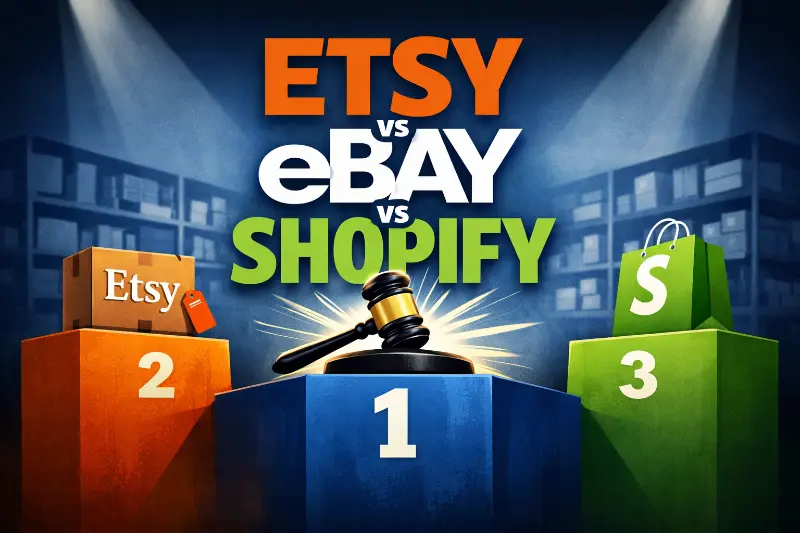
Selling across Etsy, eBay, and Shopify is not one channel strategy with three storefronts — it is three different selling models with three different fulfillment operations. If you are deciding on Etsy vs eBay vs Shopify, the short answer is this: Etsy works best for handmade, gift-driven, and made-to-order products; eBay is stronger for vintage, collectibles, and broader merchandise with tighter shipping enforcement; Shopify gives you the most control with your own direct-to-consumer store, no marketplace rules, and no mandatory shipping standards, but you have to create the customer experience yourself.
For online sellers and ecommerce entrepreneurs choosing where to start, where to expand, or whether they can realistically run all three at once, the real decision is not just fees or branding — it is whether your operation can handle the order profiles, shipping requirements, return patterns, inventory placement, and customer communication norms each platform creates. This comparison focuses on those differences, including fulfillment enforcement, returns management, multichannel inventory risk, and the point where adding another platform stops being growth and starts creating oversells, late shipments, defects, and preventable customer issues.
The difference between a multichannel brand that scales and one that drowns in defect rates and oversold inventory comes down to understanding these operational realities before expanding, not after.
What a Typical Order Actually Looks Like on Each Platform
The most consequential operational difference between these three platforms starts at the order itself. Each platform enables sellers to list and sell products online, but they cater to different audiences and product types, which shapes the entire selling experience. An Etsy order, an eBay order, and a Shopify order look nothing alike, and those differences reflect the platforms’ focus on serving different audiences and the types of products online that sellers can offer. These distinctions cascade through every downstream process.
Etsy
Etsy’s order profile is dominated by single-item, high-intent, gift-driven purchases. Many sellers operate an Etsy shop or Etsy store to sell handmade or unique products, leveraging the platform’s reputation for artisan goods. Average order value sits in the $40 to $50 range, and gifting drives approximately 44% of all purchases. Roughly 30 to 33% of gross merchandise sales involve custom or made-to-order items, which means a significant portion of Etsy orders require production after placement rather than pick-and-ship from existing inventory. Most orders are single-SKU transactions. Seasonality is sharp — December traffic spikes significantly above the monthly average, and wedding season creates a secondary peak for paper goods, party supplies, and personalized gifts.
eBay
eBay’s order profile is broader but equally single-item dominant. Average selling prices vary sharply by category, with general merchandise sellers commonly reporting ASPs in the $30 to $60 range and eBay Motors parts pulling category averages higher. eBay is also a popular platform for selling vintage goods and collectibles, attracting buyers interested in unique and aged items. The vast majority of eBay transactions are now fixed-price Buy It Now purchases — auctions represent only about 12% of sales. Buyer intent spans bargain hunting, collectible acquisition, refurbished electronics, and replacement parts. Various advertising tools and promotions are available to help ensure an item sells quickly on eBay, attracting potential buyers and increasing visibility. A meaningful segment of eBay’s most active buyers are category enthusiasts who spend at a rate that rivals any other ecommerce platform.
Shopify
Shopify’s DTC order profile is the most operationally predictable of the three. A Shopify store allows merchants to operate their own Shopify store with full control over branding, customer experience, and sales strategies. Platform-wide average order values run in the $85 to $92 range, rising meaningfully during peak periods like BFCM. Unlike marketplace orders, Shopify transactions often involve planned repurchases from known brands. Repeat customers represent roughly 27% of the customer base but generate 44% of revenue and 46% of orders. Multi-item orders are more common here than on either marketplace, driven by upsell flows, subscription models, and bundle strategies.
These order profiles dictate entirely different fulfillment architectures. Etsy’s gift-driven, made-to-order workload rewards artisan workshop throughput and flexible processing windows. eBay’s diverse, often one-of-a-kind inventory rewards condition-grading accuracy and fast pick-pack for standardized items. Shopify’s replenishment-based model rewards multi-location inventory positioning and carrier optimization. When considering Shopify vs other platforms, owning your own Shopify store gives you greater flexibility and control compared to selling on marketplaces, setting the stage for a deeper comparison of operational differences.
How Each Platform Enforces Shipping Promises
The shipping enforcement gap between these platforms is the single largest source of operational friction for multichannel sellers. Each platform takes a fundamentally different approach to holding sellers accountable for delivery performance, and misunderstanding these differences destroys seller standing. Shipping enforcement also directly impacts the customers experience, as timely and reliable delivery shapes how buyers perceive your business on Etsy, eBay, or Shopify.
On Shopify, merchants operate within a voluntary framework, giving them full control over their shipping promises and fulfillment processes. This autonomy allows sellers to tailor the customers experience and choose how to accept payments, whether through integrated payment gateways or third-party solutions, to best fit their business needs.
Etsy’s Star Seller Program
Etsy ties shipping performance to its Star Seller program, evaluated monthly on a rolling three-month window. Sellers must ship 95% of orders on time with valid tracking, respond to 95% of first messages within 24 hours, and maintain a 4.8-star average review rating across a minimum of 5 orders and $300 in sales. “On time” means the shipping label is purchased or the order is marked shipped before a seller-defined ship-by date, calculated from customizable processing times that can range from one business day to ten weeks. This flexibility is Etsy’s concession to its made-to-order reality.
Etsy fees, including the recurring listing fee for each product, transaction fees, and payment processing fees, all factor into the overall cost structure for sellers. These costs can add up, especially for small business owners, making it important to maintain Star Seller status to maximize visibility and benefits.
Losing Star Seller status does not directly tank search rankings, but it removes the badge that buyers can filter by, and critically, it disqualifies sellers from Etsy’s Purchase Protection program — where Etsy covers refunds up to $250 (or $500 during holidays) when items are lost or arrive late, absorbing that cost so sellers keep their earnings. The program covers one damaged-item claim per seller per calendar year. Sellers who maintain Star Seller status effectively outsource certain loss-of-delivery risk to Etsy.
eBay’s Defect Rate System
eBay’s enforcement is far more aggressive and punitive. Top Rated Seller status requires a late shipment rate at or below 3%, a transaction defect rate at or below 0.5%, and tracking uploaded within handling time with carrier validation for 95% or more of U.S. transactions. Top Rated Plus — the tier that unlocks a 10% final value fee discount and prominent search placement — requires same-day or one-business-day handling plus 30-day free returns.
eBay’s estimated delivery date system dynamically calculates promises based on seller handling time, carrier service, buyer location, and historical performance. If that promise is missed, the eBay Money Back Guarantee gives buyers grounds for full refunds. Sellers who fall below performance thresholds face higher final value fees, increased selling fees, selling restrictions, and payment holds — consequences that are operationally existential at scale. These higher selling fees and reduced visibility can limit access to potential customers, making it harder to grow your business on the platform.
Shopify’s Voluntary Framework
Shopify imposes no mandatory shipping enforcement, which sounds like freedom but creates a different kind of pressure. Merchants set their own promises, choose their own carriers, and face no platform penalties for late shipments. However, unlike Etsy and eBay, Shopify requires merchants to pay a monthly fee, also referred to as a monthly subscription fee, for access to its customizable storefront features and ongoing platform support. The emerging exception is Shop Promise, a delivery badge displayed on products that Shopify’s algorithms predict can arrive within five calendar days. It is algorithmically awarded based on historical fulfillment data — merchants cannot opt in by commitment alone. If a Shop Promise order’s first delivery attempt is late, the customer receives $5 in Shop Cash absorbed by Shopify, not the merchant.
The real shipping pressure on Shopify merchants comes from consumer expectations, not platform rules. Research consistently shows that the majority of online shoppers expect two-day or faster delivery, and expected delivery windows have compressed materially over the past decade. A Shopify brand that routinely ships in five to seven days is not penalized by the platform — it is penalized by its own conversion rates and repeat purchase behavior.
The operational implication for multichannel sellers is acute. A warehouse running eBay’s one-day handling requirement alongside Etsy’s one-to-three-week MTO window and Shopify’s three-to-five-day standard promise must either segregate workflows by channel or build a priority queue system that correctly triages orders by platform SLA. A spike in Etsy custom orders during wedding season can push eBay handling times past the 3% late-shipment threshold that costs Top Rated status — a failure mode that almost always arrives as a surprise.
Inventory Placement and Routing Implications
Where inventory lives — and how much of it — depends entirely on which platform’s order profile you are serving. These three platforms demand fundamentally incompatible inventory strategies. Many brands choose to sell the same products across Etsy, eBay, and Shopify to maximize reach and test different sales channels, which adds complexity to inventory management.
Managing inventory across these online platforms can be as challenging as running a traditional brick and mortar store, where you must carefully track stock levels and ensure products are available for customers in real time.
Etsy’s Make-to-Order Constraint
Etsy’s MTO model means inventory often does not exist until after the sale. The vast majority of Etsy sellers operate from home, and most run their shops solo. The typical Etsy seller’s warehouse is a workshop, spare room, or kitchen table. Raw materials and components are the real inventory, and the finished product is created after purchase. For the roughly 67 to 70% of Etsy GMS that is ready-to-ship — vintage items, craft supplies, pre-made handmade goods — inventory tends to be small-batch and stored on-site. Multi-warehouse operations are rare; the economics of handmade goods rarely justify distributed fulfillment.
eBay’s Single-Unit Inventory Problem
eBay’s inventory challenge is the opposite: unique items that can only exist in one place. A meaningful portion of eBay’s catalog consists of one-of-a-kind used, vintage, or collectible items. Each requires individual photos, condition descriptions, and pricing — making standardized inventory management extremely difficult. A single vintage watch cannot be split across two warehouses. Multi-quantity fixed-price listings for standardized new goods do exist, but the operational reality for many eBay sellers is that every SKU is effectively a quantity of one. eBay operates no first-party fulfillment service — sellers self-fulfill or use third-party 3PLs. eBay’s Inventory API now supports multi-warehouse fulfillment center location mapping, enabling more accurate estimated delivery dates based on the closest inventory location to each buyer, but adoption requires investment in integration work.
Shopify’s Distributed Fulfillment Model
Shopify’s replenishment model is the most conventional but demands the most infrastructure at scale, making it critical to choose the right Shopify order fulfillment option as volumes grow. Shopify supports up to 10 inventory locations on standard plans and 200 on Plus, with built-in smart order routing that assigns orders based on proximity, market boundaries, split-shipment avoidance, and merchant-ranked location priorities. Shopify offers more features on higher-tier plans, such as advanced inventory management and automation tools, but shopify fees also increase as you move to plans with more features and scalability. The typical progression is self-fulfillment from a single location through roughly 200 to 500 monthly orders, then integration with a 3PL in the 500 to 1,000 order range, then multi-node fulfillment above 1,000 monthly orders. After Shopify sold its fulfillment network to Flexport in June 2023, merchants must build their own 3PL stack rather than relying on Shopify-operated warehouses.
The multichannel inventory implication is this: a brand selling the same product on all three platforms needs a unified inventory pool with real-time sync across channels. But that pool must simultaneously accommodate eBay’s requirement for unique-item tracking, Etsy’s MTO production queues, and Shopify’s replenishment-based allocation. Most order management tools handle the sync layer, but the business logic of which channel gets the last unit is a strategic decision that software cannot make for you.
Returns Rates, Reasons, and Friction by Channel
Return dynamics vary so dramatically across platforms that a unified returns process is essentially impossible. Each platform’s return rate, typical dispute pattern, and seller protection model requires its own operational workflow. Effective returns management can strengthen customer relationships and help build a loyal customer base, as smooth returns foster trust and repeat business.
For example, Shopify tends to have higher return rates, but brands with loyal customers may see more exchanges than refunds, reflecting the value of established customer relationships and the potential for building a loyal customer base through direct engagement.
Etsy Returns
Etsy’s return rates are likely the lowest of the three, estimated broadly at 5 to 15%, though Etsy publishes no official figure. The structural reasons are clear: custom and personalized items are commonly listed as non-returnable, many sellers set no-returns policies (which Etsy permits), and gift recipients rarely return items. Sellers must set a return policy on every physical listing, but that policy can be “no returns accepted.” Even so, buyers can still open cases for items that are not as described, damaged, or never delivered. Etsy’s case system gives sellers 48 hours to resolve before the buyer can escalate. A persistent seller complaint is that Etsy sometimes sides with buyers even when tracking shows delivery — the platform’s consumer-protection orientation is strong.
eBay Returns
eBay reports an overall return rate of approximately 3%, dramatically below the ecommerce average, which reflects its product mix — collectibles, used goods, and auto parts have inherently lower remorse-return rates than apparel. But the return process is operationally treacherous because of Item Not As Described claims. When a buyer files an INAD claim, the seller must accept the return and pay return shipping regardless of their stated return policy. INAD returns feed into eBay’s Service Metrics system: sellers rated “Very High” for INAD returns in a category face an additional 5% final value fee surcharge.
The perverse incentive is well-documented — buyers routinely select “not as described” when the real reason is remorse, because INAD gets them free return shipping. Top Rated Sellers can deduct up to 50% of the refund for items returned used or damaged, and receive return shipping label credits up to $6 for provably false INAD claims. Many experienced eBay sellers proactively offer free returns to reduce INAD abuse, since buyers have less incentive to misrepresent their reason when remorse returns are also free.
Shopify Returns
Shopify merchants face the highest return rates but have the most control over the returns experience. Industry-wide ecommerce return rates ran at approximately 20% for online purchases in 2024, with apparel — the dominant Shopify DTC category — reaching 24 to 30%. Gen Z’s “bracketing” behavior (buying multiple sizes intending to return extras) drives this higher for fashion brands, reflecting broader trends in rising e-commerce return rates. Processing a return costs 20 to 65% of the item’s original value, and only about 50% of returns make it back to sellable inventory.
Shopify’s native returns tools are functional but basic. At scale, virtually every serious Shopify merchant uses a third-party returns platform, such as a Shopify-focused solution like Return Prime, to manage policies and customer experience even if reverse logistics is outsourced separately. Exchange-first workflows — where customers receive store credit or an instant exchange rather than a refund — have become standard among DTC brands trying to retain revenue that would otherwise leave through the returns funnel, and are now a core tactic in crafting an effective e-commerce returns program. Box-free, label-free drop-off networks have expanded meaningfully, reducing friction for customers while lowering return shipping costs for merchants who consolidate returned goods through aggregated drop-off points, with solutions like Happy Returns’ drop-off network exemplifying this model.
Customer Communication and Delivery Transparency
Each platform creates different buyer expectations for communication cadence, transparency, and proactive outreach — and failing to match those expectations shows up directly in reviews, ratings, and platform standing.
Additionally, platforms differ in their approach to customer data ownership, which impacts how sellers can use digital marketing to attract customers. For example, Shopify gives merchants full access to customer data, allowing them to use this information for targeted digital marketing campaigns and personalized outreach to attract customers and build loyalty. In contrast, Etsy owns the customer relationship, limiting sellers’ access to customer data and restricting their ability to use digital marketing strategies outside the platform.
Etsy Communication Norms
Etsy buyers expect personal, artisan-level communication. The Star Seller requirement of responding to 95% of first messages within 24 hours, including weekends, sets the floor. But the reality of Etsy’s custom-order workflow demands more: back-and-forth messaging to confirm personalization details, proactive production updates for MTO items, and personalized thank-you messages. Tracking is not technically mandatory, but without it sellers lose Star Seller eligibility and Purchase Protection coverage. Over 93% of Etsy buyers report that reviews significantly impact their purchasing decisions, making communication-driven review management existential for sellers.
eBay Communication Norms
eBay communication is more transactional, but tracking is operationally critical in a way that makes it effectively a communication tool. All buyer-seller messaging flows through eBay Messages, monitored for policy compliance. The real communication imperative is tracking data: without it, sellers have zero protection against Item Not Received claims. For items valued at $750 or more, signature confirmation is required. eBay shows estimated delivery dates prominently on listings and in purchase history, and if that date passes without delivery confirmation, buyers can report non-receipt — giving sellers just three business days to respond before eBay steps in. The tracking number is not a nice-to-have; it is the entire basis of seller protection in a dispute.
Shopify Communication Ownership
Shopify merchants own the full communication stack, which is both an advantage and a burden. There is no platform-mediated messaging — merchants control email flows, SMS, and tracking pages entirely. Post-purchase transactional emails see open rates of 60 to 80%, and branded tracking pages can recapture meaningful web traffic that would otherwise go to carrier sites. Proactive shipping notifications reduce “Where Is My Order?” inquiries by up to 65%.
The dominant stack for Shopify post-purchase communication typically combines an email and SMS marketing platform for transactional flows with a dedicated shipping visibility tool for carrier-tracked updates. But this control requires investment: coordinating between Shopify’s default transactional emails and third-party marketing flows to avoid duplicate notifications is a recurring operational pain point, and only Plus merchants can fully disable Shopify’s default order confirmation emails.
Why Operational Complexity Increases Non-Linearly on Multiple Platforms
Adding a second and third sales channel does not double or triple operational complexity — it compounds it. The interactions between divergent platform requirements create failure modes that do not exist on any single channel.
Inventory sync is the foundational risk. Real-time synchronization across platforms is difficult because different platforms operate on different data structures and API update cycles. Returns through one channel may not update stock on another. A Shopify return not reflected on eBay leads to phantom inventory; an eBay cancellation that does not propagate to Etsy leads to overselling. Even with automated sync tools, latency measured in minutes rather than milliseconds creates windows of exposure that grow with order volume.
Conflicting SLAs force impossible prioritization at the warehouse level. eBay’s Top Rated Plus demands same-day or one-day handling. Etsy’s MTO items may have one-to-three-week processing windows. Shopify customers expect three-to-five-day delivery. A single warehouse processing orders from all three channels must build a triage system that correctly prioritizes by platform deadline. A spike in Etsy custom orders during wedding season can push eBay handling times past the 3% late-shipment threshold that costs Top Rated status — a failure mode that almost always arrives as a surprise.
Carrier selection adds another layer. eBay’s tracking requirements strongly favor major integrated carriers; Shopify’s platform-negotiated rates offer discounts on specific services; and Etsy provides its own label discounts through USPS and FedEx. Optimizing carrier costs per platform while meeting tracking requirements across all three requires rate-comparison logic that most small operations manage manually until they cannot.
Customer service capacity is also non-linear. Etsy’s 24-hour message response requirement, eBay’s three-day dispute response window, and Shopify’s owned communication infrastructure each impose their own time demands. Managing three different inboxes with different SLAs is straightforward until order volume rises — at which point the staffing model breaks if it was designed around any single channel’s norms.
Managing multiple platforms requires more effort than relying on a single marketplace, but building a Shopify website alongside marketplaces can be worthwhile for brands that want more control over customer data and merchandising. Building your own website, such as with Shopify, means you must generate your own traffic through marketing, SEO, and possibly paid ads, which is significantly more effort compared to leveraging the built in traffic of established marketplaces like Etsy and eBay. These marketplaces provide access to an existing customer base and secure payment processing, while a standalone site offers more control but demands intentional effort to attract visitors.
The revenue case for multichannel expansion is real. Sellers operating on three or more channels generate substantially more revenue than single-channel sellers, and multichannel customers spend meaningfully more on a trailing annual basis than single-channel buyers. But the failure modes are equally real, and they compound: inventory oversells, SLA violations, returns reconciliation failures, and listing management overhead all arrive simultaneously rather than in sequence.
How to Choose Platforms Based on Fulfillment Readiness
Operational readiness for each platform sits at different thresholds, and the sequence of expansion matters as much as the decision to expand. Platforms like Etsy, eBay, and Shopify make it easy to start selling and quickly launch an e-commerce business, allowing sellers to bring products to market with minimal setup.
Etsy has the lowest operational barrier but the highest product-fit requirement. No monthly subscription, $0.20 listing fees, and processing times up to ten weeks make it accessible. The total take rate climbs to 20 to 25% of sale price when accounting for transaction fees, payment processing fees, listing fees, and the mandatory Offsite Ads fee that kicks in permanently once a seller crosses $10,000 in annual revenue. Etsy also provides built-in tools for order management and shipping, streamlining the selling process. The operational readiness question for Etsy is not about fulfillment infrastructure — it is about whether your product fits Etsy’s buyer intent (gifting, uniqueness, personalization) and whether your team can handle the communication-intensive custom-order workflow. The failure mode is underestimating how much buyer messaging MTO items generate.
eBay demands fulfillment discipline from day one. The defect-rate tracking and strict handling-time requirements mean new sellers are under scrutiny from their first transactions. Final value fees range from roughly 12.8% to 15% depending on category, and sellers should also consider payment processing fees as part of their total costs. eBay offers built-in tools for shipping and order tracking, helping sellers manage fulfillment efficiently. The operational readiness bar is carrier integration with tracking upload within handling time for 95% or more of transactions, condition-grading accuracy to minimize INAD claims, and the discipline to maintain same-day or one-day handling for Top Rated Plus benefits. The failure mode is expanding to eBay with Etsy-speed fulfillment expectations.
Shopify requires the most upfront investment but offers the most operational control. Platform plans range from $29 to $299 per month, with Plus at $2,300 or more, but the real cost is the marketing stack required to drive traffic — unlike marketplaces, Shopify provides no built-in audience. Shopify is a dedicated e-commerce platform, offering extensive built-in tools for inventory management, shipping, and analytics, which can streamline operations for sellers, especially when paired with specialized Shopify fulfillment services to handle nationwide delivery. Payment processing fees are an additional cost to consider on top of the monthly subscription. Operational readiness for Shopify means having a 3PL relationship or self-fulfillment capacity for predictable replenishment volumes, a post-purchase communication stack, and enough order volume to justify the fixed costs. The typical threshold where Shopify infrastructure delivers strong ROI is 500 to 1,000 monthly orders.
The sequencing guidance is consistent: master one channel’s operations before adding a second, and invest in an order management system or multichannel inventory tool before launching on channel three. The order volume threshold where manual cross-channel management breaks down is roughly 200 to 500 orders per month. Above 1,000 monthly orders, a 3PL with WMS integration becomes nearly essential for maintaining the SLA discipline each platform requires. A distributed fulfillment network — with inventory positioned closer to buyer demand concentrations — reduces the cost of meeting fast delivery expectations on Shopify while keeping per-unit shipping costs manageable on eBay and Etsy. The question is not whether to expand channels, but whether your operations can absorb three different sets of rules without breaking any of them.
Frequently Asked Questions
What is the most important operational difference between Etsy, eBay, and Shopify?
The most decisive operational difference is how each platform enforces shipping promises. eBay enforces strict handling-time requirements through a defect rate system with real financial penalties including higher fees, selling restrictions, and payment holds. Etsy ties shipping performance to its Star Seller badge and Purchase Protection eligibility, evaluated monthly on a rolling 90-day window. Shopify imposes no mandatory shipping enforcement at the platform level, placing the operational burden entirely on the merchant to meet consumer delivery expectations on their own.
Why do return rates differ so much across Etsy, eBay, and Shopify?
Return rates reflect each platform’s product mix and buyer intent. Etsy’s return rates are low because custom and personalized items are commonly listed as non-returnable, and gift-driven buyers rarely return purchases. eBay reports a roughly 3% return rate, which reflects its high proportion of collectibles, used goods, and parts where remorse returns are uncommon. Shopify DTC merchants face ecommerce-average return rates of 20% or higher, driven by apparel categories and consumer behaviors like bracketing (buying multiple sizes to return extras).
How does multichannel inventory management break down in practice?
The most common failure point is inventory overselling. When the same physical inventory is listed across Etsy, eBay, and Shopify simultaneously, any latency in syncing a sale on one channel to the others creates a window where the same unit can be sold twice. Even automated sync tools operate with latency measured in minutes, not seconds, which is sufficient exposure to generate oversells during peak periods. Returns that update inventory on one channel but not others compound the problem over time.
What does eBay’s Item Not As Described claim system mean for operations?
An INAD claim is operationally costly regardless of its accuracy. When a buyer files INAD, the seller must accept the return and pay return shipping regardless of their stated return policy. INAD returns also feed into eBay’s Service Metrics system — sellers rated “Very High” for INAD returns face an additional 5% final value fee surcharge. Because INAD automatically provides free return shipping, buyers sometimes misuse it to return items for remorse reasons. Many experienced eBay sellers proactively offer free returns to remove the incentive for buyers to misclassify remorse returns as INAD.
How does Etsy’s processing time system work for fulfillment planning?
Etsy allows sellers to set processing times between one business day and ten weeks, and the platform calculates a ship-by date for each order based on that setting plus any buyer-customization time. For Star Seller eligibility, a seller must ship 95% of orders before their stated ship-by date. This system is designed to accommodate made-to-order workflows where production happens after purchase. The operational implication is that processing time is a public commitment — setting it too short creates Star Seller violations; setting it too long reduces conversion because buyers can see the estimated delivery date at checkout.
When is a Shopify brand operationally ready to expand to eBay or Etsy?
For eBay, readiness requires carrier integration capable of uploading tracking for 95% or more of orders within handling time, condition-grading processes for any used or refurbished inventory, and staffing that can maintain same-day or one-day handling without disrupting existing Shopify fulfillment — all supported by a robust eBay fulfillment strategy focused on fast shipping. For Etsy, readiness requires genuine product-fit with Etsy’s buyer intent, a team capable of handling customer messaging within 24 hours including weekends, and clarity on whether your products suit MTO workflows or require pre-built inventory. In both cases, the prerequisite is a multichannel inventory management system that keeps stock synchronized in real time before the first marketplace order ships.
Why does selling on three platforms simultaneously create non-linear complexity?
Each additional platform adds not just its own operational requirements but interactions between requirements that do not exist on any single channel. Conflicting SLA demands — eBay’s one-day handling, Etsy’s multi-week MTO window, and Shopify’s consumer delivery expectations — must be managed from a single fulfillment operation. Returns through one channel create inventory discrepancies on others if not reconciled in real time. Customer service staffing sized for Shopify’s communication norms will be undersized for eBay’s dispute response windows and Etsy’s 24-hour messaging requirement. The failure modes arrive simultaneously rather than sequentially, which is why multichannel operations break down faster than most brands anticipate.
What does Shopify’s Shop Promise badge require and how does it affect fulfillment?
Shop Promise is a delivery badge displayed on Shopify product listings for orders that the platform’s algorithm predicts can arrive within five calendar days. It is algorithmically awarded based on a merchant’s historical fulfillment performance data — merchants cannot opt in simply by committing to fast shipping. Eligibility requires consistently fast order processing and reliable carrier performance across a sufficient volume of orders. If a Shop Promise order’s first delivery attempt is late, the buyer receives $5 in Shop Cash, which Shopify absorbs rather than passing the cost to the merchant. For Shopify brands, Shop Promise functions as a trust signal in search results and on product pages.
How should a brand decide which channel gets the last unit when inventory is shared across Etsy, eBay, and Shopify?
This is a strategic business decision that inventory sync software cannot make automatically. The relevant inputs are each channel’s margin contribution after platform fees and fulfillment costs, the risk profile of holding unsold inventory on each platform, and the seller performance implications of a cancellation on each channel. An eBay cancellation counts as a transaction defect and damages seller standing in a way that a Shopify out-of-stock or an Etsy cancellation does not, which often makes eBay the default priority for the last unit. But a high-AOV Shopify repeat customer may represent more lifetime value than a one-time eBay sale. Brands that operate at volume typically codify this logic in their OMS allocation rules rather than making it manually.
Written By:

Rinaldi Juwono
Rinaldi Juwono leads content and SEO strategy at Cahoot, crafting data-driven insights that help ecommerce brands navigate logistics challenges. He works closely with the product, sales, and operations teams to translate Cahoot’s innovations into actionable strategies merchants can use to grow smarter and leaner.

Turn Returns Into New Revenue
Related Articles

Why Cross-Border DTC Brands Are Moving Fulfillment Inside the US
Cross-border ecommerce fulfillment is the process of shipping ecommerce orders across national borders—often from warehouses outside the United States to U.
Crafting a Return Policy that Drives Customer Loyalty and Reduces Returns
Let’s talk about ecommerce returns policies.

Cheapest Shipping from USA to UK: What It Really Costs
Shipping from the USA to the UK is one of the most common international routes for ecommerce brands, and it is also one of the most misunderstood from a cost perspective.
How to Talk Board Level Returns Strategy

A backorder happens when a customer places an order for a product that is not currently in stock, and the business accepts that order with the intent to fulfill it once inventory arrives. In other words, a backordered item is temporarily unavailable but can still be purchased, with shipment expected after the product is restocked.
For ecommerce brands, inventory managers, and business owners, that distinction matters because accepting a backorder is a customer commitment, not just an inventory status. This article explains what backorder means, how it differs from an out-of-stock item, where it affects revenue, warehouse operations, and customer experience, and what teams can do to communicate clearly and reduce backorders over time.
Done well, backorder management preserves demand and buys time to restock. Done poorly, it turns a supply chain problem into a customer trust problem, and that damage usually lasts longer than the stockout itself.
What a Backorder Actually Means in Practice
When a customer places an order on a backordered item, a transaction is completed and revenue is collected against inventory that does not yet exist. The business logs a sale, but fulfillment is deferred. The customer expects to receive the product by a specific date, typically communicated at checkout. Everything between that moment and the actual delivery is the backorder window, and it is operationally fragile. It is important to inform customers and focus on updating customers about the backorder status and expected shipping dates to maintain transparency and trust.
Backorders happen when product demand exceeds available inventory. Supply chain disruptions, raw material shortages, demand spikes that outpace forecasts, and low safety stock all contribute. In some cases, they are genuinely unforeseeable. In many cases, they reflect a reorder point that was set too low or a replenishment cycle that did not account for supplier lead times accurately, especially as consumer expectations have been reshaped by Amazon-style fast, free shipping and alternative fulfillment models.
A rolling backorder compounds the problem. When the initial restock date slips, the customer’s wait extends, communications have to be updated, and the risk of cancellation rises with every passing week. Transparency in communicating accurate timelines to customers is crucial, as it builds trust and improves customer satisfaction during backorder situations. When an item is backordered, the retailer communicates an estimated delivery date or keeps the customer informed as soon as updates are available. What started as a two-week backorder can stretch into a month-long trust deficit.
Backorder vs. Out of Stock: A Meaningful Distinction
These two terms describe different operational decisions, and treating them as interchangeable creates real business risk. Communicating a product’s availability is crucial: for out of stock items, customers are informed that the product cannot be purchased and there is no estimated restock date, while for backordered items, customers are told the product is temporarily unavailable but will be restocked within a certain timeframe.
An out-of-stock item is unavailable for purchase. The product listing reflects that, and the customer cannot complete a transaction. There is no promise made, no revenue collected, and no customer expectation set. It is a lost sale opportunity, which has a real cost, but it does not create a commitment you might fail to fulfill. An item is out of stock when the seller doesn’t have the item in inventory and has no sure date to restock, which is why a resilient ecommerce fulfillment strategy that supports profitability matters as volume and complexity grow.
A backordered item, by contrast, is available for purchase even though inventory is zero or insufficient. This differs from a pre-order, which is for a product that has not yet been released. The business is explicitly telling the customer: we do not have this yet, but we will, and we are accepting your order on that basis. Unlike an out-of-stock item, a backordered item should have a confirmed restock date, even if the exact arrival timing shifts slightly, and be expected within a reasonable timeframe.
The critical variable is whether you actually know when inventory will arrive. If a confirmed purchase order and a reliable supplier lead time sit behind the backorder, the commitment is manageable. If the backorder is accepted without a confirmed restock date, it is essentially speculation, and customers are bearing the cost of that uncertainty.
A practical rule: if your restocking timeline is confirmed and within a reasonable window (typically under two weeks for most ecommerce contexts), a backorder is defensible. If the timeline is uncertain or extends beyond three weeks, showing the item as out of stock and offering a back-in-stock notification is a more honest and less operationally risky choice. Remember, backordered items are sold out but expected to be restocked within a certain timeframe, while out of stock means there is no sure date for restocking.
The Revenue vs. Customer Experience Tradeoff
The case for businesses that accept backorders is straightforward on paper. You capture demand that would otherwise evaporate, keep revenue flowing, and gather real data on which products customers want badly enough to wait for. Backorders allow customers to reserve a product in advance, reserve their place in line on a first-come, first-served basis, and ensure the business maintains sales revenue during temporary shortages. However, if you do not manage backorders properly, you risk losing sales due to customers turning to competitors when faced with delays. Backorder revenue can also fund the restock purchase itself, which has cash flow advantages for brands with tight working capital, especially when paired with ecommerce order fulfillment services that outclass traditional 3PLs.
The case against is equally clear, but it tends to be underweighted. Customer expectations for delivery speed have tightened significantly. When a customer accepts a backorder with a promised ship date, they have made a specific plan around that timeline. If the date slips, the reaction is not neutral. If customers experience long delays with backorders, they may cancel their order and purchase elsewhere, leading to potential loss of sales. Research consistently shows that a poor delivery experience is one of the highest-impact drivers of customer attrition, and one poor experience can suppress repeat purchase behavior at a rate that exceeds the initial revenue the backorder generated, much like elevated ecommerce return rates quietly erode long-term profitability. Poor backorder management can cause you to lose customers to competitors who can fulfill orders faster, just as failing to address rising ecommerce return rates drives shoppers toward brands that offer a smoother post-purchase experience, and a weak backorder experience can undo the gains of an otherwise exceptional ecommerce returns program that builds loyalty.
The math here is worth doing explicitly. If your average order value is $80 and your customer lifetime value is $320, accepting a backorder that leads to a cancellation or a deeply dissatisfied customer costs you not just the $80 in potential revenue you might have lost by showing out of stock, but potentially the full $320 in future value. Brands that optimize purely for immediate revenue capture when going out of stock routinely underestimate this downstream effect. Frequent backorders can lead to a loss of customers if they become frustrated with repeated stockouts.
The Contrarian View: Backorders Are Not Always Conservative
There is a common assumption that allowing backorders is the cautious move, a way to avoid losing a sale without taking on much risk. In reality, backorders represent a strategic decision that can align with broader business goals, and whether you accept backorders should depend on the business model, especially for replenishment-focused or subscription-based businesses, rather than being just an operational workaround. The actual risk profile is inverted.
Showing out of stock is operationally clean. You lose a potential sale, but you make no promises. The customer may return when the product is available. They may sign up for a notification. They may buy a comparable alternative from you. The relationship is not damaged. Backorders can also be used to test and respond to market demand, allowing businesses to gauge customer interest and adjust safety stock levels accordingly, much like a well-designed ecommerce returns program reveals which products or policies are undermining repeat purchases.
Accepting a backorder under uncertain supply conditions is the aggressive move. You are taking on a customer commitment before you have the operational ability to back it up. If your supplier delivers late, your carrier loses a shipment, or your demand forecast was wrong on total volume, the backorder queue does not absorb those shocks quietly. It amplifies them into customer service volume, cancellation requests, and negative reviews that are publicly visible on the exact product pages where you are trying to convert new buyers.
The brands that manage backorders well treat them as a deliberate, time-bounded tactic with clear operational prerequisites, not a default response to running out of stock. Staying current on emerging logistics best practices through ecommerce logistics and fulfillment events can sharpen this strategy further. Backorders can provide better demand insights, helping businesses adjust inventory strategies based on which items frequently go into backorder status.
What Happens to Inventory Management During a Backorder
A backorder is not just a customer-facing event. It creates complexity inside your inventory management system that compounds if not handled carefully. When a backorder is placed, it is typically converted into one of several sales orders for fulfillment once inventory becomes available. The accumulation of these unfulfilled sales contributes to the company’s backlog, which may be tracked by unit count or as a dollar figure in accounting records and supports broader business processes tied to inventory control and fulfillment.
Once stock arrives, retailers usually prioritize shipping to customers who placed their backorders first, and efficient pick and pack fulfillment processes and accurate packing slip practices for ecommerce shipping are essential to ensure those orders are processed accurately and quickly.
When backordered items are recorded, your accounting records show a completed sale against zero available inventory. That gap has to be tracked accurately so that when the replenishment shipment arrives, the system fulfills backorders in the correct sequence before releasing units to new orders. If your warehouse management discrepancies go unnoticed, backorder customers can end up waiting while new orders jump the queue. Managing fulfillment in this context requires careful coordination to ensure backorders are handled efficiently and customer satisfaction is maintained.
Partial backorders add another layer. A customer orders three items, two are in stock and one is backordered. You can ship the available items immediately and hold fulfillment until the third arrives, or you can split the shipment. Both options have cost and experience implications. Partial shipments solve the immediacy problem but create additional shipping costs and the potential for a customer to receive a box that feels incomplete. Holding the full order keeps shipping costs contained but holds in-stock items hostage to a supply chain problem that only affects one SKU. Analyzing historical data on sales trends can help optimize inventory levels and reduce the likelihood of future backorders, though relying solely on past data may not always predict demand accurately.
Safety stock exists precisely to absorb the kind of demand variability that generates backorders. When safety stock is too low relative to demand patterns and supplier lead times, backorders become a recurring operational mode rather than an occasional exception. That is when the cost accumulates at scale. Using real-time inventory tracking helps prevent overselling and reduces the likelihood of backorders.
Managing backorders can increase operational workload due to the need for communication with suppliers and customer notifications, especially when shipment delays or carrier shipment exceptions further extend already sensitive timelines and poor coordination often drives customer complaints, which is where robust ecommerce fulfillment software with real-time visibility becomes increasingly valuable.
Storage and Warehouse Management During Backorders
Effective warehouse management services are a critical, often overlooked, component of managing backorders successfully and supporting streamlined inventory management. When backordered items are expected, the way your storage and fulfillment processes are organized can make the difference between a smooth recovery and a cascade of customer frustration, while lean handling helps control storage costs and warehousing costs by avoiding unnecessary excess inventory.
A robust warehouse management system should track incoming replenishment shipments and clearly flag which products are allocated to backorders. Designating specific storage areas for backordered items ensures that, once inventory arrives, these products are prioritized for fulfillment in the correct order. This prevents mix-ups where new customer orders are shipped before existing backorders, which can quickly erode trust and create unnecessary service issues.
Implementing a first-in, first-out (FIFO) approach is especially important for backordered items. By fulfilling the oldest backorders first, you maintain fairness and transparency, reducing the risk of customer dissatisfaction. Accurate, real-time inventory levels are essential—not only to avoid overselling but also to keep customers informed about their order status.
Ultimately, strong warehouse management practices during backorders help minimize delays, streamline backorder fulfillment, and maintain customer loyalty even when supply chain issues arise. Leveraging expert insights from educational ecommerce logistics webinars can further refine these practices over time. By proactively organizing your storage and fulfillment processes, you can turn a potential pain point into an opportunity to demonstrate operational excellence and care for your customers, while efficient replenishment and allocation also help reduce storage costs.
How to Communicate With Customers During a Backorder
Customer communication is where backorders are won or lost. Customers who are kept informed and given accurate timelines are far more likely to wait. Following best practices in communication, such as proactive updates and transparency, is essential to minimize negative experiences. Customers who receive silence or vague updates after placing an order are far more likely to cancel and leave with a negative impression.
Several communication practices reduce the risk significantly, and the same mindset underpins effective returns management software that streamlines post-purchase experiences:
- Set the expectation before purchase. The estimated ship date should appear on the product page and in the checkout flow, not just in a post-purchase email. Customers who discover the backorder status after paying feel misled, even if the disclosure was technically present somewhere in the process.
- Send a clear confirmation immediately after order placement. This should include the specific expected ship date, a direct path to contact support, and a straightforward cancellation option. Customers who know they can cancel without friction are less likely to leave a negative review.
- Proactively communicate if the timeline changes. A delayed restock should trigger an immediate notification, not a response to a customer inquiry. Every day a customer waits past a promised date without an update is a day their likelihood of cancellation and their frustration compound together.
- Update the timeline with specificity. “Your order will ship by March 18” is a recoverable update. “We are still working on restocking this item” is not. Vague status updates signal that you do not have operational control of the situation, which is the impression you most need to avoid.
- Proactively update customers about backorder status. Regular, transparent updates—even if there is no new information—help maintain customer trust and satisfaction.
By following these best practices and ensuring effective communication about backorders, you can help maintain customer trust and satisfaction even when delays occur.
Minimizing Backorders Over Time
Backorders are sometimes unavoidable, but stronger forecasting and supplier planning support effective backorder management. Setting accurate reorder points using historical sales data, sales forecasts, and supplier lead times is the foundational step, as set reorder points help prevent backorders by triggering timely replenishment before stockouts occur. However, while trying to avoid backorders, businesses should also be cautious of excess inventory, which can lead to overstocking and unnecessary holding costs. Balancing inventory levels is crucial, and managing excess stock ensures you have enough to meet unexpected demand without tying up too much capital. Setting safety stock levels can help businesses manage unexpected demand spikes and reduce backorders, while regularly monitoring stock levels of popular items helps ensure timely replenishment and prevents backorders. The safety stock buffer has to account for both demand variability and supply variability, not just one of them, just as choosing the best returns management software for your business requires balancing cost, control, and customer experience.
Using multiple suppliers reduces the risk that a single disruption creates a stockout across your full supply of a SKU. If one supplier faces a raw material shortage or production delay, a secondary source with existing onboarding gives you options rather than a forced backorder. This lowers backorder risk during supply chain disruptions.
Demand planning that incorporates market trends, promotional calendars, seasonal patterns, and sudden demand fluctuations prevents the most predictable category of backorders: the demand spike that was visible in advance but not reflected in the replenishment plan. Accurately anticipating future demand helps minimize backorders by ensuring inventory levels align with expected sales. Analyzing market insights, such as real-time data and industry trends, can further improve demand planning and reduce the likelihood of backorders; excessive backorders are often a sign that inventory planning or supplier coordination is failing across supply chains.
Frequently Asked Questions
What is a backorder in ecommerce?
A backorder is when a customer places and pays for an order on an item that is not currently in stock, with the expectation that the business will fulfill it once inventory arrives. The sale is recorded immediately, but fulfillment is deferred until the product is available. Backorders work by allowing customers to purchase out-of-stock items, and the business manages these orders by processing them as soon as inventory is replenished.
What is the difference between a backorder and out of stock?
An out-of-stock item cannot be purchased because inventory is zero and no purchase option is offered; some retailers instead label an item as temporarily out of stock when replenishment is expected but they are not accepting a backorder. A backordered item can still be purchased even though inventory is zero, because the business has committed to fulfilling the order when stock arrives. The key difference is whether a customer commitment is made. With backorders, customers can expect the item to be restocked within a foreseeable future, while out-of-stock items have no such expectation of resupply.
How long do backorders typically last?
Backorder timelines vary depending on the cause and the supplier’s lead time. A demand spike that a supplier can address quickly might resolve in one to two weeks. A supply chain disruption affecting raw materials or manufacturing can extend backorders for months. Communicating a specific, accurate estimated ship date at the point of purchase is more important than the length of the wait.
Do backorders hurt customer satisfaction?
They can, significantly, particularly when the timeline is not communicated clearly or when the promised ship date slips without notice. Customers who are informed proactively and given accurate updates are substantially more likely to wait and remain satisfied. The damage to customer satisfaction is less about the delay itself and more about how the delay is managed.
Should you allow backorders on marketplaces like Amazon?
In most cases, no. Amazon does not formally support backorders and requires that orders ship within the promised delivery window. Accepting orders you cannot fulfill on time on Amazon damages your on-time delivery rate and can trigger account health penalties. Backorders are generally better suited to direct-to-consumer channels where you control the customer experience end to end.
What causes backorders to happen?
Backorders occur when customer demand exceeds available inventory, often due to insufficient stock levels. Demand fluctuations can lead to backorders when the demand for certain products is unpredictable. Supply disruptions can cause delays, leading to backorders. Common causes include low safety stock, inaccurate demand forecasting, supply chain disruptions, supplier delays, and demand spikes driven by promotions or viral attention. Poor reorder point settings relative to actual supplier lead times are a frequent structural cause in growing ecommerce businesses, much like weak controls around returns can open the door to ecommerce returns fraud that quietly erodes margins.
How do backorders affect inventory management systems?
Accepted backorders create a recorded sale against zero available inventory, which has to be tracked and reconciled accurately. When an order contains a backordered item, it can’t be packed and shipped immediately due to the lack of physical inventory at the time. This can also create complications with payment processing, especially if payment is only processed at shipping time. In some cases, a partial backorder occurs when only some items in an order are out of stock, requiring inventory management systems to split shipments or postpone fulfillment for those specific items. When new stock arrives, the system must fulfill backorders in sequence before releasing units to new orders. Failures in this process, where new orders fulfill ahead of existing backorders, create customer service problems and operational discrepancies that are difficult to resolve cleanly, especially on high-volume platforms like Shopify where choosing the right order fulfillment option and partners is critical.
Written By:

Manish Chowdhary
Manish Chowdhary is the founder and CEO of Cahoot, the most comprehensive post-purchase suite for ecommerce brands. A serial entrepreneur and industry thought leader, Manish has decades of experience building technologies that simplify ecommerce logistics—from order fulfillment to returns. His insights help brands stay ahead of market shifts and operational challenges.
Turn Returns Into New Revenue
Related Articles
Crafting a Return Policy that Drives Customer Loyalty and Reduces Returns
Let’s talk about ecommerce returns policies.
Cheapest Shipping from USA to UK: What It Really Costs
Shipping from the USA to the UK is one of the most common international routes for ecommerce brands, and it is also one of the most misunderstood from a cost perspective.

Why Faster Refunds Made Returns More Expensive
Introduction Faster refunds feel like obvious progress.
How Backorders Impact Ecommerce Inventory and Customer Experience
In this article
18 minutes
- What a Backorder Actually Means in Practice
- Backorder vs. Out of Stock: A Meaningful Distinction
- The Revenue vs. Customer Experience Tradeoff
- The Contrarian View: Backorders Are Not Always Conservative
- What Happens to Inventory Management During a Backorder
- Storage and Warehouse Management During Backorders
- How to Communicate With Customers During a Backorder
- Minimizing Backorders Over Time
- Frequently Asked Questions
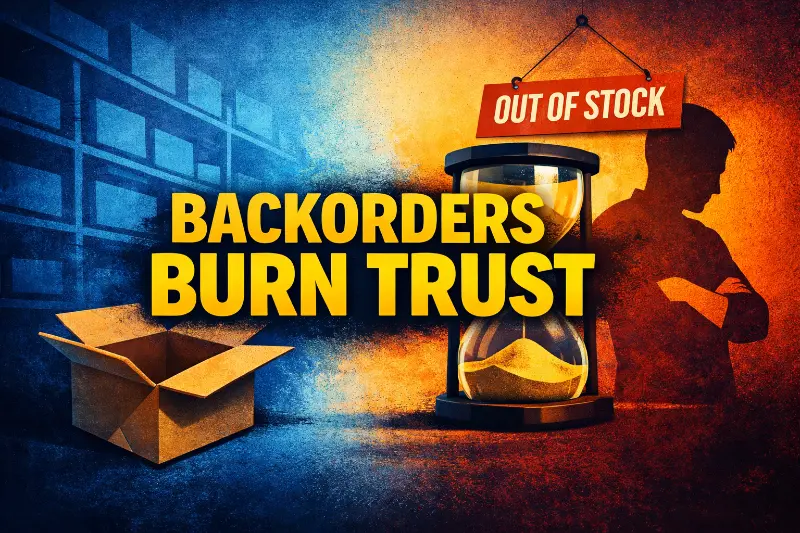
A backorder happens when a customer places an order for a product that is not currently in stock, and the business accepts that order with the intent to fulfill it once inventory arrives. In other words, a backordered item is temporarily unavailable but can still be purchased, with shipment expected after the product is restocked.
For ecommerce brands, inventory managers, and business owners, that distinction matters because accepting a backorder is a customer commitment, not just an inventory status. This article explains what backorder means, how it differs from an out-of-stock item, where it affects revenue, warehouse operations, and customer experience, and what teams can do to communicate clearly and reduce backorders over time.
Done well, backorder management preserves demand and buys time to restock. Done poorly, it turns a supply chain problem into a customer trust problem, and that damage usually lasts longer than the stockout itself.
What a Backorder Actually Means in Practice
When a customer places an order on a backordered item, a transaction is completed and revenue is collected against inventory that does not yet exist. The business logs a sale, but fulfillment is deferred. The customer expects to receive the product by a specific date, typically communicated at checkout. Everything between that moment and the actual delivery is the backorder window, and it is operationally fragile. It is important to inform customers and focus on updating customers about the backorder status and expected shipping dates to maintain transparency and trust.
Backorders happen when product demand exceeds available inventory. Supply chain disruptions, raw material shortages, demand spikes that outpace forecasts, and low safety stock all contribute. In some cases, they are genuinely unforeseeable. In many cases, they reflect a reorder point that was set too low or a replenishment cycle that did not account for supplier lead times accurately, especially as consumer expectations have been reshaped by Amazon-style fast, free shipping and alternative fulfillment models.
A rolling backorder compounds the problem. When the initial restock date slips, the customer’s wait extends, communications have to be updated, and the risk of cancellation rises with every passing week. Transparency in communicating accurate timelines to customers is crucial, as it builds trust and improves customer satisfaction during backorder situations. When an item is backordered, the retailer communicates an estimated delivery date or keeps the customer informed as soon as updates are available. What started as a two-week backorder can stretch into a month-long trust deficit.
Backorder vs. Out of Stock: A Meaningful Distinction
These two terms describe different operational decisions, and treating them as interchangeable creates real business risk. Communicating a product’s availability is crucial: for out of stock items, customers are informed that the product cannot be purchased and there is no estimated restock date, while for backordered items, customers are told the product is temporarily unavailable but will be restocked within a certain timeframe.
An out-of-stock item is unavailable for purchase. The product listing reflects that, and the customer cannot complete a transaction. There is no promise made, no revenue collected, and no customer expectation set. It is a lost sale opportunity, which has a real cost, but it does not create a commitment you might fail to fulfill. An item is out of stock when the seller doesn’t have the item in inventory and has no sure date to restock, which is why a resilient ecommerce fulfillment strategy that supports profitability matters as volume and complexity grow.
A backordered item, by contrast, is available for purchase even though inventory is zero or insufficient. This differs from a pre-order, which is for a product that has not yet been released. The business is explicitly telling the customer: we do not have this yet, but we will, and we are accepting your order on that basis. Unlike an out-of-stock item, a backordered item should have a confirmed restock date, even if the exact arrival timing shifts slightly, and be expected within a reasonable timeframe.
The critical variable is whether you actually know when inventory will arrive. If a confirmed purchase order and a reliable supplier lead time sit behind the backorder, the commitment is manageable. If the backorder is accepted without a confirmed restock date, it is essentially speculation, and customers are bearing the cost of that uncertainty.
A practical rule: if your restocking timeline is confirmed and within a reasonable window (typically under two weeks for most ecommerce contexts), a backorder is defensible. If the timeline is uncertain or extends beyond three weeks, showing the item as out of stock and offering a back-in-stock notification is a more honest and less operationally risky choice. Remember, backordered items are sold out but expected to be restocked within a certain timeframe, while out of stock means there is no sure date for restocking.
The Revenue vs. Customer Experience Tradeoff
The case for businesses that accept backorders is straightforward on paper. You capture demand that would otherwise evaporate, keep revenue flowing, and gather real data on which products customers want badly enough to wait for. Backorders allow customers to reserve a product in advance, reserve their place in line on a first-come, first-served basis, and ensure the business maintains sales revenue during temporary shortages. However, if you do not manage backorders properly, you risk losing sales due to customers turning to competitors when faced with delays. Backorder revenue can also fund the restock purchase itself, which has cash flow advantages for brands with tight working capital, especially when paired with ecommerce order fulfillment services that outclass traditional 3PLs.
The case against is equally clear, but it tends to be underweighted. Customer expectations for delivery speed have tightened significantly. When a customer accepts a backorder with a promised ship date, they have made a specific plan around that timeline. If the date slips, the reaction is not neutral. If customers experience long delays with backorders, they may cancel their order and purchase elsewhere, leading to potential loss of sales. Research consistently shows that a poor delivery experience is one of the highest-impact drivers of customer attrition, and one poor experience can suppress repeat purchase behavior at a rate that exceeds the initial revenue the backorder generated, much like elevated ecommerce return rates quietly erode long-term profitability. Poor backorder management can cause you to lose customers to competitors who can fulfill orders faster, just as failing to address rising ecommerce return rates drives shoppers toward brands that offer a smoother post-purchase experience, and a weak backorder experience can undo the gains of an otherwise exceptional ecommerce returns program that builds loyalty.
The math here is worth doing explicitly. If your average order value is $80 and your customer lifetime value is $320, accepting a backorder that leads to a cancellation or a deeply dissatisfied customer costs you not just the $80 in potential revenue you might have lost by showing out of stock, but potentially the full $320 in future value. Brands that optimize purely for immediate revenue capture when going out of stock routinely underestimate this downstream effect. Frequent backorders can lead to a loss of customers if they become frustrated with repeated stockouts.
The Contrarian View: Backorders Are Not Always Conservative
There is a common assumption that allowing backorders is the cautious move, a way to avoid losing a sale without taking on much risk. In reality, backorders represent a strategic decision that can align with broader business goals, and whether you accept backorders should depend on the business model, especially for replenishment-focused or subscription-based businesses, rather than being just an operational workaround. The actual risk profile is inverted.
Showing out of stock is operationally clean. You lose a potential sale, but you make no promises. The customer may return when the product is available. They may sign up for a notification. They may buy a comparable alternative from you. The relationship is not damaged. Backorders can also be used to test and respond to market demand, allowing businesses to gauge customer interest and adjust safety stock levels accordingly, much like a well-designed ecommerce returns program reveals which products or policies are undermining repeat purchases.
Accepting a backorder under uncertain supply conditions is the aggressive move. You are taking on a customer commitment before you have the operational ability to back it up. If your supplier delivers late, your carrier loses a shipment, or your demand forecast was wrong on total volume, the backorder queue does not absorb those shocks quietly. It amplifies them into customer service volume, cancellation requests, and negative reviews that are publicly visible on the exact product pages where you are trying to convert new buyers.
The brands that manage backorders well treat them as a deliberate, time-bounded tactic with clear operational prerequisites, not a default response to running out of stock. Staying current on emerging logistics best practices through ecommerce logistics and fulfillment events can sharpen this strategy further. Backorders can provide better demand insights, helping businesses adjust inventory strategies based on which items frequently go into backorder status.
What Happens to Inventory Management During a Backorder
A backorder is not just a customer-facing event. It creates complexity inside your inventory management system that compounds if not handled carefully. When a backorder is placed, it is typically converted into one of several sales orders for fulfillment once inventory becomes available. The accumulation of these unfulfilled sales contributes to the company’s backlog, which may be tracked by unit count or as a dollar figure in accounting records and supports broader business processes tied to inventory control and fulfillment.
Once stock arrives, retailers usually prioritize shipping to customers who placed their backorders first, and efficient pick and pack fulfillment processes and accurate packing slip practices for ecommerce shipping are essential to ensure those orders are processed accurately and quickly.
When backordered items are recorded, your accounting records show a completed sale against zero available inventory. That gap has to be tracked accurately so that when the replenishment shipment arrives, the system fulfills backorders in the correct sequence before releasing units to new orders. If your warehouse management discrepancies go unnoticed, backorder customers can end up waiting while new orders jump the queue. Managing fulfillment in this context requires careful coordination to ensure backorders are handled efficiently and customer satisfaction is maintained.
Partial backorders add another layer. A customer orders three items, two are in stock and one is backordered. You can ship the available items immediately and hold fulfillment until the third arrives, or you can split the shipment. Both options have cost and experience implications. Partial shipments solve the immediacy problem but create additional shipping costs and the potential for a customer to receive a box that feels incomplete. Holding the full order keeps shipping costs contained but holds in-stock items hostage to a supply chain problem that only affects one SKU. Analyzing historical data on sales trends can help optimize inventory levels and reduce the likelihood of future backorders, though relying solely on past data may not always predict demand accurately.
Safety stock exists precisely to absorb the kind of demand variability that generates backorders. When safety stock is too low relative to demand patterns and supplier lead times, backorders become a recurring operational mode rather than an occasional exception. That is when the cost accumulates at scale. Using real-time inventory tracking helps prevent overselling and reduces the likelihood of backorders.
Managing backorders can increase operational workload due to the need for communication with suppliers and customer notifications, especially when shipment delays or carrier shipment exceptions further extend already sensitive timelines and poor coordination often drives customer complaints, which is where robust ecommerce fulfillment software with real-time visibility becomes increasingly valuable.
Storage and Warehouse Management During Backorders
Effective warehouse management services are a critical, often overlooked, component of managing backorders successfully and supporting streamlined inventory management. When backordered items are expected, the way your storage and fulfillment processes are organized can make the difference between a smooth recovery and a cascade of customer frustration, while lean handling helps control storage costs and warehousing costs by avoiding unnecessary excess inventory.
A robust warehouse management system should track incoming replenishment shipments and clearly flag which products are allocated to backorders. Designating specific storage areas for backordered items ensures that, once inventory arrives, these products are prioritized for fulfillment in the correct order. This prevents mix-ups where new customer orders are shipped before existing backorders, which can quickly erode trust and create unnecessary service issues.
Implementing a first-in, first-out (FIFO) approach is especially important for backordered items. By fulfilling the oldest backorders first, you maintain fairness and transparency, reducing the risk of customer dissatisfaction. Accurate, real-time inventory levels are essential—not only to avoid overselling but also to keep customers informed about their order status.
Ultimately, strong warehouse management practices during backorders help minimize delays, streamline backorder fulfillment, and maintain customer loyalty even when supply chain issues arise. Leveraging expert insights from educational ecommerce logistics webinars can further refine these practices over time. By proactively organizing your storage and fulfillment processes, you can turn a potential pain point into an opportunity to demonstrate operational excellence and care for your customers, while efficient replenishment and allocation also help reduce storage costs.
How to Communicate With Customers During a Backorder
Customer communication is where backorders are won or lost. Customers who are kept informed and given accurate timelines are far more likely to wait. Following best practices in communication, such as proactive updates and transparency, is essential to minimize negative experiences. Customers who receive silence or vague updates after placing an order are far more likely to cancel and leave with a negative impression.
Several communication practices reduce the risk significantly, and the same mindset underpins effective returns management software that streamlines post-purchase experiences:
- Set the expectation before purchase. The estimated ship date should appear on the product page and in the checkout flow, not just in a post-purchase email. Customers who discover the backorder status after paying feel misled, even if the disclosure was technically present somewhere in the process.
- Send a clear confirmation immediately after order placement. This should include the specific expected ship date, a direct path to contact support, and a straightforward cancellation option. Customers who know they can cancel without friction are less likely to leave a negative review.
- Proactively communicate if the timeline changes. A delayed restock should trigger an immediate notification, not a response to a customer inquiry. Every day a customer waits past a promised date without an update is a day their likelihood of cancellation and their frustration compound together.
- Update the timeline with specificity. “Your order will ship by March 18” is a recoverable update. “We are still working on restocking this item” is not. Vague status updates signal that you do not have operational control of the situation, which is the impression you most need to avoid.
- Proactively update customers about backorder status. Regular, transparent updates—even if there is no new information—help maintain customer trust and satisfaction.
By following these best practices and ensuring effective communication about backorders, you can help maintain customer trust and satisfaction even when delays occur.
Minimizing Backorders Over Time
Backorders are sometimes unavoidable, but stronger forecasting and supplier planning support effective backorder management. Setting accurate reorder points using historical sales data, sales forecasts, and supplier lead times is the foundational step, as set reorder points help prevent backorders by triggering timely replenishment before stockouts occur. However, while trying to avoid backorders, businesses should also be cautious of excess inventory, which can lead to overstocking and unnecessary holding costs. Balancing inventory levels is crucial, and managing excess stock ensures you have enough to meet unexpected demand without tying up too much capital. Setting safety stock levels can help businesses manage unexpected demand spikes and reduce backorders, while regularly monitoring stock levels of popular items helps ensure timely replenishment and prevents backorders. The safety stock buffer has to account for both demand variability and supply variability, not just one of them, just as choosing the best returns management software for your business requires balancing cost, control, and customer experience.
Using multiple suppliers reduces the risk that a single disruption creates a stockout across your full supply of a SKU. If one supplier faces a raw material shortage or production delay, a secondary source with existing onboarding gives you options rather than a forced backorder. This lowers backorder risk during supply chain disruptions.
Demand planning that incorporates market trends, promotional calendars, seasonal patterns, and sudden demand fluctuations prevents the most predictable category of backorders: the demand spike that was visible in advance but not reflected in the replenishment plan. Accurately anticipating future demand helps minimize backorders by ensuring inventory levels align with expected sales. Analyzing market insights, such as real-time data and industry trends, can further improve demand planning and reduce the likelihood of backorders; excessive backorders are often a sign that inventory planning or supplier coordination is failing across supply chains.
Frequently Asked Questions
What is a backorder in ecommerce?
A backorder is when a customer places and pays for an order on an item that is not currently in stock, with the expectation that the business will fulfill it once inventory arrives. The sale is recorded immediately, but fulfillment is deferred until the product is available. Backorders work by allowing customers to purchase out-of-stock items, and the business manages these orders by processing them as soon as inventory is replenished.
What is the difference between a backorder and out of stock?
An out-of-stock item cannot be purchased because inventory is zero and no purchase option is offered; some retailers instead label an item as temporarily out of stock when replenishment is expected but they are not accepting a backorder. A backordered item can still be purchased even though inventory is zero, because the business has committed to fulfilling the order when stock arrives. The key difference is whether a customer commitment is made. With backorders, customers can expect the item to be restocked within a foreseeable future, while out-of-stock items have no such expectation of resupply.
How long do backorders typically last?
Backorder timelines vary depending on the cause and the supplier’s lead time. A demand spike that a supplier can address quickly might resolve in one to two weeks. A supply chain disruption affecting raw materials or manufacturing can extend backorders for months. Communicating a specific, accurate estimated ship date at the point of purchase is more important than the length of the wait.
Do backorders hurt customer satisfaction?
They can, significantly, particularly when the timeline is not communicated clearly or when the promised ship date slips without notice. Customers who are informed proactively and given accurate updates are substantially more likely to wait and remain satisfied. The damage to customer satisfaction is less about the delay itself and more about how the delay is managed.
Should you allow backorders on marketplaces like Amazon?
In most cases, no. Amazon does not formally support backorders and requires that orders ship within the promised delivery window. Accepting orders you cannot fulfill on time on Amazon damages your on-time delivery rate and can trigger account health penalties. Backorders are generally better suited to direct-to-consumer channels where you control the customer experience end to end.
What causes backorders to happen?
Backorders occur when customer demand exceeds available inventory, often due to insufficient stock levels. Demand fluctuations can lead to backorders when the demand for certain products is unpredictable. Supply disruptions can cause delays, leading to backorders. Common causes include low safety stock, inaccurate demand forecasting, supply chain disruptions, supplier delays, and demand spikes driven by promotions or viral attention. Poor reorder point settings relative to actual supplier lead times are a frequent structural cause in growing ecommerce businesses, much like weak controls around returns can open the door to ecommerce returns fraud that quietly erodes margins.
How do backorders affect inventory management systems?
Accepted backorders create a recorded sale against zero available inventory, which has to be tracked and reconciled accurately. When an order contains a backordered item, it can’t be packed and shipped immediately due to the lack of physical inventory at the time. This can also create complications with payment processing, especially if payment is only processed at shipping time. In some cases, a partial backorder occurs when only some items in an order are out of stock, requiring inventory management systems to split shipments or postpone fulfillment for those specific items. When new stock arrives, the system must fulfill backorders in sequence before releasing units to new orders. Failures in this process, where new orders fulfill ahead of existing backorders, create customer service problems and operational discrepancies that are difficult to resolve cleanly, especially on high-volume platforms like Shopify where choosing the right order fulfillment option and partners is critical.
Written By:

Indy Pereira
Indy Pereira helps ecommerce brands optimize their shipping and fulfillment with Cahoot’s technology. With a background in both sales and people operations, she bridges customer needs with strategic solutions that drive growth. Indy works closely with merchants every day and brings real-world insight into what makes logistics efficient and scalable.
Turn Returns Into New Revenue
Related Articles
Why Cross-Border DTC Brands Are Moving Fulfillment Inside the US
Cross-border ecommerce fulfillment is the process of shipping ecommerce orders across national borders—often from warehouses outside the United States to U.
Crafting a Return Policy that Drives Customer Loyalty and Reduces Returns
Let’s talk about ecommerce returns policies.
Cheapest Shipping from USA to UK: What It Really Costs
Shipping from the USA to the UK is one of the most common international routes for ecommerce brands, and it is also one of the most misunderstood from a cost perspective.
FedEx 2026 Peak Season Surcharges: Dates, Rates, and Ecommerce Cost Impact

In this article
14 minutes
- FedEx's 2026 holiday and demand surcharges begin September 28 and peak November 23
- Everyday ecommerce shipments carry the largest percentage increases
- FedEx now charges more for Overnight than for 2Day and Express Saver
- The $595 demand fee can become a $2,470 Ground Unauthorized charge before fuel
- Enterprise shippers face a second charge tied to their June baseline
- Five ecommerce shipping profiles have the greatest exposure
- Operators have two separate preparation deadlines
- The 2026 lesson is to manage all-in shipping cost
- Frequently Asked Questions
FedEx’s 2026 holiday and demand surcharges begin September 28 and peak November 23
FedEx announced its 2026 U.S. holiday demand surcharges on July 22, 2026. These FedEx 2026 peak season surcharges, used to manage network capacity during high-volume periods, start September 28 for Additional Handling, Oversize, and Ground Unauthorized packages, then expand October 26 to Express, Ground Residential, Home Delivery, and Ground Economy. The highest rates apply from November 23 through December 27, and the program ends January 17, 2027.
At the holiday peak, FedEx will charge $0.80 per Ground Residential or Home Delivery package, $4.05 per Ground Economy package, $2.55 per Overnight package, $11.85 for Additional Handling, $117.25 for Oversize, and $595 for a Ground Unauthorized package, with core per-package surcharges up roughly 12% to 23% in 2026. Compared with the 2025 holiday maximum, Ground Residential increases 23.1%, Ground Economy 14.1%, and Overnight Express 21.4%.
The practical risk differs by shipper. Conventional ecommerce brands face small demand fees multiplied across thousands of residential orders, stacked on top of the ordinary Residential Delivery Charge, which increased from $6.55 to $6.95, with applicable fuel surcharges calculated on top. Large-item shippers face demand fees stacked on top of existing accessorial charges, with applicable fuel surcharges calculated on top. Enterprise shippers moving more than 20,000 residential and Ground Economy packages in a calculation week can face a separate charge based on how sharply volume exceeds their June 2026 baseline.
FedEx’s 2026 demand surcharge schedule sets the following maximum-window rates against the 2025 holiday maximum:
| FedEx demand surcharge | 2026 holiday maximum | 2025 holiday maximum | Increase |
| Additional Handling | $11.85 | $10.90 | 8.7% |
| Oversize | $117.25 | $108.50 | 8.1% |
| Ground Unauthorized Package | $595.00 | $545.00 | 9.2% |
| Ground Residential / Home Delivery | $0.80 | $0.65 | 23.1% |
| Ground Economy | $4.05 | $3.55 | 14.1% |
| Overnight Express | $2.55 | $2.10 | 21.4% |
| 2Day / Express Saver | $2.35 | $2.10 | 11.9% |
These percentages compare the maximum November 23 through December 27 rates. ShipScience separately reports 25% and 16% increases for the lower base tiers of Ground Residential and Ground Economy, respectively. Those figures describe a different tier of the same schedule and should not be mixed with the maximum-window table.
For ecommerce operators, logistics teams, finance leaders, and enterprise shippers using FedEx, the issue is straightforward: Q4 shipping costs will rise, and the effect depends on package profile, weekly volume, and how multiple surcharges stack on the same shipment. This breakdown shows the 2026 surcharge dates, peak rates, year-over-year increases, which shipping profiles take the biggest hit, how enterprise volume-based charges work, and what to do now to budget accurately and reduce margin damage. Understanding how a shipping surcharge works is the starting point for isolating which of those traps hits which orders.
Everyday ecommerce shipments carry the largest percentage increases
The biggest year-over-year jumps in the 2026 schedule sit on the services that most DTC brands use every day. Ground Residential and Home Delivery rise 23.1% at the peak, Ground Economy rises 14.1%, and Overnight Express rises 21.4%. Individually, each fee is small. Multiplied across a Q4 residential order file, the numbers move quickly.
The table below isolates the FedEx demand surcharge across representative package counts during the November 23 through December 27 maximum window:
| Example | 2026 demand charge | 2025 equivalent | Additional 2026 cost |
| 50,000 Ground Residential packages | $40,000 | $32,500 | $7,500 |
| 50,000 Ground Economy packages | $202,500 | $177,500 | $25,000 |
| 100,000 Ground Economy packages | $405,000 | $355,000 | $50,000 |
| These calculations isolate the applicable FedEx demand surcharge. They exclude transportation charges, ordinary residential fees, delivery-area charges, fuel, and other accessorials. |
For a brand that ships 50,000 Ground Economy packages during the five-week peak, the demand surcharge alone is worth $25,000 more in 2026 than it was in 2025, before a single transportation dollar is counted. For finance teams building 2026 Q4 budgets, that delta is the number to model, not the base-rate percentage change on the label, and it should sit alongside a clear understanding of order fulfillment costs and ecommerce fulfillment pricing.
FedEx now charges more for Overnight than for 2Day and Express Saver
FedEx’s Express structure looks different this year. During the 2025 maximum window, FedEx applied a single $2.10 Express demand tier across Priority Overnight, Standard Overnight, 2Day, and Express Saver. During the 2026 maximum window, FedEx splits the tier: Overnight is $2.55, and 2Day and Express Saver are $2.35.
Operationally, that means the speed tier a brand chooses now carries a bigger relative penalty during peak. Brands that reflexively upgrade to Overnight to protect a delivery promise will see the all-in FedEx rate rise more than in 2025 and 2026, because the service choice changes the total shipping cost during peak, not just the base transportation line, and the gap widens further once fuel is applied on top.
The $595 demand fee can become a $2,470 Ground Unauthorized charge before fuel
The $595 figure that has circulated in coverage is the maximum Demand – Ground Unauthorized Package Charge. It is not the total fee. FedEx’s regular 2026 Ground Unauthorized Package Charge is $1,875. During the peak, both apply to the same shipment.
| Package condition | Regular 2026 list charge | Maximum demand charge | Combined before transportation and fuel |
| Additional Handling – dimension | $29.50-$40.75 | $11.85 | $41.35-$52.60 |
| Additional Handling – weight | $46.00-$58.75 | $11.85 | $57.85-$70.60 |
| Oversize | $255-$330 | $117.25 | $372.25-$447.25 |
| Ground Unauthorized | $1,875 | $595 | $2,470 |
Regular Additional Handling and Oversize list charges vary by zone. The combined figures exclude transportation and applicable fuel. Contracted rates and discounts can change what a specific customer actually sees on an invoice. According to FedEx’s fuel surcharge rules, Ground fuel is assessed on the net package rate plus applicable Additional Handling, Oversize, Ground Unauthorized, corresponding demand charges, and other listed surcharges. Fuel therefore lands on top of the stacked total, not just the base rate.
A package qualifies as Ground Unauthorized when it exceeds any of three thresholds: more than 108 inches in length, more than 165 inches in combined length and girth, or more than 150 pounds. FedEx may refuse, return, or dispose of an unauthorized package, although it may accept and deliver one at its discretion. That discretion is the reason the fee shows up on invoices at all: the shipment moves, and the charge follows.
In one published Cahoot carrier-billing case, merchant-entered dimensions of 45 x 8 x 8 inches were changed by the carrier to 114 x 19 x 19 inches, producing a $2,401.41 correction. The case shows how a single recorded dimension can move a parcel across a hard threshold. It does not prove that every carrier correction is wrong or recoverable. Brands that ship anything close to those thresholds should read our guide to carrier surcharge recovery, evaluate whether smarter ecommerce fulfillment software for cost optimization can reduce exposure, and build a documented dispute workflow before Q4.
Enterprise shippers face a second charge tied to their June baseline
Shippers moving more than 20,000 combined residential and Ground Economy packages during a calculation week are exposed to a separate Demand Residential Delivery Charge. The mechanics matter, and enterprise level customers should review their FedEx agreement to confirm whether any surcharge discounts still apply for their businesses, because contracted discounts do not apply.
The baseline is average weekly volume from June 1 through June 28, 2026. FedEx calculates a peaking factor by dividing calculation-week volume by the June weekly average and multiplying by 100. The resulting tier determines a per-package rate, which applies two weeks later in the corresponding application week. The charge is added on top of the ordinary Residential Delivery Charge, and any contracted discounts or caps on that ordinary Residential Delivery Charge do not apply to the demand charge. Ground and Home Delivery tiers range from $1.70 to $8.00 per applicable package. Express tiers range from $3.05 to $9.35 per applicable package. For a calculation week containing a holiday, FedEx normalizes four operating days to five by multiplying volume by 5 and dividing by 4.
The following is a Cahoot illustration, not a forecast:
- June weekly average: 16,000 residential and Ground Economy packages.
- Holiday calculation week: 40,000 packages.
- Peaking factor: 40,000 / 16,000 = 250%.
- Ground / Home Delivery tier: $3.35 per package because 250% falls in the greater-than-200% through 300% tier.
- If 30,000 qualifying Ground / Home Delivery packages ship during the corresponding maximum-rate application week: 30,000 x $3.35 = $100,500.
- The separate fixed $0.80 Ground Residential demand surcharge adds 30,000 x $0.80 = $24,000.
- Combined illustrated demand charges: $124,500.
This is a constructed example, not a forecast for every shipper. It excludes transportation, the ordinary Residential Delivery Charge, delivery-area charges, fuel, and other accessorials.
The two-week lag matters. A brand that runs a Black Friday promotion has already locked in its application-week rate before it sees the invoice impact, which is why forecasting against the June baseline in advance is the only lever available, and agreement details should be checked before peak so no assumed discount lapses go unnoticed.
Five ecommerce shipping profiles have the greatest exposure
The 2026 schedule does not hit every operator the same way. Five profiles carry the most concentrated risk:
- High-volume DTC brands shipping primarily to homes, where the 23.1% Ground Residential increase multiplies across most of the order file.
- Ground Economy users, where the $4.05 peak rate and 14.1% increase compound on already tight fulfillment margins.
- Big-and-bulky sellers, where a single misclassified carton can trigger a stacked Oversize or Ground Unauthorized charge in the hundreds or low thousands of dollars.
- Brands dependent on Overnight delivery to protect promise dates, where the split Express tiers now penalize the fastest service most.
- Enterprise brands with a large Q4 increase over their June baseline, where the Demand Residential Delivery Charge lands on top of the fixed per-package fee and outside contracted discounts.
Most brands sit in more than one profile. A DTC apparel brand with a small furniture line, for example, faces multiplication on its core catalog and stacking on its bulky SKUs at the same time, which is where shifting to national fulfillment services with a distributed network can meaningfully reduce zones and mitigate some surcharge impact.
Operators have two separate preparation deadlines
The dates split the preparation work into two windows.
Before September 28, when Additional Handling, Oversize, and Ground Unauthorized demand charges begin:
- Audit carton and SKU dimensions against Additional Handling, Oversize, and Ground Unauthorized thresholds.
- Validate pack-out data and document borderline cartons with dated measurements and photographs so disputes have evidence attached at the point of ship.
- Model regular accessorial + demand accessorial + fuel for every SKU that lands close to a threshold, using the stacking table above as a template.
- Identify large-item SKUs whose margin cannot absorb a stacked $2,470 charge and decide, for each, whether to reprice, restrict, or reroute.
Before October 26, when Express, Ground Residential, Home Delivery, and Ground Economy demand charges begin:
- Forecast demand surcharge spend by service and week, using expected volume and the published rate schedule to control shipping costs, not just model them.
- Calculate enterprise peaking-factor exposure against the June 1 through 28 baseline, including the holiday-week normalization rule.
- Rate-shop using all-in cost per shipment, not label rate alone, with multi-carrier shipping software that includes surcharges in the comparison and leverages order fulfillment integrations with major marketplaces and carriers.
- Review the carrier and service mix for orders where a slower service or different carrier is genuinely equivalent to the customer.
- Negotiate for discounts before peak or renewal periods rather than waiting until surcharges are already hitting invoices.
- Test whether closer inventory through distributed fulfillment can reduce zones and Express dependence during peak weeks, especially when paired with a peer-to-peer order fulfillment service that outperforms traditional 3PLs.
- Adjust free-shipping thresholds and promotional assumptions so demand-surcharge cost sits inside the offer economics rather than outside them. Add incentives that encourage customers to buy earlier during peak season so volume shifts forward before the highest-charge window.
- Establish invoice monitoring that flags measurement changes, unexpected accessorials, and stacked charges within days rather than weeks.
For a deeper checklist, review our guide to UPS and FedEx surcharge mitigation strategies. Preparation is not permanent optimization; it is the work that must be done before the two September and October deadlines pass.
The 2026 lesson is to manage all-in shipping cost
The 2026 schedule reinforces two patterns. Multiplication is where high-frequency ecommerce brands lose money quietly, in per-package fees compounding across the residential order file. Stacking is where big-and-bulky shippers lose it visibly, in single-invoice line items in the hundreds or thousands of dollars once regular accessorials, demand accessorials, and fuel are combined.
Individual tools may optimize a step. The system does not. Cahoot’s ecommerce order fulfillment services are an end-to-end ecommerce fulfillment operations suite that connects inventory placement, fulfillment, packaging, carrier and service selection, including FedEx Ground and FedEx Home Delivery as distinct package services, tracking, and carrier invoice monitoring so operators can manage all-in cost instead of only the label rate. That connection is how brands centrally manage distributed fulfillment, routing, and exception workflows without adding a patchwork of warehouses and tools, and how they protect delivery promises and marketplace performance without reflexively buying Overnight service.
Cahoot helps ecommerce brands save every penny, scale operations without adding complexity, and outperform on every sales channel. Its national fulfillment services network shows how distributed inventory can reduce zones across domestic package services and limit reliance on options in a higher tier, but it does not remove a demand surcharge from an otherwise eligible FedEx shipment. Multi-carrier selection can shift volume between Ground FedEx Home Delivery and other services, but it does not make every surcharge avoidable. Packaging discipline prevents avoidable non-standard charges, but it cannot change a legitimately oversized product. And a charge is not recoverable simply because it is expensive.
The right question heading into Q4 is where domestic shipping costs are actually leaking, and which controllable operational lever, from packaging to placement to invoice monitoring, can save the most first. Our analysis of why shipping prices keep climbing is a useful next read for teams framing that question.
Frequently Asked Questions
When do FedEx’s 2026 peak season surcharges begin and end?
Additional Handling, Oversize, and Ground Unauthorized demand charges begin September 28, 2026. Demand surcharges for Express, Ground Residential, Home Delivery, and Ground Economy begin October 26, 2026. The highest rates apply from November 23 through December 27, 2026, and the entire program ends January 17, 2027.
When are FedEx’s 2026 holiday surcharges highest?
The maximum rates apply from November 23 through December 27, 2026. During that window, FedEx charges $0.80 per Ground Residential or Home Delivery package, $4.05 per Ground Economy package, $2.55 per Overnight package, $2.35 per 2Day or Express Saver package, $11.85 for Additional Handling, $117.25 for Oversize, and $595 for a Ground Unauthorized package.
Is the $595 Ground Unauthorized demand charge the total fee?
No. The $595 is the maximum Demand – Ground Unauthorized Package Charge only. FedEx’s regular 2026 Ground Unauthorized Package Charge is $1,875. During the peak window, both apply to the same shipment, producing a combined $2,470 before transportation and applicable fuel. Fuel is assessed on the net package rate plus applicable surcharges, including this one.
Which customers face FedEx’s enterprise Residential Delivery Charge?
Shippers moving more than 20,000 combined residential and Ground Economy packages during a calculation week. FedEx compares that week’s volume to the average weekly volume from June 1 through 28, 2026, calculates a peaking factor, and applies a per-package rate two weeks later. Contracted discounts or caps on the ordinary Residential Delivery Charge do not apply to this demand charge.
Does FedEx apply fuel surcharges to demand charges?
Yes. FedEx says Ground fuel is assessed on the net package rate plus applicable Additional Handling, Oversize, Ground Unauthorized, corresponding demand charges, and other listed surcharges. That means fuel lands on top of a stacked total, not only on the base rate. For big-and-bulky shipments, the fuel component can add meaningfully to the combined figures shown in the stacking table above.
Written By:
Manish Chowdhary
Manish Chowdhary is the founder and CEO of Cahoot, the most comprehensive post-purchase suite for ecommerce brands. A serial entrepreneur and industry thought leader, Manish has decades of experience building technologies that simplify ecommerce logistics—from order fulfillment to returns. His insights help brands stay ahead of market shifts and operational challenges.
Turn Returns Into New Revenue
Related Articles
Why Cross-Border DTC Brands Are Moving Fulfillment Inside the US
Cross-border ecommerce fulfillment is the process of shipping ecommerce orders across national borders—often from warehouses outside the United States to U.
Crafting a Return Policy that Drives Customer Loyalty and Reduces Returns
Let’s talk about ecommerce returns policies.
Cheapest Shipping from USA to UK: What It Really Costs
Shipping from the USA to the UK is one of the most common international routes for ecommerce brands, and it is also one of the most misunderstood from a cost perspective.
Amazon 2026 Holiday Fulfillment Fees: What FBA Sellers Will Actually Pay

In this article
21 minutes
- Key Takeaways
- Amazon's revised New Selection Program launches July 30
- The 2026 program protects more units but gives sellers less time
- Fee credits can reach $450 on a $30 product with a 15% referral fee
- The 120-day clock changes the product-launch decision
- Not every new SKU is a new-to-FBA parent ASIN
- Use a Day 0-to-Day 120 operating plan
- The revised program favors fast-validation products
- Amazon reduces launch cost, not product risk
- Frequently Asked Questions
Amazon’s revised Amazon FBA New Selection Program launches July 30, 2026, replacing the current version on the same day and applying to eligible branded new-to-FBA parent ASINs. The revised program protects the first 200 units of a qualifying parent ASIN for the first 120 days with free monthly storage, free customer returns, and free liquidations, plus instant fee credits that cap referral fees at 10% on units 1-100 and 5% on units 101-200, $50 in coupon variable-fee credits, and $75 in Vine middle-tier enrollment-fee credits within the first 60 days. The tradeoff is that the former return-processing and liquidation window lasted 180 days from the first inventory-received date. Sellers now have 60 fewer days to prove demand before protection expires.
The tradeoff is that the former return-processing and liquidation window lasted 180 days from the first inventory-received date, so sellers now have 60 fewer days to prove demand before protection expires. That makes eligibility, product qualification, and launch timing more important: the details determine which ASINs actually qualify, how the 2026 benefits compare with the former program, when the fee credits are worth using, and which products are the best fit for a shorter 120-day testing window.
Key Takeaways
- The 2026 program launches July 30, 2026, and the existing program ends the same day.
- Benefits cover the first 200 units for 120 days from the first inventory-received date, not the listing-creation date.
- Instant fee credits replace the former monthly ~10% rebate: 10% referral-fee cap on units 1-100, 5% cap on units 101-200, plus $50 in coupon credits and $75 in Vine credits usable within 60 days.
- The former 180-day return-processing and liquidation window is now 120 days, so the launch-decision clock is shorter.
- Only branded new-to-FBA parent ASINs qualify. A parent ASIN is new-to-FBA only if no seller shipped it through FBA in the previous 12 months.
- 200 units is a benefit ceiling, not a recommended opening order. Treat the program as a controlled 120-day experiment with a predetermined decision on Day 120.
Amazon’s revised New Selection Program launches July 30
Amazon announced the revision on June 17, 2026. The new program takes effect July 30, 2026, and the existing program ends that day. Sellers already enrolled in the existing program automatically receive 2026 benefits for qualifying new branded FBA ASINs launched between July 30 and October 31, 2026. To continue receiving benefits after October 31, current participants must confirm enrollment in the revised program.
Seller eligibility follows Amazon’s eligibility requirements: a Professional selling plan, FBA enabled for eligible ASINs, and, if an Inventory Performance Index score has been assigned, a maximum trailing six-month Amazon Inventory Performance Index of at least 300; eligibility status is assessed daily based on that IPI score. Sellers struggling to stay above that threshold should focus on improving their IPI score and inventory health before banking on New Selection benefits for a launch. Product eligibility is limited to branded new-to-FBA parent ASINs, defined by Amazon as parent ASINs with no FBA shipment by any seller in the preceding 12 months. Both standard-size and non-standard-size products can qualify. A few categories, including video game consoles, video game accessories, apparel and shoes categories, and some media categories, have historically been treated differently under FBA program benefits, so sellers should confirm category treatment in the live Amazon help page before assuming eligibility. A professional seller account is required to meet the selection program’s basic eligibility requirements.
Two mechanics are worth flagging upfront. First, benefits activate from the first inventory-received date at an Amazon fulfillment center, not the day the listing goes live. Second, 2026 New Selection benefits do not stack with New Seller Incentives. When a seller qualifies for both, New Seller Incentives are applied first, and New Selection Program benefits apply to remaining eligible activity. Existing sellers can enroll in the program by selecting “Enroll now” on the program page when they need to confirm participation in the revised version. Enrollment also unlocks the FBA New Selection dashboard, and the program details note that FBA New Selection benefits apply across a seller’s global Amazon accounts once enrolled.
The 2026 program protects more units but gives sellers less time
The revised program raises the ceiling on protected units and adds new fee-related credits, but it also compresses the timeline for return and liquidation protection. The table below compares the former program with the 2026 version on the benefits sellers use most.
| Benefit | Former program | 2026 program | Seller implication |
| Standard-size free storage | First 100 units for 120 days | First 200 units for 120 days | Doubles the protected quantity at the same time window. |
| Non-standard-size free storage | First 50 units for 120 days | First 200 units for 120 days | Fourfold increase in protected units, most valuable for bulky items. |
| Free return processing | Up to 20 standard-size units received back within 180 days of first inventory-received date | First 200 units within 120 days | More units protected, but the window is 60 days shorter. |
| Free liquidation and removal | First 100 standard-size or first 50 non-standard-size within 180 days | First 200 units within 120 days | Higher unit ceiling, but exit must be executed 60 days sooner. |
| Fee reduction mechanism | Average ~10% rebate on qualifying sales, varying by category from 0% to 12%, applied to next month’s fulfillment fees | Instant credits: referral-fee cap of 10% on units 1-100, 5% on units 101-200 (or existing rate if lower) | Predictable per-unit economics instead of a variable, delayed rebate. |
| Vine benefit | 25% enrollment discount for 3-10 units per parent ASIN | $75 credit toward Vine middle-tier enrollment fee, usable within first 60 days | Flat-dollar credit is easier to model but only helps if Vine is used. |
| Coupon credit | None | $50 in coupon variable-fee credits within first 60 days | Small but useful for early promotional activity. |
| Low-inventory-level fee | Applied normally | Does not apply to first 200 units for first 120 days | Reduces launch-phase fee risk if velocity is uneven. |
| Storage utilization surcharge | Applied normally | Does not apply to first 200 units for first 120 days | Helps sellers with slower initial sell-through. |
| Vine Pre-launch | Not specified | 45-day extension on the listed benefits | Meaningful for sellers building reviews before general availability. |
| Product scope | Branded and non-branded new-to-FBA parent ASINs | Branded new-to-FBA parent ASINs | Excludes generic/unbranded launches. |
The 2026 program increases the quantity protected but shortens the return and liquidation window by 60 days. Sellers gain more room to fail cheaply on inventory volume and lose room to wait out slow demand.
Standard-size storage protection doubles to 200 units
Under the former program, the first 100 standard-size units received free monthly storage for 120 days. The 2026 program doubles that ceiling to 200 units per standard size parent ASIN while keeping the 120-day window. For a seller launching a mid-sized housewares or electronics accessory, that means twice as much cushion against monthly storage fees during the validation phase. Even the first unit must be received at a fulfillment center before the storage-fee waiver begins.
Keep in mind that New Selection fee discounts don’t shield eligible units from other seasonal cost pressures. If you’re planning to send qualifying inventory into FBA during Q4, model your landed cost against the current Amazon FBA peak season fees as well, since those surcharges apply on top of standard fulfillment rates and can erode a meaningful share of the New Selection savings on high-volume SKUs.
Non-standard-size storage protection increases from 50 to 200 units
The bigger structural change is for oversize and non-standard products. The former ceiling was 50 units for 120 days. The revised program applies the same 200-unit / 120-day protection regardless of size tier. For bulky products, where cubic-foot storage costs are the dominant fee line during a slow start, this is one of the more consequential changes in the update, especially when combined with low-cost bulk options like Amazon AWD long-term storage.
Returns and liquidations cover more units but lose 60 days
The former program covered up to 20 standard-size units of free return processing, including waived return processing fees, and free liquidation on the first 100 standard or 50 non-standard units, each within 180 days of the first inventory-received date. The revised program protects the first 200 units for 120 days across both categories, and that window can waive return processing fees for qualifying units while also covering liquidation fees for eligible inventory. The unit ceiling is materially higher and the size distinction is gone. The tradeoff is time: a seller who used to have six months to decide whether to liquidate now has four. If the product is a slow validator, the free-liquidation exit ramp closes before the decision would normally be made. Cahoot recommends sellers analyze Amazon FBA returns at the ASIN level early in the window to gauge whether the return profile makes continued FBA fulfillment viable, and high-return ASINs may also benefit from Amazon’s invite-only FBA Return Expert Service or, where appropriate, routing unsellable units into FBA Grade and Resell for value recovery.
For these fee waiver benefits to apply, the new to FBA ASIN or eligible parent ASINs must be received at fulfillment centers within the eligibility window.
Fee credits can reach $450 on a $30 product with a 15% referral fee
The following is a Cahoot calculation based on Amazon’s stated caps, not an Amazon case study, and unlike the old monthly average rebate, the current structure applies savings as instant credits. Assume a $30 product in a category with a 15% referral fee. The normal referral fee is $4.50 per unit.
- Units 1-100: the 10% cap equals $3.00 per unit, so the potential credit is $1.50 per unit, or $150 across 100 units.
- Units 101-200: the 5% cap equals $1.50 per unit, so the potential credit is $3.00 per unit, or $300 across 100 units.
- Total potential fee credits across the first 200 units: $450.
Adding the $50 in coupon variable-fee credits and $75 in Vine middle-tier enrollment-fee credits brings the total known potential credits to $575, before valuing free storage, free returns, free liquidations, or the low-inventory-level and storage-utilization exemptions.
The formulas are:
- Units 1-100 credit = price × [normal referral rate – min(10%, normal referral rate)] × qualifying units
- Units 101-200 credit = price × [normal referral rate – min(5%, normal referral rate)] × qualifying units
These are fee credits, not cash. Actual value depends on selling price, the product’s normal referral rate, the seller’s qualification for each benefit, actual sales within the window, whether other qualifying fees are incurred, and any Amazon time limits. Rebate amounts expire one year after being applied. These credits cannot be combined with other Amazon bonuses. If the normal referral rate is at or below a cap, that tier’s credit is smaller or zero. A product with an 8% referral rate, for example, generates no benefit from the 10% cap tier and only a small benefit from the 5% cap tier. Sellers should model their own category’s Amazon referral and FBA fees before assuming the $450 figure applies, including less obvious cost lines and hidden charges surfaced by an FBA fee calculator and hidden-fee analysis, and understand how prior and upcoming Amazon FBA fee increases change the value of New Selection incentives.
The 120-day clock changes the product-launch decision
The most consequential change is not the higher unit ceiling. It is the compressed timeline. The former 180-day window on returns and liquidations gave sellers roughly six months to build reviews, absorb advertising inefficiency, and observe repeat-purchase behavior before making a keep-or-exit call. The 2026 window is 120 days. A new FBA seller should treat that as a fixed test period, not an open-ended launch runway. That is enough time for many fast-validation products (single-purchase decisions, low consideration, straightforward category), but it is not enough time for products that require sustained ad investment to reach review thresholds or that depend on seasonal peaks arriving late in the window.
The practical implication is that the 200-unit ceiling should not be read as a recommended opening order. It is a benefit ceiling. Even if the program supports an unlimited number of launches or ASINs, ordering 200 units on Day 1 without validated demand still exposes the seller to the exact scenario the compressed window makes harder: inventory that has not sold enough by Day 100 to justify a replenishment order but cannot be liquidated free of charge after Day 120.
A more defensible approach is to size the initial inbound based on realistic 60-to-90-day demand estimates, reserve the option to send additional units if early signals are strong, and use the 120-day window as a hard decision date rather than a runway.
Not every new SKU is a new-to-FBA parent ASIN
Amazon’s eligibility rule is precise, and the language creates traps: not every new parent or newly created parent ASIN qualifies just because the listing is new.
- A new listing you created is not automatically an eligible new-to-FBA parent ASIN. Amazon defines a new-to-FBA parent ASIN as one with no FBA shipment by any seller in the preceding 12 months. Qualification depends on the parent ASIN’s shipment history, not your catalog history. If any seller, including you, shipped that parent ASIN through FBA in the last 12 months, it does not qualify.
- New child ASINs under an existing parent ASIN do not qualify if the parent ASIN itself has FBA shipment history within the 12-month window.
- New to Amazon and new to your account are not the same as new-to-FBA. A product you have never sold may still be ineligible if another seller shipped the same parent ASIN through FBA in the last year.
- Branded requirement. The 2026 wording specifies branded parent ASINs. Sellers relying on generic or unbranded listings under the former program will not receive the new benefits. Amazon’s Brand Registry is not stated in the announcement as a hard requirement, but being a brand owner or one of the new brand owners in Brand Registry may affect access to certain incentives tied to branded product sales, so sellers should confirm the live program terms before assuming eligibility for a specific parent ASIN.
Before committing manufacturing capital, verify eligibility inside Seller Central for the specific parent ASIN, not just the child ASIN or SKU. A misread here means paying full storage, referral, and return fees on inventory that was planned around a subsidized launch. Also verify whether the first buyable ASIN is tied to an eligible parent structure before assuming benefits.
Use a Day 0-to-Day 120 operating plan
Treating the program as a controlled experiment requires a written plan with predetermined decision points. The following schedule is a starting template.
| Milestone | Actions |
| Before inbound | Confirm enrollment status, including whether you still need to enroll in the FBA workflow or were automatically enrolled within 90 days of listing or after creating a shipment within 90 days. Verify parent-ASIN eligibility and 12-month FBA shipment history. Model unit economics with and without the fee credits. Set the initial test quantity based on realistic 60-90 day demand, not the 200-unit ceiling. Define the maximum acceptable launch loss and the exit criteria in writing. Confirm FBA preparation requirements and costs so units are not rejected at receiving, and consider whether outsourcing prep to a specialized Amazon FBA prep service makes sense for your catalog and volume. |
| Day 0 | First eligible inventory received at an Amazon fulfillment center. For a new seller, this receipt is the practical trigger point after enrollment timing has been established. The 120-day clock starts. |
| Days 1-30 | Activate eligible Vine and coupon benefits and confirm they are being applied. Launch initial advertising. Monitor for listing errors, Buy Box issues, or category classification problems that would blunt the fee credits. |
| Days 30-60 | Review conversion rate, advertising cost of sales, return rate, sell-through, and early customer feedback. Calculate inventory turnover and days to sell using observed velocity, not forecast velocity. |
| Days 60-75 | Reforecast days-to-sell using actual data. Resist automatic over-replenishment: a strong Week 4 does not guarantee a strong Week 12. |
| Days 75-90 | Choose one of four paths: replenish (demand validated, unit economics acceptable), maintain (uncertain, extend observation but do not add inventory), discount (accelerate sell-through while free returns and liquidations still apply), or exit (initiate free liquidation while the window is open). |
| Before Day 120 | Complete the appropriate free liquidation or removal action while protection is still active. Sellers who wait past Day 120 pay standard removal and disposal fees. Plan the exit to prevent a failed product test from becoming dead stock. |
| Day 120 onward | Assume normal fees resume unless Amazon confirms a specific extension (for example, Vine Pre-launch’s 45-day extension). Standard storage, referral, low-inventory-level, and storage-utilization fees apply from this point. |
The revised program favors fast-validation products
Not every product benefits equally. The 120-day window rewards categories where demand can be evidenced quickly and punishes those that need time to build.
Strong candidates:
- Branded products with a normal 15% referral rate, which maximize the value of the 10% and 5% caps.
- Products for which 200 units is a meaningful test quantity, not a rounding error against monthly demand or a multi-year supply.
- Non-standard-size items that benefit disproportionately from the fourfold storage-quantity increase.
- Products with meaningful return or exit risk, where fee waivers and free return processing on 200 units offset a real cost line.
- Products that can generate reliable demand evidence within 60 to 90 days: single-purchase categories, clear use cases, low consideration.
- Sellers prepared to activate Vine Pre-launch and coupon credits immediately, capturing the $75 and $50 credits inside the 60-day window, and to use pre-launch Vine reviews to seed social proof before the main demand test.
- Products that benefit from a reduced Vine enrollment fee or similar seller incentives Vine benefit, especially when early reviews materially affect conversion.
Weak candidates:
- Unbranded or generic products, which are excluded under the 2026 wording.
- Highly seasonal products whose peak demand arrives late in the 120-day window or after it closes.
- Products that need more than 120 days to accumulate reviews, ranking, or repeat purchases before demand stabilizes.
- Products with manufacturing minimums that force order quantities well above the 200-unit ceiling.
- Low-margin products dependent on prolonged advertising subsidies to reach breakeven.
- Sellers who cannot remain eligible under the program’s ongoing requirements and should not model their launch around the incentives, and who may be better served by building a Prime offer through Seller Fulfilled Prime for greater control or by using SFP strategically to offset rising FBA fees while maintaining fast shipping.
- Products whose parent ASIN had any FBA shipment by any seller in the previous 12 months, which disqualifies them regardless of how new the child ASIN or listing is.
Amazon reduces launch cost, not product risk
The 2026 program is a meaningful update. Doubling protected storage on standard-size units, quadrupling it on non-standard-size units, converting the delayed rebate into predictable per-unit fee caps, adding $125 in coupon and Vine credits, and exempting protected units from the low-inventory-level fee and storage utilization surcharge all reduce the cost of learning whether a product deserves a permanent slot in FBA through fee relief, not through any separate monthly subscription fee structure.
The 60-day cut to the return and liquidation window is the real cost of the trade. It moves the burden of proof onto the seller earlier and rewards products, categories, and launch strategies that can generate signal quickly. These are operational cost reductions, not a new seller incentives bonus or guarantee of profitable demand. Sellers who plan their launch around the 200-unit ceiling instead of realistic demand, or who assume the fee credits guarantee profitability, will find that the program reduces the cost of a bad launch without changing the underlying odds.
Amazon has lowered the cost of a controlled experiment. It has not lowered the cost of a bad product decision. Sellers who write down the decision criteria before Day 0, use the 120-day window as a hard deadline rather than a runway, and treat the fee credits as a modeled offset rather than a promise, will get the most from the revised program. Those who read 200 units as an order size and 120 days as breathing room will discover that the compressed window is the mechanic that matters most.
Frequently Asked Questions
What is the Amazon FBA New Selection Program (2026)?
It is Amazon’s revised program of launch-phase benefits for eligible branded new-to-FBA parent ASINs. Amazon continues to handle customer service and returns for FBA orders. On the first 200 units received into an Amazon fulfillment center, and for 120 days from the first inventory-received date, sellers receive free monthly storage, free customer returns, free liquidations, exemption from the low-inventory-level fee and storage utilization surcharge, instant fee credits that cap referral fees at 10% on units 1-100 and 5% on units 101-200, and $50 in coupon variable-fee credits plus $75 in Vine middle-tier enrollment credits within the first 60 days.
When does Amazon’s 2026 New Selection Program begin?
July 30, 2026. The existing program ends the same day. Amazon announced the revision on June 17, 2026.
What must current participants do by October 31, 2026?
Sellers already enrolled in the existing program automatically receive 2026 benefits for qualifying new branded FBA ASINs launched between July 30 and October 31, 2026. To continue receiving benefits after October 31, they must confirm enrollment in the revised program.
Which products qualify for the 2026 FBA New Selection Program?
Only branded new-to-FBA parent ASINs qualify. Amazon defines a new-to-FBA parent ASIN as one with no FBA shipment by any seller in the preceding 12 months. Both standard-size and non-standard-size products can qualify. Some categories have historically been treated differently, so sellers should confirm eligibility for a specific parent ASIN in the live Amazon help page. Only eligible new to FBA parent structures qualify, and a new-to-FBA ASIN must be attached to the correct eligible parent status.
How do the 10% and 5% fee caps work?
The caps apply as instant fee credits, not as permanent referral-rate changes. For units 1-100 of a qualifying parent ASIN, the effective referral fee is capped at 10% of the sale price or the seller’s normal referral rate, whichever is lower. For units 101-200, the cap is 5% or the normal rate, whichever is lower. On a $30 product with a 15% normal referral rate, that is a potential $1.50 credit per unit on the first 100 and $3.00 per unit on the next 100, or $450 in potential credits. If the normal referral rate is already at or below a cap, that tier’s credit is smaller or zero.
How long do the 2026 New Selection benefits last?
Benefits apply to the first 200 units for the first 120 days from the first inventory-received date at an Amazon fulfillment center. The $50 coupon credit and $75 Vine credit are usable within the first 60 days.
Does Vine Pre-launch extend the benefits?
Amazon states that Vine Pre-launch provides a 45-day extension on the listed benefits. Sellers planning to use Vine Pre-launch should confirm the extension mechanics inside Seller Central before relying on the added time.
Can New Selection benefits stack with New Seller Incentives?
No. 2026 New Selection benefits do not stack with New Seller Incentives. When a seller qualifies for both, New Seller Incentives are applied first, and New Selection Program benefits apply to remaining eligible activity.
Is 200 units the recommended launch quantity?
No. 200 units is a benefit ceiling, not a recommended opening order. The right test quantity depends on realistic 60-to-90-day demand estimates, unit economics, manufacturing minimums, and the maximum launch loss the seller is willing to accept. Sizing the initial inbound to the ceiling exposes sellers to the exact risk the compressed 120-day window makes harder: unsold inventory that cannot be liquidated free of charge after the window closes.
Written By:
Rinaldi Juwono
Rinaldi Juwono leads content and SEO strategy at Cahoot, crafting data-driven insights that help ecommerce brands navigate logistics challenges. He works closely with the product, sales, and operations teams to translate Cahoot’s innovations into actionable strategies merchants can use to grow smarter and leaner.
Turn Returns Into New Revenue
Related Articles
Why Cross-Border DTC Brands Are Moving Fulfillment Inside the US
Cross-border ecommerce fulfillment is the process of shipping ecommerce orders across national borders—often from warehouses outside the United States to U.
Crafting a Return Policy that Drives Customer Loyalty and Reduces Returns
Let’s talk about ecommerce returns policies.
Cheapest Shipping from USA to UK: What It Really Costs
Shipping from the USA to the UK is one of the most common international routes for ecommerce brands, and it is also one of the most misunderstood from a cost perspective.
Residential Surcharge vs Delivery Area Surcharge: Why You May Pay Both
In this article
20 minutes
- Residential Surcharge vs Delivery Area Surcharge: The Short Answer
- Residential Surcharge vs Delivery Area Surcharge Comparison Table
- Consumer Brands Should Treat Residential Pricing as the Normal Case
- A Low Negotiated Base Rate Can Hide the Real Shipping Cost
- Delivery Area Surcharge Depends on the Carrier's ZIP-Code List
- Check the Latest UPS and FedEx DAS ZIP Codes
- Residential and Delivery Area Surcharges Can Stack
- Four Scenarios: Residential Only, DAS Only, Both, or Neither
- Delivery Area Does Not Necessarily Mean Rural
- How to Calculate Your Residential and DAS Exposure
- What 10,000 Monthly Orders Could Look Like
- Why a 20% DAS Exposure Can Change SKU Margin
- How to Model the Fees During Carrier Negotiations
- How Ecommerce Brands Can Reduce the Impact
- How Cahoot Uses Destination-Level Data to Select Shipping Services
- Frequently Asked Questions
A residential surcharge is a per-package fee based on delivery destination type: it applies when a carrier classifies the address as residential or home-based. A delivery area surcharge is a separate per-package fee based on destination ZIP code: it applies when that ZIP code appears on the carrier’s current DAS, extended-area, or remote-area list. The two are not interchangeable, and they can stack on the same shipment, so a package going to a home in a designated DAS ZIP code may carry both charges on top of the base transportation rate and fuel.
For consumer brands—especially DTC ecommerce operators and the supply chain teams managing parcel spend and carrier contracts—this is not a small rate-card detail. Residential delivery is the default shipment profile for many brands, which means these surcharges can materially change landed shipping cost, SKU margins, and the accuracy of pricing and profitability models. This comparison breaks down how residential and delivery area surcharges differ, when each applies, how to estimate your exposure, where they show up in contract analysis, and what to do in negotiation or network design to reduce them before the numbers on a carrier proposal turn into higher invoice costs.
Residential Surcharge vs Delivery Area Surcharge: The Short Answer
A residential surcharge is a per-package fee that carriers apply when the delivery destination is classified as residential. The carrier’s classification controls, not the merchant’s description of the address. A home, an apartment, a condo, a dorm, and many home-based businesses can all trigger the fee.
A delivery area surcharge, or DAS, is a per-package fee that carriers apply when the destination ZIP code appears on the carrier’s current surcharge list. UPS and FedEx each publish and periodically update their own ZIP-code files. The lists include multiple categories, such as DAS, DAS Extended, and Remote, and each category has separate residential and commercial rates.
The two fees answer different questions. Residential asks, what kind of address is this? DAS asks, where is this address? A single shipment can be both residential and inside a DAS ZIP code, in which case both fees apply. This is why many ecommerce operators see carrier accessorial fees compound in ways the base rate does not predict.
Residential Surcharge vs Delivery Area Surcharge Comparison Table
| Attribute | Residential Surcharge | Delivery Area Surcharge |
| Basic trigger | Address classification | ZIP-code classification |
| Destination factor | Type of delivery location | Geographic location |
| Residential address | Applies | May apply if ZIP is on the list |
| Commercial address | Does not apply | May apply if ZIP is on the list |
| ZIP-code dependency | Not the primary driver | Primary driver |
| Rural-only misconception | Not applicable | DAS is not limited to rural areas |
| Ability to stack | Yes, with DAS | Yes, with residential surcharge |
| Home-based business | Often classified as residential | Same DAS rules apply |
| Carrier-list dependency | Carrier address database | Carrier ZIP-code file |
| Rate variability | Varies by carrier, service, and contract | Varies by carrier, category, service, and contract |
| Best method to estimate exposure | Historical residential share of shipments | Historical destinations matched to current carrier ZIP file |
Consumer Brands Should Treat Residential Pricing as the Normal Case
For most consumer-facing brands, residential shipments are not an edge case. They are the entire shipping profile.
In Cahoot’s experience reviewing consumer-brand shipping patterns, residential destinations can represent close to 99% of shipments for some DTC brands. This is not an industry-wide benchmark. Each brand should calculate its own residential share using its historical shipment data. But when the residential share is that high, the practical implication is straightforward: because residential deliveries are often less efficient than deliveries to commercial locations, the residential surcharge is a standard cost input, not an accessorial that appears occasionally.
That changes how you evaluate carrier proposals. A discount on the base transportation rate that ignores residential pricing does not describe your actual cost. If 99 out of every 100 shipments receive the residential fee, the residential fee is effectively part of your rate. It belongs in every model, every SKU margin calculation, and every free-shipping threshold review. Residential delivery surcharges became common in the early 2000s as e-commerce and home deliveries expanded, which is why building a more cost efficient model matters.
The same logic applies to service selection. Services that price residential delivery differently, including hybrid last-mile options like UPS Ground Saver, can change your effective all-in cost for eligible orders, but they are not universal replacements.
A Low Negotiated Base Rate Can Hide the Real Shipping Cost
Carrier proposals often lead with a headline transportation discount. That number is useful, but it is not the number that ends up on your invoice.
The final shipment invoice can include the base transportation charge plus the full range of shipping surcharges and additional fees that show up beyond it, including the residential surcharge, a delivery area surcharge, an extended or remote area charge, fuel surcharges, demand or peak surcharge, dimensional-weight adjustment, additional handling, large package or oversized package surcharges, address correction, and other accessorials the carrier applies. Not every shipment receives every fee, but the base transportation number rarely represents the true cost. This is one of the main reasons shipping prices are so high relative to what a rate card suggests.
The takeaway for contract analysis: a large transportation discount does not necessarily produce the lowest all-in shipping expenses if residential and delivery-area charges apply to a large share of the brand’s orders. Re-rate your historical shipments under each proposed contract to see what the invoice would have been.
Delivery Area Surcharge Depends on the Carrier’s ZIP-Code List
DAS is not derived from any single public geographic classification. DAS emerged in the late 1990s to help carriers cover rural delivery costs. Each carrier maintains its own list of surcharge ZIP codes and its own category structure. Categories can include DAS, DAS Extended, Remote, Alaska, Hawaii, and separate rates for residential and commercial destinations within each.
UPS and FedEx use separate ZIP-code lists, and classifications may change. That helps explain why das exists: these fees are commonly tied to destinations with low package delivery volume and limited infrastructure, which raise operational costs. A ZIP that is on one carrier’s list may not be on the other’s, and a ZIP that was classified as standard DAS in a previous cycle may move to Extended, Remote, or off the list entirely in a later update. Do not assume the two carriers agree, and do not assume last year’s file still describes your exposure.
The practical consequence is that DAS analysis is carrier-specific. If you ship with both UPS and FedEx, run the exposure calculation twice, using each carrier’s current file.
Check the Latest UPS and FedEx DAS ZIP Codes
Use current official carrier resources, not saved copies from a previous negotiation cycle.
- UPS Shipping Costs and Rates: https://www.ups.com/us/en/support/shipping-support/shipping-costs-rates
- UPS Area Surcharge ZIP Codes: https://www.ups.com/media/en/xarea_x.pdf
- FedEx Shipping Rate Changes and DAS ZIP Lists: https://www.fedex.com/en-us/shipping/rate-changes.html
Check the current lists before modeling your shipping cost. UPS and FedEx may add, remove, or reclassify ZIP codes. A file saved during a previous contract negotiation may no longer reflect current exposure. Record the effective date or the date you downloaded each list, and refresh at least annually and before each major contract negotiation. Rates and ZIP files referenced in this article should be verified against the carriers’ current published documents.
Residential and Delivery Area Surcharges Can Stack
The two conditions are independent. An address can be residential without being in a DAS ZIP. An address can be in a DAS ZIP without being residential. And an address can be both, which is common in DTC.
When a residential destination sits in a DAS, extended, or remote ZIP code, the carrier can apply residential delivery surcharges, which commonly run about $4 to $6 per package before any contracted discount, and the applicable residential area surcharge to the same package, creating real extra costs. Fuel may also apply to one or both of those charges depending on the carrier’s current fuel-table treatment. This stacking is a routine reason invoices exceed the base rate, and it is one of the main levers behind residential delivery fees to address when working to reduce ground shipping costs.
Four Scenarios: Residential Only, DAS Only, Both, or Neither
The table below summarizes the four common combinations. These are not the only possible carrier outcomes, but they cover the majority of cases and illustrate how the two fees interact.
| Scenario | Destination Type | ZIP on DAS List | Likely Charges |
| Residential Only | Suburban home | No | Residential surcharge only |
| DAS Only | Commercial facility | Yes | Commercial delivery area surcharge only |
| Both | Residential | Yes | Residential surcharge plus applicable residential area surcharge; fuel or other charges may also apply |
| Neither | Commercial | No | Neither residential nor delivery area surcharge; other charges may still apply |
Delivery Area Does Not Necessarily Mean Rural
One of the most common misconceptions about DAS is that it only applies to rural or hard-to-reach areas. The carrier’s current ZIP list controls, not intuition about the destination.
Urban, suburban, and exurban ZIP codes can appear on carrier surcharge files. Customers living in those areas rarely think of themselves as remote, and merchants looking at a shipping address in a metropolitan region often assume DAS does not apply. Commercial addresses can also receive DAS, since geographic classification is independent of address type. Different carriers may classify the same area differently. Some separate standard DAS, extended DAS, and remote areas based on how destination ZIP codes fall within their current das zones, so a ZIP that avoids DAS with one carrier may trigger it with another.
The operational implication: do not rely on address appearance to estimate exposure. Match your historical destinations against each carrier’s current file.
How to Calculate Your Residential and DAS Exposure
Exposure calculations are simple arithmetic once you have your shipment history and the current carrier ZIP files.
Residential Exposure Rate Residential shipments ÷ Total shipments × 100
DAS Exposure Rate Shipments to current carrier DAS ZIP codes ÷ Total shipments × 100
Stacked Exposure Rate Residential shipments to current DAS ZIP codes ÷ Total shipments × 100
Estimated Monthly Residential Cost Residential shipments × Contracted residential surcharge
Estimated Monthly DAS Cost DAS shipments × Applicable contracted DAS rate
Run separate calculations for UPS and FedEx, review your shipping invoices, and separate surcharge exposure by service, category, destination type, residential and commercial, DAS and Extended, Remote, Alaska, and Hawaii where relevant so brands can see true parcel spend. This makes it easier to measure overall parcel spend and avoids a single blended number that obscures real differences in cost between categories and between carriers.
What 10,000 Monthly Orders Could Look Like
Suppose a consumer brand ships 10,000 orders per month. Using Cahoot’s operator observations only as planning assumptions:
- 10,000 × 99% = 9,900 residential shipments
- 10,000 × 20% = 2,000 DAS-exposed shipments
Approximately 9,900 orders may receive residential pricing under carrier services where that fee applies. Approximately 2,000 destinations may fall within DAS ZIP codes. For a heavily DTC brand, many of the DAS orders may also be residential and therefore may receive both charges on the same shipment.
The exact overlap depends on the specific mix of destinations and cannot be assumed to be 2,000 stacked cases in every brand’s data. The brand must replace these assumptions with its own shipment data. What the model illustrates, however, is scale. When residential is nearly universal and DAS applies to a meaningful minority, the surcharge cost each month is not a rounding error against transportation spend.
Why a 20% DAS Exposure Can Change SKU Margin
In some Cahoot analyses, approximately 20% of shipment destinations have fallen within carrier surcharge ZIP codes. The exact percentage varies by carrier, customer geography, service, and the carrier’s current ZIP-code definitions. This is an anecdotal observation, not a universal benchmark.
At that level, DAS is not a minor accessorial. It is large enough to affect contribution margin, SKU pricing, and free-shipping decisions, and it can materially increase higher costs across lightweight or low-AOV shipments. A SKU that looks profitable under the base label rate can become marginal or unprofitable once frequent destination surcharges are included. That is especially true for lightweight, low-AOV items where the surcharge represents a larger share of the total shipping cost.
Model surcharge exposure by SKU or by shipping profile, considering package weight, package dimensions, average zone, residential percentage, DAS percentage, stacked exposure, average discounted residential fee, average discounted DAS fee, fuel, average order value, gross margin, contribution margin, free-shipping threshold, carrier alternative, and service alternative, and use that modeling to inform broader shipping strategy, including pricing strategies for making free shipping profitable. Two SKUs with identical base transportation costs can have materially different all-in costs once destination fees are applied.
How to Model the Fees During Carrier Negotiations
A carrier proposal should be evaluated on total cost, not headline discount. When you are comparing UPS and FedEx contracts, or a proposed renewal against your current terms, work through this checklist:
- Base transportation rate
- Minimum charge
- Residential surcharge
- Discount on residential surcharge
- DAS
- DAS Extended
- Remote Area
- Discounts on area fees
- Fuel surcharges applied to surcharges
- Demand or peak surcharges
- Zone distribution
- Package-weight distribution
- Relevant weight thresholds that trigger added handling or oversized fees
- DIM-weight profile
- Earned discounts
- Service mix
- Treatment across specific ups services
- Total shipment cost
A large transportation discount does not necessarily create the lowest all-in shipping cost if residential and delivery-area charges apply to a large share of the brand’s orders. The reliable way to compare proposals is to re-rate 60 to 90 days of historical shipments under each contract’s full fee schedule, including residential, DAS, fuel treatment, any demand surcharges, and opportunities for discounted rates on residential and DAS categories. The proposal that produces the lowest actual invoice, not the highest transportation discount, is the one worth signing; brands that need help quantifying this can contact Cahoot for a customized quote. There are additional levers to mitigate UPS and FedEx surcharges beyond the negotiated schedule itself, and those should be part of the same review.
How Ecommerce Brands Can Reduce the Impact
There is no single strategy that eliminates residential or delivery area charges, and the goal is usually to save money on recurring fees rather than remove every charge. There is a set of strategies that, used together, can meaningfully reduce exposure and cost.
- Negotiate specific discounts on residential and DAS categories, not just the base rate
- Analyze historical ZIP exposure separately for UPS and FedEx
- Compare carrier classifications for the same ZIP codes to identify carrier arbitrage opportunities
- Use multi-carrier rate shopping at the label-generation stage
- Compare the United States Postal Service or another postal service where the service level and destination make it appropriate
- Evaluate hybrid services for eligible residential orders, including UPS SurePost as a historical example alongside current carrier options
- Use right size packaging and smart cartonization software to reduce dimensional weight and related surcharge risk
- Improve inventory placement to shorten average distance to customers
- Reduce average zones through better fulfillment-node distribution
- Consider regional carriers as another cost effective option for some destination profiles and review how to ship heavy items profitably when large or dense products drive additional fees
- Adjust free-shipping thresholds to reflect true all-in shipping cost
- Apply SKU-specific shipping policies for items with unfavorable dimensional or destination profiles so that order fulfillment costs and ecommerce fulfillment pricing stay aligned with contribution margins
- Audit address classifications where residential fees appear to be applied incorrectly
- Review carrier invoices for errors in common shipping surcharges and additional handling surcharges, then file disputes where warranted
- Avoid assuming a single carrier is best for every destination
Distributed fulfillment can reduce distance and transportation cost, but it does not automatically change a carrier’s ZIP-code surcharge classification, and modern order fulfillment services for ecommerce companies are most effective when they factor DAS exposure into network design. A closer origin does not remove a destination ZIP from the carrier’s DAS list. What distributed fulfillment can do is lower zone-based transportation costs and open up more service-level options, which together may offset some of the surcharge impact, especially when paired with ecommerce order fulfillment services that outclass traditional 3PLs. For a fuller view of levers, see the broader Cahoot guidance on how to lower shipping costs.
How Cahoot Uses Destination-Level Data to Select Shipping Services
Cahoot approaches shipping-service selection using package attributes, order attributes, destination ZIP, carrier options, service levels, route optimization, and inventory location together, rather than defaulting to a single carrier or a single service, and multi-carrier shipping software for ecommerce makes that level of decisioning practical at label time. Because residential classification and DAS classification are destination-level facts, the label decision is made with them in view rather than after the fact, and integrations like Amazon Buy Shipping for ecommerce order fulfillment help apply those rules consistently on marketplace orders.
That approach can help identify cases where a different carrier avoids a DAS classification on the same ZIP, and comparing other carriers can reduce delivery-area exposure on some ZIPs and improve cost efficient service selection, where a hybrid service changes the residential fee structure, or where a different origin location changes the zone enough to justify a service change. It does not eliminate carrier surcharges, but it puts the surcharge picture into the label decision rather than leaving it as a line item to reconcile on the invoice. The same ecommerce shipping software logic supports the distributed fulfillment side, where inventory placement can shorten zones for a meaningful share of orders, with label choices also reflecting major delivery routes or distribution hubs when those network differences affect classification logic, and dedicated ecommerce fulfillment software can orchestrate these decisions across nodes.
Frequently Asked Questions
What is a residential delivery surcharge?
A residential delivery surcharge, sometimes called residential delivery fees, is a per-package fee that a carrier applies when it classifies the delivery destination as residential, because deliveries to residential addresses are usually less dense than commercial stops. Houses, apartments, condominiums, dormitories, and many home-based businesses are commonly classified as residential. The carrier’s classification controls, not how the merchant describes the address.
What is a delivery area surcharge?
A delivery area surcharge, or DAS, is a per-package fee that a carrier applies when the destination ZIP code appears on the carrier’s current surcharge list, and some carriers also classify certain destinations under remote area surcharges in addition to standard DAS categories. Carriers publish and periodically update these lists, which can include categories such as DAS, DAS Extended, Remote, Alaska, and Hawaii, with separate rates for residential and commercial destinations; these charges are often a flat fee per package based on destination ZIP-code classification and service level.
What is the difference between residential surcharge and delivery area surcharge?
Residential surcharge is based mainly on the type of delivery address. Delivery area surcharge is based mainly on the destination ZIP code. Residential surcharge answers what kind of address the destination is. DAS answers where the destination is located.
Can residential surcharge and delivery area surcharge both apply?
Yes. The two conditions are independent, and both fees can apply to the same package. A residential destination inside a DAS, extended, or remote ZIP code may receive the residential surcharge and the applicable residential area surcharge on the same shipment.
Can a commercial address receive delivery area surcharge?
Yes. DAS is driven by the destination ZIP code, not by whether the address is residential or commercial. A commercial address in a DAS ZIP code may receive the commercial version of the delivery area surcharge.
Does delivery area surcharge only apply to rural ZIP codes?
No. Carrier ZIP files can include urban, suburban, and exurban ZIP codes. Customers in those areas may not consider the destination remote, and merchants may be surprised to see DAS applied to metropolitan addresses. The carrier’s current published list is the source of truth. In practice, DAS reflects changing delivery patterns and delivery density, not just whether an area feels rural to the recipient.
How do I check whether a ZIP code receives DAS?
Check the current official carrier documents. UPS publishes shipping cost information and an area surcharge ZIP-code file, and FedEx publishes rate change materials that include DAS ZIP lists. Because UPS and FedEx use separate lists and update them periodically, check each carrier separately.
How often should brands update their DAS ZIP files?
At minimum, refresh the files annually and before each major carrier contract negotiation. Carriers can add, remove, or reclassify ZIP codes during their rate cycles, and a saved file from a previous negotiation may no longer reflect current exposure.
How should DTC brands model residential surcharge?
Because residential shipments can represent the large majority of orders for consumer brands, residential surcharge should be modeled as a standard cost input rather than an occasional accessorial. Include it in carrier proposal analysis, SKU margin calculations, and free-shipping threshold reviews, and re-rate historical shipments under each proposed contract.
How can ecommerce brands reduce these charges?
Negotiate specific residential and DAS discounts, analyze historical ZIP exposure, use multi-carrier rate shopping, use business addresses where appropriate to help eliminate residential delivery surcharges, evaluate hybrid economy services for eligible residential orders, improve inventory placement to reduce zones, adjust free-shipping thresholds, apply SKU-specific shipping policies, and audit carrier invoices for classification errors. No single tactic eliminates the fees, since residential routes often involve fewer packages per stop, but together they can meaningfully reduce exposure.
Does UPS Ground Saver avoid residential surcharge?
UPS Ground Saver has its own fee structure and service rules, and as one of UPS’s hybrid services—historically including UPS SurePost—it may treat residential pricing differently than standard UPS Ground for eligible shipments. It is not a universal replacement for standard ground service. Whether it produces a lower all-in cost depends on package characteristics, destination, and current contract terms, so verify treatment against the current UPS documentation and your negotiated schedule; for eligible residential orders, it can be a cost effective option compared with standard UPS Ground.
Does distributed fulfillment eliminate delivery area surcharge?
No. Distributed fulfillment can reduce distance and transportation cost by shortening zones, and new distribution centers can lower transportation distance even though they do not remove DAS classification, but the destination ZIP code’s DAS classification is set by the carrier, not by the shipment’s origin. A closer fulfillment node does not remove a ZIP code from a carrier’s DAS list. What it can do is lower the underlying zone-based cost and open up more service options, which can offset part of the surcharge impact. In practice, distribution centers can change the economics around shipping expenses, but the carrier’s destination ZIP rules still control DAS.
Written By:
Rinaldi Juwono
Rinaldi Juwono leads content and SEO strategy at Cahoot, crafting data-driven insights that help ecommerce brands navigate logistics challenges. He works closely with the product, sales, and operations teams to translate Cahoot’s innovations into actionable strategies merchants can use to grow smarter and leaner.
Turn Returns Into New Revenue
Related Articles
Why Cross-Border DTC Brands Are Moving Fulfillment Inside the US
Cross-border ecommerce fulfillment is the process of shipping ecommerce orders across national borders—often from warehouses outside the United States to U.
Crafting a Return Policy that Drives Customer Loyalty and Reduces Returns
Let’s talk about ecommerce returns policies.
Cheapest Shipping from USA to UK: What It Really Costs
Shipping from the USA to the UK is one of the most common international routes for ecommerce brands, and it is also one of the most misunderstood from a cost perspective.
What Is Carrier Surcharge Recovery? How to Dispute Incorrect Shipping Charges

In this article
23 minutes
- What Is Carrier Surcharge Recovery and Cost Recovery Fee? The Short Answer
- One Inch Can Turn a Normal Parcel Into a Large Package
- Why Carrier-Recorded Dimensions Can Change the Final Invoice
- Valid Surcharges, Federal Regulatory Recovery Fee, and Recoverable Billing Errors Are Not the Same
- Why Borderline Large Packages Carry Disproportionate Risk
- Three Real Dimension Disputes That Produced Major Carrier Corrections
- Strong Evidence Does Not Guarantee a Carrier Credit
- A Dimension Correction Can Trigger Several Carrier Charges on the Invoice
- How Carrier Surcharge Recovery Works
- What Evidence Strengthens a Dimension Dispute?
- Recovery and Prevention Solve Different Problems
- How Brands Can Reduce Exposure on Borderline Packages
- When Manual Carrier-Invoice Auditing Stops Working
- How Cahoot Connects Carrier Billing With Shipping Operations
- Frequently Asked Questions
What Is Carrier Surcharge Recovery and Cost Recovery Fee? The Short Answer
Carrier surcharge recovery is the process of identifying carrier charges that appear inconsistent with the package actually shipped, the shipper’s contract, applicable carrier rules, or refund terms; disputing those charges; and verifying that any approved credits are actually received. It is a billing discipline, not a pricing tactic. It does not mean passing shipping costs to customers, and it does not mean that every carrier surcharge is invalid or refundable.
The reason recovery matters operationally is simple. For brands shipping large or borderline parcels, a single carrier-recorded inch can push a shipment across a hard threshold, and the resulting invoice line items can dwarf the original label price. If nobody on the operations or finance side is watching, the money quietly leaves the business.
This article explains what carrier surcharge recovery actually covers, how carrier dimensional audits generate corrections, which charges may be recoverable, which usually are not, and what evidence tends to strengthen a dispute. It uses four real anonymized examples reviewed by Cahoot to show what these corrections look like in practice, including one dispute that was denied even with strong package evidence.
One Inch Can Turn a Normal Parcel Into a Large Package
Consider an actual Cahoot billing dispute involving a package that the merchant entered as 27 × 25 × 24 inches at 26 pounds. The carrier’s audited dimensions came back as 28 × 25 × 25 inches. Two sides moved by one inch each.
The math tells the story:
- Entered cubic volume: 27 × 25 × 24 = 16,200 cubic inches
- Carrier-audited cubic volume: 28 × 25 × 25 = 17,500 cubic inches
- Relevant Large Package cubic-volume threshold: 17,280 cubic inches (effective for the year of the dispute)
The entered volume sat 1,080 cubic inches below the threshold (17,280 − 16,200). The carrier-recorded volume sat 220 cubic inches above it (17,500 − 17,280). Adding a single inch to two sides increased the recorded volume by 1,300 cubic inches (17,500 − 16,200), which was enough to move the parcel across a binary line.
The total carrier correction was $159.31. It included a transportation charge correction, a change to Additional Handling treatment, a Large Package Surcharge, and the associated fuel surcharge. The carrier-recorded dimensions appeared inconsistent with the available package evidence, so Cahoot disputed the correction. This is the clearest example of why a small measurement change can create a large billing consequence, and it is the reason ecommerce operators cannot afford to treat carrier billing as a passive line item.
Why Carrier-Recorded Dimensions Can Change the Final Invoice
UPS and FedEx both operate high-volume dimensional audits. Parcels move through automated scanners and manual measurement checks at sortation facilities, and the carrier reserves the right to adjust billed dimensions and weight when its measurement differs from the shipper’s entered data. That is a legitimate contractual right, and most of the time the audit either confirms the entered data or produces a minor adjustment.
The problem is that carrier billing runs on hard thresholds. A parcel is either above or below the cubic-volume line, the length-plus-girth line, the maximum-length line, and the actual-weight line. There is no gradient. A one-inch difference on the wrong side of a threshold does not produce a proportionally larger charge. It produces a categorical reclassification, and reclassification can cascade across multiple invoice codes at once.
The three real dimension disputes summarized below give a sense of the range:
| Case | Merchant-Entered Dimensions | Carrier-Recorded Dimensions | Threshold Crossed | Total Correction |
| Small cubic-volume flip | 27 × 25 × 24 in. | 28 × 25 × 25 in. | 17,280 cubic inches | $159.31 |
| Length-plus-girth flip | 32 × 24 × 24 in. | 32 × 25 × 25 in. | 130 in. length + girth | $197.67 |
| Length reclassification | 45 × 8 × 8 in. | 114 × 19 × 19 in. | 108 in. maximum parcel length | $2,401.41 |
The label rate the merchant sees at the point of purchase is not necessarily the final invoice cost. This is one of the reasons why shipping prices are so high in aggregate, even when a rate card looks reasonable. Recovery works because label price and invoice price can diverge, and it is not guaranteed because carriers can back their measurements with facility scans.
Valid Surcharges, Federal Regulatory Recovery Fee, and Recoverable Billing Errors Are Not the Same
A surcharge is not a recovery candidate simply because it is expensive; that contrast applies to parcel accessorials, not telecom billing items such as the Federal Regulatory Recovery Fee and similar cost recovery fees. In telecom billing, such line items may apply to interstate and international services charges and can cover costs tied to telecommunications services for the hearing impaired. It becomes a candidate when the carrier-recorded facts, applied rules, or repeated billing behavior appear inconsistent with the actual package, label data, contract, or available evidence. The table below shows the practical distinction, and none of these categories is automatically refundable.
| Situation | Likely Valid or Potentially Recoverable | What Must Be Verified |
| Actual package exceeds the Large Package threshold | Likely valid | Verified packed dimensions, actual weight, carton specs |
| Carrier-recorded dimensions exceed photographic and packaging evidence | Potentially recoverable | Photos with tape measure, carton SKU spec, pack-out record |
| Dimensional weight calculated from verified package dimensions | Likely valid | Confirm DIM divisor and applicable contract terms |
| Duplicate charge on the same tracking event | Potentially recoverable | Invoice charge codes, tracking-level reconciliation |
| Address-correction fee where no correction appears to have occurred | Potentially recoverable | Original ship-to, tracking scans, delivery address on record |
| Correct residential surcharge on a residential delivery | Likely valid | Delivery classification and address type |
| Incorrect contract rate on rated shipment | Potentially recoverable | Contract rate sheet, effective dates, accessorial waivers |
| Over Maximum charge based on a dramatically inconsistent length scan | Potentially recoverable | Package evidence, repeat-ship history, product dimensions |
| Eligible service refund under the applicable guarantee | Potentially recoverable | Guarantee terms, tracking scans, timing evidence |
| Charge associated with a voided label | Potentially recoverable | Void request timing, unused-label evidence |
For a broader breakdown of the surcharge categories that can appear on a parcel invoice, see the Cahoot overview of how shipping surcharges work. Such telecom line items can also appear alongside state sales tax, which varies by state, plus other applicable taxes and fees where required.
Why Borderline Large Packages Carry Disproportionate Risk
Brands often design cartons intentionally sized just under a carrier threshold to preserve margin on bulky items, which becomes even more critical as carriers change dimensional weight calculation policies that can raise costs on oversized or lightweight parcels. That is a rational decision, but it creates financial fragility. A carton designed one inch under the Large Package cubic-volume line is protected on paper, and yet the same carton can trigger a Large Package correction in real operations for reasons that have nothing to do with fraud or malice.
Common causes include:
- Bulging from soft or over-stuffed contents
- Compression or expansion of the carton in transit
- Tape ridges and seam variations that increase measured height
- Irregular edges from corner damage or protective add-ons
- Two units bundled or strapped together being measured as one parcel
- Inconsistent measurement practices between warehouse stations
- Automated dimension scanners that read the bounding box, not the design spec
- Package orientation changes on the belt
- Nominal carton dimensions on the box print differing from packed dimensions
A package designed one inch below a carrier threshold may comply on paper but remain financially fragile in real operations. There is no universal safety-margin recommendation that fits every product. Instead, brands should evaluate a practical buffer for each SKU family, measure the fully packed carton rather than the flat carton spec, standardize pack-out procedures, prevent overstuffing, flag borderline carton SKUs in the shipping system, retain package evidence at tender, and review whether an alternative carrier or transportation mode is safer for the highest-risk SKUs or outsourced order fulfillment services for ecommerce companies that can distribute inventory closer to customers.
Three Real Dimension Disputes That Produced Major Carrier Corrections
Two One-Inch Changes Produced a $159.31 Correction
The first case, previewed earlier, is the cleanest illustration of threshold sensitivity. The merchant entered 27 × 25 × 24 inches at 26 pounds, and the carrier audit came back as 28 × 25 × 25 inches. Two sides changed by one inch each.
- Entered cubic volume: 27 × 25 × 24 = 16,200 cubic inches
- Carrier-audited cubic volume: 28 × 25 × 25 = 17,500 cubic inches
- Relevant threshold: 17,280 cubic inches
- Entered volume was 1,080 cubic inches below the threshold
- Carrier-recorded volume was 220 cubic inches above the threshold
- Two one-inch changes produced a 1,300-cubic-inch swing in recorded volume
The correction totaled $159.31 and included a transportation charge correction, an Additional Handling change, a Large Package Surcharge, and the associated fuel surcharge. The carrier-recorded dimensions appeared inconsistent with the available package evidence, so Cahoot disputed the correction. Whether or not any individual dispute is approved, the point is that the difference between compliant and non-compliant is measured in inches, and small measurement variance can translate into three-figure corrections per shipment.
A 128-Inch Package Was Remeasured at 132 Inches
The second real package-dimension correction reviewed by Cahoot involved a length-plus-girth threshold rather than cubic volume. The merchant purchased the label with dimensions of 32 × 24 × 24 inches.
- Entered length plus girth: 32 + (2 × 24) + (2 × 24) = 128 inches
- Carrier-audited dimensions: 32 × 25 × 25 inches
- Carrier-audited length plus girth: 32 + (2 × 25) + (2 × 25) = 132 inches
- Actual documented package dimensions: 30.5 × 21.75 × 21.5 inches
- Actual documented length plus girth: 30.5 + (2 × 21.75) + (2 × 21.5) = 117 inches
- Relevant threshold: more than 130 inches in length plus girth
The entered package was two inches below the threshold. The carrier-audited package was two inches above it. That is a four-inch swing in length plus girth from what looks like a small one-inch change on two sides, and the reason is arithmetic: width and height are each counted twice in the length-plus-girth formula. One added width inch contributes two girth inches, one added height inch contributes two girth inches, for a total increase of four inches in length plus girth per single inch of width and height combined.
The documented actual package was calculated at 117 inches in length plus girth, materially below both the entered and the carrier-recorded figures. The total carrier correction was $197.67, covering a transportation charge correction, a Large Package Surcharge, the demand surcharge associated with Large Package treatment, changes to Additional Handling lines, and the fuel surcharge. This case shows why accurate package-weight data and accurate dimensional data both need to travel with the shipment record from tender through invoice, and why many brands turn to multi-carrier shipping software for ecommerce to automate label generation, address validation, and cost-optimized carrier selection.
An Apparent 114-Inch Measurement Produced a $2,401.41 Charge
The third case is a real oversized-shipment invoice correction of a completely different magnitude. The merchant’s shipping system entered dimensions of 45 × 8 × 8 inches. The carrier-recorded dimensions came back as 114 × 19 × 19 inches.
- Merchant-entered length: 45 inches
- Carrier-recorded length: 114 inches
- Relevant maximum-length context: 108 inches for normal parcel service
- Total carrier surcharge and correction: $2,401.41
Operationally, the same product type was shipped repeatedly, its packaging dimensions were normally consistent, and the shipping system was designed to prevent extremely large parcels from being assigned to parcel service in the first place. The recorded 114-inch length was dramatically inconsistent with both the shipment record and the available package evidence, and it placed the parcel above the 108-inch normal parcel length limit relevant to the dispute.
This was not a small DIM-weight adjustment. The carrier-recorded dimensions transformed the shipment classification and generated a four-figure Over Maximum correction. The recorded dimensions were so different from the shipment record and repeat-packaging history that Cahoot escalated the charge for dispute. Cases like this are the reason surcharge recovery cannot be treated as a rounding exercise. A single questionable measurement on a single shipment can produce a correction larger than the profit on many orders combined, especially when layered on top of major carrier peak shipping surcharges during high-demand seasons.
Strong Evidence Does Not Guarantee a Carrier Credit
Recovery is not a mechanical process, and strong evidence does not guarantee approval. Consider a real Cahoot billing dispute involving merchant-entered dimensions of 35 × 35 × 12 inches. The carrier-recorded dimensions came back as 40 × 37 × 11 inches, producing a carrier-recorded length plus girth of 40 + (2 × 37) + (2 × 11) = 136 inches and an additional surcharge of $211.67.
Photographs of the parcel appeared to show that the package was not even a full 35 inches along its larger sides. The entered dimensions were materially smaller than the carrier-recorded dimensions. Package evidence was submitted with the dispute. Despite that, the dispute was denied. The carrier cited supporting dimensional scans from two separate facilities as the basis for its measurement.
Photographs and keyed dimensions can strengthen a dispute, and they usually should be part of any evidence package for a borderline or clearly inconsistent charge. They do not guarantee approval. A carrier may rely on its automated or repeated facility scans, and recovery outcomes can depend on evidence quality, contract language, dispute timing, escalation channel, repeat scans, carrier review, and case-specific facts. An honest recovery practice acknowledges this. A dispute that fails is not a wasted dispute if the process also feeds prevention.
A Dimension Correction Can Trigger Several Carrier Charges on the Invoice
One reason dimension corrections feel disproportionate is that a single measurement change can affect multiple lines on the same invoice at once. Not every line applies to every correction, but the potential list includes:
- Transportation charge recalculation
- Dimensional weight recalculation
- Additional Handling assessment or reclassification
- Large Package or Oversize treatment
- Over Maximum treatment
- Residential surcharge variant tied to service level
- Demand surcharge or peak surcharge associated with Large Package status
- Fuel surcharge, which is typically calculated as a percentage of applicable charges
- Minimum billable weight where applicable
- Impact on applicable discounts or contract rating
Each of these lines carries its own charge code on the invoice, and reconciling them by hand across thousands of shipments is where most brands quietly lose money. This is one of the reasons controlling dimensional shipping costs increasingly requires shipment-level record retention, systematic invoice reconciliation, and ecommerce fulfillment software like Cahoot’s fulfillment platform rather than manual spot checks.
How Carrier Surcharge Recovery Works
An effective recovery workflow follows a consistent set of stages, whether the volume is a few hundred shipments a month or a few million a year:
- Reconcile the label, tracking, shipment record, carrier invoice, and contract so that every charge can be tied back to a specific shipment
- Flag any adjustment that appears inconsistent with the shipment record, contract terms, or expected accessorial pattern
- Validate the carrier rule against current official documentation and confirm that the shipment evidence supports or contradicts the applied rule
- Gather documentation, including photos, carton specs, packing records, weight and dimension data, and any prior shipment history for identical SKUs
- Submit the dispute within the applicable window defined by the carrier and the contract
- Respond to carrier requests for additional information within the stated deadlines
- Escalate when the initial response appears to overlook submitted evidence or misapply the rule
- Track the outcome by dispute ID and shipment ID so nothing gets lost between invoice cycles
- Verify that any approved credit actually appears on a subsequent invoice, since approval and application are separate events
- Identify recurring operational causes and feed them back into packaging, pack-out, service selection, and product-data workflows
The last step is what turns recovery into a durable program. If the same SKU keeps generating the same correction, the fix is upstream of the carrier and often involves better data flows between your WMS, shipping systems, and order-fulfillment integration and ecommerce partners.
What Evidence Strengthens a Dimension Dispute?
Evidence has more influence when it is captured at tender than when it is assembled from memory weeks after the invoice arrives. For high-risk parcels, the following items should be captured as part of the pack-out routine whenever practical:
- Photos of all three dimensions with the full package visible
- A tape measure with clearly visible start and endpoint in each photo
- Packed-carton specifications for the specific SKU
- Carton SKU and manufacturer box specifications
- Product dimensions from the item master
- Warehouse pack-out record showing station, operator role, and time
- Actual weight from a certified scale
- Label dimensions transmitted to the carrier
- WMS and shipping-system data for the shipment
- Invoice and charge codes for the disputed line
- Repeat-shipment history for the same SKU or carton
- Prior measurements for identical packages
- Packing video where operationally feasible
- Original timestamps on all captured evidence
Photographic evidence is most persuasive when it clearly shows the tape measure against a fully packed, sealed carton in a stable position, with no cropping and no visible edits. Two or three angles beat one hero photo. Evidence captured before the shipment leaves the building is materially stronger than anything reconstructed later, because it eliminates the argument that the parcel changed shape in transit.
Recovery and Prevention Solve Different Problems
Recovery catches money after a questionable charge has already reached the invoice. Prevention keeps the questionable charge from being generated in the first place. Both are necessary, and they operate on different timelines.
| Recovery | Prevention |
| Applies to past charges | Applies to future shipments |
| Requires a dispute | Requires operational change |
| Requires evidence gathering after the fact | Requires evidence and controls at tender |
| Result is a credit, if approved | Result is a lower probability of exposure |
| Outcome is uncertain and case-specific | Outcome is systemic and cumulative |
| Levers: contract, evidence, escalation | Levers: package design, dimension accuracy, pack-out discipline, service controls, data retention, alternative transportation, recurring process improvement |
The strongest programs do both. Recovery pays for prevention by returning capital that would otherwise be lost, and prevention shrinks the population of shipments that ever need to be disputed. For a broader view of how carrier-invoice auditing fits into total shipping-cost management, see the Cahoot guide to how to lower shipping costs, and for the specific tactics that reduce accessorial exposure, review these strategies to mitigate UPS and FedEx surcharges alongside multi-carrier shipping automation and awareness of upcoming dimensional weight policy changes.
How Brands Can Reduce Exposure on Borderline Packages
Reducing exposure on borderline parcels is mostly an operations and packaging problem, not a carrier problem, though channel-specific fulfillment programs like Google Shopping delivery and shipping fulfillment can also change your mix of parcel profiles. Practical steps that consistently move the needle include:
- Measure the fully packed, sealed carton, not the flat spec, when qualifying a new box
- Choose a practical buffer below the relevant threshold based on how the specific product packs and settles
- Standardize pack-out procedures so the same SKU always uses the same fill pattern
- Prevent overstuffing that causes bulging and increases the measured bounding box
- Flag borderline carton SKUs in the WMS and shipping system so they can be tracked
- Retain package evidence at tender for high-risk cartons
- Review whether a different carrier, service level, or transportation mode is safer for the largest SKUs
- Reconcile shipment-level dimensions against invoice-recorded dimensions at least monthly
- Feed recurring correction patterns back into product data and packaging engineering
Brands that treat these items as ongoing operational hygiene tend to see fewer corrections year over year even as parcel volumes grow.
When Manual Carrier-Invoice Auditing Stops Working
At low volume, an ops leader or finance analyst can eyeball a weekly invoice and catch outliers. At higher volumes, that stops being viable for reasons that compound:
- Invoice line counts grow faster than headcount
- Charge codes are numerous and change over time
- Evidence for each disputable charge lives in multiple systems
- Dispute windows are strict and unforgiving
- Follow-up on submitted disputes is easy to lose track of
- Approved credits do not always appear on the next invoice
- Repeat corrections on the same SKU indicate upstream problems that manual review does not fix
Beyond a certain scale, spot auditing becomes rounding error suppression rather than recovery. The gap between what could be recovered and what is actually recovered widens quietly, and the operational causes never get addressed. Many distributors recover only about 70% of total freight costs from customers. Businesses on fixed-price contracts often have to absorb surcharge increases instead of passing them through. This is one place where connecting shipment and billing data in a single system starts to matter more than individual analyst diligence and where dedicated ecommerce fulfillment software becomes a practical necessity.
How Cahoot Connects Carrier Billing With Shipping Operations
Cahoot can connect shipment records, fulfillment data, carrier invoices, disputes, claims, and credits inside a single operational view, including marketplace-specific workflows like Amazon Buy Shipping integration for ecommerce order fulfillment. That connection is what makes recovery repeatable rather than heroic. When the shipment record, the carton spec, the label dimensions, the tracking history, and the invoice charge codes all reference the same shipment identity, questionable adjustments become visible on a timeline that matches the dispute window, and recurring correction patterns become visible on a timeline that matches packaging and product-data changes.
The point is not that automation guarantees recovery. It does not, and this article has been explicit about that. The point is that automation is what allows a brand to keep up with modern parcel invoices at scale, capture evidence at tender rather than after the fact, submit disputes inside the window, track outcomes to actual credit, and turn recurring corrections into upstream fixes. Recovery and prevention work best when they share the same data.
Frequently Asked Questions
What is carrier surcharge recovery?
Carrier surcharge recovery is the process of identifying carrier charges that appear inconsistent with the package actually shipped, the shipper’s contract, or applicable carrier rules; disputing those charges; and verifying that any approved credits are received. In telecom billing, similar cost recovery fees may be called different names by providers and are generally not a government tax. It applies to charges such as Additional Handling, Large Package Surcharge, Over Maximum, dimensional weight adjustments, incorrect residential charges, duplicate charges, and eligible service refunds.
What is a carrier shipping charge correction?
A carrier shipping charge correction is an adjustment the carrier makes to the originally rated charge after the shipment has been tendered. Corrections are commonly driven by dimensional audits, weight audits, service-classification changes, and accessorial reclassifications. A correction can be valid, potentially recoverable, or a mix of both across different invoice lines on the same shipment.
Can a Large Package Surcharge be disputed?
Yes, a Large Package Surcharge can be disputed when the carrier-recorded dimensions appear inconsistent with the actual packed carton, when packaging evidence contradicts the recorded measurements, or when the applied rule appears to misclassify the parcel. Dispute approval is not guaranteed, and carriers may rely on their own facility scans as supporting evidence.
Why did the carrier change my package dimensions?
UPS and FedEx operate dimensional audits at their facilities using automated scanners and manual checks. When a facility measurement differs from the shipper’s entered dimensions, the carrier can adjust billed dimensions under the shipper’s contract. Differences may reflect bulging cartons, seam and tape variance, measurement rounding, orientation changes on the belt, or genuine data-entry errors on the shipper side.
Can one inch trigger a carrier surcharge?
Yes. Carrier billing runs on hard thresholds for cubic volume, length plus girth, and maximum length. A one-inch change on two sides of a parcel can move it across the 17,280-cubic-inch Large Package threshold or add four inches to length plus girth, because width and height are each counted twice in the length-plus-girth formula.
What evidence is needed to dispute package dimensions?
Useful evidence includes photos of all three dimensions with a visible tape measure, packed-carton specifications, carton SKU and manufacturer box specs, product dimensions, warehouse pack-out records, actual scale weight, label data, WMS and shipping-system records, invoice charge codes, and repeat-shipment history for identical packages. Evidence captured at tender is materially stronger than evidence reconstructed after the invoice arrives.
Are carrier surcharge refunds guaranteed?
No. Carrier surcharge refunds are not guaranteed. Outcomes depend on evidence quality, contract language, dispute timing, escalation channel, repeat facility scans, carrier review, and case-specific facts. Strong evidence improves the probability of approval, and denials happen even when the shipper’s evidence appears clear.
How long do carrier surcharge disputes take?
Dispute timelines vary by carrier, charge type, contract, evidence, and escalation path. There is no single universal timeline. Shippers should confirm the applicable submission window for each charge type against current carrier documentation and track each dispute to resolution and credit application.
What happens when a surcharge dispute is denied?
A denial usually cites carrier facility scans or other supporting measurements. Shippers may be able to escalate with additional evidence, request a supervisory review, or accept the denial. Even denied disputes have value when the underlying case is fed back into packaging, pack-out, and service-selection changes that reduce future exposure on the same SKU.
How can brands prevent incorrect dimensional charges?
Prevention relies on measuring the fully packed carton rather than the flat spec, choosing a practical buffer below relevant thresholds, standardizing pack-out procedures, preventing overstuffing, flagging borderline carton SKUs, retaining package evidence at tender, and reviewing whether an alternative carrier or transportation mode is safer for the largest SKUs.
Is carrier surcharge recovery or universal service fund recovery the same as carrier invoice auditing?
They overlap but are not identical. Carrier invoice auditing is the broader activity of reconciling every charge on an invoice against the underlying shipment and contract, while Universal Service Fund recovery in telecom billing relates to the federal universal service fund overseen by the federal communications commission, which supports telecommunications access in rural and high cost areas, as well as for schools, libraries, healthcare providers, and low-income users; for example, Emergency 911 Fees fund local emergency telecommunications services, and this is not the same as parcel invoice auditing. Carrier surcharge recovery is the disciplined follow-through: disputing the specific charges that appear inconsistent, tracking outcomes, verifying credits, and feeding operational causes back into packaging and process changes so the same charges do not keep recurring.
Written By:
Indy Pereira
Indy Pereira helps ecommerce brands optimize their shipping and fulfillment with Cahoot’s technology. With a background in both sales and people operations, she bridges customer needs with strategic solutions that drive growth. Indy works closely with merchants every day and brings real-world insight into what makes logistics efficient and scalable.
Turn Returns Into New Revenue
Related Articles
Why Cross-Border DTC Brands Are Moving Fulfillment Inside the US
Cross-border ecommerce fulfillment is the process of shipping ecommerce orders across national borders—often from warehouses outside the United States to U.
Crafting a Return Policy that Drives Customer Loyalty and Reduces Returns
Let’s talk about ecommerce returns policies.
Cheapest Shipping from USA to UK: What It Really Costs
Shipping from the USA to the UK is one of the most common international routes for ecommerce brands, and it is also one of the most misunderstood from a cost perspective.
Seller Fulfilled Prime for Oversized Items: The FBA vs. SFP Math Sellers Need to Run
In this article
23 minutes
- Why Oversized Items Look Like Obvious SFP Candidates
- The Carrier Caveat: SFP Costs Are Not Cheapest-Label Costs
- The Carton Matters More Than the Category
- Real Examples: FBA vs. Modeled Zone 5 SFP Fulfillment Cost
- What the Examples Reveal
- The SKU Where SFP Wins Is the One Sellers Should Study
- The SKUs Where FBA Wins Are Just as Important
- When Seller Fulfilled Prime Can Work for Oversized Items
- When FBA Is Still the Better Answer
- Five Questions to Ask Before Moving Bulky SKUs Into SFP
- The Real Takeaway: Oversized SFP Is SKU-Level Math
- Frequently Asked Questions
Seller Fulfilled Prime can work for oversized and bulky items, but it is not automatically cheaper than FBA. That is the mistake many sellers make when they look at high FBA fees, large cartons, or awkward products and assume they should move those SKUs into Seller Fulfilled Prime.
The real answer is more specific. Some oversized products are still cheaper in FBA. Some are close enough that the decision depends on margin, control, inventory strategy, or delivery speed. And some bulky SKUs become strong Seller Fulfilled Prime candidates because dimensional weight or extra-large FBA tiering pushes Amazon’s fulfillment fee high enough that seller-controlled fulfillment can win.
That means oversized Seller Fulfilled Prime is not a category-level strategy. It is SKU-level math.
To make that math concrete, this article compares real-world bulky product examples across Amazon’s Small Bulky, Large Bulky, and Extra-Large tiers. The examples use package dimensions, package weight, dimensional weight, modeled 2026 FBA fulfillment fees, and a modeled average Zone 5 Seller Fulfilled Prime fulfillment cost using SFP-appropriate parcel services.
The goal is not to prove that SFP always beats FBA. It does not. The goal is to show when oversized items deserve a closer look and when FBA may still be the better fulfillment option.
Why Oversized Items Look Like Obvious SFP Candidates
Oversized items often look like natural Seller Fulfilled Prime candidates for a simple reason: FBA fees can feel painful.
A bulky SKU may take up more storage space, require a larger carton, have higher fulfillment fees, and create more operational friction inside Amazon’s network. Sellers looking at those costs often wonder whether they could do better through their own warehouse, a 3PL, or a distributed fulfillment partner, and some look at Seller Fulfilled Prime for cost savings because it can avoid high FBA fees, preserve full control over inventory, and avoid FBA storage limits while keeping inventory storage in the seller’s hands.
That instinct is not wrong. It is just incomplete.
FBA fulfillment fees cover more than a shipping label. Amazon’s FBA model includes picking, packing, shipping, customer service, and returns handling, along with storage-related handling inside Amazon’s system, while sellers evaluating SFP are often trying to reduce fulfillment costs by 30 to 40% on the right SKUs. Amazon describes FBA as a program where sellers outsource fulfillment to Amazon and Amazon handles storage, packing, shipping, customer service, and returns for eligible orders. So if a seller compares an FBA fulfillment fee against only a parcel label, the comparison is already distorted.
For Seller Fulfilled Prime, the seller has to model the complete cost of fulfillment. That includes the parcel label, pick and pack, packaging, operating margin, delivery promise risk, and the cost of using carrier services that are reliable enough for Prime expectations.
That is where many oversized-item calculations change.
The Carrier Caveat: SFP Costs Are Not Cheapest-Label Costs
For ordinary merchant-fulfilled orders, sellers may be able to use a wider pool of lower-cost shipping methods. Depending on the SKU and delivery promise, that may include postal-heavy services, economy consolidators, DHL eCommerce, OSM, USPS-based options, or other discount services.
Seller Fulfilled Prime is different.
When a seller puts a SKU into SFP, the seller is responsible for shipping directly to customers, and the shipment has to protect the Prime delivery promise. For oversized and bulky items, that usually means relying on Amazon-approved shipping carriers that support Prime performance, rather than assuming the cheapest possible label is usable.
This matters because a seller may look at a bulky item and say, “I can ship that cheaper.” Maybe they can for a normal FBM order. But SFP is not just about getting the package delivered eventually. It is about protecting Amazon’s delivery-speed and on-time delivery expectations while preserving the Prime customer experience, often through Amazon Buy Shipping Services and related shipping services used to keep compliant Prime shipments on track.
That is why the SFP examples below use a modeled average Zone 5 fulfillment cost, not a cheapest-label estimate.
Important caveat: The modeled Zone 5 SFP fulfillment cost used in this article includes representative Zone 5 parcel label economics using SFP-appropriate carrier services, a pick/pack component, and an operating buffer. It is not a Cahoot rate card, not a quote, and not a guarantee. Actual costs vary by SKU, carton, destination zone, carrier agreement, residential/commercial mix, surcharges, packaging, fulfillment node, and delivery promise.
The Carton Matters More Than the Category
“Bulky” is not a precise fulfillment category. A product can look bulky in the customer’s home but ship in a compact carton. Another product can be lightweight but long enough to fall into an Extra-Large FBA tier. A third product can weigh far less than its billable shipping weight because dimensional weight drives the fee.
That is why oversized SFP decisions should start with the carton, not the product description.
The key inputs are:
- Package dimensions: length, width, and height of the shipping carton.
- Actual or package weight: the physical weight of the packaged item.
- Dimensional weight: the package cube converted into a billable weight.
- Billable shipping weight: the greater of actual weight or dimensional weight, rounded according to the applicable rule.
- FBA size tier: the Amazon tier that determines the fulfillment fee, based on Amazon’s size tier definitions, and accurate classification matters because oversized SKUs can lose Prime eligibility if they are assigned to the wrong tier.
- SFP-safe fulfillment cost: the complete cost to pick, pack, and ship the order using carrier services that can support the Prime promise.
If sellers misclassify oversized products against Amazon’s size tier definitions, Amazon can pause Prime eligibility or revoke Prime status for those seller fulfilled listings.
For the FBA side of the comparison, this article uses Amazon’s 2026 non-peak FBA fulfillment fee table for non-apparel products priced above $10. Amazon’s published 2026 table lists separate rates for Small Bulky, Large Bulky, and Extra-Large tiers, and Amazon states that the 2026 fee table does not include the separate 3.5% fuel and logistics-related surcharge that applies starting April 17, 2026.
For the SFP side, this article uses modeled average Zone 5 fulfillment costs because Zone 5 is a useful stress test. It is not the cheapest nearby shipment, and it is not the most extreme long-zone shipment. It gives sellers a more realistic view of whether the SKU has enough room to work outside FBA, especially in the context of rising FBA fees and the role of SFP in 2024.
Real Examples: FBA vs. Modeled Zone 5 SFP Fulfillment Cost
The examples below use real-world package dimensions and weights to show how different bulky products behave. The point is not that these exact products should or should not go into SFP. The point is that items sellers casually describe as “oversized” can produce very different cost outcomes once the carton math is visible.
| Example product | Package dimensions | Actual / package weight | DIM weight | Billable weight | FBA size tier | FBA fulfillment fee with 3.5% surcharge | Modeled average Zone 5 SFP fulfillment cost | What the example shows |
| 30-inch folding storage ottoman | 30 × 15 × 2.5 in | 9 lb | 8.1 lb | 9 lb | Small Bulky | $10.96 | $21.41 | FBA is hard to beat when the product collapses into a compact carton. |
| 9-ft patio umbrella | 55 × 6.3 × 4.5 in | 11.18 lb | 11.2 lb | 12 lb | Large Bulky | $14.00 | $42.21 | A long and awkward item can still have a low FBA fee while being expensive to ship through SFP-safe parcel services. |
| 8 × 10 indoor/outdoor rug | 96 × 5.31 × 5.31 in | 15.23 lb | 19.5 lb | 20 lb | Extra-Large 0–50 lb | $34.72 | $42.21 | Extra-large by length does not automatically mean SFP is cheaper. |
| Narrow bathroom linen cabinet | 63.4 × 16.9 × 5.9 in | 59.5 lb | 45.5 lb | 60 lb | Extra-Large 50–70 lb | $45.61 | $55.00 | Actual weight pushes this SKU into a higher tier, but FBA may still win on pure fulfillment cost. |
| 42-inch metal dog crate starter kit | 44.09 × 29.53 × 8.27 in | 36 lb | 77.5 lb | 78 lb | Extra-Large 70–150 lb | $58.55 | $46.14 | DIM weight pushes FBA high enough that SFP can become meaningfully cheaper. |
| For oversized SFP, the standard is tied to prime customer page views and the delivery date shown for the customer’s location, not just whether the label was bought on time. |
Amazon also evaluates oversized and extra-large performance separately, including thresholds where at least 15% of Prime customer views must show a 1-day delivery date and 80% must show a 5-day delivery date for qualifying oversized offers.
This table is the heart of the oversized SFP decision. In this modeled set, Seller Fulfilled Prime does not clearly win on four of the five examples. That is not a weakness in the analysis. It is the lesson.
Oversized SFP is not a blanket savings strategy. It works when the SKU’s dimensions, weight, fulfillment network, carrier mix, and Prime delivery requirements create enough economic room. Without that room, FBA may still be the better option.
What the Examples Reveal
The folding storage ottoman is a good reminder that the customer’s perception of size is not the same as the shipping network’s perception of size. In the home, a 30-inch storage ottoman feels bulky. In fulfillment, it collapses into a 30 × 15 × 2.5 inch carton. That carton produces a Small Bulky FBA fee of about $10.96 after surcharge in this model. Once the seller has to use SFP-safe parcel services, add pick and pack, and include an operating buffer, the modeled Zone 5 SFP cost is much higher.
The patio umbrella shows a different problem. A 9-foot patio umbrella sounds like an oversized SKU, and its 55-inch package length makes it awkward to handle. But under the modeled FBA fee schedule, it still lands around $14.00 after surcharge. The SFP-safe Zone 5 modeled fulfillment cost is materially higher, and the delivery speed requirements have to be tailored to large items rather than borrowed from standard-size Prime shipping. The lesson is simple: long does not always mean expensive in FBA, but it can still be expensive to fulfill through a seller-controlled parcel network, especially because SFP requires strict adherence to delivery performance metrics for oversized items.
The 8 × 10 rug is more interesting because it crosses into Extra-Large because of length. At 96 inches long, the carton is clearly not a standard small-parcel item. But even there, SFP does not automatically win. The modeled FBA fee is $34.72 after surcharge, while the modeled Zone 5 SFP fulfillment cost is $42.21. Oversized items also face higher transit-damage risk, so SFP economics should account for freight claims, claims handling, and exception management. Extra-Large classification creates an opportunity to investigate SFP, not a guarantee that SFP is cheaper.
The narrow bathroom linen cabinet shows that actual weight can push an item into a higher Extra-Large tier. In this example, the dimensional weight is about 45.5 lb, but the actual package weight is 59.5 lb, so the billable weight is 60 lb. That creates an Extra-Large 50–70 lb FBA fee of $45.61 after surcharge. The modeled SFP cost is still higher, which means FBA may remain the better pure-cost option unless the seller has other strategic reasons to avoid FBA.
The dog crate starter kit is the SKU where the economics flip. The item weighs 36 lb, but the carton dimensions create a dimensional weight of about 77.5 lb, rounded to a 78 lb billable weight. That pushes the modeled FBA fulfillment fee to $58.55 after surcharge. In this case, the modeled Zone 5 SFP fulfillment cost is $46.14. That is where Seller Fulfilled Prime becomes interesting: not because the product is bulky in a generic sense, but because FBA’s dimensional-weight treatment creates a large enough cost gap for seller-controlled fulfillment to matter.
The SKU Where SFP Wins Is the One Sellers Should Study
The dog crate example is the most important row in the table because it shows the kind of oversized SKU where Seller Fulfilled Prime may create meaningful savings.
The product is not the heaviest item in the set. It weighs less than the linen cabinet. But the carton is large enough that dimensional weight, not actual weight, drives the billable shipping weight. That moves the SKU into the Extra-Large 70–150 lb FBA tier and pushes the FBA fee meaningfully higher.
That is the profile sellers should look for when evaluating oversized SFP candidates:
- The product is still parcel-shippable through SFP-safe services.
- The FBA fee is meaningfully inflated by dimensional weight or Extra-Large tiering.
- The seller can place inventory close enough to demand to avoid constant long-zone shipments, whether through own fulfillment in a warehouse they operate or a specialized national fulfillment services network for oversized shipments.
- The SKU has enough margin to absorb exceptions, particularly when sellers leverage peer-to-peer order fulfillment networks that can reduce parcel costs.
- The fulfillment operation can protect Prime delivery speed without frequent emergency upgrades, with strong inventory control across these SKUs.
That does not mean every dog crate, furniture panel, rug, or bulky home goods SKU belongs in Seller Fulfilled Prime. It means those SKUs deserve a serious SKU-level comparison before the seller assumes FBA is the only viable path.
The SKUs Where FBA Wins Are Just as Important
The most useful part of the table may be the rows where FBA wins.
That is because many sellers approach oversized fulfillment with the assumption that FBA must be overcharging them. Sometimes that is true. But sometimes Amazon’s fee is still a better deal than the seller can reproduce with SFP-safe parcel shipping, pick and pack, packaging, and operating margin.
This is especially true for Small Bulky and Large Bulky products where Amazon’s fee remains relatively low. A seller may have a product that looks awkward in the warehouse, takes up shelf space, or feels expensive compared with small standard-size items. But if Amazon can fulfill that product for $11 or $14, the seller-controlled SFP model has a very high bar to clear.
This is why high FBA fees should be treated as a signal, not a conclusion. A high fee should trigger investigation. It should not automatically trigger a fulfillment migration.
For a broader SKU-selection framework, sellers should also evaluate whether the item belongs in SFP at all. Some SKUs should stay out of Seller Fulfilled Prime because they cannot protect both the Prime promise and the seller’s margin. That includes products that are too large for normal parcel, too low-margin to absorb premium shipping, too low-volume to absorb delivery exceptions, or too demanding for the seller’s fulfillment network. See Cahoot’s guide to which SKUs should not be in Seller Fulfilled Prime for the broader exclusion framework.
When Seller Fulfilled Prime Can Work for Oversized Items
Seller Fulfilled Prime can work for oversized items when the product passes both the cost test and the operating test.
The cost test asks whether the complete SFP fulfillment cost is meaningfully lower than FBA after all relevant costs are included. That means sellers should compare FBA against the full SFP cost, not just the label. The SFP cost should include the parcel service, pick and pack, packaging, operating buffer, residential delivery exposure, dimensional weight, carrier surcharges, and the risk of faster-service upgrades.
The operating test asks whether the seller can actually deliver the product fast enough and reliably enough to protect the Prime promise. In amazon seller fulfilled prime, sellers fulfill Prime orders from their own facilities while meeting prime requirements for speed and reliability. That is how seller fulfilled prime work in practice: the seller keeps fulfillment control, but also takes on the responsibility of meeting Prime-level delivery expectations.
For oversized products, SFP is more likely to work when:
- The SKU is still compatible with normal parcel services such as UPS Ground, FedEx Ground, or FedEx Home Delivery.
- The FBA fee is materially higher than the complete modeled SFP fulfillment cost.
- The product has predictable packaging and low damage risk.
- The seller can place inventory close to demand instead of shipping every order across the country, often by using specialized Amazon SFP 3PL fulfillment services.
- The item has enough margin to absorb delivery exceptions and occasional premium shipping.
- The seller or fulfillment partner can support same-day processing, late cutoffs, and reliable carrier handoff, since weekend operations are generally required to protect prime shipping promises for oversized items.
That is where a distributed fulfillment partner can matter, because fulfillment operations are often the real reason network design matters. A single warehouse may be able to ship the item, but still fail the economics because too many orders travel too far. A stronger network can reduce long-zone exposure, protect delivery speed, and lower the need for expensive upgrades, especially when it doubles as an FBA alternative through merchant fulfilled Prime-style networks. Cahoot’s Seller Fulfilled Prime operating model guide explains why SFP success depends on more than finding a warehouse that says it can ship fast.
When FBA Is Still the Better Answer
FBA is still the better answer for many oversized items. That is not a failure of SFP. It is a sign that the seller is doing the math correctly.
FBA may be better when Amazon’s bulky-item fee is still low relative to the seller’s complete fulfillment cost. The ottoman and patio umbrella examples show this clearly. Both products can be described as bulky or awkward, but the modeled FBA fees are low enough that SFP is difficult to justify on pure fulfillment cost.
FBA may also be better when the seller would need frequent long-zone shipments, premium services, or expensive parcel surcharges to hit the Prime promise. Oversized packages can be unforgiving because a small change in carton size can move the SKU into a different surcharge profile. Even if the base label looks reasonable, the final delivered cost may not be, and rising shipping costs can erase oversized SFP margins.
FBA may also be better when the item is too large for normal parcel shipping. For example, a product that exceeds common parcel length limits may no longer be a normal parcel fulfillment decision at all. It may require freight, LTL, special handling, or a limited carrier setup. In that case, the seller is not simply comparing FBA against SFP. The seller is comparing FBA against a freight-like operating model.
This is why oversized SFP should not be used as a blanket alternative to FBA. Some bulky SKUs belong in FBA. Some belong in standard FBM, where the seller keeps own inventory storage without Prime status. Some may require LTL or specialized fulfillment. And some are excellent SFP candidates. The work is knowing which is which.
Five Questions to Ask Before Moving Bulky SKUs Into SFP
Before moving oversized or bulky products into Seller Fulfilled Prime, sellers should pressure-test the SKU with five questions.
1. What is the actual FBA size tier and fee?
Do not estimate based on the product category. Use the package dimensions, package weight, dimensional weight, and Amazon’s current FBA fee schedule. A product that looks bulky may still be Small Bulky or Large Bulky. A lightweight product may become Extra-Large because of length. A moderate-weight item may become expensive because dimensional weight creates a higher billable weight.
2. What is the complete SFP fulfillment cost?
The SFP comparison should include more than the label, because sellers fulfill orders themselves and keep full control over inventory, packaging, and shipping. Add pick and pack, packaging, carrier surcharge exposure, operating margin, and the cost of using SFP-safe services. If the comparison only uses the cheapest possible shipping method, it is not a realistic comparison, which is the real math behind the seller fulfilled prime program for bulky items.
3. How much of demand can be served from nearby fulfillment nodes?
Zone mix matters. A dedicated prime shipping template or shipping template for oversized SKUs can help separate regional promises from standard items. A bulky item that works from a nearby warehouse may fail when too many orders ship across long zones. Sellers should evaluate where demand is coming from and whether inventory can be placed close enough to customers to protect both speed and cost, potentially using specialized Amazon FBM shipping and fulfillment services.
4. What happens when the order is not easy?
The average shipment is not the whole story. Sellers should model exceptions: longer zones, residential delivery, carrier surcharges, missed pickups, weekend orders, inventory imbalance, and orders that require faster service. A SKU that only works in the perfect scenario is not ready for SFP.
5. Can the operation protect Prime metrics?
Seller Fulfilled Prime is not just a cost model. It is a performance program. Sellers need the fulfillment process, inventory accuracy, cutoff discipline, carrier handoff, and tracking reliability to protect the Prime promise, including a 93.5% on-time delivery rate, cancellation rates of 0.5% or lower, and valid tracking rates of 99% as core performance metrics. These are reviewed weekly from Sunday to Saturday, not monthly, and missing them can put Prime offers at risk. Recent Amazon SFP guidelines effective October 2023 and the upcoming SFP and Premium Shipping requirement changes in June 2025 both raise the bar further. Cahoot’s Seller Fulfilled Prime trial checklist goes deeper on the readiness questions sellers should answer before entering or expanding SFP, especially given Amazon’s ongoing performance scrutiny and the strict operational discipline required to avoid penalties.
The Real Takeaway: Oversized SFP Is SKU-Level Math
The strongest lesson from the examples is that oversized items should not be accepted or rejected as a category.
A folding ottoman, patio umbrella, rug, linen cabinet, and dog crate can all be called bulky. But the fulfillment math points in different directions. The ottoman and umbrella are hard to beat in FBA. The rug and cabinet are closer, but still favor FBA in this model. The dog crate is where SFP becomes meaningfully attractive because dimensional weight pushes the FBA fee high enough for seller-controlled fulfillment to compete.
That is the decision pattern sellers should use. Start with the carton. Calculate dimensional weight. Identify the FBA tier. Model the complete SFP cost using SFP-safe carriers. Stress-test the Prime delivery promise. Then decide SKU by SKU.
Seller Fulfilled Prime can be a smart strategy for oversized and bulky items, but only when the math and the operation both work. The Prime badge is valuable because it signals fast, reliable delivery and can lift conversion rates by roughly 20 to 25%, but it does not fix bad unit economics. Prime members spend up to 3 times more than non-members, Prime products are more likely to win the Buy Box, and SFP listings can see over a 50% sales uplift after Prime eligibility. The best SFP candidates are the bulky SKUs where the seller can protect speed, preserve margin, and deliver reliably without turning every order into an exception.
Cahoot helps Amazon sellers evaluate Seller Fulfilled Prime readiness, model SKU-level fulfillment economics, and operate distributed fulfillment networks designed for fast, reliable delivery. But the first step is deciding which oversized SKUs actually belong in SFP. For bulky products, that decision starts with the carton, not the category.
Frequently Asked Questions
Is Seller Fulfilled Prime good for oversized items?
Seller Fulfilled Prime can be good for some oversized items, but not all of them. It gives third-party sellers access to prime customers and prime members while they ship from their own facilities, and the Prime badge adds free shipping benefits that standard seller fulfilled offers do not automatically get. It works best when the SKU is parcel-shippable, has enough margin, can be fulfilled from the right locations, and has a complete SFP fulfillment cost that is meaningfully lower than FBA. Many bulky items are still cheaper in FBA, even as Amazon tightens new Seller Fulfilled Prime requirements and expectations.
Are bulky items always cheaper to fulfill outside FBA?
No. Bulky items are not always cheaper outside FBA. Some Small Bulky and Large Bulky products have relatively low FBA fulfillment fees, while seller-controlled fulfillment may require more expensive parcel services, pick and pack, operating margin, and delivery-risk coverage. Sellers should compare complete fulfillment cost, not just shipping labels. While FBA fees cover storage and SFP does not impose storage limits like FBA does, potentially reducing some storage fees, bulky items are still not automatically cheaper outside FBA.
Why does dimensional weight matter for oversized SFP?
Dimensional weight matters because bulky cartons can be billed based on the space they occupy rather than their actual scale weight. A product may weigh 36 lb but have a much higher billable weight if the carton is large. That can push the SKU into a higher FBA tier and change whether Seller Fulfilled Prime is economically attractive.
Why should SFP cost models use UPS or FedEx instead of the cheapest carrier?
SFP cost models should use carrier services that can reliably protect the Prime delivery promise. For oversized parcel items, that usually means sellers need to offer premium shipping options through Amazon-integrated services, with two day shipping where applicable, using premium shipping options such as UPS Ground, FedEx Ground, or FedEx Home Delivery. Lower-cost methods may work for ordinary FBM orders, but they may not be appropriate for Seller Fulfilled Prime if they cannot support the required delivery speed and reliability.
When is FBA still better for oversized products?
FBA may still be better when Amazon’s fulfillment fee is lower than the seller’s complete SFP cost, when stronger actual delivery performance matters, when the SKU requires frequent long-zone parcel shipments, when the seller lacks enough fulfillment coverage, or when the item has high damage, return, or carrier-surcharge risk. FBA can also be better when Amazon is absorbing complexity that would be expensive for the seller to recreate.
What should sellers calculate before moving bulky SKUs into SFP?
Sellers should calculate the SKU’s package dimensions, actual weight, dimensional weight, billable shipping weight, FBA size tier, FBA fulfillment fee, complete SFP fulfillment cost, zone mix, carrier surcharge exposure, and Prime delivery risk. The decision should be made SKU by SKU. Sellers also need a professional selling account and a baseline of at least 100 seller fulfilled packages in 90 days before enrollment. Enrollment runs through seller central, includes a 30-day trial period, typically requires enough volume to ship 100 Prime packages monthly, and has a maximum limit of three trial attempts per year.
Written By:
Manish Chowdhary
Manish Chowdhary is the founder and CEO of Cahoot, the most comprehensive post-purchase suite for ecommerce brands. A serial entrepreneur and industry thought leader, Manish has decades of experience building technologies that simplify ecommerce logistics—from order fulfillment to returns. His insights help brands stay ahead of market shifts and operational challenges.
Turn Returns Into New Revenue
Related Articles
Why Cross-Border DTC Brands Are Moving Fulfillment Inside the US
Cross-border ecommerce fulfillment is the process of shipping ecommerce orders across national borders—often from warehouses outside the United States to U.
Crafting a Return Policy that Drives Customer Loyalty and Reduces Returns
Let’s talk about ecommerce returns policies.
Cheapest Shipping from USA to UK: What It Really Costs
Shipping from the USA to the UK is one of the most common international routes for ecommerce brands, and it is also one of the most misunderstood from a cost perspective.
How Businesses Ship So Cheap: The Reality Behind Commercial Shipping Rates
In this article
23 minutes
- Introduction to Shipping
- Retail rates versus commercial pricing is real but overestimated
- Negotiated discounts matter far less than merchants assume
- Service-level overspend destroys margins silently
- Zone reduction through inventory placement is the biggest lever
- Cartonization and dimensional efficiency eliminate waste
- Returns and reshipment costs are silent margin killers
- Rate-focused versus decision-focused shipping in practice
- Choosing the Right Shipping Carriers
- International Shipping
- USPS Shipping Options
- Software and systems make operational decisions scalable
- Conclusion
- Frequently Asked Questions
When small ecommerce merchants compare their shipping costs to what large brands appear to pay, the gap feels insurmountable. A package that costs $15 at retail rates seems to ship for $4 or $5 for major retailers. The assumption is that big businesses have access to secret carrier contracts that smaller merchants cannot obtain. While it may look like large brands simply get cheaper shipping rates, the real advantage is not just discounted rates or pre-negotiated discounts. The real advantage is software-driven decision-making that eliminates waste at every step: shorter distances through inventory placement, tighter packaging that avoids dimensional weight penalties, ground service instead of unnecessary air, and operational excellence that prevents returns and reshipments. These advantages are accessible to mid-market merchants, but only if they stop chasing rate discounts and start managing the operational levers that actually control cost.
Introduction to Shipping
Shipping is more than just getting products from point A to point B—it’s a fundamental part of running a successful business. As e-commerce continues to grow, shipping costs have become a major factor in determining a company’s profitability. Every dollar spent on shipping expenses directly impacts your bottom line, making it essential to understand and manage these costs effectively.
Key concepts like flat rate shipping, average shipping cost, and shipping discounts play a crucial role in shaping your shipping strategy. Flat rate shipping offers predictable pricing, which can help you control costs and simplify the checkout process for customers. Knowing your average shipping cost per order allows you to set accurate product prices and maintain healthy profit margins. Taking advantage of shipping discounts—whether through carrier programs or shipping software—can further reduce shipping costs and give your business a competitive edge.
Ultimately, a well-planned shipping strategy not only helps reduce shipping costs but also enhances customer satisfaction by offering reliable, affordable delivery options. By understanding the basics of shipping expenses and the tools available to manage them, businesses can create a shipping process that supports growth and keeps customers coming back.
Retail rates versus commercial pricing is real but overestimated
The difference between walking into a post office and shipping through a commercial carrier account is real. The retail price refers to the published list rates intended for consumers mailing individual packages. In contrast, commercial accounts access discounted rates, which are base rates offered to businesses with carrier accounts. These discounted shipping rates can range from roughly 20% to 40% below the retail price depending on carrier and service level, with ground services typically receiving smaller discounts than air.
For a 5-pound package shipped 1,000 miles, retail pricing might be $18 to $22. The same shipment on a commercial account drops to $12 to $15 thanks to discounted rates. This is meaningful, but it is also the baseline. Every ecommerce business with a Shopify store and a carrier integration (UPS, FedEx, or USPS through Stamps.com or similar) already has access to discounted shipping rates through these platforms. However, the final price a business pays includes not just the base rate but also surcharges, which can diminish the impact of discounted shipping rates.
The gap between what a small merchant pays and what a large brand pays is not primarily explained by negotiated rate cards. It is explained by operational decisions that happen before the package ever reaches a carrier.
Negotiated discounts matter far less than merchants assume
Volume-based negotiated discounts do exist. A merchant shipping 10,000 packages per month can negotiate 5% to 15% off commercial base rates depending on mix, weight, and zones. A merchant shipping 100,000 packages per month might push that to 20% to 30% off. However, many shipping platforms now offer pre-negotiated discounts and pre-negotiated rates, allowing merchants to access lower costs and cost savings without having to negotiate directly with carriers. These pre-negotiated rates are available regardless of shipping volume and can help businesses save money on shipping expenses. But these discounts apply to the base rate before surcharges, and surcharges now represent 35% to 50% of the final invoice. Fuel surcharges, residential delivery fees, delivery area surcharges, address correction fees, and dimensional weight adjustments are not typically discounted, meaning a 20% discount on base rates translates to roughly 10% to 12% on total spend.
More importantly, negotiated discounts evaporate quickly when operational inefficiencies dominate. Focusing on operational improvements—such as optimizing packaging, analyzing order history, and strategically placing inventory—leads to greater cost savings and helps businesses save money and lower costs more effectively than relying solely on rate negotiations. A merchant with a 25% rate discount who ships oversized boxes across the country in Zone 7 and 8 will spend more per package than a merchant with standard commercial rates who right-sizes packaging, places inventory regionally, and ships in Zones 2 to 4. The math is not close. A Zone 8 shipment with dimensional weight of 30 pounds costs $35 to $42 even with a 20% discount. A Zone 3 shipment with actual weight of 5 pounds costs $8 to $11 at standard commercial rates.
This is why businesses that appear to ship cheaply are not primarily benefiting from carrier contracts. They are benefiting from systems that ensure most shipments are short-distance, ground service, right-sized packages. Those operational wins compound across thousands of orders in ways that rate discounts cannot match.
Service-level overspend destroys margins silently
One of the most common silent cost drivers is service-level misalignment. Merchants should balance cost with shipping speed instead of defaulting to 2-Day Air or Next Day Air for every shipment because they believe customers expect fast shipping. While fast shipping options like UPS® 2nd Day Air and USPS Priority Mail Express are available for quick delivery, they significantly increase costs and should be used strategically. Ground service from a well-placed warehouse reaches 85% of the U.S. within two to three business days. Air service is only necessary for the remaining 15% of distant customers or for time-sensitive orders.
The cost difference is dramatic. A 5-pound package shipped ground 800 miles costs approximately $10 to $13. The same package via 2-Day Air costs $22 to $28. Next Day Air costs $35 to $45. Merchants who use air service by default are spending an extra $12 to $32 per package when ground would have delivered within the same customer expectation window.
Large brands solve this through automated service-level selection. Their warehouse management systems calculate the furthest shipping zone a package can reach via ground and still meet the promised delivery date. Only packages that cannot meet that window are upgraded to air. This single decision can reduce average shipping cost per order by 30% to 50% for brands that were previously using air service broadly.
Small and mid-market merchants often lack this automation. They either manually select service levels (which leads to inconsistent, overly conservative choices) or they set a blanket policy (usually defaulting to faster, more expensive options to be safe). Offering free shipping can support the customer experience, but margins depend on aligning service levels with delivery promises while also managing rising return rates and shipping costs. The result is systematic overspend. The software to automate service-level selection based on destination, promised delivery date, and carrier transit time maps exists and is accessible through most modern shipping platforms and 3PLs. Implementing it is one of the highest-return operational improvements available.
Zone reduction through inventory placement is the biggest lever
Of all the factors that make businesses appear to ship cheaply, inventory placement is by far the most impactful. Shipping zones are based on distance. Zone 2 covers roughly 50 to 150 miles. Zone 8 is coast to coast. A package to Zone 2 costs 50% to 60% less than the same package to Zone 8, and dimensional weight penalties are identical across zones, meaning zone reduction saves money on every package regardless of size or weight.
A business with one warehouse on the East Coast will ship 60% to 70% of packages to Zones 5 through 8 if their customer base is distributed nationally. A business with three warehouses (West Coast, Central, East Coast) will ship 85% of packages to Zones 2 through 4. The cost impact is profound. At 5,000 orders per month, shifting average zone from 6 to 3 can save $25,000 to $40,000 monthly.
This is why large brands with distributed inventory appear to have impossibly low shipping costs. They are not negotiating better rates on long-distance shipments. They are eliminating long-distance shipments entirely. Their systems route each order to the fulfillment center closest to the customer, ensuring that nearly every package travels less than 500 miles. Using many carriers can further optimize shipping zones, since merchants can compare region-specific options and improve reliability by choosing the best fit for each shipping scenario.
For mid-market merchants, distributed inventory and the right warehousing services provider or order fulfillment service designed for ecommerce companies become economically viable at 50 to 100 orders per day or roughly $3 million to $5 million in annual revenue. Below that threshold, the fixed costs of operating multiple warehouse locations (duplicate safety stock, split inventory management, technology integration) can outweigh the savings. While multiple warehouses can increase operational costs, the savings from reduced shipping distances and zone optimization often outweigh these expenses for businesses above a certain volume. But above that threshold, the math strongly favors two to three fulfillment locations over a single centralized warehouse.
Merchants who cannot yet justify multiple warehouses can still optimize single-warehouse location. A centrally located warehouse (Kansas, Missouri, Tennessee, or similar) minimizes average distance to customers compared to a coastal location. This is a lesser version of the same principle, and it still delivers meaningful savings.
Cartonization and dimensional efficiency eliminate waste
Dimensional weight pricing means carriers charge for space, not just weight. To calculate dimensional weight, measure the package’s length, width, and height in inches, multiply these dimensions together, and then divide by the carrier’s DIM factor (139 for UPS and FedEx, 166 for USPS). If the calculated dimensional weight exceeds the actual weight, the higher number determines the price. These dimensional weight charges make box size especially important for bulky but light shipments.
Businesses that appear to ship cheaply have solved the packaging optimization problem. This involves two components: cartonization (selecting the right box size for each order) and material efficiency (eliminating excess void fill and overly large protective packaging). Minimizing packaging cost is a key strategy for reducing overall shipping expenses.
Cartonization is the process of matching box dimensions to order contents. A merchant with 10 box sizes can fit most orders into a box that minimizes dimensional weight while still protecting the product. A merchant with three box sizes (small, medium, large) will consistently use boxes that are too big, inflating dimensional weight. Software-based cartonization tools analyze order contents (dimensions and weight of each SKU) and recommend the optimal box from available inventory in real time. This is standard in large fulfillment operations and increasingly available through 3PL partners for mid-market brands that leverage ecommerce fulfillment software with smart inventory placement.
The savings are not trivial. A 3-pound order in an 18x14x8 inch box calculates to 14 pounds of dimensional weight. The same order in a 12x10x6 inch box calculates to 5 pounds. At commercial rates, that is the difference between $11 and $8 per shipment, a 27% cost reduction achieved purely through packaging choice.
Material efficiency also matters. Excess void fill (bubble wrap, air pillows, packing peanuts) increases box size, which increases dimensional weight. Brands that use poly mailers for soft goods instead of boxes eliminate dimensional weight entirely on those orders, as mailers typically fall under the dimensional weight threshold. Rigid mailers for books and documents accomplish the same goal. USPS Priority Mail Cubic is often cheaper for small, dense packages. These decisions happen during fulfillment, not during rate negotiation, and they compound across thousands of shipments. Businesses can also take advantage of free packaging supplies offered by carriers to further reduce costs. USPS flat-rate boxes can ship items up to 70 lbs, which helps when weight is high but box size is controlled.
Using a postage scale to accurately measure package weight is essential so you avoid rating errors, additional fees, and surcharges by getting precise shipping charges every time.
Returns and reshipment costs are silent margin killers
The average ecommerce return rate is 20.4%, and returns are a hidden shipping cost multiplier. Every return incurs an outbound shipment cost and a return shipment cost, but only one of those shipments generated revenue. This effectively doubles the transportation cost on 20% of orders.
Return processing costs go beyond shipping. The full cost of processing a return includes the return label ($8 to $12), inspection and receiving labor ($5 to $8), restocking ($2 to $4), and customer service overhead ($2 to $5), totaling $17 to $29 per return. Only 48% of returned products are resold at full price, meaning inventory depreciation adds another 10% to 40% of the product’s value on top of processing costs.
Businesses that appear to ship cheaply have invested in return rate reduction and in crafting an effective e-commerce returns program. This means better product photography, accurate sizing information, detailed product descriptions, and return flow design that encourages exchanges instead of refunds. Effective return management not only reduces costs but also supports customer retention by improving satisfaction and encouraging repeat business. An apparel brand that reduces return rate from 30% to 20% through better size guides and fit recommendations eliminates returns on 1,000 orders annually at $20 to $30 per return, saving $20,000 to $30,000 in direct return costs. The shipping budget savings alone (eliminating 1,000 return labels at $10 each) is $10,000.
Additionally, businesses with tight quality control and accurate order fulfillment avoid the reshipment costs that occur when wrong items are sent or products arrive damaged. A 2% error rate on 10,000 monthly orders means 200 reshipments, costing $2,000 to $3,000 monthly in redundant shipping charges. Operational excellence that drives error rates below 0.5% eliminates most of this waste.
Rate-focused versus decision-focused shipping in practice
The distinction between rate-focused and decision-focused shipping becomes clearest through direct comparison. Consider two hypothetical merchants, each shipping 3,000 orders monthly with an average order value of $80 and average product weight of 3 pounds.
Merchant A (rate-focused) negotiates a 15% discount off commercial base rates through volume commitments. They ship from a single warehouse in California. They use three standard box sizes (10x8x6, 14x12x8, and 18x16x10) and default to 2-Day Air service to ensure fast delivery. Their packaging includes substantial void fill for protection. They offer free returns with prepaid labels. Their average shipping cost per order is $16.50, resulting in $49,500 in monthly shipping spend.
Merchant B (decision-focused) uses standard commercial rates without volume discounts. They ship from two warehouses (California and Pennsylvania). They use eight box sizes selected through cartonization software and poly mailers for 30% of orders. Their warehouse management system selects ground service unless air is required to meet the promised delivery date, resulting in 82% ground usage. They use minimal void fill and right-sized packaging. They encourage exchanges over refunds and charge return shipping for buyer’s remorse returns. Their average shipping cost per order is $8.20, resulting in $24,600 in monthly shipping spend.
Merchant B spends $24,900 less per month on shipping despite having no negotiated discounts. The savings come from inventory placement ($12,000 monthly), service-level optimization ($8,000 monthly), packaging efficiency ($3,000 monthly), and return reduction ($1,900 monthly). Over a year, Merchant B saves $298,800 compared to Merchant A, an amount that no carrier negotiation could replicate.
Small business owners can adopt similar decision-focused strategies—such as using right-sized packaging, optimizing service levels, and strategically placing inventory—to help small businesses save money on shipping, even without large-scale negotiated discounts, especially when paired with marketing strategies that make free shipping profitable.
This example is not hypothetical in principle. It reflects the actual operational patterns that separate businesses that ship efficiently from those that ship expensively while assuming the problem is carrier pricing, including how they structure free shipping to remain profitable.
Choosing the Right Shipping Carriers
Selecting the right shipping carriers is a critical step in keeping shipping costs low and ensuring your products reach customers quickly and reliably. With a variety of shipping carriers to choose from—including major carriers like usps ups fedex and DHL, as well as regional carriers—businesses have more options than ever to find the most cost effective shipping solution.
To find the best fit, businesses should compare shipping rates across carriers because they use varying pricing structures. USPS is often the cheapest shipping for packages under 15 pounds. UPS Ground Saver often becomes the cheapest option for packages over 15 pounds. Major carriers offer a range of shipping services, from ground shipping for everyday deliveries to express delivery for urgent orders and international shipping for global customers. Regional carriers can be especially valuable for shorter shipping distances, often providing significant savings and faster delivery within specific areas.
When evaluating carriers, it’s important to look beyond just the base shipping rates. Additional expenses such as fuel surcharges, packaging costs, and extra fees for residential or remote deliveries can add up quickly. By understanding the full picture—including how each carrier handles shipping zones and surcharges—you can make informed decisions that reduce shipping costs and improve your shipping operations.
Merchants should compare shipping rates regularly to maintain competitive pricing and reduce your shipping costs, while leveraging multi-carrier shipping software to compare rates in real time and reviewing shipping data to unlock significant savings. The right mix of carriers and services will depend on your shipping volume, product types, and customer locations, but a thoughtful approach can lead to more cost effective shipping and better customer satisfaction.
International Shipping
Expanding your business internationally opens up new markets, but businesses have a few options for international shipping depending on budget and delivery requirements. International shipping costs can be significantly higher than domestic rates, so it’s essential to develop a shipping strategy that keeps expenses in check while ensuring reliable delivery.
Choosing the right international shipping service is key. Flat rate shipping options are one way to keep international shipping costs more predictable. Options like USPS Priority Mail Express, FedEx International Economy, and DHL Express each offer different delivery speeds, coverage areas, and pricing structures. Using flat rate boxes and poly mailers can help minimize packaging costs and avoid unexpected shipping fees, especially for lightweight or compact items.
Accurately calculating dimensional weight is crucial for international shipments, as carriers often charge based on the greater of actual weight or dimensional weight. Using shipping software can simplify this process by giving you access competitive rates, helping you compare international services, print shipping labels, and stay compliant with international shipping regulations. Review tracking capabilities alongside price when choosing international delivery services. Staying up to date on customs requirements and documentation will also help you avoid delays and extra costs.
By optimizing your packaging materials, leveraging cost effective shipping services, and using technology to streamline your shipping operations, you can reduce international shipping costs and offer competitive rates to customers around the world.
USPS Shipping Options
The United States Postal Service (USPS) provides a variety of shipping options that can help businesses reduce shipping costs and improve customer satisfaction, especially for Shopify merchants who complement USPS services with specialized Shopify fulfillment services offering fast nationwide shipping. Understanding the strengths of each USPS service allows you to choose the most cost effective option for every order.
USPS First Class Mail is ideal for lightweight parcels, offering affordable rates and reliable delivery for packages up to 16 ounces. For heavier or time-sensitive shipments, USPS Priority Mail provides fast delivery and includes tracking and insurance at no extra cost, and Priority Mail Flat Rate can be a useful option for heavier items that fit standardized packaging. If you’re shipping books, CDs, or other media items, USPS Media Mail offers significant savings, making it a great choice for eligible products.
One of the advantages of using USPS is access to free shipping supplies, such as flat rate boxes and envelopes, which can further reduce your packaging costs. By selecting the right USPS service and taking advantage of free shipping supplies, businesses can keep shipping expenses low while maintaining high levels of customer satisfaction.
Software and systems make operational decisions scalable
The common thread across all of these operational advantages is that they require real-time decision-making at scale. A human cannot manually select the optimal box for every order, calculate the cheapest carrier and service level for every destination, or route each order to the closest warehouse. These decisions require software.
Modern warehouse management systems, order management platforms, and shipping software automate these choices. They integrate with inventory systems to know which warehouse holds which products. They access carrier rate tables to compare shipping rates across carriers and service levels in real time to identify the cheapest shipping method for each order. They apply cartonization algorithms to recommend packaging. They flag high-risk orders for quality checks to prevent reshipment costs.
For mid-market merchants, this ecommerce shipping software is accessible through three paths, whether they choose general multi-carrier platforms, specialized ecommerce fulfillment software built around a peer-to-peer network, or compare options like Veeqo versus more advanced fulfillment-focused solutions. First, many 3PL providers include these capabilities in their warehouse management systems as part of their service, so merchants should understand how to choose the best 3PL for their Shopify store and how 3PL cost structures work for ecommerce fulfillment. Second, standalone shipping platforms and multi-carrier shipping software support business shipping by automating labels, rate shopping, and routing for merchants fulfilling in-house. Third, modern ecommerce platforms like Shopify are increasingly building shipping optimization into their native fulfillment tools, helping merchants save time while choosing the cheapest way to ship based on destination and service level, especially when supported by a solid Shopify order fulfillment strategy.
The cost of this software is not trivial, but it is small relative to the savings it enables. A $500 to $2,000 monthly software cost that saves $10,000 to $30,000 monthly in shipping spend is a clear positive return. The businesses that appear to ship cheaply have made these investments. The businesses struggling with high shipping costs typically have not.
Conclusion
Reducing shipping costs is an ongoing process that requires a strategic approach to every aspect of your shipping operations. By carefully selecting shipping carriers, using cost effective packaging materials, and negotiating for better rates, businesses can significantly reduce shipping expenses and unlock significant savings.
Understanding international shipping options, leveraging shipping software, and staying current with shipping regulations are also essential for streamlining your shipping process and keeping costs under control. Calculating dimensional weight accurately, accounting for fuel surcharges, and factoring in packaging costs will help you find the most cost effective shipping solutions for your business.
For small businesses, these strategies can lead to improved profit margins, faster delivery speed, and higher customer satisfaction and retention. By making smart shipping decisions and continuously optimizing your shipping strategy, you can reduce shipping costs, offer competitive rates—even free shipping—and position your business for long-term success.
Frequently Asked Questions
Do large businesses really get secret carrier rates that small businesses cannot access?
No. Large businesses do receive volume-based negotiated discounts of 20% to 30% off commercial base rates, but these are not secret and are accessible to mid-market merchants shipping 10,000+ packages monthly. However, these discounts apply only to base rates before surcharges. Since surcharges now represent 35% to 50% of the final invoice, a 20% base rate discount translates to only 10% to 12% total savings. More importantly, businesses that appear to ship cheaply achieve their advantage through operational decisions (inventory placement, packaging optimization, service-level selection) that save more than negotiated discounts ever could.
What is the biggest operational factor that makes businesses ship cheaply?
Inventory placement is the single largest operational lever. Shipping zones are based on distance, and a package to Zone 2 (50-150 miles) costs 50% to 60% less than the same package to Zone 8 (coast to coast). A business with three warehouses (West Coast, Central, East Coast) ships 85% of packages to Zones 2-4, while a business with one coastal warehouse ships 60%-70% to Zones 5-8. At 5,000 orders monthly, shifting average zone from 6 to 3 saves $25,000 to $40,000 per month. This advantage is accessible to mid-market merchants at 50-100+ orders daily or $3-$5 million+ annual revenue.
How much does packaging optimization actually save on shipping costs?
The cheapest way depends on package weight, dimensions, and packaging choice, not just published rates, because packaging optimization eliminates dimensional weight waste and can reduce shipping costs 20% to 40% on affected shipments. A 3-pound order in an 18x14x8 inch box calculates to 14 pounds of dimensional weight at commercial rates ($11 per shipment). The same order in a 12x10x6 inch box calculates to 5 pounds ($8 per shipment), a 27% savings. Software-based cartonization tools that match box size to order contents and poly mailers for soft goods eliminate this waste. For merchants shipping 3,000 orders monthly, proper packaging saves $6,000 to $12,000 per month.
Why do some businesses default to air service when ground is cheaper?
Businesses default to air service (2-Day or Next Day Air) because they lack automated service-level selection and overestimate customer delivery expectations. However, ground service from a well-placed warehouse reaches 85% of the U.S. within 2-3 business days. Air service costs 40% to 60% more per package: a 5-pound package costs $10-$13 ground versus $22-$28 for 2-Day Air versus $35-$45 for Next Day Air. Automated warehouse management systems calculate whether ground meets the promised delivery date and only upgrade to air when necessary, reducing average shipping cost 30% to 50% for merchants who were using air broadly.
How do returns affect the true cost of shipping?
Returns double the transportation cost on affected orders because both outbound and return shipments cost money but only one generates revenue. At an average ecommerce return rate of 20.4%, processing a return costs $17-$29 including return label ($8-$12), inspection ($5-$8), restocking ($2-$4), customer service ($2-$5), and, on higher-value returns or outbound orders, shipping insurance to limit losses from damage or theft. Only 48% of returned products resell at full price, adding 10%-40% inventory depreciation. Reducing return rate from 30% to 20% through better product information eliminates 1,000 annual returns at $20-$30 each, saving $20,000-$30,000 in direct costs plus $10,000 in return shipping labels.
Can small businesses access the same shipping advantages as large brands?
Yes, but small businesses can access similar advantages once their shipping needs are clear enough to match tools, carriers, and warehouse strategy to order volume, though some gains only appear above certain thresholds. Commercial pricing (20%-40% off retail rates) is accessible immediately through carrier accounts and ecommerce platforms. Automated service-level selection and cartonization software is available through 3PLs or shipping platforms at $500-$2,000 monthly. Distributed inventory becomes economically viable at 50-100 orders daily or $3-$5 million annual revenue. Below these thresholds, merchants can still optimize single warehouse location (central U.S. instead of coastal), right-size packaging manually, and reduce returns through better product information. The core advantage is not secret rates but operational decisions that minimize distance, dimensional waste, and service overspend.
What should merchants prioritize: negotiating better rates or improving operations?
Merchants should prioritize operational improvements, even though they can negotiate discounted rates and reduce costs that way; a 20% negotiated discount on base rates translates to only 10%-12% total savings after surcharges, and those savings erode as carriers implement annual 8%-12% effective rate increases. The best shipping discounts still matter only after the underlying shipping process is efficient.
Meanwhile, shifting average shipping zone from 6 to 3 through inventory placement saves 40%-50% per order. Right-sizing packaging saves 20%-40% on dimensionally-charged shipments. Service-level optimization saves 30%-50% versus defaulting to air. Return rate reduction eliminates double shipping costs on 20%+ of orders. These operational wins are larger, more durable, and compound across thousands of shipments in ways rate discounts cannot match.
What software or tools enable businesses to ship more efficiently?
Efficient shipping requires warehouse management systems with automated order routing (to nearest fulfillment center), cartonization algorithms (optimal box selection), and service-level selection (ground versus air based on transit time and delivery promise). Efficient tools help merchants find the cheapest shipping and support offering free shipping without losing control of margins. Multi-carrier shipping software provides real-time rate shopping across carriers. These capabilities are available through: (1) 3PL providers who include these features in their warehouse management systems; (2) Standalone shipping platforms for in-house fulfillment; (3) Native ecommerce platform tools (Shopify, etc.). Typical cost is $500-$2,000 monthly, which saves $10,000-$30,000+ monthly in shipping spend for merchants at scale, delivering clear positive ROI.
Written By:
Indy Pereira
Indy Pereira helps ecommerce brands optimize their shipping and fulfillment with Cahoot’s technology. With a background in both sales and people operations, she bridges customer needs with strategic solutions that drive growth. Indy works closely with merchants every day and brings real-world insight into what makes logistics efficient and scalable.
Turn Returns Into New Revenue
Related Articles
Why Cross-Border DTC Brands Are Moving Fulfillment Inside the US
Cross-border ecommerce fulfillment is the process of shipping ecommerce orders across national borders—often from warehouses outside the United States to U.
Crafting a Return Policy that Drives Customer Loyalty and Reduces Returns
Let’s talk about ecommerce returns policies.
Cheapest Shipping from USA to UK: What It Really Costs
Shipping from the USA to the UK is one of the most common international routes for ecommerce brands, and it is also one of the most misunderstood from a cost perspective.
Failed Your Seller Fulfilled Prime Trial? Fix the Root Cause Before You Retry

In this article
20 minutes
- What Should You Do After a Failed Seller Fulfilled Prime Trial?
- A Seller Can Fail the SFP Trial Even When Every Order Ships Correctly
- Why Did Your Seller Fulfilled Prime Trial Fail?
- Check the Systems That Create Amazon’s Delivery Promise
- Rebuild Inventory Placement Before Restarting the SFP Trial
- Choose the Prime SKU Pool to Support Both Performance and Page Views
- Coordinate Amazon Advertising With the Delivery Promise Window
- Do Not Blame the Carrier Until You Separate Carrier Risk From Network Design
- Build a Post-Mortem Before You Restart the Seller Fulfilled Prime Trial
- Seller Fulfilled Prime Trial Restart Checklist
- Should You Restart SFP or Reconsider the Strategy?
- The Key Lesson: Fix the Promise System, Not Just the Failed Metric
- Frequently Asked Questions About a Failed Seller Fulfilled Prime Trial
If you failed a Seller Fulfilled Prime trial, do not restart it until you know exactly which metric failed and what caused it. Amazon may let an eligible seller retry, but a second attempt with the same handling-time feed, shipping templates, inventory placement, SKU mix, carrier setup, and traffic pattern is likely to produce the same result.
The most important lesson is that an SFP trial can fail even when shipping and tracking performance are perfect. One Cahoot seller maintained clean shipping and tracking metrics but failed because its 1-day page view speed remained around 15%, below the required level for its trial. The causes were spread across its integration, Amazon shipping templates, inventory placement, SKU selection, and advertising schedule—not warehouse execution.
For Amazon sellers already in the Seller Fulfilled Prime trial—or preparing to start one—this article focuses on what to do after a failed trial, how to run a useful post-mortem, how to verify handling times and shipping templates, how inventory placement, SKU choice, advertising, and carrier decisions affect Prime promises, and when it actually makes sense to restart. Fixing those root causes is what protects you from repeated failures, improves the delivery promises customers see, and gives you a real chance to earn the Prime badge without burning another trial. Sellers preparing for their first attempt should begin with Cahoot’s Seller Fulfilled Prime trial checklist to pressure-test SKU fit, inventory readiness, warehouse coverage, and launch risk before Prime performance is on the line.
What Should You Do After a Failed Seller Fulfilled Prime Trial?
| Recovery step | What to examine | Why it matters |
| Identify the failed metric | Page view speed, on-time delivery, tracking, cancellations, weekend coverage, or another trial requirement | The visible metric determines where the investigation should begin. |
| Trace the metric to its root cause | Feeds, shipping templates, inventory location, carrier rules, cutoff times, SKU selection, and traffic timing | The SFP dashboard often shows the symptom, not the system that produced it. |
| Fix every contributing issue | Correct listing data, template assignments, inventory depth, advertising windows, staffing, and routing | Partial fixes leave the next trial exposed to the same failure pattern. |
| Rebuild the trial around suitable SKUs | Demand, margin, size, regional coverage, replenishment reliability, and page view potential | Not every SKU helps an SFP trial or belongs in SFP long term. |
| Restart only when the setup is stable | End-to-end testing from Amazon listing data through final delivery | A retry should be a controlled relaunch, not another experiment. |
After a failed trial, start with the specific metric Amazon flagged, then use the seller fulfilled prime dashboard to examine the SFP performance dashboard and identify the likely failure cause before you change settings. During the trial itself, monitor performance metrics continuously so you can catch drift early instead of waiting until Amazon records a failure.
A Seller Can Fail the SFP Trial Even When Every Order Ships Correctly
One Cahoot seller’s experience shows why a failed SFP trial requires a broader investigation than checking late shipments.
With Amazon’s Seller Fulfilled Prime, the trial period is meant to help sellers demonstrate fulfillment capabilities before Prime access is granted. The seller’s shipping and tracking metrics were perfect throughout the trial. Orders left the warehouse correctly, tracking was valid, and fulfillment execution was not the problem. Yet the seller’s 1-day page view speed remained around 15%, and the account failed to meet the trial requirement.
When Cahoot and the seller investigated, they found four causes that were not obvious from the SFP dashboard:
| Hidden problem | What happened | Effect on the SFP trial |
| Incorrect handling-time feed | The seller’s ChannelAdvisor integration was silently sending a 2-day handling time to Amazon for all listings, including Prime listings. | Amazon calculated slower delivery promises even though the warehouse could ship faster. |
| Wrong Prime shipping template | Amazon created a “Default Prime” template when the trial began, and some ASINs were assigned to it instead of the correctly configured Cahoot SFP template. | Some products did not receive the intended Prime coverage and delivery settings. |
| Inventory missing from key locations | Several Prime SKUs lacked inventory at fulfillment locations needed to serve important 1-day zones. | Shoppers in those regions did not see a fast delivery promise. |
| Traffic arrived after the promise window | A meaningful share of ad-driven page views arrived in the evening, after the relevant cutoff. | Those page views were recorded when Amazon could no longer display the same fast promise. |
The seller did not fail because its warehouse could not fulfill Prime orders. It failed because the systems surrounding fulfillment did not consistently create the customer-facing promise Amazon was measuring.
That distinction should shape every SFP recovery plan: start with the failed metric, but investigate the entire promise chain while monitoring trial status, since listings do not have prime branding or the prime badge displayed during the trial.
Why Did Your Seller Fulfilled Prime Trial Fail?
The first step is to identify the metric that failed. Sellers should download available performance and defect data, review Amazon’s notification, and compare the issue against order-level, ASIN-level, location-level, and traffic data. Check the failed result against Amazon’s required thresholds, including a 93.5% on-time delivery rate, a valid tracking rate over 95%, and a cancellation rate below 0.5%, with seller-initiated cancellations capped at 0.5%.
Do not assume the most visible problem is the root cause. Use the table below to decide where to investigate first.
| Failed SFP metric | Likely areas to investigate | Common mistake |
| 1-day or 2-day page view speed | Handling time, shipping template assignment, inventory location, Prime SKU pool, cutoff times, and advertising schedule | Reviewing shipped orders only, even though the failure occurred before an order was placed |
| On-time delivery rate | Warehouse cutoff, carrier pickup, service selection, distance to customer, late-risk lanes, and delivery scans | Blaming the carrier without examining whether the network depended on perfect carrier performance |
| Valid tracking rate | Label workflow, tracking uploads, first scans, integrations, carrier support, and data mapping | Assuming a generated tracking number is the same as valid, timely carrier tracking |
| Cancellation rate | Inventory synchronization, overselling, replenishment, damaged stock, channel allocation, and routing failures | Looking only at total inventory instead of available inventory by location |
| Weekend performance | Staffing, warehouse schedules, carrier pickup availability, cutoff configuration, and exception handling | Turning on weekend settings before the physical operation is ready |
For a broader explanation of current program rules and recovery guardrails, see Cahoot’s guide to Seller Fulfilled Prime and Premium Shipping program changes and the impact of Amazon’s new shipping and delivery policy updates. Sellers should also confirm current requirements in Amazon Seller Central because program rules and account-specific instructions can change.
Check the Systems That Create Amazon’s Delivery Promise
Seller Fulfilled Prime performance begins before the warehouse receives an order. Amazon builds the delivery promise from listing data, inventory availability, shipping settings, delivery regions, cutoff times, and other inputs, all of which must align with the updated Seller Fulfilled Prime requirements. A fast warehouse cannot compensate for inaccurate information being sent to Amazon.
Verify the handling time Amazon is actually receiving
Do not rely on what the integration or order-management system appears to show. Confirm the handling time displayed and used inside Amazon for the affected listings.
In the Cahoot seller example, ChannelAdvisor silently pushed a 2-day handling time across Prime listings. The warehouse could ship quickly, but Amazon was making its promise from slower data. Sellers using middleware, an ERP, an OMS, a marketplace connector, or bulk listing tools should verify which system controls handling time and whether another feed can overwrite it.
This is especially important because Amazon handling-time settings influence the promise shown to shoppers. Cahoot’s article on the Amazon handling time requirement explains why listing configuration and physical fulfillment speed must agree.
Confirm every SFP ASIN is assigned to the correct Prime template
Amazon may create or modify templates during setup, and listings can end up assigned to a template the seller did not intend to use. Export or inspect the SKU-to-template assignments instead of checking only the template that appears correctly configured.
For each SFP SKU, verify:
- the assigned shipping template;
- the Prime regions and delivery speeds enabled;
- the order cutoff and weekend settings;
- the fulfillment locations supporting the promise and the shipping services tied to the template, making sure they use approved carriers and integrated carrier options for valid tracking; and
- whether any automated rule, integration, or Amazon-created default can overwrite the assignment.
Prime eligible SKUs should be configured with shipping services that support Prime delivery promises and reliable tracking through approved carriers such as UPS or FedEx.
Test the customer-facing promise by location and time of day
The dashboard is not the only place to inspect an SFP trial. Sellers should test what shoppers actually see, especially when they fulfill orders from their own warehouse rather than Amazon’s network.
Check representative ASINs using ZIP codes near each fulfillment location and in important customer regions. Repeat the test before and after the order cutoff. The goal is to understand when and where Amazon displays a 1-day or 2-day promise—and where it does not.
This makes invisible gaps visible. A listing may look properly configured but still show a slower promise in a high-traffic region because inventory is too far away, a cutoff has passed, or the ASIN is assigned incorrectly, and this customer-facing test helps confirm that Seller Fulfilled Prime gives sellers control over inventory and logistics while the seller fulfilled setup actually supports Prime-eligible promises in each region.
Rebuild Inventory Placement Before Restarting the SFP Trial
Total inventory is not enough. The right SKUs need sufficient inventory in the locations that support the delivery promises Amazon measures.
Before restarting, the Cahoot seller analyzed its sales data, identified its best-selling SKUs, and prepared to send significantly deeper inventory of those products to every relevant fulfillment location. That decision addressed two problems: the risk of a location stocking out and the risk that a shopper would see a slower promise because the nearest node lacked stock.
The recovery analysis should answer:
- Which SKUs generate the most sales and qualified page views?
- Where are those shoppers located?
- Which fulfillment locations can support 1-day and 2-day promises to those regions?
- How much safety stock is needed at each location for the full trial?
- Which SKUs have replenishment times that make distributed stocking risky?
Inventory placement is one reason SFP should not be treated as a simple badge activation. Cahoot’s analysis of Amazon’s Prime delivery speed and inventory placement explains why proximity to demand often matters more than trying to ship every distant order faster.
Sellers that are still deciding how many warehouses they need should use the SFP trial readiness checklist to evaluate whether the current footprint supports the intended coverage.
Choose the Prime SKU Pool to Support Both Performance and Page Views
Not every SKU belongs in Seller Fulfilled Prime, but a trial also needs enough appropriate products and qualified traffic to create a meaningful page view base.
The Cahoot seller planned to add more suitable SKUs to its Prime pool before restarting. The goal was not to enroll the entire catalog. It was to broaden the view base with products that had demand, sufficient inventory, reliable replenishment, and sustainable fulfillment economics.
| Stronger SFP trial candidate | Riskier SFP trial candidate |
| Consistent sales and page views | Very low traffic or highly unpredictable demand |
| Healthy margin after required shipping | Low margin that depends on cheap, slow delivery |
| Inventory stocked across required locations | Inventory concentrated in one region |
| Reliable replenishment | Long or uncertain replenishment cycle |
| Standard, easy-to-ship parcel | Bulky, fragile, extra-large, or operationally complex item |
The Prime badge can improve conversion, but it does not automatically make every SKU profitable. Seller Fulfilled Prime can help sellers avoid FBA storage fees, but only if shipping costs and operational risk still work at the SKU level. Sellers should compare the required shipping cost, shipping costs exceptions, and operating risk at the SKU level. Cahoot’s Seller Fulfilled Prime profit math article explains why SFP decisions should be made product by product rather than across the entire catalog.
Coordinate Amazon Advertising With the Delivery Promise Window
More traffic does not automatically improve SFP page view speed metrics. Timing matters.
In the Cahoot seller’s first trial, a meaningful share of ad traffic arrived in the evening, outside the strongest delivery promise window. Those shoppers viewed the listing after the relevant cutoff, when Amazon could no longer display the same fast promise.
For the retry, the seller hired a dedicated person to manage Amazon marketing and actively drive page views during the delivery promise window.
This does not mean advertising should be manipulated solely to satisfy a metric. It means the marketing team must understand that the promise shown on the product page changes with time, inventory, and location, especially around major sales peaks such as Amazon Prime Day preparation and promotions. During an SFP trial, advertising and fulfillment cannot operate as separate functions.
Before restarting, compare hourly traffic against the delivery promises displayed for priority ASINs. If campaigns disproportionately send shoppers after cutoff, test whether budget scheduling, bid adjustments, or campaign timing can shift more qualified traffic into periods when the fast promise is available.
Do Not Blame the Carrier Until You Separate Carrier Risk From Network Design
Some SFP failures are caused by late delivery, and carriers do create real risk. A seller can ship on time and still receive a late delivery scan because of network congestion, weather, a missed sort, or another carrier exception. That can happen even with expedited shipping on difficult lanes.
However, the recovery analysis should still ask whether the fulfillment model allowed enough margin for normal carrier volatility. A network that depends on one warehouse, one service, one late pickup, or flawless carrier execution is fragile, and delayed shipments can also reflect insufficient operational capacity, especially when carrier shipment exceptions and their resolution are not well understood and managed.
Review:
- which carrier and service handled each failed lane;
- whether the package received a timely first scan;
- whether another fulfillment location could have shortened the zone;
- whether the order was routed before or after a safe cutoff;
- whether an alternate carrier could have protected the promise; and
- whether amazon buy shipping services were used correctly to buy shipping labels, authenticate tracking numbers, and preserve compliance protections.
Amazon customer service handles post-order support for Prime orders, but carrier relationships and fulfillment operations still determine whether delivery promises are met. Many sellers rely on specialized Amazon SFP 3PL fulfillment services to support consistent nationwide 1- and 2-day delivery.
Cahoot’s analysis of Seller Fulfilled Prime carrier on-time delivery covers how carrier performance can affect Prime eligibility and why sellers still need operational safeguards around the carrier.
Build a Post-Mortem Before You Restart the Seller Fulfilled Prime Trial
A useful SFP post-mortem should connect Amazon’s performance metrics to the operational and technical causes behind it.
| Post-mortem question | Required answer before retrying |
| Which metric failed? | The exact trial metric, affected period, size tier, ASINs, regions, or orders |
| What created the failure? | Specific feed, template, inventory, traffic, carrier, staffing, or routing causes |
| Why was it not detected earlier? | The monitoring, ownership, or data gap that allowed the issue to continue during the Seller Fulfilled Prime trial, even though metrics are reviewed weekly and drift should be caught before failure |
| What has changed? | Concrete configuration and operational fixes—not a promise to “monitor more closely” |
| How will the fix be verified? | Test orders, customer-facing promise checks, feed audits, inventory checks, and daily reporting |
| Who owns the next trial? | Named owners for Seller Central, integrations, inventory, fulfillment, carriers, and advertising |
The Cahoot seller’s recovery plan included four concrete changes:
- Send deeper inventory of best-selling SFP SKUs to every required fulfillment location.
- Add more suitable SKUs to broaden the Prime page view base.
- Assign a dedicated Amazon marketing owner to drive qualified page views during the delivery promise window.
- Fix the handling-time feed and verify every Prime shipping template assignment before reactivation.
Amazon typically notifies sellers which specific metrics were not met after a failed trial, and that notice should be turned into operational improvements before another attempt. That is the standard a recovery plan should meet. “We will watch the dashboard more carefully” is not a root-cause fix.
Seller Fulfilled Prime Trial Restart Checklist
Confirm before restart that you can complete the 30-day trial, ship at least 100 Prime orders, maintain a 93.5% on-time delivery rate, and meet the 99% valid tracking rate requirement.
| Before restarting | Complete? |
| Failed metric and affected SKUs, regions, or orders have been identified | |
| Enough expected prime order volume exists to reach the minimum 100 Prime trial orders required for evaluation | |
| Handling time has been verified inside Amazon, not only in the source system | |
| All SFP SKUs are assigned to the intended Prime shipping template | |
| Customer-facing promises have been tested by ZIP code and time of day | |
| Priority SKUs have enough inventory at every required fulfillment location | |
| The Prime SKU pool balances page view potential, operational fit, and margin | |
| Advertising timing has been compared with delivery promise windows | |
| Carrier, cutoff, weekend, and exception workflows have been tested | |
| Named owners, weekend operations readiness for at least one weekly shipping day, and daily monitoring of prime trial orders and trial performance metrics are in place |
Sellers that need to re-evaluate the full operating model before another attempt should review why Seller Fulfilled Prime only works with the right operating model and how to focus on winning on Amazon Seller Fulfilled Prime. A strong trial setup needs more than a capable warehouse; it requires aligned inventory, systems, templates, carriers, marketing, and accountability.
Watch Before You Attempt Another SFP Trial
A retry should begin only after the failed metric has been traced to its causes and the fixes have been tested. Manish’s trial-preparation walkthrough gives you a second pass through SKU selection, inventory, shipping configuration, delivery promises, and operational readiness.
The takeaway: Do not treat a new trial attempt as the test of whether your fixes worked. Verify the listing data, Prime templates, stocked locations, customer-facing promises, and carrier handoff first.
Should You Restart SFP or Reconsider the Strategy?
A failed trial does not automatically mean Seller Fulfilled Prime is the wrong program. It may reveal fixable configuration or execution problems. But sellers should still use the post-mortem to decide whether SFP makes sense for every SKU and every region.
FBA may be a better fit for some high-velocity standard items. Standard FBM may be safer for slow, bulky, fragile, or low-margin products. Premium Shipping may provide a useful fast-delivery option without applying SFP across the same assortment, while alternatives such as merchant fulfilled Prime and other FBA substitutes can diversify fulfillment risk. SFP may be best reserved for products where margin, inventory placement, and fulfillment reliability all support the Prime promise.
The decision should be economically honest. Use Cahoot’s SFP profit analysis and strategies from the webinar on using Amazon SFP to fight rising FBA fees to compare the badge’s potential conversion benefit against shipping cost and execution risk.
The Key Lesson: Fix the Promise System, Not Just the Failed Metric
A failed Seller Fulfilled Prime trial is not always evidence of poor shipping. The warehouse may perform perfectly while a handling-time feed, default template, inventory gap, or after-cutoff page view prevents Amazon from showing the required delivery promise.
Before restarting, trace the failed metric across the full system: listing data, integrations, templates, SKU selection, inventory placement, traffic timing, order routing, warehouse operations, carrier delivery, and even broader changes in order fulfillment models like peer-to-peer networks and Buy with Prime.
Amazon may let an eligible seller retry the SFP trial. But the opportunity should not be treated as a reset button. It should be treated as a controlled relaunch built from the first attempt’s evidence.
Do the post-mortem first. Fix every root cause. Then restart with a setup designed to pass—and to keep working after the trial ends.
Frequently Asked Questions About a Failed Seller Fulfilled Prime Trial
Can you restart a Seller Fulfilled Prime trial after failing?
Amazon states that a seller who does not pass the trial may restart it when the account meets the applicable prequalification requirements outlined in the latest Seller Fulfilled Prime guidelines and signup criteria. Amazon generally limits SFP trial attempts to three per calendar year, so sellers should plan those trial attempts carefully. A failed trial uses one of those attempts, some failures can trigger an automatic reset if performance criteria are not met, and repeated failure may temporarily block re-application depending on Amazon’s current policy. Sellers should check their current Seller Central instructions before restarting because eligibility and program requirements may change.
Why did my SFP trial fail if my orders shipped on time?
SFP trial performance includes more than warehouse shipping. A seller can fail because shoppers did not see enough qualifying fast delivery promises. Handling time, shipping templates, inventory location, cutoff times, and page view timing can affect the promise even when fulfilled orders ship correctly.
What is Seller Fulfilled Prime page view speed?
Page view speed measures the share of eligible product page views, including prime customer page views, that show qualifying fast delivery promises rather than only what happens after an order is placed. It is influenced by where inventory is located, the shopper’s delivery ZIP code, when the page is viewed, handling time, shipping settings, and the SKU’s template assignment.
Should I immediately retry after a failed SFP trial?
No. First identify the exact failed metric, complete a root-cause analysis, make the required fixes, and verify the customer-facing delivery promise. Review your seller fulfilled prime dashboard to identify the exact cause of failure before retrying. Restarting with the same setup is likely to repeat the failure.
Can advertising affect an SFP trial?
Advertising can affect which products receive page views and when those views occur. If a large share of traffic arrives after a shipping cutoff, shoppers may see a slower delivery promise, and campaign timing during major sales events or major weather events can distort those windows and raise trial risk, so avoid launching during peak Q4 holiday traffic when possible. During the trial, marketing teams should understand how campaign timing intersects with delivery promise windows.
How do I choose SKUs for an SFP trial retry?
Favor SKUs with reliable demand, sufficient page views, healthy margin, predictable replenishment, manageable parcel characteristics, and inventory positioned across the locations needed to support fast delivery so the SKU pool can also help you maintain Prime eligibility after the retry, not just pass the trial. Avoid adding products only to increase assortment if they create fulfillment or margin risk, and remember that sellers can reapply after fixing operational issues when choosing SKUs with sustainable fulfillment economics that protect prime offers.
Written By:
Manish Chowdhary
Manish Chowdhary is the founder and CEO of Cahoot, the most comprehensive post-purchase suite for ecommerce brands. A serial entrepreneur and industry thought leader, Manish has decades of experience building technologies that simplify ecommerce logistics—from order fulfillment to returns. His insights help brands stay ahead of market shifts and operational challenges.
Turn Returns Into New Revenue
Related Articles
Why Cross-Border DTC Brands Are Moving Fulfillment Inside the US
Cross-border ecommerce fulfillment is the process of shipping ecommerce orders across national borders—often from warehouses outside the United States to U.
Crafting a Return Policy that Drives Customer Loyalty and Reduces Returns
Let’s talk about ecommerce returns policies.
Cheapest Shipping from USA to UK: What It Really Costs
Shipping from the USA to the UK is one of the most common international routes for ecommerce brands, and it is also one of the most misunderstood from a cost perspective.