
Why Returns Management Is Becoming a Strategic Capability in 2026

In this article
 25 minutes
- Why returns were treated as a necessary evil
- What changed going into 2026
- Visibility isn’t the same as recovery
- Restocking speed is the new KPI
- The hidden cost of traditional reverse logistics
- Customer initiates the return: the new first impression
- Customer resolution and support: turning returns into loyalty
- Reducing fraudulent returns in a digital-first era
- What a strategic returns management process actually looks like
- Technology’s role in next-generation returns management
- Continuous improvement: building a future-proof returns operation
- Why customer satisfaction will separate winners from everyone else
- Frequently Asked Questions
In 2026, product returns management is no longer just about processing refunds. As margins tighten and volumes rise, the ability to restock faster, recover inventory value, and reduce waste is becoming a strategic capability. Most returns platforms optimize for visibility and convenience, but brands that optimize for recovery are gaining a measurable advantage. The National Retail Federation projects $850 billion in merchandise returns for 2025, representing nearly one-quarter of all online sales. In 2023 alone, consumers returned retail purchases worth $743 billion, about 14.5% of all sales, highlighting the massive scale and complexity of ecommerce returns. For ecommerce operators, the question has shifted from “how do we make returns convenient” to “how do we turn returned inventory back into sellable stock before it loses value.”
To address rising return volumes and evolving customer expectations, businesses need a comprehensive returns strategy and an effective returns management strategy that covers logistics, inventory management, and customer support. This distinction matters because the operational gap between processing a return and recovering its value determines whether returns function as a controllable cost or an uncontrolled margin drain. Operations leaders and ecommerce founders who recognize this difference are restructuring reverse logistics around recovery speed, not just customer satisfaction scores. A positive returns experience can also drive future growth—70% of North American consumers say they purchased more from a retailer after a good return experience, underscoring the importance of meeting or exceeding customer expectations.
Why returns were treated as a necessary evil
For most of ecommerce’s history, the customer returns process existed as a customer experience function. The logic was straightforward: online shopping required trust, and generous return policies built that trust. Amazon normalized free returns, Zappos built its brand on hassle-free exchanges, and the entire industry converged on the idea that friction-free returns were table stakes for customer acquisition and retention.
This framing positioned returns as a cost of doing business in the service of customer loyalty. Retailers invested in return portals, prepaid labels, extended windows, and streamlined refund processing. Clear, transparent policies reduce friction in the returns process, making them easy to find and understand, which is essential for a positive customer experience. The operational goal was speed to refund, not speed to recovery. Processing returns meant getting money back to customers quickly to preserve satisfaction scores and avoid chargebacks.
The underlying economics were tolerable when margins were healthier and return volumes from online purchases were lower. Ecommerce return rates hovered around 15-20% industry-wide, concentrated in specific categories like apparel and footwear where fit issues drove predictable return patterns, and understanding the average ecommerce return rate and its key drivers became essential for managing these costs. Accurate product information, including comprehensive descriptions and high-resolution images, helps prevent returns due to mismatches in these categories, and preventive returns management also depends on answering pre sales questions before checkout. Brands absorbed the cost as customer acquisition expense, measuring success through Net Promoter Scores and repeat purchase rates rather than inventory recovery metrics.
Warehouse operations reflected these priorities. Returned products entered the same receiving queues as new inventory, got triaged when capacity allowed, and often sat in holding areas waiting for inspection and disposition decisions. The focus was compliance (did we issue the refund within policy?) rather than velocity (how fast can we get this back on the virtual shelf?). For many operations, a two-week return processing cycle seemed acceptable if customer-facing resolution happened in 48 hours.
What changed going into 2026
Multiple structural forces converged to make this approach unsustainable. Return volumes accelerated beyond historical norms, with online sales now experiencing 24.5% return rates compared to 8.9% for physical retail and brick and mortar stores. The gap reflects fundamental differences in purchase behavior when customers can’t touch, try, or examine products before buying. Categories like fashion see returns reaching 30-40%, while electronics, home goods, and beauty products all trend above 20%, mirroring broader trends in rising ecommerce return rates and their causes. These high return rates present unique challenges for ecommerce businesses, requiring tailored returns management strategies to address the specific difficulties of online retail. Generous return policies may build trust, but preventive returns management starts before checkout by answering pre sales questions clearly.
Margin pressure intensified across ecommerce. Digital customer acquisition costs rose 222% between 2013 and 2024, climbing from roughly $9 to $29 per customer. Simultaneously, carriers implemented 5.9% rate increases in 2024 with additional surcharges for peak seasons, rural delivery, and oversized packages, making it critical for brands to adopt strategies to mitigate FedEx and UPS surcharges as part of their margin protection playbook. Brands operating on 30-40% gross margins discovered that absorbing both outbound and return shipping costs on a 25% return rate left little room for profitability. Operational inefficiencies, especially those caused by manual or outdated returns processes, further erode margins by introducing delays and errors in returns management and inventory updates. For e commerce retailers, those pressures make every preventable return more costly.
The resale and recommerce market matured into a $200+ billion global industry, creating new expectations around product lifecycle value. Customers increasingly view returns not as failures but as part of normal shopping behavior, and returns happen often enough that 67% of online shoppers check return policies before making purchase decisions, pushing retailers to craft returns programs that balance loyalty with cost. This normalization increased return frequency while simultaneously raising the stakes for recovery, as competitors with faster restocking could capture secondary sales that slower operators missed. Analyzing return reasons is now critical—collecting and reviewing data on why items are returned helps identify common causes such as sizing issues, product quality, and wrong items sent. High return rates are often driven by these factors, as well as poor product descriptions, making accurate product information a form of preventive returns management that reduces avoidable returns and improves customer satisfaction.
Sustainability scrutiny added regulatory and reputational pressure. An estimated 5.8 billion pounds of returned goods end up in landfills annually in the U.S. alone, with some estimates suggesting that up to 25% of returns are ultimately destroyed rather than resold. Brands facing Extended Producer Responsibility legislation in Europe and increasing consumer activism around waste found that returns management directly impacted environmental commitments and public perception.
The emergence of AI shopping agents introduced a new dynamic. As automated purchasing tools evaluate inventory availability in real-time, returned items sitting in processing limbo represent invisible stockouts. Products marked as available but actually tied up in reverse logistics create failed purchase attempts when agents try to complete transactions. This means slow returns processing now directly impacts future conversion, not just current customer satisfaction.
Make Returns Profitable, Yes!
Cut shipping and processing costs by 70% with our patented peer-to-peer returns solution. 4x faster than traditional returns.
Visibility isn’t the same as recovery
The returns management software market responded to growing complexity with dashboards, analytics, and process automation. However, an efficient returns management process requires more than just visibility; it transforms returns from a challenge into an opportunity by protecting profit margins and enhancing customer trust, especially given how ecommerce return rates directly affect profit margins. Most platforms focus on visibility: tracking return requests, monitoring refund timing, analyzing return reasons, and providing customers with status updates. This creates the appearance of control without necessarily improving the underlying economic outcome.
A returns management system, as a comprehensive, cloud-based software solution, automates key tasks throughout the returns process—from authorization to inventory updates and customer notifications—enhancing efficiency, data analysis, and integration with other logistics and warehouse management systems. Implementing returns management software automates tasks such as generating return labels and processing refunds, increasing speed and accuracy. Automating returns also involves using software for return authorization, tracking, and initial inspection validation, which streamlines the process and reduces manual errors. Keeping customers updated on their return status is crucial for effective communication and maintaining customer trust.
Visibility tells you that 3,000 units are in return transit. Recovery gets those units back into sellable inventory within 72 hours. Visibility shows you that apparel returns average 35%. Recovery reduces the time between customer return initiation and product availability from 14 days to 3 days. Visibility provides a dashboard showing return reasons. Recovery implements disposition logic that routes items directly to the right endpoint (restock, outlet, liquidation, disposal) without manual intervention.
The distinction matters because time is the enemy of inventory value. Research from the reverse logistics industry shows that products lose approximately 1-2% of value per week they spend in return processing. A $100 item returned in Week 1 might restock at full price. The same item processed in Week 8 may require a 15-20% markdown to clear. For fashion and seasonal goods, this depreciation accelerates dramatically as trends shift and seasons change.
Processing speed also determines working capital efficiency. When $500,000 in inventory sits in return processing for two weeks, that capital is neither generating revenue nor available for reinvestment. For brands operating on tight cash cycles, the difference between 3-day and 14-day return processing can determine whether they have budget to restock bestsellers or run out of cash before the next sales cycle.
Current returns platforms typically optimize for metrics that don’t correlate with recovery value: customer satisfaction with the return experience (95%+ regardless of restocking speed), refund processing time (usually 2-5 days, independent of inventory recovery), return request completion rate (measures portal functionality, not operational outcome), and return reason analytics (useful for product improvement but disconnected from reverse logistics velocity).
Recovery-focused metrics look different: median time from customer handoff to inventory availability (measures full-cycle speed), percentage of returns restocked at full value versus marked down (measures value preservation), inventory availability impact from in-process returns (measures opportunity cost), and working capital tied up in reverse logistics at any given time (measures financial efficiency).
Restocking speed is the new KPI
Return authorization is the first step in an effective returns management process, where the customer initiates the return request. The operational reality of returns creates a hidden constraint on inventory availability. When a customer returns a product, it typically enters a multi-stage process: after return authorization, the return shipment is sent as the customer ships the item back to the returns center, often using prepaid return shipping labels. Once the product arrives at the warehouse, it is received and checked in. At this point, the item undergoes a thorough inspection and quality control to ensure it meets standards and to prevent fraudulent returns or restocking of damaged goods. The disposition decision then determines the next step (restock, repair, liquidate, dispose), and finally, approved items get added back to available inventory. The need to ship the product back to the business after authorization adds to the cost and time associated with returns, so the right execution layer directly affects operational efficiency.
Industry data shows this process averages 10-14 days for most ecommerce operations, with many taking 3-4 weeks during peak seasons. For high-velocity SKUs, this creates a perpetual availability gap. A product selling 100 units weekly with a 25% return rate has 25 units constantly in reverse logistics limbo. If processing takes two weeks, that’s 50 units of phantom inventory, equivalent to 3.5 days of lost sales. In practice, the system typically uses Return Merchandise Authorization for authorization and tracking, and it can connect with an online store to support self-service returns, refunds, replacements, or store credit once the customer receives the final resolution after inspection.
Self-service return portals reduce customer service demand and improve user experience, and over 60% of consumers prefer automated self-service return options.
This compounds during peak seasons when both sales and returns spike simultaneously. Holiday 2024 data showed return rates surging from 17.6% to 20.4% during peak periods, with processing backlogs extending to 30+ days at some operations, underscoring the need to optimize reverse logistics rather than treating it as an afterthought. Brands that couldn’t clear this backlog entered January with their bestselling items showing as out-of-stock despite warehouses full of returned inventory awaiting processing.
The competitive advantage of speed becomes clear in marketplace dynamics. On Amazon, products experiencing stockouts lose organic ranking by 30-50% after just 7 days, requiring 3-4 weeks of consistent availability to recover. A brand that restocks returns in 3 days maintains continuous availability and ranking. A competitor taking 14 days experiences repeated micro-stockouts that trigger algorithmic penalties, requiring higher advertising spend to maintain visibility.
The math scales with volume. A brand processing 10,000 returns monthly at $75 average order value has $750,000 in inventory circulating through reverse logistics at any given time. Cutting processing time from 14 days to 5 days frees up approximately $480,000 in working capital while simultaneously improving availability across the catalog. For brands operating on tight margins, this capital efficiency directly determines growth capacity.
Restocking speed also impacts the ability to fulfill new orders from existing inventory. Distributed Order Management systems can’t route orders to inventory that’s physically present but systemically unavailable due to return processing status. This forces brands to carry higher safety stock to buffer against the availability gap created by slow reverse logistics, increasing storage costs and inventory carrying costs. Recovery-focused metrics also matter here, because teams can use data insights to manage returns effectively and more cost effectively.
The hidden cost of traditional reverse logistics
Standard warehouse operations treat returns as a secondary priority behind outbound fulfillment. This makes operational sense when measured by revenue per labor hour (outbound generates revenue, returns represent costs), but it creates systematic delays that quietly erode profitability and disrupt the overall supply chain.
Returned items typically arrive at the same receiving dock as new inventory. During high-volume periods, they wait in queues behind vendor deliveries and FBA shipments. Once received, returns enter holding areas awaiting quality inspection. Inspection teams work through backlogs based on available capacity, which shrinks during peak seasons when warehouses prioritize pick, pack, and ship operations. In many workflows, return authorization also triggers a prepaid return label before the item reaches the warehouse or distribution center. Items requiring cleaning, minor repair, or repackaging wait for these services to be performed. Disposition decisions often require manual review and approval, creating bottlenecks when operations managers are focused on outbound performance. Once condition is confirmed, the customer receives the promised resolution, whether that is a refund, exchange, or store credit.
This structure creates a predictable failure mode during growth phases. As sales volume increases, warehouse capacity gets consumed by outbound operations. Return processing teams get pulled to help with fulfillment. The return queue grows longer, processing times extend, and the percentage of returns ultimately marked down or liquidated increases because products age out of full-price sellability while sitting in processing.
The financial impact manifests in several ways. Markdown costs average 15-30% of original value for products that can’t be restocked at full price. Liquidation channels typically recover 10-25% of retail value. Disposal costs range from $5-15 per unit depending on product category and disposal method. Storage costs accumulate at roughly $5-8 per cubic foot monthly for inventory sitting in return processing areas.
Labor inefficiency compounds these costs. Traditional return processing requires manual inspection of each item, individual disposition decisions, separate workflows for different return reasons, and manual data entry to update inventory systems. This manual approach increases the risk of human error, leading to mistakes in processing and inventory records. Automation and technological tools can help reduce human error, resulting in more efficient and accurate returns management, which becomes even more important as many retailers reconsider free returns and explore alternatives to blanket free-return policies. Industry benchmarks show that processing a single return can consume 15-30 minutes of labor time depending on product complexity. At $20/hour fully loaded labor costs, that’s $5-10 per return in processing expense before accounting for any markdown or liquidation losses.
Quality control failures create additional exposure. Items restocked without proper inspection may get returned again, doubling reverse logistics costs. Products with defects that slip through inspection and get resold generate negative reviews that impact future conversion. Missing or damaged items create customer service escalations and potential fraud losses. Achieving operational excellence in returns management requires robust quality control and process improvement to minimize these risks. Implementing a system for inspecting and evaluating returned products, along with a clear and well-defined returns management process, can help verify the authenticity of returns and reduce return fraud. The industry estimates that fraudulent returns (returning used, damaged, or counterfeit items) account for 5-10% of all returns, representing tens of billions in annual losses.
Convert Returns Into New Sales and Profits
Our peer-to-peer returns system instantly resells returned items—no warehouse processing, and get paid before you refund.
I’m Interested in Peer-to-Peer Returns
Customer initiates the return: the new first impression
When a customer initiates a return, it marks the beginning of the returns management process—and sets the stage for the entire customer experience. This initial step is more than just a transaction; it’s a critical moment that can shape customer satisfaction and influence future loyalty. A well-designed returns process, with clear instructions and transparent policies, reassures customers that their concerns will be addressed efficiently. By providing customers with straightforward return options and proactive communication, businesses can transform a potentially negative situation into a positive one. This approach not only resolves immediate issues but also demonstrates a commitment to customer care, turning the returns process into an opportunity to build trust and foster long-term customer loyalty.
Customer resolution and support: turning returns into loyalty
Delivering effective customer resolution and support is essential for a successful returns management process. When customers reach out with a return, they expect responsive, empathetic service that addresses their needs quickly, and even a more restrictive approach still needs to feel clear and fair at the point of initiation. By offering flexible solutions such as store credit or easy exchanges, businesses can encourage customers to remain engaged, support customer retention, and improve long-term loyalty even after a return, especially when these elements are built into an exceptional ecommerce returns program that drives loyalty. Implementing returns management best practices—like timely communication, clear status updates, personalized support, and transparent policies on details such as return fees—ensures operational efficiency and reinforces customer satisfaction. Additionally, gathering and acting on customer feedback allows companies to continuously refine their returns management strategy, turning each return into a chance to strengthen relationships and drive repeat business while also improving the return experience by setting expectations earlier in the buying journey.
Reducing fraudulent returns in a digital-first era
Fraudulent returns have become a significant challenge for online retailers, especially as ecommerce continues to grow. To protect both margins and customer trust, businesses must leverage return data and advanced analytics to identify suspicious patterns and prevent abuse. Implementing robust verification steps—such as tracking return histories, flagging high-risk transactions, and using AI-driven fraud detection—can help reduce the incidence of fraudulent returns and address the broader problem of returns fraud and refund fraud eroding profits. Transparent communication about return policies and the consequences of dishonest behavior further discourages abuse, while maintaining a fair and respectful environment for genuine customers. By proactively addressing fraudulent returns, companies can safeguard their operations and uphold the integrity of their returns management process.
What a strategic returns management process actually looks like
Returns management focuses on a comprehensive approach that prioritizes both customer experience and operational efficiency, ensuring that every aspect of the returns process is optimized for satisfaction and business outcomes. Recovery-focused returns management starts with a fundamental reframing: returned inventory is an asset to be recovered, not a problem to be processed. This shifts operational priorities from customer service metrics to economic outcomes, and highlights the importance of forward logistics in integrating inventory management and customer service to streamline the return process and product reintegration.
The first element is speed-optimized routing. Rather than sending all returns to a central warehouse where they compete for attention with outbound operations, strategic operators route returns to facilities with dedicated reverse logistics capacity. This might mean regional return centers near major population clusters, partnerships with 3PLs specializing in return processing, or in some cases, leveraging distributed networks where returns can be inspected and restocked at the nearest location to where they’ll be resold. As a business grows, managing returns and logistics becomes increasingly complex, often requiring specialized vendors or third-party logistics providers to handle scaling operations efficiently.
Disposition automation eliminates the manual review bottleneck. Rule-based systems can make instant decisions on straightforward cases: unopened items in original packaging auto-approve for full-price restock, minor wear items route to outlet channels, products with specific defect types go to repair partners, and SKUs below minimum resale value route directly to liquidation. This reduces manual touches from 100% of returns to perhaps 15-20% of edge cases requiring human judgment. Automation and process improvements like these help reduce costs by streamlining workflows and minimizing manual intervention.
Parallel processing replaces sequential workflows. Traditional operations inspect items, then make disposition decisions, then execute the chosen action. Strategic operators inspect, photograph, and process items simultaneously, updating inventory systems in real-time as products move through quality control. This collapses multi-day processes into same-day cycles and helps transform returns from a challenge into a strategic advantage by improving customer experience, optimizing operations, and gaining a competitive edge.
Value preservation becomes an explicit goal. This means implementing cleaning and refurbishment capabilities for products that can be restored to full-price condition, maintaining relationships with multiple liquidation channels to ensure competitive bids on items that can’t be restocked, and tracking which return reasons correlate with successful full-price restocking versus markdowns (to identify product quality issues or listing problems that can be fixed). Effective strategies for managing product returns involve proactive prevention, clear policies, automation, technology use, data analysis, and excellent customer communication. Reducing unnecessary returns through customer education and accurate product information is also crucial for operational efficiency and cost reduction. For example, improving product listings with high-quality images, detailed descriptions, accurate sizing, and materials helps set correct expectations and prevent avoidable returns. Additionally, virtual try on tools can reduce return rates by enabling customers to better visualize products and make more accurate purchase decisions.
Working capital metrics get tracked with the same rigor as customer satisfaction scores. Strategic operators monitor total inventory value in reverse logistics, average processing cycle time by category, percentage of returns restocked at full value, and days of sales lost due to return processing delays. These metrics get reviewed in the same operational meetings where outbound fulfillment performance is discussed. Regularly analyzing returns data helps identify trends and issues that inform future improvements.
Cross-functional coordination treats returns as a full-lifecycle concern. Product teams receive feedback on which items generate high return rates or fail quality inspection. Marketing teams factor return rates and processing speeds into promotional planning. Finance teams incorporate return processing efficiency into margin analysis and cash flow forecasting. Warehouse operations receive clear SLAs for return processing speed, not just accuracy.
Technology integration enables visibility and execution simultaneously. Systems that connect return portals, warehouse management systems, inventory management platforms, and ecommerce backends ensure that restocked items become available for purchase the moment they’re approved for restock, rather than waiting for batch updates or manual data entry.
Technology’s role in next-generation returns management
Modern returns management is powered by technology designed for managing returns efficiently and delivering improved operational efficiency, from return initiation to final resolution. Integrated technology solutions automate routine tasks like generating return labels, processing refunds, and updating inventory, reducing manual effort and operational costs. Advanced analytics and machine learning provide deep insights into customer behavior, enabling businesses to identify trends, improve product quality, and enhance customer communication in customers native languages. Technology also supports omnichannel returns, allowing customers to initiate returns online, in-store, or via mobile, and receive consistent, high-quality support across all touchpoints.
Integrated platforms can also enforce a country specific strategy for international returns. When returns are routed across facilities or partners, selecting the right shipping solution matters. The same systems can support insuring return shipments for valuable shipments by applying automatic value thresholds, helping teams insure valuable shipments with less manual review.
These tools also speed parallel workflows and disposition decisions, which helps operators stay competitive. By embracing integrated technology, businesses can deliver a seamless returns experience that boosts customer satisfaction and drives operational efficiency.
Continuous improvement: building a future-proof returns operation
To stay ahead in the competitive ecommerce landscape, businesses must view their returns management process as a dynamic, evolving capability. Continuous improvement means regularly evaluating returns operations, incorporating customer feedback, and adopting a strategic approach that aligns with changing consumer behavior. Investing in scalable, cloud-based returns management systems enables companies to adapt quickly to market shifts and support business growth. By focusing on reducing operational costs, enhancing customer satisfaction, and leveraging data-driven insights, businesses can transform their returns management into a true competitive advantage. This commitment to innovation and agility ensures that returns operations not only meet today’s demands but are also prepared for the challenges and opportunities of tomorrow.
No More Return Waste
Help the planet and your profits—our award-winning returns tech reduces landfill waste and recycles value. Real savings, No greenwashing!
Learn About Sustainable Returns
Why customer satisfaction will separate winners from everyone else
The competitive separation happens along three dimensions: margin preservation, inventory efficiency, and algorithmic advantage.
On margin preservation, efficient returns management is critical. The gap between operators processing returns in 3 days versus 14 days translates directly to bottom-line performance. A brand with $10M in annual returns, operating on 35% gross margins, and experiencing 20% markdown rates on slow-processed returns loses approximately $400,000 annually to avoidable markdowns. Cutting processing time in half might reduce markdown rates to 8%, recovering $240,000 in annual margin. At scale, this difference determines whether the business is profitable.
On inventory efficiency, faster return processing means lower working capital requirements and higher inventory turnover. Brands that excel at recovery can operate with 10-15% less total inventory while maintaining the same in-stock rates, because they don’t need to buffer against the availability gap created by slow reverse logistics. This capital efficiency creates compounding advantages: less inventory requires less warehouse space, lower storage costs, and freed capital to invest in growth initiatives or weather cash flow challenges. Efficient returns management also helps reduce returns by enabling proactive measures such as quality control, accurate product descriptions, and clear customer communication.
The algorithmic advantage manifests in marketplace performance. Platforms like Amazon, Walmart, and emerging channels increasingly use availability consistency as a ranking factor. Products that maintain high in-stock rates, avoid frequent stockouts, and demonstrate reliable fulfillment earn better organic positioning. Returns that restock in 3 days instead of 14 reduce stockout frequency by roughly 75%, directly improving algorithmic treatment and reducing the paid acquisition costs needed to maintain visibility.
As AI shopping agents become more prevalent, the advantage intensifies. Agents evaluating purchase options in real-time can’t select products that show as available but are actually tied up in return processing. The agent moves to the next seller with verified inventory. Brands that recover return inventory faster capture these automated purchases that slower competitors never even see as lost opportunities.
The environmental and regulatory dimension will increasingly matter for brand reputation and compliance. Operations that minimize return-to-landfill rates, maximize product lifecycle value, and transparently report on waste reduction will meet both consumer expectations and emerging regulatory requirements. This isn’t just reputation management, it’s risk mitigation against Extended Producer Responsibility legislation and waste disposal restrictions expanding globally.
The strategic insight is that managing returns optimization compounds over time rather than providing a one-time benefit. Every percentage point improvement in restock rates, every day reduced from processing cycles, and every markdown avoided flows through to both immediate profitability and long-term competitive positioning. Analyzing return patterns and customer feedback is essential for reducing future returns and maximizing profitability. Brands that treat returns as a strategic capability rather than a customer service cost center are building systematic advantages that competitors will find increasingly difficult to match. Efficient returns management not only keeps customers happy by providing a smooth experience, but a well-managed returns process can turn a dissatisfied customer into a loyal advocate. In addition, returns management can enhance brand reputation, as a smooth returns process can turn dissatisfied customers into loyal advocates.
Frequently Asked Questions
What is the difference between returns visibility and returns recovery?
Returns visibility focuses on tracking and reporting: knowing where returns are in the process, monitoring refund timing, and analyzing return reasons through dashboards and analytics. Returns recovery focuses on economic outcomes: how quickly returned inventory becomes sellable again, what percentage restocks at full value versus markdown, and how much working capital is tied up in reverse logistics. Most returns platforms optimize for visibility metrics like customer satisfaction and refund speed. Strategic operators optimize for recovery metrics like time-to-restock and value preservation. The distinction matters because visibility alone doesn’t improve profitability.
How does return processing speed impact inventory availability and sales?
Products lose approximately 1-2% of value per week in return processing. A high-velocity SKU selling 100 units weekly with 25% returns has 25 units constantly in reverse logistics. If processing takes two weeks, that creates a 50-unit availability gap equivalent to 3.5 days of lost sales. On Amazon, stockouts reduce organic ranking by 30-50% after 7 days, requiring 3-4 weeks to recover. Brands processing returns in 3 days versus 14 days maintain higher availability, better marketplace rankings, and lower advertising costs while reducing the working capital tied up in inventory limbo.
What are the hidden costs of traditional reverse logistics approaches?
Traditional warehouse operations treat returns as secondary to outbound fulfillment, creating systematic delays. Returns compete with new inventory at receiving docks, wait in queues for inspection, require manual disposition decisions, and often take 10-14 days to process (extending to 30+ days during peak). This creates markdown costs of 15-30% for aged inventory, liquidation recovery of only 10-25% of retail value, storage costs of $5-8 per cubic foot monthly, and labor costs of $5-10 per return for manual processing. For a brand processing 10,000 returns monthly at $75 AOV, slow processing ties up $750,000 in working capital while generating avoidable markdown losses.
What operational changes enable faster returns recovery?
Strategic operators implement speed-optimized routing to dedicated reverse logistics facilities instead of central warehouses, disposition automation using rule-based systems to eliminate manual review bottlenecks (reducing manual touches from 100% to 15-20% of cases), parallel processing that inspects and updates inventory systems simultaneously rather than sequentially, cleaning and refurbishment capabilities to restore items to full-price condition, and real-time inventory system integration so restocked items become available immediately. These changes can reduce processing cycles from 10-14 days to 3-5 days while increasing the percentage of returns restocked at full value.
Why does returns management increasingly impact competitive positioning?
Returns management affects three competitive dimensions simultaneously. First, margin preservation: cutting processing time from 14 days to 5 days can reduce markdown rates from 20% to 8%, recovering hundreds of thousands in annual margin. Second, inventory efficiency: faster processing requires 10-15% less total inventory to maintain in-stock rates, freeing working capital and reducing storage costs. Third, algorithmic advantage: maintaining availability through faster restocking improves marketplace rankings and reduces paid acquisition costs. As AI shopping agents become prevalent, they select sellers with verified inventory availability, making recovery speed directly impact conversion for automated purchases.
How do return volumes and economics differ between online and physical retail?
Online sales experience 24.5% return rates compared to 8.9% for physical retail, reflecting fundamental differences when customers can’t examine products before purchase. Fashion categories see 30-40% online return rates, while electronics, home goods, and beauty trend above 20%. The National Retail Federation projects $850 billion in merchandise returns for 2025. With ecommerce gross margins typically 30-40% and carriers implementing 5.9% rate increases plus surcharges, absorbing both outbound and return shipping on 25% of sales leaves minimal profitability. An estimated 5.8 billion pounds of returned goods reach U.S. landfills annually, with up to 25% of returns destroyed rather than resold.
Written By:

Indy Pereira
Indy Pereira helps ecommerce brands optimize their shipping and fulfillment with Cahoot’s technology. With a background in both sales and people operations, she bridges customer needs with strategic solutions that drive growth. Indy works closely with merchants every day and brings real-world insight into what makes logistics efficient and scalable.

Turn Returns Into New Revenue
Related Articles

Why Cross-Border DTC Brands Are Moving Fulfillment Inside the US
Cross-border ecommerce fulfillment is the process of shipping ecommerce orders across national borders—often from warehouses outside the United States to U.
Crafting a Return Policy that Drives Customer Loyalty and Reduces Returns
Let’s talk about ecommerce returns policies.

Cheapest Shipping from USA to UK: What It Really Costs
Shipping from the USA to the UK is one of the most common international routes for ecommerce brands, and it is also one of the most misunderstood from a cost perspective.
Coopetition is Disrupting Ecommerce Order Fulfillment

In this article
23 minutes
- Ancient Rome Had a Lending Problem
- High Tide Lifts All Boats
- What Is Coopetition
- Strategic Coopetition Benefits
- Ecommerce Order Fulfillment Problem
- Coopetition Strategy in Action
- Coopetition Risks and Benefits
- Is Coopetition Worth the Trouble?
- Yara Coopetition
- Walmart Coopetition
- The Power of Many: Coopetition Examples
- Big Challenges Require Evolved Thinking
Strategic coopetition is the act of cooperation between competing companies with partial congruence of interests to gain advantage by cooperation and generate more value together than they could alone.
Amazon makes up most of the US ecommerce sales. However, they rely heavily on 3rd party sellers. These sellers experience major pain related to ecommerce order fulfillment cost and time. It can be a challenge to meet the fast shipping demands of customers with 1-day and 2-day shipping costs nationwide cutting deep into profits.
Fast shipping is now an expectation, but it is expensive for most sellers. Sellers often limit fast shipping to very small items or to local addresses, while high-volume Amazon merchants increasingly turn to specialized Seller Fulfilled Prime 3PL fulfillment services to stay competitive. This limits their Amazon buy box opportunities.
For ecommerce sellers, business owners, and other stakeholders looking to cut fulfillment costs without giving up speed, strategic coopetition offers a practical way to share advantages with competitors, expand market reach, and improve customer service in the face of the Amazon Prime effect on ecommerce fulfillment. This presentation explains what strategic coopetition is, where it comes from, how businesses have used it from ancient Rome to modern ecommerce, and the benefits, risks, and order fulfillment case studies that show how it works in practice.
This presentation highlights how Sellers can save time and money on shipping by using strategic coopetition – a concept that has been around for centuries
Coopetion in Ecommerce Order Fulfillment from Cahoot Ecommerce Fulfillment
Ancient Rome Had a Lending Problem
Rome offers a great example of coopetition strategy. Once upon a time around 3rd Century BC, Roman Empire was immensely extended.
At this time, the 4 most lucrative business activities were: renting buildings, agriculture, lending money and maritime trade. The two last activities were closely linked because in order to engage in a trading business, one needed capital, which meant the need for borrowing money. Transport of goods on land for more than tens of kilometers were not feasible because of high costs and the material conditions to mobilize. Trade (especially maritime trade) had greatly contributed to the development of Rome and its Empire.
During this period of Roman antiquity, the organization of trade was significantly similar to ours, with mostly small businesses. Profession of maritime merchant at this time could be defined as a wholesaler activity. First, they had to purchase goods to sell it afterwards, hence the need to borrow money
But, long distance trade suffered from lack of information until the invention of telegraph. There was uncertainty all along the journey because no information was transmitted until goods’ final delivery. Hence, Landlords didn’t practice long distance trade, they sold their own products to local merchants who exported it afterwards. These merchants operated free markets and were in competition locally because “when several merchants sell the same products in the same area and there is formation of prices, there is competition”
Rich senators and landlords divided their wealth in two activities, on the one hand agriculture and on the other hand individual loans. Lending money was a very profitable activity and maritime loan was the most profitable but riskier. Its reimbursement rate was very low because of a very high level of defection, scams and many malice acts during Republic times. Being a landlord was honorable whereas being a merchant wasn’t. Tradespeople suffered from a very bad reputation. This resulted in a major lending problem at the time.
Around the 3rd century BC, a rich landlord and a senator by the name of Caton, wanted to diversify his investments, and wanted to have more lucrative loans by mitigating his risks. So, he invented a concept of collective loan. To ensure reimbursement of loans, Caton asked his borrowers (the merchants in this case) to form an association. They had to create a society by assembling enough colleagues to gather fifty merchants and fifty ships. He would then loan the money to the group instead of an individual member. Caton allocated loans to a large number of ships, thereby reducing the risks of maritime incidents. He started the activity of collective maritime loan, comparable to modern concept of microcredit. This society worked following a principle of auto-selection and auto-management. Borrowers were therefore linked together and each had a part of responsibility, which established a social pressure on them. So, the merchants cooperated, via this common association. This collective loan had a fixed and high rate. This didn’t only decrease maritime risks, but also the one linked to borrowers’ disloyalty.
These loans allowed merchants to purchase goods, then they repaid it after having sold these goods. Collective loan is the first activity of collaboration between merchants during maritime trade process.
After having purchased their goods, merchants cooperated on another activity: sea freight. Acts of fraud and piracy occurred very often during Roman Republic, and also loss of goods due to weather related hazards. A shipwreck represented a terrible economic loss.
Facing these uncertainties related to navigation conditions and to avoid the complete loss of goods, merchants divided their total quantity of goods on various ships. This divided risks of loss of cargos due to maritime incidents or deliberates acts.
Second, transport of goods by sea were long and expensive. The higher the tonnage was and the cheaper the freight was, which motivated the merchants to fill boats for deliveries by joining forces. It was possible to rent space on a boat of another competing merchant. It did not make financial sense for each merchant to send ships with sub-optimal load to the same destination, hence these competing merchants came together to follow the “common freight for a journey” principle which was win-win for all of them.
With many owners for the same freight, risks were divided; the effect is the same as the one about the association imposed by Caton to his borrowers. It is an act of safety which needs many actors and transactions.
Romans combined cooperative and competitive activities in the trading process:
- In the first activity of the value chain, to get collective loan, merchants cooperated via an association asked by the lender (Caton). Cooperation was not only informal but was institutional. Merchants were linked together via the association’s management, which imposed to them a social pressure, diminishing loan default risks.
- Once funding is obtained, in the second activity of the value chain, merchants were rivals to purchase goods from suppliers at the best price. Loan obtained collectively allowed them to purchase goods individually, without any form of cooperation.
- Into the third activity of the value chain, related to ship freight, merchants cooperated to minimize risks of cargos’ loss due to sea accidents or deliberate acts of piracy. Social pressure stayed strong but wasn’t institutionalized as for collective loan. This was the result of merchants’ deliberate strategy due to strong economies of scale in this activity of the value chain. Transportation costs greatly decreased when cargos’ burden increased, which made collective freight very profitable.
- For the last activity of the value chain, once goods arrived at their destination, merchants ended any form of cooperation and sold their goods individually. Rivalry was very strong to sell their goods to the same consumers.
High Tide Lifts All Boats
The entire system benefitted:
- Commerce was a major driver of the Roman Empire and of wealth
- Maritime commerce one of the most profitable forms of commerce
- As coopetition increased the maritime merchants position improved, and so did the Empire’s.
What Is Coopetition
Coopetition is the act of cooperation between competing companies with similar interests to gain advantage by cooperation with the goal of generating more value by working together compared to the value created without interaction.
Coopetition is “the dyadic and paradoxical relationship that emerges when two firms cooperate in some activities, such as in a strategic alliance, and at the same time compete with each other in other activities” (Bengtsson and Kock, 2000, p. 412).
Think of it as “firms collaborating in order to increase the size of the business pie, and then compete to divide it up.”
Roman merchants used coopetition since the beginning of the 3rd century BC. Hence, Coopetition is not a modern strategy driven by the double race to globalization and technology, which began at the beginning of the 1980’s. However, many major examples of coopetition are identified from the 1950’s. Driven by public policies in Japan, and in Europe, coopetition is responsible for many industrial successes.
Strategic Coopetition Benefits
Grow Current Markets
In 2004, rivals Sony and Samsung joined forces to build a LCD manufacturing facility in South Korea in order to better compete against LG and Phillips. Partly because of the new factory, the average price for LCD televisions that are 40 inches or larger fell from about $8,000 to $1,500
Gain Resource Efficiency
Formed in 1997, Star Alliance now counts over 27 airlines as partners and serves over 640 million passengers each year. One of the biggest benefits of STAR ALLIANCE is codesharing. Using this arrangement, two or more airlines are able to sell the same flight using the same code. Codesharing reduces the costs associated with operating underbooked flights while it increases the visibility of an airline who is able to boast multiple routes worldwide despite not actually operating them. Increased scale allows partner airlines to gain efficiency and access to complementary assets.
Ecommerce Order Fulfillment Problem
Fast shipping is the expectation, but fast shipping is expensive.
Coopetition Strategy in Action
Changing Dynamics of the Parcel Shipping Industry
- Explosion in parcel volume due to e-commerce
- Relationship between the players in the market is changing
- Coopetition is leading to a “win-win” situation
USPS Core Strengths
- “Last mile” connectivity
- Literally touches every doorstep, 153M delivery points
- Processing and handling capabilities that excel at smaller packages (< 5 lbs.)
- Low marginal delivery costs
UPS Core Strengths
- Highly automated distribution hubs that include larger vehicles, rail and airplane
- Superior routing logistics for large package transport
- Efficient airport-to-airport delivery
- Lower per unit upstream cost
Scope
- UPS picks up a package from the warehouse or distribution center and moves it through the UPS parcel network
- UPS delivers package to USPS for the “last mile” delivery to a residential address
Coopetition Results
- UPS and USPS share the revenue
- Increased market share and revenue
- Lower cost from optimized distribution efficiency
- Lower delivery charges for customers
- Improved customer service
- Sustainability and lower CO2 emissions
Coopetition Risks and Benefits
Whether you are familiar or not with the term, you’ve likely seen examples of coopetition in the news in some form or another. But of course, in these sort of deals, when two large competitors who first and foremost are looking to protect their own interests partner up, conflict happens. In fact, coopetition arrangements between larger competitors are often temporary…
COOPETITION REQUIREMENTS
- But the best, most successful, most sustainable coopetition arrangements – where you aren’t starting and restarting or terminating permanently – nearly always happen when then participants/stakeholders are looking to achieve something greater then themselves. Something greater than their own individual profits, or their combined benefits.
- A large external north star provides a guiding light for partners so that they don’t have to spend time, arguing over which priorities are most important. Or spend energy and resources focused on protecting themselves within the partnerships. A big bright, north star keeps them aligned on the same path for the long-term.
MLS
“And sometimes, competitors come together to change the way an entire industry operates. Back in the 1800’s, U.S. real estate agents began to create multiple listing services. Essentially, they paid into a listing service that allowed agents to see information regarding potential deals represented by competing agents. And agents received additional commissions for helping one another out. The approach allowed even the smallest firms to compete on the same footing as industry behemoths.
- Sometimes, come together to change how entire industry operates
- 1800’s: US RE agents create multiple listing services: “Realtors would meet at the offices of their local association and share with one another information about the properties they were trying to sell.”
- Paid into a listing service that shared deal info of competing agents
- Shared commissions
- Fundamental principal: “Help me sell my inventory and I’ll help you sell yours.”
- Smallest firms can compete on same level as industry behemoths.
Increase probability of long-term coopetition success:
- information is shared
- constant communication is present
- participants feel they can continuously learn
- information used to collectively adjust to external environment
In fact, MLS’s are still used today, even in the modern information age. Making the market liquid, helping agents earn their keep, and making easier for average citizen to buy into the American dream.
Governance
This case of Roman merchants during Antiquity also shed light on contractual forms of coopetition. Cooperation to get loan is an example of institutionalized coopetition through creation of an association by borrowers, driven by the lender (Caton). We find here an example of coopetition imposed by a third actor, as it could be possible in our contemporary period.
This actor plays a role of initiator and manager of coopetition. Structured management by the third actor appears as a tool and ensures good performance of implemented coopetition strategy.
Size of firms involved in coopetition is another interesting element of discussion. Coopetition in antic maritime trade appears in small business context. This contradicts the commonly shared idea by researchers that coopetition appeared first in big companies, in order to increase their power
- Another way to play this game. The Roman way. And coopetition works even better when things are set up so that many direct stakeholders benefit along the way.
- Often times, a collection of small businesses will use this way of coopetition to forward their collective interests in an entire region, market, or industry.
Constant data communication: Knowledge sharing/transfer/creation à competitive information asymmetry
Constant communication facilitates learning, opportunities, and trust
Data: A shared measurement system; Adapt to data
Backbone: Aware potential stakeholder synergies and power dynamics.
Proactive facilitator of stakeholder relationships and resources. Oversight of network performance, environmental risk.
Learning: Each partner believes it can learn from the other. Continuous and dynamic process that adjust to environment and helps participants evolve.
This brings up another point in putting together strategic coopetition arrangements. An arrangement where information is shared, constant communication is present, and where participants feel they can continuously learn from the experience greatly increases the probable long-term success of a coopetition agreement. Doubly so when information can be used to help the participants collectively adjust to any threats or changes in the external environment.”
Is Coopetition Worth the Trouble?
But is this really possible in today’s day and age? Why would two dominate forces look to spend resources to pursue benefits that are achieved beyond themselves?
The Big Reservation
- And, inevitably, at this point, a few will have a very specific reservation. It’s usually the small business owner. The man or woman who has owned their business for 2, 5, maybe 20 years, and is worried about supporting their employees and surviving as they compete against companies many times their size. They’ll say something like…
- Does coopetition really mean a few large companies orchestrate some way to grow the entire pie, and then have an even larger share of it? How can I be sure I benefit?
- Or in other words, do these big companies tout cooperation as something everybody benefits from, but really they operate in the same old way of doing business.
Yara Coopetition
We’ll take a broad look at how two very different companies—the Norway-based manufacturer Yara and the retail giant Walmart—have used collective-impact principles to improve their ecosystems for all concerned.
Yara is a global leader in fertilizer manufacturing based in Norway. It faced numerous obstacles in its effort to reach small African farmers from its port of entry in Tanzania. Yara’s Fertilizer had the potential to increase crop yields in the famine-afflicted country. But corruption in the government-controlled port delayed the unloading of shipments for many months. Roads were inadequate for transporting the fertilizer to farms and the produce back to the port; a third of the harvest was typically left to rot for lack of refrigerated transport. Farmers were poor, often illiterate, and unaccustomed to using fertilizer; they also lacked access to credit. A government ban on the export of key crops, meant to protect local consumption, had the unintended consequence of shrinking the market and curbing capital investment.
All this added up to a classic market failure that propagated famine and poverty and also curtailed Yara’s growth. The problem was deeply entrenched: The farmers had little power to influence government policy, and they were suspicious of any changes to their traditional methods. International aid temporarily alleviated hunger but left the underlying issues untouched. No single intervention could prevail; success required that all the interrelated obstacles be addressed at once.
Starting in October 2009, Yara worked to bring together 68 organizations, including multinational companies, civil society groups, international aid agencies, and the Tanzanian government, in a partnership known as the Southern Agricultural Growth Corridor of Tanzania (SAGCOT). The mission was to build a $3.4 billion fully developed agricultural corridor from the Indian Ocean to the country’s western border, covering an area the size of Italy. It involved investing in infrastructure, including the port, a fertilizer terminal, roads, rail, and electricity; fostering better-managed farmer cooperatives; bringing in agro dealers and financial services providers; and supporting agro-processing facilities and transport services. Public sources have provided one-third of SAGCOT’s funding; the rest comes from the participating private enterprises. Although originally envisioned as a 20-year project, the corridor was well established within 3 years and has already bolstered the incomes of hundreds of thousands of farmers. Yara was decisive in launching the effort but did not lead or control it. Nor was the company’s investment—$60 million—a major part of the funding. Yet the project has boosted Yara’s sales in the region by 50% and increased the company’s EBITDA by 42%.
Walmart Coopetition
Societal constraints are not limited to emerging markets, of course.
In 2012, as Walmart was working to reduce its packaging costs by eliminating 20 million tons of greenhouse gas emissions from its supply chain and, it encountered an unexpected roadblock: Its suppliers could not source enough recycled plastic to use in their packaging. It turned out that 45% of the U.S. population lived in cities that were still dumping trash in landfills. Even though recycling would have yielded significant new revenues and savings, cash-strapped municipalities could not afford the up-front investment required for collection and sorting equipment and for campaigns to change consumer behavior. So in April 2013 Walmart, like Yara, convened a cross-sector coalition of NGOs, city managers, recyclers, major consumer brand companies (including direct competitors such as Unilever and P&G), and financing experts from Goldman Sachs. Many of the participants had spent years trying to launch their own recycling programs; by the time they met, all recognized that the problem could be solved only by collectively addressing the challenge of financing municipal curbside recycling.
Together, 10 companies invested in the $100 million Closed Loop Fund, whose purpose is to promote investments in recycling infrastructure across the United States. It is governed by an independent committee of experts in finance, the environment, recycling, supply chain, and municipal management.
To date the fund has financed 10 projects. As the result of one project, every household in Memphis, Tennessee—a city that had no curbside recycling whatsoever—now has access to convenient recycling carts. These 10 projects alone are expected to reduce annual waste to landfill by more than 800,000 tons and cut greenhouse gas emissions by more than 250,000 tons while creating hundreds of jobs.
And the benefits to Walmart are considerable: The increased availability of recycled materials strengthens its supply chain and reduces the cost of packaging. Again like Yara, Walmart neither led nor controlled its cross-sector effort—but it provided the necessary impetus.
A SOLUTION FOR ALL
So at this point, you should have some sense of not only what strategic coopetition means, but when done right, what it can achieve for those who decide to participate. It’s generally, at this point, when I can get people to understand the true power of coopetition, that people get excited. They began to think about ways to leverage this approach for the benefit of their own businesses, or problems they know everyone in their industry or neighborhood are facing.
GREED IS GOOD
In the words of Gordon Gekko, “Greed, for lack of a better word, is good.” Greed is a clean drive that “captures the essence of the evolutionary spirit. Greed, in all of its forms; greed for life, for money, for love, knowledge has marked the upward surge of mankind.” If the first caveman didn’t greedily want cooked meat and a warm cave, he never would have bothered to figure out how to start a fire.
BUT, GOOD IS BETTER
The problem with greed however is that it’s a zero sum game; somebody wins, somebody loses. Money itself isn’t lost or made as Gekko said; it’s simply transferred.”
The goal of strategic coopetition on the other hand is to increase the size of the pie, such that all the players reap the benefits proportionately.
THE NEW WAY WORKS BEST
The Power of Many: Coopetition Examples
There’s another way to play this game. The Roman way, if you like. Coopetition works even better when things are set up so that many direct stakeholders benefit along the way. Often times, a collection of small businesses will use this way of coopetition to forward their collective interests in an entire region, market, or industry.
Porto Alegre Beer: For example, in the Porto Alegre region of Brazil, local microbreweries very much did as the Romans. They worked together to collectively purchase and distribute goods to lower costs and achieve scale in making and delivering their products. They went one step forward, creating formal and informal associations that worked together to successfully position Porto Alegre beers as premium products. [5 small firms producing specialty beers located in the Anchieta neighborhood in the city of Porto Alegre, Brazil work together to forward local microbrewery market. Initiatives include purchasing and distribiution. à This all seemed to happen fairly recently, in the 2000’s/2010’s. Led to revitalization of local neighborhood.]
California Dairy: In the United States, dairy farmers across California collectively invested in shared advertising campaigns to further penetrate their collective markets.
Pic Saint Loop Wine: French wineries in the Pic Saint Loup region did same in an even more organized fashion, running creating one organization that successfully position Pic Saint Loup wines as premium brands and grew their collective market in the process. [Informal community to exchange practices and resources. guided by a proactive economic effort: the positioning in a niche for “premium” wines. Decided to found a collective brand in order to follow their individual strategies. Thus, the winemakers of Pic Saint-Loup took part in a global movement to launch a collective brand. The collective brand supports a coopetition strategy based on quality improvement of the products. The relationships between the members, the rules of production and the union were formalized.
Big Challenges Require Evolved Thinking
In the past, companies rarely perceived themselves as agents of social change. Yet the connection between social progress and business success is increasingly clear. For example: The first large-scale program to diagnose and treat HIV/AIDS in South Africa was introduced by the global mining company Anglo American to protect its workforce and reduce absenteeism. The €76 billion Italian energy company Enel now generates 45% of its power from renewable and carbon-neutral energy sources, preventing 92 million tons of CO2 emissions annually. And MasterCard has brought mobile-banking technology to more than 200 million people in developing countries who previously lacked access to financial services.
If business could stimulate social progress in every region of the globe, poverty, pollution, and disease would decline and corporate profits would rise. In recent years creating shared value—pursuing financial success in a way that also yields societal benefits—has become an imperative for corporations, for two reasons. The legitimacy of business has been sharply called into question, with companies seen as prospering at the expense of the broader community. At the same time, many of the world’s problems, from income inequality to climate change, from childhood obesity to human trafficking, are so far-reaching that solutions require us to combine our expertise and resources and evolve our way of thinking.
But even as corporations pursue shared value strategies, businesses inevitably face barriers at many turns. Pfizer and BioNTech developed the first COVID-19 vaccine together, combining research, clinical research, manufacturing, and distribution capabilities to produce hundreds of millions of vaccine doses for the world, including support for the poorest countries. No company operates in isolation; each exists in an ecosystem where societal conditions may curtail its markets and restrict the productivity of its suppliers and distributors. Government policies present their own limitations, and cultural norms also influence demand.
These conditions are beyond the control of any company. To advance shared value efforts, businesses must foster and participate in multisector coalitions—and for that they need a new framework. Strategic coopetition is one such framework. Companies that embrace such new frameworks will not only develop innovation and expand impact across the world but also find economic opportunities that their competitors miss.
Learn more about how you can leverage the power of coopetition. Offer 1-day and 2-day shipping at ground rates or less. Drive down your shipping costs, delight your customers, and scale as big as you want.
Written By:

Manish Chowdhary
Manish Chowdhary is the founder and CEO of Cahoot, the most comprehensive post-purchase suite for ecommerce brands. A serial entrepreneur and industry thought leader, Manish has decades of experience building technologies that simplify ecommerce logistics—from order fulfillment to returns. His insights help brands stay ahead of market shifts and operational challenges.
Turn Returns Into New Revenue
Related Articles
Crafting a Return Policy that Drives Customer Loyalty and Reduces Returns
Let’s talk about ecommerce returns policies.
Cheapest Shipping from USA to UK: What It Really Costs
Shipping from the USA to the UK is one of the most common international routes for ecommerce brands, and it is also one of the most misunderstood from a cost perspective.

Why Faster Refunds Made Returns More Expensive
Introduction Faster refunds feel like obvious progress.
How Much Does Seller Fulfilled Prime Cost? Calculate It for Your SKU

In this article
17 minutes
- Start With One SKU: An 8.4-Pound Case of Adult Diapers
- Start Seller Fulfilled Prime With the Costs You Already Know
- The $9.36 Parcel Rate Only Works if Inventory Is Close to the Customer
- Once Inventory Is Distributed, You Have to Pay to Store the Buffer
- The Adult Diaper Comes Out Cheaper on SFP
- A Foldable Cart Shows When the Shortcut Tells You Almost Everything
- Slow Sales Can Make Distributed SFP Inventory Expensive
- “Is SFP Cheaper?” and “Is SFP Worth It?” Are Different Questions
- The Fulfillment Network You Build for SFP Can Serve More Than Amazon
- Calculate the Cost First. Then Decide Whether the Benefits Are Worth It.
- Frequently Asked Questions
Seller Fulfilled Prime sounds attractive until you start thinking about the bill. You have to ship Prime orders yourself, may need inventory in several fulfillment locations, and those warehouses charge for storage and handling. If you cannot reach customers inexpensively by Ground, parcel costs can eat into the margin quickly. So how much does SFP actually cost for your product?
There is no useful universal answer. The right question is what SFP will cost for this specific SKU compared with FBA, and that is something you can estimate. At a high level:
SFP cost per order = parcel shipping + pick and pack + packaging + inventory distribution + storage.
If you’re still getting oriented to the program itself, our Seller Fulfilled Prime guide explains the current eligibility, performance, size-tier, and trial requirements. Here, rather than explain every cost in the abstract, we’ll run one real product through the calculation from beginning to end.
Watch: Three SKU-Level SFP vs FBA Cost Examples
Is Seller Fulfilled Prime cheaper than FBA? There is no catalog-wide answer. Manish works through three different products to show how FBA size tier, storage, inbound inventory costs, fulfillment, parcel shipping, and delivery requirements change the result from one SKU to another.
The takeaway: Compare each SKU against the full FBA and SFP cost stacks using the assumptions shown below. Keep an unverified FBA destination or inbound charge out of a definitive savings claim, and test whether the SFP shipping plan can also sustain the required Prime delivery promises.
Want to Compare Your Own SKU?
Use our free Seller Fulfilled Prime vs. FBA Cost Calculator to run a quick one-unit comparison using your packaged dimensions, FBA fulfillment fee, Zone 3 UPS/FedEx rate, pick and pack, packaging, and storage.
Calculate Your SFP vs. FBA Cost →
This is a quick core-cost comparison. The full analysis below covers additional costs such as inventory distribution, inbound placement, buffer inventory, and multi-node fulfillment.
Start With One SKU: An 8.4-Pound Case of Adult Diapers
Our first example is a case of adult diapers with these characteristics:
| Input | Value |
|---|---|
| Selling price | $42.50 |
| Dimensions | 16 × 11.9 × 11.1 in. |
| Weight | 8.4 lb |
| Monthly sales | 1,000 units |
This is a useful SFP candidate to investigate because it is large enough that Amazon’s FBA fulfillment fee is meaningful but still ships as an ordinary parcel. Before calculating SFP, we need a fair FBA baseline.
FBA Costs About $20.45 Per Order Before Inbound Transportation
For this SKU, the FBA fulfillment fee is $16.31 per order. Amazon describes that fee as covering the work involved in picking, packing, and shipping an order, while storage and other applicable FBA costs are charged separately. (Sell on Amazon)
We’re also assuming the merchant chooses Amazon’s minimal shipment splits option, which produces an inbound placement fee of $3.12 per unit for this example. With minimal shipment splits, the seller generally ships to fewer Amazon receiving locations and Amazon distributes the inventory farther through its network for a fee. (Amazon Seller Central)
Then there is storage. One common mistake in FBA-versus-SFP comparisons is charging SFP for all the unsold inventory sitting in warehouses while treating FBA as though only the unit that sold incurs storage; FBA needs buffer inventory too. For this example, we assume average FBA inventory on hand equals 1.5 months of sales—one month of safety stock plus approximately half of a one-month replenishment cycle. At $0.68 per unit per month, that becomes $0.68 × 1.5 = $1.02 of FBA storage per unit sold. That gives us:
| FBA Cost | Per Order |
|---|---|
| FBA fulfillment | $16.31 |
| Inbound placement | $3.12 |
| Storage | $1.02 |
| Total | $20.45 |
There is one deliberate omission: the $20.45 does not include transportation from the merchant’s origin warehouse to Amazon. We do not know which receiving location Amazon would assign for this hypothetical shipment, so guessing a destination would create false precision. Amazon’s placement fee and the cost of sending inventory into Amazon’s network are separate considerations. (Amazon Seller Central)
That omission makes the comparison conservative in FBA’s favor, because the actual FBA cost will include some cost to move inventory into Amazon’s network. We’ll keep that limitation visible and now build the SFP number from the same SKU.
Start Seller Fulfilled Prime With the Costs You Already Know
Assume the warehouse charges $3.99 to pick and pack one order, and the product needs an external shipping box that adds $0.50 in packaging. Then check your actual negotiated parcel rate. With inventory positioned close enough to customers, our modeled UPS/FedEx Ground cost is $9.36 per order. Before doing anything else, stop here.
Compare Parcel Shipping Against the Entire FBA Fulfillment Fee
This is the fastest screening test in the entire calculation. Our FBA fulfillment fee is $16.31 and our Ground parcel shipment is $9.36, leaving almost $7 of headroom. That does not mean SFP will save $7—we still have to pay for pick and pack, packaging, inventory distribution, and storage—but it tells us this SKU deserves the full calculation.
Want to run this first-pass comparison on your own SKU? Our Seller Fulfilled Prime vs. FBA Cost Calculator compares your FBA fulfillment and base storage costs against SFP pick and pack, packaging, Zone 3 Ground shipping, and storage.
Now imagine the numbers went the other way. If Amazon’s FBA fulfillment fee were $16 but your Ground parcel shipment cost $24, you would already be $8 behind FBA before anyone picked the order, before you bought packaging, before you distributed inventory, and before you paid storage. If saving money is your only reason for considering SFP, you may be able to stop the analysis right there.
This is why many inexpensive Small Standard products are difficult to justify on SFP purely on cost: Amazon’s fulfillment economics can be extremely difficult to beat with a standalone residential parcel shipment. For our diaper SKU, however, the parcel economics look promising, so now we need to calculate the network costs that make that $9.36 Ground rate possible.
The $9.36 Parcel Rate Only Works if Inventory Is Close to the Customer
You cannot simply put all 1,000 units in one warehouse and assume every customer will be inexpensive to reach if you want to deliver Prime orders through Seller Fulfilled Prime from your own warehouse. To make our Ground assumption practical, let’s model inventory across five locations: Utah, Dallas, Indiana, California, and New Jersey. The exact network needed varies by SKU and demand pattern. Geography matters because Amazon measures the delivery promise shown to Prime shoppers; our SFP cutoff-time analysis explains why even a late cutoff cannot make a distant warehouse behave like a local one.
This setup lets sellers retain control over inventory and fulfillment instead of routing stock through Amazon, which is one of the core reasons many brands explore third-party logistics (3PL) ecommerce fulfillment alternatives.
First we need to know how many units fit on a pallet. The product measures approximately 16 × 11.9 × 11.1 inches, and for this SKU we’ll use a representative 40 × 48 × 72-inch loaded pallet with roughly 95% usable volume after allowing for unavoidable gaps. That gives us approximately 62 units per pallet. If you have real historical palletization data, use it—a simple cubic calculation is only an estimate, and carton orientation, stackability, weight, and actual warehouse practices can change the answer. Now get freight quotes from your origin warehouse to the nodes:
| Destination | Freight Per Pallet |
|---|---|
| Utah | ~$121 |
| Dallas | ~$166 |
| Indiana | ~$108 |
| California | ~$113 |
| New Jersey | ~$343 |
Sending one pallet to each location costs about $852. Five pallets × 62 units gives us 310 units positioned, so $852 ÷ 310 units works out to approximately $2.75 of inventory-distribution cost per unit. This is the cost people often fear when they hear “distributed inventory,” but $2.75 is not automatically fatal; we still have to compare it with the parcel savings the network creates.
Once Inventory Is Distributed, You Have to Pay to Store the Buffer
Our SKU sells 1,000 units per month. For simplicity, assume demand is evenly divided among the five nodes, or about 200 orders per warehouse per month. We want roughly one month of safety stock, so each location needs about 200 units. Replenishment also happens in whole-pallet quantities, and at 62 units per pallet a roughly one-month replenishment batch rounds to four pallets, or 248 units.
Average stored inventory is not safety stock plus the entire replenishment shipment because that batch gets consumed over the replenishment cycle. A useful approximation is safety stock plus half the replenishment batch: 200 + (248 ÷ 2) = 324 average units per warehouse, or 1,620 units stored on average across five locations.
This product occupies approximately 1.223 cubic feet. Using an example SFP storage rate of $0.84 per cubic foot per month, that works out to about $1.03 per unit-month. At 1,620 average units, storage is roughly $1,664 per month, or about $1.66 per order at 1,000 monthly orders. That storage tradeoff also comes with more control over inventory than FBA. With that, we have every major SFP cost.
The Adult Diaper Comes Out Cheaper on SFP
Put the pieces together:
| SFP Cost | Per Order |
|---|---|
| Inventory distribution | $2.75 |
| Pick and pack | $3.99 |
| Packaging | $0.50 |
| Parcel shipping | $9.36 |
| Storage | $1.66 |
| Total SFP cost | $18.26 |
Our FBA baseline was $20.45 per order before transportation into Amazon, while SFP comes to $18.26. Under these assumptions, SFP is therefore about $2.19 cheaper per order, or roughly $2,190 per month at 1,000 orders. For this SKU, SFP can be a more cost-effective option than FBA when fulfillment operations are efficient and lower fees create enough room to offset the added network costs. The important lesson is not that adult diapers are automatically better on SFP; it is what happened inside the calculation.
Distributed fulfillment added freight and increased the amount of inventory sitting around the country, but the gap between $16.31 of FBA fulfillment and $9.36 of parcel shipping created enough room to absorb those extra network costs. That is why SFP economics need to be calculated at the SKU level. Before you enter the trial, our SFP Trial Checklist uses the same SKU-first logic to pressure-test margin resilience, warehouse footprint, inventory readiness, and carrier setup.
A Foldable Cart Shows When the Shortcut Tells You Almost Everything
Now let’s apply the same method to a different SKU without repeating every calculation. The second product is a foldable cart selling for $84.95, with approximately 1,000 sales per month. Its FBA economics look like this:
| FBA Cost | Per Order |
|---|---|
| Fulfillment | $15.58 |
| Inbound | $3.50 |
| Storage | $1.07 |
| Total | $20.15 |
Now do the quick check. The lowest modeled Ground parcel cost is $17.66, which is already $2.08 more than Amazon’s entire $15.58 fulfillment fee before we have paid anyone to pick the order, distribute inventory, or store it. The warning light is flashing early, and the full SFP calculation confirms it:
| SFP Cost | Per Order |
|---|---|
| Inventory distribution | $4.01 |
| Pick and pack | $3.99 |
| Parcel shipping | $18.09 |
| Storage | $1.86 |
| Total | $27.95 |
In practice, shipping costs for SFP can run higher than expected once order volume, packaging sizes, and delivery-network requirements are factored in.
SFP costs about $7.81 more per order than FBA. If your only objective is to reduce fulfillment expense, this SKU is a poor SFP candidate under these assumptions, but that is not necessarily the end of the decision. You now know the price of choosing SFP: roughly $7.81 per order.
The next question is whether that premium buys something the business genuinely values. Is greater inventory control important? Are FBA receiving or inventory-management constraints materially hurting the operation? Does keeping the same inventory available to non-Amazon channels matter enough to justify the premium? Amazon itself notes that FBA can include storage, aged-inventory, returns-processing, removal, disposal, and inbound-placement costs depending on the seller’s situation. (Sell on Amazon) Those benefits or problems have to be worth more than the premium; if they are not, leave the SKU on FBA. For larger items, shipping fees and referral fees tied to the product’s selling price can further compress margin, though oversized or slow-moving products may still be worth reviewing for SFP when FBA inventory fees are less favorable—and the broader FBA vs. FBM fulfillment tradeoffs are worth understanding before you commit.
Slow Sales Can Make Distributed SFP Inventory Expensive
Our third example shows another failure mode: a $1,265 motorbike light kit measuring 15 × 14 × 7 inches, weighing 8.95 pounds, and selling only about 100 units per month. FBA costs about $11.11 per order, while the SFP Ground parcel cost alone is $14.68—already $5.38 above the $9.30 FBA fulfillment fee. The quick screen is warning us before we even finish the model, just as tools like Amazon AWD bulk storage can change—but not eliminate—the storage and distribution math for slow-moving SKUs.
The full SFP calculation comes out to:
| SFP Cost | Per Order |
|---|---|
| Inventory distribution | $5.45 |
| Pick and pack | $3.99 |
| Parcel shipping | $14.68 |
| Storage | $1.56 |
| Total | $25.67 |
That’s about $14.57 more per order than FBA and more than double the FBA logistics cost. Two things are hurting this SKU: parcel shipping is already structurally more expensive than FBA fulfillment, and the product only sells about 100 units per month. Once those sales are divided across four warehouses, pallet-sized replenishment and buffer inventory become expensive on a per-order basis, which is exactly why sales velocity belongs in the SFP calculation.
The SKU does sell for $1,265, so the $14.57 premium is only about 1.15% of the selling price. That does not prove SFP is affordable—we do not know the product’s cost of goods or true margin. The merchant still has to decide whether the actual margin can absorb the extra $14.57 and whether there is a sufficiently valuable reason to stop using FBA.
“Is SFP Cheaper?” and “Is SFP Worth It?” Are Different Questions
Our three examples produced three very different answers:
| SKU | FBA | SFP | SFP Difference |
|---|---|---|---|
| Adult Diapers | $20.45 | $18.26 | SFP saves $2.19 |
| Foldable Cart | $20.15 | $27.95 | SFP costs $7.81 more |
| Motorbike Light Kit | $11.11 | $25.67 | SFP costs $14.57 more |
That is exactly what should happen: SFP is not supposed to win every spreadsheet. The calculation answers the first question—how much more or less will SFP cost for this SKU?—and then the business has to answer the second: what am I getting for that difference? Prime eligibility can improve sales visibility and conversion rates. Some sellers find Seller Fulfilled Prime worth the added complexity because it can lift sales by over 50%, though that is not guaranteed.
For some SKUs, the economics simply say FBA. For others, SFP may be slightly cheaper, and in still other cases a merchant may intentionally accept an SFP premium because the operational benefits are valuable enough. The point of the model is not to manufacture an SFP win; it is to put a real price on the choice.
The Fulfillment Network You Build for SFP Can Serve More Than Amazon
There is one final factor the spreadsheet does not fully capture: if you distribute inventory to support one- and two-day delivery for Seller Fulfilled Prime, you have not necessarily built an Amazon-only network. Those same fulfillment locations can potentially ship orders from your own ecommerce site and other marketplaces, which can change how you value the investment, especially if you leverage Amazon SFP-focused 3PL fulfillment services that are designed for multichannel use.
Amazon says merchants using its Multi-Location Inventory together with Shipping Settings Automation saw more than 20% higher sales conversion on average, which it attributes to faster and more accurate delivery promises. Walmart similarly reports that its seller-fulfilled shipping solutions can improve conversion by 20% on average while enabling sellers to offer OneDay, TwoDay, and ThreeDay delivery programs. Those are Amazon- and Walmart-reported program outcomes, not guarantees for any individual merchant. (Sell on Amazon; Walmart Marketplace)
The principle is straightforward: an inventory position that helps you offer Prime delivery on Amazon can potentially help you offer faster delivery on your DTC site, Walmart, Target, Etsy, or other channels as well. That means the $7.81 premium in our cart example isn’t necessarily buying only an Amazon Prime badge; it may also help fund fulfillment infrastructure for the broader business. You still shouldn’t use that argument to justify terrible unit economics, but it belongs in the decision.
Calculate the Cost First. Then Decide Whether the Benefits Are Worth It.
If you’re evaluating Seller Fulfilled Prime, don’t begin by asking a 3PL for an average SFP price. You also need a professional selling account and a qualifying Prime trial period before full enrollment. Sellers must complete a trial period of at least 30 days and ship at least 100 Prime trial packages while meeting Prime requirements under Amazon’s updated SFP program requirements and current SFP performance guidelines.
Start with the quick comparison: Enter your packaged dimensions, FBA fulfillment fee, and Zone 3 Ground rate into our SFP vs. FBA Cost Calculator. If the numbers are close enough to investigate, then move on to the full inventory, distribution, and network analysis described above.
Then compare that SFP total against FBA, making sure both sides include realistic buffer inventory. If SFP is cheaper, you have an easy economic argument. If it’s more expensive, you now know exactly what the SFP premium is and can decide whether greater inventory control, reduced dependence on FBA, or a faster multichannel fulfillment network is worth paying for, provided you can consistently meet strict performance metrics to maintain eligibility. Amazon itself encourages sellers to compare FBA with self-fulfillment using its Revenue Calculator, and the more accurate your actual shipping, inventory, and warehouse inputs are, the more useful that decision becomes—especially once you account for hidden FBA fees that the calculator can surface. (Sell on Amazon)
If the economics work but you need an outside network to execute them, our Seller Fulfilled Prime 3PL guide explains the capabilities an SFP provider needs beyond generic two-day fulfillment. If you also need strategic context on how SFP can offset rising Amazon fees, the Use Amazon SFP to fight increasing FBA fees in 2024 webinar walks through common scenarios. Want to run the same calculation on your own SKU? Download the SFP vs. FBA Cost Calculator used for these examples and replace our assumptions with your actual rates.
Frequently Asked Questions
How do you calculate Seller Fulfilled Prime cost per order?
Add your average parcel shipping cost, warehouse pick-and-pack fee, packaging cost, inventory-distribution cost per unit, and storage cost per order. For a useful estimate, storage should account for the buffer and replenishment inventory actually sitting across your fulfillment network.
Is Seller Fulfilled Prime usually cheaper than FBA?
Not necessarily. SFP also requires offering free standard shipping on Prime orders, which affects whether it ends up cheaper than FBA. FBA can be especially difficult to beat for products where Amazon’s total fulfillment fee is lower than the seller’s parcel postage alone, even when offering free shipping. SFP economics vary significantly by SKU dimensions, weight, carrier rates, sales velocity, inventory placement, and warehouse costs.
What is the fastest way to tell whether a SKU deserves a full SFP cost analysis?
Compare the SKU’s FBA fulfillment fee against your realistic Ground residential parcel cost. If parcel postage alone is already substantially higher than the FBA fulfillment fee, SFP is unlikely to win purely on fulfillment cost. You may still continue the analysis if you are considering SFP for strategic reasons. As a quick screen, confirm you can buy shipping through Amazon Buy Shipping Services and hit the core thresholds: ship over 99% of orders on time, maintain at least a 93.5% on-time delivery rate, use Buy Shipping Services for at least 98.5% of orders, and ship Prime orders on weekends—bearing in mind that SFP and Premium Shipping performance requirements are tightening again in June 2025.
Should storage cost include buffer stock for both FBA and SFP?
Yes. A fair comparison should account for unsold inventory under both models. FBA inventory also sits in storage before it sells. SFP may require additional inventory because safety stock and replenishment batches are spread across several fulfillment locations.
What if I don’t know my FBA inbound transportation cost?
Leave it out rather than inventing an Amazon destination. Make the omission explicit and label your FBA result as being before inbound transportation to Amazon. That makes the comparison conservative in FBA’s favor, because the actual FBA cost will include some cost to move inventory into Amazon’s network. Beyond inbound transportation, sellers evaluating Prime readiness also need a cancellation rate of less than 0.5%, and those using FBA should ensure their products meet all Amazon FBA prep and inspection requirements before they ever ship to a fulfillment center.
Rate note: These worked examples use the rates and assumptions available for this analysis as of September 14, 2026. Amazon fees, carrier rates, warehouse prices, product dimensions, demand patterns, and inventory requirements change. Substitute your own current numbers before making a fulfillment decision.
Written By:
Manish Chowdhary
Manish Chowdhary is the founder and CEO of Cahoot, the most comprehensive post-purchase suite for ecommerce brands. A serial entrepreneur and industry thought leader, Manish has decades of experience building technologies that simplify ecommerce logistics—from order fulfillment to returns. His insights help brands stay ahead of market shifts and operational challenges.
Turn Returns Into New Revenue
Related Articles
Why Cross-Border DTC Brands Are Moving Fulfillment Inside the US
Cross-border ecommerce fulfillment is the process of shipping ecommerce orders across national borders—often from warehouses outside the United States to U.
Crafting a Return Policy that Drives Customer Loyalty and Reduces Returns
Let’s talk about ecommerce returns policies.
Cheapest Shipping from USA to UK: What It Really Costs
Shipping from the USA to the UK is one of the most common international routes for ecommerce brands, and it is also one of the most misunderstood from a cost perspective.
Return Reason Codes Lie: How to Find the Real Cause of Ecommerce Returns

In this article
14 minutes
- Key takeaways
- ACH return codes and return reason codes are useful signals, not ground truth
- Shopify is making return reasons more specific, such as 'invalid account number', because better data matters
- The box can tell a different story than the portal
- Kulfi found a packaging defect that internal QA missed
- A "defective" return may need functional diagnosis, not a dropdown
- Physical evidence can separate product problems from customer abuse
- Use three layers of evidence to establish root cause
- Send the corrected cause to the team that can actually fix it
- Frequently Asked Questions
Return reason codes are the dropdown options customers select when returning an item—wrong size, changed mind, damaged, defective. For ecommerce operators, product teams, merchandising staff, and fulfillment managers, they’re a useful structured signal, but they’re also self-reported and unverified, which makes each one a clue, not a diagnosis. Before a code gets used to redesign a product, retrain fulfillment, tighten a policy, or write off a unit as unsellable, it needs checking against what comes back in the box and what the order record shows.
That’s the core of this piece: what return reason codes can tell you, where they break down, how to validate them with physical and operational evidence, how platforms like Shopify can improve reason granularity, and how to route the real root cause to the right owner. Komar’s Jay Harris summarized the gap at Cahoot’s August 2026 Ugly Talk event: “Return codes lie, garments don’t.” Kulfi Beauty’s leaky lip-product package, already passed by quality control, shows the same pattern from the product side. When brands treat customer-selected labels as fact, they fix the wrong problem, miss preventable product or process issues, and absorb avoidable return costs.
Key takeaways
- A return reason code is a clue, not a diagnosis. Validate it against physical and operational evidence before acting on it.
- Every return carries three stories: what the customer said, what the item showed, and what actually caused it.
- Granular reason options, like Shopify’s 2026 category-specific update, improve the initial signal but don’t establish root cause alone.
- Physical inspection can surface a manufacturing defect labeled as sizing, a setup problem labeled “defective,” or product use that looks like abuse.
- A six-step validation workflow assigns a corrected root-cause owner: product, merchandising, fulfillment, carrier, customer preference, or abuse.
- Don’t optimize the dropdown. Diagnose the return.
ACH return codes and return reason codes are useful signals, not ground truth
Structured return reasons exist because free text doesn’t scale. A dropdown lets a team count “wrong size” returns, more useful than reading a thousand open-ended comments one at a time. That structure has real value, and more granular options make it more valuable still.
It’s also, at the level of any single return, still just what a customer chose to click under real constraints: a short option list and a desire to close the return quickly, which sometimes makes a comfortable reason more likely than an accurate one. That doesn’t make the customer dishonest. It means a reason code is an input to a diagnosis, not the diagnosis itself. The table below shows how that gap typically resolves once a team looks past the selected reason.
| Customer said | Item showed | Root cause | Action |
| Doesn’t fit | Recurring construction/grading issue on one SKU | Product / fit issue | Escalate to product design |
| Defective | Works after reset; software or setup issue | Product support | Improve setup guidance and QA test path |
| Damaged | Packaging failure or carrier-damage pattern | Fulfillment / carrier | Fix packaging or carrier handling |
| Product issue | Temperature-sensitive packaging failure | Product development / supplier | Rework packaging or supplier spec |
| Changed mind / other | Significant product use before return | Potential abuse / policy issue | Apply targeted verification |
Treat these as illustrations, not a fixed classification scheme. The mapping between a stated reason and its real cause looks different at every brand, which is why validation, not a better dropdown alone, is the work.
Shopify is making return reasons more specific, such as ‘invalid account number’, because better data matters
Platforms are investing in more granular reason data because broad categories weren’t giving operators enough to work with. Operators trying to benchmark against the average ecommerce return rate across categories need reason data that explains why items come back, not just how often. In its January 16, 2026 changelog, Shopify introduced category-specific return reasons built on its Standard Product Taxonomy. Apparel returns can now select “Too big” and “Too small” instead of a generic “wrong size,” standardized across Admin, POS, self-serve returns, and Shop.
That update matters the way a better lab test matters before a diagnosis: a sharper input produces a sharper starting signal. It doesn’t, on its own, tell a brand whether “Too small” means a customer misjudged their size, a size chart was wrong, or a style runs small across an entire grading run. Granularity narrows the range of possible explanations. It doesn’t pick one.
Shopify’s March 13, 2026 changelog made a related clarification: the difference between broad sales reversals and metrics tied to an actual physical return, such as “Quantity returned” and “Return line item reason.” A refund isn’t automatically the same event as a customer sending a physical item back, so a root-cause investigation should work from line-item return data.
Narvar’s return-reasons research, updated in January 2026, reports that 42% of consumers cited size or fit for their last return, and recommends splitting that category into choices like “too small” versus “too big” because vague labels limit what a team can act on. That lines up with Shopify’s update: better categories improve the starting signal, but neither establishes root cause by itself.
The box can tell a different story than the portal
Granular categories still describe what the customer reported, not what actually happened. Closing that gap is the habit Jay Harris described building at Komar: when a return arrives, reconcile the selected reason code against the purchase and order record, the customer’s report, and the physical item itself. Jay called this “course correcting” the data, treating the reason code as a hypothesis to confirm or overturn, not a fact to log and move past. He pointed to imagery, a repository of reference images, and benchmark comparisons as tools that help establish what a return actually shows, especially in apparel, where “damaged” or “doesn’t fit” can mean several different things.
Academic research backs the idea that returns split into meaningfully different categories of cause. A 2024 study in the Journal of Retailing and Consumer Services grouped online-return causes into company-centric reasons, including unsuitable products, compromised delivery, and manipulated information, and customer-centric reasons, including regret, wardrobing, and spontaneous purchasing. Broader analyses of the rise of ecommerce return rates to 20–30% similarly highlight how fit issues, expectation gaps, and behaviors like wardrobing and bracketing sit behind what customers select in a portal. Treat that as a conceptual ownership map, not a U.S. incidence benchmark; the study is qualitative and focused on young consumers in India.
Cahoot’s guide to common ecommerce return reasons covers the broader taxonomy of what customers typically select, and its guide to using customer feedback to reduce future returns covers what to do once a theme is confirmed. This article sits between them: once a reason is selected, how a team confirms whether it’s actually what happened. And once validated causes accumulate, Cahoot’s guide to diagnosing what a blended return rate is hiding shows where cohort, SKU, and seasonality cuts point a team to look next. For a sense of how these ideas show up in the market, Cahoot’s recent news and partnerships highlight how peer-to-peer fulfillment and returns innovation are being adopted by leading merchants.
Kulfi found a packaging defect that internal QA missed
Return data isn’t only useful for catching mislabeled reasons. It can surface a real product problem standard quality control never caught. Kulfi Beauty’s Gabrielle Kerins described exactly this at Ugly Talk: a lip product whose packaging had passed QA before launch, then showed a consistent pattern in customer feedback once it was in the market, leaking under certain temperature conditions the lab test hadn’t caught.
Kulfi’s response was to repackage the product rather than treat the returns as ordinary buyer’s remorse. That’s the payoff of validating returns instead of trusting the selected reason code at face value: a batch marked “damaged” or “product issue” can be routine noise, and it can also be the earliest signal a QA process has a blind spot.
A “defective” return may need functional diagnosis, not a dropdown
“Defective” is one of the least specific labels a return system offers, and George Bova’s description of handling sophisticated alarm clocks at Ugly Talk shows why. A customer marks a unit defective. Before it can be classified, resold, refurbished, or scrapped, someone plugs it in, runs a hard reset, checks for a software issue, resets it again if needed, and repackages it for whatever disposition comes next.
That process is specific to that product category and operation, not a universal SOP every electronics return should follow, and no fixed inspection time or cost applies across categories. What it shows is that “defective” is a starting label, not an ending one: a dead battery, a genuine hardware fault, and a unit that simply needed a factory reset all get returned under the same word, and each points to a different fix. Modern returns management software for ecommerce helps standardize this kind of testing and disposition logic across SKUs so “defective” cases are inspected consistently. Cahoot’s overview of how 3PL returns processing works covers the physical handling side; the point here is narrower: functional testing turns “defective” from a guess into an operational fact.
Physical evidence can separate product problems from customer abuse
Validation cuts both ways. It can reveal a defect the brand is responsible for, and it can also reveal that a return has nothing to do with the product at all. George Bova described a wholesale restaurant customer who returned bottles of hand sanitizer after using approximately 40% of the product. Whatever reason code accompanied that return, the physical evidence told a different story: product use, not a product complaint.
That kind of finding is why Jay Harris argued brands should validate the real cause before tightening a policy across the board, challenging the assumption that whatever reason a customer picks first becomes operational truth. A validated return can point to several owners: a construction flaw belongs with product and quality, a confusing size chart with merchandising, a damaged package with fulfillment or a carrier lane, and product use before return, like the sanitizer example, with targeted verification and structured returns-fraud prevention workflows rather than a blanket policy.
Use three layers of evidence to establish root cause
Every return carries three separate stories: what the customer said when they selected a reason and, when available, added free text or a photo; what came back, meaning the physical item, its condition, and what the packaging and order paperwork show; and what actually caused the return, which becomes clear once the first two are reconciled against the operational record. The distance between those three stories is where the useful information lives. A return where all three align confirms itself; one where they diverge is worth a closer look.
Turning that model into practice is what the operators at Ugly Talk described doing, and it holds up as a practical six-part workflow rather than a formal industry standard:
- Capture the stated reason at the line-item level, logging the specific SKU or variant, not just the order, and collecting free text or photos when the return flow offers them.
- Inspect the physical item against that reason: condition, wear, damage, size or fit evidence, completeness, packaging, and functional behavior where it applies.
- Reconcile the operational record: SKU and variant, order details, what was actually shipped, carrier events, and batch or manufacturing context when available.
- Check for repetition across the same SKU, variant, batch, channel, cohort, or fulfillment node.
- Assign a corrected root-cause owner: product or quality, merchandising, fulfillment or the warehouse, a carrier, customer preference, or abuse and fraud review, especially where patterns match known returns and refund fraud tactics.
- Feed the corrected cause back to the team that can act on it, keeping the original reason alongside the validated cause rather than overwriting it.
None of this requires treating every return as a forensic investigation. It requires treating the reason code as the first data point in a short chain of evidence, not the last one, because even small improvements in root-cause accuracy compound when high ecommerce return rates erode profit margins.
Send the corrected cause to the team that can actually fix it
A validated root cause is only useful if it lands somewhere it can change a decision. A product team can’t fix a construction flaw it never hears about because the dashboard only shows “doesn’t fit” as an aggregate count, and merchandising can’t rewrite a misleading size chart if the complaint gets logged as “changed mind.” Getting the corrected cause to the right owner is the actual payoff of validation.
Cahoot is an end-to-end ecommerce fulfillment operations suite built around a simple principle: save every penny a returns process doesn’t need to spend. Misclassified returns work against that principle: a team fixes a problem the data never actually pointed to, and inventory misclassified as unsellable when it was really a setup issue or a carrier-damage pattern is recoverable value walking out the door. Returns workflows built to capture item-level reasons and condition signals, rather than just an order-level refund, give a team the raw material this kind of process needs. Once a return’s condition and validated cause are clear, brands can route eligible units through Cahoot’s Peer-to-Peer Returns as a downstream option, sending resellable inventory back toward new demand instead of a full warehouse cycle. For brands wrestling with whether generous policies and free returns are sustainable, Cahoot’s analysis of the true cost of free returns sits alongside its guide to returns KPIs worth tracking and its breakdown of the hidden economics of a return to show what’s at stake once a misdiagnosed return turns costly.
The dropdown will keep getting better, and every brand should take advantage of more specific reason categories where they’re available. But a better category is still a better guess, and the operators closest to this problem keep landing on the same discipline: don’t optimize the dropdown. Diagnose the return.
See how Cahoot helps ecommerce brands turn return data into smarter recovery and fulfillment decisions, from smarter root-cause workflows to more efficient options like digital and boxless ecommerce return shipping labels.
Frequently Asked Questions
What are ecommerce return reason codes?
Return reason codes are the structured options a customer selects when requesting a return, such as wrong size, changed mind, damaged, or defective. They let a business count and categorize returns at scale, but each selection is self-reported and unverified until checked against the returned item and order record.
Why can return reason codes be inaccurate?
Customers select a reason under real constraints, including a short option list and a desire to finish quickly, so the selection doesn’t always match what happened. A customer might choose “changed my mind” instead of admitting a fit problem. Jay Harris of Komar described the pattern directly: “Return codes lie, garments don’t.”
How should ecommerce brands validate a return reason?
Reconcile the stated reason against the physical item and the operational record: the order, what actually shipped, delivery events, and any batch or manufacturing context. This turns a self-reported code into a confirmed or corrected root cause before it drives a product, policy, or fulfillment decision.
What should be checked during physical return inspection?
Inspection typically covers condition, wear, and completeness; visible damage and packaging failure; size or fit evidence for apparel and footwear; and functional behavior for anything that plugs in or runs software, which may need a reset before “defective” is confirmed.
How can return reason data and account holder information improve product quality?
Validated returns can surface manufacturing or packaging defects that routine complaints hide. Kulfi Beauty found a temperature-sensitive packaging failure this way, one that had already passed standard QA, and redesigned the packaging, reinforcing how understanding the broader rise in ecommerce return rates and their drivers matters as much as fixing individual defects.
Who should own root-cause analysis for ecommerce returns?
Ownership depends on what validation finds: product or quality for construction issues, merchandising for sizing and description gaps, fulfillment or a carrier for packaging and shipping damage, and a fraud review process for confirmed abuse. The validated cause, not the selected reason alone, determines who owns the fix.
Written By:
Manish Chowdhary
Manish Chowdhary is the founder and CEO of Cahoot, the most comprehensive post-purchase suite for ecommerce brands. A serial entrepreneur and industry thought leader, Manish has decades of experience building technologies that simplify ecommerce logistics—from order fulfillment to returns. His insights help brands stay ahead of market shifts and operational challenges.
Turn Returns Into New Revenue
Related Articles
Crafting a Return Policy that Drives Customer Loyalty and Reduces Returns
Let’s talk about ecommerce returns policies.
Cheapest Shipping from USA to UK: What It Really Costs
Shipping from the USA to the UK is one of the most common international routes for ecommerce brands, and it is also one of the most misunderstood from a cost perspective.
Why Faster Refunds Made Returns More Expensive
Introduction Faster refunds feel like obvious progress.
Ecommerce Returns Analytics: Why Your Return Rate Hides the Real Problem

In this article
17 minutes
- Key takeaways
- A blended return rate tells you scale, not cause
- Carve Designs shows why customer cohorts must be separated
- The SKU leaderboard tells you what the company average cannot
- Return reason codes are clues, not verdicts
- Kulfi shows how returns data can expose a product defect
- Seasonality can make the same headline rate mean something different
- Recovery value changes while the returned item is in motion
- Use five return analytics diagnostic numbers before changing policy or product
- After diagnosis, manage the outcome KPIs separately
- Frequently Asked Questions
Your ecommerce return rate tells you that returns happened. It does not tell you what to fix. Ecommerce returns analytics is the work of breaking that blended return rate into diagnostic cuts, so an operator can see whether the problem sits with a customer cohort, a specific SKU, a likely cause, a seasonal swing, or the recovery value lost after an item comes back. A blended figure like a 22% return rate is a warning light, not a diagnosis: it cannot say whether the shift came from new customers who don’t yet trust your sizing, from a handful of SKUs a merchandising team should have pulled months ago, from a fulfillment mistake, from a seasonal swing that one month exaggerates, or from returned inventory sitting too long before it recovers value. Skip that split, and a fix aimed at the average risks solving a problem that was never actually there.
For ecommerce operators, retail brand managers, merchandising teams, fulfillment and reverse logistics personnel, and product quality teams, that distinction changes real decisions about assortment, fit content, warehouse process, and resale recovery. Komar’s event data from Cahoot’s August 2026 Ugly Talk series shows what this looks like in practice. Before Carve Designs did combined fit and purchase-path work, its new-customer return rate ran around 35% and its repeat-customer rate around 25%, a wide gap sitting quietly inside whatever single return-rate number appeared on Carve’s dashboard. After that work, new-customer returns fell to roughly 20% and repeat-customer returns to about 12%. A brand watching only the blended average would have seen one figure move and had no way to know which customers, or which fix, actually mattered.
The rest of this guide walks through those five cuts—customer cohort, SKU, return reasons, seasonality, and recovery value—and then separates diagnosis from the outcome KPIs a team tracks once it knows what it is fixing.
Key takeaways
- A blended return rate is a warning light, not a diagnosis. It shows scale, not cause.
- Splitting return rate by new versus repeat cohort often reveals two different businesses in one number, as Carve Designs’ shift from 35%/25% to 20%/12% shows.
- Ranking return rate by SKU usually finds a small number of products, not a random cross-section of shoppers, driving most of the volume.
- Reason codes are a starting clue, not a verdict. Customers often mislabel why they’re actually returning an item.
- Seasonality and recovery value, what a returned unit is worth once sellable again, both change what the same headline rate means.
- Diagnosis identifies the problem. Outcome KPIs measure whether the fix works, and the two belong in separate conversations.
| Headline view | Diagnostic cut | What decision it changes |
|---|---|---|
| Company-wide return rate | New vs. repeat customer cohort | Acquisition, onboarding, and fit-confidence investment |
| Overall return volume | Return rate by SKU / variant | Product, sizing, grading, and assortment decisions |
| Top return reason | Customer reason plus inspection evidence | Product quality, content, fulfillment, returns fraud and refund fraud prevention controls |
| Monthly average | Comparable periods / seasonality | Inventory, staffing, and campaign planning | | Resale / restock rate | Recovery per unit net of cycle time | Routing, processing speed, markdown exposure |
A blended return rate tells you scale, not cause
U.S. retailers were on pace to process $849.9 billion in returned merchandise in 2025, with an estimated 19.3% of online purchases sent back, according to NRF and Happy Returns research. Another benchmark shows 92% of global shoppers return up to 30% of online purchases, which underscores how routine returns are in e-commerce. That figure confirms returns are a permanent, material line item in ecommerce. It says nothing about any single brand’s problem, because a market-wide aggregate blends every category, business model, and customer base into one number. For most retailers, headline return rates still miss context such as why customers bought in the first place, and 88% of customers check return policies before purchasing.
Apparel makes the point clearly. Fit can’t be verified until a product is on a body, so apparel and footwear carry some of the highest return rates in ecommerce. Coresight Research, sponsored by sizing-technology vendor 3DLOOK, put the U.S. online apparel return rate at 24.4%, with size and fit cited by 53% of surveyed brands and retailers among top return reasons, and estimated 2023 online apparel returns at roughly $38 billion, with about $25.1 billion in processing costs attached. A beauty or home-goods brand won’t see anything close to that rate, and comparing rates across categories without adjusting for that is a common reporting mistake; understanding why ecommerce return rates are rising helps teams avoid drawing the wrong conclusions from a single benchmark.
Cahoot’s breakdown of the average ecommerce return rate by category is a useful ceiling check for whether an ecommerce business sits inside a normal range. Its companion piece on how return rate affects profit margins explains why that blended number is dangerous to plug directly into a margin model. Resources on crafting the perfect ecommerce returns program pick up from there, but neither answers the operator’s real question: what inside that number needs to change.
Carve Designs shows why customer cohorts must be separated
New and repeat customers are not the same population wearing the same size. A new customer is guessing at fit for the first time and may be buying on impulse or as a gift. A repeat customer already knows how a brand’s sizing runs and buys with more confidence, and that matters because return behavior can shape customer lifetime value, not just the immediate return rate. Blending their return rates into one company-wide figure erases that difference, along with the clearest signal in the data.
Carve Designs’ cohort numbers show the gap in practice. Per the Komar event deck presented by Jay Harris at Ugly Talk NYC, new-customer returns ran around 35% and repeat-customer returns around 25% before Carve’s combined fit and purchase-path work; afterward, the same cohorts fell to roughly 20% and 12%. About one in five Carve shoppers now completes the brand’s proprietary swim-fit quiz before buying, and the event deck reports higher average order value and lower returns among that group, without isolating an exact reduction attributable to the quiz alone. More personalized post-purchase and return experiences based on customer differences can strengthen customer loyalty, and an exceptional returns program turns those operational choices into a retention asset. The larger cohort-level gain came from pairing that guidance with changes across the purchase path, not one feature working in isolation, and a smooth return experience can increase customer lifetime value.
It’s worth being direct about what 35% means here. As Jay Harris put it, a 2% return rate and a 35% return rate can represent completely different business models. Bad SKUs, poor sizing charts, weak construction, and design choices that don’t match how customers use a product can all push a headline number up. Treating 35% as simply too high, without asking why, misses the point as much as treating it as acceptable would. The cohort split turns that number into a question worth answering, especially when longer windows can improve customer confidence and when policy choices need to match customer expectations if you want retention, not just a lower rate.
The SKU leaderboard tells you what the company average cannot
A company-wide return rate can sit at a stable, unremarkable number while a small set of products quietly drives most of the volume behind it. The Komar deck put this bluntly: “Repeat offenders are SKUs, not shoppers.” The recommendation is straightforward: rank return rate by SKU, not just by category or channel, and use return analytics to track product, variant, order, customer, and reason level data so you can investigate the styles that keep coming back rather than assuming the problem is spread evenly across the catalog.
This doesn’t mean every brand has the same concentration pattern; there’s no fixed share of returns that always sits in the worst-performing SKUs. What’s consistent is the habit: a SKU-level leaderboard turns a vague “returns are up” conversation into a specific one about a style, size grade, fabric, or listing, with the key metrics needed to understand product performance. Cahoot’s guide to why ecommerce returns run high covers the product, content, and fulfillment drivers that tend to concentrate in a handful of SKUs, pointing merchandising toward a sizing correction, a copy update, or pulling the SKU from the assortment.
Return reason codes are clues, not verdicts
Most returns platforms ask a customer to select a reason or submit a return request: wrong size, changed mind, item not as described, defective. Those codes are useful as a starting point and unreliable as a final answer. Jay Harris described selected reason codes as frequently wrong in his own operating experience, summarized on the Komar deck in one line: “Reason codes lie. Garments don’t.” A customer who feels awkward admitting a product wasn’t as flattering as expected may select “changed my mind” instead, and one returning a defective item may just pick whichever option sits first in the list. That’s an attributed operating observation, not a published industry statistic, but it argues for treating a reason code as a clue, not a number to report at face value.
The correction is inspection. When merchandise physically comes back, someone can look at the item itself: is it worn, damaged, mismatched to the order, or genuinely defective? Carrier tracking and return processing time help validate what happened across the entire process, from initiation to completion. Pairing the stated reason with what the item shows closes the gap between what a shopper says and what happened. Cahoot’s guide to reducing returns using customer feedback goes deeper on turning that combined data into prevention work, and platforms like Return Prime’s Shopify-focused returns solution can operationalize those insights for smaller brands without in-house reverse logistics.
Kulfi shows how returns data can expose a product defect
Return data isn’t only an operations signal; it’s a product-development signal, and Kulfi Beauty’s experience shows why. Speaking on Ugly Talk, Kulfi’s Gabrielle Kerins described a lip product whose packaging had passed quality control before launch. Consistent return feedback on that one product eventually revealed the real problem: the packaging was temperature-sensitive and leaked under certain conditions, something a standard QA pass hadn’t caught. Kulfi used that pattern to redesign the packaging rather than treating the returns as ordinary buyer’s remorse, illustrating how convenient drop-off networks like Happy Returns’ reverse logistics solution can surface recurring issues quickly when feedback and inspection data flow back to product.
That sequence only works if return data reaches product and quality teams, not just the returns desk. A defect showing up as a handful of “damaged” or “wrong item” codes each week can look like noise in a dashboard and a clear pattern once someone maps it back to a single SKU and root cause, using real-time visibility to spot return trends and customer behavior patterns faster. Treating returns data as an input to product development, not just a cost center, is what turned Kulfi’s leaky packaging into a fixed product in a data-driven way that supports smarter decisions.
Seasonality can make the same headline rate mean something different
A return rate is not a fixed characteristic of a brand. It moves with the calendar, and a trailing average can smooth away the exact months where the economics spike. Gabrielle Kerins made this point directly on Ugly Talk: return rate is not static. Manish Chowdhary added the operator framing on the same panel: an annual average can hide the specific months where returns jump, whether from a holiday gifting surge, a size-run change between seasonal collections, or a spike in first-time buyers from a new marketing channel.
The fix isn’t to distrust monthly reporting; it’s to compare like periods against like periods. A December return rate should be measured against last December, not the trailing twelve-month average, and when seasonality and channel mix move together, the comparison should also be broken out by sales channels. A spike tied to a product launch should be evaluated against that launch’s own cohort. What drives a spike in one category during one season won’t generalize to every brand or month, which is why the comparison has to be specific rather than assumed.
Recovery value changes while the returned item is in motion
A returned unit’s value isn’t fixed at the moment a customer requests a return. The value of returned items decays the longer that item takes to travel back, get inspected, and become sellable again, so recovery value and cycle time have to be measured together for better inventory management decisions by product category.
McKinsey’s research on apparel returns management found the difference between a retailer’s least and most expensive return channel averaged $5 to $6 per unit, and that in-store processing could save up to 18 days compared with warehouse processing, improving the odds an item resells at full price rather than at a markdown. Full return costs also include shipping and restocking labor, so tracking the complete operational cost supports more rational return window and return policy choices, especially when weighing the true cost of offering free returns. Those days are the gap between an item back on a shelf at full margin and one reaching a liquidator after a season has turned, with consequences for markdown exposure and the broader supply chain. Cahoot’s breakdown of the hidden economics of a return walks through the full cost stack this section only touches.
Use five return analytics diagnostic numbers before changing policy or product
Pull these five measurements before rewriting a return policy, redesigning a product, or restructuring reverse logistics. Together, they make up the diagnostic scorecard Komar presented at Ugly Talk NYC, useful as a working method rather than a universal Cahoot KPI standard every brand must adopt.
- Return rate split by customer cohort, especially new versus repeat, to separate an acquisition and fit-confidence problem from a retention problem.
- Return rate by SKU, ranked, to identify products carrying disproportionate return exposure instead of assuming volume spreads evenly.
- Recovery per returned unit, net of cycle time, to capture what an item was actually worth once it became sellable again, not what it was worth on the day it shipped.
- Reverse cost per unit versus forward cost per unit, to show how policy choices affect both cost recovery and customer experience instead of treating the return journey as a fixed cost.
- Share of returns the brand caused, covering wrong item, damage, lateness, misleading copy, fit or shade guidance, and product or packaging defects.
- Exchange-versus-refund mix, because exchanges retain revenue that refunds surrender and often correlate with higher satisfaction, creating a more positive experience.
Reading these five together, rather than one at a time, turns a single return-rate headline into a specific decision about acquisition, product, quality control, fulfillment, or reverse-logistics routing, including whether policy, routing, or store credit can improve recovery.
After diagnosis, manage the outcome KPIs separately
Effective ecommerce returns management separates diagnosis from outcome measurement, and conflating them is how a returns program tracks the wrong thing. The five-number scorecard above explains what’s driving a return-rate change. Once diagnosis points at a cause, outcome KPIs measure whether the response is working.
Cahoot’s guide to the KPIs that actually matter for modern returns management owns that second layer, covering metrics like refund time, share of returns eligible for peer-to-peer resale, and net cost per order. Predictive insights, machine learning, and fraud detection in modern returns management software can automate ecommerce returns management and cut handling costs by up to 40%. Those metrics show whether a returns operation is executing well; they don’t explain why the underlying return rate moved, which is the gap diagnosis closes first.
Cahoot is an end-to-end e-commerce returns management and fulfillment operations suite built around a simple principle: save every penny a returns process doesn’t need to spend while supporting brand reputation and customer satisfaction when execution is strong. A brand that has diagnosed where its returns value is actually being lost is better positioned to use a recovery lever like Cahoot’s Peer-to-Peer Returns or broader returns management software, which routes eligible items toward new demand instead of a full warehouse cycle, on the SKUs and cohorts where routing will matter most to enhance customer satisfaction.
Frequently Asked Questions
What is the best way to analyze an ecommerce return rate?
The best approach is systematic return analytics: split the blended rate into cohort, SKU, cause, seasonality, and recovery-value cuts rather than reacting to the headline number, and track product, variant, order, customer, and reason as core key metrics. Each cut points to a different owner and fix, whether that’s acquisition, merchandising, product quality, fulfillment, or reverse-logistics routing.
Why can an average ecommerce return rate be misleading?
An average blends every customer, product, season, and cause into one figure, so it can stay flat, rise, or fall for different reasons underneath, including shifts across customer segments and changes in customer behavior. A brand can show a stable company-wide rate while one cohort or a handful of SKUs drives most of the actual volume and cost.
Should ecommerce brands track return rate by new and repeat customers?
Yes. Repeat customers already know a brand’s fit and sizing, while new customers are often guessing for the first time. High return rates do not automatically lower customer lifetime value when the return experience is smooth. Carve Designs’ shift from a 35% new-customer and 25% repeat-customer return rate to roughly 20% and 12%, following combined fit and purchase-path work, shows how differently those cohorts can move. Brands can gauge the retention impact with Net Promoter Score.
How do you calculate return rate by SKU?
Divide units returned for a SKU by units of that SKU sold over the same period, then rank every SKU from highest to lowest. The goal is a ranked list showing which products drive disproportionate return volume, so a team can investigate the specific style, size grade, product page, or product descriptions.
Can return reason codes be inaccurate?
Yes. Komar’s Jay Harris described selected reason codes as frequently wrong in his own operating experience, using the shorthand “reason codes lie, garments don’t” to describe the gap between what a customer selects and what inspecting the item actually shows. Authentic negative reviews can also help validate whether fit or quality complaints are isolated or recurring.
Which returns metrics should ecommerce brands track beyond return rate?
Once diagnosis identifies the cause of a return-rate change, brands should also monitor self-service portal workflows, real-time tracking, and how they communicate proactively, alongside outcome metrics like refund time, share of returns eligible for peer-to-peer resale, and net cost per order. Many teams also track fraudulent returns, patterns involving multiple items, and the effect of free return shipping because they shape both cost and customer experience. Cahoot’s guide to the KPIs that actually matter for modern returns management covers that layer in detail. Automation can reduce handling costs by up to 40%.
Written By:
Manish Chowdhary
Manish Chowdhary is the founder and CEO of Cahoot, the most comprehensive post-purchase suite for ecommerce brands. A serial entrepreneur and industry thought leader, Manish has decades of experience building technologies that simplify ecommerce logistics—from order fulfillment to returns. His insights help brands stay ahead of market shifts and operational challenges.
Turn Returns Into New Revenue
Related Articles
Why Cross-Border DTC Brands Are Moving Fulfillment Inside the US
Cross-border ecommerce fulfillment is the process of shipping ecommerce orders across national borders—often from warehouses outside the United States to U.
Crafting a Return Policy that Drives Customer Loyalty and Reduces Returns
Let’s talk about ecommerce returns policies.
Cheapest Shipping from USA to UK: What It Really Costs
Shipping from the USA to the UK is one of the most common international routes for ecommerce brands, and it is also one of the most misunderstood from a cost perspective.
Return Fees vs. Free Returns: What Ecommerce Brands Should Actually Optimize
In this article
17 minutes
- Return fees and restocking fees work, but they also create a commercial cost
- Kulfi shows why some low-value returns should not come back at all
- Carve Designs prices refunds differently from exchanges
- The cheapest return is often the one the brand prevents
- Fraud needs targeted friction, not a worse policy for everyone
- Policy is only one part of the economics, routing and recovery speed matter
- Use a decision model, not a blanket return rule
- Measure return economics by cohort, SKU, recovery, and cycle time
- Frequently Asked Questions
Return fees are charges ecommerce brands may apply when customers send merchandise back, and they can reduce how often shoppers return items while also raising complaints, shrinking average order value, and pushing a buyer toward a competitor’s checkout instead of yours. For ecommerce operators deciding how to structure a returns policy, the real question isn’t whether to charge for returns at all; it’s which resolution, refund, exchange, keep-it credit, verification, resale, or physical return, actually protects both the customer relationship and the margin on that order.
Return fees are not a returns strategy on their own. They are one economic lever inside a much larger and very costly retail function, so the better decision is which resolution creates the best outcome for the customer and the merchant, not whether returns should be free or paid as a blanket rule. That’s what the operator data below focuses on: how charging for returns changes behavior, when alternatives like exchanges or keep-it credits work better, where fraud controls help or hurt, how return routing affects cost, and how to balance customer experience with sales and profitability.
Here’s what the operator data below actually shows:
- Charging for returns changes behavior. Merchant data cited by NRF shows lower overall return rates and higher exchange rates among brands that charge for at least one return option, alongside more complaints, lost customers, lower average order value, and lower sales.
- Kulfi Beauty treats exchanges and shade corrections as the first move, and lets customers keep low-value items outright rather than shipping them back.
- Carve Designs prices refunds and exchanges differently on purpose, and pairs that pricing with fit guidance that has measurably changed its cohort return rates.
- Fraud is real, at roughly 9% of returns industrywide, but blanket friction built to stop it tends to punish loyal customers more than it stops bad actors.
- The cheapest return is usually the one that never has to travel back to a warehouse at all.
- Return fees are one lever in a larger economic decision, not a substitute for one.
Return fees and restocking fees work, but they also create a commercial cost
U.S. retail returns were projected to reach $849.9 billion in 2025, with an estimated 19.3% of online purchases sent back, according to NRF and Happy Returns research. At that scale, even small shifts in return rate move real dollars, which is why fees keep coming up in board meetings.
The same NRF research shows why brands can’t treat fees as a free lever. Eighty-two percent of consumers say free returns are an important consideration when deciding where to shop, and 71% say they are less likely to shop with a retailer again after a poor return experience.
NRF’s merchant-side data adds the other half. Seventy-two percent of merchants surveyed charged for at least one return option, and the reported effects cut both ways, reinforcing how an exceptional returns program can be a loyalty driver as much as a cost center.
| Reported positive effects after charging | Reported negative effects after charging |
| 53% lower overall return rates | 47% more customer complaints |
| 52% increased exchange rates | 37% lost customers over fees |
| Fees recouped some revenue and shifted behavior toward exchanges | 34% lower average order value |
| Some shoppers chose a free alternative return method instead | 24% lower sales |
Read plainly, that table isn’t an argument for or against fees. It’s evidence that a return fee is a behavior-shaping tool with a measurable upside and a measurable commercial risk attached to the same decision. Fraud sits inside this picture too: NRF puts fraudulent returns at roughly 9% of the total, a benchmark worth knowing before deciding how much friction a policy needs (more below). None of this makes free returns the automatically safer default either; Cahoot has covered why free returns are no longer the sacred, unconditional expectation they were during the pandemic-era ecommerce boom, and has also detailed the rising financial and environmental cost of free returns. Fees change behavior in measurable ways, and an operator who treats that data as directional, not moral, makes better decisions than one who treats fees as either a betrayal or a free win.
Kulfi shows why some low-value returns should not come back at all
Kulfi Beauty’s approach starts before a return gets requested. Speaking on Cahoot’s Ugly Talk series, Kulfi’s Gabrielle Kerins described the brand’s first line of defense as an exchange or shade correction, not a refund.
For returns under $50, Kerins said Kulfi goes further: the customer keeps the item, and Kulfi deducts a processing fee rather than paying to ship the product back. Customers are sometimes encouraged to pass the item to a friend or sibling while Kulfi helps them find a better match. That guidance came from Kerins onstage, not Kulfi’s published policy; the brand’s current public FAQ lists a separate $6.95 return processing fee deducted from the refund, described as a way to partially recover shipping and processing costs, on Kulfi’s FAQ page. By comparison, H&M standardized a $3.99 mail return fee for all customers in 2025.
Kerins also treated the fee itself as a live experiment. Processing returns commonly costs about $10 to $30 per item, which helps explain why brands test deducted fees on low-value orders. A modest, competitively priced fee increase generated little pushback, but she was clear the brand would revisit it if feedback suggested the fee had become a real barrier to a customer’s first purchase.
Not every return Kulfi sees is a customer preference problem. Repeated return feedback on one lip product surfaced a pattern: packaging that had passed quality control behaved badly at certain temperatures, causing leaks. Kulfi used that data to repackage the product rather than assuming shoppers were simply changing their minds, a reminder that return reason data is a quality control signal, not just customer friction.
Carve Designs prices refunds differently from exchanges
Carve Designs’ public return policy draws a clean line between the two outcomes. A refund carries a $10 return shipping fee deducted from the amount refunded, but the brand allows one free exchange per order, and that fee isn’t charged on an exchange unless the same order also includes an item returned for refund, according to Carve’s returns and exchanges policy. Typical online return fees often fall in the $4 to $12 range for mail-in returns. By contrast, percentage-based restocking fees can run higher; Best Buy may charge a 15% restocking fee for opened items. The structure rewards the outcome Carve wants more of, an exchange that keeps revenue in the business, without waiving the cost of the one it wants less of, a refund that sends inventory and cash back out.
Pricing isn’t the only lever Carve pulls. Per a Komar event deck presented by Jay Harris at Ugly Talk NYC, roughly 20% of Carve shoppers opt into the brand’s proprietary swim fit quiz before buying, and the deck reports average order value rose and returns fell among that group, without attaching a specific reduction percentage to the quiz alone. The same deck shows a broader cohort shift: before Carve’s combined fit and purchase-path work, new-customer return rates ran around 35% and repeat-customer rates around 25%; after that work, the same cohorts fell to roughly 20% and 12%. That change illustrates how ecommerce return rates directly affect profit margins. That’s better pre-purchase guidance paired with a return policy that has real economic teeth, not one feature working alone.
The lesson isn’t “add a quiz.” Carve’s fee structure recovers cost and nudges customers toward exchanges, but the larger cohort-level improvement came from reducing wrong-size and wrong-fit purchases before they ever shipped.
The cheapest return is often the one the brand prevents
Apparel and footwear carry some of the highest return rates in ecommerce: fit can’t be verified until the product is on the customer’s body. Coresight Research estimated the U.S. online apparel return rate at 24.4%, with size and fit cited by 53% of surveyed brands and retailers as a top reason. Broader analyses of the rise in ecommerce return rates echo those drivers. The same Coresight research, sponsored by sizing-technology vendor 3DLOOK, estimated 2023 online apparel returns at roughly $38 billion, with about $25.1 billion in processing costs attached. Those numbers are apparel-specific; a beauty brand like Kulfi won’t see the same rate, and comparing return rates across categories without adjusting for that is a common mistake. Fees also tend to be higher for large or bulky items because return logistics get more expensive as size and weight increase.
What does travel across categories is the economics of where a return gets processed. McKinsey’s research on apparel returns management found the difference between a retailer’s least and most expensive return channel averaged $5 to $6 per unit, and that in-store processing could save up to 18 days compared with warehouse processing, improving the odds an item resells at full price. That helps explain why a retailer may set separate charges for different costs, and why a restocking fee can vary by product category; the true cost to process an e-commerce return can run $10 to $35.
Accurate product descriptions, clear sizing guidance, and basic quality control belong in the same conversation as return fees. Kulfi’s repackaging fix and Carve’s fit quiz are both prevention plays: they reduce the number of returns that ever need a fee policy applied. For the full accounting of what a return costs in labor, shipping, and lost inventory value, see Cahoot’s breakdown of the hidden economics of a return.
Fraud needs targeted friction, not a worse policy for everyone
Fraud is a real cost, but a smaller share of returns than most operators assume. NRF puts the market benchmark at roughly 9% of all returns reported as fraudulent, a useful anchor when one fraud story starts to drive an entire policy.
George Bova, also speaking on Ugly Talk, described a wholesale customer, a restaurant, that had used roughly 40% of a bottle of hand sanitizer before returning it for a refund. That’s abuse a brand can act on directly: a specific customer, a specific pattern, a consumption level that makes “changed my mind” implausible.
Bova also described the failure mode on the other side. One brand, trying to stop that kind of abuse, started requiring records, receipts, serial numbers, and other proof before processing any return. Legitimate refunds slowed down, and negative reviews followed. Friction applied evenly across every customer, instead of targeted at accounts and patterns that actually look like abuse, taxes loyal customers most while doing the least to stop the volume it was meant to reduce. It also should not be applied when the issue is a defective product, since charging restocking fees on defective items is illegal in most regions.
Policy is only one part of the economics, routing and recovery speed matter
A return fee changes what a customer does before shipping an item back. It does nothing to change what happens once that item arrives, and treating those as one cost center is how brands miss real savings. Many retailers waive return fees for in-store returns even when mailed returns cost more.
Blue Yonder’s research found 30% of surveyed retailers had implemented flexible return shipping charges or restocking fees that vary by reason, and 63% said charges always or sometimes vary by reason. The industry is moving away from one flat fee and toward routing decisions based on why an item is coming back.
The gap shows up in the workflow: forward fulfillment is typically three touches, pick, pack, ship. A reverse apparel path in Komar’s event framework at Ugly Talk NYC can run up to seven: receive, inspect, steam, re-tag, re-poly, re-slot, or liquidate. A brand can shrink that path without touching its refund policy, by routing eligible items around those steps instead of charging customers more.
Carve’s numbers illustrate this. Per the same Komar event materials, Redo was attributed roughly $250,000 in return-freight savings for Carve in one year, called onstage hundreds of thousands of dollars, without shortening the return window or adding a restocking fee. That’s one brand’s reported result, disclosed as Komar and Jay Harris’s event material rather than audited data, but it shows pricing and routing are separate levers.
This is the layer where Cahoot operates: an end-to-end fulfillment operations suite built around saving every penny a returns process doesn’t need to spend, a claim backed by fulfillment customer reviews highlighting lower shipping costs and better efficiency. Cahoot’s Peer-to-Peer Returns recovers value from eligible returned items before unnecessary warehouse processing and reverse logistics, building on the same peer-to-peer fulfillment model described in Cahoot’s overview of peer-to-peer as the future of order fulfillment. When a return starts, eligible items can be verified and matched against new demand; if a buyer orders during that resale window, the item ships directly to them instead of completing a warehouse cycle first. If no match exists, the item follows the standard workflow. Amazon charges return fees unless shoppers use label-free drop-off options. That changes routing economics, not policy harshness, part of the shift away from treating a warehouse as the only place a return can go. See how Cahoot’s Peer-to-Peer Returns can reduce unnecessary reverse-logistics cost on eligible returns.
Use a decision model, not a blanket return rule
Kulfi keeps low-value items rather than shipping them back; Carve charges a flat fee on refunds but not exchanges; Cahoot’s routing model changes what happens after a return starts rather than what a customer pays upfront. Each decision gets made at the level of the individual return, not as a blanket rule for every order.
A practical version of that decision looks like this:
- Resale value: What can this item resell for, after reverse shipping, handling, and cycle time?
- Who caused it: Did the customer change their mind, or did the brand cause it through the wrong item, damage, lateness, poor fit or shade guidance, or a defect? When the brand caused the problem, a fair approach also accounts for region-specific legal regulations that may govern what a seller can charge.
- Exchange potential: Would an exchange solve the problem and preserve more revenue than a refund?
- Fraud signal: Is there real evidence of abuse justifying targeted verification, or would friction just slow a legitimate customer?
- Routing need: Does this need to travel back to a warehouse, or is there an eligible route that avoids reverse logistics costs the brand doesn’t need to pay?
Answer those honestly, and the right resolution usually becomes obvious without a company-wide policy debate. The future of returns isn’t free returns or paid returns. It’s economically intelligent returns, priced and routed based on what a specific return actually costs and recovers, not on an ideology about fees.
Brands matching resolution to individual customer history and segment, rather than just return type, are getting into personalization territory beyond what a single fee policy can do. Customer history can include loyalty status, since members are often exempt from return fees. Cahoot covers that ground in its guide to individualized ecommerce return policies; the fundamentals of an ecommerce return policy are worth reviewing before layering fees, exchanges, or segment logic on top.
Measure return economics by cohort, SKU, recovery, and cycle time
A blended return rate hides more than it reveals. Komar’s operator framework, presented at Ugly Talk NYC, breaks that single number into measurements that actually point to a decision.
- Return rate split by cohort, new versus repeat customers, the way Carve’s shift from 35% to 20% among new customers and 25% to 12% among repeat customers played out differently.
- Return rate ranked by SKU rather than one blended average, since a handful of products usually drive most of the returns.
- Recovery value per unit measured net of cycle time, since an item that resells in three weeks is a different outcome than one resold in three days.
- Reverse cost per unit compared against forward cost per unit, the same comparison that makes the seven-touch reverse path visible.
- The share of returns the brand itself caused, wrong item, damage, lateness, fit or shade guidance, or a defect, the category Kulfi’s leaky packaging story falls into.
That last measurement matters more than it usually gets credit for. A brand that assumes every return is a customer decision will keep adjusting fee policy to influence behavior, when the data might actually point at a packaging defect or a sizing chart that needs updating. Reading return reason data as an operational signal, not just a satisfaction metric, turns returns from a cost center into a source of product improvement.
Frequently Asked Questions
Should ecommerce brands offer free returns or charge return fees?
Charging for returns is legitimate, but not automatically right. Many major retailers adjust policies during the holiday season, such as Amazon allowing returns until January 31, 2026 and Best Buy extending returns until January 15, 2026 for holiday purchases. NRF’s merchant data shows fees can lower return rates and increase exchange rates, while also raising complaints and losing customers over the fee. The better question is whether a fee fits a specific category and customer base, not whether fees are universally good or bad.
Do return fees reduce return rates?
Yes. Per NRF’s merchant survey, 53% of merchants that charged for at least one return option reported lower overall return rates, and 52% reported increased exchange rates, alongside more complaints and lost customers.
Can return fees hurt sales or customer loyalty?
They can. NRF data found merchants who charged fees also reported 34% lower average order value, 24% lower sales, and 37% of customers lost over the fee. Separately, 71% of consumers say they’re less likely to shop again with a retailer after a poor return experience.
When should a brand offer free exchanges but charge for refunds?
This works well when a brand wants to preserve revenue and keep the customer in the product, as Carve Designs does with one free exchange per order alongside a return fee on refunds. It fits apparel and footwear well, where the return is often a fit or shade problem an exchange can solve.
When does a keep-it refund make economic sense?
A keep-it resolution, where the customer keeps the item and the brand deducts a fee from the refund, makes sense when the item’s value is too low for reverse shipping, inspection, and restocking to be worth recovering it. Kulfi applies this logic to low-value returns.
How should ecommerce brands decide which returns within return windows should go back to a warehouse?
A return should go to a warehouse when no faster or cheaper eligible recovery route exists, such as resale to a new buyer during a defined window, local processing, or keep-it resolutions sometimes called returnless refunds. When a match exists, brands recover value without the full receive-inspect-restock cycle and may also avoid charges tied to a prepaid label or return shipping label by directing the shopper to a designated location or to a person for handoff; when it doesn’t, the standard workflow applies.
Written By:
Manish Chowdhary
Manish Chowdhary is the founder and CEO of Cahoot, the most comprehensive post-purchase suite for ecommerce brands. A serial entrepreneur and industry thought leader, Manish has decades of experience building technologies that simplify ecommerce logistics—from order fulfillment to returns. His insights help brands stay ahead of market shifts and operational challenges.
Turn Returns Into New Revenue
Related Articles
Why Cross-Border DTC Brands Are Moving Fulfillment Inside the US
Cross-border ecommerce fulfillment is the process of shipping ecommerce orders across national borders—often from warehouses outside the United States to U.
Crafting a Return Policy that Drives Customer Loyalty and Reduces Returns
Let’s talk about ecommerce returns policies.
Cheapest Shipping from USA to UK: What It Really Costs
Shipping from the USA to the UK is one of the most common international routes for ecommerce brands, and it is also one of the most misunderstood from a cost perspective.
Amazon AWD Size Limits Changed: What Bulky Sellers Must Do Before Q4 2026
In this article
15 minutes
- The Sellable Unit Is Tested, Not the Master Carton
- Existing AWD Stock Is a Finite Transition Buffer
- Q4 Deadlines Make the Change Immediate
- Sellers Lose More Than Low-Cost Storage
- The Cost Exposure Depends on SKU Volume and Weight
- Route Each Affected SKU Instead of Moving the Whole Catalog
- Audit the Catalog Before the Next Purchase Order
- How Cahoot Helps Rebuild the Buffer Without More Operational Sprawl
- Frequently Asked Questions
Beginning July 31, 2026, Amazon AWD stopped accepting new sortable sellable units at or above 18x14x8 inches or 20 lb, so any unit that meets or exceeds those thresholds is no longer eligible for AWD inbound shipments. For Amazon sellers who used Amazon Warehousing and Distribution as low-cost, upstream storage for bulky, seasonal, or slow-moving inventory, that cuts off AWD as an inbound route for every Small Bulky, Large Bulky, and Extra-Large FBA unit and forces a fulfillment-plan change before peak season.
This is not a pricing adjustment, it is a category change: AWD becomes a small-item program, and bulky SKUs must be re-routed through direct FBA, an external buffer, a third-party logistics provider, or another strategy before Q4 2026 volume arrives. Below, we break down the new Amazon AWD size and weight limits, what they do to bulky-inventory fulfillment, the cost and routing tradeoffs, the deadlines that matter, and how Cahoot can help sellers avoid shipment disruptions, higher costs, and lost sales. The first step is mechanical: pull packaged dimensions and weight for every affected ASIN and check them against the new gate before the next AWD shipment.
The Sellable Unit Is Tested, Not the Master Carton
Amazon validates ASIN eligibility during shipment creation, and the test applies to the individual sellable unit, including retail packaging, not the master carton it ships in. A shipping carton holding several compliant units can pass its own carton limits while units inside pass or fail independently. Confusing the two is the most common way sellers misjudge AWD eligibility.
The threshold is strict. A unit measuring exactly 18, 14, or 8 inches on any side, or weighing exactly 20 lb, does not qualify, since Amazon’s published limits read “smaller than” and “less than,” not “at or below.” The envelope: 18 x 14 x 8 inches equals 2,016 cubic inches, about 1.17 cubic feet, and true eligible volume runs slightly under that once the strict inequality applies.
Exhibit 1: Eligibility examples
| Unit dimensions and weight | Result | Reason |
| 17 x 13 x 7 in, 19 lb | Passes | Under all four thresholds |
| 10 x 10 x 10 in, 5 lb | Fails | Third dimension exceeds 8 inches |
| 19 x 8 x 6 in, 8 lb | Fails | Longest side exceeds 18 inches |
| 17 x 13 x 7 in, exactly 20 lb | Fails | Amazon requires less than 20 lb |
| 17 x 13 x 7 in unit in a compliant 25-inch master carton | Unit may pass; carton may separately pass | Unit and carton are tested independently |
AWD master cartons carry a separate shipment rule: no side over 25 inches and no more than 50 lb, even though Amazon has expanded the maximum FBA box length to 36 inches for certain FBA shipments. A carton can satisfy that rule while holding units that individually fail the sellable-unit gate, and the reverse is also true. Seller Central measurement and eligibility results control, so a spec sheets dimension is a starting point, not a final answer.
AWD has also always carried category restrictions independent of size: hazmat items are not eligible for AWD storage, and dangerous goods, battery products, non-spillable batteries, wax-based products, and expiration-dated items face added documentation. Those rules did not change on July 31, but they are strictly enforced and compound the size gate for sellers with regulated SKUs.
Existing AWD Stock Is a Finite Transition Buffer
Non-sortable units already stored in AWD before the July 31 cutoff are not automatically pulled from the facility. Amazon has indicated existing affected inventory can remain as a finite transition buffer and continue replenishing FBA under its announced treatment, with affected units referring to units no longer eligible to be newly supplied through AWD after the cutoff. That is a bridge, not a new allowance: it does not permit new receipts of over-threshold units, and it does not guarantee indefinite storage.
Sellers should verify current status for every affected ASIN in Seller Central rather than assume last quarter’s shipment record still applies. Confirm current awd inventory levels in Seller Central, how they reconcile against what remains in the facility, how it is being drawn down, and whether Amazon has flagged a wind-down timeline. Also separate awd inventory from inbound shipments so you know what stock is still available versus only on the way. Treat this buffer as inventory moving through a transition period, not permanent fulfillment capacity.
Q4 Deadlines Make the Change Immediate
The size-limit change lands inside peak planning. Amazon’s 2026 arrival cutoffs for Prime Big Deal Days are September 2 for AWD, September 9 for FBA minimal-split shipments, and September 16 for FBA optimized-split shipments. For Black Friday and Cyber Monday, the cutoffs are October 14, 21, and 28 respectively. Amazon states shipments arriving later are not guaranteed to be processed in time. These cutoffs sit inside Amazon’s broader 2026 holiday fulfillment fee changes, which reach well beyond AWD-excluded SKUs, and they raise the stakes on having ecommerce fulfillment software that can dynamically reroute inventory as deadlines shift.
Because affected bulky units have already lost the AWD route, sellers now work backward from the FBA cutoffs. Amazon recommends delivery appointments at least seven days before the cutoff and Partnered Carrier pickups at least 14 days before.
Exhibit 4: Cahoot back-plan using Amazon’s minimum seven-/14-day guidance
| Direct-FBA route | Cutoff | Appointment | Partnered pickup |
| PBBD, minimal split | Sep. 9 | Sep. 2 | Aug. 26 |
| PBBD, optimized split | Sep. 16 | Sep. 9 | Sep. 2 |
| BFCM, minimal split | Oct. 21 | Oct. 14 | Oct. 7 |
| BFCM, optimized split | Oct. 28 | Oct. 21 | Oct. 14 |
As of publication, the August 26 pickup window for the PBBD minimal-split route has already passed, and the September 2 appointment date for that route is imminent. Sellers still planning PBBD inventory should move to the optimized-split lane or confirm an alternate route can land before September 9. Longer transit lanes may need earlier booking, so treat the 7-/14-day figures as a floor, not a target.
Sellers Lose More Than Low-Cost Storage
The practical mistake is treating this as a storage price story. AWD combined functions that bulky sellers now have to replace individually: bulk pallet storage away from fulfillment centers, auto replenishment into FBA based on demand as stock sells or manual replenishment on the seller’s schedule, included FBA inbound placement rather than a separately billed fee, and peak-capacity relief during the weeks FBA capacity is tightest.
Amazon has reported that sellers enrolled in AWD in Q4 2025 shipped more than 13% more units and saw a greater than 30% reduction in out-of-stock days. Amazon reported both figures; they describe outcomes for AWD participants broadly, not a guarantee tied to any seller or replacement route, and should not be read as independent research or a promise that an alternative reproduces the same result. They do illustrate AWD’s operational role: fewer stockouts and higher sell-through during the year’s busiest stretch.
Losing that buffer means a seller now owns the sequencing Amazon used to manage: how much bulk stock to hold, where it should sit relative to customer demand, and how often to replenish FBA as part of a broader fulfillment strategy that avoids disruption across channels. That routing logic once leaned in part on Amazon’s network, so sellers now have to replicate more of it themselves while capacity limits at fulfillment centers tighten heading into peak. Sellers who want the fuller mechanics of how AWD storage, replenishment, and placement fit together can start with Cahoot’s Amazon AWD guide.
The Cost Exposure Depends on SKU Volume and Weight
Two cost categories change for bulky SKUs pushed out of AWD: storage, including the awd storage fees sellers give up when those units can no longer sit there, and, for units routed through Send to Amazon’s minimal-split option, placement fees.
Exhibit 2: Cahoot calculation using Amazon-published storage rates
AWD storage runs $0.48 per cubic foot monthly in the East Coast, Southeast, and South Central regions, and $0.57 in the West. FBA oversize storage runs $0.78 monthly from January through September, and $2.43 from October through December, about 3.1 times the off-peak rate.
| Q4 volume | AWD storage (3 months) | FBA oversize storage (3 months) | Difference |
| 100 cu. ft. | $144-$171 | $729 | $558-$585 |
| 500 cu. ft. | $720-$855 | $3,645 | $2,790-$2,925 |
| 1,000 cu. ft. | $1,440-$1,710 | $7,290 | $5,580-$5,850 |
This table isolates storage only. It excludes inbound freight, AWD processing and transportation, FBA fulfillment fees, placement fees, aged-inventory charges, capacity fees, and 3PL receiving and handling. It is not a total-cost or total-savings figure, only one input into a routing decision.
Exhibit 3: Cahoot calculation using Amazon-published per-unit placement ranges
For Small Bulky inventory sent through Amazon’s minimal-split option, Amazon publishes a per-unit placement fee range by weight tier. These are placement fees only, before freight, storage, and fulfillment.
| Weight | Per unit | 1,000 units | 5,000 units |
| 5 lb or less | $1.10-$1.60 | $1,100-$1,600 | $5,500-$8,000 |
| Over 5-12 lb | $1.75-$2.40 | $1,750-$2,400 | $8,750-$12,000 |
| Over 12-28 lb | $2.74-$3.50 | $2,740-$3,500 | $13,700-$17,500 |
| Over 28-42 lb | $3.95-$4.95 | $3,950-$4,950 | $19,750-$24,750 |
| Over 42-50 lb | $4.80-$5.95 | $4,800-$5,950 | $24,000-$29,750 |
Optimized splits can carry no placement fee at all, but typically require more destinations and different freight economics. Direct FBA is not always the cheapest path, and FBM can be cheaper for slow-moving oversized SKUs. The quote generated at shipment creation controls the actual fee; these ranges are for planning, not invoicing. That matters even more in Q4, when tight warehouse space can change storage economics. Those tradeoffs often determine how oversize inventory gets routed.
Route Each Affected SKU Instead of Moving the Whole Catalog
The instinct to move every affected SKU to a third-party warehouse is understandable and usually wrong. The right response is a SKU-by-SKU decision built on velocity, variability, dimensions, margin, and channel demand.
Fast, predictable bulky SKUs
Stable sell-through and margin to absorb oversize storage and placement fees can keep these SKUs on direct FBA, particularly if Q4 volume keeps the exposure in Exhibit 2 and Exhibit 3 manageable and your fba shipments plan also accounts for box weight compliance. Cahoot’s Amazon AWD vs. FBA comparison walks through that trade-off in more detail.
Seasonal, volatile, or long-lead-time SKUs
These are the ones AWD was built for. They generally fit better in an external buffer, such as a third-party warehouse, with measured FBA replenishment timed to demand rather than a fixed schedule; that setup can also support other sales channels as part of a multi channel distribution approach, with multiple units flowing into standard replenishment batches to avoid stranded inventory and Q4 storage-fee spikes, especially when paired with specialized order fulfillment services for ecommerce companies. Cahoot’s Amazon FBA vs. 3PL cost breakdown covers that comparison in more depth.
FBM or Seller Fulfilled Prime
This route fits only when parcel economics, coverage, margins, and operating standards support it. SFP is not generic two-day shipping; it requires meeting Amazon’s updated Seller Fulfilled Prime requirements and is not the answer for every bulky SKU just because AWD no longer is. Cahoot’s Amazon FBA vs. FBM comparison covers the operational trade-offs, and sellers evaluating SFP further can review Cahoot’s Amazon Seller Fulfilled Prime guide for program requirements and the current Seller Fulfilled Prime 3PL shortlist for vetted partners.
Packaging redesign for borderline SKUs
A unit at 19 x 8 x 6 inches fails on one dimension; have the packaging team verify the sellable-unit dimensions and weight before any redesign decisions are made, since trimming that side under 18 inches, or cutting weight under 20 lb, restores eligibility without changing the product.
A qualifying GWD route for off-Amazon distribution
Separate from AWD, this may fit specific SKUs once current eligibility is verified in Seller Central. Global Warehousing and Distribution launched on April 9, 2026, and compared with us awd as the domestic baseline, warehousing and distribution awd is a separate route sellers should use only after confirming the SKU and origin profile fit.
Audit the Catalog Before the Next Purchase Order
Before the next inbound shipment, run every affected ASIN through a short checklist, and use a structured 3PL RFP template for evaluating Amazon prep and logistics partners if you plan to shift inventory into external warehouses:
- Packaged dimensions and weight, confirmed in Seller Central, and checked against packaging details before shipment creation
- Confirm whether the ASIN accepts sortable items under current AWD rules
- Size tier and catalog attribute accuracy
- Sell-through velocity, seasonality, and weeks of cover
- Expected Q4 unit volume by SKU
- Placement option and fee exposure
- Inbound freight mode and lead time, including open pickup windows and any limits that apply to pallet shipments for direct-FBA routing
- Storage profile under off-peak versus October-December rates
- Parcel costs and coverage if FBM or SFP is considered
- Margin per unit after added storage, placement, and freight
- Demand on other channels, not just Amazon
- Packaging redesign feasibility for narrow misses
- Track expiration date risk for any date-sensitive inventory
Missing catalog attributes are a common cause of incorrect eligibility results. Confirm dimensions and weight before escalating a rejected shipment to Selling Partner Support, and use Amazon’s Seller Assistant if ASIN classification or eligibility appears wrong.
How Cahoot Helps Rebuild the Buffer Without More Operational Sprawl
Cahoot is a connected ecommerce fulfillment operations layer, not a single warehouse, a shipping tool, or a WMS bolted onto existing systems. For sellers rebuilding the buffer AWD used to provide, that distinction matters. Cahoot can coordinate inventory placement across a distributed fulfillment network, including Bring-Your-Own-3PL workflows and external warehouse nodes for sellers with existing warehouse relationships when AWD is no longer an option for bulky and oversize inventory, standardize shipment creation and labeling workflows across locations through deep order fulfillment integrations with major ecommerce partners as Amazon no longer provides item labeling services for US FBA shipments, and keep replenishment, tracking, and SLA governance visible instead of scattered across vendors.
Cahoot helps ecommerce brands save every penny, scale operations without adding complexity, and outperform on every sales channel through its networked order fulfillment services for ecommerce companies. Saving every penny means SKU-level modeling of where inventory should sit, cartonization and zone reduction that lower shipping costs, and fulfillment placed closer to the customer and customer demand, surfacing cost leaks a single storage rate can hide. Scaling without complexity means centralized routing and standardized workflows across a distributed footprint, not a pile of new vendors. Outperforming on every channel matters because Amazon decisions do not happen in isolation: the same inventory typically also serves Shopify, Walmart, TikTok Shop, B2B, wholesale, and retail demand.
None of this replaces direct FBA where it still works, and SFP fits only sellers who meet its bar. The point is modeling each SKU against real options, not defaulting every bulky unit to whichever route is loudest. In one operating layer, sellers can also keep visibility into inbound flows and shipments created across channels and nodes.
Frequently Asked Questions
What are Amazon AWD’s size and weight limits after July 31, 2026?
Only sortable sellable units qualify, and AWD now accepts sortable items only; they must be smaller than 18 x 14 x 8 inches and weigh less than 20 lb. A unit at exactly any of those thresholds does not.
Do the new Amazon AWD limits apply to the sellable unit or the master carton?
The individual sellable unit, including retail packaging. Amazon measures the sellable unit for AWD size eligibility, not the shipping carton. Master cartons follow a separate rule, no side over 25 inches and no more than 50 lb, tested independently.
What happens to oversized inventory already stored in AWD?
It can remain as a finite transition buffer as existing AWD inventory and continue replenishing FBA under Amazon’s announced treatment. Keep that stock separate from inbound shipments still in transit when checking quantities or planning moves. Verify current status and any wind-down timeline in Seller Central rather than assume indefinite eligibility.
Can bulky products still be sent directly to Amazon FBA?
Yes, where the ASIN qualifies for its size tier. Amazon validates eligibility at shipment creation, and units excluded from AWD can generally still move through direct FBA, subject to that tier’s limits and fees.
How much more could direct FBA storage and placement cost?
FBA oversize storage from October through December runs about 3.1 times the off-peak rate, and Small Bulky minimal-split placement fees range roughly $1.10 to $5.95 per unit by weight. Exposure depends on volume and shipment option.
What are the best AWD alternatives for bulky Amazon inventory?
There is no single best alternative. Fast, predictable SKUs may fit direct FBA; seasonal or long-lead SKUs fit better in an external buffer with measured replenishment; FBM or SFP fits only where parcel economics support it; and packaging redesign can restore eligibility for units that miss the threshold narrowly.
Affected sellers do not need to solve this catalog-wide at once. Model the SKUs Q4 volume depends on first, route each against its own velocity, dimensions, and margin, and treat AWD’s transition buffer as time to plan with, not a deadline to react to. Cahoot can help model and route affected SKUs systematically before the next purchase order.
Written By:
Manish Chowdhary
Manish Chowdhary is the founder and CEO of Cahoot, the most comprehensive post-purchase suite for ecommerce brands. A serial entrepreneur and industry thought leader, Manish has decades of experience building technologies that simplify ecommerce logistics—from order fulfillment to returns. His insights help brands stay ahead of market shifts and operational challenges.
Turn Returns Into New Revenue
Related Articles
Why Cross-Border DTC Brands Are Moving Fulfillment Inside the US
Cross-border ecommerce fulfillment is the process of shipping ecommerce orders across national borders—often from warehouses outside the United States to U.
Crafting a Return Policy that Drives Customer Loyalty and Reduces Returns
Let’s talk about ecommerce returns policies.
Cheapest Shipping from USA to UK: What It Really Costs
Shipping from the USA to the UK is one of the most common international routes for ecommerce brands, and it is also one of the most misunderstood from a cost perspective.
Why Even a 4:30 PM Cutoff Cannot Solve Amazon’s 40% One-Day SFP Rule
In this article
18 minutes
- Short Answer
- What Changed in Amazon's Seller Fulfilled Prime Requirements on July 6, 2026?
- How Does Amazon Calculate the 40% One-Day SFP Page-View Metric?
- What Does Amazon's Temporary Weekend Exclusion Actually Change?
- Why Is a 4:30 PM ET Seller Fulfilled Prime Cutoff Already Unusually Late?
- Why Can an East Coast Warehouse Still Lose West Coast One-Day Page Views?
- Why Doesn't Next Day Air Solve Every SFP Speed-Metric Problem?
- Why Do the Obvious SFP Fixes Fall Short?
- When Does Distributed Fulfillment Become More Sustainable Than Routine Air Shipping?
- What Decision Does a Single-Node SFP Merchant Face?
- What Should an SFP Merchant Evaluate Next?
- Frequently Asked Questions
- When the Remaining SFP Gap Is Geographic
An established ecommerce merchant shipping more than 20,000 monthly orders from Pennsylvania had already pushed its cutoff to 4:30 PM Eastern Time and was willing to use Next Day Air extensively to protect Amazon Prime delivery promises.
Yet a Cahoot assessment observed approximately 15% one-day page-view coverage—not 40%. That does not establish that the merchant failed Amazon’s metric or lost Seller Fulfilled Prime eligibility. It shows why a strong operation can hit a geographic ceiling that later cutoffs and faster transportation cannot fully remove.
Short Answer
Amazon’s July 2026 SFP update makes the amazon sfp cutoff time more consequential: Amazon requires Seller Fulfilled Prime cutoff times to be no earlier than 2:00 PM local time, and while a 4:30 PM ET cutoff is already operationally aggressive, it is only 1:30 PM PT and cannot by itself solve the new delivery-speed standard. For ecommerce merchants running SFP, the real issue is maintaining Prime eligibility when standard-size offers must show delivery within one calendar day for at least 40% of eligible Prime page views, effective July 6, 2026.
West Coast shoppers continue browsing after the Pennsylvania warehouse’s same-day window closes, and Next Day Air cannot restore the handling day lost after cutoff. At that point, inventory placement—not carrier speed alone—becomes the constraint. This analysis breaks down Amazon’s updated SFP delivery thresholds, how the one-day metric is calculated from customer page views, why late cutoffs and weekend fulfillment still leave coverage gaps, and what sellers can do with inventory placement and network distribution to improve performance before stricter standards cost them delivery promise visibility and sales.
Watch: Why a 4:30 PM Cutoff Still Leaves a One-Day Gap
A Pennsylvania seller can keep its warehouse open until 4:30 PM Eastern and still lose one-day page views from California shoppers browsing later in their afternoon. Manish walks through the time-zone and delivery-promise problem—and why paying for Next Day Air cannot recover a handling day lost after cutoff.
The takeaway: Amazon’s one-day speed metric depends on the delivery date shown when an eligible Prime customer views the offer. A 4:30 PM Eastern cutoff is only 1:30 PM Pacific. Once that warehouse’s same-day window closes, faster transit alone cannot make every later West Coast page view a one-day promise. The sections below examine the metric, cutoff rules, and fulfillment options in detail.
What Changed in Amazon’s Seller Fulfilled Prime Requirements on July 6, 2026?
Amazon raised the standard-size one-day delivery-speed threshold from 30% to 40% of eligible Prime customer page views, following a series of stricter Seller Fulfilled Prime and premium-shipping changes that have steadily tightened performance expectations. That is a 10-percentage-point increase, but a 33.3% relative increase in the one-day coverage sellers must produce.
Amazon SFP Prime Badge Rule at a Glance
| Item | What sellers need to know |
|---|---|
| Effective date | July 6, 2026 |
| Standard-size one-day threshold | 40% of eligible Prime customer page views |
| Standard-size two-day threshold | 75% |
| Standard-size five-day threshold | 90% |
| Measurement basis | The delivery promise shown during qualifying Prime customer page views—not the percentage of orders shipped by air |
| Weekday cutoff minimum | 2:00 PM local time or later |
| Temporary weekend treatment | Weekend page views excluded from speed evaluation from May 31 through October 17, 2026; weekend fulfillment still required |
| Scheduled Amazon change | ZIP-code-level shipping-time, weekend-availability, and cutoff inputs scheduled for September 2026 |
The previous standard-size thresholds were 30% within one day, 70% within two days, and 90% within five days. Amazon’s SFP performance requirements describe delivery speed in terms of what qualifying Prime shoppers see, alongside other performance metrics such as a valid tracking rate of at least 99% and a cancellation rate below 0.5%. Cahoot’s complete Seller Fulfilled Prime requirements guide covers the broader program—including on-time delivery, tracking, cancellation, weekend operations, and trial requirements—and notes that Amazon reviews these performance metrics weekly, with removal from the program possible after three weeks of missing them.
How Does Amazon Calculate the 40% One-Day SFP Page-View Metric?
Amazon calculates the SFP delivery-speed metric from the customer-facing delivery date displayed during eligible Prime page views, based on the customer’s location—not from the shipping service eventually purchased for completed orders. This approach is consistent with Amazon’s broader new Seller Fulfilled Prime framework introduced in 2023, which emphasizes nationwide one- and two-day coverage rather than just fast shipping on completed orders.
That distinction matters because a page view happens before an order exists. Amazon evaluates whether the displayed date is within one calendar day, two days, or longer, and whether the displayed promise can still qualify before the cutoff time passes based on the order cutoff time Amazon uses. A seller can execute every order correctly while still showing a one-day promise on too few qualifying page views.
Consider the Pennsylvania merchant. The operation can use Next Day Air for an order received before 4:30 PM ET because the warehouse still has time to fulfill and tender the package that evening. But when a California customer views the same offer at 2:00 PM PT, it is already 5:00 PM in Pennsylvania. The warehouse cutoff has passed. Amazon must account for a later handling day before carrier transit even begins.
This is why flawless trial execution can create false confidence. Non-buying shoppers may still see a slower promise. Cahoot’s failed SFP trial analysis explains how cutoffs, shipping templates, handling-time feeds, inventory, and page-view geography affect it.
Public seller discussions illustrate the same disconnect. One seller reported a 4:00 PM cutoff, 5:00 PM pickup, and a one-day metric in the low-to-mid 30% range. Another reported nationwide Next Day Air, a 4:00 PM cutoff, Saturday operations, hundreds of daily orders, and a one-day metric below 30%. These are anecdotes, not representative survey data, but they align with the mechanics of a page-view metric.
What Does Amazon’s Temporary Weekend Exclusion Actually Change?
Amazon’s temporary weekend exclusion removes weekend page views from the delivery-speed calculation through October 17, 2026. It does not suspend the 40% weekday requirement, and it does not remove the obligation to fulfill SFP orders on weekends. Sellers must ship Prime orders on Saturday, Sunday, or both to stay compliant.
Amazon said weekend page views would be excluded from speed evaluation from May 31 through October 17 while sellers adapted. The 40% threshold still took effect July 6 for evaluated page views. Amazon temporarily removed weekends from the score—not from the job.
The Pennsylvania observation occurred while weekends were excluded, so the pressure cannot be attributed only to a weekend operating gap. When weekend views return after October 17, sellers with weaker weekend coverage could face additional pressure, although the effect will vary. Once weekend requirements are enforced, failing to operate on weekends can cost a seller the Prime badge.
Amazon also scheduled a September feature for ZIP-level shipping times, weekend availability, and cutoffs. More precise inputs may improve displayed promises. Until Amazon confirms the feature is live, sellers should treat it as scheduled—and not confuse better configuration with physically faster fulfillment.
Why Is a 4:30 PM ET Seller Fulfilled Prime Cutoff Already Unusually Late?
A 4:30 PM Seller Fulfilled Prime cutoff is 2.5 hours later than Amazon’s 2:00 PM weekday minimum. Those extra hours require real labor, capacity, carrier coordination, and operational risk.
Amazon’s order-fulfillment settings FAQ says weekday cutoffs cannot be earlier than 2:00 PM local time and must be at least 30 minutes before carrier pickup. A 4:30 PM cutoff therefore implies a pickup no earlier than 5:00 PM, plus enough time to pick, pack, label, sort, and stage a late wave.
Extending the cutoff also compresses the recovery window. Inventory, address, packaging, system, or labor exceptions have less time to be corrected. The late cutoff is not evidence of a slow warehouse; it shows the merchant has pushed centralized same-day fulfillment unusually far—often beyond what traditional 3PLs can support without a specialized ecommerce order fulfillment service built for late cutoffs and weekend operations.
That experience matches a seller report describing 4:00 PM as the latest practical cutoff before a 5:00 PM carrier pickup. The ceiling differs by facility, but the constraints are physical: processing speed and carrier acceptance.
Why Can an East Coast Warehouse Still Lose West Coast One-Day Page Views?
An East Coast cutoff occurs three hours earlier for West Coast shoppers. A 4:30 PM cutoff in Pennsylvania ends the merchant’s same-day fulfillment window at only 1:30 PM in California.
| Eastern Time | Pacific Time | Operational meaning |
|---|---|---|
| 2:00 PM ET | 11:00 AM PT | Amazon’s minimum weekday SFP cutoff |
| 4:30 PM ET | 1:30 PM PT | The merchant’s unusually aggressive cutoff; Pennsylvania’s same-day window closes |
| 6:00 PM ET | 3:00 PM PT | West Coast shoppers are still browsing after the Pennsylvania cutoff |
| 8:00 PM ET | 5:00 PM PT | The West Coast business day ends hours after the Pennsylvania same-day window |
The warehouse may be fast, accurate, and fully staffed. Pennsylvania still cannot remain open indefinitely to cover an entire California shopping day. Once the cutoff passes, late West Coast page views begin with a handling-day disadvantage before the package travels a mile.
One seller reported nearly 700 after-cutoff views over two days for an ordinarily low-traffic ASIN. Whatever caused the traffic, after-cutoff browsing can affect a page-view metric even when few shoppers purchase.
Another East Coast seller reported historically serving more than 75% of customers with reasonably priced regional two-day shipping. Strong regional coverage does not necessarily produce national one-day promises after the origin closes.
Why Doesn’t Next Day Air Solve Every SFP Speed-Metric Problem?
Next Day Air is one form of expedited shipping that accelerates transit after carrier tender. It still cannot recover a handling day that Amazon must add when the page view occurs after the warehouse cutoff.
Suppose a California shopper views the Pennsylvania merchant’s offer at 2:00 PM PT on Monday. It is 5:00 PM ET, after the 4:30 PM cutoff. The earliest normal sequence may be:
• Monday: The shopper views the offer after cutoff.
• Tuesday: The warehouse fulfills and tenders the package.
• Wednesday: Next Day Air delivers it.
Wednesday is two calendar days after Monday’s page view. The air service performs as purchased, but the package entered the network Tuesday. An Amazon forum moderator similarly explained that after cutoff, the fastest promise is two days or more depending on the shipping template.
Air can protect before-cutoff orders, remote destinations, inventory imbalances, or isolated failures. The expensive pattern is using expedited shipping routinely to create national Prime speed from one origin, and leaning on expedited shipping options too often can erode margins even when it protects isolated Prime promises. A SKU-level review should identify SKUs that should not be enrolled in Seller Fulfilled Prime when premium-shipping risk overwhelms contribution margin.
Why Do the Obvious SFP Fixes Fall Short?
Common SFP fixes address only part of the cutoff problem. None removes the combined constraints of time, distance, inventory, and carrier availability.
Can Sellers Extend Their SFP Cutoff?
Yes. A later cutoff recovers same-day handling time, but every warehouse reaches a labor, dispatch, or carrier-pickup ceiling. Moving from 2:00 PM to 4:30 PM adds 2.5 hours; it does not cover the remaining West Coast afternoon.
Can Sellers Use Next Day Air?
Yes, when the warehouse tenders the order on the same day. Next Day Air solves the transit portion of the promise, not the handling portion. After cutoff, the seller has already lost a calendar day before the package enters the air network.
Does Weekend Delivery Operation Fix the Metric?
Weekend execution is necessary because sellers must handle weekend fulfillment on at least one weekend day, and weekend page views return to scoring after October 17. Amazon also expects weekend shipping capability and carrier support for weekend delivery, but only one weekend day of seller operation is required. Staffing cannot eliminate distance, unavailable Sunday delivery, or carrier-service gaps. It is not a substitute for network coverage.
Will Shipping Settings Automation or ZIP-Code Inputs Solve the Problem?
Accurate settings in Seller Central can improve customer-facing promises. Amazon’s planned ZIP-level inputs should add precision for shipping times, weekend availability, and cutoffs, while accurate Prime shipping templates and supported shipping services can improve displayed promises without changing physical inventory placement. Software can correct assumptions; it cannot move inventory closer or create an unavailable carrier service, even when settings, tracking, and service availability involve Amazon integrated carriers.
Will Multiple Warehouses Improve SFP Coverage?
No. A second warehouse helps only when it is part of a broader multiple warehouses strategy that improves real delivery coverage; its location, assigned SKUs, inventory depth, operating schedule, carrier pickups, and coverage still have to match actual demand. A poorly placed or poorly stocked node may add cost and complexity without materially increasing one-day page views.
The better question is which eligible page views each stocked location can support when shoppers are browsing. Using 3PLs can sometimes lower shipping costs through volume discounts and provide multiple warehouse locations for faster delivery, but only when those nodes are properly placed and stocked. A hybrid model can preserve the merchant’s own warehouse while adding only the coverage it lacks. Some merchants use order fulfillment services designed specifically for ecommerce companies to achieve this balance. Cahoot’s Seller Fulfilled Prime operating-model guide explains how seller-owned and partner nodes can operate as one network.
When Does Distributed Fulfillment Become More Sustainable Than Routine Air Shipping?
Distributed fulfillment becomes more sustainable when shorter ground zones replace enough routine air to justify the added inventory and operating complexity. The goal is to make air the exception, using a peer-to-peer order fulfillment network that outperforms traditional 3PL models to handle most shipments by ground.
In a separate five-location Cahoot assessment, average ground shipping cost approximately $18, while air exceptions ranged from approximately $23 to $47 and represented approximately 2% of shipments. These rounded observations are not benchmarks or guarantees. They show the intended pattern: ground carries the program while air protects exceptions, which can also ease fulfillment fees pressure versus overusing premium air, depending on the model.
That changes the operating question. Instead of asking whether a carrier can fly almost every distant package overnight, the merchant can ask:
• Where do eligible Prime page views and orders originate?
• Which SKUs generate those views, and where is their inventory?
• Which locations extend the usable cutoff across time zones?
• Which carriers actually support the required destination and delivery day?
• What air spend remains after the best ground-routing options are exhausted?
The right network follows demand, delivery regions, and Amazon’s customer-facing promises. It does not begin with an arbitrary warehouse count.
Methodology note: Merchant details are based on 2026 Cahoot fulfillment assessments. The companies have been anonymized, and order volume and shipping costs have been rounded. Delivery promises and costs vary by inventory position, package, destination, operating schedule, cutoff, carrier service, and Amazon configuration.
What Decision Does a Single-Node SFP Merchant Face?
A single-node merchant approaching the cutoff ceiling generally has three strategic paths:
- Move eligible inventory into FBA and accept less operational control.
- Continue single-node SFP, absorb premium-air costs, and remain exposed to cutoff-driven page-view gaps.
- Add strategically located fulfillment capacity designed around Amazon’s actual customer-facing delivery promises, which can help sellers offer Prime shipping benefits while still using their own facilities.
None is universally correct. FBA may suit some SKUs; single-node SFP may remain viable for regional demand or high-margin products. Distributed SFP becomes compelling when the merchant wants control but needs inventory closer to national demand, and the Seller Fulfilled Prime program can help them maintain Prime eligibility and keep Prime branding visible without moving all inventory into FBA.
Cahoot supports that third path as an end-to-end ecommerce fulfillment operations suite—not merely a collection of warehouses. It can coordinate the merchant’s facility and added capacity through marketplace-aware routing, weekend operations, carrier selection, Amazon Buy Shipping integration, and Seller Fulfilled Prime performance monitoring, powered by ecommerce fulfillment software built for multi-node routing and cost optimization. The network still must fit actual SKUs, demand, and economics.
What Should an SFP Merchant Evaluate Next?
The right next step depends on whether the seller is preparing, diagnosing, or expanding, or evaluating Merchant Fulfilled Prime as a flexible alternative to FBA:
• Preparing for a first trial: Use the SFP Trial Readiness Checklist to test cutoff readiness, weekend execution, carrier pickup schedules, inventory availability, and premium-shipping exposure before the trial begins.
• Recovering from a failed trial: Diagnose the displayed promise—not only shipped orders. Review handling-time feeds, shipping templates, SKU assignment, after-cutoff traffic, and inventory by location using Cahoot’s failed-trial framework linked earlier.
• Evaluating outside fulfillment: Compare providers using the operational criteria in Cahoot’s Seller Fulfilled Prime 3PL shortlist, including verified SFP experience, trial support, weekend operations, Amazon Buy Shipping, carrier contingencies, and multi-node routing, as well as robust order-fulfillment integrations with major ecommerce and carrier platforms. For sellers aiming to scale SFP, compare providers specifically on weekend service, trial support, and multi-node execution.
Before adding capacity, model page-view coverage, order geography, inventory by SKU, cutoff exposure, ground-versus-air mix, and each node’s realistic promises, especially before major sales events. A warehouse address alone proves nothing.
Frequently Asked Questions
What Is Amazon’s 40% One-Day SFP Requirement?
For standard-size Seller Fulfilled Prime offers, at least 40% of eligible Prime customer page views must show a delivery date within one calendar day. The threshold took effect July 6, 2026. Amazon evaluates the promise displayed during qualifying page views, so the metric is not the same as the percentage of completed orders shipped by Next Day Air; it sits within the broader program and applies to Seller Fulfilled Prime items carrying the Prime badge for Prime members.
What Is the Minimum Seller Fulfilled Prime Cutoff Time?
Amazon says weekday SFP order cutoffs cannot be earlier than 2:00 PM local time and must be at least 30 minutes before carrier pickup. If you operate Prime on weekends, the minimum weekend cutoff is 10:30 a.m. local time or later. Sellers can configure a later cutoff when their warehouse and carrier schedule support it. A later cutoff can improve delivery-speed coverage, but it increases operational pressure and cannot eliminate national time-zone differences, and it also has to align with the carrier’s weekend pickup schedule when weekend service is enabled.
Does Next Day Air Count as One-Day Delivery for SFP?
Next Day Air can support a one-day promise when an order is received, fulfilled, and tendered before cutoff. If the page view occurs after cutoff, the package may not tender until the following day. Next Day Air then delivers one day after tender, which can still be two calendar days after the original page view.
Why Can an East Coast SFP Seller Lose West Coast One-Day Page Views?
An East Coast warehouse reaches cutoff three hours earlier from a West Coast shopper’s perspective. A 4:30 PM ET cutoff is only 1:30 PM PT. West Coast customers browsing later in the afternoon may see a promise that includes next-day handling, even when the seller is willing to use premium air.
Are Weekends Currently Included in Amazon SFP Speed Metrics?
As of August 28, 2026, Amazon is temporarily excluding weekend page views from SFP speed evaluation through October 17, 2026. Sellers must still ship orders for Prime customers on their required weekend schedule, and the 40% standard-size one-day requirement is already active for evaluated page views. Sellers should recheck Amazon’s requirements after the temporary exclusion ends, as Amazon can suspend Prime privileges if weekend requirements are not maintained once scored operations resume.
How Many Warehouses Are Needed for Seller Fulfilled Prime?
There is no universal number. The required network depends on demand geography, page-view timing, eligible SKUs, inventory placement, operating schedules, cutoff times, carriers, package characteristics, and Amazon configuration. Sellers should model the incremental coverage of each location rather than assume that any fixed warehouse count guarantees compliance.
When the Remaining SFP Gap Is Geographic
A merchant operating until 4:30 PM ET and paying for Next Day Air has not failed to work hard enough. The merchant may have reached the limit of what additional warehouse time and faster transportation can accomplish from one origin.
Amazon’s 40% requirement reduced how long one warehouse can remain visible as “one-day” nationally. Once the remaining gap is geographic, the solution must be evaluated geographically. Repeated Prime performance failures can also lead to permanent loss of the Prime badge, not just temporary setbacks.
Cahoot can analyze SFP page-view coverage, order geography, cutoff exposure, inventory placement, and ground-versus-air mix to assess whether additional locations could improve coverage and economics, including by enrolling suitable operators in its Cahoot Fulfillment Partner Program. Learn more about Cahoot’s Seller Fulfilled Prime fulfillment network and request an SFP Coverage and Shipping-Cost Analysis.
Written By:
Manish Chowdhary
Manish Chowdhary is the founder and CEO of Cahoot, the most comprehensive post-purchase suite for ecommerce brands. A serial entrepreneur and industry thought leader, Manish has decades of experience building technologies that simplify ecommerce logistics—from order fulfillment to returns. His insights help brands stay ahead of market shifts and operational challenges.
Turn Returns Into New Revenue
Related Articles
Why Cross-Border DTC Brands Are Moving Fulfillment Inside the US
Cross-border ecommerce fulfillment is the process of shipping ecommerce orders across national borders—often from warehouses outside the United States to U.
Crafting a Return Policy that Drives Customer Loyalty and Reduces Returns
Let’s talk about ecommerce returns policies.
Cheapest Shipping from USA to UK: What It Really Costs
Shipping from the USA to the UK is one of the most common international routes for ecommerce brands, and it is also one of the most misunderstood from a cost perspective.
Amazon Prime Badge: Optimize SFP Performance

In this article
7 minutes
Seller Fulfilled Prime sounds like freedom on paper, but in reality, it’s THE toughest performance program in ecommerce. Optimizing Amazon SFP performance in 2026 means consistently hitting Amazon’s strict Seller Fulfilled Prime thresholds—on-time delivery rate of at least 93.5%, valid tracking rate of at least 99%, and cancel rate of 0.5% or less—through reliable carriers, accurate tracking, tight inventory control, fast defect resolution, and automation that keeps Prime orders moving without mistakes. One late order, one canceled shipment, and the Prime badge, along with Buy Box visibility, can vanish.
For Amazon sellers already in Seller Fulfilled Prime, or trying to qualify and stay compliant, the Prime badge isn’t just a logo; it’s shorthand for trust, speed, and credibility with millions of Prime customers. And Amazon enforces it with razor-sharp precision, which is why weak fulfillment processes quickly turn into lost visibility and lost sales.
At Cahoot, we see every day how hard it is for sellers to balance those requirements while protecting margins. That’s why it’s worth breaking down what SFP performance really means today: why the badge matters, the exact 2026 metrics Amazon is tracking, the operational fixes that prevent cancellations and delivery defects, the tools and automation that improve fulfillment, and the advanced tactics that help sellers maintain and extend Prime eligibility.
Why Seller Fulfilled Prime Badge Matters, and Why It’s Tougher in 2026
Prime customers are the holy grail: they convert higher, shop more often, and tolerate almost zero friction. Earning the Prime badge leads to higher sales due to increased visibility and trust among Prime members. Losing your Prime badge means your buy-box performance tanks, and your visibility plummets. In 2026, Amazon is watching you like a hawk: on-time delivery > 93.5%, cancel rate < 0.5%, and a lightning-fast response when a rare issue happens. Maintaining Prime eligibility and Prime status requires consistently meeting these key performance metrics to keep your products available to Prime members.
Here’s the kicker: supply chain disruptions linger, carrier delays still happen, and rate complexity trips sellers up. Amazon has seen Prime delivery complaints surge in early 2026, so they’re policing Seller Fulfilled Prime with more bots and automated reviews. To ensure customer satisfaction and provide excellent customer service, sellers must meet Prime members’ expectations for fast, reliable Prime shipping and quick issue resolution to retain the badge.
The Exact SFP Metrics That Make or Break You
Amazon mandates: were updated in 2025,including changes effective June 29, 2025:
- On-Time Delivery Rate (OTD): ≥ 93.5% – Ship late, and your badge gets flagged.
- Valid Tracking Rate (VTR): ≥ 99% – missing or late tracking? End of story.
- Pre-Fulfillment Cancel Rate: ≤ 0.5% – every cancel hurts.
- Free standard shipping to the contiguous U.S. and the District of Columbia, plus required one-day and two-day delivery-speed thresholds based on product size tier and detail-page-view coverage.
- Minimum Product Detail Page Views by product size tier
- To pass the trial, sellers must participate for 30 days and ship at least 100 Prime trial packages; ongoing enrollment also requires continued Prime-package volume and performance compliance.
To qualify for SFP, sellers must have a professional selling account and successfully complete the official trial period, meeting all required metrics.
Note: The trial lasts 30 days, but once enrolled, Amazon reviews Seller Fulfilled Prime performance on a weekly basis. One bad quarter, and you’re up for manual review, or worse, auto-suspension. Managing shipping costs is also crucial for maintaining compliance with SFP requirements.
How to Nail SFP Performance (Even With Small Team or Lean Ops)
1) Build Speed into Ops, Not Hype
- Batch-pick orders early. Always aim to pack and hand off by midday, not the end of the day, to meet Prime’s fast standards for speedy delivery and fast and reliable shipping.
- Use shipping APIs that auto-prioritize Prime lanes without manual toggles to help ensure reliable shipping practices.
- Monitor ETA cutoffs for your regular carriers and test express backups, as reliable shipping is critical for meeting Amazon’s expectations.
2) Over-Deliver on Tracking
- Auto-push tracking as soon as the label prints.
- Validate tracking format before upload; Amazon bots punish malformed data.
- If your carrier is flaky, add a second provider or backup (especially for rural destinations).
- Implement real-time inventory tracking to ensure accurate order fulfillment and prevent stockouts.
- Monitor customer feedback related to shipping and tracking to quickly identify and resolve any issues.
3) Prevent Cancels like a CEO
- Never “hope it lands.” Hope is not a strategy. Use buffer stock, or auto-route to FBA if you’re under threat.
- Effective inventory management is crucial; monitor your storage space closely to ensure you have enough stock on hand and avoid last-minute cancellations.
- Understanding product category-specific risks can help you anticipate demand fluctuations and prevent stockouts that lead to cancellations.
- If a stock issue comes up, cancel proactively before the SFP badge gets flagged, and contact buyers where possible.
- Watch the “future release risk”; don’t oversell what isn’t in your warehouse yet.
4) Fix Defects Fast
- Set alerts for negative feedback or A-to-Z claims and investigate root causes quickly. For Seller Fulfilled Prime items, Amazon handles post-order customer service, including returns, refunds, and adjustments.
- Promptly address customer service inquiries to ensure customer satisfaction and resolve issues before they escalate.
- Monitor customer messages daily and respond within minutes.
- Providing excellent customer service is key to resolving defects and maintaining Prime eligibility.
- If a product causes repeated issues, pause SFP listings on it until the root cause is solved.
5) Use Tools That Ready Your Stack
- Dashboards like Cahoot’s surface SFP metrics in real time, flag at-risk orders, and suggest next actions. Leveraging real-time inventory tracking tools within your fulfillment process helps monitor stock levels, avoid stockouts, and ensure efficient order fulfillment.
- Automate reporting: have OTD, VTR, and cancel funnel dashboards you can glance at before Amazon does. Staying ahead in the competitive landscape requires continuous monitoring and adjustment of your SFP strategies to respond to changes and maintain high performance.
Stretch Goals That Keep You Ahead of the Curve
- Test local courier options in high-risk ZIP codes for same-day assurance.
- Stagger dispatch so that slow zones don’t pile up late-hand opening issues.
- Return workflows: quick pickups with prepaid labels reduce returns drag on ODR.
- Seasonal boosts: plan staff and carrier guarantees for Prime Day and holiday surges.
What To Do Monday Morning
- Pull your last 30 days of SFP performance. If any metric is close to thresholds, act immediately.
- Review real-time inventory tracking data to quickly identify potential stockouts or overstock issues.
- Evaluate your fulfillment process for efficiency, ensuring all steps from packing to shipping meet Amazon’s requirements.
- Monitor shipping fees closely to maintain profitability and consider strategies to reduce costs or offer free delivery where possible.
- Confirm courier ETA averages vs. Amazon cutoff times. Adjust the clock.
- Embrace the tool that automates tracking validation and alerts.
- Run test orders to rural areas to audit actual delivery performance.
The Bottom Line
Maintaining the Prime badge via SFP is no mystery, it’s detail and discipline wrapped in speed. The brands that nail it aren’t the fastest; they’re the most consistent. They protect margins because they built structural resilience, not wishful workflows. Be precise, proactive, and responsive, and your Prime badge remains your best badge.
Frequently Asked Questions
How fast must I ship to keep the Prime badge?
Ideally, same-or-next-day pickup with your carrier, aiming for delivery well before the customer sees a “slower shipping” estimate. Late shipments can affect Seller Fulfilled Prime performance, but Amazon maintains separate on-time-delivery guidance and policy updates for Seller Fulfilled Prime, so sellers should review current exceptions and promise-setting rules directly in Seller Central. Buffer, even one-hour picks help.
What’s the easiest way to avoid tracking-related issues?
Use shipping tools that auto-validate tracking numbers, ensure they follow Amazon’s format, and auto-upload to Seller Central through API. Manual uploads always risk errors or mismatches.
My Amazon cancellation rate is high. How do I fix it?
Inventory buffer. Auto-route to FBA when stock dips. Or proactively cancel orders before they ship and offer a solution. One preventative cancel is better than badge loss.
What should I prioritize for SFP if I’m juggling orders and compliance?
Prioritize on-time delivery, valid tracking, cancellation control, and delivery-speed coverage. Amazon’s published requirements do not treat tracking issues as optional; valid tracking remains a core compliance metric.
Can I use multiple carriers for SFP?
Yes, and you probably should. Multi-carrier strategy protects against one carrier’s delays, system outages, or regional slowdowns. Just monitor all carrier performances vigorously.
Written By:

Jeremy Stewart
Jeremy Stewart leads customer success at Cahoot, helping merchants achieve high-performance logistics through smart technology and process optimization. With a background in both ecommerce operations and client services, Jeremy ensures that every merchant using Cahoot gets measurable results—whether they’re scaling from one warehouse to many or managing complex returns.
Turn Returns Into New Revenue
Related Articles
Crafting a Return Policy that Drives Customer Loyalty and Reduces Returns
Let’s talk about ecommerce returns policies.
Cheapest Shipping from USA to UK: What It Really Costs
Shipping from the USA to the UK is one of the most common international routes for ecommerce brands, and it is also one of the most misunderstood from a cost perspective.
Why Faster Refunds Made Returns More Expensive
Introduction Faster refunds feel like obvious progress.
DHL eCommerce: What Is It and Why It’s Important for Online Sellers
In this article
15 minutes
- Key Takeaways
- DHL eCommerce and DHL Parcel: An Overview
- Affordable Shipping Solutions and Shipping Labels
- Domestic Shipping Services
- International Shipping Options
- Hybrid Delivery Model as a Delivery Service Provider
- Integration with Ecommerce Platforms
- Real-Time Tracking and Transparency
- Operational Pitfalls
- What They Don’t Tell You: Hidden Costs in DHL’s Latest Rate Hike
- Customs and Trade Considerations
- Sustainability Initiatives
- Checklist for Sellers
- Summary
- Frequently Asked Questions
This essential guide to DHL eCommerce explains how it works as a global shipping solution for online sellers, marketplaces, startups, and large ecommerce brands that need affordable, scalable delivery. You’ll learn which services DHL eCommerce offers, how its domestic and international shipping options compare, how its hybrid delivery model and real-time tracking work, and where platform integrations fit into day-to-day operations.
It also looks at pricing, customs and trade considerations, common shipping challenges, sustainability programs, and practical ways to optimize fulfillment. For ecommerce businesses, these details matter because shipping cost, delivery reliability, and visibility directly affect margins, customer experience, global expansion, and sustainability goals.
Key Takeaways
- DHL eCommerce offers affordable and scalable shipping solutions, making it suitable for businesses of all sizes, with no minimum volume requirements.
- The company provides fast domestic shipping options, with services like Expedited Max averaging delivery in just 2 – 3 days.
- Commitment to sustainability is a key focus for DHL eCommerce, as they aim for net-zero emissions by 2050 through their GoGreen program.
DHL eCommerce and DHL Parcel: An Overview

DHL eCommerce is a division of Deutsche Post DHL Group, specializing in domestic and international shipping solutions for e-commerce merchants around the world. With operations in over 220 countries and territories, DHL eCommerce shipments provide extensive global reach across the globe, making it a reliable partner for businesses looking to expand their market presence.
The company employs over 45,000 specialists focused on ecommerce logistics, ensuring that your shipments are handled by experienced professionals. DHL eCommerce offers services for ecommerce businesses, marketplaces, and B2B shippers, with larger companies able to open a business account to streamline shipping operations, helping them manage their logistics effectively as a logistics company. This makes it an ideal choice for businesses of all sizes, from small startups to large enterprises, and helps companies simplify logistics as they grow.
Sustainability is also a key focus for DHL eCommerce, aligning with green logistics goals to promote environmentally friendly practices. Partnering with DHL eCommerce allows businesses to grow and meet changing demands while contributing to a more sustainable future.
Affordable Shipping Solutions and Shipping Labels

One of the standout features of DHL eCommerce is its affordability, particularly for international parcels. While rates vary based on size, weight, and service level, many ecommerce sellers report that DHL eCommerce often provides lower-cost options compared to USPS for similar cross-border shipments. For example, shipping a lightweight package from the U.S. to the UK can be significantly cheaper through DHL’s Parcel International Direct service compared to USPS Priority Mail International. This price advantage makes DHL eCommerce a compelling choice for businesses seeking cost-effective international delivery without compromising global reach.
DHL eCommerce offers:
- Scalable pricing models that adjust based on order volume, allowing businesses to save on costs as more shipments are processed.
- No minimum volume requirements, making DHL accessible for businesses of varying sizes. But note that ultra-low tier pricing is only available to high-volume shippers (e.g., 1,500+ packages per month).
- A transparent pricing structure that factors in both weight and dimensions, ensuring that you know exactly what you’re paying for.
DHL eCommerce offers competitive pricing for lightweight packages by consolidating and pre-sorting shipments, reducing costs and simplifying the shipping process. With its global network and partnerships with various carriers, DHL eCommerce makes it easy for businesses to expand their reach and deliver packages efficiently—similar to how national fulfillment services with distributed warehouses reduce distance-to-customer and overall shipping spend.
For example, a Brooklyn-based apparel brand shipping lightweight t-shirts to customers in California saved nearly 35% on each DHL eCommerce shipment compared to USPS Ground Advantage. By using DHL’s scalable pricing and consolidating shipments during peak sale periods, they optimized both cost and delivery accuracy, while avoiding common USPS delays.
Domestic Shipping Services
DHL eCommerce offers a range of domestic shipping services to cater to different needs. One of the popular specific services is the Expedited Max service, which ensures faster deliveries with an average postal time of just 2 – 3 days. The Ground shipping service averages 3 – 8 days for delivery, suitable for less time-sensitive shipments.
Another notable service is the SmartMail Parcel, designed for packages weighing up to 25 lbs. This service allows for a maximum shipment value protection of up to $100, providing peace of mind for valuable items.
DHL eCommerce delivery times can range from 2 to 8 business days for domestic shipments within the United States, making it a versatile option for various shipping needs. These options allow businesses to tailor their shipping strategies to meet customer expectations and ensure timely deliveries, whether expedited or more cost-effective ground shipping is needed.
A popular DTC skincare brand uses Expedited Max for its starter kits under 1 lb—ensuring delivery in 2 – 3 days—while heavier bottles are shipped via Ground to keep shipping costs down. This dual strategy lets them meet shopper expectations on speed while preserving margin.
International Shipping Options
DHL ecommerce services comparison table.

DHL eCommerce provides robust international shipping solutions for businesses aiming to expand globally, but brands also need ecommerce fulfillment software for smart inventory placement and rate shopping to fully capitalize on these options. The DHL Parcel International Direct service offers:
- Coverage of 37 important ecommerce markets
- Shipping times range from 3 to 10 business days
- Options for duty paid in advance or upon delivery, simplifying the customs process for businesses
The Parcel International Standard service delivers to over 220 countries and territories, with transit times of 4 to 8 business days for Europe and Canada, and 8 to 14 days for the rest of the world. This service is ideal for businesses looking to reach a wider audience without breaking the bank.
For smaller parcels under 4.4 lbs, DHL Packet International offers a cost-effective solution with expected delivery times of 4 to 8 business days. These options enable businesses to select the most suitable service based on shipping needs and destination country, ensuring timely and efficient deliveries worldwide.
However, brands shipping to the UK or Canada should closely monitor customs documentation. One merchant selling tech accessories saw delays of up to 7 days due to missing HS codes on shipping labels, a preventable issue that impacted their ability to confirm delivery dates and caused complaints from international shoppers.
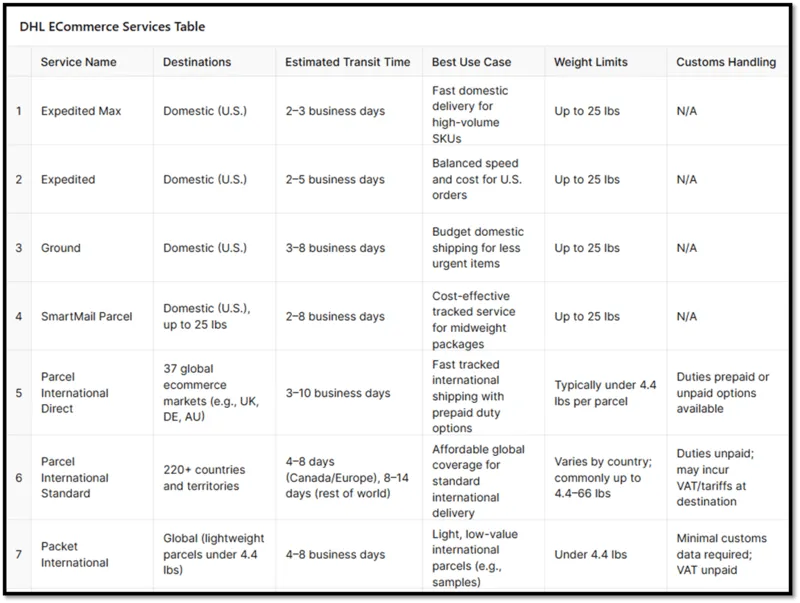
Hybrid Delivery Model as a Delivery Service Provider
DHL eCommerce employs a hybrid delivery model that combines the strengths of DHL and USPS. In this model, DHL manages upstream logistics, including sorting and processing packages at distribution centers, then completes the transfer to USPS for final delivery.
This collaboration allows DHL eCommerce to offer economical shipping solutions while ensuring reliable last-mile service through USPS. However, reliance on USPS can lead to service variability across regions, which businesses should keep in mind when planning their shipping strategies.
For example, a Texas-based seller noticed consistent delays in rural New England ZIP codes when DHL hands off to USPS. To mitigate this, they adjusted cut-off times and proactively updated customers with tracking links and additional information during the USPS handoff period to manage expectations, a tactic that helped reduce customer service tickets by 18%. Others complement DHL with a peer-to-peer order fulfillment service that outperforms traditional 3PLs to maintain 1–2 day delivery in regions where USPS performance is inconsistent.
Integration with Ecommerce Platforms
DHL eCommerce seamlessly integrates with all major ecommerce platforms, making it easier for businesses to manage their shipping operations. Key features include:
- Marketplace sellers can link existing DHL eCommerce accounts to supported platforms for a streamlined shipping experience.
- Simplified parcel delivery and returns.
- Real-time rate retrieval for shipments, improving efficiency and accuracy in pricing.
The 1-call buys feature simplifies the shipping label purchase process by combining multiple actions into a single API request, accelerating operations and helping businesses grow. By connecting with platforms like Shopify, Pulse Commerce, and BigCommerce, DHL eCommerce ensures that businesses can manage their orders and shipments with ease, create shipments from connected platforms, and manage account settings within connected workflows. For Shopify brands in particular, pairing DHL with specialized Shopify fulfillment services can make it easier to offer fast, low-cost shipping nationwide. EasyPost integrates with DHL eCommerce for shipping label creation.
Real-Time Tracking and Transparency
Transparency is key in the shipping process, and DHL eCommerce excels in providing real-time tracking for shipments. Key features include:
- The Delivery Confirmation Service offers tracking from the sender to the recipient.
- Ensures visibility throughout the shipping journey, providing important details.
- Particularly beneficial for international shipments, where comprehensive tracking is crucial.
DHL eCommerce shipments can be tracked via dhl.com/tracking. Access requires a shipment ID.
DHL eCommerce utilizes advanced technologies and features to enhance shipment tracking.
- Uses GPS and RFID to provide accurate real-time updates on the location of shipments.
- Minimizes human error and enhances automation in tracking parcels.
- Sends proactive notifications to customers regarding any delays or issues during the shipping process, improving their overall experience.
With various tracking solutions, such as API and On-Demand Delivery options, DHL eCommerce caters to diverse business needs, ensuring that both merchants and consumers have access to reliable tracking information and shipment data that supports tracking visibility, especially when integrated with robust ecommerce fulfillment software and analytics.
Operational Pitfalls
While DHL eCommerce offers numerous benefits, there are also operational challenges to be aware of. Many sellers experience tracking delays, particularly during peak shipping seasons, which can lead to customer dissatisfaction. Inadequate communication with logistics partners and the shipper can exacerbate these issues, leading to unforeseen delays in order fulfillment.
Disruptions in supply chains can significantly impact shipping timelines for DHL eCommerce users. Additionally, certain SKUs, particularly those containing hazardous materials, cannot be shipped through DHL eCommerce, making compliance essential. Establishing clear guidelines for unacceptable shipment types is crucial for avoiding pitfalls and ensuring smooth operations, and some brands even join a fulfillment partner program to diversify where and how orders are shipped.
A seller in the supplements category learned this the hard way when a batch of shipments containing hemp-based products was flagged during transit. Despite full compliance on the origin country side, destination country regulations caused parcel returns and spam-level customer support volume. Lesson learned: Review restricted items by both carrier and country before you ship.
DHL eCommerce’s tracking updates depend on timely USPS tracking event updates, making it important for sellers to monitor these closely. By being proactive and aware of these potential challenges, businesses can gain valuable insights to better navigate the complexities of using DHL eCommerce for their shipping needs.
What They Don’t Tell You: Hidden Costs in DHL’s Latest Rate Hike
If you blinked, you might’ve missed it, but DHL quietly implemented another round of rate increases in July 2025. While smaller than the dramatic spike that took effect in January, these new rates still chip away at the cost advantage many merchants once counted on.
Let’s break it down.
In early 2024, DHL was one of the most affordable shipping options for lightweight parcels, especially in Zones 1 and 2. Fast forward to July 2025, and that edge is eroding. Rates for 1 – 5 oz parcels in Zones 1 & 2 have climbed significantly—often by $0.10 to $0.20 per package. That might sound negligible, but if you’re shipping 10,000 orders per month, that’s a $1,000–$2,000 hit to your bottom line.
What most merchants miss:
- Price creep is consistent across all weight breaks. The increases are small but relentless.
- The biggest relative jumps are at the lightest weights (1 – 3 oz), a core volume segment for ecommerce.
- Zone compression no longer delivers the savings it used to. Previously, you could count on Zones 1 & 2 to be reliably cheap. Now, even “local” deliveries are being repriced to match broader zone costs.
This isn’t just a DHL issue. It’s the downstream effect of new USPS pricing agreements that have reshaped how DHL and other consolidators structure their pricing tiers. In short: the margins are tighter, and their flexibility is fading.
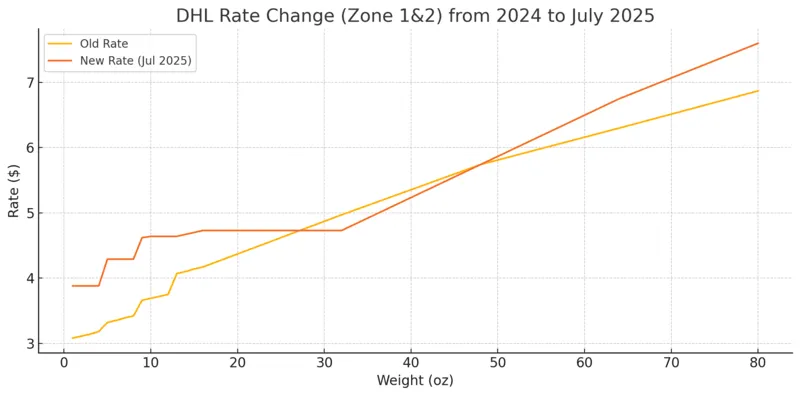
Customs and Trade Considerations
International shipping involves navigating complex customs and trade regulations. DHL eCommerce provides options for customs clearance, letting businesses choose between prepaid or unpaid duties and clarifying duties-and-taxes payment responsibility, thus streamlining international shipping processes and avoiding unexpected costs. With Delivered Duty Paid and Delivered Duty Unpaid options, responsibility shifts based on how the shipment is delivered to the destination country.
Changes in U.S. tariffs do not apply to shipments that have already left their origin, and no current exemptions exist for small businesses regarding tariffs. This situation has created challenges for many businesses who are advised to explore existing trade agreements to obtain tariff impacts and stay informed about changing trade regulations to help their business grow.
Sustainability Initiatives

DHL eCommerce is committed to sustainability, as demonstrated by its GoGreen program. The company aims for net-zero emissions by 2050, encouraging employees to engage in climate protection initiatives. This collective effort emphasizes the importance of individual contributions to combat climate change.
The GoGreen program fosters a culture of environmentally friendly behavior within DHL and encourages customers to adopt sustainable practices. Choosing DHL eCommerce allows businesses to align with eco-friendly shipping solutions and contribute to a more sustainable future.
Checklist for Sellers
DHL can be a powerful ally, but only if you treat it as one part of your fulfillment toolkit, especially if you sell through marketplaces or your own online store. Hybrid delivery, tracking intelligence, and adaptive networks (like Cahoot) are how you thrive in 2025’s logistics landscape.
- Checklist: Before you go all-in on DHL…
- Know your SKU best fit (size/weight limits)
- Be GDPR & customs-ready for cross-border parcels
- Build tracking automation for 48-hour gaps in tracking updates
- Add a fulfillment backup plan for shipments >$800 (de minimis changes may lead to customs delays or rejections)
- Build sustainability/consumer transparency into shipping costs
- Visit DHL’s service pages or tracking resources before rollout to confirm requirements
By following this checklist, sellers can optimize their use of DHL eCommerce and ensure smooth operations. Before committing, many merchants also review order fulfillment service reviews from similar ecommerce brands and reach out directly to request a customized fulfillment quote and consultation.
Summary
In summary, DHL eCommerce offers a comprehensive suite of shipping solutions designed to meet the needs of ecommerce businesses. From affordable domestic and international shipping options to real-time tracking and sustainability initiatives, DHL eCommerce provides the tools necessary for businesses to thrive in the competitive online market.
Many merchants adopt a hybrid strategy, using DHL eCommerce for non-urgent items and maintaining parallel channels with a faster delivery service provider like DHL Express or UPS for high-ticket or time-sensitive orders. This hybrid approach keeps costs in check while meeting the diverse delivery expectations of today’s online shoppers, as seen in industry case studies and news about innovative fulfillment partnerships.
By leveraging these services, businesses can enhance their shipping processes, improve customer satisfaction, and contribute to a more sustainable future. Whether you’re a small startup or a large enterprise, DHL eCommerce has the solutions to help you succeed.
Frequently Asked Questions
What is the delivery time for DHL eCommerce domestic shipping services in the United States?
DHL eCommerce domestic shipments typically take 2 to 8 business days, depending on the specific shipping service selected. Options like Expedited Max average 2 – 3 days, while Ground shipping may take up to 8 days. Delivery timelines are influenced by package weight, destination location, and USPS’s last-mile performance.
How long does DHL eCommerce international shipping take for online shoppers sending packages abroad?
DHL eCommerce offers several international shipping services. For example, Parcel International Direct delivers to 37 countries in about 3 to 10 business days, while Parcel International Standard ships to over 220 countries in 4 to 14 days. Shipping times vary based on the destination country, service type, and customs clearance.
What is DHL eCommerce’s hybrid delivery model and how does it affect shipping performance?
The hybrid delivery model used by DHL eCommerce combines DHL’s global logistics infrastructure with USPS for domestic last-mile delivery. This allows ecommerce businesses to access affordable, reliable shipping while benefiting from USPS’s nationwide reach. However, tracking and delivery times may vary depending on USPS efficiency in the final delivery zone.
Does DHL eCommerce offer real-time tracking for shipments and delivery confirmation?
Yes, DHL eCommerce provides real-time shipment tracking through GPS and RFID technologies. Merchants and customers can track packages across every stage of the shipping process, from pickup to final delivery. The Delivery Confirmation service ensures visibility and enhances trust, especially for international ecommerce shipments.
What sustainability programs does DHL eCommerce offer for eco-conscious ecommerce businesses?
DHL eCommerce is committed to sustainable logistics through its GoGreen program, which aims for net-zero carbon emissions by 2050. The company invests in alternative fuels, electric vehicles, and climate protection initiatives, helping ecommerce merchants align their shipping operations with environmentally responsible practices.
Written By:
Jeremy Stewart
Jeremy Stewart leads customer success at Cahoot, helping merchants achieve high-performance logistics through smart technology and process optimization. With a background in both ecommerce operations and client services, Jeremy ensures that every merchant using Cahoot gets measurable results—whether they’re scaling from one warehouse to many or managing complex returns.
Turn Returns Into New Revenue
Related Articles
Why Cross-Border DTC Brands Are Moving Fulfillment Inside the US
Cross-border ecommerce fulfillment is the process of shipping ecommerce orders across national borders—often from warehouses outside the United States to U.
Crafting a Return Policy that Drives Customer Loyalty and Reduces Returns
Let’s talk about ecommerce returns policies.
Cheapest Shipping from USA to UK: What It Really Costs
Shipping from the USA to the UK is one of the most common international routes for ecommerce brands, and it is also one of the most misunderstood from a cost perspective.