
Why Peer-to-Peer Returns Scale When Warehouses Don’t

In this article
 12 minutes
- Warehouse Returns Scale by Adding More Capacity
- Peer-to-Peer Returns Scale by Increasing Match Density
- More Volume Can Strengthen the Network Instead of Congesting It
- Fixed Assets and Network Density Solve Different Problems
- Scalability Is One of the Biggest Structural Differences Between P2P Lending and Traditional Financial Institutions
- P2P Does Not Need to Replace Every Return to Outscale the Warehouse Model
- The Bottom Line on Scalability and Credit Risk
- Frequently Asked Questions
A returns system is not defined by what it costs at low volume. It is defined by what happens when volume grows. That is where warehouse-based returns and peer-to-peer returns diverge most sharply, and where most operators get the comparison wrong.
The instinct is to treat peer-to-peer returns as a cheaper version of the same warehouse loop. It is not. The two models absorb growth in fundamentally different ways. Warehouses scale by adding capacity. Peer-to-peer scales by increasing density. One model leans harder on fixed assets and labor as volume rises. The other leans on verification, eligibility logic, and matching opportunity across a denser network. For ecommerce operators trying to figure out how returns will behave at twice their current volume, that distinction is the entire argument.
Warehouse Returns Scale by Adding More Capacity
The warehouse-centric returns loop is an infrastructure problem dressed up as a logistics problem. Every additional return requires a physical destination, a person to receive it, space to hold it, and time to process it. The math is brutally linear. More volume means more docks, more labor hours, more inspection stations, more put-away cycles, and more square footage absorbing inventory that has not yet been resold.
This is what fixed-capacity scaling actually looks like in practice:
- More space to stage and inspect inbound returns
- More labor to handle intake, inspection, repackaging, and restocking
- More processing overhead to keep refund cycles from slipping
- More infrastructure strain during peak periods when outbound and inbound volume collide
The uncomfortable part is that warehouse capacity does not flex. You cannot half-build a receiving dock or hire a quarter of a supervisor. Capacity gets added in expensive chunks, and those chunks usually arrive after the pain has already shown up in cycle times and refund delays. By the time the new capacity is online, return volume has often moved again.
There is also a second-order effect that rarely gets discussed. Warehouse returns are competing for the same labor, space, and management attention as outbound fulfillment. When return volume spikes, it does not just cost more on its own line item. It quietly degrades outbound throughput, which is where the actual revenue lives. That is fixed-capacity scaling at its worst: more volume, more strain, and the strain shows up in places the P&L does not immediately reveal.
Peer-to-Peer Returns Scale by Increasing Match Density
Peer-to-peer returns scale through a different mechanism entirely. Rather than a returns optimization solution that requires more fixed capacity for every increment of growth, what are peer-to-peer returns at the core is a verification-first system that matches eligible returned items to new demand before warehouse processing occurs. The system is not just moving products differently. It is screening for eligibility, evaluating condition, checking for fraud signals, and then matching verified returned inventory to a real buyer who already wants that item.
Once the model is verification-first, growth behaves differently. More activity across the network means more eligible verified returns entering the matching pool and more demand signals to match them against. That is what match density actually means: a denser graph of eligible returned items and willing buyers, with routing intelligence sitting between them deciding which match is best.
The inputs that drive scaling are not square footage and headcount. They are:
- More eligible returns flowing through the verification layer
- More buyers generating demand for items that already exist in the network
- More routing intelligence shaping which verified returned items get matched to which orders
- More opportunities to recover value before unnecessary reverse logistics occurs
This is the part that takes a minute to fully internalize. In a warehouse model, every additional return is an additional cost event. In a peer-to-peer model, every additional eligible return is also a potential supply event, because that verified returned item can be matched to a new buyer and fulfilled from a verified return source rather than from primary stock. The unit of scale is matching opportunity, not intake capacity.
For a deeper walk-through of the underlying mechanics, how peer-to-peer returns actually work covers the step-by-step process, including how eligibility is determined and how verified returned inventory gets routed. The mechanics matter, but the point for this article is narrower: the inputs that make a peer-to-peer system better are the same inputs that grow as the business grows.
More Volume Can Strengthen the Network Instead of Congesting It
The contrarian insight at the center of this comparison is not lower cost. Lower cost is downstream. The real advantage is a different scaling logic. Warehouses get more congested as return volume grows. Peer-to-peer networks, for the eligible slice of returns, get denser, which is closer to the opposite of congestion.
Think about what happens in each model when monthly return volume doubles.
In a warehouse model, doubled volume means doubled inbound parcels at the dock, doubled inspection queues, doubled put-away work, and doubled exposure to markdown decay while items sit waiting for processing. Cycle times stretch. Refund speed degrades. Labor schedules get harder to manage. The system absorbs the growth, but it absorbs it as strain, which is why many operators look for ways to optimize reverse logistics long before they hit breaking points. More volume produces more friction at exactly the moment the business needs the loop to move faster.
In a peer-to-peer model, doubled eligible volume changes the math for the eligible slice. There are more verified returned items in the matching pool, which means more chances that any given new order can be fulfilled from a verified return source rather than from primary inventory. The probability of a successful match for any individual eligible return goes up, not down, as activity grows. Growth feeds the matching layer instead of clogging the intake layer.
This is not a claim that volume is unlimited or that every return will find a buyer. It is a claim about direction. Warehouse models tend to get worse at scale on the dimensions that matter most to operators: speed, cost, and labor stability. Network-density models tend to get better at scale on the dimensions that matter most to recovery: match probability, time to recovery, and recovery before loss compounds.
Fixed Assets and Network Density Solve Different Problems
This is the line worth remembering. Warehouses solve scale with infrastructure. Peer-to-peer solves scale with network participation and routing intelligence. They are not two flavors of the same approach. They are two different scaling logics aimed at two different problems.
A warehouse is fundamentally a throughput machine. It exists to receive, process, and move physical goods through a controlled environment. When you ask a warehouse to absorb more returns, you are asking it to do more of what it was built to do, and that requires more of what it was built from: space, equipment, and labor. Infrastructure-based scaling is real, and for some categories of returns, it is the right answer, including models like Happy Returns’ drop-off return network that still depend on centralized processing behind the scenes.
A peer-to-peer system is fundamentally a matching machine. It exists to verify eligibility, evaluate condition, and match verified returned inventory to new demand before that inventory has to be handled in a centralized facility. When you ask a peer-to-peer system to absorb more eligible volume, you are not asking it to do more handling. You are giving it a larger pool of inputs to match against. Network-based scaling is also real, and for the eligible slice of returns, it produces different economics over time, similar to how peer-to-peer fulfillment is reshaping forward logistics for merchants competing in the Amazon era.
The strategic point is that operators get to choose which problem they want to solve at the margin. If the next 30% of return growth is going to be absorbed by adding warehouse capacity, the cost curve looks one way. If the eligible portion of that growth is absorbed by network density instead, the cost curve looks meaningfully different, especially when paired with the right returns management software for 2025 to orchestrate verification and routing logic. This is upstream of the cost comparison itself. The economics of peer-to-peer returns deserves its own treatment, and there is a full article on that. But the economics are downstream of the scaling logic, not the other way around.
Scalability Is One of the Biggest Structural Differences Between P2P Lending and Traditional Financial Institutions
Operators sometimes treat scalability as a footnote inside the broader peer-to-peer vs warehouse returns comparison. That underweights it. Most of the structural differences between the two models, including cost, fraud exposure, and refund speed, are downstream of how each system absorbs growth, and they show up differently in software-first tools like Return Prime’s return management solution that stop at policy and routing rather than full reverse logistics.
A few comparisons make the structural divergence clearer:
- How growth is absorbed. Warehouses absorb growth by adding capacity. Peer-to-peer absorbs eligible growth by adding density.
- What more volume creates. In warehouses, more volume usually creates more strain. In peer-to-peer, more eligible volume usually creates more matching opportunity.
- What the system depends on. Warehouse scaling depends on physical infrastructure. Peer-to-peer scaling depends on verification, eligibility, and demand matching.
- What stays true regardless. Not every return qualifies for peer-to-peer, and exceptions still need a path through the standard warehouse flow.
That last bullet is the bridge to the next section, and it matters more than the rest. A model is only credible if it knows where it ends.
P2P Does Not Need to Replace Every Return to Outscale the Warehouse Model
The realism check is non-negotiable. Not all returns qualify. Some fail verification. Some arrive damaged. Some are not sold in time. Some are simply unsuitable for resale because of the category, the condition, or the regulatory context. Those returns continue through the standard warehouse flow, and they should. There are specific scenarios where where peer-to-peer returns don’t work is the more useful frame, and the limitations article covers those in detail.
The point is that peer-to-peer does not need to absorb every return to change the scaling math. It needs to absorb the eligible slice. For that slice, more network density creates more matching opportunity, and that compounds as activity grows. The remaining returns continue through traditional reverse logistics, which is exactly what warehouses are good at, especially when paired with the right partner in the broader peer-to-peer network vs traditional 3PL fulfillment debate on the outbound side.
This is also why the right adoption goal is rarely 100%. There is a separate argument for why 100% p2p adoption is the wrong goal, and hybrid models tend to be what wins in practice. A selective optimization layer sitting on top of a working warehouse flow produces a different cost curve than either model in isolation. The warehouse handles what it is built for. The peer-to-peer layer handles the eligible verified returns where density and matching intelligence change the economics.
The structural rewrite is not that warehouses go away. It is that the eligible slice no longer scales the same way as the exceptions, much like how peer-to-peer order fulfillment services beat legacy 3PLs without eliminating the need for traditional infrastructure altogether.
The Bottom Line on Scalability and Credit Risk
Warehouses scale by building more infrastructure around the same loop. Peer-to-peer scales by making recovery opportunities denser and smarter around eligible verified returns. The advantage is not just cheaper unit economics, though those follow. The advantage is that the two models behave differently as the business grows. One absorbs growth as strain. The other absorbs the eligible portion of growth as opportunity.
For operators planning the next phase of return volume, that is the comparison that actually matters, and it rhymes with the choices brands face when evaluating the world’s first peer-to-peer fulfillment network for their forward logistics.
Frequently Asked Questions
Why do peer-to-peer returns scale differently from warehouse returns?
Warehouse returns scale by adding fixed capacity such as space, labor, and processing overhead. Peer-to-peer returns scale by increasing network density and matching opportunities for eligible verified returned items. The two models absorb growth through different mechanisms, which is why their cost and recovery curves diverge as volume grows.
Does more return volume make a peer-to-peer system better?
For the eligible slice of returns, more activity can create more matching opportunity because there are more verified returned items in the pool and more demand signals to match them against. This does not mean every return will be matched, but the probability of recovery before unnecessary warehouse processing tends to improve with density.
Do warehouses get cheaper per return as volume grows?
In most operations, warehouse returns do not benefit from economies of scale the way outbound fulfillment does. More volume tends to create more congestion, more labor strain, and more pressure on cycle times, particularly during peak periods when returns compete with outbound fulfillment for the same capacity.
Does peer-to-peer eliminate the need for warehouses?
No. Not all returns qualify for peer-to-peer. Some fail verification, are damaged, are not sold in time, or are unsuitable for resale. Those continue through the standard warehouse flow. Peer-to-peer is a selective optimization layer for eligible verified returns, not a replacement for warehouse-based reverse logistics.
What makes a return eligible for a peer-to-peer flow?
Eligibility typically depends on verification, condition evaluation, fraud screening, resale suitability, and whether there is demand for the item in the network. Peer-to-peer is a verification-first system, which means eligible items are matched to new demand only after the relevant checks have been completed.
Is the real advantage of peer-to-peer just lower cost?
Lower cost is part of it, but it is downstream. The deeper advantage is a different scaling logic. Warehouses scale through fixed assets. Peer-to-peer scales through network density and routing intelligence. The cost difference at any given volume is largely a result of how each model absorbs growth.
Written By:

Manish Chowdhary
Manish Chowdhary is the founder and CEO of Cahoot, the most comprehensive post-purchase suite for ecommerce brands. A serial entrepreneur and industry thought leader, Manish has decades of experience building technologies that simplify ecommerce logistics—from order fulfillment to returns. His insights help brands stay ahead of market shifts and operational challenges.

Turn Returns Into New Revenue
Related Articles
Crafting a Return Policy that Drives Customer Loyalty and Reduces Returns
Let’s talk about ecommerce returns policies.

Cheapest Shipping from USA to UK: What It Really Costs
Shipping from the USA to the UK is one of the most common international routes for ecommerce brands, and it is also one of the most misunderstood from a cost perspective.

Why Faster Refunds Made Returns More Expensive
Introduction Faster refunds feel like obvious progress.
Why Returns Are the Next Battleground in Retail

In this article
12 minutes
- Introduction
- Returns Moved From Back-Office Problem to Strategic Pressure Point
- Returns Now Sit Where Margin, Fraud, and Customer Satisfaction Collide
- Carriers and Platforms Are Already Fighting for the Reverse Logistics Post-Purchase Layer
- Retailers Are Already Competing Through Return Economics, Policy, and the Returns Management Process
- Returns Are Becoming the Next Battleground Because Easier Levers Are Weaker
- The Brands That Solve Returns Better Will Gain a Competitive Advantage
- Frequently Asked Questions
Introduction
The next battleground in retail is not at checkout. It is what happens after the sale goes wrong. U.S. retail returns are on track to hit $849.9 billion in 2025, roughly 15.8% of total sales, and the brands competing for that ground already know what most operators are still figuring out: returns management is no longer back-office cleanup.
For most of the last decade, returns were treated as a tax on growth. Returns management refers to overseeing returned products from authorization through restocking or disposal, making the returns management process central to product returns. Returns management focuses on customer satisfaction, while reverse logistics handles the operational aspects of moving goods back through the supply chain. Something to absorb. Something the warehouse handled while the rest of the business focused on acquisition, conversion, and AOV. That framing held up while easier levers were still working. It does not hold up now. Acquisition costs are climbing, discounting has limits, and the obvious places to defend margin have already been squeezed. Returns are one of the largest under-managed intersections of cost, fraud, customer trust, and differentiation left in retail. That is exactly why they are about to be contested.
Returns Moved From Back-Office Problem to Strategic Pressure Point
Start with the size of the room. $849.9 billion in projected U.S. returns for 2025 is not a line-item rounding error. In 2023, consumers returned retail purchases worth $743 billion, or about 14.5% of all sales, showing this pressure has been building. At about 15.8% of retail sales, returns are now a category of activity nearly as large as some entire retail verticals. A function that consumes one out of every six dollars of sales is not operational. It is strategic.
The shift in framing matters more than the number itself. When returns were 5% to 8% of sales, an “average cost per return” calculation could absorb them quietly. At 15.8%, the financial impact is visible in EBITDA, and every percentage point of improvement or deterioration affects profit margins. Finance teams notice. Boards notice. This is part of why returns are becoming a board-level topic, and it is also why operational reframing is happening internally. The internal reframing of returns as a margin lever, not a cost center, is one thread of that shift, because efficient return management helps reduce costs and strengthen customer loyalty. The strategic-competition thread is the one that matters here: when something is this large and this leaky, it does not stay uncontested for long, and a stronger returns management process also improves inventory management and operational efficiency.
Returns Now Sit Where Margin, Fraud, and Customer Satisfaction Collide
The reason returns are becoming the next battleground is that they have stopped being a single-purpose function. They now combine four pressures that used to be handled separately.
- Margin defense. Two shipping legs, intake labor, inspection, repackaging, and markdown decay stack into a fully-loaded cost most retailers underestimate.
- Fraud control. Nearly 9% of returned items are expected to be fraudulent. U.S. retailers lost nearly $25.3 billion to fraudulent returns in 2020, showing how much returns fraud and refund fraud can drain profitability. That is not a service problem. That is a loss-prevention problem riding inside a customer experience flow, especially when teams must review suspicious return requests.
- Customer trust. Roughly one in five online purchases are returned. The return experience is no longer the exception path. It is a core part of how customers evaluate a brand. Clear, proactive customer communication, including confirmation that an item was received and updates on refund timelines, helps boost customer satisfaction, encourage customer loyalty with an exceptional returns program, and protect brand reputation.
- Differentiation. Speed of refund, ease of return, condition transparency on resold goods, all of these now show up in reviews, social posts, and repeat-purchase rates. Streamlining refund processing and processing refunds quickly can improve customer satisfaction.
That combination is what makes returns competitive terrain. A function that touches margin, abuse control, trust, and brand perception in one workflow is not a function any serious retailer can afford to ignore. Strong communication around returns management can improve customer satisfaction and customer loyalty, while delayed refunds and weak updates drive customer dissatisfaction.
Carriers and Platforms Are Already Fighting for the Reverse Logistics Post-Purchase Layer
The clearest evidence that returns are contested terrain is that the largest logistics and platform players are already moving for position.
UPS-owned Happy Returns now operates at more than 8,000 locations, having been folded into UPS Store coverage after UPS acquired it from PayPal. FedEx launched FedEx Easy Returns in 2025 to compete directly for that same drop-off footprint. Amazon has expanded boxless and label-free returns through Kohl’s, UPS Stores, Whole Foods, and Amazon-owned locations. USPS has rolled out its own label-free return options.
This is not a coincidence of product roadmaps. When four of the largest logistics networks in the country simultaneously invest in owning the return entry point, they are signaling that the post-purchase layer has strategic value. That value also comes from returns management software that helps streamline returns through self-service portals, so customers can manage returns and routine return requests without contacting the customer service team, with options ranging from enterprise platforms to Shopify-focused tools like Return Prime returns solutions. It can issue return labels, route items to the right fulfillment center across sales channels, and track patterns that help flag suspicious behavior. They want the data, the customer touchpoint, the consolidation economics, and the relationship with the retailer that pays for the lane. None of that happens around a function that is genuinely back-office.
The post-purchase layer is being claimed. The same automation reduces work that is otherwise time-consuming for support and warehouse teams, while tying returns more tightly to order fulfillment. The question for individual brands is whether they participate in shaping how it works for their customers, or accept whatever shape it takes.
Retailers Are Already Competing Through Return Economics, Policy, and the Returns Management Process
The same pattern is visible on the retailer side. Brands that spent a decade competing on free returns are now competing on the design of paid returns. A clear and concise returns policy should spell out acceptable reasons, time windows, and any potential fees to meet customer expectations.
A short, telling list:
- PrettyLittleThing introduced a £1.99 return fee.
- ASOS charges £3.95 in the UK and applies a $4.95 deduction per returned parcel in the U.S.
- H&M rolled out return fees in several markets.
- Zara charges for mailed returns while keeping store returns free, steering customers toward the lower-cost channel.
The broader trend confirms this is not a handful of outliers. Roughly 40% of retailers are now charging return fees, up from 31% the year before, with typical fees in the $3.99 to $9.99 range, underscoring that the era of free returns coming to an end is reshaping expectations on both sides of the transaction. Paid returns can protect margins, but the cost of free returns remains a central question even as free return shipping is a proven way to build trust, lower barriers to purchase, and encourage future purchases. This is the visible surface of why retailers are quietly tightening returns policies across the industry. Each of these moves is small in isolation. Together, they describe a market actively redesigning return economics in real time. Fee structure, channel steering, window length, condition requirements, and restocking deductions are all now levers brands are pulling against one another. A strong returns strategy can also use exchanges or store credit to retain revenue and support repeat business instead of defaulting every return to a refund. That is what competition on a function looks like before it becomes table stakes.
Returns Are Becoming the Next Battleground Because Easier Levers Are Weaker
None of this would matter as much if the rest of the P&L still had easy answers. It does not.
Customer acquisition costs have risen sharply across most paid channels. Organic reach has compressed on every major platform. Discounting works but trains customers and erodes brand. Supply-side savings are largely tapped out for brands that have already optimized sourcing and 3PL contracts. The obvious moves have been made. For online shoppers, returns happen at far higher rates: roughly 20–30% of online purchases come back, versus 8.89% in physical stores, reflecting the broader rise of e-commerce return rates.
That is the strategic context returns walk into. When the easy levers are weaker, attention shifts to the levers that have been under-managed. Effective returns management has to balance customer satisfaction with fraud prevention and cost-efficiency if brands want to cut costs, reduce costs, and protect profit margins while improving operational efficiency and lowering operational costs, from detecting and preventing ecommerce returns fraud step-by-step to addressing the nuances between ecommerce return fraud vs. refund fraud. Returns are arguably the largest of these. A function representing 15.8% of sales, with ~9% fraud exposure on returned items, that simultaneously touches customer retention and Scope 3 reporting, is not a small lever. It is one of the few large ones still sitting in plain sight.
This is part of the reason sustainability didn’t kill returns — economics did. The pressure on returns is not coming primarily from ESG mandates. It is coming from the basic arithmetic of running a retail business when growth is harder to buy, because faster, more efficient processing also lowers shipping, labor, and storage expenses.
The Brands That Solve Returns Better Will Gain a Competitive Advantage
The competitive logic from here is straightforward.
A brand that handles returns poorly loses money on the return itself, loses trust with the customer, loses inventory value to delay and markdown, and absorbs fraud it cannot see. A brand that handles returns better protects margin on the same revenue, retains customers who would otherwise churn, recovers inventory value faster, and surfaces abuse earlier. Brands also compete better when they reduce returns upstream through stronger quality control, better product quality, accurate product descriptions, and detailed size guides that set expectations correctly. Same function. Different outcome.
The advantage compounds because each piece reinforces the others. Faster recovery improves cash flow, which improves the ability to invest in further improvement. Better fraud signals improve policy design, which improves margin. Better use of returns data helps teams identify trends, spot recurring defects, separate buyer’s remorse from fulfillment mistakes in order fulfillment, and prevent future returns. Cleaner post-purchase experience improves repeat rates, which improves CAC payback, which improves the willingness to invest in better returns infrastructure. This is the underlying logic behind treating returns as a margin lever, not a cost center, and it is also why the broader argument that returns need to go forward, not back is gaining traction operationally. Once a function is competitive terrain, the cost of treating it as a back-office process is not a static disadvantage. It widens every quarter against brands that are actively building capability there.
Returns are not becoming important. They have been important. What is changing is that the market has finally noticed, and the brands that move first will set the standard the rest of the industry has to react to. Better disposition decisions across the reverse logistics process—restock, refurbish, recycle, or resale—help recover more revenue while supporting sustainable returns and environmental responsibility.
Frequently Asked Questions
Why are returns considered the next competitive battleground in retail?
Because returns now combine financial leakage, fraud exposure, customer trust, and brand differentiation in a single function, at a scale of roughly $849.9 billion and 15.8% of U.S. retail sales. That mix of pressure, at that size, makes returns one of the largest under-managed areas left in retail, which is exactly the kind of function that attracts competitive attention.
How big is the U.S. returns problem in 2025?
U.S. retail returns are projected to reach $849.9 billion in 2025, equal to about 15.8% of total retail sales. Roughly one in five online purchases is returned, and nearly 9% of returned items are expected to be fraudulent.
Why are major carriers competing for return drop-off networks?
UPS-owned Happy Returns operates at more than 8,000 locations, FedEx launched FedEx Easy Returns in 2025, and Amazon and USPS continue to expand boxless return options. Carriers and platforms are competing to own the post-purchase layer because it carries strategic value: data, customer touchpoints, consolidation economics, and embedded relationships with retailers.
Why are retailers introducing return fees now?
About 40% of retailers are charging return fees, up from 31% the previous year, with typical fees between $3.99 and $9.99. Brands including PrettyLittleThing, ASOS, H&M, and Zara have introduced fees or channel-based pricing. The shift reflects active competition on return economics as easier margin levers elsewhere in the business have weakened.
Does this mean free returns are over?
Not entirely. It means free returns are no longer a default entitlement. They are increasingly treated as a priced service, a loyalty perk, or a channel-specific option, depending on the brand’s strategy. The competitive question is no longer whether returns are free, but how return economics are designed.
What should retailers do first if returns are becoming competitive terrain?
Establish a real baseline. That means a fully-loaded cost per return broken out by shipping, labor, markdown, and fraud, plus return rate by SKU and recovery rate of returned inventory. As part of returns management best practices, include tracking return reasons and regularly reviewing progress against those metrics. The returns process should cover initiation, return labels, processing refunds, and final disposition such as restocking or recycling. Transparency and multi-channel customer communication across email, phone, and live chat improve customer satisfaction by keeping shoppers informed about status and timing. Without that baseline, any policy or process change is anecdotal. With it, returns can be managed as a strategic lever rather than an absorbed cost.
Written By:
Manish Chowdhary
Manish Chowdhary is the founder and CEO of Cahoot, the most comprehensive post-purchase suite for ecommerce brands. A serial entrepreneur and industry thought leader, Manish has decades of experience building technologies that simplify ecommerce logistics—from order fulfillment to returns. His insights help brands stay ahead of market shifts and operational challenges.
Turn Returns Into New Revenue
Related Articles
Crafting a Return Policy that Drives Customer Loyalty and Reduces Returns
Let’s talk about ecommerce returns policies.
Cheapest Shipping from USA to UK: What It Really Costs
Shipping from the USA to the UK is one of the most common international routes for ecommerce brands, and it is also one of the most misunderstood from a cost perspective.
Why Faster Refunds Made Returns More Expensive
Introduction Faster refunds feel like obvious progress.
Sustainability Didn’t Kill Returns — Economics Did

In this article
15 minutes
- Economics Forced the Issue First
- Sustainability Became the Language of a Change Economics Had Already Forced
- ESG Is Downstream of Cost Pressure
- Policy and Market Behavior Changed Because the Old Model Stopped Working
- Sustainable Returns Helped Legitimize a Financial Correction
- If Economics Had Still Worked, the Sustainability Case Would Have Stayed Weak
- What This Means for the Returns Management Process and Strategy
- Frequently Asked Questions
The shift in returns management over the last few years is often explained as a sustainability awakening. That gets the causal order wrong. Retailers did not tighten policies, kill free returns, or rethink reverse logistics because they suddenly cared more about the planet. They did it because the numbers stopped working.
Sustainability language showed up later, as the publicly acceptable explanation for a financial correction that was already underway. The environmental case is real, but it is not what forced the issue. The forcing function was economics: margin pressure, shipping cost, handling cost, fraud, delayed recovery, and markdown drag. Anyone trying to read the market correctly needs to get that order right, because confusing justification with cause produces bad strategy.
Economics Forced the Issue First
For most of the last decade, returns were treated as a controllable cost of doing business. A few percentage points of leakage in exchange for higher conversion, longer customer lifetime value, and category dominance. That trade made sense when volumes were small, labor was cheap, and shipping was a rounding error.
None of those conditions held by 2023.
A single $100 sale routed back through a warehouse now carries shipping in two directions, intake labor, inspection, repackaging, restocking, and markdown exposure. Stack those costs and a meaningful share of the original order value disappears before the item is even relisted. Factor in customer acquisition cost on a sale that no longer holds, and the math gets worse. The full picture is laid out in the hidden economics of a $100 return and in a deeper look at the cost of free returns and their sustainability limits, but the short version is this: per-return averages mask the actual damage, and the actual damage compounded year over year.
The specific pressures that turned returns from a tolerated cost into a structural problem are not abstract:
- Margin pressure across categories, made worse by tariffs and input cost inflation
- Shipping and label cost rising faster than retail prices
- Handling and labor cost climbing in every major fulfillment market
- Return fraud expanding from roughly $27B in 2019 to over $100B by 2023, with return and refund fraud emerging as a silent profit killer
- Recovery lag, where items sit in inspection queues while resale value decays
- Markdown drag, where reverse-logistics delay forces deeper discounts at resale
None of those pressures has a green color. They are line items on a P&L. Returns became too expensive to ignore long before they became politically inconvenient.
Sustainability Became the Language of a Change Economics Had Already Forced
Once the economics broke, brands needed a way to talk about the change without sounding like they were taking something away from customers. “We’re charging for returns because they’re crushing our margin” is an honest sentence that no marketing team wants to send. “We’re reducing the environmental impact of our returns process” is the same sentence with better optics.
That is not cynicism. The environmental claim is often genuinely true. Cutting returns volume, eliminating unnecessary shipping legs, and keeping product in circulation does reduce waste and emissions. But sincerity is not the same as causation. The sustainability story gained traction because the economic story had already made change unavoidable. Without the cost pressure, the green case would have stayed where it sat for years: real, defensible, and largely ignored.
It is worth noticing the sequencing. Brands did not lead with sustainability and then discover the cost savings. They felt the cost pain first, then reached for a public-facing frame that customers, employees, and investors could rally behind. The packaging followed the correction.
ESG Is Downstream of Cost Pressure
This is the part of the argument that matters most for anyone trying to plan returns management strategy.
ESG is downstream of cost pressure. Economics is upstream. Causal order matters because it determines what is durable and what is decorative. Policies anchored in financial pressure will persist as long as the pressure persists. Policies anchored only in environmental language will erode the moment the financial pressure eases or competitive dynamics shift. In that context, returns management refers to the customer-facing side of handling returns, while reverse logistics covers the broader movement of goods back through the supply chain. Reverse logistics can include repair, refurbishment, recycling, or resale, whereas returns management focuses on customer satisfaction and operational efficiency.
If you treat sustainability as the root cause, you build the wrong roadmap. You over-invest in narrative, under-invest in routing and recovery, and get blindsided when the next CFO asks why returns cost has not actually moved. If you treat economics as the root cause, you ask harder questions: where is the cost actually concentrated, which SKUs are recoverable, how much of the loss is structural versus controllable, and what would need to change for returns to stop being a margin sinkhole.
The brands that have made the most progress on returns management started from the financial question, not the moral one. The moral question came along for the ride.
Policy and Market Behavior Changed Because the Old Model Stopped Working
The visible changes in retail returns over the last 24 months are downstream expressions of the same upstream pressure. Zara introduced return fees. H&M, J.Crew, and Anthropologie followed. Amazon began flagging frequently returned items on product detail pages and tightening seller penalties. Return windows shortened across apparel and footwear. Refund timing moved from “instant” to “on receipt” in more programs than most consumers noticed, reflecting the broader trend of free returns coming to an end for many merchants. High visibility of the return policy also affects customer trust, because transparency matters as much as generosity.
These moves are often discussed individually, as if each were a standalone marketing decision. They are not. They are the same balance sheet showing up in different policy documents. There is a much longer treatment in the piece on why retailers are quietly tightening returns policies, but the framing here is narrower: tighter policies, reduced generosity, and disciplined messaging are consequences of the economic pressure, not independent root causes. Even the cultural shift captured in free returns aren’t sacred is downstream of the same forces. The expectation reset that came with it stuck because the entire market moved together, and the market moved together because the underlying math was the same everywhere. In that context, returns management refers to the customer-facing side of handling returns, with a focus on customer satisfaction, customer experience, and operational efficiency. A clear self-service path works best when the customer initiates the request with minimal friction. That often includes prepaid return labels, which make shipping simpler while giving retailers more control over cost. Clear updates on return status can also reduce hesitation when policies tighten, because the process itself reinforces customer trust.
When every major retailer in a category makes the same adjustment within an 18-month window, that is not a sustainability movement. That is a shared response to a shared cost structure.
Sustainable Returns Helped Legitimize a Financial Correction
None of this means environmental concerns are fake or that ESG is a marketing trick. The sustainability case for rethinking returns is genuinely strong. Roughly 44% of apparel returns never reenter inventory. A meaningful share gets liquidated, incinerated, or landfilled. Two shipping legs per return, doubled packaging, and the carbon footprint of warehouse handling all add up, which is why many brands are exploring eco-friendly returns strategies that align sustainability with consumer expectations. Streamlined logistics can reduce costs and lower operational costs by minimizing shipping, handling, and warehousing expenses. Regulators in the EU and UK have moved against destruction of unsold goods, and similar pressure is building in the United States.
The role those facts play is important, though. They legitimize a correction that economics had already forced. They give brands a story to tell customers, a frame to share with investors, and an answer to give boards. Automated return systems can also speed refunds or store credit cost effectively, which makes the correction easier to sustain operationally. A clear self-service path for the customer to initiate a return request can still reduce hesitation when policies tighten. Prepaid return labels and clear return status updates also help preserve trust even when policies become less generous. That is real value. A financial correction with a credible public narrative is easier to sustain than one without. But the narrative did not cause the correction. The correction created demand for the narrative.
This matters at the board level too. The board-level framing of returns is increasingly about margin durability, working capital, and structural cost, with sustainability disclosure as an adjacent concern rather than the lead concern. Around 20–30% of online purchases are returned, versus 8.89% in physical stores, which helps explain why online retailers felt the pressure first and why so many are now focused on addressing the rise of e-commerce return rates at a structural level. Boards have been clear about the order of operations even when public communications have not.
If Economics Had Still Worked, the Sustainability Case Would Have Stayed Weak
The clearest way to check the causal order is to run the counterfactual.
Imagine returns had remained genuinely affordable. Shipping cost flat, labor cheap, fraud contained, recovery rates high, markdown drag minimal. In that world, would brands have voluntarily walked away from free returns, tightened windows, or charged restocking fees in the name of the environment? Almost certainly not. The sustainability case existed for years before any of this happened, and it produced very little structural change. Brands do not give up profitable convenience because something is wasteful. They give up profitable convenience when it stops being profitable.
That is not a flattering observation about retail, but it is an accurate one. The same logic explains why returns are now showing up as a strategic question in places they never appeared before. Once the cost stops being absorbable, returns become a battleground in retail and a category-level question about whether the industry needs returns to go forward, not back. Those conversations did not begin with sustainability. They began with margin.
The sustainability case got louder because the financial case got harder to deny. Reverse the polarity of that statement and the recent history of returns stops making sense.
What This Means for the Returns Management Process and Strategy
The practical implication is straightforward. If you are building or revising a returns strategy, define the returns management process as overseeing returned products from authorization through restocking or disposal when resale is no longer possible. It typically covers return authorization, transportation, inspection and processing, customer resolution, and restocking or disposal. Customers return roughly 15% to 30% of online purchases, with average online return rates around 19% to 20.5%, which is why many retailers are rethinking how to craft the perfect e-commerce returns program that balances cost and loyalty. Cost per return, recovery rate, fraud exposure, refund cycle time, markdown exposure, and inventory management are the levers that determine whether efficient returns management is durable, with faster turnaround and shorter processing times as measurable outcomes. Sustainability metrics belong in the program too, but as outputs and reporting, not as the primary justification for change.
This is also why many returns management solutions do not solve the underlying problem on their own. Better returns portals, smoother exchange flows, and tighter policy enforcement sit on top of the same warehouse-centric routing that created the cost pressure in the first place. Automation can also generate return labels and support processing refunds with fewer errors, including more consistent refund processing. Good systems also help track returns and connect return decisions with warehouse management. They make a broken loop faster, not cheaper. Managing returns efficiently is about lowering cost while using an exceptional returns program to deepen customer loyalty. The structural change happens when routing itself moves, which is the argument behind the end of traditional returns, the evaluation of networked drop-off solutions like Happy Returns and their trade-offs, and the case for peer-to-peer alternatives. But even there, the reason to consider structural change is economic when managing returns. The sustainability benefits are real, and they show up as a consequence, not a cause. Data from returns and customer feedback can reveal root causes, improve product quality, and reduce future returns.
Get the order right and the strategy gets cleaner. Costs become measurable. Trade-offs become explicit. Sustainability claims become defensible because they rest on a financial foundation rather than a rhetorical one. That is what a serious returns management posture looks like in 2026.
Frequently Asked Questions
Did sustainability concerns actually cause retailers to change their returns policies?
Not primarily. The environmental case for changing returns existed for years before any major policy shift occurred. What forced retailers to act was economic pressure: rising shipping and handling costs, fraud expansion, margin compression, and recovery delays. Sustainability language became more visible afterward because it offered a publicly acceptable explanation for a financial correction that was already underway. Retailers also communicate policy changes carefully because a smoother process can improve the customer experience.
Why does the causal order between economics and sustainability matter?
Because it determines strategy. If a leader believes sustainability caused the shift, they will over-invest in narrative and under-invest in cost structure, fraud controls, and routing. If they understand that economics is the root cause, they ask sharper questions about where loss is concentrated and what would actually move the cost curve. Getting the order right produces a more durable returns management program.
Are environmental claims about returns dishonest, then?
No. The environmental impact of returns is real. Roughly 44% of apparel returns never reenter inventory, reverse logistics doubles transportation emissions, and packaging waste compounds. Brands citing these facts are usually accurate. The point is not that sustainability claims are false. The point is that they describe a benefit of change rather than the original force that compelled change.
What economic pressures specifically forced the shift?
The main pressures are margin compression across categories, rising shipping and label costs, increasing handling and labor costs, fraud expansion (from roughly $27B in 2019 to over $100B in 2023), delayed recovery that erodes resale value, and markdown drag on items that sit in reverse logistics queues. 44% of brands cite returns fraud and abuse as their biggest returns pain point. Common abuse methods include label tampering, fraudulent tracking, and empty box returns. Stricter proof-of-purchase rules, tighter return limits, and fraud-prevention software can help flag suspicious activity tied to a return request. Each of these is measurable on a P&L, and together they made the old model harder to defend, which is why tactics like restocking fees and alternative return options have become more common in certain categories.
Does this mean ESG and returns are unrelated?
No. ESG and returns are tightly related, but the relationship runs in one direction. Economics drives the structural change, and ESG benefits follow as a consequence. Returns programs that improve recovery, reduce unnecessary shipping legs, and keep more product in circulation produce real environmental gains. Those gains are easier to defend and report on when they are grounded in a financial program that is already working.
What should retailers focus on first—customer satisfaction—when rebuilding returns management?
Start by managing returns efficiently, with economics first: returns management best practices should begin with cost per return by category (shipping, labor, markdown, fraud), refund cycle time, and recovery rate by SKU. Identify which segment of returns is genuinely recoverable and which is not. The goal is not only cost control but also to retain revenue where exchanges or store credit make sense. Every return also provides useful data that can help reduce future sales losses by lowering return rates over time; Amazon sellers in particular benefit when they analyze FBA return patterns and reasons systematically. That data can also reveal customer behavior and support repeat business. Once the financial picture is clear, design policy, routing, and customer communication around it. Improving quality control, accurate size guides, and clearer product descriptions can prevent avoidable returns and reduce customer complaints. Proactive updates at key milestones can also cut support tickets. Sustainability reporting comes naturally from that foundation, rather than the other way around, and a clear, concise returns policy sets expectations and improves customer satisfaction. A streamlined process also helps build customer loyalty.
Written By:
Manish Chowdhary
Manish Chowdhary is the founder and CEO of Cahoot, the most comprehensive post-purchase suite for ecommerce brands. A serial entrepreneur and industry thought leader, Manish has decades of experience building technologies that simplify ecommerce logistics—from order fulfillment to returns. His insights help brands stay ahead of market shifts and operational challenges.
Turn Returns Into New Revenue
Related Articles
Crafting a Return Policy that Drives Customer Loyalty and Reduces Returns
Let’s talk about ecommerce returns policies.
Cheapest Shipping from USA to UK: What It Really Costs
Shipping from the USA to the UK is one of the most common international routes for ecommerce brands, and it is also one of the most misunderstood from a cost perspective.
Why Faster Refunds Made Returns More Expensive
Introduction Faster refunds feel like obvious progress.
USPS Is Moving From 166 to 139 DIM. Bulky Ecommerce Packages Will Feel It
In this article
13 minutes
- What USPS Is Changing on July 12
- Why the DIM Divisor Matters
- How a 47 lb DIM Shipment Can Become 59 lb
- Big Bulky Packages Were Never USPS’s Sweet Spot
- Why UPS and FedEx May Be Better Options for Some Bulky Shippers
- Which Ecommerce Products Are Most Exposed?
- What Ecommerce Brands Should Audit Before July 12
- Packaging Still Matters Even If You Change Carriers
- Carrier Routing Needs to Get Smarter
- The New Fulfillment Reality: Inches Are Margin
- Frequently Asked Questions
A large ecommerce package does not need to get heavier for the shipping invoice to go up.
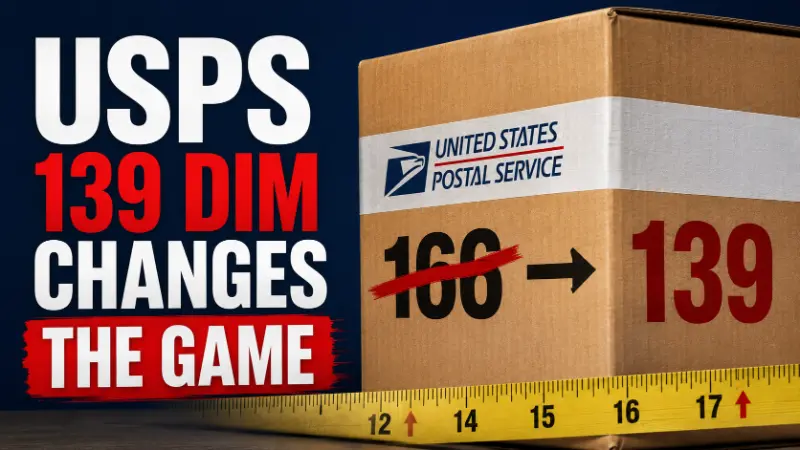
Starting July 12, USPS is changing how it calculates dimensional weight for several package services. The agency plans to move its DIM divisor from 166 to 139 and round fractional package dimensions up to the next whole inch.
That sounds like carrier math.
For ecommerce brands, it is margin math.
The change affects large, lightweight packages that exceed 1 cubic foot and are subject to dimensional weight pricing. For bulky products, the same item, in the same box, going to the same customer may be billed at a higher weight simply because the pricing formula changed.
This matters most for sellers of low-density products: ride-on toys, pillows, pet beds, backpacks, lamps, baby gear, home decor, lightweight furniture parts, and other items that take up more space than their scale weight suggests.
The practical takeaway is simple: wasted inches are becoming more expensive.
What USPS Is Changing on July 12
USPS is making two major changes to dimensional pricing for several package services.
First, USPS will begin rounding package dimensions up to the next whole inch. A side that measures 12.2 inches will be treated as 13 inches. A side that measures 16.7 inches will be treated as 17 inches.
Second, USPS will change the dimensional weight divisor from 166 to 139.
The affected services include:
- USPS Ground Advantage
- Parcel Select
- Priority Mail
- Priority Mail Express
The change applies to packages over 1 cubic foot that are subject to dimensional weight pricing.
USPS has tightened dimensional pricing before. Cahoot previously covered an earlier USPS dimensional pricing change when the agency moved toward a 166 divisor. This new update goes further by moving from 166 to 139 and adding stricter rounding rules.
Why the DIM Divisor Matters
Dimensional weight is a way for carriers to price packages based on the space they occupy, not just the package weight or the actual scale weight, and carriers bill whichever is higher.
The basic formula is:
Length × width × height ÷ DIM divisor = dimensional weight
A lower divisor creates a higher dimensional weight for the same package.
That is why the move from 166 to 139 matters. The product does not change. The box does not change. But the billed weight can increase because the formula becomes less forgiving.
If you need a deeper primer on how this works, Cahoot’s guide to dimensional weight pricing explains how carriers convert package size into billable weight.
How a 47 lb DIM Shipment Can Become 59 lb
Here is a practical ecommerce example.
Consider a toddler ride-on plastic car, such as a Cozy Coupe-style toy. The product itself is not extremely heavy, but the package is bulky.
Using package dimensions of 29.3 × 16.7 × 15.8 inches, you can figure the cubic volume from length x width x height, or length x width x height / width x height volume math as shown in the rounded example, for roughly 7,731 cubic inches before rounding.
| Scenario | Calculation | DIM Weight |
| Old USPS divisor | 7,731 ÷ 166 = 46.6 | 47 lb |
| New USPS divisor, no rounding | 7,731 ÷ 139 = 55.6 | 56 lb |
| New USPS divisor, with rounding | 30 × 17 × 16 = 8,160 ÷ 139 = 58.7 | 59 lb |
| That is the real impact. |
The same large toy package can move from a 47 lb dimensional weight to a 59 lb dimensional weight.
Nothing about the product changed. Nothing about the customer changed. Nothing about the delivery promise changed.
The package simply gets billed differently, which helps determine dimensional weight when a parcel is large but light.
That 12 lb increase in billed weight is the kind of change that can quietly turn a profitable order into a margin problem, especially for sellers offering free or flat-rate shipping.
Big Bulky Packages Were Never USPS’s Sweet Spot
The obvious 3PL takeaway is that large, bulky items were never USPS’s strongest lane to begin with.
USPS can be excellent for many ecommerce shipments, especially across many domestic services, small residential parcels, lightweight items, and certain nationwide delivery use cases. But large packages create a different network problem.
A large package consumes truck space, sortation space, and delivery vehicle capacity regardless of how little it weighs. Parcel carriers do not only manage pounds. They manage cube.
That is why this change should not be viewed only as a rate update. It is also a network signal, similar to how carriers structure pricing for shipping heavy items to maximize profit.
By moving from 166 DIM to 139 DIM and rounding package dimensions up, USPS is reducing one of the pricing advantages that may have made some bulky shipments look attractive under the old math.
The practical effect is that USPS is making large, lightweight packages less attractive to ship through its network.
That does not mean USPS is the wrong choice for every package. There are still USPS use cases that can make sense, including certain flat-rate shipping scenarios. Cahoot’s guide to USPS flat rate boxes explains when flat-rate packaging can be useful and when it may not be the best fit.
But for big bulky products, the old assumption that USPS is automatically the cheaper option deserves another look.
Why UPS and FedEx May Be Better Options for Some Bulky Shippers
UPS and FedEx are not always the most affordable option for every large package. Their published dimensional rules can also be expensive, and many bulky shipments can trigger additional handling, large package, or oversize surcharges.
But for shippers with meaningful volume, non-USPS carriers may offer more room for negotiation.
Depending on package profile, volume, zone distribution, and contract structure, shippers may be able to negotiate:
- steeper discounts for heavier or larger packages
- better minimum charge terms
- discounts or concessions on additional handling fees
- more favorable treatment for large-package surcharges
- custom incentives based on predictable shipping volume
That matters because the headline DIM factor and dim weight pricing are only one part of the total shipping cost.
For bulky products, the carrier agreement can matter as much as the formula. A shipper with poor UPS or FedEx terms may still find USPS competitive on certain lanes. A shipper with strong negotiated discounts may find that UPS, FedEx, or another carrier produces better landed cost for large-package profiles, especially when they partner with a fulfillment provider that beats traditional 3PLs as outlined in Cahoot vs. ShipMonk fulfillment comparison.
Cahoot has also covered how UPS and FedEx dimensional weight rules have changed over time, which is important context for understanding why USPS is now moving closer to private-carrier practices.
The point is not to abandon USPS across the board.
The point is to stop treating carrier selection as static.
After July 12, bulky-package shippers should rerun the math.
Which Ecommerce Products Are Most Exposed?
The most exposed products are not always the heaviest products.
They are often products with a large package cube and relatively low actual package weight.
Examples include:
- ride-on toys and large plastic toys
- pillows, bedding, and cushions
- pet beds and bulky pet products
- backpacks, bags, and luggage
- lamps and home decor
- baby gear and nursery products
- lightweight furniture parts
- foldable or assembled household products
- oversized subscription boxes
- apparel bundles shipped in oversized cartons
The shared pattern is low density.
The parcel is large and light relative to its actual package weight.
This is why ecommerce furniture and home goods sellers already feel dimensional weight pressure so heavily. Cahoot’s article on how to ship furniture without destroying margins explains why DIM weight, packaging, and fulfillment location can determine whether bulky orders remain profitable.
What Ecommerce Brands Should Audit Before July 12
Before the USPS change takes effect, ecommerce brands should identify where they are most exposed.
Start with SKUs that ship in packages over 1 cubic foot. Then calculate the new billable weight by comparing actual weight and expected DIM under the 139 divisor with rounded dimensions, and consider how packaging rules across different channels, such as Amazon’s expanded FBA box size limits, interact with USPS dimensional changes.
At minimum, shippers should audit:
- SKUs with package dimensions over 1 cubic foot, or 1,728 cubic inches
- actual weight versus dimensional weight
- old billed weight versus new billed weight, including the pound impact at the SKU level
- accurate measurement of package dimensions after you measure every side before rounding up
- USPS services currently used for bulky products
- UPS and FedEx alternatives for the same package profiles
- additional handling or large-package surcharge exposure
- shipping rules inside the OMS, WMS, or shipping platform
- free shipping thresholds and marketplace shipping promises
- SKU-level margin by channel after the new billing math
This is also a good time to revisit broader ground shipping costs. Using multi-carrier shipping software for ecommerce alongside Cahoot’s guide on how to reduce ground shipping costs covers additional ways brands can manage transportation costs without sacrificing delivery speed.
The key is to model the impact at the SKU level.
A blended shipping-cost average can hide the problem. One product may barely change. Another may jump enough to erase the margin on an entire product line.
Packaging Still Matters Even If You Change Carriers
Switching carriers does not fix bad packaging or a poor package shape.
If a product ships in an oversized carton, it will usually be expensive somewhere. UPS, FedEx, USPS, and regional carriers may price that package differently, but none of them want to move wasted air for free.
That is why brands should look at packaging before assuming the answer is only a new carrier contract.
Questions to ask include:
- Are we using the smallest box that safely protects the product? Can we trim fractions of an inch where possible, since USPS rounds up and that extra size can raise postage?
- Are warehouse teams selecting the right carton consistently?
- Do we have too many orders shipping in fallback boxes?
- Are bundles or kits creating unnecessary cube?
- Can the product packaging be redesigned to reduce empty space? For compressible goods, would mailers reduce volume?
- Do our systems recommend cartons based on actual item dimensions?
This is where cartonization becomes more than a warehouse efficiency tool. It becomes a shipping-cost control mechanism, especially when merchants use smart cartonization software to save big on shipping.
Cahoot’s article on cartonization software explains how better box selection can reduce waste, improve packing consistency, and help retailers and 3PLs control fulfillment costs.
When the DIM divisor drops, every unnecessary inch becomes more expensive.
Carrier Routing Needs to Get Smarter
The USPS change also increases the importance of carrier routing.
A shipping rule that worked under the old dimensional pricing model may not work after July 12. A service that used to be the cheapest option for a bulky package may become less competitive once the new billed weight is calculated.
That creates risk for brands relying on static shipping rules.
For example, a seller may have rules that default certain package types to USPS Ground Advantage because it historically performed well. After the divisor change, the better option may be UPS Ground, FedEx Ground, a regional carrier, or a different service depending on distance, zone, package size, promised delivery date, and negotiated discounts.
This is where ecommerce shipping software and multi-carrier logic become more important. Next-generation ecommerce shipping software for warehouse automation and Cahoot’s guide on how to save money with ecommerce shipping software explain how automation, rate shopping, and carrier selection can help brands reduce shipping costs.
But software only works if the inputs are accurate.
If item dimensions, box dimensions, product weights, or shipping rules are outdated, the system may still choose the wrong service.
The July 12 change is a good trigger to clean up the data brands need to choose the right shipping service when they send packages.
The New Fulfillment Reality: Inches Are Margin
For ecommerce brands, the USPS DIM change is not just about one carrier.
It is part of a broader shift in parcel pricing. Carriers are getting more precise about charging for the space packages occupy inside their networks.
That means shipping cost optimization cannot stop at rate negotiation.
Brands need to manage their operations with robust ecommerce fulfillment software for intelligent order routing:
- package dimensions
- carton selection
- DIM weight exposure
- carrier contracts
- surcharge rules
- shipping software logic
- fulfillment location strategy
- SKU-level profitability
The brands that handle this well will not simply look for the cheapest label. They will build fulfillment operations that reduce wasted cube, route orders intelligently, and match each package to the right carrier and service.
That is where distributed fulfillment can also matter. Placing inventory closer to customers can reduce zones, improve delivery promises, and give brands more flexibility in carrier selection. For bulky products, shorter shipping distances can help brands pay less for shipping and preserve margin.
Cahoot helps ecommerce brands reduce fulfillment and shipping costs through distributed fulfillment, intelligent order routing, and multi-carrier optimization, offering ecommerce order fulfillment services that outclass traditional 3PLs. For brands shipping large or bulky products, the goal is not just to move packages. It is to move them through a reliable network that manages large, low-density shipments at the right cost, using peer-to-peer order fulfillment services for ecommerce companies and a peer-to-peer order fulfillment network that beats old 3PLs.
The USPS change makes one thing clear:
Inches are no longer just packaging details. They are billable weight.
Frequently Asked Questions
What is USPS changing about dimensional weight pricing?
Starting July 12, USPS is moving its dimensional weight divisor from 166 to 139 for several package services and rounding fractional package dimensions up to the next whole inch. This can increase billed weight for large, lightweight packages.
Which USPS services are affected by the 139 DIM divisor change?
The change affects USPS Ground Advantage, Parcel Select, Priority Mail, and Priority Mail Express packages over 1 cubic foot when they move through the post office network to Zones 5–9 and are subject to dimensional weight pricing.
Why does moving from 166 DIM to 139 DIM increase billed weight?
Dimensional weight is calculated the way USPS measures one dimension after another in the formula: multiply length, width, and height, then divide by the DIM divisor to determine billed weight; one cubic foot equals 1,728 cubic inches. A lower divisor produces a higher dimensional weight for the same package, which can increase the billed weight.
What types of ecommerce products are most affected?
Large, lightweight products are most exposed. Examples include ride-on toys, pillows, pet beds, backpacks, baby gear, home decor, lightweight furniture parts, and other bulky products with low actual weight relative to package size.
Should ecommerce brands stop using USPS for bulky packages?
Not necessarily. USPS may still make sense for some shipments. But brands shipping bulky products should rerun the math after July 12 and compare USPS against UPS, FedEx, regional carriers, and negotiated carrier agreements.
How can ecommerce brands reduce DIM weight exposure?
Brands can reduce exposure by right-sizing packaging, improving carton selection, auditing package dimensions, using smarter carrier routing, negotiating better carrier terms, and reviewing SKU-level profitability after the new DIM math takes effect.
Written By:

Indy Pereira
Indy Pereira helps ecommerce brands optimize their shipping and fulfillment with Cahoot’s technology. With a background in both sales and people operations, she bridges customer needs with strategic solutions that drive growth. Indy works closely with merchants every day and brings real-world insight into what makes logistics efficient and scalable.
Turn Returns Into New Revenue
Related Articles

Why Cross-Border DTC Brands Are Moving Fulfillment Inside the US
Cross-border ecommerce fulfillment is the process of shipping ecommerce orders across national borders—often from warehouses outside the United States to U.
Crafting a Return Policy that Drives Customer Loyalty and Reduces Returns
Let’s talk about ecommerce returns policies.
Cheapest Shipping from USA to UK: What It Really Costs
Shipping from the USA to the UK is one of the most common international routes for ecommerce brands, and it is also one of the most misunderstood from a cost perspective.
Amazon’s July 2026 Seller Fulfilled Prime Speed Changes: What Sellers Need to Know

In this article
17 minutes
- Amazon Is Raising the SFP Delivery-Speed Bar on July 6, 2026
- What Is Changing in the July 2026 SFP Requirements?
- The Biggest Issue Is the Customer-Facing Delivery Promise
- Standard-Size Sellers Face the Most Direct One-Day Delivery Pressure
- Oversize and Extra-Large Products Still Need a Faster Fulfillment Plan
- Sellers Should Audit Their SFP Dashboard Before July 2026
- The July 2026 Update Rewards Better Fulfillment Network Design
- What Sellers Should Do Now
- Where Cahoot Fits
- Frequently Asked Questions
Amazon is raising the minimum delivery-speed requirements for Seller Fulfilled Prime, effective July 6, 2026. The update tightens the percentage of Prime customer page views that must show fast delivery dates across standard-size, oversize, and extra-large products, and it signals that Amazon expects the Prime badge to reflect a faster, more reliable customer-facing promise.
This article focuses on the July 2026 delivery-speed changes specifically. If you already run an SFP program, the practical question is whether your current fulfillment network, shipping templates, cutoff times, and carrier mix can still produce the delivery dates Amazon will require on offer pages. Sellers who designed their operation around speed of promise, not just speed of pick-pack, are positioned to absorb this change. Sellers who built their model around a single warehouse and a generous handling buffer may need to make structural decisions before the deadline.
Amazon Is Raising the SFP Delivery-Speed Bar on July 6, 2026
Amazon has announced updated minimum delivery-speed requirements for Amazon Seller Fulfilled Prime, Amazon’s Prime program for eligible third-party sellers, citing rising customer expectations and improvements in fulfillment speed across the marketplace. To remain eligible for SFP starting July 6, 2026, Prime offers must meet new thresholds for how often Prime customer page views show fast delivery dates.
The change is meaningful for two reasons, and it follows earlier updates like the June 29, 2025 adjustments to SFP and Premium Shipping performance requirements. First, the tighter SFP speed thresholds raise the standard across every size tier. Second, the metric Amazon evaluates is the delivery date shown to the shopper on the offer page, not the speed at which an order eventually ships. That distinction is what most directly affects compliance, conversion, and Prime badge stability.
Amazon has stated that all other SFP eligibility requirements remain unchanged. The on-time delivery requirement, valid tracking rate, cancellation thresholds, buy shipping usage, and weekend operations expectations carry over as they exist today. What is changing is the speed metric and the percentage of page views that must show qualifying delivery dates, while the Prime badge continues to function as Prime branding tied to fast, reliable delivery.
What Is Changing in the July 2026 SFP Requirements?
The new thresholds vary by size tier. Amazon delivered over 13 billion items same-day or next-day in 2025, which helps explain the higher customer expectations behind these changes and continues the trend of increasingly demanding Seller Fulfilled Prime requirements. Here is a side-by-side view of the current and July 2026 requirements:
| Size Tier | Delivery Window | Current Requirement | July 2026 Requirement |
| Standard-size | 1 day | 30% of Prime page views | 40% of Prime page views |
| Standard-size | 2 days | 70% of Prime page views | 75% of Prime page views |
| Standard-size | 5 days | (existing) | 90% of Prime page views |
| Oversize | 1 day | 10% of Prime page views | 15% of Prime page views |
| Oversize | 5 days | (existing) | 80% of Prime page views |
| Extra Large | 2 days | 15% of Prime page views | 25% of Prime page views |
| Extra Large | 5 days | (existing) | 60% of Prime page views |
The percentages refer to Prime customer page views of your offer, not to orders. Two listings with very different order volumes can have very different page-view-weighted delivery promises depending on where shoppers are browsing from.
You can monitor your current performance against these thresholds in the Seller Fulfilled Prime performance dashboard in Seller Central, including the speed metric calculations Amazon will use to assess compliance.
The Biggest Issue Is the Customer-Facing Delivery Promise
The metric Amazon uses for SFP speed eligibility is the delivery date a Prime customer sees on the offer page before they buy, which is central to any strategy for winning on Seller Fulfilled Prime. That promise is generated in Seller Central through Amazon’s new delivery promise tool, which acts as the delivery promise tool by using ZIP-code-level inputs from your shipping template, cutoff times, warehouse locations, carrier transit times, and weekend shipping availability to determine SFP delivery dates. If a shopper in Texas views your offer and the calculated delivery date is four days out, that page view counts against your one-day and two-day thresholds even if the order, once placed, ships the same hour.
This is why operational speed alone is not enough. A warehouse that picks and packs in 30 minutes still cannot show a one-day delivery date to a customer who is three transit days away by ground. The promise on the page is what Amazon evaluates, and that promise is a function of network design, not pick speed.
The downstream effects matter as well. The delivery date shown to a Prime customer influences conversion. A tighter promise wins more sales. A looser promise loses them to competing Prime offers. The July 2026 update is essentially Amazon telling sellers that the floor for an acceptable Prime promise is moving up.
Standard-Size Sellers Face the Most Direct One-Day Delivery Pressure
For standard-size products, the one-day page-view requirement moves from 30% to 40%, and the two-day requirement moves from 70% to 75%. The five-day threshold is set at 90%.
The one-day jump is the most operationally demanding. Producing a one-day delivery date for 40% of US-based Prime page views typically requires inventory in multiple regions, late cutoff times, reliable ground service across short zones, and in many cases weekend pickup or injection. Sellers running a single East Coast or single West Coast warehouse will struggle with this threshold, and single-warehouse SFP sellers are the most exposed because ground one-day coverage from a single node only reaches a fraction of the US population while Prime browsing is distributed nationally.
The two-day move from 70% to 75% is smaller in absolute terms, but it pushes the edge of what a two-node network can cover with standard ground. Many sellers who comfortably hit 70% today will find that small gaps in carrier coverage, holiday cutoffs, or weekend handling pull them under 75%.
See the Standard-Size Rule in Practice
The 40% one-day threshold is measured from the promises shown to eligible Prime shoppers, not the percentage of orders shipped by air. This video uses a Pennsylvania warehouse with a 4:30 PM Eastern cutoff to show why West Coast browsing can create a one-day coverage gap.
The takeaway: Audit delivery promises by customer location and time of day before assuming a later cutoff or faster shipping service closes the gap.
Oversize and Extra-Large Products Still Need a Faster Fulfillment Plan
For oversize products, the one-day requirement moves from 10% to 15% of Prime page views, with 80% needing to show a delivery date within five days. For extra-large products, the two-day requirement rises from 15% to 25%, with 60% needing to show a delivery date within five days.
These numbers look smaller than the standard-size thresholds, but they are arguably harder to hit. Oversize and extra-large items often ship via different carrier networks, with longer transit times, fewer same-day pickup options, and limited weekend service. Packaging and dimensional weight matter more, and rate shopping across carriers becomes a real constraint.
Consider the oversize change specifically. Moving from 10% to 15% one-day page-view coverage may sound minor, but it can materially change the fulfillment footprint required to stay compliant. Historically, some oversize sellers have met the older threshold with two strategically located warehouses. Under the new 15% threshold, many two-node networks may struggle to generate enough one-day promise coverage, especially when customer demand is distributed across regions that are not close to those warehouses.
This is why sellers should not evaluate a fulfillment provider only by asking whether it has multiple warehouses or whether it can ship fast. The better question is whether the network can produce the required customer-facing delivery promises for the seller’s actual SKU mix, size tiers, customer geography, cutoff times, weekend operations, and carrier lanes.
Adding more warehouses is not automatically the answer either. More nodes can improve delivery promise coverage, but they can also create inventory fragmentation, replenishment complexity, and routing risk. The right footprint depends on SKU velocity, margin, size tier, demand geography, and the cost of premium shipping. A well-designed two-node network with the right carrier coverage and late cutoffs can sometimes outperform a poorly placed four-node network, especially when paired with specialized Amazon SFP 3PL fulfillment services. Cahoot’s Seller Fulfilled Prime trial checklist is a useful starting point for thinking through these tradeoffs.
Sellers Should Audit Their SFP Dashboard Before July 2026
The Seller Fulfilled Prime performance dashboard and account health view show your current speed metric performance broken down by size tier. This is the most direct view of where you stand against the new thresholds and how to manage seller fulfilled products under the coming rules.
Things to check now:
- Current one-day, two-day, and five-day page-view percentages by size tier
- Trend over the last 30 to 90 days, not just the most recent snapshot; export 90 days of shipment data to assess delivery performance against the new standards
- Whether performance varies meaningfully across regions or carriers
- Gather shipping times and cut-off data before September 2026 so your inputs are ready for analysis and template updates
- Whether weekend orders pull your numbers down; weekends are excluded from speed metric evaluation until October 17, 2026, but you still need to prepare weekend operations
- Whether specific SKUs or size tiers drag the overall percentage
Waiting until June 2026 to look at the dashboard is risky; many sellers are already exploring how using SFP to fight rising FBA fees fits into their broader fulfillment strategy. If your current performance is below the new thresholds, the operational changes required, whether that means adjusting shipping templates, adding a warehouse, changing carriers, or extending cutoff times, take weeks or months to implement, validate, and measure. Use this data to understand the new speed metric calculation and review the underlying speed metric calculations before Amazon tightens enforcement. Amazon is also rolling out tools and resources to support sellers, but waiting reduces the time you have to test changes. Sellers who lose Prime eligibility during the lead-up to Prime Day will feel the cost in both badge loss and conversion.
The July 2026 Update Rewards Better Fulfillment Network Design
The structural takeaway is that the new requirements reward sellers whose fulfillment network is designed to produce strong delivery promises before orders come in, whether through SFP itself or alternative models like Merchant Fulfilled Prime as an FBA alternative. Reactive speed, fast picking after an order lands, is not the same as proactive speed, having inventory close enough to the customer that the offer page already shows a one-day or two-day date.
The variables that drive promise quality include:
- Inventory placement across regions, weighted by where Prime customers actually browse
- Prime shipping templates that reflect realistic handling and transit times, with shipping settings automation helping align promises with actual handling and transit capabilities
- Cutoff times that are late enough to capture afternoon orders without overpromising
- Weekend operations, both pickup and delivery, with weekend shipping availability feeding the promise shown by zip code
- Carrier service selection, including the use of two or more carriers for redundancy and lane coverage
- Size-tier classification accuracy, since misclassified items distort the speed metric
- Packaging for oversize and extra-large items that keeps them eligible for ground service rather than freight
Sellers who treat these as a connected system, rather than as separate Seller Central settings, will find the new thresholds manageable, since these settings feed both the delivery promise and broader account health monitoring. Sellers who optimize one variable at a time tend to chase the metric without ever stabilizing it.
For a deeper view on what a sustainable SFP operating model looks like, the Seller Fulfilled Prime operating model article and the SFP carrier on-time delivery article are useful follow-ups.
What Sellers Should Do Now
A practical preparation checklist:
- Pull your current SFP performance dashboard and benchmark each size tier against the July 2026 thresholds
- Identify the regions where your one-day and two-day promises fall short
- Review your Prime shipping templates and confirm handling times, cutoffs, and transit times reflect reality
- Audit weekend operations, including Saturday pickup and Sunday delivery where applicable
- Confirm carrier coverage across the lanes that matter for your SKU mix, and consider whether a second carrier or an FBM shipping and fulfillment partner reduces risk
- Verify size-tier classifications, especially for items near the standard/oversize boundary
- Model what a network change, whether an additional node, a relocation, or a 3PL partnership, would do to your page-view coverage
- Tighten the linkage between marketing-driven demand and inventory placement, since Prime Day prep starts well before July and effective Prime Day order and fulfillment planning requires long lead times
The point of the checklist is not to do everything. It is to surface where your current operation has the least margin against the new thresholds, so you can prioritize.
Where Cahoot Fits
Cahoot has supported Seller Fulfilled Prime sellers for years, including through prior program changes and tightening eligibility rules, as reflected in multiple order fulfillment services reviews from merchants. The work tends to come down to the same set of decisions: how to place inventory, how to set shipping templates, how to choose carriers, how to handle weekends, and how to keep the customer-facing promise strong without overcommitting.
For sellers who need faster page-view coverage without relying on a single centralized warehouse, Cahoot’s distributed fulfillment network and SFP expertise can help close the gap. We do not guarantee Prime eligibility, no fulfillment partner can, but we can help you build the operating model that gives your offers the best chance of meeting the new thresholds. The Amazon SFP fulfillment services page is the right starting point if you want to talk through your specific size tiers and geography.
You can read Amazon’s official announcement on the Seller Fulfilled Prime help page in Seller Central.
Frequently Asked Questions
What changes to Seller Fulfilled Prime take effect on July 6, 2026?
Amazon Seller Fulfilled Prime (SFP) is raising the minimum delivery-speed requirements. For standard-size products, 40% of Prime customer page views must show a one-day delivery date (up from 30%), 75% must show a two-day date (up from 70%), and 90% must show a five-day date. For oversize products, 15% must show a one-day date (up from 10%) and 80% must show a five-day date. For extra-large products, 25% must show a two-day date (up from 15%) and 60% must show a five-day date. These are the updated delivery speed requirements and tighter SFP speed thresholds effective July 6, 2026.
Are all SFP eligibility requirements changing in July 2026?
No. Amazon has stated that all other SFP eligibility requirements remain unchanged. The July 6, 2026 update applies specifically to the delivery-speed thresholds measured by Prime customer page views, meaning it is limited to the prime speed rules and sfp delivery speed rules rather than the rest of the program requirements.
What does Amazon mean by Prime customer page views?
Page views refer to instances where a Prime customer views your offer page. The delivery date shown on that page is what Amazon measures for the speed metric evaluation, and this is based on page-view-weighted delivery promises rather than orders. The percentages in the new requirements are share of qualifying page views, not share of orders.
Why do the July 2026 SFP changes matter for sellers?
The customer-facing delivery promise drives both Prime eligibility and conversion. Tighter minimum delivery speed thresholds matter because the Prime badge influences search visibility and conversion, so sellers need stronger inventory placement, faster carrier coverage, and better shipping template settings to maintain the Prime badge and remain competitive in Prime filtered search results.
Do the new SFP speed requirements apply to oversize and extra-large products?
Yes. The new thresholds apply across standard-size, oversize, and extra-large size tiers, with different percentage requirements for each. Oversize and extra-large items often require different carrier networks and packaging strategies, which can make the thresholds operationally harder to hit despite lower headline percentages.
How should sellers prepare for the July 2026 SFP changes?
Start with the SFP performance dashboard in Seller Central. Benchmark current performance against the new thresholds, identify weak regions, review shipping templates and cutoff times, audit weekend operations, confirm carrier coverage, and model whether a network change is needed. The earlier this work happens, the more room there is to adjust before the deadline and before Prime Day. Amazon is also taking steps to support sellers with webinars on the new requirements scheduled for June 8 and June 15, 2026.
Can a 3PL help sellers meet the new SFP delivery-speed requirements?
A 3PL can help, particularly one with a distributed network that improves one-day and two-day page-view coverage. But a 3PL is not a default answer. The right choice depends on SKU velocity, margin, size tier, customer geography, and the cost of premium shipping. Sellers should evaluate any fulfillment partner by whether its network can produce the required delivery promises for their specific business, not by warehouse count alone.
Written By:

Rinaldi Juwono
Rinaldi Juwono leads content and SEO strategy at Cahoot, crafting data-driven insights that help ecommerce brands navigate logistics challenges. He works closely with the product, sales, and operations teams to translate Cahoot’s innovations into actionable strategies merchants can use to grow smarter and leaner.
Turn Returns Into New Revenue
Related Articles
Why Cross-Border DTC Brands Are Moving Fulfillment Inside the US
Cross-border ecommerce fulfillment is the process of shipping ecommerce orders across national borders—often from warehouses outside the United States to U.
Crafting a Return Policy that Drives Customer Loyalty and Reduces Returns
Let’s talk about ecommerce returns policies.
Cheapest Shipping from USA to UK: What It Really Costs
Shipping from the USA to the UK is one of the most common international routes for ecommerce brands, and it is also one of the most misunderstood from a cost perspective.
Why Retailers Are Quietly Tightening Returns Policies
In this article
14 minutes
- Stricter Return Policies Are a Signal That the Old Economics No Longer Hold
- Shorter Windows, Fees, and Exclusions in Return Policies Are Forms of Economic Triage
- PrettyLittleThing, ASOS, H&M, and Zara Show the Pattern
- The Numbers Say This Is Normalization, Not Anomaly
- Policy Is Easier to Change Than Infrastructure
- Conditional Free Returns in E-Commerce Show Where the Market Is Heading
- Tighter Policy Can Slow Customers Returning, But It Does Not Redesign Returns
- Frequently Asked Questions
Introduction
Reverse logistics innovation did not stall because the industry stopped trying. It stalled because nearly every improvement happened inside the same warehouse-first box, which meant the tools got better while the economics did not. Software matured, drop-off got easier, fraud modules multiplied, and carrier networks expanded. None of it changed the one thing that drives the cost of a return: the assumption that the item must travel backward to a central node before it can move forward again.
That distinction matters operationally because it explains why a decade of investment left cost per return roughly where it started. If you run ecommerce ops, finance, or supply chain, you have probably bought several of these improvements and watched your returns line item keep climbing anyway. This article explains why. The short version is that the industry mostly treated symptoms instead of structure, and symptom relief, however polished, is transitional rather than transformational.
The Returns Industry Really Did Innovate the Reverse Logistics Process
It would be dishonest to claim the returns industry sat still. Reverse logistics refers to managing goods as they move back from the end consumer through the reverse supply chain after purchase. It has been busy, and a lot of the work was genuinely good.
Returns Management Systems matured into a crowded, capable market. Modern platforms deliver branded return portals, policy automation, exchange flows, return-reason analytics, label generation, and customer communications. These are real improvements to customer experience and process visibility. Shoppers get self-serve flows and faster approvals; ops teams get RMAs, disposition codes, and basic analytics they never had before. This software layer also supports reverse logistics management within broader supply chain management and inventory management workflows, illustrating many of the top benefits of using returns management software.
The convenience layer expanded too. Box-free, label-free drop-off networks made the first mile dramatically easier for customers. Carriers integrated returns into their footprints. Fraud modules appeared across the major platforms, adding risk scoring, serial binding, and refund gating. Recommerce partnerships gave brands a way to resell returned goods and tell a circular-economy story. Larger players consolidated reverse logistics to coordinate more of the journey under one roof. The global market for reverse logistics operations was valued at $768.59 billion in 2023 and is projected to reach $1.17 trillion by 2032.
So this is not a story about stasis. The point is not that nothing happened. For e commerce businesses, that investment makes sense: worldwide returns reached $1.8 trillion in 2022, more than double the level of less than a decade earlier. The point is what kind of thing happened, and where it stopped.
But the Warehouse Stayed the Default Endpoint
Here is the center of the problem. Almost every one of those improvements was built to sit on top of warehouse-centric logistics, not to challenge it. In nearly every case, the returned item still routes back to a brand-owned warehouse, a 3PL, a centralized inspection facility, or a carrier-managed reverse logistics hub—the default endpoint in the reverse logistics process, unlike forward logistics in traditional logistics where goods move out toward the customer.
When the endpoint stays the same, the cost logic stays the same. The Returns Bible research states it plainly: warehouses remain the default endpoint, labor and time remain unavoidable, fraud detection remains delayed, and sustainability costs remain externalized. The tools get better. The economics do not. Effective reverse distribution depends on streamlined handling that recovers value quickly from returned, damaged, or end of life products.
This is why better visibility never translated into better margins. Knowing why an item was returned does not eliminate inbound freight, remove inspection labor, prevent markdown decay, reduce waste, or stop fraud. Rapid disposition matters because the less time items spend in limbo, the more asset recovery improves when they are routed immediately to the right destination. The reverse logistics process also often spans inspection, testing, repackaging, repair, and resale channels, which adds coordination demands across supply chain operations. In some cases, smoother tooling actually increases return velocity, which feeds more volume into the most expensive part of the system faster. A polished portal can become a faster on-ramp to an expensive engine. That is the trap that the myth of “efficient” reverse logistics keeps brands stuck in: optimizing a flow whose direction is the actual cost driver.
Most Innovation in Returns Management Improved Symptoms, Not Structure
The cleanest way to understand the plateau is to separate the benefits of reverse logistics described on paper from the limited structural change achieved in practice.
What clearly improved:
- Convenience, through box-free and label-free drop-off
- Visibility, through tracking, dashboards, and return-reason data
- Control, through policy automation and refund rules
- Physical access, through wider drop-off coverage
- Fraud screening, through reactive scoring and gating, even as e-commerce return rates continue to rise due to issues like bracketing, sizing problems, and changing shopper behavior
What did not change structurally:
- The endpoint, which is still a centralized node
- The direction, which is still backward
- The timing, since recovery still happens late, after handling and consolidation
- The underlying warehouse-first logic that sets the cost floor
Across the common types of reverse logistics, including returns management, remanufacturing, packaging management, unsold goods, delivery failure, rental equipment, repairs and maintenance, and end-of-life processing, most flows still route through the same centralized logic.
Symptom relief gets mistaken for transformation because it is visible and immediate. A faster refund feels like progress. A cleaner portal feels like progress. But the question that determines economics is not “how smoothly did this return get processed,” it is “where did the item go within the product life cycle, and how long did it take to recover value,” because delayed recovery weakens potential cost savings. On those dimensions, most innovation left the system exactly where it found it. Improvements in execution are not the same as a change in architecture, which is also why more automation didn’t lower return costs in any structural way.
The Industry’s Favorite Alternatives in the Reverse Supply Chain Still Clustered in the Bottom Half
When you map the major alternatives against adoption and impact on core economics, a pattern emerges. They cluster in the bottom half. Adoption varies, but structural impact stays low.
- Recommerce: medium adoption, low impact. It extends product life and earns sustainability headlines, but every resale still costs intake, inspection, and markdown, and some returned or excess inventory ends up in secondary markets when it is not suitable for regular stock.
- Drop-off networks: high adoption, medium impact. They are convenient and cut packaging waste in ways that reduce packaging materials use and save costs, but items still funnel back to DCs.
- Refurbish and recycle: low adoption, low impact. Expensive, slow, and still niche at scale, even when recycling programs recover raw materials and support environmental sustainability.
- BORIS, or buy online return in store: medium adoption, medium impact. It works for store-heavy retailers and is a non-starter for DTC-first brands.
- “Shop now” exchanges: medium adoption, low impact. They retain revenue, but the returned item still goes through the same warehouse slog.
Reverse logistics can reduce waste and minimize environmental impact by reusing products and materials, extending their life cycle, and lowering demand for natural resources.
Effective reverse logistics also helps companies comply with environmental rules through proper disposal and other sustainable practices, especially when teams focus on optimizing reverse logistics with better routing, technology integration, and data-driven decisions.
The takeaway is not that any of these is useless. Each solves one or two real pain points. The takeaway is that none of them fundamentally changes the cost structure, because none of them changes the endpoint. They remained transitional, not transformational. This is the same pattern behind why scale and consolidation failed to reduce returns and why drop-off networks improve UX but don’t fix economics: the loop got more sophisticated without getting fundamentally different.
The Bible’s framing is blunt, and worth borrowing once: these are not innovations, they are anesthetics. They dull the pain, but the patient is still bleeding out.
UPS + Happy Returns and FedEx Easy Returns Prove the Pattern
If you want the clearest single example of scale without structural change, look at Happy Returns. It was acquired by PayPal in 2021, sold to UPS in 2023, and folded into the UPS Store network through 2024 and 2025. The product improved drop-off convenience. It did not improve return economics, a pattern that becomes clearer when you examine the advantages and disadvantages of Happy Returns.
The mechanics are the proof. Items dropped off through Happy Returns still enter a centralized network, still require handling and consolidation, and still flow back into warehouses or resale pipelines. The fact that Happy Returns now partners with other RMS platforms rather than competing with them is telling: its value is physical convenience, not systemic cost reduction. These networks still depend on fulfillment centers and conventional logistics management to process returns.
FedEx’s launch of FedEx Easy Returns in 2025 confirms where the industry’s energy is going. Carriers are racing to own return entry points, not to eliminate reverse logistics. Entry-point control is a land grab for the front of the loop. It is not loop replacement.
This is the difference that gets blurred in vendor messaging. Owning the drop-off bar, the locker, or the label is a convenience play. It can be a good business. But it leaves the expensive steps in the return process, including inbound transport, inspection, customer returns handling, repackaging, restocking, and markdown risk, fully intact. That may save money at the front end through convenience, but it does not help a business save money structurally because the reverse logistics strategy remains unchanged. The same dynamic explains why returns outsourcing didn’t solve the problem: transferring ownership of the loop is not the same as redesigning it.
These Tools Bought Time, But They Didn’t Rewrite the System or Address Environmental Impact
Put the pieces together and the plateau makes sense. Despite better software, more scale, more capital, and more analytics, the industry has not meaningfully reduced cost per return, fraud exposure, environmental impact, or time to recovery. The failure is not execution. It is architecture. Even a solid reverse logistics plan still depends on clear return policies, automated RMA tracking, routing rules, and similar tactics to optimize reverse logistics operations, but those do not fix the structural problem.
Symptom relief is valuable, but it is not enough, because the constraints that drive return cost are physical. Distance, time, labor, and handling compound regardless of how clean the interface is. Reverse logistics is bi-directional, so it also depends on the right infrastructure and software to track each step across the reverse flow, as well as a thoughtful approach to crafting an effective e-commerce returns program that balances customer expectations with cost. No amount of volume or software removes those constraints if the item still has to go backward through the system. That is why the cost curve flattened instead of bending.
Here is the simple test for any returns improvement. A platform can add fraud scoring, easier drop-off, box-free returns, deeper carrier integration, analytics that systematically categorize the root cause of returns, and recommerce partnerships to improve the common reverse logistics process. Those are real features. Teams also use KPIs such as return cycle time, processing cost per item, and salvage value recovery to optimize reverse logistics, and many of the best returns management software options for 2025 highlight these metrics. But if the returned item still enters a centralized reverse logistics chain before its value is restored, the system has become more sophisticated without becoming fundamentally different. Sophistication inside the same box is the definition of the plateau.
This is also why the more interesting question is no longer “how do we optimize returns” but “why do returns have to work this way at all.” Streamlining reverse logistics processes with a customer-centric returns policy helps meet customer expectations, protect customer satisfaction, and drive repeat business, especially when 84% of consumers say they will not shop again after a bad returns experience. That pressure is especially acute in e-commerce, where shoppers expect returns to be fast and seamless, and where an exceptional returns program can drive loyalty rather than just absorb cost. That question is what the argument that returns need to go forward, not back steps into, and it is the natural next read once the inside-the-box ceiling becomes obvious.
Conclusion
The returns industry did innovate. It built better portals, easier drop-off, smarter fraud modules, and bigger networks, and many of those improvements were worth buying. The plateau happened anyway, because nearly all of that effort stayed inside the same warehouse-first box instead of replacing it. The tools got better. The economics did not.
That is the realization worth carrying forward. Convenience, visibility, and control are not the same as structural change, and treating them as equivalent is how a decade of investment produced a flatter cost curve instead of a lower one. The ceiling on returns innovation was never a lack of tools. It was the unquestioned assumption that returns must travel backward at all.
Frequently Asked Questions
What does it mean that reverse logistics innovation plateaued?
It means the rate of meaningful improvement in return economics flattened even as the volume of new tools increased. The industry kept adding software, convenience layers, and fraud controls, but cost per return, recovery time, and fraud exposure stayed roughly where they were because the underlying warehouse-first architecture never changed. Here, reverse logistics refers to the movement of goods back through the supply chain after purchase.
Did returns software actually improve anything?
Yes. Returns Management Systems genuinely improved customer experience and process visibility through branded portals, policy automation, exchange flows, and analytics. Many also connect with inventory tools and a warehouse management system to support warehouse workflows. Solutions like the ZigZag returns management platform show how far this digital layer has come, even as physical logistics remain separate. The limitation is that they optimize the front end of returns while still routing items back to a centralized endpoint, so they rarely change cost per return, which is what matters to finance teams.
Why didn’t drop-off networks fix return costs?
Drop-off networks improved first-mile convenience and reduced packaging waste, which is why adoption is high. When customers initiate a return, the process often includes scheduling return shipments, but the item still funnels back to distribution centers for handling and consolidation. Convenience improved; the endpoint and the cost structure did not, and many RMS tools, such as the Return Prime returns solution, explicitly stop at digital orchestration rather than owning that physical loop.
What is the difference between symptom relief and structural transformation in returns?
Symptom relief improves how a return feels or how smoothly it is processed, things like faster refunds, cleaner tracking, and easier drop-off. Structural transformation changes where the item goes and how quickly value is recovered. A simple case is reverse return logistics, where an item can go back into stock for resale without extra processing, like an unworn clothing return. Most returns innovation delivered the former while leaving the latter untouched.
Does the UPS acquisition of Happy Returns prove the point?
It illustrates it well. Happy Returns improved drop-off convenience and gained scale through PayPal and then UPS, but returned items still enter a centralized network and flow back into warehouses or resale pipelines. As one of several reverse logistics examples, it shows how brands can streamline entry points without changing the downstream path. FedEx Easy Returns follows the same logic, with carriers competing to own entry points rather than eliminate reverse logistics.
If the tools work, why hasn’t the cost of returns gone down?
Because returns are physical. Shipping legs, inspection labor, repackaging, restocking, and markdown risk are driven by distance, time, and handling. In 2022, U.S. consumers returned 14.5% of purchases, costing retailers an estimated $743 billion in lost revenue, which shows why effective execution matters and why understanding the true cost of “free” returns is critical for long-term sustainability. More than 80% of shoppers review return policies before buying, tying seamless returns to customer loyalty and customer demand. Software can reorder and optimize those steps, but it cannot remove them while the item still travels backward to a central node. That is the structural limit the industry kept running into.
Written By:
Manish Chowdhary
Manish Chowdhary is the founder and CEO of Cahoot, the most comprehensive post-purchase suite for ecommerce brands. A serial entrepreneur and industry thought leader, Manish has decades of experience building technologies that simplify ecommerce logistics—from order fulfillment to returns. His insights help brands stay ahead of market shifts and operational challenges.
Turn Returns Into New Revenue
Related Articles
Crafting a Return Policy that Drives Customer Loyalty and Reduces Returns
Let’s talk about ecommerce returns policies.
Cheapest Shipping from USA to UK: What It Really Costs
Shipping from the USA to the UK is one of the most common international routes for ecommerce brands, and it is also one of the most misunderstood from a cost perspective.
Why Faster Refunds Made Returns More Expensive
Introduction Faster refunds feel like obvious progress.
What Is eBay Dropshipping? Rules, Risks, and How It Works
In this article
16 minutes
- Introduction to Dropshipping: Definition and Benefits
- Setting Up an eBay Dropshipping Business
- What eBay's Dropshipping Policy Actually Says
- The Retail Arbitrage Model and Why It Gets Sellers Suspended
- The Wholesale Supplier Model: What Allowed Actually Looks Like
- Discovering Winning Products
- Managing Orders and Shipping
- Marketing and Promoting Products
- Practical Risks Beyond Policy Violations
- What the eBay Policy Explicitly Prohibits: A Clear Summary
- Is eBay Dropshipping Worth It?
- Frequently Asked Questions
eBay dropshipping is a fulfillment model where a seller lists products on eBay without holding physical inventory, and when a sale is made, the order is fulfilled by a third-party supplier who ships directly to the eBay customer. The appeal is low upfront capital requirement and the ability to list a large product catalog without owning stock. The reality is that eBay’s dropshipping policy is narrow and specific, and many of the most common dropshipping practices that exist across the broader ecommerce ecosystem are explicitly prohibited on eBay.
Sellers who do not understand exactly where the line is between allowed and prohibited dropshipping on eBay are running accounts that are vulnerable to suspension. The policy has always had restrictions, but enforcement has tightened, and the consequences of violations range from listing removals to permanent account closure.
Introduction to Dropshipping: Definition and Benefits
Dropshipping is a flexible online business model that enables entrepreneurs to launch an eBay dropshipping business without the need to hold any store inventory. Instead of buying stock upfront, eBay sellers partner with a wholesale supplier who handles the storage and shipping of products directly to customers. This approach allows sellers to offer a wide variety of products in their online store without the risks and costs associated with managing inventory. One of the biggest advantages of dropshipping is the low barrier to entry—it’s possible to start making money online with minimal upfront investment. Sellers can focus their efforts on marketing and growing their business, while the supplier takes care of fulfillment. This makes dropshipping an attractive option for those looking to build an online business, expand their product range, and reach more customers on eBay without the traditional challenges of inventory management.
Setting Up an eBay Dropshipping Business
Launching a successful eBay dropshipping business starts with a simple strategy: find a reliable wholesale supplier that offers dropshipping services. Sellers can use online tools like SaleHoo or Worldwide Brands to research and connect with reputable suppliers. Once a supplier is chosen, the next step is to create an online store and start listing products on eBay. It’s important to ensure that each listing is optimized for search results, with competitive pricing and clear, compelling descriptions. Understanding and following eBay’s dropshipping policy is crucial—compliance helps avoid account issues and ensures a smooth operation. Sellers should also prioritize fast shipping, excellent customer satisfaction, and efficient management of returns. By focusing on these key areas, sellers can build a strong foundation for their dropshipping business and create a positive experience for their customers.
What eBay’s Dropshipping Policy Actually Says
eBay permits one specific form of drop shipping: selling goods sourced from a legitimate wholesale supplier, where the supplier fulfills the order by shipping directly to the buyer. eBay allows drop shipping only under strict conditions—sellers must comply with eBay’s dropshipping policy and ensure all inventory is sourced from wholesale suppliers, not retailers or marketplaces.
The policy language is straightforward on the permitted model. A seller who has a genuine wholesale relationship with a supplier, lists that supplier’s products, and has orders fulfilled directly by that supplier is operating in a way eBay formally allows. Dropshippers must avoid sourcing from other retailers and must send items directly from wholesale suppliers to comply with eBay’s rules. The seller takes full responsibility for the transaction from the buyer’s perspective, including delivery timelines, item condition, and any returns or disputes.
The policy is equally direct on what is not permitted. eBay explicitly prohibits purchasing items from another retailer or marketplace to fulfill orders. The prohibition covers Amazon, Walmart, AliExpress, and any other retail channel where a seller would buy a single unit to fulfill an eBay order. eBay also prohibits dropshipping from any source where the item would arrive in packaging that identifies a different retailer, such as an Amazon-branded box, as the origin of the shipment. eBay’s dropshipping policy was updated in January 2019 to specifically prevent sellers from sourcing products from large retailers like Walmart and Amazon.
The distinction eBay draws is between wholesale dropshipping, which involves genuine B2B sourcing relationships with suppliers, and retail arbitrage dropshipping, which involves using consumer retail platforms as fulfillment sources. The first is permitted with conditions. The second is prohibited.
The Retail Arbitrage Model and Why It Gets Sellers Suspended
The most common form of eBay dropshipping that new sellers attempt is listing products they find on Amazon, Walmart, or AliExpress, then purchasing from those platforms when an eBay order comes in. This practice is called retail arbitrage dropshipping, and it violates eBay policy directly.
The problems this creates go beyond policy compliance. When a seller sources from Amazon to fulfill an eBay order, the buyer receives an Amazon-branded package. The buyer, who has no idea they are dealing with a dropshipper, sees that they purchased on eBay but received an Amazon box with a receipt showing a lower price than they paid. This creates confusion, generates negative feedback, and often triggers buyer disputes that claim misrepresentation.
eBay’s systems detect indicators of this model at scale. An account that ships exclusively via retail courier tracking numbers from Amazon or Walmart logistics networks, that has delivery timelines inconsistent with stated handling times, or that generates high volumes of buyer complaints about packaging and delivery source is flagged algorithmically. Account suspension follows, and for sellers whose eBay account is their primary or sole revenue channel, that suspension is a significant business disruption.
The risk extends beyond individual listings. eBay permanently bans accounts found to be systematically in violation of the dropshipping policy, and attempts to create new accounts after a ban using the same personal or business details result in those accounts being suspended as linked to the original banned account.
The Wholesale Supplier Model: What Allowed Actually Looks Like
Permitted eBay dropshipping requires a genuine wholesale relationship with a supplier. That means the seller has established a business account with a manufacturer, distributor, or wholesale supplier, has agreed to pricing terms that differ from retail, and is sourcing product at a per-unit cost that allows a margin to exist after eBay fees and the fulfillment cost. Partnering with reliable suppliers that comply with eBay’s rules is crucial for dropshipping success.
In practice, this model works as follows. A seller identifies products in demand on eBay, sources them through a reliable wholesale supplier with a direct fulfillment arrangement, lists the products at a price that covers the wholesale cost plus eBay selling fees plus any margin target, and submits the buyer’s shipping address to the supplier when an order is placed. The supplier ships the item directly to the eBay buyer, typically with neutral packaging rather than packaging that identifies the supplier as the origin. Sellers must ensure their suppliers can meet the required delivery time frame, specifically that items are delivered to buyers within 30 days after the eBay listing ends, as required by eBay, and many rely on fast, reliable eBay fulfillment solutions to consistently hit these targets.
For this model to function correctly, several conditions need to be in place consistently. The supplier must be able to fulfill within the delivery timeframe the seller has committed to on eBay. If the seller has listed items with a three-to-five business day delivery window and the supplier routinely ships in seven to ten days, the seller will consistently miss their stated delivery timeline, which generates negative feedback and risks violating eBay’s minimum seller performance standards.
The supplier must ship in neutral packaging or the seller’s own branded packaging if the seller arranges it. A wholesale supplier shipping in their own business packaging is typically fine. A wholesale supplier who also operates as a retail platform and ships in retail-branded packaging creates the same buyer experience problem as the retail arbitrage model.
The seller bears full responsibility for the transaction in eBay’s system regardless of what the supplier does. If the supplier ships the wrong item, ships a damaged item, fails to ship at all, or ships to the wrong address, the eBay seller owns the buyer’s complaint and is responsible for making it right. The supplier’s failure is not a defense in an eBay dispute, and eBay’s buyer protection framework is oriented entirely around holding the seller accountable. Sellers must also take full responsibility for customer service, including handling returns and refunds, when dropshipping on eBay.
Discovering Winning Products
Finding winning products is essential for any dropshipping business aiming for consistent sales on eBay. Sellers need to conduct thorough product research to identify items that are in high demand but face low competition, applying the same disciplined approach used in Amazon market and product research. Tools like Google Trends, Amazon Best Sellers, and eBay’s own market research features can help pinpoint trending products and emerging market opportunities. It’s important to ensure that any product chosen complies with eBay’s selling restrictions and can be sourced reliably from a trusted supplier. Staying up to date with market trends and regularly reviewing product performance allows sellers to adjust their listings and stay ahead of the competition. By focusing on discovering and offering winning products, sellers can drive more sales and grow their dropshipping business effectively.
Managing Orders and Shipping
Efficiently managing orders and shipping is a cornerstone of a successful dropshipping business, and partnering with specialized ecommerce order fulfillment services can help sellers keep operations scalable and cost-effective. Sellers must ensure that every order is fulfilled promptly, whether by using a third-party provider or handling manual fulfillment. Providing safe delivery and making sure products are shipped directly to customers is essential for maintaining trust and satisfaction, and quickly resolving carrier shipment exceptions and delays is a key part of protecting that experience. A robust system for managing returns and refunds, as well as handling customer inquiries and complaints, is also vital, and standardized documents like accurate, well-designed packing slips play an important role in keeping these workflows organized. By prioritizing excellent customer service and reliable shipping, sellers can build a loyal customer base and encourage repeat business, all while keeping their dropshipping operations running smoothly, especially when they integrate tools like Amazon Buy Shipping for streamlined label creation and tracking.
Marketing and Promoting Products
Effective marketing and promotion are key to attracting more buyers and increasing sales in any dropshipping business. Sellers should leverage a mix of strategies, including promoted listings on eBay, social media campaigns, and email marketing, to reach a wider audience. Optimizing product listings with relevant keywords and high-quality product images helps improve visibility in search results and draws in potential buyers, but sellers also need flexible ecommerce fulfillment software to keep up with the increased order volume their marketing generates. Expanding to other marketplaces, such as a Shopify store with the right fulfillment strategy or Amazon, can further boost exposure and sales opportunities. By developing a comprehensive marketing plan and consistently promoting their products, sellers can drive more traffic to their store, increase sales, and build a successful online business.
Practical Risks Beyond Policy Violations
Even sellers operating a technically compliant wholesale dropshipping model on eBay face structural risks that are worth understanding before committing to this as a business model.
Margin compression is the persistent financial challenge. eBay charges selling fees that vary by category but typically range from 10 to 15 percent of the transaction value. Payment processing adds another 2 to 3 percent. When these costs are applied to a product sourced at wholesale pricing, the margin available to the seller often ranges from thin to nonexistent, particularly in categories where eBay’s search results surface many competing listings driving prices toward parity with other channels. Dropshipping on eBay can lead to low profit margins, requiring sellers to sell a large volume of products to break even.
Price parity with other channels creates a structural problem. If a wholesale supplier’s products are also available through their own website, through other distributors, or through retailers on Amazon and eBay, the seller is competing against listings with potentially better pricing, more reviews, and more established seller ratings. eBay customers often shop around for lower prices and multiple sellers may list identical products, making it harder for new sellers to stand out. A new dropshipping account competing against established sellers on the same product has a structurally disadvantaged position.
Supplier reliability risk is fully borne by the eBay seller. A supplier who runs out of stock, changes their pricing without notice, or experiences a logistics failure creates problems for the seller’s eBay account metrics regardless of the underlying cause, much like marketplaces such as Amazon face scrutiny over how they handle third-party seller responsibility for defective products. Sellers who rely on a single supplier for a significant portion of their listings are concentrated in that supplier’s reliability.
Account performance metrics are the governing constraint on any eBay selling account. eBay measures defect rate, cases closed without seller resolution, and late shipment rate. Sellers who fall below eBay’s minimum standards enter a below standard status that reduces listing visibility in search results significantly and can ultimately result in selling restrictions being applied to the account. A dropshipping model where the seller does not control fulfillment is inherently more exposed to late shipment rate issues than a seller shipping from their own inventory.
While dropshipping can provide extra income, competition in the eBay dropshipping space is intense due to low barriers to entry, making it difficult for new sellers to differentiate their stores.
What the eBay Policy Explicitly Prohibits: A Clear Summary
Because the line between permitted and prohibited is the most practically important thing to understand, a direct summary is useful:
Prohibited dropshipping practices on eBay include purchasing from Amazon, Walmart, AliExpress, or any other retailer or marketplace to fulfill individual eBay orders; shipping items to buyers in packaging from another retailer; listing products the seller has no established supply arrangement for and sourcing them on demand from wherever a lower price can be found; and using any method that results in the buyer receiving a package that does not correspond to the seller’s represented identity and supply chain.
Permitted dropshipping on eBay includes selling goods sourced from a genuine wholesale supplier or manufacturer under a business account arrangement, where the supplier ships directly to the buyer within the seller’s committed handling and delivery timeframes, in neutral or seller-branded packaging, with the seller accepting full responsibility for all buyer-facing aspects of the transaction.
Is eBay Dropshipping Worth It?
This is a question of fit rather than a universal answer. For a seller who already has wholesale supplier relationships from an existing wholesale or distribution business, adding eBay as a direct fulfillment channel can be an incremental revenue stream with manageable additional complexity. Sellers must buy stock or purchase inventory from suppliers to fulfill orders, and dropshipping products requires effort and careful management to make the business profitable.
For a seller approaching eBay dropshipping as a zero-inventory business model that can be started with no supplier relationships and no product sourcing groundwork, the risks are stacked against success. The permitted model requires establishing real wholesale relationships, which takes time and requires meeting minimum order volume thresholds that many wholesale suppliers impose on new accounts. The entire process of dropshipping involves product research, supplier selection, and fulfillment, all of which are crucial for success. The prohibited model is the faster path to listing but leads reliably to account suspension for sellers who pursue it at volume.
The sellers who successfully operate compliant wholesale dropshipping on eBay tend to treat it as one channel within a broader ecommerce operation rather than as a standalone business built entirely on eBay’s platform. Concentration of revenue in a single marketplace account that can be suspended is a structural business risk regardless of how carefully the account is operated. You research products and establish relationships with suppliers, like AliExpress or specialized dropshipping wholesalers.
Frequently Asked Questions
Is dropshipping allowed on eBay?
Yes, in a specific and limited form. eBay permits dropshipping from legitimate wholesale suppliers where the supplier fulfills orders directly to eBay buyers. eBay prohibits dropshipping that involves purchasing from retail platforms or other marketplaces to fulfill individual orders.
What happens if eBay detects policy-violating dropshipping?
eBay may remove individual listings, restrict selling privileges, or permanently suspend the account depending on the severity and scale of the violation. Sellers who attempt to create new accounts after a ban using the same identifying information are typically suspended as linked to the original account.
Can I dropship from Amazon to eBay?
No. eBay explicitly prohibits purchasing from Amazon or any other retailer or marketplace to fulfill eBay orders. This is one of the most commonly attempted and most clearly prohibited practices in eBay dropshipping.
What is a legitimate wholesale supplier for eBay dropshipping?
A legitimate wholesale supplier is a manufacturer, distributor, or wholesaler with whom the seller has a formal business account relationship, with pricing that differs from retail and terms that allow direct-to-buyer fulfillment. The supplier should ship in neutral or seller-branded packaging within the seller’s committed delivery timeframe.
Who is responsible for buyer complaints in eBay dropshipping?
The eBay seller bears full responsibility for all buyer-facing aspects of the transaction, including delivery time, item condition, and dispute resolution. If the supplier makes an error, the eBay seller is still accountable to the buyer and to eBay’s performance metrics.
Can my eBay account be permanently banned for dropshipping violations?
Yes. eBay permanently bans accounts found to be systematically violating dropshipping policy. Repeated violations or operating a high-volume prohibited dropshipping model are the most common triggers for permanent bans.
Is eBay dropshipping profitable?
Profitability depends on the product category, the wholesale pricing achieved, and the seller’s ability to compete on price and reputation against other eBay listings. eBay selling fees ranging from 10 to 15 percent plus payment processing fees compress margins significantly on many product categories, particularly those with high competition and price transparency across channels.
Written By:
Rinaldi Juwono
Rinaldi Juwono leads content and SEO strategy at Cahoot, crafting data-driven insights that help ecommerce brands navigate logistics challenges. He works closely with the product, sales, and operations teams to translate Cahoot’s innovations into actionable strategies merchants can use to grow smarter and leaner.
Turn Returns Into New Revenue
Related Articles
Crafting a Return Policy that Drives Customer Loyalty and Reduces Returns
Let’s talk about ecommerce returns policies.
Cheapest Shipping from USA to UK: What It Really Costs
Shipping from the USA to the UK is one of the most common international routes for ecommerce brands, and it is also one of the most misunderstood from a cost perspective.
Why Faster Refunds Made Returns More Expensive
Introduction Faster refunds feel like obvious progress.
Why Returns Outsourcing Didn’t Solve the Problem
In this article
14 minutes
- Introduction
- Outsourcing Solves a Real Operational Pain
- But the Item Still Travels Backward Through the Same Reverse Logistics Loop
- Outsourcing Returns Management Changes Who Handles the Return, Not What the Return Costs
- A 3PL Can Absorb the Work Without Delivering the Benefits of Outsourcing
- Hidden Costs Become Someone Else's Workflow, Not a Different System
- The Wrong Loop Stays Wrong Even When Someone Else Runs It
- Conclusion
- Frequently Asked Questions About Customer Satisfaction
Introduction
Returns outsourcing changes who performs the work, not how the system works. A merchant can hand the entire returns operation to a 3PL and feel real relief, yet still lose the same margin on every returned item, because the underlying loop never changed.
That distinction is the whole point of this article. Outsourcing returns is often sold as a fix, and for a specific set of internal problems it genuinely is. Staffing pressure eases. The warehouse stops drowning in inbound boxes during peak. Process discipline improves when a weak internal team hands the function to someone who does it for a living. But none of those gains touch the part that actually destroys value. The item still moves backward. It still gets received and inspected at a central node. It still sits while value decays. Recovery still happens late, after markdown pressure has already done its work.
So the honest framing is this: outsourcing changed who did the work. It did not change what the work was. If you finish this piece still believing that moving returns to a partner repaired the economics, the article has failed.
Outsourcing Solves a Real Operational Pain
Start with the part that is true, because credibility depends on it.
For a lot of brands, returns are an internal mess long before they are an economic one. Inbound boxes pile up at the dock. Seasonal spikes create high volumes tied to holiday rushes and product launches, pulling labor away from outbound fulfillment exactly when speed matters most. A small ops team ends up improvising disposition decisions it was never trained to make. In that environment, handing returns to a third party is not a mistake. It is a sensible operational decision.
Outsourcing delivers genuine local relief across a few predictable dimensions:
- Staffing burden falls. The merchant no longer has to hire, train, and retain trained professionals for intake, inspection, and restocking, work that is volatile and hard to staff precisely when demand peaks.
- Warehouse congestion eases. Returned items stop competing with outbound orders for dock space, shelf space, and attention.
- Operational complexity drops. Return merchandise authorization, refunds, policy enforcement, return label generation, and disposition routing become part of someone else’s standardized workflow instead of an internal scramble.
- Discipline improves where internal teams are weak. An outsourcing partner can handle returns with improved efficiency, usually running a tighter, more consistent process than a brand treating the work as a side task.
These are not trivial wins. For a founder watching the warehouse choke during Q4, outsourcing can look like obvious progress, and in operational terms, it is. The problem is what people conclude from that relief.
But the Item Still Travels Backward Through the Same Reverse Logistics Loop
Here is where the reasoning usually breaks.
When internal pain goes down, it is easy to assume the cost went down with it. It didn’t. The relief is real, but it is operational, not structural. Underneath the new arrangement, the canonical reverse logistics loop is fully intact: the customer ships the item back, it lands at a centralized facility, it gets received and inspected, it gets repackaged or held, and only then does it move toward resale, liquidation, or disposal. Unlike forward logistics, this reverse logistics process adds inspection, sorting, and recirculation steps that make returns harder to manage.
Outsourcing does nothing to that sequence. It is the same loop with a different operator. Specifically:
- Backward shipping still happens. The item still travels in reverse before it can move forward again. That return leg is a cost no matter whose name is on the invoice.
- Centralized intake still happens. Goods still funnel into a central node for receiving and inspection, the most labor-intensive step in the entire chain. In practice, returns handling can require up to 20% more warehouse space than forward movement because inspection and exception workflows take more room.
- Delayed recovery still happens. The item still waits in a queue. Time is the silent killer of return value, and a partner’s queue erodes value the same way an internal one does.
- Markdown drag still happens. Every day an item sits, seasonal demand decays and resale value drops, forcing repeated discounts to clear it.
This is the broader pattern behind the myth of “efficient” reverse logistics: the goal of making the backward journey smoother is not the same as questioning whether the journey should happen at all. Brands focused on optimizing reverse logistics can certainly streamline steps and improve visibility, but outsourcing optimizes who runs the trip. It does not change the direction of travel, and that cost ripples across the supply chain.
Outsourcing Returns Management Changes Who Handles the Return, Not What the Return Costs
This is the line that matters most, so it is worth stating plainly.
Outsourcing is a transfer of labor and responsibility. In other words, outsourcing returns management changes who handles customer returns, not what they cost. The merchant may no longer touch the box, but the box still has to be shipped, received, inspected, processed, and recovered, and every one of those steps still costs what it costs. The cost classes are unchanged. They have simply moved off the merchant’s org chart and onto a partner’s.
Consider the real cost layers in a traditional return. Shipping runs roughly seven to nine dollars per leg. Intake, inspection, repackaging, and restocking labor add another ten to fifteen dollars. The blended operational cost lands around forty dollars per return, and total return cost commonly runs seventeen to thirty percent of the item’s original sale price, before markdowns or fraud enter the picture; those costs matter because they shape the post purchase experience and customer satisfaction. A $59.99 hooded sweatshirt that nets about $18 in margin when kept becomes roughly a $55 loss when it comes back unsellable, or about a $24 loss even when it is successfully resold at thirty percent off.
Outsourcing does not delete any of those line items. It rebadges them. The intake labor still exists; the partner does it and bills for it. The inbound shipping still exists; it shows up in a service fee instead of a carrier invoice. Same work, different hands. A clear, simple return policy with an easy process helps customers, can meet customer expectations, and supports customer loyalty built on an exceptional returns program; in fact, 96% of consumers say they would return to a retailer with an easy process. The economics that make a returned item a loss are properties of the loop, not of the operator running it.
A 3PL Can Absorb the Work Without Delivering the Benefits of Outsourcing
This is the sharpest version of the argument.
A 3PL is very good at absorbing operational pain. That is the service. It can absorb the work and deliver some benefits of outsourcing, especially when paired with returns management software, but it does not eliminate structural waste. Conflating the two is how merchants end up surprised by their returns P&L a year into an outsourcing arrangement.
Watch what actually happens to the cost when a partner takes over:
- Partner fees replace direct labor. The intake and processing work doesn’t vanish. It gets priced into a per-return or per-unit fee. You stopped paying your own staff and started paying someone else’s, often with a margin layered on top.
- Reconciliation slows down. Seamless data flow is the backbone of efficient returns management, but returns data and financial settlement now live partly outside your systems. They should offer complete visibility over the return lifecycle, from when a customer initiates a label to when the item hits the warehouse floor, and you should request examples of standard reporting dashboards while establishing clear benchmarks and strict Service Level Agreements around processing time, inventory discrepancy rates, and customer satisfaction scores tied to returns. Strong platforms can auto-generate return labels, support issuing refunds, and update inventory levels in real time. Choosing the best returns management software for your stack and using an automated return portal can also help customers track returns independently, but better tooling still does not change the underlying economics.
- Recovery stays slow. A partner’s queue is still a queue. Items still wait for inspection and disposition, and that delay still pushes goods toward markdown and liquidation rather than full-value resale.
- Resale value still erodes. Roughly forty-four percent of apparel returns never reenter inventory in the traditional model. Handing the flow to a 3PL does not change the timing or the handling that drives that outcome, so margin erosion persists.
This is the same trap brands hit when they assumed scale and consolidation would reduce returns. Bigger networks and specialized operators optimize throughput. They do not bend the cost curve, because the waste is structural. By partnering with a 3PL, businesses can access advanced technology for tracking returns and managing customer communications, and that is one of the key benefits. But the benefits of outsourcing stop short of cost reduction: smoother operations do not equal lower costs. A more capable operator running the wrong loop still runs the wrong loop, just more smoothly.
Hidden Costs Become Someone Else’s Workflow, Not a Different System
Here is the contrarian point, and it is the one most likely to be missed: outsourcing can remove operational burden without removing structural waste, and in doing so it can make the waste harder to see.
When managing returns in house, some costs stay visible, while outsourcing can bury operational expenses and overhead costs. When returns are handled internally, the pain is visible. You see the labor hours, the congested dock, the markdown reports. That visibility is uncomfortable, but it is honest. Outsourcing wraps those costs into a partner’s workflow and a partner’s invoice. The dock clears. The headcount drops. The reports get cleaner. And the cost, now bundled into fees, becomes much easier to overlook. Ask for transparent breakdowns of per-return fees, labor, storage, and charges for restocking items.
That is the real risk. Outsourcing can hide cost better than it removes cost. The same economics, lower visibility. A merchant feels relief and reads it as repair, when in fact the only thing that changed is where the pain is filed. This is also why automation gets misread the same way; better tooling and a capable partner both improve the experience of the loop without changing its economics, which is the core of why more automation didn’t lower return costs. For many ecommerce brands, crafting the perfect e-commerce returns program becomes an exercise in balancing that customer experience against unit economics. Smoother is not cheaper. Quieter is not fixed, and understanding the billing model is critical because reverse logistics is inherently time consuming and labor-intensive.
The Wrong Loop Stays Wrong Even When Someone Else Runs It
Strip everything down and you are left with one idea: architecture determines the ceiling of improvement, and the operator does not.
Outsourcing helps locally, and the right partner may improve operations, but it cannot change the architecture. That is not in dispute, and a brand drowning in returns should not feel bad about reaching for it. But the deeper bottleneck is structural. As long as the model assumes every return must travel backward to a central node before it can move forward again, the cost layers, shipping, handling, delay, and markdown, will keep showing up no matter who is on the other end of the contract. Choosing a provider also means checking whether its returns management process and software integrate natively with platforms like Shopify, Magento, or Salesforce, and understanding whether options like the Return Prime returns solution fit your volume, geography, and operational complexity.
The point of no return in the logic is simple. Software cannot change physics, and neither can a vendor relationship. Distance, time, and handling compound cost regardless of how disciplined the operator is. The only thing that meaningfully bends the curve is changing where returns go, which is the case for why returns need to go forward, not back rather than backward through a warehouse at all. Even capable companies that can manage restocking, refurbishing, liquidation, donation, or responsible recycling, or run sophisticated portals such as the ZigZag returns management solution, still operate inside the same backward loop. Outsourcing keeps the backward journey and changes the driver, while a business still needs to control strategy and focus internally. A structural rewrite changes the journey.
That is the difference between operational relief and structural repair, and it is the difference this entire article exists to make obvious.
Conclusion
Outsourcing returns is a reasonable response to a real problem. It eases staffing pressure, clears warehouse congestion, and brings discipline to a function many teams struggle to run well. Those gains are genuine, and no one should pretend otherwise.
But reducing burden is not the same as removing cost. The item still moves backward. It still gets processed centrally. It still recovers late, after markdown drag has already eaten into its value. Outsourcing changed who did the work. It did not change what the work was. The same warehouse-first economics remain, simply relocated onto a partner’s workflow where they are easier to ignore.
If returns are quietly draining margin, the question is not who should run the loop. It is whether the loop should exist in its current form at all.
Frequently Asked Questions About Customer Satisfaction
Does outsourcing returns to a 3PL lower the cost per return?
Not structurally. A 3PL absorbs the operational work, but the underlying cost classes, backward shipping, centralized intake, inspection labor, delayed recovery, and markdown drag, all remain. Those costs get repriced as partner fees rather than eliminated, which is why cost savings, significant cost savings, and cost reduction claims are often really repricing claims. The cost per return is a property of the warehouse-first loop, not of who operates it.
What is the difference between burden transfer and structural redesign in returns?
Burden transfer moves the work from the merchant to a third party while keeping the same process intact. Structural redesign changes the process itself, for example by rerouting eligible returns forward to the next buyer instead of backward to a warehouse. Outsourcing is burden transfer. It can free internal resources and lead to better service, but it changes ownership, not architecture.
If outsourcing helps, why isn’t it a real solution to returns economics?
It is a real solution to internal operational pain such as staffing strain and warehouse congestion. For some ecommerce brands, it can also be a cost effective way to manage free returns, offset shipping costs, and create fewer headaches around customer expectations by leveraging convenient networks like Happy Returns’ reverse logistics solution, even if it does not structurally reduce costs. It is not a solution to the economics, because the item still travels backward through a centralized loop and still suffers delay, handling cost, and markdown erosion before value is recovered. Local relief is not the same as structural repair.
Why can outsourcing make returns costs harder to see?
When returns are handled internally, the labor, congestion, and markdown losses are visible. Outsourcing bundles those costs into partner fees and shifts reconciliation onto the partner’s reporting cadence. The dock clears and headcount drops, so the pain feels resolved, even though the same economics persist with lower visibility.
Are 3PLs bad for handling returns?
No. A capable 3PL often runs a tighter, more disciplined returns process than an internal team, and for many brands that is valuable. The key is choosing a partner that helps with controlling costs, limits return fraud, maintains quality control, and protects quality, whether through careful fee structures, restocking fee strategies and alternatives, or smarter disposition rules. The argument is narrower: a 3PL can absorb the work without removing the waste, because the waste is built into the backward-moving loop rather than into the operator running it.
Written By:
Manish Chowdhary
Manish Chowdhary is the founder and CEO of Cahoot, the most comprehensive post-purchase suite for ecommerce brands. A serial entrepreneur and industry thought leader, Manish has decades of experience building technologies that simplify ecommerce logistics—from order fulfillment to returns. His insights help brands stay ahead of market shifts and operational challenges.
Turn Returns Into New Revenue
Related Articles
Crafting a Return Policy that Drives Customer Loyalty and Reduces Returns
Let’s talk about ecommerce returns policies.
Cheapest Shipping from USA to UK: What It Really Costs
Shipping from the USA to the UK is one of the most common international routes for ecommerce brands, and it is also one of the most misunderstood from a cost perspective.
Why Faster Refunds Made Returns More Expensive
Introduction Faster refunds feel like obvious progress.
Prime Day Everywhere: How Sellers Prepare for Cross-Channel Demand Spikes
In this article
17 minutes
- Prime Day Deals Are Starting to Look Like a Summer Deal Week
- This Is Not Cyber Week, But It Creates a Smaller Version of Peak Planning
- Why Loading Up FBA Is No Longer Enough
- The Real Risk Is Inventory in the Wrong Place
- Prime Day Inventory Planning Should Include Flexible Stock
- Promotions Drive Demand, Order Fulfillment Decides Whether Sellers Capture It
- A Prime Day Fulfillment Checklist for Sellers
- What Sellers Should Watch in Prime Day Performance After This Year's Sale
- Conclusion
- Frequently Asked Questions
Prime Day used to be mostly an Amazon planning exercise. This year, with Walmart and Target running overlapping deal events the same week, the question for sellers has changed: what happens if Prime Day demand shows up across several channels at once, and is your inventory in the right place to capture it?
If shoppers respond to the broader summer deal window, Prime Day could quietly become a recurring cross-channel sale period. That is good news for sellers, but only if inventory and fulfillment capacity are set up to serve orders outside Amazon, not just inside it.
Prime Day Deals Are Starting to Look Like a Summer Deal Week
For 2026, Amazon moved Prime Day earlier than usual. The event runs June 23 to 26, four days of Prime-exclusive deals across 35-plus categories, making this Prime Day 2026 and putting it a month earlier than the usual July timing. Walmart Deals runs June 22 to 28, a seven-day window that brackets Prime Day on both sides, with Walmart+ members getting early access on June 22. Target Circle Deal Days runs June 23 to 26, with Target Circle 360 members getting early access on June 22. Best Buy is running its own Tech Fest the same week. Prime Day 2025 also lasted four days, creating an extended window sellers should expect again. That longer format kept 40% of shoppers browsing longer, which matters for Prime Day shoppers and planning during Prime Day week.
That kind of calendar alignment is not accidental. Amazon trained shoppers to expect a summer deal moment, and the other retailers want a share of that attention. When Walmart shifts its summer event up by two to three weeks to line up with Amazon, and Target lands its window inside the same four-day block, the message is clear: each retailer is fighting for the same shopper at the same time.
The honest framing is that this year is a test. If shoppers respond meaningfully across all three retailers, the pattern will likely repeat and probably expand. If most of the activity stays on Amazon, the cross-channel hype fades. Either way, sellers have to plan as if the demand could show up anywhere, because by the time it is clear which retailer is winning, the event is already over.
This Is Not Cyber Week, But It Creates a Smaller Version of Peak Planning
Prime Day is not Q4. Holiday demand has natural urgency built in: gifts that have to arrive by a date, gatherings, school breaks, travel, shipping cutoffs, Christmas morning, and year-end deadlines that nothing else can replace. Shoppers spend even when prices are not great, because the calendar forces their hand.
Prime Day is a manufactured sales event. It is still a major sales event and a big sales event—Prime Day 2025 generated $24.1 billion in sales—but operationally it belongs with summer sales events, not Q4, much like the fall Prime events and Q4 deal periods that have their own Lightning Deal submission timelines. Customers browse, compare across retailers, and cherry-pick discounts. June demand is not going to equal November demand, and sellers should not staff up or buy in as if it will.
But if Amazon, Walmart, Target, and DTC promotions all hit the same week, the seller still faces a smaller version of the peak-season problem. Demand can spike across several channels at once. Order routing decisions that were easy in May get harder when three channels are all moving. Carrier pickups need to clear faster. A 3PL that was running smoothly suddenly has a busier week than expected. The volume will not be Cyber Week volume, but the operational shape rhymes with it.
Why Loading Up FBA Is No Longer Enough
FBA still matters for Amazon Prime Day. For Amazon demand, nothing else routes orders, communicates delivery promises, or handles returns the same way, so sellers need enough FBA inventory to keep products Prime badge ready before the Prime Day window opens. Sellers who under-invest in FBA going into Prime Day usually regret it.
The issue is that FBA solves for one channel. For multichannel sellers, that is part of the answer, not the whole answer. If too much inventory ships into FBA, sellers may end up short on units to fulfill Walmart orders, Target Plus orders, Shopify orders, or marketplace orders that come in during the same window. If too much inventory is held back to keep DTC flexible, the Amazon listing goes out of stock, the BuyBox is lost, the deal page underperforms, and the ad spend that drove traffic gets wasted, so monitoring inventory levels and the Inventory Performance Index in Seller Central helps protect availability.
The right question is not “how much should I send to FBA.” It is “how much do I commit to Amazon, and how much do I keep available for everywhere else?” The seller who can answer that question with a clear number and a clear placement plan is already ahead of most of the field. For multichannel sellers, Prime Day preparation increasingly depends on multichannel fulfillment, not just Amazon fulfillment, and many will benefit from a hybrid FBA vs FBM fulfillment strategy that keeps options open when demand spikes. For Prime Day 2026, sellers should plan ahead around key dates so inventory must arrive at Amazon by May 27 through fulfillment centers.
The Real Risk Is Inventory in the Wrong Place
A seller can have enough total inventory and still lose sales if that inventory is sitting somewhere it cannot reach the customer who wants it, especially when stock is in the wrong place and teams miss key demand signals.
A few common ways this shows up during a cross-channel deal week:
- Stock is loaded into FBA or low-cost Amazon AWD bulk storage, but Walmart and DTC orders come in faster than expected, and the only available units are locked behind Amazon’s network.
- Inventory is concentrated in one warehouse on one coast, and orders from the opposite coast either ship late or eat the margin on expedited carriers.
- A non-Amazon channel outperforms the forecast, and the seller cannot replenish it quickly because the units are already committed elsewhere, so forecasts should use sales data from previous Prime Days or past Prime Days to decide placement.
- A surprise winning SKU drives more orders than the 3PL was staffed for, and the pick rate slips. Promised delivery dates slip with it.
- Delivery promises on a product detail page get less competitive because the nearest unit is three zones away from the buyer.
The underlying problem is the same. Prime Day preparation is not just an inventory quantity question. It is an inventory placement and flexibility question. Distributed fulfillment matters when sellers need inventory close enough to customers to protect delivery promises across channels, and options like Merchant Fulfilled Prime as an FBA alternative can support that strategy, and using historical sales data to forecast Prime Day demand helps avoid excess inventory in the wrong network while still protecting sales volume in the right one.
Prime Day Inventory Planning Should Include Flexible Stock
A useful way to think about Prime Day inventory is in three buckets, and sellers should start early on inventory planning rather than waiting until the last minute:
- Committed inventory. Stock already allocated to FBA, Walmart Fulfillment Services, Target retail partners, or specific channel promotions, including Prime Day promotions that make inventory channel-specific. Once it ships, it serves that channel and only that channel for the duration of the event.
- Flexible inventory. Stock that can support DTC orders, marketplace spikes, and routing decisions made during the event. This is the bucket that lets the seller respond to demand rather than guess at it in advance.
- Reserve inventory. Safety stock for surprise winners, late-event demand, replenishment after early stockouts, and the first week of July when the event is done but momentum may carry; this bucket should also reflect which SKUs drove the most sales in prior events.
Flexible inventory is more valuable when sellers do not know which channel will win the shopper. Amazon may win on some categories where price competition is brutal, especially when brands follow a dedicated Prime Day fulfillment and promotion playbook. Walmart may win where there are fewer direct competitors and where Walmart+ members convert. Target may win on home, beauty, and seasonal categories that match its audience. DTC may win when the brand has a better bundle, loyalty offer, or repeat customer relationship, and an established brand can lean more confidently on repeat demand than an unknown launch.
The job is not just to order more units. The job is to keep enough units available, in the right network, to follow demand once it shows up.
Promotions Drive Demand, Order Fulfillment Decides Whether Sellers Capture It
Channel strategy matters during Prime Day. Amazon is the most price-competitive and crowded environment for many categories. Walmart may have fewer direct competitors for some products and a different buyer profile. Target plays well in specific categories. DTC preserves the most margin and the most customer data, but the seller has to do the work of fulfilling the order on time. Prime Day shoppers often expect deep discounts, with 33% needing at least 30% off and 20% looking for 50% or more before a deal feels worthwhile.
Different channels may deserve different promotional strategies, ad budgets, and discount depths. That includes choosing the right promotion types and deciding when a price discount is the best deal for the channel. That is a real conversation worth having before the event starts. Sales on Amazon often prompt competitors to run matching prices, so sellers need a channel-aware pricing plan to maximize sales and increase sales without eroding margin.
The harder truth is that even the best channel and pricing strategy fails if the inventory is locked in the wrong place, or if the seller cannot ship the order profitably on time. A winning promotion that creates orders the operation cannot fulfill is just a refund queue and a stack of bad reviews. Fast shipping promises across channels are increasingly table stakes, whether a seller uses Amazon Multi-Channel Fulfillment (MCF) or another network, and same-day fulfillment from a regional node is sometimes the difference between winning Prime Day and watching the conversion go to a competitor, which also shapes overall sales performance.
A Prime Day Fulfillment Checklist for Sellers
This is the practical part. A Prime Day checklist that actually helps a multichannel operator should cover the following, because this level of preparation is what makes a successful event during a major sales window:
- Forecast demand by channel, not just total sales. Build a working estimate for Amazon, Walmart, Target, DTC, and any other relevant marketplace. A blended forecast hides the question of where the inventory should sit.
- Decide how much inventory must go to FBA. Use Seller Central for deal planning and account checks before shipping decisions are finalized, then lock in the FBA send-in number with a clear rationale: expected sell-through, ad spend, deal page traffic, replenishment lead time. Be honest about whether shipping more in actually helps, or just strands units after the event.
- Map promotional timing early. Plan prime day deals and amazon deals well in advance, including lightning deals, prime exclusive discounts, prime exclusive price discounts, and prime exclusive best deals. Deals can be submitted starting April 6, 2026, Amazon recommends submitting by April 30, 2026, and Lightning Deals can run for up to 12 hours.
- Reserve inventory for Walmart, Target, DTC, and other non-Amazon channels. Treat these as real demand sources, not leftovers. If Walmart Deals runs from June 22 through 28, the Walmart-allocated stock has to last the full window, not just the Amazon window.
- Identify flexible inventory that can be routed where demand appears. This is the bucket that protects sellers from being wrong about which channel wins. Keep a portion of stock in a network that can ship to any channel quickly.
- Confirm 3PL capacity before the sale period. Talk to fulfillment partners now. Confirm staffing, cutoff times, pick rates, and carrier handoffs for the week of June 22. Surprise volume is a planning failure, not a 3PL failure.
- Check carrier cutoffs and delivery promises. Verify what the seller can actually promise on each channel during the event, and make sure the channel listings reflect those promises. With 88% of amazon prime members planning to shop, sellers should expect sustained order flow across the four-day window. Overpromising delivery during a deal week is one of the fastest ways to generate refunds and negative feedback.
- Confirm order routing rules. Make sure DTC and marketplace orders route to the warehouse that can hit the promised delivery date, not just the warehouse with the most stock. Bad routing during a peak quietly destroys margin.
- Monitor inventory daily during the event. Daily is not optional during a four-day window. Sell-through can move fast, and decisions about pulling listings, raising prices, or shifting stock have to be made the same day, especially with so many prime members expected to keep shopping throughout the event.
- Watch for stockouts and stranded inventory. Stockouts on a hot listing kill momentum. Stranded units in the wrong network kill margin after the event. Both deserve a clear owner.
- Review post-event inventory quickly to avoid Q3 overstock drag. A week after the event is the right time to look at what is left, what is on its way in, and what should be repositioned, marked down, or held for fall promotions.
Sellers who can meet Amazon’s delivery standards from their own network may also want to evaluate Seller Fulfilled Prime as part of the Prime Day readiness conversation, particularly if FBA placement decisions are constraining their multichannel plan, and Seller Central is also where sellers should verify account health before the event.
What Sellers Should Watch in Prime Day Performance After This Year’s Sale
This year is the test. The post-event signals that matter most are not the headline gross numbers Amazon or Walmart will announce, but the details that show true Prime Day performance. They are the operational signals that tell sellers how to plan next year.
Things worth watching:
- Whether non-Amazon channels see meaningful sales lift, and how results compare across multiple channels and sales channels, or whether the buzz stayed mostly on Amazon.
- Which categories perform outside Amazon. Because Prime Day typically touches nearly every product type sold on Amazon, category-specific lift matters more than overall event hype; home, beauty, electronics, apparel, and grocery may behave very differently.
- Whether buyers actively compare prices across retailers, or simply default to whichever app they already have open.
- Whether DTC demand rises during the event, gets cannibalized by marketplace deals, or both, and whether brands can turn event-driven new customers into customer loyalty after the sale.
- Whether fulfillment capacity outside FBA becomes a real bottleneck, especially for sellers that leaned too heavily on Amazon-only fulfillment.
If the cross-channel pattern holds, sellers should expect Prime Day preparation to look more like a small peak-season plan every year, with a real role for FBA alternatives and a real expectation of distributed inventory across multiple networks.
Conclusion
Prime Day may not become another Cyber Week overnight. The urgency is different, the buyer behavior is different, and a manufactured sales event has limits the holidays do not. But if Walmart, Target, and other retailers keep turning Amazon’s event into a broader summer sale period, sellers will need to prepare differently than they did three years ago, and use this year’s results to plan for the next big sales event.
The winners over the next few seasons will not just be the brands with the deepest discounts. They will be the brands with enough flexible inventory, non-Amazon fulfillment capacity, and the ability to drive traffic from outside Amazon, plus the operational discipline to serve demand wherever it actually shows up. That is the real Prime Day preparation question, and it does not get easier by waiting until July to answer it.
Frequently Asked Questions
How should sellers prepare for Prime Day?
Sellers should build a channel-by-channel demand forecast, start early, and update product listings about six weeks before the event so the algorithm has time to react. Sellers should decide how much inventory to commit to FBA versus other channels, keep a flexible inventory bucket that can serve DTC and marketplace spikes, confirm 3PL capacity and carrier cutoffs before the event, and plan to monitor inventory daily during the sale window. Those updates should include stronger titles with relevant keywords, clearer bullet points, high-quality images, and A+ Content to improve engagement and trust. Cross-channel planning matters more than it used to because Walmart and Target are running overlapping events the same week. Listings should also be structured for ai shopping assistants and search visibility before Prime Day promotions begin.
How much inventory should sellers send to FBA for Prime Day?
There is no universal answer, but the right approach is to base the FBA commitment on expected Amazon sell-through, ad spend, deal page traffic, inventory levels, demand signals, and healthy replenishment timing, not on a round number or a percentage of total stock. Sending too much risks stranded inventory after the event. Sending too little risks losing the BuyBox during peak demand and wasting ad spend on out-of-stock listings. Sellers should also use historical sales data and previous Prime Days to estimate how much inventory delivered the strongest sell-through. For Prime Day 2026, have inventory arrive at Amazon by May 27 to reduce splits and protect in-stock levels during the Prime Day window.
Why does Prime Day inventory planning matter for multichannel sellers?
Because Walmart Deals, Target Circle Deal Days, and DTC promotions are now running the same week as Prime Day. Inventory committed to FBA is not available for Walmart, Target, or DTC orders, so sellers who plan only for Amazon may have plenty of total stock but still lose orders on other channels. Cross-channel inventory placement is the planning problem, not just total quantity. Multichannel sellers should also plan their amazon store alongside off-Amazon channels, because prime day sales can shift between them unexpectedly.
Is Prime Day becoming like Cyber Week?
Not yet, and probably not soon. Prime Day 2026 is happening a month earlier than many sellers are used to, which is another reason to plan ahead for a compressed summer calendar. Prime Day lacks the natural calendar urgency of Q4 holidays. But the 2026 alignment of Amazon, Walmart, Target, and Best Buy events into one June week is a meaningful test. If shoppers treat late June as a deal-shopping period and other retailers see real sales lift, sellers should expect summer to start looking more like a mini peak season every year.
How can sellers prevent stockouts during Prime Day?
Forecast demand by channel rather than in aggregate, keep a flexible inventory bucket that can be routed to whichever channel is moving fastest, confirm 3PL capacity and carrier cutoffs before the event, and monitor inventory daily during the sale. Stranded inventory in the wrong network causes most preventable stockouts, so placement decisions before the event matter as much as total units on hand. Fast responses to customer inquiries during the event also help preserve customer satisfaction when shipping promises are under pressure. Forecast demand by channel rather than in aggregate, keep a flexible inventory bucket that can be routed to whichever channel is moving fastest, confirm 3PL capacity and carrier cutoffs before the event, and monitor inventory daily during the sale, with extra protection against stockouts for household essentials and other fast-moving repeat-purchase items.
Written By:
Indy Pereira
Indy Pereira helps ecommerce brands optimize their shipping and fulfillment with Cahoot’s technology. With a background in both sales and people operations, she bridges customer needs with strategic solutions that drive growth. Indy works closely with merchants every day and brings real-world insight into what makes logistics efficient and scalable.
Turn Returns Into New Revenue
Related Articles
Why Cross-Border DTC Brands Are Moving Fulfillment Inside the US
Cross-border ecommerce fulfillment is the process of shipping ecommerce orders across national borders—often from warehouses outside the United States to U.
Crafting a Return Policy that Drives Customer Loyalty and Reduces Returns
Let’s talk about ecommerce returns policies.
Cheapest Shipping from USA to UK: What It Really Costs
Shipping from the USA to the UK is one of the most common international routes for ecommerce brands, and it is also one of the most misunderstood from a cost perspective.
Why Fraud Detection Alone Will Never Stop Returns Abuse

There is a line from operations that captures this cleanly: more volume plus more handoffs equals more opportunity. Every time a return changes hands, from the customer to the carrier, from the carrier to the warehouse dock, from the dock to the inspection station, from inspection to the refund system, a new gap opens where the truth about that return can blur.
This is the structural weakness that the common fraud vectors all exploit. Common examples of return fraud include returning stolen goods for cash, wardrobing, and swapping high-value items for counterfeit or cheaper alternatives. Wardrobing works because the wear on a returned item is not verified at the moment of refund. Switch fraud works because the substitution happens in the gap between shipment and scan, including cases where a fraudster returns the same item’s damaged or broken version instead of the sold unit. Empty box scams work because nobody confirmed the weight or contents against the order before the refund cleared; empty box fraud also includes bricking, where valuable components are removed before return and only a physical inspection will catch it, which is why step-by-step guides to detecting and preventing ecommerce returns fraud emphasize tightening verification before refunds are issued. In a retail store, price switching happens when someone swaps price tags so a lower-value product can be returned as a higher priced item at a higher price. Triangulation fraud works because the order looks legitimate at every checkpoint that only validates the transaction, not the goods.
These are not four different problems requiring four different tools. They are four expressions of the same vulnerability: a window of ambiguity between the return event and the verified truth of what came back. Add handoffs and you widen that window. The fraud does not need to be clever. It just needs the system to look away at the right moment, and a warehouse-centric loop with many touchpoints looks away constantly.
Brands Face a Bad Refund Abuse Verification Tradeoff
Here is where a common misconception needs correcting. The problem is not that brands cannot verify returns. They can. The problem is that loosely designed return policies and refund policies create a bad tradeoff between verifying well and verifying affordably.
A disciplined brand can inspect every return before issuing a refund. That approach catches abuse at the point it matters most, before money leaves the building. But it is expensive and resource-intensive. It requires labor, trained inspectors, queue management, and process rigor, and it slows refunds enough to frustrate honest customers who now wait while their item sits in a verification backlog.
The alternative is to refund quickly and inspect later. This protects the customer experience and keeps the warehouse moving, but it routinely catches abuse too late, after the refund has already cleared and the loss is locked in, which is why marketplaces like Amazon enforce strict returns policy standards for sellers to keep abuse and inconsistency in check. Common fraud prevention measures include a shorter return window, restocking fees, or final-sale exclusions, but they also add friction for legitimate customers, especially as brands already struggle with rising e-commerce return rates that strain operations and margins. The tradeoff gets sharper under real conditions. When warehouse resources are thin, inspection quality drops. When a 3PL handles returns, scrutiny is often lower because the provider is optimizing for throughput, not for catching your fraud. The financial incentive to inspect carefully belongs to the brand, but the hands doing the inspecting frequently belong to someone else.
So the honest framing is not that verification is impossible. It is that the system makes good verification either too expensive, too slow, or too late to prevent the loss. A detection tool dropped into that environment inherits the same constraint. It can flag the suspicious return, but if the refund already cleared three days ago, the flag is a record of a loss, not a prevention of one, and those losses can force higher prices because only 48% of returned items are typically resold at full price, which can erode customer loyalty.
Disconnected Returns Systems Make Abuse Easier to Repeat
The verification tradeoff gets worse when the systems involved do not talk to each other, and in most warehouse-centric operations they do not. The result is a set of predictable, concrete failures.
- A return portal disconnected from the warehouse approves returns based on what the customer claims, while the people who actually receive the goods have no real-time link back to confirm whether the claim held up. The approval and the proof live in separate systems, and clear return policies should define timing, item condition, and proof-of-purchase expectations, backed by actionable strategies for preventing return and refund fraud.
- There is often no system to prevent repeated abusers. A customer flagged for fraud in one channel or one season simply tries again, because the return history, transaction data, and automated systems that could flag serial returners across channels never cross the gap between the portal, the warehouse, and the customer record, though overreliance can also wrongly affect good customers or delay legitimate returns.
- Auto-approvals increase fraud while manual reviews cost time and trust. Approve everything automatically and you invite abuse. Review everything by hand and you slow refunds, annoy honest customers, and burn staff hours; employee training helps staff spot red flags, especially on high value items or returns with missing parts. Neither setting fixes the underlying gap; they just move the pain around.
- Return labels are frequently untracked or uncapped, so ecommerce retailers offering free returns in online shopping environments eat both shipping and verification costs when fraud slips through. The label gets paid for whether or not a legitimate item ever comes back.
Each of these is a systems failure, not a screening failure. You could bolt the smartest risk-scoring engine in the market onto this setup and it would still be reasoning from incomplete, delayed, and fragmented data. Detection is only as good as the visibility feeding it, and a disconnected loop starves it on purpose.
The Real Fix Is Structural, Not Just Better Screening
The contrarian point underneath all of this is straightforward. Detection can flag abuse, but it cannot erase the conditions that produce abuse. As long as the return loop depends on opacity, delay, and stacked handoffs that push extra handling onto warehouse and logistics teams, every tool you add is reacting inside an environment built to generate the very problem it is trying to catch.
This is why the more durable approaches focus on the structure of the loop itself rather than on screening harder at the end of it. There is a growing body of thinking on why peer-to-peer returns reduce fraud by design, which is worth reading as the structural counterpoint to detection-only strategy, because it changes the conditions rather than reacting to them, much like drop-off network models such as Happy Returns and similar solutions attempt to redesign the loop for convenience and control. The honest version of that conversation also acknowledges where peer-to-peer returns don’t work, and addresses the common objections to peer-to-peer returns around trust and verification head on. Stepping back further, all of this connects to a broader category argument that returns need to go forward, not back. Those pieces carry the structural answer in full; the point here is narrower.
The point here is only this: better screening cannot close an open loop. If your verification is late, fragmented, or outsourced to a partner with no skin in the game, no detection layer will compensate for it, especially when processing a single return can cost between $10 and $65 in direct operational expenses and fraudulent returns disrupt supply chains, leaving companies with unsellable or missing stock before anything is even confirmed, turning them into a silent profit killer of returns and refund fraud. The fix has to change the conditions, not just watch them more carefully, if you want to combat return fraud.
Frequently Asked Questions
Why does return fraud keep rising even as detection technology improves?
Because detection is reactive. Return fraud rose from $27 billion in 2019 to $101 billion in 2023 and is approaching $125 billion by 2025, while 13.7% of eCommerce returns were fraudulent in 2023 and rising return volume added more cost and pressure. The losses keep climbing because tools react to abuse after it occurs while the underlying system, built on opacity, delayed verification, and multiple handoffs, keeps recreating the conditions that make abuse possible.
Is return fraud mostly caused by dishonest customers?
No. A share of customers will always try to exploit lenient policies, but the size of your loss is determined by the system, not the shopper. Fraud is not a customer problem, it is a systems problem. The relevant variables are how much opacity, delay, and handoff complexity your returns process contains, because those are what give abuse room to operate.
What is the difference between serial matching, receipt validation, and AI risk scoring?
Serial matching confirms the returned unit is the one that was sold. Receipt validation ties a return to a legitimate purchase. AI risk scoring flags accounts or patterns that look abnormal. All three are useful, but they add friction without closing the loop. Each activates after a return is already in motion, so they react to abuse rather than removing the structural conditions that enable it.
Can brands actually verify what was returned?
Yes, but the system usually forces a bad tradeoff. Inspecting every return before issuing a refund catches abuse early but is expensive and labor-intensive. Refunding first and inspecting later protects the customer experience but often catches abuse too late to prevent the loss. The problem is not that verification is impossible; it is that good verification tends to be too costly, too slow, or too late, especially when warehouses are under-resourced or a 3PL handles returns with less scrutiny.
How do disconnected systems make return fraud worse?
When the return portal and the warehouse operate as separate systems, approvals and physical proof live in different places, so repeat abusers are rarely caught across channels. Auto-approvals increase fraud while manual reviews cost time and trust, and return label costs often go untracked, meaning merchants pay shipping on fraudulent or never-completed returns, a dynamic that helps explain why truly free returns are becoming unsustainable for many merchants. More volume plus more handoffs equals more opportunity for abuse to hide.
What types of return fraud exploit these system gaps?
Wardrobing, item swapping, empty box scams, and triangulation fraud are the common examples. They look like four separate schemes but exploit the same weakness: a window of ambiguity between when a return is initiated and when its contents are actually verified, and as fraud rides rising volumes it amplifies the underlying cost of “free” ecommerce returns that many brands are already struggling to absorb. Widening that window with more handoffs makes all of them easier, which is why the fix is structural rather than a matter of cataloging scam types.
Written By:
Manish Chowdhary
Manish Chowdhary is the founder and CEO of Cahoot, the most comprehensive post-purchase suite for ecommerce brands. A serial entrepreneur and industry thought leader, Manish has decades of experience building technologies that simplify ecommerce logistics—from order fulfillment to returns. His insights help brands stay ahead of market shifts and operational challenges.
Turn Returns Into New Revenue
Related Articles
Crafting a Return Policy that Drives Customer Loyalty and Reduces Returns
Let’s talk about ecommerce returns policies.
Cheapest Shipping from USA to UK: What It Really Costs
Shipping from the USA to the UK is one of the most common international routes for ecommerce brands, and it is also one of the most misunderstood from a cost perspective.
Why Faster Refunds Made Returns More Expensive
Introduction Faster refunds feel like obvious progress.